Digital Libraries and Information Literacy Issues within Virtual
Learning Environments: An e-Learning Impasse?
George Macgregor
1& Lou McGill
21
Centre for Digital Library Research,
Department of Computer & Information Sciences, University of Strathclyde,
Glasgow G1 1XH, UK.
Email: [email protected]
2
Learning Technologist,
Department of Learning Services, University of Strathclyde, Glasgow,
UK.
Email: [email protected]
Abstract
The DIDET digital library and VLE approach places much of the responsibility for managing the digital library work flow into the hands of students, as well as academics and librarians. Student responsibilities include the application of metadata, as well as conventional information literacy competencies such as ascertaining information resource provenance, investigating intellectual property rights and/or digital rights management implications, before depositing digital resources within the library. This has obviously laid bare numerous research issues relating to future digital library and VLE design, student information literacy, the use of ICT in education and design, and related pedagogical issues, all of which are worthy of further investigation within the UK HE community and will be elucidated in this paper. More importantly, this paper will argue that such a model signifies a definite impasse in the evolution of e-learning models and questions the degree to which current information literacy models are effective in specific e-learning contexts. The paper will conclude by further recognising that greater student information literacy skills are necessary to unlock the potential of such radical approaches to e-learning and digital library creation.
1 Introduction
Typical ‘Virtual Learning Environment’ (VLE) software deployed in the UK includes applications such as WebCT, Blackboard and Learnwise. Whilst a debate continues as to what constitutes a VLE, the JISC provide a useful and succinct working definition by stating that a VLE is "the components in which learners and tutors participate in online interactions of various kinds, including online learning" (JISC, 2002, p.1). VLE’s usually provide controlled access to components of a specific curriculum, interactive online learning activities, online assessments, course materials, learning objects, resources, and tools such as email or discussion fora for communication purposes. Yet the need for sound student information literacy skills underpins and is absolutely essential to the overall pedagogical merits of a VLE (Johnson, 2003; Bundy, 2004; Bridgland & Whitehead, 2005). VLE models are continually evolving and the use of digital libraries within VLEs indicates a further evolutionary step for ICT enhanced learning, as demonstrated by the 'Digital Libraries for Global Distributed Innovative Design, Education and Teamwork Project' (DIDET) (http://dmem1.ds.strath.ac.uk/didet/).
The DIDET project is a component of the transatlantic USA National Science Foundation and the JISC funded 'Digital Libraries in the Classroom' programme (JISC, 2004) involving the Department of Design Manufacturing and Engineering Management (DMEM) University of Strathclyde, UK and the Center for Design Research (CDR) Stanford University, USA. The multi-disciplinary project team are researching the impact of the use and re-use of digital content within the design engineering classroom. In the UK this has been facilitated through the development of a learning environment comprising a VLE and a digital library.
The DIDET approach is quite distinctive as it places much of the responsibility for managing the digital library work flow into the hands of students, as well as academics and librarians. Experience has revealed numerous research issues relating to future digital library based VLE design and student information literacy which are worthy of further investigation within the UK HE community. This experience would indicate that such a model signifies a definite impasse in the evolution of ICT models to support learning and teaching, and questions the degree to which current information literacy models are effective in the e-learning environment.
2
Digital Libraries & VLEs: the DIDET rationale
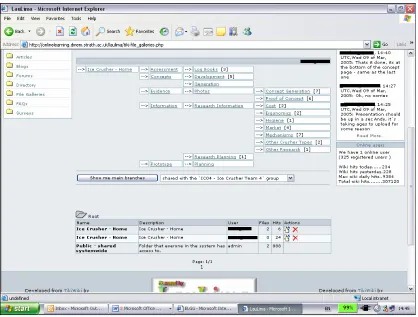
[image:2.595.90.508.347.664.2]The aim of DIDET is to "enhance student learning opportunities by enabling them to partake in global, team based design engineering projects, in which they directly experience different cultural contexts and access a variety of digital information sources via a range of appropriate technology" (DIDET, 2003, p.4). As Juster et al (2004) notes, such an aim resonates with current design engineering ethos. The design and development of new products for the global marketplace frequently dictates that engineers operate as part of an internationally distributed team using communication tools, virtual environments, shared workspaces, video and audio conferencing facilities and digital libraries to expedite information creation and sharing, and to capture information that is often informal or tacit in nature. This can be especially true of creative processes such as 'concept generation' whereby design engineers need to access and share ideas, information and knowledge in order to develop new design concepts (Wodehouse et al, 2004a; 2004b). This is reflected in the design engineering curricula which has adopted an open-ended Project Based Learning (PBL) approach. This problem-based pedagogical approach has been proven to encourage collaborative work, enhance design thinking and improve retention (Dym at al, 2005 ).
Figure 1: Hierarchical file gallery with the LauLima Learning Environment
2.1
LauLima: Group Of People Working Together
The VLE and digital library platform for DIDET is an extensively customised version of TikiWiki software entitled, 'LauLima'∗. TikiWiki is a PHP-based open-source groupware application (TikiWiki, 2005) and whilst quite different to typical VLE applications, offers much of the same functionality. TikiWiki is gaining increasing prevalence within the corporate sector for content management purposes
∗
and/or knowledge management, but other instances of TikiWiki-based e-learning are beginning to emerge also (Schostak et al, 2004).
LauLima has two distinct elements: the LauLima Learning Environment (LLE) and the LauLima Digital Library (LDL).
The LLE constitutes an 'informal' environment in which students can create Wiki pages (similar to Web pages but without the need for intimate knowledge of HTML) that link information together and detail the concept generation process. Students can also access and engage with course materials (assignments, lecture slides, etc.), utilise communication tools such as discussion fora, blogs, synchronous chat facilities and email, and enjoy the benefits of current awareness. More importantly however, students can upload files of various types into hierarchical team file galleries (Figure 1) to facilitate easy and organised retrieval, engage in information sharing, and participation in online design processes.
By contrast, the LDL exemplifies the traditional digital library model, allowing content uploaded within the LLE to be transferred to the LDL for long term storage and re-use. Once within the LDL, resources are organised, managed and made retrievable according to conventional LIS principles. The LDL has an immediate use for students, but its long term use by future students and departmental staff is expected to be particularly important as users will have access to a variety of internally and externally created resources pertaining to their subject discipline. In addition, departmental staff will be able to re-use or point students to invaluable information sources or examples of previous student contributions. Links to high quality external resources are also provided (library catalogues, bibliographic databases, professionally evaluated design engineering Web resources, etc.)
2.2
The Digital Library & Metadata Workflows
Metadata is traditionally created by dedicated and specialist library professionals with an understanding that the production of high quality metadata necessitates the observance of elaborate conventions and schemes. A single catalogue record can assume a variety of different manifestations (e.g. MARC21, DC, MODS, IEEE LOM, etc.), the contents of which have to simultaneously observe other cataloguing rules, classification schemes and subject schemes (e.g. AACR2, DDC, LCSH, etc.). Thus, whilst high quality metadata is often necessary and wholly desirable, it can be a resource intensive pursuit and can be unscalable in certain contexts.
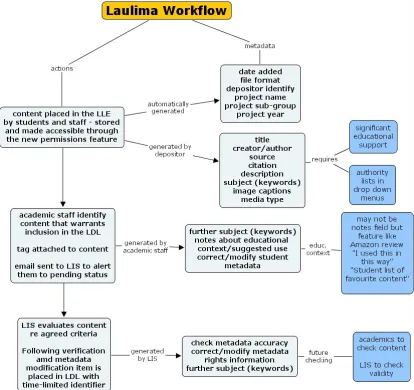
In order to make the LDL both scalable and as user-interactive as possible a 'metadata work flow' was instantiated (illustrated in Figure 2). Such a work flow would be rendered untenable by those sophisticated schemas that require specialist LIS knowledge (MARC21) or complex e-learning schemas (IEEE LOM). As such, a qualified and extended version of the Dublin Core Metadata Element Set (DC) (Dublin Core Metadata Initiative, 2003) was considered more appropriate. DC resonated more with the nature of the content expected to be deposited in the digital library, which neither exemplified the complexities necessary to warrant MARC21 nor conformed to conventional learning object paradigms to justify the use of LOM. Aside from the issues already noted with respect to the use of DC, the need for a metadata workflow was dictated by a variety of other factors relating to project expediency, lack of cataloguing support for more developed schema, and the need for academics to be involved in the assignation of subject headings.
Figure 2: Illustration of the LauLima Metadata Workflow
4
Information Literacy Impasse = e-Learning Impasse
The UK Chartered Institute of Library and Information Professionals (CILIP) define information literacy as:
“…knowing when and why you need information, where to find it, and how to evaluate, use and communicate it in an ethical manner.
This definition implies several skills. We believe that the skills (or competencies) that are required to be information literate require an understanding of:
• A need for information
• The resources available
• How to find information
• The need to evaluate results
• How to work with or exploit results
• Ethics and responsibility for use
• How to communicate or share your findings
• How to manage your findings” (CILIP, 2004).
strategies for locating information; Locate and access information; Compare and evaluate information; Organise, apply and communicate; Synthesise and create (SCONUL ACIL, 2004).
Further still, Bundy (2004) has observed the role information literacy has to play in participative citizenship, personal empowerment and social inclusion. A recent definition proposed by the ‘Prague Declaration’ goes yet further by proposing that information literacy constitutes a human right:
“Information Literacy encompasses knowledge of one’s information concerns and needs, and the ability to identify, locate, evaluate, organize and effectively create, use and communicate information to address issues or problems at hand; it is a prerequisite for participating effectively in the Information Society, and is part of the basic human right of life long learning” (NCLIS, 2003).
All of the aforementioned definitions are based on extensive research. They have provided a useful basis for LIS practitioners to develop information literacy instruction initiatives in order that students are equipped with a suite of generic and adaptable competencies. However - and as this paper has already noted - VLE models are evolving, potentially demanding student fluency in competencies out with those outlined in the above definitions. Consequently, the digital library approach adopted for LauLima not only assumes that students exemplify the competencies noted by CILIP, SCONUL or the Prague Declaration, but that students have some competencies normally associated with librarianship
[image:5.595.83.507.315.470.2]itself.
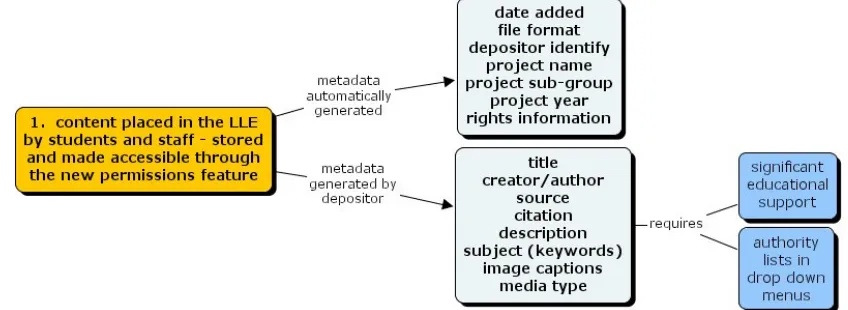
Figure 3:Illustration of student metadata remit within LauLima
Not only is the LDL founded upon the creation of metadata, but the students constitute the genesis of that metadata. As can be observed from Figure 3, when students upload a resource into the LLE for later transfer to the LDL, they are presented with the task of applying metadata elements such as title, author, citation, description, subject, and so forth. Therefore, in order for the LDL metadata workflow to function successfully, students must have a greater knowledge of the storage, organisation, and general management of information itself. Such metadata need not conform to sophisticated library standards like AACR2, but a degree of standardisation is nevertheless required and a clearer understanding on the part of students is required as to the purpose and function of such metadata elements. Since the students are applying various mandatory metadata within a workflow, erroneous elements can be rectified by the academic or librarian when they apply additional metadata further down the workflow. This, however, is a precautionary measure and is little substitute for a workflow in which all stages observe metadata rules and conventions to ensure overall efficiency and metadata quality.
The DIDET experience during the formative stages of LauLima development revealed that current information literacy aptitudes were wholly inadequate to support the meaningful creation of quality metadata (Wodehouse et al, 2004 & Juster et al, 2004). This is particularly noteworthy since at the time of user testing LauLima was a prototype, with an embryonic metadata workflow, no controlled subject vocabulary*, and a metadata schema with fewer elements for students to complete. Despite this apparent reduction of student responsibilities and a brief orientation session, very few students applied metadata or even understood the need for metadata. Those that did apply metadata provided
*
LauLima now uses the Institute of Electrical Engineers INSPEC Thesaurus 2004 for a controlled vocabulary. See:
meaningless descriptions or subject descriptors that were too broad to support useful document retrieval. Testing further demonstrated that this multiplicity of subject terms was further muddied by the inability of students to discern the subject from which their (often self created) resource derived. This was perhaps best exemplified by their observed behaviour during a ‘can crusher’ product design project, where pertinent resources, irrespective of their specific content, were tagged with inadequate subject terms such as, ‘can crusher’, ‘can crusher project 1’, ‘can crusher assignment’, and so forth. In particular cases these same subject terms were mirrored in the title and description fields also. Yet such an outcome was unsurprising: why should students understand a concept that has traditionally been the preserve of librarians for centuries?
It is clear that current conceptualisations of generic information literacy fall short of providing students with the skills they require to operate in a VLE model akin to LauLima. Whilst it has to be acknowledged that LauLima is currently a novel example of a digital library-based VLE, it is nevertheless prudent to recognise that the recent evolution of VLE models have emphasised the incorporation of institutional digital libraries within VLEs to improve their overall efficacy (Currier et al, 2001; JISC, 2003; UNESCO-Institute for Information Technologies in Education, 2003; Wang & Hwang, 2004). More explicitly, the ‘Digital Libraries in the Classroom’ funding programme is spearheading three further transatlantic projects entailing the deployment of digital libraries within VLEs (JISC, 2004). The pedagogical paradigm shift towards greater interactive Project Based, Problem-Based and constructivist learning in HE generally and the acknowledged benefits therein (Savin-Baden, 2000; Dochy et al, 2003; Neo, 2005; Dym at al, 2005), would tend to indicate that the future prevalence of digital library-based VLE models is, as Roes (2001) notes, a ‘natural’ progression, particularly as the pillars of librarianship and digital libraries aid the reinforcement of those current pedagogical trends pioneered by educationalists (Ibid.).
Whereas the use of a student focussed metadata workflow within LauLima remains quite unique, it also should be recognised that LauLima is not an entirely isolated example of a VLE necessitating student participation in the information management process. Similar models are emerging, such as the ‘InfoBase Project’ based at the Delft University of Technology. InfoBase takes a similar approach to LauLima, but places greater emphasis upon making the student creation of metadata a reflective process designed to underpin the learning experience, as well as for the purposes of information management (Stouffs et al, 2004). Other innovative models, such as the ‘Spoken Word’ project based at Glasgow Caledonian University and Michigan State University, are also demanding that students participate in the ‘enhancement’ of digital audio object metadata by creating detailed annotations and tagging items with additional metadata (Goldman et al, 2003). Like LauLima, such examples clearly suggest that there are considerable information literacy anomalies to be addressed in the future if LIS practitioners are to stem a consequent e-learning impasse.
Since the preliminary experiments outlined above, the authors have been experimenting with the implementation of an integrated and embedded information literacy model, loosely based on Eisenberg and Berkowitz’ Big6 Model (Eisenberg, 2001). The Big6 Model has been embraced by Design Engineers on the DIDET Project Team as it has a resonance with several design process models and uses similar, and therefore, familiar terminology. Initial work has focussed on a PBL approach which clearly links information creation, sourcing, searching, evaluating, organising and presenting, to the design process within a time-limited collaborative team project. Although the model has had to be extended to accommodate the implications of student created metadata, it has thus far proved extremely conducive to design engineering pedagogy, particularly where VLEs and digital libraries support PBL, and may find readable use within other subject disciplines adopting a similar approach to learning and teaching. The scope of this paper prevents any exhaustive exposition in this paper, but details of this approach and results will be documented in the relevant literature in due course.
5 Conclusion
The emergence of VLE models, particularly those in which students have to engage in content or information management to underpin their very own learning experience would suggest that the LIS community should consider debating the need to augment or revise those information literacy models already advocated by organisations such as CILIP and SCONUL, among others. Such a revision could include a greater emphasis on content management within large VLEs or digital libraries, and a strand designed to furnish students with basic metadata orientation. This latter strand would not only provide users with skills to succeed within these environments, but, furnished with this knowledge, students would be better placed to improve their searching strategies according to the environment in which the find themselves, whether it be an online host using complex metadata or a Web search engine that relies on post-coordinate indexing. Without sufficient acknowledgement or revision by the LIS community, future students may lack the necessary skills necessary to unlock the potential of such radical approaches to ICT enhanced learning. Of course, this is not to state that current information literacy models are wholly redundant. That they will continue to inform many LIS practitioners is unquestionable. However, what this paper has attempted to argue is that their efficacy and applicability within specific e-learning contexts is diminishing and students may soon find themselves bereft of the skills necessary to propel their own learning architecture.
6 References
Barton, J., Currier, S. & Hey, J, M, N. (2003), Building quality assurance into metadata creation: an analysis based on the learning objects and e-prints communities of practice. In Sutton, S. and Greenberg, J. and Tennis, J., Eds. Proceedings 2003 Dublin Core Conference: Supporting
Communities of Discourse and Practice - Metadata Research and Applications, Seattle, Washington
(USA). Available: http://eprints.rclis.org/archive/00001972/01/03barton.pdf (Accessed 22 March 2005)
Bridgland, A. & Whitehead, M. (2005), Information Literacy in the ‘E’ Environment: An Approach for Sustainability, The Journal of Academic Librarianship, Vol.31 No.1, pp.54-59.
Bundy, A. (2004), One Essential Direction: Information Literacy, Information Technology Fluency,
Journal of eLiteracy, Vol.1 No.1, pp.7-22. Available:
http://www.jelit.org/archive/00000006/01/JeLit_Paper_1.pdf (Accessed 22 March 2005)
CILIP. (2004), Information Literacy: Definition, CILIP, London. Available:
http://www.cilip.org.uk/professionalguidance/informationliteracy/definition/ (Accessed 22 March 2005).
Currier, S., Brown, S. & Ekmekioglu, F, C. (2001), INSPIRAL: INveStigating Portals for
Information Resources And Learning - Final Report, Centre for Digital Library Research, Glasgow.
Available: http://inspiral.cdlr.strath.ac.uk/documents/INSPfinrep.pdf (Accessed 22 March 2005)
DIDET. (2003), DIDET – Project Plan, University of Strathclyde, Glasgow. Available: http://dmem1.ds.strath.ac.uk/didet/about/project_plan.pdf (Accessed 22 March 2005)
Dochy, F., Segers, M., Van den Bossche, P. & Gijbels, D. (2003), Effects of problem-based learning: a meta analysis, Learning & Instruction, Vol.13 No.5, pp. 533-568.
Dublin Core Metadata Initiative. (2003), The Dublin Core Metadata Element Set, Version 1.1:
Reference Description, OCLC, USA. Available: http://dublincore.org/documents/dces/ (Accessed 22
March 2005)
Dym, C., Agogino, A., Eris, O., Frey, D. & Liefer, L. (2005) Engineering Design Thinking, Teaching and Learning, Journal of Engineering Education, Vol. 94 No.1, pp.103-120
Eisenberg, M, B. (2001), A Big6 Skills Overview, Big6 Associates, New York. Available: http://www.big6.com/showarticle.php?id=16 (Accessed 22 March 2005)
Goldman, J., Kornbluh, M. & Rehberger, D. (2003), The Problems of Ingesting and Delivering Complex Objects from Digital Repositories, Workshop on Multimedia Contents in Digital Libraries, Chania, Crete, Greece, 2-3 June 2003. Available:
JISC. (2002), VLEs and MLEs Explained, UK Joint Information Systems Committee, London. Available: http://www.jisc.ac.uk/uploaded_documents/bp1.pdf (Accessed 22 March 2005)
JISC. (2003), Linking Digital Libraries with VLEs (DiVLE) Programme, UK Joint Information Systems Committee, London. Available: http://www.jisc.ac.uk/index.cfm?name=programme_divle (Accessed 22 March 2005)
JISC. (2004), Digital Libraries in the Classroom Programme, UK Joint Information Systems
Committee, London. Available: http://www.jisc.ac.uk/index.cfm?name=programme_dlitc (Accessed 22 March 2005)
Jonassen, D, H. & Hernandez-Serrano, J. (2002). Case based Reasoning and Instructional Design: Stories to Support Problem Solving, Educational Technology Research and Development, Vol. 50 No. 2, pp. 65–77.
Johnson, H. (2003), Product, Process or Pre-Requisite? Information Literacy as Infrastructure for Information Networking, The New Review of Information Networking, Vol.9, pp2-20.
Joint, N. (2003), Information Literacy Evaluation: Moving Towards Virtual Learning Environments,
The Electronic Library, Vol.21 No.4, pp.322-334.
JORUM. (2004), The JISC Online Repository for [learning and teaching] Materials -
JORUM Scoping and Technical Appraisal Study. Volume V: Metadata, EDINA, UK. Available:
http://www.jorum.ac.uk/docs/Vol5_Fin.pdf (Accessed 22 March 2005)
Juster, N., Grierson, H., Nicol, D., Ion, B., Stone, A. & Wodehouse, A. (2004), Using Digital Libraries to Enhance Distributed Design Team Performance, In: Proceedings of DETC2004, International
Design Engineering Technical Conference, September 2004, Salt Lake City, USA, American Society
of Mechanical Engineers, USA.
NCLIS. (2003), The Prague Declaration: "Towards an Information Literate Society", NCLIS, Washington D.C.Available at:
http://www.nclis.gov/libinter/infolitconf&meet/post-infolitconf&meet/PragueDeclaration.pdf (Accessed 22 March 2005)
Neo, M. (2005), Web-Enhanced Learning: Engaging Students in Constructivist Learning,
Campus-Wide Information Systems, Vol.22 No.1, pp.4-14.
Robertson, J, R. (2005), Metadata quality: some implications for Library and Information Science,
Library Review, Vol.54 No.5. In Press.
Roes, H. (2001), Digital Libraries and Education: Trends and Opportunities, D-Lib Magazine, Vol.7 No.7/8. Available: http://www.dlib.org/dlib/july01/roes/07roes.html (Accessed 22 March 2005)
Savin-Baden, M. (2000), Problem-Based Learning in Higher Education: Untold Stories, Society for Research into Higher Education / Open University, Philadelphia.
Schostak, J., Smith, J. & Hough, M. (2004), Developing Democratic Cultures in Schools and Communities through Interactive On-Line Learning Environments, Proceedings of 2004 European
Conference on Educational Research, 22-25 September, University of Crete, Crete. Available:
http://www.enquirylearning.net/ELU/Issues/Information%20Technology/Ciel.html (Accessed 22 March 2005)
SCONUL ACIL. (2004), Learning Outcomes and Information Literacy, Society of College, National and University Libraries, London. Available:
Stouffs, R., Kooistra, J. & Tuncer, B. (2004a), Metadata as a means for correspondence on digital media, Electronic Journal of Information Technology in Construction (ITcon), Vol.9, pp. 129-142. Available: http://www.itcon.org/2004/9 (Accessed 22 March 2005)
TikiWiki. (2005), available: http://www.tikiwiki.org/ (Accessed 22 March 2005)
UNESCO-Institute for Information Technologies in Education. (2003), Digital Library and Virtual Learning Environments, UNESCO IICBA, Vol.5 No.3, pp.7-10. Available: http://www.unesco-iicba.org/Resouces/Eng_v5_n3.pdf (Accessed 22 March 2005)
Wang, M. & Hwang, M. (2004), The e-Learning Library: Only a Warehouse of Learning Resources?
The Electronic Library, Vol.22 No.5, pp.408-415.
Wodehouse, A., Grierson, H., Ion, W, J. Juster, N., Lynn, A. & Stone, A. (2004a), TikiWiki: A Tool to Support Engineering Design Students in Concept Generation, In: Proceedings of the International Engineering and Product Design Education Conference, Delft University of Technology, Delft, the
Netherlands, September 2-3 2004, Delft University of Technology, Delft. Available:
http://www.io.tudelft.nl/iepde04/Documents%20for%20Downloads/Final%20Papers/HC_Wodehouse. pdf (Accessed 22 March 2005)