Condie, Rae and Livingston, Kay and Seagraves, Liz (2004) Evaluation of the flexible learning in the community (FLIC) project. [Report]
http://strathprints.strath.ac.uk/27729/
Strathprints is designed to allow users to access the research output of the University of Strathclyde. Copyright © and Moral Rights for the papers on this site are retained by the individual authors and/or other copyright owners. You may not engage in further
distribution of the material for any profitmaking activities or any commercial gain. You may freely distribute both the url (http://strathprints.strath.ac.uk) and the content of this paper for research or study, educational, or not-for-profit purposes without prior
permission or charge. You may freely distribute the url (http://strathprints.strath.ac.uk) of the Strathprints website.
Evaluation of the
Flexible Learning in the Community
(FLiC) Initiative
Final Report
July 2004
Dr Rae Condie
Dr Kay Livingston
Liz Seagraves
The Quality in Education Centre, University of Strathclyde,
Faculty of Education, Jordanhill Campus,
CONTENTS
Page No
Executive Summary i
1. Introduction 1
2. The FLiC evaluation 3
3. Methodology 4
3.1 Initial survey of pilot schools 4
3.2 Visits to schools 5
3.3 Second survey of schools 6
4. Findings from the initial survey: Analysis of pupil questionnaires 7
4.1 Video-conferencing 7
4.2 Digitalbrain 9
4.3 Kar2ouche 12
4.4 Using computers 13
5. Findings from the initial survey: Analysis of teacher questionnaires 16
5.1 Experience of working with FLiC 17
5.2 Digitalbrain 18
5.3 Using Kar2ouche 20
5.4 Video-conferencing 20
5.5 National priorities, development planning and other 22 initiatives
5.6 Looking to the future 23
6. Key points from Phase 1 of the evaluation 26
7. Findings from the visits to schools 27
7.1 Familiarisation visits 27
Page No
8. Final survey of schools 35
8.1 Additional schools beyond the FLiC pilot phase 35
8.2 The FLiC pilot schools 36
9. Discussion 40
9.1 The impact of FLiC on teachers and pupils 40 and the learning environment
9.2 Digitalbrain, Kar2ouche and video-conferencing 40 within the pilot schools
9.3 The impact on community learning 41
9.4 Gender-related differences 42
9.5 Reflections on the initiative 42
Appendix 1: Timetable for the evaluation 45
Appendix 2: Questionnaires 46
Sample pupil questionnaire 47
Teacher questionnaire (2004)
___________________________________________________________________________
Evaluation of the i QIE Centre
FLiC Initiative University of Strathclyde
Executive Summary
The Flexible Learning in the Community project (FLiC) was set up by the City of Edinburgh to take advantage of the potential of the City’s information and technology network to support flexible learning and teaching within and across its schools, colleges and community learning centres. An evaluation of the project was commissioned by the Scottish Executive Education Department, which had provided some funding for FLiC, through the Future Learning and Teaching (FLaT) programme. The evaluation was carried out during 2003-04 by a team from the Quality in Education Centre, the University of Strathclyde.
The FLiC project had three main strands: video-conferencing, multi-media presentations (Kar2ouche1) and a virtual learning environment (digitalbrain2). Support and training for both teachers and pupils were provided by the Information Technology Support Team (ITSU) alongside a considerable investment in hardware, software and networking. Following a year of pilot work the initiative was launched by the Minister for Children and Young People in March 2003.
The evaluation focused on three main school clusters (15 schools in total), who had been involved in the pilot phase of the FLiC project. (The involvement of colleges and community learning centres had not developed as originally intended and so they were omitted from the evaluation.) Questionnaires were developed to gather teachers’ and pupils’ views on their involvement with the project and visits were made to observe and talk informally with staff and pupils while they were working with one of the strands. A second series of questionnaires was issued towards the end of the evaluation. This was distributed to teachers and headteachers in the pilot schools and a small number of additional schools that had become involved since the pilot.
The number of schools, teachers and pupils who participated in the evaluation was disappointingly low. The response to the first survey revealed a much less extensive use of the FLiC strands than had been indicated in the information received prior to the evaluation. In addition it proved difficult to find sufficient use of the strands within the timescale of the evaluation to carry out observation visits as planned.
The key aims of the evaluation were:
1. to determine the impact of FLiC on teachers and pupils and on the learning environment.
2. to analyse the use of digitalbrain, Kar2ouche and video-conferencing within the pilot schools.
3. to determine the impact of community learning
4. to provide information on any gender-related differences in relation to pupil participation.
The key findings are presented to reflect the aims of the evaluation. In the light of the low participation in the evaluation these findings should be treated with a degree of caution. However, the feedback was consistent across participants and throughout the course of the study.
1
Kar2ouche – see www.kar2ouche.com 2
_________________________________________________________________________________
Evaluation of the ii QIE Centre
FLiC Initiative University of Strathclyde
1. The impact on teachers, pupils and the learning environment
i. Enthusiasm was high at the launch of FLiC (http://egfl.net/news/news/flic.html), but this was not translated into the anticipated numbers of actively involved teachers and pupils.
ii. The usage of each of the strands of FLiC was less than anticipated. This was, in the main, due to delays in the supply of equipment and training as well as difficulties with the managed system (Syntegra) and the firewall.
iii. Considerable frustration and disillusionment were reported due to the unreliability of equipment and network connections, both during training and in classroom use. Several had access to ICT at home which was far superior to that available in school (e.g. broadband), which they found irritating.
iv. Teachers and pupils who persevered were very enthusiastic and saw real potential in the extension and integration of all 3 strands into the classroom. Where this enthusiasm existed it has continued to develop, albeit through the efforts of particular individuals rather than as a whole-school phenomenon.
v. These teachers were positive about the benefits of using technology in the classroom in relation to enhancing pupil motivation, attainment, confidence and skills. FLiC activities were reported as encouraging young people to work collaboratively; Kar2ouche, in particular, encouraged dialogue and discussion.
vi. The majority of pupils were very enthusiastic, although this was tempered at times by the frustrations of establishing contact and getting online. There was some evidence that pupils were ahead of the teachers in their ICT competence but as we were able to observe very few genuine lessons involving the FLiC strands, it is difficult to make judgements on the impact on the relationship between teacher and learner.
2. The use of digitalbrain, Kar2ouche and video-conferencing
i. Both pupils and teachers reported high levels of experience in using computers and standard software packages; the frustrations reported in using some of the strands are unlikely to result from lack of knowledge and confidence generally.
ii. Video-conferencing was more readily used than digitalbrain or Kar2ouche in the pilot phase, possibly because it required less investment of time to acquire new knowledge and skills and there were existing events that could be enhanced by its use, e.g. transition. It was also used to provide opportunities for pupils to share learning, particularly modern language skills.
iii. The use of digitalbrain and Kar2ouche initially had been confined primarily to the learning and teaching of modern languages, where they were seen as effective in encouraging imagination, creativity and confidence in speaking. Digitalbrain was also used to support learning in maths and Environmental Studies and the use of Kar2ouche was developing in other subjects.
iv. The use of the virtual learning environment, digitalbrain, is the most relevant to the impact on home study, homework and revision. It was, however, the least used of the three strands and teachers saw providing information for pupils and their parents by electronic means, as low priority. Technical issues, including time to download, caused some annoyance amongst pupils.
_________________________________________________________________________________
Evaluation of the iii QIE Centre
FLiC Initiative University of Strathclyde
video which is then edited on the computer. In one school, the videos were used as assessment evidence for the talking component of the Standard Grade examination.
vi. A number of teachers (primary and secondary) expressed a desire to link with schools and organisations in other countries by video-conference facilities, and use the language skills in an international context. The authority firewall prevented that, however.
3. The impact of community learning
i. The hoped-for increased involvement of parents and improved home-school links had been very limited. Parents were marginally involved in digitalbrain, as discussed earlier, and we can assume that their children told them of some of the events in schools, but otherwise parents appear to have been largely unaware of the initiative.
ii. The community dimension of the FLiC initiative was never really developed. Although talks were held, in the early stages, with representatives of the community education sector, they did not get involved in the roll-out for reasons that were not made clear.
iii. Schools were interested in becoming more involved in the wider community – local, national and international – through video-conferencing in particular. However, issues with the stability of the video-conferencing network and firewall restrictions had inhibited this development.
4. Gender-related differences
While some attempt was made to determine whether there were any gender-related differences in relation to attainment and/or motivation, sample sizes were relatively small and any differences observed were inconclusive. There was some evidence that teachers varied in their perceptions of whether boys or girls were gaining more from their involvement, but most appeared to believe that both groups were benefiting similarly. Any benefits are likely to attributable to a range of factors, including the wider availability of ICT generally and the impact of out-of-school access as much as in-school.
___________________________________________________________________________
Evaluation of the 1 QIE Centre
FLiC Initiative University of Strathclyde
FLiC Final Report
1. Introduction
In 2003, the Scottish Executive commissioned an evaluation of the FLiC initiative under the Future Learning and Teaching (FLaT) Programme. This is the final report of that evaluation, undertaken by the Quality in Education Centre at the University of Strathclyde.
The Flexible Learning in the Community (FLiC) project was introduced by Edinburgh City Council with the aim of using the City’s ICT network for schools to develop flexible delivery methods that could respond to the needs of students of all ages (lifelong learning), promote cross-sectoral partnerships and maximize the use of Information and Communication Technology (ICT) in learning. The original intention was to involve schools, colleges and community learning centres in Edinburgh and to encourage the development of a wide range of ICT-based flexible learning materials for students. In the event, the initiative focused on learning and teaching in schools, both primary and secondary.
To support the project, the City Council invested in hardware, software and staff training through the Information Technology Support Unit (ITSU). This Unit had been in existence for some time and had offered training in a range of ICT approaches, including video-conferencing. While some staff and schools had benefited, it was felt that there was a lack of city-wide coordination and that good practice was not disseminated. In May 2001, a steering committee was established involving schools in 3 cluster areas and further education, community and business partners. This group, with the support of City of Edinburgh Education Services, sought and gained financial support from SEED in January 2002, with the new FLiC initiative starting shortly thereafter. The specific aims were to:
• promote and develop flexible approaches to curriculum delivery, incorporating ICT
• provide appropriate staff training through the FLIC development Team • disseminate good practice across educational sectors and business partners.
Following a year of pilot work, the initiative was launched by the Minister for Children and Young People in March 2003. At this event, early success stories were reported, including: boys’ improved attainment in modern languages; the successful amalgamation of two primary schools; better primary-secondary transitions; extended support for subjects online; greater use of home computers/local community facilities for homework activities; and increased parental involvement in their children’s learning. These had been facilitated through the use of a series of ICT initiatives including virtual learning environments, multimedia authoring/editing and video-conferencing.
_________________________________________________________________________________
Evaluation of the 2 QIE Centre
FLiC Initiative University of Strathclyde
_________________________________________________________________________________
Evaluation of the 3 QIE Centre
FLiC Initiative University of Strathclyde
2. The FLiC Evaluation
The evaluation of FLiC by the QIE team began in September 2003. The original specification for the evaluation indicated that the main focus was to be on project outcomes, rather than processes, concentrating on:
• assessment of the overall impact of the project on both teachers and pupils in participating schools and identification of any improvement on the learning and teaching environment
• analysis of the use of the three strands of ICT support - Digitalbrain (online learning environment), Kar2ouche (Multimedia Authoring Package) and Video-conferencing - and identification of the impact these resources have had in assisting with home studying, the teaching of languages and the transition between Primary and Secondary
• assessment of project impact on community learning
• identification of any gender differences in relation to pupil participation in the project.
In line with this, four specific aims, each with a number of research questions, were identified:
1. to determine the impact of FLiC on teachers and pupils, and on the learning environment
i. What has been the extent of the usage of each of the strands of the project?
ii. What has been the impact on the strategies and approaches used by teachers and learners, separately and together?
iii. In what ways have the resources, written and electronic, supported and complemented each other (blended learning)?
iv. What impact has the introduction of ICT-based activity had on the nature of the relationship between teacher and learner?
2. to analyse the use of Digitalbrain, Kar2ouche and Video-conferencing within the pilot schools
i. What has been the impact on:
• home studying, including homework and revision? • the teaching and learning of languages?
• the primary-secondary transition? 3. to determine the impact on community learning
i. To what extent have parents and the wider community been aware of and involved in the project?
ii. What has been the impact of their involvement?
4. to provide information on any gender-related differences in relation to pupil participation
i. What gender-related differences are discernible in the motivation and/or attainment of pupils?
_________________________________________________________________________________
Evaluation of the 4 QIE Centre
FLiC Initiative University of Strathclyde
3. Methodology
[image:11.595.160.436.167.248.2]The initial pilot project involved 3 secondary schools and their associated primaries, giving a total of 16 schools (one of which subsequently indicated little/no involvement and withdrew from the evaluation). The specification for the evaluation indicated that the numbers of teachers and pupils involved were as in Table 1.
Table 1: Breakdown of teachers/pupils across strands
Strand Teachers Pupils
Digitalbrain 300 400
Kar2ouche 30 200
Video-conferencing 40 900
As the evaluation aimed to determine the impact on practice, staff and pupil perceptions of the developments and the implications for further development within and across educational establishments, a balance of quantitative and qualitative approaches to data-gathering was identified. (The timetable for, and key events in, the evaluation process are outlined in Appendix 1.)
3.1 Initial survey of pilot schools (Sept – Dec 2003)
In the first instance, a series of questionnaires was designed for pupils and teachers to provide baseline data on their experiences of and attitudes to the pilot project. This was followed by visits to schools with the aim of gathering further, qualitative data through observations of teacher-pupil-ICT interaction, together with interviews and focus groups involving staff and/or pupils. In addition, various documents including the internal evaluation of training programmes were provided by the FLiC Project Team.
The sample
The evaluation focused on samples of pupils and staff within the 15 pilot schools. Access was sought from the Director of Education and letters were distributed to schools to be issued to parents. These letters outlined the extent of their children’s involvement and sought their permission to involve them.
At the start of the study, information was sought from schools on the numbers of staff and pupils who had been actively involved in FLiC, and in which of the three strands. In the majority of instances pupils were involved in only one of the strands, but in some schools teachers had been involved in more than one, usually with different classes/stages. Separate questionnaires were therefore developed for teachers and pupils. While attempts were made to ensure that the samples were representative of the pupils and teachers within the pilot schools, the numbers were relatively low and choice was limited.
Teacher Questionnaire (Appendix 2) The questionnaire for teachers included sections on each of the three strands as well as some general questions on the new technologies, development planning, including National Priorities, and aspirations/intentions for the future.
_________________________________________________________________________________
Evaluation of the 5 QIE Centre
FLiC Initiative University of Strathclyde
on their use of a range of Information and Communication Technologies (ICT). Different groups of pupils, from across the schools involved, were identified for each of the strands.
3.2 Visits to schools (Oct 2003 - May 2004)
In the original proposal, a series of observation visits to schools was scheduled to begin during the autumn term of 2003. The visits were expected to produce qualitative data on pupils and teachers working with ICT as part of the everyday learning and teaching experience. The 15 pilot schools were asked to advise the evaluation team of opportunities for visits to observe any of the FLiC strands in action. However, feedback indicated that none of the schools expected to be working with the FLiC strands before the Christmas break. It was decided therefore to arrange interviews with key people in a number of the schools to gain some background information on their involvement and to postpone observation visits until early 2004.
The interviews were arranged on a cluster basis. A representative from each of the secondary schools was interviewed, as were two primary representatives from one cluster while a primary representative from a second cluster was interviewed by phone. It proved impossible to arrange an interview with a primary representative from the third cluster during the relevant period.
Between January and May 2004 schools were contacted on a regular basis asking for opportunities to observe video-conferencing, Kar2ouche and/or digitalbrain as naturally occurring events in the classroom. Although a few responded that they were hoping to arrange video-conferences with other schools in their cluster or hoped to be using the other strands, it remained very difficult to identify specific events and set days and times. A few video-conferencing sessions were identified in February and early March; a number of schools indicated that they were still having difficulty with network connections or with equipment not working.
One secondary contact reported that it was not a priority for the school and that there would be nothing happening that could be observed. Some of the primaries likewise said they were not doing any FLiC activities. This was confirmed by ITSU staff. Other schools indicated that they would not be doing anything until the summer term.
Identifying opportunities in the summer term to observe Kar2ouche and digitalbrain still proved more difficult than expected. Schools who had indicated they had started using digitalbrain earlier in the year had experienced difficulties and by May still did not have it ‘up and running’. It was reported from one school that 2 teachers had started using it but they had ‘so many problems they don’t want to use it with pupils because they know it will go wrong’. Two of the schools who had given early indications of using Kar2ouche had not been using it after all. Reasons included difficulty of access to laptops, which were shared with other classes and teachers for other purposes and, although it was being developed by language teachers in one school, they were not using it ‘at the moment’.
_________________________________________________________________________________
Evaluation of the 6 QIE Centre
FLiC Initiative University of Strathclyde
Visits for observation and interviews with teachers and pupils
Primary Secondary
Video-conferencing
P6 with S1 for Spanish P7 with S1 for transition
P4 with P4 for Environmental Studies
S1 with P6 for Spanish S1 with P7 for transition
Kar2ouche P6 – PSD – dilemma solving P7 – German
digitalbrain P6 – French
P7 - Environmental Studies project
iMovies P7 – French; bullying S grade Spanish group
In total, 6 of the 15 schools in the FLiC project were visited to observe the 3 main strands of FLiC. Although iMovies was not part of the original FLiC package, it was included as 2 of the schools had introduced it as a development from digitalbrain and/or Kar2ouche. Two schools were visited twice – once each for video-conferencing and once each for Kar2ouche.
3.3 Second survey of schools (May – June 2004)
Given the lack of opportunities to observe ‘naturally occurring events’, it was decided that a second survey of schools would be undertaken towards the end of the evaluation process. Two new questionnaires were developed from those used in the initial survey – one for the headteacher/senior management team member (SMT) in each school and one for class teachers (see Appendix 2). These were distributed to all pilot schools and 10 others identified by the FLiC Co-ordinator as having made progress in one or more of the FLiC strands since the pilot project.
_________________________________________________________________________________
Evaluation of the 7 QIE Centre
FLiC Initiative University of Strathclyde
4. Findings from the initial survey: Analysis of pupil questionnaires
Following feedback from schools on active involvement in FLiC, a target sample of pupils was identified. The numbers of pupil questionnaires sent out and returned are shown in Table 2.
Table 2: Nos. of pupil questionnaires sent out and returned
Strand Target sample Questionnaires
returned
digitalbrain 86 42
Kar2ouche 58 24*
Video-conferencing 100 57
* One school sent a package of 9 questionnaires which was not received
at the project office and so one set of data was lost
(Given the relatively small numbers, both percentages and numbers have been given in this report.)
4.1 Video-conferencing
A total of 57 pupil video-conferencing questionnaires were returned from schools, 44% of which were from boys and 56% from girls. The largest group of questionnaires came from pupils who had used video-conferencing in their final year of primary school and were now in Secondary 1.
Pupils were asked to indicate which of a number of possible uses they had made of the video-conferencing facilities. Three of these were concerned with familiarisation before transfer to secondary or in preparation for a merger of primary schools. Thirty-four (60%) had used it to speak with secondary pupils when in primary school and 4 (7%) had used it to speak to primary pupils when in secondary school. Thirty-one (54%) had used video-conferencing when preparing for merger.
In addition, pupils reported sharing ideas with pupils in other schools (22: 39%), talking to teachers in other schools (19: 33%) and talking to people other than teachers (8: 14%).
Other uses given by pupils included one respondent who reported ‘having a conversation in French to another Primary School’ and another who reported ‘meeting another class’ though did not give any details. A third said they had used it for the purposes of ‘testing it’.
For 49 (86%), video-conferencing was ‘easy’ and for 48 (88%) it was ‘fun’. Sufficient instructions were given to 49 (86%) and where there were problems, teachers were on hand and able to help, according to 51 (90%). Forty-five (80%) thought that video-conferencing should be used more frequently in school, while only 2 (4%) thought that it took up too much time to be worthwhile.
Pupils were asked to indicate what they thought would make it better to use and 44 (77%) made suggestions. The most common comments related to the quality and stability of the connection or the transmission. Two indicated that a better connection would be helpful, while a group of 12 pupils (all from the same school) suggested that using Broadband would improve it. A few said, broadly, ‘It would be good if it worked’
(3). Six spoke of the quality of the picture and sound: for example, it would be better if
_________________________________________________________________________________
Evaluation of the 8 QIE Centre
FLiC Initiative University of Strathclyde
Eight suggested that getting more opportunity and more time to use video-conferencing would be better and six suggested further uses such as talking to pupils in other countries, talking to teachers and playing games with other schools. The remaining pupils indicated that no improvements were necessary: for example, ‘I think video-conferencing is perfect in every single way!’
Other open-ended questions asked pupils to indicate what they liked most and liked least about video-conferencing. All (100%) gave responses to ‘liked most’. The majority gave one suggestion but a few made more than one and so the responses add up to more than the number of respondents. Two indicated that they liked everything. The majority of ‘likes’ focused on the inter-personal links that occurred, including:
• talking to others generally (25)
• being able to see the person or people you were talking to (14), with a subset mentioning specifically those who were far away or in other places (5)
• learning or getting information about high school (12) • meeting or getting to know new people (10)
• listening to others (4).
A few specific comments were made about getting ‘to see old friends’ and ‘talking to my old primary teachers’; one mentioned that ‘your worries were answered’. The above comments were made by both boys and girls.
A smaller number of pupils (10) indicated that they liked using the equipment best, for example ‘being able to make the camera move’ and ‘talking to a camera’. Only one girl mentioned the equipment and that related to ‘acting in front of the camera’ as opposed to using it.
Slightly fewer pupils (53: 93%) responded to the ‘liked least’ question, with the main areas of concern falling into two broad categories: technical issues and the nature of pupil involvement.
The technical issues were similar to the points made about what would improve vide-conferencing. They included:
• problems relating to the quality of the transmission: for example delayed responses - ‘when your mouth moves, five minutes later the words come out’; and ‘fuzzy and frozen’ pictures (15)
• problems relating to the connection and setting up time: for example
‘waiting for the school to answer (just sitting there)’ and failed connections (14).
Issues relating to the nature of pupil involvement included:
• the process of involvement: such as taking turns and being ‘quiet when it was not your turn’’; asking and answering questions; having ‘to do what was written on the sheet, I would like a choice’; and having to prepare for it (7)
• personal impact: such as being embarrassed or nervous (6)
• lack of opportunity: for example, not everyone taking part or getting a chance to ask questions; not doing video-conferencing often enough (4).
_________________________________________________________________________________
Evaluation of the 9 QIE Centre
FLiC Initiative University of Strathclyde
• linking to foreign countries (12) with a subset specifically mentioning speaking foreign languages (4)
• social contact, for example ‘chatting’ and ‘for a social point of view’ (4) • revision and sharing subject knowledge (3).
Two pupils mentioned video-conferencing with teachers and three mentioned making other links: ‘Talking to different people, not just schools’; one suggested ‘leisure centres’ and another, more enigmatically, ‘cars’.
Thirty-one (54%) suggested they were already using video-conferencing during 2003-04, with a further 7 (12%) unsure as to whether they would be or not. Those who were using it were asked to indicate what they were using it for. The responses to this question were from two of the secondary schools and one primary. In one of the secondary schools it was suggested that the main use was to ‘talk to primary pupils’. Some responses suggested that this was future rather than current, and some stated that it would be ‘the school’ or the ‘S1s’ who would do this and, therefore, not necessarily them in particular. The pupils in the other secondary school spoke more generally of ‘talking to other schools’, though a few (3) specifically mentioned Spanish. The primary pupils indicated that they communicated with peers in other cluster schools, for example a P5 pupil stated ‘P5 talk to another P5 class in another school’; two mentioned this was about topics and projects. The future use for P7s to talk to the high school was also mentioned.
A space was left for any other comments that pupils wished to make on video-conferencing and 10 (18%) did so. These were all strong endorsements, for example: ‘I thought it was a really good idea and I would really like to do it again’; ‘It is so much fun and I would like to do it again’; ‘I really enjoyed it. I want to do it more. I think it was really fun.’; ‘I would like to use it more. We use it once in a blue moon.’
4.2 Digitalbrain
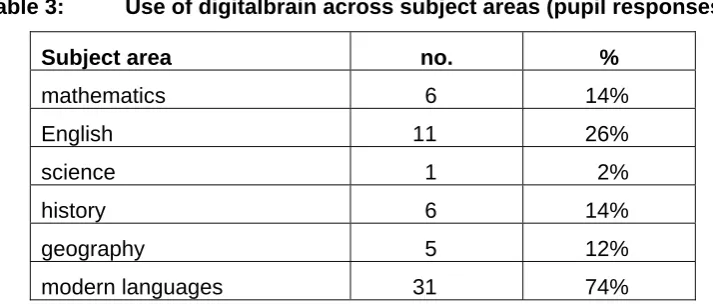
[image:16.595.116.473.491.644.2]A total of 42 pupils returned questionnaires, 23 (55%) boys and 19 (45%) girls. Pupils were asked to indicate in which of the subject areas they had used digitalbrain. The responses are shown in Table 3.
Table 3: Use of digitalbrain across subject areas (pupil responses)
Subject area no. %
mathematics 6 14%
English 11 26%
science 1 2%
history 6 14%
geography 5 12%
modern languages 31 74%
Other areas given by pupils included computing and business management. A number indicated that they used it for homework projects and a few highlighted at this point in the questionnaire that they had not used it since the launch of FLiC: ‘I never used it again after the conference launch.’ Some of these made negative comments throughout the questionnaire.
_________________________________________________________________________________
Evaluation of the 10 QIE Centre
FLiC Initiative University of Strathclyde
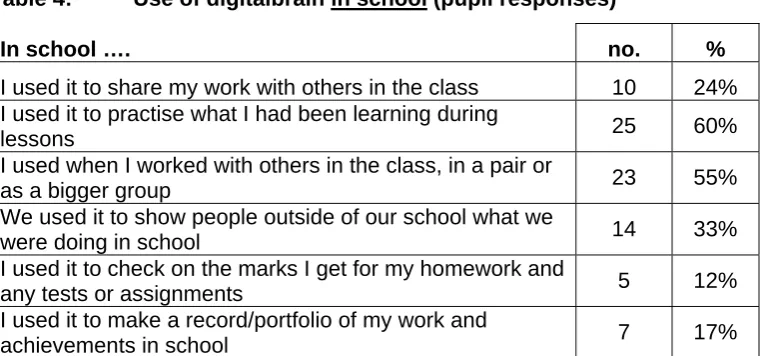
[image:17.595.112.494.122.300.2]said they used it 2-3 times per week. Overall, very few said they made regular use of it. Pupils were asked to indicate what they used it for in school and at home. The responses are shown in Tables 4 and 5.
Table 4: Use of digitalbrain in school (pupil responses)
In school …. no. %
I used it to share my work with others in the class 10 24% I used it to practise what I had been learning during
lessons 25 60%
I used when I worked with others in the class, in a pair or
as a bigger group 23 55%
We used it to show people outside of our school what we
were doing in school 14 33%
I used it to check on the marks I get for my homework and
any tests or assignments 5 12%
I used it to make a record/portfolio of my work and
achievements in school 7 17%
Therefore, in school, digitalbrain was used to practise recently acquired learning and often as part of a pair or group.
Table 5: Use of digitalbrain at home (pupil responses)
At home …. no. %
I used it to see what homework was due and when 13 31%
I used it at home to let my family see my school work 15 36%
I used it to send homework to the teacher from home 11 26%
I used it to check what was happening on the school calendar
5 12%
In terms of use, 28 (67%) thought it was ‘easy to use’ and 23 (55%) thought it was ‘fun’. Twenty-nine (69%) thought that they had been given enough instructions to be able to use it and the same number reported that the teacher was able to help with any problems that arose when using digitalbrain. Overall, levels of enthusiasm were lower than for video-conferencing.
Digitalbrain should be used in more subjects according to 27 pupils (64%) and 22 (52%) thought that it made learning more interesting. While 16 pupils (38%) found it easy to access, only 6 (14%) reported doing more homework with digitalbrain than before.
Asked for suggestions for improving digitalbrain, 34 pupils (81%) responded, some making more than one suggestion. Three suggested they would add ‘nothing’ – ‘I don’t think there is anything that would make it better to use because it’s good the way it is.’ The comments fell into the following categories:
• user interface and access: for example, shorter usernames, more icons and pictures, more colour, guide to buttons and toolbar and generally it should be ‘easier to use’ (13)
• content: for example, more subjects, more activities, use of chat room and, predominantly, games (suggested mainly by boys) (13)
[image:17.595.138.495.339.469.2]_________________________________________________________________________________
Evaluation of the 11 QIE Centre
FLiC Initiative University of Strathclyde
• pupil use: for example, it should be used more often and in more subjects; more training and practice should be given (5).
As with video-conferencing, pupils were asked what they liked most and least about working with digitalbrain. Thirty-two (76%) made positive comments. Two main themes emerged:
• having a personal webpage (15). In particular they liked having personal access, their own email and student planner, and being able to customise their homepage by using their own pictures and colours
• the fact that it was different from normal class work (10). ‘It was more fun than doing proper work’.
A number of additional individual points were made. For example, two mentioned being able to do homework on the internet; two mentioned mathematical games; others liked working in a group, the fact that help was available, developing ICT skills and doing French.
The aspects that they did not like were split between:
• difficulties in relation to technical issues: for example, the system not working, but mainly the length of time it took to access, to upload and download materials (12) and generally finding it difficult to use (4)
• the way it was used in school: for example, as it was mainly work it was
‘boring’; the school or teachers laid down restrictions on what material could be uploaded and the use of email, and had access to the pupils’ private files (9).
Additionally, a few suggested they did not use it often enough.
Twenty-one pupils (50%) made suggestions for other things to do with digitalbrain. These reflect some of the points made in response to making digitalbrain better, for example, generally using it more, using it in more subjects and having access to games and chat rooms (13). Some S1 pupils noted that they would like to be using it in secondary school (8), with a few specifically mentioning using it for homework.
Twelve pupils were using digitalbrain during 2003-04. The main uses were: checking on homework set (5: 12%); sending homework to the school/teacher (1: 2%); keeping a record of how s/he is doing in school (7: 17%); and showing new teachers her/his work (2: 5%).
_________________________________________________________________________________
Evaluation of the 12 QIE Centre
FLiC Initiative University of Strathclyde
4.3 Kar2ouche
A total of 24 questionnaires were returned from 11 boys (46%) and 13 girls (54%) in two secondary schools. Of these, 18 (75%) were in S1 and the remaining 6 (25%) in S4. All respondents used it in modern languages classes; no other subject area was identified.
Kar2ouche was used: 2-3 times per week by 4 pupils (17%); 2-3 times per month by 8 pupils (33%); at least once a month by 6 pupils (25%); and hardly ever by 6 pupils (25%).
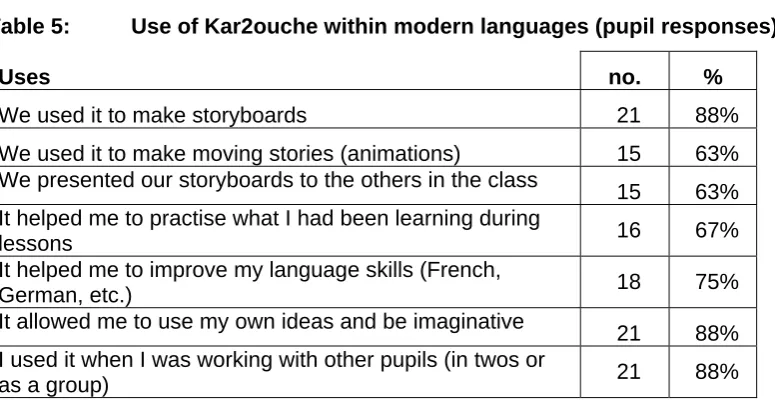
[image:19.595.113.501.208.412.2]The main uses for Kar2ouche are shown in Table 5.
Table 5: Use of Kar2ouche within modern languages (pupil responses)
Uses no. %
We used it to make storyboards 21 88%
We used it to make moving stories (animations) 15 63% We presented our storyboards to the others in the class
15 63% It helped me to practise what I had been learning during
lessons 16 67%
It helped me to improve my language skills (French,
German, etc.) 18 75%
It allowed me to use my own ideas and be imaginative
21 88% I used it when I was working with other pupils (in twos or
as a group) 21 88%
One pupil reported that s/he had used Kar2ouche ‘for dialogues’.
Twenty pupils (83%) thought that Kar2ouche was easy to use and 20 (83%) thought it was ‘fun’ (not exactly the same pupils). Eleven (46%) thought it was ‘difficult in parts’. Most (21: 88%) thought that using Kar2ouche made learning more interesting and 20 (83%) reported that the teacher was there to help with any problems that arose.
Two pupils said that they had used it at home. One said this was to show her family her storyboard and animations and the other to show his parent his own and other people’s ‘shows’.
Nineteen (79%) made suggestions for making Kar2ouche better to work with. Two indicated that there was ‘nothing’ which would make it better. The majority of comments related to perceived limitations of the software (12); these included wanting more scenes to place characters in, more characters, characters that move, more graphics; one suggested that it would be better if pictures from the internet could be added and another proposed the option of including ‘ourselves and our own environment, eg from a digital photo’. Four comments were from pupils who had evidently been using Kar2ouche for French: one wanted a dictionary added, two suggested it would better in English and one wanted it in Spanish. A small number of more individual comments were made suggesting it could be easier to use, understanding how to record sound would have helped, one wanted to use it more and one suggested using it in other subjects (maths and English).
_________________________________________________________________________________
Evaluation of the 13 QIE Centre
FLiC Initiative University of Strathclyde
creative and using your imagination (4); conversing in another language (4); it was fun, interesting and a change from class work (4).
When asked what they liked least, 21 (88%) responded. Seven of those said there was ‘nothing’ that they did not like, or more positively ‘I liked it all’. Comments included:
• difficulties with recording (5): for example, ‘When it came to recording our voices it was complicated because we had to keep remembering to save each recording we made which was a hassle’; ‘the speaking didn’t sound realistic’ and ‘you had to go into a quiet room’.
• the characters didn’t move (4).
Other comments reflected technical difficulties (microphone not working) and the fact it had been used in French.
Only 7 reported that they were actually using Kar2ouche during 2003-04, although a further 6 were unsure as to whether they would be using it later on. The main uses this year were: making storyboards (5); making moving stories (4); presenting stories to others (1); and printing stories to show to others (1).
Four other comments were received, repeating the view that it was fun and also it was a ‘good way to learn’.
4.4 Using computers
All three groups of pupils (video-conferencing, digitalbrain and Kar2ouche) were asked some general questions about using computers. The aim behind this was to determine their use of and confidence in using computers to provide background information against which the use of the three strands of FLiC could be set. Where the responses from the three groups are separated out, the abbreviations VC (video-conferencing), db (digitalbrain) and K2 (Kar2ouche) are used.
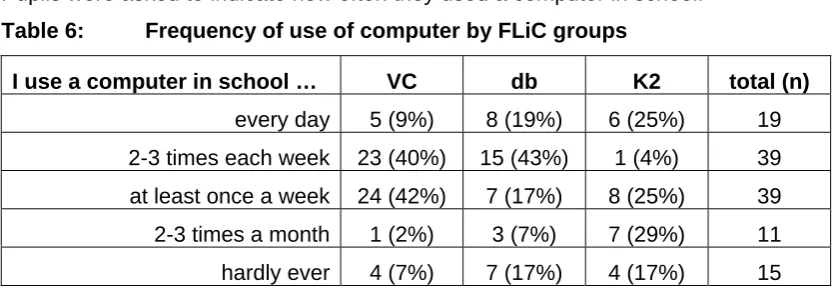
[image:20.595.106.525.471.615.2]Pupils were asked to indicate how often they used a computer in school.
Table 6: Frequency of use of computer by FLiC groups
I use a computer in school … VC db K2 total (n)
every day 5 (9%) 8 (19%) 6 (25%) 19
2-3 times each week 23 (40%) 15 (43%) 1 (4%) 39
at least once a week 24 (42%) 7 (17%) 8 (25%) 39
2-3 times a month 1 (2%) 3 (7%) 7 (29%) 11
hardly ever 4 (7%) 7 (17%) 4 (17%) 15
Most pupils used a computer in school at least once a week, if not more frequently.
_________________________________________________________________________________
Evaluation of the 14 QIE Centre
[image:21.595.104.537.79.382.2]FLiC Initiative University of Strathclyde
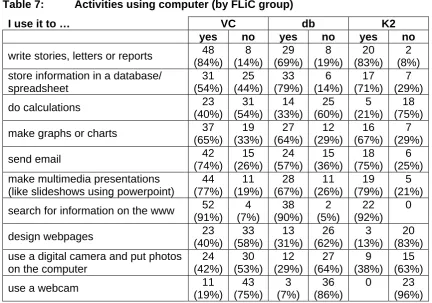
Table 7: Activities using computer (by FLiC group)
I use it to … VC db K2
yes no yes no yes no
write stories, letters or reports 48 (84%) 8 (14%) 29 (69%) 8 (19%) 20 (83%) 2 (8%) store information in a database/
spreadsheet 31 (54%) 25 (44%) 33 (79%) 6 (14%) 17 (71%) 7 (29%)
do calculations 23 (40%) 31 (54%) 14 (33%) 25 (60%) 5 (21%) 18 (75%)
make graphs or charts 37 (65%) 19 (33%) 27 (64%) 12 (29%) 16 (67%) 7 (29%)
send email 42
(74%) 15 (26%) 24 (57%) 15 (36%) 18 (75%) 6 (25%) make multimedia presentations
(like slideshows using powerpoint)
44 (77%) 11 (19%) 28 (67%) 11 (26%) 19 (79%) 5 (21%)
search for information on the www 52 (91%) 4 (7%) 38 (90%) 2 (5%) 22 (92%) 0
design webpages 23 (40%) 33 (58%) 13 (31%) 26 (62%) 3 (13%) 20 (83%) use a digital camera and put photos
on the computer
24 (42%) 30 (53%) 12 (29%) 27 (64%) 9 (38%) 15 (63%)
use a webcam 11
(19%) 43 (75%) 3 (7%) 36 (86%) 0 23 (96%)
A few indicated that they also used computers in school to learn to touch-type and a number mentioned that they used them to play games, with some emphasising that these are ‘educational games’.
Asked to indicate how good they thought they were at using a computer, 28 (49%) of the video-conferencing group thought that they were ‘really good’ while 29 (51%) thought that they were ‘good at some things but not others’. The respective figures for the digitalbrain group were 11 (26%) and 29 (69%) while, of the Kar2ouche group, 10 (42%) thought that they were ‘really good’ while 14 (58%) considered they were ‘good at some things but not others’.
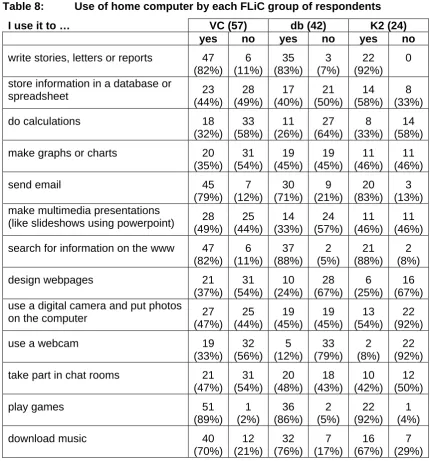
Fifty-two (91%) of the VC group had access to a computer at home, 89% of which were connected to the internet. The figures were similar for the other two groups, with 39 (93%) of the digitalbrain pupils and 23 (96%) of the Kar2ouche pupils having access to a computer. Internet access was available for 38 (91%) and 20 (83%) respectively.
_________________________________________________________________________________
Evaluation of the 15 QIE Centre
[image:22.595.104.535.77.539.2]FLiC Initiative University of Strathclyde
Table 8: Use of home computer by each FLiC group of respondents
I use it to … VC (57) db (42) K2 (24)
yes no yes no yes no
write stories, letters or reports 47 (82%) 6 (11%) 35 (83%) 3 (7%) 22 (92%) 0
store information in a database or
spreadsheet 23
(44%) 28 (49%) 17 (40%) 21 (50%) 14 (58%) 8 (33%)
do calculations 18 (32%) 33 (58%) 11 (26%) 27 (64%) 8 (33%) 14 (58%)
make graphs or charts 20 (35%) 31 (54%) 19 (45%) 19 (45%) 11 (46%) 11 (46%)
send email 45
(79%) 7 (12%) 30 (71%) 9 (21%) 20 (83%) 3 (13%) make multimedia presentations
(like slideshows using powerpoint) 28 (49%) 25 (44%) 14 (33%) 24 (57%) 11 (46%) 11 (46%)
search for information on the www 47 (82%) 6 (11%) 37 (88%) 2 (5%) 21 (88%) 2 (8%)
design webpages 21 (37%) 31 (54%) 10 (24%) 28 (67%) 6 (25%) 16 (67%) use a digital camera and put photos
on the computer 27 (47%) 25 (44%) 19 (45%) 19 (45%) 13 (54%) 22 (92%)
use a webcam 19
(33%) 32 (56%) 5 (12%) 33 (79%) 2 (8%) 22 (92%)
take part in chat rooms 21 (47%) 31 (54%) 20 (48%) 18 (43%) 10 (42%) 12 (50%)
play games 51
(89%) 1 (2%) 36 (86%) 2 (5%) 22 (92%) 1 (4%)
download music 40 (70%) 12 (21%) 32 (76%) 7 (17%) 16 (67%) 7 (29%)
_________________________________________________________________________________
Evaluation of the 16 QIE Centre
FLiC Initiative University of Strathclyde
5. Findings from the initial survey: Analysis of teacher questionnaires
Following feedback from schools on active involvement in FLiC, questionnaires were sent out to 67 teachers across the 15 pilot phase schools. Although 67 questionnaires were sent out, it soon became evident that some teachers had not been actively involved in using any of the strands with their pupils. Some had undertaken training but not actually used the programmes in their classes, while others had been listed to take part but had not, at that time, participated in training nor had they used the FLiC strands with their pupils. In the end, only 14 valid teacher questionnaires were returned.
Of these 14, 3 teachers had used all three strands, 3 had used video-conferencing and digitalbrain, 7 had used only video-conferencing and one had used only digitalbrain. Thus responses were given to each strand as follows: videoconferencing – 12; digitalbrain – 8; Kar2ouche – 3. (Given the small numbers responding, they are reported as actual figures rather than percentages.)
The questionnaires for teachers included sections on each of the three strands as well as some general questions on the new technologies, development planning, including National Priorities, and aspirations/intentions for the future.
Background data on the respondents showed that 8 were female and 4 male. While 10 had been teaching for over 5 years, 4 had between 0 and 5 years’ experience. All had undergone staff development in ICT and 7 of the 14 had attended NOF training, while 13 had attended other local authority classes. Other training included 2 who had undertaken ELITE training (primary) and one who had training for her/his role as ICT co-ordinator (primary). Three held formal qualifications related to ICT (Postgraduate Diploma in Information Technology [secondary], Master of Education in IT [primary]; and ECDL [primary]).
The responses from primary schools indicated that, in one school, digitalbrain had been used across all of the stages. One other teacher reported that it had been used in P6 (7 pupils) and two teachers reported using it in P7 (32 and 50 pupils). Kar2ouche was used by 2 teachers in P7 (32 and 50 pupils) and video-conferencing was used in P6 by 1 teacher (10 pupils) and P7 by 6 teachers (10, 12, 20, 25 and 34 pupils).
All 4 teachers from the 3 secondary schools reported that digitalbrain had been used with pupils, although only 2 provided data. In both cases it was used with S3 (7 and 15 pupils). Only 1 teacher reported using Kar2ouche with pupils, though provided no data, while 4 teachers said that they had used video-conferencing with pupils, although only 3 provided additional data. Two used it in S1 (12 and 20 pupils), 1 in S2 (12 pupils) and 1 in S4 (6 pupils).
Nine of the 14 teachers had undergone training for digitalbrain; 4 thought it ‘good’, 4 thought it ‘adequate’ and 1 thought that it was ‘inadequate’. Of the 4 who had training for Kar2ouche, 2 rated it as ‘good’ and 2 as ‘adequate’. Eleven had undergone training for video-conferencing, with 5 rating it as ‘good’, 5 as ‘adequate’ and one as ‘inadequate’.
_________________________________________________________________________________
Evaluation of the 17 QIE Centre
FLiC Initiative University of Strathclyde
5.1 Experience of working with FLiC
[image:24.595.104.514.147.362.2]Teachers were asked to indicate the extent to which they agreed or disagreed with a series of statements relating to the experience of being involved with FLiC.
Table 9: Teachers’ views on involvement in FLiC
SA A D SD NR*
The pupils work effectively on their own without
teacher input on FLiC activities 0 2 6 4 2 The FLiC project encourages pupils to work
together more effectively 1 10 1 0 2 The motivation of pupils has increased through
the use of technology 4 7 0 0 2
FLiC activities have contributed to an
improvement in the attainment levels of pupils 0 5 4 1 3
Pupils have become more confident through FLiC activities
2 6 2 1 2
The use of technology does not suit some pupils 1 3 8 1 1 I have changed how I organise teaching and
learning activities because of involvement in FLiC 1 3 5 1 4
Key: SA = strongly agree, A = agree, D = disagree, SD = strongly disagree * NR = non-responses – included ‘too early to say’
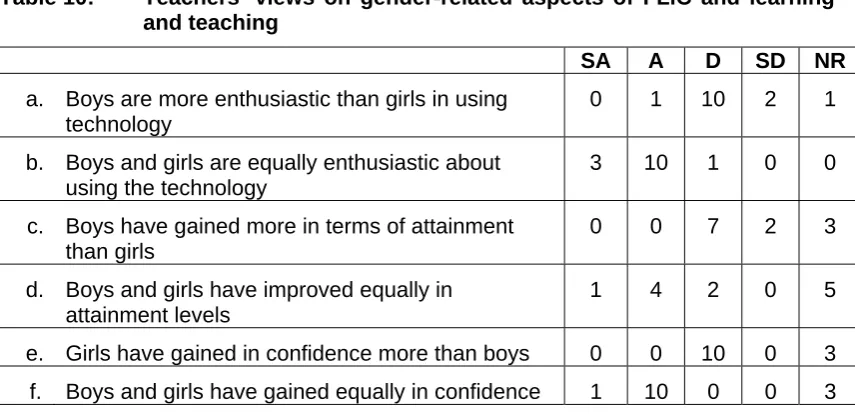
[image:24.595.107.535.453.660.2]One of the aims of the project was related to gender-related issues on learning and motivation and the impact of FLiC on these.
Table 10: Teachers’ views on gender-related aspects of FLiC and learning and teaching
SA A D SD NR
a. Boys are more enthusiastic than girls in using technology
0 1 10 2 1
b. Boys and girls are equally enthusiastic about using the technology
3 10 1 0 0
c. Boys have gained more in terms of attainment than girls
0 0 7 2 3
d. Boys and girls have improved equally in attainment levels
1 4 2 0 5
e. Girls have gained in confidence more than boys 0 0 10 0 3
f. Boys and girls have gained equally in confidence 1 10 0 0 3
_________________________________________________________________________________
Evaluation of the 18 QIE Centre
FLiC Initiative University of Strathclyde
5.2 Digitalbrain
In the primary schools, digitalbrain was used in environmental studies (1), modern languages (1) and ‘for homework’ (1). In secondary schools, it was used for administration in relation to Standard Grade (1).
From a list provided, teachers were asked to indicate and rank up to five reasons for the introduction of digitalbrain to their school, ranking them 1 – 5, where 1 was the most important.
The prime reasons ranked ‘1’ were:
• ‘to improve the range of resources available to pupils’ (2); • ‘to encourage pupils to work independently’ (1); and • ‘to develop ICT skills’ (3).
A number of teachers ranked as ‘2’, the reasons
• ‘to manage homework and assignments’ (2); • ‘to encourage pupils to work independently’ (2); • ‘to encourage creativity and imagination (1); and • ‘to encourage pupils to work collaboratively’ (1).
Only ‘to provide information for pupils and their parents’ was not ranked as either 1 or 2 by teachers; only one teacher ranked it at all and as ‘5’ out of a possible 5.
Other uses of digitalbrain included encouraging home/school links for a child with poor attendance and to develop foreign language skills through access to the materials.
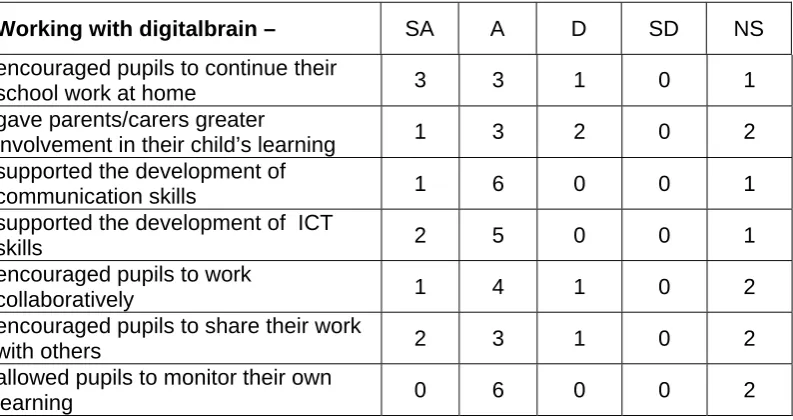
Teachers were asked to indicate what benefits they thought that the use of digitalbrain had brought, firstly for themselves as teachers, and secondly for the pupils. Their responses are shown in Tables 11 and 12.
Table 11: Perceptions of benefits to be gained from using digitalbrain for teachers
Working with digitalbrain – SA A D SD NS*
helped me to introduce new concepts
within subject areas 0 4 0 0 2
provided a range of resources for
learning and teaching 1 5 0 0 1
helped to provide for differentiation 0 5 1 0 1
improved communication with
parents/carers 0 2 2 0 2
reinforced and gave practice in new
learning 2 4 0 0 1
provided quality resources for learning
and teaching 2 3 0 0 2
provided templates that I used to
prepare lessons, etc. 0 2 2 0 2
assisted with assessment and
feedback 0 4 1 0 2
_________________________________________________________________________________
Evaluation of the 19 QIE Centre
[image:26.595.114.511.107.317.2]FLiC Initiative University of Strathclyde
Table 12: Perceptions of benefits to be gained from using digitalbrain for pupils
Working with digitalbrain – SA A D SD NS
encouraged pupils to continue their
school work at home 3 3 1 0 1
gave parents/carers greater
involvement in their child’s learning 1 3 2 0 2 supported the development of
communication skills 1 6 0 0 1
supported the development of ICT
skills 2 5 0 0 1
encouraged pupils to work
collaboratively 1 4 1 0 2
encouraged pupils to share their work
with others 2 3 1 0 2
allowed pupils to monitor their own
learning 0 6 0 0 2
Digitalbrain also brought challenges, however. The challenges identified by the respondents fell into two broad categories – using technology (11) and incorporating digitalbrain into the learning process (6). Comments about the technology included: • internet failure, for example ‘… when it goes down, so does the lesson’. Others
mentioned the server crashing and the frustration of slow uploading and downloading
• problems with the user interface: this was described as ‘not user friendly’ and
‘complicated’. Others described difficulties getting used to the navigation and
‘channelling information to different factions’
• other problems related to using digitalbrain on ‘Macs’ and difficulties for pupils connecting from home. One commented that ‘parents are unsure of how to resolve technical problems’.
The challenges around incorporating digitalbrain into the learning process related primarily to finding time for teachers to learn and practise, for pupils to learn how to use it and for teachers to check how the pupils are using it, in particular checking homework. A further concern was finding time to allow pupils who did not have internet access at home to use it in the school.
Four out of the eight respondents were not using digitalbrain during 2003-04. The others were trying it out with new groups and more classes and using it to access resources. One teacher had trained ten ‘fast-track’ pupils who had then trained the rest of the class.
_________________________________________________________________________________
Evaluation of the 20 QIE Centre
FLiC Initiative University of Strathclyde
5.3 Using Kar2ouche
As only three responses were received to this section, these are presented very briefly. Two teachers had used Kar2ouche in modern languages lessons with primary pupils and one in modern languages with secondary pupils. Only one teacher completed the ranking of reasons for using the technology. Other uses given were to share resources with other primary schools and to develop foreign language competence.
All 3 teachers agreed that amongst the benefits for them as teachers were to introduce new concepts and to provide an increased range of resources. One agreed and one strongly agreed that it provided for differentiation while all three agreed that it reinforced new learning. All agreed, one strongly, that it provided quality resources and added a new dimension to traditional subject areas.
Benefits to the pupils included the development of communication skills and ICT skills, collaborative working, the sharing of work and the opportunity to monitor their own learning. They agreed that it helped the less able to achieve and motivated boys (in modern languages). They were divided on whether it gave parents greater involvement in their children’s learning or whether it encouraged pupils to continue to work at home.
The three respondents agreed that not having enough computers was a problem and it was difficult to give every child the time they needed on the computer. It was also a challenge to find space for recording that was free from distractions and noise. It was also noted that the software caused certain computers to crash.
In terms of current use and plans for the future, one of the respondents was not using K2 during 2003-04, one was using it linked to digitalbrain and the other was using it for language assessments. Future plans were to put the software on to more computers and extend its use to more classes and year groups.
5.4 Video-conferencing
Eleven teachers had been involved in using video-conferencing for primary/secondary transfer and one had used it to facilitate the merger of two primary schools. Three used it to communicate with other schools and 2 used it to support learning and teaching.
Of those who had used it for transition activities, 6 found it very effective and 3 rated it as ‘effective’. Two were less enthusiastic. Use prior to merger had been very effective; communicating with other schools was rated as ‘effective’ or ‘very effective’ by 2 teachers and support in learning and teaching was also considered to be ‘effective’.
The benefits noted of using video-conferencing fell into three main categories with a few additional points. These included:
• pupil learning and development (14): for example, increased motivation, confidence and self-esteem leading to improved behaviour and, potentially, achievement. Pupils also benefited from improved communication, language and technical skills
_________________________________________________________________________________
Evaluation of the 21 QIE Centre
FLiC Initiative University of Strathclyde
• using technology (6): for example, learning how to use the equipment and seeing the potential of it. In particular, the pupils learned to operate and control the equipment themselves. This was both exciting and enjoyable for the pupils, though one respondent added, ‘when the equipment works’.
Other comments included the suggestion that staff benefited from learning about the potential of new technology and that secondary staff time was saved by not travelling to primary schools. One respondent said there had been no benefits so far.
The challenges outlined by respondents related broadly to management issues (18 comments) and to technical issues (12 comments), with a few additional comments. The management issues included:
• managing time: this affected the use of video-conferencing in a number of ways, for example to prepare and set up the conferencing, to meet with colleagues in other schools to plan, to find time when both schools are available and, indeed, to incorporate it within lessons
• staff issues: it was a challenge to provide staff with adequate training and practice so that they were confident using the equipment; also to find sufficient staff cover
• space: it was also suggested in two cases that finding space for the equipment was a problem.
Technical issues related primarily to the unreliability of the network connection and secondly to the quality of transmission, both picture and sound. It was suggested that the network problems had meant a ‘huge gap between initial training and eventual use’. It was reported that it was difficult ‘keeping pupils motivated after two or three failed connections’. Other challenges related to ensuring that video-conferences were ‘partly scripted to keep them fun’. In terms of using video-conferencing at present and in the future, 9 of the respondents had not used video-conferencing in the current session for a variety of reasons: for example, the network had been down, the camera was being repaired, there were other priorities such as getting digitalbrain
‘up and running’; some planned only to use it later in the year for transition.
Those who had used it reported video-conferencing between schools for discussion in a foreign language; one reported arranging a discussion between two S6 groups in different schools to discuss UCAS applications. This school had also used a special arrangement to allow video-conferencing at the SETT exhibition between the exhibition, the school and schools in Northern Ireland and the Highlands.
_________________________________________________________________________________
Evaluation of the 22 QIE Centre
FLiC Initiative University of Strathclyde
5.5 National Priorities, development planning and other initiatives
The final questions in the survey focused on aspects of other national and local initiatives that were in place in schools and the relationship between them and FLiC. Teachers were asked to indicate the extent to which involvement in FLIC had helped in meeting the school’s National Priorities targets. FLiC had contributed to the first of the National Priorities, relating to achievement and attainment, only a little or not at all (12 teachers) although 2 replied ‘much’ and 1 ‘very much’. The second priority focused on a framework for learning and again most respondents (10) thought that FLiC had contributed little or nothing to the targets, while 4 were much more positive. Similarly, FLiC had made little or no contribution to inclusion and equality according to 12 teachers, although 2 felt it had contributed much or very much. For targets related to values and citizenship, 8 teachers felt it had contributed little or not at all, while 5 said ‘much’. The fifth priority, learning for life, was more evenly split, with 6 on the positive side and 8 more negative.
[image:29.595.101.520.361.580.2]In relation to school development planning, FLiC had contributed ‘very much’ according to 3 teachers, ‘much’ according to 1, and ‘only a little’ (7), or ‘not at all’ (2) for the remainder. Views on the extent to which involvement in FLiC complemented other initiatives are shown in Table 13.
Table 13: Views on FLiC’s contribution to other initiatives
Very much
Much Only a little
Not at all
We are not involved in this initiative
a) Assessment is for Learning 0 1 5 2 3
b) Creativity in Education 0 5 1 2 4
c) Curriculum Flexibility 0 3 4 2 2
d) Education for Citizenship 0 3 6 1 1
e) Enterprise in Education 0 2 2 4 3
f) National Grid for Learning 0 6 2 4 n/a
g) Edinburgh’s Grid for Learning 1 6 2 4 n/a
_________________________________________________________________________________
Evaluation of the 23 QIE Centre
FLiC Initiative University of Strathclyde
5.6 Looking to the Future
[image:30.595.111.526.160.551.2]Teachers were asked the extent to which they agreed or disagreed with a number of statements relating to future developments. Their responses are summarised in Table 14.
Table 14: Teachers’ views on future developments
SA A D SD
We need better ICT resources to take full advantage of the new technologies in FLiC
5 5 3 0
Resources like digitalbrain and Kar2ouche will lead to significant changes in learning and teaching in schools
2 10 1 0
Video-conferencing will lead to significant changes in learning and teaching in schools
1 9 1 1
I would like to see virtual learning environments like digitalbrain extended to more areas of the curriculum
3 8 1 0
I would like all pupils to have the opportunity to use multimedia software such as Kar2ouche.
6 7 0 0
I would like to see greater use made of video-conferencing
4 7 2 0
I intend to undertake further staff development in on-line learning/use of virtual learning environments
4 8 0 0
I intend to undertake further staff development in use of multimedia software
5 6 1 0
I intend to undertake further staff development in video-conferencing
2 8 2 0
We need better technical support to extend these initiatives
1 5 8 0
I anticipate that within 5 years many more courses will be taught using these technologies
3 9 0 0
_________________________________________________________________________________
Evaluation of the 24 QIE Centre
[image:31.595.104.523.84.369.2]FLiC Initiative University of Strathclyde
Table 15: Teachers’ views on their own competence across strands of ICT capability
Very competent
Competent Need development
No idea how to do this
doing word processing 11 2 1 0
using databases and spreadsheets
5 8 1 0
using graphics and digital media
4 7 2 1
finding information on the WWW
10 3 1 0
designing web-pages 1 3 8 2
using simulations and playing games
4 4 3 3
using computer based resources with my pupils
7 6 1 0
undertaking video-conferencing
2 9 2 1
Combined with the data on training and qualifications, there is evidence that, for most of the aspects of FLIC, the teachers who completed the questionnaires were competent in the skills and knowledgeable about ICT. Eleven of the 14 had a computer at home, with 10 of these connected to the internet. They used it for a range of personal and professional activities (Table 16).
Table 16: Teachers’ use of computer at home
Frequently Occasionally Never
preparing documents for personal use 9 2 0
preparing documents for school and professional use
11 0 0
accessing the WWW for personal use 10 0 0
accessing the WWW for school and professional use
9 1 0
sending email for personal purposes 9 1 0
sending email for school or professional purposes
7 2 1
using digital media for personal purposes 5 3 3
using digital media for school and professional purposes
4 4 3
using webcam for personal purposes 0 1 9
using webcam for school and professional reasons
[image:31.595.102.531.469.789.2]