Consequence in Context:
Two-Dimensional Semantics meets Logical Consequence
MSc Thesis(Afstudeerscriptie)
written by
Bruno Jacinto
(born May 17th, 1983 in Lisbon, Portugal)
under the supervision ofDr Maria AloniandDr Catarina Dutilh Novaes, and submitted to the Board of Examiners in partial fulfillment of the requirements for the degree of
MSc in Logic
at theUniversiteit van Amsterdam.
Date of the public defense: Members of the Thesis Committee:
December 23, 2011 Dr Maria Aloni Dr Paul Dekker Dr Emar Maier
Abstract
Two-dimensional semantics is a formal framework used to characterize the meaning of sentences and sub-sentential expressions and distinguished by the view according to which the extension of an expression depends on two dimensions. Contextual philosophical interpretations of that framework intend to capture how the extension of an expression depends on context. These interpretations have been argued to provide insight into questions related to logical consequence.
Acknowledgments
I am grateful first of all to my grandmother Elisa Gonçalves and mother Ana Jacinto for all their support. I thank also my supervisors Dr Maria Aloni and Dr Catarina Dutilh Novaes for the attention with which they have read the thesis, their comments and the fruitful discussions we have had (and also for their patience and support on what concerns my continuous feeling that there was something more to be said). I would also like to thank Maria for all the help she has given me as my academic mentor.
My thanks go also to Dr Paul Dekker, Dr Emar Maier and Prof Dr Frank Veltman for being on my thesis committee and for their questions and comments during the defense.
During my time at the ILLC I have had the pleasure to have valuable classes with Dr Stéphane Airiau, Dr Maria Aloni, Prof Dr Johan van Benthem, Dr Paul Dekker, Umberto Grandi, Prof Dr Jeroen Groenendijk, Dr Catarina Dutilh Novaes, Dr Floris Roelofsen, Dr Sara Uckelman, Dr Frank Veltman and Lucian Zagan. Thank you for the knowledge you have passed on to me. I would also like to thank my Master of Logic colleagues and other members of the ILLC for the exciting academic environment they have provided me with during my stay in Amsterdam.
Carla Simões, Filipa Seabra and Prof Dr Leonel Ribeiro dos Santos (as well as the rest of the secretariat of the Center of Philosophy of the University of Lisbon) are also to be thanked for their great help and support concerning my decision to pursue my studies abroad.
In my bachelor studies I have greatly profited from the classes by Prof Dr João Branquinho, Prof Dr Adriana Silva Graça and Prof Dr António Zilhão – with the latter also being in part responsible for the fact that I have chosen to do the Master of Logic –, as well as from those by Prof Dr Manuel Lourenço. During that time I have also benefited from the continuous discussions with Ricardo Miguel and Josiano Nereu (I find it fair to say that I have learned as much from our discussions as I have learned from the classes themselves). Later on Francisco Gouveia and José Mestre also became members of these discussions. To all of them my thanks.
Contents
Introduction 1
Structure of the argument . . . 1
Structure of the thesis . . . 3
1 Logical consequence and the role of context in the determination of truth 4 1.1 The role of context in the determination of truth . . . 5
1.2 Logical consequence . . . 16
1.3 The problems . . . 25
1.4 The positions . . . 29
2 Logically possible cases and 2D semantics 31 2.1 The Zalta-Nelson vs. Hanson debate on the existence of contingent logical truths . . . . 31
2.2 Logically possible cases and the semantic interpretation of 2D semantics . . . 34
2.3 Logical possibilities and the meta-semantic interpretation . . . 42
3 Kaplan’s thesis 46 3.1 Presemantics, compositional semantics and postsemantics . . . 47
3.2 Kaplan’s thesis . . . 49
3.3 The class of Kaplan-validities . . . 52
3.4 The problem with Kaplan’s thesis∗ . . . . 56
3.5 The semantic interpretation and alternative theses on the nature of logical consequence . 57 4 Logical consequence and the meta-semantic interpretation 62 4.1 Two puzzles concerning logical consequence and the analyticity thesis . . . 62
4.2 Reference determiners: a semantic solution . . . 67
4.3 What isreallyexpressed: a pragmatic solution . . . 68
4.4 Semantics? Or pragmatics? . . . 80
Introduction
Two-dimensional semantics is a formal framework used to characterize the meaning of sentences and sub-sentential expressions and distinguished by the view according to which the extension of an expression depends on two dimensions. Contextual philosophical interpretations of that framework intend to cap-ture how the extension of an expression depends on context. These interpretations have been argued to provide insight into questions related to logical consequence.
The present essay is concerned with problems having to do with logical consequence and the role of context in the determination of truth – with contextual interpretations of two-dimensional semantics constituting theories in which solutions to those problems can be devised. The main problem that will be addressed is the logically possible cases problem, the problem of what are the logically possible cases – that is, what are those thingsx such that, if the premise of an argument is true relative tox while the conclusion of an argument is false relative tox, an argument is logically invalid. Linked to the logically possible cases problem, and thus also of interest in the present thesis, is therelata problem, the problem of what are the things that the relation of logical consequence relates. In particular, the interest will reside in whether thecontexts as cases thesis– the thesis that logically possible cases are just contexts / context-related entities – and thecontext-sensitive relata thesis– the thesis that the relata of logical consequence are context-sensitive, in the sense that their truth is determined relative to contexts / context-related entities – hold. I will argue that the contexts as cases thesis does not hold, and that the context-sensitive relata
thesis does.
Structure of the argument
as well against the two other options. Kaplan’s thesis was also committed to the claim that the only relata of logical consequence are sentence-types (and thus that the context-relative relata thesis holds). Since Kaplan’s thesis is shown to be false, no commitment to amonismconcerning the relata of logical consequence follows.
Afterwards I address two puzzles concerning theprimary relataand analyticity theses – the primary relata thesis having some initial plausibility and the assumption that the analyticity thesis is the case being a non-negotiable assumption of the present essay–, where the primary relata thesis is the position according to which the relation of logical consequence between secondary truth-bearers holds in virtue of the fact that the relation holds between the propositions they stand for. The primary relata thesis seems to entail that the context as cases thesis is not the case. The puzzles are important since they seem to entail the rejection of the primary relata thesis, and this rejection provides some initial plausibility to the contexts as cases thesis. The puzzles are also important insofar as a proposed solution to the second puzzle – a solution which I call thesemantic solution– implies that the contexts as cases thesis is in fact the case (despite the fact that none of the different options for being the class of logically possible cases distinguished in chapter 2. would betheclass of logically possible cases under the semantic solution, since the solution implies a three-dimensional semantics).
I show that both puzzles can also be solved without the rejection of the primary relata thesis, through a solution which I call thepragmatic solution. This is done in part by adopting some considerations arising from the meta-semantic interpretation of two-dimensional semantics, and also by taking the primary relata thesis seriously. I also argue that the pragmatic solution to the puzzles is more plausible than the semantic solution. The outcome is that the primary relata thesis preserves its initial plausibility, and thus the contexts as cases thesis ought to be rejected. Other important consequences of the plausibility of the primary relata thesis are that it allows for a pluralist position on the nature of the relata of logical consequence – some of these being context-sensitive – that the class of logically possible cases should be understood as the class of all circumstances of evaluation, that logical consequence, when the relata are taken to be context-sensitive truth-bearers, gets to obtain relative to contexts / context-related entities.
The dialectics can thus be summarized as follows: there is a distinguished position on the nature of logical consequence – Kaplan’s thesis – which enjoys considerable popularity and entails that the contexts as cases thesis is true; and there are puzzles posing some threat to the primary relata thesis, a seemingly plausible thesis about logical consequence entailing that the contexts as cases thesis is not the case. Furthermore, these puzzles are (arguably) solved by endorsing a position according to which the contexts as cases thesisisthe case.
possible cases problem is the rejection of the contexts as cases thesis.
Structure of the thesis
In the first chapter the theoretical background required to appreciate the problems and deal with the subsequent discussion is introduced, as well as the problems with which the thesis will be concerned and the available positions and their proponents. On what concerns the theoretical background the most prominent interpretations of two-dimensional semantics are presented, and the contextual interpretations of two-dimensional semantics are distinguished, since they will provide the needed theoretical apparatus on how to conceive the role of context on the determination of truth. Afterwards several views on the nature of logical consequence are distinguished, and our own commitments are signaled, since these will constrain what solutions to the problems can plausibly be accepted. One of the most important commitments will be to the truth of theanalyticity thesis, the position according to which if an argument is logically valid whenever the meanings of its premises are true, so is the meaning of the conclusion. Finally, the problems to be investigated and the available positions are presented.
In the second chapter the logically possible cases problem is exhibited within a two-dimensional framework, the upshot being that of distinguishing different options concerning candidates for being the class of logically possible cases within the semantic and the meta-semantic interpretations of the framework. Of the different candidates distinguished three options are found to have some plausibility, all of them within a semantic interpretation of the framework: i) the class of all pairs constituted by a context and a circumstance of evaluation; ii) the class of all pairs constituted by a context and its circumstance of evaluation; and iii) the class of all pairs constituted by a distinguished contextc∗and any circumstance of evaluation whatsoever.
In the third section it is investigated whether Kaplan’s thesis holds, a thesis committed to the positions that the relata of logical consequence are sentence-types and that option ii) constitutes the class of logically possible cases. It is also investigated whether position i) and iii) hold. It is concluded that all options should be rejected.
Chapter 1
Logical consequence and the role of
context in the determination of truth
In Monty Python’s comic sketchArgument ClinicMichael Palin pays John Cleese in order for them to have a discussion. At some point Cleese stops the discussion, claiming that their debating time is over. Palin rejects that this is so, and starts discussing the topic with Cleese. In the interest of keeping the discussion going on, Palin adduces something like the following argument:
(1) Ah ah! I got you! You’ll be having a discussion with me for as long as I have payed you to. You’re having a discussion with me. Hence, I have payed you for this time of discussion.
Cleese rejects Palin’s argument by remarking the following:
“No, no, no. I could be arguing in my spare time.”
Cleese’s reply shows that there is a sense in which something iswrongwith Palin’s argument, a sense in which Palin’s argument isbad. The argument is, in logical jargon, anon-sequitur. What is wrong with it is that its conclusion is not alogical consequenceof its premises.
Despite the importance of the relation of logical consequence in our lives, we seem to have an im-perfect grasp both of the nature of the relation and of the extension of the class of arguments whose conclusions logically follow from the premises. The present thesis deals with problems in the philoso-phy of logic having to do with the nature of logical consequence. The interest will be on whether and how considerations stemming from the role of context in the determination of truth are relevant for accounting for the nature of logical consequence.
1.1 The role of context in the determination of truth
Two-dimensional semantics is a formal framework used to characterize the meaning of sentences and sub-sentential expressions and distinguished by the view according to which the extension of an expression depends on two dimensions. Some philosophical interpretations of the framework provide the theoretical background required for an account of how context is relevant in the determination of truth.
An important example of such application of the two-dimensional framework is provided by Kaplan. In [Kaplan, 1989a] an account is given of how the conventional semantic rules governing the use of index-ical expressions such as ‘I’ and ‘here’ determine the extension of those expressions, and of the sentences containing them, relative not only to circumstances of evaluationbut also to contexts of use/generation. Consider sentence (2):
(2) I was in Amsterdam all day on the 18th of March 2010.
The truth of sentence (2) depends on what is the context in which it is being used/generated. The context provides the reference of ‘I’, which consists of the person using the sentence on that context. The truth of sentence (2) depends also on what is the circumstance with respect to which the sentence is being evaluated. If the circumstance is such that the contextually determined reference of ‘I’ was in Amsterdam all day on the 18th of March 2010, then (2) will be true. Otherwise, (2) will be false.
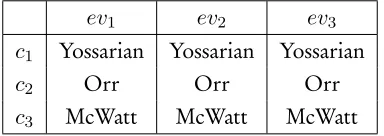
The dependence of the extension of an expression on two dimensions can be illustrated by the use of two-dimensional matrices for those expressions. These are matrices whose rows and columns are labeled, respectively, with whatever objects belong to the first-dimension and whatever objects correspond to the second-dimension; and whose entrieshi, jicorrespond to the extensions of the expression with respect to the object in rowiand columnj. As an example, consider a possible two-dimensional matrix for ‘I’, according to Kaplan’s context-dependent treatment of indexicals:
ev1 ev2 ev3
c1 Yossarian Yossarian Yossarian
c2 Orr Orr Orr
[image:9.612.211.403.596.664.2]c3 McWatt McWatt McWatt
The above matrix encodes the information that the speaker of contextc1 is Yossarian, the speaker of
c2is Orr, and the speaker ofc3is McWatt. In addition, it also exhibits the fact that ‘I’ is a rigid designator
(something which is the case with respect to all indexicals), where a rigid designator is an expression that, relative to a context of use, designates the same individual in all circumstances of evaluation. Kaplan [Ka-plan, 1989a] not only holds that indexicals are rigid designators, but also that they are directly referential, in the sense that they refer without the mediation of any Fregean sense or sense-like entity. A possible two-dimensional matrix for (2) is as follows:
ev1 ev2 ev3
c1 T F F
c2 F T F
[image:10.612.254.361.198.268.2]c3 F F T
Figure 1.2: Kaplanian two-dimensional matrix for ‘I was in Amsterdam all day on the 18th of March 2010’
From the matrix one can obtain, for instance, the information that Yossarian was not in Amsterdam all day on the 18th of March 2010 at circumstances of evaluation ev2 and ev3, and that McWatt was in
Amsterdam all day on the 18th of March 2010 in circumstance of evaluationev3.
Two main ways of distinguishing the different philosophical interpretations of two-dimensional se-mantics have been proposed. Stalnaker [2006] proposes to distinguish the interpretations depending on whether these aresemanticormeta-semantic, while Chalmers [2006a] distinguishescontextual from epis-temicinterpretations.
The idea behind Stalnaker’s distinction is based on what the dependence of the extension on two dimensions is intended to capture: if an interpretation intends to account for some semantic object -such as the meaningof an expression - through the dependence of the extension of the expression on two-dimensions, then the interpretation is semantic. If instead what an interpretation intends to account for is how the facts determine that the expression has one or another meaning, then the interpretation is meta-semantic.
The distinction between contextual and epistemic interpretations groups interpretations of the two-dimensional framework depending on whether the rows of a two-two-dimensional matrix are intended to capture the way the extension of an expression depends on context, or if instead they are intended to capture some kind of epistemic dependence.
The semantic interpretation
Kaplan’ssemantic interpretationcorresponds to the view that the extension of linguistic types depends on both contexts of use/generation and circumstances of evaluation. That the extension of linguistic types is context-dependent as depicted in Kaplan’s framework is nowadays a consensual position (as Soames puts it, “In Kaplan’s benign sense, we are all two-dimensionalists now”1). Nonetheless, there is some divergence with respect to what is the nature of contexts and circumstances of evaluation and how they should be represented. Two proposals of how to represent contexts depict them as centered worlds, either as worlds centered in an agent and time – that is, as triplesc = hw, s, ti(withwa possible world,san agent ofwandta time ofw) –, or as worlds centered in a token of the expression and a time – that is, as triplesc=hw, p, ti(withwa possible world,pthe token of the expression inwandta time inw). There have also been different proposals as to what constitutes a circumstance of evaluation, and how these should be represented. For instance, it has been proposed that circumstances of evaluation be represented as triplesev= hw, t, li, wherewis a possible world andtandlare times and locations of that possible world, as pairsev=hw, li, or even just as possible worlds (i.e.,ev=w).
Character andcontent are two important notions in Kaplan’s theory. The content of an expression consists in a function from circumstances of evaluation to extensions. For instance, the content of ‘runs’ maps circumstances of evaluation to sets of objects, and the content of ‘John runs’ maps circumstances of evaluation to truth-values. The content of a sentence is such that it maps a circumstance of evaluation ev to truth if the sentence is true with respect tohc, evi, where c is a particular context of use, or to falsity, if the sentence is false with respect tohc, evi. Contents of sentences play, for Kaplan, the role of propositions. However, it is more correct that to say that, in Kaplan’s view, propositions determine contents (see [Kaplan, 1989a, pp. 502]). The character of a sentence is a function from contexts of use to contents. A character maps a contextcto a content mapping each circumstanceevto a truth-valueT if and only if the sentence has the truth-valueT with respect tohc, evi. A full two-dimensional Kaplanian matrix for some linguistic expression (that is, a matrix whose rows and columns are labeled by contexts of use and circumstances of evaluation respectively, and that for each context of use and each circumstance of evaluation there is exactly one row and column labeled by them) can be seen as modeling that expression’s character, and each of the rows as modeling the content of the expression with respect to some context of use. Even though Kaplan distinguishes between these two kinds of meanings – character and content – it is not the case that every expression of the language is seen as possessing a character; or, if preferred, it is not the case that the character of every expression of the language is sensitive to the context of use. Some expressions possess a constants character, qua functions from contexts of use to contents, while others possess variable characters. The expressions of the language with variable characters are calledindexicals2.
1
In [Soames, 2006].
2Of these, Kaplan distinguishes two kinds:pure indexicalsandtrue demonstratives; the difference is, roughly, that in order for
The upshot of the notions of character and content is that they provide two different accounts of meaning. Content corresponds to the meaning of an expression required in order for the truth of a sentence in which it occurs to be evaluated. In order for the truth of (2) to be evaluated, the sentence is required to express a determinate content (for instance, the same content expressed by ‘Orr was in Amsterdam all day on the 18th of March 2010), and it will be true if the actual circumstances of evaluation are such that Orr was in fact in Amsterdam all day on the 18th of March 2010. Character provides a notion that is more general than content, in the sense that it incorporates the context-dependence of expressions, and also in that it ‘is close to the intuitive idea of linguistic meaning’ [Kaplan, 1989b, pp. 568]. It determines the content of an expression with respect to a determinate context of use/generation.
The interplay between character and content allows us to better understand what contexts of use/generation of a sentence are intended to stand for in a theory of linguistic meaning of expression-types: even though contexts of use are intuitively conceived as metaphysical and spatio-temporal locations (the location of the speaker, or alternatively, that of a token of the sentence-type), their role in a theory of linguistic meaning shows that what is important is that they are “parametrized”, in the sense that their role is to supply parameters (a speaker, a possible world, a time, etc.) required for sentences to express one or another content. Hence, for the purposes of a formal semantics for a particular language, contexts of use/generation need only be represented by tuples of parameters.
Kaplan’s interpretation of the two-dimensional framework provides an interesting insight with re-spect to the truth of some sentences. Let a sentence be true at a context of usecjust in case it is true atc andev(c), the circumstance of evaluation determined byc. For instance, if a contextcis represented by a triplec=hw, s, tiand circumstances of evaluation are represented by possibilities, then the circumstance of evaluationev(c)determined bycis such thatev(c) =w. There are sentences which are true whenever used (i.e., true in every context of use), despite the fact that they are not necessarily true. An example is sentence (3):
(3) It is raining if and only if actually, it is raining.
Assume that that contexts are triples c = hw, s, ti and circumstances of evaluation are possible worlds. Sentence (3) is true whenever it is used, that is, at every pairhc, ev(c)i, due to the meaning of ‘actually’, since a sentence pactuallyϕq is true at a contextc and circumstance of evaluation ev if and only ifϕ is true at context c and circumstance of evaluation k, where k is the world of the context c. That is, k=ev(c).
But (3) is not necessarily true. A sentence of the form pnecessarilyϕq is true at a context c and circumstanceevif and only ifϕis true at contextcand all circumstances of evaluation (possible worlds) whatsoever. Since there are both circumstances of evaluation in which it is not raining and circumstances of evaluation in which it is raining, if it is true that actually it is raining, then (3) will be false with respect to its context of use and those circumstances in which it is not raining; and if it is false that actually it
is raining, then (3) will be false with respect to its context of use and those circumstances in which it is raining. Either way, there will be circumstances of use such that (3) will be false with respect to its context of use and those circumstances, and therefore (3) is not necessarily true.
The meta-semantic interpretation
Themeta-semanticinterpretation intends to account for how the extension of an expression-token could have been different had the facts of the world determined a different meaning for the expression-type of which the token is a token of. It thus intends to capture how the extension of an expression depends not only on what are the facts, but also on what happens to be the meaning of the type of which it is a token. Consider the following sentence:
(4) Hesperus is Phosphorus.
Assuming both that the meaning of a name is given solely by the object it stands for and that names refer to the same object in every possibility (that is, that names are both directly referential expressions and rigid designators), sentence (4) is a necessary truth, no matter its context of utterance. Still, if the meaning of ‘Hesperus’ or ‘Phosphorus’ had been different, then (4) would not have been a necessary truth. For instance, in a possibility where the evening star is Mars, the morning star is Venus, the name ‘Hesperus’ denotes the the evening star, ‘Phosphorus’ denotes the morning star (and ‘is’ just means identity), sentence (4) will be false.
This dependence of extensions on both the meaning of the expression and what is the case is captured by positing possible worlds as the objects in both the first and the second dimensions. However, the roles they play are different depending on whether they are being considered as elements of one or the other dimension: in the first-dimension, they capture what the content of an expression would have been, had that possibility been the case (in the case of sentences, they capture what the proposition expressed by the sentence would have been, had that possibility been the case); in the second dimension what is captured is what the extension of the expression would have been at a possible world, with respect to the content determined by the possible worlds on the first-dimension.
Stalnaker’s motivation for adopting the two-dimensional framework is different from Kaplan’s. While the point of the latter was to give a fuller account of linguistic meaning, one that incorporates context-dependence, the former intends to characterize how what is communicated by an assertion depends on two different roles played by the context in which the assertion takes place. Stalnaker, influentially, proposed that the purpose of making an assertion is that of leading the audience to which the assertion is directed to exclude certain possibilities being held as live possibilities at a particular context. This corresponds to the first role played by context: it is that which assertions intend to affect. For instance, an assertion of
aims at excluding from the context the possibilities being held as live possibilities in which the speaker still lives in his old house. The second role of context has to do with the determination of what is expressed by an assertion. For assertions to achieve their desired effect the participants on the conversation must share somepresuppositionsconcerning both the meaning of the words used and the actual circumstances. If the audience did not understand English, then the assertion of (5) would not achieve the desired effect; and if the audience was ignorant of who performed the utterance of (5) (for instance, because two friends were on another room when one made the utterance, making the audience unaware of which one of the two made it), then the assertion would also not have achieved its desired effect. Thus, in order for an assertion to achieve its desired effect, some presuppositions must be in force in the context that the assertion intends to affect.
One can thus represent a context as a set of possibilities, thecontext set, which contains all possibilities where the shared presuppositions of the participants on the conversation hold. The desired effect of an assertion in a particular context is to exclude some of the possibilities in that context set, and what is communicated by an assertion is determined with respect to the possibilities in that context.
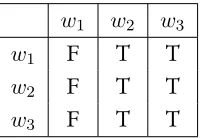
Given this picture of a context and of the aim of an assertion, what is communicated by an assertion can be modeled by a two-dimensional matrix, where rows and columns are labeled by possibilities in the context set. For instance, if what is presupposed is that the language being spoken is English and that John is the person uttering (5), the following is a possible two-dimensional matrix for the utterance of the expression:
w1 w2 w3
w1 F T T
w2 F T T
[image:14.612.257.358.393.462.2]w3 F T T
Figure 1.3: Two-dimensional matrix for (5)’s utterance.
Each world represents a possibility compatible with the presuppositions of the participants, and the truth-values of each row represent what the content of (5) would be if the possible world labeling that row would happen to be the actual world. Since the shared presuppositions are that the language is English and the speaker is John (and that the time is t), the content of (5) is the same no matter the possibilities. In such case, the possibility that the assertion of (5) is intended to exclude isw1, for the
each possibility.3
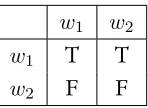
There are, however, assertions that, prima facie, fail to determine which possible world is to be excluded. Assume participants in a conversation are unaware of the fact that ‘Hesperus’ and ‘Phosphorus’ have the same reference, even though they are English speakers aware that proper names rigidly designate. In such case, an utterance of (4) by one of the participants would seem to fail in proposing the exclusion of any possibility, due to the fact that, relative to each possibility in the context set, the content of (4) would be different. A possible two-dimensional matrix depicting this situation is the following:
w1 w2
w1 T T
[image:15.612.270.344.195.249.2]w2 F F
Figure 1.4: Two-dimensional matrix for (4)’s utterance.
The audience is unaware whetherw1 orw2 is the world where the assertion is being performed, and
depending on whether it takes place in w1 or w2, it either proposes to eliminate no possibility, or to
eliminate all possibilities. None of these cases is desirable: to propose to eliminate all the possibilities in the context set is ‘self-defeating’, for it is to assert something that is contradictory with what is already being presupposed; to propose to eliminate no possibility in the context set is to go against the aim of making an assertion.
In order to account for assertions like that of (4), Stalnaker proposes that what is being pragmatically communicated is something different from either of the propositions that are determined, depending on whetherw1 orw2 is the actual world. Since such assertions violate the rational maxim of conversational
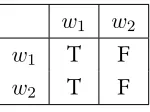
cooperation according to which the same content should be expressed relative to every possible world in the context set, the audience seeks for a non-standard interpretation of the utterance. The proposal is that what is pragmatically communicated by (4) is thatthe content of (4) is true, where ‘the content of (4)’ may refer to different contents in different worlds. That is, what is communicated is thediagonal proposition4, where this is the content that is true at a possibilitywif and only if the content expressed inwis true atw. In the case of the assertion of (4), it corresponds to cellshw1, w1i andhw2, w2i. The
following two-dimensional matrix captures what is pragmatically communicated:
3As Stalnaker [2006] points out, this immediately answers an objection by Chalmers [2006a] to the effect that in some
possible worlds it would be quite difficult to pinpoint if a token of a sentence being asserted was the same as the original token, and what the criteria for such trans-world identification would be, thus making the question of what content to be assigned to the utterance with respect to those possibilities a difficult one to answer. However, once the scope of the meta-semantic interpretation is appropriately delineated, the problem vanishes, for the token just has to be the unique epistemically salient token at each of the relevant worlds. The participants of the conversation will be aware that a particular assertion takes place, and thus such token is guaranteed to exist at each of the possible worlds of the context set.
4I will be using ‘content’ and ‘proposition’ interchangeably, in the current presentation of the meta-semantic interpretation,
w1 w2
w1 T F
[image:16.612.269.344.70.126.2]w2 T F
Figure 1.5: Two-dimensional matrix for what (4) pragmatically communicates
By reinterpreting the assertion of (4) as expressing the diagonal proposition with respect to each possibility taken as actual, the participants in the conversation are able to make sense of the assertion, and it achieves its target: that of proposing to exclude worldw2. The diagonal proposition thus captures
a sort of pragmatic content, highly dependent on both literal content (for the determination of the truth-values of each row) and on what are the ‘live’ possibilities of the participants (for the determination of both the rows and the columns of the matrix).
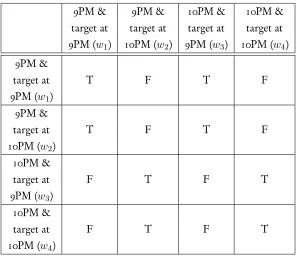
It is important to note how Stalnaker’s and Kaplan’s interpretations are not rivals, but intend to account for different phenomena. Consider the following example: Orr wants to warn Yossarian that they’re just passing above the target that they’re supposed to drop the bombs on. Orr says the following to Yossarian:
(6) The target is below us now.
9PM & 9PM & 10PM & 10PM & target at target at target at target at 9PM (w1) 10PM (w2) 9PM (w3) 10PM (w4)
9PM &
target at T F T F
9PM (w1)
9PM &
target at T F T F
10PM (w2)
10PM &
target at F T F T
9PM (w3)
10PM &
target at F T F T
[image:17.612.158.455.69.326.2]10PM (w4)
Figure 1.6: Two-dimensional matrix for what (6) pragmatically communicates
Since different propositions are expressed by the assertion, what is being communicated is not (6), but thatsentence (6) is true, a proposition that is true at possibilitiesw1andw4, and false atw2andw3.
As was the case with respect to sentence (4), sentence (6) determines different propositions depending on the possibility in which it is uttered, and therefore violates the aforementioned rational maxim of cooperation. Hence, what is being communicated is not (6) but thatsentence (6) is true(i.e., the diagonal proposition), a proposition that is true at possibilities w1 and w4, and false at w2 and w3. Thus, the
two-contextual interpretations aim at accounting for different phenomena, and as the example shows, without Kaplan’s theory Stalnaker’s interpretation would not be able to account for what is pragmatically communicated in cases like that of the assertion of (6).
The example also allow us to assess the difference between the roles that the notion of context is required to play in Kaplan’s and Stalnaker’s theories: for both the intuitive idea of a context is that of a metaphysical and spatio-temporal location, that of the speaker or of the sentence-token that is being used to make an assertion. However, for Stalnaker, what is important in a context is that: i) there are some presuppositions in force at that metaphysical and spatio-temporal location; ii) the resulting proposition, modeled as a set of worlds, is true if the possible world where the utterance takes place belongs to that set of possible worlds.
Chalmers’s epistemic interpretation
the fact that in recent years it has gained some prominence.
Chalmers intends to account for how the extension of expression-tokens depends both on an epis-temic dimension and a metaphysical dimension. Episepis-temic dependence is intended to capture a dimen-sion of meaning usually associated with Fregean senses, in that it is capable of distinguishing (at least in part) expression-tokens relative to their cognitive significance. The objects in the first dimension are thus to be understood asscenarios/epistemically possible worlds. Each scenario consists of a maximally specific hypothesis about what one’s actual environment and one’s location in that environment might be like that cannot be ruled out by apriori reasoning alone (a hypothesis is maximally specific if it leaves no other hypothesis open; and a hypothesis H1leaves another hypothesisH2 open if and only if both the con-junctions ofH1withH2and its negation are epistemically possible). The extension of a sentence-token ϕat a scenario sis determined in such a way thatϕ is true if and only if it is apriori incoherent that bothsand pnotϕq; and a sentence-token’s primary intensionis a function from epistemic possibilities to truth-values, such that an epistemic possibility is mapped to truth if the sentence-token is true at that scenario, and to falsity if the sentence-token is false at that scenario.
The objects in the second dimension are uncentered scenarios, maximally specific hypothesis about what one’s actual environment might be like that cannot be ruled out by apriori reasoning alone. The secondary intensionof a sentence-token ‘p’ is a function from ‘uncentered’ scenarios to truth-values, map-ping an ‘uncentered’ scenario to the the truth-value that the token as is actually used would have had in that scenario. Atwo-dimensional intensionis a function mapping pairshs, wi, of scenariossand ‘uncen-tered’ scenarios wto truth-values, where a pairhs, wiis mapped to truth if and only if, ifsis the case, then ifwhad been the case thenpwould have been the case. For instance, consider sentence (7)
(7) Water isXY Z.
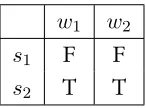
Suppose that in the epistemically possible worlds1 the drinkable liquid in oceans and lakes isH2O, and
that in the epistemically possible worlds2 the drinkable liquid in oceans and lakes isXY Z, and that
w1and w2 are, respectively, the epistemically possible worldss1 ands2when these are stripped of their
center. Then, the following two-dimensional matrix would reflect the position of the proponents of the epistemic interpretation:
w1 w2
s1 F F
[image:18.612.270.343.543.597.2]s2 T T
Figure 1.7: (Partial) two-dimensional matrix for (7)
If the epistemic possibility s1 is the case, then water is not XY Z, and thus, had w2 been the case,
water would still not have beenXY Z, for water could not have been different of itself: thanH2O. That
is, ifs1 is the case what can be concluded is that water is not the drinkable liquid in oceans and lakes
case or hadw1 been the case. The matrix (partially) depicts the primary intension, secondary intension
and two-dimensional intension of (7). The primary intension of (7) is a function that maps the epistemic possibilities si labeling the rows of the matrix to the truth-values in the cells hsi, wii; the secondary
intension of (7) is a function that maps the ‘uncentered’ scenarioswi labeling the columns of the matrix
to the truth-values in the cellshs1, wii; and the two-dimensional intension of (7) maps the pairshsi, wji
to the truth-values on cellshsi, wjiof the matrix.
Chalmers argues that both primary and secondary intensions explain different aspects of meaning (the same happening with two-dimensional intensions). The secondary dimension explains the connection between meaning and modality, while the epistemic dependence is intended to capture a dimension of meaning usually associated with Fregean senses. According to Frege, two token names ‘A’ and ‘B’ have the same sense if and only if the identity ‘A=B’ is cognitively insignificant, and two token sentences ‘p’ and ‘q’ have the same sense if and only if the equivalence ‘pif and only ifq’ is cognitively insignificant. A common understanding of cognitive significance is that sentencesr andsdiffer in cognitive significance if: i)r andsdiffer in informativeness; or ii) one of the sentences is knowableaprioriwhile the other is knowable only aposteriori; or iii) r and sdiffer in cognitive value (that is, if it is possible for an agent who understands bothpandqto sincerely assent to one of them and sincerely dissent to the other. The primary intension of a sentence accounts for differences in apriori knowability, since, given the way primary intensions are defined, a sentence will be a priori if and only if it its primary intension maps all scenarios to the truth-value truth. Thus, primary intensions resemble Fregean senses. Nonetheless, there are cases with respect to which it is possible to see that the two yield different results. For instance, mathematical truthspand q will have both the same primary intension and the same two-dimensional intension, since they are both a priori knowable, while differing in cognitive significance, and thus in its Fregean sense.
worlds provides a way to capture the meaning of different expressions.
1.2 Logical consequence
One of the main problems in philosophy of logic has been that of providing a proper explanation of the nature of the relation of logical consequence. The history of the problem dates back to Aristotle, and among the philosophers who have addressed it are, besides Aristotle, Buridan, Bolzano, Frege, Russell, Tarski and Quine.
The following three arguments are all examples ofgoodarguments, in the sense that their conclusions logically followfrom their premises:
(8) All men are animals; John is a man. Therefore, John is an animal.
(9) John is a student. Therefore, John is a student or John is intelligent.
(10) John is hungry or John is sad; John is not hungry. Therefore, John is sad.
However, the next three arguments arebadin the same sense that Palin’s argument (1) was, since their conclusions do not logically follow from their premises:
(11) All men are animals; John is an animal. Therefore, John is a man.
(12) John is a student. Therefore, John is a student and John is intelligent.
(13) John is hungry or John is sad; John is hungry. Therefore, John is not sad.
In what follows I will say of an argument that it is logically valid when its conclusion logically follows from its premises, and that it islogically invalidotherwise. Other logical properties are related to logical consequence. A set of sentences islogically consistent if and only if no contradiction is a logical conse-quence of that set. A sentence islogically independentof a set of sentences just in case the sentence is not a logical consequence of the set. And a sentence is alogical truthif and only if it is a logical consequence of any set of premises.
Even though, as noted, there is an imperfect grasp of the nature of logical consequence, there are some features that have been attributed to it. These features are possibly behind our judgments of logical validity/logical invalidity. Crucially, they constitute a theoretical start-point in the inquiry into the nature of the logical consequence relation.
Modality
It has been proposed in the literature (e.g., [Etchemendy, 2008] and [Rumfitt, 2010]) that there is a notion of logical necessity, of which the following biconditional is true: it is logically necessary that ϕif and only if it is logically contradictory that notϕ. Ian Rumfitt [2010], one of the proponents of this notion, provides a rough characterization of logical contradictoriness, according to whichψis logically contra-dictory just in case some overt contradiction logically follows from the supposition thatψ(where overt contradictions include not only formal contradictions such aspχand notχq, but also sentences such as ‘This is both green and yellow all over’). The notion of logical necessity has lead to the formulation of thelogical necessity thesis, endorsed by Etchemendy and Rumfitt:
Logical Necessity Thesis The conclusion of an argument follows logically from its premises if and only if it is logically impossible that the premises are true and the conclusion is false.
Modality has been associated with logical consequence ever since Aristotle. In the following passage, one way to understand Aristotle is as proposing something akin to the logical necessity thesis:
A syllogism is a discourse in which, certain things having been supposed, something different from the things supposed results of necessity because these things are so. By “because these things are so,” I mean “resulting through them” and by “resulting through them,” I mean “needing no further term from the outside in order for the necessity to come about.” (Prior Analytics, book I, ch. 2).
In the present thesis I will assume that there is indeed a notion of logical necessity, and that the logical necessity thesis holds. Assuming this notion the question arises of what is the nature of logical necessity, and in particular whether logical necessity is nothing but some other kind of necessity. As has been extensively noted throughout the literature (e.g., [Burgess, 2009]), there are (arguably) different notions of necessity and possibility. The following notions are distinguishable:physical necessity, where it is physically necessary thatϕjust in caseϕcould not have been otherwise, so long as the laws of nature remained the same;epistemic necessity, where it is epistemically necessary thatϕjust in case, for all one knows, it is not the case that ϕcould not have been the case; deontic necessity, where it is deontically necessary thatϕif and only if it is not the case thatϕcould not have permissibly have been done; and metaphysical necessity, whereϕis metaphysically necessary if and only if it is not the case thatϕcould not have been the case, no matter what.
Of the different notions of necessity just distinguished, logical necessity is usually equated with meta-physical necessity. For instance, Shapiro advances a way to understand Aristotle according to which ‘necessity’ stands for metaphysical necessity. If it accepted that logical necessity just is metaphysical ne-cessity, then the following thesis holds:
Even rejecting that logical necessity just is metaphysical necessity, one can be lead to equate it to some different notion of necessity. An interesting question concerning all notions of necessity is what is their comparative strength, and in particular whether logical necessity is at least as strong as any other notion, where a notion of necessitynecessity1is at least as strong as a notionnecessity2 just in case, for all
ϕ,necessary2ϕis a logical consequence ofnecessary1 ϕ. Arguments in defense of this position have been
presented in the literature both by McFetridge [1990] and Rumfitt [2010].
In the present essay the logical necessity thesis will be assumed to hold. As will be seen later on, a related but stronger thesis – thegeneralized Tarski’s thesis– will be assumed to hold as well.
Analyticity
Analyticity has also been regarded as an important feature of logical consequence (e.g., [Read, 1994, Shapiro, 2005]). Two families of conceptions of analyticity have been distinguished : metaphysical concep-tions of analyticity and epistemological concepconcep-tions of analyticity [Boghossian, 1996, 1997, Williamson, 2007]. Metaphysical conceptions are, roughly, those that take a sentence to be analytically true just in case it is true in virtue of its meaning. Epistemological conceptions share the view that a truth is analytic just in case the true sentence or thought has a “privileged status in respect to knowledge or justification (...) in virtue of the conditions for understanding its constituent words or possessing its constituent concepts” [Williamson, 2007]. Common examples of analytic truths are:
(14) Yossarian is a bombardier or Yossarian is not a bombardier
(15) If Yossarian is a bombardier, then Yossarian is a bombardier
(16) If Doc Daneeka is Yossarian’s doctor, then Yossarian is Doc Daneeka’s patient
(17) Red is a color
while the following are examples of synthetic truths:
(18) Yossarian is a bombardier
(19) Doc Daneeka is Yossarian’s doctor
(20) The range of the wave length of red is roughly between 630 and 740 nm.
Metaphysical conceptions of analyticity
Sentences are usually said to be true because they mean what they do and because what they mean is the case. For instance, sentence (18) is true because it means that Yossarian is a bombardier and because Yossarianisa bombardier.
view, sentence (14) is true just because it means that Yossarian is a bombardier or Yossarian is not a bombardier.
It has been objected that this conception of analyticity is flawed, since no sentence is true just because of what it means, and thus the conception does not accommodate the fact that sentences (14) - (17) are analytic. The conception can be characterized as the view that analytic truths are those truths that have no truthmakers. Williamson [2007] has cogently argued against this conception. The argument is that, according to general truthmaker principles for disjunctive sentences, what makes a disjunction true is what makes one of its disjuncts true. Hence, whatever makes (18) true, also makes true both sentence (21),
(21) Yossarian is a bombardier or Yossarian is a pilot
and sentence (14). But sentence (14) is a prime example of an analytic truth. Hence, analytic truths are not adequately conceived as those truths that have no truth-makers.
A different conception of analyticity,Frege-analyticity, takes it that a sentence is analytic just in case it is a logical truth or synonymous with a logical truth. Frege-analyticity also does not seem to consti-tute an adequate conception of analyticity. The problem is that sentences such as (16) and (17) are not synonymous with logical truths, despite the fact that they are both analytic. Furthermore, a different problem arises for Frege-analyticity on the present setting. The point of relating logical consequence with analyticity is to constrain our perspective on what counts as a logical consequence of what. But Frege-analyticity is itself characterized in terms of logical truth, which, as has been pointed out, can itself be characterized in terms of logical consequence (a sentence is a logical truth just in case it is a logical consequence of any premise(s) whatsoever). Hence, Frege-analyticity is unable to play the role that is presently required of analyticity – that of constraining our perspective on logical consequence – and thus a different conception is required.
A third conception of analyticity has it that a sentenceϕis analytically true just in case its meaning is sufficient for its truth, which is further explained by the meaning of ϕbeing such that ϕ is trueno matter what. As presented in the last section, the meaning of a sentence can be understood (at least) as its character, or as its content. This third conception of analyticity,modal-analyticity[Williamson, 2007], will be understood as neutral with respect to the notion of meaning being assumed. That is, it can give rise to a conception of analyticity taking characters as the meaning of sentence, to a different conception of analyticity taking contents as the meaning of sentences, or even to other conceptions of analyticity taking other entities as being the meaning of sentences.
Epistemological conceptions of analyticity
(22) Every bachelor is an unmarried man
fail to count as analytic on such conception. An argument is that a competent philosopher may not assent toson the grounds that there are no bachelors. Such philosopher (call it ‘McWatt’) may take it that a necessary condition for the truth of (22) is that there are bachelors, and also endorse the view that, as a matter of fact, there are no bachelors. McWatt may be wrong in both respects (that is, in holding that a necessary condition for the truth of (22) is that there are bachelors, and in holding that, as matter of fact, there are no bachelors), but this would not count as failure to understand (22). One can assume without any implausibility that McWatt is as proficient in English as any native speaker, and that his views on what is required for the truth of (22) arise solely from the fact that he has an incorrect theory on the meaning of ‘every’ (as Williamson correctly notes, “Giving an incorrect theory of the meaning of a word is not the same as using the word with an idiosyncratic sense - linguists who work on the semantics of natural languages often do the former without doing the latter” [Williamson, 2007, p.89]). This means that McWatt understands (22) without assenting to it, and thus that the conception of analyticity in question does not count (22) as analytic. But (22) is a paradigm example of an analytic sentence. Hence, it is not the case that a sentencesis analytic if and only if necessarily, whoever understandss, assents to it”.5
I will assume that the conception of analyticity which is of importance to the analyticity feature of logical consequence is modal-analyticity. Thus, the following thesis will be endorsed:
Analyticity thesis The conclusion of an argument follows logically from its premises if and only if the meanings of the premises and conclusion of the argument are such that no matter when the meaning of the premises are true, the meaning of the conclusion is true as well.6
The analyticity thesis yields the outcome that a sentence is logically true if and only if its meaning is true no matter what; i.e., if and only if it is an analytic truth.
I wish to point out two things with respect to the analyticity thesis. The first is that it is not the case that the analyticity thesis is true if and only if the metaphysical necessity thesis is true. A straightforward way to appreciate that the biconditional may fail is that when meanings are taken as characters, there might be metaphysically true sentences which are not analytic truths.
The other thing that I wish to point out is that I am aware that modal-analyticity is not the no-tion of analyticity philosophers are most used to. However, philosophers such as Timothy Williamson [Williamson, 2007] and Gillian Russell [Russell, 2010] do endorse this or related views. Hence, on this respect I am not completely at odds on what concerns other philosophers usage of the term and
under-5
For more on the present argument, and on other arguments against this conception of analyticity, see [2007, section 4].
6Given the commitment to the analyticity thesis as a non-negotiable component of the present essay it might have been
standing of the concept. Furthermore, the point of the preceding considerations was to show that other conceptions of analyticity are not, arguably, coherent conceptions.7
Formality
The idea that logically valid arguments are those that instantiate logically valid argument-forms can be traced back to Bolzano [1837]. According to this view, arguments (8), (9) and (10) are logically valid in virtue of exhibiting, respectively, the argument-forms:
(23) AllAs areBs;cisA. Therefore,cisB
(24) p. Therefore,porq
(25) porq; Notp. Therefore,q.
while arguments (11), (12) and (13) are invalid, for they exhibit, respectively, the argument-forms:
(26) AllAs areBs;cisB. Therefore,cisA
(27) p. Therefore,pandq
(28) porq;p. Therefore,q.
An argument’s argument-form can be characterized in either syntactic or semantic terms. According to the syntactic characterization, an argument-form is obtained by substituting some of the expressions present in the sentences composing it for schematic expressions of the same type. As for the semantic characterization, the form of an argument is obtained by “unsaturating” at least some of the semantic valuessthat compose the semantic valuesS expressed by the premises and conclusion of the argument, the result being an argument-form composed of semantic value functionsFS().
Consider, for instance, argument (8). (23) can be straightforwardly conceived as providing the syn-tactic argument-form of (8), A and B being schematic expressions for common nouns, and c being a schematic expression for a name.
Assuming that the semantic value of a sentence which is relevant for the relation of logical conse-quence is the proposition expressed by the sentence, and the view that propositions arestructured(where a structured proposition is a structured entity, containing individuals, functions, properties, relations, etc. as constituents), the argument-form of (8) can be semantically characterized as follows:
(29) hALLhX, Yii;hXhzii. Therefore,hYhzii.
7In this respect, Gillian Russell [Russell, 2010] also presents some interesting considerations to the effect that the conception
Characterizing argument-forms in syntactic (semantic) terms yields syntactic (semantic) accounts of the logical validity of argument-forms.
Definition(Logical validity of syntactic argument-forms). A syntactic argument-form is logically valid just in case there is no argument that results from substituting the schematic letters for expressions of the appropriate type which is such that the premises of the argument are true while the argument’s conclusion is false.
For instance, argument-form (23) is logically valid just in case there are nocommon nounsC1 andC2,
and noproper namen1such that the argument
(30) AllC1s areC2s;n1isC1. Therefore,cisC2
has true premises and false conclusion.
The logical validity of semantic argument-forms is defined as follows:
Definition(Logical validity of semantic argument-forms). A semantic argument-form is logically valid just in case there are no semantic valuessof the appropriate type such that the semantic valuesFSP(s)resulting
from saturating the semantic value functionsFSP()are all true (where, for each premiseP,FSP()is the
seman-tic value function resulting from unsaturating the semanseman-tic valueSP expressed byP), while the the semantic
valueFSC(s) which results from saturating the semantic value functionFSC() is false (where FSC() is the
semantic value function that results from unsaturating the semantic valueSC expressed byC, the argument’s
conclusion).
Thus, the argument-form (29) is logically valid just in case there are no (first-order)propertiesP1 and
P2, and noobjecto1 such thathALLhP1, P2iiandhP1ho1ii– the propositions expressed by the premises
– are both true, whilehP2ho1ii– the proposition expressed by the conclusion – is false.
The semantic characterization has an obvious advantage over the syntactic characterization. Whereas what counts as a logically valid argument according to the syntactic characterization depends on the expressive power of the language, what counts as as logically valid according to the semantic characteriza-tion does not. For instance, if the language has only one common noun and at least a proper name, the syntactic argument-form (24) will not have as instances arguments with true premises and a false conclu-sion, but it will have as instances arguments with true premises and a false conclusion if the language has, at least, the common nouns ‘French’ and ‘Men’, as well as the proper name ‘Stalnaker’. The following is an instance with true premises and false conclusion:
(31) All French are men; Stalnaker is a men. Hence, Stalnaker is French.
However, the semantic argument-form
will not be logically valid, since the propositions hALLhF rench, M enii8 and hM enhstalnakerii are both true, while the propositionhF renchhstalnakeriiis false. This will be so regardless of the language’s expressive power.
In providing the syntactic argument-form of (8) not all expressions in (8) were substituted by schematic letters. The expression ‘all’ remained unsubstituted. Similarly, in providing the semantic argument-form of (8) the semantic value of ‘all’ was not unsaturated from the proposition expressed by the first premise. It is easy to see that, if all expressions in (8) were substituted by schematic letters, then (8)’s argument-form would be logically invalid, provided that the language had sufficient expressive power. Similarly, abstract-ing all component semantic values from the semantic values expressed by the premises and conclusion would have as result that the semantic argument-form of (8) would be logically invalid.
This raises the question of which expressions/semantic values should remain unsubstituted in an argument’s argument-form. This is nothing but the problem in philosophy of logic of demarcating the logical expressions/logical notions, the expressions/semantic values which are present not only in an argument but also in the argument-form of the argument. Arguments have been presented in defense of different classes as constituting the class of logical expressions – also called ‘logical constants’ – and of different classes constituting the class of logical notions. Philosophers such as Sher [2008] have argued that among the logical constants are the expressions ‘and’, ‘or’, ‘not’, ‘if... then...’, ‘all’, ‘some’ and ‘... is the same as...’ (while among the logical notions are the semantic values of these expressions, at least according to some understanding of them). Still, a more liberal view [Tarski, 2002] has also been proposed, the claim being that the argument-form of an argument is determined relative to a choice of logical constants/logical notions. If this latter position is correct, then the logical validity of an argument turns out to also be relative to a choice of logical expressions/logical notions.
Given the above considerations, the view that logical consequence exhibits the formality feature can thus be put under the following thesis:
Formality thesis The conclusion of an argument follows logically from its premises if and only if the argument exhibits a semantic argument-form which is logically valid.
The formality thesis will not be assumed to be the case in the present essay. As a matter of fact, it will be assumed not to hold. An important reason for this assumption is that, since I adhere to the analyticity thesis, I am convinced by Read’s argument [1994] to the effect that either there are logically valid arguments that do not exhibit a logically valid semantic argument-form, or there are logically invalid arguments that do exhibit logically valid semantic argument-forms. Read asks us to consider the following argument:
(33) Iain is taller than Bill; Bill is taller than Mary. Therefore, Iain is taller than Mary.
8This is an extremely rough (and incorrect) characterization of the structured proposition expressed by ‘All French are men’.
Assuming the analyticity thesis, argument (33) is logically valid. However, under the (absurd) assumption that the formality thesis holds, abstracting the semantic value of ‘is taller than’ has the effect that (33)’s semantic argument-form is logically invalid, and thus the argument itself is logically invalid. On the other hand, if the semantic value of ‘is taller than’ is assumed to be a logical notion then the following argument turns out to be logically valid – on the assumption that the semantic values of ‘no one’, ‘everyone’, ‘some-one’ and ‘someone else’ are all logical notions (something which agrees with the orthodoxy concerning the division between the notions which are logical and those which are not) –, contra its obvious logical invalidity:
(34) No one is taller than everyone. Therefore, someone is taller than someone else.
No matter whether there are logically valid arguments that do not exhibit a logically valid semantic form, or there are logically invalid arguments that do exhibit logically valid semantic argument-forms, the class of logically valid arguments will be different of the class of arguments which exhibit logically valid semantic argument-forms. Since either there are logically valid arguments that do not exhibit a logically valid semantic argument-form, or there are logically invalid arguments which exhibit a logically valid semantic-argument-form, it follows that the class of logically valid arguments will be different of the class of arguments which exhibit logically valid semantic-argument forms. But this means that the formality thesis does not hold.910
Rationality and normativity
A different account of logical consequence is based on the rationality feature. Shapiro [2005] formulates the relation between rationality and logical consequence through therationality thesis(whereΓstands for
9For more on this argument see [Read, 1994].
10The argument is not “bullet-proof”. The second horn of the dilemma – that there are logically invalid arguments that
exhibit logically valid argument forms – can be objected to with some plausibility. Existential and universal quantifiers are known to take their domain of quantification from context. For this reason, the proposition expressed by ‘someone is taller than someone else’ will be different depending on the context where the sentence is used (assuming that the context-sensitivity of quantifiers is a phenomenon present at the level of the proposition expressed, not one concerning the circumstance of evaluation with respect to which truth is evaluated). Things being so, it is natural to suppose that there is some element in the proposition expressed corresponding to the domain of quantification. The effect of such supposition is that even though the semantic value of ‘someone’ is a logical notion, the domain of quantification need not be. Thus, there will be domains of quantificationDwith respect to whichFSC(D)is false whileFSP(D)is true (whereP stands for the premise of (34) andCfor (34)’s conclusion), an
example being whenDis an empty domain.
This objection brings with it important questions in the philosophy of language, such as whether the domain of quantification should somehow be a component of the proposition expressed (and how to conceive of structured propositions with such component) or if it should be a component of circumstances of evaluation instead.
It seems to me that the argument can be objected to by taking the semantic values of ‘someone’ and ‘everyone’ to be unre-stricted quantifiers (where ‘quantifier’ is applying now not to the linguistic item but to its semantic value), assuming that there are in fact such quantifiers (and I am aware that the plausibility of unrestricted quantification is a “big” assumption, a position that has been subject to much scrutiny in the last years).
the set of premises of an argumentΓ; Φ, whileΦstands for its conclusion):
Rationality thesis “Φis a logical consequence ofΓif it is irrational to maintain that every member ofΓ
is true and thatΦis false. The premisesΓalonejustifythe conclusionΦ” [Shapiro, 2005, p. 659].
The rationality feature seems to be linked to the thesis that logical consequence isnormative. The normativity thesis can be (roughly) put as follows:
Normativity thesis If the conclusion of an argument logically follows from its premises, then one ought to accept the conclusion of the argument if the premises of the argument are accepted.
As Beall and Restall put it, “In an important sense, if an argument is valid, then you somehow go wrongif you accept the premises but reject the conclusion” [Beall and Restall, 2006]. If you accept the premises, then youought to accept the conclusion, and by not accepting them you go wrong by being, in some sense, irrational. Harman [1986] has raised several difficulties to the idea that logic has to do with correct reasoning, a criticism that has inspired both MacFarlane [2004] and Field [2009] to develop work on the direction of appropriately characterizing the relationship between logical consequence and correct reasoning (remarkably, Field’s work on the subject has lead him not only to endorse the view that logic must somehow be connected to the laws of rational thought, but also to reject the thesis that logic is the science of what forms of inference necessarily preserve truth, even when the necessity is restricted to logical necessity – and thus, to reject the logical necessity thesis).
In what follows no stance will be taken with respect to the rationality and normativity theses. All other things being equal, if an account A of the nature of logical accommodates something like the rationality and normativity theses, while an accountBdoes not accommodate at least one of the accounts, accountAis to be preferred.
Apriority, and generality are three other features attributed to logical consequence. Whether the relation holds is something taken to be knowable apriori, at least to the extent that it is knowable at all that an argument is valid [Hanson, 1997]. As for logical consequence’s maximal generality, the rationale is that the relation is not applicable to one or another field of inquiry, but is taken as holding (or not) of the premises and conclusion of any argument whatsoever, no matter whether the argument is one in mathematics, physics, biology, sociology, politics, etc.
1.3 The problems
Logically possible cases and the contexts as cases thesis
Generalized Tarski’s thesis An argument is valid if and only if, in every case in which the premises are true, so is the conclusion.
Beall and Restall furthermore propose that the generalized Tarski’s thesis provides the sense in which logical truths are logically necessary and the logical necessity thesis holds: a logical truth is logically necessary since it is true ateverycase, and the logical necessity thesis holds in virtue ofthere being nocase at which the premises of a logically valid argument are true while the conclusion is false.
The parallelism is with the notion of metaphysical necessity and talk of metaphysically possible worlds. Just like the metaphysical possibility of ϕ is cashed out in terms of the truth of ϕ at some metaphysically possible world, the logical possibility of ϕ is cashed out in terms of the truth of ϕ at some case (or, as I will also say, at some logically possible case). This does not necessarily imply that the generalized Tarski’s thesis provides an analysis of logical necessity in a non-modal idiom, just like accepting the truth of the equivalenceϕis metaphysically possible if and only if there is a metaphysical possible world at which ϕis true does not necessarily imply that one endorses the view according to which talk of metaphysically possible worlds provides an analysis of metaphysical necessity in a non-modal idiom. Such talk about logically possible cases may constitute nothing but an auxiliary device for our thought about logical necessity and logical consequence, just like some philosophers (e.g., Kripke [1980]) endorse the position that talk about metaphysically possible worlds constitutes nothing but an auxiliary device for our thought about metaphysical necessity.
Besides the logical necessity thesis, it will also be assumed that the generalized Tarski’s thesis holds. Furthermore, the possibility of equating logically possible cases with entities whose nature need not be described in logical terms will be investigated. That is, in the present essay one of the problems that will be addressed is the following:
Logically possible cases problem What is the nature of logically possible cases?
As previously mentioned, the interest of the essay is on whether and how considerations stemming from the role of context in the determination of truth are relevant for accounting for the nature of logical consequence. This interest will bring the focus of the essay into investigating whether the following thesis holds:
Contexts as cases thesis Logically possible cases are just contexts / context-related entities, or are deter-mined by reference to contexts.
The relata of logical consequence and the context-sensitive relata thesis
A problem which goes hand in hand with the logically possible cases problem is therelata problem: