Szymon Klarman · Ulle Endriss · Stefan Schlobach
To appear in theJournal of Automated Reasoning Accepted: February 03, 2010
Abstract Due to the growing popularity of Description Logics-based knowledge rep-resentation systems, predominantly in the context of Semantic Web applications, there is a rising demand for tools offering non-standard reasoning services. One particularly interesting form of reasoning, both from the user as well as the ontology engineering perspective, is abduction. In this paper we introduce two novel reasoning calculi for solvingABox abduction problemsin the Description LogicALC, i.e. problems of find-ing minimal sets of ABox axioms, which when added to the knowledge base enforce entailment of a requested set of assertions. The algorithms are based onregular con-nection tableaux and resolution with set-of-support and are proven to be sound and complete. We elaborate on a number of technical issues involved and discuss some practical aspects of reasoning with the methods.
Keywords Description Logic · Abduction · Non-standard Reasoning Services · Semantic Tableaux·Resolution
S. Klarman
Department of Computer Science, Vrije Universiteit Amsterdam de Boelelaan 1081a, 1081 HV Amsterdam, The Netherlands Tel.: +31-(0)-20-5987752
E-mail: [email protected]
U. Endriss
Institute for Logic, Language and Computation, University of Amsterdam Science Park 904, 1098 XH Amsterdam, The Netherlands
E-mail: [email protected]
S. Schlobach
1 Introduction
In recent decades abduction has gained considerable attention in such fields as logic, artificial intelligence and philosophy of science. It has been widely recognized that the style of reasoning, usually illustrated as an inference from puzzling observations to explanatory hypotheses, is in fact inherent in a vast majority of problem solving and knowledge acquisition tasks. The scope of applications is immense and varies from sci-entific discovery, over medical and engineering diagnosis, design problems, planning, language and multimedia interpretation, to example generation in tutoring systems. In the face of such a widespread and diverse application interest much research has been devoted to gaining a better understanding of the theoretical foundations of abductive reasoning [1, 16, 40] and to developing computational frameworks for abduction, mainly in the context of logic programming [27, 14], but also with certain insightful proposals founded on the standard logical calculi, such as semantic tableaux [32, 33, 1] or res-olution [11, 36], targeted at reasoning in propositional, first-order and several modal logics.
A new, challenging area for exploring the potential of abductive reasoning, which we aim to address in this paper, is Description Logic (DL) [3]. DL has become a leading paradigm of logic-based knowledge representation, a status that has been acknowledged in the course of standardization efforts for the Semantic Web, embracing DLs as the logical underpinning of the Web Ontology Language [26].1Due to the growing popular-ity of the formalism, there has been an ever rising demand for efficient tools providing different reasoning services for DL knowledge bases. Whereas highly optimized deduc-tive reasoning algorithms for expressive DLs abound and are readily available [20, 24, 29, 35], the advances on non-standard types of inference —in particular abduction— are still very limited, though the need for them is obvious.
In their programmatic paper, Elsenbroich et al. [13] advocate initiating research on abduction in the context of DL ontologies, supporting their case with several ap-plication scenarios. For instance, the user of a medical ontology, covering descriptions of health disorders and their symptoms, should appreciate the possibility of querying the knowledge base for a short list of plausible diagnoses based on a patient’s medical record. Ontology engineers, on the other hand, can benefit from having tool support for identifying minimal sets of axioms that should be inserted into a knowledge base for a certain entailment to hold [6]. Practically every research community interested in applying DL/Semantic Web technologies to their specific domains, such ase-Science, medical informatics, law and AI, computational linguistics or computer-supported en-gineering and design, can easily extend the list of feasible use cases for abduction over ontologies.
In this paper we studyABox abductionin DL, i.e. the type of abductive inference constitutive for problems of finding all minimal sets of ABox axioms, such that added to the knowledge base each of them triggers entailment of the initially specified set of ABox assertions. We propose a computational framework for solving this kind of problems in the DL ALC, and argue for its adequacy and universal character that can facilitate extensions to more expressive DLs. Our work, being to the best of our knowledge a so far unique attempt of addressing such a form of reasoning, is thus the first step towards the creation of practical abductive reasoners for the family of DL languages.
T = { Optimistt(Nihilistu ∃owns.Dog)vHappy ∀watches.ComedyvOptimist }
A= { Nihilist(John), Dog(Snoopy) }
Q= Happy(John) ?
Fig. 1 Happy JohnABox abduction problem.
Example. For a motivating illustration of the problem, which will serve as the running example in the remainder of the paper, consider a simple knowledge base (Figure 1) defined by the terminologyT (TBox) and the two assertions given in A(ABox). The terminology states that every individual who is an optimist or who is a nihilist owning a dog is happy, whereas every individual who watches only comedies is an optimist. Moreover, it is known that John is a nihilist and Snoopy a dog. Given this background one might want to find out what kind of facts, i.e. what ABox assertions, should be true in the described world for John to be naturally considered a happy individual, or more formally, for the assertionHappy(John) to be derivable from the knowledge base. Clearly, there are several alternatives. For instance, one can conjecture that John is an optimist, which automatically renders him an instance of happy individuals. Another, more specific guess is that John watches only comedies, as then he is obviously an optimist, and thus a happy individual. Also, since Nihilist(John) is already in the knowledge base, the requested statement is entailed by assuming that John owns a dog, or in particular, that John owns Snoopy, who is already known to be a dog.
In the presented example, the background knowledge together with the query Happy(John) forman ABox abduction problem, whereas the briefly listed alternatives constitute its solutions. Arguably, reasoning tasks of this sort comprise an essential share of all abduction problems in DL, in particular the majority of cases of potential attractiveness for end-user applications.
In this paper we introduce a framework for solving ABox abduction problems in the DL ALC. As its central part we define two reasoning calculi, based on refine-ments of two well-known automated theorem proving techniques: regular connection tableaux andresolution with set-of-support. Both proof methods, enjoying the benefits of connection-driven decision procedures for satisfiability, in the sense originally for-mulated by Bibel [7], exhibit a goal-oriented behavior in solving abductive problems. Roughly, the approach allows for conducting the search only among those formulas that have good chances of contributing to the abductive solution, discarding possibly large parts of the knowledge base that are irrelevant for the problem. Next to the calculi, we define a special clausal transformation of DL axioms, which uses the techniques of flattening and Skolemization of formulas under standard translation, and finally we specify a procedure of reconstructing abductive solutions from the parts of the proofs generated by the calculi. The whole method is proven sound and complete.
soundness and completeness, and addresses additional constraints typically applied for restricting the space of abductive solutions. Finally, we conclude the paper with a summary and a discussion of the results.
2 Problem definition
DLs are a family of logical languages intended particularly for representing knowledge about a domain of application. With their rich means of expressiveness and epistemi-cally motivated clustering of knowledge bases into the terminological and factual layer, DLs provide a wide range of interesting contexts for investigating and applying forms of abductive reasoning. ABox abduction, for the first time formally identified in [13], comes here as conceptually the simplest, nevertheless computationally very demanding type of abduction, which requires reasoning over both layers of the knowledge base. In this section we introduce the preliminary notions and discuss the background necessary for explaining and justifying our approach to solving ABox abduction problems.
2.1 Preliminaries
A signature of a DL languageLconsists of a set of individual namesNI, a set of concept namesNCand a set of simple rolesNR[4]. The semantics is given by an interpretation I= (∆I,·I), where∆Iis a non-empty domain of individuals and·Iis an interpretation function defining the meaning of the vocabulary by mapping every individual name to an individual from∆I, every concept name to a subset of individuals, and every role name to a set of pairs of individuals from the domain. By default, we also treat>(top concept) and⊥(bottom concept), where>I =∆I,⊥I =∅, as fixed symbols in the language. The remainder of the semantics is defined inductively on the construction rules for complex expressions available in the given language. In the following, we will consider only languages including concept constructors presented in Table 1.
Constructor Syntax Semantics
concept negation ¬C ∆I\CI
concept intersection CuD CI∩DI
concept union CtD CI∪DI
existential restriction ∃r.C {x| ∃y(hx, yi ∈rI∧y∈CI)} universal restriction ∀r.C {x| ∀y(hx, yi ∈rI→y∈CI)}
nominal {a} {aI}
Table 1 The syntax and semantics of complex concept constructors.
for two GCIs holding betweenCandDand vice versa. The ABox of a knowledge base consists of a set of assertions about individuals, of the formC(a) orr(a, b), wherea,b
are names of individuals,Cis a concept description, andris a role. The former states thatais an instance ofC, whereas the latter expresses that individualais related to
bvia roler.
The semantics of TBox and ABox axioms is defined in a standard way, presented in Table 2. An interpretation·I satisfies an axiom if and only if the semantics of the axiom is respected under·I. An interpretation is amodel of a knowledge base when it satisfies all its axioms. Finally, we say that a knowledge base issatisfiable if and only if it has at least one model. Else, the knowledge base isunsatisfiable.
Axiom Semantics
CvD CI⊆DI C≡D CI=DI C(a) aI∈CI r(a, b) haI, bIi ∈rI
Table 2 Semantics of DL axioms.
2.2 ABox abduction problems and solutions
The following two definitions introduce the central notions ofABox abduction problem andsolution to such a problem.
Definition 1 (ABox abduction problem) Let LK and LQ be DLs, K= (T,A) a knowledge base in LK and Φ a set of ABox assertions in LQ, denoted as the abductive query. We call the tuplehK, ΦianABox abduction problemiff K2Φ
andK ∪Φ2⊥.
Definition 2 (ABox abduction solution) Let LS be a DL and Aa set of ABox assertions inLS.Ais a (plain)solutionto abductive problemhK, Φiiff K ∪AΦ. Moreover, we callA:
1. consistentiff K ∪A2⊥. 2. relevantiff A2Φ.
3. minimal iff there is no solutionB tohK, Φi that isminimal with respectto
A. We say that B is minimal with respect to A iff there exists a renaming
ρ :NI?(B) 7→NI?(A), where NI?(B) and NI?(A) are the sets of individual names fromA andB that do not occur inK, such thatAρB, but for every renaming
%:NI?(A)7→NI?(B) it holds thatB2%A.
ABox abduction, in the above sense, is the problem of finding a set of assertions A
generalize the definition proposed in [13] by allowing multiple assertions as elements of an abductive query, interpreting them as implicitly connected by conjunction. We also adopt a purely logical perspective on abductive reasoning, and depart from the tra-ditional, philosophically influenced nomenclature, which silently implies the existence of an explanatory or causal relationship between the premise and a conclusion of the inference. Instead ofexplanandumandexplanans, common in the literature, e.g. Elsen-broich [12], we use the neutral notions of the query and a solution to the problem.2 The only constitutive feature of an abductive problem in this setting is, therefore, inde-termination of the truth value of the query given the background knowledge, whereas that of a solution is its potential of forcing this value to true when coupled with the knowledge base.
Since the space of abductive solutions can be in principle infinite, it is common to employ additional constraints to narrow it down, at least by excluding obviously unacceptable solutions, and even further, to a fragment of a higher pragmatic value from the application perspective. The choices proposed here, widely approved in the studies on the subject, e.g. Aliseda [1], Paul [36], should be to our opinion the least controversial, as they embrace arguably the most intuitive and universal criteria used in all applications of abductive reasoning.
– The consistency requirement discards solutions inconsistent with the knowledge base. For instance, if ¬Optimist(John) followed from the knowledge base, in the introductory example, thenOptimist(John) would not be a consistent solution to the problem. Obviously, it is not rational to conjuncture something that is neces-sarily false.
– Therelevancecondition filters out those solutions that entail the query without any contribution of the background knowledge. Such outcomes trivialize the problem instead of really solving it, as it is the case, for example, with solutionHappy(John) to thehappy John problem.
– The requirement forminimalityor simplicity of abduced hypotheses is often a sub-ject of debate in the literature, and in fact, several different, incompatible criteria have been proposed. Since it is not our intention to favor any particular view on abduction, we refrain from adjudicating between the proposals, and instead abide by the weakest and most fundamental notion of minimal solutions in the analytical sense of Quine’s prime implicants [37]. Theminimality criterion in this meaning ensures that solutions do not contain superfluous information, i.e. that one does not abduce more than is necessary. Clearly, there is no point in conjecturing that (OptimistuNihilist)(John) ifOptimist(John) alone is already sufficient to solve the problem. Naturally, one can easily plug in a stronger notion of minimality on top of this one.
We will further address the problem of selection criteria, including the computational aspects of their verification, in Sections 4.2 and 4.3.
In this paper we restrict our attention to ABox abduction problems, the knowledge bases of which are expressed in ALC, the basic attributive language with complex concept negation, which is the most prominent fragment of DL, covering an essential part of expressive means available in DLs. The syntax of the queries and abductive solutions is restricted to the conjunctive variant ofALC, namelyALE. The syntax of the two languages is recapped in Table 3. Noticeably, inALE the union constructor is
ALC: > | ⊥ |A| ¬C|CuD|CtD| ∀r.C| ∃r.C
ALE: > | ⊥ |A| ¬A|CuD| ∀r.C| ∃r.C
Table 3 Concept constructors in the DLsALCandALE.
prohibited and use of negation is reserved only for atomic concepts. No new expressive means with respect toALCare introduced.
The syntactic restriction that we use is typically applied in the context of abduction, e.g. Aliseda [1], Elsenbroich [12], for obtaining fine-grained and interesting problems and solutions. For instance, the assertion (Optimistt ∀watches.Comedy)(John) would not be a legalALEsolution to thehappy Johnproblem, although it does solve the prob-lem in theALC language. Still, amongALE solutions one can find separately all the disjuncts comprising this assertion, i.e.Optimist(John) and∀watches.Comedy(John), which in most cases is exactly what one seeks through abductive reasoning: a list of alternative ways the world should be for the query to hold. Given such knowledge it follows analytically that also the disjunctions of these alternatives solve the problem. There are, however, also other types of disjunctive solutions that cannot be recon-structed in a similar manner. For instance if ∀watches.(ComedytMusical)(John) was a valid ALC solution to the problem, then only ∀watches.Comedy(John) and ∀watches.Musical(John) would be retrieved in ALE, where the union of the two (∀watches.Comedyt ∀watches.Musical)(John) is obviously not equivalent to the orig-inalALCassertion. Admittedly, in such cases the disjunctive solutions are simply lost and unrecoverable.
2.3 Related work
A discussion on the place for abduction in the context of DLs has been initiated by Elsenbroich et al. [13], who introduced a broad classification of the relevant types of abductive problems, coined some of the basic terminology, provided a number of use case scenarios, and finally outlined a far-reaching research programme on the subject. The call for tool support for abductive reasoning required in ontology engineering has been repeated also by Bada et al. [6].
by Espinosa et al., does not in fact involve genuine abductive reasoning for DL, but merely abduction over rules accompanying DL ontologies. Thus the style of inference used there falls much closer to the paradigm of abductive logic programming, whereas DL reasoning occurs only in the most standard form, as a support for deductive parts of the process. Both methods are therefore of a little help for the goal of this work, which is to propose a universal framework for ABox abduction in DL. Even though our focus is on the DLALC, we want the approach to be generic, so that lifting it to more expressive extensions ofALCis possible.
Other loosely related work includes results on the computational complexity of con-cept abduction in DL EL, obtained by Bienvenu [8], and some proposals concerning other reasoning tasks, which reveal some affinity with the abductive style of inference. The latter include the work of Schlobach et al. [39] on debugging incoherent terminolo-gies, where the problem is to find a minimally unsatisfiable subset of TBox axioms, and the proposals of Kalyanpur et al. [28], and later Horridge et al. [23], on finding justi-fications, i.e. minimal sets of axioms of an ontology that make a particular entailment of the ontology hold. Both tasks can be seen as borderline cases of abduction, where the query (the bottom concept in the former problem, and the specified entailment in the latter) already follows from the knowledge base, but still one has to check why it is the case, i.e. which subset of the ontology exactly guarantees the entailment. Regard-less of this similarity, the formal properties of both problems permit a much simpler computational treatment, based on looking up into the inference graph generated by a standard DL reasoner, or even using the reasoner as a black-box. Hence, the solutions discussed by the cited authors bare no significant overlap with ours, which conversely, rest on deep adaptations of the standard automated reasoning techniques. On a differ-ent note, the works on justifications offer some interesting procedural explications of the notion of precision, which is closely related to our notion of minimality, but which in this paper is provided only with a semantic interpretation.
2.4 Requirements
Based on a number of insights coming from the literature on abduction, DLs, and au-tomated reasoning techniques, we have identified the following high-level requirements as the guiding principles for constructing the framework for ABox abduction.
– Universality and flexibility: The framework should be universal enough to be able to accommodate different expressive extensions of DL, thus enabling relatively uni-form treatment of all DLs. Further, as signaled in Section 2.1, it should not in-corporate any selection criteria for delimiting the scope of solutions, apart from ones that are supported by a firm epistemological justification, such as consistency, relevance and minimality in the sense defined above. Finally, it should not be con-fined to a particular search strategy, e.g. depth-first or breadth-first, leaving the issue open to customization. At the same time it has to be sufficiently flexible to allow tuning the solving strategy with respect to different dimensions. Preferably, one should be able to model within the framework a specific interpretation of the notion of best hypothesis, which is central to abduction, and adjust the balance of completeness/efficiency trade-off, inherent in abductive reasoning, according to the requirements of concrete application scenarios.
– Utilization of standard reasoning methods: Given the state-of-the-art advancements in the field of automated reasoning, especially concerning FOL, MLs and DLs, it is highly desirable to build the framework on reasoning calculi that offer good chances for integration with existing reasoners, thus facilitating reuse of well-developed and broadly applied methodologies and transfer of verified optimization techniques. In particular, since current DL reasoners are based almost exclusively on semantic tableaux [20, 24, 35] and resolution [29], the choice of refinements of these techniques as the foundation for abductive reasoning tools for DL knowledge bases seems most natural and promising.
– Goal-orientedness: Considering the issues of efficiency and basic principles of intelli-gent problem solving, ideally, the algorithm should exhibit a goal-oriented behavior. The reasoning should start from the abductive query as the goal to be explained and conduct a form of backward-chaining search for solutions through the formulas in the knowledge base. Consequently, the employed proof strategies should allow for a selective use of the background knowledge, such that those parts of the knowledge base that cannot contribute to solving the problem are not considered and thus do not introduce extra computational burden for reasoning. As will be pointed out in the beginning of the next section, one way of achieving goal-orientedness in this sense is employingconnection-driven proof strategies [30].
3 Computing solutions
In this section we present the computational framework for solving ABox abduction problems in the DLALC. We start with a general overview of the approach, indicating its formal and conceptual foundations, and provide an outline of its structure. In the subsequent parts we proceed with presenting the details. We close the section with an example of solving an ABox abduction problem in the framework.
3.1 Roadmap: A high-level overview
The reasoning mechanism constitutive to our approach to solving ABox abduction problems rests on two observations concerning themodel-theoreticandproof-theoretic aspects of abductive inference, respectively.
On themodel-theoreticside, solving an abduction problem can be seen as finding a formula that is unsatisfiable in all those models of the knowledge base in which the abductive query is not satisfied, therefore a formula that can eliminate all unintended models of the background knowledge. To solve a problem, one requires an overview of those models, or at least of their parts, in order to decide which formulas can succeed in eliminating them. This observation, endorsed by several authors [11, 32, 33, 1] and followed here, can be exploited within standard refutation proof systems such as resolution and semantic tableaux, which given the negated abductive query along with the knowledge base as input, provide a necessary insight into the structure of all the unintended models. In this context, recall that open branches in a tableau tree can be associated with possible models of the input, while resolvents in a resolution proof represent constraints that have to be satisfied in every such model.
by adding a suitable conjunctive formula A, which either closes all open branches or contradicts some resolvent. Such a formula will be a plain solution to the translated problemhK, Φi, as obviously it follows thatK ∪AΦ. After transformingAfrom FOL back to DL, for which one has to account for an underlying relational structure of an essentially modal character, we obtain a set of ABox assertions that solve the original problem. The following sections address particular aspects of the framework.
1. In Section 3.2 we present the transformation of DL formulas into a clausal form, which uses the standard translation to FOL, but at the same time also encodes the modal structure of the formulas.
2. In Section 3.3 we elaborate on the two reasoning calculi, providing details of the proof construction rules.
3. Section 3.4 accounts for the aspects of bookkeeping of the relational structure underlying the proofs. To this end we introduce the notion of an abductive graph. Further, we define the conditions under which reverse transformation from FOL to the DLALE is possible.
4. Section 3.5 describes the procedure of reverse transformation, i.e. of retrieving solutions from a proof. This defines our target notion of a `ABox-solution to an ABox abduction problem.
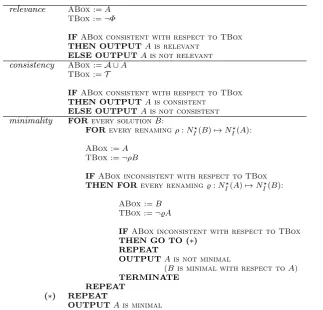
The procedure`ABox described in this section computesplain solutions to an ABox abduction problem. How to extend the basic method to also account for consistency, relevance and minimality will be discussed in Sections 4.2 and 4.3.
3.2 Transformation
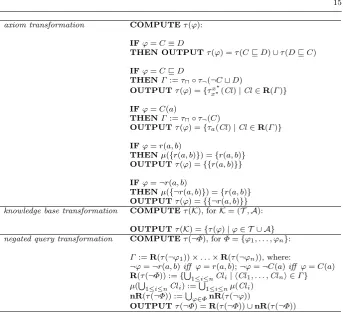
A complete transformation of DL formulas into the representation required by the ab-ductive procedure comprises translation intoNegation Normal Form of TBox axioms and concept descriptions in ABox assertions, followed by a reduction to Conjunctive Normal Form andflattening of the clauses, i.e. extraction of nested concept descrip-tions from quantification restricdescrip-tions. Finally, all the clauses are Skolemized, while their modal structure is recorded in a way which enables a faithful reconstruction of the Kripke models underlying the abductive proofs. Overall, we obtain an equisatis-fiable and structure-preserving transformation of the input DL formulas. The entire transformation procedure is summarized in Table 7, while in the following paragraphs we discuss its particular fragments.
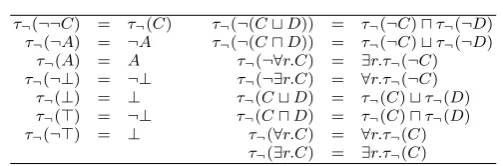
τ¬(¬¬C) = τ¬(C) τ¬(¬(CtD)) = τ¬(¬C)uτ¬(¬D) τ¬(¬A) = ¬A τ¬(¬(CuD)) = τ¬(¬C)tτ¬(¬D)
τ¬(A) = A τ¬(¬∀r.C) = ∃r.τ¬(¬C) τ¬(¬⊥) = ¬⊥ τ¬(¬∃r.C) = ∀r.τ¬(¬C)
τ¬(⊥) = ⊥ τ¬(CtD) = τ¬(C)tτ¬(D) τ¬(>) = ¬⊥ τ¬(CuD) = τ¬(C)uτ¬(D) τ¬(¬>) = ⊥ τ¬(∀r.C) = ∀r.τ¬(C)
[image:12.595.118.370.83.166.2]τ¬(∃r.C) = ∃r.τ¬(C)
Table 4 Negation Normal Form transformation.
τu(F1≤i≤nCi) = F1≤i≤nCi, for Ci∈ {L,∀r.P,∃r.P}
τu(Bt(CtD)tE) = τu(BtCtDtE)
[image:12.595.126.366.200.249.2]τu(Bt(CuD)tE) = τu(BtCtE), τu(BtDtE) τu(Bt ∀r.CtD) = τu(Bt ∀r.P?tD), τu(¬P?tC) τu(Bt ∃r.CtD) = τu(Bt ∃r.P?tD), τu(¬P?tC)
Table 5 Conjunctive Normal Form transformation with flattening of the axioms.
The NNF and CNF transformations of ALC concept descriptions, presented in Tables 4 and 5, are standard and do not require any comments. The flattening tech-nique, included in Table 5, is also a relatively common practice, used for instance in [41] and [23]. Under flattening the qualifying concept descriptions in the quantification restrictions are replaced with new predicate symbols, which are then related to the descriptions by means of separate GCIs. Such an approach is desirable for facilitating connection-driven construction of proofs, as given a flattened formula one obtains a direct access to all its literals at any depth. Figure 2 presents a small example of the transformation.
¬(Optimistt(Nihilistu ∃owns.Dog))tHappy ¬OptimisttHappy
¬Nihilistt ∀owns.P1tHappy ¬P1t ¬Dog
¬(∀watches.Comedy)tOptimist ∃watches.P2tOptimist ¬P2t ¬Comedy
Nihilist Nihilist Dog Dog ¬Happy ¬Happy
Fig. 2 Happy Johnproblem: NNF and CNF transformations and flattening.
The transformation of a concept description throughτ¬ andτu results in a set of
unions. With every such unionC=C1t. . .tCn we associate the clause comprising all its disjunctsCl ={C1, . . . , Cn}. Within any set of such clausesΓ we distinguish the subset of theirroots R(Γ), i.e. all those clauses that do not contain a literal ¬Pi for anyPi∈P, and the remaining subset of thenon-rootclausesnR(Γ).
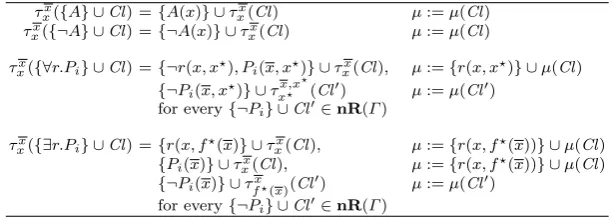
quantifica-tion restricquantifica-tions in the clause are replaced with the corresponding FOL expressions according to the standard translation, while the predicates are suitably Skolemized. During this process the modal structure of every clause, originally encoded in its quan-tification restrictions, is extracted and recorded as the so-calledmodal core µ of the clause, i.e. the graph describing role relationships between the terms occurring in the Skolemized clause. The modal cores of clauses are used later in the process of finding well-formed ABox solutions to abduction problems. The output of the transformation includes therefore a set of Skolemized clauses (so-called τ-clauses), each one accom-panied by its modal core. Observe, that in order to Skolemize flattened formulas in a
τx
x({A} ∪Cl) ={A(x)} ∪τxx(Cl) µ:=µ(Cl)
τx
x({¬A} ∪Cl) ={¬A(x)} ∪τxx(Cl) µ:=µ(Cl)
τx
x({∀r.Pi} ∪Cl) ={¬r(x, x?), Pi(x, x?)} ∪τxx(Cl), µ:={r(x, x?)} ∪µ(Cl) {¬Pi(x, x?)} ∪τx,x
?
x? (Cl0) µ:=µ(Cl0) for every{¬Pi} ∪Cl0∈nR(Γ)
τx
x({∃r.Pi} ∪Cl) ={r(x, f?(x)} ∪τxx(Cl), µ:={r(x, f?(x))} ∪µ(Cl) {Pi(x)} ∪τxx(Cl), µ:={r(x, f?(x))} ∪µ(Cl) {¬Pi(x)} ∪τfx?(x)(Cl0) µ:=µ(Cl0)
[image:13.595.91.399.218.328.2]for every{¬Pi} ∪Cl0∈nR(Γ)
Table 6 Skolemization and the modal core.
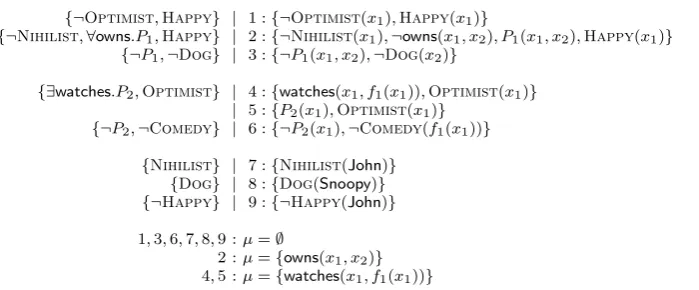
satisfiability preserving manner, the non-DL predicates have to be used for carrying over all universally bound variables into separated subformulas. The sequences of these variables are noted down as the superscripts of the transformation function. This way all Skolem functions that might possibly occur on the deeper levels of the nestings, obtain appropriate arguments. Since non-DL predicates uniquely identify the points of split, it is guaranteed that the connection can be established only in the original place and that all variables originally shared between a sub– and their superformulas will be fine-tuned by unification. An example of Skolemized clauses along with their modal cores is given in Figure 3.
Table 7 presents the complete procedure for computing theτ-transformation of the formulas that comprise the input of an ABox abduction problem, i.e. a knowledge base, consisting of TBox and ABox axioms, and the negated query. The latter case requires a slightly more elaborate approach, as the assertions in the query are implicitly connected by conjunction. The negation of the query is, therefore, equivalent to the disjunction of the negations of those assertions, which has to be properly reflected in defining the resulting root clauses and their modal cores.
{¬Optimist,Happy} | 1 :{¬Optimist(x1),Happy(x1)}
{¬Nihilist,∀owns.P1,Happy} | 2 :{¬Nihilist(x1),¬owns(x1, x2), P1(x1, x2),Happy(x1)} {¬P1,¬Dog} | 3 :{¬P1(x1, x2),¬Dog(x2)}
{∃watches.P2,Optimist} | 4 :{watches(x1, f1(x1)),Optimist(x1)} | 5 :{P2(x1),Optimist(x1)}
{¬P2,¬Comedy} | 6 :{¬P2(x1),¬Comedy(f1(x1))}
{Nihilist} | 7 :{Nihilist(John)} {Dog} | 8 :{Dog(Snoopy)} {¬Happy} | 9 :{¬Happy(John)}
1,3,6,7,8,9 :µ=∅
2 :µ={owns(x1, x2)} 4,5 :µ={watches(x1, f1(x1))}
Fig. 3 Happy Johnproblem: Skolemization and the modal core.
3.3 Tableaux and resolution-based abduction
Semantic tableaux [21] and resolution [5] are the two best known and most commonly used automated reasoning methods for FOL, with a plethora of refinements, optimiza-tion techniques and extensions to other logics available. In the following we explain the procedure of solving abductive problems based on application of two variants of the calculi:regular connection tableauxandresolution with set-of-support. Our approach di-verges from similar proposals presented in the literature [11, 32, 33, 1], which differently, refer to the standard tableau and linear resolution in addressing abductive inference. We assume acquaintance with the basics of both calculi and only briefly characterize them below in order to introduce the respective refinements.
Aclause tableau is a labeled tree, whose nodes are literals and whose root contains a set of clauses. The tree is developed by consecutive applications of thebeta expansion rule to the clauses. Each clause can be expanded only once on a branch. Whenever a branch contains complementary literals or the symbol ⊥, the closure rule can be applied. A tableau issaturated if no more expansion steps are possible. A treeT is a tableau refutation proof ofΦfromK, denoted asK `Φ, if the root ofT containsK ∪¬Φ
and all branches ofT are closed. Aregular connection tableauis a clause tableau, whose construction is restricted by the following conditions:
– Connectedness: A clause can be expanded on a branch only if it contains a literal that is complementary to the literal in the current leaf.
– Regularity: A clause can be expanded on a branch only if it does not contain a literal that already occurs on the branch.
[image:14.595.77.427.94.239.2]axiom transformation COMPUTEτ(ϕ):
IFϕ=C≡D
THEN OUTPUTτ(ϕ) =τ(CvD)∪τ(DvC)
IFϕ=CvD
THENΓ:=τu◦τ¬(¬CtD)
OUTPUTτ(ϕ) ={τx?
x?(Cl)|Cl∈R(Γ)}
IFϕ=C(a)
THENΓ:=τu◦τ¬(C)
OUTPUTτ(ϕ) ={τa(Cl)|Cl∈R(Γ)}
IFϕ=r(a, b)
THENµ({r(a, b)}) ={r(a, b)}
OUTPUTτ(ϕ) ={{r(a, b)}}
IFϕ=¬r(a, b)
THENµ({¬r(a, b)}) ={r(a, b)}
OUTPUTτ(ϕ) ={{¬r(a, b)}} knowledge base transformation COMPUTEτ(K), forK= (T,A):
OUTPUTτ(K) ={τ(ϕ)|ϕ∈ T ∪ A} negated query transformation COMPUTEτ(¬Φ), forΦ={ϕ1, . . . , ϕn}:
Γ:=R(τ(¬ϕ1))×. . .×R(τ(¬ϕn)), where:
¬ϕ=¬r(a, b)iff ϕ=r(a, b);¬ϕ=¬C(a)iff ϕ=C(a)
R(τ(¬Φ)) :={S
1≤i≤nCli| hCl1, . . . ,Clni ∈Γ}
µ(S
1≤i≤nCli) :=S1≤i≤nµ(Cli) nR(τ(¬Φ)) :=S
ϕ∈ΦnR(τ(¬ϕ))
[image:15.595.75.419.69.383.2]OUTPUTτ(¬Φ) =R(τ(¬Φ))∪nR(τ(¬Φ))
Table 7 Completeτ-transformation procedure.
if every resolvent has at least one parent that is (a factor of) a resolvent or (a factor of) a member of S. Table 9 presents the two inference rules used in resolution with set-of-support.3
In case of both methods we shall assume that the selection procedure for inference steps isfair, i.e. that no clause that can be potentially used in the proof is persistently omitted. We also require that all variables in a clause included to the proof are consis-tently renamed, in order to avoid unintended interactions with already used variables. Under certain conditions concerning the choice of the first clause to be expanded on the tableau and the choice of the set-of-support for resolution, which we highlight in Section 4, the calculi are sound and complete for FOL [21, 31]. As for now, let us take it for granted that in the context of abduction the choice of the negated abductive query as the initial clause or the set-of-support is sufficient to satisfy these conditions.
Both reasoning methods share some important formal similarities. First, they em-ploy a connection-driven proof strategy, which means that a clause can be included in a proof, constructed by any of the methods, only if it can be connected to it. More
{L1, . . . , Ln} ∈ K L1 .
.
. ... ...
¬L ¬L2 ⊥
L1 | . . . | Ln × ×
β−rule Branch closure
iff there exists an MGUσofLandLifor some
1≤i≤n, andσis applied to the whole tableau; for no 1≤i≤nthere isLion the branch above.
iff there exists an MGUσof L1 andL2andσis applied to
the whole tableau.
Table 8 Regular connection tableau rules.
Cl1∪ {L1} ∈ K Cl2∪ {¬L2} ∈S Cl∪ {⊥} ∈S Cl∪ {L1, L2} ∈S σ(Cl1∪Cl2)∈S Cl∈S σ(Cl∪ {L1})∈S
Binary resolution Factoring
iff there exists an MGUσofL1 andL2.
Table 9 Resolution with set-of-support rules.
specifically, a clauseCl∪ {L1(t1)}can be connected to an abductive proof through a literal L2(t2) occurring in that proof either as the leaf of an open branch or a literal in a resolvent only if there exists an MGUσ ofL1(t1) and¬L2(t2). As mentioned in the opening of this section, the proofs constructed according to such a strategy are typically structured in a more intuitive manner and involve less redundancy, in the sense of employing inference steps over clauses that are semantically irrelevant for the goal to be proved, and as such do not contribute to the proof. Second, both calculi are refutation proof systems. To prove that a certain conclusion is entailed by a set of premises one proves that the union of the premises and the negated conclusion is unsatisfiable. This characteristic makes both calculi especially attractive for abductive applications, allowing to identify all possible solutions of an abductive problem by at-tempting to construct a refutation proof for the negated abductive query, given the knowledge base.
Let us refer to a sample ABox abduction problemhK, Φi. Consider a borderline case when the query actually follows from the knowledge base. In such a situation there has to exist a refutation proof forKΦ, i.e. a closed tableau tree or a resolution deduction of an empty clause, initiated by¬Φ, with Kas the set of premises. Naturally, both calculi operate only on FOL clauses, therefore the input has to be provided under the
we clearly do not deal with a genuine abductive problem, as no additional formula is needed to entail the query. Otherwise, we can identify such formulas by analyzing the structure of possible partial proofs constructed by either of the calculi. Observe, that at every stage of a proof it is possible to construct a formulaAthat forces its completion by simply closing all open branches of the tableau or enabling derivation of an empty clause via resolution. The simplest way of constructingA is to pick literals that are unifiable with the complements of the leaves of open branches of the tableau, or with the complements of the literals comprising any of the resolvents, and connect them with the conjunction symbol. Such a formula would obviously complete the proofs of the query, and thus it could be seen as a solution to the translated problemhK, Φi, as obviouslyτ(K)∪A∪τ(¬Φ)` ⊥and thereforeK ∪AΦ. Since both calculi are sound and complete for FOL it is guaranteed that every such solution will be found at some point, provided it satisfies certain syntactic and semantic requirements. Eventually, we will be interested only in the formulas that can be translated back to the DLALE, so at this stage we callA only aFOL base of a solution to the original problemhK, Φi. The following definition gives the formal account of this notion.
Definition 3 (FOL-base of solution)LethK, Φibe an ABox abduction problem. A set of literalsAFOLis aFOL-base of a solutiontohK, Φiiff either of the following conditions holds:
1. (tableau): There exists a regular connection tableauT such that: (a) the root ofT contains all and only the clausesτ(K)∪τ(¬Φ), (b) T was initiated by expansion of some clauseClinit∈R(τ(¬Φ)),
(c) AFOL={¬L(t) |L(t)∈Cl}, whereCl is the set of the leaves of all the open branches ofT.
2. (resolution): There exists a sequence of resolution inference steps, with the re-sulting set of resolventsR, where:
(a) the initial set of clauses comprised all and onlyτ(K)∪τ(¬Φ), (b) R(τ(¬Φ)) was the set-of-support for that sequence,
(c) AFOL={¬L(t)|L(t)∈Cl}, whereCl is a resolvent inR.
As will be shown in Section 4 both conditions in fact coincide, hence both reasoning methods can be used interchangeably in the framework for ABox abduction.
3.4 Abductive proof constraints
In the context of FOL abduction one would typically applyreverse Skolemization[32] to the FOL-base retrieved from the proof in order to obtain an adequately quantified FOL formula solving the problem. Under this technique all free variables in a FOL-base get bound by existential quantifiers, whereas all Skolem terms are replaced by universally quantified variables. Thus the resulting formula can be immediately unified with the literals in the FOL-base and consequently force completion of the abductive proof.
to a particular term occurring in the proof [33]. This characteristic applies also to DLs and is handled in the framework for ABox abduction by means ofabductive graphs, which encode the relational structure underlying the proof of each FOL-base.
An abductive graph is a tuple G = (V, E), whose vertices are terms (variables, individual names, Skolem terms) and edges are labeled with role names. With every abductive proof and its FOL-base we associate a single graph, which describes the relationships between all the terms occurring in the proof. The modal meaning of the terms is implied by their syntax: variables represent individuals bound by some universal restriction, Skolem terms, by existential restrictions, while individual names stand for individuals that were not originally bound in the used clauses. The graph is initiated at the start of the proof, by including all role assertions occurring in the ABox of the problem, and later it evolves along the construction of the proof. On each inference step it is extended with new edges and vertices present in the modal core (Section 3.2) of the connected clause, under the substitution applied to the proof at that step. We formalize the notion of abductive graph by the following inductive definition.
Definition 4 (Abductive graph) Let hK, Φi be an ABox abduction problem and
AF OL a FOL-base obtained in an abductive proof forhK, Φi.
1. IfAF OLis derived from a clauseCl, such thatCl is the initial clause expanded on the tableau or one of the clauses in the initial set-of-support, thenG= (V, E) is the abductive graphassociated with the proof ofAF OLiff V ={a, b|r(a, b)∈E} andE={r(a, b)|r(a, b)∈ A} ∪µ(Cl), whereAis the ABox inK.
2. If AF OL is obtained by connecting a clause Cl to an abductive proof involving application of an MGUσ, andG0 = (V0, E0) is the abductive graph associated with that proof, thenG= (V, E) is theabductive graphassociated with the proof of
AF OLiff V ={a, b|r(a, b)∈E}andE=σE0∪σµ(Cl).
The abductive graphs, along with the associated FOL-bases, enable a sound recon-struction of ABox assertions from abductive proofs. Roughly, we will apply areverse relational Skolemization, thus reversing the effects of Skolemization in a similar way as in the FOL case, but instead of quantified FOL formulas we deriveALE assertions involving nested quantification restrictions over the role chains encoded in the graph. The expressive power ofALE delimits the scope of graphs that can be submitted to such a procedure. The notion ofALE-admissible graphreflects these limitations.
Definition 5 (ALE-admissible graph)GraphG= (V, E) associated with the FOL-baseAF OLisALE–admissibleiff the following requirements are satisfied:
1. for every Skolem termt1∈V there is a uniquet2∈V andr, such thatr(t2, t1)∈E, 2. for every Skolem term t∈V,tcan be only succeeded by a tree-shaped subgraph
inG, which does not contain individual names fromNI.
belong to these models, hence no names from NI can occur in such subgraphs. On the contrary to Skolem terms, relationships between named individuals and variables, which can be always replaced by new individual names in the process of reverse Skolem-ization, can take structures of arbitrary shapes, expressible via ABox assertions of the formr(t1, t2). Figure 4 presents an example of anALE–admissible graph that could be associated with some abductive proof.
• r ' ' P P P P p x1 • r $ $ H H H H H H a • s z z
vvvvvv r A A A A A A A A x3 • pnn77 n n r b
•x2
• p
w
w
nnnn rPPP'' P
f1(b) •
p
w
w
nnnn pPPP'' P f2(x3)
•
s
~~~~ r
33 3
f ... •
s
EEEsE""
x... •
r
|
|
yyyy 333s
x... •
s r
@@@@s
x...
•f ... •x... •f ... •x... •x... •f ... •f ... •f ...
Fig. 4 AnALE–admissible graph associated with an abductive proof: every Skolem vertex has exactly one predecessor and can be only succeeded by a tree-shaped subgraph containing no individual names.
Apart from discarding clauses associated with non-admissible graphs, we will also place restrictions on the FOL-bases, which are similarly inexpressible inALE.
Definition 6 (ALE-admissible base)LetAFOLbe a FOL-base obtained in an ab-ductive proof for an ABox abduction problem.AFOLisALE-admissibleiffit contains none of the following literals:
1. Pi(x) or¬Pi(x) for anyPi∈P, 2. r(t1, fi(t2)) for anyfi∈Fand anyr.
The first condition acknowledges impossibility of including non-DL predicates into DL assertions. The second one discards clauses that containr(t1, fi(t2)), a construct in-expressible in the DLALEafter reverse Skolemization. In fact the FOL-bases obtained through the procedure will only contain elements of the form:
1. A(t) or ¬A(t), where A ∈ NC and t is an individual name, Skolem term, or a variable;
2. r(t1, t2), wherer∈NR andt2is an individual name or a variable; 3. ¬r(t1, t2), wherer∈NRandt2is a Skolem term.
3.5 Solution retrieval
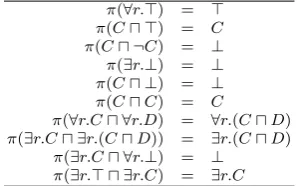
[image:19.595.121.379.183.287.2]applicable to them, and render them into DL axioms accordingly. To avoid syntactic ambiguity we will be referring only to the solutions in a certain normalized form. To this end we define a satisfiability preserving transformationπ, presented in Table 10, which removes redundancy fromALEconcept descriptions. For any concept descriptionCin ALE, we writeπ(C) to refer to a concept equivalent toC, whose all subconcepts are closed underπ. Further, if Ais a set of ABox assertions inALE, we will callA non-redundant if and only if for all concept assertionsC(a) ∈Ait holds thatC =π(C), and there is not more than one concept assertion inAper individual name.
π(∀r.>) = > π(Cu >) = C π(Cu ¬C) = ⊥ π(∃r.⊥) = ⊥ π(Cu ⊥) = ⊥ π(CuC) = C
π(∀r.Cu ∀r.D) = ∀r.(CuD) π(∃r.Cu ∃r.(CuD)) = ∃r.(CuD)
[image:20.595.170.319.202.295.2]π(∃r.Cu ∀r.⊥) = ⊥ π(∃r.> u ∃r.C) = ∃r.C
Table 10 Redundancy elimination from concept descriptions inALE.
The following definition introduces the notion of a `ABox-solution to an ABox abduction problem.
Definition 7 (`ABox-solution) LethK, Φibe an ABox abduction problem, AF OL anALE-admissible FOL-base obtained in an abductive proof forhK, Φi, andG= (V, E) anALE-admissible abductive graph associated with AF OL. A non-redundant set of assertionsAis a`ABox-solutiontohK, Φiiff it is semantically equivalent to a set of
assertionsA0 (i.e.AA0 andA0A) generated according to the following procedure:
1. A0:=AF OL
2. For every termt∈V with no successors inG, if it is a Skolem term or has a Skolem predecessor, getr(t0, t) fromE and begin:
(a) If t is a variable then add∃r.d{
C | C(t) ∈ A0}(t0) to A0 and remove every
C(t). In case there are noC(t)∈A0 add∃r.>(t0). Remover(t0, t) fromA0. (b) If t is a Skolem term then add ∀r.d
{C | C(t) ∈ A0}(t0) to A0 and remove everyC(t). In case there are noC(t)∈A0 but there is¬r(t0, t)∈A0 then add ∀r.⊥(t0). Remove¬r(t0, t) fromA0.
(c) RemovetfromV andr(t0, t) fromE.
3. For every (remaining) termt∈V with no successors inG, begin:
(a) Iftis an individual name then for everyC(t)∈A0 choose one option: – leave it unmodified
OR
– if there is r(t0, t) ∈ E add (∀r.C)(t0) to A0 and remove C(t). If t0 is a variable then instantiate it with a new individual name.
(b) Iftis a variable then choose one option:
– instantiatetwith a new individual name and consider it according to the previous rule
– if t has a unique immediate predecessor in G and r(t0, t) ∈ E then add ∃r.d{
C|C(t)∈A0}(t0) toA0and remove everyC(t). In case there are no
C(t)∈A0add (∃r.>)(t0). Remover(t0, t) fromA0. (c) RemovetfromV and everyr(t0, t) fromE.
Provided the requirements for admissibility of the FOL-base and its graph are satisfied, the procedure returns a proper set ofALEABox assertionsA0. Let us shortly comment on the consecutive steps of the retrieval procedure. Initially (1)A0 contains only concept and role literals. Note, that the former might be used only in simple concept assertions or as the qualifying concepts in quantification restrictions, whereas the latter, either in role assertions or implicitly in existential restrictions (positive role literals) or in the universal restrictions of the form∀r.⊥(negative role literals). First (2) we consider the tree-shaped subgraphs rooted at Skolem terms inG. We start with their leaves and move node by node up the trees. Assertions over variables are converted into existential restrictions on their respective predecessors (2a), while assertions over Skolem terms are translated into universal restrictions (2b). Once all Skolem terms are removed from the graph we consider the remaining individual names and variables, similarly, starting from the leaves of the graph and proceeding upwards (3). For every individual nametand every assertion C(t) one can choose between a solution, which usesC(t) directly or another one, in whichC(t) is replaced with (∀r.C)(t0), provided
t0 is anr-predecessor of tin G (3a). For every variable term t one has an option of treating it as a new “abduced” individual (3b’), or by considering it, like before (2a), as an individual entailed by an existential restriction placed on the predecessor of t, provided there exists a unique one (3b”).
3.6 Example
To illustrate how ABox abduction problems can be solved in the framework discussed in this section we will now present a small example of using the approach in handling the happy John problem hK,{Happy(John)}i. Recall the content of the problem’s knowledge base given in the introductory section and its transformation outlined in Section 3.2. For parsimony, we will compute parts of solutions using different calculi, though obviously both of them generate the same answers.
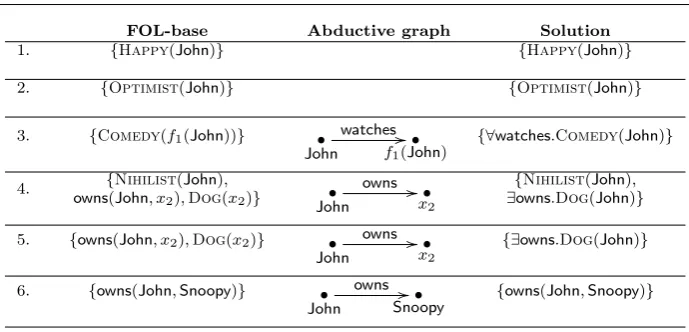
Figure 5 presents a regular connection tableau tree for the translated problem. Every subtree of the tableau with the root containing the clauses of the knowledge base and the negated query is a partial refutation proof for the query. The leaves of these subtrees surrounded by boxes form FOL-bases for proper ABox solutions, listed further in Table 11.
The resolution proofs for the query are included in Figure 6. Again, the resolvents printed in boxes give rise to FOL-bases of`ABox-solutions to the problem.
. . .
{¬Optimist(x1),Happy(x1)} :τ(K)
{P2(x2),Optimist(x2)} :τ(K)
{¬P2(x3),¬Comedy(f1(x3))} :τ(K)
1.¬Happy(John)
hhhhhhhhh
:τ(¬Φ)
Happy(John) ×
2.¬Optimist(John)
ggggggg Optimist(John)
×
P2(John)
gggggggggggg ¬P2(John)
×
3.¬Comedy(f1(John))
Fig. 5 Happy Johnproblem: tableaux proofs.
τ(K) set–of–support
τ(¬Φ) {¬Nihilist(x1),¬owns(x1, x2),
P1(x1, x2),Happy(x1)}
Z Z Z Z Z Z Z Z Z Z Z Z Z Z
Z 1.{¬Happy(John)}
{¬P1(x1, x2),¬Dog(x2)}
Z Z Z Z Z Z Z Z Z Z Z
Z {¬Nihilist(John),¬owns(John, x2), P1(John, x2)}
{Nihilist(John)}
Z Z Z Z Z Z Z Z Z Z Z Z Z Z Z Z
Z 4.{¬Nihilist(John),¬owns(John, x2),¬Dog(x2)}
{Dog(Snoopy)}
Z Z Z Z Z Z Z Z Z Z Z Z Z Z Z Z Z Z Z
Z 5.{¬owns(John, x2),¬Dog(x2)}
. . . 6.{¬owns(John,Snoopy)}
Fig. 6 Happy Johnproblem: resolution proofs.
[image:22.595.133.380.82.279.2] [image:22.595.80.412.347.505.2]FOL-base Abductive graph Solution
1. {Happy(John)} {Happy(John)}
2. {Optimist(John)} {Optimist(John)}
3. {Comedy(f1(John))} • John
watches //• f1(John)
{∀watches.Comedy(John)}
4. {Nihilist(John),
owns(John, x2),Dog(x2)} John•
owns // • x2
{Nihilist(John), ∃owns.Dog(John)}
5. {owns(John, x2),Dog(x2)} • John
owns //• x2
{∃owns.Dog(John)}
6. {owns(John,Snoopy)} • John
owns //• Snoopy
[image:23.595.72.417.78.244.2]{owns(John,Snoopy)}
Table 11 Happy Johnproblem: solutions.
4 Correctness and selection criteria
In this section we elaborate on basic formal properties of the introduced procedure. First, we prove its soundness and completeness with respect to the semantics of plain solutions to ABox abduction problems, as specified in Definition 2. Following this, we address the task of applying additional selection criteria to the generated sets of plain solutions, and further, the problem of correctness and termination of reasoning under the criteria. We consider two cases: a general one (Section 4.2), involving no syntactic constraints on the knowledge bases, and the case of acyclic terminologies (Section 4.3), for which stronger results can be obtained.
4.1 Soundness and completeness
Below, we formally argue for adequacy of the procedure for solving ABox abduction problems. In Theorem 3 we claim that every solution that is found by the procedure is indeed aplain solutionto the input problem. Conversely, Theorem 4 ensures that if
A is aconsistent andminimal solution to a given problem, then Awill be found via `ABox in a finite number of steps.
We start by recapping the results of soundness and completeness of the two calculi discussed in the paper.
Theorem 1 (Regular connection tableaux: completeness [21, Thm. 4.14], [22, Thm. 3]) If a finite ground clause set S is unsatisfiable then there is a regular connection tableau proof forS, in which a relevant clause4 Cl∈S is the first to which a beta rule is applied.
Proposition 1 (Regular connection tableaux: soundness) If there exists a reg-ular connection tableau proof for a set of ground clausesS thenS is unsatisfiable.
Proof The proposition follows immediately from soundness of the standard semantic tableaux calculus [21, Thm 3.12] and by observing that every regular connection tableau
proof is in fact a standard tableau proof.
Theorem 2 (Resolution with set-of-support: completeness [31, Thm. 3.2.2.]) IfS is an unsatisfiable set of ground clauses andT ⊆S such thatS\T is satisfiable then there exists a resolution refutation ofS with set-of-supportT.
Proposition 2 (Resolution with set-of-support: soundness) If there exists a resolution refutation of a set of ground clausesS with set-of-supportT ⊆S thenS is unsatisfiable.
Proof The proposition follows immediately from soundness of the standard resolution method [31] and by observing that every resolution with set-of-support proof is in fact
a resolution proof.
To simplify the layout of the following arguments we will entirely adopt the FOL perspective on the procedure and the involved DL formulas. In order to do so, we must acknowledge that due to the specific character of the employed calculi (Section 3.3), the
τ-transformation (Section 3.2), and the admissibility conditions (Section 3.4), reasoning in the framework can be seen as standard translation-based theorem proving forALC andALE, where the input is reduced to Skolem Normal Form, i.e. Conjunctive Normal Form of Skolemized formulas. Notice, that for any DL axiomϕ, the set of clausesτ(ϕ) closed under connection steps through the non-DL predicates, i.e. the set of all clauses that can be possibly constructed by pasting back each non-root clause to its original position marked by a non-DL predicate, is in fact equivalent to the setSN F(st(ϕ)), where st(ϕ) denotes the standard translation ofϕ. In the remainder of this section, unless specified otherwise, we will hence assume that all considered DL formulas are simply sets of Skolemized FOL clauses constructed exactly in such a way. In particular, for any ABox abduction problemhK, Φiand a solutionA, we will assume the following abbreviations hold:
K := SN F(st(K)) ¬Φ := SN F(¬V
st(Φ))
A := SN F(st(A))
Given the above conventions observe the following.
Proposition 3 Let Abe a set of ABox assertions in the DL ALE with the signature (NI, NC, NR). Then:
1. Every clause Cl∈Amust be of the form Cl=S
0≤i≤n{¬ri(ti, ti0)} ∪ {L(t)}, where
ri∈NR, for all1≤i≤n, andL∈ {A,¬A, r,⊥,>}for someA∈NC orr∈NR. 2. For every clause Cl∃r = S
0≤i≤n{¬ri(ti, ti0)} ∪ {r(tn0, tn00)} ∈ A, where tn00 is
a Skolem term, there exists at least one clause Cl∃.C ∈ A, such that Cl∃r \ {r(tn0, tn00)} ⊆Cl∃.C andL(tn00, t)∈Cl∃.C.
tn00 is a Skolem term then the literal r(tn0, tn00) inCl∃r must originate from an
ex-istential restriction. But then there has to also exist at least one more clauseCl∃.C containing the termtn00, which had to occur in the qualifying concept used in the same
restriction. By the style of the standard translation and the SNF transformation, one can see that this clause has to containCl∃r\ {r(tn0, tn00)}as its proper subset.
The proof of soundness is relatively simple. We demonstrate that if a`ABox-solution
AtohK, Φiis added to the abductive proof from which it had been retrieved, the proof has a continuation that succeeds, thus guaranteeing thatK ∪AΦ.
Theorem 3 (`ABox: soundness) If A is a `ABox-solution to the ABox abduction problemhK, ΦithenAis a plain solution to hK, Φi.
Proof Let hK, Φi be an Abox abduction problem and A a `ABox-solution to it. To demonstrate that A is a plain solution to hK, Φi we have to show that K ∪A Φ
(Definition 2). We rest on the soundness of regular connection tableaux and resolution with set-of-support (Proposition 1 and 2) and show there is a refutation proof for K ∪A∪ ¬Φ constructed with either of the calculi. Recall the form of clauses in A
from Proposition 3. Also, note that FOL-base AF OL of A must have contained all concept and positive role literals occurring in those clauses (except for >), plus the negative role literals preceding⊥, modulo reverse Skolemization of the terms involved (Definition 3 and 7). Focus on the abductive proof from whichA was retrieved, add
A to the set of premises and continue the proof. Consider one of the concept literals
C(s)∈AF OL(analogical argument will hold also for positive and negative role literals). Clearly there must be a clause in A, which contains the corresponding literal. Let Cl = {¬r1(t1, t10), . . . ,¬rn(tn, tn0), C(t)} be that clause (where we allow the set of
negative role literals to be empty). ConnectCl to the corresponding leaf on the tableau or to the respective resolvent viaC(t). Unification is naturally possible due to the style of reverse Skolemization involved in the reconstruction ofAfromAF OL. In particular, one of the following must be the case:
1. sis a variable: Thentmust be a Skolem term or an individual name.
2. sis an individual name: Thentmust be a variable or an individual name such that
s=t.
3. sis a Skolem term: Thentmust be a variable.
After includingCl in the proof, the connecting literal on the tableau or in the resol-vent is replaced by the sequence of literals{¬r1(t1, t10),¬r2(t2, t20), . . . ,¬rn(tn, tn0)}.
Notice, that every occurrence of such a literal was originally motivated by the presence of a corresponding edge in the abductive graph associated with the FOL-base of A
(Definition 4). Note also that for every 1≤i≤n, termti0 is a variable. Consider the
last literal ¬rn(tn, tn0). Clearly there must be an edgern(sn, sn0) in the graph such
thatsn0 is an individual name or a Skolem term, or otherwisetn0 would not have been
reversely Skolemized into a variable. Consider the following cases:
1. sn andsn0 are individual names: Then one of the following has to hold:
– There is a role assertion rn(sn, sn0) in the ABox, included in the graph by
default. Thenrn(sn, sn0) can be used as a connection to¬rn(sn, sn0).
– There is a role assertion rn(sn, sn0) in AF OL, and consequently in A. Then
2. sn0 is a Skolem term: Then there must be a clause Cl0 used in the same proof,
whose modal core contains rn(sn, sn0). Consider this clause. Notice that by the
definition of theτ-transformation (Table 6) eitherCl0containsr(sn, sn0) (sincesn0
is a Skolem term it has to originate from some existential restriction), or there is another clause that containsrn(sn, sn0), whose remaining literals belong toCl0. In
either case it is possible to use such clause in the proof, connecting it to¬rn(tn, tn0).
Again unification is possible due to soundness of reverse Skolemization. From that point on construction of the proof should mimic the inference steps that were used in the context ofCl0 in the same proof. Eventually, all literals from the connected clause must obtain the same connections as the ones fromCl0 and so this fragment of the proof, started with¬rn(tn, tn0), succeeds.
Repeat the argument for all remaining negative role literals and for all clauses in
A. Clearly the refutation proof has to succeed, resulting in a closed tableau tree or an empty resolvent, which shows that indeedK ∪AΦ.
The completeness result, presented in Theorem 4, holds under an additional re-striction, which reveals a certain limitation of the procedure. Namely, any consistent and minimal solution A to a problem hK, Φi is guaranteed to be found, only if ev-ery subconcept C occurring in the assertions from A, such that C 6= ⊥, is satisfi-able with respect to K, i.e. for which there exists a model of the knowledge base I = (∆I,·I) such that CI 6= ∅. Consider for instance the problem hK, Φi, where K={CvBu ¬B,∀r.(Du ¬D)vA}andΦ={A(a)}. The procedure will return solu-tion∀r.⊥(a), but will fail to output∀r.C(a), even though it clearly solves the problem, asK |=Cv ⊥. Nevertheless, the connectedness requirement makes it impossible to use the clauses fromCvBu ¬Bfor solving the problem, as they could not be connected to the proof starting from ¬A(a). As the use of unsatisfiable concepts other than ⊥ is practically always unintended in applications of Description Logics, we believe that this limitation does not diminish the pragmatic value of the procedure.
The proof of the result is more involved than that of soundness and requires ad-ditional formal machinery, which we now introduce. First, we assume that solutions to ABox abduction problems, which are under consideration in this section, are al-ways non-redundant in the sense defined in Section 3.5. For any non-redundant set of assertionsA under SNF transformation, we define an operationA\> ={Cl ∈A | >(t),¬⊥(t) 6∈ Cl}, i.e. an operation of removing from A all clauses containing the literal>(t) or¬⊥(t) for any termt. Now we note a simple observation.
Proposition 4 Let Abe a consistent solution to an ABox abduction problem hK, Φi. Any solutionB tohK, Φisuch thatB\>⊂A\> is minimal with respect toA.
Proof Observe that once all clauses containing symbol>are removed fromA, then any proper subsetA0⊂A\>is deductively weaker thanA\>, i.e.A06|=A\>. Any solution
B, such thatB\>⊂A\>, must be therefore deductively weaker fromAand therefore, by Definition 2, minimal with respect toA.
Let us recall the notion ofminimal unsatisfiabilityand present three lemmas, build-ing upon it, which will play a pivotal role in the followbuild-ing part.
Lemma 1 LetS be a MU set of ground clauses,A⊆S a set of unit clauses, and Cl any clause inS\A. The following claims hold:
1. There exists a regular connection tableau tree initiated with beta expansion of Cl , whose root is S\A, such that{¬L | {L} ∈A}is the set of the leaves of its open branches.
2. There exists a sequence of resolution inference steps fromS\Awith set-of-support {Cl}resulting in the clause{¬L | {L} ∈A}.
Proof 1. SinceCl is relevant inS, it follows from Theorem 1 that there exists a closed tableau initiated withCl, whose root containsS. Notice that if you remove any unit clause from A the proof cannot succeed, or else S would not be MU. Hence every clause fromAcontains a literal complementary to the leaf on (at least) one of the closed branches. Now ifAis removed from the root we get a tableau, for which{¬L| {L} ∈A} is the set of the leaves of its open branches.
2. SinceS\{Cl}is satisfiable, it follows from Theorem 2 that there has to be a resolution refutation ofS with set-of-support{Cl}. Assume now that Ais not present inS. We prove the claim of the lemma by induction on the cardinality ofA.
Consider|A|= 0. Then{¬L| {L} ∈A}is an empty clause. Clearly, derivation of such a clause in the specified setting is guaranteed by Theorem 2.
Assume that for somekand anyA, such that|A|=k, the clauseClS
¬A={¬L| {L} ∈ A}is derivable. Consider|A|=k+1 and letA=B∪{{L0}}, such that|B|=k. Assume {L0}is added to the set of premises. By inductive assumption it follows that the clause ClS
¬B={¬L| {L} ∈B}is now derivable. We argue that there exists a derivation of ClS
¬B in which the last inference step is resolution of {L0}against{¬L0} ∪ClS
¬B. First, note that{L0}is necessary for derivingClS
¬B or otherwise S would not have been MU at the first place. Therefore there has to be a clauseCl0∪{¬L0}against which {L0}has to be resolved, such that eitherCl0 =ClS
¬B, which would prove the point, orCl0 is further resolved against other clauses. But in the latter case it is possible to defer resolution of {L0} until Cl0 is first resolved. Switch the sequence of resolution steps in such a derivation and repeat the argument. Since derivation of ClS
¬B has to be finite, it follows that at some point one has to arrive at a sequence in which {¬L0} ∪ClS
¬B appears as the last clause to be resolved. But then there also exists a derivation ofClS
¬A, which is equivalent to{¬L0} ∪ClS
¬B.
Lemma 2 ([31, Lemma 2.3.2]) LetS be a MU set of clauses, let Cl0 be a subset of clause Cl ∈ S, and let S0 = (S\ {Cl})∪ {Cl0}; i.e. replace Cl inS with Cl0. Then every MU subset ofS0 contains Cl0.
Lemma 3 (MU set under a solution)LetAbe a consistent and minimal solution to an ABox abduction problemhK, Φi, such that except for⊥all subconcepts occurring in the assertions fromAare satisfiable with respect toK. There exists a finite MU set S =K∪A\>∪Q, where K ⊆ K and Q 6=∅ ⊆ ¬Φ, a ground substitution σ and a MU set of ground clausesσS, call it aMU set underA, which contains at least one instance of every clause fromS.
Proof By Definition 2 it holds thatK ∪AΦ, hence the setΘ=K ∪A∪ ¬Φis unsat-isfiable. By Herbrand’s theoremΘis unsatisfiableiff there exists a finite set of ground instances of Θwhich is unsatisfiable. Thus there must exist a ground substitutionσ
set must have a MU subsetσS. First we show thatσA\>⊆σS. Recall from Proposi-tion 3 two types of clauses that can occur inσA\>:Cl1=S
0≤i≤n{¬ri(ti, ti0)}∪{C(t)}
andCl2=S0≤i≤n{¬ri(ti, ti0)} ∪ {r(tn0, tn00)}. Suppose for some clauseCl1∈σA\>it
holds thatCl16∈S. This would mean that one can construct a solutionBwhich differs fromAonly in that C(t) is replaced with>(t) inCl1. But then, by Proposition 4, it would follow thatBis minimal with respect toA, which contradicts the assumed min-imality ofA. Suppose the same holds for some clause of typeCl2. One of the following has to be the case: a) iftn00 is not a Skolem term or there is no clause Cl∃2.C ∈σS,
whereCl∃2.C is defined as in Proposition 3, then a solution minimal with respect toA can be constructed, which contradicts the assumption; b) (else) iftn00is a Skolem term
and there is a clauseCl∃2.C ∈S, then A contains unsatisfiable subconcepts different from⊥, which is also not true by assumption. Observe that the literalr(tn0, tn00) does
not occur inσS, and hence, neither does¬r(tn0, tn00). Moreover, there cannot be any
other termt0 nor role r0 ∈NR such thatr0(t0, tn00) is inσS, as every Skolem term is
introduced by a unique existential restriction. Sincetn00 has no predecessors inσS, it
follows that neithertn00nor any of its successors inσScan occur inσQ. ReplaceCl∃2.C
inσS with ClC2 = Cl2∃.C \Cl2 (clauses corresponding to the qualifying concept C), and focus on the resulting MU set (Lemma 2). Repeat for everyCl∃2.C ∈σS. Eventu-ally no clauses fromσQcan be present in the resulting MU set. Since all clausesClC2 that remain in the set are rooted attn00, it is possible to render them back intoALE,
as a concept description C, which is clearly unsatisfiable with respect to K. Hence
σS = σK ∪σA\>∪σQ, where σK ⊆ σK and σQ ⊆ σ¬Φ. Moreover, σK ∪σA is satisfiable (by consistency ofA), henceσQ6=∅. ThereforeS=K∪A\>∪Q.
Finally, we demonstrate the proof of the main result. We first argue that for any solution one can find the corresponding FOL-base and its abductive graph and then we show that the solution retrieval method presented in Definition 7 effectively recon-structs the solution given such input.
Theorem 4 (`ABox: completeness) If A is a consistent and minimal solution to the ABox abduction problemhK, Φi, such that except for⊥all subconcepts occurring in the assertions fromA are satisfiable with respect toK, then A is a`ABox-solution to hK, Φi.
Proof Let A be a consistent and minimal solution to the ABox abduction problem hK, Φi. Consider a ground substitutionσand a MU setσSunderA(Lemma 3), where
σA\>⊆σSis a set of clauses containing at least one ground instance of every clause from A\> andσQ ⊆σS is a set of ground instances of ¬Φ. Obviously, there has to exist a refutation proof forσS, constructed with either of the calculi, initiated by some clause fromσQ. Given that, we show that there exists an abduction proof forhK, Φi, which is associated with the FOL-base AF OL and the graph G, such that σG is the graph associated with the refutation proof ofσS, and [σA\>] =σAF OL, where [σA\>] is the set of unit clauses obtained by pruning clauses fromσA\>.
1. FindingAF OL: Take a non-unit clauseCl=S0≤i≤n{¬ri(ti, ti0)} ∪ {L(t)} ∈σA\>
and consider two cases: 1) L(t) = ⊥(tn0): Since we assume A is non-redundant
there has to exist ¬r(tn, tn0) ∈ Cl (Table 10). Replace Cl in σS with the unit
clause Cl0 = {¬ri(tn, tn0)}; 2) L(t) 6= ⊥(tn0): Replace Cl in σS with the unit