City, University of London Institutional Repository
Citation
:
Petroulakis, N. E., Tragos, E. Z., Fragkiadakis, A. G. & Spanoudakis, G. (2013).
A lightweight framework for secure life-logging in smart environments. Information Security
Technical Report, 17(3), pp. 58-70. doi: 10.1016/j.istr.2012.10.005
This is the accepted version of the paper.
This version of the publication may differ from the final published
version.
Permanent repository link:
http://openaccess.city.ac.uk/5154/
Link to published version
:
http://dx.doi.org/10.1016/j.istr.2012.10.005
Copyright and reuse:
City Research Online aims to make research
outputs of City, University of London available to a wider audience.
Copyright and Moral Rights remain with the author(s) and/or copyright
holders. URLs from City Research Online may be freely distributed and
linked to.
City Research Online:
http://openaccess.city.ac.uk/
[email protected]
A Lightweight Framework for Secure Life-logging in Smart Environments
✩Nikolaos E. Petroulakisa, Elias Z. Tragosa, Alexandros G. Fragkiadakisa, George Spanoudakisb
aInstitute of Computer Science, Foundation for Research and Technology-Hellas, Heraklion, Greece
bSchool of Informatics, City University London, London, UK
Abstract
As the world becomes an interconnected network where objects and humans interact with each other, new challenges and threats appear in the ecosystem. In this interconnected world, smart objects have an important role in giving users the chance for life-logging in smart environments. However, smart devices have several limitations with regards to memory, resources and computation power, hindering the opportunity to apply well-established security algorithms and techniques for secure life-logging on the Internet of Things (IoT) domain. The need for secure and trustworthy life-logging in smart environments is vital, thus, a lightweight approach has to be considered to overcome the constraints of smart objects. The purpose of this paper is to present in details the current topics of life-logging in smart environments, while describing interconnection issues, security threats and suggesting a lightweight framework for ensuring security, privacy and trustworthy life-logging. In order to investigate the efficiency of the lightweight framework and the impact of the security attacks on energy consumption, an experimental test-bed was developed including two interconnected users and one smart attacker, who attempts to intercept transmitted messages or interfere with the communication link. Several mitigation factors, such as power control, channel assignment and AES-128 encryption were applied for secure life-logging. Finally, research into the degradation of the consumed energy regarding the described intrusions is presented.
Keywords: Smart Objects; Internet of Things; Life-logging; Security; Smart Environment; GNUradio
1. Introduction
In an interconnected smart world humans and devices inter-act with each other, establishing a smart environment in which the exchange of data and decisions is continuous. Smart de-vices and in general theInternet of Things(IoT) are considered to be one of the key elements of the 21st century. The Internet has given us the opportunity to enhance aspects of everyday life using computers, smart phones, social networks, etc. A Smart Environment can be considered as a digital ecosystem consist-ing of two layers: (i) the first one is the reality, involvconsist-ing com-munications between people, daily duties or entertainment; (ii) the second layer is the virtual life, in which humans and objects are interconnected to a local network (or the Internet) and their communication is achieved through various collaborating tech-nologies offering seamless connectivity. Decisions are taken by programmed devices or by users who have the capability to monitor, manage, adjust and interact with their automated smart environment.
The term smart object refers to small ubiquitous devices, such as sensors, actuators, RFID tags, smart phones and
embed-✩This submission is an extended version of our conference papers
”Life-logging in Smart Environments: Challenges and Security Threats” which ap-peared in the IEEE ICC-WS Conwire 2012 [1] and ”An Experimental Investiga-tion on Energy ConsumpInvestiga-tion for Secure Life-logging in Smart Environments” which appeared in the 17th IEEE Camad 2012 [2] and has been invited for the ISTR journal publication.
ded systems or any other type of objects that are equipped with “intelligence”. With the exception of modern smart phones, most smart objects have limited resources in terms of process-ing or computational power, available memory, storage, net-working capabilities, routing and energy. Furthermore, most devices are incompatible with standard networking protocols, which makes them susceptible to a number of security threats. Finally, smart objects are able to be internetworked with other devices, using either the IP or other non IP protocols.
One of the greatest challenges for future networks is the abil-ity of smart objects to get connected to a local network or the Internet under the IoT domain. The idea is transparent but faces many unresolved issues due to the different technologies of smart objects which try to interact with almost incompatible, but well-established networking technologies. One of the most important topics for the IoT is the need for connectivity with other networks and devices. The need to assign IP addresses in each of these devices is mandatory for many researchers and companies. IPSO alliance [3] has made a great effort to spec-ify the rules and the prerequisites for advocating the use of IP networked devices. However, the limited resources of smart ob-jects due to their design and tiny size makes it difficult to adopt well known protocols such as the TCP/IP.
communicate with other people or objects. The act of recording everyday life of people, their personal information and data and the process of exchanging this information with others through-out a network introduces the term oflife-logging. Although the term sounds new, it has been used since the old days, when peo-ple used to keep data and records about their lives’ experiences and manage them effectively. The life-logging procedure can be separated into a two-phase approach in which the first is the recording of personal data from devices (i.e. sensors and actua-tors) and the second is their uploading onto a virtual space such as a social network.
Life-logging in smart environments faces several challenges, with security being the most critical one. There are several se-curity issues regarding life-logging in an interconnected smart world due to the lack of efficient security standards for smart objects. Just as real-life networks encounter challenges in se-curity, privacy and trust, the same can occur in a smart en-vironment. Life-logging creates the possibility of disclosing things about someone’s life that should not be revealed. Secu-rity risks arise because of the lack of suitable secuSecu-rity protocols in smart devices. Smart objects have many security vulnera-bilities caused by their limited resources for supporting well-established cryptography and security algorithms. In an insuffi -cient security environment new lightweight approaches should be considered in order to overcome the lack of trust and privacy, thereby avoiding security dangers.
The issue of energy consumption for securing smart object such as wireless sensor networks (WSN) is an open challenge which has been discussed in bibliography in works such as [4, 5]. Experimental investigations concerning the energy con-sumption of WSN have been made on [6, 7]. Theoretical anal-ysis and simulation results for mitigating mechanisms to detect jam attacks in wireless sensors networks are presented in [8, 9]. Moreover, experiments for intrusion detection of jamming at-tacks and passive listening in 802.11 using software defined radios, are described in [10, 11, 12]. Finally, channel assign-ment based on energy detection and received signal strength in wireless networks are presented in [13]. The decrease of en-ergy due to the security protocols and the attempt to mitigate attacks from eavesdroppers, passive listeners and denial of ser-vices such as jamming attacks are critical points for research. To our best of our knowledge, the contribution of this research advances the state of the art by the development of an exper-imental test-bed including all the previous different described research areas. The setup consists of two users interconnected with their smart devices and one smart attacker, a software de-fined radios (SDR), whose main objective is to break any se-curity wall on the communication channel either as a passive listener or as a jammer. The investigation due to different secu-rity threats, need different types of mitigation techniques such as channel assignment, power control and encryption.
The remainder of this paper is organized as follows. In Sec-tion 2 we present the factors of life-logging in a smart environ-ment in which life-logging is applied to different technologies of smart objects to the IoT. In Section 3 we discuss the secu-rity challenges and vulnerabilities of life-logging in a smart vironment and we analyze the security challenges due to
en-ergy constraints of smart objects In Section 4 we suggest a lightweight framework consisting of the most important pillars to overcome the described security challenges. In Section 5 we present the experimental setup containing the communica-tion model of users, the attack model and the test-bed descrip-tion. In Section 6 we describe different experimental scenarios to measure and compare the energy consumption of life-logging in smart environments concerning different security threats. We conclude this paper in Section 7.
2. Life-logging in smart environments and the Internet of Things
In a modern ecosystem devices, buildings and people have the potential to create a smart environment using internal and external interfaces of various technologies. The importance of smart infrastructure in the context of smart cities has attracted several companies to develop initiatives such as the IBM’s vi-sion of Smart Planet [14] and the Smart+Connected Commu-nities of Cisco [15]. The structure of smart environments con-sists of three basic ingredients: (i) smart objects that interact with the environment, (ii) the interconnection of smart objects with the network; either the traditional Internet or the IoT, and (iii) the procedure of life-logging in this interconnected smart environment. The structure of the described smart ecosystem is depicted in Figure 1, consisting of a network infrastructure layer, an object ecosystem layer and an overlay layer.
Object Ecosystem Layer
Network Infrastructure Layer
3G LTE
RFID
Bluetooth
Barcodes
Ethernet 802.15.4
WiFi WiMax
PLC
non IP
4G IP
ZigBee
Internet of Things Life-logging
Internet domain
Overlay Layer
Figure 1: A life-logging smart ecosystem
2.1. Smart objects
The term smart objects was introduced for the first time by Neil Gershefelds in his articleWhen Things Start to Think
resources and a tiny microprocessor. Smart devices encompass innovations such as intelligent tags (RFID), sensors that mea-sure physical quantities and convert them into analog or digital signals (temperature, pollution, motions), actuators that control equipment and embedded devices that perform specific func-tions [17]. Furthermore, smart objects can be combined with mobile devices such as laptops, PDAs, mobile phones or smart-phones, as well as Bluetooth devices. In the Future Internet different wireless technologies (WiFi, 3G/4G, 802.15.4, RFID etc) or wired ones (ethernet, PLC) might interact and create a machine to machine ecosystem.
The most common communication technologies and proto-cols of smart objects transmit on the unlicensed spectrum. Blue-tooth (IEEE 802.15.1) is a standard normally used in mobile phones, in hands-free headsets for transferring data or as a re-placement of IrDA on remote controls. However, IrDA hard-ware is still less expensive and does not share the same se-curity problems encountered with wireless technologies such as Bluetooth. Wireless sensorsuse the IEEE 802.15.4 proto-col, which characterizes the Low Rate Wireless Personal Area Network (LR WPAN). ZigBee is an extension of 802.15.4 sup-ported by ZigBee Alliance [18], which enables the connectivity of the devices in a mesh network architecture and is able to sup-port thousands of sensors, in comparison to the normal IP-based protocols, which have a limited range. Low power IEEE 802.11 uses chips that are optimized for low power consumption, espe-cially when the device is on standby mode. Powerline Commu-nication (PLC) systems (IEEE 1901) exploit conductors used for electric power transmission for data transmission. Radio-frequency identification (RFID) technology includes a small RF transmitter and receiver, that usually operate at a low frequency and are mainly used for identifying or tracking objects [19].
There are two basic categories: the based and the non IP-based objects. The IP IP-based objects normally have high capa-bilities and are able to connect to the Internet by running op-erating systems and they only have energy and memory con-straints for supporting the TCP/IP protocol. Sensors have nat-ural limitations such as limited energy resources, low memory and processing capability, which make them difficult to provide full IP protocol stack support. For that reason, suitable OSs have been developed for tiny embedded systems and sensors with limited requirements such as Contiki, TinyOS and FreeR-TOS [20, 21, 22, 23]. For the connectivity and communication of non-IP objects, protocols, such as ZigBee [18] have been developed for short-range low-power and low bit-rate radios and sensors. Non IP-based devices such as RFID tags can be: (i) passive, which do not incorporate a power supply, because the electrical power induced by the reader is enough to trans-mit data, or (ii) active, which use their own battery for data transmissions [24]. The main disadvantage of the non IP-based sensors is the lack of network connectivity without the need of gateways
2.2. Interconnecting smart objects with the Internet of Things
One of the most important pillars of Future Networks is the
Internet of Things(IoT), which has attracted many supporters in
the research community and industry. The European Commis-sion has made a deal of great effort to fund project proposals, especially in the 7th Framework Programme, related to the IoT and Future Networks [25]. The termIoT was coined in 1999 by Kevin Ashton [26] with the vision of interconnecting previ-ously unconnected and isolated objects to the Internet. The IoT has the potential to be incorporated into the network devices with minimal capabilities like smart objects. Moreover, the IoT aims to connect not only things but also networks as well, cre-ating “networks of networks”. For instance, such a network of networks could be a small sensor network connected with wireless access points managed by a mobile smart-phone. Col-lected data can be added to a database, in which remote devices may interact. IoT is able to interconnect wireless sensor net-works, telemetry, embedded systems, mobile telephony, com-puter networking, mobile computing and ubiquitous computing [20]. There are two ways for a node to be attached to an IoT network: (i) by using a IoT gateway and (ii) by direct contact with other smart objects, using a communication interface such as ZigBee.
The three most important characteristics of IoT are: (i) the ability to instrument ordinary objects with a chip and a com-munication device, (ii) the interconnection capability, and (iii) a way to provide intelligent services. One critical challenge is to combine heterogeneous IP or non IP-based objects under the same network and connect them to the global Internet. The Internet Engineering Task Force (IETF) [27] and the IPSO Al-liance [3] with the support of companies such as Cisco, Erics-son, Oracle, Intel, Google and Motorola, aim to standardize IP (and more specifically IPv6) for embedded systems in order to homogenize heterogeneous smart objects. The incompatibility between smart devices and their supported technologies, espe-cially in different layers, leads to difficulties in their collabora-tion, as well as in their secure and trustworthy interdependence with their environment and logged in followers.
2.3. Life-logging
Start
19th
20th
80s 90s21st
Figure 2: Life-logging in history
The increasing amount of life-logged data and the need to integrate it has been one of the main issues of IoT in the last decade. Authors in [28] analyzed in 2004 the usage of life-logging activities for different applications and media such as sending and receiving emails, TV programs, GPS records, vis-ited web pages and photographs, focusing on the problem of combining life-log activities from different media types. A few years ago, someone could have only a couple of network-connected devices compared to today and the near future when each person will have access to and control quite more network-connected devices. The need to connect, manage and interact with a plethora of devices means having a life-account in which it is possible to connect to different applications and accounts. Social networks have attracted a great number of computer-connected users who share similar concerns, ideas, personal moments, photos, achievements, news and data. One step fur-ther is the possibility of managing these data in a centralized or a distributed base by interacting with the smart environment. There are a number of examples of life-logging on smart de-vices such as the use of smart phones to check emails, the key to unlock your car, the device to open your garage door or a RFID card needed to enter the entrance of an office or lab.
A life-logging experience of interacting with devices is a daily issue for a variety of people. The scenario of [29], in which a runner with a heart rate sensor and a pedometer, records his data and transfer them through his WiFi-connected iPod to a web database in which his friend have access, is not a future scenario but is already reality. The increasing use and need for personal smart devices such as sensors and actuators indoor or outdoor create the need to develop applications with which a user may interact under the prism of the IoT. Whereas a couple of years ago smart phones were not affordable for many people, they now have a widespread penetration into the market with a variety of developed applications with interconnected capabil-ities in different environments. A very interesting framework platform for Android phones has been developed by Google un-der the Tungsten Project with the nameAndroid at Home[30] in which IoT is applied for allowing individual users to log into their accounts and control their smart objects at home. Google’s next challenge is the addition of ”Android at Home” in Google Plus where life-logging in social networks will fulfill the inter-section with smart objects and the IoT.
3. Security threats in smart environments
Security is assumed to be one of the key issues of smart en-vironments. Not only is it critical for the connected devices and users but it is also dangerous for the gateways that are connected
to them. The issue for security and emergency response in mis-sion critical communications and infrastructure is always an im-portant topic especially for mobile ad-hoc networks [31, 32]. In addition, military applications, factories and industries, bridges, medical and health and environmental applications are some examples where security threats should be taken into consid-eration. Moreover, the widespread use of smart objects in the home environment endangers disclosing private data. For stance, a wireless installed camera, for recording possible in-truders, connected to an insecure home network could be a sus-ceptible threat to disclose the private actions of a family. The fast growth of life-logging applications and the potential for integrating them into smart environments mandated that secu-rity issues need to be addressed. Secure and trustworthy life-logging in smart environments involves challenges, risks and threats on the communication layer under the IoT and finally on the end-users who log on and interchange data with their smart objects.
The general concept of CIA triad (Confidentiality, Integrity and Availability) supported by [20] and [33] can be applied suc-cessfully for the security of smart environments.Confidentiality
focuses on keeping information private by encrypting it or en-suring that only the right people will have access to it.Integrity
confirms that data has not been modified. Integrity is achieved by the use of Message Integrity Codes (MICs) or Message Au-thentication Codes (MACs). Finally, availability, guarantees that information is available when it is needed.
3.1. Security vulnerabilities and attacks in smart objects and the IoT
Smart objects, particularly sensor networks, are vulnerable by their very nature because of the lack of security support in the primary design of low lossy networks. Their previous status did not face the need to ensure secure transmissions. Informa-tion about measurements such as temperature and humidity is not so attractive for attackers. Nevertheless, the rapid growth of system automation, the massive production of sensors and smart devices and their integration in the smart environments reveal security deficits and raises possible threats from mali-cious users. Security add-on features in an insecure design cannot replace the capabilities of a securely designed network. Moreover, the limited resources of smart objects in terms of memory, CPU and energy make the inclusion of add-on secu-rity features even harder.
in a secure or insecure communication channel and jamming attacks [33].
Security and privacyare critical points in sensors and actu-ators. A malicious node can easily intercept transmitted infor-mation or impersonate a receiver. Furthermore, privacy seems to be quite challenging because of the inability of the sensors to anticipate and sense possible eavesdroppers. If the messages exchanged between the nodes have a MIC in the headers and payload, it is impossible for an attacker to launch a success-ful impersonation attack but it is possible to become a passive listener or launch Denial of Service (DoS) attack. On the other hand, if the payload message is encrypted then a malicious node that has the encryption key can launch an impersonation attack but not to become a passive listener. The disclosure of sensi-tive information about the location, track and identity of a user may cause significant problems for him and his interconnected network and users.
Authentication is a very important issue that is missing in many objects. Trusted Platform Computing (TPM) imple-mented in laptops is difficult to be applied because of the lack of suitable cryptographic algorithms developed for lightweight smart devices. Moreover, lack of authentication, encryption or integrity on the interconnected objects raises serious consider-ations. The Transport Layer Security (TLS) protocol and the Secure Socket Layer (SSL) protocol appear to be efficient cryp-tographic solutions but they cannot be easily applied because of the resource-constraints of the smart objects. The low process-ing mechanisms for data minprocess-ing and services capable for au-thenticity, confidentiality and privacy of devices raise security issues and threats for revealing sensitive information to insecure devices and storages.
Low networking capabilities in bandwidth, throughput and data rate along with the minimal computation power for real time aggregations and buffering, which are needed for secure networking, make the smart objects susceptible to attacks at the network layer. At the MAC layer security issues occur due to collisions and channel occupations, which may disable trans-mission opportunities for some users, exhausting the batteries of the devices in parallel. At the physical layer jamming, DoS, traffic analysis, injection and tampering are very serious secu-rity threats for smart objects. Especially, the inability of many objects to acquire IP addresses makes them vulnerable to at-tacks (such as DoS) that in powerful IP hardware devices, run-ning efficient security protocols, can be avoided successfully.
Finally, the topology in a IoT multi-hop and multi-route domain is completely different that in the traditional Internet where service providers route and manage the traffic, avoiding malicious attacks and securing not only specific computers but also the whole network. These issues seem to be challenging for the IoT domains where there is no central control of the net-works. The lack of IP for a number of smart objects raises secu-rity issues on the routing protocols where black holes, spoofing, forwarding and sinkholes attacks are launched.
3.2. Security challenges due to limited resources and energy constraints of smart objects
The tiny capabilities of smart objects in terms of computa-tional power, memory and energy create difficulties in applying well-established security protocols. Smart objects and sensors are vulnerable to attacks because of the lack of security support in the primary design of low lossy networks. The most crit-ical factor for secure communication between smart objects is the required energy. Mechanisms for mitigating security threats result in consuming more energy form their already limited en-ergy resources. Nevertheless, if no security encryption exists, a malicious node can easily intercept transmitted information or impersonate a receiver. Furthermore, privacy seems to be challenging because of the smart objects’ weakness to antici-pate and sense possible listeners. However, the use of AES-128 (Advanced Encryption Standard) link-layer security mech-anism of IEEE 802.15.4 seems to have lightweight properties but the necessary time to encrypt and decrypt interchanging messages increases significantly the energy consumption. The encryption algorithm used in 802.15.4 is AES with a 128b key length (16 Bytes). Moreover AES algorithm is not only used to encrypt the information but to validate the sent data. This concept is called Data Integrity and it is achieved using a MIC (or a MAC) which is appended to the message. This code en-sures the integrity of the MAC header and the attached payload data. On the other hand, jamming attacks can be detected using suitable algorithms based on dropped packets or the decrease of the signal to noise ratio [35]. In order to mitigate such attacks, two possible solutions may be applied: (i) an increase in the power level or (ii) a channel assignment procedure as described in [36]. The use of both mitigating factors severely affects the energy consumed in smart objects, as will be described exten-sively in the next sections.
3.3. Risks and security issues of life-logging
The trend of life-logging encounters a number of security is-sues which need to be resolved in order to step forward into the interconnected world and the Future Internet. To highlight the benefits and the risks of life-logging, authors in [32] present a future scenario in which they detail benefits, challenges, risks and threats of life-logging in real life. The scenario occurs in 3-5 years from now when the members of a family live in an integrated smart world in which life and objects have acquired a stable and tailored relationship. Several possible risks and threats are depicted in this scenario involving life-logging in a variety of activities, services and devices. Social networking, as a part of their lifestyle and as a tool for socializing or for work, has substantially enhanced the virtual reality in a cyber space world.
one, is believed to be one of the most serious threats for most people. Such an incident could enable an attacker to gain ac-cess to a person’s accounts, starting from his social networking profile or emails, up to his bank account.
Life-logging from a computer or a laptop on to the Internet differs from life-logging in a smart environment because of the unsolved security threats which occur in the unsafe smart en-vironments. Secure life-logging in smart environments is rela-tively straightforward compared to the security of smart objects and the IoT. As discussed in previously, there are many vulner-abilities in a heterogeneous ecosystem in which every device faces different challenges in security and privacy. The discrep-ancy between technologies and the attempt to interconnect them have brought new security challenges and gaps which need to be filled.
4. Defining a lightweight framework
The increasing trend for the addition of life-logging appli-cations into the smart environment and the discussed security threats require efficient countermeasures to ensure security, pri-vacy and trustworthiness in life-logging applications. The key way to overcome these constraints is the development of a lightweight framework for ensuring security, privacy and trust-worthy life-logging in smart environments. We describe the basic pillars of this framework including the use of lightweight versions of IP protocols, privacy by design and cryptography.
4.1. Lightweight IP protocols for securing smart objects
Security threats in life-logging under a smart environment and the IoT occur mainly because of the lack of suitable secu-rity protocols. Considering smart objects’ limited capabilities, proper algorithms and techniques need to be implemented in order to achieve maximum security and privacy. The IPSO Al-liance advocates the use of the IP protocol for establishing a secure exchange of data. In order to achieve security in smart objects, the IPv6 over Low power Wireless Personal Area Net-works (6lowPAN) protocol is proposed [38]. Smart objects are able to connect throughout the lightweight 6lowPan protocol which gains its advantage from the use of AES-128 link-layer security mechanism of IEEE 802.15.4. However, the IP frag-mentation allows the use of available buffer from malicious users to send large or invalid packets. Even if in the trans-port layer 6lowPAN is shown to have efficiency, in the network layer, Internet Protocol Security (IPsec) and Secure Neighbor Discovery (SEND) appear to be more suitable to attain network security in IPv6 [39]. Authors in [40] suggest a security adap-tation layer to overcome security issues when connecting the IoT network to the Internet. The adaptation layer is based on one similar to the 6lowPAN concept or IPv6 in which gateways connected to different domains are able to translate standard IP security protocols to domain-specific protocols variants.
4.2. Lightweight design for ensuring privacy
Privacy is a major concept of life-logging especially in inse-cure smart environments in which a variety of data from users
and devices are exchanged and collected. The massive produc-tion and transfer of sensitive data such as personal photos, mes-sages and videos encounter the danger of disclosure. In order to ensure privacy on smart environments the principles of privacy should be applied in a lightweight privacy by design approach. The basic principles for ensuring privacy in smart environments of life-logging are detailed in [41]:
• Opennessis established when recorded data are
transpar-ent and no secret data are stored.
• Participation of Individualsensures that records are
avail-able to them.
• Limits of Recorded and Appropriate Datahave to be
as-signed for specific applications.
• Data Qualityof recorded data should be related and
accu-rate to the application.
• Limits of Useindicates that records should be used only by
authorized users and for an assessed purpose.
• Personal data should beSecured Appropriatelyon storage
devices.
• Accountabilityof record keepers has to be ensured.
• The last principle which should be emphasized is
Aware-nessfrom the user point of view.
Since privacy is not a convenient issue to be resolved, espe-cially in smart environments, the principles of privacy should be implemented under an international framework and stan-dards. Smart environments (more precisely the IoT) should be designed under the concept of Privacy by Design (PbD) defined by Ann Cavoukia [42] who suggested that privacy should be embedded into the design of technologies ensuring privacy and control over one’s information and not solely by compliance with regulatory frameworks.
4.3. Lightweight cryptography for trustworthy life-logging in smart environments
for some nodes to store footprints in memory and run cryp-tographic algorithms, it is crucial the low-power and low-cost devices to embed applications instead of hardware circuitry be-cause of the limited resources of smart objects. Symmetric and asymmetric key cryptography can apply lightweight properties for trustworthy life-logging in the IoT.
Symmetric Key Cryptographycan be separated into three cat-egories: (i) block ciphers, (ii) stream ciphers and (iii) hash func-tions. Block ciphers with lightweight properties have been pro-posed for AES and Data Encryption Standard (DES) such as CLEFIA [44] and PRESENT [45]. Stream cipher algorithms with lightweight properties have been proposed and developed in the ECTRYP II eSTREAM portfolio [46]. The hash al-gorithm SHA-3 [47] do not satisfy lightweight requirements. Lightweight hash functions are possible to construct based on lightweight block ciphers.
Asymmetric Key Cryptographyis difficult to be implemented because the amount of data for public key cryptography in smart objects is much larger than in symmetric key cryptography. Ef-ficient security such as Rivest Shamir Adleman (RSA) and El-liptic Curve Cryptography (ECC) cannot be implemented ef-ficiently in smart objects because of the limitations for storing additional footprints. ECC is more likely to be implemented be-cause of its smaller operand lengths and relatively lower com-putational requirements [48]. Nevertheless, it is possible to im-plement public key cryptography in smart environments but it is difficult to execute in reasonable time.
Considering the major need for authentication and authoriza-tion for users and devices in smart environments, cryptography will always be a challenge. Well-established or new algorithms may well have to be implemented efficiently in order to over-come the limitations of smart objects with lightweight capabil-ities. However, as strong as the cryptographic algorithms are, they will never get over the vulnerability of an insecure or inex-pert user with a lack of basic security and privacy precautions.
5. Experimental investigations on energy consumption for secure life-logging
To investigate the impact of security attacks on energy con-sumption, an experimental test-bed was developed. The topol-ogy of the model consists of three users: (i) Bob, (ii) Alice and (iii) Eve. Bob and Alice are interconnected each with a smart device. The life-logging procedure is applied to their communication in which they share data, personal preferences and habits. The transmitted information may be sensitive, like security codes or personal data and secrets. Under this com-munication model, an attacker (Eve) appears to have as main target to break any available security wall and steal users’ per-sonal data or destroy the communication.
5.1. Test-bed description
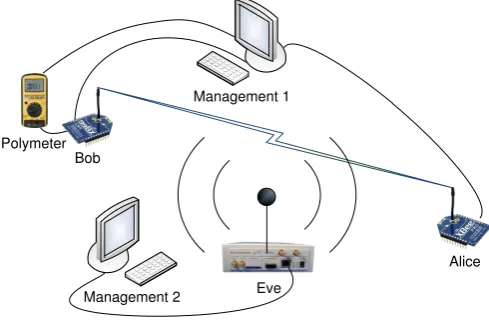
The test-bed contains three users each one equipped with a smart device. Bob and Alice are connected each with a Digi XBee Pro 802.15.4 device [49]. Both devices are connected (through their serial cable) with Matlab 2011b on a Windows
XP management server. Suitable algorithms have been devel-oped in order to satisfy the communication model. To measure the energy consumption of XBee a True-RMS polymeter with USB output was used for storing the current measurements of each experiment connected serially with Matlab as well. Eve is a malicious user which acts as an eavesdropper or as an attacker. This node is emulated with a Universal Software Radio Periph-eral (USRP2) device from Ettus Research LLC [50] holding a XCVR2450 Dual-band Transceiver interchangeable daugh-terboard module that serves as the RF front end. The GNU Radio 3.3 software is installed for creating complex software-defined radio systems [51]. The GNU Radio software is in-stalled on a Ubuntu 11.04 which manages the attack node. The IEEE 802.15.4 PHY implementation as well as UCLA Zigbee [52] GNU Radio extension was installed to capture and decode 802.15.4 messages. Jamming attacks are implemented using GNU Radio signal generator. Finally, the attacker model al-gorithms were implemented by the use of shell scripts. The described test-bed topology is depicted in Figure 3.
Eve Management 2
Management 1
Alice Polymeter
[image:8.595.309.554.330.493.2]Bob
Figure 3: Test-bed topology
5.2. Energy consumption calculator
BOB ALICE
Assign Default Options (Low Power Level, Channel, no AES
encryption)
Dropped
Packets No
Yes
Decision
Change Assigned
Channel Change
Power Level
Increase Powel Level
Scan energy detection channels
Send Agreement to ALICE
AES-128 Security
Channel Assignment
Yes No
Assign Pre-shared AES-128 key
Assign Default Options (Low Power Level, Channel, no AES
encryption)
Assign Agreement from BOB Transmit/ Receive Data Transmit/
Receive Data
Assign Pre-shared AES-128 key Channel
Assignment Assign Powel
Level
[image:9.595.46.563.85.338.2]Verify Agreement
Figure 5: The communication flowchart model
Figure 4: Consumed energy calculator
5.3. Communication model
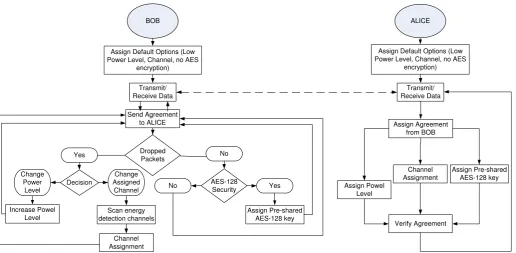
The main concept of this model focuses on mitigating se-curity threats and attacks. In the specific model Bob acts as the coordinator and Alice as the end-user. In the first phase of the process, Bob and Alice assign the default identical options in power level and transmission channel without any security in order to consume the minimum amount of energy. When they start to interchange messages, if they anticipate dropped packets, they increase the power level to mitigate the issue. Power level cannot totally solve the problem if an attacker ap-plies severe jamming attacks or if the channel is occupied by another transmission. For that reason Bob applies an energy
detection scan to detect the most energy-free channel, inform-ing Alice about the new channel. If an attacker exists, then he may identify the new communication channel, starting to jam the new channel. Bob will continue to apply energy detection techniques every time there are dropped packets until the users interchange the number of data they have to. This procedure in-corporates the danger of disclosing personal data if there is no security on their transmission if an eavesdropper exists. Bob, being the coordinator, decides to enable the AES encryption on their data. So he requests Alice to enable the security option decrypting their messages with a pre-shared AES-128 key. The necessary computational power to decrypt and encrypt mes-sages delay the procedure therefore the time to exchange the same number of messages is greater, increasing the required amount of energy. If the attacker cannot decode the messages, he will again start to apply jamming attacks causing dropped packets. Power level and channel assignment procedures will have to be followed again in order to mitigate the attack. These communication model scenarios, as described, are presented in Figure 5.
5.4. Attacker model
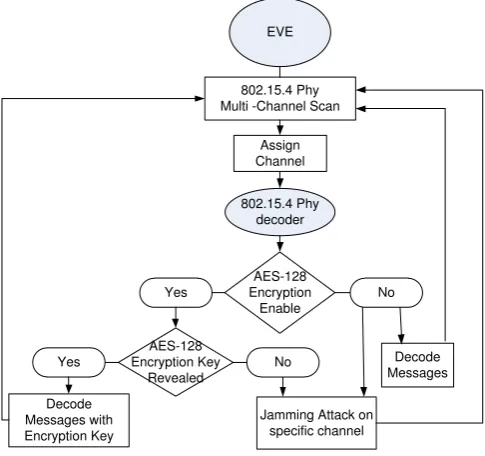
the communication between the users is without any AES-128 encryption, so the attacker is able to decode encrypted mes-sages. The second case is when Bob and Alice share a prede-fined AES key. In this scenario if the attacker has stolen the shared key, she is able to decode the messages. If she does not hold the key, she can destroy the transmission by apply-ing a jammapply-ing attack on the specific channel. When Bob and Alice anticipate a jamming attack, they change channel. In this case the attacker applies a multi-channel scan until she finds the transmitted channel. Finally, a malicious person can always ap-ply jamming attacks independently whether there is encryption or not. Figure 6 depicts the flowchart model of the attacker.
EVE
AES-128 Encryption Enable Yes
AES-128 Encryption Key
Revealed Yes
Decode Messages with Encryption Key
Jamming Attack on specific channel 802.15.4 Phy Multi -Channel Scan
Decode Messages Assign
Channel
802.15.4 Phy decoder
No
[image:10.595.42.285.242.470.2]No
Figure 6: The attacker flowchart model
6. Performance evaluation
In this section the results from real experiments analyzing the security risks and emphasizing the energy consumption are presented. Different scenarios are presented in which the en-ergy consumption is measured. The main concept involves the exchange of information and data between Alice and Bob ei-ther insecure or secure. The case in which a smart attacker (Eve) tries to steal exchanging data or to destroy the traffic, is investigated. Three different scenarios are presented to prove the vulnerabilities based on the energy consumption of diff er-ent attack models. The maximum packet size in IEEE 802.15.4 standard (including the frame overhead which is 25 bytes) is 127 bytes or 102 bytes maximum data length [53]. Therefore, in the following experiments Bob sends to Alice 1000 packets of 102 bytes data length. The polymeter stores electric current and these values are used as the main measurements for this in-vestigation. The power consumption is measured in watts (1) and in watt-hour (2).
P=V I. (1)
W H=
Z t
0
V Idt=
n X
i=1
1
2(ViIi+Vi−1Ii−1)(ti−ti−1). (2)
Where P is the consumed electric power in Watts, WH is the consumed electric power Watt-Hour, V is the Voltage, I is the consumed Current and t is the time.
6.1. Transmission without attack
The first phase of this scenario includes the communication between Bob and Alice without any security encryption focus-ing on the power consumption on different power levels for each smart device. Bob transmits a packet to Alice who returns it back. The counter calculates the number of transmitted packets over the received ones. When there are dropped packets due to the distance of the users, the power level is increased. When there is a successful transmission Bob sends a new message to Alice. This scenario is applied to show the basic commu-nication model. Under this model Eve is able to decode the exchanged messages as was described in the previous section by using the 802.15.4 PHY extension. Even if the users spend the minimum of the energy on this experiment the communi-cation involves many security and privacy issues. Under this scenario an energy consumption investigation was carried out, measuring the different power levels of the modules.
The second phase of this scenario occurs when Alice and Bob become aware of the security level of their communica-tion. They decide to decode their messages using AES-128 cryption. The result of exchanging information with AES en-cryption is the delay of transmitted data. This can be explained because of the limited computational power of XBee to encode and decode messages. The comparison of Figure 7a and 7b shows that the required time to transmit the same number of packets is 36% greater when AES encryption is enabled.
0 20 40 60 80 100 120 140 160 180 300
320 340 360
mW
sec (a) without AES Encryption
0 20 40 60 80 100 120 140 160 180 300
320 340 360
mW
sec (b) with AES Encryption
Idle Power Level 0 Power Level 1 Power Level 2 Power Level 3 Power Level 4
Figure 7: Energy consumption for different power levels (a) without AES en-cryption and (b) with AES enen-cryption
6.2. Channel assignment on jamming attack
[image:10.595.310.557.492.632.2]2.4GHz which shares the same band as the popular 802.11. The users apply the previously described communication model, in which, when dropped packets are anticipated, an energy detec-tion process for finding the most suitable energy-free channel is executed. The attack model of Eve will observe that there is no transmission on the previously occupied channel but a new channel has been assigned. The next step is to detect the new channel and continue the attacks on the new channel. This loop will continue until Bob and Alice complete the number of pack-ets that they want to transmit.
[image:11.595.308.556.80.221.2]The second phase on this scenario describes the case in which Alice and Bob exchange messages with AES encryption. Since it is not possible for Eve to listen and decode interchanging messages her efforts focus on destroying the communication link. For this purpose a jamming attack is launched. This phase follows the same procedure as the first phase of this scenario but there is more delay for the transmission of 1000 packets be-cause of the computation time to decrypt and encrypt messages. Figure 8 presents the comparison of energy consumption with-out and with AES encryption on different power levels.
0 50 100 150 200 250 300 350 400
280 300 320 340 360
Channel assignment on jamming attack without AES encryption
mW
sec
0 50 100 150 200 250 300 350 400
280 300 320 340 360
Channel assignment on jamming attack with AES encryption
mW
sec
Power Level 0 Power Level 4
Figure 8: Energy consumption: channel assignment on jamming attack (a) without AES encryption and (b) with AES encryption
6.3. Power increase and channel assignment on jamming at-tack
The third scenario is similar with the previous scenario but the coordinator is able to execute an increment in the power level when there are 10 dropped packets on their devices. If the problem of dropped packets continues, a channel assignment procedure is applied. The gradual increase in the power level and the channel assignment procedure result to higher energy consumption. As the power increases, the energy consumption becomes higher. If the level of power reaches its maximum value, the coordinator applies a channel assignment. When the new channel is assigned, the power level is decreased to its min-imum value. In Figure 9 the energy consumption on jamming,
0 50 100 150 200 250 300
300 310 320 330 340 350 360
mW
sec
no−AES AES
Figure 9: Energy consumption: power increment and channel assignment on jamming attack (a) without AES encryption and (b) with AES encryption
[image:11.595.321.536.338.507.2]with and without AES encryption, is depicted. The graph shows the gradual increment of power until the nodes reach the max-imum power level; so a new channel assignment is occurred decreasing the transmission power level to the minimum level in parallel.
Figure 10: Energy consumption in milliWatt-Hour for different power levels (PL) of the three scenarios
6.4. A comparison of the experimental results
[image:11.595.39.289.339.551.2]This final conclusion proves the value of this research concern-ing the correlation of security in addition with the energy con-sumption.
6.5. Evaluation of the experiments and future work
The experimental evaluation of this study has shown many valuable conclusions. The limited capabilities of smart devices severely affect the performance of the security framework. Es-pecially the limitation in energy is assumed to be one of the most important issues for the smart objects especially if they run over batteries. The chosen method, measuring the electric current, proved to be the most proper and simpler way to mea-sure the energy consumption. This method includes all the pa-rameters which affect the performance of devices. Single mea-surements such as monitoring the CPU usage or memory use cannot reflect exactly the total consumed energy of the mod-ules. Therefore, the developed setup was necessary in order to measure the consumed energy.
This research work has proved the prior assumption concern-ing the impact on energy consumption in smart objects due to different security mechanisms such as power control, encryp-tion and channel assignment to mitigate passive listening and jamming attacks. Even if the experiments were done for spe-cific devices such as XBee Pro, the same architecture can be used in order to measure energy consumption for a variety of different devices which mitigate attacks. The percentage of the effect may vary but the consumed energy will be increased. Nevertheless, the results are relative not only to the assigned parameters but also to the test-bed setup which is affected by the software used, operating systems and algorithms and the at-tempt to interconnect the plethora of different devices, software and algorithms. Much time was spent in the development of the communication model, the attacker model and the test-bed in order to be able to evaluate real experimental results. How-ever, the development of such a setup will give the potential for further investigation, experiments, using a variety of different devices so as to construct a lightweight, energy efficient frame-work for secure life-logging in smart environments.
7. Conclusion
In this paper the topic of life-logging in smart environ-ments was presented, giving details about the smart objets and their potential for interconnection in the Internet of Things do-main. The plethora of smart objects and their connection with life-logging applications have raised new issues and security threats. Security challenges appear due to the lack of suitable security mechanisms and protocols in the Internet of Things be-cause of the limited resources of smart objects. To overcome considerations in security, privacy and trustworthy life-logging, a lightweight framework was described. Furthermore, an ex-perimental investigation on the energy consumption for secure life-logging in smart environments was described. The grow-ing development of smart devices and their broad use by users has lead to new security challenges including not only secu-rity issues but in privacy as well. One of the most important
restrictions in securing the communication on these devices is the limited resources. Under these conditions a communication model, an attacker model and an experimental test-bed were developed to investigate the consumed energy under different scenarios. The specifications of the users were defined in order to be able to mitigate eavesdropper’s attacks of passive listeners and jamming attacks. The research has shown there is a great influence on the energy consumed to secure such attacks. A smart attacker was designed to break any security walls of such a communication. The conclusions of this investigation have shown weaknesses in this situation, increasing the need to se-cure life-logging in smart environments while overcoming the energy constraints.
References
[1] Nikolaos E. Petroulakis, Ioannis Askoxylakis, and Theo Tryfonas. Life-logging in Smart Environments: Challenges and Security Threats. Inthe 2012 IEEE ICC Workshop on Convergence among Heterogeneous Wire-less Systems in Future Internet (ConWire), Ottava, Canada, June 2012. [2] Nikolaos E. Petroulakis, Elias Z. Tragos, and Ioannis G. Askoxylakis.
An Experimental Investigation on Energy Consumption for Secure Life-logging in Smart Environments. Inthe IEEE International Workshop on Computer-Aided Modeling Analysis and Design of Communication Links and Networks (CAMAD), Barcelona, Spain, September 2012.
[3] IPSO Alliance. Enabling the Internet of Things, www.ipso-alliance.org, 2011.
[4] E Shi and A Perrig. Designing secure sensor networks.Wireless Commu-nications, IEEE, (December):38–43, 2004.
[5] David Boyle and Thomas Newe. Securing wireless sensor networks: se-curity architectures.Journal of Networks, 3(1):65–77, 2008.
[6] RSJ Reyes, JC Monje, and MEC Santos. Implementation of Zigbee-based and ISM-based wireless sensor and actuator network with throughput, power and cost comparisons. WSEAS TRANSACTIONS on COMMUNI-CATIONS, 9(7):395–405, 2010.
[7] Javier Alonso and Sergio G´omez. Experimental Measurements of the Power Consumption for Wireless Sensor Networks.Internal Report UPC, June, pages 1–14, 2006.
[8] Incheol Shin, Yilin Shen, Ying Xuan, MT Thai, and T Znati. Reactive jamming attacks in multi-radio wireless sensor networks: an efficient mit-igating measure by identifying trigger nodes.FOWANC09, pages 87–96, 2009.
[9] V. Bhuse, a. Gupta, and a. Al-Fuqaha. Detection of Masquerade Attacks on Wireless Sensor Networks. 2007 IEEE International Conference on Communications, pages 1142–1147, June 2007.
[10] E Bayraktaroglu, C King, and X Liu. On the Performance of IEEE 802.11 under Jamming.Infocom/08, 2008.
[11] Liran Ma, AY Teymorian, and Xiuzhen Cheng. Passive listening and intrusion management in commodity wi-fi networks. GLOBECOM’07. IEEE, 2007.
[12] Alexandros G Fragkiadakis, Elias Z Tragos, Theo Tryfonas, and Ioan-nis G Askoxylakis. Design and performance evaluation of a lightweight wireless early warning intrusion detection prototype. EURASIP Journal on Wireless Communications and Networking, 2012(1):73, 2012. [13] VA Siris and M Delakis. Interference-aware channel assignment in a
metropolitan multi-radio wireless mesh network with directional anten-nas.Computer Communications, 2011. Query date: 2012-10-13. [14] IBM. Smart Planet, http://www.ibm.com/smarterplanet.
[15] Cisco. Smart+connected communities, changing a city, a country, the world, 2010.
[16] N. Gershenfeld.When Things Start to Think. Owl Books, 2000. [17] P. Wetterwald. Promoting the use of IP in networks of Smart Objects.
ETSI M2M Workshop, 2010. [18] ZigBee Alliance. www.zigbee.org.
[19] et al. Vasseur, JP. A survey of several low power Link layers for IP Smart Objects.IPSO Alliance, 2010.
[21] TinyOS. www.tinyos.net. [22] FreetOS. www.freertos.org. [23] Contici-OS. www.contiki-os.org.
[24] R. Tesoriero, J.A. Gallud, M. Lozano, and V.M.R. Penichet. Using active and passive RFID technology to support indoor location-aware systems.
ICCE, 2008.
[25] Internet of Things and Future Internet Enterprise Systems, http://cordis.europa.eu/fp7/ict/enet/.
[26] K. Ashton. That ’Internet of Things’ Thing.RFID Journal, 2009. [27] IETF. The Internet Engineering Task Force, http://www.ietf.org/. [28] T. Ushiama and T. Watanabe. A Life-Log Search Model Based on
Bayesian Network.ISMSE, 2004.
[29] A. Manfred. Security in the Internet of Things.RFIDsec Asia, 2010. [30] P. Wetterwald. Android@home.Google I/O developer conference, 2011. [31] Alexandros G Fragkiadakis, Ioannis G Askoxylakis, Elias Z Tragos, and Christos V Verikoukis. Ubiquitous robust communications for emergency response using multi-operator heterogeneous networks.EURASIP Jour-nal on Wireless Communications and Networking, 2011(1):13, 2011. [32] I. Askoxylakis, I. Brown, P. Dickman, M. Friedewald, K. Irion, E. Kosta,
M. Langheinrich, P. McCarthy, D. Osimo, S. Papiotis, A. Pasic, M. Petkovic, B. Price, S. Spiekermann, and D. Wright. TO L0G OR NOT TO L0G ? Risks and benefits of emerging life-logging applications.
ENISA, 2011.
[33] K. Stammberger, M. Semp, M. B. Anand, and D. Culler. Introduction to Security for Smart Object Networks.IPSO Alliance, 2010.
[34] IOS/IEO Commission. Information technology - Open Systems Intercon-nection - Basic Reference Model: The Basic Model.ISO/IEC, 1994. [35] A. Fragkiadakis, V. Siris, and N. Petroulakis. Anomaly-based intrusion
detection algorithms for wireless networks. Inthe 8th WWIC 2010, June 2010.
[36] N. Petroulakis, M. Delakis, M. Genetzakis, T. Dionysiou, S. Papadakis, and V.A. Siris. Demonstration of channel assignment in a wireless metropolitan MESH network. Inthe 10th IEEE WoWMoM 2009, June 2009.
[37] R. Rawassizadeh and A M. Tjoa. Securing Shareable Life-logs. Social Computing (SocialCom),, 2010.
[38] J. Hui, D. Culler, and S. Chakrabarti. 6LoWPAN: Incorporating IEEE 802.15.4 into the IP architecture.IPSO Alliance, 2009.
[39] C. E. Caicedo, J.B.D. Joshi, and S. R. Tuladhar. IPv6 Security Challenges.
Computer, 42(2), February 2009.
[40] R. Hummen, T. Heer, and K. Wehrle. A Security Protocol Adaptation Layer for the IP-based Internet of Things.Interconnecting Smart Objects with the Internet Workshop, 2011.
[41] P.A. Nixon, W. Wagealla, and C. English. Security, privacy and trust issues in smart environments.Smart Environments, 2004.
[42] A. Cavoukian. Privacy by Design: The 7 Foundational Principles.
http://privacybydesign.ca/, 2011.
[43] M. Katagi and S. Moriai. Lightweight Cryptography for the Internet of Things.Sony Corporation, 2008.
[44] T. Shirai, K. Shibutani, and T. Akishita. The 128-Bit Blockcipher CLE-FIA.FSE, 2007.
[45] A Bogdanov, L Knudsen, G Leander, and C Paar. PRESENT: An ultra-lightweight block cipher.Systems-CHES, 2007.
[46] The eSTREAM Project. http://www.ecrypt.eu.org/stream/, 2008. [47] A. Regenscheid, J. Kelsey, and S. Paul. Status Report on the First Round
of the SHA-3 Cryptographic Hash Algorithm Competition.NIST, 2009. [48] T. Eisenbarth, S. Kumar, C. Paar, A. Poschmann, and L. Uhsadel. A
Survey of Lightweight-Cryptography Implementations. IEEE Design&
Test of Computers, 24(6), November 2007. [49] Digi XBee Pro. www.digi.com.
[50] Ettus Research. www.ettus.org. [51] GNU Radio. http://gnuradio.org.
[52] T. Schmid. Gnu radio 802.15. 4 En-and decoding. UCLA NESL, Los Angeles, CA, 2005.