
City, University of London Institutional Repository
Citation:
Aschoff, Rafael Roque (2014). A Proactive Adaptation Framework for Composite Web Services. (Unpublished Doctoral thesis, City University London)This is the accepted version of the paper.
This version of the publication may differ from the final published
version.
Permanent repository link:
http://openaccess.city.ac.uk/13548/Link to published version:
Copyright and reuse: City Research Online aims to make research
outputs of City, University of London available to a wider audience.
Copyright and Moral Rights remain with the author(s) and/or copyright
holders. URLs from City Research Online may be freely distributed and
linked to.
City Research Online: http://openaccess.city.ac.uk/ [email protected]
A Proactive Adaptation
Framework for Composite Web
Services
Rafael Roque Aschoff
Department of Computer Science
City University London
A thesis submitted for the degree of
Doctor of Philosophy
Contents
Contents i
List of Figures iii
List of Tables v
1 Introduction 1
1.1 Web Services Architecture . . . 6
1.2 Services Composition . . . 12
1.3 Motivation and Research Challenges . . . 16
1.4 Research Objectives and Hypotheses . . . 20
1.5 Contributions . . . 22
1.6 Research Methodology . . . 25
1.7 Outlines of this Thesis . . . 27
2 Literature Review 29 2.1 Software Engineering Adaptation . . . 30
2.2 Service Composition Adaptation . . . 37
2.2.1 Static Adaptation . . . 40
2.2.2 Reactive Adaptation . . . 41
2.2.3 Proactive Adaptation . . . 47
2.3 QoS-Aware Service Selection . . . 55
2.4 Discussion . . . 61
CONTENTS
3 ProAdapt Adaptation Framework 65
3.1 Overview . . . 67
3.2 Architecture . . . 73
3.3 Adaptation Process . . . 80
3.3.1 Analysis of Events . . . 83
3.3.2 Decision and Execution of Actions . . . 105
3.4 Summary and Discussions . . . 117
4 Experiments and Evaluation 119 4.1 Prototype I . . . 121
4.1.1 Evaluation . . . 126
4.2 Prototype II . . . 134
4.2.1 Evaluation . . . 138
4.3 Prototype III . . . 144
4.3.1 Evaluation . . . 145
4.4 Summary and Discussions . . . 156
5 Behavioural Compensation Extension 158 5.1 Running Example . . . 160
5.2 Overview . . . 163
5.3 Query-based Service Selection . . . 165
5.4 Behavioural Compensation . . . 168
5.5 Matching and Compensation Cases . . . 170
5.6 Proof of Concept . . . 175
5.7 Summary and Discussions . . . 184
6 Conclusions and Future Work 187 6.1 Future Work . . . 193
6.2 Final Remarks . . . 196
List of Figures
1.1 Basic Web Service Architecture . . . 8
1.2 Web Service Interaction Model . . . 9
1.3 Service Composition: Loan Process . . . 13
2.1 MAPE Architectural Guideline . . . 31
2.2 Failure prediction process performed for fault tolerant systems . . 32
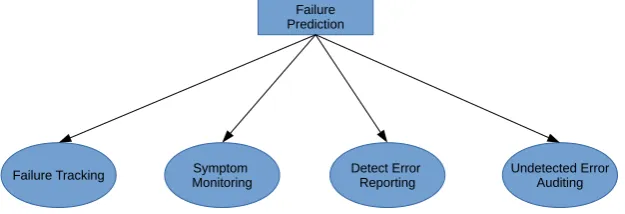
2.3 Classification of failure prediction techniques . . . 33
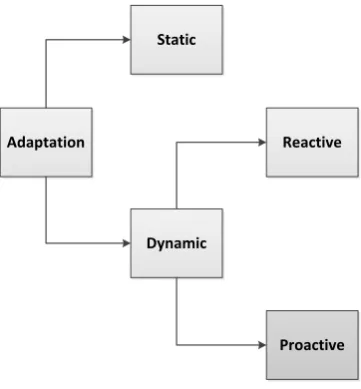
2.4 Adaptation Approach Classification . . . 38
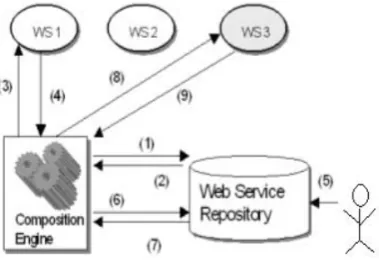
2.5 Example of ruintime adaptation using dynamically composed Web services . . . 44
2.6 Reconfigurable Regions (extracted from [91]). . . 46
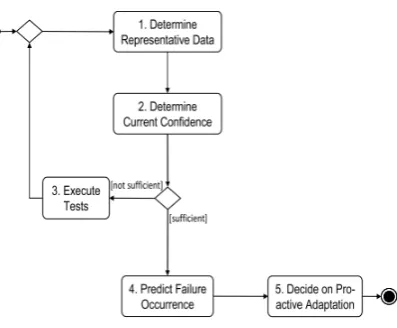
2.7 Steps performed by to achieve proactive adaptation with confidence 50 2.8 Requirements Monitoring Steps performed by to achieve proactive adaptation with confidence (extracted from [106]) . . . 52
2.9 Structured view of an example of execution instance (extracted from [72]) . . . 53
3.1 ProAdapt Overview . . . 68
3.2 Illustration of the Execution Engine accessing Execution Instances of Service Composition. . . 70
3.3 Architecture overview of ProAdapt framework . . . 75
3.4 Example of a business process for ordering of goods . . . 76
3.5 Execution model instance for the business process. . . 78
LIST OF FIGURES
3.7 Example of a scenario for the selection of operations. . . 113
4.1 Experiment service composition . . . 122
4.2 Testbed Configuration for Prototype I . . . 124 4.3 Impact of spatial correlation on composition response times . . . . 127
4.4 Number of simultaneous users consuming resources. . . 129
4.5 Variation of composition response times during the experiment. . 130
4.6 Cumulative frequency distribution of response times. . . 131
4.7 Cumulative frequency distribution of cost. . . 132
4.8 Adaptation time for each composition execution over the experiment.133
4.9 Cumulative frequency distribution of the adaptation time. . . 133
4.10 Compositon workflow logic with invoke activites for evaluation of
Prototype II . . . 137 4.11 Service composition workflow for evaluation of Scenario 1 . . . 146
4.12 Comparison of the adaptation process for Case 1 - Scenario 1. . . 147
4.13 Comparison of the adaptation process for Case 1 - Scenario 2 . . . 149
4.14 Comparison of the adaptation process for Case 1 - Scenario 3 . . . 150
4.15 Complex service composition workflow . . . 151
4.16 Comparison of the adaptation process for Case 2 . . . 152
4.17 State Machine of the Concurrent Requests Generator Process . . . 154
4.18 Comparisons of the distribution of operation request for a single
provider between the approach with and without load balancing. 155
5.1 Example of Car Rental Service . . . 162
List of Tables
3.1 Summary of the aggregated response time for logic regions. . . 92
4.1 Configuration of experiment environment. . . 123
4.2 Experiments parameters for Prototype I . . . 125
4.3 Performance per subactivity of the adaptation process. . . 139
4.4 Performance gor the whole adaptation process. . . 143
5.1 Results of the experiments for Case 1.1 . . . 178
5.2 Results of the experiments for Case 1.2 . . . 180
Acknowledgements
First, I would like to thank my supervisor, Professor Andrea Zis-man, for her dedication, patience, assistance and motivation during
my research at City University. Our conversations and her attention
to detail was surely an opportunity for my personal and professional
growth.
I would also like to thank my colleagues and friends for their support
in times of self-doubt and frustration.
I would like to express my gratitude toward Professor Judith Kelner
and the Network and Telecommunication Research Group for their help during the final stages of my work.
Finally, I would like to thank my family, my parents and sister, for
their unquestionable support and encouragement to overcome all my
LIST OF TABLES
Declaration on consultation and copying
The following statement is included in accordance with the Regulations
gov-erning the Physical format, binding and retention of theses of the City University London.
I grant powers of discretion to the University Librarian to allow this thesis to
be copied in whole or in part without further reference to me. This permission
covers only single copies made for study purposes, subject to normal conditions
of acknowledgement.
Abstract
Service orientation is a design paradigm consisting of a set of princi-ples governed by a service-oriented architecture (SOA) to support the
creation of software systems as a composition of interoperable services.
The ability to effectively compose services is not a trivial task due to
the dynamic nature of the execution environment of service
compo-sitions. In this context, dynamic service selection and composition
is a critical requirement and one of the major research challenges for
service-based systems.
This research investigates the identification, detection and prediction
of the need for adaptation as well as ways to autonomously reconfigure
the service composition during its execution time in order to improve
service reliability and conformance with systems requirements and
policies. We propose a framework for proactive adaptation of
vice compositions that extends current approaches for dynamic ser-vice composition by proactively and individually identifying the need
for adaptation for each parallel running instance of service
composi-tion while avoiding unnecessary changes and distributing load request
among different service operations when necessary.
Our framework has been tested and validated using different
proto-types implemented in both simulated and real environments. The
results were favourable with the research objectives and indicates a
major gain in the use of the proposed proactive techniques in the
Chapter 1
Introduction
Business processes can be defined as a set of structured activities coordinated
to accomplish a particular organisational goal. Due to the complexity of current
computer-based applications, the rapid changes in market conditions and
regula-tions, the dynamic creation of business alliances and partnerships, and the need
to support the changing demands of users, business processes need to be more
flexible, adaptable, and versatile in order to remain competitive in an
increas-ingly competitive world. In this context emerges theService-Oriented Computing
(SOC), a distributed computing platform that envisages software as a temporary
service rather than permanent property.
SOC extends previous computing paradigms with a new set of design
princi-ples, standard technologies, governance considerations, and definesservicesas the fundamental unit or basic building blocks to support the development of business
processes. Services are loosely-coupled and autonomous computer-based entities owned by third parties and representing different functionality, which can be
com-bined to realise applications and implement business processes. More specifically,
defined in business processes.
Services can be implemented and accessed locally but it is the ability to locate
and access third party services distributed over the web that spurred the rapid
growth of the service orientation. Web Services are formally defined by the World Wide Web Consortium (W3C) as “a software system designed to support
interoperable machine-to-machine interaction over a network” [19]. Web Services are defined through formal contract documents that exposes the available service
operations, in a similar way to a traditional application programming interface
(API).
The process of creating a coordinated flow of activities using distributed
ser-vices in order to accomplish a certain task or implement a business process receives
the denomination of service composition, and the resulting system is defined as a Service-Based System (also known as Service-Based Application) [2,46]. More precisely, a Service-Based Application is the resulting service composition
cre-ated as a coordincre-ated aggregation of services and associcre-ated with the automation
of a parent business process[48]. The terms service composition, service-based systems, and service-based application, are used as synonyms in this work.
Service-based systems have a great advantage when using services to
imple-ment activities required by business processes. However, by requiring such
ser-vices through partner providers, the system loses control of these components.
This can be an advantage, since the maintenance and implementation of the
ser-vice are not the responsibility of the serser-vice-based system. On the other hand,
these external services may suffer degradation in its performance over time,
be-come faulty or unavailable, directly affecting the service-based system.
where changes are almost certain and therefore should be taken into consideration.
In other words, service based systems must continuously evolve in order to adapt
to the dynamic execution context of business processes.
The constantly changing environment of business processes creates a complex
problem for service-based systems. As outlined in [43][45][107], a major research challenge in SOC is the support for autonomic composition of services in which
service compositions need to adapt autonomously and automatically to new
sit-uations.
Generally speaking, changes can be introduced to service composition through
a mechanism that supports eitherstatic adaptation ordynamic adaptation. While the first mechanism focuses on remodelling the service composition duringdesign time, the second mechanism focuses on adaptation during runtime. Dynamic adaptation is usually preferable to static adaptation due to the ability to change
service-based systems without stopping their execution.
Moreover, methods to support adaptation of service compositions are usually
classified depending on how to deal with possible internal system faults, namely:
reactive and proactive approaches. Reactive approaches adapt the system by re-acting to faults that occur and are observed during the system execution. Proac-tive approaches attempt to avoid faults by predicting their future occurrence[64]. Regardless of the strategy employed, the most desired feature of self-adaptable
service-based systems is arguably the ability to improve, or at least maintain,
the system reliability while meeting certain Service Level Agreement (SLA). In
software engineering, reliability can be defined as the ability of a system to deliver
its main functions under routine or unexpected situations[96].
under certain constraints or system requirements and be tolerant to changes in
the execution context. Certain events, such as the unavailability of certain service
operations can cause the service composition to halt if a candidate service is not
identified and use as replacement. Other events, such as an overloaded network
can impact the performance of the composition which may lead to nonconformity
with the SLA previously agreed between the involved parties.
The focus of the work described in this thesis report is ondynamic and proac-tive adaptation of Web service compositions. More specifically, the work in this thesis report investigates the identification, detection and prediction of the need
for adaptation as well as ways to autonomously reconfigure the service
composi-tion during its execucomposi-tion time.
In the work described in this thesis report, proactive adaptation of service
composition is defined as the combination of the preventive and perfection
adap-tation types. The preventive adapadap-tation is concerned with the detection of the
need for changes and enacting the required changes in a composition, before
reach-ing an execution point in the composition where a fault or failure would occur,
impacting the correct execution of the composition as a whole. The perfection
adaptation aims to optimise the service composition even when it is running
correctly.
Instead of just predicting and preventing unwanted situations in the service
composition, however, we expect to continually improve and adapt a service
com-position even when there are no expected faults in the comcom-position. Optimisation
can be performed, for instance, by choosing faster service operations while
reduc-ing the costs related to the execution of the composition as a whole.
ser-vice compositions named ProAdapt. The framework extends current approaches
for dynamic service composition by proactively and individually identifying the
need for adaptation for each parallel running instance of service composition
while avoiding unnecessary changes and distributing load request among
differ-ent service operations when necessary. Reactive adaptation is also supported and
exploited in case where proactive adaptation is not possible.
ProAdapt performs monitoring and analysis over different events of interest
in order to prevent possible execution failures and to improve service composition
continuously, even when there are no expected or observable issues. Examples of
these events are: (a) unavailability or malfunctioning of a deployed service
op-eration, (b) QoS deviations, (c) evolution of requirements, and (d) emergence of
better services. The reconfiguration of running instances is performed by
replac-ing a sreplac-ingle service operation or a group of service operations in the composition,
by another service operation or by a group of dynamically composed service
op-erations.
Different prototypes were developed to illustrate and evaluate the proposed
framework. The analysis of the collected data shows that the architecture and
methods defined for ProAdapt can efficiently improve the execution of service
compositions in terms of performance and reliability. Overall, we believe that the
work conducted in this thesis was satisfactory with respect to the objectives and
hypotheses raised (See Section 1.4).
In what follows, we present some formal definitions required to a better
un-derstanding of the topic of this thesis. More specifically, Section 1.1 presents a
of business processes as compositions of orchestrated Web Services.
The insights are then used to summarise the motivation and research
chal-lenges of this work in Section1.3. The hypotheses and the main objectives of this
thesis are presented in Section1.4. The contributions are included in Section1.5.
Finally, Section 1.7 presents the outline of the thesis report.
1.1
Web Services Architecture
The concept of Web Services, and technologies to support them, have much
evolved since the term was first publicly introduced by Bill Gates at the
Mi-crosoft Professional Developers Conference in Orlando on the 12th of July 2000.
Although many definitions for the term Web Services exist, they are mostly
re-lated to the task of delivering and integrating business processes as services over
the web [19].
Businessmen tend to prefer a looser definition, describing Web Services as any
set of functionality delivered over the Internet, while software engineers are more
inclined for a precise definition on the use of standards to support interoperability
between software systems [2, 33].
The distinction becomes clear when surveying practical applications.
Com-mercial banners, search engines, pools, and chat area are examples of external
services usually consumed by websites in the form of plugins. While these are
arguably the most apparent applicability of service components, they are usually
based on different standards, such as URL commands and JavaScript.
On the other side, usually hidden from customers, services that provide
and many other behind-the-scene functions, are usually accessed through formal
standards including XML and SOAP. The work in this thesis report is oriented
towards the software engineering point of view for Web services.
The necessity of Web Services technologies appears as a result of a growing
demand of properly defined interaction between organisations (online businesses)
and the lack of support from the software component paradigm in this context.
While components are helpful when it comes to rapidly software
develop-ment and maintenance, the interoperability across organisations introduces a real
challenge. Moreover, Web Services do not share the tangibility characteristic of
software components, in the sense that Web Service implementation is not
avail-able for the system requesting to use it. Such characteristic is very interesting
for business organisations because it permits a complete control of the provided
services.
It is clear then that Web service technologies focus on improving the
software-to-software communication, rather than techniques to implement actual
function-ality. The Web Service Architecture (WSA) dictates the foundation of such a
communication model. The work described in this thesis adopts a variation of
the basic WSA defined in [19].
The main component of the WSA, as well as the basic interaction between
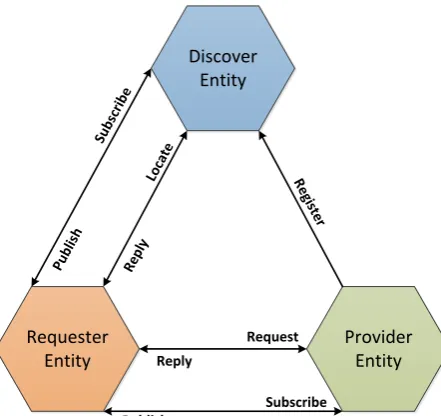
them are presented in Figure 1.1. The service requester is the party that wishes
to make use of the functions offered by the service provider. The interaction
between them is flexible enough to allow either the pull or push strategy. In the
pull strategy the requester will contact the provider on demand, whenever its
functions are required. In the push strategy however, the requester subscribes
Requester Entity
Discover Entity
Provider Entity
Loca te Sub
scrib e
Pub lish
Repl y
Request
Re gi
ster
Reply
[image:18.595.196.417.155.363.2]Subscribe Publish
Figure 1.1: Basic Web Service Architecture
engine provides a way to register and locate services.
Before the requester and provider parties start exchanging messages, both
of them have to implement a specific agent. The provider entity uses a concrete
software agent to implement the abstract notion of a service. The requester entity
requires an agent to work as a bridge between a software system (or human)
attempting to interact with the desired service, and the provider itself.
The service interface is exposed in a document named Web service
descrip-tion (WSD), which contains detailed informadescrip-tion about how to construct request
messages for each operation available in the service, as well as how to interpret
response messages. There may be also a need for exchange the expected semantic
of the service which includes the expected order to call different functions or any
Service Agent Requester
Agent Interaction
Sem
WSD
Sem
WSD Operations
...
Provider Entity Provider Entity Requester Entity
Requester Entity
Sem + WSD
Semantics & Service Description Agreement
[image:19.595.122.495.157.352.2]Uses Provides
Figure 1.2: Web Service Interaction Model
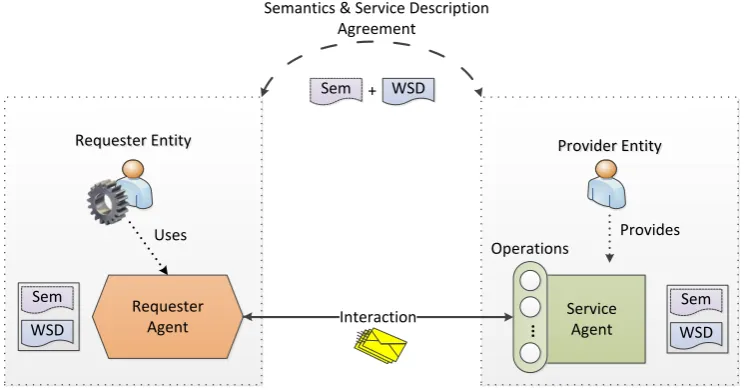
As a model for these elements, Figure 1.2, adapted and extended from [19], presents a basic illustration of this software-to-software interaction model. It
includes the basic elements that compound the Web service infrastructure, which
revolves around the requester and provider entities. We define below the main
components of Figure 1.2.
Service Agent : A Web service agent is a piece of software which implements
the abstract set of operations defined in a service. It is also responsible for
identifying the requested operation and for receiving and sending messages
over the communication channel. A provider may decide to update its
ser-vice agent to improve security or performance for instance, or just rollback
for a previous working version in case of a problem, while maintaining the
same functionality. In such case, the service itself remains the same, and
Requester Agent : The Web service interaction model defines standards for
software-to-software communication, which means that a person cannot
interact directly with a service. A requester agent provides an interface
between a person (or software systems) and the desired service. It is also
responsible for creating messages and wrap them into the right network
protocol, as described in the WSD.
Requester Entity : A requester entity is the party interested in making use of
Web service. It can be a software system which uses the service to provide
some of its internal functions or a person or organisation that which to
access the service directly. In either case, a requester entity will use an
agent to interact with a Web service.
Provider Entity : A provider entity is the party interested in implementing a
service through an agent. It can be an individual or organisation and is
independently responsible for maintaining and make available its services
agents. It is usually also the entity responsible for the advertising of services
at some global Marketplace using standards such as UDDI [12] and DAML-S DAML-ServiceProle [99].
Web Service Description : A WSD is a document usually written in the
Web Services Description Language (WSDL)[32] which provides a machine-readable specification of how the service can be invoked, the messages and
types it expects, and what data structures it returns. The document has an
abstract and a concrete section. In the abstract section a WSD defines the
operations, types, and messages. The concrete section contains the binding
The XML-based Web Service Description Language is arguably the most
well-know solution for WSDs. Some extension such as DAML-S [23], how-ever, attempts to extend the service description with elements to answer
what is the actual functionality available, instead of only how the operations
are accessed. As another example, SA-WSDL [49] provides a mechanism to add annotations to WSDL components that can reference semantic models
using arbitrary languages, which can be placed both within or outside the
WSDL document.
Behaviour : The behaviour of a Web service is the shared expectation about
the exchange messages between request and service agents. It generally
defines the required ordering of operations to be invoked or some generic
constraints over the set of available operations. The Web service behaviour
may be implicit or formally registered to be processed by interested parties.
Communication Channel : The communication channel is the physical and
logical transmission medium in which messages and documents are
ex-changed between requester and provider. The physical transmission medium
is usually hidden from both parties. The logical transmission medium is the
set of protocols chose to wrap the exchange messages or documents, such as
Transmission Control Protocol (TCP), HTTP, and SOAP. It is important
that both requester and provider support the same set of protocols, which
is defined in the WSD.
The presented architecture, together with the interaction model provide an
intelligent way for Service-Based Applications to invoke Web services, however, it
sec-tion describes how such complex interacsec-tions are accommodated by using service
compositions.
1.2
Services Composition
When only atomic Web services are considered, that is, when service
implementa-tions (Service Agents) are enclosed and do not rely on external components, the
basic infrastructure involving Requesters, Providers, and Discovers, is adequate. As Web services become more complex, however, their internal implementation
will usually involve invocation of other Web services.
These distinct Web services receive the denomination of composed service [2], and the process of developing a composite service is called service composition[46]. For reasons of simplicity, from this point onwards, this report refers to composite
services and service compositions as interchangeable synonyms.
While an atomic service is self-contained, requiring no connections to other
resources to provide its operations, a composite service relies on interactions with
external resources as a way to deliver its functionality. In fact, service
compo-sitions are not limited to connections with atomic services, and are recursively
defined as an aggregation of atomic and composite services[117]. This new design pattern enables high sophisticated interactions suitable to implement complex
logic while keeping a simple external interface.
More specifically, services compositions can be used to quickly implement
business processes using partners’ services as a way to implement functions
re-quired, while the composition itself hides the internal logic and is exposed as a
Entity point of view, this is an interesting approach, since it is usually concerned with receiving the required functionality, regardless of how it is implemented.
Start
Credit Rating
Get Loan Get Loan
Select
Best End Loan
Process
Credit Rating Service
[image:23.595.172.434.196.445.2]Loan Provider Services Loan Process
Figure 1.3: Service Composition: Loan Process
In engineering, the general flow of plant processes and equipment are usually
illustrated using a process flow diagram (PFD) [124], which display the inter-action between major equipment without getting into minor details. Designers
of business processes and service compositions follow a similar approach using a
Business Process Diagram (BPD)[60], which is a graphical representation com-posed of a flow of basic and structured activities. Basic activities are atomic
basic units for the construction of the process, such as invoking Web Service
op-erations. Structured activities are used to provide the logic flow of the process,
and are recursively defined as an aggregation of basic and structured activities.
well-know standard for business process modelling.
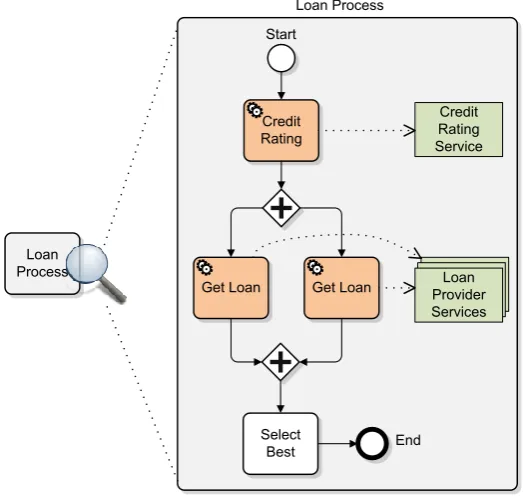
In order to illustrate the use of BPDs, Figure 1.3 presents a Loan Process
service composition using the BPMN graphic notation. The process starts when
a client submits a loan application, and finishes with a loan offer. The internal
process comprises three phases. First, the composition invokes an external
ser-vice to receive the credit rating of the client. Next, the composition sends the
client application to two different loan service providers. Finally, the composition
decides for the best loan offer and returns it to the client.
BPMN provides a very powerful notation to describe the general properties
and behaviour of service compositions, however, considering that it provides only
the process skeleton, BPMN is not enough to actually make a process executable
[54]. BPMN knowingly misses details not required to describe the process flow, such as data and links definition. Because of that, in order to make service
composition executable, designers have to choose between (a) languages
specifi-cally designed for it, or (b) proprietary BPMN extensions aimed at fulfilling the
required gaps.
Two languages appear as the candidates most frequently used in the
descrip-tion of executable processes, namely (a) the Web Services Business Process
Ex-ecution Language (WS-BPEL) [73], and the XML Process Definition Language (XPDL) [116]. WS-BPEL, or BPEL for short, is an executable language based on the Pi-Calculus mathematical model and defined by the Organization for the
Advancement of Structured Information Standards (OASIS) [113]. It is designed to specify business processes with Web services. XPDL is a general purpose
busi-ness process definition language based on Petrinet models and standardized by
When choosing the best language to describe executable business processes,
there are various arguments in favour of BPEL or XPDL. For instance, BPEL is
arguable better fitted to describe distributed and collaborative processes, which is
expected since its goal is the web service orchestration. On the other hand, XPDL
is better defining standalone processes, since it is target at defining the process
diagram. For designers looking for interchange business process definitions with
detailed graphical information, XPDL may be the better choice, because it was
design to include all aspects of a BPDs such as X and Y position of the nodes,
while BPEL does not define in itself graphical aspects, and is targeted most
exclu-sively to automatic interpreters. Regardless of the advantages and disadvantages
of each standard, the fact is that BPEL has been winning the battle for the
preferred language in the definition of executable business process for composite
Web services. The above claim is supported by recent research and publications,
e.g. [28][55][86], recognising BPEL as the de facto standard for Web services orchestration.
The prototypes developed for the ProAdapt framework use service
compo-sitions defined in BPEL. Executable languages such as BPEL provide all the
detailed information required to enact business processes, but without a way of
putting these processes into practice, they would not make much sense. A
busi-ness process execution engine provides the execution environment and the
infras-tructure for business process execution [58]. Execution engines are responsible for enacting the various activities defined in the business process.
In order to execute a service composition defined in a language such as BPEL,
in the service composition. Over the past few years, a number of execution
engines have been proposed for different environment and languages, such as
Silver [59], jBPM [125], Apache ODE [114], and IBM Websphere [77]. Silver is a very peculiar SOAP and BPEL execution engine for mobile devices that
offer support for Java 2 Platform Micro Edition (J2ME). jBPM is an open-source
project that allows the execution of business processes specified using BPMN with
additional annotations. IBM Websphere is a SOA platform with run-time support
for both Enterprise Service Bus and BPEL processes. Apache ODE is an open
source project targeted specifically at BPEL processes, with good community
support, easy installation, and service deployment procedures.
Given a proper way to represent the service composition and an engine to
execute it, there is still the problem of how to select the operations to form the
composition. In other words, we must know how to find services that satisfy the
functional requirements of our business process and how to proper choose between
different service candidates. The answers to these two questions are strongly
related to the adaptation of the composition itself. More details regarding this
subject can be found in Section 2.3.
1.3
Motivation and Research Challenges
The previous sections presented the overall context in which this thesis is
in-serted, including some of the challenges and motivations behind the topic of
dynamic adaptation of service compositions. In this section, we summarise these
motivations and research challenges and present some new insights that inspired
The Service-Oriented Computing paradigm has attracted great interest from
industry and research communities around the world. Service integrators,
de-velopers, and providers are collaborating to address the various challenges in the
area. Various approaches and tools have been proposed to support different areas
of SOC such as (a) languages to describe services, (b) service design and
develop-ment, (c) service discovery, (d) service composition, and (e) service management
and monitoring.
Dynamically adaptable systems have also been the focus of study in several
areas of computing such as software engineering, robotics, control systems,
pro-gramming languages, and bio-informatics. The software engineering community
attaches great importance to this topic as demonstrated by regular workshops
held in conjunction with main conferences in the area (e.g. ICSE, FSE/ESEC,
SEAMS, ICSOC).
To deal with the challenges of SOC dynamic and demanding business
envi-ronment, service compositions need to be (a) self-configuring, compositions that
are able to automatically identify, select, and combine new services with which to
interact; (b) self-optimising, compositions that can select the best services with
which to interact in order to become more efficient; and (c) self-healing.
Despite the advances in the area, more work is required to support the
devel-opment of software systems based on dynamic composition of software services,
enabling the provision of new products to the market in a rapid and efficient way.
To be successful, these dynamic compositions should be able to adapt to various
situations, including (i) changes in or emergence of requirements, (ii) changes in
the context of the composition and participating services, (iii) changes in
compositions, and (v) evolution of services.
Based on the need to support dynamic evolution and changes of business
activities, users’ demands, and service availability, it is important to provide
ap-proaches that consider the various autonomic aspects together (e.g., self-configuring,
self-optimising, self-healing, self-adapting) [118] in a proactive way, predicting problems before they occur.
As defined above, proactive adaptation of service composition constitutes the
detection of the need for changes and implementation of changes in a composition,
before reaching an execution point in the composition where a problem may
exist. Such a problem may cause the process to generate erroneous, unexpected
behaviour, or even to halt.
Examples of such proactive actions include (1) the prediction that a service
used in a composition may be malfunctioning, unavailable, or no longer compliant
with various aspects of the system, followed by the implementation of necessary
changes in the composition even before this service is invoked during the execution
of the composition; (2) the identification of the parts of a service composition that
cannot fulfil a new requirement, again before execution of such parts; and (3) the
identification of compositions parts that need to be changed due to the existence
of a new better service, before the execution of these parts.
Ensuring QoS in Web services is a critical and significant challenge due to the
dynamic and seemly unpredictable nature of their context of execution. There
is often more than one business process available to execute a required task,
which means some level of competition, both for network resources and attention
of the market. Ensuring the correct execution of service compositions, while
for businesses.
The overall adaptation aim for service compositions is to permit the correct
execution of business process and maintain or improve some system requirements
such as reliability, performance, and general aspects of quality of service (QoS).
In fact, the QoS parameters of Web services and compositions are one of the main
concerns for service providers. The reason is that business opportunities may be
lost, or penalties may be due if service compositions do not satisfy the expected
performance requirements of their customers. The strong relation between user
satisfaction, revenues, and the performance of a system was observed in a number
of previous research done in the field.
In research conducted by Amazon, it was observed that when the time to generate the pages was increased by around 100ms, there was a drop on sales of
about 1%[92]. In the session What Google Knows presented by Marissa Mayer at the Web 2.0 conference in 2006, she explained how a delay of 500ms when
generating search results could lead to a traffic and revenue drop close to 20%
[101].
The impact of degraded QoS values on business revenue, however, is not
limited to the largest online retailer or the giant of internet-related products
and services. In the competitive stock market, the TABB Group estimates that
a response time of about 5 milliseconds behind the competition could cause a
broker to lose $4 million in revenues per millisecond[75].
In summary, although services compositions appear as a solution for
seam-less integration of business processes over the Internet, this integration does not
come without a price. Service compositions use resources from numerous partner
part-ner services. Such preparation comes in the form of self-adaptable and dynamic
service compositions.
Overall, the existing approaches that deal with such issue are fragmented and
in their initial stage of development, leaving space for further investigating the
topic of adaptation of service compositions.
1.4
Research Objectives and Hypotheses
This thesis explores techniques to achieve autonomous execution of Web service
compositions with a focus on the adaptation process. The general hypothesis of
the work is the following:
Proactive adaptation of service compositions can improve the performance, reliability, and general conformance with system requirements of service compositions when compared to traditional static and reactive adaptation
approaches.
The above general hypothesis can be broken down into the following
sub-hypotheses:
• It is possible to proactively identify the need for adaptation in service com-positions by constantly monitoring the execution environment, systems re-quirements, and the status of the service composition itself.
• It is possible to use a local service repository and proactively replace candi-date operations in service compositions.
• It is possible to avoid unnecessary changes in service compositions when identified problems can be compensated by parts of the service composition yet to be executed.
Given the above hypothesis, the general aim of the research is to support a dynamic and proactive adaptation of service compositions through the use of mon-itors, candidate service replacements, and techniques for prediction of problems in order to improve the reliability, performance, and conformance of business process.
The above general aim can be broken down into the following measurable
objectives:
Objective 1: Literature Review
To provide a literature review and analysis of works in relevant areas of the
research topic. The review needs to include topics such as service
composi-tion, monitoring, discovery, adaptacomposi-tion, and failure prediction techniques.
Objective 2: Prediction of Problems
To design and implement mechanisms to support the detection and
proac-tive prediction of events that may require adaptation of service
composi-tions.
Objective 3: Events Analysis
To deliver techniques to help understanding potential faults and to identify
the parts in a service composition that may be affected by detected or
Objective 4: Adaptation Approaches
To analyse and specify relationships between the different ways of adapting
service compositions and the circumstances that may trigger adaptation.
Objective 5: Adaptation Framework
To specify an adaptation framework including techniques for monitoring,
detection and prediction of events that may require adaptation, and
enforce-ment of changes in a dynamic and proactive way. udies to demonstrate and
evaluate the work.
Objective 6: Evaluation
To develop scenarios and evaluate proof-of-concept tools that will be
cre-ated to support the techniques and mechanisms crecre-ated for the Adaptation
Framework considering medium to large scale case studies.
1.5
Contributions
The ProAdapt framework includes the following major contributions:
Response Time Modelling: The framework offers a new technique to support
service operation response time modelling based on exponentially weighted
moving average (EWMA) function [67].
Signature mismatches: The framework considers dependencies that may exist
between the signature of service operations within a composition in order
to avoid adaptation of the composition that may lead to mismatches of
a replacement due to signature mismatches or modify other parts of the
composition to treat the mismatches.
Independent Execution Instance Adaptation: Different from existing
ser-vice composition adaptation approaches, ProAdapt is able to reconfigure
single execution instances independently, acting in response of specific needs
for each execution instance, without interfering with other execution
in-stances currently running. ProAdapt supports adaptations that are
re-quired for specific contexts of each execution instance.
Parallel Adaptation: ProAdapt supports the adaptation and sharing of events
that may require adaptation in parallel of running instances, allowing for
faster and potentially more efficient adaptation procedures.
Load Balancing: The ability to handle execution instances individually,
to-gether with the sharing of information in parallel enables ProAdapt to
distribute the load between multiple service operations simultaneously.
Behavioural Compensation: In a extension of the ProAdapt framework we
propose a solution to deal with missing behaviour of candidate replacement
services by compensating such missing behaviour with other candidates,
which can be new services or the ones already deployed in the composition.
Following the list of major contributions, this work also includes some other
important additions to the field of service composition as presented below.
Spatial Correlation: ProAdapt employs a spatial correlation method to
by inspecting messages of network protocols such as TCP/IP, HTTP, and
SOAP.
Adaptation based on different classes of events : The framework supports
adaptation of service composition triggered by four different classes of
situ-ations, namely C1: problems that cause the composition to stop its
execu-tion; C2: problems that allow the composition to continue to be executed,
but not necessarily in its best way; C3: evolution of requirements; and C4:
emergence of better services.
N-M Operations Replacement: ProAdapt allows changes in service
sitions performed by (a) replacing a single service operation in the
compo-sition by another service operation or by a group of dynamically composed
service operations (replacement of types 1-1 or 1-n), or (b) replacing a group
of service operations in a composition by a single operation or by a group
of dynamically composed service operations (replacement of types n-1 or
n-m).
Simulated Web Service Infrastructure : The second prototype developed
for the research includes a complete Web service infrastructure layer for the
network simulator three (NS-3) [62] that can be used by other researches to perform experiments for service-based systems.
The contributions above lead to the publication of the following papers:
• Aschoff, R.R.; Zisman, A., “QoS-Driven Proactive Adaptation of Service
Service-Oriented Computing(ICSOC’11), Springer-Verlag, Berlin, Heidelberg,
421-435. 2011 DOI=10.1007/978-3-642-25535-9 28.
• Aschoff, R.R.; Zisman, A., “Proactive adaptation of service composition,”
Software Engineering for Adaptive and Self-Managing Systems (SEAMS’12),
pp. 1-10, 4-5 June 2012 doi: 10.1109/SEAMS.2012.6224385.
We are also preparing a journal paper to be submitted to the TSE journal and
have been invited to submit a chapter in the book Engineering Adaptive Systems.
Moreover, we are planning to publish the ideas and results of the extension of our
framework (See Chapter5). The list below summarises the planned publications.
• Parallel Adaptation of Service Composition
• Behaviour Compensation of Service Compositions
• ProAdapt: A Proactive Adaptation Framework for QoS-Aware Dynamic
Service Composition
1.6
Research Methodology
The research process is usually defined in two clear stages. First, the research
questions are made, and thus some process is followed to answer those questions.
This section describes the process undertaken to find the answers to the dynamic
adaptation problem investigated in this report. Our research process was based
on methods and good practice guidelines defined in the literature, such as the
In the work presented in this thesis, we follow a research process composed of
eight-steps, namely: (1) Research Problem Formulation; (2) Literature Review;
(3) Objectives Definition; (4) Research Design; (5) Data Collection; (6) Analysis
of Data; (7) Generalisation and Interpretation; and (8) Preparation of Final
Report. These steps are better described below.
Research Problem Formulation
The research problem formulation is the first step followed in the research
process. This step must include an analysis of the importance of the topic of
adaptation in the context of service composition. In this context, the specific
area of concern is described, including what are the challenges or conditions to
be improved.
Literature Review
Reviewing the literature is an important step to establish a theoretical
frame-work and maintain a methodological focus. The critical reading of related frame-work
can be used to acquire insights for the proposal of new theories or methods, as
well as to locate the research within a context, relating the findings to what has
been done.
Objectives Definition
The goals of the research must be defined clearly and specifically to inform
the reader about what the work described in this thesis attempts to attain. This
step includes three level of abstraction, namely: (a) a general hypothesis, (b)
sub-hypotheses, and (c) objectives.
Research Design
It is in the research design that we define the path that our research will
the thesis. In such case, we need to revisit the hypothesis and objectives and
define the method for data collection and analysis. In our case, we decide to use
a quantitative research method, which is useful to analyse proposed hypotheses
through measurable variables.
Collecting Data
Considering that the research design is defined, together with the hypotheses
and objectives, the next step is to collect data from the experiments in order to
draw inferences and conclusions.
Analysing Data
Analysing the data or evaluating the results is the process used to extract
in-formation from the collected data and presenting it in order to test the hypotheses
and confront the objectives of the research. Considering that the research is a
work in progress, this step can be also used to revisit the hypotheses and
objec-tives
Preparation of Final Report
Finally, the last step is to write the thesis with the results of the research
conducted.
1.7
Outlines of this Thesis
The remaining of this thesis is structured as follows.
Chapter 2 - Literature Review
This chapter situate the current study within the body of literature and
provides a representative review of works related to the research topic of this
of software engineering as well as a review of some of the works more closely
related to the topic of dynamic adaptation of service compositions.
Chapter 3 - ProAdapt Adaptation Framework
This chapter introduces the current stage of the adaptation framework
de-veloped in this thesis to support dynamic adaptation of service
composi-tions. The chapter presents an overview of the main concepts of the
frame-work and the architecture created to support these concepts. The chapter
also includes details of the process of adaptation and the techniques used
to analyse events and predict failures.
Chapter 4 - Experiments and Evaluation
This chapter presents the prototypes developed to verify the concepts,
tech-niques, and methods of the adaptation framework. For each of the
proto-types, the analysis of the collected data is presented and discussed.
Chapter 5 - Behavioural Compensation Extension
This chapter presents an extension for ProAdapt to support behavioural
compensation. It includes a running example with which the extension is
explained and also the results and evaluation of the experiment performed.
Chapter 6 - Conclusions and Future Work
This chapter highlights the current contributions of the research done
Chapter 2
Literature Review
Software systems often go through various stages in their development life-cycle
in order to meet the defined requirements under the expected operating running
environments. However, it is arguably impossible to anticipate the requirements
and behaviour of all users or create a single best configuration for the system
that works all the time. Moreover, requirements and especially the running
en-vironment changes over time, potentially invalidating previous agreements. This
nonstatic environment forces software systems to support continuous adaptation
in order to avoid unwanted behaviour or loss of opportunities.
There are various works in the literature dealing with adaptation approaches
in the context of software systems, however, it is important to note that the focus
of this research is adaptation specifically targeted at service composition.
Never-theless, some core concepts are common and important for a better understanding
of the topic. The remaining of this section starts by introducing adaptation in
the general concept of Software Engineering, and progressively address the
2.1
Software Engineering Adaptation
The adaptation of software systems has been extensively studied in various branches
of the software engineering field, including control engineering [134][44], software architectures [82][47], self-adaptive systems theory [29], autonomic computing [78], and fault-tolerant computing [123][112].
In control engineering, adaptation is concerned with the use of sensors to
monitor the devices being controlled and actuators that are able to make
cor-rections on the system according to the reasoning performed with the monitored
values. Different adaptation techniques, such as gain scheduling [133], automatic tuning[148] and continuous adaptation [129] have been used in controllers for more than twenty years [7].
An example of adaptation in the context of control engineering is the method
presented in [129] to reduce the acoustic feedback in hearing aids that contain a substantial amount of gain. The authors use a continuous adaptation approach,
together with a delay in the forward or cancellation paths of the hearing aid
plant to achieve acoustic feedback reduction of more than 15 dB, increasing the
maximum insertion gain of a hearing aid using the approach. The approach is
somewhat similar to the work present in this thesis in the way that it constantly
adapts the filter coefficients based on the monitored signal, while our approach
constantly adapts service compositions based on monitored QoS values.
In a similar way to control engineering, self-adaptive systems are able to
au-tonomously evaluate their execution context and change their own behaviour in
order to meet or improve previously defined requirements. For example, a
and user disabilities[131]. In other words, it is possible to select among possible output formats, such as sound, image, and text, in order to present information
based on user preferences. A website can self adapt to increase the font size when
presenting information for elderly users, or play sounds instead of presenting texts
in case of blind users.
In a more ambitious goal, autonomic computing refers to the self-managing
computing model named after the human body’s autonomic nervous system. The
main overall aim of autonomic computing is the design of systems able to manage
themselves given high-level objectives specified by humans while keeping the
com-plexity of the system itself invisible to the user. To accomplish these ambitious
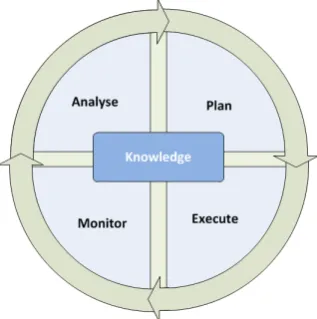
goals, IBM has proposed a conceptual guideline architectural named MAPE[35]. Figure2.1 illustrate the MAPE model, which is consisted of a central knowledge
[image:41.595.229.388.459.619.2]base surrounded by four modules: Monitor, Analyse, Plan, and Execute.
Figure 2.1: MAPE Architectural Guideline
The monitoring process is responsible to collect information about the
information from the monitored data to model adaptation situations. The
plan-ning phase uses policies to guide different adaptation procedures. Finally, the
planned actions are executed through controlled mechanisms. The MAPE model,
however, is purposely only to be used as a guideline. It is up to the system
de-signer to decide how each component is going to be implemented and where they
are going to be positioned.
Regardless of the software domain, perhaps the main reason that motivates
the need for adaptation is the faults that invariably occur in software systems,
especially distributed systems. In many application contexts, such as in business
process, the reliability of the overall system must be far higher than the reliability
of its individual components[80].
Software reliability can be defined as the probability that the software will
be functioning without failure under a given environmental condition during a
specified period of time[141]. In other words, some systems are designed so that even in the event of faults risen by internal components, the overall system must
still attempt to accomplish its goal while meeting the defined requirements.
Observable
Fault Detected by Monitoring
Undetectable Fault
Failure Reasoning
Predicts
May lead to May lead to
Figure 2.2: Failure prediction process performed for fault tolerant systems
The failure and fault terms are thus key to the understanding of system
reli-ability. A failure is defined as a deviation from the conformance with the system
incurred by internal component or interacting systems [61].
Figure 2.2 illustrate this relation between faults and failures in the context
of fault tolerant systems. Generally speaking, as depicted in the picture,
fault-tolerant systems compute the probability of one or more observable faults causing
a system failure. A direct interpretation of such a system is that hidden or
undetectable faults can easily cause system failures since they are not computed
by the reasoning process. If those undetectable faults lead first to observable
faults, then the fault tolerant system can work as expected.
By predicting failures, fault-tolerant systems can adapt accordingly to prevent
such failures to happen and thus ensuring the system reliability. In the context of
service-based system, failures of external partner services are identified as internal
faults by the service composition. For example, whenever a service operation
deployed in a service operation does not meet its expected QoS aspects, or cannot
be invoked for some reason, a fault is observed.
Failure Tracking
Failure Prediction
Symptom
[image:43.595.153.466.482.589.2]Monitoring Detect Error Reporting Undetected ErrorAuditing
Figure 2.3: Classification of failure prediction techniques
As previously described, the ability to predict and prevent failures is of great
importance to ensure the system reliability. At the same time, the continuous
grow in complexity and size of the computer systems make almost mandatory the
overview of the four major branches of failure prediction techniques as presented
in [126] and depicted in Figure 2.3. Failure Tracking
Failure tracking is the method used to assert the probability of future failures
based on the occurrence of previous failures. The work in [37] presents an offline Bayesian predictive approach which attempts to predict the probability
distribu-tion funcdistribu-tion of future failures given the occurrence of present and past failures.
The approach is applied to the Markov process model known as Jelinski-Moranda
[97] and besides been a complex offline method can also be used during runtime. Failure Tracking can also be accomplished by exploiting the fact that failures
can usually occur next to each other, either in time or in space. An example of
work that examines such relation is [52], which presents a method for temporal and spatial correlation of failures in distributed system. This approach has some
resemblance to our technique to predict faults in operations, service and providers
(see Section 3.3.1.2).
Symptom Monitoring
Symptoms of a software system can be seen as side effect of errors. Before a
failure can be observed in a system, there are some symptoms that can be detected
and exploited to predict, prevent or at least mitigate these failures. In other
words, failure-prediction techniques based on symptom monitoring analyse the
system behaviour and context in order to detect symptoms that can be perceived
as prelude of upcoming failures.
An example of symptom monitoring is presented in [88] through the form of a function approximation. The work attempts to predict the resource utilization of
building an auto-regressive model to predict the time of resource exhaustion.
The work in [104] uses instead a technique known as time series prediction. Generally speaking, monitored values are seen as sequence of data points in time.
Time series forecasting is performed by modelling previous measured values to
compute future values. In the case of the work in [104], the system variable is the memory usage of J2EE applications, which is monitored every twelve minutes.
Future memory usage and resource exhaustion is predicted by combine rough set
theory with wavelet networks to the collected data.
The previous approach retains some similarities to our own regarding the
pre-diction of data values using time series forecast. As described in Section 3.3.1.1,
we use exponentially weighted moving average to predict the expected service
operation response time.
Detected Error Reporting
In some cases, collecting and reasoning about system symptoms promptly is
not practical or indicated. In such cases, failure prediction can work using as input
some sort of discrete system error report. More precisely, failure prediction using
detected error reporting can be generalised as the reasoning function f(rn) =
P(n +k), where rn is the error report given at time tn and P(n + k) is the
prediction of what may happen at time t(n+k).
This approach is employed in [84] to generate failure warning in high per-formance Linux clusters. The authors extended the Open Source Cluster
Ap-plication Resources (OSCA) by introducing high availability (HA-OSCA). The
proposed method collects and aggregates hardware sensitive information, such
as temperature, voltage and power supply, and uses thresholds to predict and
Undetected Error Auditing
In the previous branches of failure prediction, the approaches focus on analysing
an event that is observed or logged as a direct result of the use of a particular
function of the system. In the case of undetected error auditing approaches, the
idea is to proactively look for incorrect or undesired system states, even for those
parts that are not actually in use at the moment.
This search for undetected errors, or latent failure is exploited in [9]. The authors propose a method to detect and predict latent sector errors in disk
drive-based storage systems. The contribution of the paper is in the fact that such
latent errors can be detected before the corresponding disk sectors are accessed
and thus, potentially avoiding system failures.
This section discusses topics and works in the general context of software
engineering for self-adaptable systems. Many concepts have been used in the
ProAdapt framework, such as the precise definition of faults and failures, and
the control loop of the MAPE architectural model. Moreover, two important
concepts of the ProAdapt framework were designed as the result of the research
done, reviewing general techniques for failure prediction. The spatial correlation
of availability and the function approximation of the response time were both
envisioned by adapting some ideas reviewed as general adaptation and failure
prediction. The next section closes the gap by targeting specifically on adaptation
2.2
Service Composition Adaptation
The highly dynamic nature where business processes for Web services operate,
which usually requires access to an infrastructure without centralised governance,
exacerbates the adaptation issue of service-based systems. In fact, the adaptation
of service compositions constitutes a major research challenge for service-based
systems[43][45][107].
Service compositions require access to numerous partner Web services that
might evolve over time, changing their structures, behaviours, and quality or just
becoming unavailable, potentially forcing the composition itself to adapt to these
new circumstances. An adaptable service-based system is thus defined as the one
that continuously monitors and modifies itself in order to satisfy new requirements
and to adjust to new conditions imposed by changes of the executing environment
[63].
Such definition for adaptable service-based systems can be viewed as an
ex-tension of what is expected from a fault tolerant system (see Section 2.1) by
considering adaptations of service composition triggered not only by observable
faults, but also extra events of interest. More precisely, the adaptations of
ser-vice compositions revolve around four main objectives, namely (a) recovery, (b)
context, (c) interoperability, and (d) optimisation [13].
The recovery is concerned with compensation actions for partially executed service compositions. The execution context of service compositions changes rel-atively often and adaptation strategies must act accordingly, with actions such as
replacing partner services to accommodate changes. While standards proposed
services creates a challenge. Web services may use different protocols and
inter-faces, which could cause signature mismatches between the service composition
and provider entities. Finally, optimisation is the need to continually improve the general system performance.
In Chapter1an overview of the general adaptation classification is introduced
and briefly discussed, which is here illustrated by Figure 2.4. In this section we
revisit the previusly presented concepts and expand the discussion to introduce
some of the various approaches that have been proposed to accomplish the
afore-mentioned adaptation goals.
Static
Dynamic
[image:48.595.218.399.370.565.2]Proactive Reactive Adaptation
Figure 2.4: Adaptation Approach Classification
As shown in Figure 2.4, the first level of categorisation defines adaptation
in static and dynamic ones. Dynamic adaptation approaches can be further
categorised as reactive or proactive.
compo-sition during design time or while the system is not running, dynamic adaptation
occurs while the system is up and running. Dynamic adaptations can be classified
as reactive, when the idea is to correct some observable problem, or proactive,
when there is an attempt to predict such problems and thus act before they
happen.
Reactive adaptations aim to resolve the internal faults that can happen in
distributed systems and specially service-based systems in order to allow the
correct execution of system as a whole. This can be performed in a number of
ways but usually the faulty activity is identified and replaced. For instance, a
service composition may not receive a reply from a particular service operation.
In this case, a reactive adaptation must retry to invoke the operation or replace
the identified unreachable operation with another candidate service operation.
A Proactive adaptation on the other hand, aims to predict and prevent future
faults or failures of the service composition. As defined in [126], the prediction of faults and failures is concerned with the identification of the occurrence of a
problem in the near future based on an assessment of the current state of the
system. More specifically, in the scope of service-based systems, fault prediction
is concerned with the assessment of what is the impact of service misbehaviour,
or of a group of services, in other parts of the service composition, while failure
prediction is concerned with the impact of observed and predicted faults in the
service composition as a whole.
The dynamic and competitive environment of business processes demands
continuous evolution of the business processes and their implementation. Given
this evolution demand, another example of proactive adaptation is to improve
![Figure 2.6: Reconfigurable Regions (extracted from [91]).](https://thumb-us.123doks.com/thumbv2/123dok_us/1499472.102666/56.595.140.484.173.436/figure-recongurable-regions-extracted-from.webp)
![Figure 2.8: Requirements Monitoring Steps performed by to achieve proactiveadaptation with confidence (extracted from [106])](https://thumb-us.123doks.com/thumbv2/123dok_us/1499472.102666/62.595.168.461.264.599/figure-requirements-monitoring-performed-achieve-proactiveadaptation-condence-extracted.webp)