Valid Inequalities for a Single Constrained 0-1 MIP Set Intersected with a
Conflict Graph
Agostinho Agraa, Mahdi Doostmohammadib, Cid C. de Souzac a
Department of Mathematics and CIDMA, University of Aveiro, Aveiro, Portugal
b
Instituto de Engenharia Mecˆanica (IDMEC), Instituto Superior T´ecnico, Universidade de Lisboa, Lisboa, Portugal
c
Institute of Computing, University of Campinas, Campinas, Brazil
Abstract
In this paper a mixed integer set resulting from the intersection of a single constrained mixed 0-1 set with the vertex packing set is investigated. This set arises as a subproblem of more general mixed integer problems such as inventory routing and facility location problems. Families of strong valid inequalities that take into account the structure of the simple mixed integer set and that of the vertex packing set simultaneously are introduced. In particular, the well-known mixed integer rounding inequality is generalized to the case where incompatibilities between binary variables are present. Exact and heuristic algorithms are designed to solve the separation problems associated to the proposed valid inequalities. Preliminary computational experiments show that these inequalities can be useful to reduce the integrality gaps and to solve integer programming problems.
Keywords: mixed integer programming; valid inequality; separation; vertex packing set; conflict graph; independent set;
1. Introduction
It is well-known that the use of strong valid inequalities as cuts can be very effective in solving mixed integer problems. One classical approach to generate these valid inequalities is to study the polyhedral structure of simple sets which occur as relaxations of the feasible sets of those general problems. Two such successful examples are the use of Mixed Integer Rounding (MIR) inequalities, derived from a basic mixed integer set [14, 19], and the use of valid inequalities for conflict graphs, resulting from logical relations between binary variables, for solving mixed integer programs [5].
The goal of this paper is to investigate the polyhedral structure of a mixed integer set that results from the intersection of two well-known sets: a simple mixed integer set and the vertex packing set associated with a conflict graph.
LetX be the set of points (s, x)∈R×Zn satisfying s+c X
i∈N1
xi≥d, (1)
xi+xj ≤1, {i, j} ∈E, (2)
xi∈ {0,1}, i∈N, (3)
s≥0, (4)
whereN={1, . . . , n}is the index set of binary variables, andEis the set of pairs of indices of incompatible nodes,N1⊆N, andc >0, d >0.The graphG= (N, E) is known as the conflict graph of pairwise conflicts between binary variables (see [1, 5]).
LetN0=N\N1.Although the general results and the validity of the inequalities presented in the paper hold for the case whereN0is empty, some facet-defining conditions need to be adjusted. Therefore, to ease the reading of the paper,N0 is assumed to be nonempty. When c > d,the inequality s+cPi∈N1xi ≥d
can be replaced by the stronger inequality s+dPi∈N1xi ≥d. Thus, henceforward, it is also assumed that
c≤d.
SetX is the intersection of two sets: X =XV PTXSM I,whereXV P is the vertex packing set defined by
(2)–(3), that results by considering the conflict graphG= (N, E), and XSM I is a simple mixed integer set
defined by{(s, x)∈R×B|N1||satisfying (1) and (4)}.The convex hulls ofX, X
V P,andXSM I,are denoted
byP, PV P,andPSM I,respectively.
The setXSM Ihas been intensively used as a relaxation of several mixed integer sets, see [19] for examples.
It is well-known that in order to describePSM I,when|N1| ≥ ⌈dc⌉, it suffices to add to the defining inequalities
(1), (4), xi≥0, andxi≤1, i∈N1,the following MIR inequality
s+rX i∈N1
xi≥r ld
c m
, (5)
wherer=d−c(⌈d c⌉ −1).
On the contrary, a complete description ofPV P is not known and since optimizing a linear function over XV P is a NP-hard problem, there is not much hope in finding such a description. Nevertheless, families of
valid inequalities are known, see [9, 10, 16, 17]. The derivation of inequalities for integer programs based on conflict graphs have also been considered in the past (see [5] for further details).
Although the two sets XSM I andXV P have been intensively considered in the past, to the best of our
knowledge, setX has only been considered in a preliminary version of this paper [4]. The most related mixed integer sets considered before are the mixed vertex packing set studied by Atamt¨urk et al. [6] and the flow set with partial order studied by Atamt¨urk and Zang [7].
Cuts from valid inequalities forXSM I andXV P are commonly used by researchers using MIP solvers, by
identifying these sets as relaxations of the original feasible set. This work aims at deriving new inequalities that can be used when those structures are present simultaneously. Such structures can be found in various mixed integer problems, such as inventory routing, production planning, facility locations, network design, etc. The practical examples that motivated this research stemmed from maritime Inventory Routing Prob-lems (IRPs), see [2, 3]. Constraint (1) results from the relaxation of inventory constraints, where sis the stock level at a given location,dis the aggregated demand at that location during a set of periods,cis the vehicle capacity (when several vehicles are considered one may assume this capacity to be constant for all vehicles, otherwise one can takecas the maximum of these capacities) andxi represents an arc traveled by a
vehicle. N1is the index set of arcs entering to that particular node. Constraints (2) represent incompatible arcs, that is, arcs that cannot belong to the same route, for instance, due to time constraints. The two sets XSM I (e.g. in [2]) andXV P (e.g. in [3]) were considered as relaxations of the set of feasible solutions
previously in such problems. However they have never been considered simultaneously.
From the theoretical point of view, valid inequalities for XV P and valid inequalities for XSM I are valid
for X. As, in general,P is strictly included in PV PTPSM I, there are fractional solutions that cannot be
cut off by valid inequalities derived either for PV P or PSM I. Hence, in this paper, the focus is on valid
inequalities derived forP that take into account properties from the two sets simultaneously. In particular, valid inequalities are proposed that extend the well-known MIR inequalities to the case where incompatibility constraints are imposed on pairs of binary variables. This leads to new inequalities, some of them resembling MIR inequalities, that incorporate variables inN0that do not appear in the setXSM I.Notice however that,
similar to what happens to PV P, the complete linear description ofP remains unknown.
The outline of this paper is as follows. In Section 2, basic properties of P are discussed and related with PSM I and PV P. Furthermore, conditions for the MIR inequality, the defining inequality s ≥0, and
other known inequalities forXV P to define facets ofP are established. In Section 3, several families of valid
are provided. In Section 4, exact and heuristic procedures are discussed to solve the separation problems associated to those valid inequalities. In Section 5, computational experiments on randomly generated instances of a single node fixed-charge set with conflicts on arcs are reported. Finally, in Section 6, the main conclusions and future lines of research are presented.
2. Basic polyhedral results
In this section some basic results on setX are provided.
Proposition 2.1. Polyhedron P is full-dimensional.
Proof. It suffices to consider the followingn+ 2 affinely independent points belonging toX : (i) for allj∈N1, xj = 1;xi= 0, i∈N\ {j};s=d−c;
(ii) for allj∈N0, xj = 1;xi= 0, i∈N\ {j};s=d;
(iii) xi= 0,∀i∈N;s=d;
(iv) xi= 0,∀i∈N;s= 2d.
Proposition 2.2. Polyhedron P is unbounded, with one extreme rayv = (1,0),where 0is the null vector of dimensionn.
Proof. The characteristic cone of polyhedronP is the following.
char.cone(P) =n(s, x)|s+c X i∈N1
xi≥0, xi+xj≤0,{i, j} ∈E, s≥0, xi= 0, i∈N o
=n(s, x)|s≥0, xi = 0, i∈N o
.
Hence,P has an extreme ray (1,0).
Proposition 2.3. Inequality (1) defines a facet ofP.
Proof. It suffices to consider the firstn+ 1 points given in the proof of Proposition 2.1.
It is easy to check that the projection ofX onto the space ofxvariables,P rojx(X),coincides withXV P,
which is stated in the following proposition.
Proposition 2.4. P rojx(X) =XV P.
The following result establishes a relation between facet-defining inequalities for PV P and some
facet-defining inequalities forP.
Proposition 2.5. Every facet-defining inequality Pi∈Nαixi≥δ,for PV P is a facet-defining inequality for P. Conversely, every facet-defining inequality Pi∈Nαixi+βs ≥ δ, for P with β = 0, is a facet-defining
inequality ofPV P.
Proof. Assume Pi∈Nαixi ≥ δ is valid for XV P, and defines a facet of PV P. Since X includes all the
constraints definingXV P,andPi∈Nαixi≥δis valid forXV P,then it is also valid forX.As (1,0) is a ray
ofP,then each facet-defining inequality ofPV P defines also a facet ofP.
Next, assume Pi∈Nαixi+βs ≥ δ defines a facet of P with β = 0. As P rojx(X) = XV P, and since P
i∈Nαixi+βs≥δ is valid forX withβ = 0,then it is also valid forXV P. Suppose P
i∈Nαixi ≥δdoes
not define a facet ofPV P.This assumption implies that all the points inPV P satisfyingPi∈Nαixi=δalso
As a consequence of Proposition 2.5, one can conclude that the interesting inequalities (those that combine the structure of the vertex packing set with the simple mixed integer set) must include the continuous variable. The following notation is used throughout this paper. Consider graphG= (N, E). Forj∈N,N(j) =
i∈N | {i, j} ∈E is set of vertices inN which are in conflict with nodej,N1(j) =i∈N1| {i, j} ∈E , and N0(j) = i∈ N0 | {i, j} ∈E . In addition, for S ⊆N, N1(S) =Sj∈SN1(j), Ne1(S) =
T
j∈SN1(j),
andN0(S) =Sj∈SN0(j). Notice that ifS is a singleton thenNe1(S) =N1(S). Moreover,G[S] denotes the subgraph induced by setS and α(G[S]) represents the independence number of the corresponding graph. ForC⊆N andb∈Z+,I(C) denotes the set of all independent sets ofG[C] which includes the empty set, andIb(C) denotes the set of all independent sets ofG[C] with cardinality equal tob.
A class of well-known clique inequalities (see [16, 17]) for set XV P is given next.
Theorem 2.1. An inequalityPi∈Kxi≤1, whereK⊆N, is a facet ofPV P if and only if K is a maximal
clique in the conflict graph G.
Theorem 2.1 and Proposition 2.5 ensure that inequality Pi∈Kxi≤1,whereK⊆N is a maximal clique
in G, defines a facet of P. In particular, they give conditions for trivial inequalities to define facets of P,
see (ii) and (iii) in the following proposition. A single node (case (ii)) defines a maximum clique if it has no neighbors, and a pair of adjacent nodes (case (iii)) defines a maximum clique if they do not have any common neighbor.
Proposition 2.6. (i)xi≥0, i∈N is facet-defining for P.
(ii)xi≤1, i∈N defines a facet of P if and only ifN(i) =∅.
(iii)xi+xj≤1 defines a facet of P if and only if N(i)∩N(j) =∅.
Next, sufficient conditions for inequalities s ≥ 0 and MIR to be facet-defining for P are established. Furthermore, the idea of constructing an auxiliary graph presented in [13], to prove that the rank inequalities define facets, is implemented to achieve the following result.
Define the graph G′
a = (N′, E′), a∈Z+,having N′ as node set and whose edges are defined as follows:
two nodes i and j are adjacent inG′
a if and only if there exists an independent set I ∈ Ia(N′) such that i∈I, j6∈I, and (I\ {i})∪ {j} ∈ Ia(N′).
Proposition 2.7. Inequality s≥0 defines a facet ofP if the following conditions hold. (i) α GN1≥
l d c m
+ 1.
(ii) G′ ⌈d
c⌉
with N′ =N
1 is connected. (iii) α GN1\N1(j)≥
l d c m
,∀j ∈N0.
Proof. Define K =P ∩ {(s, x) | s = 0} and show that inequalitys ≥ 0 is facet-defining by showing that whenever the inequalityγs+Pi∈Nβixi ≥γ0, is valid forP and satisfies the condition γs+Pi∈Nβixi = γ0,∀(s, x)∈K,then γs+Pi∈Nβixi andsare identical linear forms up to positive multiple.
For each j ∈N0, condition (iii) ensures that there existsTj ⊆N1\N1(j) such that|Tj|=⌈dc⌉.Hence,
for eachj∈N0, consider the following points belonging toK. (P1) s= 0;xi= 1, i∈Tj;xi = 0, i∈N\Tj;
(P2) s= 0;xi= 1, i∈Tj;xi = 0, i∈N\(Tj∪ {j});xj = 1.
Points (P1) and (P2) imply βj = 0,∀j ∈N0. Now takei, j ∈N1 and assume that they are adjacent in graphG′
⌈d c⌉
. From the definition of G′ ⌈d
c⌉
, there exists an independent set I such that I ⊆N1, i ∈ I, j 6∈
I, I′ = (I\ {i})∪ {j} is an independent set and |I| =|I′| = ⌈d
points in (8) and subtracting the resultant equations givesβi =βj. It now follows from the connectivity of
graphG′ ⌈d
c⌉ (condition (ii)) thatβi=β,
∀i∈N1.
Finally, from (i), there exists T ⊆N1,|T|=⌈dc⌉+ 1 such that the point (P3)s= 0, xi= 1, i∈T, xi=
0, i∈N\T belongs toK.Now, considering the point (P4)s= 0, xi= 1, i∈T\ {ℓ}, xi= 0, i∈(N\T)∪ {ℓ}
also inK,it follows that β= 0 and thereforeγ0= 0.
The facet-defining conditions for the MIR inequality are established and presented as follows.
Proposition 2.8. The MIR inequality (5)defines a facet of P if the following conditions hold. (i) α GN1≥dc
.
(ii) G′ ⌊d
c⌋
= (N1, E′)is connected. (iii) α GN1\N1(j)≥dc,∀j∈N0. Proof. Consider the equation
s+rX i∈N1
xi=r ld
c m
. (6)
DefineK=P∩{(s, x)|(s, x) satisfies (6)}. One can prove that inequality (5) is facet-defining by showing that whenever the inequalityγs+Pi∈Nβixi≥γ0 is valid forP and satisfies the condition
γs+X
i∈N
βixi=γ0,∀(s, x)∈K, (7)
then equality (7) is a multiple of (6).
For each j ∈ N0, condition (iii) ensures that there exists a set Tj ∈ I⌊d
c⌋(N1\N1(j)), such that the
following feasible points belong toK. (P1) s=r;xi = 1, i∈Tj;xi= 0, i∈N\Tj;
(P2) s=r;xi = 1, i∈Tj;xj = 1;xi= 0, i∈N\(Tj∪ {j}).
By substituting the points of type (P1) and (P2) in equation (7) and subtracting the resultant equations it follows thatβj= 0,∀j∈N0. Thus, equality (7) can be rewritten as
γs+ X
i∈N1
βixi=γ0. (8)
Now takei, j∈N1 and assume that they are adjacent in graphG′⌊d c⌋
. From the definition ofG′ ⌊d
c⌋
,there exists an independent set I such that I ⊆N1, i∈ I, j 6∈ I, I′ = (I\ {i})∪ {j} is an independent set and
|I|=|I′|=⌊d
c⌋. Consider the pointss=r;xi= 1, i∈I;xi= 0, i∈N\Iands=r;xi= 1, i∈I
′;x
i= 0, i∈ N \I′ in X that belong to K. Substituting the two points in (8) and subtracting the resulting equations
givesβi=βj. It now follows from the connectivity of graphG′⌊d c⌋
that βi=β,∀i∈N1.
Condition (i) ensures the existence of the points of the following form, which are inK, ∀T ∈ I⌈d
c⌉(N1), s= 0;xi= 1, i∈T;xi= 0, i∈N\T.
Replacing these points in equation (8), it follows thatβ⌈d
c⌉=γ0.Now, using points of type (P1) gives γr+β⌊d
c⌋=γ0.These two equalities implyβ =γr andγ0=γr⌈ d
c⌉and so (7) is a multiple of (6).
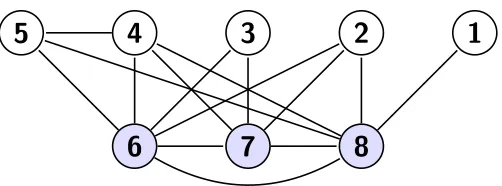
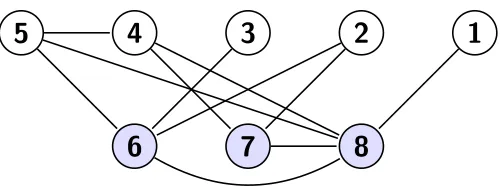
Example 2.1. Consider the set X with d = 20, c = 9, N = {1, . . . ,8}, N1 = {1, . . . ,6}, and the conflict graph depicted in Figure 1. It can be seen that the MIR inequality (5),s+ 2Pj∈N1xj ≥6,defines a facet of
P.In addition to the points of type (P1) and (P2) the following (s, x)pointse6,7, e5,7, e5,6, e1,2, e1,3, e2,3,are tight, whereeij is the vector with 1 in positions iandj,and zero elsewhere. Using these points, graphG′⌊d
c⌋
depicted in Figure 2 is obtained. Although this graph is not connected, following the proof of Proposition 2.8, such points are enough to enforceβi=β, i∈N1 in equation (8).
1
2
3
4
5
6
7
8
Figure 1: Conflict graph corresponding to Example 2.1.
1
2
3
4
5
[image:6.595.77.480.158.269.2]6
Figure 2: GraphG′ ⌊d
c⌋
corresponding to Example 2.1.
The following proposition shows that if α(G[N1])≤ ⌊d
c⌋, then all non-trivial facet-defining inequalities
forP are those from the vertex packing polytope.
Proposition 2.9. Let α(G[N1])≤ ⌊d
c⌋. If inequality X
i∈N
αixi+βs≥γ, (9)
withβ 6= 0, defines a facet ofP, then inequality (9) is a multiple of inequality (1).
Proof. First, note that since (1,0) is an extreme ray, thenβ≥0. Asβ6= 0,assume thatβ >0. Then every point ofX satisfying inequality (9) as equation also satisfiess+cPi∈N1xi=d. Otherwise, if there exists a
point (s∗, x∗)∈X such thats∗+cP
i∈N1x ∗
i > dand P
i∈Nαix∗i+βs∗=γ, then conditionα(G[N1])≤ ⌊dc⌋
impliess∗>0. Thus, the feasible point (s∗−ǫ, x∗)∈X with 0< ǫ≤s∗+Pi∈N1x ∗
i −dviolates inequality
(9), which is a contradiction.
Henceforward, assumeα(G[N1])≥ ⌈d c⌉.
2.1. Application to single node fixed-charge set with conflicts on arcs
SetX discussed in this paper can occur as a relaxation of several more complex feasible sets of general mixed integer programs. Here a set Y is introduced that can be seen as an intermediate set between those general mixed integer sets and the set X. This set is a variant of the single node fixed-charge set where incompatibilities between arcs are considered, and it is defined as follows.
Y =n(s, y, x)∈R×R|N1|×
B|N|| s+ X
i∈N1
yi≥d, yi≤cxi, i∈N1,
xi+xj ≤1,{i, j} ∈E, s≥0, yi≥0, i∈N1
o ,
whereN1⊂N,andE is the edge set.
Set X is a restriction ofY by setting yi =cxi,∀i∈N1.Obviously, valid inequalities for XV P are valid
forY. Furthermore, the following proposition establishes the relation between valid inequalities for X and
Proposition 2.10. Any valid inequalityγs+Pi∈Nβixi ≥γ0 for X is also valid for Y.
Proof. Suppose not. That is, there exists (s∗, y∗, x∗) ∈ Y such that γs∗ +Pi∈Nβix∗i < γ0. Then the inequality is also violated by (s∗, y′, x∗) ∈ Y where y′
i = cx∗i. Thus (s∗, x∗) ∈ X and inequality γs+ P
i∈Nβixi≥γ0 is violated by this point, which is a contradiction.
The computational tests discussed in Section 5 are conducted for setY.
3. Valid inequalities
This section presents new families of valid inequalities for X. These inequalities will be grouped into three large families: the lifteds≥0 inequalities, the residual inequalities and the conflict MIR inequalities. 3.1. Lifted s≥0inequalities
To derive the first family of inequalities, notice that if xj = 1 for some j ∈N,then xi = 0,∀i∈N1(j).
Hence, it follows
s≥ljxj, (lift 0)
is valid forX,wherelj= (d−α(G[N1\N1(j)])c)+ and (x)+= max{0, x}.This inequality can be regarded as the lifting of inequality s ≥ 0 when this inequality does not define a facet. Inequality (lift 0) can be extended in two directions. One is to extend the right-hand side of the inequality for each clique. The other direction is to consider a subset ofN1 in the left-hand side. The following proposition gives the valid inequality for the general case.
Proposition 3.1. Let S⊆N be a clique in GandT ⊆N1\S.Then the following inequality is valid forX.
s+cX i∈T
xi≥ X
i∈S
(d−pic)+xi, (lift 1)
wherepi=α(G[N1\(N1(i)∪T)]).
Proof. Let (s, x) ∈ X. Notice that sinceS is a clique then Pi∈Sxi ≤1. If Pi∈Sxi = 0 then inequality
(lift 1) is implied by nonnegativity ofxi, i∈T ands.
Assume xi = 1 for some i∈ S. This implies xj = 0, j ∈N1(i). If (d−pic)+ = 0, then the inequality
trivially holds. Hence, assumed−pic >0.Then from (1) it follows s+c X
i∈N1
xi=s+c X
i∈T xi+c
X
i∈N1(i)\T
xi+c
X
i∈N1\(N1(i)∪T)
xi≥d,
which implies
s+cX i∈T
xi≥d−c
X
i∈N1\(N1(i)∪T)
xi≥d−cpi= (d−cpi)+xi= X
i∈S
(d−pic)+xi.
Proposition 3.2. If the following conditions hold, then inequality (lift 1)defines a facet of P. (i) For each i∈N1\(T∪S), α GN1\(T∪S∪N1(i)∪ {i})≥dc.
(ii) For each i∈N0\S, α GN1\(T∪S∪N1(i))≥dc.
(iii) For eachi∈T, there exists at least onej∈S with{i, j} 6∈E, andpj<⌊dc⌋such that
1
2
3
4
5
[image:8.595.182.433.67.160.2]6
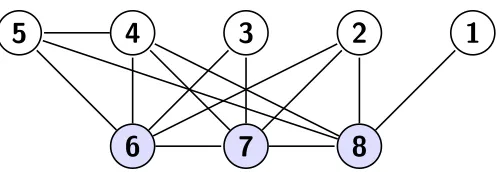
7
8
Figure 3: Conflict graph considered in Example 3.1.
Proof. Without loss of generality assume thatd−pic >0, i∈S.Consider the equality s+cX
i∈T xi=
X
i∈S
(d−pic)xi, (10)
and letK =P∩ {(s, x)| (s, x) satisfies (10)}. Now assume inequality γs+Pi∈Nβixi ≥γ0 is valid for X and satisfies the condition
γs+X
i∈N
βixi=γ0,∀(s, x)∈K. (11)
So one can show that equality (11) is a multiple of (10) by generating the following points belonging to
K. Conditions (i) and (ii) ensure the existence of the following points. (P1) ∀ T ∈ I⌈d
c⌉(N1\(T∪S)), s= 0;xi= 1, i∈T;xi= 0, i∈N\T;
(P2) ∀j ∈ N1\(T ∪S),∀ T ∈ I⌈d
c⌉(N1\(T ∪S∪N1(j)∪ {j})), s = 0;xi = 1, i ∈ T;xj = 1;xi = 0, i ∈
N\(T∪ {j});
(P3) ∀j∈N0\S,∀T ∈ I⌈d
c⌉(N1\(T∪S∪N1(j))), s= 0;xi= 1, i∈T;xj= 1;xi= 0, i∈N\(T∪ {j}).
Points (P1), (P2) and (P3) implyβi= 0, i∈N1\(T∪S), βi= 0, i∈N0\S andγ0= 0. For eachj∈S, from the definition ofpj,there exitsT ∈ Ipj(N1\(T∪N1(j))).Considering the points=d−pjc;xi= 1, i∈
T;xj= 1;xi= 0, i∈N\(T∪ {j}) and substituting it in equation (11) givesβi=−γ(d−pic), i∈S. Finally,
for eachi∈T,and eachj∈S such that condition (iii) is satisfied, consider the points=d−(pj+ 1)c;xk=
1, k∈T ∈ Ipj(N1\(T∪N1(j)));xj =xi= 1;xk = 0, k∈N\(T∪ {j, i}). Replacing these points in equation
(11) impliesβi=γc, i∈T. Hence, (11) is a multiple of (10).
Facet-defining inequalities of type (lift 1) are illustrated in the following example.
Example 3.1. Letd= 20, c= 9, N={1, . . . ,8}, N1={1, . . . ,5}and the conflict graphGshown in Figure 3. One can check that the following inequalities
s+ 9x5≥11x6+ 11x7+ 11x8,
s≥11x6+ 2x7+ 11x8,
define facets of P withS={6,7,8}, T ={5},andS={6,7,8}, T =∅,respectively.
Remark 3.1. Consider valid inequality (lift 1) by setting T = N1\Ne1(S). Then, one can check that
pi= 0,∀i∈S. Thus, the following inequality is valid for X.
s+c X
i∈N1\Ne1(S)
xi≥d X
i∈S
For the particular case ofd−pic=r, the following class of valid inequalities can be derived whereS is
not restricted to be a clique.
Proposition 3.3. Let S⊆N0,andT ⊆N1 such that
α GS≤ld c m
,
and
α GT\N1( ¯S)≤ld c m
−S¯,∀S¯∈ I(S). (13) Then the following inequality is valid for X.
s+r X
i∈N1\T
xi≥r X
i∈S
xi. (lift 2)
Proof. IfPi∈Sxi = 0, then validity of (lift 2) follows from nonnegativity of sand xi, i∈N1\T. Assume
P
i∈Sxi≥1. Let ¯S={i∈S:xi= 1}.Thus P
i∈Sxi=
S¯where ¯S is an independent set. Then
s+r X
i∈N1\T
xi≥r ld
c m
−X
i∈T xi
=rld c m
− X
i∈T\N1( ¯S)
xi
≥rld c m
−α GT\N1( ¯S)
≥rld c m
−ld c m
+S¯=rX i∈S
xi,
where the first inequality follows from the validity of the MIR inequality, the second inequality follows from the definition of independent set, and the third inequality follows from (13).
Proposition 3.4. Consider setsS andT as defined in the statement of Proposition 3.3. Suppose
S=nS¯∈ I(S) |α GT \N1( ¯S)=ld
c m
−S¯o6=∅,
and consider the following two graphs:
G′ = (N
1\T, E′), where {i, j} ∈E′ if there exist S¯ ∈ S,T¯ ∈ I⌈d
c⌉−|S¯|(T \N1( ¯S)), and an independent
setI⊆N1\(T∪N1( ¯S)∪N1( ¯T))such that|I| ∈ {|S| −¯ 1,|S|}¯ ,i∈I,j6∈I, andI′∪S¯∪T¯ is an independent set where I′ = (I\ {i})∪ {j};
G′′ = (S, E′′), where {i, j} ∈E′′ if there exist S¯ ∈ S,T¯ ∈ I ⌈d
c⌉−|S¯|(T \N1( ¯S)), and an independent set
I⊆N1\(T∪N1( ¯S)∪N1( ¯T)) such that|I| ∈ {|S¯| −1,|S|}, i¯ ∈S¯,j6∈S¯,S¯′= ( ¯S\ {i})∪ {j} ∈ S and sets ¯
S∪T¯∪I andS¯′∪T¯∪I are independent.
Then inequality (lift 2)defines a facet of P if the following conditions hold. (i) For each i∈T, α GT\(N1(i)∪ {i})≥d
c
.
(ii) For each i∈N0\S, α GT\N1(i)≥dc. (iii) For eachS¯∈ S there existsT¯∈ I⌈d
c⌉−|S¯|(T\N1( ¯S))such that
α GN1\(T∪N1( ¯S)∪N1( ¯T))≥
S¯.
(iv) Graph G′= (N
1
2
3
4
5
[image:10.595.182.432.67.160.2]6
7
8
Figure 4: Conflict graph corresponding with Example 3.2.
The proof is left to the Appendix.
Example 3.2. Consider the data given in Example 3.1 and the conflict graph G shown in Figure 4. By setting S ={6,7,8} and T = {1,2,3,4}, one can check that the validity and the facet-defining conditions established in Proposition 3.3 and Proposition 3.4 hold. Hence, the following inequality of type (lift 2)defines a facet ofP.
s+ 2x5≥2x6+ 2x7+ 2x8.
3.2. Residual inequalities
Next, a new family of valid inequalities is introduced where the residuum c−r=c⌈d
c⌉ −doccurs as the
independent term.
Proposition 3.5. Let S⊆N0 such thatα(G[S])≤ ⌈dc⌉and α GN1\N1( ¯S)
≤ld
c m
−S¯,∀S¯∈ I(S). (14) Then the following inequality is valid for X.
s+ (c−r)≥cX i∈S
xi. (residual 1)
The proof of Proposition 3.5 is omitted since a proof of a more general class will be given later. Next, it is shown that, ifNe1(S)6=∅, then (residual 1) does not define a facet. Let
F =n(s, x)∈X |s=cX i∈S
xi−(c−r) o
.
As −(c−r) < 0 and s ≥ 0 then Pi∈Sxi > 0,∀(s, x) ∈ F. This implies that if i ∈ Ne1(S), then xi = 0,∀(s, x)∈ F. Thus, (residual 1) does not define a facet whenNe1(S)6=∅. In order to obtain a stronger
inequality, xi, i ∈ Ne1(S) are lifted as follows. Consider R ⊆ Ne1(S) such that R is a clique in G[Ne1(S)].
Hence, it suffices to find coefficientsli, i∈Rsuch that inequality s+ (c−r)≥cX
i∈S xi+
X
i∈R
lixi, (15)
remains valid for X. If xi = 0,∀i∈R, then inequality (15) is trivially valid. So assume xj = 1, for some j∈R. Notice that sinceRis a clique, thenxj = 1 impliesxi = 0,∀i∈R\ {j}. Thus, in order for inequality
s+ (c−r)≥cX i∈S
1
2
3
4
5
[image:11.595.180.434.82.185.2]6
7
8
Figure 5: Conflict graph corresponding with Example 3.3.
to be valid,lj must satisfylj≤s+ (c−r)−cPi∈Sxi,∀(s, x)∈X|xj=1. Sincej ∈Ne1(S), soxj= 1 implies
xi = 0,∀i∈S. Hence
lj≤s+ (c−r),∀(s, x)∈X|xj=1 =⇒ lj ≤min(s,x)∈X|xj=1{s}+ (c−r).
The minimum value whichs attains can be obtained by maximizing the number of binary variables in
N1 set to one.
lj= (c−r) + h
d−α GN1\(j∪N1(j))+ 1
ci+. (16)
Therefore, sinceRis a clique, inequality (15) is valid forX whereli, i∈R,is defined by (16). Moreover,
if conditionα(G[N1\(i∪N1(i))])≥ ⌊dc⌋holds, then s= 0 impliesli=c−r, i∈R.
Example 3.3. Consider the data given in Example 3.1 and the conflict graph Gshown in Figure 5. Taking
S={6,7}implies that the inequalitys+7≥9x6+9x7of type(residual 1)is valid forX. SinceNe1(S) ={2,5} is a clique, then let R =Ne1(S). One can check that the following lifted inequality, with lifting coefficients
l2=l5=c−r= 7, defines a facet ofP.
s+ 7≥7x2+ 7x5+ 9x6+ 9x7.
Now, inequality (residual 1) is generalized as follows.
Proposition 3.6. Let S⊆N0 withα(G[S])≤ ⌈dc⌉, andT ⊆N1 such that
α GT\N1( ¯S)≤ld c m
−S¯,∀S¯∈ I(S).
Then the following inequality is valid for X.
s+c X
i∈N1\T
xi+ (c−r)≥c X
i∈S
xi. (residual 2)
Proof. Consider (s, x)∈X. If Pi∈Sxi = 0, then validity of (residual 2) is implied by the nonnegativity of
variablesxiands.Assumexi= 1, i∈S¯⊆Sandxi= 0, i∈S\S.¯ From (1) it follows thats+cPi∈N1\Txi≥
d−cPi∈Txi.Thus
s+c X
i∈N1\T
xi+ (c−r)≥d−c X
i∈T
xi+ (c−r)≥d−α G
T\N1( ¯S)c+ (c−r)
≥d−cld c m
−S¯+ (c−r) =cjd c k
+r−cld c m
−S¯+ (c−r) =cS¯=cX i∈S
Similarly to inequalities (residual 1), inequalities (residual 2) can be strengthened by lifting variables in
e
N1(S). These variables are lifted by takingR ⊆ Ne1(S) such that R is a clique. It suffices to find lifting coefficientsli, i∈R such that inequalitys+ (c−r)≥cPi∈Sxi−cPi∈N1\Txi+
P
i∈Rlixi,remains valid
for X. Following the same steps used to lift inequality (residual 1), the following general family of valid inequalities can be derived.
Proposition 3.7. Consider the sets S⊆N0, T ⊆N1,andR⊆Ne1(S)such that α(G[S])≤ ⌈dc⌉,
α GT\N1( ¯S)≤ld c m
−S¯,∀S¯∈ I(S),
andR is a clique. Then following inequality is valid forX.
s+c X
i∈N1\T
xi+ (c−r)≥c X
i∈S xi+
X
i∈R
lixi, (residual 3)
where
li= (c−r) + h
d−α GN1(S)\(i∪N1(i))+ 1ci
+
, i∈T.
Ifα(G[N1(S)\(i∪N1(i))])≥ ⌊d
c⌋, thenli=c−r, i∈T.
3.3. Conflict MIR inequalities
Next, families of valid inequalities, called conflict MIR inequalities, are introduced that can be regarded as an extension of MIR inequalities to the case where a conflict graph representing incompatibilities between pairs of variables is present. To do so, initially consider the following weaker MIR inequality obtained from a restriction of setX. For eachT ⊂N1,lets′ =s+cPi∈N1\Txi. Then the MIR inequality
s′+rX i∈T
xi≥r ld
c m
,
is valid forX. When this inequality does not define a facet (see Proposition 2.1), it could be lifted as follows.
Proposition 3.8. Consider S⊆N0 withα(G[S])≤ ⌊dc⌋andT ⊆N1 such that
α GT\N1( ¯S)≤jd c k
−S¯, ∀S¯∈ I(S). (17) Then the following inequality is valid for X.
s+c X
i∈N1\T
xi+r X
i∈T xi≥r
ld c m
+ (c−r)X
i∈S
xi. (cMIR 1)
Proof. Let (s, x)∈X. IfPi∈Sxi= 0,then the validity is implied by the MIR inequality (5) as follows.
s+c X
i∈N1\T
xi+r X
i∈T
xi≥s+r X
i∈N1\T
xi+r X
i∈T xi≥r
ld c m
.
AssumePi∈Sxi ≥1. So Pi∈Sxi =
S¯where ¯S ⊆S is an independent set. Now letPi∈T\N1( ¯S)xi =
⌊d c⌋ −
S¯−kwhere 0≤k≤ ⌊d c⌋ −
S¯. As
X
i∈N1
xi = X
i∈N1\T
xi+ X
i∈T\N1( ¯S)
xi = X
i∈N1\T
xi+ jd
c k
then, using inequality (1) gives
s+c X i∈N1
xi≥d⇐⇒s+c X
i∈N1\T
xi+c X
i∈T\N1( ¯S)
xi ≥d.
Thus
s+c X
i∈N1\T
xi≥d−c jd
c k
−S¯−k≥S¯c+kc+r
≥S¯c+ (k+ 1)r≥rld c m
+ (c−r)S¯−rjd c k
−S¯−k.
Hence
s+c X
i∈N1\T
xi+r jd
c k
−S¯−k=s+c X i∈N1\T
xi+r X
i∈T\N1( ¯S)
xi ≥r ld
c m
+ (c−r)S¯.
Definition 3.1. For S ⊆N0 and T ⊆ N, α¯(G[T ∪S]) denotes the independence number of the subgraph induced byT∪S such that at least one node from set S appears in the corresponding independent set.
In the following proposition sufficient conditions for inequality (cMIR 1) to be facet-defining are presented.
Proposition 3.9. Consider S andT as defined in the statement of Proposition 3.8. Suppose
S1=
n
¯
S∈ I(S)| α GT\N1( ¯S)=jd
c k
−S¯o6=∅, and consider the following graph:
G′′= (S, E′′), where{i, j} ∈E′′if there existsJ ∈ S
1such thati∈J,j6∈J, andJ′ = (J\{i})∪{j} ∈ S1. Then inequality (cMIR 1)is facet-defining forP if the following conditions hold.
(i) α GT≥d c
.
(ii) For each i∈N1\T,α G¯ (T∪S)\N(i))≥dc
.
(iii) For eachi∈N0\S,α G¯ (T∪S)\N(i)≥dc
.
(iv) Graph G′ ⌊d
c⌋
= (T, E′)is connected.
(v) Graph G′′= (S, E′′)is connected.
The proof is left to the Appendix.
WhenS⊆N0 is a clique, inequalities (cMIR 1) can be strengthened as follows.
Proposition 3.10. LetS be a clique inG[N0], andT ⊆N1 such that
α GT\N1(i)≤jd c k
−pi,∀i∈S,
wherepi∈
1, . . . ,⌊d
c⌋ , i∈S. Then the following inequality is valid for X.
s+c X
i∈N1\T
xi+r X
i∈T xi≥r
ld c m
+X
i∈S
Proof. Let (s, x)∈X. AssumePi∈Sxi= 0. Then validity is implied by the MIR inequality (5) similarly to
the proof of the same case given in Proposition 3.8.
LetPi∈Sxi= 1. So assumexj = 1,for somej∈S. ThenPi∈T\N1(j)xi=⌊
d
c⌋−kjwherepj≤kj≤ ⌊ d c⌋.
From (1), usingPi∈N1(j)xi= 0 andPi∈T\N1(j)xi=⌊dc⌋ −kj,then
s+c X
i∈N1\T
xi+c X
i∈T\N1(j)
xi+c X
i∈N1(j)
xi ≥d⇔s+c X
i∈N1\T
xi+r X
i∈T\N1(j)
xi≥d−(c−r) X
i∈T\N1(j)
xi
≥d−(c−r)jd
c k
−kj
=r+cjd c k
−(c−r)jd
c k
−kj
=rld c m
+ (c−r)kj ≥r ld
c m
+ (c−r)pj.
Inequalities (cMIR 2) can be lifted as follows.
Proposition 3.11. Let S⊆N0 define a clique inG,k∈N0\S such thatS∪ {k}does not define a clique, andT ⊆N1 such that
α GT \N1(i)≤jd c k
−pi,∀i∈S∪k,
α GT \N1({k, j})≤jd c k
−pj−pk,∀j∈S1, wherepi ∈
1, . . . ,⌊d
c⌋ , i∈S∪ {k},1≤pj+pk ≤ ⌊ d
c⌋, j ∈S1={j ∈S :{j, k} 6∈E}. Then the following
inequality is valid.
s+c X
i∈N1\T
xi+r X
i∈T xi≥r
ld c m
+X
i∈S
pi(c−r)xi+pk(c−r)xk. (cMIR 3)
Proof. Ifxk = 0 or xk = 1 and Pi∈Sxi = 0, then validity of (cMIR 3) follows from validity of (cMIR 2).
The proof of casexk= 1 and Pi∈Sxi = 1 is similar to the proof of validity of (cMIR 2).
The following example presents facet-defining inequalities of types (cMIR 1), (cMIR 2), and (cMIR 3).
Example 3.4. Assume d= 20, c = 9, N = {1, . . . ,8}, N1 = {1, . . . ,5} and consider the conflict graph G depicted in Figure 6. Then it can be checked that condition (17) is satisfied for S = {6,7,8} and T =
{2,3,4,5}. So the following inequality of type (cMIR 1) is valid forX.
s+ 9x1+ 2x2+ 2x3+ 2x4+ 2x5≥6 + 7x6+ 7x7+ 7x8.
One can check that the previous inequality as well as the following inequalities of type (cMIR 1)define facets of P.
s+ 2x1+ 2x2+ 2x3+ 2x4+ 9x5≥6 + 7x6+ 7x7+ 7x8,
s+ 2x1+ 2x2+ 2x3+ 2x4+ 2x5≥6 + 7x6+ 7x8. The following inequalities of type (cMIR 2)are facet-defining forP.
s+ 9x1+ 2x2+ 2x3+ 2x4+ 9x5≥6 + 14x6+ 14x7,
s+ 2x1+ 2x2+ 9x3+ 2x4+ 9x5≥6 + 7x7+ 14x8,
s+ 9x1+ 2x2+ 2x3+ 2x4+ 2x5≥6 + 14x6+ 7x7,
s+ 2x1+ 2x2+ 9x3+ 2x4+ 2x5≥6 + 14x8.
The unique facet-defining inequality of type (cMIR 3)is obtained withS={6,7}, k={8} andT ={2,3,4},
and is given by
1
2
3
4
5
[image:15.595.183.432.67.153.2]6
7
8
Figure 6: Conflict graph considered in Example 3.4.
The following proposition generalizes inequalities (cMIR 1).
Proposition 3.12. LetS ⊆N0, T ⊆N1 and let{T1, T2}defines a partition of T such that
α GS≤jd c k
+p, α GT1\N1( ¯S)≤
jd c k
+p−S¯, ∀S¯∈ I(S), (18)
α GT2\N1( ¯S)≤
p−S¯+, ∀S¯∈ I(S). (19) Then the following inequality is valid for X.
s+c X
i∈N1\T
xi+r X
i∈T xi ≥r
ld c m
+ (c−r) X
i∈S
xi−p+ X
i∈T2
xi
. (cMIR 4)
Proof. Let (s, x)∈X. Let xi= 1, i∈S¯⊆S,andxi= 0, i∈S\S.¯ If|S¯|< p,then X
i∈S
xi−p+ X
i∈T2
xi=|S| −¯ p+ X
i∈T2
xi≤ |S¯| −p+α GT2\N1( ¯S)≤0,
where the last inequality follows from (19). Hence, inequality (cMIR 4) is implied by the MIR inequality
s+r X
i∈N1\T
xi+r X
i∈T xi≥r
ld c m
.
Now, let|S| ≥¯ p.Then, from (19) it follows thatxi = 0, i∈T2.The proof is now similar to the proof of Proposition 3.8 for casePi∈Sxi≥1.
1
2
3
4
5
6
[image:16.595.153.463.88.216.2]7
8
9
10
Figure 7: Conflict graph corresponding with Example 3.5.
(I1)s+ 9x1+ 9x2+ 9x3+ 9x4+ 9x5+ 9x6≥14, (I25)s+ 9x1+ 5x2+ 9x3+ 9x4+ 9x5+ 5x6≥4x7+ 10, (I2)x1≥0, (I26)s+ 9x1+ 9x2+ 5x3+ 9x4+ 5x5+ 5x6≥4x8+ 10, (I3)x2≥0, (I27)s+ 9x1+ 5x2+ 9x3+ 9x4+ 5x5+ 9x6≥4x9+ 10, (I4)x3≥0, (I28)s+ 9x1+x2+ 9x3+ 9x4+ 5x5+ 5x6≥4x7+ 4x9+ 6, (I5)x4≥0, (I29)s+ 9x1+ 5x2+ 5x3+ 9x4+ 5x5+x6≥4x7+ 4x8+ 6, (I6)x5≥0, (I30)s+ 9x1+ 5x2+ 5x3+ 9x4+x5+ 5x6≥4x8+ 4x9+ 6, , (I7)x6≥0, (I31)s+ 9x1+x2+ 5x3+ 9x4+x5+x6≥4x7+ 4x8+ 4x9+ 2,
(I8)x7≥0, (I32)s+ 5x1≥5x8,
(I9)x8≥0, (I33)s+ 5x2≥5x8,
(I10)x9≥0, (I34)s+ 5x3+ 5x4≥5x9,
(I11)x10≥0, (I35)s+ 5x3+ 5x6≥5x9, (I12)s≥0, (I36)s+ 5x1+ 5x4≥5x8+ 5x9, (I13)x6+x7≤1, (I37)s+ 5x1+ 5x4≥5x7+ 5x8, (I14)x5+x9≤1, (I38)s+ 5x1+ 5x3+ 5x4≥5x7+ 5x9, (I15)x2+x9≤1, (I39)s+ 9x1+ 4x3+ 9x4≥4x7+ 5x8+ 5x9, (I16)x2+x4≤1, (I40)s+ 9x1+ 4x3+ 9x4≥5x7+ 5x8+ 4x9, (I17)x1+x6≤1, (I41)s+ 9x1+ 5x3+ 9x4≥5x7+ 4x8+ 5x9, (I18)x1+x4≤1, (I42)s+ 5x1+ 5x3+ 5x4≥5x7+ 5x8+ 5x9, (I19)x3+x6+x8≤1, (I43)s+ 4 + 9x1+ 9x4≥4x6+ 9x7+ 9x8, (I20)x3+x5+x8≤1, (I44)s+ 4 + 9x1+ 9x4≥4x5+ 9x8+ 9x9, (I21)x2+x7+x10≤1, (I45)s+ 4 + 9x1+ 9x3+ 9x4≥4x2+ 9x7+ 9x9, (I22)x1+x2+x4+x6+x7≤2, (I46)s+ 5≥5x6+ 5x7+ 5x8,
(I23)x1+x2+x3+x4+x5+x6+x8+x9≤3, (I47)s+ 5≥5x5+ 5x8+ 5x9, (I24)s+ 5x1+ 5x2+ 5x3+ 5x4+ 5x5+ 5x6≥10, (I48)s+ 5 + 5x3≥5x2+ 5x7+ 5x9.
Inequalities (I1)–(I18) are trivial inequalities discussed in Proposition 2.3, Proposition 2.6 and Propo-sition 2.7. Inequalities (I19)–(I23) stem from PV P. (I24) is the MIR inequality, (I25)–(I27) are of type
3.4. Valid inequalities for case d=c
Notice that all the inequalities discussed previously are valid whend ≥c. Below a new class of valid inequalities is introduced forX which defines facets only whend=c.
Proposition 3.13. LetS ⊆N0,α(G[S]) =p,and define
T = \
¯
S∈Ip(S)
N1( ¯S), T = \ ¯
S∈Ip−1(S)
N1( ¯S).
Let T′⊆T such thatT′ defines a clique. The following inequality is valid forX.
s+c X
i∈N1\T
xi≥c X
i∈S
xi−p+ 1
+cX i∈T′
xi. (20)
Proof. To prove validity of (20), consider the following cases. Let (s, x)∈X.
CaseI. Letp= 1. It implies thatS is a clique,T =Ne1(S) and T =T′ =∅. If P
i∈Sxi= 0, then the
validity follows from nonnegativity ofsandxi, i∈N1\T. AssumePi∈Sxi= 1. Then inequality (1) implies s+c X
i∈N1
xi=s+c X
i∈N1\T
xi+c X
i∈T
xi=s+c X
i∈N1\T
xi+c X
i∈Ne1(S)
xi
=s+c X i∈N1\T
xi≥c=c X
i∈S xi.
CaseII. Letp≥2. If Pi∈Sxi= 0 then validity of (20) is implied by nonnegativity ofs, xi, i∈N1\T, and propertiesPi∈T′xi ≤1 and 1−p ≤ −1. Suppose Pi∈Sxi =
S¯ where ¯S is an independent set. If 1≤S¯≤p−2, then
X
i∈S
xi−p+ 1 =
S¯−p+ 1≤p−2−p+ 1 =−1,
which implies thatc Pi∈Sxi−p+ 1+cPi∈T′xi≤0. Thus, the validity is implied by nonnegativity ofs
andxi, i∈N1\T.
Now, letp−1≤S¯≤p. Then, it results from the definition ofT′that this condition impliesP
i∈T′xi = 0.
So, for the caseS¯=p−1, the validity follows from nonnegativity ofsand xi, i∈N1\T. For S¯=p, it can be concluded thatPi∈Txi = 0. So inequality (1) implies
s+c X i∈N1
xi=s+c X
i∈N1\T
xi+c X
i∈T
xi=s+c X
i∈N1\T
xi≥c=c X
i∈S
xi−p+ 1
.
Next, sufficient conditions for inequality (20) to define a facet ofP are presented.
Proposition 3.14. LetS⊆N0be an independent set. Inequality (20)is facet-defining forP if the following conditions hold.
(i) For each i∈T\T′, there exists at least oneS¯∈ I
p−1(S)such that i∈T\(T′∪N1( ¯S)).
(ii) For each i∈T′, there exists at least one S¯∈ I
p−2(S)such that i∈T′\N1( ¯S).
(iii) For each i ∈ N0\ S, there exists at least one S¯ ∈ I(S) where p−1 ≤
S¯ ≤ p such that i ∈ N0\(S∪N0( ¯S)).
1
2
3
4
5
6
[image:18.595.128.486.90.203.2]7
8
9
Figure 8: Conflict graph considered in Example 3.6.
Example 3.6. Assumed=c= 15, N ={1, . . . ,9}, N1={1, . . . ,6},and consider the conflict graphGgiven in Figure 8. Then the following inequalities of type (20)are facet-defining for P.
s+ 15x1+ 15x4≥15(x7+x8−1) + 15x6,
s+ 15x1+ 15x4≥15(x8+x9−1) + 15x5,
s+ 15x1+ 15x3+ 15x4≥15(x7+x9−1) + 15x2.
Observe that, as discussed in Section 2, inequality (20) under the foregoing conditions defines a facet of
P ifc > d.
4. Separation
This section discusses the separation problems associated with the families of inequalities (lift 1), (cMIR 1), (lift 2) and (residual 2), used in the computational tests reported in Section 5.
Consider a point (s∗, x∗)∈ R+×[0,1]n. Then for each family, V, of valid inequalities the separation
problem is to find an inequality in V that is violated by the point (s∗, x∗) or show that there is no such
inequality. All the separation problems discussed here are NP-hard since they include the computation of the independence number of a graph as a subproblem.
The separation problems are discussed in detail for inequalities (lift 1) and (cMIR 1), and also a brief discussion on the separation of (lift 2) and (residual 2) is given at the end of this section.
First consider inequalities (lift 1). For a clique S⊆N and T ⊆N1\S,these inequalities can be written as follows.
X
i∈S
(d−pic)+xi≤s+c X
i∈T xi
⇐⇒ X
i∈S
(d−pic)+xi+c X
i∈N1\T
xi≤s+c X
i∈N1
xi.
Hence, for a given solution (s∗, x∗), inequality (lift 1) is violated if and only if the maximum of the LHS,
max
S⊆N,T⊆N1\S
n X
i∈S
(d−pic)+x∗i +c X
i∈N1\T
x∗
i|S is a clique o
, (21)
is greater than the constant s∗+cP
i∈N1x ∗
Exact separation of inequalities (lift 1)
In order to solve this separation problem exactly, define the binary variablesyi, i∈N1such that yi is 1
ifi∈N1\T,and 0 otherwise, and the binary variableszi, i∈N indicating whetheri∈S or not. For each i∈N,also define the non-negative integer variablesγi which are 0 ifzi= 0 and are lower bounded by pi if zi= 1.The maximization problem (21) can be solved by solving the following MIP problem.
max X
i∈N1
cx∗iyi+ X
i∈N
dx∗izi− X
i∈N
cx∗iγi (22)
s.t. z defines a clique inN , (23)
γi≥ X
j∈I
yjzi, i∈N, I∈ I(N1\N1(i)), (24)
zi≤yi, i∈N1, (25)
yi∈ {0,1}, i∈N1, (26)
zi∈ {0,1}, i∈N, (27)
γi∈Z+0, i∈N. (28)
Constraints (23) can be modeled in many different ways. For a discussion and comparison of formulations for clique problems see [12]. Following [18], define the variableszij,{i, j} ∈E indicating whether both nodes iandj belong to the clique. Then constraints (23) can be modeled as follows:
zij ≤zi, zij ≤zj, {i, j} ∈E, zi+zj≤1 +zij, {i, j} ∈E, zi+zj≤1, {i, j} 6∈E, zij ∈ {0,1}, {i, j} ∈E, zi∈ {0,1}, i∈N.
Constraints (24) ensure thatγi must be greater than the cardinality of each independent set defined by
variablesy,hence it must be greater than the maximum cardinality set. Clearly, in any optimal solution to (22)–(28), constraint (24) will be satisfied as equation, that is,γi=pi.Since (24) are nonlinear, they can be
linearized by introducing new binary variables wij =yjzi.For eachi∈N,constraints (24) can be replaced
by the following set of constraints.
γi≥ X
j∈I
wij, I ∈ I(N1\N1(i)), (29)
wij ≤zi, j∈N1, (30)
wij ≤yj, j∈N1, (31)
wij ≥zi+yj−1, j∈N1, (32)
wij ∈ {0,1}, j ∈N1. (33)
Finally, constraints (25) impose that each element inS that also belongs toN1must be inN1\T, that impliesS andT are disjoint.
Algorithm 1Separation heuristic for inequalities (lift 1).
T ← {j∈N1:x∗j = 0} for alli∈N\T do
Compute an upper boundpionα(G[N1\(N1(i)∪T)]) using the sequential elimination algorithm given in [11] for the complement of graphG
ci←(d−pic)+ end for
Sort the values of x∗
j, j ∈N \T in a decreasing order. Letj1, . . . , jr denote the indices of the resulting
order.
S← ∅
for allj1, . . . , jrdo
if S∪ {j1}is a clique then
S←S∪ {j1}
end if end for
if Pi∈Scix∗i > s∗+c P
i∈Tx∗i then
Add inequality (lift 1) for the givenS andT. end if
Heuristic separation of inequalities (lift 1)
The exact separation procedure can hardly be used in practice. Here a heuristic procedure to separate inequalities (lift 1) is proposed, which is given in Algorithm 1.
Next, the separation of inequality (cMIR 1) is examined. ForS ⊆N0 andT ⊆N1, this inequality can be written as follows.
rld c m
+ (c−r)X
i∈S
xi≤s+c X
i∈N1\T
xi+r X
i∈T xi
⇐⇒ (c−r)X
i∈S xi−c
X
i∈N1\T
xi−r X
i∈T
xi ≤s−r ld
c m
⇐⇒ (c−r)X
i∈S
xi+ (c−r) X
i∈T
xi≤s−r ld
c m
+c X i∈N1
xi
⇐⇒ X
i∈S xi+
X
i∈T xi≤
s−r⌈d c⌉+c
P i∈N1xi
c−r . (34)
Notice that condition (17) is equivalent to the following condition. ¯
α GT ∪S≤jd c k
. (35)
Consider a fractional solution (s∗, x∗) and the graphGwhere the weight of node i∈N is given byx∗i.
To find the most violated inequality, one needs to maximize the LHS of inequality (34) by determining S
andT that satisfy condition (35): max
S⊆N0,T⊆N1
n X
i∈S x∗i +
X
i∈T
x∗i |α G¯
T∪S≤jd c
ko .
Therefore, the separation problem is equivalent to find the maximum-weight subset ofN such that the maximum independence number of the subgraph induced by that subset is less than or equal to ⌊d
c⌋, and
Exact separation of inequalities (cMIR 1)
A possible approach to solve this separation problem exactly is to formulate it as a binary problem. To achieve this goal, define the binary variables zi, i ∈ N, that indicate, for i ∈ N1, whether i ∈ T, and for
i∈N0, whetheri∈S. LetC be the family of all subsets in N whose independence number is greater than
⌊d
c⌋, that is C = {C ⊆ N| α(G[C]) > ⌊ d
c⌋}. Then the separation problem can be solved by solving the
following binary problem.
max X
i∈N
x∗izi (36)
s.t. X
j∈C
zj ≤ |C| −1,∀C∈ C, (37)
X
j∈N0
zj≥1, (38)
zi ∈ {0,1}, i∈N. (39)
Inequalities (37) increase exponentially with the size of the graph. Hence, these inequalities should be included dynamically using a separation routine to find the maximum cardinality independent set.
Heuristic separation of inequalities (cMIR 1)
A heuristic procedure is now described to separate (cMIR 1). A greedy heuristic is proposed to form set S∪T. First, the nodes are sorted accordingly to the value x∗
j × |δ(j)|, where δ(j) denotes the set of
arcs incident to node j. Then, following that order (starting from a node in N0) the nodes are selected if the independence number of the resulting induced graph does not exceed⌊d
c⌋. In order to ensure that this
condition holds, a nodej is selected if there are at most⌊d
c⌋ −1 selected nodes that are not neighbors of j,
that is, ifNC(j)≤ ⌊dc⌋ −1,where NC(j) denotes the set of neighbors ofj in C⊆N,in the complement of
graphG.
The separation algorithm is given in Algorithm 2.
Algorithm 2Separation heuristic for inequalities (cMIR 1).
Lj ←x∗j× |δ(j)|, j∈N.
SortLj in a decreasing order. Letj1, . . . , jn denote the indices of the resulting order. C← {j∗} wherej∗= min{i:j
i∈N0}
for alli∈N|ji6∈C do
if |NC(ji)| ≤ ⌊dc⌋ −1 then C←C∪ {ji}
end if end for
S←C∩N0;T ←C∩N1;RHS← s ∗
−r⌈d c⌉+c
P
i∈N1x
∗
i
c−r if Pi∈S∪Tx∗
i > RHS then
Add inequality (cMIR 1) for the givenS andT. end if
Separation of inequalities (lift 2)and (residual 2)
As a final remark, the separation of inequalities (lift 2) and (residual 2) is discussed. It is similar to the separation of inequalities (cMIR 1). For eachS⊆N0,andT ⊆N1,inequalities (lift 2) can be rewritten as
rX
i∈S
xi ≤s+r X
i∈N1\T
xi⇐⇒ X
i∈S∪T xi≤
s r+
X
i∈N1
1
0
2
0.5
3
0.5
4
1
5
1
6
[image:22.595.211.403.71.180.2]0.5
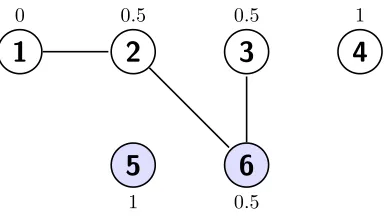
Figure 9: Conflict graph corresponding to the fractional solution given in Example 4.1.
So inequality (lift 2) resembles inequality (34). Hence, the separation problem amounts to maximize
P
i∈S∪Txi over a set which is very similar to (35).
Now, consider the case of inequalities (residual 2). For eachS⊆N0,andT ⊆N1,these inequalities can be rewritten as
cX
i∈S
xi ≤s+c X
i∈N1\T
xi+ (c−r)⇐⇒c X
i∈S∪T
xi ≤s+c X
i∈N1
xi+ (c−r).
Again, the separation problem becomes very similar to the one of inequalities (cMIR 1) and (lift 2).
Example 4.1. Consider setY withN ={1, . . . ,6}, N1={1, . . . ,4}, d= 12, c= 5andE={{1,2},{2,6},{6,3}}. Also consider the problem of minimizing an objective function over set Y. For a given objective function, the following fractional solution of the linear relaxation is obtained.
s= 2, y1= 0, y2= 2.5, y3= 2.5, y4= 5, y5= 5, y6= 2.5,
x1= 0, x2= 0.5, x3= 0.5, x4= 1, x5= 1, x6= 0.5.
The corresponding conflict graph is presented in figure 9, where the weight of nodei∈N is given by the value ofxi in the fractional solution. In order to separate inequality (cMIR 1), as explained in Section 4, set S ={6} andT ={2,3,4} where S∪T is the maximum-weight subset ofN satisfying condition (35). This gives 2.5 for the left-hand side of inequality (34), while the right-hand side is equal to 2, and so inequality (cMIR 1)is violated for the proposed setsS andT.
5. Computational experiments
In Section 3 several families of valid inequalities have been introduced and sufficient conditions for defining facets ofP have been provided, showing that these inequalities are relevant from a theoretical point of view. From a practical point of view, applying these inequalities to general mixed integer problems raises several questions, namely, to find the most efficient inequalities, to find efficient separation algorithms, and to test different relaxations of those problems since, for some problems as the ones discussed in [2], set X can be obtained through different relaxations. Given all these difficulties, this paper aims at providing only preliminary computational tests, using the intermediate set Y, to test, from a practical point of view, the inclusion of such inequalities. Thus, the goals of the computational experiments are (a) to evaluate how these inequalities approximate the convex hull ofY, and (b) to test whether these inequalities can improve the performance of a commercial solver to solve IP instances.
5.1. Integrality gap reduction
In this section, the integrality gap reduction obtained with the addition of inequalities (lift 1), (lift 2), (residual 2), and (cMIR 1) is tested.
A set of instances of the minimization problem over the single node fixed-charge set are generated as follows. For each d∈ {55,80,95,110,130}and eachc∈ {25,35,45} five instances are randomly generated. The conflict graphG= (N, E) with|N|= 20 is randomly generated with density 25% and 50%. Elements in N1 are randomly chosen from N with probability 12. The coefficients of s in the objective function are randomly generated in the interval [3,5); the coefficients ofyi, i∈N1, in the objective function are randomly
generated in the interval [0,1); and the coefficients of xi are randomly generated in the interval [0,20) if i∈N1, and in the interval (−20,0] otherwise.
For each pair (d, c) the following average values are computed:
• the average initial integrality gap denoted byIG;
• the average closed gap using known inequalities for XSM I (the MIR inequality) and forXV P (Clique
and Odd hole inequalities), denoted by MCO;
• the average closed gap using the new inequalities (lift 1), (lift 2), (residual 2), (cMIR 1), denoted by
N ew;
• the average closed gap usingMCO and theNew cuts, denoted byAll.
ForMCO inequalities, the MIR inequality is includeda prioriwhile clique and odd hole inequalities are introduced as cuts using the separation routines given in [15]. For theNew inequalities, the exact separation schemes discussed in Section 4 are implemented. Initial gaps are computed as OP T−LR
max{|OP T|,|LR|}×100 where OP T denotes the optimal value and LRindicates the linear relaxation value. Furthermore, closed gaps are calculated as ILR−LR
OP T−LR ×100 where ILR denotes the value of the linear relaxation after the inclusion of
the corresponding cuts. Moreover, the closed gap obtained by the MIR, clique, odd hole inequalities and inequality (lift 1) is denoted byMCO+(lift 1), and also the similar notation is used for inequalities (lift 2), (residual 2), and (cMIR 1). The computational results are reported in Tables 1-3.
Table 1: Average integrality gaps and closed gaps on 75 randomly generated instances with graph density 25%.
(d,c) IG MCO New All
(55,25) 47.91 81.62 71.72 87.54 (55,35) 39.35 82.71 59.32 94.12 (55,45) 24.28 95.55 54.74 97.32 (80,25) 75.34 91.54 91.62 96.52 (80,35) 38.64 94.88 87.82 97.21 (80,45) 27.61 81.56 48.42 95.52 (95,25) 89.86 90.02 92.47 95.46 (95,35) 48.98 78.89 74.88 94.54 (95,45) 34.99 96.71 79.56 98.91 (110,25) 107.01 93.09 96.12 96.88 (110,35) 62.45 85.83 92.33 95.82 (110,45) 38.85 82.70 60.80 89.58 (130,25) 113.15 95.33 98.63 100 (130,35) 102.94 90.85 95.08 99.61 (130,45) 48.06 80.71 80.34 87.97
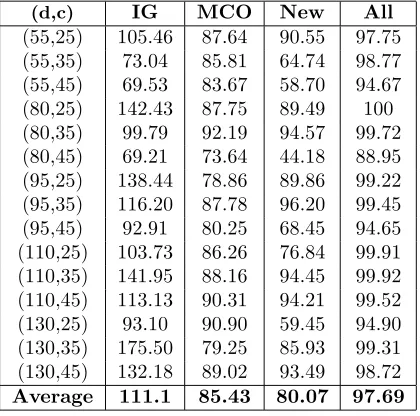
Table 2: Average integrality gaps and closed gaps on 75 randomly generated instances with graph density 50%.
(d,c) IG MCO New All
(55,25) 105.46 87.64 90.55 97.75 (55,35) 73.04 85.81 64.74 98.77 (55,45) 69.53 83.67 58.70 94.67 (80,25) 142.43 87.75 89.49 100 (80,35) 99.79 92.19 94.57 99.72 (80,45) 69.21 73.64 44.18 88.95 (95,25) 138.44 78.86 89.86 99.22 (95,35) 116.20 87.78 96.20 99.45 (95,45) 92.91 80.25 68.45 94.65 (110,25) 103.73 86.26 76.84 99.91 (110,35) 141.95 88.16 94.45 99.92 (110,45) 113.13 90.31 94.21 99.52 (130,25) 93.10 90.90 59.45 94.90 (130,35) 175.50 79.25 85.93 99.31 (130,45) 132.18 89.02 93.49 98.72
Average 111.1 85.43 80.07 97.69
It can be seen from Tables 1-2 that the addition of the New cuts to the linear relaxation allowed to improve the integrality gap closed byMCO inequalities of all tested instances. Moreover, those tables also show that the improvement on the integrality gap obtained by adding theNew cuts to the linear relaxation of the instances with graph density 50% is slightly greater than the improvement obtained for the instances with lower graph densities. Such behaviour is somehow expected since most inequalities introduced in the paper are based on conditions stating that when a given set of variables is selected from N0, then the maximum number of variables that can be selected fromN1timescis not enough to coverd,forcingsto be positive. These conditions are satisfied when there are many edges between nodes inN0 and nodes in N1. Additional tests on graphs with density of 10% were performed. Such tests, not reported here, showed that for such small size instances MCO inequalities were able to reduce the integrality gap in 100% in almost all the instances. These results seem to indicate that the inequalities introduced here should be applied to subsets of more general sets where the conflict graph should not be too sparse.
Table 3 shows that inequality (lift 1) was ineffective, while (lift 2) was the most effective inequality for 10 pairs of (d, c), and inequality (cMIR 1) was the most effective one for the remaining pairs.
5.2. Inclusion of cuts to solve a set of instances
This section reports the results obtained to test the use of the proposed inequalities as cuts to solve a new set of instances. The objective of this experiment is different from the one in the previous section. Here, the purpose is to avoid exact separation, as it is too time consuming, and to tackle more difficult instances (in the previous section all the instances were solved to optimality). To this end, the new set of instances is generated in a very similar way to the one given in the previous section for a density of 50%, but with two differences: the number of nodes considered is set to|N |= 400 and the coefficient ofsis taken in the interval (0,1].
Table 3: Average closed gaps by inequalities (lift 1), (lift 2), (residual 2), and (cMIR 1) which are taken individually on 75 randomly generated instances with graph density 50%.
(d,c) MCO MCO+ (lift 1) MCO+ (lift 2) MCO+ (residual 2) MCO+ (cMIR 1)
(55,25) 87.64 87.64 94.30 94.56 94.09
(55,35) 85.81 85.81 97.92 86.31 85.81
(55,45) 83.67 83.67 93.54 83.67 83.67
(80,25) 87.75 87.75 93.22 95.27 98.77
(80,35) 92.19 92.19 98.23 94.51 96.31
(80,45) 73.64 73.64 87.72 78.16 73.64
(95,25) 78.86 78.86 99.22 91.34 80.75
(95,35) 87.78 87.78 99.45 93.20 88.16
(95,45) 80.25 80.25 84.02 86.21 90.89
(110,25) 86.26 86.26 92.16 90.85 98.96
(110,35) 88.16 88.16 92.48 95.02 98.75
(110,45) 90.31 90.31 99.52 91.18 90.95
(130,25) 90.90 90.90 90.90 91.04 94.90
(130,35) 79.25 79.25 99.31 87.25 80.97
(130,45) 89.02 89.02 98.66 96.23 89.35
Average 85.43 85.43 94.71 90.32 89.73
It can be readily seen that both the running times and the average gap decreased substantially with the inclusion of the proposed cuts. These results should be regarded as illustrative examples where the cuts proposed in the paper can be useful to solve IP problems. Other sets of instances generated with other parameters have been tested where no significant impact was observed, such as the instances using the coefficient ofsgenerated as in the previous section.
6. Conclusion
This paper investigated a mixed integer set that intersects a simple mixed integer set, defined for a single constraint, with a vertex packing set, resulting from a conflict graph. It was shown that many new facet-defining inequalities appear when the intersection of the two sets is considered. Such inequalities cannot be obtained from original sets individually. In particular, the conflict MIR inequalities were proposed, which extend the well-known MIR inequalities to the case where incompatibilities between binary variables are considered. The new families were effective in solving and in reducing the integrality gap of a single node fixed-charge set with arc incompatibilities,when the conflict graph is dense.
Observe that identifying relevant setsX as substructure of general feasible sets is an open question that depends on the problem at hand. Another research direction is the study of related mixed integer sets, such as the intersection ofXV P with the following multiple simple mixed integer sets
n
(s, x)∈Rr+×B
n :s k+
X
i∈Nk
cixi ≥dk, k∈ {1, . . . , r} o
,
arising when several 0-1 mixed integer constraints are considered simultaneously.
Acknowledgment
Table 4: Computational results with and without the inclusion of the new cuts at the root node.
Without cuts With cuts
(d,c) Time (s) Nodes Gap Time (s) Nodes Gap
(55,25) 1444 156857 2.47 941 123452 1.08
(55,35) 1678 156651 7.18 952 123515 3.24
(55,45) 1697 153661 3.45 761 162406 0.80
(80,25) 1512 159775 3.41 768 145346 1.97
(80,35) 1499 154722 6.44 731 139510 1.73
(80,45) 1417 155827 1.94 816 142776 1.04
(95,25) 1649 166961 2.86 709 136488 1.67
(95,35) 1507 166912 6.64 825 137997 2.09
(95,45) 1634 168664 2.38 733 157304 1.64
(110,25) 1526 161720 4.83 779 162567 1.32
(110,35) 1517 154936 6.39 674 130098 1.53
(110,45) 1575 160989 2.4 712 143534 1.82
(130,25) 1466 149827 2.79 758 159055 1.41
(130,35) 1663 144488 7.97 725 142073 2.85
(130,45) 1643 145206 5.80 731 153750 1.25
Average 1561.8 156746.4 4.46 774.3 143991.4 1.70
through projects EXPL/MAT-NAN/1761/2013 (through program COMPETE: FCOMP-01-0124-FEDER-041898) and UID/MAT/04106/2013, and the third author was supported by CNPq grants 304727/2014-8 and 477692/2012-5 from the Brazilian Ministry of Science, Technology and Innovation.
References
[1] T. Achterberg, Conflict analysis in mixed integer programming, Discrete Optimization 4 (2007) 4–20. [2] A. Agra, H. Andersson, M. Christiansen, L. Wolsey, A maritime inventory routing problem: Discrete
time formulations and valid inequalities, Networks 62 (2013) 297–314.
[3] A. Agra, M. Christiansen, A. Delgado, L. Simonetti, Hybrid heuristics for a short sea inventory routing problem, European Journal of Operational Research 236 (2014) 924–935.
[4] A. Agra, M. Doostmohammadi, Cid C. de Souza, Intersecting a simple mixed integer set with a vertex packing set, Electronic Notes in Discrete Mathematics 41 (2013) 327–334.
[5] A. Atamt¨urk, G.L. Nemhauser, M.W.P. Savelsbegh, Conflict graphs in integer programming, European Journal of Operations Research 121 (1998) 40–55.
[6] A. Atamt¨urk, G.L. Nemhauser, M.W.P. Savelsbegh, The mixed vertex packing problem, Mathematical Programming 89 (2000) 35–53.
[7] A. Atamt¨urk, M. Zhang, The Flow Set with Partial Order, Mathematics of Operations Research 33 (2008) 730–746.
[8] T. Christof, A. L¨obel, PORTA–POlyhedron Representation Transformation Algorithm, http :
//comopt.if i.uni−heidelberg.de/sof tware/P ORT A/.
[10] P. Fouilhoux, M. Labbe, A.R. Mahjoub, H. Yaman, Generating facets for the independence system polytope, SIAM Journal on Discrete Mathematics 23 (2009) 1484–1506.
[11] B. Gendron, A. Hertz, P. St-Louis, A sequential elimination algorithm for computing bounds on the clique number of a graph, Discrete Optimization 5 (2008) 615–628.
[12] L. Gouveia, P. Pires, Solving the maximum edge-weight clique problem in sparse graphs with compact formulations, EURO Journal on Computational Optimization 3 (2015) 1–30.
[13] M. Laurent, A generalization of antiwebs to independence systems and their canonical facets, Mathe-matical Programming 45 (1989) 97–108.
[14] H. Marchand, L. Wolsey, Aggregation and mixed integer rounding to solve MIPs, Operations Research 49 (2001) 363–371.
[15] G.L. Nemhauser, G. Sigismondi, A strong cutting plane/branch-and-bound algorithm for node packing, Journal of the Operational Research Society 43 (1992) 443–457.
[16] G.L. Nemhauser, L.E. Trotter, Properties of vertex packing and independence system polyhedra, Math-ematical Programming 6 (1974) 48–61.
[17] M.W. Padberg, On the facial structure of set packing polyhedra, Mathematical Programming 5 (1973) 199–215.
[18] K. Park, K. Lee, S. Park, An extended formulation approach to the edge-weighted maximal clique problem, European Journal of Operational Research 95 (1996) 671–682.
[19] Y. Pochet, L. Wolsey, Production Planning by Mixed Integer Programming, Springer, New York, 2006. [20] Xpress–Optimizer, http : //www.f ico.com/en/P roducts/DM T ools/P ages/F ICO − Xpress −
Optimization−Suite.aspx.
Appendix
Proof of Proposition 3.4. Consider the equation
s+r X
i∈N1\T
xi=r X
i∈S
xi, (A.1)
and letK=P∩ {(s, x)|(s, x) satisfies (A.1)}. Now assume inequalityγs+Pi∈Nβixi ≥γ0 is valid for X and satisfies the condition
γs+X
i∈N
βixi=γ0,∀(s, x)∈K. (A.2)
Next, it is shown that equality (A.2) is a multiple of (A.1). In order to achieve this goal, generate the points belonging toK as follows.
Condition (i) implies α(G[T])≥ ⌈d
c⌉. So the following points exist and are inK.
(P1) ∀ T ∈ I⌈d
c⌉(T), s= 0;xi= 1, i∈T;xi= 0, i∈N\T.
In addition, condition (i) shows that for eachj ∈T, there existTj∈ I⌈d
c⌉(T) such thatj 6∈N1(Tj). So
the following points are inK.