City, University of London Institutional Repository
Citation
:
Jarzabkowski, P. and Kaplan, S. (2015). STRATEGY TOOLS-IN-USE: A FRAMEWORK FOR UNDERSTANDING "TECHNOLOGIES OF RATIONALITY" IN PRACTICE. STRATEGIC MANAGEMENT JOURNAL, 36(4), pp. 537-558. doi: 10.1002/smj.2270This is the accepted version of the paper.
This version of the publication may differ from the final published
version.
Permanent repository link:
http://openaccess.city.ac.uk/8641/Link to published version
:
http://dx.doi.org/10.1002/smj.2270Copyright and reuse:
City Research Online aims to make research
outputs of City, University of London available to a wider audience.
Copyright and Moral Rights remain with the author(s) and/or copyright
holders. URLs from City Research Online may be freely distributed and
linked to.
City Research Online: http://openaccess.city.ac.uk/ [email protected]
STRATEGY TOOLS-IN-USE: A FRAMEWORK FOR UNDERSTANDING ‘TECHNOLOGIES OF RATIONALITY’ IN PRACTICE
Paula Jarzabkowski
Cass Business School, City University London
106 Bunhill Row London, EC1Y 8TZ
United Kingdom [email protected]
Sarah Kaplan
University of Toronto, Rotman School 105 St. George St.
Toronto, ON M5S 3E6 Canada
Final version accepted into Strategic Management Journal
STRATEGY TOOLS-IN-USE: A FRAMEWORK FOR UNDERSTANDING ‘TECHNOLOGIES OF RATIONALITY’ IN PRACTICE
Abstract: In response to critiques of strategy tools as unhelpful or potentially dangerous for
organizations, we suggest casting a sociological eye on how tools are actually mobilized by
strategy makers. In conceptualizing strategy tools as tools-in-use, we offer a framework for
examining the ways that the affordances of strategy tools and the agency of strategy makers
interact to shape how and when tools are selected and applied. Further, rather than evaluating the
‘correct’ or ‘incorrect’ use of tools, we highlight the variety of outcomes that result, not just for
organizations but also for the tools and the individuals who use them. We illustrate this
framework with a vignette and propose an agenda and methodological approaches for further
STRATEGY TOOLS-IN-USE: A FRAMEWORK FOR UNDERSTANDING ‘TECHNOLOGIES OF RATIONALITY’ IN PRACTICE
In business schools, when we teach strategy we introduce students to various strategy tools –
such as Five Forces (Porter, 1980), strategic group maps (McGee and Thomas, 1986), or the
BCG growth-share matrix (Henderson, 1979). Research suggests that managers use such tools to
support situation analysis and evaluation of strategic choices (Grant, 2003; Orndoff, 2002;
Tapinos et al., 2005). Managers use tools in what they consider to be rational processes of
strategic decision-making (Cabantous and Gond, 2011; Jarratt and Stiles, 2010). Yet, March
(2006: 211) (and others such as Mintzberg, 1994; 2004) critique an excessive trust in these
‘technologies of rationality,’ as potentially inappropriate props for decision making that ‘defend
a utopia of the mind against the realism of experience.’
Bridging this gap between the ‘utopia of the mind’ (the theory of how strategy tools
should be used) and the ‘realism of experience’ (how managers actually use tools) falls squarely
into the strategy-as-practice research agenda (Balogun et al., 2007; Golsorkhi et al., 2010;
Johnson et al., 2007; Orlikowski, 2010; Vaara and Whittington, 2012). To address this challenge,
Whittington (2007: 1577-1578) suggests we take a ‘sociological eye’ to strategy, examining not
only specific tools or actors, but also the rich interactions within which people and ‘things’ are
engaged in doing strategy work. A sociological eye encourages close attention to tools as they
are used in context, the motivations of actors in using them, the purposes to which tools are put,
and their potential to lead to an array of sometimes unanticipated outcomes. In this paper, we
develop a framework for seeing strategy tools through such a lens, probing their selection, their
application and the outcomes associated with their use. To gain traction on this agenda, we treat
strategy tools as tools-in-use, much as research on technology has approached
‘technologies-in-use’ (Orlikowski, 2000; Orlikowski and Barley, 2001).
purposes of our paper, we focus specifically on strategy tools, such as Porter’s Five Forces, that
codify knowledge about strategy-making within structured approaches to strategy analysis, often
through some form of propositional or visual representation (March, 2006; Worren et al., 2002).
We focus on these tools because they embed particular content and methods for structuring
thinking that may have implications for the practice of strategy (Worren et al., 2002). March
(2006) calls these tools ‘technologies of rationality’ because they offer models of causal
structures, provide spaces for collecting data, and establish decision rules for selecting among
alternatives. That is, the tools support what Simon (1978: 9) calls ‘procedural rationality’ to help
actors make rational choices for the firm given the limits of human cognitive powers (Cabantous
and Gond, 2011).
Strategy tools are intended to be useful in coping with the uncertainties associated with
strategy making. Yet, March (2006: 203) claims that it is precisely in periods of greatest
uncertainty that use of such tools can be inappropriate: decision-making ‘disasters’ may stem
from the oversimplification or misrepresentation encoded in tools. He argues that technologies of
rationality are less reliable where the environment is uncertain, the situation is causally complex,
preferences are ambiguous, or there are important interpersonal tradeoffs (March, 2006: 208).
Managers may make inapt use of tools by getting the ‘wrong’ information or overlooking
important variables. They may also use tools for rhetorical purposes to justify positions that
support their political interests. Such actions are cast as failures (or even deliberate distortion and
deviance) in using tools, which can lead to poor strategic outcomes.
From a practice perspective, the search for such individual- or organizational-level
rationality can be seen as a product of a Western culture that values rationality as a supposedly
neutral basis of thought and action (Cabantous and Gond, 2011; Feldman and March, 1981;
practices of individuals intending to be rational as they make strategy. Following this approach,
we seek to examine the practices of individuals working with tools in the context of this
normative ideal. In doing so, we portray strategy tools as fluid objects that, through their
selection and application by particular actors in particular contexts, produce a variety of
outcomes for different stakeholders, including the degree of exploration provoked, resolution
achieved, satisfaction with the process, discretion or competence of the actor, and routinization
of the tool in an organization’s practice. Our approach suggests that evaluating the correct (and
rational) or incorrect (and ‘irrational,’ at least according to some definitions) use of tools is a
problematic dichotomy that obscures the multiple outcomes relevant to managers and
organizations and directs attention away from the dynamics involved in using such technologies
of rationality.
We draw on emerging research on strategy tools to highlight what is known and unknown
and then illustrate the dynamics of strategy tools-in-use through a vignette. Our framework
informs a research agenda that directs us to examine the actors using strategy tools, the
multiplicity of potential outcomes and the social processes that produce them. Further, this
framework can help developers of strategy tools understand the affordances (possibilities and
constraints) that such tools create. And it can help teachers position strategy tools not simply as
answers to specific problems but as parts of complex organizational processes that involve both
individual and organizational objectives.
A FRAMEWORK FOR STRATEGY TOOLS-IN-USE
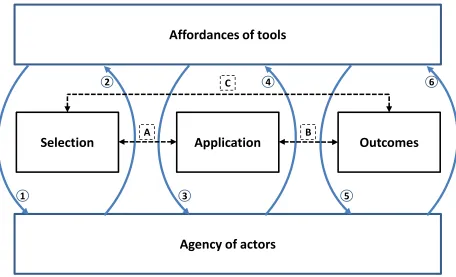
We apply a practice lens to develop a framework of strategy tools-in-use (Figure 1). In this
section, we outline the implications of a practice lens on understanding tools and the actors who
use them and then, in the next section, explain how tools and actors interact in the selection,
elements of the framework with reference to existing literature and develop a series of statements
about the way these relationships work (as catalogued in Table 1). The statements explicate the
association between tools and actors based on the evidence we have or can infer from current
research and also provide the grounds for an empirical research agenda on tools-in-use. The
framework also highlights the feedback loops through which selection, application and outcomes
shape each other (Arrows A-C in Figure 1). While a practice lens suggests that these
relationships are important, little is known about their role. In a subsequent section, we offer
supplemental statements as a starting point for future explorations of these recursive dynamics.
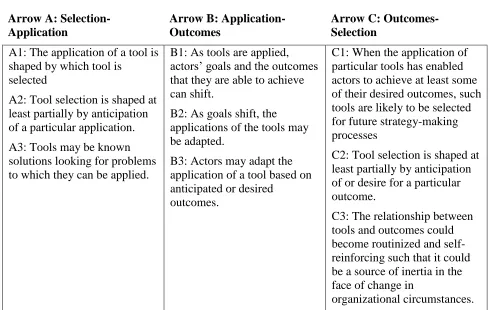
-- Insert Figure 1 and Table 1 about here --
Research on strategy tools per se is limited. Much of the early interest was in
practitioner-oriented journals. Only more recently, as part of the strategy-as-practice movement,
studies of strategy tools have begun to penetrate the periphery of scholarly journals. Therefore, to
develop these statements, we benefit from studies of related tools and techniques (e.g., Balanced
Scorecard, formal analysis), other enabling technologies (e.g., PowerPoint, meetings, off-site
‘away days’), and, more broadly, formal analysis, accounting practices, and technologies-in-use.
Affordances of tools
As with technologies-in-use, a practice lens highlights that strategy tools come with affordances
that enable and constrain their use (Orlikowski and Scott, 2008). By affordances, we mean that,
as Zammuto et al (2007: 752) say, ‘the materiality of an object favors, shapes or invites, and at
the same time constrains, a set of specific uses’ (see also Orlikowski and Scott, 2008). For
example, a chair may be intended as a seat, but actors may use it as a stepping stool, a coffee
table, a barrier to keep a child away from a fireplace, a bookshelf, etc. (but not likely as a pen, a
window shade or a cook stove). The use depends not only on the material properties, nor on the
the technologies in creative, unpredictable ways (Faraj and Azad, 2012; Jarzabkowski and Pinch,
2014). The literature on affordances emphasizes that tools and technologies are as much
conceptual as material devices through which actors pursue multiple ends, such as negotiating
about the content of PowerPoint slides (Kaplan, 2011) or using Blackberry devices to manage
workflow (Mazmanian and Orlikowski, 2013). We are encouraged to consider the way tools and
technologies provide interpretive, as well as material, affordances for action (Darr and Pinch,
2013).
Strategy tools, similarly, have both material and conceptual affordances that shape their
use. Strategy tools come with choices embedded in them about what knowledge to privilege.
Researchers have suggested that the content of artifacts ‘disguise[es] itself as information, rather
than argument’ (Meyer et al., 2013: 6). By implication, a strategy tool is not neutral or
‘objective,’ but makes an argument about what is important to analyze strategically and,
conversely, what is not. For example, critiques of Porter’s Five Forces have claimed that, by
featuring buyers, suppliers, barriers to entry, substitutes and rivalry, the tool may direct managers
away from exploring other industry dynamics such as complementors (Brandenburger and
Nalebuff, 1996). While the designers of tools may intend them to be selected for particular tasks,
to be applied in certain ways and to achieve certain outcomes, these intentions may or may not
be realized as actors engage with the tools. Actors’ perceptions of a tool’s affordances will shape
its use such that tools should not be understood separately from their use (Orlikowski, 2000,
2010; Orlikowski and Scott, 2008).
For example, Chesley and Wenger’s (1999) study of the Balanced Scorecard shows that
many features – from the labels to the meanings attributed to different boxes in the worksheet –
may be altered during use. Sometimes these changes are done to reflect the specifics of a
particular directions. As accounting scholars have demonstrated, changes in an accounting
framework or metric may be manifestations of the interpretations and interests of different actors
(Feldman, 2004; Gephart, 1997; Nahapiet, 1988; Power, 2003). We can infer from these studies
that tools have affordances that shape the way that actors frame problems but can also enable
actors to advance their own interests in that problem.
Agency of actors in using tools
In conceptualizing tools ‘in use,’ we necessarily highlight the actors who use them. A practice
lens draws attention to what actors do as they make strategy (Vaara and Whittington, 2012) and
emphasizes that people ‘enact technologies in multiple ways’ (Boudreau and Robey, 2005, p. 4).
March (2006) conceptualizes tools as ‘technologies of rationality’ based on assumptions of
procedural rationality: individuals, even though cognitively limited, ‘attempt to collect the
information necessary to form expectations about various alternatives, and [use] this information
in the final decision’ (Dean and Sharfman, 1993: 1071). In this view, people make strategic
choices based on some ‘model-based assessment of the likelihoods of different possible future
outcomes and of preferences among them’ (March 2006: 203). These preferences may be
associated with the best interests of the firm (where political action would be seen as irrational)
or with the best interests of the individual decision maker (where political action can be seen as
rational) (Dean and Sharfman, 1993).
A practice lens offers an alternative view of the achievement of rationality. It suggests
that, when making strategy, actors are seeking to conform to the normative ideal of rationality
(Cabantous and Gond, 2011; Langley, 1988) where the use of strategy tools is part of that
rationality-seeking process. Using tools may enable actors to feel rational (Pondy, 1983) and to
convey an appearance of rationality to others (Feldman and March, 1981). Therefore, while a
‘technologies of rationality,’ it recognizes that they can function as technologies of intended
rationality, or ‘rationality carriers’ (Cabantous and Gond, 2011: 577; Dodgson et al., 2013).
Further, using a strategy tool signifies the user as a strategist, able to conform to and perform
within the wider norms and discourses of strategy making (Knights and Morgan, 1991).
Research on users of strategy tools has focused primarily on senior executives (Frost,
2003; Stenfors et al., 2007). Those at the top of the organization are likely to have hierarchically
derived power to choose tools – consciously or unconsciously – and control their application
(Hill and Westbrook, 1997; Hodgkinson et al., 2006). However, a practice lens directs us to
consider the wide variety of actors involved in strategy-making, not just top managers, but also
middle managers and those outside the organization, such as consultants (Whittington, 2007).
Middle managers are likely to see strategy tools as a way to engage in strategy
conversations laterally across divisions (Balogun and Johnson, 2004) or to influence upwards
(Floyd and Lane, 2000; Mantere and Vaara, 2008). Senior managers may regard tools as a means
of conveying information and presenting positive images of a strategy (Grant, 2003; Ketokivi
and Castaner, 2004; Mantere and Vaara, 2008). Consultants might regard the use of tools as a
professional skill that gives them status and expertise to act across organizations (McKenna,
2006). Research on strategy making implies that the outcomes of using tools will include not
only their effectiveness for problem-solving but also the returns that may accrue to actors from
their use, e.g., demonstrating competence as a strategist (Mantere, 2008), gaining support for
particular views (Kaplan, 2008) and resolving interpersonal and political differences (Eisenhardt
and Bourgeois, 1988; Pettigrew, 1977).
STRATEGY TOOLS-IN-USE: SELECTION, APPLICATION AND OUTCOMES
Actors and tools interact in the selection, application and achievement of outcomes associated
strategic problems in mind, it is not clear that managers inside organizations pick or use tools for
these reasons. There is much to suggest that the choice of tools is shaped by actors’ competence
in their use, power in their organization, and their boundedly rational satisficing where, in many
cases, a wide variety of tools would be considered suitable for a particular strategic issue.
Similarly, tools are not only applied to solve an organization’s strategic problems. A practice
lens leads scholars to focus on the use of tools for creating common language about strategy and
offering spaces for the negotiation of interests. Such uses enable actors to make sense of the
world, transform the uncertain into the more certain, and demonstrate their own mastery in
strategy making. A practice lens on the selection and application of tools thus offers a more
expansive menu of potential outcomes to examine in the strategy making process, from the
institutionalization of a tool to its impact on the satisfaction and careers of the users to the ability
to move the organization forward in the face of uncertainty.
In this section, we dissect the selection, application and outcomes of tools-in-use,
examining how they are shaped by both the affordances of the tools and the agency of the actors.
In doing so we develop a series of statements (as numbered in Table 1) about possible
relationships that provide the grounds for empirical exploration in future research. While we
endeavor for analytical purposes to draw out the directionality of relationships, the influences are
recursive, such that actors shape the use of tools for strategy making, and, correspondingly, tools
shape the way that actors do strategy making.
Selection
One key question is how and why actors select particular strategy tools to use for specific
applications (Arrows 1 and 2 in Figure 1). A rational perspective implies that managers
consciously select tools that will be most effective for solving the particular problem that they
that strategists’ choices of tools may be unconscious and routinized in organizational practice
(Feldman and Orlikowski, 2011).
Affordances of tools in tool selection (Arrow 1).
March (2006) questions the appropriateness of strategy tools for problem-solving in uncertain
environments, and other scholars have expressed concerns about strategy tools being obsolete
under changing industry conditions (D'Aveni and Gunther, 1995; Prahalad and Hamel, 1990).
Yet existing literature provides little evidence that managers vary their tool use under conditions
of change and uncertainty (Grant, 2003; Koufopoulos and Chryssochoidis, 2000). While some
minimal industry variation is found in the number of tools used in different industries, it is not
correlated with complexity or uncertainty (Frost, 2003; Stenfors et al 2007).
Some tools, for example Porter’s (1980) Five Forces, get taken up in nearly every core
strategic management course in business schools and in the practice of many strategic
management consultants (Jarzabkowski et al., 2013; Kachra and Schnietz, 2008; Knott, 2008).
Five Forces is thus a tool that is both highly familiar and also has a recognized scholarly
pedigree (with some refinements, see Brandenburger and Nalebuff, 1996; and some more
substantive disagreements, see Farjoun, 2007; Pfeffer and Sutton, 2006). This familiarity means
that the Five Forces tool is accessible and widely embedded within organizational
strategy-making processes (Argyres et al., 2002; Clark, 1997; Frost, 2003; Grant, 2003), which may lead
actors to select it for tasks for which it was not intended (e.g., company rather than industry
analysis).
Similarly, the SWOT (strength, weaknesses, opportunities, threats) framework (Andrews,
1971) is used even more frequently in organizations, though perhaps taught less in business
schools today (Ghazinoory et al., 2011). This framework has been assailed as having little
Scholars posit that managers prefer this tool because it is familiar and easy to use, requiring no
training or specific competence to understand and apply it (Frost, 2003). The investment in
searching and acquiring the competence to use a different tool may not be worth the effort, when
existing tools are ready-to-hand. Rather than their applicability to a task, familiarity may be a
key reason for using particular tools that are already embedded in organizational practice and
widely recognized by other actors. McCabe and Narayanan’s (1991) survey of portfolio planning
tools notes that, once institutionalized within firms’ planning processes, tools are used
persistently, independent of context. We therefore suggest that the selection of tools may be
more dependent on standardized organizational use than on the ‘fit’ of the tool with the situation
in the environment (statement 1.1 in Table 1).
Tool selection may also be influenced by the degree to which tools are simple and offer
clear visual representations; simpler tools are easier to remember and use (statement 1.2). For
example, the BCG matrix is memorable because of its evocative labels of cash cow, dog and star
and the two-by-two matrix suggested for sorting businesses into different categories (Armstrong
and Brodie, 1994). Similarly, we may speculate that the mnemonic character of Porter’s Five
Forces, with its alliterative name and its relatively few concepts have aided its uptake (Worren et
al, 2002).
Given that strategy-making is concerned with profit and loss, forecasting, and financial
performance, the ‘number-crunching’ properties of tools will likely shape their selection
(Whittington, 1996: 732). Quantitative tools may be desired in particular contexts. Grant’s
(2003) study of strategic planning in the oil majors shows that long-term planning required
qualitative and scenario-based information, whereas medium-term planning required quantitative
information and financial analysis techniques. Quantitative tools may also be attractive because
other hand, quantitative tools may be harder to use. For example, ‘real options’ is a strategy tool
designed for ‘big bet’ industries, such as oil or mining (Bowman and Hurry, 1993). It enables
managers to experiment with a range of possible strategic options while retaining the ability to
exit at relatively low cost (McGrath, 1997; Miller and Waller, 2003). Yet, one of the criticisms
of the real options tool is that its mathematical complexity may have restricted its uptake:
managers simply lack the competence to use it (Remer et al., 2001). The selection of quantitative
tools is thus attractive to users because numbers can signal rationality, but this attractiveness is
offset by potentially greater difficulty in using the tool (statement 1.3).
Agency of actors in tool selection (Arrow 2).
Selection of strategy tools involves interaction between the affordances of the tools and the
agency of the actors who use them. One way to understand this interaction is through
behavioralist theories (Cyert and March, 1963; Simon, 1947), as we might imagine that
managers are satisficers when they select the tools to use. Rather than search for a ‘best’ tool,
which, even if hypothetically possible to find, would require considerable time to learn to use
(Haspeslagh, 1982; Stenfors et al., 2007), managers tend to use tools already embedded within
their organization’s strategy-making processes (McCabe and Narayanan, 1991). The ‘garbage
can’ (Cohen et al., 1972) might be a model of how people select strategy tools. That is, given a
particular circumstance, they will pick the first tool that they know how to use (or with which
they are familiar) that seems to fit the problem at hand (statement 2.1).
This effect may be reinforced by the power dynamics of the organization (Hill and
Westbrook, 1997; Hodgkinson et al., 2006). One obvious source of power is that flowing from
hierarchy. A recent survey finds that senior managers use more strategy tools than lower level
managers (Jarzabkowski et al., 2013). The support of the CEO also plays a crucial part in the
higher CEO commitment was associated with successful adoption of portfolio planning tools.
Even where other managers initiated use of the tool, signals from the CEO such as investing time
and personal engagement aided adoption. Thus, actors have more or less freedom to select a tool
depending on their position in the hierarchy (statement 2.2).
Expertise is another source of power (French and Raven, 1968) that shapes the selection
of strategy tools. Managers may select a tool because it allows them to demonstrate their
educational status and competence. Studies show that receiving an MBA enables actors to feel
competent in proposing and using tools (Jarratt and Stiles, 2010), and managers with higher
postgraduate and executive training use a greater number of strategy tools (Jarzabkowski et al.,
2013). Furthermore, MBA-educated managers jealously guard their competence from colleagues
that have not had MBA training, using their education to further their own careers, rather than
sharing knowledge about tools with their teams (Legge et al., 2007). Thus, actors have more or
less freedom to select a tool depending on their competence in its use (statement 2.3).
Application
When seen through a practice lens, the application of tools is situated within specific social
contexts and shaped by both the affordances of the tools and the actors who apply them (Arrows
3 and 4, Figure 1). Studies suggesting that using the ‘wrong’ tools (Ghoshal and Moran, 1996) or
using tools in the ‘wrong’ way (Lozeau et al., 2002) is bad for management practice promote a
false dichotomy between correct and incorrect use that obscures the many improvisations that
occur as tools are used in practice (Orlikowski, 1996; Whittington, 2006; Worren et al., 2002).
While the designers of strategy tools may intend certain applications, this does not guarantee that
such as PIMS1 and BCG ‘star/dog’ models have increasingly been applied in theoretically unanticipated ways, as managers become familiar with their principles and adapt them to include
new dimensions (e.g., stockholder value) (McCabe and Narayanan, 1991). Haspeslagh (1982:65)
shows that portfolio planning tools are more useful where managers remove the ‘theoretical
mask’ of their intended use for corporate level portfolio planning and apply the tools at multiple
levels, including within strategic business units. As an executive in a survey of tool use in
Finnish companies responded, ‘[The methods behind the tools] are not important in practice if
the work gets done’ (Stenfors et al., 2007: 933).
Affordances of strategy tools in their application (Arrow 3).
Because tools have interpretive flexibility, users can adapt them according to their interpretations
and interests. Haspeslagh (1982) found that when managers in multinationals stuck too
rigorously to the theoretical bases of a portfolio planning tool, they generated hundreds of items
to plot in their corporate portfolio, an exercise that many ultimately found unhelpful. More
usefully, portfolio-planning tools enabled managers to think about the various missions of their
strategic business units. The more experienced managers were in using portfolio-planning tools,
the more successful they were in adapting them to their various needs. These adaptations
violated the intended use of the tools and could therefore be seen as incorrect and potentially
error prone. One might imagine that this would lead managers to discard tools. Yet, McCabe and
Narayanan (1991) find that the use of strategy tools, even as they are adapted sometimes beyond
recognition, persists in organizations. The practice lens suggests that such tools persist because
they afford a variety of useful organizational functions.
Strategy making often requires people from different parts of the organization (different
divisions, different functions) to work together. Because these people will likely come from
1 PIMS stands for ‘profit impact of marketing strategy’ and is a tool used to identify key performance criteria in
different ‘thought worlds’ (Dougherty, 1992), they must find a means for overcoming
interpretive barriers. Various studies have shown the importance of fostering strategic
conversations across multiple managerial levels, functions and divisions as part of generating
buy-in to strategy (Floyd and Lane, 2000; Jarzabkowski and Balogun, 2009; Mantere and Vaara,
2008). A critical feature of this process is generating a common language across these
boundaries. Research on boundary-spanning work in other domains (such as new product
development) has shown that artifacts can serve important roles in bridging divides and creating
shared reference points. These artifacts can be characterized as ‘boundary objects,’ in that they
mediate relations between diverse groups to enable problem solving across boundaries (Bechky,
2003; Carlile, 2002; Levina and Vaast, 2005; Star and Griesemer, 1989). Building on these ideas,
some scholars have proposed that strategy tools might play a similar role (Spee and
Jarzabkowski, 2009; Stenfors et al., 2007), providing a common language for strategic
conversations between managers across hierarchical, functional and geographic boundaries
(statement 3.1).
Strategy tools can also create spaces for social interactions that allow actors to negotiate
their different interests (statement 3.2). That is, strategy making is both an interpretive and a
political process (Kaplan, 2008). Differences across boundaries demand not just shared language
but also resolution of the tensions arising because different groups of actors have different things
at stake (Carlile, 2002). Chesley and Wenger’s (1999) study of the Balanced Scorecard finds that
the tool created a space for managers to negotiate their anxieties and political interests about the
introduction of new performance measures by enabling them to revisit and revise the dimensions
of the tool. Providing sites for social interaction and participation in strategy making across
organizational levels can have positive effects on performance, even where consensus is not an
sources of power in the organization. Tools are powerful to the extent that they map on to (or can
be adapted to) the existing interests of the dominant actors in an organization (Denis et al., 2006)
or if they are useful in realigning those interests and views.
Carlile (2004) points out that, where differences between groups are known, the boundary
objects used to negotiate these differences can be relatively stable. However, with increasing
complexity and uncertainty – the kind that March (2006) highlights as problematic – negotiations
across boundaries involves transforming knowledge, typically by changing the meaning of the
objects used by participants. As managers appropriate the tools, they change them. But the
possible scope of these improvisations is not infinite. As Pentland and Feldman (2008: 243)
remark: ‘A personal computer can be translated as a plant stand…[but] no amount of translation
will turn a toaster into a cell phone.’ A feature of strategy tools is that they embed particular
content and are often presented using visual frameworks. Hence, while strategy tools can be
adapted, their affordances also bracket what may and may not be discussed. For example, when
managers use a BCG matrix, they will be inclined to see some strategic activities as stars and
others as cash cows (Armstrong and Brodie, 1994), so that strategic focus is oriented towards the
categories available within the tool. Therefore, the content and structure of the tool channel
potential improvisations as the tool is used (statement 3.3).
Agency of actors in the application of strategy tools (Arrow 4).
Given these affordances, how do managers mobilize strategy tools? Again, we can refer to
interpretive and political dimensions, where actors can use tools to make sense of uncertain
environments, advocate particular points of view, and legitimate certain courses of action.
Strategy is inherently a social process, where a good deal of strategy making takes place in
meetings and workshops (Hendry and Seidl, 2003; Hodgkinson et al., 2006; Johnson et al.,
2004). Strategy tools are one important means by which managers navigate these social
dynamics while at the same time working to develop strategic insights.
Research on strategy practices has suggested that it involves both sensemaking and
‘sensegiving’ (Balogun and Johnson, 2004; Gioia and Chittipeddi, 1991). Top managers must
sort out the ambiguous signals from the environment and then convey their insights to others;
and they can use strategy tools in both of these functions. As Grant (2003) demonstrates, some
executives in oil majors used strategic planning templates and tools to support communication
and coordination between corporate and divisional managers. Similarly, middle managers
responsible for implementing strategy can use tools to convey the deliverables expected during
critical phases, such as mergers (Whittington et al., 2006), or communicating key concerns to
senior managers during strategic change (Jarzabkowski and Balogun, 2009). Thus, actors use
tools as interpretive devices that enable them to focus attention on and make sense of strategic
issues for themselves and for others (statement 4.1).
Some studies characterize any use of tools to justify positions taken for ‘non-rational’
reasons as incorrect or bad for practice (Ghoshal and Moran, 1996; Hamel and Prahalad, 1994).
Yet, research on strategy making shows that, in practice, actors find it useful to marshal tools to
legitimate particular positions or viewpoints (statement 4.2). Tools can be mobilized in political
processes by actors who are looking for ways to contain or influence strategic debate
(Hodgkinson and Wright, 2002). Related studies on strategic planning and accounting echo these
insights. Vaara, Sorsa and Palli’s (2010) study of the City of Lahti (Finland) finds that actors
imbued strategic planning texts with ‘textual agency’ that enabled shifts in power relations in the
organization. These shifts in power forced consensus and legitimized certain courses of action.
Denis et al’s (2006) study of health care boards shows that by mapping quantitative metrics onto
The numbers filled ‘the strategic void created by pluralism’ (p. 350) and conveyed ‘consistency,
transparency and competence’ (p. 362) that disempowered adversaries. Similarly, studies of
auditing and accounting (Nahapiet, 1988; Pentland, 1993) show how accounting rubrics get used
to transform the uncertain into the certain by categorizing and quantifying data. That is, using a
strategy tool to justify a position does not get in the way of the use of the tool, it is a use of the
tool (Weick, 1998).
As people engage in these negotiations, they work with the tools. And, as actors work
with tools, they adapt them to fit the needs at hand (statement 4.3). As Orlikowski (1992) finds in
her analysis of one organization’s implementation of computer-aided software engineering
(CASE) tools, users modify the functionality of the tools in order to make them more useful in
daily practice. Such improvisatory uses of tools are responses to real life situations. By adapting
tools to their particular purposes, actors are able to negotiate their way through the specific
demands of their context. For example, Haspeslagh (1982) finds that experienced managers
adapted portfolio analysis tools and techniques from the corporate level for which they were
intended to the business unit level, which they did not see as a deviation but rather as a practical
way to make better use of the tool for strategy making. By implication, increased complexity or
uncertainty does not necessarily lead to more ‘mistakes’ in the use of tools, as March (2006)
would suggest, but rather to adaptive behavior to make tools useful.
Outcomes
When considering outcomes, a functionalist view of tools prevails in the literature. This view
assumes that, ‘correctly’ used, tools can achieve the ‘right’ outcome. Failure to achieve such an
outcome indicates an inadequacy of the tool or the user (Lozeau et al., 2002). March’s (2006:
208) main concern in his critique of strategy tools is the risk that such ‘technologies of
Yet, he is not trying simply to prevent these disasters. He is trying to balance the potential for
tools to be used to identify new possibilities in more complex situations with the risk that this
exploration might lead to ‘costly, even deadly’ errors. His dilemma begins to open up the
possibility for alternative criteria against which to evaluate the use of tools. We use a practice
lens to build on this idea, suggesting that an assessment of outcomes can be extended to consider
not only whether a ‘successful’ strategic outcome for the organization was attained but also
whether the tool-in-use produced a range of other organizational or individual outcomes for the
actors and tools themselves.
The strategy-as-practice research agenda has called for consideration of a wider range of
outcomes beyond firm performance (Johnson et al., 2007; Whittington, 2006). Yet, research has
not yet fulfilled this agenda, having privileged detailed explanations of the practices of making
strategy as a first stage in the development of the field (Jarzabkowski and Kaplan, 2010). Studies
of outcomes associated with strategy tools are rare, with the exception of Armstrong and
Brodie’s (1994) lab experiment showing how using the BCG matrix shaped participants’
evaluation of a decision task.
Outcomes associated with strategy tools (Arrow 5).
Why is it that certain tools become widely used and others not? This field-level question in tool
use is a less-explored aspect of the strategy-as-practice agenda (Jarzabkowski, 2004;
Whittington, 2006). It calls attention to the huge industry of individuals and organizations
making and selling strategy tools (academics, business executives and consultants). Institutional
theory could provide one set of approaches for future analysis. It offers theories about the
mechanisms of institutionalization and isomorphism (DiMaggio and Powell, 1983) that point us
to consider the degree to which a tool becomes routinized in organizational practice or
Some strategy tools get routinized into organizational and educational life. As highlighted
above, Porter’s (1980) Five Forces, the SWOT framework and many other tools are well-known
and frequently used. On the flip side, the list of tools that have been developed and proposed by
consultants or academics yet never get widely adopted is too long to enumerate. Some tools,
such as the BCG ‘star’/ ‘dog’ matrix, now persist at a moderate level of use after a prior peak in
popularity (McCabe and Narayanan, 1991). Thus, the ‘success’ of the use of a strategy tool can
be examined at the organizational and field levels, where success is associated with adoption and
routinization in organizational practice (statement 5.1), diffusion and wide adoption in
management education (statement 5.2) and diffusion and wide adoption by managers in
organizations (statement 5.3).
We might find a starting point for assessing these statements in Zbaracki’s (1998)
analysis of the rhetoric and reality of total quality management (TQM) implementation. In this
study, he digs into the details of how managers constructed their TQM programs to conform to
rhetorics of success that then fueled the processes of institutionalization. In related work from
science studies, Owen-Smith (2005) looks at how university technology licensing officers
structured their work around the dockets that contain all of the background information about the
invention. He documents that, in rationalizing their actions through ongoing organizational
learning, these officers stabilized and institutionalized particular work procedures and language
associated with building and maintaining dockets. Research on practices in management
education (Kipping et al., 2004) and management consulting (Kipping, 1999a) offers another
starting point for analysis of the institutionalization of some tools and not others. For example,
evidence that management education is associated with greater use of strategy tools
(Jarzabkowski et al., 2013) suggests that management education and, by corollary business
Outcomes associated with actors in organizations (Arrow 6).
A standard approach to assessing tools is to evaluate whether the use of the tool led to an
accurate analysis and a successful strategy. The problem with these criteria is that such outcomes
are often only known in the long term and are difficult to ascribe to the use of the tool itself. The
case of Shell Oil’s famous anticipation of the 1970’s oil embargo has been used to justify the
power of scenario tools (Schwartz, 1991). Merck’s use of real options to manage its R&D
portfolio has been equally lauded (Nichols and Lewent, 1994). But, these examples are few and
far between, and, in the case of Merck, scholars have called into question the attribution of the
company’s success to the tool (Bowman and Moskowitz, 2001). From the standpoint of actors in
organizations, there are many more proximate measures of the usefulness of strategy tools.
March (2006: 209) suggests that we should be concerned with how a tool is mobilized for
exploratory search. The tension of most concern to him was whether such explorations –
provoked by the (mis-)use of tools, or their use in settings for which they are not suited – might
be worth the risk:
‘Technologies of rational choice…are not simple instruments of exploitation but (partly) instruments of exploration hiding behind a façade of exploitation: revolutionaries in pin-stripe suits. As such, they should perhaps be seen less as stodgy agents of conventional knowledge than as dangerous fools, joining thereby the pool of dreams out of which come great ideas as well as monstrous and idiotic ones.’
Whether a strategy is ultimately ‘great’ or ‘idiotic’ may only be known well into the future. As a
more immediate outcome, we can assess the degree to which the improvisational use of the tool
provoked exploration (statement 6.1).
Using tools can also produce consensus or at least provisional settlements (Kaplan and
Orlikowski, 2013) that can be the basis of a strategic choice. Research has pointed out that not all
strategy making efforts lead to decisions (Bachrach and Baratz, 1963; Pettigrew, 1977).
2008). The degree to which the use of a tool enables interim decisions that allow a project or
organization to move forward may be an outcome in and of itself (statement 6.2).
Another measure of success in the use of a tool is the degree to which the ‘client’ of the
particular strategy project in which a tool is used is satisfied with the outcome of the project
(statement 6.3). Inside an organization, a team may engage in strategic analysis for an executive
who is the client for that project. The literature on team performance (e.g., Wageman et al.,
2005) suggests that the satisfaction of a team’s client is a centrally important outcome. In the
case of management consultants, the paying client has commissioned the study and may be more
or less content with the services provided (Czarniawska and Mazza, 2003; Kipping, 1999a;
McKenna, 2006). Such client satisfaction, while it may be difficult to assign solely to the use of
the tool, is thus a relevant outcome.
The strategy-as-practice field has focused attention on the actors who make strategy
(Whittington, 2006), pointing out that actors pursue their own interests – either in supporting one
view over another (Balogun and Johnson, 2004; Kaplan, 2008; Sonenshein, 2010) or in
achieving career objectives (Mantere and Vaara, 2008) – as much as those of the organizations to
which they belong. Yet, little is known about how the use of strategy tools connects to these
objectives. Some studies suggest that managers may use tools to demonstrate their educational
skill base (Jarratt and Stiles, 2010; Jarzabkowski et al., 2013) and generate status and career
outcomes (Baruch and Peiperl, 2000; Jarratt and Stiles, 2010; Legge et al., 2007) by being more
competent in the use of the tool than their peers. The ability to speak the language of strategy
through skilled use of strategy concepts is critical for participating in and influencing
strategy-making activities (Astley and Zammuto, 1992; Barry and Elmes, 1997). The very concept of
competence in strategy making is embedded within a normative strategy discourse in which the
Morgan, 1991). The reverse is also true. Chesley and Wenger’s (1999) study of the
implementation of the Balanced Scorecard shows that, by providing a systematic means to assess
individual performance, it created career anxieties for those feeling less competent. Given that
actors have different degrees of competence in using strategy tools, using such tools could
provoke similar career anxieties (if a person was unable to master the tool) or contribute to a
person’s advancement (if he or she were seen to be a proficient user of the tool). Thus, the
success of a tool may be assessed by the degree to which its use helps an actor demonstrate
competence (statement 6.4).
Relatedly, the use of a tool can also constrain or enable discretion of individual actors.
Hodgkinson et al (2006) finds that most of the organizations they surveyed used strategy
workshops (an enabling technology if not precisely a strategy tool under our definition) to
exclude middle managers, thus reinforcing the power of elites. Hodgkinson and Wright’s (2002)
examination of scenarios concludes that their use provoked intense concerns about the personal
impact of potentially negative futures. As a result, members of the senior management team
engaged in a variety of coping mechanisms that led to the ‘failure’ of the process. This failure
was actually a ‘success’ for those actors who would have been disadvantaged by the proposed
strategy. In this case, using a tool will be considered a success to the extent that actors are able to
achieve their personal objectives such as the legitimacy of their own roles or the ratification of a
preferred strategy (statement 6.5).
These kinds of power dynamics and interpersonal tradeoffs imply that the use of a tool
can involve different degrees of contestation about interests or ideas and may lead to different
degrees of shared understanding about the strategic problem and its potential solution. The
development of strategy repeatedly has been shown to be political, requiring negotiation across
Kaplan, 2008; Pettigrew, 1977). Strategy tools are likely to be enlisted in this process of
surfacing and resolving differences across actors (statement 6.6). For example, Kaplan (2011)
shows that actors mobilized PowerPoint technology to carve up strategic territory, excluding
some actors and ideas and including others.
It is important to note that scholarship on the outcomes of strategy tools-in-use is largely
absent. A first step to building research in this area is recognizing the multiplicity of possible
outcomes for both tools and the actors who use them. The framework we develop leads
researchers to problematize the notion of ‘successful’ or ‘correct’ use of tools, as success in one
dimension or for one actor may be failure on another dimension or for another actor.
ILLUSTRATING A FRAMEWORK FOR STRATEGY TOOLS-IN-USE
To illustrate some of the dynamics in Figure 1, we offer a vignette of a tool-in-use drawn from
fieldwork studying the strategy-making processes at a multinational telecommunications
equipment company (‘CommCorp’) facing a significant industry crisis.2 Because the exploration of strategy tools-in-use was not the focus of the data collection, we use it as only as a way to give
life to a few of the statements in Table 1.
This vignette involves the introduction at CommCorp of a standard tool in strategic
management, the ‘aggregate project plan’ originally proposed by Wheelwright and Clark (1992).
This tool is a matrix intended as a means to assess the balance of innovation efforts in an
organization’s project portfolio by plotting projects on two dimensions according to the extent of
product and process change required. CommCorp was going through radical changes in the
environment that required a new strategic approach (this was a communications technology
company during the bursting of the Internet bubble in 2001-2002). The head of technology
strategy (‘Brad’) announced he would bring together his team to discuss a realignment of their
2 These data come from a wider study of strategy making in CommCorp as reported in other publications, including
strategy. The challenge was complex, both strategically in terms of the issues and socially in
binding together the team that would have to work on them:
We are going to create a team of people that are going to look at the business dimensions, at what the return is. We are going to have marketing people and economists and business planners…We would not want to make a technology decision that did not have some well-founded reason and rationale.
Managers were searching for tools that might facilitate analysis and decisions in this
context. The aggregate project plan tool had already been introduced to CommCorp through an
executive education course at a top business school. The tool became known within the
organization as ‘bubble charts’ because it involved using ‘bubbles’ to locate projects on the
two-by-two matrix. ‘Chris,’ a team member who had recently been promoted to senior management
and wanted to demonstrate his abilities, proposed that he would use the bubble charts to analyze
the portfolio. Some felt that this tool would be useful in providing a rational basis for making
decisions: ‘Some kind of quantitative effort to say what kind of measures you would apply to
this, from very bad to very good. At least if you apply that consistently across your analysis then
you actually have something which you can measure.’ Thus Chris selected the tool because of
his expertise in its use (2.3) and also because the tool was seen as a way to provide a rational
basis for decisions (1.3). But this choice was also guided by anticipation that its use would give
legitimacy to certain technology strategy decisions and anticipation of certain outcomes,
especially Chris’ personal objective to advance his own career.
In applying the tool, Chris immediately changed the original (product and process
change) dimensions of the matrix to depict two new dimensions – product reach and market
reach. He felt these externally-oriented dimensions would be more useful in analyzing the
CommCorp project portfolio during the period of crisis. The emphasis on the market was
essential during the economic crisis because no strategy could go forward without a market
Thus, he appropriated the existing matrix structure (4.3) and adapted it for his local context.
Subsequently, during a senior management meeting, executives hotly debated the dimensions
and proposed many other alternatives, including technology reach, risk and return, and size of
investment. Managers supported different ideas for a variety of reasons: some because particular
axes would favor preferred projects, some because of particular views about the external
environment, some because of concerns about internal politics. As one executive noted, ‘There
are different views about the definitions of the axes and the ranking of projects, and these need to
be clarified and aligned as a group.’ The tool became a vehicle for surfacing and contesting
various actors’ interests (3.2). Said one manager, ‘It is very clear that [one executive] would rank
the projects very differently than [another executive]. Guaranteed.’ Over the course of the
discussion, it became apparent that Brad had preferred outcomes in mind, as he attempted to use
the indicators in the bubble charts to convince the others that they did not have enough ‘Hail
Mary’ (radical innovation) projects.
Because of these differences, the discussion was tabled until further work could be done.
The managers did not make a decision about the final portrayal of the portfolio (6.2). In this
sense, the use of the tool ‘failed.’ But the team came away from the discussion collectively
focused on the need to evaluate projects in terms of risk and reward over both the short term and
the long term and a clearer understanding of where each person in the organization stood on
different issues. Hence, the use of the ‘bubble charts’ led to several strategic outcomes but not
because the tool was used ‘correctly.’ The use of the tool led CommCorp managers to consider
new sources of data (6.1), debate a range of issues (6.6) and discuss what achieving a ‘Hail
Mary’ might look like (6.5). These explorations might not have been productive in reaching an
immediate decision, but they did break down existing frames about the situation and opened up
RECURSIVE DYNAMICS BETWEEN SELECTION, APPLICATION AND OUTCOMES
This vignette has illustrated how some aspects of our model in Figure 1 might operate in
practice. As it shows, no single rationale is responsible for tool selection, multiple features guide
application, and various outcomes are achieved as tools are used. Further, if we turn to Arrows
A, B and C in Figure 1, we argue that the selection, application and outcomes of tool-in-use are
intertwined. Each arrow is double-headed, indicating that the influences move in both directions
and are mutually interdependent. To date, there is little theoretical or empirical understanding
about how these relationships work. In Table 2, we offer an initial set of guiding statements that
we intend to provoke future research into the types of effects that should be of interest. To do so,
we draw on and integrate various streams of research in strategic management, tracing out their
implications for tools-in-use.
-- Insert Table 2 about here --
Starting with Arrow A – the relationship between selection and application – we can
make the superficially obvious point that the application of a tool in strategy making is shaped by
which tool is selected (statement A1). Each tool has its own affordances and these will constrain
and enable its use. Reciprocally, tool selection may be shaped at least partially by anticipation of
a particular application (A2). This could be seen through the rationalist view undergirding
positioning theories of competitive strategy (Ghemawat, 1999; Porter, 1980): certain analytical
problems require specific tools to analyze them. Political theories of strategy making (Eisenhardt
and Bourgeois, 1988; Pettigrew, 1977) enrich this view by highlighting that actors will select
tools precisely because their particular affordances are more easily applied to some problems
than others and likely to favor some kinds of solutions over others. Indeed, the subtlety of this
relationship between selection and application may be inferred from the ‘garbage can’ model of
which they can be applied (A3).
Turning to Arrow B – the relationship between application and outcomes – our
processual view implies that the use of tools evolves: as tools are applied, actors’ goals and the
outcomes they are able to achieve can shift (B1). This view is grounded in the body of research
on emergent strategy (Eisenhardt, 1989; Mintzberg and Waters, 1985) in which the strategic
outcomes realized by an organization arise from an evolving stream of actions. Further, as goals
shift, the applications of the tools may have to be adapted (B2). On the other hand, as political
models suggest (Pettigrew 1977), actors may also instrumentally adapt the application of a tool
based on anticipated or desired outcomes (B3).
Finally, in Arrow C – the relationship between outcomes and selection – we highlight the
effects of tool use over time. Learning theories posit success as an important activator of
‘learning by doing’ (Eggers and Kaplan, 2013; Greve, 2003; Levitt and March, 1988), where
prior organizational performance determines whether organizations search for new solutions or
reinforce old ones. Thus when the application of particular tools has enabled actors to achieve at
least some of their desired outcomes, such tools are likely to be selected for future
strategy-making processes (C1). Reciprocally, tool selection is shaped at least partially by anticipation of,
or desire for, a particular outcome (C2). This relationship between tools and outcomes could
become routinized and self-reinforcing such that it could be a source of inertia in the face of
change in organizational circumstances (C3). That is, a core competence in the use of a tool
(reinforced by success) could become a ‘core rigidity’ (Leonard-Barton, 1992) or source of
organizational ‘myopia’ (Levinthal and March, 1993) when the tool continues to be selected
under conditions for which it is no longer appropriate.
By paying attention to the recursive relationships between tools and actors through the
understanding in the strategic management field about how the tools we develop and teach can
shape individual, organizational and field-level outcomes.
DISCUSSION: A RESEARCH AGENDA FOR STRATEGY TOOLS-IN-USE
By viewing strategy tools as tools-in-use, we can understand that tools do not cause managers to
make right or wrong decisions but rather enable them to engage in strategy making. Actors use
tools for many reasons, in many ways, and in accomplishing a wide variety of outcomes. Hence,
when strategy tools are thought of primarily as technologies of rationality, knowledge of the rich
and complex ways in which actors learn, explore, improvise and thus make strategy with tools is
limited. The main contribution of this paper is to develop a framework, Figure 1, which shifts the
conversation about strategy tools away from characterizations of ‘good’ or ‘poor’ use and
towards an understanding of how tools are used and are more or less useful. The accompanying
statements in Tables 1 and 2 provide resources to guide empirical research on strategy
tools-in-use. These statements are not exhaustive, but rather represent a crystallization of what is known
or what can be inferred from current research. Our goal is to promote further research on these
topics.
Implications for research on strategy making
One implication for research is that the contrast between the ‘rationality’ of economic man with
the ‘irrationality’ of use is not analytically useful. March (2006) argues that deviations from
procedural rationality can be regarded as potentially problematic for the firm. A practice lens
suggests instead that, in their political and interpretive practices, actors seek rationality and make
attempts to convey rationality as they make strategy (Cabantous and Gond, 2011). As Meyer and
Rowan (1977) pointed out, rationality is a social convention prescribing a certain set of values
that actors should hold. Thus, being or appearing to be rational is an ‘effortful accomplishment’
efforts to produce rational accounts of their strategy making. The more that tools become part of
the organizational routines of strategy making, the more they come to symbolize these intendedly
rational strategic processes. The framework presented here allows us to reconcile views of
strategy tools as ‘technologies of rationality’ and as ‘tools-in-use.’ In particular, mapping the
recursive loops between selection, application and outcomes provides an integrated
understanding of how people mobilize tools to enact a rational ideal, and in doing so achieve a
wide variety of outcomes for themselves and the organizations in which they operate.
A second implication for research is that a practice lens on strategy tools directs attention
away from a sole focus on whether or not the strategy makers ‘got it right’ in terms of firm
performance. Instead, it points us towards outcomes related to the processes of strategy making –
such as settlement on a decision, satisfaction with the outcome, contestation in the process,
discretion of the actor – which may be critical indicators of success for the actors who use tools,
or to the institutionalization of the tool within the organization or the field. With this broader
range of outcomes to assess, scholars may be less prone to judge the use of a tool as poor and
more likely to examine how and why actors use tools and how the use of a tool constrains and
enables strategy making.
Where positioning theories of strategy have assumed that strategy is a largely analytical
and relatively tractable task (e.g., Ghemawat, 1999; Porter, 1980), our model of strategy
tools-in-use suggests that these intendedly rational activities are implicated in political and interpretive
processes. These processes are not deviations from use but rather are motivated by participants’
different viewpoints and goals, enabling them to cope with uncertainties. The introduction of
strategy tools does not remove the politics or emotions of strategy making. Instead tools can be
coopted and adapted to match the circumstances. To political theories of strategy making (e.g.,
arena in which to examine how political processes play out. Further, it emphasizes that even
highly politicized processes of strategy making are also shaped by the intended rationality of the
participants choosing and using the tools.
Extensions of the framework of strategy tools-in-use
There are at least three natural extensions of our framework of strategy tools-in use that could be
explored in future research: examining the different implications for the creation of new tools,
for different types of tools, and for different types of actors.
Our focus has been on those strategy tools either developed from management theory
and/ or taught in business schools in order to encourage us as strategy academics to reflect more
upon our role in the practice of strategy tools-in-use. However, as managers may also create new
tools for their own purposes, a natural extension of our analysis would be to focus on the de novo
development of strategy tools. Why would a manager develop a new tool when there are so
many already available? Drawing from our framework, such research might find that actors
make new tools in order to provide quantifications of contentious issues. Actors may create tools
to demonstrate a particular level of competence or to have influence over subsequent strategy
discussions and outcomes, as others will be less versed in the tool. Building from this, we may
also query, how are newly developed tools incorporated into organizational practice? Do the
selection, application and outcomes of de novo tools mimic the adaptation and re-purposing of
existing tools, as outlined in our framework, or do new analytical categories emerge? These
subjects are open terrain for future scholars.
The variation in existing types of strategy tools also merits exploration. Some (such as
real options tools) are quantitative and embedded in spreadsheets or other software. Others are
more easily captured with simple visual representations (e.g., the aggregate project plan or
different types of actions. For example, a tool that requires detailed quantitative analysis may not
be chosen because actors do not feel competent to use it. Alternatively, the quantitative metrics
in a spreadsheet may be easier to manipulate in order to support a desired strategic choice. A
visual tool may be easier to adapt to the specific needs of the organization, much as we saw the
participants at CommCorp adapt the ‘bubble charts.’ Scholars have the opportunity to attend to
the different affordances of different types of tools.
Finally, it should be clear from our analysis that not all actors are the same. Most work on
strategy tools to date has had a distinctively senior management focus (Frost, 2003; Stenfors et
al., 2007), although scholars have readily pointed out that middle managers play a central role in
strategy making (Balogun and Johnson, 2004; Burgelman, 1994). In addition, strategy officers
within organizations and external consultants are regularly involved in making strategy. It seems
natural that these different actors might choose different tools and use them differently because
of their diverse sources of power, varied levels of expertise, and the wide range of outcomes at
stake. How might the dynamics portrayed in our model of strategy tools-in-use change if we
were to focus on any one of these different communities of actors or on the interactions between
them?
Methodological approaches to studying strategy tools-in-use
To pursue these research avenues, we need an expanded portfolio of methods. Our view of
strategy tools-in-use opens up different levels and units of analysis for research. That is, strategy
scholars should not only focus on the firm as a monolithic whole, but also consider analyses of
individuals (their interests, career aspirations, skillful demonstration of competence), teams or
groups (their efforts to work together, their learning, their resolution of differences), projects
(who is involved, how the problem is defined, how progress occurs, whether decisions are
institutionalized) and the field (the institutionalized practices, the professions and professionals
who develop and sell tools).
To achieve this breadth of research on strategy tools, scholars will want to employ
multiple methods. Current work is dominated by observational field studies (e.g., Jarzabkowski,
2008; Kaplan and Orlikowski, 2013; Rouleau, 2005; Samra-Fredericks, 2003). This approach
will remain an essential source of insight for studying tools-in-use. If we want to understand
strategy tools, there is little substitute for spending time in the field watching organizational
members use them. The challenge for this kind of work, however, is that it is often difficult to
track tools – especially if they are subject to many handoffs, potentially across many locations –
or to identify in advance the type of interactions with tools that should comprise the unit of study
(Bechky, 2008). The actual use of tools is emergent, requiring the researcher to be in the right
context at the right time to observe what unfolds.
Surveys and interviews are useful supplements. Elsbach’s (2004) study of workplace
identity is one model. She conducted surveys about objects that signaled identity and then
followed up with interviews to understand when such objects mattered most. Bechky (2008)
brought particular artifacts to interviews and asked interviewees to explain how and when they
used the artifacts. Balogun et al (2003) suggest that interview protocols might be extended to
discussion groups and self-reports, methods that are not yet well-established in strategic
management. Surveys would also be helpful in contexts where ethnographic work is not feasible,
such as in complex, multi-divisional or multinational organizations.
Recently, scholars have noted that visual evidence of artifacts as they are used and as
they change over time (i.e., photographs of artifacts, such as design blueprints and prototypes) is
a rich source of data (Bechky, 2008; Meyer et al., 2013). With a few exceptions (e.g., Dougherty