City, University of London Institutional Repository
Citation
:
Kappes, A. & Schikowski, A. (2013). Implicit theories of emotion shape regulation of negative affect. Cognition & Emotion, 27(5), pp. 952-960. doi:10.1080/02699931.2012.753415
This is the accepted version of the paper.
This version of the publication may differ from the final published
version.
Permanent repository link:
http://openaccess.city.ac.uk/18710/Link to published version
:
http://dx.doi.org/10.1080/02699931.2012.753415Copyright and reuse:
City Research Online aims to make research
outputs of City, University of London available to a wider audience.
Copyright and Moral Rights remain with the author(s) and/or copyright
holders. URLs from City Research Online may be freely distributed and
linked to.
City Research Online: http://openaccess.city.ac.uk/ [email protected]
Running head: IMPLICIT THEORIES OF EMOTION
Implicit Theories of Emotion Shape Regulation of Negative Affect
Andreas Kappes
New York University
Andra Schikowski
University of Hamburg
Word count: 3679 (4000)
Author Note
The research reported in this article was supported by the German Science Foundation Grant
Ka 3382/1-1 to the first author.
Correspondence concerning this article should be sent to Andreas Kappes, New York
University, 6 Washington Place, 7th floor, New York, NY 10003. Email:
Abstract
Implicit theories of emotion—assumptions about whether emotions are fixed (entity theory)
or malleable (incremental theory)—have previously been shown to influence affective
outcomes over time. We examined whether implicit theories of emotion also relate to the
immediate regulation of negative affect. Consistent with our hypotheses, we found that the
more students endorsed an entity theory of emotion, the more discomfort they reported while
watching an aversive movie clip, the more they avoided affective stimuli in this movie clip,
the more negative affect they reported after the clip, and the less likely they were to watch the
same clip again to learn about its ending. These findings suggest that implicit theories of
emotion might produce poor affective outcomes immediately as well as over time. They also
offer insight into why some people avoid negative affect while others confront it.
Words: 139
Keywords: implicit theories of emotion, emotion regulation, negative affect, experiential
Implicit Theories of Emotion Shape Regulation of Negative Affect
All people inevitably experience upsetting or stressful events throughout life, but they
differ in how they manage the resulting negative affect. There is a growing body of research
on how people handle their affective responses (Koole, 2009, for an overview), but rather
little is known about why some people attempt to regulate negative affect in one way, and
some people in another. One might wonder, for instance, why some individuals avoid
negative affect, while others do the opposite.
We suggest that lay theories about the nature of emotions (Tamir, Srivastava, & Gross,
2007) impact the strategies people use. Entity theorists see emotions as fixed, running their
course no matter how hard one might try to alter them. Such an understanding of emotions
might lead entity theorists to favor an avoidance-centered approach to regulating their affect.
Specifically, people who believe that emotions cannot be changed might evaluate everyday
levels of unpleasant affect as negative, perhaps even threatening, since such unpleasant affect
might indicate the onset of emotions beyond control. Negative evaluations of unpleasant
affect in turn are central to the unwillingness to experience such affect (i.e., experiential
avoidance; Hayes et al., 1996; 2006). Entity theorists might therefore be prone to use
experiential avoidance, potentially seeing it as a self-protective strategy that can prevent
dreadful consequences (cf. Kashdan, Barrios, Forsyth, & Steger, 2006).
In light off this reasoning, we suggests that entity theorists might try to influence
negative affect by avoiding the experiential contact, by, for instance, trying to distract
themselves from the unpleasant feelings or by trying to suppress the feelings. Subsequently,
entity theorists might also avoid circumstances similar to those that elicited such affect, trying
thereby to control the frequency of these emotional reactions. If, for instance, an entity
theorist has a fear of flying, he might try to avoid thinking about flying, distract himself when
flying-related thoughts are elicited, and avoid situations that involve talking about flying (e.g.,
Incremental theorists, on the other hand, view emotions as malleable, and susceptible
to control and change. Such a view of emotions might lead to an acceptance-centered
approach to affect regulation. In contrast to entity theorists, incremental theorists might not
evaluate unpleasant affect as negative. Instead, incremental theorists might be interested in
their affective reactions, since they could potentially gain insight into understanding and
controlling their emotional states (cf. Whiteside et al., 2007). Hence, events that might bear
negative feelings should not be avoided per se, but rather should be approached when
something could be learned. If, for example, an incremental theorist experiences fear of
flying, instead of distracting herself, she might start wondering about how this fear is elicited,
and where it is coming from. Furthermore, she should seek out opportunities to learn more
about her fear, such as a fear-of-flying workshop, and ultimately, she should approach flying
to test her ideas about the emotion.
There is some evidence that implicit theories of emotion shape the way people manage
their affect. Tamir and colleagues (2007) examined the relation between implicit theories and
affective outcomes over time. Before the beginning of college, students reported their implicit
theories of emotion (incremental versus entity) as well as their emotion regulation
self-efficacy, and throughout the first year in college, their emotional experiences. At the end of
the first college year, they also indicated their depressive symptoms and well-being. The more
that students endorsed an entity theory of emotion at the beginning of college, the lower was
their emotion regulation self-efficacy, the more negative were their emotional experiences
throughout the first year, the higher were their depressive symptoms, and the lower was their
well-being at the end of the year. These findings suggest that entity theorists and incremental
theorists deploy different regulation strategies, which lead to poor outcomes for the former
compared to the latter.
Our predictions are in line with these findings. Avoiding negative affect, as we suspect
2004; Shaar & Herr, 2011; Shallcross, Troy, Boland, & Mauss, 2010). For instance, the
tendency to avoid negative affect—measured before a negative life event—predicts greater
psychological distress after the negative life event as well as the subsequent development of
depressive symptoms (Shallcross, Troy, Boland, & Mauss, 2010, Study 2; Shahar & Herr,
2011). Interestingly, Tamir et al. (2007) found that students with an entity theory of emotion
had lower emotion regulation self-efficacy compared to students with an incremental theory.
Such confidence beliefs in turn have been linked not only to experiential avoidance, but also
to negative evaluations of unpleasant affect (Barlow, Allen, & Choate, 2004; Catanzaro &
Mearns, 1990; Lazarus, 1991). We theorized that such negative evaluations of affect might
trigger experiential avoidance in entity theorists. Hence, we suspect that students with entity
theories might have unfavorable emotional outcomes due to their tendency to avoid negative
affect in the short-term, and that this tendency is initiated by the negative evaluation of
unpleasant affect.
Entity theorists’ experiential avoidance might not only lead to poor affective outcomes
over time, but also to increases in negative affect after an aversive event. Even though some
evidence suggests potential short-term benefits (Wegner & Gold, 1995), the majority of
studies examining the effects of experiential avoidance on subsequent negative affect found
that avoidance backfires by increasing negative affect, especially in non-clinical samples. For
example, students high in avoidance of negative affect reported higher negative affect when
watching an aversive film clip compared to students low in avoidance (Shallcross et al., 2010,
Study 1, see also Eifert & Heffner, 2003; Feldner et al., 2003, Levitt et al, 2004). Based on
these results, we expected that the more students endorsed an entity view of emotion the more
negative affect they would experience after an aversive event, potentially by using
experiential avoidance throughout the aversive event.
To test our predictions, we invited female students to a study about movie perception,
which stopped right before its resolution. Thereafter, we measured multiple facets of
experiential avoidance. Specifically, we measured participants’ feelings of discomfort during
the movie clip, their negative affect thereafter, and their self-reported use of avoidance-based
regulation strategies. Finally, to measure participants’ avoidance of the event itself, we
offered them the choice between watching the movie clip again, this time with its resolution
revealed, or watching an entertaining movie clip instead. Hence, students could choose to
confront the same aversive clip again, or could avoid the clip, but also miss the chance to
learn more about it.
We predicted that the more students endorsed an entity view of emotion, the more
discomfort they would report while watching the aversive movie clip, the more they would
avoid affective stimuli in the clip, the more negative affect they would report after the clip,
and the less likely they would be to watch the same clip again, even though this would mean
forgoing the chance to learn something.
Method
Participants
Eighty-four female university students (M = 24.2 years, SD = 5.5, range 19 to 42)
participated in return for partial course credit. We recruited only women to reduce the
variance within the sample, since men and women tend to differ in their emotional reactivity
(Timmers, Fischer, & Manstead, 1998). All participants were briefed about the potentially
upsetting nature of the movie clip before the experiment.
Procedure
In the beginning, we measured participants’ implicit theories and baseline negative
affect. Following Campbell-Sills et al. (2006), participants then saw a scene from the movie
“The Deer Hunter.” The scene was about five minutes long and depicted soldiers being forced
to play Russian roulette. The soldiers cried and begged for their lives while they were forced
before it became clear that the two soldiers would survive. Directly thereafter, we measured
participants’ feelings of discomfort as well as the avoidance of affective stimuli during the
movie clip and their negative affect. Finally, to observe the subsequent avoidance of the
upsetting event, students had the chance to either watch a longer version of the previously
presented movie in order to find out whether the soldiers were able to escape, or to watch an
uplifting, animated movie clip of the same length called “No Time for Nuts.”
Materials
Implicit theories of emotion. The Implicit Theories of Emotion Scale (Tamir et al.,
2007) is based on the Implicit Theories of Intelligence Scale (Dweck, 1999) and assesses
beliefs about the nature of emotions. It consists of two items referring to the malleable nature
of emotions, (i.e., “everyone can learn to control their emotions,” “if they want to, people can
change the emotions that they have”) and two items referring to the fixed nature of emotions
(i.e., “no matter how hard they try, people can’t really change the emotions that they have,”
“the truth is, people have very little control over their emotions”) Participants indicated their
agreement with each statement on a 6-point scale, ranging from 1 (strongly disagree) to 6
(strongly agree). Following Tamir et al. (2007), we averaged the items to form one score (α
=.79), with higher scores indicating a stronger endorsement of an entity view of emotion.
Negative affect. We measured participants’ negative affect with the Negative Affect
Scale of the Positive and Negative Affect Schedule (PANAS-N, Watson, Clark & Tellegen,
1988). The PANAS-N consists of ten adjectives pertaining to negative affect (e.g., distressed,
upset, afraid) which participants rated on a 5-point scale to indicate how they felt at this
moment. Answers were averaged to form one negative affect score (before the movie clip: α =
.72, after the movie clip: α = .82).
Experiential avoidance. We measured different facets of experiential avoidance:
feelings of discomfort during the movie, avoidance of affective stimuli, and subsequent
were bothered by feeling uncomfortable while watching the movie clip on a scale ranging
from 0 (not at all) to 8 (all the time). To measure avoidance of affective stimuli, participants
indicated whether they focused on the less emotional details of the film (e.g., the scenery),
whether they distracted themselves during the movie (e.g., by thinking about other things),
whether they were interested in getting drawn into the film to really experience it or shifted
their gaze when seeing something upsetting (reverse coded). Again, participants used a scale
ranging from 0 (not at all) to 8 (all the time) to rate how often they had applied each strategy
during the movie clip. We averaged the three items to form one avoidance scale (α = .81).
Finally, to measure the subsequent avoidance of the upsetting event, we recorded
students’ choices between watching a longer version of the previously presented movie in
order to find out whether the soldiers were able to escape (coded 1), or to watch an uplifting,
animated movie clip of the same length called “No Time for Nuts” at the end of the study
(coded 2). We selected an up-lifting movie clip as alternative choice, rather than a neutral
movie clip. We theorized that choosing an uplifting movie clip conveys experiential
avoidance since it indicates the unwillingness to further experience unpleasant affect. A
neutral movie clip, in contrast, might be perceived as offering a further opportunity to
confront current affect since a neutral movie clip does not offer distraction.
Results
We excluded three participants because they knew the movie clip and its ending.
Manipulation Check
First, we tested whether the movie clip induced negative affect. We computed a
repeated measures analysis of variance with negative affect as dependent variable and time
(before the movie clip versus after the movie clip) as within-subject factor. We found the
predicted main effect of time, F(1,81) = 98.28, p < .0001, with negative affect after the movie
clip (M = 2.30, SD = .69) higher than negative affect before the movie clip (M = 1.55, SD
Implicit Theories of Emotion
Implicit theories of emotion were measured using a scale ranging from one to six, with
higher scores indicating a stronger entity theory of emotion. In our sample, students tended to
endorse the entity view slightly less than the incremental view of emotion, M = 3.16, SD =
.95; scores ranged from 1.25 to 5.25. These results are similar to the ones found in previous
research (Tamir et al., 2007). Implicit theories of emotion did not correlate with negative
affect before the movie, r(82) = -.003, p = .98.
Implicit Theories of Emotion and Affect Regulation
Using correlational analysis, we examined whether participants’ implicit theories of
emotion were related to three outcomes: their negative affect after the movie clip, avoidance
of affective stimuli, and feelings of discomfort during the movie clip. We controlled for
negative affect before the movie to ensure that our results were not due to differences in
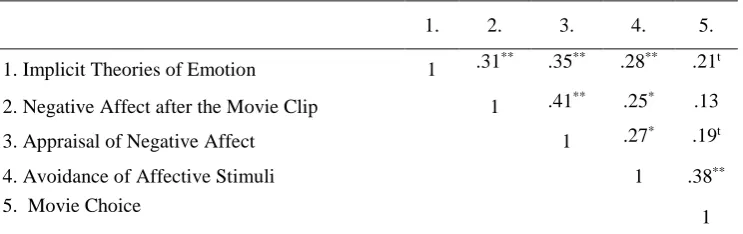
negative affect in general (see Table 1 for all the zero order correlations and Table 2 for all
the partial correlations).
In line with our predictions, we found that the stronger the belief in an entity theory of
emotion, the more negative affect participants reported after the movie clip, r(82) = .31, p =
.005, controlling for negative affect before the movie. Furthermore, the stronger the belief in
an entity theory of emotion, the more students avoided the affective stimuli during the movie,
r(82) = .28, p = .01 , and the more feelings of discomfort they reported having during the
movie, r(82) = .35, p = .001. Importantly, the relationship between implicit theories and
feelings of discomfort remained even when additionally controlling for negative affect after
the movie, r(82) = -.26, p = .02, indicating that implicit theories of emotion were related to
how much students felt bothered by their negative affect, over and above its intensity.
Finally, we examined whether participants’ implicit theories of emotion influenced
their choice of movie clip (i.e., same movie clip again or funny movie clip) at the end of the
and film choice, r(82) = .21, p = .057, indicating that the stronger the belief in the entity
theory of emotion was, the less often participants chose to watch the same movie clip again to
learn about its ending.
Discussion
We examined whether students’ ideas about the nature of emotions (i.e., implicit
theories of emotion) predicted the regulation of negative affect during an unpleasant event,
and affective outcomes as well as avoidance behavior thereafter. As expected, endorsing an
entity belief about emotions was related to experiential avoidance. The more that students
believed emotions cannot be changed, the more they were bothered by their negative affect
during an aversive movie clip, the more they avoided affective stimuli during the clip, the
more negative affect they reported after the movie clip, and the less likely they were to watch
the same clip again to learn about its ending. Taken together, these results suggest that
implicit theories of emotion might lead to poor affective outcomes in the short-term, not only
in the long run as has been previously found (Tamir et al., 2007). Furthermore, lay theories
about emotion might play an important role in how people manage aversive events, and how
people subsequently adapt their behavior.
Implications
The present findings imply that implicit theories of emotion might play a role in
explaining individual differences in affect regulation. Whereas most research on emotion
regulation focuses on identifying strategies that people in general use to regulate their affect,
we looked at why people might choose one strategy over another. Our results imply that the
ideas people hold about the nature of emotion—susceptible to change, or not—influence their
responses to emotional situations. By providing a framework for evaluating negative affect,
implicit theories of emotion may guide reactions to aversive events, leading entity theorists to
The presented results in conjunction with previous research also contribute toward a
better understanding of how implicit theories of emotion shape affect regulation and affective
outcomes. In the short-term, these theories influence whether people approach or avoid
negative affect, thereby fashioning their affective outcomes over time. Furthermore, our
results also suggest that the appraisal of experienced affect is critical for the influence of
implicit theories of emotion on affect regulation. We found that participants with entity
theories of emotion judged their negative affect during the movie clip more discomforting
than incremental theorist. The relationship between implicit theories of emotion and feelings
of discomfort was still present when controlling for the reported negative affect after the
movie clip. This finding suggests that it was not merely the comparatively higher intensity of
negative affect for entity theorists that caused these feelings of discomfort, but rather entity
theorists’ appraisal of the affect. In support of this idea, previous research found that entity
theories of emotion are related to low confidence in the ability to control one’s emotions (i.e.,
emotion regulation self-efficacy; Tamir et al., 2007) and such low confidence is related to
appraising negative affect as threatening (Barlow, Allen, & Choate, 2004; Lazarus, 1991).
Potential Limitations
In our study we measured, rather than manipulated, implicit theories of emotion. Our
results in conjunction with the findings of Tamir et al. (2007) speak to the ecological validity
of implicit theories of emotion; people do systematically differ in their assumptions about the
nature of emotion. However, the presented results do not speak to the causal relation between
implicit theories of emotion and the management of negative affect. One could argue, for
instance, that participants who tend to avoid negative affect, might, as a consequence form the
idea that emotions cannot be changed. Hence, entity theories of emotion might be the
outcome of avoidance, rather than the cause. Speaking against this possibility, extensive
research on lay theories of personal attributes such as intelligence (Dweck, 1999; Molden &
independent of whether they are manipulated or measured (e.g., Hong et al., 1999). Similarly,
implicit theories of emotion might establish a framework to understand one’s affective
reactions, which then guides subsequent behavior. However, it is important for future research
to manipulate the theories people hold in order to gain more insight into the causal
relationship between implicit theories of emotion and responses to aversive events.
The design of our study had some further limitations. For instance, implicit beliefs
were measured right before the emotional manipulation and students might have felt that they
had to report and behave in a way consistent with their previous answers. This is a point of
particular concern as we did not measure social desirability. However, the items on the
implicit theories of emotion scale ask participants about their general ideas about the nature of
emotion (e.g., “the truth is, people have very little control over their emotions”), making it
harder for participants to guess how they might be connected to other items. Nevertheless,
measuring implicit theories of emotion at the end and controlling for social desirability in
future studies would rule out these concerns.
A strength of our study is that we measured different indicators of poor affect
management—not only negative affect itself, but also how students felt about the negative
affect and the strategies they used to regulate the affect. Importantly, we found a consistent
pattern among these different indicators. However, we measured avoidance and feeling of
discomfort during the movie retrospectively via self-report and at the same time as negative
affect. Hence, one might argue that those students who had increased negative feelings after
the movie would report more feelings of discomfort and more avoidance during the movie
just to respond consistently. However, we found only small to moderate correlations between
our dependent variables (see Table 1), suggesting that students were capable of differentiating
between the various aspects of their affect regulation. Furthermore, we also observed
implicit theories of emotion do not only relate to self-reported indicators of affect
management, but also to behavioral indicators.
In the interest of generalizability, future studies should try to incorporate additional
measures and alternative samples. Such studies might measure, for instance, physiological
indicators of experienced affect (e.g., heart rate, skin conductance, eye movement) to examine
how far reaching the effects of implicit theories of emotion are. Such studies could also
ensure that these effects are present in samples more varied than ours, which consisted only of
female university students.
Future Directions
Better understanding how implicit theories of emotion influence emotion regulation
has some intriguing implications for interventions and therapy. Obviously, if entity theories of
emotion lead to experiential avoidance and unfavorable affective outcomes over time, then
trying to change these ideas about the nature of emotions would be crucial to emotion
regulation interventions. Research on implicit theories of intelligence not only shows that
such theories can be changed, but also that doing so helps people to master challenges
(Blackwell, Trzesniewski, & Dweck, 2007). In therapeutic settings, implicit theories of
emotion might impact the degree to which clients believe that therapy can help them to
change certain aversive affective states. These theories might even influence whether a person
seeks out professional help in the first place.
Conclusion
We tested whether lay theories about the nature of emotions shape people’s affect
management during and after an aversive event. In our study, students who endorsed the view
that emotions cannot be changed reported stronger negative affect after an aversive movie
clip, and not only avoided affective stimuli during the movie clip, but also passed up the
chance to see how the story in the movie clip ended. In spite of some methodological
regulation. Understanding the ideas that people have about their emotions might offer the
chance to help people manage their affect effectively, turning incremental theories about
References (19 out of 25)
Blackwell, L., Trzesniewski, K., & Dweck, C.S. (2007). Implicit theories of intelligence
predict achievement across an adolescent transition: A longitudinal study and an
intervention. Child Development, 78, 246-263.
Dweck, C. S. (1999). Self-theories: Their role in motivation, personality, and development.
Philadelphia, PA: Psychology Press.
Eifert, G. H., & Heffner, M. (2003). The effects of acceptance versus control contexts on
avoidance of panic-related symptoms. Journal of Behavior Therapy and Experimental
Psychiatry, 34, 293–312.
Feldner, M. T., Zvolensky, M. J., Eifert, G. H., & Spira, A. P. (2003). Emotional avoidance:
An experimental test of individual differences and response suppression using
biological challenge. Behaviour Research and Therapy, 41, 403–411.
Hayes , S. C. Wilson , K. G. Gifford , E. V. Follette , V. M. Strosahl , K. (1996). Experiential
avoidance and behavioral disorders: A functional dimensional approach to diagnosis
and treatment. Journal of Consulting and Clinical Psychology, 64, 1152-1168.
Hayes, S.C., Luoma, J.B., Bond, F.W., Masuda, A., & Lillis, J. (2006). Acceptance and
commitment therapy: model, processes and outcomes. Behaviour Research and
Therapy, 44, 1-25.
Hong, Y.-y., Chiu, C.-y., Dweck, C. S., Lin, D. M.-S., & Wan, W. (1999). Implicit theories,
attributions, and coping: A meaning system approach. Journal of Personality and
Social Psychology, 77, 588-599.
Koole, S. L. (2009). The psychology of emotion regulation: An integrative review. Cognition
& Emotion, 23, 4–41.
Kashdan, T.B., Barrios, V., Forsyth, J.P., & Steger, M.F. (2006). Experiential avoidance as a
generalized psychological vulnerability: Comparisons with coping and emotion regulation
Lazarus , R. S. (1991). Progress on a cognitive-motivational-relational theory of emotion.
American Psychologist, 46, 819-834.
Levitt, J. T., Brown, T. A., Orsillo, S. M., & Barlow, D. H. (2004). The effects of acceptance
versus suppression of emotion on subjective and psychophysiological response to
carbon dioxide challenge in patients with panic disorder. Behavior Therapy, 35, 747–
766.
Molden, D.C., & Dweck, C.S. (2006). Finding “meaning” in psychology: A lay theories
approach to self-regulation, social perception, and social development. American
Psychologist, 61, 192-203.
Plumb, J., Orsillo, S., & Luterek, J. (2004). A preliminary test of the role of experiential
avoidance in post-event functioning. Journal of Behavior Therapy and Experimental
Psychiatry, 35, 245-257.
Shahar, B., & Herr, N. R. (2011). Depressive symptoms predict inflexibly high levels of
experiential avoidance in response to daily negative affect: A daily diary study.
Behaviour Research and Therapy, 49, 676-681.
Shallcross, A. J., Troy, A. S., Boland, M., & Mauss, I. B. (2010). Let it be: Accepting
negative emotional experiences predicts decreased negative affect and depressive
symptoms. Behaviour Research and Therapy, 48, 921–929.
Tamir, M., John, O. P., Srivastava, S., & Gross, J. J. (2007). Implicit theories of emotion:
Affective and social outcomes across a major life transition. Journal of Personality
and Social Psychology, 92, 731–744.
Timmers, M., Fischer, A. H., & Manstead, A. S. R. (1998). Gender differences in motives for
regulating emotions. Personality and Social Psychology Bulletin, 24, 974-985.
Wegner, D. M., & Gold, D. B. (1995). Fanning old flames: Emotional and cognitive effects of
suppressing thoughts of a past relationship. Journal of Personality and Social
Whiteside, U., Chen, E., Neighbors, C., Hunter, D., Lo, T., & Larimer, M. (2007). Difficulties
regulating emotions: Do binge eaters have fewer strategies to modulate and tolerate
Table 1. Zero-order correlations between the measured variables in the study
1. 2. 3. 4. 5. 6. 1. Implicit Theories of Emotion 1 -.003 .29** .35** .26* .21t 2. Negative Affect before the Movie Clip 1 .32
** .05 .37** .13
3. Negative Affect after the Movie Clip 1 .40** .34** .17 4. Appraisal of Negative Affect 1 .27* .20
5. Avoidance of Affective Stimuli 1 .40**
6. Movie Choice
1 ** p < 01, * p < .05, t p <.10, Note that movie choice is coded 1 = wanted to watch movie again, 2 = did
Table 2. Partial correlations between the measured variables in the study, controlling for
baseline negative affect
1. 2. 3. 4. 5. 1. Implicit Theories of Emotion 1 .31** .35** .28** .21t 2. Negative Affect after the Movie Clip 1 .41** .25* .13 3. Appraisal of Negative Affect 1 .27* .19t 4. Avoidance of Affective Stimuli 1 .38**
5. Movie Choice
1
** p < 01, * p < .05, t p <.10, Note that movie choice is coded 1 = wanted to watch movie again, 2 = did