City, University of London Institutional Repository
Citation:
Von Landesberger, T., Brodkorb, F., Roskosch, P., Andrienko, N., Andrienko, G.
& Kerren, A. (2016). MobilityGraphs: Visual Analysis of Mass Mobility Dynamics via
Spatio-Temporal Graphs and Clustering. IEEE Transactions on Visualization and Computer
Graphics, 22(1), pp. 11-20. doi: 10.1109/TVCG.2015.2468111
This is the accepted version of the paper.
This version of the publication may differ from the final published
version.
Permanent repository link:
http://openaccess.city.ac.uk/12849/
Link to published version:
http://dx.doi.org/10.1109/TVCG.2015.2468111
Copyright and reuse: City Research Online aims to make research
outputs of City, University of London available to a wider audience.
Copyright and Moral Rights remain with the author(s) and/or copyright
holders. URLs from City Research Online may be freely distributed and
linked to.
City Research Online:
http://openaccess.city.ac.uk/
[email protected]
MobilityGraphs: Visual Analysis of Mass Mobility Dynamics
via Spatio-Temporal Graphs and Clustering
[image:2.612.75.536.144.281.2]Tatiana von Landesberger, Felix Brodkorb, Philipp Roskosch, Natalia Andrienko, Gennady Andrienko, and Andreas Kerren,Senior Member, IEEE
Fig. 1. Hourly flows of residential Twitter users in Greater London area over a week are spatially and temporally simplified to gain an overview of mobility dynamics. A calendar view shows the temporal cluster distribution over a week. Each map displays movements between spatial aggregates in a temporal cluster. Movement direction is represented by a color gradient from dark to light blue.
Abstract—Learning more about people mobility is an important task for official decision makers and urban planners. Mobility data sets characterize the variation of the presence of people in different places over time as well as movements (or flows) of people between the places. The analysis of mobility data is challenging due to the need to analyze and compare spatial situations (i.e., presence and flows of people at certain time moments) and to gain an understanding of the spatio-temporal changes (variations of situations over time). Traditional flow visualizations usually fail due to massive clutter. Modern approaches offer limited support for investigating the complex variation of the movements over longer time periods.
We propose a visual analytics methodology that solves these issues by combined spatial and temporal simplifications. We have developed a graph-based method, called MobilityGraphs, which reveals movement patterns that were occluded in flow maps. Our method enables the visual representation of the spatio-temporal variation of movements for long time series of spatial situations originally containing a large number of intersecting flows. The interactive system supports data exploration from various perspectives and at various levels of detail by interactive setting of clustering parameters. The feasibility and utility of our approach was tested on aggregated mobility data derived from a set of geolocated Twitter posts within the Greater London city area and mobile phone call data records in Abidjan, Ivory Coast. We could show that MobilityGraphs support the identification of regular daily and weekly movement patterns of resident population.
Index Terms—Visual analytics, movement data, networks, graphs, temporal aggregation, spatial aggregation, flows, clustering
1 INTRODUCTION
An understanding of the movement behavior of people and its dynam-ics is crucial for official decision makers and urban planners, among others. Mobility data sets give information about the presence of people in different places at certain points in time as well as about movements (or flows) of people between the places. Movement data can be obtained from various sources—such as traffic sensors, pub-lic transportation usage records—or reconstructed from many kinds of data sources that contain people’s locations at different times
de-• T. von Landesberger, F. Brodkorb and P. Roskosch are with Technical University of Darmstadt, Germany. E-mail:
{tatiana.von-landesberger|felix.brodkorb}@gris.tu-darmstadt.de.
• Natalia Andrienko and Gennady Andrienko are with Fraunhofer Institute IAIS, Bonn, Germany and with City University, London, UK. E-mail:
{natalia|gennady}[email protected].
• Andreas Kerren is with Linnaeus University, V¨axj¨o, Sweden. E-mail: [email protected].
Manuscript received 31 Mar. 2015; accepted 1 Aug. 2015; date of publication xx xxx 2015; date of current version xx xxx 2015. For information on obtaining reprints of this article, please send e-mail to: [email protected].
spite not being collected with the purpose of tracking people’s move-ments. Examples of the latter type of data include records about the use of mobile phones collected for billing purposes, and geographi-cally referenced contents appearing in social media: Twitter, Flickr, YouTube, Foursquare, etc. In particular, Twitter data sets have gained prominence lately due to their wide availability and large scale. Even though, geographically referenced tweets only cover a small percent-age of all tweets, the absolute amount of them is very large and thus provides a sufficiently representative sample [4]. The individual data is often pre-processed (e.g., summarized) for gaining time-varying flows of multiple people (mass movement data). We refer to them as ‘move-ment data’ or ‘time-varying flow data’.
Movement data consists of records reporting the number of people in an area in a short time interval, so-calledtime step (e.g., people in the City of London between 9am and 10am). The data also contains the amount of movements (i.e., flow magnitudes) between areas during specific time periods (e.g., hourly movements between city suburbs). The data is usually collected over longer time periods, thus it is time-varying.
movements occur in specific occasions (e.g., demonstrations or bomb attacks). They are important for emergency management. We focus on analyzing typical movements addressing the following questions:
• How do thespatial situations(i.e., the spatial distributions of the flow magnitudes) at particular time moments within a regularly week cycle (e.g., working days in the morning) look like? How big are the flows between urban areas at a certain point in time? Which areas have many people at a certain time moment? Which areas have high/low flows at a certain point in time?
• What is thetemporal variationof the flows? How do spatial sit-uations change over time (e.g., over a typical week)? What is the difference between the spatial situations in two time moments? Which flows increase/decrease?
Traditional visual analysis methods for assessing this type of data usu-ally fail due to massive clutter and/or the inability to investigate the complex variation of the movements over time. A widely employed flow map visualization gets extremely cluttered when there are flows between non-neighboring regions (see Fig. 2(a)). Even filtering by flow magnitude or increasing edge transparency does not solve this problem (see Fig. 2(b)). Moreover, visualization of temporal data vari-ation using animvari-ation or small multiples do not scale [7, 31, 41]. Clus-tering and aggregation-based visual analytics approaches mostly focus on spatial or temporal components of the flows. They have limited suitability for dense flows with many time moments (see Sect. 2).
[image:3.612.43.297.337.430.2](a) Original flows (b) Filtered flows (c) Aggregated flows
Fig. 2. Afternoon movements of the London residents (see Sect. 5.1). Original flow maps are cluttered. Filtered flow map (>200movements) is still cluttered. Spatial simplification (c) clearly shows important flows and their magnitudes (edge width, see also Sect. 4).
We propose a visual analytics methodology that addresses the two above-mentioned analytical questions. Our approach relies on spa-tial and temporal simplification that uses a spatio-temporalmobility graphas a representation of movement data. Here, a discrete set of places (geographical regions) with flows between them is considered as a weighted directed graph. Edge weights are determined by flow magnitudes. Our graph is dynamic, as spatial situations vary over time. The mobility graph is spatially simplified by a specifically devel-oped spatial graph clustering algorithm. The temporal simplification is achieved through clustering of time steps based on the similarity of the respective spatial situations. The results of the spatial and temporal simplifications are presented in several coordinated views for compre-hensive data exploration. Based on our observations, these methods notably reduce the visualized data size and thus help to mitigate clut-ter problems as well as to visually represent the temporal variation of movement for a large number of time steps. Moreover, the proposed fast clustering algorithm allows for interactive change of parameters and thus supports interactive exploration of movements at various de-grees of abstraction and from different perspectives. This assists in gaining a deep understanding of spatial situations and their changes.
Our approach can be used for analyzing any flow (i.e., collective movement) data over time, such as population migration, commuting, or flows of attendees of public events. The feasibility and usefulness of our approach has been tested on two real-world flow data sets. The first data set concerns the resident Twitter user mobility in Greater Lon-don area. The analysis of hourly movements throughout the weekly
time cycle has revealed typical movement patterns such as strong city-centric movement of London residents in the morning, quiet ment periods during the working hours, and correspondence of move-ment patterns to the rail network topology. Most of the uncovered patterns could not be perceived from flow map displays. These re-sults confirm the analytical power of our methodology even when us-ing Twitter data approximatus-ing the population movement. The sec-ond real-world data set was produced from call data records over two weeks in Abidjan, Ivory Coast. The analysis of hourly movements identified similar but slightly less prominent routine mobility patterns with differentiation of morning and evening flows. We found that the city has a polycentric structure, where one center is the location of businesses and jobs and the other two have a different role.
The remainder of this paper is organized as follows. Section 2 discusses the related works. Then, we present our visual analyt-ics approach together with design decisions in Section 4. Section 5 demonstrates the feasibility of the proposed methods on two real-world datasets. Section 6 discusses our approach. We conclude our paper with an outline of future work in Section 7.
2 RELATEDWORK
As our approach covers several research fields. We subdivide the related work into two groups: (1) visualization approaches for time-varying flow data and (2) an overview of techniques for the visual analysis of flows represented as geolocated dynamic graphs.
Visualization of time-varying flow data Much work has been done in the area of time-oriented data [2]. As for flow data, the existing visualization methods have been recently surveyed by Boyandin [13] and Andrienko [4]. There are two main classes of techniques for the visual representation of flow situations: flow map [36, 43] and origin-destination matrix (OD matrix) [52, 53].
The common approach to representing time-varying flow data is to visualize the time series of flow magnitudesassociated with the links on a non-cartographic time series display, e.g., as it is done by Boyandin et al. [14]. However, such a visualization does not show the spatial patterns of the flows, i.e., the spatial flow situations. Bremm et al. [15] propose another kind of non-cartographic visualization of flows, where locations are represented by distinct colors. The flows between the places are represented by colored bands connecting seg-ments of neighboring bars. When the time series are long, several complementary techniques for selecting representative time moments can be applied [48]. An obvious limitation of this method is scalability w.r.t. the number of places.
Time-variant spatial flow situations can be represented bymultiple mapsarranged either temporally in a map animation or spatially in a small multiple maps display [3]. Alternatively, one can use different operations on the space-time cube to analyze the flows [8].Flow maps show the spatial context of flow data in an undistorted way but often suffer from numerous intersections, occlusions, and visual clutter. The problems of flow mapping are comprehensively discussed by Guo and Zhou [28]. Moreover, map animation may be ineffective [31, 44], be-cause the user cannot memorize and mentally compare multiple spatial situations. In small multiples, a limited number of spatial situations can be shown simultaneously. Hence, this approach is not suitable for long time series. Therefore, simplification of individual maps or reduction of time moments has been proposed.
radial movements from and to one central location [22]. Besides, map users can wrongly interpret the flow lines resulting from edge bundling as the routes of the movement.
Locations and flows can beaggregatedfor reducing the size of the represented data, while still being able to uncover general patterns of flows. Kisilevich et al. [35] describe state-of-the-art approaches of clustering for geospatial data. Guo [26, 27] applies spatially con-strained hierarchic graph partitioning techniques to group places into larger units and then visualizes aggregated flows between these larger units. Guo and Zhu [28] point to the modifiable areal unit problem (MAUP) [38]. They propose kernel-based density estimation, which also normalizes the flow magnitudes. Filtering still needs to be ap-plied for reducing the intersections of the resulting aggregated flows, i.e., only the most important flows are shown on the map. These ap-proaches are suitable for spatial simplification, however they have a relatively high computational complexity. Moreover, they do not con-sider time-dependence of flows. Gao et al. apply the hierarchic clus-tering of Guo et al. [27] to time-dependent flows [25]. They cluster each time moment individually. This creates problems with automati-cally determining cluster correspondence over time and thus makes it difficult to identify changes between time moments. Correspondence needs to be found manually. Zhu and Guo [56] use hierarchic clus-tering of flows (not places) to analyze movement data. As each time moment needs to be inspected, these two approaches do not scale for large time periods.
Clustering of spatial situations over time [4, 5] can be used to reduce the number of distinct situations that need to be shown. Clustering puts together similar flow situations corresponding to different time moments. The individual spatial situations grouped into the clusters are then summarized by computing the mean or median flows. The summarized situations representing different clusters can be shown on small multiple flow maps. However, the problem of visual clutter and over-plotting of flow symbols on the flow maps was not solved. In the examples occurring in the previous works [4, 5], the flow maps were not too cluttered owing to either a small number of distinct locations or the absence of flow intersections (i.e., there were only flows between neighboring places).
Time-varying flows as geolocated dynamic graphs Movements between regions can be represented as a graph, where regions are graph nodes and flows between them are treated as weighted directed edges. The node position in the graphs is fixed to its geographic lo-cation. Time-dependence of the flows creates dynamic geolocated graphs. So, the assessment of movement data is closely related to the visualization of dynamic networks with geolocation constraints on node positions. The available methods for visualization of (potentially multivariate) dynamic graphs are comprehensively overviewed in re-cent surveys [6, 10, 29, 50, 51]. Here, we conre-centrate on works related to time-varying flow visualization, i.e., dynamic graphs.
Animationin dynamic graph visualization is often connected with the problem of creating a stable graph layout for supporting the users’ mental map [7], such as foresighted layouts [20]. In flow visualization, however, the node positions are fixed. Nevertheless, animation can still pose a challenge for the user, due to high cognitive load, when per-ceiving changes between consecutive time steps [7, 44]. This problem is especially severe when many time moments or large/dense graphs need to be analyzed. Approaches mitigating this problem include re-ducing the number of time steps and highlighting of changes between consecutive graphs [9], usage of smooth edge bundling [34], drawing of clustered graphs or filtered graphs [1, 24]. These approaches still suffer from animation perception problems.
Timeline visualizationof dynamic graphs shows all graphs in a se-quence. For large graphs and/or a large number of time moments, a scalability challenge emerges. In the network visualization com-munity, this is often mitigated by suitable node layouts [18]. This is however not applicable to geolocated graphs, as the understanding of geographic distribution is diminished. Alternatively, one can cluster time moments by similarity of corresponding graphs. This is analog-ical to the clustering of flow maps (see above). In juxtaposed (small
multiples) views, the space for individual graph visualization is very limited. Even when clustering time moments, large and dense graphs often get cluttered in small multiples views. This can be further dimin-ished by graph aggregation (clustering of graph nodes). It aggregates compact graph structures (e.g., communities) or nodes with similar at-tributes (e.g., persons of similar age) into one aggregated node and thus reduce the size of the graph for visualization [42, 47]. These al-gorithms exploit the graph structure, but often disregard geographic closeness of the nodes. This may result in clusters which are “scat-tered” in geographic space.
Superimposed visualizationdraws graphs on top of each other in a 2.5D display [21]. This strategy, however, suffers from occlusion, especially for dense graphs and many time moments.
Integrated approachesuse specialized visual designs to show the time dimension. For example, Reitz [40] shows the time evolution of edge weights by colored sections within edges. While this enables the assessment of edge weight evolution directly on edges, it poorly performs for intersecting edges, as in the case of geolocated flows. It also does not show how the overall graph structure evolves over time.
Matrix-based approaches show dynamic graphs as adjacency matrices (i.e., OD matrices), where intra cell timelines such as sparklines [17, 55] show the dynamics of edge and node weights. Ow-ing to the limited space, they are limited to short time periods. For large graphs, graph aggregation is needed [17]. Moreover, only the lo-cal changes of the edges and/or nodes are visible, but not the evolution of the overall graph structure.
3 DEFINITIONS
We consider time-varying flow data over a time interval T =
{t1, . . . ,tτ}. And we have a discrete set of spatial locations, a.k.a.
placesP={p1, . . . ,pN}. Then, we define the number of people at placepain time steptiaspresence count wa(ti)of this place.
There is a set of moving objects (such as people) that can move from any location to any other location. The routes of their movements are unknown, only the origins and destinations of the trips. For any ordered pair of places(pa,pb), all trips originating inpaand ending inpbin a time steptiare called flowfa,b(ti). A flowfa,b(ti)frompa topbin time steptiexists only, if there was at least one trip originating in paand ending inpbduringti. We say that there is a directed link ea,b(ti). If there exist a linkea,b(ti)oreb,a(ti), then the placespaand pbare flow-connected. The number of trips aggregated in a flow is calledflow magnitude ma,b(ti).
The time-varying flow data set can be formally represented as <P,L,T,W(P,T),M(L,T)>, wherePis the set of places,L⊂P×P is the set of links,Tis the set of time steps,W(P,T)is the function that assigns presence count to the placespain time stepti, andM(L,T)is the function that assigns a certain non-negative value of flow magni-tude to each pair(e,tI),e∈L, andti∈T.
For each time stepti∈T and the whole set of linksL, the function Mgives a set of flow magnitudesM(L,ti), which is calledspatial flow situation(or shorter: spatial situation) at time steptiand is denoted withS(ti)orSi.
Asimplified situation(i.e., asimplified spatial situationor aggre-gated situation)ASi, in time stepti, is a situation, where similar places are grouped intospatial aggregates (i.e., regions) Rl={S
m∈lPm}, and the flows between them are aggregated accordingly into aggre-gated flows AF with magnitudes summarized according to the used clustering algorithm. The creation of spatial aggregates, e.g., by using a clustering algorithm is calledspatial simplification.
Atemporal cluster TCk,k∈ {1, . . . ,K}is a group of possibly simi-lar (simplified) spatial situations in various time steps
TCk(S) ={
S
i∈kSi}orTCk(AS) ={
S
i∈kASi}. The creation of tem-poral clusters, e.g., by using a particular clustering algorithm is called temporal simplification. Temporal simplification can be done on the original situationsTC(S)or on simplified spatial situationsTC(AS).
4 APPROACH
(1) Representation of the spatial situations significantly reducing the visual clutter while conveying important movement patterns. (2) Representation of the temporal variation without the need to
con-sider and compare a great number of time steps.
We propose a combination of spatial and temporal simplification with interactive exploration of the resulting data.
• Spatial simplificationreduces visual clutter by the aggregation of regions using a special graph-based spatial clustering suitable for time-varying flows (see Sect. 4.1.1).
• Temporal simplificationreplaces the great number of spatial sit-uations by a much smaller number of spatial sitsit-uations that need to be viewed and compared by the analyst. We cluster the time steps by the similarity of the spatial situations (see Sect. 4.1.2).
• Visual exploration offers a set of interactive graph and geography-based views for the exploration of spatial situations and their changes over time. These views were specifically de-signed for the exploration of time-varying flow data with simpli-fication (see Sect. 4.2). In particular, we have developed tech-niques supporting comparisons of spatial situations. Our ap-proach also supports interactive adjustment of clustering param-eters for the exploration of temporal flows from various perspec-tives and at various levels of detail.
4.1 Spatial and Temporal Simplification
Our approach combines spatial aggregation (i.e., aggregating nodes into regions and aggregating flows between places into flows between regions) and temporal clustering (i.e., grouping similar spatial situa-tions from several time steps) for reducing the data size, reducing data clutter in the visualization, and simultaneously supporting an abstract grasp of characteristic features of the mobility behavior. The main challenge in the simplification was to develop appropriate clustering methods for time-varying flows and to combine the two simplifica-tions.
While there are various ways of combining spatial and temporal simplification (see Sect. 6), we considered two main approaches:
(1) Spatial aggregation preceding temporal clustering:Spatial situ-ations in all time steps are spatially aggregated first. This sub-stantially reduces the data size for the subsequent temporal clus-tering, which uses flow magnitudes for calculating situation sim-ilarity (<<N2).
(2) Temporal clustering preceding spatial aggregation: Temporal clustering based on original time-varying flows is performed be-fore spatial aggregation. The temporal clustering reduces the number of time steps, and the subsequent spatial aggregation re-duces data clutter in the visualization. The main problem of this approach is the determination of the similarity of spatial situa-tions. The common approach using flows between all places [4] leads to high-dimensional data sets (up toN2flow magnitudes – dimensions). It leads to unstable results and long calculations. Thus, a dimensionality reduction is needed.
We investigated both types of simplification combinations with vari-ous ways of determining similarity of spatial situations in the temporal clustering. We decided to use the first option, because the second op-tion requires feature reducop-tion, esp. using general dimensionality re-duction methods, whose results do not relate to the geographic context and therefore are not easy to interpret. In contrast, in the first option, spatial simplification is well understandable and easy to represent vi-sually within the geographic context.
4.1.1 Spatial Simplification
We employ a specially developed method for aggregating places and aggregating flows between individual places into flows between the spatial aggregates (i.e., regions, or clusters of places). Our algorithm groups spatially close places with high flow magnitudes into regions. This aggregation greatly simplifies the graph structure. Inevitably, it
hides the patterns of local movements between the places within the regions; however, it captures and prominently represents larger-scale movement patterns, which could not be seen otherwise (see Fig. 2(c) as an example).
Our spatial aggregation method extends the “Density-Based Spatial Clustering of Applications with Noise” (DBScan) [23] with additional features: (a) it considers both spatial closeness and strength of flows between places (i.e., flow strength) as well as (b) applicability to time-dependent data. Thus, our algorithm has been designed to work on time-dependent flows. The reasoning behind this approach as well as the algorithm’s details are described below.
Algorithm rationale We decided to use a density-based cluster-ing, because (a) it is fast (O(|P|log˙ (|P|))according to [23]), (b) it does not require pre-setting of the number of clusters, (c) it is able to detect arbitrary shaped clusters (in our case spatial aggregates, or regions) as well as outliers, and (d) it uses easily comprehensible parameters (e.g., spatial closeness, flow magnitudes). We note that DBScan can in some cases lead to slightly different results depending on the node order [23]. To mitigate this drawback, we propose to use a pre-defined node order (e.g., according to presence count).
Spatial closeness and flow magnitudes: Our algorithm computes spatial aggregates (in this section also referred to as regions for sim-plicity) using both the density of places and their flow magnitudes. By aggregating only spatially close places that are connected by a high flow magnitudes, we prevent cases where locations would become one aggregate (i.e., region) that are close but have (nearly) no connection to each other. An example for this case would be an airport that usu-ally does not have a significant flow with its surrounding areas. Too small or insufficiently flow-connected spatial aggregates are treated as outliers, thus they are filtered out.
Suitability for time-variant data: As we deal with time-varying flows, the algorithm needs to ensure comparability of spatial aggre-gates across time steps. If we used spatial simplification on each spa-tial situation individually [25], it would be difficult to automatically compare the resulting spatial aggregates across time steps, since there is no inherent region correspondence. Therefore, we propose to apply the algorithm to a so-called “supergraph” [20], which combines all time steps. In this way, we derive spatial aggregates in individual time steps. Although the use of a supergraph may hide some small regions appearing in few time steps, it offers a general overview of regions and, most importantly, it provides region correspondence.
Algorithm The algorithm starts with building the supergraph com-bining all time steps. It then performs an extended DBScan-like algo-rithm including filtering out of outliers.
The supergraph (or superflow) < P,L,T,W(P,T),M(L,T)> is composed of all places and links of all spatial situations in the data set. Its flow magnitudesM(L,T)and presence countsW(P,T)are av-erages of all spatial situations.
The algorithm extends DBScan with specific condition of enclos-ing a place in a region (i.e., spatial aggregate). A place is added to a region if two criteria are met: (1) it is spatially closeand(2) has suf-ficiently high flows with the region. We developed and implemented two variants of the aggregation criteria: using absolute and relative flow magnitudes. The absolute criterion filters out nodes that are close to each other but have a non-significant flow between them. The rel-ative flow criterion can be used to prevent nodes from being excluded from a cluster, if those nodes are small but have a large relative flow compared to their size.
(1) A placepais considered spatially close to a regionR, if its ortho-dromic distance to the nearest point in the region is lower than a user-defined threshold, i.e.,min(d(pa,pR))≤thdist,pR∈R. (2) A place pa has a sufficiently high flow, if its flow strength
ex-ceeds a user-defined thresholdthconn:mc(pa,R)≥thconn.
We offer two ways of calculating flow strength:
and all places with flows to or from this place and the cluster, i.e., its flow-based neighbors in clusterv∈(n(pa)∩R).
mcabs(pa,R) =
∑
v∈(n(pi)∩R)Mi,v+
∑
v∈(n(pa)∩R) Mv,i
• Relative Flow Strength: The flow strength of relative flows is calculated similar to the absolute flow. However for each link, we relate the magnitude of the link to the presence count in the source of the flow.
mcrel(pi,R) =
∑
v∈(n(pi)∩R)Mi,v Wi
+
∑
v∈(n(pi)∩R) Mv,i Wv
During the procedure, we also filter out newly created spatial aggre-gates which are outliers (i.e., they are either too small or have few connections). All links leading to/from this outlier are also filtered out. We provide the user with three filtering options, depending on size, absolute, and relative flow strength.
• Size Filter: It filters out aggregates with presence countW(R) smaller than a user-adjustable thresholdthmagn.
• Absolute Flow Filter:This filter uses the total sum of all flows to/from the region. When analyzing movement behavior, one might think of places irrelevant when only few people leave or enter this region.
• Relative Flow Filter:Relative flow relates the number of people entering/leaving a region to its presence count. This can be used to keep aggregates that are rather small but have a high fluctua-tion relative to their size.
Pseudo-code for our spatial simplification method is shown in Algo-rithm 1 with the following notation: RR is the set of all (resulting) spatial aggregatesR,Pis the set of all places, pop(P)takes a (ran-dom or top-ordered) node fromPand removes it from the collection, n(pi)gets all places that have a flow from or topi, andf ilter(R)is a user-chosen cluster filtering method to eliminate outlier clusters.
Algorithm 1Algorithm for spatial simplification RR←/0
whileP6=/0do
p1←pop(P) R← {pi}
N←n(pi)
whileN6=/0do
pj←pop(N)
ifd(pj,R)≤thdistandmc(pj,R)≥thconnthen
R←R∪p2 N←N∪
n(pj)\P P←P\
pj
end if end while if¬f ilter(R)then
RR←RR∪RC
end if end while
Thesimplified spatial situations ASi in each time stepti∈T are extracted from the original situationsSi by aggregating their places and flows according to the clustersRl∈RR,Rl=S
Pu identified by the above-mentioned algorithm. These simplified spatial situations are used as an input to the following temporal simplification (i.e., creation of temporal clusters) described in the next section.
4.1.2 Temporal Simplification
Temporal simplification groups the time steps by the similarity of the corresponding (previously simplified) spatial situations. The cluster-ing can be performed by a clustercluster-ing algorithm, such as k-means [30].
The main challenge is to determine a suitable similarity function for comparing situations that results in meaningful clustering outputs.
The similarity of spatial situation is commonly determined based on so-calledfeature vectorsthat uniquely characterize a spatial situation by a vector of numbers (i.e., features). A similarity of spatial situations is then calculated as a similarity of their corresponding feature vectors (e.g., Euclidean vector distance). In this respect, the challenge is to find a suitable feature vector for the spatial situations.
A way of describing a spatial situation for determining similarities is to use a set of flow magnitudes as a feature vector, as each spatial situation is uniquely characterized by its flow magnitudes. However, movements form very dense relationships, which lead to a high num-ber of flows (quadratic to the numnum-ber of places, e.g., 21,727 links between 606 places). Hence, the dimensionality of this feature vector is extremely high, leading to two kinds of problems: first, the cluster-ing takes much time, and second—more importantly—the clustercluster-ing results in such cases are known to be unstable and unreliable [12, 37].
For the above-mentioned reason, we perform temporal clustering on the spatially simplified situations. Spatial simplification groups and aggregates places and flows, thus decreasing the situation’s size. This reduces the dimensionality of the feature vectors composed of the cor-responding flow magnitudes. In our case, the reduction in dimension-ality is significant: initial 606 places with 21,727 links are aggregated into 42 clusters with only 394 aggregate links between them. Using the magnitudes of these links as the features describing the spatial sit-uations reduces the dimensionality to 1.8% of the original 21,727 di-mensions (i.e., features). This mitigates the instability and scalability problem. Moreover, the clustering results show to be meaningful (see Sect. 5). Note, alternative feature vectors have not proven suitable for our case (see Sect. 6).
4.2 Visual Data Exploration
[image:6.612.319.567.440.634.2]The results of this spatio-temporal simplification are shown in several interlinked views. They enable a deep exploration of the clustering results as well as investigation of the impact of the results depending on the choice of clustering parameters. The views combine abstract graph visualization with map-based views. Interactive features show details on demand.
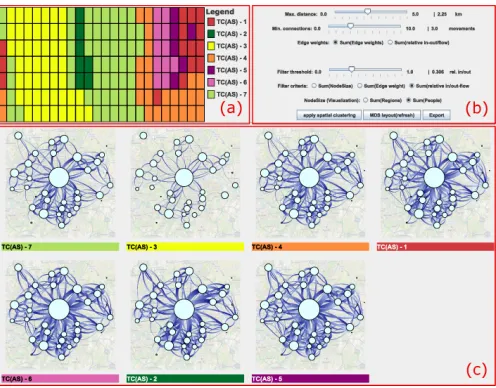
Fig. 3. Cluster result window with several views contained: (a) calen-dar view of temporal clusters, (b) interactive parameter setting, and (c) cluster overview.
Parameter adjustment: The user can employ the interactive fea-tures for steering the spatio-temporal simplification. By varying the parameters, she can examine the impact of the parameters on the re-sulting simplified situations. Parameter variation also allows the user to vary the degree of abstraction and schematization in representing the movement and thereby generalize or refine the knowledge gained. In addition, the tool supports finding suitable parameters. We calcu-late several quality values (e.g., within region flows [27] and average distance [30]) for regularly sampled combinations of connectivity and distance thresholds. The quality values are shown in a heatmap with the two thresholds as rows and columns (see Sect. 5 and Fig. 7). The user chooses suitable parameters and fine tunes them in the main win-dow.
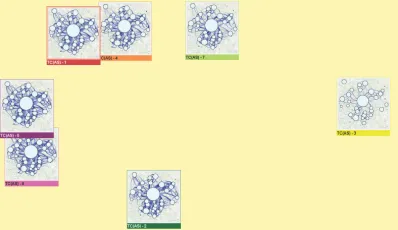
Fig. 4. The MDS layout shows similarity of spatio-temporal clusters by positional closeness.
Calendar view of temporal clusters:This view shows in which time steps the temporal clusters occur (see Fig. 3(a)). Here, colored cells represent clusters. In our case, the time steps are wrapped into days (rows) and hours (columns) similar to the calendar view of van Wijk et al. [46]. It allows to emphasize the weekly pattern of the temporal clusters.
Cluster overview:This view shows small multiples of the spatially simplified temporal clusters, calledcluster thumbnails(see Fig. 3(c)). Cluster Thumbnails A thumbnail is color-coded according to the temporal clusters and shows the average graph of a spatio-temporal simplification. Here, the node position is geographically determined. It is shown in the center of the included geographic regions. The un-derlying map supports a geographic understanding of the flow graph. In order to enhance the contrast between the map and the graph, the map saturation can be optionally reduced (e.g., to light grayscale). Node size is determined either by the average number of people in the cluster’s regions or by the number of aggregated regions, as chosen by the user. The edge width is determined by the average aggregate flow between the two regions. After experimenting with various edge direction designs proposed by [32], we decided to use both color gra-dient (from dark to light) and the edge position to encode direction (edges to the right of the noto-node line are outgoing). This de-sign reduces clutter caused by edge arrows and allows to encode edge weights, which is difficult to achieve with tapered edges, for instance. The position of cluster thumbnails on the screen can be twofold. First, the so-called sequential positioning lays the thumbnails next to each other in one or several rows (see Fig. 3(c)). The thumbnails are ordered according to their occurrence in temporal clusters. Second, the so-called distance-based positioning uses multidimensional scal-ing (MDS) [19] to position the thumbnails accordscal-ing to their similarity (see Fig. 4). The similarity function is user-chosen from a set of graph edit distance functions with varying composition (e.g., edge weights, edge existence, node existence, node weight). We chose to employ the two screen layouts as they both have complementary advantages: sequential positioning is overlap-free but disregards time cluster sim-ilarity. In contrast, the distance-based positioning also shows how the time clusters relate to each other.
Visual comparison of cluster thumbnails offers the user the possi-bility to examine commonalities and differences between spatial sit-uations. The user can gain a broad understanding of the differences
between those. However, the exact differences need to be examined in more detail. In this case, the user can click on two thumbnails for seeing their detailed comparison in a so-calleddifference view.
Fig. 5. The difference graph view displays differences between two spa-tial situations. Blue indicates decrease, white no change, and red an increase. A user-selected spatial aggregate is shown on a map.
Difference View The user can examine differences between user-selected situations in a detailed view (see Fig. 5). The compared situ-ations are indicated by coloring of the left and right border. The time steps of the two situations are highlighted in the calendar view on the bottom. It enables the user to examine when the two compared situa-tions occur. For example, whether both are in the same week days and similar hours, or one is in the morning and the other in the evening.
The graph representation shows the difference of the two spatial sit-uations: both the spatial distribution of persons and flow magnitudes. Node size is determined by the number of people in the aggregate (i.e., region) in the left situation. The change of the relative size of the region is color-coded (from blue via white to red). We use rel-ative changes (percentage change with respect to the left aggregate) as it results in more reasonable difference indication. The alternative absolute change overemphasizes large aggregates. In contrast, rela-tive change takes into account the aggregate’s size. If an aggregate (dis)appears between the two situations, it is colored yellow for ap-pearing and black for disapap-pearing. Edges are color-coded according to the relative differences in the flow magnitudes between the two sit-uations. It uses the same color scheme as the nodes.
The node position is determined by its geographic location (center of the included geographic regions), and a change can be examined in detail in the linked map view (see Fig. 5 on the right). The map highlights the regions included in each of the two compared situation (by their original color) and in both situations (using color weaving). The user can thus explore commonalities and differences in spatial clusters in the context of the original geographic positions.
5 USECASES
To test the feasibility of the devised methodology, we apply it to two real-world data sets: resident Twitter user mobility in Greater London area (Sect. 5.1) and mobile call user mobility patterns in Abidjan area (Sect. 5.2). Due to space limitations, we de-scribe the first use case in more detail and concentrate on the main results in the second use case. For both cases, descrip-tion of data source and data pre-processing as well as high resolu-tion pictures are provided in the annex and as supplementary ma-terial. All documents are also provided at website www.gris.tu-darmstadt.de/research/vissearch/projects/MobilityGraphs.
5.1 Mobility in Greater London Area
[image:7.612.71.270.190.305.2]TC7vs.TC2 TC7vs.TC4 TC4vs.TC6 TC6vs.TC5 TC5vs.TC1 TC1vs.TC7
Fig. 6. Pairwise comparisons of simplified temporal clustersTC(AS)i(or simplyTCi) of mobility in the Greater London area.
obtain mass movement data from records of individuals by spatially aggregating the individuals’ movement data into cells by an irregular grid (see Fig. 5 on the right). The data is also temporally aggregated into hourly intervals within the weekly time cycle (7 days×24 hours). Thus, we receive time series of transitions between pairs of (not nec-essarily neighbored) cells. As this type of data is event-based—the location is stored when a posting event occurs—the resulting move-ment data is episodic [5], and the path between two tweets may not be determined. We have 21,727 time-varying links between the 606 places in 168 time steps.
Spatial and Temporal Simplification We first perform spatial simplification of the movement graph and analyze the quality of re-sults for various parameter settings (see Fig. 7). We analyze a combi-nation of three criteria as they offer a comprehensive assessment: total flows within regions (should be high), number of clusters (should be intermediate) and average distance between regions (should be high). We see that with the increasing connectivity and distance threshold, the results first improve and then get worse. This is natural as a too low thresholds lead to too small regions with low connectivity (red setting). Vice versa, large values lead to large regions disregarding in-ternal structures (yellow setting). So, we choose a balanced setting (or-ange) with the following parameters: max. distancethdist=2.25 km, min. nr. connectionsthconn=3, and relative change in people presence threshold=0.3. As a result, 302 out of the 606 places (about 50%) are united in 42 clusters, and the remaining 304 places treated as “noise”.
Fig. 7. Top: quality values for various combinations of connectivity and distance thresholds. Bottom: results for selected settings (see colored rectangles). Red:thconn=1,thdist=0.7, orange:thconn=3,thdist=2.25 and yellow:thconn=6,thdist=3.5. All use relative flow filter of0.3.
We then perform temporal clustering using k-means applied to the spatially clustered flows. We tried different values of k and finally choosek=7, which gives a well interpretable temporal pattern (see Fig. 1), where night, morning, midday, and evening of the working days are well differentiated. This differentiation corresponds to
peo-ple’s everyday mobility, which includes movements to the work or study places in the morning, followed by business time, and move-ments back to the home places in the afternoon and evening. The clustering also differentiates between the week days from Monday to Friday and the weekend, which could be expected.
Exploration of the Overall Flow Topology We begin our analy-sis with the investigation of the overall topology of the collective mo-bility behavior in London, which is reflected in the structures of the aggregated graphs (see Fig. 1). We see that the city has a prominently mono-centric structure with a large central region. It is characterized by the highest people’s activity and highest internal mobility. Spa-tially, the mobility patterns correspond to the topology of the railway network in London. The central region plays the key role as the area of highest mobility and interconnectedness between places, which also attracts people from the periphery. Many people go to the center for work in the morning (around 9 o’clock) or move through the center for reaching their destinations. In the evening of working days (hours 18-19), working people move back from the center to the periphery, whereas some people move to the center (see Fig. 5). Probable pur-poses of these movements are social activities or cultural events.
Comparing Spatial Situations at Different Times Figure 1 shows an overview of all spatio-temporal clusters. The yellow clus-terTC(AS)-3 stands out as it differs significantly from other clusters. The presence of moving people and the movement flows are expect-edly very low. This cluster unites the night hours (see calendar view in Fig. 1). The data shows that the quiet night time begins and ends later on the weekend than on the week days. Other clusters differ less, thus we proceed with detailed difference analysis (see Fig. 6).
Time clusterTC(AS)-7 (abbr. TC7in the following; light green) chronologically both precedes and follows the morning time cluster TC2 (dark green). Their comparison shows that the morning cluster has notably stronger flows from the periphery to the center. However, the presence of people in the nodes is slightly higher in the morning hours than before and after that. Observing the high center-directed flows in the morning and knowing that many people usually go to work or study at this time, we can conclude that many Twitter users either work/study in the center or go through the center to other places.
Next, we compare the light green clusterTC7, which covers the day time (from 10-11 to 15-16 o’clock), to the afternoon clusterTC4 (orange; before 18 o’clock). The presence of people and the center-directed flows mostly decrease, whereas outward movements slightly increase. Notably higher increase of the center-outward flows occurs in the followingTC6 (pink; weekdays 18-19 o’clock). Based on our background knowledge about the typical mobility behaviors of peo-ple, we can relate these outward flows to people returning home from their work or study places, evidently, located in the central region. Hours 18-19 are also characterized by more movements between the peripheral regions. Interestingly, we also see an increase of flows from the periphery towards the center. Two explanations are possible: some people may move to the center for leisure and social activities, or some people may go through the center to reach their home places.
[image:8.612.55.303.470.633.2]nodes; however, there is still much movement between peripheral nodes. Further decrease of flows, including peripheral ones, is ob-served in the late eveningTC1(red).
Finally, the comparison ofTC7withTC1shows that people mostly stay or move within the regions represented by the nodes rather then move between the regions. This behavior is characteristic for this time of the day—early night and midday hours, also on the weekend, as well as for early morning hours of the week days.
In sum, the changes of the mass mobility behavior over an average week correspond well to our background knowledge about the general mobility behavior of people. What we learned specifically for Lon-don are the typical times of usual movements and their topology. We observed a division between the mostly residential places on the pe-riphery and mostly public places in the center (places of work, study, leisure, etc.). Such a division is not a unique feature of London; there are many other cities where the geographic center is also the center of activities. However, this is not a universal pattern. There are other cities, where the center mostly includes tourist attractions, whereas home and work places of residents are located on the periphery.
5.2 Mobility in Abidjan Area
The second study analyzes anonymized mobile phone use records of 50,000 users in Abidjan area, Ivory Coast over two weeks from April 9 to April 22, 2012. The positions are determined by antennas of the mobile phone network. We use the hourly flows between the antenna areas. The time series has 336 moments (14 days×24 hours). Unlike in the London case study, we did not transform the data to the weekly cycle. The mobility graph consists of the 386 nodes corresponding to the antenna areas (cells) and 55,832 links.
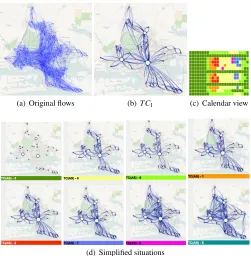
A detailed view (see Fig. 8(a)) shows that the mobility topology in Abidjan corresponds to the topology and geography of the city, where several districts are separated by waters and an intrusion of a national park (Parc National du Banco). Like the city itself, the mobility graph has a shape of a butterfly, whose body and four wings correspond to the central part of the city and four peripheral parts to the north, south, east, and west of the center.
(a) Original flows (b)TC1 (c) Calendar view
[image:9.612.307.559.325.444.2](d) Simplified situations
Fig. 8. Mobility in Abidjan area. (a) original flows, (b) temporal cluster
TC1, (c) calendar view on temporal clusters, and (d) overview of
situa-tions.
We perform a spatio-temporal simplification with parameters:
dis-tance threshold = 2.0 km, connection threshold = 1.0 and filter of 20 people. The result was clustered by k-means withk=8. Figure 8(d) shows the results. They preserve the “butterfly shape”, while present-ing it in a more schematized way (see Fig. 8(b)). Three large nodes are prominent, one close to the center and the others to the north and west of it. These large nodes are connected by flows with surrounding regions. This allows us to conclude that, unlike London, Abidjan has a polycentric structure, with three major areas of activity. The northern and eastern nodes are strongly linked to the central one. The southern “wing” of the “butterfly” is formed by the shoreline part of the city. The flows within this part are aligned along the shoreline, i.e., corre-spond to the underlying geography, and there are also strong links to the central part. Similar alignments, but along the major roads, can be seen on the north and on the east of the territory.
Temporal variation During the two weeks, there were 3 days (2, 7, and 11), for which data are missing. The time clustering has put the intervals from these days together with the night time intervals, when the flows were low, into time clusterTC3—dark green, see Fig. 8(c). The three days with missing data are clearly seen as fully green rows in the calendar view. For the remaining days, a repeating (with small variations) daily pattern can be seen. The first day, April 9, 2012, Monday, differs from the other week days. We looked for possible reasons and found that it was the Easter Monday—a public holiday in Ivory Coast. Its temporal pattern is similar to that of the last day— Sunday (and data is missing for the Sunday of the first week). The time patterns of the Saturdays also differ from those of the week days.
Fig. 9. Comparison of temporal clusters in Abidjan area. Left: Morning hours (TC1vs.TC2). Right: MorningTC1vs. eveningTC7.
The temporal clusters show a few outliers (see Fig. 8(c) and 8(d)). ClusterTC6(steel blue), which occurred only in hour 19 on day 4, has much higher flows on the whole territory, except for the southern part, than in clusterTC7, which occurred in the same hours on the other days. ClusterTC5(magenta), also with high flows, occurred twice in hour 17 (days 3 and 4) and once in hour 13 (day 6, which was Satur-day). Compared toTC6, the flows to the central region were higher and the flows from the central regions lower. Besides, there is an in-trusion of time clusterTC1, which is specific to mornings, in hour 14 of day 5 (Friday). Unfortunately, we have no background knowledge about the life in Abidjan for trying to explain these temporal outliers.
In the week days, people begin to move in hour 7 (TC8; light green), and the movement grows in the next hour or two (TC1; orange). This is obvious from the overview display (see Fig. 8(d)). However, the fur-ther changes throughout a working day require pairwise comparison (see Fig. 9).
[image:9.612.46.297.426.682.2]light green), the mobility decreases and gets especially low in the night (TC3; dark green). Hence, the observed variation of mobility over a working day corresponds to what can be expected based on the general knowledge of the human daily behavior.
The comparison of the morning time cluster (TC1; orange) with the evening time cluster (TC7; violet) in Fig. 9 shows the prevalence of incoming flows to the central region in the morning and the prevalence of outgoing flows from the central region in the evening. However, for the other two centers (on the north and west), there are no direction-related differences but only quantitative ones: more movements and within-region activities in the evening than in the morning. Based on this observation, we see that the central region is where the jobs and business activities are mostly located, while the other two centers play a different role, possibly, shopping and/or leisure.
6 DISCUSSION
Our approach uses a combination of spatial and temporal data sim-plification. In general, there are three variants: spatial simplification preceding temporal simplification and vice versa as well as simulta-neous spatio-temporal simplification. The last method is challenging both from the algorithmic and visualization perspective. It is not clear how to visualize spatial situations with individual spatial aggregates appearing in varying time intervals. Therefore, we focus on the two combined variants in this paper. Both variants rely on a suitable de-scription of spatial situations by feature vectors for calculating simi-larity in temporal clustering. A natural choice is to use a vector of flow magnitudes. For large data sets, this vector is very high dimensional (about 22,000 dimensions for our data set) and thus leads to unreliable and unstable results. Therefore, we use an initial spatial simplification for data reduction.
We analyzed also alternative methods for data reduction. For ex-ample, the use of feature vectors associated with the places such as number of people present in an area. This would lead to 606 dimen-sions in the London case and 386 dimendimen-sions in the Abidjan case.. However, these features do not represent the movements. Thus, they are not suitable for grouping the time steps according to the similarity of the flow patterns. As the flows form spatio-temporal graphs, we hoped to use graph-based features for clustering [49], in particular, the degree, centrality, and clustering measures of the nodes. None of the graph centralities of nodes reflect movement direction. Respectively, they cannot differentiate the flows in the morning and evening hours of the week days. Moreover, the use of edge-related measures does not decrease the dimensionality of the data in comparison to using the original flow magnitudes.
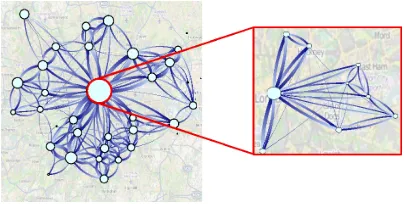
The presented spatial and temporal simplification of flow data em-ploys an extended version of the DBScan algorithm (spatial) combined with k-means (temporal). Our version includes both spatial similarity and flow magnitudes of places as well as includes special features for dealing with time-dependent flows. This leads to consistent clusters across time. As our clustering extends DBScan, it is quite fast (about 1sfor London data set with 168 time steps, each with up to 606 places and 21,727 links between places and less then 2 min compared to 15 min for the migration data set used in [27]). Our variant has similar limitations to the original DBScan algorithm, e.g., it cannot find clus-ters of varying densities and results in “flat clusclus-ters” (i.e., no hierarchy is produced). We mitigate the “flat” cluster structure by interactive semantic zoom into clusters of interest (see Figure 10) and interac-tive setting of clustering parameters for analyzing the data on various scales. The algorithm relies on a set of parameters, which cannot be optimized automatically. We support finding suitable parameters by algorithmic analysis of the resulting clusters by a set of cluster qual-ity criteria (e.g, total flows inside clusters or average distance within clusters).
[image:10.612.341.543.49.151.2]Our approach employs temporal simplification for handling data sets with hundreds of time steps. For larger data sets—e.g., very long time periods, data with multiple time cycles, or places spread around the globe—additional extensions to our approach would be needed.
Fig. 10. Interactive change of level of detail for spatial aggregates. An aggregate (red circle) can be semantically zoomed into.
7 CONCLUSION ANDFUTUREWORK
In this paper, we presented an approach for the visual exploration of time-varying flow data, especially dynamic mass movements. Our ap-proach combines spatial and temporal clustering for dealing with a large number of time steps and a high number of flows between places. Spatial clustering offers consistent clusters across time-steps, which enables the analysis of temporal variations in the data. An important difference to the previous approaches [27, 25] is that the spatial clus-tering takes time-variation into consideration and thus constructs con-sistent regions. Our approach supports interactive parameter setting, so that we can observe different whilst consistent spatial patterns and thus gain a more comprehensive understanding of the spatial structure of the mobility. Moreover, our approach enables a general overview of spatial situations across time steps for interrelated flows at all stages of the interactive data exploration, while previous approaches [45] focus on details or on user-selected data parts.
We have tested our approach on dynamic mass movements of res-idents in the Greater London city area and in Abidjan area. We spe-cially focused on routine behavior. Interestingly, there are obvious similarities between the spatial and temporal mobility patterns in Lon-don and Abidjan: adherence to the daily and weekly cycles, centre-directed movements in the morning and outward-centre-directed movements in the evenings, and correspondence of the flow topology to the geog-raphy of the underlying territory, particularly, to the transportation net-works and natural barriers. It is also notable that these similar patterns have been revealed despite the different kinds of data used: georefer-enced tweets for London and mobile phone use records for Abidjan. For finding anomalies in the data, or for other types of data sets, spe-cial preprocessing (such as data cleaning) and spespe-cial visualizations (highlighting anomalies) would be of advantage.
ACKNOWLEDGEMENTS
The authors are thankful to M. Laux for his support with respect to the software development. This research has been partially supported by the EU-funded projects GRACeFUL and SoBigData.
REFERENCES
[1] J. Abello, S. Hadlak, H. Schumann, and H.-J. Schulz. A modular degree-of-interest specification for the visual analysis of large dynamic networks.
IEEE Trans. on Visualization and Computer Graphics, 20(3):337–350, Mar. 2014.
[2] W. Aigner, S. Miksch, H. Schumann, and C. Tominski.Visualization of time-oriented data. Springer, 2011.
[3] G. Andrienko, N. Andrienko, P. Bak, D. Keim, S. Kisilevich, and S. Wro-bel. A conceptual framework and taxonomy of techniques for analyzing movement.J. of Visual Languages & Computing, 22(3):213–232, 2011. [4] G. Andrienko, N. Andrienko, P. Bak, D. Keim, and S. Wrobel. Visual
analytics of movement. Springer Science & Business Media, 2013. [5] N. Andrienko, G. Andrienko, H. Stange, T. Liebig, and D. Hecker.
Vi-sual analytics for understanding spatial situations from episodic move-ment data.KI-K¨unstliche Intelligenz, 26(3):241–251, 2012.
net-works. InMultivariate Network Visualization, volume 8380 ofLNCS, pages 151–174. Springer, 2014.
[7] D. Archambault, H. C. Purchase, and B. Pinaud. Animation, small multi-ples, and the effect of mental map preservation in dynamic graphs.IEEE Trans. on Visualization and Computer Graphics, 17(4):539–552, 2011. [8] B. Bach, P. Dragicevic, D. Archambault, C. Hurter, and S. Carpendale. A
review of temporal data visualizations based on space-time cube opera-tions. InEurographics Conference on Visualization, 2014.
[9] B. Bach, E. Pietriga, and J.-D. Fekete. GraphDiaries: Animated tran-sitions and temporal navigation for dynamic networks. IEEE Trans. on Visualization and Computer Graphics, 20(5):740–754, 2014.
[10] F. Beck, M. Burch, S. Diehl, and D. Weiskopf. The state of the art in vi-sualizing dynamic graphs. InEurographics Conference on Visualization – State of The Art Reports, 2014.
[11] R. Beecham and J. Wood. Characterising group-cycling journeys using interactive graphics. Transportation Research Part C: Emerging Tech-nologies, 47:194–206, 2014.
[12] K. Beyer, J. Goldstein, R. Ramakrishnan, and U. Shaft. When is nearest neighbor meaningful? InDatabase Theory, volume 1540 ofLNCS, pages 217–235. Springer, 1999.
[13] I. Boyandin. Visualization of Temporal Origin-Destination data. PhD thesis, University of Fribourg, Switzerland, 2013.
[14] I. Boyandin, E. Bertini, P. Bak, and D. Lalanne. Flowstrates: An ap-proach for visual exploration of temporal origin-destination data. Com-puter Graphics Forum, 30(3):971–980, 2011.
[15] S. Bremm, G. Andrienko, N. Andrienko, T. Schreck, and T. v. Landes-berger. Interactive analysis of object group changes over time. InInt. Workshop on Visual Analytics, pages 41–44, 2011.
[16] K. Buchin, B. Speckmann, and K. Verbeek. Flow map layout via spiral trees. IEEE Trans. on Visualization and Computer Graphics, 17(12):2536–2544, Dec 2011.
[17] M. Burch, B. Schmidt, and D. Weiskopf. A matrix-based visualization for exploring dynamic compound digraphs. InInformation Visualisation, pages 66–73, July 2013.
[18] M. Burch, C. Vehlow, F. Beck, S. Diehl, and D. Weiskopf. Parallel edge splatting for scalable dynamic graph visualization.IEEE Trans. on Visu-alization and Computer Graphics, 17(12):2344–2353, Dec. 2011. [19] T. Cox and M. Cox. Multidimensional Scaling, volume 1. CRC Press,
2001.
[20] S. Diehl, C. G¨org, and A. Kerren. Preserving the mental map using fore-sighted layout. InJoint Eurographics – IEEE TCVG Symposium on Visu-alization, pages 175–184. Springer, 2001.
[21] T. Dwyer and P. Eades. Visualising a fund manager flow graph with columns and worms. InInt. Conference on Information Visualisation, pages 147–152, 2002.
[22] O. Ersoy, C. Hurter, F. Paulovich, G. Cantareiro, and A. Telea. Skeleton-based edge bundling for graph visualization. IEEE Trans. on Visualiza-tion and Computer Graphics, 17(12):2364–2373, Dec 2011.
[23] M. Ester, H.-P. Kriegel, J. Sander, and X. Xu. A density-based algorithm for discovering clusters in large spatial databases with noise. In Inter-national Conference on Knowledge Discovery and Data Mining, pages 226–231, 1996.
[24] Y. Frishman and A. Tal. Dynamic drawing of clustered graphs. InIEEE Symposium on Information Visualization, pages 191–198. IEEE, 2004. [25] S. Gao, Y. Liu, Y. Wang, and X. Ma. Discovering spatial interaction
communities from mobile phone data.T. in GIS, 17(3):463–481, 2013. [26] D. Guo. Regionalization with dynamically constrained agglomerative
clustering and partitioning (redcap). International J. of Geographical Information Science, 22(7):801–823, 2008.
[27] D. Guo. Flow mapping and multivariate visualization of large spatial interaction data. IEEE Trans. on Visualization and Computer Graphics, 15(6):1041–1048, 2009.
[28] D. Guo and X. Zhu. Origin-destination flow data smoothing and mapping.
IEEE Trans. on Visualization and Computer Graphics, 20(12):2043– 2052, Dec 2014.
[29] S. Hadlak, H. Schumann, and H.-J. Schulz. A survey of multi-faceted graph visualization. InEurographics Conference on Visualization – State of The Art Reports, 2015.
[30] J. Han, M. Kamber, and J. Pei.Data Mining: Concepts and Techniques. Morgan Kaufmann, 2nd edition, 2006.
[31] M. Harrower. The cognitive limits of animated maps. Cartographica, 42(4):349–357, 2007.
[32] D. Holten, P. Isenberg, J. van Wijk, and J. Fekete. An extended evaluation
of the readability of tapered, animated, and textured directed-edge repre-sentations in node-link graphs. InIEEE Pacific Visualization Symposium, pages 195–202, March 2011.
[33] D. Holten and J. J. Van Wijk. Force-directed edge bundling for graph visualization.Computer Graphics Forum, 28(3):983–990, 2009. [34] C. Hurter, O. Ersoy, S. Fabrikant, T. Klein, and A. Telea. Bundled
visu-alization of dynamic graph and trail data. IEEE Trans. on Visualization and Computer Graphics, 20(8):1141–1157, Aug 2014.
[35] S. Kisilevich, F. Mansmann, M. Nanni, and S. Rinzivillo. Spatio-temporal clustering. Springer, 2009.
[36] M.-J. Kraak and F. Ormeling. Cartography: Visualization of Spatial Data. Guilford Press, 2011.
[37] H.-P. Kriegel, P. Kr¨oger, and A. Zimek. Clustering high-dimensional data: A survey on subspace clustering, pattern-based clustering, and cor-relation clustering. ACM Trans. on Knowledge Discovery from Data, 3(1):1–58, 2009.
[38] S. Openshaw.The Modifiable Area Unit Problem. Geo Books, 1984. [39] A. Rae. From spatial interaction data to spatial interaction information?
geovisualisation and spatial structures of migration from the 2001 UK census.Comp., Environment and Urban Sys., 33(3):161–178, 2009. [40] F. Reitz. A framework for an ego-centered and time-aware visualization
of relations in arbitrary data repositories.CoRR, abs/1009.5183, 2010. [41] G. Robertson, R. Fernandez, D. Fisher, B. Lee, and J. Stasko.
Effective-ness of animation in trend visualization. IEEE Trans. on Visualization and Computer Graphics, 14(6):1325–1332, Nov 2008.
[42] S. E. Schaeffer. Graph clustering.Computer Science Review, 1(1):27–64, 2007.
[43] W. R. Tobler. Experiments in migration mapping by computer.The Amer-ican Cartographer, 14(2):155–163, 1987.
[44] B. Tversky, J. B. Morrison, and M. Betrancourt. Animation: Can it facil-itate?Int. J. of Human-Computer Studies, 57(4):247–262, 2002. [45] S. van den Elzen and J. van Wijk. Multivariate network exploration and
presentation: From detail to overview via selections and aggregations.
IEEE Trans. on Visualization and Computer Graphics, 20(12):2310– 2319, Dec 2014.
[46] J. J. Van Wijk and E. R. Van Selow. Cluster and calendar based visualiza-tion of time series data. InIEEE Symposium on Information Visualization, pages 4–9. IEEE, 1999.
[47] C. Vehlow, F. Beck, and D. Weiskopf. The state of the art in visualizing group structures in graphs. InEurographics Conference on Visualization – State of The Art Reports, 2015.
[48] T. von Landesberger, S. Bremm, N. Andrienko, G. Andrienko, and M. Tekusova. Visual analytics methods for categoric spatio-temporal data. InIEEE Conference on Visual Analytics Science and Technology, pages 183–192. IEEE, 2012.
[49] T. von Landesberger, M. G¨orner, and T. Schreck. Visual analysis of graphs with multiple connected components. InIEEE Symposium on Vi-sual Analytics Science and Technology, pages 155–162, 2009.
[50] T. Von Landesberger, A. Kuijper, T. Schreck, J. Kohlhammer, J. J. van Wijk, J.-D. Fekete, and D. W. Fellner. Visual analysis of large graphs: State-of-the-art and future research challenges. Computer graphics fo-rum, 30(6):1719–1749, 2011.
[51] A. Wolff. Graph drawing and cartography, page 697736. CRC Press, 2013.
[52] J. Wood, J. Dykes, and A. Slingsby. Visualisation of origins, destinations and flows with OD maps.The Cartographic J., 47(2):117–129, 2010. [53] J. Wood, A. Slingsby, and J. Dykes. Visualizing the dynamics of
Lon-don’s bicycle-hire scheme. Cartographica: The Int. J. for Geographic Information and Geovisualization, 46(4):239–251, 2011.
[54] L. Xiao, R. Yeh, and P. Hanrahan. Flow map layout. InIEEE Symposium on Information Visualization, pages 219–224, Oct 2005.
[55] J. S. Yi, N. Elmqvist, and S. Lee. TimeMatrix: Analyzing temporal social networks using interactive matrix-based visualizations.Int. J. of Human– Computer Interaction, 26(11-12):1031–1051, 2010.