Copyright0 1974 AmericanSocietyforMicrobiology Printed inU.S.A.
Physiological Study of Cooperative Infection by Restricted
Bacteriophage
Ti
THOMAS V. POTTS' ANDJ. R. CHRISTENSEN
Department ofMicrobiology, University of Rochester School of Medicine and Dentistry, Rochester, New York 14642
The
ability
ofcertain phages tosuccessfully infect a restricting host at a highmultiplicity
of infection is known as cooperative infection or cooperation. Wehave
examined the ability of unmodifiedTi
(Ti
* 0)toparticipate in cooperativeinfection in cells possessing the
P1
restriction system. We have found thatcooperation is dependent upon protein synthesis during the first few minutes
afterphage infection. However, we have been unable to attribute the necessary
protein to a known
Ti
cistron. Degradation of the restrictedTi
genome isapproximately
equally extensivewhether cooperative infection occurs or whetherit is blocked by
chloramphenicol.
It is postulated that an inducible host repairmechanism may
be responsible
forthephenomenon
ofcooperative infection.Ithas
previously
been shown that the abilityof certain
bacteriophages
tosuccessfully
infectrestricting
hosts isstrongly dependent
onthe
multiplicity
of infection(MOI).
As the MOIincreases, the proportion of infected restricting
cells increases atanevengreaterrate. This has
been
showntobe true ofunmodifed X.C
(bacte-riophage X grown in
Escherichia
coliC)
infect-ingE: coli K(13), for
phage
e".A(e15
grown inSalmonella anatum) infecting
therestricting
strain
Salmonella butantan (17),
forcoliphage
T*2
infecting
E.coli
B (8),and
forcoliphage
Ti .0
(Ti lacking
P1modification) infecting
P1lysogens
(6).Thisphenomenon
hasbeen
termed"cooperative
infection"by Paigen
and Weinfeld(13). It is
unlikely
thataspecialsubpopulation
ofviruses is
responsible
for cooperativeinfec-tion,
sinceanincrease inMOI results
ina morethan
proportional
increase in the fraction ofsuccessfully
infected cells.VVhether
or not infectionby
A orTi
athigh
MOI
willbe successful inestablishing
areplica-tive
cycle
inarestricting
hostisdependent
upon thephysiological
conditionsunder
which theinfection is carried out. In the case of
X.C
infecting E.
coli
K,
cooperative infection isseverely
inhibitedby
anaerobicconditions,
whereas a lack of nutrients in the attachment
medium hasbeen shown todestroy cooperative
infection of
P1
lysogensby
Ti
0.
However,these conditions donot influence the
ability
ofmodified
X orTi
toinfectthesamecells(6,
20).
Weinfeld and
Paigen (20)
found thecoopera-tive infection ofE. coliK with
A.C
sensitive toanaerobiosisfor
only
3minafterattachmentof'Presentaddress: DepartmentofBasic DentalSciences,
CollegeofDentistry, UniversityofFlorida,Gainesville, Fla.
the phages. In addition, they discovered that
dividing the infecting A.C population intotwo
inputs gaveaslightly enhanced level of
coopera-tive infection. Separation of thetwoportionsof
infecting A.C by several minutesshowed that if
aeration was stopped during either period of
infection, then the number of successfully
in-fected cellswasgreatly reduced.
These results imply that the conditions
pre-vailingintherestricting host during the earliest
stages of the infectious process are critical in
determining the fate of the infecting DNA. In
thehope ofobtaining an indication of the basis
for these effects, we have studied some of the
requirements forobtaining a high proportion of
successful infections when unmodified Ti-0
infects the restricting host B(Pl) at high MOI.
MATERIALS AND METHODS
Terminology.To identify modifiedTi which has
beengrown in aP1 lysogen,thedesignationT -P is used. Ti grown inastrainwhichis notP1 lysogenic (i.e., unmodifiedT1) istermedTi'0.
Abacteriumtowhichone ormoreTi has irreversi-blyattached isreferredto as aninfected cell.Bacteria
which produce any Ti after infection are termed
successfullyinfected cellsoryielders,and the ratio of
yielders to infected cells is termed the yield ratio. Cells which produce atleast onemodified Ti Pare
termedmodifiers,and the ratioofmodiferstoinfected cells istermed the modification ratio.
Phage strains, bacterial strains, and growth
media. Most of thesehave beenpreviouslydescribed
(3, 4, 5). StrainAB1157,which hasanamber suppres-sor, was from Cynthia Lark, and AB1157(Pl) was derivedfrom it inthislaboratory.Itwasused forthe propagationofTlam-P stocks.T1+*0waspropagated
onB andT1+iPonB(Pl). Propagationand
concen-tration ofthe stocks were asin Figurskiand
Chris-1319
on November 10, 2019 by guest
http://jvi.asm.org/
tensen (5),aswerethepreparation and concentration
of Ti heads and tails.
Preparationofcellsfor attachment.Log phase E.
coli B(P1) cellsgrown inDifco brandnutrient broth (NB) + NaCl media were twicecentrifuged, resus-pended in NB, and then titeredonLBagar(5) plates. Portions of the suspension were pipetted into tubes
inanicebath and aeratedfor 3min before the proce-dures indicated in each figure ortable were carried out.
Measurement of MOI andthe modificationor yield ratios. Subsequent to the performance ofthe
procedures indicated in each table or figure, the infected cell suspension was diluted with an equal
volume of NB + NaCl at 0 C and immediately centrifuged for5 min at 4,000 x g. The number of unattachedphagewasthen titeredonLBagarplates, using theamber permissive strain KB3as aplating
culture. This determinationallowscalculation of the MOI and the number of infected cells, assuming a Poisson distribution of phage oncells. Todetermine
the modification and yield ratios, the pellet of in' fected cells was then resuspended, serially diluted,
and titered on LB agar plates using KB3 or
AB1157(P1) asaplating culture. Each plaque formed on strain AB1157(P1) resulted from amodifier cell,
whereas each plaque formedonKB3resulted froma
yieldercell. AB1157(P1)wasused forplating modifiers
instead of KB3(P1)because its restrictionpropertyis
morestable.
Titration of Ti tails. Ti tails were titered by
mixing with a large (20- to 100-fold) excess of Ti
headsat aconcentration of 5.0 x 10⁹ headsperml. After mixing tails with heads, 30 minat 27 C were allowed forassembly into wholeparticles. The assem-bledparticlesweretiteredonKB3, and theresulting
titerwascompared with the plaque-forming ability of
the headortailpreparations alone. From unpublished
studies of the kinetics of the assembly process, we
haveconcluded thatatleast90%of the tailswere
de-tectedby this procedure.
Preparation of Ti ghosts. Ghostswere prepared
by a method similar tothat ofKaiser (10). Ti was
heated for20 min at70C. At the conclusion of this treatment, 99% ofthephage were inactivated. This
preparation was negatively stained and examined
under the electron microscope. Theelectron micro-graphs (not presented) revealed thatalmostall
heat-treated phage heads were filled with the negative
stainandhadapparently ejectedtheirDNA. Preparation of radioactive phage. Radioactive Ti 0wasprepared by infecting log phase E. coli KB3
inthepresenceof1.2mM of adenosinepermland16
ACiof[methyl-3H
]thymidine
perml. Two hourswerethenallowedforlysis, the lysatewasmade0.005Min
MgCl,, and 50 gg of deoxyribonuclease I per ml (Worthington) were then added. This reaction
mix-turewas incubatedfor30minat37C, during which time 40 to 60% of the cold trichloroacetic acid precipitable counts were made acid soluble. The
lysatewasthencentrifugedtwicefor90minat105,000
x g,the supernate wasdiscarded, and thepelletwas
resuspended each time in NB. The amountof acid precipitable non-phage radioactivity that would not attach to E. coli Bwas then determined (never >
18%). This figure was thensubtracted from the total
radioactivity in the preparation, and the remaining radioactivity wasconsidered to be in phage.
DNAsolubilization. The solubilization of Ti DNA in the restricting host was followed by removing 0.5-ml portions of the infected cells at various times and placing them in a testtubecontaining an equal volume of 10% trichloroacetic acid at 0 C. This mixture was allowed to sit on ice for 30 min, and the precipitate wascollected on a glass fiber filter (What-man GF/C).The test tubewhich had contained the sample was then washed three timeswith 10 ml of 5% trichloroacetic acid at 0 C, and the washes were poured over the filter. The filter was then dried, added to 10 ml of liquid scintillation counting solution inlow Kglass vials, and counted in a liquid scintilla-tion counter. Thecounting solution was 4 g of New England Nuclear Omnifluor (98%
1,5-diphenylox-azole,2%p-bis [o-methylstyryl]benzene)in 1.0liter of
Eastman Kodak scintillation grade toluene. The counting efficiency wasalwaysbetween 48 and 50%.
RESULTS
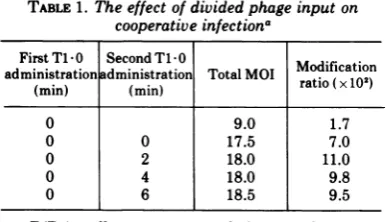
The effect of divided input. We found that
administering the same Ti -0 phage input in
two separate portions did not decrease the
efficiencyof cooperation (Table 1); if anything,
there was a slight increase. This is the same
result reported by Weinfeld and Paigen (20) for the infection of E. coli K by X.C. This double input type ofprotocol was used in several of the
experimentsbelow.
The effect of attachment of phage tails or
phage ghosts. Oneway oflookingatthe above
result is to assume that the first portion of
infecting phage initiated a change in the cell
such that the second portion of phage had a
better chance of establishingasuccessful
[image:2.499.264.458.474.585.2]infec-tion.Sincethere is someindication(14)thatthe restrictionenzymes arelocated near the surface
TABLE 1.The effect of divided phage input on cooperative infectiona
FirstTl-0 SecondT1-0
administration administration Total MOI
ratio
(x10o)
(min) (min)rai(x1)
0 9.0 1.7
0 0 17.5 7.0
0 2 18.0 11.0
0 4 18.0 9.8
0 6 18.5 9.5
a
B(P1)
cells were prepared for attachment asdescribed. They were then placed in tubes and transferred underconstant aeration to a 37 C water bathat T= -3 min.Three minutes later (T=0min), the cells wereinfected with the first portion ofTi+-0.
The second portion containing the same number of phages was added at the time indicated. The MOI andmodification ratio were then determined as de-scribed.
1320
on November 10, 2019 by guest
http://jvi.asm.org/
of the cell,asurface alteration brought about by
the attachment of the first portion of phage could conceivably alter the ability of surface
enzymes to acton subsequently invading DNA
molecules.
Table 2 shows the results when Ti tailsorTi
ghosts replace the first portion in a divided
input experiment. It is clear that these particles hadnoeffect whatsoever. Theinfectiouscenters
obtainedwere equaltothoseobtained from the second input alone. If a surface change is
important in the establishment of successful cooperative infection, neither Ti tails nor Ti
ghosts effect that change.
The effect of the inhibition of protein
syn-thesis. To test whether infection ofrestricting cellsby Ti *0 might result in the synthesis ofa
protein which could alter the outcome ofthe infection, the following experiments were
un-dertaken. Chloramphenicol (50 ug/ml) was
added prior to Ti *0infection in a cooperative
experiment and had the following effect:
coop-erative infection was eliminated. The small
fraction of infected cells yielding phage was
approximately equal tothat obtained in single-phage infections (data not shown). Apparently only the "exceptional cells", which are unable
to restrict (11, 13), were successfully infected.
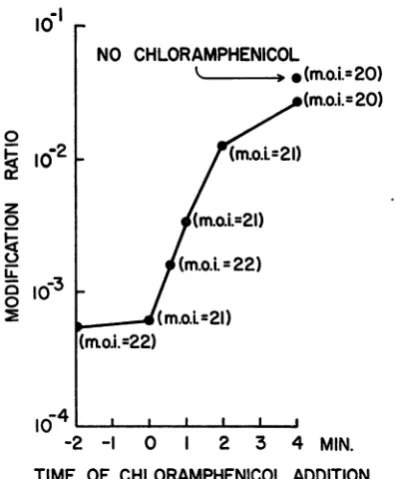
The results presented in Fig. 1 show that the period during which the infectionwas
suscepti-ble to inhibition lastedonly about4 min; after
this time mostof thesuccessfully infected cells
had become insensitivetochloramphenicol. We
also showed thatchloramphenicol hadnoeffect on the infection of B(P1) by Ti1 P, and that
chloramphenicol greatly reduced yield ratio as
well as modification ratio when Ti-0 infected B(Pl) at high MOI (data not presented). This
last observation rules out the possibility that chloramphenicol was blocking modification of
the progeny without blocking successful
infec-tion ofthe cells.
We then tumedto the divided input type of
I0
z
0
0
42
_2 -I
NO CHLORAMPHENICOL
(rn(.oi.=
20):21)
0 1 2 3 4 MIN.
TIME OF CHLORAMPHENICOL ADDITION FIG. 1. The effect of the addition of chlorma-phenicol at different times on cooperative infection.
B(PI) cells were prepared for attachment as
de-scribed. The cellswerethen transferredtoa37C bath
atT= -3min. Tl+*0wasaddedtoall tubesatT=0.
Chloramphenicolwasaddedtoeachtubeatthe time
indicated on the abscissa. Chloramphenicol was
washedoutbetween T= 10min and T=30min. The
[image:3.499.251.449.136.376.2]modification ratiowasdeterminedasdescribed.
TABLE 2. The effect of Tl tails andTi ghosts oncooperative infection of E. coli B(P1)a
Addition time Multiplicityof Modification
Exptno. Tube MOI tails attachedor ratio(x102)
0 min 4min ofghostsadded
1 1 T1-0 Tl0 19.0 17
2 NB Ti*0 11.5 6.0
3 Titails T1i0 10.0 10.5 6.5
4 T1-0 Titails 11.5 5.5 6.0
5 Titails NB 11.5 <0.003
2 1 T1*0 T1-0 15.5 4.7
2 TiGhosts Tl-0 8.2 8.4 0.22
3 NB Ti-0 7.8 0.30
a
B(P1)
cellswere preparedasdescribed. Theywereinfectedatthetimes indicated withphage, ghosts,or tails.At 8min, the tubeswereallchilledinanicebath and diluted withanequalvolumeofchilledNB +NaCl.Inthecase oftails, the MOIwasdeterminedbycorrectingfortails thatremainedfree inthe supranatant fluid after infection; in the case of ghosts, no assay for efficiency ofattachment was made. Tail assay and
modificationratios weredeterminedasdescribed.
1321
on November 10, 2019 by guest
http://jvi.asm.org/
experiment to see whether protein synthesized
during infection by the first portion of phage would be sufficient for the second phage input
to make its contribution to overcoming the restriction system. As can be seen from the
results in Table 3, this was not the case: the
presence ofchloramphenicol during the second
phage input prevented that infection from in-creasing the number of successfully infected cells. We did not attempt to test the effect of chloramphenicol during the first infection only, since it is not certain how rapidly any residual
effect of chloramphenicol treatment might be reversed by washout. However, it is difficultto
see how protein synthesized during the second
infectionwould be abletohelp the phage added first, since the reverse is nottrue. Weconclude that protein synthesis during each of the two
infections isnecessarytoincrease the number of
cooperatively infected cells.
The effect of amber mutations. A series of
Tlam mutants were isolated and mapped by
Michalke (12). Work in this laboratory (5) has established the phenotype of these amber mu-tants, which have been placed in 18 genes.
Mutants in gene 1 and gene 2 synthesize no
phage DNA and are presumably blocked in someearlystepin the Ti infectiouscycle. These werethoughttobe the bestcandidates forarole
in controlling the protein required for
coopera-tive infection, but mutants in all of the other known genes werealsotested.
Testing of the mutants for their ability to
synthesize the protein required for cooperation
was accomplished by means ofadivided input
experiment. The suppressorless strain B(P1)
was first infected with an amber mutant
(TlamX 0) and subsequently with wild-type phage (T1 .0). It was reasoned that if a
phage-coded protein were required for
success-ful cooperative infection, then Ti with an
amber mutation in a gene required for the
expression of that protein shouldbe unable to
participate in establishing cooperative infection in the suppressorless strain. As a result of the
mutant's inability to cooperate, the level of successful infection would be that correspond-ingtothe input of T1+ only. On the other hand, if TlamX could synthesize the necessary
pro-tein, then the level of successful infection would reflect the entire MOI. Asseen in theexamples inTable4, the Tlam mutants ingenes 1and2 wereabletoparticipate in establishing
success-ful infections. Similar results were found with am mutants representing all ofthe known Ti genes (data not shown). It can also be seen in
Table4 that the order of addition of Tlam and T1+ didnot influence the results.
Itcanbeseenfrom Table4,however, thatthe
plaque morphology mutant TlGe, which was
previously noted (6) to be associated with
er-ratic results in cooperative infection, was
una-ble to enhance the level of successful infection in these experiments, regardless of whether it
was added first or second. This mutant maps
closetoam 2andam46(12), which places it in
the tailregion of the Ti map (5). It makes an
alkaline plaque on pH indicator media. The
functional alteration in this mutant is
un-known.
The degradation of the DNA from
re-stricted TI. In other phage-host systems, a
majority of the DNA from restricted phage is degradedtoacid-solublefragments by the host (1, 8, 17). The laterstages of this degradation depends in part on recBC nuclease acting on
DNA which is sensitized by the restriction endonuclease (15). It has been shown that phages T4 andX code forproteins that interfere
[image:4.499.61.457.507.595.2]with the action of the recBC nuclease (16, 18).
TABLE 3. Theeffect ofchloramphenicol on cooperative infectiona
Addition time
Modifica-Tubeno. MOI tion ratio
-2min 0min +2min +4min +7min (x102)
1 T1*0 NB NB 9.1 1.1
2 Ti1o T10 NB 16.4 4.3
3 T1-0 T10 Chloramphenicol 16.8 3.7
4 TlPO Chloramphenicol T10 17.3 1.1
5 Chloramphenicol T1o0 T1*0 16.4 0.11
aLog phase
B(P1)
cellswere prepared for attachment as described, and 3.4 ml of cells were placed in eachtube.
The tubes were then transferred under constant aeration to a 37 C water bath at -3 min. Then, 0.20-mi portions ofTi-0,chloramphenicol,or NB were added at the times indicated in the table. Each 0.20-ml portion
ofTi 0contained 10phage per cell, and each portion of chloramphenicol consisted of a total of 200
gg
ofchloramphenicol, resultinginafinal concentration of 50ug/ml.At 8min, all tubes were transferred to an ice
bath and diluted with an equal volume of chilled NB + NaCl. The MOI and modification ratios were
determinedas described.
1322
on November 10, 2019 by guest
http://jvi.asm.org/
TABLE 4. Tests on Tl mutants for theirability to participate in cooperative infectiona
Phageaddedat Total Modification
Exptno. Tubeno. orai(x12
0 min 4mi MOI ratio(x 102)
1 1 NB T1+*0 9.6 0.36
2 T1+*0 T1+*0 19.5 2.5
3 Tlam5- 0 (gene 2) T1+*0 18.0 3.0
4 Tlaml6.0 (gene 1) T1+ 0 17.5 2.5
5
Tlaml5
.0 (gene5)
T1 +0 20.0 3.92 1 NB T1+*0 7.5 0.42
2 T1+*0 T1+*0 15.0 3.7
3 Tlam16*0 T1+*0 15.0 3.6
4 T1+*0 Tlam16 0 15.0 2.6
5 TlGe-0 T1+*0 15.0 0.39
6 T1+*0 TlGe*0 14.7 0.80
aLogphase
B(P1)
cells were prepared as described, and 3.6 ml were dispersed to each tube. At -3 min, the tubes were moved to the 37 C waterbath,andthe procedures shown in the table were performed with constant aeration.All phagepreparations werediluted to the same concentration and added in 0.20-ml portions when indicated inthe table. At 8 min, all tubes were transferred to an ice bath and diluted with an equal volume of chilled NB +NaCl.TheMOIand modification ratiowere determined asdescribed.Wereasoned from theseobservations that
chlor-amphenicol might be blocking cooperative in-fection by preventing the synthesis of a Ti
protein thatwould inhibit degradationof DNA.
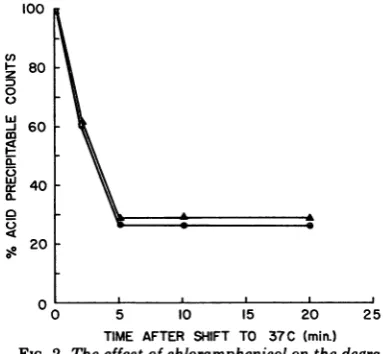
To test this hypothesis, the degradation of restricted DNA to acid solubility was followed
in the presence and absence of chlorampheni-col. As can be seen in Fig. 2, chloramphenicol
hadverylittle effectonTi.0degradation.This
result does notruleoutlarge differences inthe
molecularweight of the remaining DNA, which
was notdegradedtothe degree requiredfor acid
solubility. The small increase in degradation
seen in the presence of chloramphenicol (3 to
7%) isrepeatableand isprobably relatedtothe
observation that chloramphenicol slightly im-proves Ti attachment (see Table 3 and Fig. 1
which show that early chloramphenicol
addi-tion increases the numberofattached phageor
MOI).
DISCUSSION
The most
noteworthy
findingreported
here isthat
proteinsynthesis
is required immediatelyfollowing infection by restricted
Ti
forcoopera-tive infection to occur.
Furthermore,
in adi-vided input experiment, the protein synthesized
following the first infection does not create
conditionssothat thesecondinputof
phage
canovercomeP1restrictionwithout furtherprotein
synthesis. This result resembles the effects of
anaerobiosisin thecaseofX.Cinfecting E. coli
K (20).
This result contrasts sharply with the recent
report by Heipet al. (9), who have shown that
chloramphenicol
does not block theability
of100
C,) I- 80 z
0
o.,
60
w
W 40 O_
20
20
0 5 10 15 20 25
TIME AFTER SHIFT TO 37 C (min.)
FIG. 2. Theeffect ofchloramphenicolonthe degra-dationof Tl 0inB(Pl).B(PI)cellswerepreparedfor attachment andplacedintwoaeration tubesat0C. At T = -6min, either NBorchloramphenicolwere
addedtothetubes(final chloramphenicol
concentra-tionwas50ug/ml).At T = -5min,
[3H]thymidine-labeled Ti+* 0wasaddedtothe cells(noinfectionor
degradation of DNA occurs at0C).AtT = -1min,
the total numberofacidprecipitablecountspresent (17,000counts/min)wasdetermined(thisisthe 100%
figure on the graph). At T = 0, the tubes were
transferred to a 37C water bath and samples were
removed at the times indicated. Acid-precipitable radioactivity wasdeterminedasdescribed. Symbols: A, nochloramphenicol; 0,withchloramphenicol.
unmodified X to successfully infect restricting
E.coliK strains athigh MOI. The experiments
ofWeinfeld (19) had
already
indicatedthatX.Ccan, at high
MOI,
overcome strain K restric-1323on November 10, 2019 by guest
http://jvi.asm.org/
[image:5.499.260.452.300.477.2]tion, but not the restriction specified by P1.
Also, enhanced recombination accompanies
cooperativeinfection withTi (6), butnotwithX (20).
It thus appears that these two phenomena,
despite their superficial similarity, may be
mechanistically very different. We prefer to
continue to use theterm cooperative infection
to refer to any case in which several phage
particles interact to successfully infect a
re-stricting host. As more informa,ion is gained
about thenatureoftheprocess in any one case,
a morespecific term,relatedtothemechanism,
can be applied, such asthe term "abolition of
restriction" usedby Heip etal. (9).
Since
it appearsthat,
in the case ofTi
infecting B(P1), protein synthesis is requiredduring both phage inputs, it seems likely that
the induction ofthe relevant protein is
ineffi-cient. Acell infected withonlyafewphagemay
havealowprobabilityofsynthesizing enoughof
this proteinfortheestablishmentof asuccessful
infection.Additional phage, added under
condi-tionsthat permit proteinsynthesis, willconvert
anadditional proportion ofthe cells into
yield-ingcells.
The requirement forprotein synthesisargues
against a simple saturation model of
coopera-tive infection. The saturation model envisions
the cooperative infection of a restricting cellas
the resultofsaturating the restriction enzymes
withunmodified DNA, such that theseenzymes
cannot act on viral DNA which is injected
subsequently (2, 20).
The question remains whether the protein is
of viral, cellular, or P1 prophage origin. The
only
Ti
mutantwhichwasunableto participate in cooperative infection asjudged by the doubleinput experiment was TlGe whichmaps in the
tail region. Under the conditionsofthe double
input experiment (low salt), this mutant
at-taches, immediately shuts off E. coli B DNA
synthesis, and gives no phage DNA synthesis
andnocell lysis (D. Figurski, personal
commu-nication). The fact that TlGe .0 DNA is
de-graded upon infection of
B(P1)
under thesameconditions (data not presented) indicates that
its DNA is injected. Since infection by TlGe under these conditions is so physiologically
abnormal,thefailureofthemutant to stimulate
cooperative infection may not indicate that the
mutant is
specifically
deficient in the proteinrequired forcooperation.
The results ofFreshman et al. (6) indicated
that extensive recombination accompanies
cooperative infection in the case of
Ti.
Wehavemadea moreextensivestudyofthis
recombina-tion and found additional features that
distin-guish itfromthe recombinationseenin
ordinary
Ti
crosses (Potts andChristensen, manuscript
inpreparation).
M. Radman (In Molecular and
Environmen-tal Aspects of Mutagenesis, in press) has
recently described an inducible E. coli UV
re-pair system, and Ganesan and Smith (7) have
shown a requirement for protein
synthesis
inRec-dependent repairofUV and
X-ray
damage.
Some of the
X-ray
damage (nicks)
may besimilarto someofthe
damage
causedby
restric-tionenzymes.
We proposethehypothesis that the
phenom-ena of cooperative infection of
B(P1)
by
Ti.0canbest be
understood
intermsofaninducible,
recombination-dependent repair system which
can act on the fraction of
restriction-damage
DNA, which escapes degradation, and which
hasthepotential togenerateintact,replicating
genomes. Thisrepairsystem may have elements incommonwith other inducibleor
recombina-tion-dependent
repairsystems.ACKNOWLEDGMENTS
We wishto thank Jeroo Kotval and David Figurski for manyhelpful discussionsduring thecourseofthese experi-ments.
This research was supported by Public Health Service grantsAI02781 from the National Institute ofAllergyand InfectiousDiseases, and5T01DE00003, fromthe National InstituteofDental Research.
LITERATURE CITED
1. Arber, W., S. Hattman, and D. Dussoix. 1963. On the host-controlled modificationofbacteriophageA. Virol-ogy21:30-35.
2. Boyer, H. W. 1971. DNA restriction and modification mechanisms in bacteria. Ann. Rev. Microbiol. 25:153-176.
3. Christensen,J.R.,and J. Geiman. 1973.A neweffectof the rex geneofphage A: prematurelysisafterinfection byphageTi.Virology56:285-290.
4. Drexler, H., and J. R. Christensen.1961.Genetic crosses between restricted and unrestrictedphageTi in lyso-genic andnonlysogenichosts.Virology13:31-39. 5. Figurski, D. H., and J. R. Christensen. 1974. Functional
characterization of the genes of bacteriophage Ti. Virology 59:397-407.
6. Freshman, M., S. A. Wannag, and J. R. Christensen. 1968. Cooperativeinfection ofPl-lysogenic bacteria by restrictedphageTi.Virology 35:427-438.
7. Ganesan,A.K., andK.C.Smith. 1972. Requirement for proteinsynthesisinrec-dependent repairof deoxyribo-nucleic acidinEscherichiacoli afterultraviolet or X irradiation. J.Bacteriol. 111:575-585.
8. Hattman, S. 1964. The functioningof T* even phages with unglucosylated DNA in restricting Escherichia colihostcells.Virology 24:333-348.
9. Heip, J.,B.Rolfe, andJ. Schell.1974. Abolition of host cell restrictionby high multiplicity of phage infection. Virology 59:356-370.
10. Kaiser,A.D.1966.Ontheinternal structure of bacterio-phagelambda.J. Gen.Physiol. 49:(suppl.):171-177. 11. Luria, S. E. 1953. Host induced modification of viruses.
ColdSpringHarbor.Symp. Quant. Biol. 18:237-244. 12. Michalke, W. 1967. ErhoteRekombinationshaufigheitan
on November 10, 2019 by guest
http://jvi.asm.org/
den Enden des Ti-Chromosoms. Mol. Gen. Genet. 99:12-33.
13. Paigen,K., and H. Weinfeld. 1963. Cooperative infection byhost-modified lambda phage. Virology19:565-572. 14. Schell, J., and S. W. Glover.1966.On the localizationofa
factor responsible for host-controlled restriction in Escherichia coliK(P1).Genet. Res.7:277-279.
15. Simmon,V.F., and S. Lederberg. 1972. Degradation of bacteriophage lambda deoxyribonucleic acid after
re-striction by Escherichia coli K-12. J Bacteriol. 112:161-169.
16. Tanner,D., and M. Oishi. 1971. Theeffectof bacterio-phage T4 infection onan ATP-dependent
deoxyribo-nucleasein Escherichia coli. Biochim. Biophys. Acta 228:767-769.
17. Uetake, H., S. Toyama, and S. Hagiwara. 1964.Onthe mechanism of host-induced modification.Multiplicity activation and thermolabile factor responsible for phage growth restriction. Virology22:202-213. 18. Unger, R. C., andA. J. Clark. 1972. Interactionofthe
recombination pathways of bacteriophage A and its
host Escherichia coli K-12: effectson exonuclease V activity. J. Mol. Biol. 70:539-548.
19. Weinfeld, H. 1969.Asearchfor cooperative infectionof PI-lysogenic Escherichia coli by restricted lambda phage.Virology38:512-519.
20. Weinfeld, H., and K. Paigen. 1964.Evidence foranew
intermediate state of the viral chromosome during cooperative infectionbyhost-modified lambda phage. Virology24:71-83.
1325