City, University of London Institutional Repository
Citation
:
de Rooij, A. and Jones, S. (2015). (E)motion and creativity: Hacking the function
of motor expressions in emotion regulation to augment creativity. Paper presented at the
Ninth International Conference on Tangible, Embedded, and Embodied Interaction (TEI
2015), 15-01-2015 - 19-01-2015, California, USA.
This is the accepted version of the paper.
This version of the publication may differ from the final published
version.
Permanent repository link:
http://openaccess.city.ac.uk/7942/
Link to published version
:
http://dx.doi.org/10.1145/2677199.2680552
Copyright and reuse:
City Research Online aims to make research
outputs of City, University of London available to a wider audience.
Copyright and Moral Rights remain with the author(s) and/or copyright
holders. URLs from City Research Online may be freely distributed and
linked to.
City Research Online:
http://openaccess.city.ac.uk/
[email protected]
(E)Motion and Creativity: Hacking the Function of Motor
Expressions in Emotion Regulation to Augment Creativity
Alwin de Rooij
Centre for Creativity in Professional Practice
City University London
Northampton Square, London EC1V 0HB, UK
[email protected]
Sara Jones
Centre for Human Computer Interaction Design
City University London
Northampton Square, London EC1V 0HB, UK
[email protected]
ABSTRACT
Positive emotion can help augment human creativity. To utilize this potential in an interactive system, we propose that such a system should be designed to regulate the emotions that are caused by a creative task. We argue that this can be done by hacking the function of motor expressions in emotion regulation. To this end, we have conceived and made an interactive system that is designed to regulate positive emotion during an idea generation and an insight problem solving task. The system regulates emotion by letting users interact using arm gestures that are designed based on motor expressions, choreographed in a way that enables emotion regulation. Using this interactive system we experimentally test the hypotheses that positive approaching, rather than negative avoiding arm gestures, used to interact with a system, can heighten positive emotion, and augment creativity. The findings demonstrate that an interactive system can be designed to use the function of motor expressions in emotion regulation to help people perform better on certain creative tasks.
Author Keywords
Emotion Regulation; Embodied interaction; Idea
generation; Insight Problem Solving; Motor Expressions.
ACM Classification Keywords
H.5.2 Information interfaces and presentation: User interfaces - Theory and methods.
INTRODUCTION
Emotion influences how well and in what way people perform creatively in their everyday lives [2]. This provides an opportunity for designers of technologies that aim to augment creativity to develop systems that influence emotion, and via emotion, augment creativity. However, until now, the possibilities to develop such systems have been limited [20, 21, 23]. This is surprising, because creativity is often seen as the new smart, a sought after skill that helps well-being, innovation, and culture thrive [22].
In this paper, we describe the conception and experimental evaluation of a system that uses embodied interactions based on the characteristics of motor expressions. This system is designed to help regulate positive emotion during two creative tasks: idea generation, and insight problem solving. To interact with the system, people use arm gestures that are designed based on motor expressions associated either with positive emotion and approach action tendencies, or with negative emotion and avoidance action tendencies. These gestures are choreographed in a way that we suppose enables emotion regulation. We demonstrate that using positive approach rather than negative avoidance arm gestures to interact with the system heightens positive emotion, and increases creativity in the tasks used. Thus, the contribution of the research presented in this paper is a demonstration that an interactive system can be designed to use the function of motor expressions in emotion regulation to help people perform better on certain creative tasks.
EMOTION AND CREATIVITY
Emotions have been defined as adaptations in the way people think and act, driven by the changing relationship between an individuals’ environment and its well-being [26]. Emotions are made up of changes in a number of components, including the following: subjective evaluations of events in the individual’s environment (e.g. this seems pleasant); action tendencies that guide taking appropriate action (e.g. approaching a pleasant event); somatic and neuro-endocrine changes to support these evaluations and actions (e.g. dopamine release in reward structures in the brain); motor expressions - the physical actions that form part of an emotion (e.g. smiling and approach arm movements); and feelings, which are the aspects of these changes that the individual becomes aware of, and are used to monitor emotional wellbeing (e.g. I feel happy) [26].
Creativity has been defined as the development of problem solutions or artifacts that are both novel and effective [22]. This involves executing a distinct set of information processing steps (the creative process). For instance, concepts may be combined to generate ideas, and generated ideas may be evaluated to estimate whether they should be further developed. Creativity is augmented when these steps are executed in a way that favours the emergence of novel and effective outcomes.
Permission to make digital or hard copies of all or part of this work for personal or classroom use is granted without fee provided that copies are not made or distributed for profit or commercial advantage and that copies bear this notice and the full citation on the first page. Copyrights for components of this work owned by others than ACM must be honored. Abstracting with credit is permitted. To copy otherwise, or republish, to post on servers or to redistribute to lists, requires prior specific permission and/or a fee. Request permissions from [email protected].
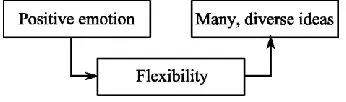
The relationship between emotion and creativity depends on the influence of the adaptive nature of an emotion on the execution of the creative process [10]. Positive emotions, and in particular those that are characterized by approach action tendencies favour creativity [2]. Positive emotion (e.g. joy or pride) is generated by the subjective evaluation that an event is conducive to the goals of an individual [26]. This stimulates dopamine release in the mesocortical and mesolimbic areas of the brain, which is associated with an increase in the flexibility with which information is relayed to other brain areas [1]. The resulting increase in flexibility makes it easier to 1) generate many and diverse ideas, a marker for creativity during the idea generation step in the creative process, and 2) gain creative insights as measured by insight problem solving tasks [2] (Figure 1). Approach action tendencies, or in other words the pursuit of a positive outcome, can further support the link between positive emotion and creativity [2].
Figure 1. Illustration of the relationship between positive emotion and creative idea generation mediated by flexibility. Interactive systems designed to influence the relationship between emotion and creativity are scarce, though some examples do exist. Emotion elicitation techniques developed in psychology have been tested on crowd-sourcing platforms within this context [20, 21]. For instance, priming positive emotion by placing a positive picture on the crowdsourcing platform during an idea generation task augments creativity [20]. Another development is using of the tendency of people to mirror each other’s facial expressions to influence emotion. For instance, manipulating faces into a desired facial expression in a video feed that is used to communicate during collaborative brainstorming augments idea generation when the faces are manipulated in a positive rather than a negative facial expression [23]. From the examples above, we can see that interactive systems can be designed to influence the relationship between emotion and creativity, to help people perform better on certain creative tasks. In this paper we focus on the relationship between positive emotion and creativity during idea generation and insight problem solving. This leads to our first hypothesis (H1).
H1: An interactive system that augments positive emotion can augment creativity during idea generation and insight problem solving.
MOTION AND EMOTION
Motor expressions are the physical actions that form part of an emotion [7, 26]. For instance, we smile when we see something nice, or we might push away the things we do
[image:3.612.89.262.277.328.2]not like. Motor expressions also regulate emotion [14]. This is because motor expressions are connected to the other emotion components via feedback loops [26]. Thus, changes in motor expressions influence the disposition towards having certain emotions, and the intensity of those emotions.
Figure 2. Motor expressions can regulate emotion by introducing A) positive feedback via congruence, and B)
negative feedback via suppression.
Congruence between a motor expression and an emotion provides positive feedback to that emotion, which increases the disposition to have and intensity of that emotion (Figure 2A). This is found across the emotion components, for instance: smiling increases the pleasantness associated with pleasant pictures [27]; arm flexion increases positive feelings when it suggests pulling something towards you that you desire, facilitating approach action tendencies [6]; smiling is shown to activate reward structures in the brain [29]; and mimicking emotion expressions increases the consciously experienced feelings of these emotions [12].
Suppression of a motor expression can lead to negative feedback, which decreases the disposition to have, and the intensity of an emerging emotion (Figure 2B). For instance, injecting Botox to block frowning reduces symptoms of mild depression [13]. These findings show two ways in which motor expressions can regulate emotion.
There are, however, certain conditions that need to be met for motor expressions to help regulate emotion. We hold the view that emotions are caused by personally relevant events that happen in an individuals’ environment [26]. Hence, motor expressions do not ‘cause’ emotion, but regulate existing emotion. For instance, approach arm movements influence emotion when people subjectively evaluate the emotion of a face, but not when they evaluate its spatial properties [25]. Therefore, we assume that motor expressions need to happen around the same time an emotion is caused. Motor expressions must also fit with an emotion in order to regulate it. For instance, when predicting the cause of future problems and opportunities, adopting an angry or sad pose only influences the prediction of future problems, not opportunities [18]. We assume that these conditions need to be met if we want to use the function of motor expressions in emotion regulation.
[30]. Physical positioning using an automated chair has been used to impose postures that are congruent with movie scenes, which increased the perceived intensity of some positive movie scenes [19]. Embodied interactions have also been designed based on characteristics of motor expressions (postures) that associate with high and low power [16]. Used as a way to interact with a mathematics game, it was hypothesized that this would help to combat math anxiety, but no results on this have been published until now. However, there are reports of heightened emotional engagement in computer games that enable or impose motor expressions during interaction [3, 4, 17]. This demonstrates that it is possible, in certain circumstances, to develop interactive systems that hack the function of motor expressions in emotion regulation.
In this paper we will attempt to enable the regulation of positive emotion by designing arm gestures based on expressions of positive emotion and approach action tendencies, and negative emotion and avoidance action tendencies. This leads to our second hypothesis (H2).
H2: Using positive approach rather than negative avoidance arm gestures to interact with a system augments positive emotion.
EMOTION, MOTION, AND CREATIVITY
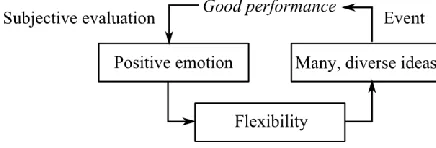
[image:4.612.316.560.125.197.2]Based on the above, we believe that motor expressions may be able to help regulate positive emotion during a creative task because as well as emotion influencing creativity, creativity also causes emotion [2, 5]. In other words, we hypothesize that when a creative task causes emotion, and the motor expression 1) happens at the same time, and 2) fits with the caused emotion, it may be able to help regulate this emotion. For instance, positive emotion can help to generate many, diverse ideas [2] and generating many, diverse ideas can increase the likelihood that a generated idea is an original idea [22] as described above. This in itself can cause positive emotion [5] (Figure 3). A positive motor expression can then help regulate that positive emotion to the benefit of creativity (Figure 4).
Figure 3. Illustration of the reciprocal nature of the relationship between positive emotion and creative ideation.
This way, motor expressions may influence creativity during idea generation and insight problem solving. In a previous study it has already been shown that smiling and performing arm flexion rather than frowning and performing arm extension helped regulate positive emotion, and via positive emotion, augmented creativity during an
[image:4.612.63.281.531.605.2]idea generation task [11]. In this paper we investigate translation of these findings into an interactive system that hacks the function of motor expressions in emotion regulation to augment creativity, which is novel in an interactive systems context.
Figure 4. Illustration of how the reciprocal relation between positive emotion and creative ideation can be regulated by
positive motor expressions.
We will focus on using arm expressions designed based on motor expressions of positive emotion and approach action tendencies as a means to regulate positive emotion and augment creativity during idea generation and insight problem solving. This leads to our third hypothesis (H3).
H3: Using positive approach rather than negative avoidance arm gestures to interact with a system augments creativity.
HACKING THE FUNCTION OF MOTOR EXPRESSIONS IN EMOTION REGULATION
To demonstrate our ideas we have developed a ‘proof of concept’ interactive system that: 1) uses arm gestures designed based on motor expressions that associate with positive emotion and approach tendencies, and with negative emotion and avoidance tendencies; and 2) uses a choreography of interaction that meets the conditions that are necessary for motor expressions to help regulate emotion.
Arm gestures
The positive approach arm gesture used to interact with our system is arm flexion (links to approach tendencies [6]) characterized by a centrifugal movement that starts at the side of the body and moves with a curve toward the heart, executed with a balanced level of muscle tension (links to positive emotion [7, 26]) (Figure 6A). This gesture is designed to increase positive emotion, when it occurs, via congruence, and decrease negative emotion via suppression. The negative avoidance arm gesture is arm extension (links to avoidance tendencies [6]) characterized by a centripetal movement that starts at the side of the body, then moves to the chest (diaphragm), and then outwards away from the body, using a slightly increased level of muscle force (links to negative emotion [7, 26]) (Figure 6B). This gesture is designed to increase negative emotion when it happens via congruence, and decrease positive emotion via suppression.
Choreography of interaction
expressions to regulate emotion. The arm gestures need to happen at the same time as any emotions caused during the creative task. We assume that emotions tend to happen right after an idea is generated or an insight problem is answered. These are events at which people might subjectively evaluate their creative task performance (e.g. positive: this idea was very good, or negative: again an idea of insufficient quality). If these caused emotions are positive and involve approach action tendencies, or are negative and involve avoidance action tendencies, the designed arm gestures can help regulate these emotions in an intended direction, and thereby influence creativity (Figure 5). To implement this, the arm gestures are consistently used immediately after people generate an idea or solve an insight problem.
Figure 5. Illustration of how positive approach arm gestures used as part of embodied interaction can help regulate positive
emotion due to the reciprocal relationship between creativity and positive emotion.
The interactive system
To test whether the arm gestures used in our proposed choreography of interaction enable us to hack the function of motor expressions in emotion regulation, we developed a basic interactive system for experimental purposes. This system is an application that hosts two creative activities, an idea generation task and an insight problem solving task. The system enables users to record their ideas or solutions with a Dictaphone by using the arm gestures.
The arm gestures are used to record an idea or solution just after it is generated, using a microphone. To start recording, the user does the arm gesture; to keep recording, the user keeps the end position of the gesture stable; and to stop recording the user releases the gesture. For the insight problem solving task releasing the arm gesture would also present the next insight problem. To meet the basic demands of the creativity tasks we present an image of the subject of the idea generation during the idea generation task, and the insight problems that need to be solved during the insight problem solving task on the screen. In case the arm gesture is used to record an idea, visual feedback is given by means of a blinking recording sign (• rec).
To enable the system to automatically trigger the recording, we use a Kinect sensor and a mechanical myograph in a classification setup. We capture the relative angles between the shoulder and the elbow, and the elbow and the wrist of the dominant arm with the Kinect; and muscle force from the biceps, triceps, flexor capri, and extensor capri is
calculated by taking the root mean square of the signal of a mechanical myograph (Figure 6). We assume this captures the characteristics on which basis the gestures were designed, see [9] for further details. We trained four hidden Markov models to classify: no gesture; the start of the gesture; keeping the gesture; and releasing the gesture, using the Viterbi algorithm. The parameters were set using grid search. The user and researcher work together to record and annotate the data for the models. Classification is done using ARGMAX of a sequence on the log probability under each model. The developed models are automatically tested for performance. In case of insufficient performance (f1
[image:5.612.54.297.240.316.2]-score<0.95) the researcher switches to a Wizard of Oz approach, i.e. the researcher triggers the recording him or herself when the user does the arm gesture.
Figure 6. Illustration of the setup (left), and the end position of the A) positive approach and B) negative avoidance gesture.
METHOD
To evaluate the system, we used an experimental between-group setup with people in one between-group using the positive approach arm gesture, and people in the other group the negative avoidance arm gesture, to interact with the system. We favoured the between group over a within group setup because it enabled us, given limited resources, to test the interactive system with two different creativity tasks. Moreover, we chose to not counterbalance the order of the creative tasks because we prioritized results for the idea generation task, which builds upon our previous work [11], over the insight problem solving task, which we consider more of an exploration. In total 37 people participated in this study (Mage=32, SDage=7, Males=20, Females=17, Left
handed=7, Right handed=30), with 19 participants using a positive approach and 18 participants using the negative avoidance arm gesture. We switched to a Wizard of Oz mode with 8 participants in both experimental conditions. The participants were students and employees of City University London.
Creative tasks
instructed participants to generate as many and diverse original uses for a brick. They were given 5 minutes to do this. Task 2 was a verbal insight problem solving task which was used as an indicator of general creative problem solving ability [8]. We instructed participants to solve as many insight problems as they could within 10 minutes, but to try not to spend more than half a minute on each problem. Insight problems are verbal puzzles that have only one correct answer, but cannot easily be solved using the details provided in descriptions of the problems themselves, nor by step-by-step logical thinking (e.g. Q: Is it legal for a man to marry his widow’s sister? A: No, he’s dead.). For both tasks the participants were instructed to do their best.
Assessment of creativity
To assess creativity during idea generation, we analyzed the outcomes of the alternative uses task by counting the amount of ideas that a participant generated (fluency), the amount of semantic concepts used in the generated ideas (flexibility), and the statistical infrequency of the participants’ ideas, given the ideas generated by all the participants [24]. To correct for inflation of originality for participants that were very fluent we used the percentage score, i.e. divided fluency by the count of original ideas [24]. To assess creativity during the insight problem solving task we calculated the percentage of correctly solved insight problems by dividing the amount of answered problems by the amount of correctly answered problems [8, 24].
Assessment of emotion
People self-reported their emotional state on a Likert scale (9 points) from negative to positive emotion after each task, which was part of a questionnaire.
Assessment of possible alternative causes
The questionnaire was further used to assess any possible alternative causes of variation by the designed arm gestures. To this end we asked people to self-report on the: 1) pleasantness and unpleasantness of the arm gestures themselves, 2) physical effort needed to perform the arm gestures, and 3) degree of freedom with which the arm could be moved given that there were four sensor units strapped to their arm, all by using Likert scales (9 points).
Procedure
Upon arrival, each participant was introduced to the study after which informed consent was signed. We strapped the myograph sensors to the participants’ dominant arm, and calibrated the Kinect sensor. When the sensors worked correctly, the participants were given instructions to use either the positive approach or the negative avoidance arm gesture as an embodied interaction throughout the study. These were given by example by the researcher. After this, we were ready to start the recording of the arm gestures to train the arm recognition capabilities of the system. In case this did not lead to sufficient classification accuracy, we switched to a ‘Wizard of Oz’ approach before the two
creativity tasks started. After this, we were ready to start the application for the alternative uses task (task 1) after which participants filled in a questionnaire. Then, participants used the application to perform the insight problem solving task (task 2), after which they again filled in a questionnaire. The participants were offered an opportunity to share their thoughts about the study, after which they received a £10 voucher for a large online retailer.
EXPERIMENTAL RESULTS
We first checked for possible alternate causes that could explain variation caused by the arm gestures by submitting them individually as dependent variables (DV) to a one-way ANOVA, with the arm gestures as the independent variable (IV). The results showed no significant differences between the pleasantness or unpleasantness of the arm gestures themselves (F(1, 35)=0.38, p=.545), the physical effort needed to do the arm gestures (F(1, 35)=0.03,
p=.866) and the freedom with which the arm could be moved (F(1, 35)=0.226, p=.638). We will therefore not include these in further analysis.
Task 1: Idea generation
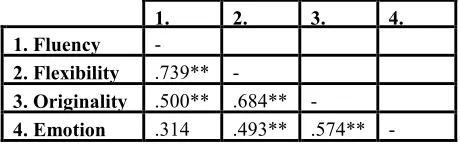
To test whether the interactive system augmented positive emotion and creativity during idea generation (H1), we correlated the assessed creativity variables fluency, flexibility, and originality, and emotion. The results show that there was a positive relationship between positive emotion and creativity during idea generation (Table 1). This relationship was characterized by no significant relationship between fluency and emotion, but rather by a significant positive relation between flexibility and positive emotion as well as originality and positive emotion. Higher positive emotion therefore related to higher flexibility and originality. This result supports H1.
1. 2. 3. 4. 1. Fluency -
2. Flexibility .739** -
3. Originality .500** .684** -
[image:6.612.323.553.469.542.2]4. Emotion .314 .493** .574** -
Table 1: Correlation between fluency, flexibility, originality, and self-reported emotion. ** is p<.005.
IV DV
[image:7.612.61.291.59.153.2]Positive appr. Negative avoid. Mean SD Mean SD Fluency 17.32 4.85 13.18 6.55 Flexibility 10.95 3.01 7.00 3.41 Originality 0.24 0.08 0.08 0.10 Emotion 6.89 1.24 5.81 1.34
Table 2: Means and standard deviations (SD) for the creativity and emotions assessments (DV) according to arm gesture (IV).
To test whether using positive approach rather than negative avoidance arm gestures to interact with the system augmented creativity during the idea generation task (H3), we used the same statistical approach, but with fluency, flexibility, and originality as the DVs. The results showed that participants using a positive approach rather than a negative avoidance arm gesture performed better creatively (Table 3), a result that was unlikely to be random, for fluency (F(1, 34)=4.71, p=.045, η2=.122), flexibility (F(1,
[image:7.612.60.290.318.383.2]34)=13.62, p=.001, η2=.286), and originality (F(1, 34)=25.52, p<.001, η2=.430). This supports H3.
Figure 7. Conditional process model of the arm gestures, flexibility, originality, and emotion. * is p<.05, ** is p<.005.
To further explore the relationship between the arm gestures, emotion, and creativity, we performed conditional process analysis using the bootstrapping method [15]. Conditional process analysis is a non-parametric test that can be used to uncover the process or mechanisms that underlie an observed finding between an IV and DV, via other DVs (mediators). Note that the test cannot be used to test for causality between the mediators and the DV. We used this test with the arm gesture as the IV, flexibility and originality as the mediators, and emotion as the DV (Figure 7). Fluency was not included because we did not find a correlation with emotion (Table ). The results showed no significant direct relationship between the arm gestures and emotion, i.e. the bounds of the confidence interval cross zero (B=0.11, 95% CI[-1.04 1.26]). Instead, the results show that the creativity parameters are conditional to the influence of the arm gestures on emotion. This conditional relationship with the arm gestures is characterized by a positive relationship between originality and emotion (B =-0.60, 95% CI[-1.51 -0.12]), and a positive relationship between flexibility, originality, and emotion (B=-0.28, 95% CI[-1.07 -0.06]), that is, the bounds of the confidence interval did not cross zero. Results for a possible relationship of the arm gestures with flexibility and emotion, without originality was not significant (B=-0.28,
95% CI[-1.26 0.17]). This provides preliminary evidence that positive approach rather than negative avoidance arm gestures help regulate positive emotion, when emotion is caused by the generation of original ideas. This supports the assumed process underlying our hypotheses (Figure 5).
Task 2: Insight problem solving
Before task 2 could be analyzed we checked whether the influence on emotion in task 1 carried over into the results of task 2. Results of a correlation showed no significant relationship between the emotions after task 1 and the percentage of correct answers (r(1, 35)=.064, p=.715). There were however, clues that emotion after task 1 carried over into task 2 (r(1, 35)=.307, p=.073). To address this issue we recoded the difference between the emotions after task 1 and after task 2 into a new variable for use in further analysis, to which we refer as emotion′, which represents the change in emotion that was observed.
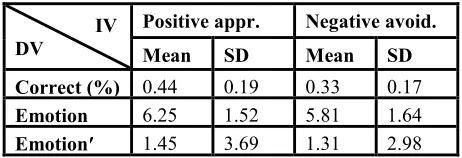
To test whether the interactive system augmented positive emotion and creativity during the insight problem solving task (H1), we correlated the percentage of correct answers with emotion, and emotion′. Participants on average answered 15.47 insight problems (SD=6.94). The results showed no significant relationship between the correct answers and emotion (r(1, 35)=.076, p=.659), but did show a significant positive relationship between correct answers and emotion′ (r(1, 35)=.335, p=.046). A change toward more positive emotion relates to increased percentages of correctly answered insight problems. This supports H1.
IV DV
Positive appr. Negative avoid. Mean SD Mean SD Correct (%) 0.44 0.19 0.33 0.17 Emotion 6.25 1.52 5.81 1.64 Emotion′ 1.45 3.69 1.31 2.98
Table 3: Means and standard deviations (SD) for the creativity and emotion assessments (DV) according to arm gesture (IV).
[image:7.612.322.553.405.484.2]is unlikely to be random (F(1, 35)=5.09, p=.030, η2=.127).
[image:8.612.62.290.113.174.2]Positive approach rather than negative avoidance arm gestures increased the percentage of correctly solved insight problems. This supports H3.
Figure 8. Conditional process model of the arm gestures, percentage of correct answers, and emotion′. * is p<.05.
Given that there was no direct relation between the arm gestures and emotion or emotion′, but there was between the arm gestures and the percentage of correct answers, and between correct answers and emotion′, it may be the case that the relationship between arm gestures, correct answers, and emotion′ follows a similar conditional process as we found in task 1. To test this we used the same statistical approach, but with the percentage of correctly answers as the mediator, and emotion′ as the DV (Figure 8). The results showed no direct relationship between the arm gestures and the emotion′, i.e. the bounds of the confidence interval crossed zero (B=-1.37, 95% CI[-3.67 0.93]). Instead, it showed a significant relation where the percentage of correct answers is conditional for positive rather than negative avoidance arm gestures to heighten positive emotion, i.e. the bounds of the confidence interval did not cross zero (B=0.98, 95% CI[0.07 2.41]). This provides preliminary evidence that positive approach rather than negative avoidance arm gestures help regulate positive emotion, when emotion is caused by solving insight problems. This supports the assumed process underlying our hypotheses (cf. Figure 5).
DISCUSSION AND CONCLUSION
Our findings demonstrate that an interactive system can be designed to hack the function of motor expressions in emotion regulation to help people perform better on certain creative tasks. Our findings show that when our interactive system augments positive emotion it also augments creativity (H1). This in itself is nothing new, but it validates this study within the context of previous research on the relationship between emotion and creativity. Our findings also show that when positive approach rather than negative avoidance arm gestures are used, positive emotion is augmented (H2). This finding is a novel contribution to research that aims to use embodied interaction designed based on characteristics of motor expressions to help regulate emotion [cf. 3, 4, 16, 17, 19, 30]. Finally, our findings show that using positive approach rather than negative avoidance arm gestures augments creativity during an idea generation task and an insight problem solving task (H3). This finding is a novel contribution to research that aims to develop interactive systems that influence emotion with the goal to augment creativity, as it provides a novel,
embodied, approach to attain that goal [cf. 20, 21, 23]. As such, this research provides opportunities for new technologies that draw on embodied interaction to help regulate emotion, including possible applications such as such as gaming and entertainment [3, 4, 17, 19], education [16], and therapeutic technologies [30], as well as creativity support tools [20, 21, 23].
Moreover, our further exploration of the data provides preliminary evidence for a process that underlies our approach. This is indicated by the finding that there is no direct relationship between the arm gestures and emotion, but that this is dependent on an increase in originality during the idea generation task, and insight problem solving performance during the insight problem solving task. This appears to match with our ideas about the role of the arm gestures in the relationship between emotion and creativity, which is the assumption that for the arm gestures to have an influence on emotion, an emotion must be generated, and this emotion is generated when the user believes that he or she is doing well (Figure 5).
Interpretation of the results needs to be limited to the context of use in our interactive system, and the conditions posed by our experimental setup. However, the results also point toward interesting limitations in the possible utility of our approach. Whereas during idea generation the results were clear, during insight problem solving there were less pronounced relationships between the arm gestures, emotion, and creativity. Considering that the change in emotion was also characterized by relatively large standard deviations, it might be that other factors, which we did not measure, had a stronger influence on emotion during insight problem solving. However, another explanation could be that the used arm gestures are only effective for a limited amount of time due to habituation [cf. 28]. We cannot rule out the latter because we did not randomize task order. The results also reveal a possible limitation in the effectiveness of our approach. People who used positive approach arm gestures reported more positive emotion than the people who used the negative avoidance arm gestures, but the latter people were still positive on average. It could well be that the used creative activities did not generate sufficient negative emotion for the arm gestures to help regulate these emotions, and all that we found was that positive approach arm gestures increase positive emotion, and negative avoidance arm gestures suppress positive emotion. Therefore we cannot know from these results whether the function of motor expressions in emotion regulation can be hacked for emotions other than positive ones. Previous attempts at hacking the function of motor expressions in emotion regulation suffered from similar complications [19, 30].
REFERENCES
1. Akhbari Chermahini, S. and Hommel, B. More creative through positive mood? Not everyone!. Frontiers in Human Neuroscience 6, (2012), article 319.
2. Baas, M., De Dreu, C.K.W., and Nijstad, B.A. A meta-analysis of 25 years of mood-creativity research: Hedonic tone, activation, or regulatory focus?.
Psychological Bulletin 134, 6 (2008), 779-806. 3. Bianchi-Berthouze, N. Understanding the role of body
movement in player engagement. Human-Computer Interaction 28, 1 (2013), 40-75.
4. Bianchi-Berthouze, N., Kim, N.N., and Patel, D. Does body movement engage you more in digital game play? And why?. In Proc. ACII 2007, (2007), 102-113. 5. Brunyé, T.T., et al. Happiness by association: Breadth
of free associations influences affective states.
Cognition 127, (2013), 93-98.
6. Centerbar, D.B. and Clore, G.L. Do approach-avoidance actions create attitudes?. Psychological Science 17, 1 (2006), 22-29.
7. Dael, N., Mortillaro, M., and Scherer, K.R. Emotion expression in body action and posture. Emotion 12, 5 (2012), 1085-1101.
8. de Bono, E. Lateral thinking: creativity step by step. Harper & Row, London, UK, 1970.
9. de Rooij, A. Technical Report: Arm Expression Recognition using Acoustic Myography. http://www.al winderooij.com/publications/acousticmyography2013.p df
10. de Rooij, A. & Jones, S. Mood and Creativity: An Appraisal Tendency Perspective. In Proc. C&C 2013, (2013), 362-365.
11. de Rooij, A. & Jones, S. Motor Expressions as
Creativity Support: Exploring the Potential for Physical Interaction. In Proc. BCS HCI 2013, (2013), article 47. 12. Flack, W. Peripheral feedback effects of facial
expressions, bodily postures, and vocal expressions on emotional feelings. Cognition & Emotion 20, (2006), 177–195.
13. Finzi, E., and Wasserman, E. Treatment of depression with Botulinum Toxin A: a case Series. Dermatologic Surgery 32, 5 (2006), 645–650.
14. Gross, J.J. The emerging field of emotion regulation: An integrative review. Review of General Psychology 2, 3 (1998), 271-299.
15. Hayes, A.F. An introduction to mediation, moderation, and conditional process analysis. The Guilford Press, New York, NY, 2013.
16. Isbister, K., Karlesky, M., Frye, J., and Rao, R. Scoop! A movement-based math game designed to reduce math anxiety. Ext. Abstracts CHI 2012, (2012), 1075-1078. 17. Isbister, K., Schwekendiek, U., and Frye, J. Wriggle: an
exploration of emotional and social effects of movement. Ext. Abstracts CHI 2011, (2011), 1885-1890.
18. Keltner, D., Ellsworth, P.C., and Edwards, K. Beyond simple pessimism: effects of sadness and anger on social perception. Journal of Personality and Social Psychology 4, (1993), 740–752.
19. Kok, R. and Broekens, J. Physical emotion induction and its use in entertainment: lessons learned. In 1st IFIP Entertainment Computing Symposium, (2008), 33-48. 20. Lewis, S., Dontcheva, M., and Gerber, E. (2011).
Affective Computational Priming and Creativity. In
Proc. CHI 2011, (2011), 735-744.
21. Morris, R.R., Dontcheva, M., Finkelstein, A., and Gerber, E. Affect and creative performance on crowd-sourcing platforms. In Proc. ACII 2013, (2013), 67-72. 22. Mumford, M.D., Medeiros, K.E., and Partlow, P.J.
Creative thinking: processes, strategies, and knowledge.
The Journal of Creative Behavior 46, 1 (2012), 30-47. 23. Nakazato, N., Yoshida, S., Sakurai, S., Narumi, T.,
Tanikawa, T., and Hirose, M. Smart Face: enhancing creativity during video conferences using real-time facial deformation. In Proc. CSCW 2014, (2014), 75-83. 24. Plucker, J.A., Qian, M., and Wang, S. Is originality in
the eye of the beholder? Comparison of scoring techniques in the assessment of divergent thinking. The Journal of Creative Behavior 45, 1 (2011), 1-22. 25. Rotteveel, M. and Phaf, R.H. Automatic affective
evaluation does not automatically predispose for arm flexion and extension. Emotion 4, (2004), 156-72. 26. Scherer, K.R. The dynamic architecture of emotion:
Evidence for the component process model. Cognition and Emotion 23, 7 (2009), 1307-1351.
27. Soussignan, R. Duchenne smile, emotional experience, and autonomic reactivity: A test of the facial feedback hypothesis. Emotion 2, (2002), 52-74.
28. Stepper, S. and Strack, F. Proprioceptive determinants of emotional and nonemotional feelings. Journal of Personality Social Psychology 64, (1993), 211–220. 29. Wiswede, D., Munte, T.F., Kramer, U.M., and Russeler,
J. Embodied emotion modulates neural signature of performance monitoring. PLoS ONE 4, (2009), e5754. 30. Zariffa, J., Hitzig, S.L., and Popovic, M.L.