City, University of London Institutional Repository
Citation
:
Rangiha, M. E. (2016). A framework for social BPM based on social tagging. (Unpublished Doctoral thesis, City University London)This is the accepted version of the paper.
This version of the publication may differ from the final published
version.
Permanent repository link: http://openaccess.city.ac.uk/14999/
Link to published version
:
Copyright and reuse:
City Research Online aims to make research
outputs of City, University of London available to a wider audience.
Copyright and Moral Rights remain with the author(s) and/or copyright
holders. URLs from City Research Online may be freely distributed and
linked to.
City Research Online: http://openaccess.city.ac.uk/ [email protected]
1
A Framework for Social BPM
based on Social Tagging
Mohammad Ehsan Rangiha PhD Thesis
City University London
2
Table of Contents
CHAPTER 1: INTRODUCTION ... 8
1.1 Introduction ... 8
1.2 Background & Motivation ... 8
1.3 Research Questions and Objectives ... 12
1.4 Thesis Scope ... 13
1.5 Research Methodology ... 15
1.6 Thesis Structure ... 16
CHAPTER 2: BACKGROUND AND RELATED WORK ... 18
2.1 Introduction ... 18
2.2 Business Process Management (BPM) ... 18
2.3 Social BPM ... 38
2.4 Social Technology for BPM ... 52
2.5 Conclusion ... 60
CHAPTER 3: SOCIAL BPM FRAMEWORK DESIGN ... 62
3.1 Introduction ... 62
3.2 Functional Requirements ... 62
3.3 The Framework ... 63
3.4 Social Process Design and Execution ... 71
3.5 Architecture Supporting the Implementation of Social BPM ... 88
3.6 Conclusion ... 90
CHAPTER 4: PROTOTYPE IMPLEMENTATION AND EVALUATION ... 92
4.1 Introduction ... 92
4.2 Evaluation Approach ... 92
4.3 Proof of Concept Implementation ... 93
4.4 Case study evaluation ... 107
4.5 Evaluation against the Literature ... 120
4.6 Limitations of our evaluation ... 122
4.7 Revisiting the Research Questions ... 125
4.8 Conclusion ... 129
CHAPTER 5: CONCLUSION... 130
5.1 Introduction ... 130
5.2 Research Contribution... 130
3
5.4 Future Research ... 138
5.5 Conclusion ... 140
REFERENCES ... 141
APPENDIX A – Questionnaire... 152
APPENDIX B – Results ... 158
4
Figures
Fig.1.1 Research Area
Fig.1.2 Social BPM Research Methodology
Fig.2.1 Definitions of a Business Process aligned to process types
Fig.2.2 Process types supported by BPM
Fig.2.3 Van Der Aalst et al.‘s BPM Model (Van der Aalst, 2009)
Fig.2.4 Process design in YAWL
Fig.2.5 Process configuration in YAWL
Fig.2.6 The work queue
Fig.2.7 Process monitoring in YAWL
Fig.2.8 Process design in ARIS
Fig.2.9 Process enactment in ARIS
Fig.2.10 Approaches to process flexibility
Fig.2.11 BPMN Social extension roles (Brambilla et al., 2011)
Fig.2.12 BPMN Social extension social activities (Brambilla et al., 2011a)
Fig.2.13 Social requirements for BPMN (Brambilla et al., 2011)
Fig.2.14 Dynamic enrolment pattern (Brambilla et al., 2011a)
Fig.2.15 Modelling and execution environment (Silva et al., 2010)
Fig.2.16 Process type interface example. (Silva et al., 2010)
Fig.2.17 Social tagging structure
Fig.3.1 Main Areas of Social BPM Conceptual Model
Fig.3.2 Social BPM Static View
Fig.3.3 Social BPM Behavioural View
Fig.3.4 Standard Tagging (Smith, 2008) VS Tagging in Social BPM
Fig.3.5 A Social BPM Tagging Example
Fig. 3.6 Task Recommender in Social BPM
Fig. 3.7 Task-Recommendation in a Study Circle Process
Fig.3.8 Task Recommendation Static View
Fig.3.9 Role Recommendation in Social BPM (at t and t+1)
5 Fig.3.11 System Architecture
Fig.4.1 Social BPM use case diagram
Fig.4.2 Social BPM sequence diagram
Fig.4.3 Pimki tool mapped to Social BPM design
Fig.4.4 Pimki tool mapped to Social BPM design
Fig.4.5 Task instance creation in Pimki
Fig.4.6 Task instance and user profile in Pimki
Fig.4.7 User profile and discussion in Pimki
Fig.4.8 Tagging task instance in Pimki
Fig.4.9 Tagging community member in Pimki
Fig.4.10 Tagging community member in Pimki
Fig.4.11 Study circle 2009 and related task instances in Graphiz
Fig.4.12 User defined tags related to task instances in Graphiz
Fig.4.13 Members participation in task instances in Graphiz
Fig.4.14 Overall view of task instance page in Pimki
Fig.4.15 Main forum dashboard
Fig.4.16 Tasks (topics) related to a study circle in the forum
Fig.4.17 Discussion about the flyer on the forum.
Fig.4.18 Example of a tag cloud
Fig.4.19 Tag cloud equivalent in Pimki
Fig.4.20 Task recommendation in Pimki
Table 2.1 Research Area
Table 2.2 Definitions of Social BPM
Table 3.1. Tagging scenarios
Table 3.2. Tagging community members
Table 3.3. Social BPM Requirements
Table 4.1 Demographics of volunteers in process 1 and 2
Table. 4.2. Quantitative Data Analysis – Number of observations = 9
Table 4.3 Results from first hand data
6
Declaration
7
Abstract
8
CHAPTER 1: INTRODUCTION
1.1 Introduction
This chapter presents an overview of what this thesis contains and what motivated
investigation in the chosen research area (Section 1.2). After briefly identifying the gaps
in the current literature, Section 1.3 lists the aims and objectives set for this research and
also the research questions which need to be answered in order to fulfil the set
objectives. Section 1.4 presents the scope of the thesis. The methodology devised to
fulfil the objectives of the research is presented in Section 1.5. Finally Section 1.6
presents a summary of what has been discussed in this chapter and also sets the overall
outline for the remainder of the thesis.
1.2 Background & Motivation
With the advancement of technology over the past decade and increase of
competition in the industry, the need for effective management of organisation‘s
business processes has become more important than ever before (Ryan et al., 2009).
Furthermore, the changes in industry such as the rise in frequency of goods ordered, the
need for quick decision making and speedy transfer of information, the need to adapt to
change in demand, the presence of more international competitors and demands for
shorter cycle times (Simchi-Levi, 2000) are amongst the factors which have made the
need for efficient and effective management of business processes essential. Gradually
over the past two decades, the manual completed forms started to be replaced by
electronic applications. This trend eventually evolved into a new phenomenon, today
known as Business Process Management (BPM) (Ryan et al., 2009).
BPM includes concepts, methods, and techniques to support the design,
9
2007). The evolution of BPM over the years suggests that there are still limitations
within the different stages of BPM. One of the main limitations of traditional BPM is
the separation between the process design and execution, which causes a discrepancy
between the designed and executed processes (Filipowska et al., 2011; Schmidt &
Nurcan, 2009a; Palmer, 2011). For instance, because the users have not been involved
in the design of the processes, they may often find shortcuts to execute specific
activities, which better reflects their understanding of the process. Additionally, because
of this separation, valuable first-hand knowledge from executing the processes may
remain unused during process design and also prevented to be shared within the
organisation. For instance, if a user has found a new and innovative approach to execute
a process, this knowledge should ideally be used during the process design. However
because of the separation which exists between the process design and execution
phases, this knowledge would not be utilised or shared with others in the organisation.
Limitations in the traditional BPM approach have triggered research that is inspired
by other emerging trends. Social BPM is one of these trends that attempts to overcome
the existing limitations and it is the focus of this thesis.
Social BPM is generally concerned with the integration of social software and
platforms into the design and execution of business processes. According to one
industry report in 2015 (Terpening et al., 2015) who surveyed 113 strategists (social,
digital and/or heads of social) at companies with more than 250 employees, 68% of
them strongly agree that the use of social media is growing in their organisation.
According to this recent report, 82% of businesses report they are either fully integrated,
in the process of, or planning the integration of social with digital in 2015. This
indicates that there is a general trend towards the ―social enterprise‖ in businesses and
10
BPM can be seen as part of this trend, as it aims at actively involving all relevant
stakeholders into BPM through the use of social software (Pflanzl & Vossen, 2013).
The start of research in Social BPM can be dated back to 2008 (Nurcan & Schmidt,
2009) with a workshop on Social BPM and it has evolved ever since. Although there
have been a number of definitions suggested for the concept of Social BPM, there is not
a unique understanding of how Social BPM operates.
The attempted approaches towards a Social BPM framework (Brambilla &
Fraternali, 2012; Brambilla et al., 2011; Brambilla et al., 2011a; Silva et al., 2010) are
limited to the inclusion of social extensions such as polls, dynamic enrolment, social
sourcing, voting and ranking/commenting (Brambilla & Fraternali, 2012; Brambilla et
al., 2011l; Brambilla et al., 2011a) in the process design stage. As an example, polling
tools such as doodle can be used during the design stage of BPM to seek the opinion of
analysts regarding the design of the processes or setting a brainstorming session date. In
doing so, the separation between the process executors and designers, that is, one of the
limitations of the traditional BPM, still exists. Furthermore, the authorisation boundaries
which are typical of traditional BPM models still exist in these approaches. This is the
main reason why useful information is not shared and passed throughout the
organisation and to different users and designers. Additionally, none of these
approaches focus on capturing process knowledge during execution in order to be used
during process design or even future executions. If, for example, a user involved in the
execution of a process finds a different and better way of doing something, this process
knowledge cannot easily be reused during the process design or future executions.
Amongst social software technologies, social tagging is a growing trend and it has
11
objects (Gupta et al., 2010). According to Trant (2009), social tagging refers to the
practice of publicly labelling or categorizing resources in a shared and on-line
environment. Social tagging is currently used in different contexts, such as libraries,
museums, online archives, education and social entertainment or networking. The tags
are used to capture knowledge about specific content from users and communities in
terms of their preference, interests or chosen categories. For example in the website
LibraryThing1, people share and tag their personal book collections and currently
members have added nearly 20 million tags to 15 million books, making it the second
largest library in North America (Smith, 2008). In this example, knowledge about the
books is being captured by the tags, such as categorising the books as romance, fiction
or science for instance. Flicker2 is another example of a social tagging platform which is
a popular photo sharing website mainly for entertainment that allows users to tag their
photos. In this example, information about pictures such as the location or the occasion
they were taken is captured by tags. Given the popularity of social tagging and the
benefit it brings about by capturing various resources, we use this technology in the
context of Social BPM.
This research builds on previous works in the area of Social BPM and exploits the
benefits of social tagging to capture process knowledge from users during the enactment
and design of the processes. Such knowledge may refer to either design-time concerns,
such as the type of tasks successfully considered in the past to fulfil a certain goal, or
run-time concerns, such as choosing users to execute tasks based on their the experience
and skills demonstrated in previous execution of the processes. Process knowledge is
exploited to drive and support the role and task recommender tools. On the one hand,
the role recommender tool helps the users to choose people to execute tasks based on
1 www.librarything.com 2
12
their expertise and past experience. The task recommender, on the other hand, helps to
design processes, by suggesting what has been done in the past to fulfil a certain goal.
In other words, in our Social BPM framework the task fit for purpose in the context of a
specific process and users‘ experience and skills as emerged during the design and
execution of processes are captured via social tagging to be reused in current or future
enactments of processes.
1.3 Research Questions and Objectives
This research aims to answer the following questions:
1. What are the key concepts that can drive the design of a Social BPM framework
exploiting social tagging as a tool to capture and re-use process knowledge?
2. Does the Social BPM framework improve the collaborativeness and reuse of
process knowledge during the design and enactment of business processes?
In order to answer the above questions, a number of research objectives need to be
fulfilled:
1. Perform a literature review of BPM and Social BPM to identify the key
characteristics of a Social BPM framework.
2. Design the key capabilities of a Social BPM framework that exploits social
tagging.
3. Build a prototype based on the proposed design for the purpose of evaluating the
designed Social BPM framework
4. Evaluate the Social BPM framework through the implemented prototype in real
13
The first question addresses the fundamental concern of what constitutes a Social
BPM system. This question is answered by fulfilling the first and second objectives,
which is done through the literature review in Chapter 2 and the design of the Social
BPM framework in Chapter 3.
The second question focuses on the value of our Social BPM framework for the
users and is answered by evaluating its functionalities. This is done by achieving the
third and fourth objectives through the prototype implementation and case study
evaluation, which are both presented in Chapter 4. The reason why we evaluate the
improvement of collaboration and the reuse of process knowledge is that these are the
two main areas affected by the limitations of traditional BPM discussed before. If
collaboration is improved, it would reduce the gap between the process executors and
process designers, which in effect would reduce the discrepancy between the designed
and executed processes. Additionally, the reuse of process knowledge is enhanced with
collaboration between users and allows for the knowledge gained from the execution to
be used during the design of the processes. This would eventually lead to the
improvement of business processes.
1.4 Thesis Scope
As presented in Fig. 1.1 there are 3 different types of business processes defined in
the literature, namely ad-hoc, structured/predefined and semi-structured (Huth et al.,
2001). This thesis addresses ad-hoc business processes. In ad-hoc processes the
execution paths are completely defined at runtime. This is opposed to structured and
semi-structured processes. Structured processes are fully defined and remain unchanged
during process execution. In semi-structured processes there is a structure, but part of it
14
An example of ad-hoc processes is organising a picnic, in which a group of friends
just discuss and come up with an idea and a park and go with it. There is no predefined
flow which is followed here. In an organizational context, e.g. higher education, an
example of ad-hoc processes is the process of recruiting a Teaching Assistant (TA) to
support the tutorials for a module. There is a general goal to be achieved (to recruit a
TA), however, how this is achieved is not defined and is left to the relevant department
to decide because there is no standard way of achieving this goal. This differs from the
process of, for instance, recruiting a permanent member of academic staff, where there
are usually clear protocols and procedures in place for the recruitment. Depending on
how detailed the procedure of recruiting a permanent member of academic staff is, this
would be a structured or semi-structured process.
In Social BPM, the processes do not necessarily have to be pre-defined. The
activities related to each process can be designed and executed on the fly, therefore the
scope of our research is to discuss and address ad-hoc processes, as presented in Fig.
1.1.
Fig.1.1 Research Area
As far as implementation is concerned, the development of a full BPM system
which is deployed in the market is out of scope in this thesis. The prototype that is
implemented in this thesis is only part of the evaluation to assess the
―buildability/feasibility‖ of the framework. Additionally, the scope of our evaluation
Structured Process
Semi Structured Process
Ad-Hoc Process
Traditional BPM
Flexible
BPM
15
only covers the validation of “usefulness” (Laitenberger & Dreyer, 1998) of the
proposed framework, that is, we evaluate whether the capabilities of a the Social BPM
framework are useful and if they have improved the collaborativeness and reuse of
process knowledge during the design and process execution. The evaluation of the
usability of the prototype, e.g., user interface, or the performance of the prototype, e.g.,
scalability, is out of scope at this stage.
1.5 Research Methodology
In this section, the stages of this research and the methods adopted in each stage are
discussed. Fig. 1.2 presents a summary of the key stages of this research:
Fig.1.2 Social BPM Research Methodology
The problem definition discusses the overall motivation, background and scope of
the research and defines the research objectives which the research aims to achieve. In
the second stage of the research, which is the literature review, an investigation is
carried out in the literature in order to find out the state of the art and identify the exact
research gap which we are investigating. The approaches to fill in the identified gap are
presented from the literature and we argue why these approaches have not fully
addressed this gap and how our research relates to the work which has been carried out
until today. To do this, we present an analysis of the background and concept of BPM,
its phases and an overview of currently available BPM tools. A number of limitations
are identified with regards to the traditional BPM systems and some of the attempts to
overcome these limitations are presented. Flexible BPM is an approach which has been
used over the past few years to address the downfalls of BPM systems and it mainly
Problem Definition
Literature
Review Design
Evaluation
•Case Study •Prototype
16
supports semi-structured processes. Social BPM is another approach which attempts to
overcome the limitations of traditional BPM, which is the focus of our research.
Furthermore the researches up to date in the Social BPM area are presented and
analysed case by case to identify the gap in the literature which is related to Social BPM
supporting ad-hoc business processes.
After having identified the gap in the literature, in the design stage we propose a
Social BPM framework to fill in the research gap and address the limitations of the
traditional BPM systems. Our Social BPM framework is inspired by goal-based
modelling (Paternò, 2002) and contains 3 main concepts, namely the role and task
recommenders and social tagging which supports the recommender mechanisms. The
concepts of a Social BPM framework are designed and the architecture of each of these
concepts are presented and discussed. This Social BPM framework is then validated in
the evaluation stage against the research questions set at the beginning of our research.
To do this, a prototype implementation is produced and a number of case studies are run
with real data and users in order to assess and evaluate the proposed solution.
The results from these case studies are analysed using qualitative and quantitative
methods to assess whether this framework has managed to address the limitations of the
traditional BPM model or not. Finally, a number of limitations are identified and
presented with regards to the evaluation methodologies applied and future work is
discussed.
1.6 Thesis Structure
This chapter (Chapter 1) presented the motivation and background of the research.
Furthermore the aims and objectives of the research have been presented in order to
give direction and focus to what is to be achieved throughout this research. The scope of
17
and what is beyond its scope. Finally the methodology adopted to undertake this
research was presented and the steps taken during each of its phases.
The remaining of the thesis comprises the following chapters:
Chapter 2 (Background and Related Work) investigates the state of the art in BPM
research, identifies the gaps and limitations, and presents the attempts made to
overcome those gaps. The background to the emergence of Social BPM is discussed and
the gap which this research aims to investigate is identified.
Chapter 3 (Social BPM Framework Design) discusses the structure of our solution and
presents the underlying design of the Social BPM framework. A set of functional
requirements is formed as a result of this which results in a design architecture that is
the basis for the implementation of the framework.
Chapter 4 (Prototype Implementation and Evaluation) evaluates the Social BPM
framework and compares the outcome to the original research questions presented in
Chapter 1. As part of the evaluation a proof of concept prototype is implemented and a
case study is run with real user participants to validate the functionality of the Social
BPM framework.
Chapter 5 (Conclusion) concludes the thesis by reflecting on the overall approach of the
research, the contributions, revisiting research questions and objectives, limitations and
18
CHAPTER 2: BACKGROUND AND RELATED WORK
2.1 Introduction
This chapter discusses the background of the research and the state of the art.
Additionally it positions our research in the overall Business Process Management
context discussing where it fits and the reason why research in Social BPM has been
chosen. It does this in the following way: Section 2.2 discusses the literature on BPM,
explaining what a process is, BPM in different disciplines, the limitations of the
traditional BPM model and the attempts made to overcome these limitations. In Section
2.3 our specific research area is discussed, explaining how Social BPM can overcome
some of the limitations of the traditional BPM systems. This chapter continues to
discuss the various definitions proposed in regards to Social BPM, the potentials and
limitations of this approach and finally presents the various approaches towards Social
BPM in the literature. Lastly, Section 2.4 discusses the concept of social software and
explains the social technologies used in BPM and in our Social BPM framework. This
chapter ends with a conclusion Section 2.5.
2.2 Business Process Management (BPM)
In this section, we first discuss the definitions and different types of processes. Then
we explain the emergence of BPM and the different understandings which have been
presented. This is followed by expanding on the main stages involved in the BPM
lifecycle, describing each of these stages and also presenting some examples of BPM
tools which are currently used in industry and finally we discuss some of the limitations
19 2.2.1 What are business processes?
Before we discuss BPM, it is important to have an understanding of what is meant
by a ―process‖.
There are has been a number of explanations in regards to the definition of a
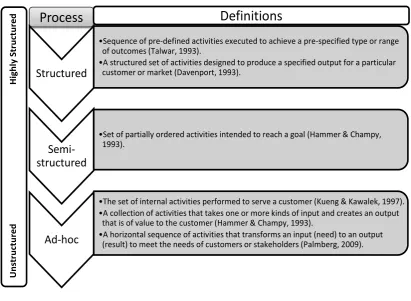
―business process‖ (see Fig. 2.1). Most of these are similar with only limited
discrepancy. Fig. 2.1 aligns each definition to a specific process type, in order to
determine which ones of these definitions are more suitable in our research.
The definitions which are explicit in stating the processes are a set of predefined
activities have been aligned to structured processes. These seem to be mainly in the
context of a rigid traditional BPM framework where all the steps before the execution of
the processes are pre-engineered. In the second category of process types, only one
definition mentioned partially designed/ordered activities which are in line with
semi-structured processes. Finally, the definitions which do not specify whether the processes
are predefined or not, it is assumed that they can be designed at any point; therefore
20
Fig.2.1 Definitions of a Business Process aligned to process types
Based on the definitions of Fig. 2.1, three types of processes can be defined (Huth et
al., 2001):
Ad-hoc processes: The execution path of such processes is completely defined at
runtime. These approaches usually apply to processes which run for a short period of
time. It is difficult to structure such processes and normally not worthwhile to automate
using a structured process modelling approach, because the frequency of their execution
is little. They may reappear or be modified at later stages of process execution. Such
processes are typically designed during runtime, or they are done in parallel, thus their
build time and run time are merged. Social processes are typical examples of ad-hoc
processes, for example the process of organising a night out. A group of friends just
discuss and come up with an idea and go with it, there is no predefined flow which is
followed here.
Structured
•Sequence of pre-defined activities executed to achieve a pre-specified type or range of outcomes (Talwar, 1993).
•A structured set of activities designed to produce a specified output for a particular customer or market (Davenport, 1993).
Semi-structured
•Set of partially ordered activities intended to reach a goal (Hammer & Champy, 1993).
Ad-hoc
•The set of internal activities performed to serve a customer (Kueng & Kawalek, 1997). •A collection of activities that takes one or more kinds of input and creates an output
that is of value to the customer (Hammer & Champy, 1993).
•A horizontal sequence of activities that transforms an input (need) to an output (result) to meet the needs of customers or stakeholders (Palmberg, 2009).
[image:21.595.127.539.70.371.2]21
Structured/predefined processes: These types of processes are fully structured and
remain unchanged during process execution. These processes are normally used in the
production stage of Workflow Management Systems (WfMS). WfMS are the
―computerized facilitation or automation of a business process, in whole or part‖
(WfMC, 1999). Structured processes usually consist of highly recurrent structures
where the same predefined processes are executed over and over again. In this type of
business processes, there is a clear separation between the design and running of the
processes. An example of such processes is hardcoded programmed applications, for
instance the process of placing an order in an ERP system. Every step of the process is
predefined and imposed on the user to follow in order to create an order.
Semi-structured processes: These processes are in between ad-hoc and structured
processes. Processes are partially open, but the initiator expects that a structure will be
established for the tasks by the process executers. For instance in the healthcare sector,
consider the process of admitting and discharging of a patient. The admission has
certain procedure which is predefined, however when the doctor is examining the
patient, the process flow varies depending on the type of diagnosis they receive. They
might be referred to a specialist, admitted to the hospital or be advised to take another
route. Finally after the treatment is completed, there is a specified process which needs
to be followed for the patient to be discharged. This is a typical semi-structured process
where parts of the process are defined and other parts are not.
In the context of our research which is geared towards Social BPM, the processes do
not necessarily have to be pre-defined. The activities related to each process can be
designed and executed on the fly which is from the characteristics of ad-hoc processes.
Finally, as far as the lifespan of processes is concerned, two types of processes can
22
(Davenport, 1993); the second is a sort of process which is constantly running. In other
words, processes can be short or long-running. This temporal categorisation of the
processes can be applied to any of the process types explained above.
What is addressed in traditional BPM systems is related to the effective management
of mainly structured processes. In ad-hoc processes, because there is no explicit
separation between the design and running of the processes, the current traditional BPM
tools have not been able to support them.
The remainder of this chapter discusses the different approaches towards BPM as
presented in Fig. 2.2. Traditional BPM which is aligned to structured processes, flexible
BPM which is aligned to semi-structured process are presented in the next two sections.
In the end the need and concept of Social BPM is discussed which is aligned to ad-hoc
processes that is the subject of our discussion in this research.
Fig.2.2 Process types supported by BPM
Structured Process
Semi Structured Process
Ad-Hoc Process
Traditional BPM
Flexible
BPM
23 2.2.2 Emergence of BPM
The impact of IT influencing business process has roots in (Hammer & Champy,
1993; Hammer & Champy, 1992) Business Process Reengineering (BPR) framework
and Davenport(1993)‘s book on how IT advancement and innovation can facilitate
BPR. However there is a distinct difference between BPR and BPM. BPR usually calls
for a radical elimination of existing business process models, whilst BPM aims to
gradually improve and manage business processes through an incremental and iterative
approach (Ryan et al., 2009).
Research in Business Process Management started and evolved immensely since the
late 1980s and was triggered by seminal work published by Davenport & Short (1990)
and Hammer & Champy (1993). Before then, the support to business processes was
provided by ad-hoc software applications. BPM systems were initially introduced as
―document routing systems dispatching documents in an organization‖ and were
traditionally referred to as WFMSs (Wohed et al., 2009). Not long after this, gradually
the theories related to BPM were implemented and started being used in practice (Houy,
2010) and today most corporations have adopted some sort of BPM model for the
management of their business processes.
Although Business Process Management is a discipline widely used across almost all
large corporations and a known term in research circles, there is not a unique
understanding of what BPM actually means. Antonucci & Goeke (2011) argue that
there is still no universally accepted definition of BPM; Table 2.1 looks at some of these
24 Table 2.1 Research Area
BPM Definitions
1 The automation of a business process, in whole or part, during which documents,
information or tasks are passed from one participant to another for action,
according to a set of procedural rules (Lawrence, 1997).
2 Supporting business processes using methods, techniques, and software to design,
enact, control, and analyse operational processes involving humans, organizations,
applications, documents and other sources of information (Van der Aalst, 2009).
3 A generic software system that is driven by explicit process designs to enact and
manage operational business processes (Van der Aalst, 2003).
4 BPM provides an approach and platform to take full control of the business
processes right from the outset of their initiation until the end, through a systematic
application of management, measurement and improvement of the company
processes (Lee & Dale, 1998).
5 A field for involving any combination of modelling, automation, execution,
control, measurement and optimization of business activity flows, in support of
enterprise goals, spanning systems, employees, customers and partners within and
beyond the enterprise boundaries (Palmer & Schoof, 2014).
6 The goal of BPM to be to create a process-centric, customer-focused organization
that integrates management, people, process and technology for both operational
and strategic improvement (Mathiesen et al., 2011).
7 BPM is a discipline where Information Technology and management intersect, to
ensure the smooth running, monitoring, designing and improving of business
25
8 BPM includes concepts, methods, and techniques to support the design,
administration, configuration, enactment, and analysis of business processes
(Weske, 2007).
The first definition appears to be a primitive definition of BPM and only captures the
running and execution of the processes and only for very structured processes, however,
as BPM has advanced over the years, its scope has been extended to cover other stages
of the BPM lifecycle too. Therefore BPM is responsible for the designing, running,
managing and monitoring of the business process right from the beginning all the way
to the end. Others (Lee & Dale, 1998; Elzinga et al., 1995; Hung, 2006) focus more on
the improvement and measurement aspects of BPM in their definition and refer to the
general management of the business processes without detailing further.
In summary, although there is a variation in the definitions given for BPM, and
different authors concentrate on certain aspects of BPM more than others, it can be said
that BPM deals with the management of all aspects of business processes in
organizations.
2.2.3 BPM Lifecycle and tools
As there are a number of different definitions for BPM, there are also various views
on the overall BPM lifecycle and the stages it entails. ABPMP (2009) considers 6 main
phases for the BPM lifecycle, namely: planning, analysis, design and modelling,
implementation, monitoring and control, refinement. Furthermore Elzinga et al. (1995)
lists the following steps: preparation, process selection, process description, process
improvement selection and implementation.
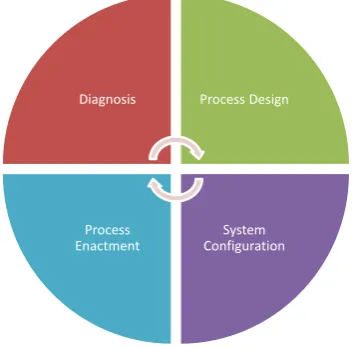
According to Van der Aalst (2009), the BPM lifecycle consists of four main stages:
26
diagnosis or improvement, as presented in Fig. 2.3. Other researches (zur Muehlen &
Rosemann, 2004; Weske, 2007; Van der Aalst, 2009; Lee & Dale, 1998) have also
mentioned similar 4 stages to Van der Aalst (2009). For the purpose of our research we
have adopted the model proposed by Van der Aalst (2009), due to its simplicity and the
[image:27.595.245.422.214.388.2]comprehensive nature of the phases it covers.
Fig.2.3 Van Der Aalst et al.’s BPM Model (Van der Aalst, 2009)
Each phase of the BPM lifecycle is supported by different components of a
Process-Aware Information System (PAIS) (Dumas et al., 2007) and involves a specific set of
different stakeholders.
Process Design: This is the first stage of BPM lifecycle in which the processes or
procedures are designed into the BPM System. This is typically done by graphically
modelling the processes into the BPM system using notations such as BPMN3 and
EPC4.
System Configuration: In this phase the processes and underlying system infrastructure
are implemented in the BPM System. Designation of roles, creating rules and process
constraints are typically introduced in this phase which are used during process
execution.
3 http://www.bpmn.org/ 4
http://www.ariscommunity.com/users/rbaureis/2010-03-22-basic-rules-epc-modelling
Diagnosis Process Design
System Configuration Process
27
Process Enactment: During this phase the design and implemented processes are
executed. This is often automated in BPM suites and executed without the need for
manual intervention.
Diagnosis: Finally in this stage of the BPM lifecycle the BPM analyst analyses the
overall performance of the business processes and identifies the areas which need
improvement. This analysis assists reducing the loopholes in the business processes and
offers an improvement to the BPM lifecycle; this is done through evaluating the process
through the right process metrics.
In order to exemplify the BPM technology we discuss how two implemented BPM
suites (one open source and one commercial) support the phases of the BPM lifecycle in
Fig. 2.3.
YAWL (Yet Another Workflow Language) 5 is a BPM system which is based on
modelling languages in order to handle complex data transformations and support full
integration with organisation resources.
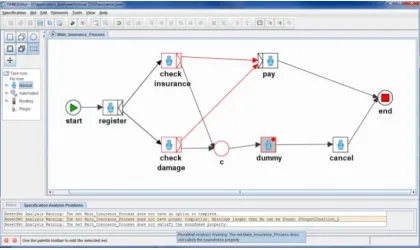
The first step is process design/discovery; this is supported by YAWL Editor and
illustrated in Fig. 2.4. YAWL has its own modelling notation which is based on an
extension of Petri-Nets (Wang, 2007).
5
28
Fig.2.4 Process design in YAWL
In the next stage, the process is configured; roles and resources are assigned to the
various designed tasks as shown in Fig. 2.5. The system admin goes through each
position, and assigns roles and authorisations to the given position, this is necessary to
[image:29.595.116.537.71.321.2]determine who is involved in the execution of the process.
29
In phase three as presented in Fig. 2.5, the tasks and linked and executed. This is
done in YAWL editor which supports the enactment of the designed and configured
processes. Often these tasks can be automated and run without human intervention. For
example in Fig. 2.6, during the execution of the process, a task is offered to the user and
they are able to accept and carry out the task or reject it.
Fig.2.6 The work queue
Finally, once the process is being/has been run, YAWL monitors the performance of
the execution. Monitoring process execution enables diagnosis of the process downfalls
and limitations and drives process improvements going forward. Fig. 2.7 presents a
snapshot of the summary/analysis of a task which has been executed.
30
Another example of a widely used and recognised BPM tool which is used is ARIS6
(Architecture of Integrated Information Systems). This BPM suite is a free-of-charge
modelling tool for business process analysis and management. It supports different
modelling notations such as BPMN2, Event-driven Process Chains, organizational
charts, process landscapes and whiteboards.
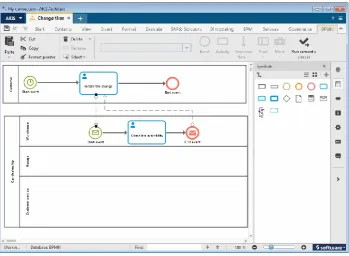
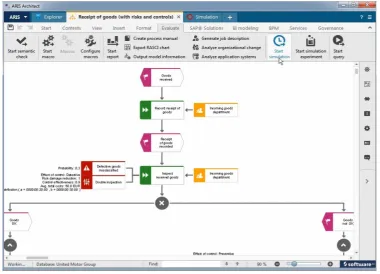
Similar to any other tool, ARIS enables process design using a graphical notation as
presented in Fig. 2.8 (BPMN). This is to visually map the documented process and
define in which section/department each of the tasks take place. Each of these tasks can
be assigned and aligned to the organisational chart to assign the actors/resources who
[image:31.595.152.502.356.612.2]are responsible for each task.
Fig.2.8 Process design in ARIS
Process enactment and diagnosis/evaluation is also supported by AIRS BPM suite.
The tasks are executed, and become coloured once then have been completed and the
6
31
output for the overall process is produced as illustrated in Fig. 2.9. This data is then
[image:32.595.136.517.126.400.2]used for process analysis and process optimization.
Fig.2.9 Process enactment in ARIS
Based on process models and organizational structures, the simulation enables a
comparison of actual and target processes in terms of excitability and efficiency. The
focus can also be laid on cost, execution time, or resource usage. This answers questions
on throughput times, weak points, bottlenecks, resource requirements,7 and can be
utilised for process improvement and optimisation.
Considering the two main BPM tools which we have briefly analysed we find that
although such tools support the BPM lifecycle through its different phases of design,
configuration, implementation and diagnosis, they only support the structured or at most
semi-structured process types. Ad-hoc processes are not supported by the BPM model
or tools.
7
32
In all of these tools, there is a clear separation between the design and execution
phases and the order of these stages needs to be followed. There are a number of
limitations associated to this type of traditional BPM model and tools which are
discussed in the next section.
2.2.4 Limitations of Traditional BPM
The evolution of BPM over the years suggests that there are still areas of limitations
within the BPM lifecycle, which we discuss in the remainder of this section.
Traditional approaches to BPM present the following limitations:
Lack of Information Dissemination: BPM normally follows a top-down approach,
where processes are designed by a group of individuals and passed on to end users to
follow (Schmidt & Nurcan, 2009a; Palmer, 2011). This approach often prevents useful
process knowledge (such as suggestions for improvements) of the end-users to be
shared within the organisation. There are many users in an organisation with different
backgrounds, who can contribute positively and share their knowledge throughout the
organisation. However, traditional BPM often limits such dissemination of knowledge
due to strict organisational layers. Although such knowledge can be captured in focus
groups and workshops, this usually only happens during the design phase of the
processes.
Model-Reality Divide: As a result of the top-down approach and the gap between the
end users who execute the processes and the process designers who design the
processes, the designed processes may not be followed correctly. This consequently
creates a gap between the designed process and the process that is executed (Filipowska
et al., 2011; Schmidt & Nurcan, 2009a; Palmer, 2011). For instance, because the users
have not been involved in the design of the processes, they may often find shortcuts to
33
Information Pass-On Threshold and Lost Innovation: Useful feedback from users is not
captured in process design due to rigid hierarchical controls in the design and
deployment phases. As a result, valuable first-hand knowledge to improve processes
may remain unused (Filipowska et al., 2011; Schmidt & Nurcan, 2009a). For instance,
if a user has an innovative idea to improve the business processes, due to the rigid
hierarchical barriers in process design, they will not be able to voice their input and
contribute towards the improvement of the processes. Such a lack of information
dissemination causes loss in innovation and often prevents the generation of new
creative ideas.
Strict Access-Control: Strict access control is present in most traditional BPM
approaches, that is, only users who have been selected and given specific access are
allowed to execute the processes (Wohed et al., 2009). This limits the level of
participation of users into the business process life-cycle. For instance, there may be
users who are not directly involved in a specific process who, however, may be able to
contribute effectively to the process design. Because of strict authorization controls in
place, they will often be prevented access beyond what they have been granted
permission to view. This will also lead to lost innovation and lack of knowledge
dissemination.
These properties of the standard BPM cycle make it unsuitable for so-called ad-hoc
processes which are under the consideration in this research.
2.2.5 Flexible BPM
Limitations in the traditional BPM approach have triggered research that is inspired
by other emerging trends. Liu & Zhao (2009) suggest that BPM allows organisations to
create flexibility and adapt dynamic collaboration in order to keep up with the changing
34
forward for the improvement of the BPM lifecycle. Additionally change and flexibility
are typical of semi-structured and ad-hoc processes which is the focus of our discussion
here.
Modern workflow systems need to provide flexiblity, but process aware execution at
runtime that do not force users into a pre-defined way of doing their work (Burkhart &
Loos, 2010) as it was promoted by traditional workflow engines (Dorn et al., 2010). The
ability to change the dynamic nature of enterprises today is one of the most important
factors of a company‘s success.
Over the past years there has been a range of definitions in regards to the notion of
‗flexibility‘. Although they all share a common principle, there are subtle differences
between these definitions. For instance, in (Reijers et al., 2003) ―[flexible] process
models define the normal way of achieving a goal, but still offer the possibility to alter
this way based on available case data‖, and this ability of alteration is referred to as
flexibility. Adams et al., (2005) promote the idea that ―[flexible] processes simply
provide a guide-line while the appropriate way of handling single tasks is chosen on as
– needed basis‖. Sadiq et al., (2001) on the other hand defines flexibility as ―the ability
to deal with processes that are only partially defined at build-time‖ (Burkhart & Loos,
2010). From a business standpoint, flexibility could be defined as the ability to change
the way tasks/processes are handled without facing serious complexity issues (Burkhart
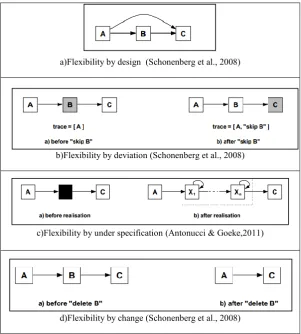
& Loos, 2010). More in detail, Schonenberg et al., (2008) define 4 categories of
35
Fig.2.10 Approaches to process flexibility
a) Flexibility by Design: this is the ability to allow different execution paths during
runtime of the process instance.
B) Flexibility by Deviation: refers to the ability to deviate from the execution path
during runtime, without altering the process model.
c) Flexibility by under specification: this is the ability to enact an incomplete process
during runtime, i.e. process does not have sufficient information to allow it to be
executed.
d) Flexibility by Change: refers to the ability to modify the process model during
execution such that the currently executing process instances are moved to a new
process model.
a)Flexibility by design (Schonenberg et al., 2008)
b)Flexibility by deviation (Schonenberg et al., 2008)
c)Flexibility by under specification (Antonucci & Goeke,2011)
36
Adaptive Case management (ACM) (Motahari-Nezhad, 2013) is also another
approach which focuses on the goal to be achieved and leaves the determination of how
to achieve that goal to the knowledge worker (i.e. the user) (Motahari-Nezhad, 2013).
Although Adaptive Case management is not new and references to this term go back to
the 1980s, it has been used in contrast to traditional BPM systems, primarily because of
the flexibility it offers (Motahari-Nezhad, 2013). The term adaptive case management
refers to managing the work needed to handle a case in a flexible manner by adhering to
the principle of planning-by-doing, considering the work context, and the ability to
accommodate changes in the environment and the work context Burns et al., (2011).
ACM is described as an approach which is based on ‗learning by doing‘ (Walters &
Holling, 1990), learning not only includes the system responses, but also learning to fill
gaps or improve understanding of key parts of the system where our knowledge is
lacking (Argent, 2009).
The approach adopted in ACM is mainly related to experiment and learning through
them in order to improve the knowledge gaps. The main principles which ACM relies
on are describing, predicting, doing and learning (Argent, 2009), which are more
concerned with performing an action and learning from it which do not overcome the
limitations of BPM. Process flexibility is needed to address and support ad-hoc
processes which are designed during execution which ACM does not facilitate.
Furthermore although these approaches towards flexible BPM offer a degree of
flexibility to the designed processes and tasks, there is still a structure and execution
path defined. This type of approach towards flexible BPM seems to be in line with
semi-structured processes. It goes beyond the structured processes which is supported
37
alteration from the main execution path which is from the characteristics of
semi-structured processes.
To summarise, we argue that approaches to flexible BPM are still vulnerable towards
a subset of the downfalls of traditional BPM systems, particularly in the context of
ad-hoc processes. Consider the following examples which would still apply:
Model-Reality Divide: Due to the fact that in flexible BPM there is still a separation
between the design and execution phase, the problem of the model-reality divide would
still be a risk. Flexible BPM supports alteration of execution path which would be in
discrepancy with the original designed processes.
Information Pass-On Threshold and Lost Innovation: Flexible BPM only introduces
changes related to the processes and tasks, not the actors. It does not introduce a
collaborative platform for all actors to be involved in the design and execution of the
processes. As a result of this lack of collaboration and hierarchical actor boundaries,
suggestions and innovative ideas by the users would most probably get lost and
unnoticed.
Strict Access-Control: Due to the boundaries and separation of design and execution
phases in flexible BPM, there are strict authorisations controls, and access rights are
given to actors based on the roles they have in the BPM lifecycle.
Information Dissemination: Given the organisational boundaries and strict access
controls, information dissemination throughout the organisation and between the users
will also be limited which is another limitation that is found in traditional and flexible
38
Given the above, the need for an approach to overcome these limitations and support
ad-hoc processes is highlighted. The execution of ad-hoc processes is the starting point
of a bottom-up approach (Bögel et al., 2014), which is key in overcoming the
limitations of traditional BPM systems.
We have presented the areas supported by traditional and flexible BPM approaches
and positioned our research which is Social BPM. We showed how workflow
management systems have evolved into Business Process Management and then
narrowed down to flexible BPM approaches. The gap found in this evolution is Social
BPM which is then expanded and explored in this research. Social BPM takes a step
further than flexible BPM and supports ad-hoc processes where the execution path
design during process execution and allows collaborative participation from the wider
community.
The next section discusses the concept of Social BPM which is another approach
towards overcoming the limitations of the traditional BPM systems.
2.3 Social BPM
2.3.1 Definition
Research in Social BPM formally started in 2008 (Nurcan & Schmidt, 2009) and it
has evolved ever since, this research emerged by the integration of social software and
BPM. Social Business Process Management is a collective effort from several users to
ensure smooth and efficient execution of business processes. There is consensus that by
working together and creating a platform for social collaboration engagement, the social
community can benefit from the ‗wisdom of the crowd‘ i.e. the exploration of tacit
knowledge amongst the participants (Surowiecki, 2004). This could eventually produce
39
Social BPM enables a large variety of users with varying degrees of training and
background to contribute their domain knowledge into process performance (Pflanzl &
Vossen, 2013). This is achieved through creating an ―architecture of participation‖ (Erol
et al., 2010) in which everyone feels part of the process execution. Social BPM is not
without its own limitations as it will be discussed later. For example, bias input from the
users need to be avoided in order for the contribution to be a real reflection of the users‘
efforts (Bruno et al., 2011).
Although there have been a number of definitions suggested for the concept of Social
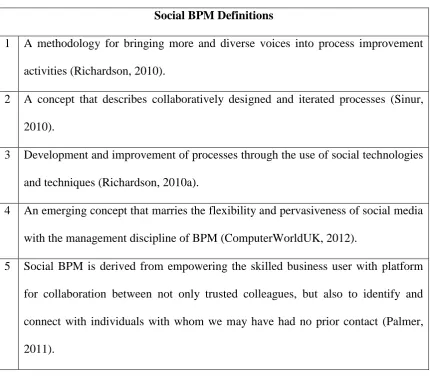
BPM, there is not a unique understanding of how Social BPM operates. Table 2.2
[image:40.595.109.540.391.767.2]presents the different definitions of Social BPM:
Table 2.2 Definitions of Social BPM
Social BPM Definitions
1 A methodology for bringing more and diverse voices into process improvement
activities (Richardson, 2010).
2 A concept that describes collaboratively designed and iterated processes (Sinur,
2010).
3 Development and improvement of processes through the use of social technologies
and techniques (Richardson, 2010a).
4 An emerging concept that marries the flexibility and pervasiveness of social media
with the management discipline of BPM (ComputerWorldUK, 2012).
5 Social BPM is derived from empowering the skilled business user with platform
for collaboration between not only trusted colleagues, but also to identify and
connect with individuals with whom we may have had no prior contact (Palmer,
40
6 Social BPM fuses business process management practices with social networking
applications, with the aim of enhancing the enterprise performance by means of a
controlled participation of external stakeholders to process design and enactment
(Brambilla & Fraternali, 2012).
7 Social BPM is the practice of actively involving all relevant stakeholders into
BPM through the use of social software and its underlying principles (Pflanzl &
Vossen, 2013).
The key element in Social BPM is user and stakeholder engagement (Sinur, 2010;
Pflanzl & Vossen, 2013), similarly what appears to be common and key in Social BPM
according these definition are: Collaboration, User engagement/participation, Process
Improvement and Social software. Therefore, for the purpose of this research we
combine these definitions and suggest the following definition of Social BPM:
A methodology to enable collaboration and user participation through social software
in order to enhance and improve BPM lifecycle.
In Social BPM, the users are involved in the designing of the processes right from
the outset and are part of a wider user community group all the way to execution and
evaluation of the processes. Therefore, in order for a Social BPM approach to be a
success it is vital to ensure the engagement of stakeholders and keeping them motivated
to contribute towards the processes (Pflanzl & Vossen, 2013). This is contrary to the
traditional BPM model where the processes are designed by a specific group of experts
and then imposed on the users to follow. On the other hand, in Social BPM there is a
seamless integration of design stage and enactment as the processes to achieve the set
41
for the unplanned participation of different users in order to complete the enactment of
the process steps more efficiently (Kemsley, 2011).
2.3.2 Social BPM Literature
Social Business Process Management is an approach which has been introduced in
order to overcome the limitations of the traditional and flexible BPM systems. The
foundations of Social BPM as a distinct research topic lie in the workshop on Business
Process Management and Social Software (BPMS2), which has been carried out in
conjunction with the International Conference on Business Process Management since
2008 (Nurcan & Schmidt, 2009).
Publications in the area of Social BPM can be broadly categorised in the following
areas:
1. Attempts to design a Social BPM framework (Brambilla & Fraternali, 2012;
Brambilla et al., 2011; Silva et al., 2010; Brambilla et al., 2011a).
2. Literature on Social BPM in general and the theory of it, discussing its benefits,
limitations and how it has emerged (Filipowska et al., 2011; Wohed et al., 2009;
Schmidt & Nurcan, 2009; Erol et al., 2010; Brambilla et al., 2011; Alexopoulou
et al., 2013), and the challenges raised by the adoptation of Social BPM in
organisations (Bruno et al., 2011; Pflanzl & Vossen, 2013; Pflanzl & Vossen,
2014; Alexopoulou et al., 2013).
This thesis discusses the literature in the first category of research analysing the
approaches to generating a Social BPM framework and identifying the current gaps in
this area. Then we discuss the advantages and limitations of Social BPM in general in
42 2.3.3 Approaches to Social BPM
The first category of literature in Social BPM is research into developing a
framework to support socially enabled BPM. Here we shall touch upon two of these
main approaches namely the BPMN Social Extension (Brambilla & Fraternali, 2012;
Brambilla et al., 2011; Brambilla et al., 2011a) and AGILIPO (Silva et al., 2010). After
this, we will then look at some of the Social BPM tools and technologies which are used
in industry.
I. BPMN Social Extension:
(Brambilla & Fraternali, 2012; Brambilla et al., 2011; Brambilla et al., 2011a) in
their approach towards designing a Social BPM framework propose a social extension
to the existing BPMN language to cater for social processes.
The first social extension to BPMN (Brambilla et al., 2011) is related to the actors,
their level of access, visibility of process status and level of social participation they
each have. Fig. 2.11 shows the types of roles considered in this approach.
Fig.2.11 BPMN Social extension roles (Brambilla et al., 2011)
Furthermore Brambilla et al., (2011a) introduces extra notations in order to denote
social activities such as setting up polls, dynamic enrolment, social sourcing, voting and
43
Fig.2.12 BPMN Social extension social activities (Brambilla et al., 2011a)
Finally the concept of community pool which is the main extension to BPMN is
introduced. This is defined as the pool devoted to social activities: it may represent a
public social network or an enterprise social network (Brambilla et al., 2011). This is
supported by different type of activity notations which have been introduced as social
extensions such as community executed activity and activity inheritance in order to
avoid duplication of activities as presented in the Fig. 2.13.
Fig.2.13 Social requirements for BPMN (Brambilla et al., 2011)
To conclude presenting this approach towards a Social BPM framework by
(Brambilla & Fraternali, 2012; Brambilla et al., 2011l; Brambilla et al., 2011a) the
following presents a simple process of ‗enrolment‘ using a social extension to the
44
sent to the social community and the details of the social network is collected and the
user is able to complete their registration and sign in. The focus of the social extension
here is making the designing and running of the processes easier by incorporating social
software such as using social tool to invite a large number of people or a social facility
to gather information from all those in the social network.
Fig.2.14 Dynamic enrolment pattern (Brambilla et al., 2011a)
This approach, although it does introduce social elements in the BPM lifecycle, it
does not lead to a fully socially integrated BPM framework and although it might
potentially address some of the limitations proposed by the BPM model, a number of
serious issues will still remain.
Some of the reasons and limitations of this approach are the following:
In this approach, the BPM developers are using some social software
applications to enhance their experience of BPM and facilitate it in an easier and
faster fashion. The key here is that the engagement of the users (who design the
process) during the execution of the processes is still missing. In fact if the total
integration of social software and BPM did take place, it will eliminate the need
of a specific group of designers or analysts designing a set of processes
(Swenson, 2010). This would still result in model-reality divide downfall.
The categorisation of the actors to three different types and authorisation
boundaries in normal circumstances is typical of BPM models which are not in
45
boundaries are one of the main reasons for lost innovation and lack of
information dissemination in an organisation.
The processes are pre-defined and social software is used to assist the execution
of these processes. This model would support structured or at most
semi-structured processes, not ad-hoc processes which is the subject of our research.
Although ad-hoc type tasks/activities have been introduced in the social BPMN
language extension, this is only a task which is embedded in the overall
predefined process which again will not support totally ad-hoc processes.
The presented approach also ignores collaboration and the use of social elements
during runtime. In Social BPM everyone contributes to the design and execution
of the processes, not just a specific group of authorised actors and only in a
specific stage (Swenson, 2010).
Overall this approach only provides social add-on features to make the BPM experience
easier, but the sequential workflows remain the same and still suffer from some of the
limitations of traditional BPM models.
II. AGILIPO:
In AGILIPO, Silva et al., (2010) investigates and proposes a framework for
embedding social software features into business process tools. This research primarily
focuses on the human-intensive aspects of business processes, where human
participation is required for activities operation. In this research a new approach to BPM
is presented which is human-centred and is supported by a collaborative environment.
AGILIPO supports unplanned exceptions during process execution where the users
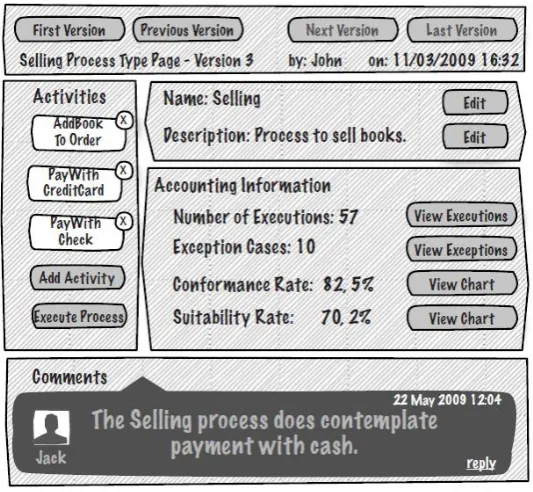
are able to design on a case by case status. Fig. 2.15 presents the different parties
involved in the modelling (i.e. designing) of the processes and the user who executes