City, University of London Institutional Repository
Citation:
Veluru, S., Rahulamathavan, Y., Viswanath, P., Longley, P. and Rajarajan, M.
(2013). E-mail address categorization based on semantics of surnames. Proceedings of the
2013 IEEE Symposium on Computational Intelligence and Data Mining, CIDM 2013 - 2013
IEEE Symposium Series on Computational Intelligence, SSCI 2013, pp. 222-229. doi:
10.1109/CIDM.2013.6597240
This is the unspecified version of the paper.
This version of the publication may differ from the final published
version.
Permanent repository link:
http://openaccess.city.ac.uk/2913/
Link to published version:
http://dx.doi.org/10.1109/CIDM.2013.6597240
Copyright and reuse: City Research Online aims to make research
outputs of City, University of London available to a wider audience.
Copyright and Moral Rights remain with the author(s) and/or copyright
holders. URLs from City Research Online may be freely distributed and
linked to.
City Research Online:
http://openaccess.city.ac.uk/
[email protected]
E-mail Address Categorization based on Semantics
of Surnames
Suresh Veluru
∗, Yogachandran Rahulamathavan
∗, P. Viswanath
†, Paul Longley
‡, and Muttukrishnan Rajarajan
∗∗Information Security Group, School of Engineering and Mathematical Sciences,
City University London, London, EC1V 0HB, United Kingdom.
E-mail:{Suresh.Veluru.1, Yogachandran.Rahulamathavan.1, R. Muttukrishnan}@city.ac.uk
†Department of CSE, R.G.M.C.E.T, Nandyal, Andhra Pradesh, India
E-mail:[email protected]
‡Department of Geography, University College London, London, WC1E 6BT, United Kingdom.
E-mail:[email protected]
Abstract—Surname (family name) analysis is used in geog-raphy to understand population origins, migration, identity, social norms and cultural customs. Some of these are suppos-edly evolved over generations. Surnames exhibit good statistical properties that can be used to extract information in names data set such as automatic detection of ethnic or community groups in names. An e-mail address, often contains surname as a substring. This containment may be full or partial. An e-mail address categorization based on semantics of surnames is the objective of this paper. This is achieved in two phases. First phase deals with surname representation and clustering. Here, a vector space model is proposed where latent semantic analysis is performed. Clustering is done using the method called average-linkage method. In the second phase, an email is categorized as belonging to one of the categories (discovered in first phase). For this, substring matching is required, which is done in an efficient way by using suffix tree data structure. We perform experimental evaluation for the 500 most frequently occurring
surnames in IndiaandUnited Kingdom. Also, we categorize the
e-mail addresses that have these surnames as substrings.
Index Terms—Vector space model; latent semantic analysis; surnames; average link clustering method; suffix tree;
I. INTRODUCTION
Due to rapid growth of digital data, knowledge discovery and data mining have great potential which would turn data into useful information and knowledge. Text mining (some-times called ‘mining from text documents’) is to extract knowl-edge from a set of text documents [6]. One such knowlknowl-edge
is to discover the clustering structure present in the data,i.e.,
to find groups of documents [11]. This can be later used to categorize a new document in to one of these pre-discovered classes (clusters) or as an outlier (saying ‘does not belong to any of these groups’). Similar to this, names, like first names, family names of individuals can be clustered to find inherent structure present in them which later can be used to classify a new name. This knowelge is shown to have importance in geography [5].
Broadly speaking, family names (surnames) represent eth-nic, geographic, cultural and genetic structures that have been developed in human populations. It is a well known fact that people migrate from one location to other due to job prospects, economic prosperity, political unrest, etc. However, the
sur-names of migrants retain semantic similarity to sursur-names of the people at their original locations.
In future, an e-mail address can be used as a form of digital identify of an individual that often holds surname as a substring. Thus, a methodology is important to categorize an e-mail address based on the knowledge extracted from names data set. Hence, association among people can be predicted from the e-mail addresses. The objective of this paper is to extract information in names data set which can be used in classifying an e-mail address. Knowledge discovery in names data set involves identifying relationship or association among groups of people (surnames).
In text mining, latent semantic analysis (LSA) is used in finding semantic similarity between terms (words) across doc-uments [15]. Here, a document is seen as a bag of words where the lower level structure (like phrases, sentences which shows a definite relationship between words) present in the document is neglected. It is shown that the phrase based approaches does not perform well since phrases do not repeat as the terms repeat in a set of documents. Hence, phrase based approaches do not capture good statistical information [14]. Vector space model is used popularly in text mining to represent documents. Similarly, surnames provide good statistical information at several location to extract knowledge from names data set using vector space model. Several surname analysis techniques have been developed in [3], [10], and [9], but do not explicitly use the vector space model to extract knowledge.
Our contribution: To the best of our knowledge, this is the first paper that represents surnames at different locations in a vector space model and applies classical text mining techniques such as latent semantic analysis (LSA), average-link clustering method, and suffix tree data structure appropri-ately to perform categorization of e-mail addresses based on semantics of surnames.
of the e-mail address. Further, it performs a substring matching technique such that if any surname is present as a substring in the e-mail address then the e-mail address is assigned into the cluster to which the surname belongs. This means that if two surnames that are in the same cluster are substrings of two different e-mail addresses then these two e-mail addresses will also be assigned into the same cluster.
This paper is organized as follows. Section II sets out the background and literature review for the proposed work. Section III describes proposed method for e-mail address categorization. Section IV presents the experimental results and finally Section V presents conclusion and future work of the paper.
II. BACKGROUND AND LITERATURE REVIEW
This section briefly explains some of the background tech-niques and literature review that are used in this paper to develop the proposed method.
A. Background
Vector space model is popularly used to extract information in text documents. Consider if a document contains a bag of
words then each document could be represented with a 𝑑
-dimensional vector where𝑑- represents𝑑most frequent terms
(or words) in a set of documents. Each element of the vector represents either term frequency multiplied by the inverse
document frequency (TF-IDF1) if the term is present in the
document or 0 if the term is not present in the document.
A set of documents are represented using a set of vectors in the form of a term-document matrix and techniques such as latent semantic analysis (LSA), clustering and classification of documents can be performed on the term-document matrix [2]. The LSA method computes the semantic similarity among words in the term-document matrix. It performs corpus based statistical analysis that finds words which co-occur together in several documents [15]. LSA represents a vector for each word and hence the cosine similarity between two vectors can be used to measure semantic similarity between corresponding words. Popular clustering methods can be applied to group words that are semantically similar. Clustering methods can be
divided into two types, i.e., hierarchicalandpartitional
clus-tering methods. Hierarchical methods represent clusters and
subclusters in a hierarchy. If 𝜋𝑖 and 𝜋𝑖+1 are two successive
levels, then normally, either𝜋𝑖is a refinement of𝜋𝑖+1or𝜋𝑖+1
is a refinement of𝜋𝑖 . Single-link, complete-link and
average-link clustering methods are the most widely used methods of this category which produce arbitrarily shaped clusters when compared with partitional clustering. The single-link clustering method is sensitive to noisy patterns and may merge two clusters if they are connected by a chain of noisy patterns [1]. In this sense, average link clustering method can be used to find good clusters.
1A popular representation scheme in information retrieval weights each term using a global weight IDF which is inversely proportionate to the number of documents that contains the term
B. Literature review
Surname analysis have been developed in geography such as identifying spatial concentration of surnames [3], migrant surname analysis [8], uncertainty in the analysis of ethnicity classification [10], and ethnicity and population structure anal-ysis [9]. However, the degree of similarity between surname mixes has been developed by comparing relative frequencies of
surnames at different locations such asisonymy[7] andLasker
distance [13]. These measures are complementary measures
such that the inverse natural logarithm of theisonymycreates
a more intuitive measure called Lasker distance. These are
applicable to study inbreeding between marital partners or social groups, but do not explicitly address the semantic similarity between surnames. E-mail address categorization based on semantics of surnames is proposed in the following section.
III. E-MAIL ADDRESS CATEGORIZATION
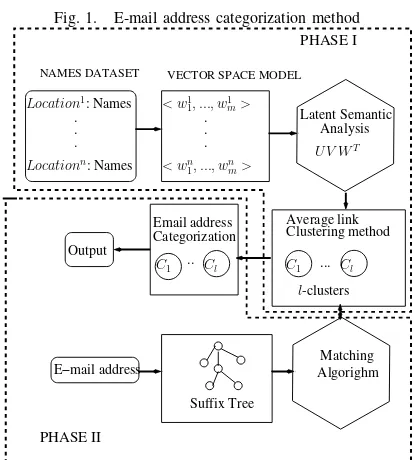
This section describes the proposed e-mail address catego-rization method. Figure 1 presents a block diagram for an e-mail address categorization technique which has two phases represented using dotted lines. Figure 1 also documents each phase as follows. In the first phase, the semantics of surnames are identified by representing a set of names at each location using a vector space model followed by latent semantic analysis as shown in the three blocks and as explained in Subsection A. Further, clustering of surnames is shown as an average-link clustering method and is explained in Subsection B. In the second phase, suffix tree construction of an e-mail address is shown in two blocks and is explained in Subsection C. Surname identification in an e-mail address is shown in matching algorithm and is explained in Subsection D.
A. Semantics of surnames
We adapt methods used in information retrieval in order to represent each location which contains a bag of surnames as a vector, and this is used to identify the semantics of surnames. Consider the location space of a region or a country consisting of a set of locations where each location has a
bag of surnames. Let there be𝑛locations that are represented
as ℒ1, . . . ,ℒ𝑛. A typical vector space model represents each
location with a vector consisting of 𝑚 entries where 𝑚
represents the top𝑚frequently occurring surnames in a region
or a country. Let these top𝑚 frequently occurring surnames
be𝒮=𝑠1, . . . , 𝑠𝑚. The vector space model for each location
ℒ𝑖 is represented with a𝑚-dimensional vector, for𝑖= 1to𝑛
is given in (1) where𝑤𝑠𝑖𝑗 represents the weight of the surname
𝑠𝑗 in location ℒ𝑖 .
ℒ𝑖=< 𝑤𝑖
𝑠1, 𝑤𝑖𝑠2, . . . , 𝑤𝑖𝑠𝑚 > (1)
We assign weight 𝑤𝑠𝑖𝑗 that represent the weight of surname
𝑠𝑗 in location ℒ𝑖. The weight depends upon the number of
occurrences of surname 𝑠𝑗 in location ℒ𝑖 called surname
frequency and a global weight for each surname 𝑠𝑗 called
Fig. 1. E-mail address categorization method
.
Average link Analysis .
.
VECTOR SPACE MODEL NAMES DATASET
. . .
... ..
Matching Algorighm
Suffix Tree
Latent Semantic
Categorization Email address
Output
E−mail address
PHASE I
PHASE II
Clustering method
𝑙-clusters
𝐶𝑙 𝐶1
𝐿𝑜𝑐𝑎𝑡𝑖𝑜𝑛1: Names
< 𝑤𝑛
1, ..., 𝑤𝑚𝑛>
< 𝑤1 1, ..., 𝑤1𝑚>
𝐶𝑙
𝐶1
𝐿𝑜𝑐𝑎𝑡𝑖𝑜𝑛𝑛: Names 𝑈𝑉 𝑊 𝑇
in (2). Here 𝑓𝑠𝑖𝑗 is the frequency of surname 𝑠𝑗 at location
ℒ𝑖 and𝐼𝐿𝐹(𝑠
𝑗) is theinverse location frequency.
𝑤𝑖
𝑠𝑗 =
{
𝑓𝑖
𝑠𝑗∗𝐼𝐿𝐹(𝑠𝑗) if surname𝑠𝑗 in location ℒ𝑖
0 if no surname𝑠𝑗 in location ℒ𝑖
(2)
𝐼𝐿𝐹(𝑠𝑗)provides the importance of surname𝑠𝑗 that retrieve
locations using surname 𝑠𝑗. If surname 𝑠𝑗 appears only in
a particular location then it is easy to retrieve that location
given the surname 𝑠𝑗. If a surname appears in one location
then it is of greater importance than a surname that appears
in several locations. If𝑛𝑗 is the number of locations in which
the surname𝑠𝑗 appears and𝑛is the total number of locations
then𝐼𝐿𝐹(𝑠𝑗)is given in (3).
𝐼𝐿𝐹(𝑠𝑗) =𝑙𝑜𝑔2(𝑛𝑛
𝑗) (3)
Let the location space which contains a set of locations beℒ,
represented by a matrix consisting of location-surnames. For
our convenience, letℒ𝑇 be a transpose matrix ofℒhaving𝑚
rows and 𝑛columns given below.
ℒ𝑇 =
⎛ ⎜ ⎜ ⎝
ℒ1 . . ℒ𝑛
𝑠1 𝑤𝑠11 . . 𝑤𝑛𝑠1
. . . . .
. . . . .
𝑠𝑚 𝑤𝑠1𝑚 . . 𝑤𝑛𝑠𝑚
⎞ ⎟ ⎟ ⎠
We apply LSA toℒ𝑇 which in-turn applies a SVD technique
that decomposes ℒ𝑇 into three matrices 𝑈,𝑉 and𝑊𝑇 such
that ℒ𝑇𝑚×𝑛=𝑈𝑚×𝑘𝑉𝑘×𝑘(𝑊𝑛×𝑘)𝑇 . The matrices𝑈𝑚×𝑘 and
(𝑊𝑛×𝑘)𝑇 correspond to surnames and locations respectively
which consist oforthonormalcolumns. The matrix𝑉𝑘×𝑘 is a
diagonal matrix that containing the singular values in
descend-ing order where the𝑖𝑡ℎ singular value indicates the amount of
variation along the𝑖𝑡ℎ axis. We focus on matrix𝑈𝑚×𝑘 which
corresponds to surnames that have𝑘columns represented with
𝑑𝑖𝑚1, . . . , 𝑑𝑖𝑚𝑘. This means that each surname𝑠𝑖is a vector
of𝑘 dimensions such that𝑠𝑖=< 𝑢𝑖1, . . . , 𝑢𝑖𝑘>, for𝑖= 1to
𝑚which is given as below.
𝑈𝑚×𝑘=
⎛ ⎜ ⎜ ⎝
𝑑𝑖𝑚1 . . 𝑑𝑖𝑚𝑘
𝑠1 𝑢11 . . 𝑢1𝑘
. . . . .
. . . . .
𝑠𝑚 𝑢𝑚1 . . 𝑢𝑚𝑘
⎞ ⎟ ⎟ ⎠
The semantic similarity between two surnames𝑠𝑖 and𝑠𝑗 is a
cosine similarity between two vectors𝑠𝑖and𝑠𝑗which is given
by (4). Further, the clustering of surnames can be performed using the semantic similarity given by (4) to identify semantic clusters of surnames which is explained in the following subsection.
𝐶𝑂𝑆(𝑠𝑖, 𝑠𝑗) =
𝑘
∑
𝑡=1
𝑢𝑖𝑡×𝑢𝑗𝑡
√
(∑𝑘
𝑡=1
𝑢𝑖𝑡×𝑢𝑖𝑡).
√
(∑𝑘
𝑡=1
𝑢𝑗𝑡×𝑢𝑗𝑡) (4)
B. Clustering of surnames
We used average-link clustering method to develop a good semantic clusters of surnames.
Average-link clustering produces a hierarchy of clusters.
Let 𝒞𝑖, 𝒞𝑗 be two clusters of surnames then the
average-link similarity (𝐴𝑣𝑔𝑆𝑖𝑚) between two clusters of surnames is
defined by (5). Here∣𝒞𝑖∣is number of surnames in the cluster
𝒞𝑖.
𝐴𝑣𝑔𝑆𝑖𝑚(𝒞𝑖,𝒞𝑗) =∣𝒞 1
𝑖∣∣𝒞𝑗∣
∑
𝑠𝑝∈𝒞𝑖,𝑠𝑞∈𝒞𝑗
𝐶𝑂𝑆(𝑠𝑝, 𝑠𝑞) (5)
Initially, the average-link clustering method assumes that each
surname𝑠𝑖∈ 𝒮 is a separate cluster and proceeds by merging
two clusters at each iteration of the clustering process. If the average-link clustering method reaches the desired number of clusters then the merging process ceases. Otherwise, at each iteration, it finds two clusters such that the average link
similarity (𝐴𝑣𝑔𝑆𝑖𝑚) between these two clusters is a maximum
and merges them into a single cluster. The algorithm for average-link clustering method is given in Algorithm 1.
C. Suffix tree construction method
A suffix tree is a versatile data structure that stores all suffixes of a given string that can be constructed in linear time [12]. It has been used in many applications [16], [4].
Given a string 𝑧, an enhanced string is represented as 𝑧$ to
make sure that every suffix is unique. The suffix tree of the
enhanced string is represented as Γ(𝑧). Each node represents
𝑤 which denotes a string 𝑤 that is the path from root to
the corresponding node. Each edge in suffix tree Γ(𝑧) is a
substring of 𝑧$. Let𝑇𝑤represents the subtree rooted at node
𝑤. The root of suffix tree is denoted as𝑟𝑜𝑜𝑡(Γ(𝑧)).
A suffix link is an auxiliary unlabeled edge between two
Algorithm 1 Average-link(𝒮,𝑑)
{𝒮 is a set of surnames, each 𝑠𝑖 ∈ 𝒮 is a vector of 𝑘
dimensions,𝑑is a desired number of clusters}
Place each surname 𝑠𝑖 ∈ 𝒮 in a separate cluster. Let it be
𝜋𝑗={𝒞1,𝒞2, . . . ,𝒞𝑚} and𝑗= 1.
{ Let∣𝜋𝑗∣ be the number of clusters at iteration𝑗}
while ∣𝜋𝑗∣> 𝑑do
Select two closest clusters 𝒞𝑝,𝒞𝑞 ∈ 𝜋𝑗 such that
𝐴𝑣𝑔𝑆𝑖𝑚(𝒞𝑝,𝒞𝑞)is a maximum.
Form a new cluster𝒞=𝒞𝑝∪ 𝒞𝑞.
Next set of clusters is 𝜋𝑗+1=𝜋𝑗∪ {𝒞}∖{𝒞𝑝,𝒞𝑞}.
j=j+1;
end while
Output final clustering 𝜋𝑗
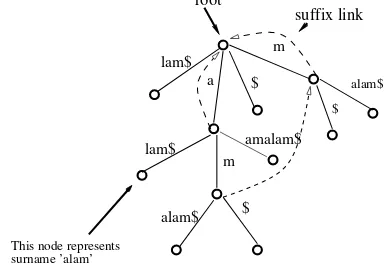
Fig. 2. Suffix Tree for an email address aamalam$ (e.g [email protected]). The surname isalam$, it is a substring in the e-mail and it has been shown at a leaf node
lam$ m
$
$ alam$
$ alam$
amalam$ lam$
m a
root
suffix link
This node represents surname ’alam’
Suffix links are used significantly to speedup the insertion of each new suffix. Each suffix shares the prefix of previous suffix and suffix links are useful to jump quickly to another node in the suffix tree and hence suffix tree construction algorithm is
linear. Each non-leaf node of a suffix tree Γ(𝑧) has a suffix
link [12] and the suffix link for a root is root itself. If the
set of all non-empty strings𝑢such that 𝑢𝑣 belongs to nodes
in the suffix tree for some string 𝑣 (possibly empty) then the
set contains all possible substrings of 𝑧$. The suffix tree data
structure is useful for computations on substrings of a string. Each leaf node represents a suffix of the given string and the dotted lines represent the suffix links.
D. Surname matching method in an e-mail address
The proposed e-mail address categorization method uses surname matching method and semantic clusters of surnames which is proposed in phase one. It constructs a suffix tree for an mail address. Further, it identifies any substring in the e-mail address that matches with a surname. If it finds a surname as a substring in the e-mail address then the e-mail address is assigned to the cluster to which the surname belongs. If it
does not find any surname then it returns a null. Similarly,
it checks for each surname and if any surname matches as a substring in the e-mail address then the e-mail address is
Algorithm 2 SurnameMatching(𝑠𝑖,Γ(𝑧),𝑚𝑎𝑡𝑐ℎ)
{𝑠𝑖 ∈ 𝒮 is a surname 𝑖in a set of surnames𝒮. Let∣𝑠𝑖∣be
number of characters in surname𝑠𝑖. LetΓ(𝑧)be suffix tree
of an e-mail address. Let𝑚𝑎𝑡𝑐ℎbe the string matched with
the surname in the e-mail address and it is empty initially.}
Let string temp=𝜙;
{let𝑇 be next child of𝑟𝑜𝑜𝑡(Γ(𝑧))and𝑇.𝑒𝑑𝑔𝑒be it’s edge.
let𝑠𝑖[𝑗] be a character at position𝑗 of string𝑠𝑖}
while𝑟𝑜𝑜𝑡(Γ(𝑧))has next childdo
k=0;
while𝑘 <∣𝑇.𝑒𝑑𝑔𝑒∣&𝑘 <∣𝑠𝑖∣ &𝑇.𝑒𝑑𝑔𝑒[𝑘]=𝑠𝑖[𝑘]do
k++;
end while
ifk ∕=0 & k=∣𝑠𝑖∣ then 𝑚𝑎𝑡𝑐ℎ=𝑚𝑎𝑡𝑐ℎ+𝑠𝑖;
return𝑚𝑎𝑡𝑐ℎ;
else
ifk ∕=0 & i=∣𝑇.𝑒𝑑𝑔𝑒∣ then
{let𝑠𝑖[𝑙, 𝑚]be a substring between position 𝑙 to𝑚
of𝑠𝑖}
𝑚𝑎𝑡𝑐ℎ=𝑚𝑎𝑡𝑐ℎ+𝑠𝑖[0, k];
𝑠𝑖=𝑠𝑖[k+1,length(𝑠𝑖)];
return SurnameMatching(𝑠𝑖,𝑇,𝑚𝑎𝑡𝑐ℎ);
else
return temp;
end if end if end while
return temp;
assigned to the cluster to which the surname belongs. Since the e-mail address is represented in a compact trie of suffixes, the proposed method is a fast one which verifies against all surnames to identify which surname is present as substring in it. If there are two surnames present as substrings in an e-mail address then it is categorized into any one of the two surname’s clusters. In general, it is unusual, however, in such cases it categorizes the e-mail address into the cluster of surname that occurs first.
Surname matching method in an e-mail address identifies whether or not the surname present as substring in the
e-mail address. The algorithmSurnameMatchingtakes surname
𝑠𝑖, suffix tree of an e-mail address Γ(𝑧), and empty string
match which represents the matching part of surname in the
e-mail address. TheSurnameMatchingalgorithm compares the
surname𝑠𝑖with the string associated to the edge of each child
of the root node. If the surname𝑠𝑖matches with prefix of the
edge then it returns surname which is identified in the e-mail
address. If there is no edge that matches with the prefix of𝑠𝑖
then it returns a null (It says there is no substring present).
Otherwise, if a prefix of surname𝑠𝑖is matched then the prefix
is copied into the match string, eliminates the prefix from
surname, and callsSurnameMatching algorithm at child node
[image:5.612.76.269.279.415.2]the e-mail address recursively.The detailed algorithm is given in 2 .
Figure 2 denotes the suffix tree for an e-mail address
aamalam$andalam$is the surname. Given a surname𝑠𝑖and
a suffix tree Γ(𝑧)where𝑧 is an e-mail address, the proposed
method finds weather 𝑠𝑖 is a substring or not in𝑂(∣𝑠𝑖∣)time.
In the example, the edge ’a’ is matched with the prefix of
surnamealam$ and the algorithm finds a child node attached
to’a’and traverses that child node. It finds the edgelam$that
matches with the remaining characters of the surname (i.e.,
lam$) and hence assigns the cluster to which the surname
belongs. If there are 𝑚 surnames then the time complexity
of the proposed method to categorize an e-mail address is
𝑂(𝑚×max{∣𝑠𝑖∣}𝑚𝑖=1).
IV. EXPERIMENTALRESULTS
This section describes experimental results. We have two
countries names and e-mail addresses data sets, viz., India
and United Kingdom. India corpus has 17.4 million names and 14.9 million e-mail addresses collected over 277 locations
which covered 28 provinces and 6 union territories. United
Kingdom corpus has 0.924 million names and 1.048 million
e-mail addresses collected over 115 locations in United
King-dom. Location information is not used in e-mail address,
per-haps, it is used to identify semantics of surnames which in-turn used to categorize e-mail addresses. In Figures 3 and 4, the horizontal axis represents surname or e-mail address domain and vertical axis represents frequency of surnames or e-mail addresses in log scale. The frequency of 40 most frequent surnames and 40 most frequent e-mail address domains for
India and United Kingdom data sets are given in Figures 3 and 4 respectively.
In phase 1, we extracted the 500 most frequently occurring surnames which are represented in a vector space model for India and United Kingdom names data set. For India
names data set, 277 vectors were generated correspond to
277 locations and for United Kingdom names data set, 115
vectors were generated correspond to 115 locations. After applying LSA, we chose 60 dimensions for each surname in a decomposed matrix which corresponds to surnames in order to find semantic similarity among surnames and clustered them into 30 groups.
Analysis of the spatial concentration of surnames has been
developed in Great Britain [5] using the Location Quotient
(LQ) to measure the concentration of any surname at different
locations. Let 𝒫𝑖𝑗 be the frequency of surname 𝑖 in location
𝑗 and let𝒬𝑖 be the frequency of surname 𝑖inGreat Britain.
Let𝑚be the total number of surnames then the LQ is defined
by (6)
𝐿𝑄𝑗𝑖 = 𝒫𝑗
𝑖
∑𝑚 𝑖=1𝒫𝑖𝑗
𝒬𝑖
∑𝑚 𝑖=1𝒬𝑖
(6)
For each 𝑖, we represented surname𝑖in the location𝑗 which
has maximum 𝐿𝑄𝑗𝑖 value in order to analyse the semantic
clusters of surnames.
Semantic clusters of surnames forIndianames data set and
United Kingdomnames data set are plotted in Figure 5 and 6
respectively. We have calculated𝐿𝑄 values of each surname
at all locations and taken the location that has the maximum
𝐿𝑄value2. For a surname, if the𝐿𝑄value in a location is a
maximum means the surname concentration in that location is the highest. Also, we have eliminated a few surnames that have
relatively low maximum 𝐿𝑄 value. Hence, we have plotted
123 surnames forIndianames data set and 118 surnames for
United Kingdom names data set in which the horizontal axis represents surnames and the vertical axis represents locations where the surname concentration is a maximum. The size of
the circle represents the𝐿𝑄value and the number represents
the semantic cluster number to each surname from1 to30.
From Figure 5, it is clear that clusters 3, 6, 11, and 28 contain surnames that are each heavily concentrated in a single province. It can be observed that surnames in clusters 21, 28 belong to a single community. Many of the surnames in
cluster 29 are highly concentrated inWest Bengal and many
of the surnames in clusters 9 and 25 are highly concentrated inGoa, Maharashtra, Dadra & Nagar Haweli, Daman & Diu and Andaman & Nicobar, but are split between two clusters. Hence, it can be concluded that surnames found in cluster 9
and 25 are the result of migration betweenGoa, Maharashtra,
Dadra & Nagar Haweli, Daman & Diu and Andaman & Nicobar, but, highly concentrated in Goa.
From Figure 6, since the 𝐿𝑄values are measured at each
location and hence all clusters are heavily concentrated in two and more locations which are limited to a few locations for some clusters. For example, surnames in cluster 28 are
heavily concentrated inZetland, Belfast, andUxbridge. It can
be observed that surnames in clusters 18 and 10 belong to a single community which are heavily concentrated in a single
location,viz., Bradford and Uxbridge.
TABLE I
CATEGORIZATION OF E-MAIL ADDRESSES FORIndiaDATA SET
No E-mail address surname category
1 [email protected] chatterjee 29
2 [email protected] kataria 8
3 [email protected] bakshi 4
4 [email protected] ghosh 29
5 [email protected] mishra 12
6 [email protected] chawla 8
7 [email protected] kumar 1
8 feroj [email protected] khan 1
9 [email protected] gautam 23
In the second phase, we analysed 14.9 million e-mail addresses and found that 3.7 million e-mail addresses have 500
most frequent surnames as substrings forIndiae-mail address
data set. We categorized these 3.7 million e-mail addresses into 30 groups based on the clusters of surnames obtained in the phase 1 of the method. We analysed 1.048 million e-mail addresses and found 318,867 of e-e-mail addresses have
Fig. 3. Frequency of 40 most frequent surnames and 40 most frequent e-mail address domains forIndiadata set
256 512 1024 2048 4096 8192 16384 32768 65536 131072 262144
gmail.comyahoo.comhotmail.comyahoo.co.inrediffmail.comaol.comvsnl.comlive.comyahoo.inymail.comsify.commsn.comsancharnet.inmail.comindiatimes.comsatyam.net.inrocketmail.comgooglemail.comrediff.comgooglegroups.comfreewhole.comnic.inin.comgawab.comdataone.inbol.net.ineyepaste.comsansad.nic.inlycos.com163.comyahoomail.comsisindia.comemail.combom3.vsnl.net.injuno.combtinternet.comrogers.comaim.comwashpost.combsnl.in
Number of e-mail addresses
Domain names
Number of e-mail addresses vs damain name statistics for India data
Number of e-mail addresses in domain
32768 65536 131072 262144 524288 1.04858e+06
kumarsinghsharmaguptashahkhanjain yadavshaikhpatilpatelmishrarao prasadmehtadevidas lal joshivermareddypandeyram agarwalpal shettytiwarijadhavnair ali ahmedarorajha chandprakashsawantthakurpawarshindedesai
Number of surnames
Surnames
Surnames statistics for India data
Number of e-mail addresses in domain
Fig. 4. Frequency of 40 most frequent surnames and 40 most frequent e-mail address domains forUnited Kingdomdata set
512 1024 2048 4096 8192 16384 32768 65536 131072 262144
HOTMAIL.COMHOTMAIL.CO.UKYAHOO.CO.UKAOL.COMBTINTERNET.COMYAHOO.COMNTLWORLD.COMGMAIL.COMLIVE.CO.UKMSN.COMGOOGLEMAIL.COMBLUEYONDER.CO.UKTISCALI.CO.UKSKY.COMTALKTALK.NETFSMAIL.NETBTOPENWORLD.COMVIRGIN.NETLIVE.COMTESCO.NETTALK21.COMYMAIL.COMO2.CO.UKBTCONNECT.COMMAILINATOR.COMSUPANET.COMROCKETMAIL.COMLINEONE.NETMAILINATOR2.COMAOL.CO.UKONETEL.COMHOMECALL.CO.UKTYLDD.COMYAHOO.CO.INGMX.CO.UKWP.PLMAC.COMREDIFFMAIL.COMVIRGINMEDIA.COMGMX.COM
Number of e-mail addresses
Domain names
Number of e-mail addresses vs damain name statistics for UK data
Number of e-mail addresses in domain
1024 2048 4096 8192 16384
SMITHJONESWILLIAMSBROWNTAYLORDAVIESWILSONEVANSJOHNSONTHOMASROBERTSWRIGHTTHOMPSONWALKERROBINSONWHITEHUGHESGREENEDWARDSLEWISHALLCLARKEMARTINHARRISJACKSONWOODCLARKSCOTTTURNERMOOREPATELHILLCOOPERWARDWATSONANDERSONMORRISKINGJAMESHARRISON
Number of surnames
Surnames
Surnames statistics for UK data
Number of e-mail addresses in domain
TABLE III
NUMBER OF E-MAIL ADDRESSES CATEGORIZED INTO DIFFERENT GROUPS FORIndiaANDUnited KingdomDATA SETS
CNo Country Name
India United Kingdom
1 403485 34022
2 132674 35843
3 75559 5094
4 249669 18088
5 52414 27827
6 12742 4093
7 28689 829
8 117376 13908
9 94766 13245
10 35499 1439
CNo Country Name
India United Kingdom
11 35941 16833
12 109691 501
13 133299 3814
14 96657 14422
15 21952 227
16 407543 9003
17 103426 5152
18 82564 9655
19 19912 9827
20 602131 16347
CNo Country Name
India United Kingdom
21 99292 886
22 60759 2969
23 79369 32415
24 39220 297
25 56875 13942
26 16194 133
27 37509 8796
28 70889 13611
29 475388 4892
30 38975 757
500 most frequent surnames as substrings forUnited Kingdom
e-mail address data set. Table I and II present the sample results of 9 e-mail addresses and their categories based on
the semantics of their parent surnames for India andUnited
Kingdomdata sets respectively. For example, e-mail addresses
1 and 4 suggest surnameschatterjee, ghoshrespectively which
belong to the same cluster 29 and hence these two e-mail addresses are assigned to group 29. Similarly, we can see that e-mail address 7 and 8 assigned to group 1. Table III presents the categorization of 3.7 million and 318,867 of
e-mail addresses for India and United Kingdom data sets
respectively and the number of e-mail addresses belonging to each category is presented.
TABLE II
CATEGORIZATION OF E-MAIL ADDRESSES FORUnited KingdomDATA SET
No E-mail address surname category
1 [email protected] middleton 1
2 [email protected] curtis 11
3 [email protected] francis 11
4 [email protected] bates 1
5 [email protected] george 23
6 [email protected] singh 30
7 [email protected] burton 23
8 [email protected] kaur 30
9 [email protected] jones 2
V. CONCLUSION AND FUTURE WORK
Fig. 5. Semantics of Surnames for India Data set A) Surnames from 1 to 62, B) Surnames from 63 to 123 BIHAR JHARKAHNDASSAM UTTARANCHAL JAMMUANDKASHMIR MANIPUR LAKSHDWEEP ANDAMANNICOBAR GUJRAT PUNJAB RAJASTHAN MEGHALAYAORISSA CHHATTISGARH HIMACHALPRADESHSIKKIM GOA DAMANDIU MADHYAPRADESH TRIPURA SIN HA RAN JA N KU M AR I AK HTA R IQ BA L KA
UGRILLMAH AJA N KH AN DELW AL PA REE K M EEN A BH
ARTAIN A KA
UDLHAR SA
HWUALIAKAUSH AL SO
OD NAN
DA NAIKKA
MA T FE RN AN DE S DIASPE
REIR A RO DR IG UES SH ETY E PE DN EK AR SA HO O M OH AN TY SW AIN RO UT M ALLIC K NA YA K DAS H PA TR A JE
NMAOH AP ATR A PR AD HA N PA ND A BE HE RA PA TN AIK TA NE JA SA CH DEV LADPA TE L PR AJAP AT I RAISH RIV AS TA VA M ATH UR CH OU HAN PA NW AR RA TH OR E DEV I SA HAN I DA
SNATHGOSW AM I ISLA M SAR MA CH OU DH UR Y DU TTA Surnames A) Semantics of surnames from 1 to 62
Surname concentration with cluster label
1 1 1 1 1 2 2 2 3 3 3
4 4 4 4
4
4 4 4
4
6 6 6 6 6 6 6 6
7 7 7 7 7 7 7 7 7 7 7
7 7 7
8 8 9 11 11 12 12 14 14 14 14 16 16 17 17
17 17 17 17 17
ASSAM UTTARANCHAL UTTARPRADESHMANIPUR LAKSHDWEEP ANDAMANNICOBAR GUJRAT GOA WESTBENGALTRIPURA MIZORAM NAGALAND PONDICHERRYKERALA RAH MAN RAW AT NEG I TH
ABISPAHT PA
NTNATH AN SU ND AR AM AH AM ED SH AN MU GA M SE
KARCHAN DR AN KAN NA N PA
UALNTO NY JO
HVANRG HE
SE JAN
I DA
VBHEAVS AR RA
VPALARM AR PA ND YA SH EKA R SO
UTHZAOM AS MA TH EW AB RAH AM GEO RG E JA CO B JO SE PH JO
SEROY SA RKA R CH AK RAB OR TY DE
YDEBBHATTAC HA
RJEE SA
HAMAJU MD ER DAT TA KARGH OSH BIS W AS CH OW DH UR Y MITR A SH
AKUWND U BH ATTAC HA RY A BA
SUDASG UPTA BO
SSEENG UP
TA GU
HA SE
NBANER JE E MU KH ER JEE CH ATTE RJE E GAN GU LY MO ND AL SR IV AS TA VA Surnames B) Semantics of surnames from 63 to 123
Surname concentration with cluster label
17 19 19 19 19 19 20 20 20 20 20 20 20 21
21 21 21
22 22 22 22 22 22
24 25
28 28 28 28 28 28 28
29 29 29 29 29 29 29 29 29 29
29 29 29 29 29 29 29 29 29 29 29 29 29 29 29 29 29 29
30
the e-mail address of an identifiable individuals. In this paper, we have analysed statistical relationships among surnames and clustered them into several groups using a vector space model in the first phase. We used latent semantic analyses to identify semantic similarity among surnames and used the average-link clustering method to allocate surnames between 30 clusters. In the second phase, the categorization of an e-mail address has been carried out. If the e-mail address contains a surname identifiable as a substring and can thus be assigned to one of the surname clusters. This is done efficiently by using the suffix tree of an e-mail address.
Through the experimental evaluations it is shown here that the surnames present as substring in an e-mail address can be retrieved which can be useful in the future to link individuals multiple digital identities to their physical identities. The e-mail addresses can then be assigned to locations because the geographic distributions of most surnames are far from
random. From India and United Kingdom data sets, this is
clearly the case from the results of our analysis of the 500 most frequently occurring surnames and the assignment of 3.7 million and 318,867 corresponding e-mail addresses into 30 groups for two data sets.
The future directions of this work will include i) finding an optimal number of clusters using the average-link clustering method; and ii) developing an efficient and fast approach for e-mail address database mining in order to find frequent sub-patterns that occur in the e-mail addresses.
ACKNOWLEDGEMENTS
Fig. 6. Semantics of Surnames for UK Data set A) Surnames from 1 to 59, B) Surnames from 60 to 118 ZETLAND CARLISLE HARROGATE SUNDERLAND LLANDRINDODWELLS GALASHIELS LLANDUDNO SHREWSBURY SWANSEA HEREFORD WORCESTER KIRKWALL KILMARNOCK DUMFRIES FALKIRKANDSTIRLING KIRKCALDY HARROW PAISLEY OUTERHEBRIDES BELFAST MOTHERWELL INVERNESS HALIFAX W ILLIA MS ON HO DG SO N ATKIN SO N STEP HEN SO N SH AR P HO GG JO NE S RO BER TS HU GH ES OW EN PR ITC HAR D PAR RY PUG H DAV IES TH OM AS GR IFF ITH S REE S JO
HBNOW EN PR
ICEWATKIN S RAN DA LL HO PE FAR ME R SPEN CE M
UIRKER R BO YD CAIRN S HE ND ER SO N RO BER TSO N THO MS ON PA TE RS ON ALLA N M CIN TYR E DIC KS ON KAN E M
ILLARDOU GLA S M AX W ELL JO HN STO NE PA
RLITKTLE HO W E PA TE L M CM ILLAN OD ON NE LL M AC DO NA LD CAM ER ON SIN CLA IR DO NN ELLY M CLAU GH LIN CA M PB ELL REILLYM UR RA Y LIN DSA Y M CIN TO SH STU AR T M AR SD EN Surnames A) Semantics of surnames from 1 to 59
Surname concentration with cluster label
1 1 1 1 1 1
2 2 2 2 2 2 2
2 2
2 2 2 2
2 2 3 3 3 3 4 4 4 4 4 4 4 4 4 4 4 4 4 4 4 4 4 4 5 7 8 8 8 8 8 8 8 8 8 8 8 8 9 9 ZETLAND HARROGATE SUNDERLAND LLANDRINDODWELLSGALASHIELS KIRKWALL DUMFRIES HARROW OUTERHEBRIDESBELFAST INVERNESSHALIFAX HUDDERSFIELDDUDLEY UXBRIDGEILFORD BLACKBURNWAKEFIELD BRADFORDPRESTON ABERDEENPERTH OLDHAM SY KESCARTW
RIG HT DO DD FLEM IN G VAU GH AN PA RK ES W HITE HO USE RO BS ON DA VIS ON TU RN BU LL PA TTER SO N STO RE Y SH AR M A MALIKDO
YLE HO LD EN BLA CKB UR N HA RTLE Y HU SS AIN KH
ANMAH MO OD IQ BA L SH
AHHENR Y JO
SEPHFIELDSLATERAKHTA R PA RK IN SO N GR EEN W OO D MAC LE OD JO HN STO N BLA CK SM YTH DO HE RTY MC CAN N KU M AR DA VID SO N RITC HIE CH RIS TIE DU NC AN FO RBE S MO RR ISO N MILN E HA
YBRUC E W
ATTGRA NT RO
SFRSAS ER SU TH ER LA ND MAC KEN ZIE MA CK AY MC KE NZIE MU NR O LE
ESSCH OFIE
LD KA
URSINGH
Surnames B) Semantics of surnames from 60 to 118
Surname concentration with cluster label
9 10 10 10 11 12 12 13 13 13 13 13 15 15 16 16 16 16
16 18 18 18
21 22 22 23 23 24 25 25 26 27 27 27 27 27
27 28 28 28 28 28 28 28 28 28 28 28 28 28 28 28 28 28 28 29 29 30 30 REFERENCES
[1] A. K. Jain, M. N. Murty, and P. J. Flynn. Data clustering: a review.
ACM Computing Surveys, 31(3):264–323, 1999.
[2] C. D. Manning, and H. Schutze. Foundations of Statistical Natural Language Processing. The MIT Press, 2003.
[3] James A. Cheshire and Paul A. Longley. Identifying spatial concentra-tions of surnames. International Journal of Geographical Information Science, DOI:10.1080/13658816.2011.591291:1–17, 2011.
[4] F. Rasheed, M. Alshalalfa, and R. Alhajj. Efficient periodicity mining in time series databases using suffix trees.IEEE Transactions on Kowledge and Data Engineering, 23:79–94, 2011.
[5] J. Burt, G. Barder, and D. Rigby.Elementary statistics for geographers. Guilford Press, 2009.
[6] K. Aas and L. Eikvil. Text categorisation: A survey. InTechnical Report 941. Norwegian Computing Center, 1999.
[7] G. Lasker. Using surnames to analyse population structure. Naming, Society and Regional Identity, pages 3–24, 2002.
[8] Paul A. Longley, James A. Cheshire, and P Mateos. Creating a regional geography of britain through the spatial analysis of surnames.Geoforum, doi:10.1016, 2011.
[9] P Mateos, Paul A. Longley, and David O’Sullivan. Ethnicity and population structure in personal naming networks.PLoS ONE, 6(9):1– 12, 2011.
[10] P Mateos, A Singleton, and P A Longley. Uncertainty in the analysis of ethnicity classifications: Issues of extent and aggregation of ethnic groups. Journal of Ethnic and Migration Studies, 35(9):1437–1460, 2009.
[11] P. Viswanath, B. K. Patra, and V. Suresh Babu. Document clustering methods: Recent trends along with some efficient and fast approaches. In
Handbook of Research on Text and Web Mining Technologies, volume 1, pages 181–188. IGI Global, 2008.
[12] R. Giegerich and S. Kurtz. From ukkonen to mccreight and weiner: A unifying view of linear-time suffix tree construction. Algorithmica, 19:331–353, 1997.
[13] A Rodriguez-Larralde, A. Pavesi, G. Siri, and I. Barrai. Isonamy and the genetic structure of sicily. Journal of Biosocial Science, 26:9–24, 1994.
[14] Fabrizio Sebastiani. Machine learning in automated text categorization.
ACM Computing Surveys, 34(1):1 – 47, 2002.
[15] T. K. Landauer, P. Foltz, and D. Laham. An introduction to latent semantic analysis. Discourse Processes, 25:259–284, 1998.