City, University of London Institutional Repository
Citation:
Press, C., Berlot, E., Bird, G., Ivry, R. and Cook, R. (2014). Moving time: The influence of action on duration perception. JOURNAL OF EXPERIMENTAL PSYCHOLOGY-GENERAL, 143(5), pp. 1787-1793. doi: 10.1037/a0037650This is the accepted version of the paper.
This version of the publication may differ from the final published
version.
Permanent repository link:
http://openaccess.city.ac.uk/4541/Link to published version:
http://dx.doi.org/10.1037/a0037650Copyright and reuse: City Research Online aims to make research
outputs of City, University of London available to a wider audience.
Copyright and Moral Rights remain with the author(s) and/or copyright
holders. URLs from City Research Online may be freely distributed and
linked to.
City Research Online: http://openaccess.city.ac.uk/ [email protected]
In press at Journal of Experimental Psychology: General
1
2
Moving time: The influence of action on duration perception
3
4
Clare Press1*, Eva Berlot2, Geoff Bird3, Richard Ivry4, and Richard Cook5 5
6
* Corresponding author
7
Phone: (+44) 20 3073 8007
8
Email: [email protected]
9
10
1Department of Psychological Sciences, Birkbeck, University of London, 11
Malet Street, London, UK
12
2Division of Psychology and Language Sciences, UCL, Bedford Way, London, UK 13
3MRC Social, Genetic, and Developmental Psychiatry Centre, Institute of Psychiatry, De 14
Crespigny Park, London, UK
15
4Department of Psychology, UC Berkeley, Tolman Hall, Berkeley, US. 16
5Department of Psychology, City University London, 17
Whiskin Street, London, UK
18
19
Word count (excl. title, references, affiliations, acknowledgments, figures, incl. abstract):
20
2997
21
22
Abstract
24
Perceiving the sensory consequences of action accurately is essential for appropriate
25
interaction with our physical and social environments. Prediction mechanisms are
26
considered necessary for fine-tuned sensory control of action, yet paradoxically may
27
distort perception. Here we examine this paradox by addressing how movement
28
influences the perceived duration of sensory outcomes congruent with action.
29
Experiment 1 required participants to make judgments about the duration of vibrations
30
applied to a moving or stationary finger. In Experiments 2 and 3, participants judged
31
observed finger movements, congruent or incongruent with their own actions. In all
32
experiments, target events were perceived as longer when congruent with movement.
33
Interestingly, this temporal dilation did not differ as a function of stimulus perspective
34
(first or third person) or spatial location. We propose that this bias may reflect the
35
operation of an adaptive mechanism for sensorimotor selection and control that
pre-36
activates anticipated outcomes of action. The bias itself may have surprising
37
implications both for action control and perception of others - we may be in contact
38
with grasped objects for less time than we realize and others’ reactions to us may be
39
briefer than we believe.
40
41
Keywords: Motor Processes, Perceptual Motor Coordination, Time Perception, Social
42
Perception
43
Introduction
45
To interact appropriately with physical and social environments, actors must predict
46
and evaluate the sensory consequences of their actions. We select actions based on their
47
predicted outcomes (Greenwald, 1970; Hommel, Müsseler, Aschersleben, & Prinz,
48
2001), and when the experienced sensory information deviates from our prediction,
49
corrective adjustments can be made ensuring successful execution. For example, when
50
picking up a cup of tea, the motor commands generated result in both visual (e.g., sight
51
of grasping and lifting) and tactile (e.g., pressure on the fingertips) sensory
52
consequences. If the actual feedback differs from the anticipated sensory outcomes,
53
rapid corrective actions can be executed to avoid spillage. Similarly, when interacting
54
with others, rapid response prediction and error correction may facilitate smooth social
55
interactions (Wolpert, Doya, & Kawato, 2003).
56
57
Successful interaction with the environment requires perception not only of the nature
58
of our action outcomes (e.g., somatosensation on the fingertips during grasping), but
59
also crucially, the onset and duration of those outcomes. We are sensitive both to the
60
‘what’ and ‘when’ of sensory predictions (Blakemore, Frith, & Wolpert, 1999;
61
Blakemore, Wolpert, & Frith, 1998; Christensen, Ilg, & Giese, 2011; Fagioli, Hommel, &
62
Schubotz, 2007; Hommel, 2010; Lee, Young, Reddish, Lough, & Clayton, 1983; Schubotz,
63
2007). For example, lifting the teacup from a saucer requires an anticipatory response
64
to maintain postural stability (Diedrichsen, Verstynen, Hon, Lehman, & Ivry, 2003;
65
Dufossé, Hugon, & Massion, 1985). Similarly, anticipating the duration of the lift phase is
66
essential for coordinating hand and mouth gestures, and when shaking someone’s hand,
67
contact must be made for an appropriate length of time, neither too long, nor too short,
68
to convey the intended social message.
69
70
While the preceding examples underscore the importance of temporal information in
71
the generation and perception of sensory expectancies, duration perception is
72
frequently distorted. For example, perceived motion of upright point light walkers is
73
temporally dilated relative to inverted walkers (Wang & Jiang, 2012; see also Gavazzi,
74
Bisio, & Pozzo, 2013).The present experiments examine how movement influences the
75
perceived duration of sensory outcomes of action. Sensory prediction mechanisms
76
essential for action selection and fine-tuned control may, paradoxically, distort the
perceived duration of outcomes, with consequences for action-control and perception in
78
a variety of contexts. In Experiment 1, participants were required to perform a lifting
79
movement with either their index or middle finger. A short target vibratory tactile
80
stimulus was presented to the moving or stationary finger, followed by a second
81
reference vibration. Participants judged which was of longer duration, allowing us to
82
determine how action influences duration perception. Experiments 2-4 asked whether
83
action influences the perceived duration of visual events in a comparable manner.
84
85
Experiment 1
86
Sixteen right-handed, healthy adults (12 male) with a mean age of 29.3 years (SEM =
87
2.5) participated in the experiment. Three were replacements for participants who
88
could not perform the perceptual discrimination (psychometric functions could not be
89
modeled or their point of subjective equivalence (PSE) fell outside the range of
90
presented stimuli). All experiments were undertaken in accordance with the 1964
91
Declaration of Helsinki.
92
93
The experiment was conducted in MATLAB using the Cogent toolboxi. Two 5V solenoids, 94
each driving a metal rod with a blunt conical tip (diameter ≈ 1.5 mm, skin indentation ≈
95
1 mm), were attached to the distal phalange (ventral surface) of the index and middle
96
fingers on the right hand. Participants held down two keys on the keyboard until an
97
imperative cue instructed them to lift either their index (‘I’) or middle (‘M’) finger. They
98
were instructed to make large, rapid, single-movement lifts. Their response hand was
99
visually occluded. Approximately 10 ms after the cued finger was lifted, a target
100
vibration lasting for one of seven durations (104 – 296 ms, 32 ms steps) was applied to
101
the moving (‘congruent’) or stationary (‘incongruent’) finger (see Fig. 1). After an
inter-102
stimulus interval (ISI; 300 – 500 ms), a 200 ms reference vibration was applied to the
103
same finger. Both vibratory stimuli were presented at 62.5 Hz.
104
105
Participants judged whether the target or reference vibration was longer, responding
106
with a button press made with their left hand. Following this response, they returned
107
the lifted finger to the start position. The next trial started after 2000 ms. There were
108
280 trials; 140 in which stimuli were applied to the congruent finger and 140 where
they were applied to the incongruent finger. Trial type was randomized and
110
participants completed 8 practice trials.
111
112
To estimate psychometric functions, the responses for each individual were modeled by
113
fitting cumulative Gaussians, and associated pDev statistics were calculated to establish
114
the goodness-of-fit of each function (Palamedes toolbox, Kingdom & Prins, 2010). This
115
procedure was performed separately for congruent and incongruent response data. In
116
each condition, bias was inferred from the PSE and precision from the difference
117
threshold (Fig. 2).
118
119
The participants were more precise in their judgments when the vibratory stimuli were
120
applied to the congruent relative to incongruent finger (t(15) = 2.3, p < 0.05, η² = 0.26;
121
Table 1). There was also an effect on PSE: Target events were judged longer when the
122
stimulus was applied to the congruent relative to incongruent finger (t(15) = 2.6, p <
123
0.02, η² = 0.32; Fig. 2 & Supplementary Fig. 1). In sum, tactile events presented to a
124
moving effector are perceived to be longer and are judged more consistently than when
125
that effector is stationary.
126
127
Experiment 2
128
If prediction mechanisms operate in social contexts, we may predict and evaluate
129
sensation not only related to our own actions, but also actions produced by interactants
130
(Wolpert et al., 2003). As such, we should observe comparable action-related predictive
131
modulation with visual action stimulus events. Additionally, such mechanisms should
132
operate across perspectives given the range of viewpoints from which others’ actions
133
are observed. Experiment 2 therefore examined duration perception of congruent and
134
incongruent visual events during action, across stimuli presented from first and third
135
person perspectivesii. 136
137
Sixteen right-handed, healthy adults (12 male) with a mean age of 25.9 years (SEM =
138
1.9) participated in the experiment. Five were replacements for participants who could
139
not perform the discrimination. Unless otherwise stated, procedural information
140
already outlined in Experiment 1 is identical in this, and all subsequent, experiments.
141
Participants compared the duration of two finger movements simulated visually by
gestures of an avatar hand. At the start of the trial, the avatar hand was presented in a
143
neutral position on the monitor (Fig. 1; screen refresh rate = 85 Hz). An imperative cue
144
(‘1’ or ‘2’) was presented between the index and middle fingers. When participants
145
lifted the cued finger, the neutral hand image was immediately replaced (within the
146
constraints of the refresh rate) by one depicting the avatar hand performing either an
147
index or middle finger lift for 120 - 480 ms (7 levels; 60 ms steps). This resulted in
148
apparent motion of the avatar’s finger approximately synchronized with the
149
participant’s action. At the offset of the target event, the avatar hand resumed the
150
neutral position for an ISI of 300 - 500 ms, followed by a second image of the same lifted
151
finger for a reference duration of 300 ms, and then the neutral image again (300 ms).
152
Participants judged which lift lasted longer. The range of durations was chosen to match
153
discrimination performance in Experiment 1.
154
155
There were four block types. In spatially aligned first person perspective (1PP) blocks,
156
participants viewed a right avatar hand with fingers aligned in the horizontal plane with
157
their own right hand (Fig. 1). In spatially aligned third person perspective (3PP) blocks,
158
the avatar hand was rotated about the horizontal axis (therefore presenting a left hand).
159
The remaining blocks consisted of these stimuli flipped on a vertical axis, such that
160
corresponding finger movements did not match in spatial location (necessitating left
161
hand for 1PP and right hand for 3PP). These blocks thereby controlled for the spatial
162
location of finger movement (Press, Gherri, Heyes, & Eimer, 2010). The four blocks each
163
comprised 140 trials and were completed in a counterbalanced order.
164
165
The precision and PSE distributions were analyzed using separate three-way ANOVAs,
166
with factors of movement congruency (avatar and participant moved the
167
congruent/incongruent finger), location (avatar and participant finger movements
168
made in aligned/misaligned horizontal locations), and perspective (1PP or 3PP). No
169
precision effects were observed (all Fs < 2.1, all ps > 0.17; Table 1). However, as in
170
Experiment 1, target events were perceived as longer when the avatar and participant
171
moved the same finger (F(1,15) = 5.3, p < 0.04, η² = 0.26). There were no other main
172
effects or interactions (all Fs < 2.5, all ps > 0.14). These results indicate a bias to judge
173
target events as longer when observed actions are congruent with self-generated
174
actions, regardless of whether stimuli are observed from first or third person
perspectives. Notably these effects reflect congruency between effectors (same finger)
176
rather than spatial location.
177
178
Experiment 3
179
Experiment 2 suggests that action performance influences the perceived duration of
180
effector-congruent visual events. However, it is possible that, despite informing
181
participants that the reference event was always presented for the same length of time,
182
participants’ actions might have influenced the perceived duration of the reference
183
rather than the target event. To control for this possibility, the reference event was
184
modified in Experiment 3. Rather than define the reference duration by a second avatar
185
movement, this interval was defined by the stimulus duration of a rectangle, a neutral
186
stimulus selected because it exhibited no congruency relationship with the fingers.
187
188
Sixteen right-handed, healthy adults (11 male) with a mean age of 28.3 years (SEM =
189
2.2) participated in the experiment. Three were replacements for participants who
190
could not perform the discrimination. The imperative cue (‘I’ or ‘M’) was presented
191
between the index and middle fingers of the observed hand. When participants lifted
192
the cued finger, the neutral hand image was immediately replaced by an image of a hand
193
with a lifted index or middle finger for 150 – 900 ms (7 levels; 125 ms steps). Following
194
an ISI of 300 - 500 ms, a rectangle was presented for a reference interval of 525 ms. The
195
color, luminance, and aspect ratio of the rectangle were identical to that of the avatar
196
hand. The test stimulus range was selected based on piloting to yield comparable
197
performance to that observed in Experiments 1 and 2. Participants again judged which
198
of the two intervals was longer. Given that spatial location had no impact on the effect in
199
Experiment 2, only aligned blocks were included. Participants completed 1PP and 3PP
200
blocks, each comprising 140 trials, in a counterbalanced order.
201
202
The precision analysis yielded no main effects or interactions (all Fs < 1.4, all ps > 0.25;
203
see Table 1). However, the PSE phenomenon observed in Experiments 1 and 2 was
204
replicated: Target events were perceived as longer when the observed event was
205
congruent with the participant’s action (F(1,15) = 6.5, p < 0.03, η² = 0.30; see Fig. 2). As
206
in Experiment 2, this effect did not interact with perspective (F(1,15) = 0.05, p = 0.8, η²
= 0.02). These findings demonstrate that action biases perception of the temporally
208
contiguous target event, rather than reference events presented after a delay.
209
210
Experiment 4
211
It is possible that the temporal dilation effects in Experiments 2 and 3 result from
212
attentional orienting towards the location of the congruent effector. Increased attention
213
may influence the perceived duration of events at this location irrespective of
action-214
stimulus congruency. A final experiment was conducted to test this possibility, identical
215
to Experiment 3, except that target durations were defined by the presentation of a
216
rectangle over the fingertip of the index or middle finger rather than by a finger
217
movement (see Fig. 1). If attentional orienting generates temporal dilation effects
218
irrespective of the nature of the target event, similar influences of congruency will be
219
observed.
220
221
Sixteen right-handed, healthy adults (7 male) with a mean age of 27.7 years (SEM = 1.7)
222
participated in the experiment. One was a replacement for a participant who could not
223
perform the discrimination. The precision analysis yielded no main effects or
224
interactions (all Fs < 0.7, all ps > 0.41; see Table 1). Unlike Experiments 1-3, there was
225
also no PSE effect (F(1,15) = 0.7, p = 0.42, see Fig. 2). ANOVA conducted on the PSE data
226
from both Experiments 3 and 4, with experiment as a between-subjects factor, revealed
227
a congruency × experiment interaction (F(1,30) = 6.8, p < 0.02, η² = 0.2). These results
228
argue against this attentional orienting account of the congruency-induced temporal
229
dilation.
230
231
Discussion
232
The present findings demonstrate a bias to judge sensory events as longer when
233
congruent with a concurrently performed action. This effect was found when
234
participants judged the duration of tactile vibrations applied to a moving finger, as well
235
as when assessing the duration of observed finger movementsiii. These results indicate 236
that subjective action-time can be subject to temporal dilation: Events
effector-237
congruent with performed actions are perceived as longer than events incongruent with
238
those actions.
239
These effects may be a consequence of pre-activated action expectancies during
241
selection and preparation (Greenwald, 1970; Hommel et al., 2001), whereby congruent
242
sensory events are perceived to begin before action onset. Imperfect distinctions
243
between anticipated and actual sensory consequences would cause congruent sensation
244
to be perceived as longer. In contrast, when action consequences are unexpected,
pre-245
activated outcomes differ from the actual sensory consequences and can thus be
246
discriminated. The hypothesis that duration biases result from imperfect distinctions
247
between predicted and stimulus-driven percepts is consistent with the finding that
248
imagined and perceived visual events activate common occipital representations
249
(Kosslyn et al., 1993; Albers, Kok, Toni, Dijkerman, & de Lange, 2013;see also Bueti &
250
Macaluso, 2010), and that action preparation activates representations of the
251
anticipated effects (Müsseler & Hommel, 1997; Kühn, Keizer, Rombouts, & Hommel,
252
2011). Furthermore, the idea that the perceived onset of anticipated events is shifted in
253
time is consistent with a number of temporal distortions in the action control literature.
254
For example, it has long been recognized that, when tapping to a metronome,
255
movements show a phase lead to the pacing signals (Dunlap, 1910; Bartlett & Bartlett,
256
1959). Moreover, effects resulting from action but at delay are perceived to occur
257
earlier than in reality (Haggard, 2005).
258
259
Temporal biases resulting from the prediction of congruent action consequences might
260
be expected to detract from effective action control. However, illusory biases often
261
result from the operation of adaptive mechanisms. For example, visual aftereffects,
262
defined by significant sensory distortion, are believed to be the products of ongoing
263
perceptual recalibration to ambient sensory inputs (Clifford & Rhodes, 2005; Thompson
264
& Burr, 2009; see also Yarrow, Haggard, Heal, Brown, & Rothwell, 2001). Similarly,
265
stimulus-general temporal dilation during action planning may maximize information
266
acquisition prior to movement (Hagura, Kanai, Orgs, & Haggard, 2012). Following this
267
line of reasoning, we suggest that the dilation of subjective action-time observed for
268
anticipated sensory outcomes may be indicative of an adaptive mechanism optimized
269
for online action control. Anticipation of the sensory consequences of action is essential
270
for action selection and subsequent error correction. Imperfect distinction between
271
anticipated and actual sensory outcomes may reflect exploitation of mechanisms
272
adapted for perception during action planning. While these mechanisms broadly benefit
actors, there may be surprising consequences for tightly time-locked action control and
274
social perception.For example, we may be in contact with grasped objects for less time
275
than we realize and handshakes may be briefer than we believe.
276
277
Equivalent effects when observing sensory events from first and third person
278
perspectives suggests that common mechanisms anticipate the consequences of our
279
own actions as well as the imitative reactions of others. Wolpert et al. (2003) proposed
280
that sensory prediction mechanisms for action control may also operate when
281
interacting with others, but this possibility has received little empirical investigation.
282
The present study provides support for this hypothesis, suggesting that we
283
overestimate the duration, not only of our own actions, but also others’ imitative
284
reactions. Future investigations must establish whether these effects are found when
285
other individuals react in a non-imitative, but predictable, manner; for example, when
286
dominant body postures result in complementary submissive postures of an interactant
287
(Tiedens & Fragale, 2003).
288
289
Neuropsychological and neuroimaging studies have implicated motor structures in
290
duration perception, even when action is not required. For example, the cerebellum and
291
basal ganglia are thought to play key roles in a range of temporal judgments
292
(Harrington, Haaland, & Hermanowicz, 1998; Ivry & Keele, 1989; Ivry, Spencer,
293
Zelaznik, & Diedrichsen, 2002; Koch et al., 2007). Additionally, greater activation has
294
been observed in cortical motor areas, including the supplementary motor area (SMA)
295
and dorsal premotor cortex, when judging the duration of visual events (Coull, Nazarian,
296
& Vidal, 2008; Ferrandez et al., 2003), than when making intensity or color judgments
297
about the same stimuli. These duration judgments may recruit the motor system to
298
exploit mechanisms adapted, either phylogenetically or ontogenetically (Heyes, 2003),
299
for action control.
300
Acknowledgments
302
This research was funded by a Wellcome Trust Biomedical Studentship awarded to EB
303
and CP, a Birkbeck School of Science grant awarded to CP, and an ESRC Future Research
304
Leaders grant (ES/K008226/1) awarded to RC. We are grateful to Martin Eimer for the
305
loan of solenoids.
306
References
308
309
Albers, A.M., Kok, P., Toni, I., Dijkerman, H.C., & de Lange, F.P. (2013). Shared representations for 310
working memory and mental imagery in early visual cortex. Current Biology, 23, 1-5. doi: 311
10.1016/j.cub.2013.05.06 312
Bartlett, N.R., & Bartlett, S.C. (1959). Synchronization of a motor response with an anticipated 313
sensory event. Psychological Review 66(4), 203-218. 314
Blakemore, S. J., Frith, C. D., & Wolpert, D. M. (1999). Spatio-temporal prediction modulates the 315
perception of self-produced stimuli. Journal of Cognitive Neuroscience, 11(5), 551–559. 316
Blakemore, S. J., Wolpert, D. M., & Frith, C. D. (1998). Central cancellation of self-produced tickle 317
sensation. Nature Neuroscience, 1(7), 635–640. doi:10.1038/2870 318
Bueti, D., & Macaluso, E. (2010). Auditory temporal expectations modulate activity in visual 319
cortex. NeuroImage, 51(3), 1168-1183. doi: 10.1016/j.neuroimage.2010.03.023 320
Christensen, A., Ilg, W., & Giese, M. A. (2011). Spatiotemporal Tuning of the Facilitation of 321
Biological Motion Perception by Concurrent Motor Execution. Journal of Neuroscience, 322
31(9), 3493–3499. doi:10.1523/JNEUROSCI.4277-10.2011 323
Clifford, C. W. G., & Rhodes, G. (2005). Fitting the mind to the world: Adaptation and after-effects
324
in high-level vision. Oxford University Press.
325
Coull, J. T., Nazarian, B., & Vidal, F. (2008). Timing, storage, and comparison of stimulus duration 326
engage discrete anatomical components of a perceptual timing network. Journal of Cognitive
327
Neuroscience, 20(12), 2185–2197. doi:10.1162/jocn.2008.20153
328
Diedrichsen, J., Verstynen, T., Hon, A., Lehman, S. L., & Ivry, R. B. (2003). Anticipatory 329
adjustments in the unloading task: Is an efference copy necessary for learning? 330
Experimental Brain Research, 148(2), 272–276. doi:10.1007/s00221-002-1318-z
331
Dufossé, M., Hugon, M., & Massion, J. (1985). Postural forearm changes induced by predictable in 332
time or voluntary triggered unloading in man. Experimental Brain Research, 60(2), 330–334. 333
doi:10.1007/BF00235928 334
Dunlap, K. (1910). Reaction to rhythmic stimuli with attempt to synchronize. Psychological
335
Review, 17(6), 399-416.
336
Fagioli, S., Hommel, B., & Schubotz, R.I. (2007). Intentional control of attention: Action planning 337
primes action-related stimulus dimensions. Psychological Research, 71, 22-29. doi: 338
10.1007/s00426-005-0033-3. 339
Ferrandez, A. ., Hugueville, L., Lehéricy, S., Poline, J. ., Marsault, C., & Pouthas, V. (2003). Basal 340
ganglia and supplementary motor area subtend duration perception: an fMRI study. 341
NeuroImage, 19(4), 1532–1544. doi:10.1016/S1053-8119(03)00159-9
342
Gavazzi, G., Bisio, A., & Pozzo, T. (2013). Time perception of visual motion is tuned by the motor 343
representation of human actions. Scientific Reports, 3, 1168. doi: 10.1038/srep01168 344
Greenwald, A. G. (1970). Sensory feedback mechanisms in performance control: With special 345
reference to the ideo-motor mechanism. Psychological Review, 77(2), 73–99. 346
Haggard, P. (2005). Conscious intention and motor cognition. Trends in Cognitive Sciences, 9,
348
290-295. doi: 10.1016/j.tics.2005.04.012 349
Hagura, N., Kanai, R., Orgs, G., & Haggard, P. (2012) Ready steady slow: action preparation slows 350
the subjective passage of time. Proceedings of the Royal Society of London, B. 279(1746),
351
4399-4406. doi: 10.1098/rspb.2012.1339 352
Harrington, D. L., Haaland, K. Y., & Hermanowicz, N. (1998). Temporal processing in the basal 353
ganglia. Neuropsychology, 12(1), 3–12. 354
Heyes, C. (2003). Four routes of cognitive evolution. Psychological Review, 110(4), 713–727. 355
doi:10.1037/0033-295X.110.4.713 356
Hommel, B., Müsseler, J., Aschersleben, G., & Prinz, W. (2001). The Theory of Event Coding 357
(TEC): A framework for perception and action planning. Behavioral and Brain Sciences, 358
24(05), 849–878. doi:10.1017/S0140525X01000103 359
Hommel, B. (2010). Grounding attention in action control: The intentional control of selection. 360
In B.J Bruya (ed.), Effortless attention: A new perspective in the cognitive science of attention
361
and action (pp.121-140). Boston, MA: MIT Press.
362
Ivry, R. B., & Keele, S. W. (1989). Timing functions of the cerebellum. Journal of Cognitive
363
Neuroscience, 1(2), 136–152. doi:10.1162/jocn.1989.1.2.136
364
Ivry, R. B., Spencer, R. M., Zelaznik, H. N., & Diedrichsen, J. (2002). The cerebellum and event 365
timing. Annals of the New York Academy of Sciences, 978(1), 302–317. doi:10.1111/j.1749-366
6632.2002.tb07576.x 367
Kingdom, F.A.A., & Prins, N. (2010). Psychophysics: A practical introduction. London, UK: 368
Elsevier. 369
Koch, G., Oliveri, M., Torriero, S., Salerno, S., Lo Gerfo, E., & Caltagirone, C. (2007). Repetitive TMS 370
of cerebellum interferes with millisecond time processing. Experimental Brain Research,
371
179(2), 291–299. doi:10.1007/s00221-006-0791-1 372
Kosslyn, S.M., Alpert, N.M., Thompson, W.L., Maljkovic, V., Weise, S.B., Chabris, C.F., et al. (1993). 373
Visual mental imagery activates topographically organized visual cortex: PET investigations. 374
Journal of Cognitive Neuroscience, 5(3), 263-287. doi:10.1162/jocn.1993.5.3.263
375
Kühn, S., Keizer, A., Rombouts, S.A.R.B., & Hommel, B. (2011). The functional and neural 376
mechanism of action preparation: Roles of EBA and FFA in voluntary action control. Journal
377
of Cognitive Neuroscience, 23, 214-220. doi: 10.1162/jocn.2010.21418
378
Lee, D. N., Young, D. S., Reddish, P. E., Lough, S., & Clayton, T. M. H. (1983). Visual timing in 379
hitting an accelerating ball. The Quarterly Journal of Experimental Psychology Section A, 380
35(2), 333–346. doi:10.1080/14640748308402138 381
Müsseler, J., & Hommel, B. (1997). Blindness to response-compatible stimuli. Journal of
382
Experimental Psychology: Human Perception and Performance, 23, 861-872. doi:
383
10.1037/0096-1523.23.3.861 384
Press, C., Gherri, E., Heyes, C., & Eimer, M. (2010). Action preparation helps and hinders 385
perception of action. Journal of Cognitive Neuroscience, 22(10), 2198–2211. 386
Schubotz, R.I. (2007). Prediction of external events with our motor system: towards a new 388
framework. Trends in Cognitive Sciences, 11(5), 211-218. doi: 10.1016/j.tics.2007.02.006 389
Thompson, P., & Burr, D. (2009). Visual aftereffects. Current Biology, 19(1), R11–R14. 390
doi:10.1016/j.cub.2008.10.014 391
Tiedens, L.Z., & Fragale, A.R. (2003). Power moves: Complementarity in dominant and 392
submissive nonverbal behaviour. Journal of Personality and Social Psychology, 84(3),
393
558.568. doi:10.1037/0022-3514.84.3.558 394
Wang, L. & Jiang, Y. (2012). Life motion signals lengthen perceived temporal duration. 395
Proceedings of the National Academy of Sciences, 109(11), 673-677. doi:
396
10.1073/pnas.1115515109 397
Wolpert, D. M., Doya, K., & Kawato, M. (2003). A unifying computational framework for motor 398
control and social interaction. Philosophical Transactions of the Royal Society of London.
399
Series B: Biological Sciences, 358(1431), 593–602. doi:10.1098/rstb.2002.1238
400
Yarrow, K., Haggard, P., Heal, R., Brown, P., & Rothwell, J. C. (2001). Illusory perceptions of space 401
and time preserve cross-saccadic perceptual continuity. Nature, 414(6861), 302–305. 402
doi:10.1038/35104551 403
405
Figure 1. The visual stimuli (created using Smith Micro Software’s Poser 7.0) and timecourse for the
action-406
related events in each of the four experiments. Timecourse stimuli depict the avatar hand in first person
407
perspective.
408
410
Figure 2. Top panel: Demonstration of how the PSE was calculated with psychometric functions for an
411
example participant, with stimuli congruent and incongruent with moving fingers. The PSE describes the
412
point where participants judge the target and reference events as having equal duration. Judgment precision
413
was inferred from the standard deviation of the Gaussian distribution which best fits the data; it pertains to
414
the inverse of the slope, and lower thresholds reflect more consistent categorizations, thereby indicating
415
better performance. Other panels: Mean PSEs for stimuli congruent and incongruent with moving fingers, for
416
all experiments and perspectives. 1PP = first person perspective, 3PP = third person perspective. Error bars
417
represent the standard error of the mean.
420
Congruent Incongruent
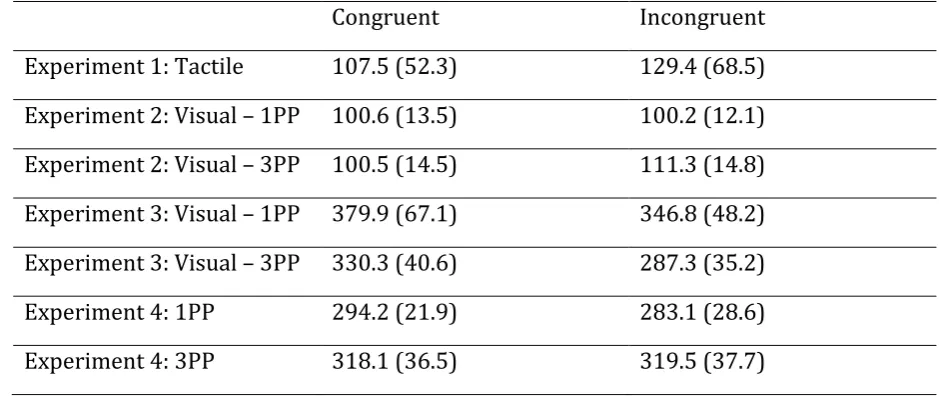
Experiment 1: Tactile 107.5 (52.3) 129.4 (68.5)
Experiment 2: Visual – 1PP 100.6 (13.5) 100.2 (12.1)
Experiment 2: Visual – 3PP 100.5 (14.5) 111.3 (14.8)
Experiment 3: Visual – 1PP 379.9 (67.1) 346.8 (48.2)
Experiment 3: Visual – 3PP 330.3 (40.6) 287.3 (35.2)
Experiment 4: 1PP 294.2 (21.9) 283.1 (28.6)
Experiment 4: 3PP 318.1 (36.5) 319.5 (37.7)
Table 1. Mean precision estimates for stimuli congruent and incongruent with moving fingers, shown
421
separately for each experiment and perspective. Standard error of the mean is displayed in brackets in each
422
condition. 1PP = first person perspective, 3PP = third person perspective.
423
424
[image:18.595.60.530.97.295.2]FOOTNOTES
426
i
Developed by the Cogent 2000 team at the FIL and the ICN and Cogent Graphics
427
developed by John Romaya at the LON at the Wellcome Trust Centre for Neuroimaging.
428
ii
Examining congruency-induced temporal dilation in the visual modality also permits
429
better isolation of perceptual effects from the direct effects of action performance.
430
Visually-defined congruency is eliminated when the hands are occluded. It is not
431
possible to eliminate tactile-defined congruency without some form of sensory
432
deafferentation.
433
iii
This similarity was observed across experiments despite changes in the range of
434
durations presented. It is worth noting that piloting indicated these shifts in duration to
435
be necessary for two reasons. First, the apparent motion in Experiments 2 and 3 did not
436
appear natural with short durations. Second, the duration judgments became more
437
difficult across experiments, moving from punctate touch to apparent motion in vision
438
in Experiment 2, and changing the nature of the reference relative to the target in
439
Experiment 3. Given these changes to the durations presented in Experiments 1-3, it is
440
difficult to draw conclusions concerning the presence of a precision effect in Experiment
441
1 and its absence in Experiments 2 and 3.
442
443