This is a repository copy of
Robustness Evaluation of Internal Model Principle-based
Controller in a Magnetically Actuated Surgical System
.
White Rose Research Online URL for this paper:
http://eprints.whiterose.ac.uk/143250/
Version: Accepted Version
Proceedings Paper:
Leong, F, Mohammadi, A, Tan, Y et al. (3 more authors) (2019) Robustness Evaluation of
Internal Model Principle-based Controller in a Magnetically Actuated Surgical System. In:
Proceedings of the 2018 Australian & New Zealand Control Conference. ANZCC 2018:
Australian & New Zealand Control Conference, 07-08 Dec 2018, Melbourne, VIC,
Australia. IEEE , pp. 257-262. ISBN 978-1-5386-6617-3
https://doi.org/10.1109/ANZCC.2018.8606572
© 2018 IEEE. This is an author produced version of a paper published in Proceedings of
the 2018 Australian & New Zealand Control Conference. Personal use of this material is
permitted. Permission from IEEE must be obtained for all other uses, in any current or
future media, including reprinting/republishing this material for advertising or promotional
purposes, creating new collective works, for resale or redistribution to servers or lists, or
reuse of any copyrighted component of this work in other works. Uploaded in accordance
with the publisher's self-archiving policy.
[email protected] https://eprints.whiterose.ac.uk/
Reuse
Items deposited in White Rose Research Online are protected by copyright, with all rights reserved unless indicated otherwise. They may be downloaded and/or printed for private study, or other acts as permitted by national copyright laws. The publisher or other rights holders may allow further reproduction and re-use of the full text version. This is indicated by the licence information on the White Rose Research Online record for the item.
Takedown
If you consider content in White Rose Research Online to be in breach of UK law, please notify us by
Robustness Evaluation of Internal Model Principle-based Controller in
a Magnetically Actuated Surgical System
F Leong
1, A Mohammadi
1, Y Tan
1, D Thiruchelvam
2, P Valdastri
3, D Oetomo
1Abstract— The local magnetic actuation (LMA) surgical method has gained popularity among medical practitioners and researchers in the field of abdominal surgery. The procedure requires the use of magnets on both sides of the abdominal cavity to anchor devices onto abdominal wall while magnetic sources on the external side generate actuation signals to drive robotic manipulators inside the cavity. Due to the transmission of magnetic fields across the abdominal wall and the interactions among multiple LMA units within the vicinity, magnetic interference will affect the performance of the intended rotor driving the degree-of-freedom (DOF) on the robotic manipulator. Since the disturbances due to the neighbouring magnetic sources are found to be sinusoidal signals with a known frequency, they can be rejected by using the internal model principle (IMP) technique. The disturbance due to the abdominal wall tissue dynamics during magnetic actuation causes oscillations on the internally anchored surgical device, which has generally been ignored in the implementation of LMA application. The focus of this paper is to provide a model that incorporates tissue dynamics in the LMA system. Moreover, the robustness of IMP controller in the presence of tissue dynamics is discussed. Simulations are performed and the results demonstrate effective rejection of both disturbances when they are taken into account in the IMP disturbance model.
I. INTRODUCTION
Recently, local magnetic actuation (LMA) techniques for abdominal surgery have been studied for its potential in replacing rigid mechanical transmission on conventional laparoscopic devices with magnetic linkages [1]. As illus-trated in Figure 1, the concept of magnetic coupling is used to anchor the internal devices onto the abdominal wall within the insufflated abdominal cavity while still allow the positioning of the anchoring location within the abdominal cavity [2], [3]. Actuation can also be produced by generating the required actuating magnetic field through sources external to the abdominal cavity, to regulate the
1 Florence Leong, Alireza Mohammadi, Ying Tan and
Denny Oetomo are with the Melbourne School of Engineering,
The University of Melbourne, 3010 Victoria, Australia.
{florence.leong,alirezam,yingt,doetomo}@unimelb.edu.au
2Dhan Thiruchelvam is with the Department of Surgery, University of
Melbourne at St Vincent’s Hospital
3 Pietro Valdastri is with the School of Electronic and Electrical
Engineering, University of [email protected]
[image:2.612.315.555.354.506.2]motion and torque of a permanent magnet rotor on the internal device (inside the abdominal cavity) [4], [5]. The resulting actuation of each of the permanent magnet rotor is used to drive individual degrees of freedom in an otherwise passive surgical (robotic) mechanism inside the abdominal cavity [6]. As each external source of magnetic field is used only to actuate an internal rotor directly on the other side of the abdominal wall (see Fig. 1), this is then referred to as Local Magnetic Actuation (LMA) approach, as opposed to using a global magnetic field such as seen in a magnetic resonance imagining (MRI) machine, Octomag [7] and the Stereotaxis system [8].
Fig. 1: An illustration of a two-DOF LMA system actuating a robotic surgical manipulation. The rotors, placed on the inside of the abdominal wall, are driven by electromagnet stators 1 and 2 located external to the abdominal wall, respectively. These stators are driven by the actuating commands,u1 and u2 which provide magnetic fieldsB1 and B2 across the abdominal wall to produce rotational motions on rotorsR1 andR2, respectively. Disturbance happens whenB1also affectsR2 andB2 affectsR1.
It is noted that there is a controller for each individual LMA set, which is usually a simple PI controller [5], [9]. The design of PI controller is usually model-based without taking disturbances into consideration. There are a few input disturbances coming from the mechanical setting of LMA. These disturbances results from unintended dynamics excited by the actuation command of the system.
Each stator-rotor pair is used to drive one degree-of-freedom (DOF) on a robotic surgical manipulator. For many surgical tasks, multi-DOF robotic manipulation is required, hence requiring multiple LMA units to be employed. The presence of multiple sources of (actuation) magnetic field within the vicinity of each other (the overall system must fit on a hu-man subject’s abdomen) causes a crosstalk of magnetic field intended for one rotor to disturb other rotors in its vicinity [10]. As these disturbances are observed to have the form of sine waves with known frequency, the internal model principle (IMP) based technique was used to eliminate the effect of such disturbances [11].
The second disturbance is due to the unmodelled dynam-ics of the abdominal wall, to which the LMA system is anchored, magnetically to an external set of magnet (see Figure 1). It is often assumed that the LMA is anchored onto a stationary / rigid platform, however it is clear that the ab-dominal wall tissue is of viscoelastic nature [12]. It is noted that the magnetic field from the external actuator produces not only the intended moment to rotate the internal rotor, but also produces forces on the rotor in other degrees of freedom, which forms the disturbance forces. The actuation magnetic field is sinusoidal in nature (in order to produce cyclical motion of the rotor) results in sinusoidal behaviour of the disturbance forces, hence creating an oscillation on the internal LMA platform as the rotor is anchored onto the non-rigid abdominal wall.
With the knowledge that the disturbance due to the tissue dynamics exists, the focus of this paper is to investigate the robustness of the proposed IMP with respect to this disturbances. The contribution of this paper is two-fold. The first one is that the tissue dynamics is incorporated into the model of IMP to capture the influence of the abdominal wall. Secondly, the evaluation of the proposed IMP when taking into account the tissue dynamics using numerical simulations.
The remainder of the paper is organised as follows. Section II describes the model of the LMA system in the presence of the disturbances. Controllers design including IMP based design is revisited in Section III. Section IV presented the numerical simulations performed on the LMA system, demonstrating the efficacy of the IMP controller with discussions in Section V. The study is then concluded in Section VI with some recommendations for future works.
II. SYSTEMMODELLING IN THEPRESENCE OF
DISTURBANCES
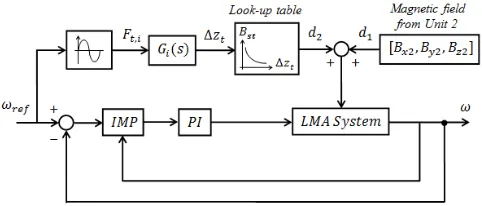
The block diagram of LMA control system in the presence of two disturbances can be seen in Figure 2. The first disturbance d1(t) exists due to the neighbouring LMA
unit while the second disturbance d2(t) comes from the
tissue dynamics during magnetic actuation from the external magnetic sources.
A. LMA system
The model of the LMA system has been identified in [11] as a linear-time-invariant system (A,B,C) and can be
represented in the state space form:
˙
x=Ax+Bu
y=Cx (1)
where statex=ω and the system input, u=iqre f, and the
following state space matrices:
A=−
b J, B=
ψR
J , C=1. (2)
where ω denotes the angular velocity of the rotor, iqre f is
the referenceiqcurrent to the LMA system,Jandbare the total moment of inertia and the friction coefficient of the rotor respectively, andψRis the magnetic flux at the rotor.
B. Disturbance due to neighbouring LMA unit, d1
As noted in the introduction, there are two main sys-tematic disturbances that needs to be handled in an LMA system. These disturbances occur as an inherent part of the LMA approach. The first is the disturbance is generated due to neighbouring unit, i.e. LMA Unit 2, known as d1.
In [11], this disturbance was taken into consideration for a multi-DOF LMA configuration because of the resultant magnetic interaction at the point of the rotor, R1. This d1
[image:3.612.314.555.502.605.2]was observed to be of sinusoidal waveform with a known frequency, though the amplitude and the phase are unknown.
Fig. 2: Block diagram with two input disturbances into the LMA where d1 is the disturbance or magnetic interference due to the
neighbouring LMA unit in term of its x, y and z components, i.e. Bx2, By2, Bz2, and d2 is the disturbance due to the tissue
The frequency of the disturbance aids the design of the observer to estimate the disturbance in the IMP controller designed in [11] which demonstrated effective suppression of d1.
C. Disturbance due to the (non-rigid) abdominal wall tissue dynamics, d2
Apart from the disturbance due to the magnetic interfer-ence caused by neighbouring LMA unit, there is another systematic disturbance inherent in the LMA approach. As the internal surgical device is anchored magnetically onto the abdominal wall, any displacement in the non-rigid tissue of the abdominal wall would translate to unmodelled displacement onto the internal LMA device.
In [12], the dynamics of the abdominal wall tissue has been investigated to produce disturbance onto rotor R1 as
[image:4.612.61.294.327.458.2]well. In this paper, as shown in Figure 3, it is treated as another input disturbance onto the LMA system.
Fig. 3: Schematic diagram of the tissue cross section, illustrating the equilibrium state of the tissue when magnetically ”clamped” or anchored. The tissue experiences perturbations in the direction normal to the anchoring axis,∆z about the equilibrium state due to external excitation signals [11]. (Note: the amount of tissue compression in the illustration is exaggerated for visualisation purpose.)
This disturbance,d2affects the z-component of the
result-ing magnetic field at the point of the rotor due to the tissue oscillation about its equilibrium, which comes from the sinusoidal frequency of the actuation signal from Unit 1 as shown in Figure 3. The tissue dynamics can be represented as a transfer function. The input of this transfer function is a sinusoidal form of the forceFt,i for surgical task (e.g.
lifting liver tissue requiring approximately 5N [6]) which is affected by the frequency of the reference signal to its corresponding unit 1. The output of this transfer function is ∆zt, which is the displacement experienced by the abdominal wall tissue. The incorporation of the transfer function model of the tissue [12] enables the changes in the magnetic field to
be determined through the look-up table derived from the displacements versus magnetic field relationship validated in [13]. The magnetic field obtained from the look-up table then get superpositioned with the magnetic field contributed by LMA Unit 2 to get the resultant magnetic field at the point of the rotor.
Three different anchoring configurations were considered in [12] for different operational points as shown in Table I and the general transfer function model identified in [12] is written as below:
Gi(s) =
k1i
τ1is+1
+ k2i
τ2is+1
e−θis
, i=1,2,3. (3)
[image:4.612.313.554.352.420.2]withi=1, 2, or 3 denoting the anchoring sets, k1,i andk2,i are the response gains for each “i”,τ1,iandτ2,i are the time constants, and θi is the time delay in the tissue response, along with the corresponding set of model parameters listed in Table II.
TABLE I: Configuration of anchoring magnet sets used in analyses [12].
Anchoring seti Anc Force (N) Internal magnet External magnet
1 2 50x50x12 mm 10x10x10 mm
2 4.7 38x38x12 mm 20x20x12 mm
3 7 50x50x12 mm 20x20x12 mm
III. CONTROLOBJECTIVE ANDCONTROLLERDESIGN
During operation, the LMA system, i.e. the rotor, is required to track a reference velocity, hence an integral con-troller is incorporated to regulate and stabilise the system. A standard PI controller is used (see more details in [11]). In order to handle input disturbances, IMP based control design is used. In [11], the disturbance d1 has the form
of sinusoidal waves with known frequency. An IMP loop is incorporated into a standard PI controller (i.e. known as
IMPd1as described in Sec. IV).
TABLE II: Best fit parameters approximation for the tissue model for all three anchoring sets [12].
Anchoring seti k1 τ1 k2 τ2 θ
1 1.715 0.2 0.345 0.283 2.783
2 1.04 0.083 0.34 0.2 1.067
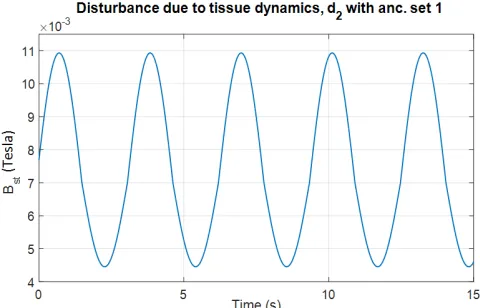
[image:4.612.335.534.652.730.2]Fig. 4: Disturbance due to the tissue dynamics d2 in sinusoidal form simulated with 2 rad/s reference, ωre f for simplicity of visualisation.
The role of IMP is to use some knowledge of the disturbances to cancel the influence of disturbances [14], [15]. More precisely, the model of input disturbances will be used in the state space representation of the system. If the state of the disturbance is able to be observed from the output measurements, by incorporating an appropriate observer, the effect of the disturbances will be cancelled.
As discussed in [11], the influence of the disturbanced1
can be easily cancelled using IMP. The performance of the proposed IMP was validated via experiments. However, the disturbanced2is more complicated. As can be seen in the
di-agram presented in Figure 2, the disturbanced2comes from
the sinusoidal force input, which has the same frequency as the reference,ωre f. The transfer functionGi(s),i=1,2,3 is
a stable linear time invariant with/without delays with fast transient responses (or small time constants). This indicates that, at steady state∆zt is also a sinusoidal signal with the same frequency, but different amplitude and phase. However the look-up table of the mapping from ∆zt to Bst is not a linear. Thus, the disturbance d2 is a not periodic signal.
Moreover, due to the existence of nonlinear look-up table, the overall system (IMP, disturbances and linear controller) is not a linear system.
As the disturbance d2 is not a sinusoidal signal, IMP
cannot be used to completely cancel its influence to the output of LMA. As the PI controller and IMP both have some robustness, this paper first investigates the robustness of the proposed PI controller and IMP [11] with respect to the tissue dynamics when they are incorporated into the model of LMA. It is noted that in the experimental setup in [11], the tissue dynamics were not included as it is considerably challenging to arrange the experiments for the LMA approach with consideration of the tissue dynamics
without going into animal or human trials. Hence, simulation based techniques are used to evaluate the performance of the proposed controller (PI and IMP) at this stage.
Furthermore, as the look-up table is almost linear, the steady-state of d2 is almost like sinusoidal with a known
frequency. By using a simulation model, which consists of the LMA and two disturbance models, it is shown that the disturbance d2 can be approximated as a sinusoidal signal
(as visualised in Fig. 4) with the frequencyωre f. It is noted that even though the simulation model cannot fully capture the LMA system, each component in the simulation model is validated via a large number of experiments [10], [11], [13], [16]. Hence, the simulation model can be use to characterize some features of the disturbances. Since the disturbance
d2 can be approximated as a sinusoidal signal with the
frequency ωre f, similar to the way of dealing with d1, d2
can be incorporated in the IMP loop as well (i.e.IMPd1,d2
as described in the following section, Sec. IV).
IV. NUMERICAL SIMULATIONS
Simulations are performed with the settings emulating the abdominal surgical environment as per [11], with the closest distance between stator units. The role of simulations is to show the robustness of IMP, which designed for d1, with
respect to the disturbanced2coming from tissue dynamics.
To simplify the notation, this IMP is calledIMPd1. On the other hand, a new IMP is designed based ond1
and approximation of d2. This IMP is calledIMPd1,d2. As
the approximation errors exist, the simulation results also demonstrate the robustness ofIMPd1,d2.
Three different reference speeds, i.e. 60rad/s, 80rad/s, 100rad/s are simulated in four cases as listed below:
• Case 1: Only LMA unit 1 is switched on to run at the
given reference speed, including tissue dynamics in the LMA system.
• Case 2: LMA unit 1 remains on and LMA unit 2 is
now switched on, producing magnetic interference or disturbance onto rotorR1.
• Case 3: Both LMA units remain on andIMPd1 is now initiated, to observe the suppression of the disturbance due to unit 2 onto R1, as well as the disturbance due
to the tissue dynamics.
• Case 4: Both LMA units remain on andIMPd1,d2 is now
initiated, to observe the suppression of the disturbance due to unit 2 onto R1, as well as the disturbance due
to the tissue dynamics.
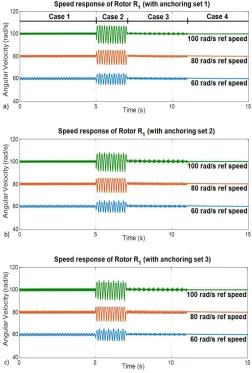
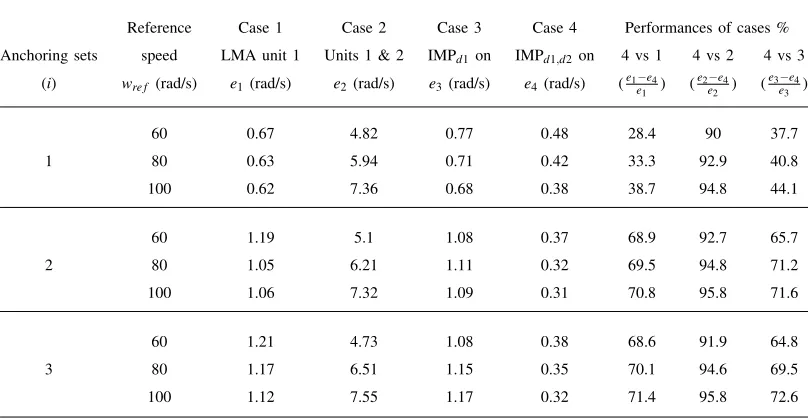
tissue dynamics is taken into consideration. The simulation results are shown in Figure 5 and the performances of the IMP controllers (i.e.IMPd1 andIMPd1,d2) are presented in
Table III.
V. DISCUSSIONS
[image:6.612.54.306.295.668.2]After taking the tissue dynamics into consideration in the system model, the performance of the rotor is observed to affect the response from the beginning (see Figs. 5). The frequency of the oscillation due to the tissue dynamics approximates the frequency of the signal transmitted by the corresponding stators as discussed in Section II. The oscillation about the equilibrium state of the anchored tissue causes displacement about that point, i.e. ∆z and in turn impacts on the resultant magnetic field in sinusoidal nature. From Figure 4, the amplitude ofd2is approximately
Fig. 5: Simulation results on the LMA system with four cases, including the implementation ofIMPd1(i.e. Case 3) andIMPd1,d2 (i.e. Case 4) for comparisons with reference speeds of 60rad/s, 80rad/s and 100 rad/s on rotorR1: a) with anchoring set 1 b) with anchoring set 2, and c) with anchoring set 3.
0.0033 Tesla (illustrated with 2 rad/s simulation to simplify
visualisation). The effect of d2 in the output is relatively
small, indicating some attenuation of the disturbance by the tissue properties itself as it is noted that the transfer function of the tissue dynamics replicates a low pass filter. Thus, when ωre f is arbitrarily large, the low pass filter will filter out some amount of disturbances.
Nonetheless, when only IMPd1 is implemented (i.e. in
Case 3), the disturbance due to the tissue dynamics is not fully suppressed. This is due to the lack of the tissue distur-bance information in the IMP disturdistur-bance rejection scheme at this instance, though some amount of the disturbance has attenuated due to the inherent low-pass filtering nature of the tissue. On the other hand, when IMPd1,d2 which
incorporated some approximated information of d2 (i.e. in
Case 4), better tracking performance and suppression of the disturbances are observed. Even though there is still steady state error due to the existence of approximation error, IMPd1,d2 demonstrated the capability of suppressing
up to 90% of the overall disturbances in Case 2 and also up to 37%, 64% and 65% in Case 3, for anchoring sets 1, 2 and 3, respectively, as presented in Table III.
It is noted that both IMPd1 and IMPd1,d2 are designed
based on a linear time-invariant LMA system, in simulation setting, the look-up table generates nonlinearity. Thus, the simulation results show the robustness of two IMP designs.
VI. CONCLUSION ANDRECOMMENDATIONS
In local magnetic actuation (LMA) surgical devices with multiple units, except for the coupling effects between two or more sets, the tissue dynamics during external excitation needs to be considered in the design of appropriate con-trollers. These effect of neighboring LMA sets d1 as well
as the tissue dynamicsd2are input disturbances. This paper
presents a new LMA model that can take these two input disturbances into consideration.
The first disturbance d1 was observed as a sinusoidal
signal with a known signal while the second disturbance
d2 has some nonlinearity, though it can be approximated
as a sine wave with the known frequency. Two internal model principle (IMP) controllers are used to deal with two disturbances. The first one only used the information ofd1
while the second one used the information of d1 and d2.
It showed from simulations, that the first IMP can work with a reasonable performance. When some information of
d2 is used, even though it is not a sinusoidal signal, the
TABLE III: Performance evaluation of the IMP controllers on the LMA system with the incorporation of the tissue dynamics in the IMP model, withIMPd1catering for onlyd1as well asIMPd1,d2 catering for bothd1andd2 (numbers presented in
terms of steady state amplitudes, e).
Reference Case 1 Case 2 Case 3 Case 4 Performances of cases %
Anchoring sets speed LMA unit 1 Units 1 & 2 IMPd1on IMPd1,d2 on 4 vs 1 4 vs 2 4 vs 3
(i) wre f (rad/s) e1(rad/s) e2 (rad/s) e3(rad/s) e4 (rad/s) (e1e−e4
1 ) (
e2−e4
e2 ) (
e3−e4 e3 )
60 0.67 4.82 0.77 0.48 28.4 90 37.7
1 80 0.63 5.94 0.71 0.42 33.3 92.9 40.8
100 0.62 7.36 0.68 0.38 38.7 94.8 44.1
60 1.19 5.1 1.08 0.37 68.9 92.7 65.7
2 80 1.05 6.21 1.11 0.32 69.5 94.8 71.2
100 1.06 7.32 1.09 0.31 70.8 95.8 71.6
60 1.21 4.73 1.08 0.38 68.6 91.9 64.8
3 80 1.17 6.51 1.15 0.35 70.1 94.6 69.5
100 1.12 7.55 1.17 0.32 71.4 95.8 72.6
REFERENCES
[1] F. Leong, N. Garbin, C. DiNatali, A. Mohammadi, D. Thiruchelvam, D. Oetomo, and P. Valdastri. Magnetic Surgical Instruments for Robotic Abdominal Surgery. IEEE Reviews in Biomedical Engineer-ing (RBME), vol. 9, pp. 66–78, Jan 2016.
[2] J. Cadeddu, R. Fernandez, M. Desai, R. Bergs, C. Tracy, S.-J. Tang, P. Rao, M. Desai, and D. Scott. Novel magnetically guided intraabdom-inal camera to facilitate laparoendoscopic single-site surgery: initial human experience. Surgical Endoscopy, vol. 23, no. 8, pp. 1894-1899, 2009.
[3] S. Park, R. A. Bergs, R. Eberhart, L. Baker, R. Fernandez, and J. A. Cadeddu. Trocar-less instrumentation for laparoscopy: magnetic po-sitioning of intra-abdominal camera and retractor. Annals of surgery, vol. 245, no. 3, pp. 379–384, 2007.
[4] N. Garbin, C. Di Natali, J. Buzzi, E. De Momi, and P. Valdastri. Laparoscopic tissue retractor based on local magnetic actuation, Journal of Medical Devices (JMD), vol. 9, no. 1, pp. 011005, 2015. [5] A. Mohammadi, C. Di Natali, D. Samsonas, P. Valdastri, Y. Tan, and D. Oetomo. Electromagnetic actuator across abdominal wall for minimally invasive robotic surgery, Journal of Medical Devices (JMD), vol. 9, no. 3, pp. 030937, 2015.
[6] G. Hang, M. Bain, J. Y. Chang, S. Fang, F. Leong, A. Moham-madi, P. Valdastri, and D. Oetomo. Local Magnetic Actuation Based Laparoscopic Camera for Minimally Invasive Surgery, Australasian Conference on Robotics and Automation (ACRA), 2015.
[7] M. P. Kummer, J. J. Abbott, B. E. Kratochvil, R. Borer, A. Sengul, and B. J. Nelson. Octomag: An electromagnetic system for 5-DOF wireless micromanipulation. IEEE Transactions on Robotics (TRO), vol. 26, no. 6, pp. 1006-1017, 2010.
[8] F. Carpi, S. Galbiati, and A. Carpi. Controlled navigation of endo-scopic capsules: concept and preliminary experimental investigations. IEEE Transactions on Biomedical Engineering (TBME), vol. 54, no. 11, pp. 2028-2036, 2007.
[9] C. Di Natali, J. Buzzi, N. Garbin, M. Beccani, and P. Valdastri. Closed-loop control of local magnetic actuation for robotic surgical instruments. IEEE Transactions on Robotics (TRO), vol. 31, no. 1, pp. 143-156, 2015.
[10] F. Leong, A. Mohammadi, Y. Tan, D. Thiruchelvam, P. Valdastri, and D. Oetomo. Magnetic Interactions of Neighbouring Stator Sets in Multi DOF Local Electromagnetic Actuation for Robotic Abdominal Surgery. In Procs. IEEE/RSJ International Conference on Intelligent Robotics and Systems (IROS), 2017.
[11] F. Leong, A. Mohammadi, Y. Tan, D. Thiruchelvam, C. Y. Lai, P. Valdastri, and D. Oetomo, Disturbance Rejection in Multi-DOF
Local Magnetic Actuation for the Robotic Abdominal Surgery,IEEE
Robotics and Automation Letters (RA-L), vol. 3, no. 3, pp. 1568–1575, 2018.
[12] F. Leong, A. Mohammadi, Y. Tan, D. Thiruchelvam, P. Valdastri, and D. Oetomo, Dynamics of Insufflated Abdominal Wall Tissue for Magnetically Anchored Surgical Instruments, Submitted to the Journal of Medical Robotics Research (JMRR), 2018, [Online]. Available: http://arxiv.org/abs/1806.09067.
[13] F. Leong, A. Mohammadi, Y. Tan, P. Valdastri and D. Oetomo. Experimentally Validated Modelling of Electromechanical Dynamics on Local Magnetic Actuation System for Abdominal Surgery, In Procs. Australasian Conference of Robotics and Automation (ACRA), 2016.
[14] P. Hippe, and J. Deutscher. Disturbance Rejection Using the Internal Model Principle. Design of Observer-based Compensators: From the Time to the Frequency Domain, pp. 131–166.
[15] I. D. Landau, A. Constantinescu, and D. Rey. Adaptive narrow band disturbance rejection applied to an active suspensionan internal model principle approach. Automatica, vol. 41, no. 4, pp. 563–574, 2005. [16] A. Mohammadi, D. Samsonas, F. Leong, Y. Tan, D.

![TABLE I: Configuration of anchoring magnet sets used inanalyses [12].](https://thumb-us.123doks.com/thumbv2/123dok_us/1869176.144001/4.612.335.534.652.730/table-i-conguration-anchoring-magnet-sets-used-inanalyses.webp)