COMMISSION OF THE EUROPEAN COMMUNITIES
Brussels, 08.09.2003
COM(2003)530 final
REPORT FROM THE COMMISSION
on the working of committees in 2002
1.
PRELIMINARY COMMENTS
This report covers the activities of comitology committees in 2002. It follows the basic
structure of the two previous reports and contains an introductory Section 1, a horizontal
overview of committee activities in Section 2 and an Annex with detailed statistics regarding
the individual comitology committees, organised according to the different areas covered by
the services of the Commission. Compared to previous years, this report significantly
improves the transparency of the statistics in the Annex by listing all committees individually
together with textual comment on the activities of the committees.
1.1
The legal nature and role of the comitology committees
The purpose of the comitology committees is to assist the Commission in exercising the
implementing powers conferred upon it by the legislator, i.e. the Council and the European
Parliament. The comitology committees share three essential features.
Firstly
, they are created by the legislator (the Council and the European Parliament) in
accordance with the “legislative” procedures in force at the time of adoption of the basic
instrument under which they are established, namely the cooperation or advisory procedures
and, since the Maastricht Treaty, the codecision procedure. Hence, the legal basis of the
comitology committees is enshrined in a so-called “basic instrument”.
Secondly
, in several respects their structure and working methods are standardised. A
representative of the Commission chairs each committee, which consists of Member State
representatives; these are the only “members” of the committees. The committees intervene
under the procedures set out in the basic legislative instrument, in compliance with the
Council’s comitology decision.
Article 9 of Council Decision 1999/468/EC
1repeals the old comitology Decision 87/373/EEC
of 13 July 1987 (the 1987 Comitology Decision).
2The 1987 procedures remained temporarily
in force until the amendment of the basic legislative instruments in line with the comitology
procedures pursuant to Decision 1999/468/EC. This has been achieved either by individual
amendment acts or the « alignment regulations » (see Section 1.2).
Thirdly
, the committees deliver opinions on draft implementing measures submitted to them
by the Commission pursuant to the basic legislative instrument and intervene under the
advisory procedure, the management procedure or the regulatory procedure provided for that
purpose.
Pursuant to Article 2 of Council Decision 1999/468/EC, the management procedure should be
reserved for management measures such as those relating to the application of the common
agricultural and common fisheries policy or to the implementation of programmes with
substantial budgetary implications (Article 2(a)). The regulatory procedure is prescribed in the
case of measures of general scope designed to apply essential provisions of basic instruments,
including measures concerning the protection of the health or safety of humans, animals or
plants and in updating the “technical” elements of a basic instrument (Article 2 (b)). The
advisory procedure is applied wherever it is considered to be the most appropriate.
1.2
The state of implementation of Decision 1999/468/EC
In Declaration No. 2 on the implementation of Council Decision 1999/468/EC
3, the Council
and the Commission agreed to adapt as soon as possible the provisions governing the
committees assisting the Commission in the exercise of its implementing powers under
Decision 87/373/EEC. This would bring them into line with the provisions of Articles 3 to 6
of Decision 1999/468/EC, in compliance with the appropriate legislative procedures.
Since the entry into force of Decision 1999/468/EC, the committee procedures of a number of
basic instruments have been updated on a case-by-case basis. In order to complete the update,
at the end of 2001 the Commission presented a package of four separate proposals (the
so-called
“alignment regulations”
)
4, covering more than 300 basic instruments laying down
implementing procedures. The four proposals for Council and Parliament Regulations
correspond to the different legislative procedures (assent procedure, codecision procedure and
consultation procedure with qualified majority and unanimity). It is worth noting that the
proposals do not affect the substantive provisions of the amended legislative acts nor do they
affect the safeguard procedures or the identity of the committees provided for by the basic
legal acts.
The
“alignment regulations”
were under examination by the Council and the European
Parliament throughout 2002. By the time this report was adopted (July 2003) three of the four
regulations had been adopted and had entered into force without any need for transposition by
the Member States
5.
An important new element is that Article 7 of Decision 1999/468/EC, and Council and
Commission statements relating to that provision (notably statements Nos. 4 and 5), put in
place measures designed to
improve the transparency
of the working of the comitology
committees.
In this respect, publication of this
annual report on the working of the committees
, as
provided for in Article 7(4), is in itself a significant contribution to shedding light on the
Commission’s activities in terms of exercising its implementing powers.
Also in compliance with Article 7(4), the Commission has published a
list of all the
committees
which help it exercise these implementing powers.
6This list will be updated and
published again in the course of 2003. On 31 January 2001, in compliance with Article 7(1),
the Commission adopted the
standard rules of procedure
7on the basis of which existing or
newly-created committees draw up their rules of procedure. The Commission intends to adopt
an updated version of the standard rules of procedure by the end of 2003 and to bring them
into line with the new rules on access to documents (see below). By the end of 2002 89 out of
3
OJ C 203, 17.07.1999, p. 1.
4
Proposals COM(2001) 789 final, adopted on 27.12.2001.
5Council regulations (EC) N° 806/2003 (OJ L 122, 16.05.2003, p. 1) and N° 807/2003 (OJ L 122,
16.05.2003, p. 36) of 14 April 2003 adapting to Decision 1999/468/EC the provisions relating to
committees which assist the Commission in the exercise of its implementing powers laid down in
Council instruments adopted in accordance with the consultation procedure (qualified
majority/unanimity) and Council Regulation (EC) N° 1105/2003 of 26 May 2003 amending Regulation
(EC) No 1260/1999 laying down general provisions on the Structural Funds, OJ L 158 of 27.06.2003,
p. 3.
6
OJ C 225, 08.08.2000, p. 2.
the total of 257 committees had adopted internal rules of procedure based on the standard text
in force.
Finally, Article 7(5) of Decision 1999/468/EC provides that the Commission has to publish a
register giving the
references of all documents sent to the European Parliament under
comitology procedures
. The register will be in operation by the end of 2003. As noted in its
statement No. 5 on Council Decision 1999/468/EC, the Commission intends, as an additional
transparency measure, to widen the scope of the register by adding a
repository
, making
documents communicated to the European Parliament available to the public in accordance
with Regulation (EC) No 1049/2001 of the Parliament and of the Council regarding public
access to the institutions’ documents,
8which came into effect on 3 December 2001.
91.3
The European Parliament’s right of scrutiny
The Commission is obliged to inform the European Parliament about the work of the
committees and to send it all draft implementing measures pursuant to a basic instrument
adopted under Article 251 of the Treaty, so that the European Parliament can exercise its right
of scrutiny enshrined in Article 8 of Decision 1999/468/EC.
In February 2000, the European Parliament and the Commission concluded an
Agreement on
procedures for implementing Council Decision 1999/468/EC
, designed specifically to
regulate the procedures for implementing the obligations incumbent on the Commission.
10The agreement provides for the electronic transmission of documents, a task which was
implemented progressively during 2001. Documents from the various Commission
departments are first transmitted to the Secretariat-General of the Commission, which
promptly dispatches them to a central service at the European Parliament. Today practically
all documents are transmitted electronically.
Except in emergencies, the agreement stipulates a period of one month from receipt of a
“definitive” draft implementing measure
11under a legal act adopted through codecision to
allow the European Parliament, where appropriate, to adopt a resolution (in plenary session),
pursuant to Article 8 of Council Decision 1999/468/EC, if it considers that the draft exceeds
the implementing powers enshrined in the basic instrument.
12It should be noted that again
during 2002 no cases were reported where the European Parliament felt the need to adopt a
resolution based on Article 8 of Council Decision 1999/468/EC.
The bilateral agreement of February 2000 was implemented by a further
administrative
agreement
by the Secretariats-General of the European Parliament and the Commission, dated
14 December 2001. This administrative agreement is intended to ensure a harmonised
approach by the departments of the Commission so that all the Commission obligations under
the bilateral agreement of February 2000 are properly fulfilled. In particular, it provides for
minimum standards with regard to the types of documents and their structure.
8
OJ L 145, 31.05.2001, p. 43.
9
The next report will include an evaluation of the impact of Regulation No 1049/2001, which was
adopted during 2001.
10
OJ L 256, 10.10.2000, p. 19. The agreement nullifies certain earlier agreements: the Plumb/Delors
Agreement of 1988, the Samland/Williamson Agreement of 1996 and the “modus vivendi” of 1994.
11
The drafts are first sent before the committee meeting and, if they are substantially modified during the
meeting, are sent again afterwards.
12
This basic instrument must itself have been adopted under the codecision procedure (Article 251 of the
1.4
Referrals to the Council
Seven cases of referrals to the Council were reported in 2002. Pursuant to Council Decision
1999/468/EC, draft measures must be referred to the Council when the Commission fails to
obtain the necessary majority under the regulatory procedure or faces an opposing vote under
the management procedure. The seven referrals occurred in different policy sectors. Two
cases concerned Agriculture (see Annex, point 3), two cases Transport policy (see Annex,
point 4), one case Environment (see Annex, point 5), one case Health and Consumer
Protection (see Annex, point 13) and one case Trade policy (see Annex, point 16).
As in previous years, the small percentage of referrals, about 0,25 %, of the total number of
instruments adopted by the Commission (under the management or regulatory procedure)
shows that the work of the committees under the current system results in a high degree of
consensus and that the proposals by Commission representatives are normally approved by
the committees.
1.5
Wider developments
In the
White Paper on Governance,
13the Commission proposed re-examining the conditions
under which it adopts implementing measures and the need to maintain the existing
committee procedures, in particular the management and regulatory procedures.
14The
Commission announced its intention to launch initiatives aimed at amending Article 202 of
the Treaty with a view to putting the Council and the European Parliament on an equal
footing “in supervising the way in which the Commission exercises its executive role”.
15A concrete
Commission proposal for reorganising the comitology framework
within the
existing Treaty was presented in December 2002
16. In essence the proposal provides for a
revised regulatory procedure
for some executive measures in respect of acts adopted under
the codecision procedure (Article 251 of the Treaty). This new procedure would be divided
into an « executive phase », to allow the comitology committees to deliver their opinions and
a subsequent « supervisory phase », where the European Parliament and the Council are
placed on an equal footing in supervising the Commission’s exercise of implementing
powers. The proposal implies an adjustment of the scope of application of current committee
procedures under acts adopted under the codecision procedure. In this context, it is proposed
to apply the advisory procedure for certain administrative measures, where the management
procedure is currently used (notably financial aid programmes). Thus, the regulatory
committee procedure would apply to executive measures of general scope concerning the
substance of the basic act (measures designed to widely implement the essential aspects of the
basic instruments or adapt certain aspects of it). The proposal is currently under examination
in the Council; the European Parliament is expected to adopt its resolution in September
2003.
In its draft Constitutional Treaty the
Convention on the Future of Europe
proposed to the
Intergovernmental Conference (IGC) that the executive powers of the Commission should be
13
COM (2001) 428 final.
14
See the White Paper, p. 36.
15Idem.
16
reorganised
17. The Convention’s draft introduces the instrument of “delegated” regulations to
be adopted by the Commission in order to supplement or amend certain “non-essential”
elements of European laws under the control of the Parliament and the Council, which can
revoke the delegation itself or object to a specific draft regulation; a distinction should be
made between these delegated regulations and implementing acts that the Commission will
adopt under the supervision of the Member States.
Preparations for the
enlargement of the European Union
include the participation of
representatives of the ten acceding States and remaining candidate countries as observers in
comitology committees. When concluding the accession negotiations at the Copenhagen
Summit of December 2002, the Member States and the ten acceding States agreed to establish
an information and consultation procedure for the interim period (running until the accession
date of 1 May 2004), to be supplemented by an active observer status for acceding States in
most EU institutions and bodies as from the day following the signature of the Accession
Treaty on 16 April 2003
18. Both Council and Commission adopted each for their area of
responsibility certain internal implementing arrangements. Under the Commission
arrangements, acceding States have been granted an "active observer status" insofar, as
representatives of acceding States should in principle be invited to all meetings of comitology
committees and of many working groups chaired by the Commission
19. They have a
possibility to express their views on the issues discussed in the meetings, but do not have the
right to take part in the voting on draft implementing measures. For the remaining three
candidate countries, participation continues to be organised on the basis of the
“Communication from the Commission to the Council on the participation of candidate
countries in Community programmes, agencies and committees”.
20In 2002, though before
active observer status applied to the ten acceding countries, the then candidate countries were
represented in approximately 50 of the total of 257 committees.
17
Draft Treaty establishing a Constitution for Europe, submitted to the European Council meeting in
Thessaloniki, 20 June 2003, Articles I-35 and I-36.
18
TOWARDS THE ENLARGED UNION, Strategy Paper and Report of the European Commission on
the progress towards accession by each of the candidate countries (9.10.2002), COM(2002) 700 final,
see point 3.3 (p. 25).
2.
HORIZONTAL OVERVIEW OF ACTIVITIES
2.1
Number of committees and types of procedures
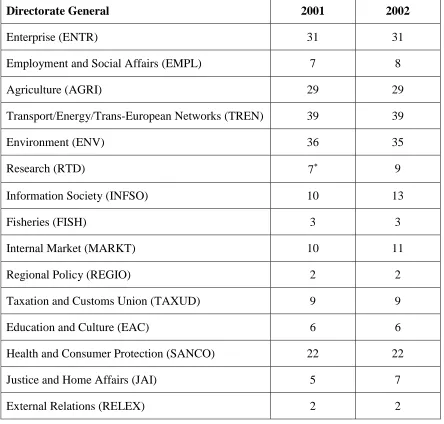
[image:7.595.70.514.292.716.2]In evaluating the activities of committees as a whole, the first step is to identify the number of
comitology committees in existence on a specific date. Here it is important to make a
distinction between the comitology committees and other entities, in particular “expert
groups” created by the Commission itself, the latter being concerned with preparing and
carrying out policies, whereas the comitology committees are involved in the context of
implementing legislative decisions. This report focuses exclusively on comitology
committees. The number of comitology committees has been calculated by sector of activity
(Table I), updated to 31.12.2002. The figures for the previous year (status as at 31.12.2001)
are given for comparison.
TABLE I – T
OTAL NUMBER OF COMMITTEES
Directorate General
2001
2002
Enterprise (ENTR)
31
31
Employment and Social Affairs (EMPL)
7
8
Agriculture (AGRI)
29
29
Transport/Energy/Trans-European Networks (TREN)
39
39
Environment (ENV)
36
35
Research (RTD)
7
*9
Information Society (INFSO)
10
13
Fisheries (FISH)
3
3
Internal Market (MARKT)
10
11
Regional Policy (REGIO)
2
2
Taxation and Customs Union (TAXUD)
9
9
Education and Culture (EAC)
6
6
Health and Consumer Protection (SANCO)
22
22
Justice and Home Affairs (JAI)
5
7
External Relations (RELEX)
2
2
Trade (TRADE)
11
12
Enlargement (ELARG)
2
2
EuropeAid (AIDCO)
8
8
Humanitarian Aid (ECHO)
1
1
Statistics (ESTAT)
6
6
Budget (BUDG)
1
1
Anti-Fraud Office (OLAF)
1
1
TOTAL
248
257
These figures show the focus of activities in the different policy sectors from the comitology
perspective. Transport/Energy (39), Environment (35), Enterprise (31), Agriculture (29), and
Health and Consumer Protection (22) have the largest number of committees. With 156 out of
a total of 257 committees, these policy sectors alone account for more than half of the
committees. The Commission is continuing its efforts to limit the growth in the number of
committees as far as possible. However, the increase in the number of committees at the end
of 2002, compared with 2001, is a result of the creation of new committees in some policy
areas with increased activities (in particular in the sectors of Environment, Information
society and Home and Justice Affairs).
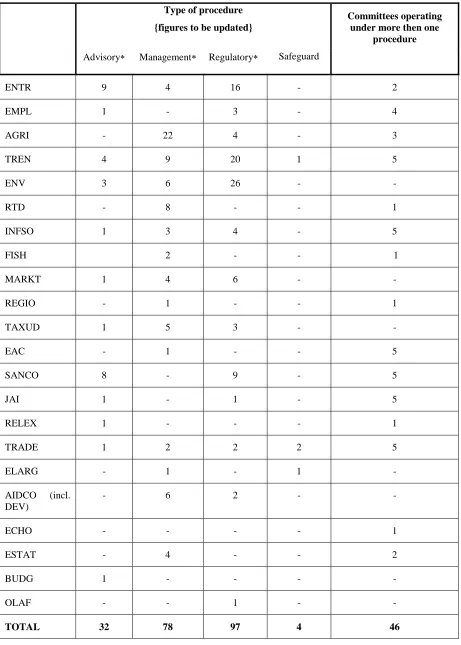
The comitology committees can be classified according to type of procedure under which
they operate (advisory procedure, management procedure, regulatory procedure, and
safeguard procedure - see Table II). For the year 2002, i.e. before the entry into force of the
“alignment regulations” (see above Section 1.2), the different
variants
in accordance with the
1987 comitology procedures (IIa and IIb, IIIa and IIIb) are counted together with the
corresponding new types of procedure as prescribed in Declaration No
2 on the
implementation of Council Decision 1999/468/EC.
21Since certain committees have multiple functions (i.e. they use different procedures ranging
from the advisory procedure to the regulatory procedure, plus the safeguard procedure), they
have been singled out from the other committees to provide a true picture of the procedures
applicable.
21
OJ C 203, 17.07.1999, p. 1. This means: Variant I together with the advisory procedure, variants IIa and
TABLE II – N
UMBER OF COMMITTEES BY PROCEDURE
(2002)
Type of procedure
{figures to be updated}
Committees operating
under more then one
procedure
Advisory
*
Management
*
Regulatory
*
Safeguard
ENTR
9
4
16
-
2
EMPL
1
-
3
-
4
AGRI
-
22
4
-
3
TREN
4
9
20
1
5
ENV
3
6
26
-
-RTD
-
8
-
-
1
INFSO
1
3
4
-
5
FISH
2
-
-
1
MARKT
1
4
6
-
-REGIO
-
1
-
-
1
TAXUD
1
5
3
-
-EAC
-
1
-
-
5
SANCO
8
-
9
-
5
JAI
1
-
1
-
5
RELEX
1
-
-
-
1
TRADE
1
2
2
2
5
ELARG
-
1
-
1
-AIDCO (incl.
DEV)
-
6
2
-
-ECHO
-
-
-
-
1
ESTAT
-
4
-
-
2
BUDG
1
-
-
-
-OLAF
-
-
1
-
-TOTAL
32
78
97
4
46
The figures indicate that a relative majority of the committees (97 out of 257) work
exclusively under the regulatory procedure, followed by a considerably smaller number of
committees working exclusively under the management procedure (78). The breakdown by
policy sector shows that the use of the three types of procedures varies from policy sector to
policy sector. However in some of the policy sectors a clear dominance of one of the
procedure types can be noted: Environment and Transport/Energy work with a large number
of committees functioning under the regulatory procedure, whereas Agriculture works with a
large number of committees functioning under the management procedure.
2.2
Number (and days) of meetings
The number of committees is not the only indicator of activity at comitology level. The
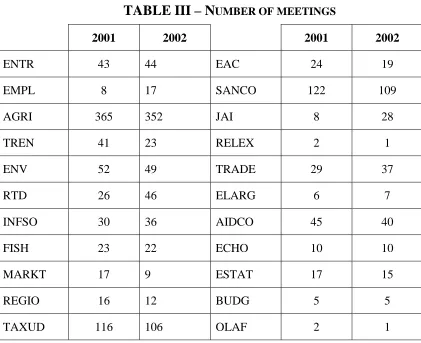
[image:10.595.68.489.265.608.2]number of meetings
held in 2002 reflects the intensity of each committee's work (Table III).
TABLE III – N
UMBER OF MEETINGS
2001
2002
2001
2002
ENTR
43
44
EAC
24
19
EMPL
8
17
SANCO
122
109
AGRI
365
352
JAI
8
28
TREN
41
23
RELEX
2
1
ENV
52
49
TRADE
29
37
RTD
26
46
ELARG
6
7
INFSO
30
36
AIDCO
45
40
FISH
23
22
ECHO
10
10
MARKT
17
9
ESTAT
17
15
REGIO
16
12
BUDG
5
5
TAXUD
116
106
OLAF
2
1
Agriculture leads the field (with 352 meetings), since managing the different agricultural
markets requires frequent meetings. It is followed by Health and Consumer (with 109
meetings) which is responsible among other things for food safety and Taxation and Customs
Union (with 106 meetings), where the focus is on customs matters involving trade with third
countries.
TABLE IV – N
UMBER OF DAYS
2001
2002
2001
2002
ENTR
41.5
50
EAC
30.5
25
EMPL
8
15.5
SANCO
164.5
138
AGRI
302
358
JAI
8
27
TREN
46
27
RELEX
1.5
1
ENV
66.5
59
TRADE
15.5
22.5
RTD
26
42
ELARG
7.5
7.5
INFSO
30.5
35
AIDCO
48
43
FISH
15
23
ECHO
10
10
MARKT
17
11
ESTAT
20.5
15
REGIO
22
21
BUDG
5
5
TAXUD
168
146.5
OLAF
2
1
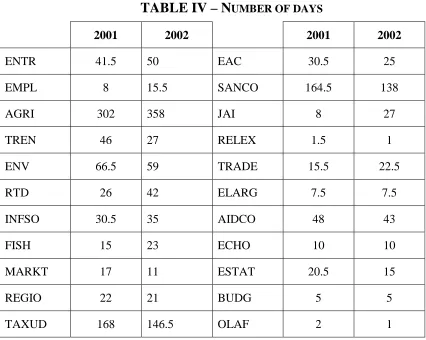
The figures in Table IV broadly correspond to those of the preceding table: a large number of
meetings means a large number of meeting days. This shows that meetings do not normally
last more than one day, or two half-days on two consecutive days.
2.3
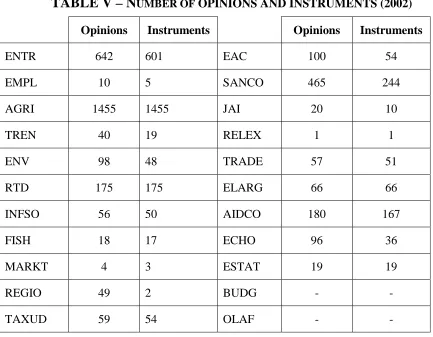
Number of opinions and instruments
Earlier reports used the number of consultations the Commission puts on a committee’s
agenda as a key indicator of the intensity of activity. This report presents overall figures on
the formal opinions delivered by the committees
22and the subsequent instruments (i. e.
implementing measures = legal acts, administrative decisions) adopted by the Commission,
since they describe the concrete « output » of the committees more accurately. (Table V). The
total number of opinions delivered by the committees in 2002 was 3610; the number of
instruments adopted by the Commission counted 3077.
22
Including favourable, unfavourable and no opinions, following a formal voting in case of regulatory and
TABLE V – N
UMBER OF
OPINIONS AND INSTRUMENTS (2002)
Opinions
Instruments
Opinions
Instruments
ENTR
642
601
EAC
100
54
EMPL
10
5
SANCO
465
244
AGRI
1455
1455
JAI
20
10
TREN
40
19
RELEX
1
1
ENV
98
48
TRADE
57
51
RTD
175
175
ELARG
66
66
INFSO
56
50
AIDCO
180
167
FISH
18
17
ECHO
96
36
MARKT
4
3
ESTAT
19
19
REGIO
49
2
BUDG
-
-TAXUD
59
54
OLAF
-
-The large number of instruments in certain policy sectors – Agriculture (1455), Enterprise
(601), and Health and Consumer Protection (244) – again reflect the intensity of the work
delegated to the Commission in these areas via the comitology procedures.
233.
PRESENTATION OF ACTIVITIES BY SECTORAL POLICY
A sector snapshot of the activities of committees should include the figures for all the
committees in a sector. In this report and in all reports in the future, all the individual
committees under the responsibility of each Directorate-General, whether active or not, will
be presented together with their relevant data. This approach will significantly improve the
transparency of the sector policy activities. In addition, textual comments are given
highlighting some important aspects of the work in the reporting year.
The following explanations should enable the reader to better understand the statistical data:
Opinions
delivered by the committees may be of various kinds: they may concern draft
legislative acts (directives, regulations), decisions designed to regulate a specific legal
situation or to approve financial projects in the context of any of the many Community
programmes, or just position statements (which explains why the total number of favourable
opinions may be greater than the total number of legal instruments adopted in a specific
sector).
23
Consequently, the
instruments
adopted by the Commission are listed according to these
categories.
In the event of a
favourable opinion
, the rule is that the Commission adopts the implementing
measures (the instruments); under the management procedure it may also adopt an instrument
in the
absence
of an opinion. Only if there is an
unfavourable opinion
is the decision referred
to the Council as “an appeal body”, which then has the power to decide (
referrals
to the
Council). Under the regulatory procedure a draft instrument is subject - even in case of
absence of an opinion - of a formal proposal to the Council, which decides with qualified
majority.
ANNEX
This Annex provides an overview of “comitology” activities during 2002 with a breakdown
by sector. For each sector the list of all existing committees (whether they have been active in
2002 or not) with their relevant data is reported
1.
ENTERPRISE
Committee Nr of meetings
Nr of
days Procedure
Favourable opinions
Unfavourable opinions
No opinion
Instruments adopted by
the Commission
Referred to Council
Cases in which EP has adopted a
resolution according to Art.
8 of Council Decision 1999/468/EC Management Committee for the
fourth multiannual programme for small and medium-sized enterprises in the European Union (2001–2005) (SMEs).
2 2 Management 9 1 0 2 0 0
Committee for execution of the specific programme for research, technological development and demonstration on promotion of innovation and encouragement of SME participation (1999–2002).
7 7 Management 8 0 0 1 0 0
Committee on implementation of projects, actions and measures to ensure interoperability of trans-European networks for telematic data interchange between administrations (IDA II-TAC)
6 6 Management 9 0 0 2 0 0
Committee on the harmonisation of the provisions relating to the placing on the market and supervision of explosives for civil uses (EXPLOSIVES).
1 1 Management 0 0 0 0 0 0
Committee for the adaptation to technical progress of legislation on the removal of technical barriers to trade in fertilisers (CATP-FERTILISERS).
0 0 Regulatory 0 0 0 0 0 0
Committee for the adaptation to technical progress of legislation on the removal of technical barriers to trade in detergents (CATP-DETERGENTS).
0 0 Regulatory 0 0 0 0 0 0
Committee on directives relating
to textile names and labelling. 0 0 Regulatory 0 0 0 0 0 0 Committee for harmonisation of
national regulations relating to cableway installations designed to carry persons.
1 1 Advisory 0 0 0 0 0 0
Committee for the harmonisation of national legislation relating to recreational craft.
Committee Nr of meetings
Nr of
days Procedure
Favourable opinions
Unfavourable opinions
No opinion
Instruments adopted by
the Commission
Referred to Council
Cases in which EP has adopted a
resolution according to Art.
8 of Council Decision 1999/468/EC Management Committee on
horizontal questions concerning trade in processed agricultural products not listed in Annex I.
11 11 Management 16 0 0 16 0 0
Standing Committee on medicinal
products for human use. 0 0 Regulatory 524 1 0 525 0 0 Standing Committee on veterinary
medicinal products 0 0 Regulatory 38 0 0 38 0 0
Committee for the adaptation to technical progress of the directives on the removal of technical barriers to trade in colouring matters which may be added to medicinal products.
0 0 Regulatory 0 0 0 0 0 0
Committee for the adaptation to technical progress of the directives on the removal of technical barriers to trade in cosmetic products (CATP/COSM).
3 3 Regulatory 2 0 0 1 0 0
Committee for the adaptation to technical progress of legislation on the removal of technical barriers to trade in motor vehicles and their trailers.
6 6 Regulatory 15 1 0 0 0 0
Committee for the adaptation to technical progress of legislation on the removal of technical barriers to trade in agricultural and forestry tractors.
0 0 Regulatory 0 0 0 0 0 0
Advisory Committee on standardisation in the field of information technology (SOGITS).
0 0 Advisory 0 0 0 0 0 0
Advisory Committee on the approximation of the laws of the Member States relating to machinery.
0 0 Advisory 0 0 0 0 0 0
Standing Committee on the approximation of the laws of the Member States relating to lifts.
0 0 Advisory 0 0 0 0 0 0
Committee for the adaptation to technical progress of legislation to remove technical barriers to trade in lifting and mechanical handling devices.
0 0 Advisory 0 0 0 0 0 0
Committee for the adaptation to technical progress of legislation to remove technical barriers to trade in construction plant and equipment.
Committee Nr of meetings Nr of days Procedure Favourable opinions Unfavourable opinions No opinion Instruments adopted by the Commission Referred to Council
Cases in which EP has adopted a
resolution according to Art.
8 of Council Decision 1999/468/EC Standing Committee on the
approximation of the laws of the Member States concerning equipment and protective systems intended for use in potentially explosive atmospheres (EXAT).
1 1 Advisory 0 0 0 0 0 0
Committee for the adaptation to technical progress of legislation to remove technical barriers to trade in electric materials used in an explosive atmosphere (CATP/EXAT).
0 0 Regulatory 0 0 0 0 0 0
Telecommunications Conformity Assessment and Market Surveillance Committee (TCAM).
4 8
Several: Advisory, Regulatory
6 0 0 6 0 0
Committee for the adaptation to technical progress of legislation to remove technical barriers to trade in pressure vessels.
0 0 Regulatory 0 0 0 0 0 0
Standing Committee on the approximation of the laws of the Member States concerning pressure equipment.
0 0 Advisory 0 0 0 0 0 0
Committee for the adaptation to technical progress of legislation to remove technical barriers to trade in aerosol dispensers (CATP/AEROSOLS).
0 0 Regulatory 0 0 0 0 0 0
Advisory Committee on the approximation of the laws of the Member States relating to medical devices.
0 0
Several: Advisory, Regulatory
1 0 0 1 0 0
Committee for the adaptation to technical progress of legislation to remove technical barriers to trade in electro-medical equipment used in human or veterinary medicine.
0 0 Regulatory 0 0 0 0 0 0
Committee for the adaptation to technical progress of legislation to remove technical barriers to trade in measuring instruments.
0 0 Regulatory 0 0 0 0 0 0
Standing Committee on approximation of the laws relating to construction products.
2 4 Regulatory 9 0 2 9 0 0
created, the number of opinions has increased steadily. This is due to a permanently increasing number
of authorisations and variations to these authorisations granted under new procedures. However, 2001
was a year of relatively weak activity, so the figures for 2002 seem to be very high, although they
follow the general trend of recent years.
In 2002, the Commission services continued its approach towards enhanced openness and
transparency in this policy sector by inviting different stakeholders to the committee meetings as
experts and/or observers. A questionnaire sent to the secretaries of the committees revealed that
consumer organisations attend most of the committees dealing with products that are of interest to
consumers. An example is the Committee on the adaptation to technical progress of the directives on
the removal of technical barriers to trade in the cosmetic products sector.
As regards individual files with institutional importance, the measures taken by the Committee on the
adaptation to technical progress in the cosmetic products sector are worth mentioning. The Directive
76/768/EEC concerning cosmetic products provided in its article 4, point 1 (i) the ban of marketing
cosmetic products containing ingredients or combinations of ingredients tested on animals after
30 June 2000. The Commission Directive 2000/41/EC of 19 June 2000 prolongated this deadline to
30 June 2002. In September 2002, the Commission proposed a directive to postpone retroactively this
deadline of June 2002. The European Parliament adopted a resolution on the 24 September 2002 by
which it "calls on the Commission to withdraw its draft decision on implementation measures".
As the
2.
EMPLOYMENT AND SOCIAL AFFAIRS
Committee Nr of meetings
Nr of
days Procedure
Favourable opinions
Unfavourable opinions
No opinion
Instruments adopted by
the Commission
Referred to Council
Cases in which EP has adopted a
resolution according to Art. 8 of Council Decision
1999/468/EC Employment Incentive Measures 3 1.5
Several: Advisory, Management
1 0 0 0 0 0
Committee of the Community action programme to encourage co-operation between Member States to combat social exclusion
4 4
Several: Advisory, Management
1 0 0 0 0 0
Committee of the Community Action Programme to combat discrimination
3 3
Several: Advisory, Management
5 0 0 5 0 0
Committee for the technical adaptation of legislation on the introduction of measures to encourage improvements in the safety and health of workers at work.
0 0 Regulatory 0 0 0 0 0 0
Committee for the technical adaptation of legislation on the minimum safety and health requirements for improved medical treatment on board vessels.
0 0 Regulatory 0 0 0 0 0 0
Restricted Committee for Safety and Health in the Mining and Other Extractive Industries.
0 0 Regulatory 0 0 0 0 0 0
Disability Advisory Committee (established within framework of the European Year of People with Disabilities).
5 5 Advisory 3 0 0 0 0 0
Committee for the implementation of the Programme relating to the Community framework strategy on gender equality.
2 2 Several 0 0 0 0 0 0
In 2002, 2 new committees, both created in 2001, started working in this policy sector:
Against that, the Committee on exceptional financial support in favour of Greece in the social
field was abolished.
3.
AGRICULTURE
Committee Nr of meetings
Nr of
days Procedure
Favourable opinions
Unfavourable opinions
No opinion
Instruments adopted by
the Commission
Referred to Council
Cases in which EP has adopted a
resolution according to Art. 8
of Council Decision 1999/468/EC Standing Committee on
Agricultural Research (SCAR). 1 1 Management 0 0 0 0 0 0 Community Committee on the
Farm Accountancy Data Network (FADN).
3 3 Management 2 0 0 2 0 0
Committee on the protection of geographical indications and designations of origin for agricultural products and foodstuffs (OAP).
3 3 Regulatory 0 0 1 1 1 0
Committee on certificates of specific character for agricultural products and foodstuffs.
1 1 Regulatory 0 0 0 0 0 0
Standing Committee on Organic
Farming. 7 7 Regulatory 6 0 1 7 1 0
Management Committee for
cereals. 45 45 Management 608 0 46 654 0 0
Management Committee for dried
fodder. 1 1 Management 1 0 0 1 0 0
Management Committee for sugar. 49 49 Management 172 0 3 175 0 0 Management Committee for oils
and fats. 17 17 Management 21 0 12 33 0 0
Management Committee for flax
and hemp. 6 6 Management 7 0 0 7 0 0
Management Committee for milk
and milk products. 23 23 Management 135 0 14 149 0 0 Management Committee for beef
and veal. 21 21 Management 71 0 2 73 0 0
Management Committee for
sheepmeat and goatmeat. 2 2 Management 7 0 0 7 0 0 Management Committee for
pigmeat. 14 14 Management 18 0 5 23 0 0
Management Committee for
poultrymeat and eggs. 13 13 Management 76 0 0 76 0 0 Management Committee for fruit
and vegetables. 14 14 Management 43 0 9 52 0 0
Management Committee for products processed from fruit and vegetables.
Committee Nr of meetings
Nr of
days Procedure
Favourable opinions
Unfavourable opinions
No opinion
Instruments adopted by
the Commission
Referred to Council
Cases in which EP has adopted a
resolution according to Art. 8
of Council Decision 1999/468/EC Management Committee for
wines. 27 32 Management 35 0 4 39 0 0
Implementation Committee for
spirit drinks. 3 3
Several: Advisory, Regulatory
1 0 0 1 0 0
Implementation Committee on
aromatised wine-based drinks. 1 1
Several: Management,
Regulatory
1 0 0 1 0 0
Management Committee for raw
tobacco. 9 10 Management 9 0 0 9 0 0
Management Committee for hops. 5 5 Management 3 0 1 4 0 0 Management Committee for seeds. 3 3 Management 1 0 0 1 0 0 Management Committee for live
plants and floriculture products. 2 2 Management 1 0 1 2 0 0 Management Committee for
bananas. 6 6 Management 11 0 1 12 0 0
Committee on Agricultural Structures and Rural Development (STAR Committee)
13 13
Several: Advisory, Management
62 0 0 62 0 0
Standing Forestry Committee
(SFC). 6 6 Regulatory 4 0 0 4 0 0
Committee on the conservation, characterisation, collection and utilisation of genetic resources in agriculture.
1 1 Management 0 0 0 0 0 0
European Agricultural Guidance
and Guarantee Fund Committee. 14 14 Management 16 0 0 16 0 0 Joint meetings of management
committees 30 30 Management 23 0 0 23 0 0
In 2002, DG AGRI's 29 committees and its joint committees delivered 1354 favourable
opinions and 101 "no opinions". Two of these ”no opinions” were given in the framework of a
regulatory committee and were therefore referred to the Council. These two referrals, along
with 45 other proposals relating to rural development, have been forwarded to the European
Parliament for information. The 1455 drafts have been adopted by the Commission.
proposed
within the period of three months, these measures have been adopted by the
Commission
24.
The other referral to the Council relates to the Standing Committee on Organic Farming. This
Committee has not delivered an opinion on the draft regulation amending Council Regulation
(EEC) No 2092/91 of 24 June 1991 on organic production of agricultural products and
indications referring thereto on agricultural products and foodstuffs . As the Council has not
adopted or voted against the implementation measures proposed within the period of three
months, these measures have been adopted by the Commission
25.
24
Commission Regulation (EC) No 1829/2002 of 14 October 2002 amending the Annex to Regulation
(EC) No 1107/96 with regard to the name "Feta", OJ L 277 of 15 October 2002, p.10.
25
Commission Regulation (EC) No 599/2003 of 1 April 2003 amending Regulation (EEC) No 2092/91 on
4.
TRANSPORT/ENERGY/TRANS-EUROPEAN NETWORKS
Committee Nr of meetings Nr of days Procedure Favourable opinions Unfavourable opinions No opinion Instruments adopted by the Commission Referred to Council
Cases in which EP has adopted a
resolution according to Art. 8
of Council Decision 1999/468/EC Ten-Energy Financial Assistance
Committee . 1 1 Regulatory 1 1 0 1 0 0
TEN-Energy Guidelines
Committee 0 0 Regulatory 0 0 0 0 0 0
Ten-Transport Financial
Assistance Committee . 2 2 Regulatory 2 0 0 1 0 0
Committee for implementation of the multiannual framework programme for actions in the energy sector (1998–2002) – promotion of renewable energy sources ("ALTENER").
3 3.5 Management 4 0 0 5 0 0
Committee for harmonisation of national measures on the indication by labelling and standard product information of the consumption of energy and other resources by household appliances.
3 3 Regulatory 0 0 0 0 0 0
Committee for implementation of the multiannual framework programme for actions in the energy sector (1998–2002) – rational and efficient use of energy resources (SAVE).
3 3.5 Management 3 0 0 4 0 0
Community/Switzerland Transport
Committee (rail and road). 0 0 Regulatory 0 0 0 0 0 0 Committee on tachograph
(CATP). 0 0 Regulatory 0 0 0 0 0 0
Transport infrastructure charging 0 0 Advisory 0 0 0 0 0 0 Ecopoints Management
Committee 3 3 Management 0 0 0 0 0 0
Advisory Committee on the conditions under which non-resident carriers may operate national road passenger transport services within a Member State (cabotage)
0 0
Several: Advisory, Safeguard
0 0 0 0 0 0
Committee on adaptation of the legislation concerning reciprocal recognition of national boatmasters' certificates for the carriage of goods and passengers by inland waterway.
0 0
Several: Advisory, Management,
Regulatory
0 0 0 0 0 0
Committee on the transport of
Committee Nr of meetings Nr of days Procedure Favourable opinions Unfavourable opinions No opinion Instruments adopted by the Commission Referred to Council
Cases in which EP has adopted a
resolution according to Art. 8
of Council Decision 1999/468/EC Developing European Railways
Committee. 1 1
Several: Advisory, Regulatory
1 0 0 1 0 0
Committee on driving licences. 1 1 Regulatory 0 0 0 0 0 0 Committee for the establishment
of conditions for the interoperability of the trans-European high-speed rail system.
3 5 Regulatory 5 0 0 0 0 0
Technical Adaptation Committee
on Roadworthiness Testing. 1 2
Several: Advisory, Regulatory
15 0 0 0 0 0
Committee overseeing the conditions governing imports of agricultural products originating in third countries following the accident at the Chernobyl nuclear power station.
0 0 Regulatory 1 0 0 0 0 0
Committee for implementation of the multiannual framework programme for actions in the energy sector (1999–2002) –-future development of energy policy ("ETAP").
0 0 Management 0 0 0 0 0 0
Committee for implementation of the multiannual framework programme for actions in the energy sector (1999–2002) – reinforcement of international cooperation ("SYNERGY").
0 0 Management 0 0 0 0 0 0
Committee for implementation of the multiannual framework programme for actions in the energy sector (1999–2002) – clean solid fuel technologies ("CARNOT").
0 0 Management 0 0 0 0 0 0
Committee for implementation of the multiannual framework programme for actions in the energy sector (1999–2002) – safety of nuclear installations in the countries participating in the TACIS programme ("SURE").
0 0 Management 0 0 0 0 0 0
Committee for implementation of the multiannual framework programme for actions in the energy sector (1999–2002) – rational and efficient use of energy resources ("SAVE").
0 0 Management 0 0 0 0 0 0
Advisory Committee for the technical adaptation of the Community procedure to improve the transparency of gas and electricity prices charged to industrial end-users.
Committee Nr of meetings Nr of days Procedure Favourable opinions Unfavourable opinions No opinion Instruments adopted by the Commission Referred to Council
Cases in which EP has adopted a
resolution according to Art. 8
of Council Decision 1999/468/EC Committee for the implementation
of the series of guidelines for trans-European energy networks.
0 0 Regulatory 0 0 0 0 0 0
Committee for harmonisation of national measures on the indication by labelling and standard product information of the consumption of energy and other resources by household appliances.
0 0 Regulatory 0 0 0 0 0 0
Advisory Committee on measures taken in the event of a crisis in the market in the carriage of goods by road and for laying down the conditions under which non-resident carriers may operate national road haulage services within a Member State (cabotage).
0 0 Several 0 0 0 0 0 0
Committee for implementation of the regulation concerning the granting of Community financial assistance for actions of an innovative nature to promote combined transport (PACT) (1997–2001).
0 0 Regulatory 0 0 0 0 0 0
Advisory Committee on application of the legislation on access for Community air carriers to intra-Community air routes.
0 0 Safeguard 0 0 0 0 0 0
Committee on application of the legislation on harmonisation of technical requirements and administrative procedures in the field of civil aviation.
0 0 Regulatory 0 0 0 0 0 0
Committee on application of the legislation concerning the definition and use of compatible technical specifications for the procurement of air traffic management equipment and systems.
0 0 Regulatory 0 0 0 0 0 0
Committee on application of the legislation on access to the groundhandling market at Community airports.
0 0 Advisory 0 0 0 0 0 0
Advisory Committee on unfair pricing practices in maritime transport.
0 0 Advisory 0 0 0 0 0 0
Committee on application of the legislation on tonnage measurement of ballast spaces in segregated ballast oil tankers (SBT).
Committee Nr of meetings
Nr of
days Procedure
Favourable opinions
Unfavourable opinions
No opinion
Instruments adopted by
the Commission
Referred to Council
Cases in which EP has adopted a
resolution according to Art. 8
of Council Decision 1999/468/EC Committee on application of the
legislation on the minimum requirements for vessels bound for or leaving Community ports and carrying dangerous or polluting goods.
0 0 Regulatory 0 0 0 0 0 0
Committee for the application of legislation on the transfer of ships from one register to another within the Community.
0 0 Regulatory 0 0 0 0 0 0
Committee on application of the legislation on ship inspection and survey organisations and the relevant activities of maritime administrations.
0 0 Regulatory 0 0 0 0 0 0
Committee on application of the legislation on the minimum level of training for seafarers and the recognition of certificates issued by training institutes or administrations of third countries (STCW).
0 0 Regulatory 0 0 0 0 0 0
Committee for implementation of the multiannual framework programme for actions in the energy sector (1999–2002).
0 0 Management 0 0 0 0 0 0
Only a few of the committees working in the policy sector Transport, Energy and
Transeuropean Networks held meetings in 2002. The following committees dealt with cases
which are particularly worth reporting because of their importance for the sector:
The Committee on the Transport of Dangerous Goods was consulted on the adaptation to
technical progress Directives 94/55/EC and 96/49/EC on transport of dangerous goods by
road and rail and Directive 1999/36/EC on transportable pressure equipment and the adoption
of certain national derogations to the requirements of Directives 94/55/EC and 96/49/EC. The
deferral of the date of application of Directives 94/55/EC and 96/49/EC for certain types of
transportable pressure equipment and the security aspects of the transport of dangerous goods
was set in force by two Commission Decisions
26, after ‘no opinions’ were reached in the
Committee and the submission of the files to the Council.
The Committee on driving licences discussed the future revision of Annex III on mental and
physical fitness to drive a vehicle and the necessary adaptation to technical progress of the
26
definition of (semi)-automatic gearboxes.The Committee on the conventional rail system
interoperability discussed and adopted the guidelines for writing technical specifications for
interoperability (TSIs) according to the provisions of Directive 2001/16/EC of the European
Parliament and of the Council of 19 March 2001 on the interoperability of the trans-European
conventional rail system
27. A second mandate was given to the AEIF for the development of
conventional rail TSIs on safety in tunnels, accessibility for people with reduced mobility and
air pollution. The relevant TSIs are expected for 2005. The Committee also discussed and
approved the representative architecture of the conventional rail system and developed formal
methodology and system engineering tools, as provided for by Article 23(3b) of the Directive.
This architecture ensures the completeness and compatibility of the TSIs, as well as a safety
assessment of the specifications.
The Committee on the Adaptation to Technical Progress of the Directives on Roadworthiness
Tests for Motor Vehicles and their Trailers came into being through the adoption of Council
Directive 91/225/EEC that adapted the original framework Council Directive 77/143/EEC.
The Committee is both legislative and advisory. The Committee's terms of reference now
include adaptation to Council Directive 99/37/EC on the Registration Document for Vehicles.
Since the Committee's inception it has approved eight Commission Directives that have
adapted to technical progress the Council Directive on regular roadworthiness testing
(consolidated Directive 96/96/EC) and the Council and Parliament Directive on roadside
inspections (Directive 2000/30/EC).
5.
ENVIRONMENT
Committee Nr of meetings Nr of days Procedure Favourable opinions Unfavourable opinions No opinion Instruments adopted by the Commission Referred to Council
Cases in which EP has adopted a
resolution according to Art.
8 of Council Decision 1999/468/EC Committee on the financial
instrument for the environment (LIFE).
2 2 Management 1 0 0 2 0 0
Committee overseeing the conditions governing imports of agricultural products originating in third countries following the accident at the Chernobyl nuclear power station.
0 0 Regulatory 0 0 0 0 0 0
Committee for implementing the Community action programme in the field of civil protection (CPC) (2000-2004)
5 7 Management 26 0 0 0 0 0
Committee for implementing the directive establishing a Community policy regarding water.
0 0 Regulatory 0 0 0 0 0 0
Committee for the adaptation to technical and scientific progress of the directive on the quality of water intended for human consumption.
1 1 Management 0 0 0 0 0 0
Committee for the adaptation to technical progress of the directive on the quality of bathing water.
1 1 Regulatory 0 0 0 0 0 0
Committee for the adaptation to scientific and technical progress and implementation of the directive on urban waste water treatment.
1 1 Regulatory 0 0 0 0 0 0
Committee for the adaptation to scientific and technical progress and implementation of the directive on protection of waters against pollution caused by nitrates from agricultural sources.
2 2 Regulatory 0 0 0 0 0 0
Management Committee for application of the directive on the standardisation and rationalisation of reports on the implementation of certain directives relating to the environment.
1 2 Management 1 0 0 1 0 0
Committee for the adaptation to scientific and technical progress of the directive on conservation of wild birds (ORNIS).
1 1 Regulatory 0 0 0 0 0 0
Committee on the conservation of natural habitats and of wild fauna and flora (HABITAT).
Committee Nr of meetings Nr of days Procedure Favourable opinions Unfavourable opinions No opinion Instruments adopted by the Commission Referred to Council
Cases in which EP has adopted a
resolution according to Art.
8 of Council Decision 1999/468/EC Committee for the protection of
species of wild fauna and flora by regulating trade therein.
2 2 Regulatory 2 0 0 2 0 0
Advisory Committee for implementation of the directive relating to a reduction in the sulphur content of certain liquid fuels.
2 2 Advisory 2 0 0 1 0 0
Committee on implementing legislation on ambient air quality assessment and management.
1 1 Regulatory 1 0 0 1 0 0
Committee for the application of the directive relating to the availability of consumer information on fuel economy and CO2 emissions in respect of the
marketing of new passenger cars
2 2 Regulatory 2 0 0 1 0 0
Committee for the adaptation to technical progress of the directive on the control of volatile organic compound emissions resulting from the storage of petrol and its distribution from terminals to service stations (VOC).
0 0 Regulatory 0 0 0 0 0 0
Committee on the monitoring mechanism of Community CO2
and other greenhouse gas emissions
2 4 Regulatory 11 0 0 1 0 0
Management Committee to monitor production and consumption of substances that deplete the ozone layer (SDO)
2 4 Management 16 1 0 4 0 0
Committee for application of the regulation authorising voluntary participation by undertakings in the industrial sector in a Community eco-management and audit scheme (EMAS).
2 4 Regulatory 0 0 0 0 0 0
Standing Committee for implementation of the directive on the control of major accidental hazards involving dangerous substances.
2 4 Regulatory 0 0 0 0 0 0
Committee for the adaptation to scientific and technical progress and implementation of the directive on the incineration of hazardous waste.
0 0 Regulatory 0 0 0 0 0 0
Committee for implementation of the directive on integrated pollution prevention and control (IPPC).
Committee Nr of meetings
Nr of
days Procedure
Favourable opinions
Unfavourable opinions
No opinion
Instruments adopted by
the Commission
Referred to Council
Cases in which EP has adopted a
resolution according to Art.
8 of Council Decision 1999/468/EC Committee for the adaptation to
technical progress and implementation of the directive on the contained use of genetically modified micro-organisms.
0 0 Regulatory 0 0 0 0 0 0
Committee for the adaptation to technical progress and implementation of the directive on the deliberate release into the environment of genetically modified organisms.
2 2 Regulatory 1 0 3 1 0 0
Standing Committee for implementation of the directive concerning the placing of biocidal products on the market.
1 1 Regulatory 1 0 0 1 0 0
Advisory Committee for implementation of the directive on the limitation of emissions of volatile organic compounds due to the use of organic solvents in certain activities and installations.
1 1 Advisory 0 1 0 0 0 0
Committee for the adaptation to technical progress and implementation of the regulation on the evaluation and control of the risks of existing substances.
0 0 Regulatory 0 0 0 0 0 0
Committee for the adaptation to technical progress of legislation to remove technical barriers to trade in dangerous substances and preparations.
1 1 Regulatory 4 0 0 4 0 0
Committee for the adaptation to scientific and technical progress and implementation of the directives on waste.
4 4 Regulatory 2 0 1 2 1 0
Committee for implementation of the directive on packaging and packaging waste.
2 2 Regulatory 0 0 0 0 0 0
Committee for the adaptation to technical progress and application of the Community award scheme for an eco-label (ECO-LABEL).
4 2 Regulatory 10 0 0 14 0 0
Committee for the approximation of the laws of the Member States relating to noise emission in the environment by equipment for use outdoors
0 0 Regulatory 0 0 0 0 0 0
Committee Nr of meetings
Nr of
days Procedure
Favourable opinions
Unfavourable opinions
No opinion
Instruments adopted by
the Commission
Referred to Council
Cases in which EP has adopted a
resolution according to Art.
8 of Council Decision 1999/468/EC Committee for the approximation
of the laws of the Member States relating to measures against the emission of gaseous and particulate pollutants from internal combustion engines to be installed in non-road mobile machinery
0 0 Regulatory 0 0 0 0 0 0
Committee for the implementation of the Community framework for cooperation to promote sustainable
urban development (2001 - 2004) 1 1 Advisory 1 0 0 1 0 0
In the Environment sector the Committee for the implementation of the Community
framework for co-operation to promote sustainable urban development
,
created by legislation
in 2001 (Decision No 1411/2001/EC of the European Parliament and of the Council of 27
June 2001 on a Community Framework for cooperation to promote sustainable urban
development
OJ L 191 of 13.07.2001, p. 1) was set up in 2002 and met for the first time. In this respect,
Decision No 1411/2001/EC lays down that, between 2001 and 2004, the Commission will
publish every year a call for proposals in order to finance networks of local authorities active
in the field of sustainable urban development. The committee, working under the advisory
procedure, is called to give its opinion on the list of projects selected each year by the
Commission for financing. The total budget available for the four years is € 14 million.
The Committee for the Adaptation to Scientific and Technical Progress of Directive
75/442/EEC on waste delivered a “no opinion” on the draft Commission Decision
establishing criteria and procedures for the acceptance of waste in landfills. The file was
referred to the Council, which adopted a final Decision on 16 December 2002 (Council
Decision 2003/33/EC, establishing criteria and procedures for the acceptance of waste at
landfills, OJ L 11, 16.1.2003, p. 27). The criteria and procedures will reinforce the protection
measures laid down in Directive 1999/31/EC on the landfill of waste, in order to reduce as far
as possible negative impacts on the environment and human health from landfilling.
The Bathing Water Committee, created under the Bathing Water Directive (76/160/EEC), has
assisted the Commission in the revision of the Directive, which resulted into the Commission
proposal for a new Bathing Water Quality Directive (COM (2002)581 final), currently going
through the first reading in the Parliament. It is a good example of how a committee can offer
field experience. It is expected that the Committee will meet again once the Council and the
Parliament adopt the proposal, in order to discuss the transition between the old and new
directive. This will be done until the directive 76/160/EEC will be repealed (3 years after
entry into force of the proposed directive).
6.
RESEARCH
Committee Nr of meetings Nr of days Procedure Favourable opinions Unfavourable opinions No opinion Instruments adopted by the Commission Referred to Council
Cases in which EP has adopted a
resolution according to Art. 8
of Council Decision 1999/468/EC Committee on the arrangements
for application of the rules for the participation of undertakings, research centres and universities and for the dissemination of research results for the implementation of the fifth framework programme of the European Community (1999– 2002).
0 0 Management 0 0 0 0 0 0
Committee for execution of the specific programme for research, technological development and demonstration on quality of life and management of living resources (1999–2002).
2 2 Management 49 0 0 49 0 0
Committee for execution of the specific programme for research, technological development and demonstration on competitive and sustainable growth (1999–2002)
5 4.5 Management 11 0 0 11 0 0
Committee for execution of the specific programme for research, technological development and demonstration on energy, environment and sustainable development (1999–2002) – environment and sustainable development.
3 3 Management 28 0 0 28 0 0
Committee for execution of the specific programme for research, technological development and demonstration on energy, environment and sustainable development (1999–2002) – energy.
3 3 Management 37 0 0 37 0 0
Committee for execution of the specific programme entitled "Confirming the international role of Community research” (1999– 2002).
1 1 Management 26 0 0 26 0 0
Committee for execution of the specific programme for research, technological development and demonstration on improving the human research potential and the socio-economic knowledge base (1999–2002).
4 4 Management 22 0 0 22 0 0
Committee for the execution of the specific programme for research, technological development and demonstration: "Integrating and Strengthening the European Research Area" (2002–2006) .
22 18.5
Several: Management,
Regulatory
Committee Nr of meetings
Nr of
days Procedure
Favourable opinions
Unfavourable opinions
No opinion
Instruments adopted by
the Commission
Referred to Council
Cases in which EP has adopted a
resolution according to Art. 8
of Council Decision 1999/468/EC Committee for the execution of the
specific programme for research, technological development and demonstration: "Structuring the European Research Area" (2002-2006)
6 6 Management 1 0 0 1 0 0
2002 was the last year of operation for the committees working under the various Specific
programmes and the rules for participation and dissemination for the Fifth Framework
Programme for research, technological development and demonstration. These committees
have efficiently continued and concluded their business, maintaining, as in previous years, the
good spirit of collaboration between the Commission and the representatives of the States
who sat on them. Their role in the smooth implementation of the Fifth Framework
Programme is greatly appreciated.
The last few months of 2002 saw the work of the two committees under the Specific
Programmes for the Sixth Framework Programme for research, technological development
and demonstration commence
28. These new committees have been consulted quickly and
effectively on the first work programme for each Specific Programme. Their support for the
Commission’s proposals made the timely launch of the new Framework Programme easier.
28