UGANDA – EUROPEAN COMMISSION
JOINT ANNUAL REPORT
UGANDA
2006
Government of Uganda Delegation of the Ministry of Finance European Commission Planning and Economic to Uganda
CONTENTS
1. Executive Summary 3
2. Update on the political, economic, social, and environmental situation 4
2.1 Update on the political situation 4
2.2 Update on the economic situation 5
2.3 Update on the social situation 6
2.4 Update on the environmental situation 8
3. Overview of past and ongoing cooperation 9
3.1 Focal sectors (and macroeconomic support)
3.1.1 Focal Sector 1 – Infrastructure 10
3.1.2 Focal Sector 2 – Rural Development 12
3.1.3 Macroeconomic Support 13
3.2 Projects and programmes outside focal sectors 14
3.3 Utilisation of resources for NSAs 17
3.4 Utilisation of B-envelope 18
3.5 Other instruments
3.5.1 STABEX 18
3.5.2 Regional cooperation 19
3.5.3 Community budget lines 19
3.5.4 ECHO 19
3.5.5 EIB 20
3.6 Assessment of performance indicators 20
3.7 Donor coordination and harmonisation 20
3.8 Dialogue in country with the NAO and NSAs 21
4. Conclusions 21
Annexes accompanying the Joint Annual Report
I Country at a glance table 26
II Table of key economic data 27
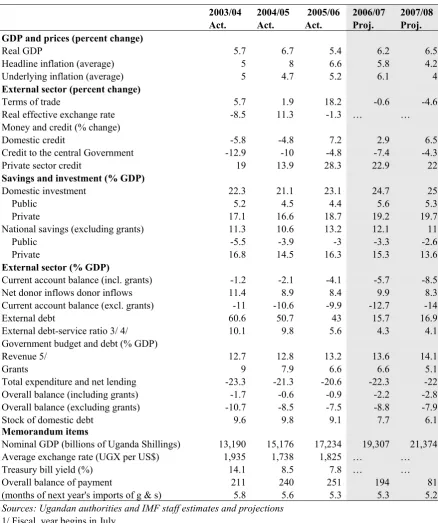
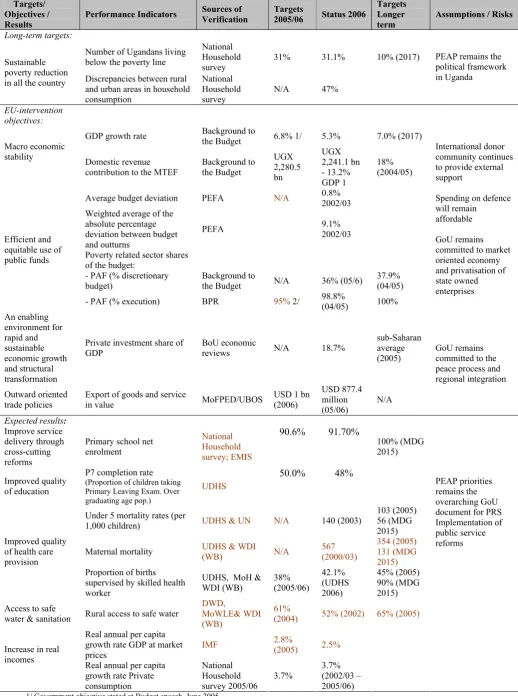
Table of macroeconomic support indicators and targets 28 III Table of indicators for the 1stfocal sector 29
IV Indicators for the 2ndfocal sector 30
V Financial situation of the 9th EDF 31
VI Financial situation of the 8th EDF 33
VII Financial situation of the 7th EDF 34
VIII Regional Projects 35
IX STABEX funds 37
Summary of STABEX accounts 38
X Overview of EIB finance operations 40
XI Use of counterpart funds 41
XII Budget Lines 42
1. Executive summary
Local Government, Parliamentary, and Presidential electiuons were held during 2006. The democratisation process in the country continued, and institutions such as the Judiciary and Parliament have exhibited assertiveness during the multiparty dispensation. This was encouraging. Wider use of dialogue and established constitutional institutions, in order to resolve political differences and boost developments with respect to the treatment of the opposition and human rights, need to be enhanced. Institutions need to become more functional to successfully reflect the competition of ideas among government, opposition, civil society and other organisations.
It was also encouraging that peace talks between the Government and LRA commenced in July 2006. It is hoped that these talks will result in a lasting peace agreement, so that the country can embark on the planned important recovery and development effort in Northern Uganda. Special attention continue specifically on the problems in Karamoja, so that stability in that troubled region can finally be achieved.
During 2006, the economy grew by 6% despite the high energy costs, drought and volatile international oil prices. The maintenance of macro-economic stability in the face of external shocks showed the economy’s resilience spearheaded by a dynamic private sector. As a result, the situation in the poverty reduction front continued to improve. However, disparities in the poverty level between the different regions of the country remain.
Maintaining budgetary discipline has improved despite challenges, and targets to contain arrears which have not been met.
There has been progress towards meeting most of the MDGs. However, increased efforts are required for some of them. In education, whereas primary enrolment rates have increased completion rates have deteriorated. Efforts to improve the quality of education are required. In health, whereas access to services by the poor has improved, and the HIV/AIDS situation has been contained, more efforts are needed to improve the quality of services offered.
Concerning the development cooperation, progress in decommitting unused funds and committing them for the last envisaged operations under the 9th EDF had been achieved by the end of the period under review. The relevant targets would be surpassed by the end of the 1st quarter of 2007. In parallel, a significant number of old commitments and projects have been closed and more will follow in 2007.
In the implementation of main programmes/projects, work has resumed on the Jinja-Bugiri Road, and activities commenced on the three operations targeting Northern Uganda. However, serious challenges face some projects (SUFFICE, OUTREACH, ASARECA, KAMPALA BY PASS ROAD) necessitating bold decisions by the NAO and the Delegation.
Progress has been achieved in the implementation of the STABEX-funded operations. The use of remaining funds has also been planned. The different bank accounts with STABEX funds are in the process of being consolidated in order to facilitate their financial monitoring.
Under the EC’s thematic budget lines, Uganda continued to benefit by having a number of interventions approved. Closer involvement of the Delegation is being planned with a view to ensuring complementarity of such operations with the NIP and STABEX operations.
Lessons learnt through monitoring of the 9th EDF operations, especially with regards to the paramount importance of having programmes / projects prepared in detail well in advance of their implementation, are being fully utilised for the preparation of the envisaged main 10th EDF interventions.
2. Update on the political, economic and social situation
2.1 Update on the political situation
The year 2006 saw many important political developments in Uganda. Following a referendum in 2005, the framework for multi-party politics was re-introduced after twenty years of the ‘no-party’ Movement system. A number of political parties were registered. During the same period, the Parliament also approved the Constitutional amendments, among which was the lifting of the Presidential term limits. President Yoweri Museveni won the 2006 Presidential elections in February 2006 with 59% of the votes. The election process was contested by the opposition candidate Dr Besigye. The Supreme Court ruled on the matter upholding the results.
The 2006 Presidential and Parliamentary elections were observed by an EU Election Observation Mission that produced a report containing recommendations aiming at strengthening multi-party democracy in Uganda. These comprise modifications in the legal framework (i.e. electoral laws), civic education, strengthening democratic processes, independence of judiciary, and electoral administration. As a follow-up to the EU EOM report’s recommendations, the European Union is supporting strengthening of a framework for multi-party democracy.
Following the 2006 elections, Parliament operates under the multi-party system with the Opposition Parties chairing some of the key committees such as the Public Accounts Committee whose mandate is to hold the Executive accountable. The position of the Leader of the Opposition in the Parliament is recognised. Some progress has been made in strengthening the legal and financial management systems to reduce opportunities for corruption. The Inspectorate of Government (IGG), which is independent and answerable to Parliament, and the PPDA are the most important institutions in this area. However, corruption in the public sector continues to be a challenge. Uganda adopted the NEPAD strategy and acceded to African Peer Review Mechanism (APRM). The decentralisation process in Uganda is well advanced with ample powers and service delivery responsibilities formally delegated to Local Governments. The creation of many new districts (from 56 to 80) in 2005-2006 has strained the organisational and financial capacities of some districts in providing effective services.
There are thousands of registered Civil Society Organisations (CSOs). In terms of media, several newspapers are published and hundreds of radio stations have a wide coverage in most parts of Uganda. The Media Council, under the President’s Office, regulates the activities of the media in Uganda.
Peace negotiations are underway to resolve the armed conflict in Northern Uganda between the Government and Lord’s Resistance Army (LRA) which has lasted for twenty years. The conflict had a disastrous effect on local populations, including many women and children who have been abducted and used as child soldiers and sex slaves. A large number of orphans have resulted from conflict and HIV/AIDS. Meanwhile, the Karamoja region is seriously affected by chronic environmental problems, small arms and cattle rustling. Special efforts are needed to restore structural stability in these conflict affected regions where poverty and social indicators seriously undermine the overall efforts in poverty eradication and economic growth. The Government has embarked on a wide consultation with a view to finalising its ‘Peace, Recovery and Development Plan’ (PRDP), and the Karamoja Integrated Disarmament and Development Plan (KIDDP), which aim to address the conflict resolution and recovery issues in the conflict affected areas.
Concerning regional integration developments, these have remained on course. The East African Community has seen its membership increased to 5 with the admission of Rwanda and Burundi. In addition, the three founding members of the EAC have embarked on a wide ranging public awareness campaign amongst their populace with a view to obtaining their support for the envisaged goal of political federation. Furthermore, some improvements in the situation in both the DRC and Southern Sudan are also contributing to the overall betterment of the conditions in the Greater Lakes Region in terms of security and increased trade. Planned interconnectivity interventions in this respect are expected to enhance regional cooperation.
2.2 Update on the economic situation
Macro-economic changes and structural reforms
GoU (Government of Uganda) macro-economic policies have remained broadly satisfactory and on-track with the commitments made by the authorities in the context of the budget process and the IMF’s Policy Support Instrument (PSI). The Bank of Uganda has continued to implement a fairly restrictive monetary policy to stave off inflationary pressures and maintained its international reserves above the level agreed with the IMF.
Despite having to face up to a number of shocks throughout the year − weather, national elections, and power crisis −, the Ugandan economy performed relatively well, demonstrating once again its increasing resilience to abrupt changes in internal or external conditions.
• The national GDP is estimated to have grown 5.5% in 2005/06, despite the electricity shortages and weather conditions.
• Annual headline inflation has increased up to 11.3% in December 2006. But this rise is expected to be transitory – a 5% rate remaining the target pursued by the Bank of Uganda.
• Private investment has continued to grow, underlined by the growth of credit to the private sector of 28%. Foreign direct investment increased from US$133 million in 2000/2001 to US$261 million in 2005/2006.
• After the Multilateral Debt Reduction Initiative, the external debt service ratio as a percentage of exports and of domestic revenues (about 10%) remains at levels well below critical benchmarks.
• Donor funding is projected at 10.4% of GDP and covers 43% of public expenditure in FY 2006/07. This marks a reduction from previous years where more than half of public expenditure was funded through aid receipts. This reflects both an improvement in tax collections (domestic revenue mobilization has improved but remains low at 13.2% of GDP), and the decreasing trend of donor inflows.
Integration into the world economy and negotiation positions with regard to the EPA
Non-traditional exports (fish, flowers and vegetables), and tourism have been growing rapidly, while the value of coffee exports (traditionally Uganda’s major export) has recovered modestly as international prices have rebounded. But the overall export/GDP ratio of 14.8% in 05/06 is still low. The trade deficit has however widened as demand for and prices of oil increased. The deficit for 2006 stood at USD 1,345 million.
Uganda is negotiating an Economic Partnership Agreement (EPA) with the EU as part of the 16-member East and South African (ESA) group. In addition, Uganda belongs to COMESA and forms the East African Community together with Kenya and Tanzania. EAC is the most advanced of the regional groupings and is perceived as one of the most dynamic regional groupings on the continent. EAC achieved Customs Union status in 2005, with a 3 band tariff structure (0, 10 and 25%) plus a category for sensitive products. Member States are working towards convergence on duties, such as VAT, corporation tax and excise, and annual pre-budget consultations are customary. Whilst political commitment to regional integration, remains high, the main challenge for the country will be to ensure that any negative impacts on industry and poverty eradication are identified, and mitigation measures put in place.
Quality of management in public finances and budgetary expenses
Fiscal developments, although broadly in line with expectations, have been mixed. Government has pursued its objective of gradually reducing the fiscal deficit (-1% of GDP in 2005/06 to 7.5% of GDP excluding grants) reflecting an increase in tax collection but also a decrease in aid flows. A prudent borrowing strategy was maintained despite increased pressures to speed up investment in the energy sector.
Maintaining budgetary discipline has however remained challenging. Targets to contain the creation of arrears have not been met. In FY 2005/06 over-expenditure in public administration and defence led the World Bank and other donors to reduce their budget support disbursements.
Budget allocations for poverty related expenditures have remained relatively high (Government executed 99.5% of the approved Poverty Action Fund (PAF) allocations for 06/07 – this represents 35.7% of total expenditures excluding interests) and indicative sector ceilings for the 07/08 budget demonstrate the on-going commitment of Government (and donors) to fund these – particularly in the case of the Education sector. Allocations to the health sector have however dropped, on account of a reduction in donor support.
Significant progress has been achieved in strengthening and updating the legal framework and regulatory environment for PFM, particularly in the areas of accounting, procurement and external oversight, whilst the quality of financial information has also improved. However, on account of the relevant novelty of these legislative changes, it is recognised that fiduciary risks remain high. It is intended that strengthened legislation and capacity building of agencies concerned should provide an avenue for intensified efforts to curb corruption
The implementation of the Integrated Financial Management System (IFMS) has progressed well. The system, which is now fully operational in all Ministries and most Government agencies should now contribute significantly to strengthening control, and reporting on Government operations. IFMS is part of a broad Public Finance Management and Accountability reform programme.
A table with key economic data is attached to this report.
2.3 Update on the social situation
In line with good economic performance, key social indicators improved during the 1990s. The introduction of universal primary education has been followed by big improvement in distribution of expenditures for primary education, largely in favour of the poor and of girls. Gross primary school enrolment increased from 71% of school age children in 1990 to 113 percent in 2005 although unsatisfactory primary completion rates remain a challenge. On going efforts to improve the quality of education also need to be strengthened.
Indicator Outcome 2002
Baseline 2003
Target 2004
Status 2004
Status 2005
Status 2006
Primary Gross Enrolment ratio
- 127% 131% 124% 108% 112.5%
Primary Completion rates 56% 62% 63% 51% 48% Not yet
available
The long effort to bring health services closer to the poor, as well as the recent abolition of user fees has also helped to improve the access of the poor to public health services. As a result, under-five mortality declined from 180 per 1,000 live births in 1988/89 to 152 in 2000. These achievements enabled Uganda to improve its ranking in the UNDP’s Human Development Report from 154 out of 173 countries in 1994 to 144 out of 177 countries in 2005.
As demonstrated in the table below, Uganda has made substantial progress towards achieving the MDGs, although more needs to be done if all are to be achieved.1
1 It is important to note, however, that Uganda’s long-term development objectives are set out in the PEAP and
MDG goals that are likely to be attained, with continued good policies MDG 1 Eradicate extreme poverty
MDG 3 Promote gender equality and empower women MDG 6 Combat HIV/AIDS
MDG 7 Ensure environmental sustainability
MDG8 Develop a global partnership for development MDG goals that may be achieved with intensified efforts
MDG 2 Universal primary education
MDG goals for which strengthened policies, institutions and funding is necessary MDG 1 Hunger
MDG goals unlikely to be met, even with improved policies, institutions and funding MDG 4 Reduce child mortality
MDG 5 Improve maternal health
It is notable that Uganda's economic growth and increases in household income have not been achieved through an expansion of employment in the manufacturing sector. The only notable change that has taken place in the structure of employment is a shift away from food crops to cash crops. Agriculture, which is relatively more labour-intensive, (especially the food crop sector), still has the highest incidence of poverty. Provided this sector can continue its healthy growth without any increase in inequality, (which should be possible in a smallholder based production), poverty reduction can continue.
Education: Over the last three years, Government has continued to give priority to education by increasing the total sector budget by about 2.6% (in nominal terms) over the last FY. Government policy has given importance to basic education by enhancing access and equity to primary education. Steps have also been taken to increase access to post-primary education for all children who complete their primary education. Challenges remaining include:
- persistent rural urban disparities and persistently high school fees in private schools; - managerial limitations particularly at the district and frontline facility levels;
- Inadequate funding, especially for hygiene and sanitation, and for the teachers’ wage bill; - lack of school feeding programmes;
- poor coordination of HIV/AIDS awareness related activities;
- restricted placement of books in the hands of pupils/students and lingering insecurity in certain parts of the country.
Population: The 2006 Uganda National Household Survey shows that the estimated population of Uganda is 27.2 million with an average population growth rate of 3.4% between 1991 and 2002 censuses. Females constitute 51% of the total population and this overall population is dominated by high proportion of children below 15 years (amidst a constantly rising household number) giving it the characteristic of a highly dependant population.
A new report by the UN Population Division, “World Population Prospects” has shown that Uganda has the youngest population in the world. Such a young population with more consumers than producers poses daunting challenges for a developing country like Uganda particularly in the provision of social services. The report shows that at more than 6 children per woman, Uganda is also among the top ten countries with the highest fertility rates and the third highest rate of natural population increase in the world. The report also states that to achieve reductions in population growth, it is essential that access to family planning expands in the poorest countries of the world like Uganda.
unsustainable. Reproductive and child health services are still inadequate. Political leadership and action is perhaps the most critical factor in this respect.
Health and HIV/AIDS:The Health Sector Strategic Plan, finalized in October 2005, is the guide to operations in the health sector for the next five years. Many of the HSSP I output targets were achieved and in some cases surpassed. User-charges were abolished in 2001 in all government health facilities except for private wings in hospitals. The combination of improved physical access, improved quality of care, and removal of major financial barriers for the poor have resulted in a dramatic rise in utilization of public sector services. Significant gains were realized in many of the priority programmes notably immunization. Mother and child healthcare remains however one of the bigger challenges. Malaria continues to kill approximately 100,000 people per annum.
Human resource capacity in terms of numbers and skills poses a special challenge. Severe constraints still exist in under-funding, frequent stock outs of essential medicines, and lack of equipment. Access to basic emergency obstetric care remains extremely low too. The National Health Policy objective of making the non government sector a major partner in national health development has to a large extent been achieved. The HIV/AIDS epidemic continues to be contained effectively. The 2005 Sero-Behavioural Survey, reports the national prevalence rate at 6.4%. A successful policy of universal access to ARV has been introduced. Despite the success, there is limited access to clinical, palliative, and home based care, as well as inadequate supply of drugs including those for opportunistic infections and ART. Male involvement and infant feeding have also been incorporated in PMTCT. Demand for VCT has increased, resulting however in inadequate counselling & laboratory facilities and personnel. Structures have been created for the integration of HIV/AIDS issues into sector strategic plans. These programmes have been relatively successful, although challenges remain, e.g. as regards stigma against HIV positive workers.
Employment conditions: Official unemployment is low at 3.2 percent but this statistic is of limited relevance in a country where about 73% of the working age population is engaged in agriculture. The UNHS 2006 indicates that the annual labour force growth rate in Uganda is 3.6% and 14% of the total labour force has never received any formal schooling. 85% of the labour force remains principally rural and the labour market is characterised by significant under-employment and surplus rural labour, exacerbated by high population growth. This keeps wages in rural and unskilled urban sectors low. However, at the same time, significant skills shortages remain in (largely urban) sectors employing scarce specialist skills. As a result, salaries in these sectors are relatively high. This underlines the importance of linking the education system to skills required by the public and private sectors. A number of initiatives are at varying stages of design and implementation to improve the employment situation in the country.
2.4 Update on the environmental situation
Physical Environment
One of the key environmental issues with visible consequences on Lake Victoria, with diminishing water level, and the related energy crisis in Uganda is the variability in rain fall and the reduction in the duration of the dry season where evaporation is the critical issue. In particular, the September to December 2006 rainfall season was influenced by moderate El Niño conditions which matured towards the start of the season. As predicted the rains were rather poor over many parts of the country during the month of September but picked up mid October and reached peak levels in November/early December. Floods were reported in a number of places during the peak rains especially over the Lake Victoria Basin and central regions, and to a certain extent in the western region. Consequently the lake level gained about 1m as compared to the level in December 2005. Land degradation is one of the main environmental issues facing Uganda. The main causes are population pressure, inappropriate land management practices and over-stocking on rangelands. The main water environment concerns are the issues of quality and access. The main threats to quality include eutrophication, pollution, and proliferation of invasive plants.
agriculture, has become a major problem throughout the nation and per capita forest has declined from 0.3 ha in 1990 to less than 0.1 ha in 2006.
Uganda’s wetlands support a rich diversity of plants and animals and serve an important natural role for sediment, nutrient and toxin retention, stabilisation of the hydrological cycle, harbouring biodiversity, and water supply in rural areas. They are under threat in many ways including from encroachment, brick production, drainage and pollution.
Fisheries are under threat from land degradation causing excessive silting in lakes and rivers, thus affecting the level of sustainable catch, and from drought, pollution and floating weed.
Socio-economic Environment
Although addressed by the Land Act 1998, land ownership remains confused in many areas and plots fragmented and small. There is no easy solution to this problem, which is likely to have a major impact for years to come.
Water and sanitation are problem areas in major urban centres with significant parts of the population unable to gain access to clean water. Slums and squatter communities are also a problem in bigger towns and particularly in Kampala.
Uganda’s main energy source is from biomass accounting for about 93 percent of demand (including about 5 percent charcoal) while petroleum products account for six percent and electricity one percent of demand respectively.
Environmental policy and legislative framework
Uganda has many plans and strategies in place. However, the main areas for improvement include: social and poverty issues, international commitments, high-level government commitment, co-ordination with donors and budgetary provision. There is nominal protection for and access to land despite the Constitution and the Land Act of 1998. Several potentially good environmental initiatives are thwarted and compromised by the land tenure issue.
A good environmental legislative framework is in place although there are aspects that lead to implementation weakness including; institutional rivalry, inadequate policy implementation, lack of clear guidelines and budgets, poor monitoring system in biodiversity conservation, political interference, and weak law enforcement.
Uganda has entered into several international and regional environmental conventions and, as a result, has played an active part in regional environmental management.
There are a number of active NGOs in the sector, including ACODE, CARE, Clean Up Uganda, Environmental Alert, Greenwatch, and the Ugandan Wildlife Society.
3. Overview of past and ongoing co-operation
The End-of-Term Review of Uganda’s NIP under the 9th EDF CSP, was conducted during 2006 in collaboration between the European Commission (including the Delegation) and the Government, involving also EU Member States and civil society representatives. The conclusions of this exercise confirmed the relevance, to the overall objectives, of the strategy followed. Consequently, the Country Strategy for Uganda was maintained. On the other hand, the review concluded that the conditions necessary to trigger the commitment of the remaining funds under the B-envelope were not in place. As a result, the overall amount of the B-envelope funds for Uganda was reduced to €38,600,905.57.
The EC-funded Global Budget Support has contributed to the maintenance of the country’s macroeconomic stability, to the strengthening of public finance management, and to the implementation of the poverty reduction agenda. Furthermore, it has allowed the EC to be an active partner in the policy dialogue with Government and other Development Partners (DP). Such enhanced cooperation, coupled with the fact that an increasing number of DPs are adhering to the Uganda Joint Assistance Strategy, helps in gradually improving aid absorption capacity and ownership. Furthermore it allows the DPs to exercise sufficient flexibility in their responses to evolving trends based on their relevant mandates and comparative advantages as in the Paris Declaration.
institutional support, and through policy dialogue. Long involvement in the sector by the EC, has validated the need for projects to be well elaborated before relevant Financing Agreements are signed in order to prevent delays in implementation. Furthermore it has been learnt that such interventions must include significant institutional strengthening activities.
Support to the second focal area of rural development, channelled through sector budget support, has shown positive results, especially in terms of policy reforms. The establishment of a new extension system, providing agricultural advice based on clearly-identified needs by farmers and delivered through private service providers has promoted the empowerment of smallholders. The National Forestry Authority has carried out its tasks satisfactorily, at times under difficult conditions.
The smooth implementation of some programmes (Support to Decentralisation, Human Rights and Good Governance, Northern Uganda Rehabilitation) necessitates an extension of their duration (through appropriate riders to the relevant Financing Agreements). This is mainly due to the longer that envisaged period that their tendering and start-up activities have taken. Also, the fact that these programmes have only a maximum of 12 months implementation period left after their D+3 dates, makes it prudent to have an additional 6 months in order to ensure their proper closure.
3.1 Focal sectors
3.1.1 Infrastructure
a) Results
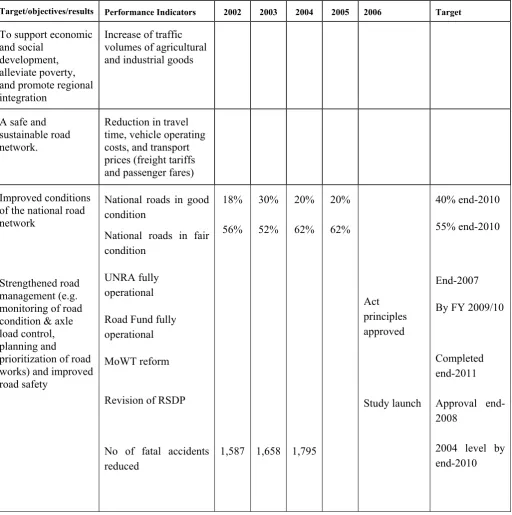
In the transport sector, the Government continued the implementation of its Road Sector Development Programme, involving rehabilitation of existing infrastructure, mainly funded by donors, and road maintenance, mainly financed by Government. The overall condition of the national road network of 10,800 km can be classified as: 20% in good condition, 62% in fair condition, 17% in poor condition, and 1% in bad condition. The continued shortfall of road maintenance funding has exacerbated the existing backlog of both routine and periodic maintenance. The high percentage of roads in fair condition continues to pose a serious challenge to preventing deterioration to poor condition. A comprehensive review of the condition of the national network was launched in 2006.
In terms of institutional reform, a major milestone was achieved with the enactment of anAct setting up the Uganda National Roads Authority. In accordance with the relevant Act, the Ministry of Works and Transport prepared to appoint the UNRA Board in early 2007. In addition, the Government followed up on its decision to establish a Road Fund. Relevant legislation is planned to be submitted to Parliament by mid-2007.
In parallel with these developments, appropriate assistance was mobilised to advise on the restructuring and right-sizing of the Ministry of Works. This reform should ensure a proper division of labour between UNRA and the Ministry. In its new role, the Ministry will focus on policy formulation, regulation and monitoring, while UNRA will be responsible for managing the national road network.
The table annexed to this report shows the updated indicators on results achieved by end-2006 and on targets from 2007 and beyond.
b) Progress in activities
There are currently three large road projects along the Northern Corridor Route funded under the 8th and 9th EDFs. On the Jinja-Bugiri road section, work resumed in July 2006 under a new works contract following the termination of the initial one. The resumption of work on this project meant the 2006 forecast on commitments was achieved. Moreover, the new Contractor has demonstrated good organisation during the mobilisation and start-up phase, thus providing reasonable assurances that this time the rehabilitation of this important section of the Northern Corridor Route will be implemented without major problems.
Progress of the works on the Kampala Northern By-pass Road project remained inadequate with approximately 55% completion by end-2006. The Contractor bears the main responsibility for this. In response to a number of claims by the Contractor, the two contracting parties agreed on a framework for an amicable settlement of the disputes. The settlement has not resulted in an improvement in the rate of progress and high level meetings were scheduled to highlight the issue. On the Kampala-Mbarara Road, the tender documents for works were updated in 2006 and the tender for the supervision was launched in November 2006. The delay in implementing this project, compounded with fuel price rises, will most probably necessitate additional funding, if the objectives of the relevant Financing Agreement are to be achieved. This issue will have to be critically reviewed when the results of the works tender are known (in June 2007).
The implementation of the District Roads Re-gravelling project (financed with STABEX funds) continued during 2006 with work on approximately 400 km. A mid-term review is due to take place in early 2007 in order to take a thorough stock of the situation with the implementation of this project and to make appropriate recommendations.
In terms of institutional support, the technical assistance to the Road Agency Formation Unit was fully mobilised during the first half of 2006. A mid-term review was completed in September 2006. It confirmed the relevance of this support and recommended some actions, amongst which the mobilisation of additional experts to support the on-going institutional reforms in the sector.
The last focal sector project under the 9th EDF, i.e. the Backlog Roads Maintenance Programme, was approved at the end of 2006. Its implementation is expected to start in the first half of 2007. Finally, it has also been planned to execute, during 2007, the necessary studies in preparation of the implementation of the roads sector interventions envisaged under the 10th EDF.
The table below provides key figures on the end-2006 financial situation in this focal sector:
Amount (as against total assigned funds) Percentage
Funds assigned € 224,599,500
Funds decided upon € 217,599,500 96.8%
Funds contracted € 111,208,648 49.5%
Funds disbursed € 44,404,332 19.7%
c) Degree of integration of cross-cutting themes
All contracts concerning the preparation and implementation of road projects provide for environmental specialists to ensure compliance with the national environmental legislation. Tender dossiers for road works routinely include provisions for appropriate HIV/AIDS awareness campaigns. As far as possible gender issues are duly taken into account.
3.1.2 Rural Development
Results
The Plan for Modernisation of Agriculture (PMA) is a framework which sets out the strategic vision and principles upon which interventions can be developed to address poverty eradication through transformation of agriculture and related sectors. The PMA strikes at the heart of rural poverty through a series of coordinated actions in inter-related intervention areas. These are: agricultural research, agricultural advisory services, agricultural education, rural financial services, marketing and agro-processing, rural infrastructure, and natural resources management. In addition, a non-sectoral conditional grant is made available to selected districts for PMA related activities.
A broad-based PMA steering committee, chaired by the PS/ST oversees the activities of the PMA. A PMA donor sub-group coordinates the donor contributions to the PMA process. Donors are also active in a number of PMA sub-committees. The major donors are: EU, World Bank, DFID, AfDB, and IFAD. During the reporting period the European Union has continued to play a lead role in the PMA. Substantial contributions were made to Agricultural Research (NARO) and Agricultural Advisory Services (NAADS). In particular:
• The EU has continued to provide Policy TA support (direct policy advice to MAAIF top management, donor coordination and planning) to the Ministry of Agriculture. It has also supported the NARO decentralisation through its change management TA.
• The support to NARO was extended until mid 2006, to consolidate the NARO transition into the new NARS.
• NAADS and NARS financing by the EU continues through the PMA Sector Budget Support, of which the FA to the tune of €17.5 million was signed in March 2005. The second instalment (€6.65 million) was made in March 2007.
PMA progress/effectiveness
The extensive evaluation of the PMA carried out by Oxford Policy Management in 2005 concluded that the PMA was largely on track and remains relevant to the rural development framework. In 2006, a ‘light’ review focused on the agreed PMA undertakings and the PMA related policy actions in the PEAP policy and results matrix for FY 05/06. Out of the 54 PMA undertakings agreed during the 05/06 JAR, 35% was achieved, 54% was partially achieved and 11% was not achieved. Of the 66 policy actions in the PEAP matrix the division between achieved, partially achieved and not achieved was 33, 36 and 30% respectively. The delays in terms of PMA undertakings and policy actions are due to the multi-sectoral nature of the programme and the complexity/sensitivity of issues concerned, generally requiring wide-range consultations with stake-holders, as well as due to the long time that the reform of the Ministry of Agriculture takes. Generally, good progress was made in Agricultural Research and Advisory Services, whereas considerable delays were experienced in undertakings regarding Lands, Agricultural Education, and Natural Resources Management. Overall, the PMA performance can be rated reasonable to good.
PMA Secretariat is a reason for concern. On the positive side, in 2006 MAAIF published its own Development Strategy and Investment Plan that will form the basis for future priorities and budget. In conclusion, the overall assessment of the PMA is still positive, and certain pillars are well established and fully operational. Further dialogue is required on the changing policy environment and the PMA principles to ensure that there is consensus on the strategy. A strong policy dialogue with GoU is required, and therefore a strong EC participation in the sector dialogue, to maintain the basic principles of the PMA, while integrating some genuine concerns about roll-out and poverty targeting as expressed by MoFPED and MAAIF.
The table below provides key figures on the end-2006 financial situation of the EDF projects in this focal sector:
Amount
(€) (as against total assigned funds) Percentage
Funds assigned 31,547,682
Funds decided upon 31,547,682 100%
Funds contracted 31,078,451 98.5%
Funds disbursed 17,630,746 55.9%
The relatively low level of funds disbursed is due to the fact that the release of the second tranche under the PMA project was effected in the beginning of 2007 and not in late 2006 as scheduled.
Cross-cutting issues
The PMA has made good progress in addressing cross-cutting issues, in particular gender and HIV/AIDS mainstreaming, but there is still scope for improvement. A major issue remains women’s access to and control over productive resources, and the fact that with a PMA emphasis on marketable crops, the traditional women’s role in food crop production may be overlooked.
3.1.3 Macro-economic support
a) Results
Overall macro-economic management remained solid during the year under review as described in chapter 2.2. Updates on the social situation have been described in more detail under chapter 2.3. Notable amongst these is the reduction in income poverty over the last three years from 36% to 31% as documented by the latest National Household Survey, pointing to the positive impact on the ground of these economic trends. Such impact has been most pronounced in rural poverty reduction. Other results indicators, such as those used in the social and PFM sectors for variable tranche disbursements, while broadly positive, point to the need to accelerate progress in the delivery of reforms (e.g. procurement indicator) or high quality government services (e.g. numeracy/literacy indicator).
The two tables annexed to this report give an overview of key economic data and of macroeconomic indicators and targets. Donors active in the macroeconomic support area (WB, UK, ADB, EC, Ireland, Netherlands, Norway, Sweden) are coordinating activities. They are also in intense discussions aiming at agreeing on a joint framework for the assessment of issues pertinent to budget support operations.
b) Progress in activities
The second fixed and the first variable tranches for the PABS V programme (€92.0 million) were released in November 2006. Disbursement for the variable tranche performed at 80% on account of failure to reach indicator targets in the areas of Procurement and Disposal Entities statutory displays of tender processes and results, and in child deliveries in health facilities.
c) Degree of integration of cross-cutting themes
Aspects of gender equality, HIV/AIDS and environmental protection, are specifically catered for in the PEAP. As regards reducing the gender gap, progress has been reported in the health and education sector programmes. Progress with regard to combating HIV/AIDS has been mixed, as evidenced by sero-prevalence surveys. Institutional strengthening activities have been initiated.
3.2 Projects and Programmes outside the Focal Sectors
3.2.1 Micro-projects Programmes
Acholi Programme: The Acholi Programme (AP) ended in June 2006. Around 200
micro-projects have been completed in the Districts Gulu, Kitgum and Pader. Cooperation activities with Local Government (LG) have concluded with final training activities and handing over of
programme assets and projects to the local authorities.
The extraordinary ‘macro’ projects in Acholi have been finalised (house of Paramount Chief, Pader Airstrip, Kitgum High School and Anaka Hospital rehabilitation).
Due to the continued high percentage of IDPs in the region, the regular implementation of mainly social infrastructure projects had to change its focus to service delivery to a displaced society. Results of this approach remained limited due to long and difficult planning procedures within LG. The ‘lessons learnt’ evaluation study covering the three recently completed MPP related programmes (MPP, AP, and KP) has started (stakeholder workshops in Acholi and Karamoja, programme review consultancy) with the focus on lessons learnt for the 9th EDF programmes.
Karamoja Programme: The European Commission supported the Programme Management Unit
KPIU with the Programme Manager and programme and support staff. The programme is in its closure phase and ending in March 2007. Around 90 community identified micro-projects at District and Sub-county level have been completed, capacity building of district personnel as well as support to peace initiatives within the draft Karamoja Integrated Disarmament and Development Plan (KIDDP) has been undertaken. The construction of staff houses and offices blocks for future EC funded programmes has started and will be the final activity under this programme.
Due to the insecurity caused by armed warrior activities against other Karimajong ethnic groups in raiding cattle or against other civilians or military authority, the programme faced huge security problems of accessibility to sub-counties with project activities. The pastoralist cultural traditions in Karamoja required very specific approaches to achieve responsibility and ownership towards the projects initiated.
3.2.2 Support to Decentralisation Programme
The 9th EDF Support to Decentralisation Programme started its operations in July 2006, when the Ministry of Local Government implemented the induction training for local councillors, elected after the local government elections in February 2006. The Programme Management Unit of the programme started its operations in November 2006. The programme is focusing on supporting the policy framework for decentralisation, local government capacity building, support to maintenance systems as well as downward accountability and democratic local governance. Cross-cutting issues are being mainstreamed into operations. The European Commission is one of the signatories of Memorandum of Understanding for the Local Government Sector Investment Plan (LGSIP) and the programme will support a more coherent approach to decentralisation. The programme links to the Decentralisation Support Group.
3.2.3 Technical Cooperation Facility
3.2.4 Projects in Governance, Human Rights and Decentralisation
Commercial Justice Reform Programme: The purpose of the project is to support the
implementation of the CJRP and thus the ability of the private sector to make and enforce commercial contracts. The first programme estimate was signed after approval from the Commission to proceed with the implementation modality of programme estimates instead of basket funding as originally designed. The period of execution of the operational implementation phase was also extended, due to delays incurred, from December 2006 to December 2008.
Degree of Integration of cross-cutting issues
The Justice Law and Order Sector is presently discussing ways of mainstreaming HIV/AIDS interventions in all government institutions under the sector. Mainstreaming gender is also being discussed.
Donor Coordination in the Sector
The programme is under the Justice, Law and Order Sector (JLOS), which is the sector-wide approach to the reform process within the administration of justice and maintenance of law and order. A multi-donor funding arrangement is in place, comprising a number of donors (Austria, Denmark, Germany, Ireland, Netherlands, Sweden, UK, EC, Norway, and the WB). The EC Delegation participates in monthly coordination meetings to assess progress of implementation, as well as quarterly visits to institutions concerned to monitor progress on agreed outputs.
Human Rights and Good Governance Programme: The purpose of the programme is to
contribute to the sustainable development centred on human security and good governance, as well as to strengthen rule of law in Uganda and to enhance the participation of Ugandan citizens in decision making. In February 2006, support was provided for 10,000 local election observers (50 % of total polling station coverage) to observe the 2006 Presidential and Parliamentary elections. The PMU started its operations in December 2006. The start-up programme estimate has been signed. Degree of integration of cross-cutting issues
Discussions about ways to integrate the human rights based approach to programming in all aspects of the programme as well as mainstreaming gender issues are on-going.
Donor Coordination in the Sector
The programme liaises with the Justice, Law and Order Sector, considering that some of the components of the programme are being supported under this programme. The JLOS Strategic Investment Plan is the overreaching policy framework and strategic guideline, with focus on both commercial and criminal justice. Development Partners involved, as well as modalities of coordination, are as outlined for the previous project.
3.2.5 Mid-Western Towns Water and Sanitation Programme
The purpose of the project is to improve access to sustainable water supply and improved sanitation in the towns of Masindi, Hoima and Mubende through rehabilitation and expansion of the existing water supply systems and construction of new sanitation facilities. The implementation of the project commenced in December 2001 and is expected to be completed in August 2007.
Main activities in 2006:
• Construction works for the Hoima Water supply system
• Construction works for the Hoima sewerage system
• Construction works for Mubende Water supply system
• Construction works for Mubende on site sanitation facilities Results achieved in 2006.
• Official commissioning of the new Masindi Water supply system was carried out in Aug 2006.
• Substantial completion of the works for the new Hoima town Water supply system.
• Substantial completion of the works for the new Mubende town water supply system
Cross cutting issues:
• A Technical assistances team in close collaboration with community leaders and town officials carried out a sensitization campaign in households mainly in Masindi and Hoima, addressing issues of clean water and hygienic sanitation with the aim of generating demand for house hold connections, mainly to the sewerage system.
Donor Co-ordination in the sector
• Donor co-ordination in the sector is being steered by the Water Supply and Sanitation Donor Partners Group which convenes monthly, currently under the chairmanship of Austria.
• Additionally the donors participate in the Sector Working Group comprising stake holders from Government of Uganda institutions within the sector, and civil society organisations.
3.2.6 Forest Resources Management and Conservation Programme
Results: The Forestry Programme’s main purpose is to improve forest management for conservation and increased sustainable production by government, individuals, groups and the commercial sector. It is spread over seven result areas and it is implemented by the National Forestry Authority (NFA), an autonomous agency established to manage the Central Forest Reserves (CFRs). The Steering Committee chaired by the Permanent Secretary, Ministry of Water and Environment oversees the activities of the Forestry Programme. During the reporting period, the European Commission has continued to play a lead role in the Forestry Sector in particular:
• The 12 MEURO Financing Agreement of FRMCP was extended to 31 December 2008 to enable the programme to finalise its activities
• Support has been extended to the Sawlog Production Grant Scheme (2.6 MEURO) to encourage the private sector to plant commercial forest plantations.
• Continued Technical Assistance support to the Sawlog Production Grant Scheme (SPGS)
Achievements: 5,000 ha of timber plantations have been planted under the SPGS while 1,922 ha of
demonstration plantations have been planted by NFA. The campaign against illegal timber and charcoal had reduced these illegal activities considerably during the reporting period. Nearly 5,000 small contracts were given directly to local people near forest to carry out forestry operations. Various guidelines for operations have been completed. Technologies in nursery and plantation management have been extended to private investors in commercial forest plantations and the enthusiasm of the private sector has continued growing.
Most of the programme activities enhance the environment. Those with some level of negativity like timber harvesting are being designed with the concept of sustainable forest management in mind. The biggest uncertainty here is how far Government is prepared to maintain commitments to its own National Forest Policy and Plan.
The main donors in the forestry sector are the Norwegian Embassy and the European Commission. Although DFID is still a key player in the sector, its funding came to an end in 2005. The Environment and Natural Resources Donor group chaired by the Norwegian Embassy coordinates the donor contributions to the Sector.
3.2.7 Sustainable Tourism Development Programme
Activities 2006: Outline National Tourism Curricula were developed and handed over to the
Ministry of Education and Sport. Slow progress in development of the Tourism Bill which was eventually prepared for submission to Cabinet late in the year. Draft Statutory Instruments designed to implement the regulations bringing the Bill to life and regulating the industry were prepared. Additional promotional material prepared and delivered to the re-branded Tourist Board now working as Tourism Uganda. Electronic newsletter preparation and distribution facilitated. A MTR was carried out. Extension to December 2007 was agreed.
Achievements 2006: There has been significant positive exposure of Uganda as a tourism
Authority staff working on the mountaineering sector was supported. Further guide training, in particular in driving skills and customer care.
Close co-operation was maintained with the World Bank PAMSU programme which funded the
development of the Tourism Bill. Joint activities included the funding of an inspection visit to Namibia by Tourism Uganda officials who were exposed to the workings of a similar Tourism Act in that country.
3.2.8 SUFFICE
SUFFICE is in its 4th year of operation. Implementation is expected to end in 2007. Donors involved include FSDU, WB, AfDB, Stromme, USAID, and GTZ. Co-ordination meetings are taking place on the local rating fund which is a multi-donor fund managed to rate MFIs.
SUFFICE has five main components namely:
Financial support (Credit lines and bank guarantees)
Capacity Building Matching grants components
New Product Development component
Credit Reference Bureau
Local Rating Fund that is partially financed by FSDU (DFID funded programme).
Progress/Achievements
Financial Support (Credit lines and Bank Guarantees)
Eight Credit Lines with a total of UGX 755million to SACCOs and seven Bank Guarantees totalling UGX 2.882 billion were issued in 2006. Interest payments due on the loans have been fully recovered.
Capacity Building Matching Grants components
90% of the amount was given to thirty four (34) SACCOs totalling UGX 988,763,691
New Product Development component
Nineteen (19) SACCOs were developed, launched and rolled with a total of UGX 583,391,680 during the year 2006; evaluation and monitoring is taking place.
Credit Reference Bureau
Funding under this component has been delayed pending the establishment of the Credit Reference Bureau managed by Bank of Uganda (BoU).
Uganda Local Rating Fund
The Local Rating Fund rated about 10 MFIs and contributed to the subcontract with Planet Rating which aims to complete 30 ratings with multi donor funding.
Challenges
The evolution of GoU policy which focuses on SACCOs and aims to establish a co-funding/basket funding arrangement with donors and the Micro Finance Industry, affected the accreditation system (rating) activity.
Planet Rating target of 30 ratings was not achieved mainly due to lack of offices. However, the rating system if sustained, is a good tool for performance measurement and evaluation of the MIFs. An MTR for the project was carried out in 2006. Its main recommendations are to be discussed between the Delegation, the NAO, and the Implementing Authority with a view to adapting the programme’s activities accordingly.
3.3 Utilisation of resources for Non-State Actors
In 2001, the civil society organisations (CSOs) organised themselves into an interim Cotonou Steering Committee. Since 2003 this has developed to a permanent network based Civil Society Steering Committee (CSSC) currently chaired by the Uganda National NGO Forum. The Interim Support Programme 2003/2004 to Non-State Actors under STABEX has supported the preparation of the 9th EDF project and strengthened the advocacy role of civil society. It has also increased the
Civil Society Capacity Building Programme: The institutional framework for the complex and so far unique 9th EDF Non State Actor programme is fully functioning with a Civil Society Steering Committee, and a Programme Advisory Board with two additional independent CSO members and an observer from DFID, as well as the NAO and Supervisor from the OPM.
The programme contracted 47 CSO grantees by end-2006. Seven intermediary CSOs, responsible for regional operational clusters, have been contracted to assist the PMU in working with successful applicants on capacity building. One such intermediary organisation is contracted to implement the Promotion Fund for cooperation with very small CSOs working on minority issues in Uganda. The Government assignment, to prepare a regulatory framework for Non Governmental Organisations in Uganda, is being implemented under the Office of the Prime Minister.
3.4 Utilisation of B-envelope
The 9th EDF Mid-Term Review had reduced the amount of the B-envelope to €58,500,000. As a result of the End-of-Term Review, conducted in the second half of 2006, this amount is to be further reduced to € 38,600,905.57.
Northern Uganda Rehabilitation Programme
After a detailed preparation phase, this programme of €20 million, commenced its operations in December 2006. The Programme Management Unit was fully operational in the last quarter of 2006. The first Call for Proposals, centred on the theme “IDP self-reliance and return to home areas”, of a total amount of €5 million, was launched in November 2006. The PMU organised planning workshops in two northern districts in order to promote the intended participatory planning of the envisaged activities.
The Northern Uganda Rehabilitation Programme is to form an integral part of the currently prepared comprehensive Government/Donor plan for the recovery of the north of the country, i.e. the Peace, Recover, and Development Plan (PRDP).
ECHO
Under the B-envelope, an initial allocation of €14.6 million was made to ECHO for their humanitarian operations in Northern Uganda. An additional amount of €4 million was allocated in the second half of 2006. ECHO’s humanitarian funding for Northern Uganda continued to focus on improving living conditions in IDP camps, while at the same time supporting return as the Juba peace talks gained momentum.
3.5 Other instruments
3.5.1 STABEX
In March 2006 agreement was reached between the EC Delegation and the NAO to arrange the consolidation of the STABEX funds into a single bank account. A new STABEX 1999 account was opened for this purpose and in June the older STABEX accounts with no active projects were closed and the balances transferred to the new account. It is planned that this process of consolidation will be completed during 2007. All new commitments will be arranged under the new STABEX 1999 account.
The following new Channelling Agreements were signed during the year, and activities started: SX99/16 – The Sawlog Grant Scheme (€2,600,000)
SX99/17 – Redevelopment of the ACOM Database (€140,000)
Micro-finance sector. The Kaweri Outgrowers Scheme has made excellent progress and has been sited by Government as an example of successful public-private partnership.
The Support to the Warehouse Receipt System/Commodity Exchange commenced full activities during 2006 following the selection of the Technical Assistance for this programme and the signing of the grant contract with the Uganda Commodity Exchange. The support to the livestock disease control programme (PACE/FITCA) continues to make progress and is due to be completed by the end of 2007. The Support to NARO was completed in September 2007 and should be closed during 2007. Under the TA to the Plan for the Modernisation of Agriculture (PMA), contracts were signed for extension of the TA to the agricultural research reform process, TA to NAADS (agriculture extension) and TA to forestry, all of which have received funding under the 9th EDF NIP. Further TA is planned in support of agricultural research and extension to complement the EC’s ongoing sector budget support programme. A TA was finally recruited under the Medium Term Competitive Strategy Programme, which has assisted Government in identifying and designing a new phase of the MTCS to monitor progress in reforms to facilitate private sector development.
Active projects under STABEX 1993 include the construction of the Kagamba-Rukungiri Road, for which final payments are being arranged; the trade sector support programme (UPTOP), which is performing reasonably well; and, the Karamoja Programme, which has been extended to mid-2007 to allow completion of activities. The only active project under STABEX 1992 is the Rehabilitation of the Kampala-Malaba Railway line, which should be completed in 2007. The accounts for STABEX 1990, 1991, 1995 and 1st Protocol were closed in June 2006.
3.5.2 Regional co-operation
Uganda is in charge of the implementation of some regional operations in the field of natural resources management. These are outlined in the relevant annex to this report.
3.5.3 Community budget lines
A number of operations are implemented in Uganda with funding from the various community budget lines. These are described in Annex XII to this report.
3.5.4 ECHO
As part of a regional financing decision for the Greater Horn of Africa area, ECHO for the first time in 2006 started supporting drought affected populations in the Karamoja region through preparedness interventions focusing on water supply for both human and livestock as well as on livestock management and health. During 2006 ECHO continued its humanitarian assistance to internally displaced persons (IDPs) and other victims of the LRA conflict in northern Uganda. In this respect, ECHO made the following financing decision in 2006 concerning Uganda:
*
F u n d s f r o m
9th EDF B-envelope.
** Regional decision including cross-border operations. Estimated EUR 1,310,972 allocated to Uganda.
Recurrent droughts prompted ECHO to launch a regional drought preparedness decision in 2006, where supporting pastoral livelihoods in the Karamoja region, faced with forceful disarmament, structural under-development and inter-clan cattle raiding, poses a particular challenge. Significant, additional LRRD efforts are needed to maximise on the combination of EC aid instruments.
Decision Amount (EUR) Grants Awarded Main Sectors Covered
ECHO/UGA/BUD
/2006/01000 15,000,000 MedAir, NRC, Goal, FAO, OCHA, World Vision, IRC, AVSI, Concern, ACF, UNICEF, Oxfam, COOPI, Danish Red Cross, ICRC, Caritas/CRS
Health, nutrition, water, sanitation, hygiene, NFIs, HIV/ADIS, food security, protection, child protection, co-ordination.
ECHO/UGA/EDF
/2006/0100* 4,000,000 UNHCR, ICRC Protection
ECHO/-HF/BUD
/2006/0200** 10,000,000 Overall: Uganda: 1,310,972
Uganda: Practical Action,
FAO, MedAir, DanChurchAid Water, sanitation, hygiene , livestock, co-ordination
In this respect, a deliberate effort was made to step up water supply in both IDP cams and return areas resulting in that approx 37% of total ECHO funds for humanitarian aid in Uganda was allocated to water and sanitation (up from 25% in 2005). Primary health care continued to receive ample funds of about 23% of total resources for humanitarian aid in Uganda, but focus was increasingly shifted from hospital support to peripheral primary health care closer to the beneficiaries (IDPs and returnees). To support the return process and self-reliance in general ECHO also increased funds for food security to about 15% of the portfolio targeting up to 200,000 households (or more than a million people). As a result WFP food rations were further responsibly reduced to between 40-60% according to land access.
As the number of formerly abducted children was reduced, reintegration assistance to children was re-focussed in 2006 on providing employable skills to youngster - both boys and girls - through vocation training and income generating activities.
The humanitarian reform in terms of ‘Cluster Approach’ and ‘Strengthening the Humanitarian Co-ordinator’ was rolled-out in 2006 in Uganda as a pilot country. ECHO has supported this important initiative to improve management and co-ordination of humanitarian assistance and has continually engaged with other donors, the UN and NGO on its implementation and adaptation to the Ugandan context.
The more effective Malaria treatment protocol of ACT was finally implemented in 2006 in Uganda and all ECHO partners in the health sector has supported its fast tracking in northern Uganda with training of relevant health workers among others.
3.5.5 European Investment Bank
The overview of the 2006 financial operations of the EIB in Uganda is shown in the attached annex.
3.6 Assessment of performance indicators
The indicators, to measure assessment of performance, shown in the 9th EDF NIP Framework of
Intervention for the focal sectors, have been under a constant review during the implementation of relevant activities. Their relevance and suitability is being assessed, especially when compared to indicators used by other Development partners in similar interventions. Particular attention is being paid to indicators used for the assessment of performance under the budget support operations. Consultations in this case are being held with the Commission HQs.
Indicators for the focal area of transport infrastructure need further refining. This however necessitates the availability of reliable data for the sector. The relevant shortcomings are planned to be addressed in the coming 10th EDF through the envisaged institutional support.
3.7 Donor coordination and harmonisation
Donor coordination primarily takes place in the context of joint Sector Working Groups (SWG), around specific sectors which are critical for poverty eradication, and their sub-groups. Sector Working Groups are often constituted in the context of Sector Programmes, and usually comprise representatives from relevant ministries and development partners, sometimes including non state actors and private sector stakeholders. The overall coordination of donors is organized through monthly Local Donor Group meetings, chaired by the World Bank, and comprising Development Partners Heads of Mission or Heads of Cooperation. Parallel to this, the EU Heads of Cooperation meet regularly, as required. The main fora for political dialogue are the EU Heads of Mission Meetings and the Donor Democracy and Governance Group.
in the different sectors. In addition, it will examine the current SWG structure with a view to streamlining it. It is envisaged to have this exercise completed by end-2007.
3.8 Dialogue in country with the NAO and non-State actors
The NAO and the Delegation meet on a monthly basis, on a technical level, to review the ongoing cooperation and to deliberate on issues affecting progress. From 2007 and onwards, it is planned to have quarterly meetings at a more political and strategic level, during which programming issues and general orientation aspects can be dealt with. Regular project-specific meetings between Delegation staff and their counterparts in the NAO’s office are also taking place. A new structure of support to the NAO’s office has been put in place and became fully operational by mid-2006, aiming at providing, in particular, assistance on matters of procurement, tendering, contracting, and payments. The NAO/Delegation dialogue is also assisted by their mutual participation in steering committees of all main projects along with other stakeholders including in many cases CSOs. In Uganda, the Civil Society Steering Committee (CSSC) provides a structured forum for civil society dialogue and consultation in the context of the 9th EDF Civil Society Capacity Building Programme. Beyond its role as a decision making instrument in this programme, the existence of a representative Civil Society Steering Committee gives the opportunity to formulate interests of Civil Society in a more coordinated manner, and to have a legitimate counterpart for government institutions, and donors, when discussing policy matters and increased involvement of civil society in decision making processes. The CSSC participates in the steering committees of 9th EDF
governance programmes (i.e. Support to Decentralisation, Human Rights and Northern Uganda Rehabilitation Programmes).
Dialogue with the private sector primarily takes place through the apex bodies which are supported by the EC, such as the Private Sector Foundation Uganda (PSFU) and the Secretariat for the Competitiveness and Investment Climate Strategy (CICS). The PSFU is represented in the steering committees of relevant EC-funded projects. Currently, competing investment initiatives and the lack of agreed strategic direction undermine the commitment by some stakeholders. However, there is emerging consensus on a strategy to increase the commitment towards making the MTCS the focal point for the Public Private Partnership dialogue.
4. Conclusions
On the basis of the analysis in the previous chapters, the overall assessment on Uganda for the year 2006 is summarized as hereunder:
Key political, economic, social, and environmental developments
After 20 years of a “no-party” policy, year 2006 saw elections under the multi-party system. Also, the Presidential elections of February 2006 saw the re-election of President Museveni. The process of decentralization is advanced, however the challenge of securing adequate financial resources remains. Peace negotiations to resolve the armed conflict in Northern Uganda were launched in July 2006, with the hope that they will be successful. The EU’s political dialogue with Uganda, as provided for under the Cotonou Partnership Agreement, was given a new impetus in 2006. Finally, progress was also achieved in the regional integration process with the notable decision of the three EAC founding members to admit Rwanda and Burundi.