ScienceDirect
Nuclear Physics B 947 (2019) 114686
www.elsevier.com/locate/nuclphysb
Quantum
variational
principle
and
quantum
multiform
structure:
The
case
of
quadratic
Lagrangians
S.D. King
∗, F.W. Nijhoff
SchoolofMathematics,UniversityofLeeds,Leeds,LS29JT,UnitedKingdom
Received 31December2018;receivedinrevisedform 4June2019;accepted 28June2019 Availableonline 3July2019
Editor: HubertSaleur
Abstract
Amodernnotionofintegrabilityisthatofmultidimensionalconsistency(MDC),whichclassically im-pliesthe coexistenceof(commuting) dynamicalflowsinseveralindependentvariables forone andthe samedependentvariable.Thispropertyholdsforbothcontinuousdynamicalsystemsaswellasfordiscrete onesdefinedindiscretespace-time.Possiblythesimplestexampleinthediscretecaseisthatofalinear quadrilaterallatticeequation,whichcanbeviewedasalinearisedversionofthewell-knownlattice poten-tialKorteweg-deVries(KdV)equation.Inspiteofthelinearity,theMDCpropertyisnon-trivialintermsof theparametersofthesystem.The Lagrangianaspectsofsuchequations,andtheirnonlinearanalogues,has ledtothenotionofLagrangianmultiformstructures,wheretheLagrangiansarenolongerscalarfunctions (orvolumeforms)butgenuinep-formsinamultidimensionalspaceofindependentvariables.The varia-tionalprincipleinvolvesvariationsnotonlywithrespecttothefieldvariables,butalsowithrespecttothe geometryinthespaceofindependentvariables.Inthispaperweconsideraquantumanalogueofthisnew variationalprinciplebymeansofquantumpropagators(orequivalentlyFeynmanpathintegrals).Inthecase ofquadraticLagrangiansthesecanbeevaluatedintermsofGaussianintegrals.Westudyalsoperiodic re-ductionsofthelatticeleadingtodiscretemulti-timedynamicalcommutingmappings,thesimplestexample ofwhichisthediscreteharmonicoscillator,whichsurprisinglyrevealsarichintegrablestructurebehind it.Onthebasisofthisstudyweproposeanewquantumvariationalprincipleintermsofmultiformpath integrals.
©2019PublishedbyElsevierB.V.ThisisanopenaccessarticleundertheCCBYlicense (http://creativecommons.org/licenses/by/4.0/).FundedbySCOAP3.
* Correspondingauthor.
E-mailaddresses:[email protected](S.D. King),[email protected](F.W. Nijhoff). https://doi.org/10.1016/j.nuclphysb.2019.114686
1. Introduction
Discreteintegrablesystems[1] havestartedtoplayanincreasinglyimportantrolein deepen-ingtheunderstandingofintegrabilityasamathematicalnotion,therebyforgingnewperspectives inbothanalysis(e.g.thediscoveryofdifferenceanaloguesofthePainlevéequations), geome-try(the developmentof discrete differentialgeometry,[2])andalgebra(e.g.the development of cluster algebras through the so-called Laurent phenomenon). In physics, at the quantum level, discrete integrablesystems appear inconnectionwithrandommatrix theory and quan-tumspinmodelsofstatisticalmechanics,andinaspectsofrelativisticmany-bodysystems[3], butmoredirectlyinapproachestoestablishintegrablequantumfieldtheoriesonthespace-time lattice [4].
Integrablesystemsareimportantnotonlybecausetheycanbetreatedbyexactandrigorous methods,butalsobecausetheyappeartobeuniversal:theyhaveararetendencyof emerging inalargevarietyofcontextsandphysicalsituations,suchasincorrelationsfunctionsinscaling limits,randommatricesandinenergylevelstatisticsofevenchaoticsystems.Furthermore,their intricateunderlyingstructuresgaverisetonewmathematicaltheories,suchasquantumgroups andclusteralgebras,revealingnoveltypesofcombinatorics.Thus,onecouldargue,lettingthese systems “speakfor themselves”the storiestheytell uswill leadus tonewprinciplesand in-sights,evenperhapsaboutthestructureofNatureitself.Onesuchstoryisabouttheirvariational description intermsof aleast-actionprincipleanditsconnectiontooneof thekey integrabil-ityfeatures,multi-dimensionalconsistency(MDC).Thelatteristhephenomenonthatintegrable equationsdonotcomeinisolation,buttendtocomeincombinationwithwholefamiliesof equa-tions,allsimultaneouslyimposableononeandthesamefieldvariable(thedependentvariable oftheequations).Suchequationsmanifestthemselvesashigheror generalizedsymmetries,as
hierarchiesofequationsorascompatiblesystems,theirverycompatibilitybeingthesignatureof theintegrability.Infact,itisthisveryfeaturethatformsapowerfultoolintheexactsolvabilityof suchequationsthroughtechniquessuchastheinversescatteringtransform(anonlinearanalogue oftheFouriertransform),LaxpairsandBäcklundtransformations.
Thisstoryaboutthevariationaldescriptionofintegrablesystemsstartedwiththepaper[5], where the Lagrangian structure of a class of 2D quadrilateral lattice equations was studied, which are integrable in the sense of the MDC property. It was shown that for particularly well-chosen discrete Lagrangians for thoseequations, embedded through the MDC property inhigher-dimensionalspace-timelattice,the Lagrangiansobeyaclosure property, suggesting that theseLagrangiansshouldbeviewedascomponentsofadiscrete p-formthatisclosedon solutionsofthequadequations.Thisremarkablepropertyledtotheformulationofanovel least-actionprincipleinwhichtheactionissupposedtoattainacriticalpointnotonlyw.r.t.variations ofthefieldvariables,butalsotheactionbeingstationaryw.r.t.variationsofthespace-time sur-facesinthehigher-dimensionallatticeofindependentdiscretevariablesonwhichtheequations are defined.Thisallowsonetoderivefrom thisextendedvariationalprinciplenot onesingle equation(intheconventionalwayonafixedspace-timesurface)butthefullsetofcompatible equationsthatpossesstheMDCproperty.Furthermore,thispropertywasalsoshowntoextendto correspondingintegrabledifferentialequationsdefinedonsmoothsurfacesinamultidimensional space-timeofindependentcontinuousvariables,aswellasonsystemsofhigherdimensionand ofhigherrank,[6–8] aswellastomany-bodysystems[9–11].Furtherextensionsanddeepening understandingoftheseresultswereobtainedinanumberofpapers,cf.[12–14].
quadrilaterallatticeequationsandhigher-ranksystems,usingnon-ultralocal Rmatrixstructures, wasalready establishedsomewhile ago[15,16],as wellas foraquantum latticeHirotatype system[17],cf.also[18].However,thenaturalsettingforaLagrangianapproachinthequantum caseisobviouslytheFeynmanpathintegral[19],whichhasremainedcuriouslyunexploredin thecontextofintegrablesystemstheorywheretherehasbeenapredilectionfortheHamiltonian pointof view.However,whendealingwithdiscrete systems,e.g.systemsevolvingindiscrete time,the Hamiltonianviewpointis nolongernatural,andthe Lagrangianpointofviewmay becomepreferable. Thefurtheradvantageisthatindiscretetime, pathintegrals arenolonger marredbytheinfinitetime-slicinglimitwhichcausessuchobjectstobenotoriouslyill-defined ingeneral.Thus,firststepstosetupapathintegralapproachforintegrablequantummappings,1 i.e.integrablesystemswithdiscrete-timeevolution,wereundertaken in[21,22].However,the mainaimofthepresentpaperistoarriveatanunderstandingoftheLagrangianmultiform struc-tureonthequantumlevel.Inordertoachievethat,andtoavoidanalyticalcomplicationsarising fromthe nonlinearities, we restrict ourselves inthisinitial treatment tothe caseof quadratic Lagrangians,associatedwithlinearmultidimensionallyconsistentequations.Althoughthismay seemrestrictive,thequadraticcaseissurprisinglyrichandexhibitsmostofthepropertiesofthe widerclassesofnonlinearmodelswhenitcomestotheMDCaspects.Thoserevealthemselvesin thewaythelatticeparametersgovernthecompatiblesystemsofequations,anditistherewhere eventheselinearequations exhibitquitenon-trivialfeatures.In fact,aninterestingrole rever-salbetweendiscreteindependentvariablesandcontinuousparametersallowsthecorresponding quantumpropagatorstobeinterpretedatthesametimeasdiscreteas wellas continuouspath integrals.Theperiodicreductionsareparticularlynoteworthy,sincetheyleadtopropagatorsthat canbereadilycomputed,anditisherethatthehumblequantumharmonicoscillatormakesits reappearanceinquiteanewcontext.
Theoutlineofthepaperisasfollows.Insection2wedescribetheclassicalquadequation, i.e.a2-dimensionalpartialdifferenceequationdefinedonelementaryquadrilaterals,andits La-grangian2-formstructure.Insection3,weconsideritsperiodicreductionsontheclassicallevel, andconstructcommutingflowsforthelowestperiodcases.Thesimplest(3-step)reductionleads totheharmonicoscillator,buteventhiscasethereisanon-trivialLagrangian1-formstructure ontheclassicallevel.Next,insection4weconsiderthequantizationofthereductionsthrough discrete-timesteppathintegralswhichatthesametimeprovidesanaturaldiscretizationofthe underlyingcontinuous-timemodelintermsofthelatticeparameters.TheMDCpropertyhereis reflectedinapath-independencepropertyof thepropagators.Thisleadsustosuggesta quan-tum variationalprinciple whichwe expect mayextend tomodels beyondthe quadratic case. Insection5wereturntothequadlatticecase,whichresemblesaquantumfieldtypeof situa-tion,andweestablishsurface-independenceoftherelevantpropagators,suggestiveofaquantum variationalprincipleinthefieldtheoreticcase.Finally,insection6wediscusssomepossible ram-ificationsofourfindings,andhowtheyconnecttosomeongoingquestionsregardingquantum mechanicsandfoundationalaspects.
2. LinearisedlatticeKdVequation
Ourstartingpointisa2dimensionalquadrilaterallatticeequation,whosedependentvariable u(n, m) isdefined on latticepointslabelled by discrete variables(n, m),which are variables
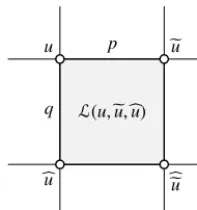
Fig. 1. An elementary plaquette in the lattice.
shiftingbyunits,andwithlatticeparameters pand q,eachassociatedwiththe nand mdirections onthelatticerespectively.Weadopttheshiftnotationbyaccentsand,i.e.for u :=u(n, m), wehaveu :=u(n +1, m),u :=u(n, m +1).Theequationofinterestinthispaperisinthelinear quadrilateralequation:
(p+q)(u−u)=(p−q)(u−u) . (1)
Thisquadrilateralequationissupposedtoholdoneveryelementaryplaquetteacrossa2 dimen-sionallattice;the elementaryplaquetteis showninFig.1.Thisissomething ofa“universal” linearquadequation,beingthenaturallinearisationofnearlyalltheintegrablequadequationsof theABSlist[23].Althoughforthesakeofthepresentstudyitisnotreallyrelevant,wemention that(1) admitsascalarinhomogeneousLaxrepresentationoftheform2
ϕ=u+p+k
p−k(ϕ−u) , ϕ=u+ q+k
q−k(ϕ−u) , (2)
where ϕ isanauxiliaryfieldvariableand k aspectral parameter.Thecompatibilitycondition
ϕ=ϕleadstothelinearequation(1) forthemainfield u.Thelatterequationcanbederivedvia discreteEuler-Lagrangeequationsonthethree-pointLagrangian
L(u,u,u)=u(u−u)−1 2
p+q p−q(u−u)
2;
∂L ∂u
+
∂L ∂u
+
∂L ∂u
=0, (3)
where,fortheaction,wesumacrosseveryplaquetteinthelattice:
S=
(n,n)∈Z2
L(un,m, un+1,m, un,m+1) . (4)
NotethattheLagrangian(3) isalsothenaturallinearisationoftheLagrangiansforthenon-linear quadequationsoftheABSlistfromwhich(1) canbederived.
Infact,thestandardvariationalprincipleon(3) producestwocopiesof(1).Inordertoregain preciselythelinearisedKdVequation,wemustmakeuseofthemultiformvariationalprinciple introducedin[5,12].(1) canbeconsistentlyembeddedintoamultidimensionallattice,with di-rectionslabelledbysubscripts i, j, k.Acrossanelementaryplaquetteinthe i−j plane,(1) takes theform:
(pi+pj)(ui−uj)=(pi−pj)(u−uij) , (5)
2 SimilarLaxrepresentationsinthecontinuouscaseofPDEswereconsideredin[24,25] tostudyinitialboundary-value
whereui indicated u shifted once inthe i direction on the lattice, and pi is now the lattice parameterassociatedtothe idirection.Thisequationhasmultidimensionalconsistency,which canbecheckedbyestablishingclosurearoundthecube[26] - fieldvariablesatanypointinthe multi-dimensionallatticecanbecalculatedviaanyrouteinaconsistentmanner.
Thevariationalprincipleproposedin[5] waselaboratedfurtherin[12],wherethesystemof generalisedEuler-Lagrangeequationswasderived,cf.also[13].Theactionbeingdefinedasthe sumofLagrangiansonelementaryplaquettesacrossa2-dimensionalsurface σ,embeddedinthe multidimensionalspace,toderivetheequationsofmotion,wedemandtheactionbestationary notonlyunderthevariationofthefieldvariables u,butalsounderthevariationofthesurface σ itself.Forthistohold,werequireclosureoftheLagrangian:ifweconsiderthecombination oforientedLagrangiansonthefacesofacube,werequirethatontheequationsofmotion,the Lagrangianssumtozero.Inotherwords,
1L23(u)+2L31(u)+3L12(u)
=L23(u1)−L23(u)+L31(u2)−L31(u)+L12(u3)−L12(u)=0, (6)
wherewe haveused theshorthandLij(u) :=L(u, ui, uj;pi, pj),andthefinalequalityin(6) holdsonlywhen we apply(5).According to[12],suchasystemmustbe describedbya La-grangian of the form L(u, ui, uj;pi, pj) =A(u, ui;pi) −A(u, uj; pj) +C(ui, uj; pi, pj); wherewe require Cij tobe antisymmetricunderinterchange of i and j. Noticethat the La-grangian(3) isalreadyinthisform.Byusingthemultidimensionalconsistency,asetof Euler-Lagrangeequationsarederived,whichsimplifyonasingleplaquetteto:
∂ ∂ui
A(u, ui;pi)−A(ui, uij;pj)+C(ui, uj;pi, pj)
=0. (7)
Thisyieldspreciselytheequation(1).Thisstructureallowsustodescribethemultiple consistent equations(5) inasingleLagrangianframework- thatofthe2-form.Thisisthentheappropriate variationalstructuretodescribemulti-dimensionallyconsistentsystems[5].
Infact,theLagrangian(3) isthealmostuniquequadraticLagrangianwitha2-formstructure (i.e.exhibitingtheclosureproperty).Consideringthegeneralformforathree-pointLagrangian 2-formandequationofmotion(7),werestrictourattentiontoquadraticLagrangiansandhave thegeneralform:
Lij(u, ui, uj)= 12aiu2+ciuui
− 1
2aju 2+c
juuj
+ 1
2biju 2 i −
1 2bj iu
2
j+δijuiuj
, (8)
wherewerequire δj i= −δij.Here,subscriptsoncoefficientsindicatedependenceonthelattice parameterspi andpj.This Lagrangian yields the equationof motion:ciu −cjuij =(aj −
bij)ui −δijuj.Thisisaquadequation, andas suchwe require ittobe symmetricunder the interchangeof iand j.Thisleadstotheconditions ci=cj=c,constant, aj−bij=δij.
Notingthat the Lagrangian (8) already obeysthe closure relation (6) on the equations of motionabove,weuseourfreedomtomultiplybyanoverallconstanttolet c=1,andhencethe generalLagrangianisgivenby:
Lij(u, ui, uj)=u(ui−uj)−12δij(ui−uj)2+12ai(u2−u2j)− 1 2aj(u
2−u2
i) . (9)
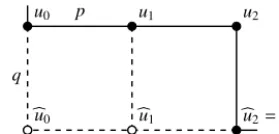
Fig. 2. Periodic initial value problem on the lattice equation.
3. Onedimensionalreduction:thediscreteharmonicoscillator
3.1. Periodicreduction
Reductionsoflatticeequationstointegrablesymplecticmappingshavebeenconsideredsince theearly1990s[27–30].Here,weareconsideringalinearisedversionofthelatticeKdVequation asourstartingpoint,andfollowthesamereductionprocedureashasbeenconsideredpreviously for non-linear quad equations.The reduction isobtainedby imposingaperiodicinitial value problem,wheretheevolutionofthedataprogressesthroughthelatticeaccordingtoa dynam-ical map, or equivalently asystem of ordinarydifference equations, whichis constructed by implementingthelatticeequation(1).Webeginwithinitialdata u0, u1and u2,andletu2=u0, according to Fig.2. Thisunit is thenrepeated periodically across an infinite staircase inthe lattice.Thisisthesimplestmeaningfulreductionwecanperformonthelatticeequation.
Applying the linear latticeequation (1) to each plaquette,we can write equations for the dynamicalmapping (u0, u1, u2) →(u0, u1, u2):
u0=u1+s(u1−u2) , u1=u2+s(u0−u1) , u2=u0; s:=
p−q
p+q . (10)
Thisisafinite-dimensionaldiscretesystem.Weintroducethereducedvariables x:=u1−u0,
y:=u2−u1and,byeliminating y,writethesecondorderdifferenceequation:
x+2bx+x
=0, b:=1+2s−s
2,
(11)
where the underhat x
indicates a backwards step. This equation can be expressed by a Lagrangian-typegenerating function, withthe equationarising from discrete Euler-Lagrange equations:
L(x,x)=xx+bx2, ∂L ∂x +
∂L
∂x =0, (12)
andsoissymplectic,dx∧dy=dx∧dy.Themapalsopossessesanexactinvariant3:
Ib(x,x)=x2+x2+2bxx , (13)
theinvarianceofwhich,i.e., Ib(x, x) =Ib(x
, x)canbereadilycheckedbydirectcomputation.
3 Unlikeinthenonlinearcaseof[27,29],inthelinearcasetheinvariantsofthereducedsystemcannotbereadily
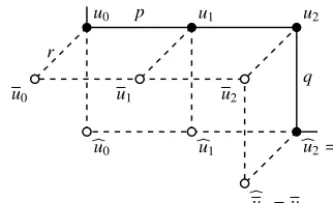
Fig. 3. The variablesuiextend from the plane in a third direction.
The equation(11) is adiscrete harmonic oscillator.It is not difficultto see that the most generalsolutionto(11) isgivenby
xm=c1sin(μm)+c2cos(μm); cosμ= −b , (14)
wherem is the discrete variable.Thishas aclear relation tothe solution for the continuous timeharmonicoscillator.Thissolutioncanalternativelybewrittenas xm=Aλm+Bλ−m, λ =
−b+√b2−1.Byconsideringderivativeswithrespecttotheparameterb,wecanthenderive theequations:
dx db=
m
1−b2(bx+x) ,
dx db= −
m
1−b2(bx+x) , (15)
Eliminatingx yieldsthesecondorderdifferentialequationin b:
(1−b2)d
2x
db2 −b
dx db +m
2x=
0. (16)
Aremarkableexchangehastakenplace:theparameterandindependentvariableofthediscrete case, b and m,haveexchangedroles tobecomethe independentvariableandparameterof a continuoustimemodel.Notethat(16) canbesimplifiedbytaking μ :=cos−1(−b)asthe“time” variable,sothat: d2x/dμ2+m2x=0.Thisistheequationfortheharmonic oscillator,witha quantisedfrequency ω=m.
3.2. Commutingdiscreteflow
Recallthatthelinearlatticeequation(5) canbeembeddedinamultidimensionallattice.From theperiodicreductionintheplane(Fig.2)weconsidertheembeddingwithinathreedimensional lattice.Thethirdlatticedirectionhaslatticeparameter r,andweintroduceshiftedvariables ui, asshowninFig.3.
Toderivethemapping,wenowusethelatticeequations(5):
(q+r)(u−u)=(q−r)(u−u) , (r+p)(u−u)=(r−p)(u−u) ,
which,intermsofthe ui,yield
u0 = u1+t (u1−u0) ,
u1 = u2+t (u2−u1) ,
u2 = u0+t(u0−u2) .
where t:= p−r p+r ,
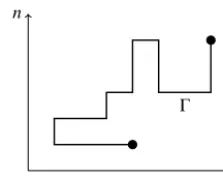
Fig. 4. A curve in the discrete variables.
Again,weusereductionvariables (x, y),whichyieldthemap (x, y) →(x, y).Thismapcanbe writteninamatrixform,fromwhichitcanbeshowntobeareapreserving,dx∧dy=dx∧dy. Eliminating yagainproducesasecondorderdifferenceequationin x:
x+2ax+x=0, with 2a:=(2t+1−t
2)−t(2t−1+t2)
1−t2t . (18)
Thisequationhasthesameformas(11),thatofadiscreteharmonicoscillator,alongwith invari-ant Ia(x, x) =x2+x2+2axx.
Wecanwritebothmaps (x, y) →(x, y)and (x, y) →(x, y)inmatrixform:x=S x,x=T x, x:=(x, y)T.Itisthenclearthatthetwomapscommute, (x, y) =(x, y),sincewehave[S, T]= 0.Thislastrelationreliesontheparameteridentity, stt=s−t+t,whichiseasilyshownusing thedefinitionsfor s, t and t.
Ourequationsareslightlysimplifiedbyintroducingtheparameters P :=p2+pq, Q :=q2 and R:=r2,intermsofwhich a=(P−R)/(P+R), b=(P−Q)/(P +Q).Byreturningto earlierevolutionequationsintermsof xand yandeliminating yinadifferentmanner,wederive “cornerequations”fortheevolution,linking x,xand x;orx, xandxrespectively.Thus:
P −Q
q −
P −R r
x=P +R
r x−
P +Q q x ,
P −Q
q −
P −R r
x=P +R r x−
P +Q
q x . (19)
Thuswe havemultipleequationsofmotion (11),(18),(19) allholdingsimultaneouslyonthe samevariable x.
3.3. Lagrangian1-formstructure
Arecentdevelopmentinunderstandingdiscreteintegrablesystemswithcommutingflowshas beentheLagrangianmultiformtheory[12,5,9,10,32,11,14].Asystemwithtwoormore commut-ing,discreteflowscanbedescribedbyaLagrangian1-formstructure,whichprovidesawayto obtainasimultaneoussystemofequationsforasingledependentvariablefromavariational prin-ciple.Thus,theLagrangiansgeneratingtheflows x→xand x→xshouldformthecomponents ofadifference1-form,eachassociatedwithanorienteddirectionona2Dlattice.
The actionfunctionalisthendefinedas asumofelementary Lagrangianelementsover an arbitrarydiscretecurve inthe2Dlattice,asshowninFig.4.
S[x(n); ] =
γ (n)∈
Theusualvariationalprincipledemands that,ontheequationsof motion,theactionSbe sta-tionaryunderthevariationofthedynamicalvariables x.Inaddition,wealsodemandthatSbe stationaryundervariationsofthecurve itself.Thisprincipleleadstothecompatibility of equa-tionsofmotionandcornerequations,undertheconditionofclosureoftheLagrangians.Thatis, ontheequationsofthemotion,theactionshouldbelocallyinvariantunderchangestothecurve
andtherefore:
2L:=La(x,x)−La(x, x)−Lb(x,x)+Lb(x,x)=0, (21) wherethislastequalityholdsonlyontheequationsofmotion.
Inthe modelwe areconsidering,wealreadyhavecompatible flowswithconsistentcorner equations,andso it isnaturalfor us toseekaLagrangianform exhibiting closure.However, ifwenaivelyseektosatisfytheclosurerelation(21) withanysimpleLagrangianyieldingthe equationsofmotion,wewillfindthatthisdoesnotsuffice- wemustseekamorespecificform. ByconsideringthegeneralformforthequadraticLagrangians:
La=αxx+(a−a0)x2+a0x2
, Lb=βxx+(b−b0)x2+b0x2
, (22)
we canapply the closure 2L=0 as acondition. Recallthat we require closure onlyon the solutionstothe equations of motion,so we applythe corner equations(19) to 2L,andthen comparecoefficientsoftheremainingterms.Demandingthat α, a0and β, b0beindependentof
Qand Rrespectively,wefindtheconditionsonthecoefficients:
α=P +R
r γ , β=
P +Q
q γ ,
a0=
r
P +Rf (P )+ 1
2a , b0= q
P+Qf (P )+ 1
2b , (23)
whereγ is some overall constant,and f (P ) isa free function of P. f does not make any contributiontowhatfollows,andsoweignoreit:welet a0=a/2 and b0=b/2.
ThisyieldstheLagrangians:
La(x, x)=1 r
(P+R) xx+1
2(P−R) (x 2+x2)
,
Lb(x,x)=1 q
(P+Q) xx+1
2(P−Q) (x 2+x2)
. (24)
Byconstruction,theseobeythecondition2L=0 ontheequationsofmotion,andalsoyieldthe equationsofmotion(11) and(18) bytheusualvariationalprinciple.Thiseliminatesagreatdeal oftheusualfreedominchoosingourLagrangian:theclosureconditionmandatesaspecificform oftheLagrangian.
Infact,notonlytheequations(11) and(18) arisefromavariationalprincipleonthisaction, butalsothecornerequations(19).Wehavefourelementarycurvesinthespaceoftwodiscrete variables,showninFig.5.4Acrosseachcurve,wecandefineanaction,andthenavariationwith respecttothemiddlepoint,whichleadstoanequationofmotion.
TheactionandEulerLagranceequationforcurve5(i)are
S=La(x, x)+Lb(x,x) , ∂S ∂x =2
P−R r +
P−Q q
x+P+rRx+P+qQx
=0, (25)
Fig. 5. Simple discrete curves for variablesmandn.
whichiscompatiblewithequations(19).Similarly,forcurve5(ii):
S=La(x, x)+La(x, x) , ∂S ∂x =2
2P−rRx+P+rRx+x=0, (26)
whichisequation(18) (i.e.thisisa“standard”Euler-Lagrangeequation).Curves5(iii)and(iv) yieldsimilarly(11) andtheotherpartof(19).Wethereforehave,forthespecificchoiceof La-grangiansdescribed,aconsistent1-formstructure,yieldingtheequationsofmotionandcorner equations,andobeyingaLagrangianclosurerelation.Thediscreteharmonicoscillatorthen, de-spiteitssimplicity,nonethelesshasanunderlyingstructureofaLagrangianone-formexpressing commutingflows:thisisthesimplestexampleyetdiscoveredofsuchastructure.
Recall theinvariants,itisstraightforwardtoshowusingtheequationsofmotionthatboth in-variantsarepreservedunderbothevolutions,Ib=Ib=Ib, Ia=Ia=Ia.Itisnotclear,however, thattheseinvariantsarenecessarilyequal: Ibhasanapparentdependenceon Q,and Iaon R,that mustberesolved.TakingourspecialchoiceofLagrangians(24),wecanthendefinecanonical momenta,andrewriteourinvariantsinthoseterms.Writing Xaasthemomentum conjugateto
xinLa,and XbsimilarlyforLb,wefind:
Xa= −
∂La
∂x = −
P +R
r x −
P−R
r x ,
Xb= −
∂Lb
∂x = −
P+Q
q x −
P−Q
q x . (27)
Asadirectconsequenceofthecornerequation(19) wethenhavepreciselythat Xa=Xb=:X. Inotherwords,wecandefineacommonconjugatemomentumforbothevolutions.Ifwethen writeourinvariantsintermsof xand Xwefindaftermultiplicationbyaconstant(whichclearly doesnotchangethenatureoftheinvariants)that
Ia=Ib= 1 2X
2+2P x2. (28)
Lagrangiandependent.AdifferentchoiceofLagrangianyieldsdifferentconjugatemomentathat arenolongerequal,andwheretheequivalenceoftheinvariantsisnolongerapparent. Requir-ingequalityof theinvariantsturnsouttobeanequivalentconditiontodemandingLagrangian closure.
Thecompatibilityof thetwo discreteevolutionsandtheir cornerequations(guaranteedby theLagrangian 1-form structure)allowsus toconsiderajoint solution totheequations xm,n. Weallow mtolabel the hat evolution,and nto labelthe bar evolution,such that x=xm,n,
x=xm+1,n, x=xm,n+1,andsoon.Requiring xm,ntoobey(11),(18) and(19),wehavethejoint solutionfortheevolutions:
xm,n=c1sin(μm+νn)+c2cos(μm+νn); b= −cosμ , a= −cosν . (29)
Inthe samewayas theparameter b generates acontinuousflow compatiblewiththediscrete evolution(16),sowecanfindacontinuousflowintheparameter a:
(1−a2)d
2x
da2−a
dx da+n
2x=0. (30)
Nowthejointsolution(29) guaranteesthecompatibilityofthe aand bflowswiththecommuting discreteevolutions.Thecompatibilityofthecontinuousflowscanbefurtherverifiedbychecking therelationdad dxdb=dbd dxda using(15) andsimilarequationsfor a.Thecontinuoustime-flowsare generatedbytheusualEuler-LagrangeequationsoncontinuoustimeLagrangiansoftheform
Lb(x, xb)= 1 2m
1−b2
∂x ∂b
2
− m
2√1−b2x 2;
La(x, xa)= 1 2n
1−a2
∂x ∂a
2
− n
2√1−a2x 2.
(31)
Usingthecornerequations(19) theseLagrangiansexhibitcontinuousmultiformcompatibility, obeyingtherelations
∂La ∂xa =
∂Lb ∂xb
, ∂
∂a
∂Lb ∂x
= ∂
∂b
∂La ∂x
. (32)
So, by considering the discrete parameters a, b now as continuous variables, we find a continuous-time1-formstructure.
As in [34], the harmonic oscillator continues to display surprising new features. On the discrete level, we discovercompatible flows that canbe expressedthroughthe structureof a Lagrangianform,evenforthisverysimplecase.Thisdeeperstructurethenextendsbeyondthe discretecasealsointocompatiblecontinuousflowsandwehaveaninterplaybetweenthese dis-creteandcontinuousone-formstructures.Havingendowedtheharmonic oscillatorwiththese multi-dimensionalstructures,howaretheyrevealedinthequantumharmonicoscillatorcase?
3.4. Higherperiodicity
Fig. 6. The periodic staircase for periodP.
The P =2 caseyieldsa1dimensionalmappingthatisentirelyequivalenttothecasewehave consideredinsection 3.1,exceptthelatticeparameterscombineinaslightlydifferentwayto givethecoefficientoftheharmonicoscillator.
The P =3 caseisthe nextcaseofinterest,as herewe findasystemof coupledharmonic oscillatorsin x1and x2,withtwocommutinginvariantsandasimilarcommutingflowstructure. Inasimilarmannerto(11) wecanderiveequationsforadiscreteflowinvariables x1and x2:
x1+x2+x1
+s(2x1+x2)=0, x2+x1+x2+s(x1+2x2)=0. (33) Asinsection3.2,wecanalsoderiveacommutingflowfortheevolution:
(1+t t)(x1+x1)+x2+t tx2+(t+t)(2x1+x2)=0, (34)
(1+t t)(x2+x2)+t tx1+x1+(t+t)(x1+2x2)=0. (35)
Commutativityoftheseevolutionscanbeeasilyshownfromthefirstorderform(with x and y variables)bywritingeachevolutioninmatrixform;theresultingmatricescommute.The evolu-tionthenalsopossessescornerequations,whichcanbederivedusingtheeliminated yvariables. Theseallowus towriteclosedformLagrangians,such that 2L=0 (21) ontheequations of motion(33),(34),(35):
L1(x,x)=x1(x1+x2)+x2x2+12s(x12+x1x2+x22+x12+x1x2+x22) , (36)
L2(x, x)=1+t t
1−t t(x1x1+ +x2x2)+ 1
1−t t(x1x2+t t
x
2x1)
+1
2 t+t 1−t t(x
2
1+x1x2+x22+x 2
1+x1x2+x22) , (37)
TheLagrangians(36),(37) allowustodefinethemomentaconjugateto x1, x2writing Xi=
−∂L1/∂xi,
X1= −
x1+x2+21s(2x1+x2)
, X2= −
x2+12s(x1+2x2)
, (38)
withrespecttowhichwehavetheinvariantPoissonstructure{xi, Xj}=δij,preservedunderthe mappings.Wecouldalsowriteexpressionsfor Xi usingL2,withequalityoftheseexpressions producingthecornerequations.
Wecanadditionallyderivetwoquadraticinvariantsofthemapping I1, I2,whichareinvariant under bothmaps. The canonical structure of (38) allows us to show the criticalintegrability propertythatthetwoinvariantsareininvolutionwitheachother,withrespecttothecanonical Poissonbracket:{I1, I2}=0 where
I1=x1X1−2x1X2+2x2X1−x2X2,
I2= 1−34s2
(x12+x1x2+x22)+X12−X1X2+X22. (39)
Theinvarianceandinvolutivityofthesecanbeshownbydirectcalculation. I1and I2willthus generatetwocommutingcontinuousflowstothemapping.
Forboththehatandthebarevolutions(33),(34),(35) itispossibletowriteexplicitsolutions, andindeedwecanfindajointsolutiontothediscreteevolutions:
x2(m, n)=acos(μ+m+ν+n)+bsin(μ+m+ν+n)
+ccos(μ−m+ν−n)+bsin(μ−m+ν−n) , (40)
wherecosμ±= −3s/4±121−3s2/4 and
cosν±= −3(t+t
)(1+t t)
4(1+t t+t2t2)± 1 2
1−t t 1+t t+t2t2
2
1+t t+t2t2−3
4(t+t)2. (41)
Wefind x1(m, n)similarlyas alinearcombinationofshifts of x2.By consideringderivatives withrespecttotheparameters sand t (recalling tisnotindependentof s, t),wecantherefore derivecommutingcontinuousflowsfromthesolutionstructure(40).Weobservethenagainthe interchangebetweencontinuousanddiscreteparametersandvariables,asinthelowerperiodic case. Weexpectthiswill leadto acontinuousLagrangian1-form structure, butdeferfurther investigationtoalaterpaper.
4. Thequantumreduction
Insection3.3,thediscreteharmonicoscillatormodel,arisingasaspecialreductionfromthe linearisedlatticeKdVequation(1),albeitasimplelinearmodelnonethelessdisplayscommuting discreteflows.Intheclassicalcase,theLagrangian1-formstructurecapturesthesecommuting flowsinavariationalprinciple.Anaturalquestionis:whatisthequantumanalogueforsucha structure?Sincetheharmonicoscillatoriswellknownandunderstood,itformsagoodfirsttoy modelforinvestigatingLagrangianformstructuresatthequantumlevel.
firststepstowardsincorporatingtheLagrangianintoquantummechanics,aroutethatwaslater pursued byFeynmanleadingtohis conceptofthe pathintegral [39].ConcurringwithDirac’s pointofview,weseekheretounderstandtheextendedLagrangianmultiformvariational princi-pleonthequantumlevel,leadingnaturallytoproblemoffindingapathintegralversionofthat formalisminordertocaptureitsnaturalquantumanalogue.Tomakefirststepsinthatdirection thesimplecaseofthequantummappingsderivedintheprevioussectionisagoodstartingpoint, exploiting the well-knownformaltechniquesofpathintegrals, cf.e.g.[19,40,41].Aswewill pointoutlatertherearesomesimilarities withideasdevelopedbyRovelliin[42,43] whoalso usestheharmonicoscillatortodevelopideasonreparametrisationinvariantdiscretisationswithin thepathintegralframework,inparticularthenaturalemergenceofconservationoftheenergyof thecontinuous modelwithinatime-slicingdiscretisation.
4.1. Feynmanpropagators
BeginningfromourLagrangianLb(24) wewritetheconjugatemomenta X:=Xb(27) and
X=∂Lb/∂x.Incanonicalquantisation,position x andmomentum Xbecomeoperatorsxand X,suchthat[x, X]=ih¯.Themomentumequations(27) becomeoperatorequationsofmotion:
x−x= q
P −QX− 2P
P −Qx, X−X= − 4P q P −Qx+
2P
P−QX. (42)
Tounderstandthediscretetimeevolutionwewishtoexpresstheevolution (x, X) →(x, X),in termsofatime-evolutionoperator Ub,suchthatx→x=Ub−1xUb,X→X=Ub−1XUb.Thisis acanonicalapproachtodiscretequantisation,seeforexample[15].Considering(42),itisnot hardtoseethatanappropriatechoiceof Ubisgivenby:
Ub=eiV (x)/2h¯eiT (X)/h¯eiV (x)/2h¯ =exp
iPx2
¯
hq
exp
iqX2 2h(P¯ +Q)
exp
iPx2
¯
hq
. (43)
Inotherwords,aseparatedformfor Ubexists,butitisrequiredtohavethreeterms.Notethat (43) isnotauniqueformfor Ub.
In discrete time, the one time-step propagator is then given by Kb(x, n;x, n +1) = n+1x|x n = x|Ub|x , where we have moved in the second equality from time-dependent, Heisenbergpictureeigenstatestotime-independent,Schrödingerpictureeigenstates.Sincewe have anexplicitformfor Ub,wecan calculatethisexpressionbyinserting acompletesetof momentumeigenstates:
x|Ub|x =
dXeiV (x)/2h¯x|X eiT (X)/h¯X|x eiV (x)/2h¯ ,
=
i(P+Q) 2πhq¯
1/2 exp
i
¯
hq (P+Q)xx+
1
2(P−Q)(x
2+x2),
=
i(P+Q) 2πhq¯
1/2 exp
i
¯
hLb(x,x)
. (44)
Thisissufficienttodefinethediscrete-timepathintegral.Byiterating(44) over N steps,we canwritepreciselythepropagatorforourdiscretesystem:
Kb(x0,0;xN, N )=
i(P +Q) 2πhq¯
N/2N−1
n=1
∞
−∞
dxneiS[x(n)]/h¯ ,
S[x(n)] =
N−1
n=0
Lb(xn, xn+1) . (45)
Inthisdiscretecase,equation(45) givesaprecisedefinitiontothepathintegralnotation:
Kb(x0,0;xN, N )=
x(N )=xN
x(0)=x0
[Dx(n)]eiS[x(n)]/h¯. (46)
Noticeinparticular thatthe normalisationassociated tothe measureishereunambiguous. In ourquadratic regime,we cannow calculate thisexplicitly. Details are giveninAppendixA, butwefirstexpandourquantumvariablesaroundtheclassicalpath,wheretheclassicalaction canbeevaluatedasScl=√P[2x0xN−(x02+xN2) cosμN]/ sinμN.Evaluatingthediscretepath integralasaseriesof N Gaussianintegrations,andrecallingthenormalisationconstantin(45), wecalculatethepropagator:
Kb(x0,0;xN, N )=
i√P πh¯sin(μN )
1/2
×exp
i√P
¯
hsin(μN ) 2x0xN−(x
2
0+x2N)cos(μN )
. (47)
Notethatthishasthesameformasthepropagatorforthecontinuoustimeharmonicoscillator. Dependenceontheparameter bisevidentthroughcosμ = −b.Wenote,then,thatthepropagator iscommontoboththediscreteflowandtotheinterpolatingcontinuoustimeflow.
Usingtheoperatorequationsofmotion(42),itiseasytoseethatwehaveanoperator invari-ant:
Ib=1 2X
2+2Px2 =1 2
−¯h2 ∂
2
∂x2+4P x 2
, (48)
Thisis,ofcourse,simplythe operatorversionofthe classicalinvariant(28),andisprecisely theHamiltonianforthecontinuoustimeharmonicoscillator,where4P =ω2.NotethatIbis Q independent,andsoitisclearthatthesameprocessappliedtothebarevolutiongeneratedbyLa willgivethesameresult.Inotherwords,bothdiscretequantumevolutionssharethesame invari-ant,whichistheharmonicoscillator.Theinvariantcanalsobeconsideredfromtheperspective of pathintegrals andthe unitary operator followingthe method of [21]; thisiselaborated in AppendixB.WecanrelateIb(48) totheevolutionoperator Ub(43) inprinciplebya Campbell-Baker-Hausdorffexpansion([45,46]);anexplicitformisgivenbyalgebraicmanipulation:
Ub=exp
1
¯
h√P arctanh
i√P q
Ib
. (49)
Fig. 7.Thesolidlineshowspath(i)forK,andthedashedlinepath(ii)forK.Thewhitecirclesrepresentvariables thatareintegratedover.
4.2. Pathindependenceofthepropagator
In equation(47) wehave established the propagatorfor an evolutionin onediscrete time variable; but we have inthe classicalcase two compatible discrete flows (24). The one-step propagatorinthehatdirectionisgivenin(44),whilstinthebardirectionitiseasilydeducedby thesamemethod:
Ka(x, x;1)=
i(P+R) 2πhr¯
1/2 exp
i
¯
hLa(x, x)
. (50)
Weremarkthat,aswehavehereasecondtimedirection,wemightplausiblyintroduceasecond
¯
hparameter.Weignoresuchconsiderationsforthetimebeingandallowh¯tobethesameinboth timedirections.Ingeneral,ifwebeginatatimeco-ordinate (0, 0)andevolvealongintegertime co-ordinatestoanewtime (N, M),thepropagatorcoulddependnotonlyontheendpoints,but alsoonthepath takenthroughthetimevariables,seeFig.4.Weassociatetothepathanaction S :=S[x(n); ](20).Wecanthendefineapropagatorfortheevolutionalongthetime-path , madeupoftheone-stepelements(44),(50):
K xb, (N, M);xa, (0,0)
:=N
(n,m)∈
dxn,m exp
i
¯
hS [x(n)]
, (51)
wherewehaveintegratedoverallinternalpoints xn,monthecurve .HereN representsthe productofnormalisationfactorsfromtherelevantelementsof(44),(50).
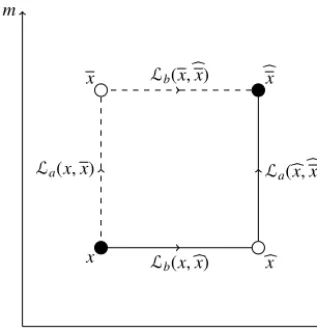
Webeginbyconsideringthesimplecaseofanevolutionofonestepineachdirection.There are two routestoachievethis, asshowninFig.7.Eitherwe evolvefirstinthe hat direction, followedbyanevolutioninthebardirection,orviceversa.Inpath(i),weevolvefirstaccording tothehatevolutionLb,andthenaccordingtothebarevolutionLa.Weevaluatethepropagator as:
K(x,x)=
(P+Q)(P+R) (−2π ih)¯ 2qr
1/2 ∞
−∞
dx exp
i
¯
h
Fig. 8.Thepathforaction S.Inthepropagator,weintegrateoverthevariablesatthewhitecircles.Notetheminussign onthebackwardstep,−La(x,x).
Forthe alternativepath (ii) we evolve first by the barevolution La,and thenthe hat evolu-tionLb:
K(x,x)=
(P +Q)(P +R) (−2π ih)¯ 2qr
1/2∞
−∞
dx exp
i
¯
h
La(x, x)+Lb(x,x) . (53)
ThesearebothresolvedbysubstitutingLagrangians(24) andevaluatingtheGaussianintegral. Theresultistotallysymmetricunderinterchangeoftheparameters qand r,asare(52) and(53); sothat
K(x,x)=K(x,x) . (54)
Wefindthesamepropagatorforeitherpath.Itisanobviouscorollaryofthisresultthat,solong aswetakeonlyforwardstepsintime,thepropagator KN,M(xa, xb)isindependentofthepath takeninthetimevariables.
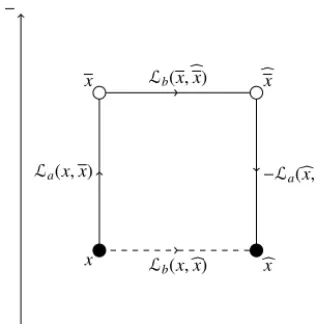
Wecouldalsoconsiderapathinthetimevariablesallowingbackwardtimesteps.Asinthe classicalcase,wecanconstructanactionforsuchatrajectory,usinganappropriateorientation fortheLagrangians.Inthequantumcaseweperformapathintegraloverthisaction,integrating overallintermediatepoints.As Ub generatesatime-stepinthe b direction(section4.1), Ub−1 generatesthebackwardevolution.
Consideringonce morethe simplestcase, we imagine atrajectory aroundthreesides ofa square,showninFig.8.Includingthenormalisationfactorsfrom(44) thisisdescribedbythe propagator,
K(x,x)=(P+Q)
1/2(P+R)
(2πh)¯ 3/2(−iq)1/2r
∞
−∞
dx
∞
−∞
dx exp hi¯La(x, x)+Lb(x,x)−La(x,x)
.
(55)
Fig. 9. (i) shows the loop in discrete variables. (ii) is what remains after collapse of the loop.
K(x,x)=
i(P+Q) 2πhq¯
1/2 exp
i
¯
hLb(x,x)
=Kb(x,x;1) . (56)
So we regain exactly our onestep propagator from (44).Remarkably, we again achieve La-grangian closure, but now on the quantum level. Recall that classically Lagrangian closure dependedupontheequationsofmotion:herewehavelefttheequationsofmotionbehind,and yetthiskeyresultstillholds.
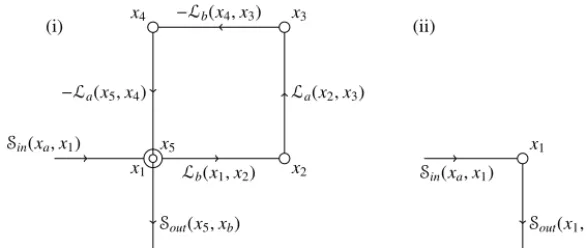
Wecouldalsoconsiderthepossibilityofaloopinthediscretevariables,illustratedinFig.9(i). We imagine someunspecified incoming and outgoing actions Sin(xa, x1)and Sout(x5, xb), a simpleloopindiscretesteps,andfiveintegrationvariables x1, . . . , x5.Notethatweassigntwo integrationvariablestothesamevertex,asitisvisitedtwicebythepath:thefollowingcalculation willjustifythischoiceasthecorrectone.
We thenconsiderthe actionfor the loop, Sloop=Lb(x1, x2) +La(x2, x3) −Lb(x4, x3) − La(x5, x4),notingtheorientationsontheLagrangians.Withnormalisingfactorsfrom(44) and complexconjugationsinthebackwardsteps,wethenhave:
Kloop(xa, xb)=
P+Q 2πhq¯
P +R 2πhr¯
dx1. . .
dx5 exp
i
¯
h
Sin+Sloop+Sout . (57)
The x2and x4integralsareevaluatedasin(52) yielding,
Kloop(xa, xb)=
(P+Q)(P +R) 2πh(P¯ −qr)(q+r)
dx1dx3dx5 exp
i
¯
h
Sin(xa, x1)+Sout(x5, xb)
−(P+Q)(P+R)
(P −qr)(q+r)(x1−x5)x3
+1
2
P−qr q+r −
P (q+r) P−qr
(x12−x52)
. (58)
Thequadratictermintheexponentin x3disappears,andsotheintegraldx3yieldsaDiracdelta function: δ(x1−x5).Combinedwiththeintegralover x5thisforces x5=x1(asexpected)and wefinallyconclude,
Kloop(xa, xb)=
dx1 exp
i
¯
h
Sin(xa, x1)+Sout(x1, xb) . (59)
[image:18.485.84.378.70.194.2]Proposition1.ForthespecialchoiceofLagrangians(24),thepropagatoralongthetimepath
(51) isindependentofthechoiceof ,dependingonlyontheendpoints.
Proof.Equations(54),(56) and(59) togethershowthatthepropagatorisunchangedunder el-ementarydeformations of the curve . Since we haveasimple topology, acurve 1 can be deformedintoanyothercurve 2(withthesameendpoints)byaseriesofelementary deforma-tions.Thepropositionfollows.
The proposition now allowsus to calculate the general propagatorfor N steps inthe hat directionand M stepsinthe bardirection, compare (51).Wedenotesuch apropagatorfrom xa to xb by KN,M(xa, xb).As aconsequence of the pathindependence, it is then clear that wecancalculatethisas KN,M(xa, xb) =
!
dxKN,0(xa, x)K0,M(x, xb).Inotherwords,wecan considertakingfirstallthehat-steps,followedbyallthebar-steps.Takingourdiscretepropagator from(47),wecanthencarryouttheintegralasanotherGaussian,butinfacttheresultfollows immediatelyfromthegrouppropertyofthepropagator,usingitssharedformwiththecontinuous timecase,so:
KN,M(xa, xb)=
i√P πh¯sin(μN+ηM)
1/2
×exp
i√P
¯
hsin(μN+ηM) 2xaxb−(x
2
a+xb2)cos(μN+ηM)
, (60)
whichbearsaclearrelationtothecontinuoustimecase.
4.3. Uniqueness
The time-path independencefor the propagatorof section4.2 isaspecial propertyof our choiceofLagrangian(24) thatdoesnotholdingeneral.AsclassicallytheLagrangian1-form obeystheclosure condition(21),sointhe quantumcase wehavetime-path independence of thepropagatorsasanaturalquantumanalogue.Whilstclassicallythisclosureholdsonlyonthe equationsofmotion,inthequantumcasethepath-independenceoccursasweperformthepath integraloverintermediatevariables.Itemergesthat,forgivenoscillatorparameters aand b,there isafairlyuniquechoiceofLagrangiansexhibitingtime-pathindependence.
Consider the generalised oscillator Lagrangians of equation (22) and define propagators aroundtwo cornersof asquare,as in equations(52) and (53).Here we allowa andb to be freeoscillatorparameters.
K(x,x)=N
∞
−∞
dx exp
i
¯
h
Lb(x,x)+La(x,x) , (61)
K(x,x)=N
∞
−∞
dx exp
i
¯
h
La(x, x)+Lb(x,x) . (62)
thesepropagatorsviaaGaussianintegral,wethenderiveconditionsfortime-path-independence onourcoefficients,whichcanbefoundinAppendixC.Wefindthenecessaryconditionsonthe coefficients:
a0= 1 2a+
f
2α , b0= 1 2b+
f
2β , α= γ
√
a2−1 , β=
γ
√
b2−1 . (63)
As in(23) the constant f makes nocontribution andwe ignore it. The general Lagrangians (22) arethereforerestrictedtoasymmetricform,withaspecifiedoverallconstantgivenbythe oscillatorparameters a, b.Notethattaking a=(P−R)/(P+R), b=(P−Q)/(P+Q)leads ustoexactlytheconditionsof(23) andtheLagrangians(24).Inconclusion:
Proposition2.Forgiven oscillatorparameters a and b,the Lagrangians(24) arethe unique Lagrangians,uptoconstants γand f (23),suchthatthemulti-timepropagatorispath indepen-dent.
Inotherwords,demandingtime-pathindependenceofthepropagatoristhenaturalquantum analogueoftheclosurerelationontheLagrangian.
4.4. Quantumvariationalprinciple:Lagrangian1-formcase
Consideraquantummechanicalevolutionfromaninitialtime (0, 0)toanewtime (N, M), alongatime-path :showninFig.4.Wecanconsiderapropagatorfortheevolution K (xb;xa) defined in(51).Wehave shownthat,in thespecialcase of Lagrangians(24),the propagator definedaboveisindependentofthepath (itdependsonlyontheendpoints);butthatthisisnot trueingeneral.ForagenericLagrangian, K willdependonthetime-pathchosen,asshownin section4.3.
Classically,thesystemisdefinedasthecriticalpointforthevariationoftheactionovernot onlythedependent variables,butalsoovertheindependentvariables,i.e.,itisacriticalpoint withrespecttothevariationofthetime-path.Thisnotonlyyieldsallthecompatibleequationsof motionforthesystem,butalsoselectscertain“permissible”Lagrangianswhichobeyaclosure relation(21).ThisthenyieldsasystemofextendedELequationsofwhichtheLagrangiancan beconsideredtobethesolution,cf.[9].
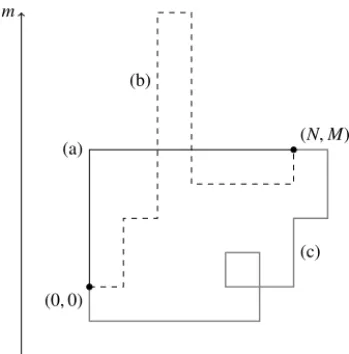
Inthequantumcase,weconsiderthedependenceofthepropagatoronallpossible(discrete) time-paths betweenfixedinitialandfinaltimes. Ingeneral,there arean infinitenumberof possibletimepathsfrom (0, 0)to (N, M),includingshortesttime-pathsaswellasthosewith long“diversions,”orloops,asillustratedinFig.10.ForagenericLagrangian,as wevarythe timepath, each yieldsadifferentpropagator(51) viewedas afunctionalofthepath. Inthe special case of the Lagrangian (24), however,the propagatorK is independent of the path takenthroughthetimevariables,andsoremainsunchangedacrossthevariationofthetime-path .Thissuggeststhat this pathindependencepropertyisthe naturalquantumanalogue ofthe Lagrangianclosurecondition(21).
Fig. 10.Threepossiblepathsinthetime-variables.Path(a)isadirectpath.Path(b)extendsforsomedistanceinthem directionbeforereturning.Path(c)includesaloopinthetimevariables.
quantumobjectoftheformaswasproposedinthecontinuoustime-casein[32].Asafunctional oftheLagrangiansuchanobjectwouldhaveasingularpointforthoseLagrangianswhich pos-sessthequantumclosurecondition,i.e.,thosewherethecontributionsofthepath-independent propagatorsoverwhichoneintegratesallcontributethesameamount.Howtocontrolthe singu-larbehaviourofsuchanobjectisamatterofongoinginvestigation.
5. Quantisationofthelatticeequation
Insection2weintroducedthelinearlatticeequation(5),andinthesubsequentsectionslooked ataspecialtypeofreductions(associatedwithperiodicinitialvalueproblems)leadingto com-mutingdynamicalmapsandtheir quantumcounterparts.Thisisobviouslybyfarnotthe only typeofreductionofthe2Dlatticesystemtoafinitenumberofdegreesoffreedomsystem:for example,anotherclassisgivenbysymmetryreductionsleadingtoself-similarsolutions.5Thus, thequantisationofthefulllatticecaseoftheMDCsystemassociatedwith(5) isinterestingin itsownright,whichwouldbethesimplestexampleofthequantisationofaLagrangian2-form structure.Thisapproachinvolvingapathintegralapproach,wouldcomplementthequantisation of(nonlinear)latticemodelsthathasbeenpreviouslyconsideredfromthecanonical(quantum inversescatteringmethod)perspective,cf.e.g.[4,48].
Classically, we supposethe equation(5) to holdon allplaquettesinthe multidimensional latticeatthesametime.TheequationisgeneratedbytheorientedLagrangian:
Lij(u, ui, uj;pi, pj)=u(ui−uj)− 1
2sij(ui−uj)
2, s ij=
pi+pj
pi−pj
. (64)
5 Suchreductionsareoftenconnectedtonon-autonomous(i.e.explicitlytime-dependent)equationsofthemotion,and
TheLagrangianitselfisacriticalpointoftheclassicalvariationalprincipleoversurfaces:itobeys theclosurepropertyontheclassicalequationsofmotion,suchthatthesurfacecanbeallowedto freelyvaryunderlocalmoves.Indeed,itisalsofairlyunique,asseenin(9).
Howmightweproceedtoquantisesuchasystem?Acanonicalapproachistotransform(5) intoanoperatorequationofmotion,butweareconcernedherewithaLagrangianapproach.The clearanalogyistoquantumfieldtheory:wehaveadiscretisedspace-timeandaLagrangianin twodimensionsoverfieldvariables u(n)indexedbyadiscretevector n.Weimaginesome space-timeboundary ∂σ enclosingamulti-dimensionalsurface σ madeupof elementaryplaquettes σij.WecanthenconstructanactionbysummingthedirectedLagrangiansoverthesurface,as wewouldclassically:
Sσ =
σij∈σ
Lij(u, ui, uj) , (65)
wherewedefinetheshorthandLij(u) :=L(u, ui, uj;pi, pj).
Wethenconsiderthepropagator Kσ(∂σ ),whereallinteriorfieldvariablesonthesurfaceare integratedover.Thepropagatordepends,inprinciple,onthesurface σ andisafunctionofthe fieldvariableson theboundary ∂σ,whichformsomeboundary value problem(seeasimilar pointmadein[43]):
Kσ(∂σ )=
[Du(n)]σ eiSσ[u(n)]/h¯ =Nσ
n∈σ
du(n) eiSσ[u(n)]/h¯ . (66)
Wewillseeaswegoonthatthisobjectissubjecttoinfra-reddivergences,asparticularsurface configurationsproduceintegrationsyieldingvolumefactors.Sinceourmainstatementsinvolves onlythecombinatoricsoftheexponentialfactorsinvolvingtheactionarisingthroughGaussian integrals,wetacitlyassume Kσ canberenormalisedbyanappropriatechoiceofnormalisation factorNσ. Kσ(∂σ )describesapropagatorinthesenseofasurfacegluingprocedure:two prop-agators Kσ1 and Kσ2 arecombinedtoanewpropagatorbymultiplicationandintegrationover allvariableslivingonthesharedboundary ∂σ1∩∂σ2.Thus,theone-stepsurfacegluingcanbe writtensymbolicallyas
Kσ1∪σ2 =
∂σ1∩∂σ2
Kσ1∗Kσ2
:=N∂σ1∩∂σ2 ⎡
⎣
n∈∂σ1∩∂σ2
du(n) ⎤
⎦ Kσ1(∂σ1).Kσ2(∂σ2) , (67)
wheretheintegralisoverappropriatelychosencoordinatesofthejoinedboundary.Iteratingthe gluingformulaistantamounttosettingupa“surface-slicing”procedureforthepathintegral.
5.1. Motivation:thepop-upcube
Fig. 11. A flat surface in (a), compared to a pop-up cube shown in (b).
Thecontribution totheactiongivenbysurface (a)isasingleLagrangian, L12(u).In sur-face(b)we havefiveplaquettes,withacontributiontotheactiongivenbyasum oforiented Lagrangians:Spop[un,m]=L23(u1) +L31(u2) +L12(u3) −L23(u) −L31(u).Notethatthe ori-entationsleadtothenegativecontributions.Inourpathintegralperspective(66),in(b)wemust alsointegrateoverthe“popped-up”variables u3, u23, u31, u123.Theboundaryvariablesonwhich thecontributionsdependare u, u1, u2and u12.Soaltogether,thecontributiontothepropagator forthepop-upcubeislikethis:
Kpop=
du3du31du23du123 exp
i
¯
hSpop[un,m]
. (68)
Nownotethat Spop[un,m]contains nofactorof u123,so that theintegral
!
du123 producesa volumefactor V.Equation(68) canthenbewritteninamatricialform:
Kpop=V
d3u expi
¯
h
1 2u
TAu+Btu
+1
2
s31(u21−u 2
12)+s23(u22−u 2
12)+(u+u12)(u1−u2)
, (69)
where uT =(u3, u31, u23), BT =(−s31u1−s23u2, −u1+s23u12, u2+s31u12),and
A= ⎛
⎝s23+1 s31 −(s121+s23) −s121
−1 s12 −(s12+s31)
⎞
⎠ . (70)
Now,inprinciple,equation(69) couldbesolvedasasetofthreeGaussianintegrals,butmatrix Aisinfactsingular.Theparameteridentityfor sij(64):
s12s23+s23s31+s31s12+1=0, (71)
leadstodetA =0.Wethereforeresolve(69) bycarryingouttwoGaussianintegrals,knowingfor thethirdintegrationvariableweshallbeleftwithanexponentthatisatmostlinear.Performing Gaussianintegrationswithrespectto u3and u31,wethereforehave:
Kpop=V 2πh¯
s23
du23exp
i
¯
h u(u1−u2)−
1
2s12(u1−u2) 2
=V22πh¯ s23
exp
i
¯
hL12(u, u1, u2)
, (72)
[image:23.485.91.382.71.171.2]Fig. 12.Elementarymove(a).Wepassbetween(i)and(ii);whitecirclesindicatevariablestobeintegratedoverinthe move.
therearenon-trivialissuestoresolvewithrespecttovolumefactorsandnormalisationfactors in(72),6inthecriticalissueofthecontributiontotheactionintheexponentbetweendiagrams 11(a)and11(b),thetwopicturesmakethesamecontribution.Inotherwords,thereissomesense inwhichtheactionisunchangedbythelocalmovethattransformsthesurface σ bythepop-up cube.Inspiredbythisdiscovery,weconsideramoregeneralsituation.
5.2. Surfaceindependenceofthepropagator
In the classicalcase, thereare threeelementary configurationsof Lagrangiansinthree di-mensions, thatformthebasisof allotherpossibleconfigurations[12].Wecanattachtothese configurationsthreeelementary movesinthequantummechanicalcasethat formthebasisfor deformationsofthesurface σ.TheseelementarymovesareshowninFigs.12,13and14. Com-bined withthe pop-upcube of Fig.11thesegive afullsetoflocal movesfor deformingthe surface σ.
The firstmoveisshowninFig.12.Theactionandcontributiontothepropagator(66) for Fig.12(i)aregivenby:
S(ai)=Lij(u)+Lj k(u)+Lki(u) , K(ai)=N(ai)
duexpiS(ai)/h¯ . (73)
Incontrast,forFig.12(ii):
S(aii)=Lij(uk)+Lj k(ui)+Lki(uj) ,
K(aii)=N(aii)
duijduj kdukiduij kexp
iS(aii)/h¯ . (74)
Wehavesomeissueinbothofthesecaseswithvolumefactorsappearingintheevaluation;but weproceedundertheassumptionthatthesecanbedealtwiththroughsomeregularisationand normalisation.AsshowninAppendixD,we thenfind thatthe exponentsinK(ai) andK(aii) are the same. With the correct choice of normalisation and regularisation,we haveidentical contributionstothepropagator.
Wethenconsiderelementarymove(b),showninFig.13.Wehavetheactionandpropagator contributionforFig.13(i):
6 Theasymmetricalfactorofs
Fig. 13. Elementary move (b). White circles indicate integration variables.
Fig. 14. Picture for elementary move (c).
S(bi)=Lij(u)+Lki(u)−Lj k(ui) , K(bi)=N(bi)
duiexp
iS(bi)/h¯ . (75)
SimilarlyforFig.13(ii):
S(bii)=Lij(uk)+Lki(uj)−Lj k(u) , K(bii)=N(bii)
duj kexp
iS(bii)/h¯ . (76)
Inthiscase, novolumefactorsappearandwe find K(bii)=K(bi).Sothecontributionstothe propagatoraredirectlyidenticalhere.
Lastly,considerelementarymove(c)showninFig.14.ThesebearaclearrelationtoFig.13: theelementLj k(u)hasbeenshiftedfromonediagramtotheother,inducingalsoaslightchange intheintegrationvariables.For14(i):
S(ci)=Lij(uk)+Lki(uj) , K(ci)=N(ci)
duj kduij kexp
iS(ci)/h¯ . (77)
Similarly,14(ii)isderivedfrom13(i)withanadditionalintegralover u.
S(cii)=Lij(u)+Lj k(u)+Lki(u)−Lj k(ui) ,
K(cii)=N(cii)
dudui exp
iS(cii)/h¯ . (78)
Oncemorewefindthat K(cii)=K(ci) (althoughthistimeavolumefactorisinvolvedonboth sides)andthecontributionstothepropagatorarethesame.
Proof. Thecombinationofelementarymovesabove,combinedwiththepop-upofFig.11, al-lowsus todeformanysurface σ toanothertopologicallyequivalentsurface σ byaseriesof elementarymoves,withoutchangingtheexponentinthepropagator.Thisfreedeformationgives usindependencefromthesurface. 2
An obviousconsequence isthatthepropagator(66) dependsonlyonthesurfaceboundary ∂σ,andthefieldvariablesspecifiedthere- i.e.itisafunctiononlyoftheboundaryvalue prob-lem.Notethatsincedifferenttopologiesarespecifiedbychangesoftheboundary,wehavenot consideredtheseexplicitly.
5.3. Uniqueness
TheLagrangian(64) hasthepropertythatitproducesapropagator(66) whichisindependent of variationsofthesurface σ.Infact,itturnsoutthat (64) istheuniquequadraticLagrangian 2-formsuchthat thisholds.Considerageneral,3-point,quadraticLagrangian,imposing anti-symmetryunderinterchangeof iand j:
Lij(u, ui, uj)=12aiju2+12biju2i − 1 2bj iu
2
j+cijuui−cj iuuj+dijuiuj. (79)
Forcoefficients,asubscript iindicatesdependenceonthelatticeparameter pi,withtheordering ofsubscriptsimportant.The2-formstructurerequires aj i= −aij, dj i= −dij (aij and dij are anti-symmetricunderinterchangeoftheparameters).OurinterestisinthesubsetofLagrangians thatdisplaythesurfaceindependencepropertyinthepropagator.Wethereforelookforconditions ontheLagrangiansuchthatelementarymoveswillleavethecontributiontotheaction(i.e.the exponentinthepropagator)unchanged.Weassumethatexternal factorsandevenvolumefactors canberesolvedbyrenormalisation,sothatweonlyconsiderthatpartofthepropagatorinthe exponent.
Consider(79) underelementarymove(a)- showninFig.12.Thecontributionstothe propa-gator, K(ai)and K(aii),arecalculatedaccordingto(73) and(74).Forsurfaceindependence,we require K(ai)=K(aii).
K(ai)iscalculatedviaanintegraldu,asin(73).Ingeneral,thecoefficientof uintheexponent maybe eitherquadratic, linear,or zero:yieldingaGaussianintegral, Diracdeltafunction,or volumefactor,respectively.However,aDiracdeltafunctionwouldforcelineardependenceof fieldvariablesatdifferent latticepoints:sincethisisundesirable,we exclude thispossibility. Theremainingcasesdivideonthetotallyantisymmetriccoefficient aij k:=aij+aj k+aki (see AppendixE.1fordetails).For aij k=0 wehaveaGaussianintegral,and:
K(ai),G=
2π ih¯
aij k
1/2 expi
¯
h
1
2 bij−bik− 1 aij k
(cij−cik)2
u2i +cyclic
+ dij−
1 aij k
(cij−cik)(cj k−cj i)
uiuj+cyclic
. (80)
Conversely,for aij k=0,werequiretheintegraltoreducetoavolumefactor(linearcoefficients of uintheexponentmustdisappear)requiringtheconditions
aij=ai−aj , cij=ci. (81)
K(ai),V =V exp
i
¯
h
1
2(bij−bik)u 2
i +cyclic+dijuiuj+cyclic
. (82)
Thisisacriticalpointofthevariation- avolumefactorappearsuniquelyforthisspecialchoice ofLagrangian,whichcanbewrittenas:
Lij(u, ui, uj)=12aiu2+ciuui−12aju2−cjuuj+12(biju2i −bj iu2j)+dijuiuj ,
=Ai(u, ui)−Aj(u, uj)+Cij(ui, uj) , (83) with Cij(ui, uj)antisymmetricunderinterchangeof iand j.Thisisthemostgeneralclassical Lagrangian2-form(7) asfoundin[12],herespecialisedtothequadraticcase.Sowehavetwo casesfor K(ai):(82) when aij k=0,and(80) when aij k=0.
For K(aii),asin(74),wehavefourintegrationsduijduj kdukiduij k.Theintegralduij kalways producesavolumefactorduetothethree-pointformoftheLagrangian.Asfor K(ai),wewish toavoidtheseintegralsreducingtoaDiracdeltafunction,andsowehave2cases.The remain-ingintegralsareeitherevaluatedasthreeGaussianintegrations,oroneintegrationreducestoa volumefactor.ThisrestsonthevalueofdetA(seeAppendixE.2fordetails):
A= ⎛
⎝bj kd−kibik bkid−kibj i ddj kij
dj k dij bij−bkj
⎞
⎠ . (84)
FordetA =0 (equivalently bij= −dij)wehavethreeGaussianintegrations,producing:
K(aii),G=V
*
(2π ih)¯ 3 detA exp
− i
2h¯B
TA−1
B
exp i
¯
h
1 2aj ku
2
i +cyclic
, (85)
where BT =cj kui−cikuj,perm(ij k),perm(kj i)
.Alternatively,whendetA =0,evaluating K(aii)requirestwoGaussianintegrations.Wethenrequirelineartermsinthethirdintegrandto disappearinordertoprohibittheappearanceofaDiracdeltafunction(seeAppendixE.2)hence werequiretheconditions
bij= −dij , cij=cj i ∀i, j . (86)
So, bij isalsoanti-symmetric,and cij symmetric.Wecanthenevaluate K(aii)as:
K(aii),V =
2πh¯ (1−ij k)1/2
V2
×exp i
¯
h
1 2aj ku
2
i +cyclic− 1 2
dij
1−ij k
(cj kui−ckiuj)2+cyclic
, (87)
wherewehaveintroducedthetotallysymmetricparameter
ij k:=dijdj k+dj kdki+dkidij+1. (88)
Oncemoretherearetwocases.For K(aii),whendetA =0,wefind(87),andwhendetA =0 we have(85).