JOINT ANNUAL REPORT
ANGOLA
2003
REPUBLIC OF ANGOLA
EUROPEAN COMMUNITY
JOINT ANNUAL REPORT 2003
1. Executive Summary
2. Angola’s policy agenda
3. Update on the political, economic and social situation
3.1 Current political situation
3.2 Current economic situation
3.3 Current social situation
3.4 Cross-cutting issues
4. Overview of past and ongoing co-operation
4.1 Focal sectors
4.2 Projects and programmes outside focal sectors
4.3 Utilisation of resources for non-State actors (NSA)
4.4 Utilisation of envelope B
4.5 Other instruments
5. Programming perspectives for the following years
5.1 Integration of new EC/EU policy initiatives and commitments
5.2 Proposal on a review and adaptation of the CSP
Annexes
Annex 1: Intervention framework
Annex 2: Chronogramme of activities [updated and including all financial instruments]
Annex 3: Indicative timetable for commitments and disbursements [updated and including
all financial instruments]
Annex 4: Donor Matrix
Annex 5: Angola’s statement on the Extractive Industries’ Transparency Initiative (EITI)
Annex 6: Country environmental profile [CEP]
Annex 7: Country migration profile
Annex 8: Gender situation in Angola
Annex 9: Financial situation for 9th EDF [grants]
Annex 10: Financial situation for 8th EDF [grants]
Annex 11: Financial situation for 7th EDF [grants]
Annex 12: Financial situation for 6th EDF [grants]
1. Executive Summary
Under the peace and reconciliation process the Government’s efforts to disarm,
demobilise and reintegrate former fighters has tended to achieve the desired effects. Almost 4.5 million displaced persons both within Angola and from neighbouring countries returned to their homelands during this period. By March 2004 the majority of the remaining 1.5 million have also been resettled. However there still remains much to be done. In 2003 the cycle of political congresses of the major parties was concluded and the Committee in charge of elaborating a new draft constitution continues its work. Thus, two important steps in the process towards presidential and legislative elections have been taken. The remaining tasks include a new electoral law, an electoral census, the completion of the resettlement of displaced persons and the guarantee of freedom of movement within the country. The main consensus for the election date points to a two years timeframe.
Poverty continued to affect the whole of Angola. The lack of access to local services in
particular required a considerable effort by the authorities and donors. A Poverty Reduction
Strategy Paper (PRSP) was produced at the end of 2003 following a consultation process that took place in 2001 and 2002 and was approved by the Council of Ministers in January 2004. It is currently being circulated.
Angola’s GDP grew by 4.7% in 2003. Exceptionally in that year the rate of growth in the oil
sector was slower than in the other sectors of the economy. However, the Government predicts that this sector will regain its role as the engine of growth in 2004 posting a rate of 16.5% compared to 9.1% for the rest of the economy.
Foreign investment in 2003 continued to focus on the extractive industries, despite Angola’s
long-term vast investment potential. Audits at the Central Bank and of financial transactions
in the oil and diamond sectors, preparation of a plan for the settlement of national debt arrears and reform of the customs service are currently under way. This is seen as a way of improving
transparency in the public sector. However, efforts need to be redoubled. This applies also
for the new framework law laying down the principles for private investment and tax
incentives and the creation of the Private Investment Agency.
By the end of 2003 the worst centres of food insecurity had beeneliminated but between 2.1
and 2.4 million Angolans are still affected. In addition to the food aid provided through the
World Food Programme the European Commission financed agricultural inputs and provided
institutional support to prepare the food security component of the PRSP and a sector strategy
and is preparing a Multi-annual Food Security Programme for early 2005.
Humanitarian and reconstruction needs continued to dominate past and current cooperation.
Consequently the Country Support Strategy (CSP) and the National Indicative Programme (NIP) under the 9th European Development Fund signed in January 2003 lay down the basis for future cooperation (2002-2007) according to the LRRD (link between relief, rehabilitation and development) approach. An analysis of cooperation in early 2003 showed some considerable delay in implementing EDF funds. However in November the situation was
reversed with the approval of three major projects, the emergency de-mining programme,
drastically reduced in 2003 to €96 million.
Emergency assistance continued to be channelled through various Community instruments (ECHO, budget headings and the EDF). Under the LRRD approach, some of ECHO’s previous
operations were continued under the Transitional Programme for Support for Displaced
Populations financed by the EDF.
With the conclusion of peace in 2002 the Community drew up an Action Plan to support the
peace process to which €125 million was allocated. Under this action programme €30 million
was set aside for an Emergency Programme to support the peace process. Its implementation
proceeded at a good pace in 2003 and should be completed by November 2004. However, as
unexploded ordinance and landmines continued to be a major obstacle to humanitarian aid
and reconstruction an emergency de-mining programme (see above) was introduced.
Since 2001 and 2002, when reconstruction and institutional support under the rural
development programmes were confined mainly to the safest areas, these operations have
been extended to municipal areas in the interior. The Programme of support for reconstruction
(PAR) and the Micro Projects Programme III (PMR III) were re-launched.
The education system which had virtually been destroyed by the war, continued to be one of
Angola’s main reconstruction tasks. The in-service training for primary teachers programme
continued to be implemented in 2003 and proposals to increase Community support are being considered. Despite significant reductions in severe malnutrition, the high levels of immunisation achieved through the polio and measles vaccination programmes and the adoption of the strategic plan and establishment of the National Commission to combat
HIV/AIDS, the free movement of persons has created worrying problems in the health sector
requiring a sustained response.
Programming for the next few years was adapted in view of the country’s enormous needs in terms of reconstruction, rehabilitation, resettlement, social and professional integration and de-mining. Under the CSP, other financing proposals will be drawn up by the end of 2004 covering for 2004 socio-economic reinsertion and reintegration (RR) and institutional support (€25 900 000), and for 2005 institutional support , health, education and food security (some €72 million). This will mean that by the end of 2005 all funds under the 9th EDF should have been committed.
An institutional support project for the Services of the National Authorising Officer
(NAO)is being prepared as this is a crucial factor in more flexible cooperation. It is expected
to be approved by the end of June 2004. It should be noted here that the Delegation is
continuing to have problems in obtaining entry and residence permits for technical staff
employed inside and outside the Delegation and in applying the customs arrangements of
the Lomé and Cotonou Agreements. On the Community side its policy of decentralising implementation of aid to the Delegation has overcome the lack of human resources at the Delegation.
The document concludes that cooperation between Angola and the Community can be
2. Angola’s Policy agenda
The ceasefire optimistically ushered in the process of peace and reconciliation of which
economic reform is an integral part. However the humanitarian needs will undoubtedly
continue in the medium term. In the longer term, until 2025, the Government is working on a strategy. The PRSP will be an integral part of this plan. In the long term, comprising a time frame of 20 years, the government has been working on a development strategy. The EC supports this work with specific technical assistance (one consultant) to the National Authorising officer in the global policy areas.
In August 2001 the Angolan Government announced its intention to organise presidential
and legislative elections. However these elections will not take place before 2005 as the Government needs to take prior measures that are logistically, technically and politically
complex. They include a new Constitution and electoral law, a voter census, the
resettlement of displaced persons and to guarantee of freedom of movement within Angola. These last three requirements are interdependent and linked to the situation regarding land mines in Angola. The Community has offered to assist the Government in this demanding task under the CSP and NIP.
The Government set up an Inter-ministerial Committee to support and carry out the peace
consolidation and reconciliation programmes and Parliament set up a Joint Committee to reassess political measures. Both these Committees have held discussions with various political groups.
During the preparation of the PRSP a systematic poverty analysis was carried out and this
was refined as the Strategy Paper was being implemented. In 2003 the final new version of the PRSP was formally presented during a meeting with the World Bank’s Vice President and donors. A version was distributed towards the end of the year, and approved by the Council of Ministers in January 2004. It is hoped that the strategy will be implemented through various
programmes and projects, in particular the Multi-Sector Post-Conflict Rehabilitation and
Reconstruction Programme (PMRR) andseveralsmall-scale projects.
The Government identified ten priority areas in the PRSP: (i) social reintegration, (ii) security and civil protection, (iii) food security and rural development, (iv) HIV/AIDS, (v) education, (vi) health, (vii) basic infrastructure, (viii) employment and vocational training, (ix) governance, and (x) macroeconomic management.
The total cost of the PRSP has been put at USD 3,170 million for the period 2003-2005/6. This amount is spread over the ten priority areas previously identified and there is an additional amount of 10% to cover the increase in operating costs resulting from the expansion of infrastructure and services generated by various operations.
Many of the measures identified under this strategy were already under way in 2003. Some
(27% of the total) this year, to USD 1 026 million (32%) in 2005 and fall back to USD 679 million (21%) in 2006.
The Government has expressed its intention to de-concentrate and decentralise public
administration to tailor management and implementation of services to beneficiaries’ needs and to introduce greater efficiency and speed in their implementation. An effective local presence and good governance at local level have been repeatedly cited by local communities as a fundamental factor in a sustainable poverty reduction strategy.
De-concentration and decentralisation are also an additional institutional mechanism to strengthen and consolidate national unity and social cohesion and will provide an appropriate response to Angola’s ethnic and geographical diversity.
3.
Update on the political, economic and social situation
3.1. Current political situation
The Government has aimed to introduce policies which are more tailored to the country’s
needs but is still trying to cope with the structural problems aggravated by the war. One of
the main causes for this situation is the lack of human resources and systems (e.g. statistical
data) needed for the formulation of an economic policy. Management of the public sector
career structure requires improvement in order to make economic policy more sustainable and should include a salary review to attract permanent qualified staff to the public
administration. This lack of human resources is a serious constraint on the reorganisation of
public services. During the long period of the war, workers were forced to flee to Luanda or more accessible provincial capitals and most rural areas, where the problem of access and security is most acute, continue to lack provision of social services in the required quantity and quality by local administrations.
The basis for reorganisation of an independent judicial system is fragile. Some regulatory institutions which are essential for the management and control of public funds do de facto
have a legal basis. These are the Constitutional Court, the Anti-Corruption Authority and
the Prosecutor-General of the Republic. The Court of Auditors was appointed in 2001 and is still in a process of organisational consolidation.
The ceasefire concluded on 4 April 2002 was maintained in 2003. It is hoped that social
reintegration of UNITA’s fighters and their families which began in 2003 will continue in the future. Although the authorities were mainly responsible for the difficult implementation of the
At a meeting on 13 October 2003 the General Affairs and External Relations Council adopted
Conclusions on Angola referring to the need to promote development, democracy and peace
in all provinces of Angola, and transparency in the management of public finances. The EU has
expressed its willingness to the authorities to continue to assist Angola in this and other tasks. Reference is also made to the need to begin the political dialogue between Angola and EU provided for in Article 8 of the Cotonou Agreement. An inaugural meeting was held in Luanda on 3 December 2003 between the Angolan Foreign Minister and locally accredited EU Heads of Mission.
Since the end of the conflict the authorities have demonstrated greater respect for human
rights in most regions of the country, with one noticeable exception Cabinda – where, for the reasons above, there are still reasons for concern. Society’s awareness of the defence of its legitimate rights has also increased.
As regards freedom of expression, there has been significant progress in the written and
spoken (radio) press but there are still differences between the capital and provinces where there is still a certain lack of tolerance.
There is a substantial lack of investment in the justice sector due to working conditions and
minimum level of services to make it possible to administer law properly in accordance with the principles of the rule of law.
Angola is seen as playing an important role in resolving the impasse in Zimbabwe, through
the influence exerted by its leaders, and ensuring stability in the Great Lakes region, namely in the Democratic Republic of Congo, where it has already felt forced to intervene militarily, and in developing SADC through the potential of its economy. Partly for these reasons, during this period Angola held the Presidency of SADC and the UN Security Council, and is still serving as a non-permanent member of the Security Council until the end of this year.
3.2. Current economic situation
Graph 1. Real growth rates in global GDP and GDP in the oil sector and oil prices, 1991-2001
-35 -30 -25 -20 -15 -10 -5 0 5 10 15 20
1991 1992 1993 1994 1995 1996 1997 1998 1999 2000 2001
%
-50 -40 -30 -20 -10 0 10 20 30 40 50 60
%
PIB Real-Petroleo PIB Real Preço de Petroleo
Legend
PIP Real-Petroleo = Actual GDP including oil PIB Real = Actual GDP
Preço de Petroleo = Oil price
Source: PRSP, 11 September 2003
Sector differences are highlighted by Angola’s exports where, during the 1990s, oil and oil products accounted on average for some 90% of the total (62% of GDP). In 2000 there was a surplus balance of payments for the first time (USD 637 million) with oil exports totalling 7 119.6 million and other exports - principally diamonds – USD 766.7 million.
The EU is Angola’s second largest trade partner in general and its main partner if the oil sector is excluded. Trade could be increased by implementing the EU’s “Everything but Arms” trade initiative for which Angola would be eligible as a least developed country.
Under the Cotonou Agreement Angola undertook to negotiate and sign a regional economic
partnership agreement (EPA) with its neighbours. As it is a member of two economic organisations (SADC and CEAC) the basis for such an agreement already exists. With this objective in mind the Government has been working at SADC level on the preparation of the institutional mechanisms.
Growth in the oil sector has not had a significant multiplier effect since this sector has no link to the rest of the economy either in terms of inter-sector relations or employment. As a result of the war the production-based economy, which generated jobs, practically disappeared and has
been replaced by a capital-based economy offering few opportunities of employment (or even
income) for the vast majority of the population. This radical change in economic
specialisation accounts for the huge increase in poverty among the majority of the population
and greater social imbalance. The general climate for the development of private-sector
(administrative, legal and trade) activities is not yet conducive to the creation of more
diversified economic activities, jobs or income.
The Government has made some efforts in the way of legislative reform to extend the
advantageous conditions offered to the oil sector to other sectors of the economy. Such
efforts have been recently reflected in the new framework law laying down the basis for
private investment and tax incentives to these sectors, the creation of the Private Investment Agency, a Consumer Protection Code and new draft fisheries and land laws.
However, in some cases, legislation has been approved only in principle and consequently
the implementing rules have yet to be adopted, and there will be some delay in its coming into force. In the future greater attention will have to focus on the judicial sector if it is to be able to
effectively apply the body of laws which are being reformed and modernised. This is the
only way that a level of transparency will be attained without which private economic
operators will not be in a position to proceed with the investment required to create the jobs which Angola so urgently needs.
Angola’s long-term investment potential is vast. The oil industry is partly responsible for
Angola’s success in recent years in attracting the greatest volume of direct foreign investment of all countries in Africa. However, the mining of kimberlite will require confidence on the part of investors for additional capital investment in the long term. A sustained peace will enable Angola to realise this potential and become a regional economic power. The signs of such changes are already there.
The economic growth rate (% of GDP) was 3.1% in 2001, 17.1% in 2002, 4.7% in 2003 and is expected to be 13.2% according to national budget estimates for 2004. The anticipated high growth rate is largely due to the increase in production in the oil sector (16.5%) compared with the rest of the economy (9.1%).
The 2003 national budget was the main component of the biannual programme of transition from war to peace. This programme’s objective is to tackle the most immediate
problems identified after the ceasefire, i.e. famine and poverty. The transition programme is
to be followed by a medium-term programme for 2005-2009 which in turn is already being
integrated into the long-term (25 year) development strategy being prepared.
Defence and public order will account for 32% of the 2004 national budget, exceeded only by social expenditure with 33%. Public administration accounts for 20% whereas the
economic sector (productive investment) 9%. The rate of inflation in 2004 is estimated to be
20% and the budget deficit 4.2% of GDP.
Sustained financial and budget imbalances and chronically high inflation throughout the
investment decisions and the allocation of resources to these sectors. A general rise in prices had a significant impact on salaries and the income of the poorest sections of the population and reduced their purchasing power. There has been some progress and the rate of inflation fell for the first time since independence below 100% (76%) in 2003. Although the 2004 national budget estimates are considered to be too optimistic (20%) the trend is clearly downwards.
At the end of 2003 external debt accounted for 90% of GDP (USD 9.5 billion). Most of this
debt is short-term: 75% has to be paid or re-scheduled by 2005. In 2003 debt servicing
accounted for some 30% of total exports, which is sustainable according to international standards. During the reporting period Angola negotiated bilateral external debt agreements
with Portugal, Germany and Poland, outside the Club of Paris framework, which would
require a prior agreement with the IMF.
As regards budget deficits, there was an improvement in the management of public finances as
a result of changes in supervision, taxation, procedural reforms and diversification of taxable income. According to official estimates the 2002 deficit will not exceed 1.2% of GDP (compared to -0.2% according to the budget) - and the primary surplus 3.5% (compared with 3.9% according to the budget).
Although the programme with the IMF was suspended in 2002, the Government has
continued to reaffirm its intention to continue implementation of the foreseen measures as part
of the economic reform process. In the first half of 2003, during consultations within the
framework of “Article IV”, the Angolan Government applied for a new programme and this request is being considered by the Fund.
One of the main obstacles to the preparation of such a programme is the management of
public accounts . The Government has shown signs of openness with its publication of the executive summary of the analysis of the Angolan oil sector, authorisation of publication of a report by the IMF on Angola’s economic situation and its commitment to draw up national
budgets which will include all sources of revenue. Angola also took part in a conference,
where the Extractive Industries (including the oil sector) Transparency Initiative (EITI), an initiative of the UK, was launched and subsequently declared its intention to participate in this Initiative when the time was right (see Annex 5). Following discussions with the IMF Angola may participate in such initiatives after signing an agreement with the Fund which is expected in 2004.
Angola already participates officiallyin the IMF’s data dissemination system (GDDS) that will provide considerable assistance in rebuilding its national statistical system.
A number of measures were also taken to improve transparency in the public sector, such as
audits of the Central Bank and of financial transactions in the oil and diamond sectors, the preparation of a plan to settle domestic debt arrears and transfer of the management of customs duties and reform of Angola’s customs service to the UK company Crown Agents. The
Government also approved a privatisation plan for 2001-2005 covering strategic economic
sectors in combination with measures to improve banking supervision and the financial system.
Legislation on foreign investment was reviewed in 2003 to end the existing distinction
reduce the number of public officials with a low standard of training by 20% and to offer training to the others.
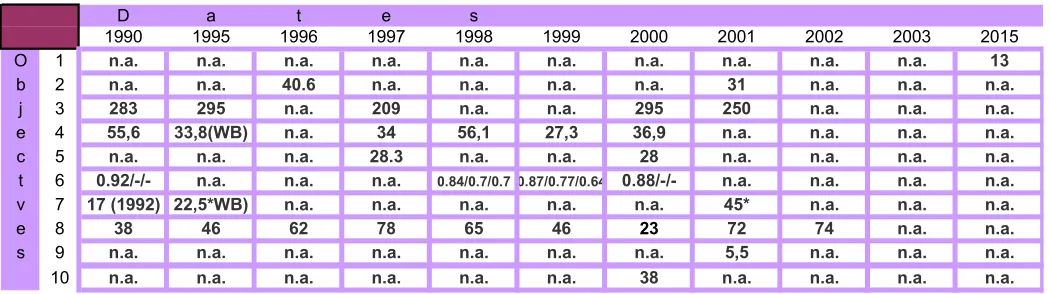
Table 2
D a t e s
1990 1995 1996 1997 1998 1999 2000 2001 2002 2003 2015
O 1 n.a. n.a. n.a. n.a. n.a. n.a. n.a. n.a. n.a. n.a. 13
b 2 n.a. n.a. 40.6 n.a. n.a. n.a. n.a. 31 n.a. n.a. n.a.
j 3 283 295 n.a. 209 n.a. n.a. 295 250 n.a. n.a. n.a.
e 4 55,6 33,8(WB) n.a. 34 56,1 27,3 36,9 n.a. n.a. n.a. n.a.
c 5 n.a. n.a. n.a. 28.3 n.a. n.a. 28 n.a. n.a. n.a. n.a.
t 6 0.92/-/- n.a. n.a. n.a. 0.84/0.7/0.7 0.87/0.77/0.64 0.88/-/- n.a. n.a. n.a. n.a.
v 7 17 (1992) 22,5*WB) n.a. n.a. n.a. n.a. n.a. 45* n.a. n.a. n.a.
e 8 38 46 62 78 65 46 23 72 74 n.a. n.a.
s 9 n.a. n.a. n.a. n.a. n.a. n.a. n.a. 5,5 n.a. n.a. n.a.
10 n.a. n.a. n.a. n.a. n.a. n.a. 38 n.a. n.a. n.a. n.a.
8. % of 1-year old children immunised against measels. 9. HIV prevalence in 15-49 age group.
* most recent year between 1995-2002
10. % population with permanent access to treated water. 4. % of children enrolled in primary education (net). 5. % primary completion rate.
6. Rate of girls to boys in primary/secondary/higher education. 7. Births attended by skilled health personnel.
1. % population living below $ 1per day (definition of poverty line). 2.% undernourished children under 5 years .
3. Under-five mortality rate per 1 000.
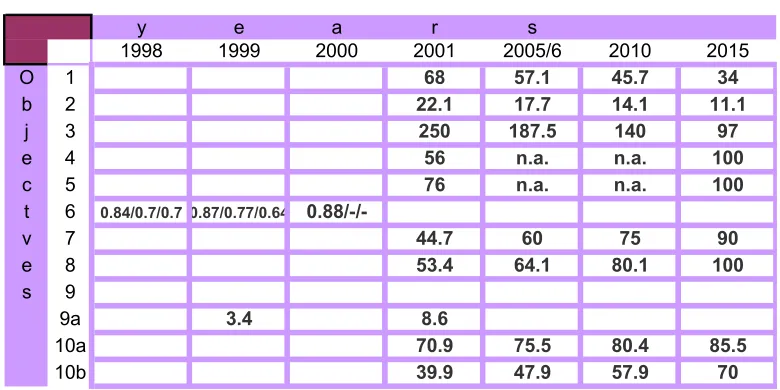
Table 3
y e a r s
1998 1999 2000 2001 2005/6 2010 2015
O 1 68 57.1 45.7 34
b 2 22.1 17.7 14.1 11.1
j 3 250 187.5 140 97
e 4 56 n.a. n.a. 100
c 5 76 n.a. n.a. 100
t 6 0.84/0.7/0.7 0.87/0.77/0.64
0.88/-/-v 7 44.7 60 75 90
e 8 53.4 64.1 80.1 100
s 9
9a 3.4 8.6
10a 70.9 75.5 80.4 85.5
10b 39.9 47.9 57.9 70
9. Prevalence of HIV in 15-24 age group.
9a. % of pregnant women in HIV total (Luanda only).
10. % population with access to potable water in urban areas. 10a. % population with access to potable water in rural areas. 5. % completed fifth year.
6. Ratio of girls to boys in primary/secondary/higher education. 7. Births assisted by skilled health personnel.
8. % of children (12 to 23 months) immunised against measels. 1. % population living below national poverty line.
2. % of under-5s suffering from severe chronic malnutrition. 3. Under-5 mortality rate per 1 000.
4. % of children enrolled in primary education.
(Source: PRSP, 11 September 2003)
3.3. Current social situation
In 2001 the survey of family income and expenditure defined the poverty line at
392 kwanzas per month the equivalent of $1.7 per day at the time. The extreme poverty line
was defined as 175 kwanzas per month or $0.76 per day. The survey showed that in 2001 68%
of the populationand 62% of families were poor with 28% of individuals and 15% of families
in extreme poverty or indigence.
The impact of poverty varies from urban to rural areas. According to the survey, urban
poverty affects 57% of families whereas rural poverty is estimated to affect 94%. The huge level of poverty in rural areas is a direct consequence of the war which has limited families’ access to farming areas and markets as a result of the lack of security and destroyed farmers’
scant resources (livestock, tools and seeds). Military recruitment also reduced available
The health situation continues to give cause for concern. Following the signing of the peace process, basic service cover in areas which had previously been inaccessible was improved leading to a reduction in the level of severe malnutrition from 25% to less than 10% by the end of 2003 and an increase in immunisation against polio (5 million children under 5 were vaccinated) and measles (7 million under 15 were vaccinated) through national vaccination programmes. Despite these measures and progress in 2003, the cover and quality of health care continues to be poor. This is due to a combination of factors including institutional weaknesses, a lack of skilled human resources, inadequate management systems, and the poor quality of coordination between central and municipal authorities and other sectors including donors, the private sector and other non-State actors.
The effects of the war, continuing food insecurity, low levels of enrolment in schools, insufficient access to water and sanitation and inadequate health care created a high-risk situation reflected in unacceptable levels, even in the African context, of mortality in children under five, maternal mortality, chronic malnutrition and endemic diseases such as malaria and tuberculosis in addition to epidemic outbreaks of measles and meningitis. There is also a growing incidence of sleeping sickness. The rate of HIV/AIDS infection in Luanda, which was 3.4% in 1999, was estimated to be 8.6% (see table 3) in 2001. If this trend continues, the scenario in the next few years will be alarming with an impact on the demographic structure of the population and on the chief development indicators. The main factors in the spread of HIV in Angola are directly related to the aftermath of the war, increasing poverty, lack of information and resources and social/cultural and geographical factors. One of the main socio-economic factors resulting from the free movement of persons and goods in the post-war period is the mobility of the population, both within Angola (internal displaced persons) and to and from neighbouring countries (in particular return of refugees from these countries with a high incidence of HIV). The implementation of the National Strategic Plan to combat AIDS has since been approved and may, if it can be implemented flexibly and adequate resources can be found, provide a more effective multi-sector response.
The food situation continued to be critical during the reporting period although there were some basic improvements and more locally produced food became available. The number of persons still dependent on food aid fell significantly, from 1.8 million in January 2003 to half a million by the end of 2003. Analyses of the population’s vulnerability also show that t 1.2 million persons cannot meet their food requirements until harvesting begun in April 2004. Contrary to the situation in 2002, food insecurity is not confined to particular areas but is affecting the entire country as a result of the process of return and resettlement.
By 2003 displaced persons were no longer the most vulnerable group. Their place was taken by the poorest families without resources to acquire factors of production. Persons newly displaced as a result of population movements to areas with better access to basic social services and the families of demobilised servicemen were also identified as vulnerable groups.
The existence of mined areas, the lack of basic social services in huge areas of the country,
the poor state of the transport infrastructure , which is sometimes impassable during the
rainy season, the lack of maintenance and consequently the collapsing of bridges have
The return of displaced persons to their areas of origin following the ceasefire in April 2002 increased the availability of land for resident communities which did not wish to move.
However, until the end of 2002 there was not sufficient distribution of factors of production
to meet the needs neither of this group nor of those who voluntarily decided to return to their areas of origin in the course of the year.
The process of transition to stability for rural populations must take into account the need to
guarantee access to land for traditional communities and to clarify the legal framework of
ownership, including the traditional rights of land use. The Government drew up a draft Land
Bill to prevent any negative impact on the food production potential and to ensure the
regulation of, and compliance with, land rights. This was submitted for consultation to civil society in 2002. In November 2003 the Council of Ministers approved this bill and forwarded it to the National Assembly for discussion and approval.
Communities would like to see customary law included in the final law in accordance with the
fundamental principles set out in the Constitution such as equality among all Angolans and
respect of women’s relationship with the land. In particular they would like legal concepts and principles (such as usucaption) to be made more explicit, put in a simpler language, be translated into the national languages and be widely disseminated.
Progress on education and illiteracy during the first fifteen years after independence has not
been sustained owing to a lack of adequate public financing during the last decade. Low
salaries have led to a mass exodus of teachers and had a negative impact on the quality of
education, compounded still further by the lack of technical training and by the recruitment
of unqualified teachers. Most school infrastructure was damaged by war, looting and vandalism or simply by the lack of maintenance, whilst investment in the building of new
classrooms has not been sufficient to cope with the explosion in numbers of pupils. Some
provinces (Luanda, Benguela, Namibe and especially Cabinda) have been better in providing access, but national averages are particularly low with only 55% of children enrolled in primary schools and 30% in secondary schools. Some 50% of men and 70% of women are illiterate.
3.4. Cross-cutting issues
Migration is not a concern at national level. The issue mainly arises in the context of the return of refugees from neighbouring countries – which is well advanced – and the participation of illegal foreign workers, principally from the DRC, in the mining of diamonds.
At the moment the question of national security poses itself only in terms of internal security.
While it can be said that with the exception of Cabinda the country enjoys peace, some risks
in relation to the resettlement of demobilised soldiers persist. Partly related to this matter is
also the question of the disarmament of the population. The problem here is that there is an
arsenal of small weapons in the hands of the population. Efforts to overcome this problem will have to be intensified.
affected by the food security situation. In towns, it is they who control a large part of the
informal commercial sector, which requires them to spend a great deal of time outside the home while at the same time trying to fulfil their domestic responsibilities. To aggravate the problem further, fewer girls than boys are in education. It is generally acknowledged that if acceptable conditions for the basic family unit to function and reproduce are not provided, there is a risk that the institutional and economic system will perpetuate these injustices.
Management of natural resources is inefficient and there is not adequate legislation. The Government has drawn up a national strategy and action plan for environmental management. It has also drafted basic environmental legislation in areas such as environmental impact assessment, taxation and audits, as well as inter- and intra-sector measures, in partnership with civil society, designed to broaden and disseminate knowledge on environmental issues in various fields. There is no systematic scientific evaluation of fish stocks although studies were undertaken at the end of 2003. A final report was published in February 2004 and this is being examined by technical departments both in Angola and in the EU. It will have an influence on the renewal of the Protocol to the Angola-EC Fishing Agreement.
4. Overview of past and ongoing cooperation
In 2003 humanitarian and reconstruction needs continued to be the main features of the
post-war situation in Angola. The CSP and the NIP under the 9th EDF signed in January
2003 by the National Authorising Officer and Commissioner Poul Nielson take due account of these needs and form the basis of cooperation for 2002-2007 under an approach linking relief, rehabilitation and development (LLRD).
The 9th EDF indicative allocation for Angola is €117 million (‘A’ envelope) and €29 million (‘B’ envelope). An amount of €37 million from previous EDFs is also available and will be used in accordance with the Community response strategy for cooperation with Angola. Under the agreed strategy, which focuses on providing emergency relief, improving the humanitarian situation in Angola and alleviating poverty, Community programmes in Angola have been
targeted at two focal sectors: the social sector and basic social services (health, education,
water and sanitation), and food security.
Because of the poor absorption capacity of a country at war, in early 2003 a considerable
delay in implementing EDF funds was observed. In view of the period of transition through which Angola is going, and its enormous needs in terms of reconstruction, rehabilitation, resettlement, social/professional reintegration and de-mining, financial programming had to be adjusted to meet these immediate and urgent challenges which have a major impact on the
process of reconciliation and reintegration. This also made it possible to speed up
commitments and disbursements of EDF funds.
Their implementation will begin this year.
Although a large percentage of disbursements continued in 2003 for emergency humanitarian aid, food aid, emergency relief, mine-related projects and social reintegration, it was possible to reverse this trend in the course of the year with greater focus on rehabilitation and reconstruction of infrastructure and basic health, education, water and sanitation systems.
The continuing serious humanitarian situation, despite a slight improvement in 2003, and
the opportunities created by the ceasefire, meant nonetheless that the many Community
instruments available (ECHO, budget and EDF) had to be mobilised to respond to the social and humanitarian crisis. Consequently ECHO operations and the Emergency programme in support the peace process (€30 million), which had been identified and approved in 2002,
played a major role. Large-scale health operations were undertaken throughout the country
(nutritional rehabilitation, epidemiological surveillance, essential medicines, support for
vaccination programmes and anti-malaria campaign), together with water and sanitation,
de-mining and distribution of seeds and agricultural tools. Help was also given to the
education sector through the “Education for All” programme and for the repatriation of refugees from neighbouring countries.
It is symptomatic of the improving situation in Angola that it has been possible to continue
some of ECHO’s operations under a different approach under the Transitional Programme
for support for displaced populations with funding from the EDF. This programme, which is
more ambitious than ECHO’s emergency operations, aims at strengthening municipal systems
in the medium term. It focuses on meeting basic health needs and improving water supply and sanitation.
In 2003 a separate component was introduced in the Reconstruction Programme to provide
concerted assistance for the rehabilitation and reconstruction of basic infrastructure.
Adoption of the programme to support the Social Action Fund will ensure greater EDF funding
in 2004 for the reestablishment of basic social services in large areas of the country.
However, this will mean that these transitional measures will have to be combined in the future with support for definition and implementation of sector policies. Consequently the
Community and the Angolan Government began work in 2003 to define a food security
policy.
4.1. Focal sectors
4.1.1. Food security
(a) Results
At the beginning of 2003 there were 2.8 million displaced persons and 1.8 million
beneficiaries of food aid in Angola. During the year the majority of displaced persons returned to their areas of origin and the number of persons suffering from food insecurity was reduced to 500 000. Most of the feeding centres were able to close. While these are very
positive results, they are mainly due to the end of the conflict. Although the priority was to
including reconstruction/rehabilitation, is consequently an ongoing priority. With the building of schools, health centres, rehabilitation of health, water and sanitation systems, programmes such as the Emergency Programme to support the peace process, the Transitional Programme
for support for displaced populations, the PAR and the PMR have had a major impact on the
life of the population.
The de-mining programme in 2003 not only opened up previously isolated areas and, consequently, enabled humanitarian aid to get in but also opened up access to social
infrastructure, water points and farming areas. The gradual degradation of the transport
infrastructure and weakness of rehabilitation and maintenance activities hampered efforts to bring about a more rapid improvement in the situation.
(b) Activities
Although operations with greater direct impact are financed by the relevant budget heading,
food security is closely linked to poverty and as such, is a cross-cutting issue. Health, water and sanitation operations which have a major impact on food security are dealt with in the relevant chapter.
The PAR, which has a greater impact on activities in rural areas in the central provinces
(Huambo, Bié, Huíla and Benguela) was revised following a reprogramming mission in early
2001. Following a request from the National Authorising Officer, the financing agreement
which expired in June 2001 was extended for two years. In early 2003 another request was
made to extend the PAR – until 2005 – to enable the second phase of the programme to be implemented and some €27 million remaining from the €55 million allocated under the financing agreement to be used.
The PAR now focuses on support for municipal rehabilitation programmes with priority
being given to the restoration of basic social services in the education, health, water and sanitation sectors and support for the rehabilitation of other sectors subject to the availability of funds from the Community, the national budget and other donors.
In 2003 ORMs (municipal reference operators) carried out and presented their first
participative analysis and municipal rehabilitation programmes for each of the urban areas for
which they are responsible. They also carried out technical studies and issued a series of calls
for tender for priority works under these programmes.
The PMR III, to which €7.4 million was allocated for a period of three years, is designed to
restore productive activities in rural areas in five provinces (Bengo, Cuanza Sul, Namibe, Huíla and Cunene) through support for rural extension services, the supply of inputs, including
seeds, and the rehabilitation of small social and economic infrastructure. As the Management
Unit for this programme began its work at the beginning of 2003, the year was devoted to
setting up the PMU and identifying the first micro projects.
The de-mining component of the Emergency programme for the support of the peace
process got under way in early 2003. A contract to provide institution capacity building to the
National Intersector De-mining and Humanitarian Assistance Commission (CNIDAH) and
mines by marking mined areas.
The Emergency Programme also financed two projects to distribute seeds, fertilizers and agricultural tools through EuronAid and the FAO at a cost of €4.5 and €2 million respectively in addition to the programme financed by the budget heading. This additional aid went to a total of 240 000 families and 1 440 000 individuals increasing the total number of beneficiaries to around 2.1 million persons.
(c) Cross-cutting issues
With the end of the war there was a pressing need for a national food security strategy to
ensure Angola’s development and for the European Commission to provide institutional support in this area to the Ministry of Planning and Ministry of Agriculture and Rural
Development. In addition to this assistance from the Community budget institution building
and community development are twoof the main objectives of PAR and PMR III. Under the PAR Municipal Reference Operators are assisting the municipal authorities in drawing up analyses and municipal rehabilitation programmes. In a second phase they will continue to assist the authorities in overseeing and monitoring rehabilitation and reconstruction works. PMR III will provide capacity building for national governmental and non-governmental institutions at municipal level (grassroots organisations, churches, local NGOs, etc.).
4.1.2 Social sectors
4.1.2.1 Education
(a) Results
Under the CSP and the NIP the Government undertook to raise education spending to 10%
of the national budget in 2003 and ensure 100% budget implementation. The national budget funds actually spent in the sector in the last three years up to 2002 accounted on average for
6.3% of total expenditure. The Government consequently approved the so called Integrated
Strategy for the improvement of the education system with the aim of reviving the sector by giving priority to the training of teachers, organisation of the education system and the rehabilitation of school infrastructure. The World Bank (WB) contributed to this programme through institution capacity building, rehabilitation and building of schools and the preparation of a strategy to rehabilitate the education system. The African Development Bank (ADB) is financing a project to extend access to basic education (rehabilitation and reconstruction of schools), improve the quality of primary and secondary education (training of teachers and educational administrative staff) and develop access to vocational training (rehabilitation of training centres for youths).
(b) Activities
Support was provided by the Community in the education sector under the Initiative for the
educational system of the African Countries with Portuguese as their Official Language (PALOP)” provided methodological and teaching support, set up local training centres and trained some 170 Angolan primary school teacher trainers, who, in turn, trained some 4 000
teachers in all provinces of the country under the national project for the “Rationalisation of
the number of training courses for primary school teachers”.
The current programme for the “In-service training of primary school teachers”, which
began at the end of 2001, is a continuation of teacher training measures in two previous projects to improve the quality and educational effectiveness of this teaching. It is proposed to improve, through continuous vocational training, the qualifications, efficiency and motivation of over 14,250 teachers. Another aim is to equip and create the conditions for the operation of local training centres in 16 other provinces, to promote the continuing training of teachers and to implement a special statistical system to monitor the results obtained in training centres and schools. In 2003 an international technical assistance team in the Ministry of Education began its work and a work programme was used to equip half the number of training centres, complete preparation of technical and logistical conditions and carry out the first training courses for teachers.
The Tchivinguiro Agricultural Institute (IMAT) is the only agricultural secondary school still operating in Angola following the closure of the institutes of Huambo and Malange. Under
the “IMAT Rehabilitation Project” it received, from mid-1998 to mid-2003, a total of
€8.24 million for rehabilitation, supplies and technical assistance measures financed under the 7th EDF, so that it could train agricultural technicians to adapt to the specific conditions of farming in Angola and become a reference pilot centre for technical agricultural training in Angola. The project was completed in August 2003, but it appears from recent information that
there are serious problems in managing this Institute which could affect the sustainability of the project.
4.1.2.2 Health
(a) Results
The Government’s approach in attempting to overcome the serious health situation is based on
improving the quality of services and re-establishing basic social services in previously
inaccessible areas, focusing on the health of mothers and children, STD/HIV and the prevention and control of other transmissible and endemic diseases.
USD 11.08 in the eastern provinces – the least populated areas.
A consistent global strategy for the sector which puts into practice the principles of the framework Health law approved in 1992 has not yet been implemented despite the approval of the general regulations for health units in the National Health Service and initiation of
discussions in the last National Consultative Council on the basis for a post-conflict
programme on reconstruction and rehabilitation 2004-2006.
(b) Activities
The post-emergency health project (PSPE,€18 million), which was reprogrammed in 1999
and concluded in December 2003, extended partnership in the health sector. In 2001, 2002
and 2003 the following main activities were implemented under the project:
(i) At central level – institutional support for the General Secretariat and accounting departments – diagnostics, introduction of methodology and operational tools and in-service training. A basic instrument for the distribution of funds for goods and services and the redefinition of a new approach to financing the sector was introduced. Training was provided in the preparation, monitoring and evaluation of annual budgets. Operational support was provided for the implementation of the Human Resource Development Plan 1997-2007 in the following fields: new health training instruments, the reorganisation of post-graduate training and the development of human resources and institution building, in particular for management of schools and evaluation of teaching staff. Projects were prepared for the regulation of hospitals and definition of specific hospital indicators but have not yet been approved.
(ii) At provincial level (Luanda and other provinces) establishment of a health development
plan for Luanda. Capacity building and training in information systems, epidemiological surveillance, HIV/AIDS, child assessment and monitoring involving 20 doctors and 178 other health technicians were carried out. 2 275 essential medical kits were supplied and complementary medicines provided to support the primary health network in Luanda. Three new health centres were built and equipped in poorer areas on the outskirts and the Provincial Health Directorate was rehabilitated. Micro projects were undertaken in education in health and nutrition, HIV, personal hygiene, water collection and supply and basic sanitation.
(iii) The National Blood Centre (CNS) (under the programme to combat HIV/AIDS) - physical
rehabilitation and equipping of the National Blood Centre. A campaign was conducted to encourage blood donation. Two senior technicians who specialised abroad in immunohaemotherapy and clinical haematology and the management of blood centres were made available. Doctors were given in-service training in the rational use of blood and basic documents for a national blood policy were drawn up but have not yet been approved. They include comparative studies of legislation in other countries and the law on the therapeutic use of blood. Statutes were drawn up for the National Blood Centre and the national blood network and blood transfusion regulations.
Following the Community’s many varied aid projects and its support for persons with motor
disabilities, implementation of the Ministry of Health’s “Project for the Support of the
have now begun, including support for the management of orthopaedic centres and production of foot prostheses by the NGOs Handicap International (B) in Benguela, Lubango and Viana and Intersos in Menongue. This involves production/repair of prostheses and pre- and post-fitting support for more than 500 persons with lower motor disabilities and technical training in management of local teams in the provinces in question. Short-term TA was provided to support the creation of the organisational and institutional conditions for the project’s full development. In October 2003 a methodological seminar involving the PNRF’s partners was organised with the active participation of all provincial partners and structures.
The “Programme in Support of the Health Sector” (€25 million) got under way with the
publication of the notice of pre-qualification for TA in September 2002. Dialogue and partnership in a more structured prospective with the health sector will be pursued through this programme. The TA contract was not awarded until December 2003 and work began in January 2004.
The “Transitional Programme for the Support for Displaced populations”, which has a health component of €9.14 million, began supporting projects by NGOs in the provinces of Uíge, Malange, Cuanza Sul, Bengo and Cuando Cubango in 2002 and 2003.
(c) Cross-cutting issues
See a) Results
4.2. Projects and programmes outside focal sectors
4.2.1. Urban reconstruction and development – water and sanitation
(a) Results
The Ministry of Energy and Water recently drew up the development plan for the water supply
and sanitation sector, and its basic components are to be implemented during the period 2001-2005.
With the central objective of improving the quality of life of Angolans and their general standard of human development, the Government defined a strategy and action programme
including “master plans for the supply of water and urban sanitation”, “programmes to
rehabilitate and expand the urban water supply and sanitation systems”, a “rural water and sanitation programme” and the” institutional support programme”.
As regards the production and distribution of drinking water, the rehabilitation of water
systems in the towns of Negage, Uíge, Malange, Huambo, Luena, Catete and Baía Farta, which is funded by the Government, is nearing completion. EC funding has been provided for:
Water supply for the town of Tômbua
- Rebuilding and bringing into production the existing system (drawing water from the
Curoca river);
- Construction of a 12 km distribution network to replace the primary and secondary
networks;
- Completion of part of a new water supply system being built to draw water from deep
including support services and four boreholes (three at 180m and one at 300m).
PAR
- 70 water points and 30 collection ditches were brought into production.
Transitional programme for the support of displaced populations
- 2 300 family latrines and 14 institutional latrines were built in Malange and Saurimo;
- 35 water committees were set up and began work in Malange and Saurimo;
- 12 drinking fountains were installed in Saurimo;
- 40 water points were built and 13 were rehabilitated in Malange and Cuando Cubango;
- One water supply system was rebuilt in Cuando Cubango.
(b) Activities
The Community has put considerable funding into this sector to support the Government in implementing projects to improve water supply and sanitation in urban centres and rural areas focusing on the following projects/programmes:
Under the project to supply water to the town of Tômbua the current water supply system is
being improved at a cost of €7.6 million (8th EDF). This includes a strong institutional capacity building component and support for the construction of the tertiary network, installation of meters and implementation of a charging system. The project began in November 2001.
In November 2003 the project for water supply and sanitation in the suburbs of Luanda
(€20 million) was approved. Its objective is to supply drinking water to some 1 360 000 people in the areas of Cazenga and Mulemba, to improve the sanitation system for some 150 000 persons and to introduce a municipal solid waste collection system for some 800 000 persons.
In addition to these projects the Community has been providing support for the water and
sanitation sector through various rehabilitation operations under the PAR which financed the rehabilitation of municipal water systems on the central plateau (Benguela, Huíla and Bié). The
Transitional programme for the support for displaced populations, which has a water and sanitation component costing €5 million, began funding projects towards the end of 2002 in the provinces of Uíge, Malange, Lunda Sul, Moxico, Huambo, Cuanza Norte, Bengo and Cuando
Cubango. The Programme to support the peace process also provided assistance for
emergency measures in newly accessible areas through the Office for Coordination of Humanitarian Assistance (OCHA) under its water and sanitation component of a value of €1.39 million.
(c) Cross-cutting issues
Preparation for projects for the supply of water to Tômbua and for water and sanitation in Luanda will include an environmental impact assessment and general analysis. Under the
4.2.2. Institutional Support
Results
In the judicial sector, the evaluation of the project “Institutional support for the INEJ
(National Institute for Legal Studies) ” concluded that the benefits which would be gained through its implementation corresponded to the objectives initially set and would improve the conditions under which the INEJ works and enable activities to be undertaken in Luanda under
the regional project to support the development of the judicial systems of the PALOP. The
report proposes that INEJ staff in its administrative and financial departments be given extra training. The INEJ management will strive to find the best way to proceed.
There have been successive delays in the preparation and implementation of projects in other areas mainly due to bureaucratic reasons but a more forthcoming approach should be taken by the authorities in the choosing and preparation of programmes so as to promote and support actions that are of interest to themselves. There is little to report even on those projects
which finally got under way in 2003 (identification study for the modernisation of Public
Administration and technical assistance for the National Assembly). However, the Delegation has insisted that the Presidential Commission set up to do the mapping of the Justice sector take into account the identification and feasibility study of support for the reform of the administration of Justice funded by the EC in 2002.
Activities
A significant amount was earmarked from the 9th EDF in accordance with the conclusions of
the General Affairs and External Relations Council on Angola to promote good governance
and institution building.
Targeted technical assistance will be provided up to July 2004 to complete the preparation of
the long-term national strategic plan (2025) based on the economic scenarios already developed. An independent evaluation of the first two phases was also commissioned to identify the Ministry’s future needs and to propose future measures.
Following proposals emerging from the mid-term review in mid-2002 recommending a change of direction in strategic planning and the new work programme presented by the technical
assistance team, the second phase of the project to provide institution building for the
National Assembly began in 2003. This is based on a more realistic and integrated approach with the National Assembly’s own work programme and will last 18 months.
In the judicial sector, the project “Institutional support for INEJ”,created the necessary basis
for the training of magistrates and other law officers. The final evaluation was completed in July 2003 and concluded that the Institute would be capable of undertaking the justice programme of the PALOP.
Under a preliminary identification study for “Support for the Reform of the Administration of
2002 study are taken into account as this is the only one which has been undertaken so far.
The financing agreement for the project “Institutional Support for the INE” was signed in
September 2002 for an amount of €1.9 million. Its objective is to enhance statistical
capabilities (business survey, a study of employment and unemployment, consumer price
index, poverty profiles) with a view to contributing towards the strategy to combat poverty. Under the work programme local surveys were undertaken in 2003 for the business survey. Unfortunately there were some delays in this very important project following the investigation by OLAF of EUROSTAT and European CESD. There will have to be a slight change of direction because technical assistance for the INE can no longer be financed by EDF funds.
The second phase of the project “Technical Assistance for Angola’s National Assembly”
begun. At the end of October 2003 ANA’s the project director was appointed and set up office in the Assembly’s Secretariat-General, and the project head took up his duties. At the end of the year, operating procedures had been introduced in accordance with the terms of reference. Following proposals made in the mid-term review in mid-2002, recommending a strategic change of direction, and the new work programme presented by the technical assistance, the second phase of the project began under a more realistic and integrated approach with the National Assembly’s work programme and will last 18 months. An ad hoc committee (NAO, ANA, project head and EC) to evaluate and monitor the project met for the first time in December 2003. It was decided that it would continue to meet on a two monthly basis.
The second phase of an additional feasibility study of a programme “Support for the
Modernisation of Public Administration” is also under way.
Support to improve the management of public finances is also considered a priority. The level
and nature of the aid to be provided (estimated at between €5 and €10 million, although more may be needed) will be determined under a coordinated framework to be defined with the Government and other donors. The World Bank has been the main player in this area and has drawn up a programme for improvements and greater transparency in public management, including in the oil sector. In February 2003 a major study on the revenue of this sector was published. However the Government does not subscribe to its conclusions although it has published it on an official site on the Internet.
The project “Institutional Support for the Services of the NAO” is of considerable direct
(a) Results
In the transport sector there are no new projects. However, as it had been a focal sector in the past, projects were still being implemented in 2003 but under the PAR only.
(b) Activities
In the road sub-sector the EC has been supporting rehabilitation and development, through the following main projects:
In the context of the project to rehabilitate major road links in the south-west of Angola
some 68 km of the road between Namibe and Lubango were restored at a cost of €12.5 million, €2.5 million from the NIP - 6th EDF, and €10 million from the RIP - 6th EDF. Work began in April 2000 and was completed in April 2003.
In the framework of the rehabilitation of national roads with regional links studies were
financed by Italy and a financing agreement was drawn up for the repair of the Lubango – Santa Clara road link (425 km). In the meantime this project has been suspended because of
differences of opinion about its sustainability. Exploratory talks were undertaken recently to
see whether this regional initiative might be revived.
Under the PAR the EC supported the rehabilitation of secondary and tertiary roads in the
central plateau, namely the secondary road between Lubango and Quinpungo, some 112 km.
4.3. Utilisation of resources for Non-State Actors (NSA)
A large proportion of the financial resources provided by the EC as response to the emergency
situation were used for programmes and projects implemented by national and international
NGOs and churches. The micro project programme was also, and continues to be, an
important instrument for the capacity building of non-State institutions - including local
NGOs, small associations and interest groups involved in the production and revitalisation of services -, which implement micro projects using the funds allocated to this programme.
Contacts continued to be maintained with a view to providing future support for civil society
on the basis of indicative amounts allocated under budget headings and the EDF and the areas to be selected for assistance in 2004.
4.4. Utilisation of envelope B
The magnitude of the movements of voluntary returnees took both the Government and the international community by surprise and, despite the lack of adequate conditions and basic social services, people continued to return to their areas of origin throughout 2003. In many
cases people returned to inaccessible areas where the presence of land mines is not only a
direct threat to their lives but also hinders or prevents farming. The NAO made a request to the Commission which mobilised the B envelope for a programme to improve access to these areas focusing essentially on de-mining. The aim of the programme is to provide access to isolated areas, provide humanitarian assistance to returnees, re-establish minimum living conditions in the areas to which people have returned and restore economic activity.
of €26 million (90% of the B envelope) was approved by the EDF Committee in November 2003 and will be implemented as from 2004. In addition to a large de-mining component to be
implemented by national NGOs specialising in this area, this programme provides institution
building for provincial coordination of de-mining projects and complementary infrastructure measures, in particular the rebuilding of bridges and rehabilitation of small sections of roads considered crucial to this operation.
4.5. Other instruments
4.5.1 European Investment Bank
The European Investment Bank (EIB) did not play a major role in Angola under the 8th EDF.
This was due to the financial and economic climate in the country which was still ravaged by
civil war and the – still unresolved - question of debt owed by the Angolan State to the EIB
as its settlement is a prerequisite for the re-establishment of the Bank’s financing in
Angola.
As a result of a mission in 2002, a project relating to air navigation and safety was
evaluated by the EIB but has been suspended for the moment because of Angola’s delay in
settling its debt.
The local financial sector is also a priority for the EIB as it plays a crucial role in the private sector, namely SMEs. Other projects in various sectors are already being studied.
It should be noted that under the 9th EDF, the EIB was made responsible for managing a
major financial instrument – the Investment Facility (IF) – for a total of €2.2 billion, its objective being to support commercially-managed investment in ACP countries in both the public and private sector. The IF was allocated a further €1.7 billion from the EIB’s own resources.
Countries which have recently emerged from conflict situations such as Angola are also eligible for the interest subsidies on EIB loans. The IF provides a broad set of financial instruments tailored to the needs of each investor and/or investment project.
The EIB intends to intensify and expand its contracts with Angolan authorities and private partners working in the country to promote and support investment focusing on rehabilitation and reconstruction of infrastructure affected by the war.
However, despite this potential, it is expected that the Angolan authorities resolve the problem