National Authorising Officer –
Head of Delegation of the European
Commission, Kenya
Joint Annual Operational Review
of Cooperation between
The Republic of Kenya
and
The European Community
in 2004
Table of contents
1 Executive summary ... 3
2 Update of the political, economical and social situation... 4
2.1 Update of the Political Situation...4
2.2 Update of the economic situation ...4
2.3 Update of the social situation ...6
3 Development agenda of the partner country ... 8
3.1 Restoring Economic Growth within the context of a sustainable macroeconomic framework ...9
3.2 Strengthening the Institutions of Governance ...10
3.3 Restoring and Expanding Infrastructure...10
3.4 Investing in the Human Capital of the Poor ...10
4 Overview of past and ongoing cooperation... 11
4.1 Focal sectors ...11
4.1.1 Macroeconomic support ...11
4.1.2 Rural Development and Agriculture ...14
4.1.3 Roads and transport ...16
4.1.4 Projects and programmes outside focal sectors...18
4.2 Utilisation of resources for Non State Actors...23
4.3 Utilisation of Envelope B ...23
4.3.1 Compensation for unforeseen losses in the tourism sector ...23
4.3.2 Disaster Preparedness...23
4.4 Other instruments ...24
4.4.1 STABEX ...24
4.4.2 Regional cooperation...24
4.4.3 Community Budget lines...25
4.4.4 EIB...25
5 Programming perspectives for the following years... 25
6 Dialogue in country with the NAO and NSAs, and donor coordination... 26
6.1 Dialogue in country with the NAO and NSAs ...26
6.2 Donor Coordination...26
7 Conclusions of the joint annual report ... 26
Annexes: ... 29
1 Focal Sector Intervention Frameworks ... 29
2 Millennium Development Goal (MDG) Indicators... 29
3 Financial Forecasts ... 29
4 EU Donor Matrix... 29
1 Executive summary
The year 2004 presented considerable challenges for both Kenya and the EC Delegation. Against a background of increasing concerns about corruption and continued political divisions within the ruling coalition, progress in economic reform was slower than expected. The Delegation, meanwhile, faced protracted staffing vacancies in key areas: the Head of Finance and Contracts, the Head of Operations and the departure of the Head of Delegation in July.
The rate of economic growth, estimated at 2.6% of GDP in 2004, must be seen in the context of estimated population growth of over 2%. This would indicate that the economy is just about keeping pace with the estimated increase in population. A substantial acceleration in growth is required if the objectives of the Economic Recovery Strategy are to be achieved.
Continued concerns about corruption and the delayed progress on the Constitutional Review undermined confidence of the EU in the Government’s commitment to reform. This resulted in the delay in the approval of the PRBSII programme and continues to create uncertainty about its implementation. From the middle of 2004 onwards, however, progress in reform improved with the rationalisation of functions between the Ministries of Finance and Planning, the revision of the budget timetable, the enactment of the Government Financial Management Bill, the revision of the Public Procurement Bill to fully encompass security/defence procurement and the establishment of the institutional structures of the KACC in full. Against this background, the Government successfully completed the first review of the IMF PRGF programme.
Relations with the NAO improved significantly following the arrival of the new NAO in July. However, it should be pointed out that there is a severe capacity problem within the NAO’s office which must be urgently addressed. The Technical Assistant has departed and the Delegation and the NAO are in the process of recruiting a replacement. Relations with the Line Ministries, however, remain difficult. This situation is particularly true for the Ministry of Roads and Public Works where despite a myriad of meetings at all levels virtually zero progress has been made during 2004. The Ministry could be described as non-cooperative but actually it hinders good cooperation. There has been a change of Permanent Secretary during the year but this has not led to an improvement in the overall situation. Lack of cooperation was also encountered in the Delegation’s relations with the Tourism Ministry despite the fact that the Tourism Trust Fund (financed by the Delegation) was identified as a major contributor to the tourism boom in Kenya in 2004. However this position improved significantly towards the end of the year following a reorganisation of Government which saw the entry of a new PS in the Ministry of Tourism. This is an area in need of urgent action in 2005.
Despite the difficulties in implementing the CSP outlined above, the Delegation was not far off its original targets for commitments and disbursements for 2004; the main contributors to the shortfall was the delay in the budget support programme and the initial contract payment for the works contract for the Maui Mahiu –Lanet Road. In addition, there were several success stories, notably the TTF and the Sultan Hamud Road- Mtito Andei Road in addition to the launch of major programmes in health and local government reform. Contacts with Non-State Actors continued, the Delegation is involved in supporting agriculture sector reform, judicial reform, the environment, public financial management, education and other important social and economic sectors.
2 Update of the political, economical and social situation
2.1 Update of the Political Situation
Political developments in 2004 continued to be dominated by the ongoing constitutional review process and revived concerns about corruption in Government. This has resulted in deep divisions within the ruling National Rainbow Alliance Coalition (NARC). This has caused significant delays in Parliamentary business and several important bills have suffered.
Corruption continued to be a major political issue during 2004. In April, a new scandal emerged, involving a company named “Anglo Leasing Finance Limited (ALFL)”, which was selected without competitive tender for a Ksh 2.7 billion project for passport and immigration screening equipment. The company appears to be a front for certain Kenyans to operate a scam involving upfront payment of a “commitment fee” of €1 million. These funds were eventually returned but the exact identity of the company directors remains unknown. Investigations continued during 2004 with investigators KACC despatched to cooperating third countries (USA, Switzerland and UK). Two Permanent Secretaries (Finance and Home Affairs) and three other senior officials (Head of Debt Management, Head of IT Services, Chief Finance Officer - Office of the President) were dismissed. A cabinet reshuffle followed in June, resulting in a new management team and NAO in the Ministry of Finance.
Following the deferral of the EDF Committee consideration of the PRBSII programme, the Government reacted positively to the need to engage more intensively with the EU on anti-corruption issues and the Head of Delegation, in the context of the EU Troika, met twice with the President on these issues in the latter half of the year. At the most recent meeting the President reiterated his resolve to fight corruption but pleaded for patience from the donor community in order to allow the due process of investigations to proceed.
A Constitution Amendment Bill was passed in August 2004. Under the terms of the Bill the Constitution of Kenya Review Act was to be amended to allow Parliament to assume control of the remainder of the review process and provided for a referendum on the draft constitution. Opponents of the Bill claim that removing the provision for approval by 65% of the electorate leaves the draft constitution too vulnerable to being watered down. The Judicial Service Commission ordered 50 magistrates facing corruption charges to retire from 12 March 2004. 82 magistrates, 23 judges and 43 paralegal officers were mentioned in the Ringera report on corruption in the judiciary.
2.2 Update of the economic situation
Real GDP growth for 2004 is estimated by the Central Bank at 2.6%. This represents a continuation of the recovery that began in 2003. However, this is far from the sustained economic growth path foreseen in the PRSP/Economic Recovery Strategy and required to underpin the reduction in poverty in the country. While this would nevertheless represent a significant improvement compared to the average annual growth rate of just over 1% over the previous 5 years, it is insufficient to generate the substantial increase in per capita incomes that is necessary for sustained poverty reduction.
Overall growth in 2004 appears to have been broad based with agriculture, manufacturing, services, building and construction, transport and communications all contributing significantly. While the higher growth rate represents a significant improvement compared to the average annual growth rate of just over 1% over the previous 5 years, it is insufficient to generate the substantial increase in per capita incomes that is necessary for sustained poverty reduction.
percent of GDP in 2003 from 12.9 percent in 2002 and private consumption increased to 73.8 percent from 72.9 percent of GDP.1 The saving ratio fell to 9.8 percent of GDP in 2003 from 13.6 percent in 2002.
The increased private sector activity is also reflected in domestic credit expansion. Credit to the private sector grew by 22.1 percent in the year to January 2005 compared with 9.8 percent a year earlier. The annual growth rate of household bank credit in January 2005 was 48,6 percent indicating high private consumption demand. Other sectors that registered increased credit included agriculture (14.9 percent), manufacturing (21.4 percent), building and construction (10.2 percent), transport and communication (16.3 percent), mining and quarrying (31.8 percent) and finance and insurance (28.0 percent). Bank sector credit to government slowed down significantly during 2004, registering an annual growth rate of – 2.5 percent in January 2005 compared with an increase of 24 per cent in the year to January 2004. This is a reflection of reduction in domestic borrowing by the Government to finance the budget deficit.
The interest rate on the benchmark 91-day Treasury Bill issue increased from an average of just under 1.7% in July 2004 to 8.3% in January 2005. The rapid rise in interest rates in the 2nd Quarter of the fiscal year fuelled speculative tendencies in the Government securities market. This undermined the Government’s ability to achieve the targeted net domestic borrowing.
Monetary policy was loosened in July 2003 through the reduction in reserve requirements for commercial banks (from 10% to 6%). This led to an increase in the money multiplier with the year-on-year expansion of broad money (M3X) reaching 12.8% in January 2005 and real interest rates being sharply negative.
The strong inflationary trends that emerged during 2004 reflect a combination of both exogenous factors (drought-induced rise in food prices, increased in transport costs reflecting reinforced regulations in the public transport sector and the international oil price rise) as well as the monetary easing since mid 2003. Headline consumer price inflation was 11.6 percent and underlying inflation 3.5 percent in 2004. Inflationary pressures have fallen with the 12- month headline inflation rate declining for five consecutive months, falling to 14.9 percent in January 2005 from 19 percent in September 2004. The 12-month underlying inflation rate remained stable between October and December at just under 5%. The Central Bank of Kenya targets 5 percent for underlying inflation.
The current account on the balance of payments moved sharply into deficit during the year to September 2004 reflecting unfavourable terms of trade developments (oil price rise), strong import demand outstripping export growth and a decline in the services balance (despite the upturn in tourism earnings) compared to the same period of 2003, mainly reflecting a decline in current transfers (both official and private). The Kenya Shilling has depreciated against all major currencies since the beginning of 2004 reflecting both the underlying terms of trade deterioration and the domestic monetary expansion.
Net domestic borrowing by Government totalled Kshs. 8.8 billion during 2003/04, far below the targeted borrowing of Kshs. 45.3 billion, partly because of the over performance in revenue as well as the lower domestically financed expenditures. The higher revenues and lower expenditures resulted in a deficit of only KShs. 4.6 billion against the planned deficit of KShs. 42.8 billion.
The 2004/05 budget presented to Parliament had assumed that, based on the commitment during the previous Consultative Group meeting in late 2003, development partners would provide sufficient budgetary support to close a financing gap of Kshs. 35 billion. This, however, turned out not to be the case, and Government has had to revise revenues, expenditures and domestic and foreign borrowing in order to close the gap. The revised fiscal framework for 2004/05 is consistent with the one underlying the
1
Poverty Reduction and Growth Facility (PRGF) supported program with the IMF. The financing gap of Kshs.35 billion was covered by: additional revenues of Kshs. 19 billion based on the sharply higher than expected first quarter out-turn; projected new external financing of Kshs.7 billion from the World Bank and the African Development Bank; and additional domestic borrowing of Kshs.10 billion. The overall fiscal deficit (including grants) for 2004/05 is now forecast to increase to Kshs. 33.4 billion. The larger deficit will be financed by net external borrowing of Kshs.6.1 billion and domestic borrowing of Kshs. 32 billion, which excludes bank restructuring costs of Kshs.5 billion. Nevertheless, domestic debt will remain broadly unchanged from the previous year, at 22 percent of GDP.
The main (provisional) revenue and expenditure trends for the first half of the FY 2004/05 (until December 2004) are the following. Total revenue (excluding grants) was Kshs. 135.1 billion which was almost 30 percent higher than during the first half of the previous fiscal year. The main sources were income tax (Kshs. 44.6 billion) and VAT (Kshs. 36 billion). Total, recurrent and development expenditures were Kshs. 133 billion, Kshs. 116.3 billion and Kshs. 16.7 billion which corresponds to annual growth rates of 9.2 percent, 8.9 percent and 12.0 percent. Donor disbursements consisted of KShs 5.6 billion which was 46 percent lower than during the first half of the previous year. Mainly due to higher revenue than expected, KShs 2.9 billion of domestic debt was repaid.
The 2004/05 budget presented to Parliament had assumed that, based on the commitment during the previous Consultative Group meeting in late 2003, development partners would provide sufficient budgetary support to close a financing gap of Kshs.35 billion. This, however, turned out not to be the case, and Government has had to revise revenues, expenditures and domestic and foreign borrowing in order to close the gap. The revised fiscal framework for 2004/05 is consistent with the one underlying the
Poverty Reduction and Growth Facility (PRGF) supported program with the IMF.
The overall fiscal deficit (including grants)) for 2004/05 is now forecast to increase to Kshs. 33.4 billion or 2.6 percent of GDP, compared with the previous deficit of 0.2 percent of GDP. The larger deficit will be financed by net external borrowing of Kshs.6.1 billion and domestic borrowing of Kshs. 32 billion (2.5 percent of GDP), which excludes bank restructuring costs of Kshs.5 billion. Nevertheless, domestic debt
will remain broadly unchanged from the previous year, at 22 percent of GDP.
2.3 Update of the social situation
Recent economic developments may have worsened poverty indicators. With real GDP growth broadly in line with the increase in population and the economy suffering from the effects of major negative shocks—the drought and the oil price increase—the poverty rate may have increased in the recent past. Moreover, progress on poverty alleviation has been hampered by delays in initiating major poverty reduction programs in the social and economic sectors. AIDS remains a major challenge.
Non-income dimensions of poverty worsened. In step with poor economic performance, key social indicators during the 1990s declined Illiteracy rates increased as enrolment rates in primary school declined during the 1990s. Life expectancy declined from 57 years to 47 years between 1986 and 2000, while the situation in infant and child mortality and HIV/AIDS worsened. Preliminary results of the Kenya Demographic and Health Survey conducted in 2003 indicate that infant mortality increased from 62 per thousand in 1993 to 78 per thousand in 2003, while under five mortality rose slightly from 96 per thousand births to 114 per thousand in the same period. Trends in nutritional status of children under age three show that the percentage of stunted children (short for their age) increased from 29 percent in 1993 to 31 percent in 2003. Similarly, the percentage of children aged 12-33 months who were fully vaccinated dropped from 79 percent in 1993 to a dismal 52 percent in 2003. These national averages conceal substantial regional variations. For example, the proportion of children fully vaccinated in Nyanza, Western and North Eastern provinces falls below 50 percent as of 2003. Need to recognise the good performance with introduction of UPE
tools. Factors highlighted in participatory poverty studies as affecting household consumption include having low agricultural productivity and poor access to markets; being unemployed or earning low wages; living in areas with poor infrastructure (especially roads) and with limited availability of affordable basic services; living with HIV/AIDS or with a disability; being a member of a minority group that is discriminated against; and living in an area with a poor and cultural beliefs that deny women access to productive assets. The government recognizes that much is still to be done to understand the causes of poverty and to identify interventions that can effectively and rapidly reduce poverty.
The Kenya Integrated Household Budget Survey (KIHBS) should provide critical data for estimating the incidence, depth, distribution, and trends of poverty, and in addition, will also provide the baseline information towards undertaking a comprehensive poverty assessment in 2005/06.
The understanding of the geographical variations in poverty has grown considerably as a result of the production of poverty maps in 2003 that show not only the provinces with high proportions of poor people, but also the sub districts within provinces with such concentrations. This information could be used in future when developing targets and programmes for the poor. The shortcomings of the available poverty maps are inadequate they do not present information for the North Eastern province, the 1997 Welfare Monitoring Survey also did not provide information on this region. Being an ASAL region where extreme poverty is highest, adequate targeted poverty data would be critical in facilitating the IP-ERS poverty reduction interventions. Data from the planned Kenya integrated household budget survey will be useful in producing a complete poverty map in the future.
Gender Dimensions of Poverty is also critical in promotion of equity and access to the most vulnerable and disadvantaged group within the population. Social factors and cultural norms emphasize the unequal power status of men and women. Some traditions favour male dominance, resulting in low social status of women. Special efforts are needed to empower women to make them less vulnerable. As a result recent statistics on HIV/AIDS prevalence have indicated a higher percentage of infested women compared to men. Efforts are ongoing to mainstream gender in the Economic Recovery Strategy. Constraints, however, include lack of gender-disaggregated analysis, except for the fields of basic education and some areas of healthcare. In addition gender specific targets for defining improvements in the economic, social and legal situation are still lacking. The macroeconomic framework that forms the core of the Economic Recovery Strategy is still analyzed in gender-neutral terms.
An influential report in inequality in Kenya was published with the support of the Swedish International Development Agency in September. The report, entitled Pulling Apart, reveals that Kenya ranks among the top ten most unequal countries in the world and the fifth in Africa. Recent statistics show that income is heavily skewed in favour of the rich and against the poor.
The report finds the following:
1. Differences in income. The 10% richest households in Kenya control more than 42% of incomes, while the poorest 10% control 0.76% of income. This means that while the top rich Kenyan earns about 56 shillings, the bottom poor earns 1 shilling.
2. Differences in life expectancy. A person being born in Nyanza province can expect to live 16 years less than his fellow citizen in Central province. At the district level life expectancy in Meru is double that in Mombasa, 68.6 and 33.1 years respectively.
3. Differences in unemployment between men and women. For the age group 20-24 years, there are about 274,000 unemployed women in urban areas compared to about 73,000 in the case of men of the same age group.
4. Differences in HIV/Aids prevalence. In Nyanza province 15% of the population is infected with the HIV/AIDs virus while the infection rate in North Eastern province is negligible, estimated at about 0%.
5. Differences in school enrolment. Going by the enrolment rates, practically every child in Central province attends primary school compared to about one out of three children in North Eastern province. For secondary school the difference is even bigger.
7. Differences in the health reach. In Central province, there are about 20,000 people for every doctor while in North Eastern province there is one doctor for every 120,000 people.
8. Differences in immunisation and mortality. The coverage of child immunization in Nyanza province is less than half that in Central, that is, 38% compared to 79% respectively. There are about twice as many infants dying before their first birthday in Nyanza province compared to Rift Valley, that is, 133 and 61 deaths per 1000 live births, respectively.
9. Difference in gender outcomes. About 93% of women in North Eastern province have no education at all, compared to 3% in Central province. Of the 2,140 elected councillors in 2002, only 97 were women. Of the 210 elected Members of Parliament in 2002 only 9 are women.
[image:8.595.62.511.287.593.2]10. Difference in poverty levels. Poverty levels can vary within and without regions. For instance, although the proportion of people living below the poverty line in Nairobi is 44%, poverty levels range from 8% in Nairobi west, Kibera Division to 77% in Makongeni, Makadara Division.
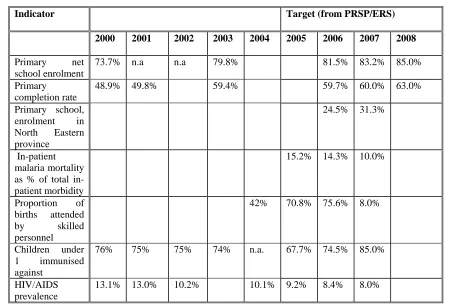
Table 1 Key Indicators
3 Development agenda of the partner country
The strategic objectives of Economic Recovery Strategy ( ERS) are the restoration of economic growth, employment creation and social development. ERS comprises a four-fold strategy to meet these objectives over the medium term:
Restoring economic growth within the context of a sustainable macroeconomic framework;
Strengthening the institutions of governance;
Restoring and expanding infrastructure;
Investing in the human capital of the poor.
Implementing the strategy requires government policy and measures which are summarised as follows in terms of each of the four strategic pillars.
Indicator Target (from PRSP/ERS)
2000 2001 2002 2003 2004 2005 2006 2007 2008
Primary net school enrolment
73.7% n.a n.a 79.8% 81.5% 83.2% 85.0%
Primary completion rate
48.9% 49.8% 59.4% 59.7% 60.0% 63.0%
Primary school, enrolment in North Eastern province
24.5% 31.3%
In-patient malaria mortality as % of total in-patient morbidity
15.2% 14.3% 10.0%
Proportion of births attended by skilled personnel
42% 70.8% 75.6% 8.0%
Children under 1 immunised against
76% 75% 75% 74% n.a. 67.7% 74.5% 85.0%
HIV/AIDS prevalence
3.1 Restoring Economic Growth within the context of a sustainable macroeconomic framework Macroeconomic stability is a prerequisite for strong private sector-led economic growth. Maintaining macroeconomic stability will also strengthen external confidence in Kenya’s economy and improve the environment for foreign investment in Kenya. Fiscal policy includes maintaining a strong revenue position whilst avoiding a tax regime that is unduly burdensome on business, and containing the growth of expenditure while ensuring a shift in its composition toward infrastructure, social programmes and service delivery supportive of private sector activity. The resulting lower fiscal deficit will permit a gradual reduction in domestic borrowing by Government, which should restrain pressure on real interest rates and, therefore, encourage private sector investment. Reducing domestic debt to sustainable levels will reduce the domestic interest expenditure of the Government and thereby provide more room in the budget for additional expenditures in the key priority areas of ERS. Monetary policy, meanwhile, is aimed at maintaining low inflation, a comfortable level of international reserves and providing sufficient credit to the private sector.
In order to promote private sector development the Government will lighten legal, regulatory and institutional constraints and promote privatisation. In order to stimulate private investment, both foreign and domestic-sourced, Government plans to enact the Investment Code and establish an Investment Authority as a one-stop office for investors. The review will include the industrial labour framework particularly wage guidelines and minimum wage legislation and recommend changes that will reduce disincentives to hire unskilled labour.
Privatization should enhance Kenya’s external competitiveness in general and particularly within the regional markets. It also reduces direct costs to the budget by eliminating transfers to public enterprises while reducing the potential contingent liabilities that could be borne by Government. The next step in the privatization process is to present a Sessional Paper to Parliament as a prelude to a revised Privatisation Bill to provide a transparent legal framework for privatization transactions. In this context, where privatization may not be the appropriate option, due to the strategic importance of the agencies concerned, increased private sector participation in the running of these agencies, through management concessions, will nevertheless be considered with a view to achieving efficiency gains. As a specific measure, Government plans to open up the telecommunications sector to more competition, thereby benefiting both consumers and producers through lower prices. As a first step in this direction, the Kenya Telecom Monopoly was allowed to expire at end-June 2004.
Increased public confidence in the financial sector and lower transaction costs will induce more intermediation between savers and investors and lower the cost of capital. The Budget Speech for 2004/05 contains several measures to strengthen the sector. Further measures that Government is planning include the enactment of the Micro Finance Institutions Bill, in order to help micro, small and medium size enterprises, as well as farmers, access financial services at affordable prices. Government also intends to review the NSSF Act in order to determine whether to convert it to a pension fund, expand coverage and thereby further increase the pool of private sector savings available to finance private sector investment. A strong commercial justice system is indispensable to the promotion of private sector investment. Work to strengthen this system is already underway, led by Kenya’s Law Reform Commission, under Government’s Governance, Justice, Law and Order Sector Programme (GJLOS). A draft Companies Bill is being prepared.
3.2 Strengthening the Institutions of Governance
Government will implement the provisions of the Anti-Corruption and Economic Crimes Act (2003) and the Public Officers Ethics Act (2003), adequately facilitate the Kenya Anti-Corruption Commission established in September, 2004, enforce asset declarations by senior public officers (as done in November 2003) and restructure the judiciary and police.
Government plans to recruit more police officers and modernize their equipment. It plans to renovate court buildings, establish small claims courts alongside traditional courts (through a bill to be tabled before Parliament), speed up case processing and reduce overcrowding in prisons through improved linkages n between the various components of the GJLOS sector and improved prison facilities. It plans to strengthen the Judicial Service Commission.
An improved legislative framework for Public Expenditure Management is being put in place. These include the Government Financial Management Act (2004) and the Public Audit Act (2004). The Public Procurement and Disposal of Assets Bill (2004) is meanwhile before Parliament. The above laws will enhance accountability in public financial management practices; strengthen the independence of and operational capacity of the Controller and Auditor General; and empower the Directorate of Public Procurement to exercise his statutory oversight role.
3.3 Restoring and Expanding Infrastructure
In this area the Government will construct, rehabilitate and maintain roads, thereby sharply increasing the proportion of good roads. At the same time the Government has embarked on developing an energy policy that will ensure sufficient affordable energy supplies to support economic growth. It will also be necessary to strengthen the railway, port and airport infrastructure both directly and through concessioning arrangements with the private sector. In the water sector, the Government intends to construct, rehabilitate and maintain dams, pans, boreholes and irrigation systems, and implement the Water Act, 2000. Support is also been sought under the Intra ACP water facility for capacity building in water management
3.4 Investing in the Human Capital of the Poor
Government will continue to provide the funding necessary for free primary education. It will also support increased net enrolment and the attainment of target student/teacher ratios and student/text book ratios. Increased net primary school enrolment implies increased demand in the future for secondary and vocational education. Economic growth and development requires the human skills developed at these stages of education, so Government will endeavour to provide the necessary funds. Measures include the rehabilitation of secondary school classrooms and laboratories and the provision of bursaries to poor bright students.
4 Overview of past and ongoing cooperation
Table 1. Financial Performance 2004 (€ million)
2004 Forecast 2004 Actual
Global Commitments 165.0 146.0
Individual Commitments 127.4 60.9
Payments 106.2 34.2
The targets for 2004 and 2005 are as follows:
Table 2. Financial Forecasts 2005-2006 (€ million)
2005 2006
Global Commitments 35.4 35.0
Individual Commitments 85.6 79.5
Payments 95.5 99.3
4.1 Focal sectors
4.1.1 Macroeconomic support
a) Results
Following the Government reshuffle in June, discussion focused on two key areas: the closing of the financing gap and the rationalisation of the budget formulation responsibilities within Government. On the first issue, agreement was reached between the authorities and the IMF in September on a package to close the budget financing gap based on the following:
Revenue KES 10.8 bn reflecting the good first half revenue performance and tendency of KRA to underestimate revenue projections.
Budget
Support KES 7.2 bn based on WB ERS credit (KES 6 bn) and African Development Bank (KES 1.2 bn). NB: the EC budget support first instalment (KES 4.8 bn) is factored in to the IMF programme.
Borrowing- The IMF accepted a relaxation in the borrowing requirement underlying the PRGF programme by KES 10 billion
Despite this progress in restoring fiscal sustainability, the more fundamental objective of restructuring the budget in line with the ERS priorities has proved elusive. Against this background, the Government also rationalised the respective roles of the Ministries of Finance and Planning in the budget process as detailed in the Presidential Circular issued in September 2004. Following this, the Ministry of Finance revised the budget timetable reflecting the conclusions of the MTEF review study. The revised timetable seeks to engage Cabinet at an early stage in the budget process through the consideration of a Budget Outlook Paper which sets clear sectoral ceilings. The Public Expenditure Review process will then look at intra-sectoral allocation issues before the preparation of a more detailed Budget Strategy Paper that is to give detailed Ministerial ceilings. Based on this revised timetable the Consultative Group meeting was rescheduled from November 2004 to April 2005 to allow the Budget Strategy Paper to be prepared in time.
In late 2004 the Government prepared a zero draft of the ERS Annual Progress Report that will be presented to the Consultative Group meeting scheduled for April 11th and 12th 2005. The zero draft has since been revised to include key indicators of success for the delivery of ERS priorities.
Towards the end of the year, the Government Financial Management Bill (a pre-condition for budget support) was enacted that further strengthens the institutional framework for the elaboration and execution of the budget. Two other key areas of legislation are, however, taking more time: the Privatisation Bill has been shelved pending the preparation of a Sessional Paper to be considered by Parliament. This Sessional Paper has been, informed by the EU Communication on the Reform of State Owned Enterprises in Developing Countries- The Need to Consider all the Options. A draft of the Sessional Paper has been shared with the Delegation. In addition, the Public Procurement Bill has been revised following the Anglo Leasing affair in order to tighten up the provisions for defence and security procurement. It is now in Parliament awaiting enactment.
Regarding Public Financial Management, the Delegation participated in the second Public Expenditure Management Assessment and Action Plan (PEMAAP) mission with the World Bank , IMF , DFID, SIDA and KfW in April. This revealed that Kenya had achieved one additional benchmark compared to the previous year to reach 4 out of 16. Progress in establishing a well sequenced and prioritised reform programme for PFM was limited despite substantial efforts by the EC and other donors.
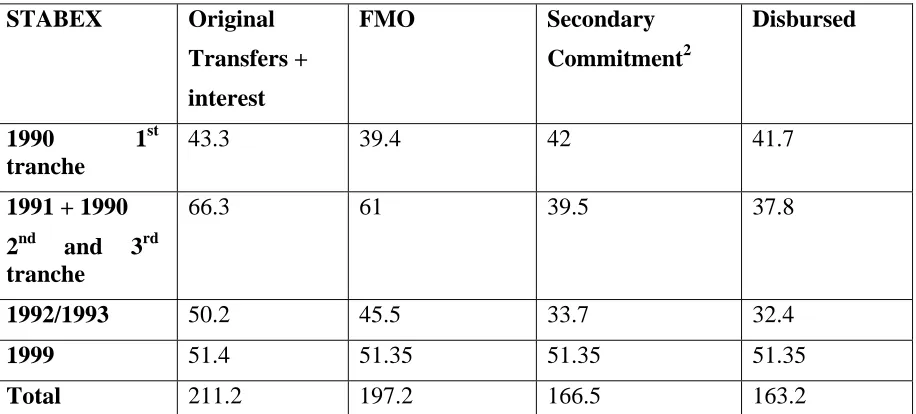
The audit of the €51 million STABEX advanced budget support completed in December 2004 generated a matrix of corrective measures that should now be incorporated into the Government’s own reform programme.
b)
Progress in activities
The approval of the PRBSII programme provides a strong focus for EU dialogue around macro reform issues. The Delegation continuously monitors progress in achieving these conditions closely with a view to being able to provide a firm commitment on disbursement around the time of the CG. This will, however, depend on progress.
The EC provided substantial capacity building support through support to an IMF official seconded through a multi-donor programme to the Ministry of Finance. In addition, the EC supported the October workshop on developing the public financial management reform programme in addition to consultancy support and staff comments on the draft Budget Outlook Paper. Support to consultancy on the BOP was offered in February and June to the Ministry of Planning and National development but only taken up in November by the Ministry of Finance following the rationalisation of budget functions within Government.
budget. These will then be adopted for the PRBSII variable tranches foreseen for 2006 and 2007. Linked to this, the Government made substantial progress in establishing a framework for undertaking the Kenya Integrated Household Budget Survey in 2005. The EC has formally indicated that it would be ready to provide some €1 million to support the KIHBS through a basket funding arrangement under the Management Support, Monitoring and Evaluation Project under the STABEX 1992/93 FMO
In the area of Public Financial Management, the Delegation is participating in the ongoing Country Integrated Fiduciary assessment that will be presented to the CG in April. The EC is financing a key component of this assessment – the Independent Procurement Review. In order to make further progress in this area, the donors have formed a group under the leadership of the EC to coordinate support in this area. A government focal point from Ministry of Finance in this context was appointed in February 2005.
The audit of the €51 million STABEX advanced budget support raised a number of issues regarding public financial management. This is not surprising, however, given that the programme was conceived and finalised in a very short space through intensive dialogue between the Ministry of Finance and the EC Delegation which did not allow the development of a full understanding and ownership of the programme across all of the targeted sectors. To some extent, this may explain the clear reluctance of the Ministry of Roads to cooperate with the audit process. Second, while the programme targeted the revised budget that was adopted by the in-coming Government in 2003, the weaknesses in budget execution that had emerged over the previous Government’s tenure clearly persisted throughout the targeted fiscal year 2002/2003. The audit concludes, however, that targeted RMLF expenditures (Ksh 1,483,243,083) and expenditures on the Kissi-Cemosit Road (Ksh 123,783,738) are ineligible. It is essential that this issue is addressed concretely before the EDF9 €125 million budget support programme can be implemented. Against this background, the Delegation and the NAO have engaged in discussions on the following:
• The Matrix of Corrective Measures should be mainstreamed within the Government’s overall Public Financial Management reform programme.
• The Audit report should be presented by the Government to the Budget Support Technical Working Group at its next meeting.
• A Protocol of Regularisation between the GoK and the EC should be concluded which provides a schedule of payments of the amounts declared ineligible, that is compatible with the GoK macro-fiscal framework, into a joint account with the money used for programmes in support of areas identified in the Matrix of Corrective Measures or in line with the original FMO.
Support under the Protocol of Regularisation is being considered for the modernisation of the Teachers’ Service Commission payroll database, capacity building to the Kenya Roads Board, basket funding support to the Public Financial Management Reform Strategy, and support to basic rural services and infrastructure through an extension of the Community Development Programme.
c) Integration of cross cutting themes
4.1.2 Rural Development and Agriculture
a) Results
The fragmentation of the central government agriculture-related functions across a number of different ministries continues to negatively affect the implementation of a coherent strategy for the agricultural sector. The organisation of marketing of export crops, especially the coffee sector, has suffered from lack of a clear leadership at ministerial level. This situation undermines the industry’s efforts to recover from a decade of low international prices and to develop a new sectoral strategy.
Nevertheless, the launch of the Strategy for Revitalising Agriculture (SRA) in March 2004, and the process engaged by the three ministries in charge of agricultural issues (Agriculture, Livestock and Fisheries Development and Cooperatives and Marketing) with the donor community is an important step towards a more coordinated action.
The establishment of an inter-ministerial Agricultural Sector Coordination Unit (ASCU) to concentrate efforts on implementing the SRA, with the support of a multi-donor funding, is in progress and should start early 2005.Among priority actions, the ASCU work plan includes: policy and legal framework review, review of state organisations, mainstream of SRA in the national budget etc…
Annual State of the Environment Report for 2003 has been prepared by NEMA (National Environment Management Authority) and submitted to the Ministry of Environment and Natural Resources. The report is still to be submitted to Cabinet and be debated in Parliament. Work has commenced on the Annual report for 2004, which is expected to concentrate on land degradation issues.
The Kenya Forestry Bill was rejected by Parliament and cannot be re-presented for another 6 months. The rejection had more to do with political considerations rather than the actual content of the Bill, which will acknowledge the involvement of communities in forest management and address the proposed establishment of an alternative service to the present Forest Department. A number of donors are interested in providing substantial long term support, particularly the Finnish Government.
NEMA, with EC support, updated and completed its 5 year Strategic Plan. This has still to be officially launched in the public domain. EC support to NEMA is proposed in the new Community Development for Environmental Management Programme (CDEMP). The launch of regulations on Environmental Audit and Environmental Impact Assessment has been completed and accredited experts are being registered, with a number of organisations complying with Environmental Audit requirements.
The EU/UNDP/DFID Poverty Environmental Initiatives Programme is ongoing under UNDP management.
The award of the Nobel Peace Prize to Kenyan Environmentalist and Assistant Minister of Environment Wangari Maathai was greeted with great acclaim in the country and has helped to raise the profile of environmental issues. The amendment to the Wildlife Act was debated and approved by Parliament in December 2004 but was subsequently rejected by the President of particular concern was the lifting of the ban on commercial hunting
b) Progress in activities
The completion of a livestock marketing study and a coffee value-chain study has provided clear guidance to both government and development partners with options for potential development actions to be undertaken. Nevertheless, the uncertain policy background (dominant role of non-productive parastatals, marginalisation of private sector) has prevented progress being made in agreeing interventions. Against this background, the SCIPII project (Ksh 1.65 billion), which provides credit to coffee farmers through a revolving fund managed by the Cooperative Bank, has been put in severe jeopardy by the structural problems faced by the coffee sector and the non-payment of loans by farmers. This reflects the problems in the coffee payments chain that emerged following the chaotic implementation of the Coffee Act 2001. This is detailed in the Coffee Study. In early 2004 the NAO requested a further audit of SCIPII with a view to assessing the possibility of providing a comprehensive write-off of outstanding loans under the programme. The EC agreed and suggested that terms of reference are drawn up under the SSPII programme. The Government has since requested that the EC funds be capitalised as part of Coop Banks’ core capital. The Delegation is considering this request in the context of possible complementary support to the World Bank Financial Sector Restructuring Credit and, in particular, the commitment by the Government to develop a credible and sustainable strategy for Development Finance Institutions.
In addition to the two sub-sector studies completed in 2003, a cotton study was finalised in November 2004 and provides orientations for further cooperation with the government in this matter.
However, possible financial support from the European Commission to specific sectoral interventions will be limited, if any, due to lack of resources available under the current Programme (EDF and STABEX). The Agricultural Research Project, conducted with KARI in the area of arid and semi-arid lands, has reached a successful conclusion. The final evaluation concluded that the main objective of the project has been satisfactory achieved (to enhance the economic integration of arid and semi-arid lands communities). The preparation of a follow-up phase is at an advanced stage. A feasibility study was completed in December 2004 and the Draft FP is ready for presentation to the Delegation IQSP. Meanwhile the NAO and the delegation have approved the funding of a bridging phase from the balances of STABEX funds. As the lead institution in Agricultural Research, KARI is expected to play a major role in the restructuring of agricultural research institutions. Research consolidation is mainly supported by KAPP (Kenya Agricultural Productivity Programme/WB).
During 2004 the Community Development Programme-Phase II was restructured to reflect AIDCO comments that the tranches foreseen under the Financing Agreement should be classified as advances rather than payments. Following this, a commitment of €3.5 million was made based on the 4th Work Programme resulting in payments of just over €1.7 million during the year. In addition, during 2004 the remaining CDP-Phase I projects were closed and 197 new projects approved. The programme also began structured collaboration with two Local Authorities in community-driven projects as a precursor to the EDF9 Local Government project. The project was subject to the regular AIDCO monitoring exercise which found that relevance (a), efficiency (b) and effectiveness had all improved since the previous monitoring exercise in 2002. This reflects the substantial efforts made by the PMU, the Delegation, the Board of Trustees and the NAO to restructure the project in the face of the huge problems encountered in 2002 (political interference, backlog of CDP1 projects, lack of transparency in the project selection process, inadequate planning of the project cycle etc.). The CDPII is due to end on 31st December 2006. This full period will be necessary to ensure the full disbursement of project investment funds. The resources to continue the PMU up to this period are not, however, available under the project. Against this background, a rider for the re-allocation of funds was recently sent to Brussels for approval.
addition, the financial modalities of the project were restructured along similar lines to CDPII during 2004. Thus, the commitment of just over €2 million was made based on the 3rd Work Programme and payments of just over €710,000 made. The project was subject to the regular AIDCO monitoring exercise which found that efficiency had increased significantly (from c to a) compared to the previous monitoring exercise in 2002. This reflects the exceptional qualities of the small PMU and more streamlined procedures applied to the appraisal/approval process. The programme is due to end in September 2005 but, in line with the recommendations of the monitoring report, a proposal is being considered to support the continuation of the programme until January 2006, to enable satisfactory completion of on-going projects.
The proposed Community Development for Environmental Management programme (CDEMP) for €13 million, comprising of two main elements, support to NEMA and the establishment of a Community Environment Facility (along the same lines as the BCP) was prepared in 2004. The Financing Proposal is likely to be approved by the NAO and the EC Delegation in early 2005 for considerations to be considered by the EDF Committee in May 2005.
As a pre-condition of support to NEMA under this programme, NEMA undertook the production of a comprehensive 5 year Strategic Plan to prioritise its functions, to guide future support and monitor progress. This was supported by EC technical assistance.
The Rural Poverty Reduction and Local Government Support Programme was signed in September 2004 by the Minister of Finance with the Minister of Local Government in attendance. The Inception Period was launched immediately thereafter with a dedicated TA recruited to support the Government in elaborating a call for proposals to all 175 LAs and tender documents for the TA to the PMU and the Kenya Local Government Reform Programme. The Minister of Local Government chaired a first donor group meeting with a view to establishing a sector wide support strategy. The EC chairs this group on the donor side.
4.1.3 Roads and transport
a) Results
The poor state of the road infrastructure in Kenya has been identified under the PRSP consultations as a primary constraint to development in Kenya, and in particular agriculture and rural development.
The Kenya Roads Board (KRB) is charged with oversight responsibility over of the road network and coordinates its development, rehabilitation and maintenance. KRB is an executive body with majority private sector representation which was created in July 2000.
KRB has for four successive financial years, since July 2001, made fund transfers to the three road agencies nominated in the KRB Act (Roads Department, District Road Committees and Kenya Wildlife Service) from the Roads Maintenance Levy Fund, incorporated into the Kenya Roads Board Fund.
Unfortunately, these funds have had little or no impact, and roads have continued to deteriorate. It is hoped with the anticipated appointment of a new Executive Director of KRB early in 2005 KRB will address the key areas of its mandate, which are aimed at ensuring proper planning, accountability and sound management in respect of maintenance and rehabilitation of the road network, namely:-
• Reviewing and approving the Annual Road Maintenance Programme Budgets by Road Agencies prior to disbursing funds.
• Monitoring activities undertaken by road agencies and delivery of works by means of technical, financial and performance audits
• Ensuring that activities carried out are in accordance with KRB guidelines and criteria
• Causing timely implementation of annual statutory financial audits of RMLF expenditure in accordance with RMLF Act.
to develop a Roads Policy and Strategy. The study report which was completed in March 2004 recommended several policy actions including the creation of autonomous Road Agencies of the KRB as the next step of the institutional reform and implementation of a 15 year investment programme to year 2020. The Ministry of Roads & Public Works has given an undertaking to review the study report and draw up a Roads Sector Strategic Plan to be approved by Government by October 2005.
Under the Northern Corridor Rehabilitation Project (NCRP) I and II, funds amounting to € 4.25 Million have been set aside for capacity building related to institutional reforms of the Roads Sector. A consultant is in the process of reviewing Government proposals for capacity building and training with a view to formulating an appropriate support package.
An Identification study was completed in 2004 for the 9th EDF Road Projects. These are:-
i. Support to institutional reforms (allocation € 2 million) involving technical assistance and capacity building to KRB financial management, harmonisation of existing policy initiatives and assisting Ministry to draw up Road Strategic Plan, legal review and change management support to proposed road agencies of the KRB
ii. Reduction of the maintenance backlog of the Northern Corridor by periodic maintenance on 220 km of the Northern Corridor to cost € 42 million to be financed by EC (€ 35 million) and Government (€ 7 million). The next stage is to commission an economic study and detailed design.
iii. Rehabilitation and improvement of 223 km of rural roads in tea and coffee growing areas of Central Kenya at a cost of € 34 million. The proposed project involves a co-financing arrangement between EC (€20 million), KfW (€10.6 million) and Government of Kenya (€3.4 million). The KfW is expected to commission an economic study and detailed design from March 2005.
Two important conferences took place during the year. A Road Sector Conference for stakeholders was held between 19th – 20th July 2004 and opened by His Excellency President Kibaki. A high level Road Sector GOK-Donor Conference also took place from 29th to 30th October 2004 and was officially opened by the Hon. Minister for Roads & Public Works. The reports of both conferences have not been released. More work needs to be done to harmonise activities of various donors involved in the sector and to develop a common and rationalised approach on development funding, to avoid acting at cross-purposes.
b)
Progressin activities
Northern Corridor Rehabilitation Project NCRP I (€ 79.5 m from 7 & 8th EDF)
Works on this € 60 million Sultan Hamud – Mtito Andei Road rehabilitation contract (131 km) commenced April 2003 and are scheduled for completion September 2005.
The first section of 27km was completed and opened to traffic on 1st May 2004 at a ceremony to mark EU Enlargement celebrations. By the end of 2004 a total of 69km (53% of total road length) was completed. Physical progress is 3 month behind schedule mainly caused by to administrative obstacles which continued to persist during 2004. Delays continued to be experienced on contractual payments, and routine contract administration decisions, as well as granting of tax/duty exemptions for imported construction equipment and materials. A contract addendum to facilitate reimbursement of taxes and duties already paid has still not been finalised.
Northern Corridor Rehabilitation Project NCRP II (€55m under 8th EDF)
The KES 4.6 billion works contract was signed contract between Government and the contractor Ministry of Roads & Public Works and (Sogea-Satom) at a public ceremony on 17th December 2004. The EC will finance € 46 million or 93% of the contract. Construction work is expected to commence in March 2005.
EC/STABEX Roads 2000 Programme (KES 700m)
The concept of small-scale labour-based contracting has been adopted under the “Roads 2000” maintenance programme, which has been focussing on maintenance and improvement of rural roads with decentralised planning and management to district levels, with the involvement of local communities. The EC STABEX funded Roads 2000 project in Eastern Province commenced in 1997. The original programme duration of 36 months was extended a number of times eventually to 31st December 2004, by which time only 44% of the budget was disbursed.
.During the year 2004, a total of 5 labour-based road improvement/gravelling contracts were in progress under the administration of Ministry engineers in the Districts who were assisted by a supervision management consultant. Only two of the contracts were eventually completed by the end of 2004.
The low physical accomplishment of the project has been a source of concern to both GOK and the EC Delegation. A consultant (Gibb) was commissioned in 2004 to carry out a review of the programme, identify the shortcomings and recommend on an optimal implementation framework for a possible second phase of the project to utilise unspent balances.
c) Cross cutting themes
Implementation of accompanying measures in respect of environment protection are included along with the road works for NCRP I & II.
The EC Delegation has however been unsuccessful in its efforts to reach agreement with Government on a AIDS/HIV awareness and treatment pilot project on Sultan Hamud- Mtito Andei road.
Similarly, a proposal to commission rural community water supply schemes along Sultan Hamud – Mtito Andei road utilising water boreholes drilled for construction, has not taken off.
4.1.4 Projects and programmes outside focal sectors
Ongoing activities funded from the 8th EDF (and STABEX) relate to support for democratic governance, institutional capacity development of the NAO’s office, to the decentralisation of health services, the tourism sector, to the preservation of cultural heritage and for institutional capacity related to the EPA-trade negotiations. Under the 9th EDF support in the non-focal sectors, support is foreseen for Non State Actors and for the Private sector. While diverse in nature, these programmes play a major role in supporting ongoing important reforms and processes in Kenya.
4.1.4.1 Governance and Legal Reform
a) Results
With the new government coming to power in 2003, the EC Democratic Governance Support programme (DGSP, funded under the 8th EDF) was finally activated, and a PIU selected. In 2004 the design of almost all sub-projects was finalised, and several individual commitments were made.
b) Progress in activities
The activity supporting the Constitutional review process (supporting drafters working for the Constitution of Kenya Review Commission) was finalised. Above all, most of the remaining DGSP activities were committed in the course of 2004: signature of the service contract for the audit of DGSP, signature of 23 grant contracts with NGOs selected after a call for proposals, signature of direct grant contracts with the Law Reform Commission (under Support to judiciary) and the Electoral Commission of Kenya. Also the Kenya National Assembly as well as the Kenya National Commission for Human Rights finalised their project proposals. Contracts should be signed as soon as possible, now that the DGSP Extension has been granted.
On 23rd December, the FA of the DGSP was extended and will now run until December 2006, which will allow for the implementation of all project activities and entering into new commitments.
c) Integration of cross-cutting issues
The EC DGSP has integrated cross-cutting issues such as Human Rights and Gender. Human Rights are also targeted through the EC’s planned support to the Kenya National Commission for Human Rights.
4.1.4.2 Institutional capacity building
a) Results
While the momentum for reforms and related programmes has been clearly gathering pace, pervasive institutional capacity weaknesses across ministries to implement and monitor programmes are acknowledged as a critical issue for improvement. In response to a recent request by the NAO, a comprehensive review study of institutional structures, functions and capacity at the NAO (and other ministries) was contracted at the beginning of 2004 and carried out in the spring. The final report was not completely accepted by the NAO, who considered that there was too much blunt criticism in it NAO did not fully accept the report. By adopting a systemic approach, this study fed in the preparation of the upcoming projects (see below).
b) Progress in activities
Concerning the strengthening of institutional capacity, EC support to Kenya includes related components in all sector-related programmes (mainstreaming). In addition, some horizontal Institutional Capacity support programmes have been implemented in 2004, and the new generation of assistance (to start in 2005) has been designed.
- The first programme is the SSP II (Services Support programme, (funded under 8th EDF), which mainly aims at 1) providing technical assistance for studies, design work, monitoring and evaluation of project and 2) a training facility. The technical assistance facility has been very much used in 2004, in various sectors of EC support to Kenya. The 2nd part of the programme (Provision of capacity building and training facility – €400,000) was launched (tender) at the end of 2004.
- In addition, the NAO itself has continued to benefit in 2004 from the NAO Support Package, funded by STABEX, which provides financial facilities (€130,000) for capacity building, equipment, seminars, etc. (this project will run until September 2005).
4.1.4.3 Private sector development
4.1.4.4 Results
In 2004, the Cabinet adopted a paper on Micro and Small Enterprise Policy. However it still has not been adopted by the Parliament. In addition the Government (represented by the Ministry of Trade and Industry) undertook to put together a Private Sector development Action Plan. It is expected that this action plan be finalised by the end of March 2005. In addition, the private sector and Government have started to meet regularly and KEPSA, the Kenya Private Sector Alliance for the first time feels that the Government has an open ear to their concerns, needs and expectations. In parallel, many development partners in the course of 2004 have approved new projects.
a) Progress in activities
Under the 9th EDF/NIP further support to the Micro-enterprise sector is envisaged (€6.5 m). A consultant was hired in 2004 to carry out a feasibility study, and propose a Financing Proposal(FP), which was delivered to the NAO in the summer. However it was not possible to submit an Identification Fiche and FP. Both the NAO and the EC were not satisfied with the Consultant’s work on the FP, notably on proposed activities. There is a need for the ECD to fundamentally review the proposal and propose appropriate activities. In addition, the changing context (new policies, forthcoming Government action plan and new major donors support) will also have to be taken into account in the identification and formulation process.
b) Integration of cross-cutting issues
Micro enterprise support will continue to incorporate, as in the past MESP programme, gender and environmental issues into project design (for instance women entrepreneurship) and will continue to promote micro-enterprise development through sustainable environmental usage. At the same time, HIV/AIDS will be targeted.
4.1.4.5 Tourism
a) Results
EC support to the Tourism Sector has been taking the form of support for direct marketing of Kenya as a tourist destination, for product diversification (including eco-tourism/community-based tourism), the formulation of a national tourism policy and an improved regulatory framework and the design of a Tourism Information and Statistics System.
EC support for re-positioning Kenya’s Tourism Marketing, under the “Tourism Institutional Strengthening and Market Promotion Programme” (TISMPP), essentially focussed on strengthening the Kenya Tourism Board (KTB) in its marketing efforts and in adapting the Kenyan tourism product to market demands. Project management shortcomings within KTB, exemplified by the lengthy absence of Managing Director and Marketing Manager, have been finally resolved in 2004. Additionally, a new Chairman coming from the private sector was appointed in November 2004, which is considered by the whole industry as a major step forward.
b) Progress in activities
Termination of Tenure as Trustees. This decision was taken unilaterally. This decision was revoked on 31 August after a joint EC – NAO meeting, when those members were reinstated to the BoT. A Strategic Review and Planning workshop took place at the end of September and the whole programme was reviewed by the full BoT and the Management Unit. Action Plan and milestones have been clearly defined. It was agreed that the Chairmanship of TTF was passed over to the private sector and the long-term TA contract extended until the end of the project. In December, with full engagement and support of the EC Delegation and the NAO, a new CEO of TTF has been recruited.
In response to the terrorist attacks in Mombasa in November 2002 and the subsequent negative travel advisories, the EC positively responded to an urgent request of the Government by setting up a jointly funded Emergency Tourism Market Recovery Programme in 2003. The marketing campaign of Kenya in the EU market came to an end in March 2004 and was extremely successful. Recent reports prepared by KTB show a major increase in tourism earnings, i.e. from € 220 million in 2003 to € 400 million in 2004. Finally, the Delegation undertook an appraisal of unexpected revenue losses and unforeseen budgetary expenditures arising from the security concerns in Kenyain 2003 (see section 4.3.1).
4.1.4.6 Trade
a) Results
Consultations between the Delegation and the Ministry of Trade and Industry have intensified, in particular in the wake of the preparations of the EPA negotiations and the Doha Development Round at the multilateral level. In the context of the EPA negotiations, Kenya participated in three regional meetings in 2004 (Mauritius, Kampala and Madagascar). A first area (fishery sector) for negotiations was agreed by the ESA members. On the international scene, Kenya hosted a mini-ministerial WTO meeting in February 2004 to push forward the DDA Round after the failure of Cancun.
The EC is providing support for Kenya’s trade negotiations through the Trade Negotiation Support Programme (KEPLOTRADE), with the specific objective of providing support for the smooth functioning of Kenya’s negotiation machinery, supporting a transparent mechanism of consultations with stakeholders and a back-up mechanism providing for demand-driven studies over the whole period of negotiations, and by providing training and capacity strengthening as required.
The EC Delegation assisted Kenya in hosting a pan-African seminar on Geographical Indications (GIs). African senior officials from the public and private sector attended the seminar and exchanged views on GIs. GIs, because of their potential in developing high value-added products, are viewed by the EC as useful tools for economic development in rural communities.
The EC also intensified consultations with the Government, private sector and the media on the Horticultural export industry. Over the past months, a number of Kenyan press articles have highlighted concerns over how Kenyan exports of horticultural products might be affected by food safety requirements in the European Union. Regretably, many of these articles contained misleading information, which have caused some confusion among the EU’s highly valued trading partners in Kenya. As a result, both EU Trade Commissioners, Pascal Lamy and Peter Mandelson, wrote to the Kenyan Ministry of Trade and Industry to clarify the scope of the EU food safety directives. Contacts have been established with KEPHIS (Kenya Plant Health Inspectorate Service) to identify possible ways of assistance.
b) Progress in activities
4.1.4.7 Health
a) Results
The main issue of the year has been the possible introduction of a National Social Health Insurance Scheme. It has been a hot topic in the Kenyan political debate as well as an issue for discussion between the various donors, at a technical as well as at a political level. The views of organisations differ greatly, which has been quite detrimental to the donor dialogue on other important health issues. By the end of the year, the Ministry of Health had presented the bill to the Parliament and it had been passed on to the President, who sent it back for further work on the financing on the scheme and on the upgrading of the Government health facilities which are in a dilapidated state. It is now in the Kenyan system and the donor group, at least at the technical level, have decided to try to move forward on the other items on the agenda.
Another key issue has been harmonisation of donor procedures and getting the Ministry of Health to take the lead in the new ordination framework. In this area, progress was made during the year. A new co-ordination framework was developed during June-July and was adopted by the Ministry of Health. Although it took some time to establish the relevant committees, it was an important step towards improved co-ordination. The donor group also took an initiative to meet and discuss ways of harmonising procedures, as many measures need to be taken by the donors themselves.
The third major topic has been the Global Fund for HIV/AIDS,TB and Malaria (GFATM). The debate around the Global Fund has hijacked a lot of the space in the health sector and there is still a need to greatly improve the management of these funds.
b) Progress in activities
Under the Financing Agreement No. 6339/KE the European Commission is providing 15 million Euro to project No. 8 ACP KE 030 in support of the health sector through the District Health Services and Systems Development Programme (DHSSDP). This Financing Agreement was signed already in 2002, but due to various reasons it took until 2004 for the programme implementation to start. In March 2004, a consultancy firm took up the task to establish a Project Management Unit and a Work Programme and Cost Estimate for the 2004 Inception Phase, was signed in July 2004.
During the Inception Phase, each district, 20 of them in the Eastern and Central Provinces of Kenya, made an assessment of the health problems and needs, and a profile was created for each district, which then formed the basis for the action plans (and the WPCE) for 2005. Through the process, it became clear that the capacity varies greatly between districts, and that the health needs are higher in the Eastern than in the Central Province. This has been taken into account in the resource allocation criteria, with the aim of favouring specifically disadvantaged districts that have a relatively higher burden of disease.
In addition, a proposal has been received from Kenya Medical Supplies Agency to utilize the interest accrued on the closed Kenya Family Programme (6 ACP KE 59 and 7 ACP KE 79). The proposal is under consideration.
4.1.4.8 Education
a) Results