This is a repository copy of Will done Better: Selection Semantics, Future Credence, and Indeterminacy.
White Rose Research Online URL for this paper: http://eprints.whiterose.ac.uk/101393/
Version: Accepted Version
Article:
Cariani, F and Santorio, P (2018) Will done Better: Selection Semantics, Future Credence, and Indeterminacy. Mind, 127 (505). pp. 129-165. ISSN 0026-4423
https://doi.org/10.1093/mind/fzw004
© 2017, Cariani and Santorio.. This is a pre-copyedited, author-produced PDF of an article accepted for publication in Mind following peer review. The version of record: Fabrizio Cariani, Paolo Santorio; Will done Better: Selection Semantics, Future Credence, and Indeterminacy, Mind, Volume 127, Issue 505, 1 January 2018, Pages 129–165,
https://doi.org/10.1093/mind/fzw004 is available online at: https://doi.org/10.1093/mind/fzw004
Reuse
Items deposited in White Rose Research Online are protected by copyright, with all rights reserved unless indicated otherwise. They may be downloaded and/or printed for private study, or other acts as permitted by national copyright laws. The publisher or other rights holders may allow further reproduction and re-use of the full text version. This is indicated by the licence information on the White Rose Research Online record for the item.
Takedown
If you consider content in White Rose Research Online to be in breach of UK law, please notify us by
indeterminacy.
Fabrizio Cariani Northwestern University
Paolo Santorio University of Leeds
Abstract Statements about the future are central in everyday conversation and reasoning. How should we understand their meaning? The received view among philosophers treatswillas a tense: in “Cynthia will pass her exam”,willshifts the reference time forward. Linguists, however, have produced substantial evidence for the view thatwillis a modal, on a par withmustandwould. The different accounts are designed to satisfy different theoretical constraints, apparently pulling in opposite directions. We show that these constraints are jointly satisfied by a novel modal account ofwill. On this account,willis a modal but doesn’t work as a quantifier over worlds. Rather, the meaning ofwillinvolves a selection function similar to the one used by Stalnaker in his semantics for conditionals. The resulting theory yields a plausible semantics and logic forwilland vindicates our intuitive views about the attitudes that rational agents should have towards future-directed contents.
[Draft of November 2, 2015]
1 Introduction
Our topic is the semantics for statements about the future in English. In particular, we focus on sentences involving the English auxiliary will, such as:
(1) Cynthia will pass her exam.
Sentences like(1)are uniquely interesting. An account of their meaning faces challenges from a number of philosophical domains: semantics, epistemology, and metaphysics.
Thesemantic challengeis generated by a tension in the linguistic behavior ofwill. On the one hand,willhas the characteristic marks of a modal operator. On the other, willfails to display the standard scope interactions of modals. For example, unlike must or might, will commutes freely with negation. That is, “It will be the case that it doesn’t rain” and “It is not the case that it will rain”
have the same truth conditions, despite the difference in relative scope between willand negation.
Theepistemological challengecomes from the role ofwill-statements in every-day thinking and deliberation. We are often uncertain about the propositions expressed bywill-claims, and at least sometimes this uncertainty seems rational. An adequate account ofwillshould assignwill-sentences contents towards which we do, and rationally may, have attitudes of this sort.
Themetaphysical challengecomes from considerations about the open future. Past facts are settled, while at least some of the facts about the future seem not to be. Both the claim that the future is open and the nature of the relationship between metaphysics and semantics of the future are disputed. But the following seems uncontroversial: whatever the truth about the metaphysics, our semantic theory should avoid ascribing widespread error to ordinary speakers.
The existing literature is split between two general approaches, roughly overlapping with the divide between philosophers and linguists. Philosophers invariably treat will as a tense, i.e. an operator whose semantic function is to shift the time of evaluation of a clause. This view, often combined with a supervaluational account of the truth value of will-claims, is well-positioned to accommodate the epistemological challenge and can be developed so as to meet the metaphysical challenge. But it is problematic from a linguistic point of view. Most linguists (though not all of them) treatwillas a modal—i.e., as an expression that manipulates a world parameter. Though typical modal accounts ofwillare well-positioned to accommodate the linguistic challenge, they flounder in the face of the epistemological challenge.
We propose a new theory of willthat draws together elements from these two views and improves on all existing accounts. Here is a sketch. Following the dominant view in semantics, we hold thatwill is a modal. Butwill differs from standard modals like must or may, which work as quantifiers. The best analogy forwillis the selection function meaning that Robert Stalnaker uses in his semantics of conditionals. That is,willselects a unique world among the ones that are included within a domain of quantification: roughly, this is ‘the world instantiating the one actual complete course of history’, among the ones that are compatible with history up to now. The approximate truth conditions of(1)are:
(2) In the actual complete course of history, Cynthia passes her exam.
room for this combination of views by distinguishing two levels of theorizing: on the one hand, the compositional semantic analysis ofwill; on the other, the proper treatment of the indeterminacy that (on some metaphysical views) affects will-statements. These levels are often conflated. We think it’s crucial that they be kept distinct. This yields a view that combines several desirable features. (i) It yields a plausible semantics and logic for will; (ii) it generates contents for will-statements towards which we can be rationally uncertain, and (iii) it makes room for (though doesn’t require) the metaphysical claim that the future is open.
Here is a an overview of the paper. In §2, we outline some plausible constraints for a semantics for will. In §3, we give an informal overview of the account, which is stated in full in §5(§4spells out our metaphysical assumptions). In §6
we explain how to define a notion of truth that makes room for indeterminacy. Finally, we check that our account yields the desired logical and epistemological predictions (§7-8).
One last preliminary point: some uses of will have a so-called ‘volitional’ reading: i.e., they work as injunctions to the hearer to bring about the prejacent. For example, on its volitional reading(1)is an injunction to the hearer to see to it that Cynthia passes her exam. In this paper, we refrain from making claims about these uses, and about their connection to the more ordinary future-directed uses.
2 Semantics for the future: three constraints
Any plausible account of will, we believe, ought to respect three constraints.
2.1 The modal character ofwill
Our first constraint is that will has a modal meaning. By this we mean that willmanipulates a possible world parameter,1 similarly to modal auxiliaries like mustormight. For example, here is a toy modal meaning forwill:
ðwill Añ is true at w and t iff for all worlds w′ that are open possibilities at wand t,Ais true at w′ and at some t′≥t
(For now, just take ‘open possibilities’ to be possibilites that, for all that is settled at the time of utterance, might instantiate the future course of events.) The modal view contrasts with a temporal view, on which willmanipulates exclusively a time parameter and no world parameter. Again, for illustration, here is a toy temporal view:
ðwillAñis true atwandt iff for some t′≥t,Ais true att′ andw
To be clear: we understand the modal view as compatible with the claim that, in addition to the world parameter, willmanipulates a time parameter. What distinguishes modal from nonmodal analyses is whetherwillmanipulates a world parameter at all.
The linguistics literature has provided three pieces of evidence for the modal view. Taken together, they seem to us compelling.
The first piece of evidence is morphological. On one widely accepted account (Abusch 1997,1998,Condoravdi 2002,Kaufmann 2005),willshares morphology with the modalwould. In particular,will andwouldhave in common a modal morpheme, often represented as ‘WOLL’:willisPRESENT+ WOLL;wouldisPAST +WOLL. The assumption of common morphology allows us to explain otherwise puzzling semantic facts. For example, it explains why we can replacewillwith would in indirect reports of past utterances of will-sentences. If, on Tuesday, Harriet says “I will come to work tomorrow”, then on Wednesday we would report Harriet’s utterance by saying “Harriet said she would come to work today”.
The second piece of evidence for the modal view of is thatwill (on a par with other expressions that normally induce future reference, likegoing to) may have epistemic readings (Palmer 1987,Enç 1996).These readings generally require a stative predicate (likebe) in the prejacent.2 Here is an example:
(3) John will be in London by now.
Notice two facts about(3). First, as is made clear by the modifierby now, the prejacent of (3) has its reference time in the present. Hence, at the time of utterance, it is settled whether John is in London. Second, in(3),will works as a marker of evidentiality: roughly, it signals that the speaker is inferring John’s location on the basis of a body of evidence. To see this, notice that(3)is infelicitous if uttered by someone who is looking directly at John, even if both are indeed in London. Both these facts are hard to explain on a purely temporal view. By contrast, views according to which our language of uncertainty and prediction are both modal in nature seem ideally placed to account for them.3
2 Following common (and medieval) usage, we use the termprejacentto denote the clause that
willtakes scope over.
3 An anonymous reviewer challenges our claim thatgoing tohas the relevant present-directed readings. We agree that it is sometimes more natural to usewillin these constructions. However, our informants uniformly agree that both of the following sentences can sound good in the appropriate contexts.
Third, as Peter Klecha (2013) has recently argued, will allows for modal subordination. Roughly, modal subordination is the phenomenon whereby, in discourses containing several modals, earlier modals may restrict the domain of later modals (Roberts 1989). As an example, consider the following discourse:
(4) Jane might come to the party. Sally would come too.
The occurrence of would in the second sentence is naturally understood as restricted to worlds where Jane does come to the party. A natural explanation for this is that its domain of quantification is somehow anaphoric to the worlds that witness the might-claim in (4). Klecha points out that, similarly to what happens with would and other modals, will-sentences can inherit restrictions from previous modal elements of the discourse.
(5) If the supplies arrive tomorrow, it will be late in the day. They will contain three boxes of cereal.
(6) The supplies might arrive tomorrow. It will be late in the day.
This makes these sentences pattern together with modals likemight andmust, and differently from tenses, like the past tense:
(7) a. If the supplies arrive tomorrow, it might (/must) be late in the day. They might (/must) contain three boxes of cereal.
b. #If the supplies arrived yesterday, it was late in the day. They contained three boxes of cereals.
(8) a. The supplies might have arrived yesterday. It would have been late in the day.
b. #The supplies might have arrived yesterday. It was late in the day.
These facts hold in languages other than English.4 This speaks against a view that tries to accommodate the modal character ofwillby claiming that English
(ii) The swordfish is not going to be ready yet.
Given that present-directedgoing tocan have a similar meaning aswill, and given that the next argument for a modal view does apply togoing to, we think that there about as much reason for a modal analysis ofgoing to.
4 An anonymous reviewer suggests that Klecha’s modal subordination argument might fail for Romance languages. According to them, in those languages, modal subordination only obtains if
willis ambiguous between a modal and a nonmodal meaning (more on this in section2.4).
The evidence in favor of a modal view seems quite strong to us. At the same time, not everyone finds it convincing.5 To motivate our project, we don’t have to take the evidence to be conclusive. All we need is that it be strong enough to make the modal view a serious contender.
2.2 Scopelessness
Our second constraint is thatwillis scopeless with respect to an important class of other linguistic items. By this we mean that changes in the relative syntactic scope betweenwilland these other items don’t make a difference to the truth-conditions ofwill-sentences. This is a remarkable feature ofwill, and one that is not generally shared by modal expressions.6
For present purposes, it is enough to observe scopelessness with respect to negative items, as illustraded by:7
(9) a. It will not rain.
b. It is not the case that it will rain.
(9-a) and (9-b) are truth-conditionally equivalent. The situation is similar with different prejacents, and when clauses like (9-a) and (9-b) appear embedded in other environments. In short,willappears to commute freely with ordinary English negation. This observation is strengthened by considering items that lexicalize negation, such asdoubt(which, following common assumptions, we understand asbelieve that not) andfail: (10-a-b) are truth-conditionally equiva-lent.
(10) a. I doubt that Sam will pass his logic exam. b. I believe that Sam will fail his logic exam.
variants with the conditional mood). Moreover, and crucially, nearly all of them strongly prefer the future indicative variants over the past tense variants, i.e. the translations of(7-b)-(8-b). 5 Modal analyses are majoritarian among linguists, but not universally accepted. Arguments
against them are found inComrie(1989) andKissine(2008). In addition,Von Stechow(1995) extensively develops a non-modal view. We believe that many anti-modal arguments can be resisted: a good starting point is Portner’s (2009: pp. 239-240) critique of Kissine’s arguments. 6 The point is widely acknowledged in the literature, since at leastThomason 1970: p.267. See also the discussion of excluded middle forwill-sentences inCopley 2009and of the interactions between future operators and negation inMacFarlane 2014: p. 216.
7 Perhaps the scopelessness of willextends further. We think it is likely thatwillis scopeless with respect to comparative expressions (see the discussion of comparatives and conditionals in
For a comparison with an auxiliary that is not scopeless, consider minimal variants of (10-a-b) which involve a deontic modal. Suppose we’re talking about the obligations that Sam must fulfill in order to stay enrolled in his degree. It is clear that (11-a) isnottruth-conditionally equivalent to (11-b).
(11) a. I doubt that[in order to graduate]Sam must pass his logic exam. b. I believe that[in order to graduate]Sam must fail his logic exam.
The lack of scope interactions with negation immediately yields an interesting logical constraint:
Will Excluded Middle(preliminary take): ðwillA ∨ will notAñ is a logical truth
For now, we informally gloss ‘logically true’ as ‘true whenever uttered’. In §7, we derive the validity of this schema, given our semantics and two standard formal concepts of consequence.
2.3 The cognitive role of future statements
Future-directed statements play an important role in our cognitive economy. It is a platitude that ordinary agents are uncertain about the future. Assuming that credences attach to propositions, it seems natural to understand ‘being uncertain about the future’ as ‘having a non-extreme degrees of belief towards the propositions that are expressed bywill-claims’. Moreover, at least in some cases, these non-extreme degrees of belief seem also rational. A semantics forwillshould yield contents forwill-claims that are appropriate inputs to our theories of attitudes. For illustration, consider the following case:
Sports Fan: Suppose that Cynthia comes to work each day wearing a Warriors cap, a Giants cap or no cap, depending on a random draw (with each option having equal probability). You are certain that for each of the three caps, it is an open possibility that Cynthia wears that cap tomorrow. What degree of belief should you assign to the proposition that tomorrow she’ll wear a Warriors cap?
These claims seem to be truisms, yet they are surprisingly hard to vindicate on a family of existing semantics forwill, i.e. modal accounts. For illustration, consider the toy modal semantics mentioned in §2.1. This theory treatswillas a universal quantifier over the open possibilities at the point of utterance (this account captures what Prior (1967) calls the ‘Peircean future tense’). The problem for this semantics is that if Warriors-cap futures and Giants-cap futures are both possible, you should have zero credence in the propositions expressed by each of
(12)and(13).
(12) Cynthia will wear a Warriors cap tomorrow.
(13) Cynthia will wear a Giants cap tomorrow.
To see why the theory makes this prediction, recall that you are certain that all the headgear options are open possibilities at the time of utterance. It follows that you are certain that the truth-condition for each of(12)and(13)does not hold.8 In the next section, we show that virtually every theory that treatswill as a universal quantifier faces this problem.
2.4 Surveying the options
It is difficult to satisfy all three constraints. For one thing, the first two seem to be in direct tension with each other. Ifwillis a modal, as the first constraint requires, we expect it to have nontrivial scope interactions, in violation of the second constraint. And indeed, basic modal analyses ofwillpredict that switching the relative scope ofwilland negation does have truth conditional effects. For illustration: on Kaufmann’s (2005) account,will is a universal quantifier over (roughly) the worlds realizing the most likely courses of future history. On this theory, by switching aroundwillandnot, we get the two nonequivalent readings:
will>not: all most likely futures do not satisfy the prejacent.
8 In a similar spirit,Belnap et al.(2001: p. 160) object to the Peircean that there is a difference between a bet that it will rain tomorrow and a bet that’s inevitable that it will rain. One can win the former without winning the latter. Also, the problem is structurally analogous to one that has recently received attention in the counterfactuals literature (seeHawthorne 2005,Edgington 2008,Moss 2013,Schulz 2014).
not>will: not all the most likely futures satisfy the prejacent.
The linguistics literature offers attempts to reconcile the first two desiderata. A prominent example is the modal analysis ofCopley(2009). Building on work by von Fintel on generics (1997), Copley claims thatwill-sentences presuppose that their domain is homogeneous with respect to the prejacent. For an occurrence ofwillin a sentence of the formðwillAñto have a denotation, its domain must contain onlyA-worlds or only¬A-worlds. We have concerns about the stipulative character of this proposal. But we can set them aside, because Copley’s theory, like all existing modal theories, runs into a more basic problem: it fails to address our third constraint. The propositions that modal theories deliver arenotpropositions that we can plausibly have nonextreme credences in.
To see the problem, consider again(1):
(1) Cynthia will pass her exam.
Despite their important differences, existing modal theories share a common core. They treatwillas a universal modal whose domain is a subset of the set of worlds that are ‘open’ at the time of utterance—i.e. worlds that, for all that is settled at the time of utterance, may capture the future course of events (more about this in §4). This subset consists of the worlds that are maximal relative to a contextually supplied ordering. Individual accounts contribute different interpretations of the ordering. The domain might then consist of the maximally likely open worlds (Kaufmann 2005), or of the maximally normal open worlds (Copley 2009), or of the worlds that maximally match the speaker’s knowledge (Giannakidou & Mari 2015) (to mention only a few of the available options). The resulting truth conditions for (1)are:
(14) (1) is true iff, for all w s.t. wis one of the best open worlds, Cynthia passes her exam in w
Suppose, however, that you are certain that Cynthia’s passing or failing the exam are both represented within the set of best open worlds. Suppose, that is, that Cynthia passes her exam at some worlds and fails it at some others.9 In this case, existing modal views require that your credence in(1)be zero. On those views,
9 Arguably, plenty of natural language cases fall in this category. Here is one that seems uncontro-versial to us. Suppose that coin tosses are genuinely indeterministic, that there is a .5 chance that the coin that you’re going to toss will land tails, and that you believe this. Then consider
(i) The coin I’m about to toss will land tails.
(1)says that all the best worlds are worlds where Cynthia passes, while you’re certain that in some best worlds she passes, and in some others she doesn’t. But this prediction is obviously wrong. You ought to (and generally do) assign positive credence to the content expressed by (1)—witness the fact that you should (and would) be disposed to accept at least some bets on it.
Copley’s (2009) assumption that the domain is presupposed to be homoge-neous with respect to the prejacent does not help here. On this view,(1)suffers from presupposition failure in the scenario we have described. It is unclear what credence, if any, one should assign to the content of a sentence in a context that violates the sentence’s presuppositions. It seems both irrational and unusual to assign them ordinary positive credences. For instance, consider the proposition expressed by “The King of France is bald”. It seems irrational to assign positive credence to that proposition while also being certain that France is not a monar-chy. And indeed, ordinary agents have no temptation to do so. By contrast, it is routine for agents to assign positive credences towill-claims in situations of uncertainty about the future. Hence the contents delivered by existing modal theories ofwillare inadequate.
Let us now peek quickly at the philosophical literature. By far the most popular view among philosophers is what Prior calls ‘Ockhamist semantics’. Ockhamists don’t ascribe any modal character towill. For them, “It will rain” is true (in a worldwand at timet) if and only if there is a moment t+in the future course ofw(i.e. aftert) such that it rains (inwand at t+) (context might further narrow down the interval during whicht+is situated). The obvious problem with Ockhamism is its inability to satisfy our first desideratum. The Ockhamist has no story about the relationship betweenwillandwould, about predictive uses of will, or about modal subordination.
brings together a modal analysis of the compositional contribution ofwill with a supervaluationist-inspired picture of indeterminacy.10
One final option is to claim thatwillis ambiguous between a modal and a nonmodal meaning. The modal meaning explains whywillseems to satisfy the firstdesideratum. The nonmodal meaning explains why it seems to satisfy the second and thirddesiderata. We won’t attempt a full refutation of the ambiguity option; but we notice that it has two major disadvantages. First, it systematically overgenerates. For example, it predicts a true and a false reading for:
(15) The probability that Cynthia will wear a Warriors cap is 0.
(15)is true on the modal meaning and false on the nonmodal meaning, so we should be able to hear it as true. Perhaps there are maneuvers to be made to block this reading, but we leave it to the ambiguity theorist to explain what they are. Second, an account ofwillthat does not exploit ambiguity seems obviously preferable on the usual grounds of simplicity and theoretical unity. So, by giving an account ofwillthat satisfies alldesideratawe provide an indirect argument against the ambiguity view.
3 Overview: selecting the future
We present our full account ofwillin the next few sections, but it is helpful to illustrate the central ideas without the formalism. We start by adopting some (but not all) of the insights associated with branching time frameworks. At every moment in time, we suppose, there are multiple possible histories that fully coincide with respect to the past and diverge with respect to the future. As time passes, histories that had previously coincided up to a point part ways, ‘making true’ different courses of events. In diagram form:
t0 t1 t2 t3 t4
This picture is often combined with substantial metaphysical claims about the nature of possible worlds and the indeterminacy of the future. Importantly, our account is neutral between all the relevant options (we clarify this in §4). All we need is that, given any worldwand time t, we can determine the historical alternatives towat t. Here is how we do it:
Two worlds w and v are historical alternatives at t iff w and v match perfectly in their history (i.e., iff they match perfectly in matters of particular fact) up tot.
The notion of perfect match in matters of particular fact is borrowed from David Lewis (1979a,1983). Two worlds that perfectly match in matters of particular fact up to a certain point in time are duplicates—indiscernible copies of each other—up to that point.11
Note that our definition of historical alternatives involves no reference to a notion of openness. This is key to our later vindication (§4) of the claim that our semantics is neutral about the open future hypothesis.
Now, consider again(12), repeated here:
(12) Cynthia will wear a Warriors cap tomorrow
As a first step, we assume thatwillis a modal. Like all modals in natural language, it is interpreted against a background set of possibilities. Following Kratzer’s terminology (1977, 1981a, 1991b), we call this set the modal base. For the particular case ofwill, the modal base in a given context is the set of historical alternatives to the world of the context, at the time of the context. For example, in the scenario we described, the modal base of (12) includes worlds where Cynthia wears a Warriors cap, worlds where she wears a Giants cap, and worlds where she wears no cap. In diagram form:
11 We think that a metaphysical notion of duplication, like the one we just invoked, is clear enough to put it to work in defining the modal base ofwill. This followsLewis(1979a), who deploys it in his official statement of the criteria for similarity used in counterfactual semantics. Alternatively, one may define a notion of indistinguishability based on a canonical language, as inThomason
Warriors cap Giants cap no cap
w v z
[image:14.612.192.421.359.462.2]t t′
Figure 1
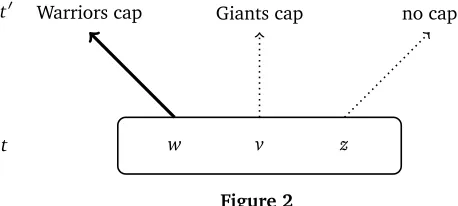
Standardly, the modal base is the domain of quantification of the modal. But, as we anticipated, our account is not quantificational. Instead, we propose that willsingles out one world within the modal base, and evaluates the prejacent at that world. Intuitively, the selected world represents the ‘way things will actually be’—in other words, the historical alternative that will actually be realized. So,
(12) is true just in case, in the selected world, Cynthia wears a Warriors cap tomorrow.
Warriors cap Giants cap no cap
w v z
t t′
Figure 2
The explanation for the scopelessness ofwill(and consequently the validation ofwill-excluded middle) flows immediately from the fact that the prejacent is always evaluated relative to a single world (see §7).
Our semantics forwillpresupposes that, at the time of utterance, there is a unique, fully specified way things will actually be (in the jargon introduced by
Even if one agrees with these concerns, we don’t think that the compositional semantics for will needs to be changed. We distinguish what information is needed by the compositional semantics from what information the world is able to supply. We assume that the compositional semantics requires as input a unique world of utterance. Like all parameters used in semantic computations, the value of this parameter is supplied by the context. At the same time, we leave it open that it may be indeterminate what context the utterance takes place in, and hence what world is supplied to the semantics.
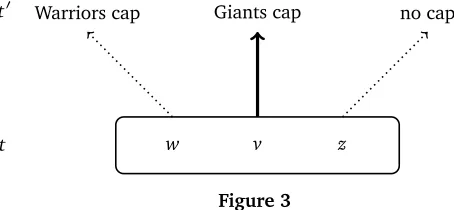
For illustration, consider again(12). Perhaps, at the time of utterance, it is indeterminate whether the actual world is a Warriors-cap-world, a Giants-cap-world, or a no-cap-world. If so, it is indeterminate which context the utterance of
(12)takes place in. The context might be the context of Figure 2, or it might be a context in which some other world (for example,v, as in Figure 3) is selected.
Warriors cap Giants cap no cap
w v z
[image:15.612.193.420.317.422.2]t t′
Figure 3
Let us highlight an important point. We grant that it may be indeterminate what world an utterance takes place in; moreover, we said that the modal base ofwillis determined as a function of the world and the time of the context. But it doesn’t follow that the modal base ofwillis indeterminate. The reason is that, given the way that we have defined historical alternatives, all worlds that are candidates for being the world of the context have the same historical alternatives. So we will be able to speak ofthemodal base ofwillin a context, even if it is indeterminate what context the utterance takes place in.
The next few sections implement the plan we just sketched. §4specifies some metaphysical background. §5presents our compositional semantics, including an analysis ofwill-conditionals. §6elaborates on our treatment of indeterminacy; §7
4 Metaphysical background
Our account is neutral on a number of metaphysical issues connected to branch-ing. In this brief section we explain how.
First, supporters of branching time often claim that possible worlds literally share temporal initial segments (see, e.g., Thomason 1970, Belnap & Green 1994,Belnap et al. 2001). The point at which two worlds branch is the point at which the initial segment ends. By contrast, opponents of branching argue that worlds with identical histories up to a point are qualitatively identical, but still have no parts in common (see, e.g.,Lewis 1986a). We understand the claim that two worlds w1 and w2 are historical alternatives at a time t as the weak claim that there is perfect match between matters of particular fact betweenw1 and w2 up to t. This is compatible both with genuine overlap and with mere indistinguishability.
Second, the branching framework is often associated with the claim that the future is ‘open’. The relevant contrast here is with past events, which are taken to be fixed in a way in which the future is not. There are a number of ways to explain the relevant concept of openness. FollowingBarnes & Cameron(2009), we choose one that is noncommittal between different metaphysical theses:
Openness: (at least some) contingent facts about how things will be are presently unsettled (in a suitably objective sense).
Some writers (for example,Belnap & Green 1994) adopt Openness as the starting point of the enterprise of giving a semantics forwill. Others (like MacFarlane 2003, 2008, 2014) take it as a methodological desideratum that a semantics for the future should not decide between different metaphysical options about Openness.
We are not committed to any of these claims. Unlike Belnap and Green, we don’t assume Openness. Our apparatus is compatible with both Openness and its denial. Unlike MacFarlane, we don’t endorse the neutrality of the semantics as a methodological constraint. As it happens, however, our semantics forwilldoes turn out to be metaphysically neutral about Openness—in the sense that both the defender and the opponent of Openness are able to use it. The reason is that we separate the design of the compositional semantics from the account of indeterminacy. As a result, both the supporter of Openness and its opponent can adopt the compositional meaning we assign to will. They will diverge on whether they accept the suggestion that it is indeterminate which context an utterance takes place in (see §6).
5 Semantics
5.1 Setup
Let us start by introducing some notation. We use sans-serif letters (‘A’, ‘B’, etc.) as metalinguistic variables over sentences; and boldface letters (‘A’, ‘B’, etc.) as metalinguistic variables over sets of worlds. We use ‘propositions’ and ‘sets of worlds’ interchangeably, but everything we say is meant to be compatible with theories according to which propositions merely determine sets of possible worlds, without being identical to them.
As is standard in semantics, we define an interpretation function of the form,
¹·ºpar amet ers,g
Such a function assigns truth values compositionally to sentences relative to a series of parameters and an assignment function, conventionally denoted by ‘g’ (the latter is just a function that assigns objects to syntactic indices, and is needed to handle variables). Different theories employ different parameters. The interpretation function is also relativized to a context, but to remove clutter we avoid explicit mention of the context unless strictly needed.
We also make some specific assumptions aboutwill. First,will is a sentential operator, i.e. an operator that takes a full clause as argument. This is a simpli-fication, but one that is harmless given our purposes. Second, as we flagged in §3, will takes as argument a modal base, i.e. a set of worlds that are used for the interpretation of the modal.12 In particular, the modal base of will is the set of historical alternatives to the world of the context.13 Syntactically, we assume that modal bases are the semantic values of covert pronouns that work as arguments of modals. We represent these pronouns as ‘fi’, and their values, a set of worlds, as ‘Fi’. For shorthand, we generally represent modal bases in LFs just as a subscript of modals; hence we write ‘willf’ rather than the more
extended ‘will[f]’.
12 This understanding of modal bases is slightly simplistic. Modal bases are officially functions from worlds to propositions (seevon Fintel & Heim 2011for discussion).
5.2 Semantics for will
Our semantics for willis based on an extended analogy with Stalnaker’s (1968) semantics for conditionals.14
Similarly to what happens on Stalnaker’s semantics, we assume that the interpretation ofwill involves appeal to a selection function, denoted by ‘s’. A selection function maps a pair of a worldw and a propositionA to a ‘selected’ worldw′. Intuitively,sselects the worldw′that is ‘closest’ to the starting world w while at the same time verifying propositionA. For the case of conditionals, and counterfactuals in particular, there is much literature on how exactly the metric of closeness should be construed.15 We don’t need to settle these issues here. We can adopt any of the metrics that have been proposed for counterfactual conditionals.16
Selection functions are characterized by two important constraints:
Inclusion: ifAis non-empty,s(w,A)∈A
Centering: if w∈A,s(w,A) =w.
Inclusion says that the world selected must verify the input proposition (provided that some world does verify the input proposition). Centering says that, if the input world verifies the input proposition, then the world selected is the input world itself. Inclusion and centering are the only constraints we impose on selection functions, which can then be defined as follows:17
A functions:W×P(W)7→W is aselection functioniff
i. ifAis non-empty,s(w,A)∈A, and
ii. ifw∈A, thens(w,A) =w.
14Schulz(2014) has recently defended an interesting variant of Stalnaker’s semantics. Roughly, conditionals quantify over a set of worlds, but they also select (via a choice function) an arbitrary world within that set. We lack space for a full comparison here. Let us just state without argument or development that, on the most natural implementation, building the analogy with Schulz’s system rather than Stalnaker’s would require us to consider indeterminacy at the level of the compositional semantics, which we are reluctant to do.
15 For some sample proposals concerning the metric of closeness for counterfactuals, seeLewis
(1979a),Kratzer(1981b),Hiddleston(2005).
16 As will be evident soon, the choice between different metrics only matters forwill-conditionals. All we need to settle the selected world in all other cases is merely the Centering condition (see below).
At this point, we’re ready to state the meaning ofwill. We assume that interpre-tation is relativized to three parameters:18 a world of evaluationw, a selection functions, and an assignment g.
(16) ¹willf Aºw,s,g=1 iff¹Aºs(w,g(f)),s,g=1
To simplify the notation, we will just write Finstead of g(f) throughout the paper.
Let us make some comments about this compositional semantics.
First, the basic effect of will is to shift the world at which its prejacent is evaluated. This feature is shared with standard semantic accounts of modals in natural language, likemust. The difference is that modals usually introduce quantification over the world of evaluation parameter, while willreplaces the world of evaluation for another one picked via the selection function.
Second, the entry in(16) does not reflect any temporal shift. It is easy to introduce temporal shift, lettingwillquantify existentially over times (accordingly, interpretation is relativized to an extra parameter for times).
(17) ¹willf Aºw,t,s,g=1 iff ∃t′≥t,¹Aºs(w,F),t′,s,g=1
This said, throughout the discussion we just stick to the entry in (16). This is mostly for simplicity. The central innovation we introduce is the appeal to selec-tion funcselec-tions. Other elements of the meaning ofwillcan stay in the background. Moreover, there are reasons to think that a full-blown semantics forwill exploits time in a way that is more complex than simple existential quantification over temporal instants.19 So the account in(17)would need update and clarification anyway.
Third, this semantics has an interesting consequence for unembedded oc-currences of will: as it turns out, will is semantically vacuous with respect to the modal parameter. Recall that the modal base ofwilldefaults to the set of historical alternatives to the world of the context. Furthermore, the initial world of evaluation defaults to the world in which the utterance takes place.20 Hence, whenwillis unembedded, the world that works as the input to the selection func-tion is a member of the modal base. In this situafunc-tion, the centering assumpfunc-tion
18 Recall: to avoid clutter, we omit the context parameter.
19 In particular, as argued byAbusch(1998) (see alsoCondoravdi 2002), it seems that our best semantics for tense should quantify over intervals rather than instants. In the context of this theory, the semantic effect ofwill(as well as of other modals) would be not to shift the time of evaluation, but rather to extend forward the time interval at which the prejacent is evaluated (for a proposal in this vein, see alsoKaufmann 2005).
entails that the world returned by the selection function is always the world of evaluation itself. Thus, in its unembedded occurrences,willmerely ‘overwrites’ the world of evaluation parameter with itself.
(18) ¹willf Aºw,s,g=1 iff¹Aºw,s,g=1
Thus, whenwilloccurs unembedded, our semantics effectively collapses on the simple Ockhamist semantics, which treatedwillas a mere tense.
Why bother, then, with the complexities of our selection function semantics? There are many good reasons. They mainly relate to the fact that, on our account,willhas a modal base. This opens up the possibility of accounting for will-conditionals (adopting the popular assumption thatwill-clauses function as restrictors), modal subordination (via anaphoric links between the modal bases of the different modals), and epistemic readings (by assuming that the modal base can have different flavors). The selection function account also allows for a vindication thewill-wouldconnection.
Giving a full-fledged account of all these phenomena would take too long. But below we give a brief sketch. Even from these quick remarks, it should be clear that our account provides the tools for vindicating the marks of the modal character ofwill.
5.3 Applications
5.3.1 Conditionals and modal subordination
A selection function semantics for will allows for a natural account of will-conditionals. This also provides the tools required for an account of modal subordination.
Following a longstanding tradition (see e.g.Lewis 1975,Kratzer 1991a,2012) we assume that the function ofif-clauses is to restrict modal bases—to rule out of the modal base the worlds that are incompatible with them (this effect is modeled by intersecting the modal base with the set of worlds individuated by theif-clause).
There are many ways to implement this semantic effect. Building on work on quantifier domain restriction by Kai von Fintel (1994), we choose a simple one that dovetails well with our assumption that the object language syntax contains a variable referring to the modal base. Nothing hinges on this particular choice of implementation.
if-clauses are coindexed with the relevant modal base variable. For example, the LF of (19) is in (20):
(19) If John goes to London, he will meet with Matthew.
(20) [If John1 goes to London]4willf4 [he1meet with Matthew]
At a semantic level, conditionals are interpreted via a rule that instructs us to perform assignment shift, mapping the modal base variable to a set of worlds determined by intersecting the old modal base with the proposition expressed by the antecedent. Formally:
(21) ¹(ifA)(M ODALf B)ºw,s,g=¹M ODALfBºw,s,g[f→F∩A]
(recall thatF=g(f)andA={w:¹Aºw,s,g=1})
To illustrate this, consider again(19). Given modal baseF, let g∗be the assign-ment that coincides withg except at index 4, which is mapped to the set of worlds inFat which John goes to London (i.e. g∗=g[4→F∩¹John goes to Londonº]). Then we predict:
(22) ¹(19)ºw,s,g =¹willf
4[he1 meet Matthew]º
w,s,g∗
Informally, and simplifying, the resulting truth conditions of(19)are:
(23) ¹(19)ºw,s,g =true iff John meets Matthew atvwherevis the world that is selected when sis given as input the set of the historical alternatives (tow) where John goes to London.
Notice that the selected world need not coincide with the actual world or with the world of evaluation. In particular, for anywsuch that John does not go to London atw, then the world selected bys taking was input must be different from w itself. In this case, our Stalnakerian semantics and semantics in the Ockhamist tradition diverge.
This treatment of conditionals also yields a straightforward account of modal subordination. Consider again Klecha’s example:
(5) If the supplies arrive tomorrow, it will be late in the day. They will contain three boxes of cereal.
(24) If the supplies arrive tomorrow, it willf3 be late in the day. They willf3
contain three boxes of cereal.
The antecedent if the supplies arrive tomorrowshifts the value of the relevant index. But, given coindexing, both occurrences of will are interpreted in the scope of the relevant supposition.21
5.3.2 Thewill-wouldconnection
Our treatment of willalso allows us to vindicate the morphological connection betweenwillandwould. The precise nature of this connection depends on one’s views about the meaning ofwould.
On the one hand, if one assumes a Stalnakerian semantics forwould, then the connection is immediately vindicated: willandwouldturn out to have exactly the same meaning—modulodifferences in what possibilities are in the modal base in the two cases. Of course, Stalnaker’s semantics forwould, and in particular the principle of Conditional Excluded Middle that it entails, are controversial. But, first, notice that all the arguments that we gave above for the scopelessness of willcarry over to the case ofwould. Moreover, the literature has provided plenty of further arguments in support of Conditional Excluded Middle (see, e.g.,von Fintel & Iatridou 2002,Williams 2010,Klinedinst 2011).
On the other, the connection is not straightforward if one adopts a Lewisian semantics forwould. In this case, one will have to explain why willdeploys a selection function whilewouldhas universal quantificational force. While this is a nontrivial task, a selection function account ofwillis better placed at fulfilling it than an old-fashioned Ockhamist semantics.
5.3.3 Epistemic readings ofwill
Recall the example we used to introduce epistemic readings ofwill:
(3) John will be in London by now.
willin(3)is not used to talk about the future, but rather has an epistemic reading. Predicting how and whenwillreceives an epistemic reading goes beyond the scope of this paper. These questions connect to general phenomena in the semantics of modality, and its relationship with tense and aspect, that we can’t cover here.22
21 We assume that the effects of the shift operated by the conditional antecedent extend beyond the boundaries of individual sentences. An assumption of this sort seems required by any account of modal subordination.
We do want to notice an interesting analogy between will and other modals concerning the availability of epistemic and nonepistemic readings.
It is well-known (see, for example, Condoravdi 2002) that the reference time of the prejacent correlates with the flavor that is assigned to the modal. In particular, prejacents with a reference time in the past or in the present correlate with epistemic readings, while prejacents with a reference time in the future correlate with nonepistemic readings. Here are some examples.
(25) a. John must/has to be in London by now. (Øepistemic/#deontic) b. John must/has to go to London tomorrow. (#epistemic/Ødeontic) (26) a. Cynthia must/has to be wearing a cap today. (Øepistemic/
#deon-tic)
b. Cynthia must/has to wear a cap tomorrow. (#epistemic/Ødeontic) (27) a. Sam must/has to have gone to Chicago last April. (Øepistemic/
#deontic)
b. Sam must/has to go to Chicago next April. (#epistemic/Ødeontic)
We note thatwillis similarly asymmetric:
(28) a. John will be in London by now. (Øepistemic/#historical) b. John will go to London tomorrow. (#epistemic/Øhistorical)
(29) a. Cynthia will be wearing a cap right now. (Øepistemic/#historical) b. Cynthia will wear a cap tomorrow. (#epistemic/Øhistorical)
(30) a. Sam will have gone to Chicago last April. (Øepistemic/#historical) b. Sam will go to Chicago next April. (#epistemic/Øhistorical)
Of course, if we are right, there are significant differences between will and modals likemustandhave to. Only the latter have a quantificational semantics and only the former are analyzed via selection functions. But these examples point to an analogy at a different level.
One natural way to account for the contrasts in(25)–(30)is that different prejacents somehow force a different choice of modal bases for the modals. For example,Condoravdi(2002) suggests that modal claims whose prejacent has a reference time in the present rule out non-epistemic modal bases via a constraint requiring that the modal base be sufficiently diverse.23 In any case, the pattern
23 This is the constraint endorsed by Condoravdi, roughly stated:
in(25)–(30)suggests that, whatever one says for the case ofmustandhave to will be exportable to will.
6 Truth, validity, and indeterminacy
§5offers a compositional semantic account of will, but does not fix the truth conditions ofwill-claims. To get the latter, we must define a notion of truth at a context (this is the stage of the theory thatMacFarlane 2003calls ‘postsemantics’). Adopting a definition of truth at a context requires us to take sides in the debate about the indeterminacy of statements about the future. To make the presentation more concrete, we adopt a specific account of how indeterminacy affects the semantics, i.e. the one defended byBarnes & Cameron(2009) (see alsoIacona 2014, who sketches an Ockhamist picture whose treatment of indeter-minacy is parallel to ours).24 According to this account, each context determines a single actual world, but it is indeterminate which context the utterance takes place in.
In a standard contextualist framework, built onKaplan (1989), truth at a context is defined by fixing the values of index parameters to the coordinates of the context (followingLewis 1980, we take contexts to be concrete situations of utterance). Here is a formal definition:
Truth at a Context. Ais true as uttered atc iff¹Aºwc,sc,gc=1
In a slogan: S is true at a context c just in caseS is true at the circumstances fixed byc. Traditional supervaluationist accounts (for example,Belnap & Green 1994) reject Kaplan’s definition of truth at a context. They maintain that a context of utterance does not fix which world is to count as actual. These accounts replace truth at a context with a new definition that allows for sentences
24 Barnes & Cameron’s view is part of a broader family of views that draw inspiration from super-valuational accounts of indeterminacy but retain a bivalent semantics. For more work in this direction, see (among many)McGee & McLaughlin (1995),Dorr(2003),Barnes & Williams
that are neither true nor false at the context of utterance.25 Unlike traditional supervaluationists, we endorse the simple definition of truth at a context above. Hence, on our account, every sentence is either true or false at a context. (This part of our account is independent of our compositional analysis ofwill, which is also compatible with a standard supervaluationist postsemantics.)
How, then, can we satisfy the theorists who maintain that the future is genuinely open? We assume that if the future is open, it is indeterminate which context the utterance takes place in, and hence it is indeterminate which truth value the sentence has. An important consequence of this hypothesis is that both the defender and the opponent of Openness are able to help themselves to our framework, including the definition of truth (and the two notions of validity that we give below). Their disagreement is moved out of the semantic apparatus entirely: the defender of Openness denies, and the opponent of Openness claims, that a concrete situation of utterance determines a unique context.
The notion of truth at a context is important for a number of reasons. One of them is that (following Kaplan himself) we can use it to define a plausible notion of validity. On this notion, an argument is valid just in case it preserves truth at a context: no context makes the premises true and the conclusion false.
Validity1. A1,...,An1Biff, for any contextc such thatA1,...,An are true at c,Bis also true atc.
We should flag an important consequence of our moving the indeterminacy outside of the semantics: unlike traditional supervaluationism, our logic for the relevant fragment of the language is allowed to be straightforwardly classical. It will also be helpful to appeal to a second notion of validity, one that captures preservation of truth at a point of evaluation.
Validity2. A1,...,An2Biff, for any triple〈w,s,g〉such that¹A1ºw,s,g= 1, ...,¹Anºw,s,g=1,¹Bºw,s,g=1
A single sentence Ais valid1 just in case 1A; similarly for valid2. Note that every argument that is valid2 is valid1. The converse however does not hold: any context that makesðwillf Añtrue, also verifiesA, but there are points at which ¹willf Aºw,s,g=1, but ¹Aºw,s,g =0 (this can happen only in points such that w∈/g(f)). WhenAandBare such thatA1BandB1A, we say that they are
equivalent1(similarly forequivalent2). Here too we have that every equivalent2 pair is equivalent1 (though not vice-versa). These connections between these
logical notions are important. Although validity1(and equivalence1) are more significant notions in the overall architecture of the theory, we can establish them by way of establishing validity2 (and equivalence2).
7 Consequences for the logic ofwill
Having acquired a notion of validity, we are ready to explore the main conse-quences of our apparatus. We start by vindicating our seconddesideratum, i.e. the scopelessness ofwill. First, we notice that the semantics satisfies the excluded middle property:
Will Excluded Middle. ðwillf A∨willf not Añis valid2 (hence valid1).
We use ‘∨’ for disjunction to highlight that the sentence is valid on the assump-tion that oris boolean disjunction.26 The argument for excluded middle also establishes a related fact:
Negation Swap. ðwillf notAñandðnot willf Añare equivalent2 (hence equivalent1)
This explains why we do not perceive different scopes for negation despite the fact thatwillis a modal.
The analysis also entails thatwill-conditionals satisfy a principle of conditional excluded middle. Interestingly, this holds whether or not conditionals in general satisfy this principle.
Compositional CEM forwill-Conditionals. For any point〈w,s,g〉,
¹(if B)(willf A)ºw,s,g=1 or¹(if B)(willf notA)ºw,s,g=1
Note that this and all the following principles about conditionals are restricted to the case in which the conditional antecedent is compatible with the modal base.
Since Compositional CEM holds at any point of evaluation,27 we get:
Postsemantic CEM forwill-Conditionals.
ð(if B)(willf A) ∨ (if B)(willf notA)ñis valid2 (hence valid1)
26 PROOF: let〈w,s,g〉be an arbitrary point of evaluation. We have thatðwillf A∨willf notAñis
true at〈w,s,g〉iff eitherAis true ats(w,F)or false ats(w,F). But the right-hand side of the biconditional is always true (since, for any set of worldsSand any worldw, it is always the case thatweither belongs or doesn’t belong to it). Hence,ðwillf A∨willf notAñis true at〈w,s,g〉.
Since〈w,s,g〉was arbitrary,ðwillf A∨willf notAñis true at any point of evaluation.
27 Whetherð(ifB)(willf A)ñis true at〈w,s,g〉boils down to the truth ofAat〈w,s,g[f 7→F∩B]〉.
Relatedly, there is only one way of negating the consequents of conditionals.
Narrow Negation Swap in Conditionals. ð(if B)(willf notA)ñ
andð(if B)(not willf A)ñare equivalent2(and hence equivalent1).
This is a trivial consequence of the non-conditional negation swap, because (if
B) merely operates on g. More importantly, we can derive:
Wide Negation Swap in Conditionals. ð(if B)(willf notA)ñand ðnot(if B)(willf A)ñare equivalent2 (and hence equivalent1).28
This completes our illustration of the basic logical implications of our semantics.
8 Belief and doubt inwill-claims
8.1 Probabilities of simplewill-claims
Recall the cognitive problem from §2.3. Ordinary agents are uncertain about the future. On one natural way to understand this uncertainty, this means that ordinary agents have nonextreme degrees of belief in the propositions expressed bywill-claims. Moreover, at least in some cases, it seems that this uncertainty is rationally permissible, if not rationally required. An adequate theory ofwillshould vindicate this intuition.
This problem should be distinguished from a different, important problem surrounding belief in future claims. Suppose that the future is objectively open, in the sense defined above. In particular, suppose that branching theorists in the style ofThomason(1970),Belnap & Green(1994),Belnap et al.(2001) are right about the metaphysics of branching: there are several possible futures, each of which share the segment that we occupy at the present time. In this case, it is unclear what we mean when we say that the probability of an open proposition— say, the proposition that Cynthia will wear a Warriors cap tomorrow—is r. If it is genuinely open whether Cynthia will wear a Warriors cap, then there are (at least) two ‘equally real’ futures. In one of them she wears the cap, while in the other she does not. This problem has received attention in philosophy of physics (in particular, by defenders of the Everett interpretation of quantum mechanics—see, among others,Wallace 2014). We are not contributing to this discussion here. Rather, we are taking for granted that it somehow makes sense
28 PROOF:¹not(if B)(willf A)ºw,s,g=1 iff¹(if B)(willf A)ºw,s,g=0 iff¹willf Aºw,s,g[f7→F∩B]=0
iff¹not willf Aºw,s,g[f7→F∩B]=1 iff¹(if B)(not willf A)ºw,s,g=1. Together with Narrow Negation
to assign nonextreme credences to propositions about the future (and hence, derivatively, to the claims that express them).29
Let us then return to our Sports Fanexample. Recall: every day, Cynthia tosses a fair die and, on the basis of the outcome, decides whether to wear a Giants hat, a Warriors hat, or no hat. Consider a rational agent who assigns credence 1/3 to each of the three possibilities. Against this background, what we want to show is that the proposition expressed by(12) (repeated below) on our account also gets credence 1/3.
(12) Cynthia will wear a Warriors cap tomorrow
Before we start, let us remind you that this is a nontrivial task. In fact, as we pointed out in §2.4, existing modal accounts fail this task. The reason is that these accounts declareðIt will be the case that Añtrue just in caseAis true at every best future. This semantics makes(12) false, and hence predicts that a rational agent who is aware of the openness of the future should assign credence zero to the proposition it expresses.
Let us spell out some basic assumptions. In keeping with standard possible worlds semantics for attitudes, assume that credences are defined over sets of worlds. In particular, assume that an agent’s credences at a given time may be modeled by a probability functionµsatisfying the usual constraints. For example, let µmodel an agent’s credences at the current point in time. Letµ(A) =1/3, where A is the set of worlds where Cynthia wears a Warriors cap. Our task is to check thatµ(PROPW) =1/3, wherePROPW is the content our semantics
associates to an utterance of(12).
For current purposes, we can take the content expressed by the utterance of awill-sentence at a given context to be the set of worlds such that the utterance is true as evaluated at those worlds. Formally:
Content ofAatc: kAkc = {w:¹Aºw,sc,gc=1}
In what follows, we suppress reference to the context to avoid clutter.
It is easy to see that this yields exactly the verdict we need. Take our example:
kCynthia will wear a Warriors capkis just the set of worlds in which Cynthia wears a Warriors cap. On the assumption that the credence that our agent assigns to Warriors-cap-worlds is 1/3, she will also assign credence 1/3 to the proposition expressed by(12). More generally, lettingkBkFdenote kBk ∩F, we obtain:
Transparency: For any prejacentA,kwillf AkF=kAkF.30
When we restrict to the worlds in the modal base, unembeddedwill-sentences and their prejacents are true at exactly the same worlds.
8.2 Probabilities of complex will-sentences
The probabilities of Boolean compounds ofwill-sentences work out as one would intuitively expect. Transparency and Negation Swap immediately entail:
For allF,knot willf AkF={w:wis an¬A-world} ∩F=k¬AkF
In our example,kIt is not the case that Cynthia will wear a Giants capk=kCynthia will not wear a Giants capk. Both propositions have probability 2/3 (according to µ). Transparency entails similar results for conjunction and disjunction, so that:
kwill(A&B)kF=kwillAkF∩kwillBkFandkwill(A∨B)kF=kwillAkF∪kwillBkF. The case of conditionals is more complex. It is well-known that standard possible worlds semantics for conditionals fails to vindicate, in general, the intu-itive assignments of probabilities to conditional sentences.31 Since our account ofwillincorporates a standard semantic account of conditionals, it shares this feature. To get a sense of the problem, consider again the Sports Fan scenario, and take the conditional:
(31) If Cynthia wears a cap, she will wear a Warriors ap.
Recall that Cynthia decides to wear a Warriors cap, a Giants cap, or no cap, depending on a random process that makes each of the three options 1/3 likely. Accordingly, suppose that (31)is evaluated against the toy modal base we de-scribed in section3, and consisting of a Warriors-cap-world, a Giants-cap-world, and a no-cap-world. It seems natural to say that your degree of belief in(31)
should be (or, at the very least,maybe) 1/2. But our semantics can’t vindicate this result.
To see this, consider the content of(31):
(32) kIf cap,willf Warriors capk=
{w: ¹If cap,willf Warriors capºw,s,g =1}=
{w: ¹willf Warriors capºw,s,g[f→F∩cap] =1}=
{w: ¹Warriors capºs(w,F∩cap),s,g[f→F∩cap] =1}
A world belongs to this proposition if the selection function maps to it when given as input that world and the restricted modal base. it is easy to show that the proposition in (32) cannot have probability 1/2. The basic point is that, given that in our model we have only three worlds, each of which has probability 1/3, no proposition (i.e, no set of worlds) can have probability 1/2.32
One could respond that the problem depends on the fact that we have used a modal base that is too simple. If we add enough worlds to the modal base, we will be able to assign to (32) a content that gets probability 1/2. This is correct, but the point illustrated by our toy example will still hold for some conditional or other, provided that we stick to finite modal bases.33 Alan Hájek (1989,2012) has pointed out that for any (nontrivial and finite-ranged) probability function P r, the conditional probability values assigned on the basis ofP r outnumber the unconditional probability values assigned by P r. Hence there will always be some conditional probability value that doesn’t find a match in the probability of any proposition—exactly as it happens in our example, where no proposition has probability 1/2. (See alsoHall 1994for an extension of Hájek’s argument to the countable case.)
Before closing, let us gesture towards a way of refining our ideas that will yield better results for conditionals. We build on a line of thinking of conditionals that has been developed over the past three decades (Van Fraassen 1976,McGee 1989,Jeffrey & Stalnaker 1994,Kaufmann 2009,2015,Bradley 2012). So far, we have assumed that the credences of a rational agent are distributed over an algebra of possible world propositions. But there is a second dimension of uncertainty, which this model doesn’t capture: an agent may be uncertain about
32 PROOF: The modal base contains three worlds: the Warriors-cap-worldw, the Giants-cap-world
which world is selected by the selection function. Go back to our example and consider the no-cap-worldz. What is the value of the selection function, when the relevant arguments arezand the proposition that Cynthia wears a cap? Both the answers ‘the Warriors-cap-world w’ and ‘the Giants-cap-world v’ seem to be open epistemic possibilities. Being uncertain between these two answers, of course, would mean being uncertain about which between two candidates for the selection function (call them ‘sw’ and ‘sv’) is the ‘correct’ one.
To register this kind of uncertainty alongside uncertainty about which world is actual, we need to refine the elements of the underlying algebra. Rather than worlds, we may use pairs of consisting of a world and a selection function. This also involves modifying our notion of content: we need to take contents to be sets of pairs of a world and a selection function (seeBradley 2012for a more extensive development of the idea; Bradley’s approach is in the tradition stemming fromVan Fraassen 1976, for which see alsoJeffrey & Stalnaker 1994,
Kaufmann 2009,2015.)
2D content ofAatc: 〈〈A〉〉={〈w′,s′〉 :¹Aºw′,s′,gc=1}
It is straightforward to see how, on the new picture, (31) may be assigned probability 1/2. We now have an algebra of six possibilities, consisting of the pairs:
{〈w,sw〉,〈v,sw〉,〈z,sw〉,〈w,sv〉,〈v,sv〉,〈z,sv〉}
it is easy to show that probability distribution that assigns to each of these pairs probability 1/6 assigns probability 1/2 to(31).
9 Conclusion