EUROPEAN POLICY STUDIES
R
EGULATING
E-C
OMMERCE
IN
F
INANCIAL
S
ERVICES
R
EPORT OF A
J
OINT
CEPS/ECRI W
ORKING
P
ARTY
CH A I R M A N: TI M JO N E S
CH I E F EX E C U T I V E, PU R S E U S
RA P P O R T E U R: NU R I A DI E Z GU A R D I A
This report contains the conclusions and policy recommendations that follow from the discussion and analytical presentations that took place at the meetings of the joint CEPS/ECRI Working Party. The members of the Working Party participated in extensive debate and submitted comments on earlier drafts of the report. Its contents contain the general tone and direction of the discussion, but its recommendations do not necessarily reflect a full common position reached among all members of the Working Party, nor do they necessarily represent the views of the institutions to which the members belong. A list of participants and invited guests and speakers appears at the end of the report.
This Working Party was chaired by Tim Jones, Chief Executive at Purseus and former Chief Executive of Retail Banking at NatWest, London. Nuria Diez Guardia served as Rapporteur for the Working Party while a Research Fellow at CEPS. Amparo San José and Alfredo Sousa greatly contributed to the drafting of Parts I and II of the final report, respectively.
ISBN 92-9079-349-X
© Copyright 2001, Centre for European Policy Studies.
All rights reserved. No part of this publication may be reproduced, stored in a retrieval system or transmitted in any form or by any means – electronic, mechanical, photocopying, recording or otherwise – without the prior permission of the Centre for European Policy Studies.
Centre for European Policy Studies Place du Congrès 1, B-1000 Brussels Tel: 32(0)2 229.39.11 Fax: 32(0)2 219.41.51 E-mail: [email protected]
Executive Summary...i
Introduction...1
I. Possible Implications of E-Commerce in Financial Services ...2
A. Opportunities in e-commerce for financial institutions ...2
1. Potential advantages...2
2. Cost savings...3
3. Cross-border expansion...4
B. Risks associated with e-commerce in financial services...4
1. Strategic risks ...5
2. Operational risks ...5
II. The EU Regulatory Framework...6
A. Financial services regulation...7
1. The Treaty...7
2. The Internal Market...8
B. Directive on e-commerce ...10
C. Cooperation in judicial matters: The Brussels Regulation and the Rome Convention...11
D. Out-of-court settlement ...14
E. The proposed distance marketing directive...15
III. Specific Policy Issues regarding the Regulatory Framework ...16
A. A brief overview...16
B. Removing obstacles to e-commerce...17
C. Judicial and contractual aspects of e-commerce ...18
D. Minimal and maximum harmonisation...20
E. Home and host country control...20
F. Prudential supervision...23
IV. Conclusions and policy recommendations...24
References...28
R
EGULATING
E-C
OMMERCE IN
F
INANCIAL
S
ERVICES
R
EPORT OF A
J
OINT
CEPS/ECRI W
ORKING
P
ARTY
NU R I A DI E Z GU A R D I A
E
XECUTIVES
UMMARYhe European financial area is not yet fully integrated. An EU action plan to be implemented by 2005 outlines a package of measures to ensure that the European financial services sector realises its full potential. One of the objectives of the plan is the removal of remaining barriers to cross-border provision of retail financial services. Indeed, the euro and new technologies have increased the opportunity costs of continued market fragmentation.
The European Council held in Lisbon in March 2000, set the ambitious objective for Europe to become the most competitive and dynamic economy in the world. It emphasised the need for Europe to quickly exploit opportunities of the new economy and in particular the internet. E-commerce could significantly stimulate the integration of European financial markets, if markets adapt to new technology and if regulatory hurdles are addressed.
This report concentrates on the business-to-consumer area, where most problems are found and market integration lags behind. Of major significance are the rules that apply to electronic cross-border consumer transactions. The directive on e-commerce has recently adopted the place of establishment or country-of-origin approach for the rules applicable to electronic transactions. However, contractual obligations are excluded from this rule. This means that all forms of web-based financial services contracts are excluded. Moreover, member states are entitled to continue to apply restrictions based upon public policy considerations to financial services provided within their jurisdictions.
Progress towards a single market in financial services is hindered by the existence of fifteen different national systems of financial legislation and the retention by member states of controlling powers as to how financial services are provided within their territory. Financial service providers in turn may decide to restrict the validity of their offer to consumers in their jurisdiction. This would constitute a lost opportunity to create a larger and deeper European financial area. Furthermore, consumers might look elsewhere in the world to trade, which would negatively affect competitiveness of European financial services providers and could undermine consumer protection in the EU.
A clarification of objectives and principles of retail financial market regulation at European level would be most useful. Furthermore, the appropriate level and character of regulation should be carefully considered.
The country-of-origin principle should apply both to electronic and traditional business-to-business operations, in order to facilitate cross-border provision of services. Only the retail consumer should be covered by host-country provisions in the interest of consumer or investor protection: business-to-business transactions should be beyond the scope of host-country control.
Regarding the retail consumer, member states need to accommodate foreign financial institutions bringing unfamiliar products and practices into their domestic market, even when this poses significant challenges for domestic incumbents. A way of addressing consumer protection concerns could be through the provision of information on how a foreign offer differs from a domestic offer. This would be more satisfactory than cross-border offers being barred in practice. A clear distinction between what are contractual and non-contractual rules is also required.
Restrictions on the free provision of services in the interest of the general good should be limited. Policy-makers should look for ways to prevent member states from imposing national requirements for protectionist reasons. In areas where minimal harmonisation has been achieved at European level, financial institutions should be required to comply only with the harmonised standards, and mutual recognition should operate. Measures that can be imposed on the basis of general-good considerations should be published and challenged. The European Commission could assess the differences in consumer protection legislation and revise the utility and justification of national rules imposed on foreign providers. Only in cases where the interests of the consumer are strengthened by the restrictions on the products offered should the national rules be maintained.
I
NTRODUCTIONne of the goals of economic and monetary union (EMU) is the deepening and improved efficiency of financial markets. In this context, development of e-commerce in financial services could play a crucial role. As many as fifteen years ago, the White Paper on “Completing the Internal Market” announced the integration of European banking markets. A major aim of the internal market programme was the creation of a European financial area. It focused on eliminating restrictions to capital movements among member states and on harmonising the regulatory framework for a European-wide market in financial services. Dramatic changes in European financial markets were expected, due to increased competition and overall price reductions.
Nevertheless, European financial markets are not yet truly integrated. The supply of financial services throughout the EU remains difficult, especially for retail products, and the number of cross-border merger-and-acquisition operations has been limited so far. The completion of an internal market in financial services appears both easier and increasingly necessary after the introduction of the euro and certain technological innovations. E-commerce in particular might ease cross-border provision of financial services and therefore assist in the integration of national markets. Moreover, as the potential for larger and more integrated financial markets is created, the opportunity costs of remaining sources of market fragmentation will increase.
The use of e-commerce in financial services poses regulatory challenges at three different levels:
- The removal of formal obstacles, which are related to use of paper and signatures in particular;
- Ensuring coherence between different regulatory initiatives forming the emerging European framework in the area of e-commerce; and
- Removing legal and regulatory hurdles, in particular in the area of conduct-of-business rules, which requires a review of European financial regulation in view of the use of e-commerce in financial services.
E-commerce brings to the forefront different issues regarding financial regulation, only some of which are new. It is necessary to address these problems in order to allow the internet to assist in integrating markets for financial services.
The purpose of this report is to identify possible implications of e-commerce in financial services and associated risks for the financial sector industry (Part I), to give an overview of regulatory initiatives at European level (Part II) and to identify main public policy issues to be addressed (Part III). The report focuses on retail financial services, or business-to-consumer, where many difficult issues appear to concentrate. So far, fewer problems have been identified for wholesale financial services, although difficulties may emerge as use of e-commerce increases. A series of policy recommendations is outlined in Part IV at the end of the report.
P
OSSIBLEI
MPLICATIONS OFE-C
OMMERCE INF
INANCIALS
ERVICESA . Opportunities in e-commerce for financial institutions
Financial institutions play a role in e-commerce at two levels. First, financial intermediaries, together with payment systems and communications systems, form the necessary infrastructure of e-commerce. Second, financial institutions can deliver financial services via e-commerce.
1. Potential advantages
[image:7.612.91.526.350.501.2]As commerce shifts toward electronic channels, banks engaged in conducting business on-line will be in a position to market and deliver traditional banking products more efficiently and to offer new products sought by electronic commerce participants. If they fail to respond, they will be confined to the role of executing payments originated in the electronic market place (see Figure 1).
Figure 1. Role of banks in e-commerce
Payment instructions Payment instructions
Source: Adapted from Wenninger (2000).
Nowadays, most retail banks in Europe offer online services. The internet can be used as a supplementary channel for marketing and delivering traditional financial products such as credit and deposit services. In addition, some institutions have developed new products designed specifically for electronic commerce, including:
§ electronic billing and collection services,
§ internet portals where services are offered by many financial institutions and § electronic payment systems including electronic money.
The potential advantages that e-commerce brings to the financial services industry mainly consist of reduced costs per electronic transaction, savings arising from centralised information collection and rationalisation of financial services and new lines
Buyer
E-commerce over
the internet Seller
Buyer’s bank Bank payment
networks
_____________________ REGULATING E-COMMERCE IN FINANCIAL SERVICES__________________
be made more easily. Information tools, extended services and new products are progressively made available, such as stock price analysis, insurance policies, loans, mutual funds or immediate customer assistance. For example, the internet has made it possible for issuers to widely disseminate information of any type to investors, so that high-quality relevant information which was previously restricted to market professionals is now available to individuals, especially in the US.
1. Cost savings
The potential of saving costs in the financial services sector has been frequently highlighted. Indeed, development of internet technology often requires a very high initial investment but marginal costs of use are low. For instance, the average cost of making a payment on the internet is only one-tenth that of a payment channelled through traditional means (ECB, 2000). The cost of carrying out a transaction varies greatly, depending on how the customer gives necessary instructions, as shown in the following table.
Table 1. Comparative costs of transactions
Branch Telephone ATM PC banking E-banking
$1.07 $0.52 $0.27 $0.015 $0.01
Source: Based on a 1996 Booz-Allen & Hamilton survey of North American financial institutions with websites, quoted in The Emerging Digital Economy published in 1998 by the US Department of Commerce.
Technological developments have transformed distribution channels for financial services with the use of ATMs, PIN cards, telephone banking and, more recently, the internet. In the future, a combination of mobile phones (and also the television) and the internet might be used for financial services. So far, new channels have generally not replaced old ones, as major financial institutions make a combined use of different channels and users regard new channels as an additional service to traditional distribution channels. Unless customers use the new channel instead of, rather than in addition to, existing ones, online banking represents an added cost rather than savings. The use of online financial services in Europe is expected to reach 40% of financial services’ customers by 2003.1 In particular, use of internet equity trading was forecasted to increase more than five-fold in five years.2
Restructuring the banking sector: The experience of Finland
The Finnish banking sector stands out for its rapid adoption of the internet. Employment in the Finnish banking sector has halved and the branch network has been cut back by a third between 1988 and 1999 (OECD, 2000). New technologies have replaced old distribution channels and there has been a reduction of operating costs in the banking sector.
Restructuring goes far beyond what most other European countries have achieved so far. Mobile phones are also used for banking transactions. As a result of these developments, the number of automatic teller machines (ATMs) in Finland and use of banknotes are falling (ECB, 2000). Efficiency improvement and capacity reduction have led to a rapid rise of profitability in the second half of the 1990s with bank profits rising to 8.5 billion FIM in 1999 from a 10.6 billion loss in 1992.
Changes in Finland’s financial sector have probably been so fast because of the severe banking crises that occurred in the early 1990s. These help explain the deep restructuring and dramatic increases in profitability. From a European perspective, Finnish banks recorded a rate of return on capital of around 20%, comparable with US banks whilst the European average stood at 10% (OECD, 2000). This indicates that the Finnish case is rather exceptional compared to other European countries. However, it signals that financial institutions will have to make choices about their branch networks’ size in order to achieve expected cost reductions.
2. Cross-border expansion
E-commerce is designed by its very nature to expand the geographical reach of institutions and customers without requiring a similar physical expansion. Financial institutions would not only offer electronic services as a cost-savings strategy to reduce paperwork and personnel costs, but also to expand into foreign markets.
Banks can adopt several approaches to their international on-line ventures, namely: § To complement the existing branch network via the internet,
§ To establish independent brands to develop on-line business,
§ To create aggregators or virtual financial supermarkets (offering also other financial institutions’ products) and,
§ To provide internet banking by new brands born out of non-bank institutions.
Despite the enormous potential of on-line financial activities in cross-border operations, most banks have generally refrained from conducting electronic activity in countries where they do not possess traditional brick-and-mortar distribution channels. For instance, SEB expansion in Germany has been accompanied by the acquisition of BfG. B. Risks associated with e-commerce in financial services
_____________________ REGULATING E-COMMERCE IN FINANCIAL SERVICES__________________
1. Strategic risks
New competitive pressures may arise from on-line financial service providers such as internet banks or discount brokers that are not supporting a branch network and are able to offer attractive rates and fees. The potential of internet-only banks is still unknown as elements of customer preference such as reputation and customer confidence enter into play. Therefore, banks run the risk of under- or over-investing in reaction to new sources of competition. If internet banking becomes very popular and banks wait too long or do not invest sufficiently, they face the risk of losing clients. On the other hand, banks may over-invest in the internet, if it does not become truly popular and consumers prefer dealing with local branches. Timing is therefore a decisive issue. A bank that is too early also risks becoming obsolete in the eyes of its customers.
There is an increasing need to interact with other technologies such as telecommunications and wireless. Speed for products and services to reach the market is a decisive element for success in the industry, which has led banking institutions to forge alliances with non-banking firms since technology outsourcing requires increasing attention. Many internet banks have discovered that they are using savings in “brick and mortar” operating costs to pay “bounties” or fees to other internet sites that refer new customers and to operate call centres to deal with customer inquiries (Federal Reserve Board, 2000).
Moreover, market transparency will increase. As information aggregators ease comparisons, geographical barriers to finding the best terms on products offered by competing institutions will be eroded. In addition, price will become one of the determinants of consumer choice, although in financial services consumers take into account variables other than price. In comparison with different mortgage credit offers, for instance, ways of financing loans or variability of interest rates are important elements. For credit cards, the length of grace periods contributes to differentiating offers.
Another possible implication of increased market transparency is that consumers will buy from different financial institutions and choose the most attractive product from each institution. Consumer loyalty may be reduced because the costs of switching supplier (“switching costs”) are lower in the case of electronic banking than with traditional banking. With the aim of retaining customers, banks have adopted a strategy of bundling products to fit individual preferences. However, the need to gather data on customer’s preferences in order to pursue this strategy raises privacy concerns.
Whereas on-line brokerage has taken off rapidly and despite new products available from pure internet banks and on-line banking, customers still show a preference for carrying out certain operations, such as selling or purchasing long-term products, face-to-face.
2. Operational risks
When speaking about new technological developments, we usually focus on the internet. However, other important technological elements are necessary to the development of the on-line financial services sector. These include the following (Hilton, 2000):
§ a greater bandwidth to ensure cheaper and faster access by individuals as well as businesses, and
§ more user-friendly internet/customer interfaces allowing the use of televisions as computer terminals or new developments in third-generation digital telephony. These developments are necessary, together with the expansion of internet traffic, in order to be able to use e-commerce in the offer and delivery of financial services. Nevertheless, financial institutions’ exposure to technological risk will increase as they expand their use of e-commerce. The need to ensure a smooth functioning of computer networks will require investments in maintenance of networks and software.
Rapid technological improvements that increase transaction speed may be associated with increased risks for banks. Security aspects include verification of the identity and authenticity of persons and, again, protection of privacy. Such new information security risks are also of interest to regulators.
PART II
T
HEEU R
EGULATORYF
RAMEWORKhis part first reviews the key components of the legal structure governing EU markets in financial services: the Treaty basis, Internal Market programme for financial services and the key directives intended to realise it, which were adopted in the late 1980s and early 1990s. Harmonisation of financial markets legislation has taken on renewed importance in the European policy agenda since 1999, being the subject of various Commission communications.
The legal measures forming the emerging European e-commerce policy will then be reviewed: the directive on e-commerce, the proposed distance-marketing directive, the Brussels regulation and the Rome Convention to be revised and adopted as EU Regulation.
Financial regulation aims at ensuring systemic stability and consumer protection. This report concentrates on the latter objective. Consumer protection regulation of financial services can be divided into prudential regulation and supervision of conduct regulation (or conduct of business regulation).
Prudential regulation aims at ensuring the financial viability and security of financial institutions, avoiding failures that would have negative consequences for retail depositors. Prudential regulation, under “home country control”, has been subject to a minimal harmonisation at EU level. Supervision regulation or conduct of business regulation refers to how firms conduct business with their customers. It covers a wide area including regulation of advertisement, security of payment systems and regulation to prevent money laundering. It creates both regulatory obligations belonging to the sphere of public law and contractual obligations in the sphere of private law. This supervision is carried out by the host state, and so far its harmonisation has been limited. The combination of national differences in conduct of business regulation and host state supervision in the area poses obstacles to integration of EU financial markets. A. Financial services regulation
1. The Treaty
The Treaty of Rome establishes the fundamental freedoms of movement and of establishment, which are involved when an undertaking operating in the financial services sector in one member state develops a commercial presence or sells its products in other member states.
The freedom to provide services (Articles 49 to 55 of the Treaty) gives nationals of a member state the right to provide services in other member states. The freedom of establishment (Articles 43 to 48 of the Treaty) entitles natural or legal persons from one member state to pursue economic activities in another member state for an indefinite period, under the conditions laid down for its own nationals by the law of the second member state. Both freedoms cover either temporary or permanent economic activity in the host country.
The Treaty essentially provides for equal and non-discriminatory treatment based on grounds of nationality. It does not mean necessarily, however, that an undertaking
authorised to offer financial services in his member state would be allowed to offer services or to establish itself in another member state without complying with rules of the second state (the host country).
Within their jurisdiction, member states may apply national requirements to the provision of financial services by domestic and cross-border institutions. They may restrict freedoms of services and establishment in the interest of the general good (public policy, security, or health), although the exercise of this power is constrained by EU law (Article 49).
Indeed, national obstacles to Treaty freedoms may be justified in light of the European Court of Justice case law. The Court has developed “mandatory requirements” which member states may impose in the absence of prior Community harmonisation in the area. They include the coherence of the fiscal system, the reputation of the financial sector and the protection of the consumer. To be justified in the interest of the general good, a national measure constituting a restriction of the Treaty freedoms has to be simultaneously non-discriminatory, objectively justified in pursuance of the public interest and proportionate to the defined objective. However, such “mandatory requirements” still constitute an important source of legal uncertainty because the list of exceptions is potentially open by future case law of the court and due to current divergences between national legislation.
2. The Internal Market
The internal market programme aimed at achieving the freedoms established by the Treaty. The method to create a single financial market is based on the three following principles:
§ Harmonisation of essential or minimum standards for prudential supervision of financial institutions between member states,
§ Mutual recognition which binds each member state to recognise the competence of the supervisory authorities of each other member state regarding any financial institution licensed in another member state, and
§ Application of the home-country control which subjects each financial institution licensed to a single supervisor: the one where the financial institution has its head of office, regardless of where it conducts its business.
Several directives were adopted to realise a single market for financial services, covering banking, insurance and investment services. They allow financial institutions to offer their services in other member states while remaining under home-country control for prudential supervision.
_____________________ REGULATING E-COMMERCE IN FINANCIAL SERVICES__________________
of communication in the host member state. The general good provisions of the
investment services directive consist of rules to ensure stability and sound operation of the financial system and protection of investors. Regarding advertisement of investment services, the directive gives member states authority to establish rules governing form and content of advertisement in their jurisdiction, in the interest of the “general good”. More specifically, it also allows organised trading systems (exchanges), classified as a “regulated market”, to have remote access in another member state. According to the directive, a member state must allow the regulated market of other member states to provide “appropriate facilities” within its territories. These facilities are terminals by which an operator can have remote access to a market of another EU country.
Nevertheless, the definition of trading systems is unclear and there is scope for host country restrictions through the provision that regulated markets should be active not only in trading but also in listing of securities. For those trading in a host-country regulated market, the application of host country conduct-of-business rules is a barrier to market integration. One of the proposals being considered is to distinguish between retail and wholesale investors to determine the application of conduct-of-business rules, whereby wholesale investors would only be subject to home country rules, or to implement a waiver for wholesale investors as far as certain conduct-of-business rules are concerned.
The uncertainty about the interpretation of other countries’ regulation and their applicability to electronic transactions and the obligation to comply with possibly conflicting laws are issues of concern to financial services providers.
Conduct-of-business rules also constitute impediments to an efficient single market and are particularly important for on-line financial service providers. Indeed, conduct-of-business rules of any member state need to be observed by:
§ providers who are authorised in the given member state as their home state and, § those who are providing the service in the given member state as a host state
through a single passport, under one of the financial services directives.
The imposition by host countries of conduct-of-business rules for contractual matters is an exemption to the country-of-origin principle in the directive on e-commerce, together with the other exemptions being in the general good. Different national measures are therefore applied to financial institutions, such as fiscal measures and rules for the protection of the consumer.
Although the regulatory framework of a single European financial market is largely in place, its practical implications in facilitating cross-border financial services have yet to become clear. The pan-European provision of financial services, which is difficult to evaluate, remains limited to specific areas. Most banking activities, for example, remain local. In the euro area, entry into foreign markets in 1999 still accounted on average for less than 10% of banking assets. Similarly, bank loan markets are mostly national. A single market of financial services is far from being effective in practice. The Lisbon European Council in 1999 urged the EU to have the Financial Services Action Plan in place by 2005. The plan3 outlines a series of measures to tackle remaining barriers and
3
aims at ensuring a single market for wholesale financial services, state-of-the-art prudential rules and supervision and open and secure retail markets. This last objective includes promotion, transparency and security of cross-border provision of retail financial services, the implementation of a speedy resolution of consumer disputes through effective extra-judicial procedures and a balanced application of local consumer protection rules.
The introduction of the euro, e-commerce and cross-border banking mergers should facilitate EU-wide provision of financial services. However, power left to host member states regarding rules of conduct may slow the integration process. The directive on e-commerce and the draft directive on distance marketing of consumer financial services (once adopted) will constitute the backbone of regulation of financial e-commerce. The Brussels Regulation and the Rome Convention also have important implications for e-commerce in financial services, especially for consumer financial services. Contractual law aspects are perhaps the most complex when dealing cross-border with consumers. B. Directive on e-commerce
The directive on e-commerce4
provides the core legislative action to allow development of e-commerce in the EU. It serves as the legal basis ensuring free movement of information society services between member states. The directive aims at ensuring that business opportunities based on new technologies such as e-commerce can take full advantage of the single market. The two main objectives of the directive are to create a framework of legal certainty for business and to build consumer confidence.
Differences between national legislation applicable to information society services can cause legal uncertainty as to which national rules apply to such services. They risk fragmenting the internal market by making less attractive the exercise of the two Treaty freedoms of establishment and provision of services.
The directive provides for the so-called “internal market clause” enabling on-line providers to supply services throughout the EU based on the rules of the member state of establishment. The country of establishment is defined as the country from which the provider effectively carries out his activities and is also called country of origin.
The directive states that member states may not restrict the freedom to provide information society services from another member state because of national legal requirements in respect of taking up and pursuit of the activity of an information society service (Article 3).5
However, there are general and specific derogations to the internal market clause.
A list of general derogations in the annex to the directive includes the freedom of parties to choose the law applicable to their contract, contractual obligations concerning consumer contracts and the formal validity of contracts creating or transferring rights in
4
Directive 2000/31/EC of 8 June 2000 on certain legal aspects of information society services, in particular e-commerce, in the internal market, O.J., L. 178, 17.07.00, pp. 1–16. It is in force and to be implemented by member states by 17 January 2002.
5
_____________________ REGULATING E-COMMERCE IN FINANCIAL SERVICES__________________
real estate. In these cases, the Rome Convention determines which member state’s law applies to cross-border contracts. Other general derogations to the internal market clause are specific provisions of other general instruments such as the Rome Convention, the directive on investment services, the UCITS directive or the electronic money directive. Insurance services are also excluded from the scope of the directive. Such exceptions to the application of the country-of-origin clause will have significant implications for financial services and especially for consumer financial services.
Furthermore, the directive defines the derogations on a case-by-case basis. Under certain conditions, member states can take measures that restrict the freedom to provide information society services. In particular, such measures shall be necessary for reasons of public policy or the protection of the consumer, including investors. The measures shall be taken against a given information society service, on a case-by-case basis, and can therefore not be of a general nature. They have to be proportionate to those objectives. Such measures are comparable to those adopted in the interest of the general good.
Since a general application of national consumer protection legislation may be exercised for traditional (off-line) cross-border provision, there is a potential to treat on-line and off-line provision of financial services differently, which would cause competitive distortions. Conditions applied to traditional provision should rapidly catch up with those applied to electronic provision.
The directive on e-commerce can be expected to assist electronic provision of wholesale financial services. Regarding the retail end of financial markets, however, problems in cross-border provision will be similar for electronic as for traditional means. However, with e-commerce, lack of cross-border provision of services becomes more visible and appears more costly. Indeed, e-commerce could become a cost-effective means to deliver financial services products to customers irrespective of their geographical/jurisdictional location.
C. Cooperation in judicial matters: The Brussels Regulation and the Rome Convention
Contract law has not been harmonised at European level and has remained in the sphere of international private law, with reference to the laws of each state. In a recent move to revise existing conventions on contractual law and adopt them as EU regulations, certain provisions on consumer contracts will be applied to e-commerce. Different (and possibly contradictory) national contractual legislation may be applied. Financial services’ providers need to know whether they have to comply with regulatory provisions in the jurisdictions in which they provide on-line services and what they consist of.
There are three distinct legal questions involved in the analysis of a cross-border transaction:
The idea of a “European judicial area” has been developing since the Single European Act (1986). So far, judicial cooperation in civil matters had materialised in the form of international private law conventions.6
The Maastricht Treaty in 1993 included judicial cooperation in civil and criminal matters as a matter of common interest for EU member states (in Title VI). The Amsterdam Treaty in 1997 linked judicial cooperation in civil matters to the free movement of persons under the EC Treaty (new Article 65) and provided for creation of an area of freedom, security and justice in five years. A Council and Commission Action Plan was subsequently adopted in order to implement the provisions of the Amsterdam Treaty. More recently the Tampere European Council in 1999 was entirely devoted to the creation of an area of freedom, security and justice, which it considered as important as the single market programme in its time.
The European Union’s work in the area of justice and home affairs is developing extremely fast. Activities are divided along three different themes:
§ immigration and asylum,
§ police, customs and security and § judicial cooperation.
Work in the area of judicial cooperation will have implications for cross-border provision of financial services. The Brussels regulation is one of the first measures adopted to create a single area of justice. It covers jurisdiction and the recognition and enforcement of judgements in civil and commercial matters. It will enter into force on 1 March 2002, replacing the Brussels Convention of 1968 and is directly applicable in all member states. Some provisions of the Brussels regulation, which will be applied to e-commerce, deal with contracts concluded with consumers and allow them to bring proceedings in the jurisdiction of their country of habitual residence. After its revision, the Rome Convention on applicable law to contractual obligations (Rome I) is also to be adopted as an EU regulation, together with the preparation of an instrument on law applicable to non-contractual obligations (Rome II) and the creation of a European judicial network.
The Brussels regulation deals specifically with contracts concluded with consumers and determines which court has jurisdiction over consumer contractual disputes and how judgements are enforced.
The court of the defendant’s domicile is competent except in specific cases which include the free choice of both parties to the contract and the subject-matter of the litigation, e.g. insurance, employment and consumer contracts. Under certain conditions, the regulation provides that consumers have the possibility to bring proceedings in the jurisdiction of the member state in which they are domiciled (Article 16). The following conditions are required (Article 15):
§ that an enterprise directs its activities towards the member state in which the consumer has his or her domicile, or towards several member states including it, and § that the contract is concluded in the framework of these activities.
_____________________ REGULATING E-COMMERCE IN FINANCIAL SERVICES__________________
Proceedings against a consumer may only be brought by the other party to the contract in the court of the member state in which the consumer is domiciled.
The absence of clear definitions on the concept of an enterprise “directing its activities” towards a member state might produce uncertainty. The Brussels regulation indicates EU and members states’ willingness to ensure high levels of consumer protection and confirms that the approach generally adopted for consumer services is controlled by the country of the consumer. EU justice ministers will decide on applicable law to consumer contracts in the forthcoming revision of the Rome Convention.
The Rome Convention determines the law applicable to financial services contracts. Parties are free to choose the law governing their contract and, if they do not, the law applicable will be the one of the state to which the contract has the closest connection. It is presumed that it will be the law of the state where the service provider is established. The express choice of law cannot exclude the protection of ‘mandatory rules’ of the law of the country of habitual residence of the consumer. If parties to the contract did not choose a law, the law of the country of habitual residence of the consumer governs the whole contract. However the application of this exception is subject to the condition that the conclusion of the contract was preceded by a specific invitation addressed to the consumer or by advertising in the consumer's member state, and that the consumer had taken in his member state all the steps necessary for the conclusion of the contract. The effect of the derogation in the field of contract law is to allow member states other than the state in which a service provider is established to apply rules that restrict the freedom to provide information society services, subject to compatibility of such measures with Article 49 of the EC Treaty.
As e-commerce makes cross-border transactions easier, with different jurisdictions being involved, national differences in private and contractual law and cultural preferences of member states will play a much more prominent role. The Brussels regulation and future amendments to the Rome Convention will have implications for on-line consumer contracts. They will address the legal issues of which courts have jurisdiction over and whose laws apply to e-commerce transactions, with the objective of improving consumers’ access to justice in cross-border cases.
D. Out-of-court settlement
Consumers rarely resort to a judicial resolution of disputes because of the relatively high legal costs of gaining and enforcing a judgement, as compared to the amounts involved in e-commercial transactions. The traditional dispute resolution system, which is based on courts, might be unsuitable to e-commerce because it is sometimes too slow and the cost of litigation is relatively high. Efficient access to redress is the key in building consumer confidence.
The Commission is continuing work on alternative (out-of-court) dispute resolution methods (ADRs) covering a variety of out-of-court settlement bodies7 that provide an alternative to court litigation which should be simpler, swifter, more effective and less expensive. An ADR procedure does not replace traditional court action, and if a consumer is not satisfied with the ADR decision, he or she may introduce a traditional action.
In 1998, the Commission launched a Recommendation8 establishing the European Extra-Judicial Network (EEJ-NET). It is a general network of ADRs which provides practical support and information to consumers who choose this form of resolution. In 1998, a Communication established the main principles to be followed by national out-of-court bodies: independence, transparency, adversarial principle, effectiveness, legality, liberty and representation.9 More recently, in April 2001, the Commission launched a Communication on widening consumer access to alternative dispute resolution. ADRs would be particularly useful for the development of e-commerce. The Commission in February 2001 adopted a sectoral approach for financial services and established an out-of-court complaints network, called FIN-NET. It is based on a voluntary Memorandum of Understanding that outlines the mechanisms and conditions that parties agree to apply. The network has been set up to respond to specific needs of the financial sector regarding out-of-court resolution schemes and to complement the general network with specialist advise and support.
FIN-NET is set up as a network of clearinghouses acting as a one-stop national contact point. It aims at facilitating an easy and swift access to an out-of-court dispute resolution scheme in the country of the supplier. In practice, when the consumer has a complaint arising from a transaction with a supplier located in another member state, the clearinghouse in the country of the consumer should be able to provide information and assistance. Information would be obtained through the clearinghouse in the supplier’s country. The clearinghouse would also assist the consumer in formatting and filing his complaint and would act as a national information resource for clearinghouses in other member states.
7
ADRs includes several methods, including arbitration, expert determination, neutral evaluation, mediation and conciliation, which are subject to different types of procedures: public, private, ombudsman, complaint board or trade association panel.
8
_____________________ REGULATING E-COMMERCE IN FINANCIAL SERVICES__________________
E. The draft directive on distance marketing
The draft directive10 on distance marketing was due to be adopted by the end of December 2000, but political agreement in the Council was only reached in September 2001. (Its formal adoption is expected shortly.) The draft directive aims at establishing a clear legal framework governing distance marketing of consumer financial services with the specific goal of increasing consumer confidence in the use of new techniques. It fills a regulatory gap left by the exclusion of financial services from the 1997 directive on distance selling. The draft mentions the objectives of contributing to the development of e-commerce and of ensuring that consumers have access without discrimination to the widest possible range of financial services available in the Community. The scope of the directive is the retail financial services sector, most of which falls under the exceptions to the country-of-origin principle of the directive on e-commerce. Different regulatory approaches are used for the retail and wholesale financial services sectors. The Commission proposal is based on a principle of full harmonisation with a view to ensuring free movement of financial services and would be jointly applied with the directive on e-commerce. Although the distinction between wholesale and retail business is not straightforward, there is a stronger case for regulating retail financial services than the wholesale business.
The proposed measure seeks to provide a high level of consumer protection. In particular, a right of withdrawal and a reflection period are introduced and the information to be provided in the contract is regulated. An article is devoted to out-of-court complaints and redress procedures. However, an inconsistency can be noted between the directive on the protection of consumers in respect of distance contracts, which applies to goods,11 and the draft directive on distance marketing of consumer financial services. The first one establishes a withdrawal period of 7 days whereas the second one proposes a withdrawal period of 14 to 30 days depending on the product. This discrepancy would inhibit the development of on-line instalment credit.
The regulatory framework covering consumer financial services will be further clarified when the Rome Convention is revised. The Convention provides for a rule of contractual freedom of the parties but also provides that the consumer can always rely on his mandatory contractual provisions under certain conditions. The revision is likely to be much more difficult than the revision of the Brussels Convention because the issue of the applicable law is of utmost importance. Should the solution adopted be equivalent to the one in the Brussels Convention? Would a court that has jurisdiction on a
contractual dispute be keen to apply foreign legislation?
10
Proposal for a Directive concerning the distance marketing of consumer financial services and amending Directives 90/619, 97/7 and 98/27, COM (1998) 468 final, 14.10.98. Amended proposal for a Directive concerning the distance marketing of consumer financial services and amending Directives 90/619, 97/7 abd 98/27, COM (1999) 385 final, 23.07.99.
11
PART III
S
PECIFICP
OLICYI
SSUES REGARDING THER
EGULATORYF
RAMEWORKhis part assesses whether there are problems with the existing regulatory basis governing e-commerce in financial services at the European level and, if so, whether there are any ways in which the legal and regulatory structure could be changed in order to tackle these problems.
A. A brief overview
Cross-border provision without a physical presence appears more feasible in the case of wholesale financial services than for retail services. For example, those retail lending and insurance products requiring personal advice and local knowledge should be more sheltered from increased international competition, even with the spread of electronic distribution technology, than wholesale products. Therefore, the possible implications of e-commerce differ for wholesale and retail financial services.
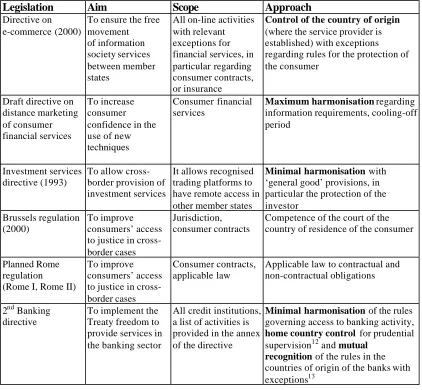
Table 2 helps in assessing the newly established regulatory framework for electronic transactions and the implications and coherence of different initiatives in the field of e-commerce.
Financial regulation tends to mirror and accentuate such differentiation between wholesale and retail segments of financial markets, because major caveats to the home-country control principle affect the retail sector more strongly than the wholesale sector. Host member states have considerable scope to declare services, products or marketing practices illegal on public policy grounds. Steil (1998) reports that cross-border mortgages have been voided on general good grounds and that Belgium formally classifies its mortgage credit law, and France all its consumer law, as general good exclusions.
The retail cross-border banking sector might develop in view of the consolidation taking place within countries and the rise in telephone, PC banking and potentially e-commerce. Indeed, cross-border entry can probably only be expected to be commercially attractive after national consolidation and a reduction of over-capacity take place. Technological innovations potentially reduce sunk costs involved by the need to establish a physical branch network. Therefore, the disparity between wholesale and retail areas might start to be eroded.
In commercial terms, however, national frontiers still matter. Even in an area such as the cross-border provision of financial services, which has been at the heart of the drive to complete the single market, substantial differences across national markets remain. In view of the scope for host country intervention, these differences entail a loss of benefits from integration and competition at European level and require a determined coordinated effort to be reduced. Different regulatory initiatives have implications for the electronic provision of financial services, although they have been or are to be adopted with different aims by different Councils of Ministers.
_____________________ REGULATING E-COMMERCE IN FINANCIAL SERVICES__________________
Table 2. Regulatory initiatives applying to e-commerce in financial services
Legislation Aim Scope Approach
Directive on e-commerce (2000)
To ensure the free movement of information society services between member states
All on-line activities with relevant exceptions for financial services, in particular regarding consumer contracts, or insurance
Control of the country of origin
(where the service provider is established) with exceptions regarding rules for the protection of the consumer
Draft directive on distance marketing of consumer financial services
To increase consumer confidence in the use of new techniques
Consumer financial services
Maximum harmonisation regarding information requirements, cooling-off period
Investment services directive (1993)
To allow cross-border provision of investment services
It allows recognised trading platforms to have remote access in other member states
Minimal harmonisation with ‘general good’ provisions, in particular the protection of the investor
Brussels regulation (2000)
To improve consumers’ access to justice in cross-border cases
Jurisdiction, consumer contracts
Competence of the court of the country of residence of the consumer
Planned Rome regulation (Rome I, Rome II)
To improve consumers’ access to justice in cross-border cases
Consumer contracts, applicable law
Applicable law to contractual and non-contractual obligations
2nd Banking directive
To implement the Treaty freedom to provide services in the banking sector
All credit institutions, a list of activities is provided in the annex of the directive
Minimal harmonisation of the rules governing access to banking activity,
home country control for prudential supervision12 and mutual
recognition of the rules in the countries of origin of the banks with exceptions13
B. Removing obstacles to e-commerce
There are different steps of increasing complexity to facilitate e-commerce. First, formal obstacles to e-commerce have to be eliminated. Member states need to modify national legislation in order to allow the making of contracts by electronic means. The legal requirements applicable to the contractual process must neither prevent effective use of electronic contracts nor result in such electronically concluded contracts having no legal force.14 For example, many jurisdictions require that investment agreements involving their nationals are printed and autographically signed. If the text of an agreement is downloaded from the internet, it has to be signed in pen and sent back to the financial
12 Meaning the country that has issued the single licence and in which the registered office of
the credit institution is located.
13 General good provisions, including the protection of the consumer, which justify the
application of national regulations restricting the free provision of services.
14 The following may be exempted from these provisions (Article 9): contracts requiring the
institution by post. Consumer credit contracts have often to be signed in paper form. The e-commerce directive requires member states to implement such changes in national legislation.
Second, coherence between different initiatives needs to be ensured. There is a mix of pieces of legislation with different objectives, of rules of public and private law and of legislation and soft law. For example, the Brussels regulation, the draft distance marketing directive, the recently agreed code of conduct for mortgage lenders and the Alternative Dispute Resolution systems would apply to the provision of mortgage credit.
Third, financial regulation at European level should be revisited once the need to address the remaining uncertainties becomes more urgent with the increased use of e-commerce. Harmonisation has been achieved on certain aspects, often in close relation with global developments as was the case in the field of prudential supervision. In other aspects, however, in particular relating to the protection of the consumer, little harmonisation has been achieved. There is no general theory to provide guidance on which aspects require harmonisation and to what extent. The OECD has developed guidelines for consumer protection in the electronic marketplace. At European level, host member states supervise the application of their national rules within their jurisdiction.
A clarification of measures that can be imposed for the general good is also missing. The approach currently used in existing legislation is applied to e-commerce, without taking the opportunity to improve this or to adapt it to electronic commerce.
Financial services consist of know-how and managerial techniques such as collecting and keeping of deposits, retail lending or the provision of insurance coverage by pooling risks. They materialise in structured information (bank accounts) and in contracts (loan contract, insurance policies, share sales), which both implies that they can be easily traded electronically and that the application of national marketing rules, advertisement and contract laws will have important implications. Differences in national rules of conduct will be further highlighted as the use of e-commerce grows. C . Judicial and contractual aspects of e-commerce
One of the main issues concerning on-line providers of financial services is jurisdiction: “As an on-line financial service provider, whose regulations do I need to comply with?” The directive on e-commerce established the country-of-origin principle: information society service providers are subject to the law of the country in which they are established. Significant areas are excluded from this principle, however, because existing directives require the application of the country-of-destination law or because mutual recognition cannot be achieved as harmonisation is considered insufficient to guarantee an equivalent level of protection across the EU. In particular, contractual obligations concerning consumer contracts are excluded from the scope of the application of the country-of-origin principle.
_____________________ REGULATING E-COMMERCE IN FINANCIAL SERVICES__________________
country of the consumer may be applied. The law applicable to an electronic consumer contract would be:
§ the law of the country of the provider for non-contractual liabilities such as information or advertisement, taking into account that mandatory rules on clear and comprehensible information are laid down in the directive on e-commerce and the draft directive on distance marketing of consumer financial services;
§ the law agreed upon by the parties or the law of the country of the provider for contractual liabilities when there is no prior proposal made to the consumer; or § the law of the country of residence of the consumer for contractual liabilities when
there is a prior proposal made to the consumer, according to the Rome Convention. The scope of application of the country of origin rule in e-commerce in financial services includes advertisement and non-contractual information, areas in which the future directive on distance marketing of consumer financial services will lay down specific mandatory rules, and financial service contracts that are not concluded with consumers. Contracts creating or transferring rights in real estate and insurance contracts are not governed by the country-of-origin rule.
Several problems arise concerning the law applicable to non-contractual liabilities. First, the distinction between contractual and non-contractual obligations differs across countries. Second, a different treatment of online services, to which the country-of-origin principle applies, and off-line services, where the host country may require the application of its national provisions, would not be acceptable. Indeed, regulation should be technologically neutral in order to avoid distortions in competitive conditions. Potentially, on-line financial service providers would need to comply with the regulations of every country in which their promotions, offers or services are available. Since the internet can be accessed in every country, this could lead to a situation with providers being subject to numerous regulators and possibly contradictory national regulations, even where there was no intention to promote or make services available in a particular jurisdiction. This stems from the fact that national regulators have traditionally assumed jurisdiction over promotions, offers or services that were made available to persons within their jurisdiction. It is an issue of concern in the case of a geographically indeterminate internet world.
The interplay between the directive on e-commerce and the distance marketing directive also raises specific questions. Certain aspects of non-contractual information will be harmonised in the future distance marketing directive. What law will be applicable to the non-contractual liabilities that will not be harmonised by the directive? The aim of making different offers easily comparable might be difficult to attain. Offers may appear comparable in view of the harmonised aspects, but certain elements outside the scope of harmonisation could make them different in practice.
complies with the legislation of the consumer’s country of residence. Consumers would then know in what ways a cross-border offer differs from an offer they are accustomed to, and cross-border offers would therefore not be prevented. In our example, a German product could be offered in France if the German bank provides the information on differences between the German offer and a French offer. Trade associations could do the comparative legal analysis on behalf of the institutions with a standard template being developed. Smaller financial institutions could then make cross-border offers. D. Minimal and maximum harmonisation
Consumer protection remains a national prerogative. Therefore, consumer protection directives in the area of financial services, such as the 1987 directive on consumer credit, typically adopt a minimal harmonisation approach. Member states can maintain or adopt stricter requirements above the harmonised minimum. We have seen that this approach does not facilitate market integration.
The lack of progress in opening markets stems to a great extent from the little confidence in other member states’ regulation in the interest of the general good. Institutions entering foreign markets would bring unfamiliar products and practices, posing competitive challenges for domestic firms. There is a risk that host country authorities would seek to protect domestic firms by asking foreign institutions to comply with domestic conduct-of-business rules. In cases where national discretion in the conduct of business reduces competition in financial markets and amounts to protectionism, the judicial process should ensure that it is combated.
The subsidiarity principle provides guidance on what to harmonise at European level and what to leave at national level. However, there is no conceptual framework to indicate which particular sectors should be harmonised. Should the EU operate in a piecemeal fashion through harmonisation of particular rules such as marketing, advertisement or contractual rules? It is a matter of national preferences and without a theory of harmonisation, it is difficult to assess in what areas and to what extent harmonisation is justified.
Mutual recognition supports the principle of competition among rules. Member states recognise one another’s laws, regulations and standards, which facilitates trade in services (and goods) without the need for a detailed harmonisation. The harmonisation of minimal standards at a base level limits the scope for regulatory competition, and member states can go further than the minimal level. If they can in addition impose their rules on foreign providers, the minimum standards will be of little use, because they will be considered as insufficient by member states to allow mutual recognition.
E. H o m e a n d h o s t c o u ntry control
_____________________ REGULATING E-COMMERCE IN FINANCIAL SERVICES__________________
The mutual recognition approach implies that national regulators rely on other regulators because they assume that foreign authorities provide standards comparable to their national provisions. For consumer financial services, accepting comparable regulation would mean that national authorities compromise on their approach to pursuing the policy objective of consumer protection and accept different national approaches. The extent to which national authorities will be willing to do so is highly political. Moreover, the possibility of having foreign financial institutions operating in the national market with different or fewer regulatory burdens would be difficult to accept for domestic providers. They could in turn push for less strict domestic regulation. This opens the door to regulatory arbitrage, which can be potentially eased by technological change.
The primary benefit of the host-country control approach is that it eliminates the problem of regulatory arbitrage. All providers operating in a given jurisdiction are subject to the same regulatory regime. However, institutions can become subject to inconsistent host and home country regulation. If every state imposes its national regulation on foreign providers seeking to access their own markets, the growing red tape would seriously impede the development of cross-border e-commerce. The legal certainty to move into markets in other member states would be reduced because of the need to produce costly inquiries into the legislation applicable in other EU countries and to adapt the offer to the legislation of the country of the consumer. Indeed, the application of the host country legislation leaves no place for the mutual recognition of financial products. In addition, member states might also seek the interest of their financial service providers. Finally, the task of national regulators would expand to cover foreign providers active in the domestic market.
With e-commerce, it appears very difficult to control the marketing and sale of financial services from countries with no guarantee of sufficient consumer protection rules. Providers located anywhere in the world can potentially conduct activities with consumers over the internet very easily and fast. For national authorities, it is very difficult in practice to control local access to e-commerce sites offering financial services and originating in other jurisdictions. Will national courts be ruling on contracts drawn up in third countries? There is a need to coordinate measures at the global level to ensure adequate consumer protection and to ensure cooperation between supervisory authorities.
A way forward could be to try to challenge on a case-by-case basis the host-country rules imposed by member states, assessing whether they are justified or whether competition is reduced with no countervailing benefits to consumers. The adoption of conflicting rules governing distance marketing and contracts would undermine the functioning of the internal market and competition between firms in the market. It could be necessary to enact common rules at Community level in this area. With further harmonisation, member states would have more confidence in other states’ legislation and would not require the application of their national legislation. Indeed, in the absence of harmonisation or the coordination of national laws, obstacles to the exercise of the freedom of establishment and the freedom to provide services may be justified in light of case law decisions by the European Court of Justice.
have to comply with domestic consumer law. Such problems would have to be solved by the European Court of Justice, but the financial services area is rapidly evolving with technological change and such uncertainty does not foster the development of e-commerce.
Member states retain authority over the activities of financial service providers in their jurisdiction. This is not only the case in EU countries. For example, the Exchange Act gives the US Securities and Exchange Commission ample authority over the activities of foreign markets and broker-dealers in the United States. The issue is to what extent should this competence be used. Institutions entering foreign markets would bring unfamiliar products and practices, posing competitive challenges for domestic firms. There is a risk that host country authorities seek to protect domestic firms by asking foreign institutions to comply with domestic rules of conduct.
If member states exercise that authority in a way that bars the cross-border sale of a financial product authorised in the home state, this is a cause for concern. The EU Treaty, the single market directives and the case law developed by the European Court of Justice allow member states to apply national measures to protect the consumer. But national authorities might use directives, including the directive on e-commerce, to support anti-competitive behaviour in their domestic markets. The application of national rules to foreign providers also results in a relative protection of national providers from foreign competition. One of the major costs of regulation to the consumer, and benefits to regulated institutions, is that it frequently reduces competition (Benston, 1998). The design of consumer protection regulation in a way that helps the consumer to make an informed choice, without preventing offers, would foster competition.
The individual consumer should be clearly separated from other market participants regarding the application of the country-of-origin principle. Transactions between businesses should remain outside the scope of control of the host country, with the application of the country-of-origin principle.
Regarding the retail consumer, a pragmatic way of facilitating the electronic provision of financial services needs to be found. A clarification and justification of the national measures that will be applied to providers from another member state would be useful. Measures that reduce competition in the domestic market should be evaluated taking into account both the benefits arising from the protection guaranteed and the losses incurred from reduced competition in the market, in order to limit the anti-competitive national measures imposed on foreign providers.
_____________________ REGULATING E-COMMERCE IN FINANCIAL SERVICES__________________
objective to be justified in the name of protection of the consumer. If the application of national provisions prevents a particular financial service from being sold in a particular member state, then it is doubtful that it enhances the interest of the consumer rather than the interest of domestic service providers. Furthermore, in areas where there is already harmonisation at EU level, it would appear difficult to argue that national legislation should be imposed on foreign financial service providers.
The internet will help accomplish full and fair disclosure, which is a central objective of securities regulation. It eliminates technological impediments to the wide dissemination of information necessary to make an investment decision. However, it also needs to provide the investor with search methods that enable him to use the information content. Legislation requiring disclosure of information may have become obsolete due to technological change because it is now readily available on-line free of charge. But this does not necessarily imply that the consumer is adequately informed.
F. Prudential supervision
The internet is likely to increase competition in the markets for financial services both at national and cross-border levels. Such intensified competition will not only take place between credit institutions, but will also involve banks entering the market. As non-banks enter the financial services market, new policy concerns may arise.
With the internet, non-banks may offer financial services more easily, without being supervised by their home authorities due to ambiguities in the definition of what constitutes a bank or a banking service. In particular, confusion may arise on the inclusion of deposit insurance. Regulation to address the policy goal of depositor protection is directed towards credit institutions, and non-banks therefore do not fall under its scope. Could non-banks offer uninsured deposits? An issue of concern regarding consumer protection will arise if the consumer is not properly informed and he assumes that his deposit is guaranteed.
The example of First-e illustrates related potential difficulties. It operates under a banking license owned by Banque d’Escompte (a French bank) and is authorised to operate in Ireland with a European passport under the second banking directive. First-e is selling banking services over the internet to the UK with the guarantee of the French deposit protection system.15The situation is unclear and requires effective coordination between supervisory authorities.