ALGORITHMS AND IMPLEMENTATION
OF FUNCTIONAL DEPENDENCY
DISCOVERY IN XML
A thesis presented in partial fulfilment
of
the requirements for
the degree
of
MASTER OF INFORMATION SCIENCES
IN
INFORMATION SYSTEMS
at
Massey University, Palmerston North, New Zealand
I wish to take this opportunity to give my sincere thanks to Associate Professor, Dr. Sven Hartmann for his kind and enlightening guidance and constructive suggestions throughout this research and valuable recommendations on improvement of the thesis.
It has been my pleasure to meet those wonderful people at the University and I have developed a solid friendship with many of them; without their support in varied forms, it would have been an arduous year for me. Particularly, I am thankful to Madre Chrystall for her inspiring encouragement, valuable technical advice on MySQL and kind proofreading. I also benefited from discussions with Thu Trinh who shared with me her knowledge on Latex. Furthermore, the Massey Masterate Scholarship which I was awarded in 2005 academic year has made my life financially manageable.
Finally, I owe my entire life and all my success to my parents for their incomparable enormous love; they are appreciated, respected and treasured by me forever and a day. My heart is always warmed also by the fondness from my aunt and my sister. They light up my life and are my everything.
Contents
1 Introduction
1.1 Background
1.2 Motivations
1.3 Related Work
1.3.1 Hypothesis Research
1.3.2 Schema Derivation Algorithms . 1.3.3 Schema Tree Inference Algorithms .
6
6
6
9
9
. . . . . . . . . 10
11 1.3.4 XML-RDB Mapping . . . . . . . . . . . . . . . 12
1.4 Our Contribution . . . . . . . . . . . . . . . . . . . . . . . . . . 14
1.5 Thesis Outline . . . . . . . . . . . . . . . . . . . . . . . . . . . . . 14
2 XML Essentials 2.1 XML Basics . 2. 2 XML Schema Schemes 15 . . . . . . . . . . . . . . . . . . . . . . . 15
. . . . . . . . 16
2.2.1 The DTD (Document Type Definition) Family . . . . . . . . . 16
2.2.2 The W3C XSD (XML Schema Definition) Family . . . . . . . . . . 16
2.2.4 The DataGuide Family . .
2.3 Functional Dependencies in XML
3 XML Schema Extraction
3.1 Element Relationship Model for XML (ER-XML)
3.2 ER-XML Extraction .. . .. . . .. . .. .
17
18
19
19
. . . . . 23
3.2.1 Depth-First Search (DFS) vs. Breadth-First Search (BFS) . . . . . 23
3.2.2 ER-XML Extraction (EXE) Algorithm . . . . . . . . . . . . . . 25
4 XML-Relation Data Transformation 29 4.1 Preliminary Definitions . . . . . . . . . . . . . . . . . . . . . . . . . 29
4.1.1 Rooted Tree and XML Tree . . . . . . . . . . . . . . . . . . . . 29
4.1. 2 XML Schema Tree . . . . . . . . . . . . . . . . . . . . . . . . 30
4.1.3 XML Schema Tree Features 30 4.1.4 Mappings between XML Trees . . . . . . . . . . . . . . . . . . 31
4.1.5 XML Data Tree . . . . . . . . . . . . . . . . . 33
4.1.6 Functional Dependencies for XML . . . . . . . . . . . . . . . . 33
4.1.7 Schema Vertex Table . . . . . . . . . . . . . . . . . . . . . . . . . . 35
4.2 Transformation Methodology . . . . . . . . . . . . . . . . . . . . . . . . . . 36
4.3 The Algorithm SVT-Trans . . . . . . . . . . . . . . . . . . . . . . . . 39
4.3.1 SVT-Trans Overview . . . . . . . . . . . . . . . . . . . 39
4.3.2 Handling NULL Values . . . . . . . . . . . . . . . . . . . . . . 42
CONTENTS
5.1
5.2
5.3
System Overview . .
5.1.1
5.1.2
Functionality
System Architecture
Functional Dependency Inference Algorithms .
5.2.1
5.2.2
5.2.3
The Naive Algorithm . . . .
The Enhanced Algorithm Using Transversals .
The Enhanced Algorithm FastFDs
Implementation Considerations . . . .
5.3.1
5.3.2
5.3.3
5.3.4
Programming language - Java
Data Definition and Manipulation Language - MySQL .
XML Parser - DOM.
Data Structure . . . .
6 Case Study
6.1 Walking Through XFD-Miner
6.2 Performance Testing . . . . .
7 Conclusion and Future Work
7.1 Conclusion ..
7.2 Future Work .
A XFD-Miner Guide
A. l Environment Configuration
A.2 Run XFD-Miner . . . .
A. 2 .1 Installed Directory Tree
A.2.2 Execute XFD-Miner
A.3 Miscellaneous . . . .
. . . . . . 69
.. . . .. . . 70
. . . . . . . . . . . . . . . . 71
B Sample XML document: warehouse.xml 72
Chapter 1
Introduction
1.1
Background
Following the advent of the web, there has been a great demand for data interchange
between applications using internet infrastructure. XML (eXtensible Markup Language)
provides a structured representation of data empowered by broad adoption and easy
deployment. As a subset of SGML (Standard Generalized MarkupLanguage), XML has
been standardized by the World Wide Web Consortium (W3C) [Bray et al., 2004]. XML
is becoming the prevalent data exchange format on the World Wide Web and increasingly
significant in storing semi-structured data. After its initial release in 1996, it has evolved
and been applied extensively in all fields where the exchange of structured documents in
electronic form is required.
As with the growing popularity of XML, the issue of functional dependency in XML has
recently received well deserved attention. The driving force for the study of dependencies
in XML is it is as crucial to XML schema design, as to relational database(RDB) design
[Abiteboul et al., 1995].
1.2 Motivations
As semi-structured data has become prevalent with the growth of the Internet and other
on-line information repositories, many organisational databases are presented on the web
cial to sustain data integrity and prevent data redundancy, inconsistency and updating
anomalies. Redundant information caused by functional dependencies in XML may give
rise to such problems. Therefore, identifying XML functional dependencies and thus
achieving normalisation becomes vital in good XML design.
Often in design practice, we are facing a task of finding all possible functional dependencies
satisfied by a given XML document, which may imply business rules. Thus emerges a
new research direction: the XML dependency discovery problem, on which however, little
investigation has been conducted so far though a breakthrough would be of prominent
value in practice.
XML schema plays a substantial role in discovering functional dependencies of XML data,
since they are defined on top of schematic information, as with relational databases.
In addition, it is well-known that XML schema information specifies the internal structure
of an XML document, which realises the promise of XML as the universal data
represen-tation format enabling free electronic data interchange (EDI) and integration of disparate
data sources. It is also critical in the efficient storage of XML data as well as formulation,
optimisation and query processing [Garofalakis et al., 2000]. Unfortunately, in practice
many XML documents are not associated with schema definitions, giving rise to the task
of inferring the schematic information from XML documents.
Our preliminary feasibility studies on XML dependency discovery have suggested the
'divide-and-conquer' strategy, leading to the following problem decomposition:
1. XML Schema Extraction
This is determined by the fact explained previously that XML schema information
is essential but absent in most cases. Certain generalisation of input data is often
required in schema extraction; ideally the extracted schema should, on one hand,
tightly represent the data, and be concise and compact on the other hand. As the
two requirements essentially contradict each other, finding an optimal tradeoff is a
difficult and challenging task [Chidlovskii, 2001].
2. XML-Relation Data Transformation
CHAPTER 1. INTRODUCTION 8
format with the help of its schema. The inspiration for such a transformation
comes from appreciation of over 20 years of work invested in relational database
technology. Relational functional dependencies have been well explored and some
inference algorithms with satisfactory performance are already in existence, which
we can leverage to assist in discovering functional dependencies in XML. There have
been some research endeavours on mapping XML documents to relational tables, as
further illustrated in the section 'Related Work'.
3. Relational FD Inference
The final step is to apply some well-developed relational functional dependency
inference algorithms to the data in relational format after the transformation to
achieve our ultimate goal.
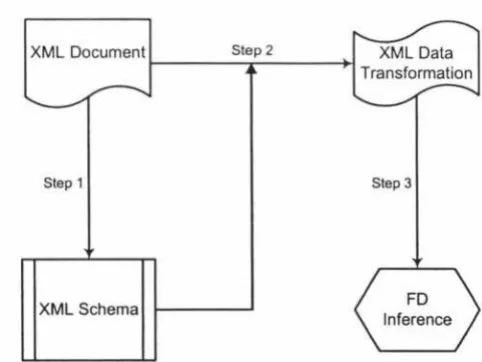
Figure 1.1 shows the entire work flow:
XML Document Step2
I , .
-Step 1
XML Schema
XML Data Transformation
Step 3
FD Inference
[image:10.560.141.382.484.665.2]1.3 Related Work
1.3.1
Hypothesis Research
The inference of structure out of semi-structured data has been long-standing in the
XML research area [Sakakibara, 1997]. Some approaches investigated possible solutions
derived from theoretical grammatical inference and were very powerful at the conceptual
level. [Ahonen, 1996] presented a technique based on machine learning, with the help
of finite-state automata describing the given instances completely. These automata were
modified by considering certain context conditions, corresponding to generalisation of the
underlying language, which were then converted into regular expressions to construct
the grammar. Although traditional grammatical inference methods for DTD generation
stated in [Ahonen, 1996] are theoretically appealing (as they guarantee to infer languages
falling within certain language classes), it is not clear whether the structure within the
limited context is valid in practice, i.e., its theoretical appeal may not necessarily translate
into practical applicability.
[Young-Lai, 1996] discussed a grammatical inference method generating stochastic finite
automata using an adapted stochastic method and attempted to improve it by isolating
low frequency data components and allowing adjustment at the generalisation level. This
approach was derived from more recent work in grammatical inference, with the base
algorithm known as Alergia [Carrasco and Oncina, 1994]. As with the methods of Ahonen,
Alergia has strong theoretical significance. Again, though, our interest lies in practical
performance. Moreover, none of them even touched the problem of how to present schema
information with high understandability to the user.
[Garofalakis et al., 2000] proposed XTRACT, a specialized DTD induction system
con-sisting of a generation module, a factoring module and an MDL1 (Minimum Description
Length) module. XTRACT employed generalisation and factorisation of regular
expres-sions, to derive a pool of candidate DTDs, and then used the MDL principle as the basis
to make a final selection. Still, XTRACT requires human intervention and judgement in
making a choice out of all candidates.
CHAPTER 1. INTRODUCTION 10
1.3.2
Schema Derivation Algorithms
Some research focusing on XML practice has also been going on, mainly centring on DTD
and schema tree extraction. [Chen, 1991] talked about generation of 'de-facto grammar',
which simply aggregated structures of all XML instances to be the DTD. The de-facto
grammar is obviously far too simple and limited.
[Chidlovskii, 2002] modelled the XML schema as extended context-free grammars and
developed an extraction algorithm inspired by methods of grammatical inference. The
algorithm was also said to cope with the schema determinism requirement imposed by
XML DTDs and XML Schema languages. He defined (range) Extended Context Free Grammar (ECFG) as a 5-tuple G
=
(T, N, D, 5, Start), where T, N and D are disjoints set of terminals, non-terminals and datatypes; Start is an initial non-terminal and 5 is afinite set of production rules. The rules take the form A-+ a for A E N, where a is a range
regular expression over terms, and one term is a terminal-nonterminal-terminal sequence
like t B t', briefly t: B, where t, t' ET and BE NU D. The extraction algorithm firstly
generalized ECFG from XML content, which was then transformed to an XML schema
definition. Details of the algorithm are shown in Figure 1.2:
0. Represent XML documents as set I of structured examples.
1. Induce an extended context-free grammar G from J:
1.1 Create the initial set of nonterminals N:
1.2 Merge nonterminals in N with the similar content and context;
1.3 Determine tight datatypes for terminals in G;
1.4 Generalize contents in nonterminals into range REs.
[image:12.559.69.475.443.571.2]2. Transform the result ECFG G into an XML Schema definition S.
Figure 1.2: ECFG Extraction Algorithm (Adapted from [Chidlovskii 2002, p. 292])
In addition to work concerned with the problem of DTD inference, there have also been
many papers published on related topics. Most notable amongst these is work within the
Lore semistructured database project to infer DataGuides [Goldman and Widom, 1997].
This included the MakeDataGuide algorithm to construct a strong DataGuide over a
source database as shown in Figure 1.3 - A DataGuide is strong iff it shares exactly
the same set of label paths as in the source, nothing more or less. Despite its simplicity
any technical aspects, such as data structure, i.e., how the schematic information can be
actually stored and utilised.
/ / Input: o, the aid of the root of a source database
/ / Effect: dg is set to be the root of a strong DataGuide for o
targetHash = global empty hash table, to map source target sets to DataGuide
objects
dg = global aid
MakeDataGuide( o) {
}
dg = NewObject()
targetHash.Insert( o, dg)
RecursiveMake( o, dg)
RecursiveMake(tl, dl) {
}
p = set of <label, oid> children pairs of each object in t1
foreach ( unique label l in p) {
t2 = set of oids paired with l in p d2 = targetHa.sh.Lookup(t2)
if (d2 != nil) {
add an edge from dl to d2 with label l
} else {
}
}
d2 = NewObject()
targetHa.sh.Insert(t2, d2)
add an edge from dl to d2 with label l
RecursiveMake( t2, d2)
Figure 1.3: Algorithm MakeDataGuide (Adapted from [Goldman et al. 1997 , Figure 4,
p. 8])
1.3.3
Schema Tree Inference Algorithms
The subject of schema tree and related issues, such as tree extraction, are not recent in
research area. A labelled tree specifying nesting relationships between labelled vertices was referred to as XML schema tree elements [Cruz et al., 2004]. A schema tree was also
[image:13.560.89.498.119.562.2]CHAPTER 1. INTRODUCTION 12
sequence (','), repetition ('*'), union ('I'),
<
tagname>
(corresponding to a tag) and<
simpletype>
(
corresponding to base types) [Ramanath et al., 2003].[Chen et al., 2002] stated a schema tree generation algorithm as displayed below:
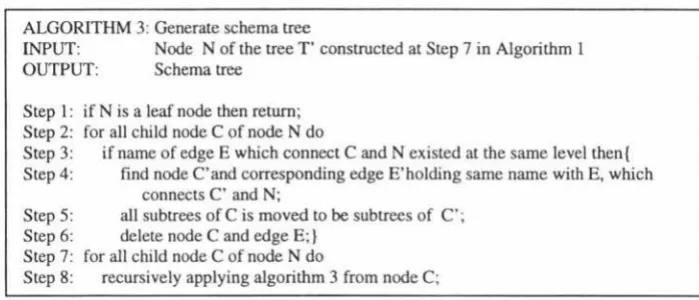
ALGORITHM 3: Generate schema tree
INPUT: Node N of the tree T' constructed at Step 7 in Algorithm 1 OUTPUT: Schema tree
Step 1: if N is a leaf node then return;
Step 2: for all child node C of node N do
Step 3: if name of edge E which connect C and N existed at the same level then{ Step 4: find node C'and corresponding edge E'holding same name with E, which
connects C' and N;
Step 5: all subtrees of C is moved to be subtrees of C'; Step 6: delete node C and edge E;}
Step 7: for all child node C of node N do
Step 8: recursively applying algorithm 3 from node C;
Fig.9: Generate schema tree algorithm
Figure 1.4: Schema Tree Generation (Adapted from [Chen et al. 2002 , Figure 9, p.84])
There are at least three deficits in this algorithm: firstly, it only considers, compares and
processes identical elements appearing at the same level (in Step 3), exclusive of the
sce-nario with one element occurring at different levels. Secondly, it just simply aggregates subtrees of all occurrences of an element (node) (in Step 5), which will merely give a
document tree at most, instead of a schema tree as supposed. Third, structural
informa-tion captured is rather poor; only a collection of possible sub-element names, without any
knowledge of element order, whether they are optional, compulsory, or iterating.
1.3.4 XML-RDB Mapping
Researchers have already shown their interest in transforming data in XML format into
relational database. [Christophides et al., 1994] proposed a one-to-one mapping from each
element declaration in the DTD to a relation. It is apparently a simple way of generating
corresponding relational schema but likely leads to excessive fragmentation.
[Shanmugasundaram et al., 1999] suggested analyse a DTD and automatically convert it
to a set of relational schemata. To do this, the original DTD should be firstly simplified
[image:14.560.90.440.179.329.2]• Basic approach Generate a DTD graph after grouping or flattening element
frequency specifications and the respective element graph on which the relational
schemata are decided;
• Shared approach Create a separate relation for each element node represented
by multiple relations in the basic approach, and share this relation; or
• Hybrid approach
element processing.
Same as the shared approach except for some variance in
Their work will also result in excessive fragmentation of DTDs, causing unnecessary data
scatter, which incurs unaffordable cost from joins when multiple relations need to be
accessed.
A new inlining algorithm was put forward by [Lu et al., 2003], featuring modeling XML
attributes as XML elements since they can be treated as elements without further nesting
structure. It comprises similar steps as the others: Create a DTD graph after DTD
simplification and inline as many descendant elements as possible to an XML element to
eliminate redundancy caused by shared elements in the generated schema, which is to be
eventually generated based on the inlined DTD graph. Such an inlining algorithm can
relatively reduce redundancy in comparison to the shared approach introduced previously, though data scatter is still present.
[Yan and Fu, 2001] described construction of schema prototype trees representing the
structure of a simplified DTD and subsequent generation of relational schema
proto-types. They also briefly mentioned functional dependency and candidate key detection
and relational schema prototype normalisation techniques.
In a summary of relevant literature, most of them are of little practical significance and
ap-plicability as their studies are no more than academic research, although their complexity
varies. Furthermore, none of them even addressed how to render the schema information
to the user. Nearly all research on XML-RDB mapping is somewhat a schema-awared
approach, requiring the existence of the DTD to operate, which most XML documents in
CHAPTER 1. INTRODUCTION 14
1.4
Our Contribution
In our research, we delved into both schema extraction and the XML-Relation data
trans-formation problem. A novel data representation model, ER-XML (Element Relationship model for XML) was devised, utilising an implementation-focused algorithm capable of
being directly applied to XML practice. ER-XML can also help to extract and identify
cardinality constraints. The data structure invented was properly designed to facilitate graphical representation generation as well as compatibility validation. As for XML-Relation transformation, we have developed an entire set of algorithms, SVT-Trans with the help of ER-XML and the concept of 'Almost Copy' in XML tree, which retrieves
semantic data from an original XML document and places them into a relational
for-mat using recursion computation. The output of SVT-Trans can be directly exploited
by relational functional dependency discovery algorithms. A prototype system was also successfully implemented and a case study was provided which demonstrated correctness and soundness of our work.
1.5
Thesis Outline
Following the introduction and review of related work, Chapter 2 of the thesis presents
some essential XML and affiliated technology. We investigate XML schema extraction and
illustrate the ER-XML model and the ER-XML Extraction (EXE) algorithm in Chapter
![Figure 1.2: ECFG Extraction Algorithm (Adapted from [Chidlovskii 2002, p. 292])](https://thumb-us.123doks.com/thumbv2/123dok_us/8361689.314820/12.559.69.475.443.571/figure-ecfg-extraction-algorithm-adapted-chidlovskii-p.webp)
![Figure 1.3: Algorithm MakeDataGuide (Adapted from [Goldman et al. 1997 , Figure 4, p. 8])](https://thumb-us.123doks.com/thumbv2/123dok_us/8361689.314820/13.560.89.498.119.562/figure-algorithm-makedataguide-adapted-goldman-et-al-figure.webp)