R E S E A R C H A R T I C L E
Open Access
Declining tuberculosis prevalence in Saharia,
a particularly vulnerable tribal community in
Central India: evidences for action
V. G. Rao
1*, J. Bhat
1, R. Yadav
1, R. K. Sharma
1and M. Muniyandi
2Abstract
Background:In spite of an alarmingly high tuberculosis (TB) burden amongst the Saharia tribe of central India, there is hardly any study to investigate the impact of DOTS implementation on the magnitude of tuberculosis disease and the changes over time. This article present the findings of TB prevalence surveys conducted amongst this indigenous population in two different time periods to know the change in the prevalence of TB.
Methods:A cross sectional survey was conducted among Saharia population in Shivpuri district, Madhya Pradesh during February 2013 to May 2013 and resurvey during March 2015 to July 2015. All individuals (≥15 years) were examined for chest symptoms suggestive of TB. Sputum samples were collected from all presumptive TB cases and were confirmed by laboratory examination by Ziehl-Neelsen smear microscopy and solid media culture methods. All detected cases were referred to health facility for anti-tuberculosis treatment as per RNTCP guidelines.
Results:There was significant reduction (trend Chi square 19.97; OR = 1.521;p= 0.000) in the prevalence of TB at the endline (1995 per 100,000) as compared to baseline (3003 per 100,000). The reduction was significant among males as compared to females (OR 1.55;p= 0.000) and in the age group of 25–34 years (OR 2.0;p= 0.007) and 45–54 years (OR 4.39;p= 0.003). There was significant reduction in the prevalence in both smear (OR 1.29;p= 0.02) and culture positive (OR 1.57;p= 0.000) TB at the endline survey.
Conclusion:The study findings highlight a reduction in the prevalence of TB among Saharia tribal population. Further studies are needed to identify the factors associated with reduction in prevalence among this population and also further surveys to monitor the prevalence trend over a period.
Keywords:Tuberculosis, Prevalence, Tribal, Saharia, PVTG, Madhya Pradesh, India
Background
The tribal populations in India are one of the marginalised sections who are constrained by structural and cultural barriers in accessing health services. The magnitude of tuberculosis disease among vulnerable population and the changes over time are useful indicators for understanding the extent of TB transmission and for monitoring the effectiveness of TB control in the area. Information on these aspects is not available in tribal areas as it is difficult to obtain such information at the community level espe-cially in a large country like India with limited resources.
In India, the tribal population is 104 million constituting 8.6% of the total population and more than 70% of these reside in central Indian states of the country [1,2]. Mad-hya Pradesh is one of the central Indian states accounting for 21.1% of tribal population with 46 ethnic groups. Of these, three are notified as Particularly Vulnerable Tribal
Groups (PVTGs) [3]. The Saharia tribe is one among
these PVTGs living in geographically isolated locations, working mainly as agriculture labours with very low socio economic living conditions. A very high prevalence of infection (20.4%) and TB disease (1518 per 100,000) has been reported among them [4, 5]. A recently conducted TB disease prevalence survey in Gwalior district show alarmingly high TB prevalence of 3294 per 100,000 in this community [6]. The high prevalence of PTB was found to
* Correspondence:[email protected]
1ICMR -National Institute of Research in Tribal Health, (Indian Council of
Medical Research), Nagpur Road, P.O. Garha, Jabalpur 482 003, India Full list of author information is available at the end of the article
be associated with malnutrition, poor housing conditions, alcoholism, tobacco smoking and history of asthma. HIV was not found to be a risk factor among them [7,8].
Following a review of the National Tuberculosis Programme (NTP) in 1992, the Government of India initiated the Revised National Tuberculosis Control Programme (RNTCP) in 1993 and adopted internationally recommended Directly Observed Treatment Short-course
(DOTS) strategy [9]. RNTCP after being successfully
implemented for more than two decades had resulted in significant reduction of TB prevalence and it was
demon-strated in Tamil Nadu [10]. With this background, we
conducted periodic prevalence surveys to investigate the impact of DOTS implementation in this tribal community residing in hard to reach tribal areas of Shivpuri district of the state. This paper present the findings of the baseline and endline TB prevalence surveys conducted amongst them by the ICMR - National Institute for Research in Tribal Health (NIRTH), Jabalpur.
Methods
Study area and population
Saharia is the main tribal community in Shivpuri district, northwest Madhya Pradesh in central India. They gene-rally inhabit small clusters of houses - a hamlet called as ‘Saharana’ outside the main village. A cross sectional sample survey was conducted among Saharia population in tribal dominated Pohri Block of the district during February 2013 to May 2013 and resurvey during March 2015 to July 2015 using the same methodology. The Directly Observed Treatment, Short-course (DOTS) has been implemented under the Revised National Tuberculosis Control Programme (RNTCP) in the study area since 2004. In addition to tuberculosis case detection under RNTCP at health facilities, a community survey for active tuberculosis detection was undertaken in the study area as epidemiological investigation.
Sample size calculation
Assuming 25 % precision with 95% confidence level, de-sign effect of two to adjust for clustering effect and 90 % sample coverage, the sample size of 9225 was calculated based on the reported prevalence of 1518/100,000 bac-teriologically positive TB cases among tribal population [5]. Considering the average size of a Saharia hamlet as 300, it was estimated that about 45 villages would be required to be visited to cover the estimated sample of 9225 adult population (15 years and above).
Sampling design and procedure
Villages were covered as the primary sampling units. Of the total 254 villages in Pohri Block, 128 were Saharia dominated (> 70% Saharia population) villages and 45 villages were randomly selected from these villages.
Additional eight adjoining Saharia villages were also selected during the baseline survey to cover the sample of 9225 individuals. All these 53 villages were covered in the baseline and endline surveys.
Data collection
Systematic communications with the local tribal leaders were established by the study team to inform them about the purpose of our survey. Study team also con-ducted community meetings prior to the survey. After this sensitization, house to house census was carried out by our trained field investigators and household infor-mation was recorded in an individual card in a pre-coded form. A baseline survey was conducted among all individuals aged 15 years and above to screen for symp-toms suggestive of TB viz. cough for≥2 weeks, fever≥1
month, chest pain for≥1 month and history of
haemop-tysis. Individuals remaining absent for symptom inquiry were revisited the same day or on subsequent days until at least 90% coverage was achieved. Persons having any of these symptoms were considered as chest symptom-atic and two sputum specimens were collected for smear and culture examination. One sputum sample was collected on the spot and the overnight sample was col-lected in the morning in sterilized McCartney’s bottles from chest symptomatics as well as from asymptomatic individuals having a prior history of receiving anti TB treatment. The samples were sent to the ICMR-NIRTH laboratory, Jabalpur for smear and culture. ZN method was used to prepare smears from the concentrated sam-ples. For culture examination, the sputum samples were kept in refrigerated condition till bacteriological investi-gations were carried out. The samples were processed and inoculated on 2 slopes of Lowensten Jensen (LJ) medium. The cultures were incubated and examined every week for the presence of mycobacterial colonies for a period of 8 weeks. In case of no growth or
contami-nation, the cultures were discarded. M. Tuberculosis
growth was confirmed using niacin test, 68 °C catalase test
and growth on LJ with PNB (500μg/ml). Individuals
having positive smear and/or culture were considered to have tuberculosis and were referred to the health facility for anti-tuberculosis treatment as per RNTCP guidelines.
Data management
All the completed cards and laboratory reports were scrutinized, checked for completeness and any incom-plete forms sent back to the field for comincom-pleteness. All the data were computerized in entry package developed on Census and Survey Processing System (CSPro) and SPSS was used for analysis. A pulmonary TB case was defined as an individual whose sputum was positive for
AFB by ZN microscopy and/or growth ofM. tuberculosis
per 100,000 population and univariate analysis age, sex wise stratification was done. Statistical tool used was univariate analysis. Chi square test of significance was used to test differences in distribution of study popula-tion. Trend Chi square was used to test the prevalence differences in different surveys. The p value of < 0.05 was considered as the level of statistical significance.
Ethical issues
The study was approved by the Institutional Ethics Committee at ICMR - National Institute of Research in Tribal Health, Jabalpur. The trained field investigators approached eligible individuals and explained the proce-dures, risks and benefits of the study in the local language. Written informed consent was obtained from all individuals willing to participate. All the patients diagnosed during the survey were referred to RNTCP and free counselling was provided to complete full course of the treatment.
Results
Coverage and TB cases
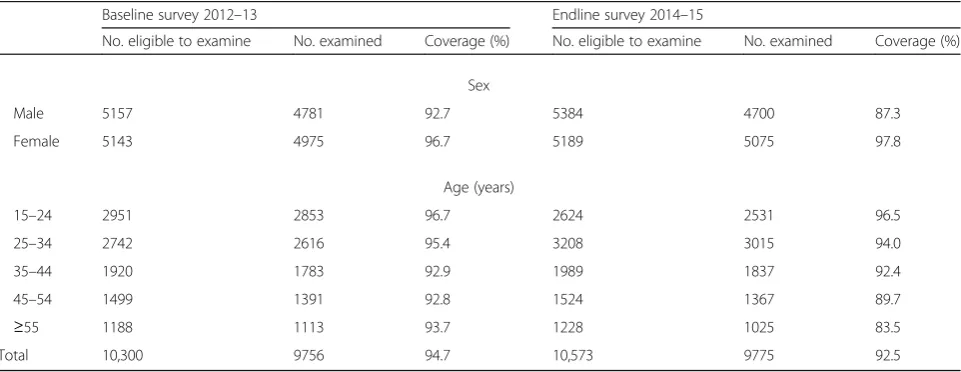
Of the total 10,300 and 10,573 individuals eligible for screening for baseline and endline surveys 9756 (94.7%) and 9775 (92.5%) individuals belonging to Saharia tribal
community were screened (Table 1). Of the individuals
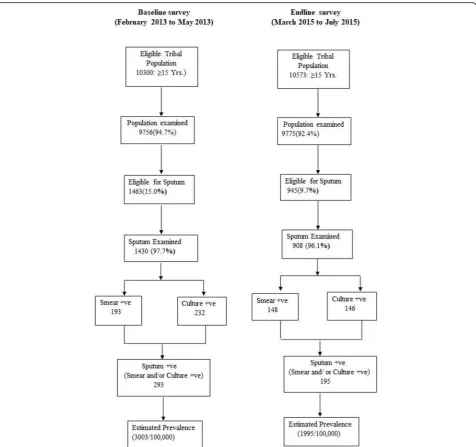
screened for symptoms, 1463 (15.0%) and 945 (9.7%) were found to be symptomatic and sputum was collected from 1430 (97.7%) and 908 (96.1%) in baseline and end line surveys respectively. The coverage of > 90% was achieved during both the surveys. At the baseline and endline surveys, a total of 9756 and 9775 population was screened and 293 and 195 TB cases were detected respectively (Fig.1), i.e. 50 Saharia individuals needed to be screened for detecting one PTB case in the endline survey as compared to 33 individuals in the baseline
survey. The number of cases detected among male population was three times higher as compared to cases detected among females in both the surveys (231& 62 in baseline, 149& 46 in endline).
Prevalence of pulmonary tuberculosis
The overall prevalence among tribal population was found to be 3003 (95% Confidence Interval (CI): 2296–3710) per 100,000 in the baseline and 1995 (95% CI, 1323–2667) per 100,000 in the endline sur-vey. There was significant reduction (trend Chi square
19.97; OR = 1.521; p= 0.000) in the prevalence of TB
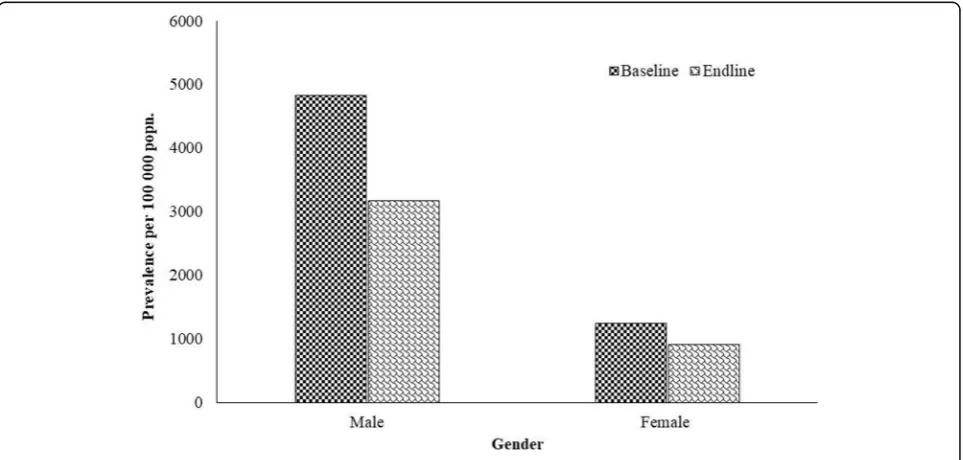
at the endline as compared to baseline (Fig.2). In both the surveys, higher prevalence was observed among males compared to females (baseline 4832 vs 1246/ 100,000 population; endline 3170 vs 906/ 100,000 population). The reduction in prevalence was 1662 ((34.4%) among males and 340 (27.3%) among females (Fig.3). There was signifi-cant prevalence reduction among males as compared to
females (OR 1.55; p= 0.000). A significantly higher
prevalence was consistently observed among males compared to females for smear, culture and bacterio-logically positive PTB.
[image:3.595.58.539.546.732.2]The prevalence of smear positive PTB was estimated to be 1978 and 1514 per 100,000 during baseline and endline respectively. The prevalence of culture positive PTB was estimated to be 2378 and 1494 per 100,000 during baseline and endline respectively. There was sig-nificant reduction in the prevalence in both smear (OR 1.29; p= 0.02) and culture positive (OR 1.57;p= 0.000) TB at the endline as compared to baseline survey. The significant reduction in the prevalence in both smear and culture positive TB was also seen among males as compared to females (change in smear prevalence 25% vs 12.6%; culture positive 37.9% vs 31.2% respectively). The prevalence reduction was higher (more than 45%)
Table 1Coverage of study population at baseline and endline surveys
Baseline survey 2012–13 Endline survey 2014–15
No. eligible to examine No. examined Coverage (%) No. eligible to examine No. examined Coverage (%) Sex
Male 5157 4781 92.7 5384 4700 87.3 Female 5143 4975 96.7 5189 5075 97.8
Age (years)
15–24 2951 2853 96.7 2624 2531 96.5 25–34 2742 2616 95.4 3208 3015 94.0 35–44 1920 1783 92.9 1989 1837 92.4 45–54 1499 1391 92.8 1524 1367 89.7
≥55 1188 1113 93.7 1228 1025 83.5
among adult population aged 25–54 as compared to younger population. However, an increase in culture positive TB in the endline (2965 to 3024/100000) among
population aged 55 years and above (Table 2). The
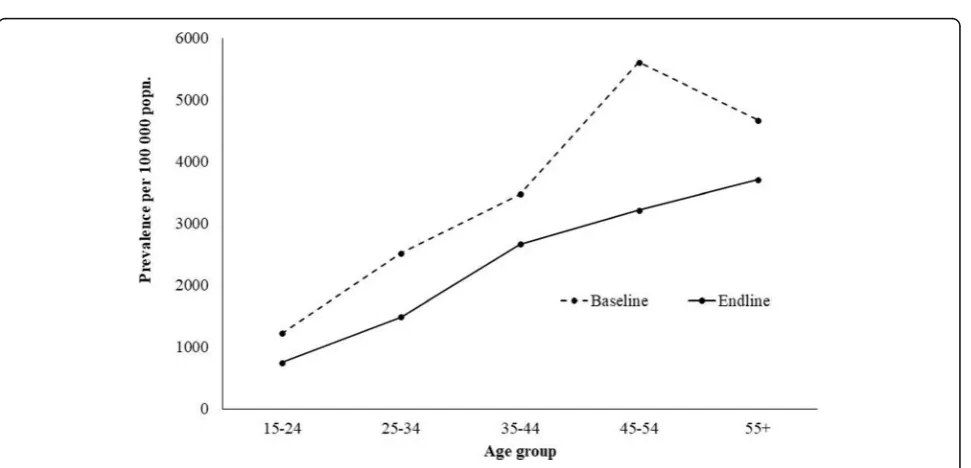
prevalence of PTB increased with the age in both the baseline and endline surveys (Fig.4). The reduction of TB was significant in the age group of 25–34 years (OR 2.0;p= 0.007) and 45–54 years (OR 4.39;p= 0.003).
Discussion
The salient finding from this study is the decreasing trend in prevalence of PTB in Saharia tribal community of cen-tral Indian state of Madhya Pradesh. Analysis of data on burden of disease caused by TB and the effectiveness of
programmatic efforts to reduce this burden are crucial for public health action [11]. Further, this analysis is essential for programme evaluation which helps guide decisions about TB control management activities and policy. It supports TB control programme managers to monitor trends in the number and distribution of TB cases across the region. This enables TB control activities to report on the country’s TB epidemic and progress in reaching TB control goals and objectives. It also helps TB control programme managers to develop targeted national strategies and budget plans.
The current finding from community based prevalence survey highlight alarmingly high TB disease burden among Saharia tribe as compared to the national average
[image:4.595.61.538.86.533.2]and different population groups within the country [5]. This finding corroborate with the global evidences of
high burden of TB among indigenous population [12].
The incidence of TB among indigenous peoples in Latin America was 1000/100000 and it was around 20 times higher than the incidence in the general population [13]. Among Yanomami people found the incidence of TB to be 2133/100000, or 37 times higher than in the surroun-ding non-indigenous population [14]. Indigenous people living in Cotopaxi Province in Ecuador’s highlands had TB prevalence rates reaching 6700/100000 [15].
It is encouraging that the repeat survey showed reduc-tion in TB prevalence suggesting that efforts to improve TB control through active case finding was one of the important contributory factor in reducing the preva-lence. The study from south India reported substantial reduction in TB prevalence in 5 years with DOTS imple-mentation along with active case finding in the popu-lation [16, 17]. The tribal population in India also has access to free DOTS under RNTCP. This could be a plausible factor behind decreasing trend of TB among this vulnerable population. The analysis of national
Fig. 2Prevalence of TB in two different surreys (base line and end line)
[image:5.595.57.541.88.304.2] [image:5.595.58.540.488.718.2]Table 2Prevalence of smear positive and culture positive TB at two different time points
Number examined Number of Pulmonary TB Prevalence Per 100,000 popn. Change in prevalence Baseline Endline Baseline Endline Baseline Endline No % Smear-positive
Sex
Male 4781 4700 156 115 3263 2447 816 25.0 Female 4975 5075 37 33 744 650 93 12.6
Age (years)
15–24 2853 2531 24 17 841 672 170 20.2 25–34 2616 3015 42 37 1606 1227 378 23.6 35–44 1783 1837 45 39 2524 2123 401 15.9 45–54 1391 1367 51 31 3666 2268 1399 38.1
≥55 1113 1025 31 24 2785 2341 444 15.9
Culture positive Sex
Male 4781 4700 185 113 3869 2404 1465 37.9 Female 4975 5075 47 33 945 650 294 31.2
Age (years)
15–24 2853 2531 24 17 841 672 170 20.2 25–34 2616 3015 52 31 1988 1028 960 48.3 35–44 1783 1837 62 34 3477 1851 1626 46.8 45–54 1391 1367 61 33 4385 2414 1971 45.0
≥55 1113 1025 33 31 2965 3024 −59 −2.0
[image:6.595.58.544.483.717.2]surveys conducted during 1990–2012 in Asia show 50% decrease in TB disease within a period of 10 years with some countries showing even greater decline with the available intervention techniques and methods [18].
However, the reduction among elderly population is less as compared to other age group particularly culture positive TB. It has been reported that smear positive TB is less in elderly and there are more chances for adverse drug reactions, default or death of newly diagnosed TB cases in this age group [19,20]. Policy makers, in consultation with all the stakeholders, should consider developing specific intervention strategies for TB management in this popula-tion group. At the same time, the studies are also required to understand the effect of such interventions on the possible concentration of cases in this group. Given that TB prevalence was high among the elderly, there is a need to step up efforts to manage this vulnerable population.
The current study finding of reduction in TB pre-valence occurred in a very short period, whereas the findings from four countries (Cambodia, China, the Philippines and Republic of Korea) demonstrated that approximately 50% reductions in TB prevalence can be achieved within 10 years [21–23]. Our findings could be understood in different programmatic context. India’s
RNTCP’s DOTS strategy covered the entire country in
2006 and considering the high burden of TB among tribal population and structural barrier for diagnosis and treatment of TB in tribal areas, a tribal action plan was developed and implemented in parallel under RNTCP since 2005. Under the tribal action plan, strengthening and expansion of additional health facilities and involve-ment of community health workers was ensured. In addition, among Saharia population in Shivpuri district, IEC campaigns and door-to-door active TB case detec-tion survey were implemented. The reducdetec-tion in TB burden among this population could be due to the cumulative effect of all these interventions.
The study population is economically poor, socially marginalized, living far away from the main locality. There are numerous challenges that this population face in accessing healthcare facility which includes poverty, shortages of healthcare workers, non-availability of me-dicines, higher transportation cost, work absenteeism, lack of awareness on health facility and availability of treatment. Under the RNTCP Tribal Plan, additional decentralization of diagnosis and treatment services and special incentives to the health workers for tribal areas
are provided [24]. The programme performance in the
area has shown gradual improvement since implemen-tation of RNTCP with an increase in the case detection rate from 121% in 2005 to 159% in 2017 and in the cure
rate from 67% in 2005 to 83% in 2017 [25, 26]. Way
back in 1989, Styblo had also highlighted the challenge before the policy makers that a significant cure rate
among smear positive pulmonary TB cases is pre-requisite to achieve overall improvement in TB burden in develop-ing countries [23]. It is important to have regular and effective monitoring in place in order to understand the effects of the intervention strategies –the improvements or otherwise in disease trend. The surveys carried out at regular intervals may also help in understanding the trend.
Limitations of the study
The information on socioeconomic change in the commu-nity was not available and so its possible impact could not be assessed. Moreover, this evidence is generated from the Saharia tribe where HIV infection and MDR-TB are not highly prevalent [8,27]. Our conclusion therefore, cannot be generalized to all areas, especially to those with a high prevalence of HIV infection or MDR-TB and non-tribes.
Conclusion
In summary, our study has shown that there is a reduc-tion in prevalence of TB among Saharia tribal popula-tion. The factors which led to the reduction in prevalence between the study periods need to be further studied. In general, there is a need for effective public health strategies for intervening disproportionate TB burden among Saharias, who live in resource poor settings.
Abbreviations
AFB:Acid-Fast Bacilli; CSPro: Census and Survey Processing System; DOTS: Directly Observed Treatment Short-course; HIV: Human immunodeficiency virus; ICMR : Indian Council of Medical Research; IEC: Information, education and communication; LJ: Lowensten Jensen; MDR-TB: Multi-Drug-Resistant Tuberculosis; NIRTH: National Institute of Research in Tribal Health; NTP: National Tuberculosis Programme; PTB: Pulmonary tuberculosis; PVTG: Particularly Vulnerable Tribal Group; RNTCP: Revised National Tuberculosis Control Programme; SPSS: Statistical package for the social sciences; TB: Tuberculosis; ZN: Ziehl-Neelsen
Acknowledgements
The authors gratefully acknowledge the contributions of the State Tuberculosis Officer,District Tuberculosis Officer,the WHO/RNTCP consultant, Block Medical Officers and field staff in the district. We thank our study subjects for their cooperation throughout the study. The assistance provided by Ms. Preeti Tiwari, Mrs. Priyashri Tiwari Pandey and Ms. Pushpa Vishwakarma for the entry, verification and analysis of the data is acknowledged. Thanks are also due to the laboratory and field staff involved in the study.
Funding
The study was supported by the Indian Council of Medical Research, New Delhi. The funding agency had no role in the design of the study; collection, analysis and interpretation of data and in writing the manuscript.
Availability of data and materials
The datasets used and/or analysed during the current study available from the corresponding author on reasonable request.
Authors’contributions
Ethics approval and consent to participate
The study was approved by the Institutional Ethics Committee at ICMR -National Institute for Research in Tribal Health, Jabalpur. Written informed consent was obtained from all individuals willing to participate. The written assent and permission from parents/guardians was obtained for participants under 16 years of age.
Consent for publication
Written informed consent/assent was obtained from the participants for publication.
Competing interests
The authors declare that they have no competing interests.
Publisher’s Note
Springer Nature remains neutral with regard to jurisdictional claims in published maps and institutional affiliations.
Author details 1
ICMR -National Institute of Research in Tribal Health, (Indian Council of Medical Research), Nagpur Road, P.O. Garha, Jabalpur 482 003, India.2ICMR
-National Institute for Research in Tuberculosis, (Indian Council of Medical Research), No. 1, Mayor Sathiyamoorthy Road, Chetpet, Chennai 600031, India.
Received: 6 August 2018 Accepted: 13 February 2019
References
1. Government of India. Annual Report 2016–17. Ministry of tribal affairs, Government of India. 2017.https://www.tribal.nic.in/writereaddata/ AnnualReport/AnnualReport2016-17.pdf.
2. Government of India. Statistical profile of scheduled tribes in India. Ministry of tribal affairs. Government of India. 2013.https://tribal.nic.in/ST/ StatisticalProfileofSTs2013.pdf.
3. Tewari DN. Primitive tribes of Madhya Pradesh–strategy for development. New Delhi: Government of India, Ministry of Home Affairs, Tribal Development Division; 1984.
4. Rao VG, Gopi PG, Yadav R, Sadacharam K, Bhat J, Subramani R, et al. Tuberculosis infection in Saharia, a primitive tribal community of Central India. Trans Trop Med Hyg. 2008;102(9):898–904.
5. Rao VG, Gopi PG, Bhat J, Selvakumar N, Yadav R, Tiwari B, et al. Pulmonary tuberculosis : a public health problem amongst Saharia, a primitive tribe of Madhya Pradesh, central India. Int J Infect Dis. 2010;14(8):e713–6.https://doi. org/10.1016/j.ijid.2010.02.2243Epub 2010 Jun 3.
6. Rao VG, Bhat J, Yadav R, Muniyandi M, Sharma R, Bhondeley MK. Pulmonary tuberculosis - a health problem amongstSahariatribe in Madhya Pradesh. Indian J Med Res. 2015;141:630–5.
7. Rao VG, Bhat J, Yadav R, Muniyandi M, Sharma R. Bhondeley MK. A comparative study of the risk factors for pulmonary tuberculosis in Saharia tribe of Madhya Pradesh, India. Trans R Soc Trop Med Hyg. 2018;112:272–8. 8. Bhat J, Rao VG, Sharma RK, Muniyandi M, Yadav R, Bhondley MK.
Investigation of the risk factors for pulmonary tuberculosis: a case–control study among Saharia tribe in Gwalior district, Madhya Pradesh, India. Indian J Med Res. 2017;146:97–104.
9. WHO Global Tuberculosis Programme. Framework for effective tuberculosis control. WHO/TB/94.179. Geneva: WHO; 1994.
10. Subramani R, Radhakrishna S, Frieden TR, Kolappan C, Gopi PG, Santha T, et al. Rapid decline in prevalence of pulmonary tuberculosis after DOTS implementation in a rural area of South India. Int J Tuberc Lung Dis. 2008;12(8):916–20.
11. World Health Organization. Understanding and using tuberculosis data. World Health Organization. Geneva: WHO/HTM/TB/2014.09; 2014. 12. Tollefson D, Bloss E, Fanning A, Redd JT, Barker K, McCray E. Burden of
tuberculosis in indigenous peoples globally: a systematic review. Int J Tuberc Lung Dis. 2013;17(9):1139–50.
13. Escobar AL, Coimbra CE Jr, Camacho LA, Portela MC. Tuberculosis among indigenous populations in Rondonia, Amazonia, Brazil. Cad SaudePublica. 2001;17:285–98.
14. Levino A, de Oliveira RM. Tuberculosis among the Indian population in Sao Gabriel da Cachoeira, Amazonas State, Brazil. Cad Saude Publica. 2007;23:1728–32.
15. Romero-Sandoval NC, Flores-Carrera OF, Sánchez-Pérez HJ, Sánchez-Pérez I, Mateo MM. Pulmonary tuberculosis in an indigenous community in the mountains of Ecuador. Int J Tuberc Lung Dis. 2007;11:550–5.
16. Subramani R, Radhakrishna S, Frieden TR, Kolappan C, Gopi PG, Santha T, et al. Rapid decline in prevalence of pulmonary TB after DOTS implementation in a rural area of South India. Int J Tuberc Lung Dis. 2008;12:916–20.
17. Kolappan C, Subramani R, Radhakrishna S, Santha T, Wares F, Baskaran D, et al. Trends in the prevalence of pulmonary tuberculosis over a period of seven and half years in a rural community in South India with DOTS. Indian J Tuberc. 2013;60:168–76.
18. Onozaki I, Law I, Sismanidis C, Zignol M, Glaziou P, Floyd K. National tuberculosis prevalence surveys in Asia, 1990–2012: an overview of results and lessons learned. Tropical Med Int Health. 2015;20(9):1128–45. 19. Pardeshi G, Deshmukh D. Disease characteristics and treatment outcomes in
elderly tuberculosis patients on DOTS. Indian J Community Med. 2007;32:292–4. 20. Velayutham BR, Nair D, Chandrasekaran V, Raman B, Sekar G, Watson B, et al.
Profile and response to anti-tuberculosis treatment among elderly tuberculosis patients treated under the TB control programme in South India. PLoS One. 2014;9(3):e88045.https://doi.org/10.1371/journal.pone.0088045.
21. Wang L, Zhang H, Ruan Y, Chin DP, Xia Y, Cheng S, et al. Tuberculosis prevalence in China, 1990–2010; a longitudinal analysis of national survey data. Lancet. 2014;383:2057–64.
22. Mao TE, Okada K, Yamada N, Peou S, Ota M, Saint S, et al. Cross–sectional studies of tuberculosis prevalence in Cambodia between 2002 and 2011. Bull World Health Organ. 2014;92:573–81.
23. Styblo K. Overview and epidemiologic assessment of the current global tuberculosis situation with an emphasis on control in developing countries. Rev Infect Dis. 1989;11(Suppl 2):S339–46.
24. Central TB Division, Government of India. Tribal action plan proposed for the World Bank assisted RNTCP II Project. New Delhi: Ministry of Health and Family welfare, Government of India; 2005.
25. Central TB Division, Government of India. TB INDIA 2006. RNTCP status report. New Delhi: Directorate General of Health Services, Ministry of Health and Family Welfare; 2006.
26. Central TB Division, Government of India. INDIA TB REPORT 2018. Annual status report. New Delhi: Revised National TB Control Programme, Directorate General of Health Services, Ministry of Health and Family Welfare; 2018. 27. Bhat J, Rao VG, Yadav R, Muniyandi M, Sharma R, Karfarma C, et al. Situation