R E S E A R C H
Open Access
Application of loop analysis for evaluation of
malaria control interventions
Junko Yasuoka
1*, Masamine Jimba
1and Richard Levins
2Abstract
Background:Despite continuous efforts and recent rapid expansion in the financing and implementation of malaria control interventions, malaria still remains one of the most devastating global health issues. Even in countries that have been successful in reducing the incidence of malaria, malaria control is becoming more challenging because of the changing epidemiology of malaria and waning community participation in control interventions. In order to improve the effectiveness of interventions and to promote community understanding of the necessity of continued control efforts, there is an urgent need to develop new methodologies that examine the mechanisms by which community-based malaria interventions could reduce local malaria incidence.
Methods:This study demonstrated how the impact of community-based malaria control interventions on malaria incidence can be examined in complex systems by qualitative analysis combined with an extensive review of literature. First, sign digraphs were developed through loop analysis to analyse seven interventions: source reduction, insecticide/ larvicide use, biological control, treatment with anti-malarials, insecticide-treated mosquito net/long-lasting insecticidal net, non-chemical personal protection measures, and educational intervention. Then, for each intervention, the sign digraphs and literature review were combined to analyse a variety of pathways through which the intervention can influence local malaria incidence as well as interactions between variables involved in the system. Through loop analysis it is possible to see whether increases in one variable qualitatively increases or decreases other variables or leaves them unchanged and the net effect of multiple, interacting variables.
Results:Qualitative analysis, specifically loop analysis, can be a useful tool to examine the impact of community-based malaria control interventions. Without relying on numerical data, the analysis was able to describe pathways through which each intervention could influence malaria incidence on the basis of the qualitative patterns of the interactions between variables in complex systems. This methodology is generalizable to various disease control interventions at different levels, and can be utilized by a variety of stakeholders such as researchers, community leaders and policy makers to better plan and evaluate their community-based disease control interventions.
Keywords:Qualitative analysis, Malaria control, Community-based intervention
Background
Malaria remains one of the most devastating global health threats. In spite of continuous efforts and recent rapid expansion in the financing and implementation of malaria control programmes, millions of people still suffer from a lack of access to preventive measures, diag-nostic testing and quality-assured treatment [1]. The Global Malaria Eradication Campaign in the 1950s and 60s failed due to its assumption that malaria eradication
could be achieved by a one-size-fits-all strategy rather than tailor-made interventions that take local contexts into account [2]. Yet current malaria control relies heav-ily on such a failed strategy, using a limited number of tools, particularly anti-malarial drugs and insecticide-treated mosquito nets/long-lasting insecticidal nets (ITN/LLIN), both of which have become less effective because of resistance [1]. Vector control follows a simi-lar strategy and has not been successful either mainly because of continued heavy dependence on chemical spraying, which has led to vectors’resistance to insecti-cides [3,4]. Furthermore, the lack of intersectoral co-operation, interdisciplinary approaches and community * Correspondence:[email protected]
1
Department of Community and Global Health, The University of Tokyo, 7-3-1 Hongo, Bunkyo-ku, Tokyo 113-0033, Japan
Full list of author information is available at the end of the article
participation has been impeding sustainability in mal-aria control efforts [5-7]. Consequently, these challenges have led to a growing interest in formulating new ap-proaches for developing, delivering and maintaining malaria control, especially in areas with high and/or unstable transmission [3,8,9].
When developing new strategies, possible consequences of each intervention need to be examined within a complex system. A majority of current efforts to plan and conduct interventions and to evaluate their effectiveness are nar-rowly focused on direct associations between a limited number of factors. For example, there has been a heavy reliance on insecticide to control malaria vectors mainly due to the belief in the single, direct aspect of the insecti-cide’s impact (lethal effect) on the pest. However, it does not necessarily work that way for at least three reasons: 1) a decrease in the vector population can decrease the predator population by affecting the availability of food for the predators; 2) insecticide directly reduces the predators of the vector; and, 3) natural selection in the vector population rapidly builds up resistance to the insecticide [10]. Therefore, there is a need for a methodology that en-ables us to better understand complex systems, to examine the associations and correlations among a var-iety of factors involved, and to foresee how unexpected consequences might occur.
Furthermore, the methodology needs to be utilized not only by researchers, policy makers and programme and project implementers, but also by community members. Community participation is a key to the success of mal-aria control interventions at the community level, and obtaining support and enthusiasm for participation is expected to become more challenging as malaria trans-mission becomes lower [2,11,12]. However, the lack of perceived risk of disease and inadequate knowledge about the reasons for conducting interventions are the two most influential factors negatively affecting accept-ability of communicable disease control and elimination programmes [2]. Therefore, it is vital to promote com-munity understanding of the whole picture of malaria control interventions conducted in the community, es-pecially about the role that community members play in the full system and how their actions and efforts might lead to a decrease in local malaria incidence. In this study, sign digraphs were developed using a method of qualitative modelling, loop analysis, to demonstrate how community-based malaria control could work in complex systems.
Methods
Loop analysis to develop sign digraphs
Details of the procedure to conduct loop analysis have been described elsewhere [10,13-15], and the method has been utilized as a standard approach mainly in
ecology and biology [16-20]. Briefly, loop analysis consists of the analysis of sign digraphs, which show whether in-creases in one variable qualitatively inin-creases or dein-creases other variables, or leaves them unchanged. It does not re-quire precise quantitative interaction rates for the system being studied. The directions of associations between vari-ables can be shown as a community matrix, which is a set of signs of interaction rates for each pair of variables [21]. The following matrix is an example of two variables, x1and x2. The effect from a variable x2on x1(a12) is negative (−), whereas that of variable x1on x2(a21) is positive (+). The variable x2also has a negative effect on itself when exces-sive levels are reached, which is called self-damping (a22). Here, positive or negative entries (+1 or−1) do not mean that the magnitude of the interactions between variables is equal.
The above matrix corresponds to a sign digraph, using symbols of loop analysis, as shown below.
An arrow from one variable to another denotes that the variable has a positive effect on the other, while a line ending in a circle denotes a negative effect on the other variable or itself. Here, the arrow a21from x1to x2 indicates a positive effect, and the line ending in a circle (a12) from x2to x1indicates a negative effect. Variable x2 is self-damped, represented by a line ending in a circle at itself (a22). (In Figures 1, 2, 3, 4, 5, 6 and 7, a comma is inserted between two numbers of variables for clarity.)
Malaria incidence (11) Breeding sites (2) Predators for
larvae (4) Source reduction (1)
Mosquitoes (8) Infective mosquitoes (9) a1,1
a2,1 a2,2 a1,15
a8,2 a4,2
a15,15
a11,9 a9,11 a9,8
a15,11 a8,4
Interventions targeting vectors
Interventions targeting humans
Positive impact
Negative impact
Educational intervention (Awareness)
[image:3.595.57.541.88.404.2](15)
Figure 1Source reduction.
Malaria incidence (11) Predators for
larvae (4)
Insecticide resistance (7) Insecticide Larvicide (3)
ITN/ LLIN (16)
Mosquitoes (8) Infective mosquitoes (9) Predators for
adults (5) a3,15
a16,16
a9,5 a5,3
a9,3 a8,3
a4,3 a3,3
a7,7 a7,16
a15,15
a16,7
a11,9 a9,11 a9,8
a15,11
a8,4
a16,15
a8,5 a3,7
a7,3
Educational intervention (Awareness)
[image:3.595.56.542.466.720.2](15)
intervention with the loop analysis method, connecting variables involved in the pathways. If any of the other six interventions were relevant to the intervention, they were included in the same sign digraph. (For example, all sign digraphs include the variable “educational intervention” because it has a positive impact on other interventions.) Each variable was randomly numbered so each pathway can be described in the text simply using the numbers. (For example, a negative impact of a variable“Source re-duction (1)”on another variable“Breeding sites (2)”is de-scribed as“a21(−)”in text). The decision on which sign to be used (positive, negative, or null) for each connection between variables was made based on a literature review of each intervention. Developing sign digraphs by combin-ing the method of loop analysis and literature review is a
unique approach taken in this study to qualitatively assess the mechanisms of how community-based malaria control intervention could influence local malaria incidence. Un-like other approaches to map out interventions, such as the intervention mapping approach [22], loop analysis ex-amines the interactions between variables involved in the interventions of interest.
Literature search
Peer-reviewed scientific literature on community-based malaria control interventions was searched through
Pubmed/MEDLINE using keywords“malaria”and “
com-munity” as major subjects. To search the literature for each intervention, these keywords were combined with terms referring to different types of interventions and
Malaria incidence (11) Predators for
larvae (4)
Mosquitoes (8) Infective mosquitoes (9)
Biological
control (12)
a15,15
a11,9 a9,11
a12,15
a12,12
a9,8
a8,12
a15,11 a8,4
a4,12
Educational intervention
(Awareness)
[image:4.595.59.539.88.314.2](15)
Figure 3Biological control.
Malaria incidence (11)
Antimalarials (13)
Infective mosquitoes (9)
Drug resistance (14)
a15,15 a11,9
a9,11
a15,11 a13,15
a14,14 a13,14 a14,13
a11,13
Educational intervention (Awareness)
(15)
[image:4.595.55.541.539.727.2]related variables, including “source reduction”, “ in-secticide”, “insecticide residual spraying”, “larvicide”, “biological control”, “mosquito fish”, “anti-malarials”, “education”, “awareness”, “bed net”, “insecticide-treated net”,“personal protection”,“house”, and“resistance”. Refer-ence lists in the literature found were reviewed for additional articles. Then, relevant articles that explain the associations between variables in the sign digraphs were
selected. Although information or data from primary sources were preferred, more general reviews and texts were also consulted.
Results
Source reduction
Source reduction provides the dual benefits of reducing the number of both indoor- and outdoor-biting mosquitoes
a15,15 Malaria incidence (11) Predators for
larvae (4)
Insecticide resistance (7) Insecticide
Larvicide (3) Plasmodium (6)
Biting rate/ Daily survival rate (10)
ITN/ LLIN (16) Mosquitoes (8) Infective mosquitoes (9)
Predators for adults (5)
a11,10
a10,16 a9,10
a10,6
a6,10 a3,15
a16,16
a9,6 a9,5
a5,3
a9,3 a8,3
a4,3 a3,3
a7,7 a7,16
a16,7 a11,9 a9,11 a9,8
a15,11 a8,4
a16,15 a8,5
a3,7 a7,3
a10,10
Educational intervention (Awareness)
[image:5.595.56.540.89.347.2](15)
Figure 5Insecticide-treated mosquito nets/Long-lasting insecticidal nets.
Malaria incidence (11)
Plasmodium (6)
Biting rate/ Daily survival rate (10)
Non-chemical personal protection
(17) Infective mosquitoes (9)
a11,10 a10,17
a17,17 a9,10
a10,6
a6,10 a9,6
a15,15
a17,15 a11,9 a9,11
a15,11 a11,13
a10,10
Educational intervention (Awareness)
(15)
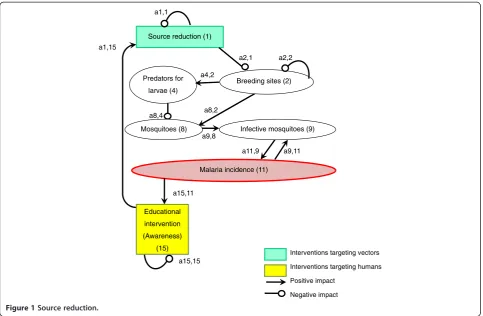
[image:5.595.60.542.496.717.2][23] (Figure 1). In the sign digraph, the impact of source re-duction on infective mosquitoes is shown by three lines: first, a negative line from“Source reduction (1)”to“ Breed-ing sites (2)”; second, a positive arrow from“Breeding sites (2)” to “Mosquitoes (8)”; and third, a positive arrow from “Mosquitoes (8)”to“Infective mosquitoes (9)”. All over, the direction of the impact of source reduction on infective mosquitoes can be“negative times positive times positive = negative”[a2,1(−) x a8,2(+) x a9,8(+) = infective mosquitoes (−)] [24]. Source reduction activities include elimination of water-holding containers, filling standing water where mos-quitoes oviposit and develop, field drainage, and cleaning and flushing of irrigation canals [5,25-27]. These activities can prevent mosquitoes from breeding simply by decreas-ing the number of aquatic habitats or the volume of stand-ing water [a2,1(−)]. Altering the distribution of aquatic habitats is also an important aspect of source reduction because extended prolonged oviposition cycles, caused by increasing the amount of time required for mosquitoes to locate oviposition sites, can reduce the basic reproductive rate of malaria [28]. Furthermore, source reduction can aggregate mosquito larvae and their predators, such as aquatic insects, into a smaller number of breeding sites and encourage aquatic insects to prey on mosquito larvae [a8,4 (−)] [5]. Source reduction could indeed have played an
important role in eradicating malaria from Israel, the USA and Italy [23,27] and in some local elimination pro-grammes in Africa [26,29] by taking the following
pathway [a2,1(−) x a8,2(+) x a9,8(+) x a11,9(+) =
malaria incidence(−)]. Because the abundance and
dis-tribution of aquatic habitats are important determi-nants for local malaria transmission intensity and risk, source reduction can be more effective than applying larvicide [27].
While LLINs and IRS target mainly indoor-biting mosquitoes, source reduction can reduce both indoor-and outdoor-biting mosquitoes [24]. Because outdoor bit-ing is becombit-ing a more important feature of malaria transmission [30,31], the importance of source reduction is revisited, as this is one of the few effective strategies to reduce outdoor-biting mosquitoes [24]. However, decreas-ing availability of breeddecreas-ing sites can also reduce prolifera-tion of predators of larvae [a2,1(−) x a4,2(+) x a8,4(−) = mosquitoes(+)]. Therefore, this negative impact on mos-quito predators needs to be taken into consideration when forecasting the overall impact of source reduction on the increase in infective mosquitoes.
The impact of educational intervention in promoting source reduction and other interventions is compiled in the final subsection of Results.
Malaria incidence (11)
Breeding sites (2) Predators for
larvae (4)
Insecticide resistance (7)
Insecticide Larvicide (3)
Antimalarials (13)
Source reduction (1)
Plasmodium (6)
Biting rate/ Daily survival rate (10)
Non-chemical personal protection
(17) ITN/
LLIN (16) Mosquitoes (8) Infective mosquitoes (9)
Predators for adults (5)
Biological control (12)
Drug resistance (14)
Interventions targeting vectors
Interventions targeting humans
Positive impact
Negative impact
a1,1
a2,1 a2,2 a1,15
a11,10
a10,17
a17,17
a10,16 a9,10
a10,6 a6,10 a8,2
a3,15
a16,16
a9,6 a9,5
a4,2 a5,3
a9,3 a8,3
a4,3 a3,3
a7,7 a7,16
a15,15 a16,7 a17,15 a11,9 a9,11
a12,15
a12,12
a9,8 a8,12
a15,11 a8,4
a13,15 a16,15
a14,14 a13,14 a14,13
a8,5 a3,7
a7,3
a11,13 a4,12
a10,10
Educational intervention (Awareness)
[image:6.595.58.539.88.397.2](15)
Insecticide and larvicide use
Insecticide use for adult mosquitoes (IRS)
Of the three major malaria control strategies (IRS, LLIN and prompt and effective treatment) promoted by the Roll Back Malaria Partnership (RBM) [32], two rely on chemicals (Figure 2). In order to directly suppress the abundance of adult mosquitoes by IRS, WHO approves the use of 12 insecticides of four chemical classes (or-ganochlorines, organophosphates, carbamates, and pyre-throids) [33,34]. Several countries recently added IRS to their national malaria control plans in line with RBM [35], and 79 malaria-endemic countries reported the use of IRS for malaria prevention [1]. As a result, IRS has significantly reduced malaria vectors and malaria inci-dence [a9,3(−) x a11,9(+) = malaria incidence(−)] [36-40]. Two major challenges that chemical use has been facing in terms of reducing malaria incidence are disturbances to the natural balance, such as predator–prey relationships and mosquitoes’ insecticide resistance. Chemical insecti-cides and pestiinsecti-cides not only reduce the abundance of target organisms but also that of beneficial organisms, such as predators, either directly by toxicity or by eliminating their prey organisms [41,42]. Chemical use for malaria vec-tor control can result in reduced abundance of predavec-tors, especially in aquatic larval habitats, and a subsequent in-crease in vector mosquitoes [a5,3(−) x a8,5(−) x a9,8(+) = infective mosquitoes(+)] [41,43,44].
The other major challenge is mosquitoes’resistance to chemicals. Because chemical insecticide interventions have been scaled up during the past decade, mosquitoes’ resistance has been spreading worldwide [1,3,45]. In 2012, 64 countries reported resistance to at least one insecticide in one malaria vector in one study site, and most of the resistance was against pyrethroids [1]. Due to the heavy reliance on one class of insecticides, the py-rethroids, mosquitoes’resistance to pyrethroids has been spreading at an exceptionally rapid rate, especially in Africa [1,46]. As a result, resistance began to threaten the sustainability of insecticide-based malaria control interventions [a7,3(+) x a3,7(−) x a9,3(−) x a11,9(+) = malaria incidence(+)] [3,4,47,48]. At the same time, there is a possibility that mosquito predators have de-veloped or will develop insecticide resistance, which favours predator population and might suppress mos-quito proliferation [a7,3(+) x a3,7(−) x a5,3(−) x a8,5 (−) = mosquitoes(−)].
There is an urgent need to develop new vector control interventions. This is because the above-stated chal-lenges exist and also because many of the anopheline species are not susceptible to current insecticide-based interventions such as IRS and LLINs, which target indoor-feeding/resting vectors [3,49]. New vector control interventions need to be developed and implemented, taking mosquito ecology into consideration, such as site
preferences for feeding, resting (especially outdoor), and oviposition, mating behaviour, and sugar meal selection [3].
Larvicide use
One of the most common interventions conducted to control mosquito larvae is the application of larvicide such asBacillus thuringiensis israelensis (Bti) andBacillus sphaericus (Bs) [24]. Several previous studies reported the effectiveness of larvicides in controlling malaria trans-mission. For example, hand-applied larviciding reduced transmission by 70-90% in Africa where the majority of aquatic mosquito larval habitats were defined and the aquatic surface was not too extensive [a8,3(−) x a9,8(+) x a11,9(+) = malaria incidence(−)] [24,50-52].
The application of larvicide for larval control can be effective in reducing not only the abundance of indoor-biting/resting mosquitoes, which IRS and LLINs target, but also of outdoor-biting/resting mosquitoes. However, several limitations have been reported. They include
disturbance to local ecosystems such as predator–prey
relationships [a4,3(−) x a8,4(−) = mosquitoes(+)] [41,53], mosquitoes’ resistance to larvicides [a7,3(+) x a3,7(−) x a8,3(−) = mosquitoes(+)] [54-56] and ineffectiveness in extensive water bodies [24,57]. In addition, Bti lacked inherent residual activity outside of potable container habitats, especially in habitats with turbid water or high organic loading [58].
Biological control
Interest in formulating non-chemical approaches has been growing over the past four decades because of the
limitations of chemical use, including mosquitoes’
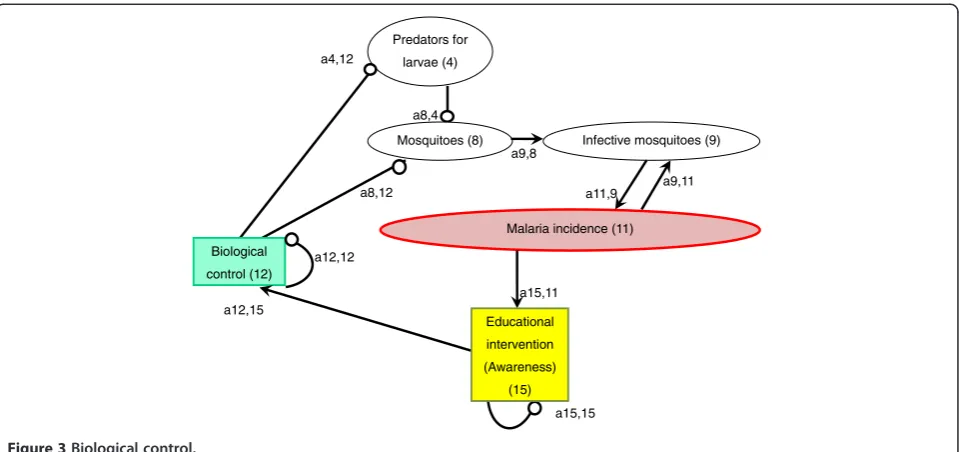
in-secticide resistance, disturbances to the ecosystem, and the health risks for human and domestic animals [5,59]. Current biological control tools that are considered most promising for malaria prevention include fungi, bacteria, larvivorous fish, parasites, viruses, and nematodes [60] (Figure 3). Among these, one of the most commonly used biological control agents is larvivorous fish, which are introduced to aquatic habitats of mosquitoes. Not only naturally occurring predators [61-64] but also intro-duced predators [24] can be effective in suppressing anopheline larval population.
affinisin malaria eradication [66]. The introduction of these larvivorous fish has been reported to be effective in control-ling local malaria by recent studies as well, especially in Asia and Africa [67-69].
A major objection to the introduction of larvivorous fish has been their direct impact on native fish species through predation or their indirect impact through com-petition [a4,12(−)]. So far, more than 30 species of native fish and other aquatic invertebrates co-inhabiting the same waters have been adversely affected by the intro-duction of G. affinis [66]. Also, the introduction of G. affinisdid not show good results in pits, riverbed pools, stone quarries, ponds, drains, rice fields, and irrigation drains alongside rice fields [70]. In addition, G. affinis
have been reported to be little more effective or equal or less effective in mosquito control compared to native fish
species they replace. In California, native Cyprinodon
maculariushad an equal effectiveness in mosquito control [71]. Application of other biological agents also involve lim-itations, which vary depending on the agent [60]. Although their effectiveness is promising, the use of these biological means needs to be planned carefully, taking their impact on the local ecosystem into consideration.
Anti-malarials
Current malaria control measures directly targeting hu-man beings rely heavily on a limited number of tools, particularly anti-malarial drugs (Figure 4) and LLINs, both of which have become less effective because of resistance. It was reported in 2011 that 79 countries/terri-tories used artemisinin-based combination therapy (ACT) as first-line treatment for Plasmodium falciparummalaria [a11,13(−) = malaria incidence(−)]. For Plasmodium vivax
malaria, it is recommended that chloroquine (combined with a 14-day course of primaquine) be used where it is ef-fective, or an appropriate ACT in areas with chloroquine resistance [1].
Malaria treatment with ACT has been spreading over the world, but access to ACT at community level still needs to be improved. The number of ACT treatment courses delivered by manufacturers to the public and private sectors increased from 11 million in 2005 to 278 million in 2011. Surveys conducted in 12 African countries in 2010–2011 showed that about two thirds (median, 65%) of all febrile children treated with an anti-malarial received an ACT. A greater proportion of children received ACT at health facilities not in the community. Therefore, expand-ing appropriate malaria treatment to the community level is urgently needed [1].
In addition to insufficient access to appropriate treat-ment, resistance to artemisinin derivatives has been posing a serious threat to malaria treatment [a14,13(+) x a13,14(−) x a11,13(−) = malaria incidence(+)]. Parasites’resistance to anti-malarial drugs arose from the extensive use and misuse
of the drugs, particularly during the Global Malaria Eradication campaign, launched by WHO in 1955 [72].
So far, resistance of P. falciparum to artemisinin has
been detected in Burma, Cambodia, China, Thailand, and Vietnam, [1,73-76]. Artemisinin resistance is a major threat to public health worldwide, especially to sub-Saharan Africa with the highest disease burden and inadequate systems for monitoring and contain-ment of resistance [74].
One of the leading causes for the development of drug resistance is the spread of poor-quality anti-malarial drugs. It is very likely that widespread availability of counterfeit anti-malarials has been accelerating drug resistance in forested areas near the Thai-Cambodian border [77,78]. A recent review study found that up to 36% of anti-malarial drugs collected in Southeast Asia were falsified, and a third of anti-malarials col-lected in sub-Saharan Africa failed chemical assay analysis [79].
Intermittent preventive treatment (IPT) is also consid-ered a cause of spreading resistance. IPT is a method proposed to reduce malaria morbidity and mortality by providing regularly spaced therapeutic doses of anti-malarials to individuals, regardless of their malaria infec-tion status [80]. IPT has been shown to be effective in reducing clinical malaria cases in pregnant women, chil-dren and infants [81-84]. For example, it was shown that IPT targeting preschool children (age < six years) during the malaria transmission season markedly reduced clin-ical malaria cases, which occurred even in areas with high ITN use [81]. Despite its effectiveness, several stud-ies suggested that IPT could accelerate the spread of re-sistance [85-87]. For example, IPT targeting infants is thought to accelerate the spread of resistant parasites in areas of low or unstable transmission and is more likely to accelerate the spread of resistance in high transmis-sion areas than is IPT in adults [80].
Insecticide-treated bed nets/long-lasting insecticidal nets ITNs, including LLINs, are considered to be the most prominent malaria preventive measure, especially in highly malaria-endemic areas [36,46,90,91] (Figure 5). To achieve Millennium Development Goal 6, which aims to reduce child mortality by 2015, ITNs are one of the most import-ant measures to be taken [92]. ITNs provide personal pro-tection as well as community propro-tection by decreasing the biting rate and daily survival rate of malaria vector mosqui-toes [a10,16(−) x a11,10(+) = malaria incidence(−)] [93-95] . ITNs can indirectly reduce malaria incidence through de-creasing the infective mosquito population by affecting their survival [a10,16(−) x a9,10(+) x a11,9(+) = malaria in-cidence(−)]. Reduced biting rate and daily survival rate can
also affect the uptake of Plasmodium to mosquitoes and
prevent mosquitoes from becoming infective [a10,16(−) x a6,10(+) x a9,6(+) = infective mosquitoes(−)] [96]. ITNs have been shown to be effective in reducing mortality from malaria in previous studies and randomized controlled tri-als [90,97-99]. A previous systematic review reported that ITNs significantly reduce the incidence of malaria com-pared to no nets and untreated nets in areas with stable malaria as well as with unstable malaria [a10,16(−) x a11,10 (+) = malaria incidence(−)] [90].
During the past decade, ITN coverage has increased substantially. By 2012, 117 countries, including 34 in Africa, had adopted the WHO recommendation to provide ITNs to all persons at risk of malaria. A total of 88 countries, in-cluding 39 in Africa, distribute ITNs free of charge [100]. Distribution of ITNs has increased exponentially from 2007, especially in sub-Saharan Africa with household own-ership of at least one ITN becoming an estimated 54% by 2013 [45,100].
However, the number of ITNs delivered in 2011 and 2012 was below the number of ITNs required to protect all populations at risk [1]. Although rapid increase in ITN coverage has occurred in some of the poorest coun-tries in Africa, coverage remains low among populations at risk. Among 44 African countries, only four have achieved ITN ownership coverage of 80% or greater. Countries with large populations at risk of malaria, such as Nigeria, continue to have low coverage. Overall, ITN ownership coverage was 32.8%, and ITN use in children under five was 26.6% among 44 African countries in 2008 [98]. In addition, the proportion of the population sleeping under an ITN has been reported to be higher in wealthier, urban areas and lower among older children [1,101,102]. ITNs provided through free mass campaigns can actually preferentially cover children from the poor-est quintile hompoor-esteads [102], and disparities in ITN access are expected to diminish as programmes move towards universal coverage [1].
Inappropriate use of ITNs is another serious issue related to malaria prevention. Household surveys conducted in
Africa from 2003–2011 indicated that approximately 90% of the population with access to an ITN within the house-hold actually used it. However, the population that used available nets included households in which nets were used beyond their assumed capacity as well as those in which nets were not used to full capacity [1]. ITN misuse has been increasingly reported. For example, ITNs are used as sleep-ing mats, for fishsleep-ing or for drysleep-ing fish, to protect crops and plants, as wedding veils, and as chicken coops [103-105]. Although a question remains as to whether the ITN misuse impedes ongoing malaria control efforts [103,104], further work is needed to ensure that all available nets are fully and properly utilized [1].
Resistance to pyrethroids, used for treating bed nets, is threatening the effectiveness of ITN use in reducing malaria incidence [a7,16(+) x a16,7(−) x a10,16(−) x a11,10(+) = malaria incidence (+)], [a7,16(+) x a16,7(−) x a10,16(−) x a9,10 (+) x a11,9(+) = malaria incidence(+)], and [a7,16(+) x a16,7(−) x a10,16(−) x a6,10 (+) x a9,6(+) x a11,9(+) = malaria incidence(+)] [46,48,91,106]. For the treatment of bed nets, only six insecticides, all of which belong to the pyrethroid class, are allowed by WHO (WHO Pesticide Evaluation Scheme). The use of pyre-throids in malaria vector control has increased dramatic-ally in the past decade through the scale up of ITN distribution programmes and IRS campaigns in Africa [46]. In addition, pyrethroids are widely used to control agricultural pests, which can pose additional selection pressure on mosquitoes when insecticides contaminate larval habitats. This intensive exposure to insecticides has inevitably resulted in the evolution of insecticide re-sistance in anopheline mosquitoes [34], and the resist-ance alleles have been spreading at an exceptionally rapid rate throughout Africa [46].
In spite of the rapid spreading of pyrethroid resistance, few studies have examined the impact of ITN use on malaria control. Controversy remains about the epi-demiological significance of current levels of resistance in sub-Saharan Africa [46]. A recent study conducted in Benin demonstrated that resistance seriously threatens ITN-based malaria control interventions because ITNs provide little or no protection once vectors became re-sistant and netting acquires holes [106]. However, an-other study in seven locations in Africa reported that ITNs were cost effective for malaria control even in areas with strong pyrethroid resistance [91].
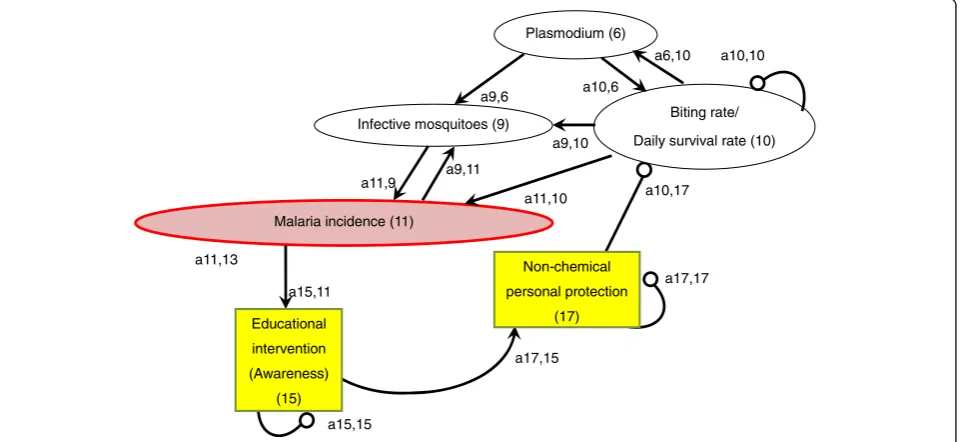
Non-chemical personal protection measures
reducing malaria incidence has not been well examined and needs to be studied. However, the improvement of house design has already been proven to be effective as a personal protection measure that does not rely on chemicals.
Improving the domestic environment, such as house de-sign and screening, can be a non-chemical, complementary approach to increasing personal protection against indoor-biting malaria vectors and interrupting the malaria trans-mission cycle [a10,17(−) x a11,10(+) = malaria incidence(−)] [108-111]. Transmission of malaria and other mosquito-borne diseases can be facilitated by poor house design that favours mosquito entry [112-114]. For example, the lack of window/door screening, presence of eave gaps and lack of a ceiling have been reported to enhance mosquitoes’ entry into houses [109,115-118].
It has been demonstrated that the improvement of house design significantly contributes to the reduction in mosquito density inside houses and to the control and reduction of malaria vectors [a10,17(−) x a9,10(+) = infective mosquitoes(−)]. The method includes screening (even with used bed nets or untreated shade cloth for agri-cultural use) [109,119-122], blocking all potential house entry points for mosquitoes [116,117] and building houses on stilts [123].
Educational intervention (awareness)
Community participation is vital for successful malaria control [2,124-127]. A recent review study identified the three most influential factors for community participa-tion: knowledge and perception of disease, multisec-toral collaboration and integration of programme(s) into broader development goals, and decentralization of power and resources and the use of community as-sets [2]. In order to raise community awareness and to involve the community in malaria control interven-tions, a variety of educational programmes have been conducted in malaria-prone countries (Figure 7).
The effectiveness of such community-based educa-tional programmes in promoting malaria control with community participation has been reported by several studies. For example, a study from Nigeria demonstrated that it was health education, not free distribution, that significantly increased the use of ITNs among commu-nity residents [a16,15(+)] [128]. In Ethiopia, a cluster randomized trial demonstrated that the burden of mal-aria among children under five (examined by mass blood investigation) was significantly reduced by training household heads on the utilization of LLINs [a16,15(+) x a10,16 (−) x a11,10(+) = malaria incidence(−)] [129].
Educational interventions targeting community resi-dents and community health workers have improved community actions to promote early diagnosis and treat-ment of malaria [a13,15(+)]. Recent studies from Nigeria
indicated that a reduction in the incidence of malaria can be achieved by conducting training programmes for caregivers of children under five, which improved their knowledge, home management of malaria and referral practices for severe malaria [a13,15(+) x a11,13(−) x = malaria incidence(−)] [130,131]. Another study reported that a treatment guideline for the effective case manage-ment of malaria for children at home, developed by the joint efforts of researchers and community members, not only built capacity at the community level but also increased the acceptability and ownership of such mate-rials [132]. In addition, training of community health workers has been reported to be effective in improving malaria diagnosis and treatment at the community level [a13,15(+)]. In Cambodia, community residents were trained as Village Malaria Workers and became effective in diagnosing malaria with rapid diagnostic tests (RDTs) and prescribing anti-malarials to malaria patients [133]. In Uganda, lay community health workers were trained and successfully diagnosed and treated malaria and pneu-monia in children [134]. Training drug vendors, who can play a role in spreading information within a community, was also shown to be effective in improving prompt and appropriate treatment of malaria and referral of severe cases [135].
Source reduction was also promoted by community residents who were motivated and trained by different educational interventions [a1,15]. A community-based educational intervention, which was conducted for rice farmers in Sri Lanka, kept high participation rates and had a significant positive impact on the knowledge and varieties of actions farmers took for mosquito control and mosquito-borne disease prevention [136]. The
farmers’environmental management activities,
includ-ing source reduction, were demonstrated to be effect-ive in reducing the density of adult female anophelines [a1,15(+) x a2,1(−) x a8,2(+) = mosquitoes(−)] [5].
Effective implementation of IRS and application of larvicide also need educational programmes to improve community understanding and acceptance by commu-nity residents [a3,15(+)]. Previous studies reported that
community residents’ understanding of the function of
the IRS, especially its effectiveness and unwanted side-effects, was related to their compliance with the IRS programme [137-139]. One of the studies reported that the most frequent suggestion for improving community acceptance of IRS was to increase the understanding of the objectives of spraying in the communities [138].
Biological control of vectors and personal protection from malaria depends on community understanding, which educational intervention can improve. A previ-ous study demonstrated that the successful
implemen-tation of biological control using fish, Toxorhynchites
entomopathogenic bacteria, and the fungus Lagenidium giganteum depended on the community’s in-depth under-standing of the ecology of these agents and targeted species [140]. Another study showed that an educational interven-tion increased community residents’activities to implement biological control using oil, salt and fish [a12,15(+)] [136]. Other previous studies have demonstrated the effectiveness of educational intervention in improving non-chemical per-sonal protection measures taken by community residents and community health workers, such as wearing long-sleeved shirts and long trousers and adding windows or door nets to houses [a17,15(+)] [136,141]. Several historical reports also describe that education was an essential part of mosquito control activities throughout the United States, especially in early 20thcentury [142].
School education can also be an important strategy for community-based malaria control. A previous study in Ghana demonstrated that school-based participatory health education decreased malaria prevalence among school children and improved knowledge and practices of adults in the community [143]. However, a recent cross-country study reported that school textbooks of primary and lower secondary schools rarely covered knowledge and skills for malaria prevention and treat-ment [144]. Utilization of school education could fur-ther raise community awareness and encourage school children, their parents, and other community members to take additional actions for malaria control.
Discussion
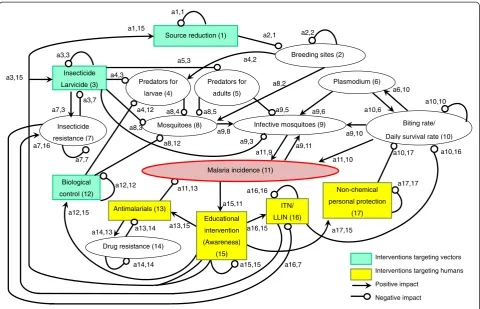
This is the first study that has demonstrated how the impact of community-based malaria control interven-tions on malaria incidence can be examined by qualita-tive analysis, specifically loop analysis, combined with an extensive review of the literature that analyses each pathway. The sign digraphs developed in this study give a more complete picture of the complex system that can be created by a variety of malaria control efforts at the community level. By carefully mapping out relevant vari-ables in the system, the digraph explains interactions and correlations among the variables involved. The sign digraphs show a variety of possible pathways through which each intervention can influence local malaria inci-dence. Combining sign digraphs of plural interventions can demonstrate changes in the variety and number of pathways as well as interactions between interventions.
Sign digraphs can demonstrate where uncertainties might exist in the complex system and what kinds of research are necessary to better understand how community-based mal-aria control interventions might influence local malmal-aria in-cidence. For example, the sign digraph of source reduction (Figure 1), shows a negative impact of the reduction in mosquito breeding sites on mosquitoes’ predators, which might eventually increase mosquito larval density in the
long run [a2,1(−) x a4,2(+) x a8,4(−) = mosquitoes(+)]. However, most previous studies focused only on source re-duction’s direct, short-term impact on mosquito larvae, and few studies have examined its impact on the ecology and density of predators. The diagram suggests that both path-ways ([a2,1(−) x a8,2(+) = mosquitoes(−)] and [a2,1(−) x a4,2(+) x a8,4(−) = mosquitoes(+)]) need to be studied in order to accurately evaluate the overall impact of source re-duction on larval mosquitoes.
A sign digraph can also be useful to qualitatively examine the mechanisms of how combined effects of plural interventions can be generated. Recent studies have demonstrated that the combination of IRS and ITN use resulted in greater reductions in malaria incidence compared to the use of IRS or ITNs alone [36,145,146]. However, the sign digraph (Figure 2) shows that insecti-cide use is interlinked with ITN use through insectiinsecti-cide resistance and that the combined use of these measures can each diminish the effectiveness of the other by fur-ther accelerating the spread of resistance. Although some studies have suggested that the insecticides used for IRS and ITNs in the same region should belong to different classes to prevent the development and spread of insecticide resistance [36,146], few studies have moni-tored how insecticide resistance progresses with the combination of the two interventions compared to the use of one of them. This way, a sign digraph demon-strates benefits and drawbacks of combining plural inter-ventions as well as the need of further research on issues that have not been well examined.
Several vital issues for the effective implementation of each intervention, including sustainability and cost-benefit analysis, need to be considered when interpreting a sign digraph. For example, although a sign digraph ex-plains pathways through which community awareness and educational interventions can influence local malaria incidence (Figure 7), it does not show how long the im-pact of the educational intervention or raised awareness could last. The literature search revealed few studies that evaluated the long-term impact of educational interven-tions on community awareness, acinterven-tions and malaria incidence. Such research is urgently needed. A deeper understanding of the sustainability of community par-ticipation is vital to encourage communities to continue their malaria control activities even when malaria inci-dence decreases with remaining transmission occurring in defined foci [147,148].
conduct the intervention. Such cost can vary by season because it not only includes direct costs to purchase ma-terials or tools but also community members’time taken from other activities such as agriculture and fishing. As local malaria incidence decreases, it becomes increas-ingly difficult to sustain community awareness and participation [2,11,12] and to persuade governments to allocate funding to maintain effective interventions. Since 1930, 75 resurgences of malaria have been re-corded, nearly all of which were linked to the scaling back of interventions [76,149]. Considering such varia-tions over time when interpreting a sign digraph could strengthen understanding of the mechanisms of how each intervention might work to decrease local malaria incidence.
One of the limitations of the study is that, mainly due to the nature of qualitative analysis, magnitudes of the interactions between variables were not examined. Therefore, it was impossible to quantitatively compare the impact of different interventions on malaria inci-dence and to examine the combined effects of plural interventions on malaria incidence. Also, to examine the interaction between variables involved in the sys-tem, different kinds of literature had to be combined regardless of their methods of analysis. Some studies conducted quantitative analysis while others only pro-vided descriptive information without statistics show-ing the extent of changes. Publication bias might have influenced this study’s analysis to some extent because most of the articles have dealt with the positive or negative impact of one variable on another rather than null effects.
Despite these limitations, this is the first study to qualita-tively review the impact of malaria control interventions on malaria incidence, using the loop analysis method. Without relying on numerical data, this study was able to describe pathways through which each intervention could influence malaria incidence on the basis of the qualitative patterns of the interactions among variables in complex systems. It contributed to a better understanding of the mechanisms of how each malaria control intervention could influence malaria incidence, examined the associations and correla-tions among a variety of factors involved, and explained how unexpected consequences may have occurred. This methodology can be utilized not only by researchers but also by community leaders, local health programme and project officers, and policy makers to better plan and con-duct their community-based malaria control interventions. It is also applicable to future studies to review the impact of malaria and other disease control interventions at commu-nity, national, and global levels.
Competing interests
The authors declare that they have no competing interests.
Authors’contributions
JY conceived the study, conducted analysis and literature review, and wrote the manuscript. MJ contributed to the interpretation of the analysis and improved the manuscript. RL provided guidance to conduct analysis and improved the manuscript. All authors read and approved the final draft.
Acknowledgements
We are grateful to Dr Anne M Johnson for her helpful advice on the manuscript.
Author details
1Department of Community and Global Health, The University of Tokyo, 7-3-1 Hongo, Bunkyo-ku, Tokyo 113-0033, Japan.2Department of Global Health and Population, Harvard School of Public Health, 665 Huntington Avenue, Boston, MA 02115, USA.
Received: 7 December 2013 Accepted: 1 April 2014 Published: 9 April 2014
References
1. WHO:World Malaria Report 2012.Geneva: World Health Organization; 2012. 2. Atkinson J-A, Vallely A, Fitzgerald L, Whittaker M, Tanner M:The architecture
and effect of participation: a systematic review of community participation for communicable disease control and elimination. Implications for malaria elimination.Malar J2011,10:225.
3. malERA Consultative Group on Vector Control:A research agenda for malaria eradication: vector control.PLoS Med2011,8:e1000401. 4. Thomas MB, Godfray HC, Read AF, van den Berg H, Tabashnik BE, van
Lenteren JC, Waage JK, Takken W:Lessons from agriculture for the sustainable management of malaria vectors.PLoS Med2012,9:e1001262. 5. Yasuoka J, Levins R, Mangione TW, Spielman A:Community-based rice
ecosystem management for suppressing vector anophelines in Sri Lanka.Trans R Soc Trop Med Hyg2006,100:995–1006.
6. Konradsen F, Amerasinghe FP, van der Hoek W, Amerasinghe PH:Malaria in Sri Lanka, Current Knowledge on Transmission and Control.Colombo: International Water Management Institute; 2000.
7. Silva KT:“Public health”for whose benefit? Multiple discourses on malaria in Sri Lanka.Med Anthropol1997,17:195–214.
8. Wiese M:Integrated approaches to malaria control–addressing new challenges to malaria research.Malar J2012,11:Poster 104.
9. Tanner M, de Savigny D:Malaria eradication back on the table.Bull World Health Organ2008,86:82.
10. Levins R:Qualitative analysis of partially specified systems.Ann N Y Acad Sci1974,231:123–138.
11. Bauch JA, Gu JJ, Msellem M, Martensson A, Ali AS, Gosling R, Baltzell KA: Perception of malaria risk in a setting of reduced malaria transmission: a qualitative study in Zanzibar.Malar J2013,12:75.
12. Najera JA, Gonzalez-Silva M, Alonso PL:Some lessons for the future from the Global Malaria Eradication Programme (1955–1969).PLoS Med2011, 8:e1000412.
13. Levins R:Qualitative mathematics for understanding, prediction, and intervention in complex ecosystems. InEcosystemhealth.Edited by Rapport D, Costanza R, Epstein PR, Gaudet C, Levins R. Malden: Blackwell Science, Inc; 1998:178–204.
14. Puccia CJ, Levins R:Qualitative modeling of complex systems: An introduction to loop analysis and time averaging.Cambridge: Harvard University Press; 1985.
15. Justus J:Qualitative scientific modeling and loop analysis.Philos Sci2005, 72:1272–1286.
16. Dambacher JM, Ramos-Jiliberto R:Understanding and predicting effects of modified interactions through a qualitative analysis of community structure.Q Rev Biol2007,82:227–250.
17. Zavaleta JO, Rossignol PA:Community-level analysis of risk of vector-borne disease.Trans R Soc Trop Med Hyg2004,98:610–618.
18. Lane PA, Blouin AC:Plankton of an acid-stressed lake (Kejimkujik National Park, Nova Scotia, Canada). Part 3. Community network analysis.Verh Internat Verein Limnol1984,22:406–411.
19. Vandermeer J:Elementary Mathematical Ecology.New York: John Wiley and Sons, Inc.; 1981.
21. Levins R:Evolution in changing environments: some theoretical explorations. Princeton, New Jersey, USA: Princeton University Press; 1968.
22. Bartholomew LK, Parcel GS, Kok G:Intervention mapping: a process for developing theory- and evidence-based health education programs. Health Educ Behav1998,25:545–563.
23. Kitron U, Spielman A:Suppression of transmission of malaria through source reduction: antianopheline measures applied in Israel, the United States, and Italy.Rev Infect Dis1989,11:391–406.
24. Fillinger U, Lindsay SW:Larval source management for malaria control in Africa: myths and reality.Malar J2011,10:353.
25. Dowling Z, Armbruster P, LaDeau SL, DeCotiis M, Mottley J, Leisnham PT: Linking mosquito infestation to resident socioeconomic status, knowledge, and source reduction practices in suburban Washington, DC.Ecohealth2013,10:36–47.
26. Yakob L, Yan G:Modeling the effects of integrating larval habitat source reduction and insecticide treated nets for malaria control.PLoS One2009,4:e6921. 27. Le Menach A, McKenzie FE, Flahault A, Smith DL:The unexpected importance
of mosquito oviposition behaviour for malaria: non-productive larval habitats can be sources for malaria transmission.Malar J2005,4:23.
28. Gu W, Regens JL, Beier JC, Novak RJ:Source reduction of mosquito larval habitats has unexpected consequences on malaria transmission. Proc Natl Acad Sci U S A2006,103:17560–17563.
29. Utzinger J, Tozan Y, Singer BH:Efficacy and cost-effectiveness of environmental management for malaria control.Trop Med Int Health2001,6:677–687. 30. Russell TL, Govella NJ, Azizi S, Drakeley CJ, Kachur SP, Killeen GF:Increased
proportions of outdoor feeding among residual malaria vector populations following increased use of insecticide-treated nets in rural Tanzania.Malar J2011,10:80.
31. Reddy MR, Overgaard HJ, Abaga S, Reddy VP, Caccone A, Kiszewski AE, Slotman MA:Outdoor host seeking behaviour ofAnopheles gambiae
mosquitoes following initiation of malaria vector control on Bioko Island, Equatorial Guinea.Malar J2011,10:184.
32. Roll Back Malaria:The Global Malaria Action Plan.Geneva: Roll Back Malaria partnership; 2008.
33. World Health Organization:WHO Pesticide Evaluation Scheme.http://www. who.int/whopes/en/.
34. Ranson H, Abdallah H, Badolo A, Guelbeogo WM, Kerah-Hinzoumbe C, Yangalbe-Kalnone E, Sagnon N, Simard F, Coetzee M:Insecticide resistance in Anopheles gambiae: data from the first year of a multi-country study highlight the extent of the problem.Malar J2009,8:299.
35. Kigozi R, Baxi SM, Gasasira A, Sserwanga A, Kakeeto S, Nasr S, Rubahika D, Dissanayake G, Kamya MR, Filler S, Dorsey G:Indoor residual spraying of insecticide and malaria morbidity in a high transmission intensity area of Uganda.PLoS One2012,7:e42857.
36. Okumu FO, Moore SJ:Combining indoor residual spraying and insecticide-treated nets for malaria control in Africa: a review of possible outcomes and an outline of suggestions for the future.Malar J2011,10:208.
37. Curtis CF, Mnzava AE:Comparison of house spraying and insecticide-treated nets for malaria control.Bull World Health Organ2000,78:1389–1400. 38. Kouznetsov RL:Malaria control by application of indoor spraying of
residual insecticides in tropical Africa and its impact on community health.Trop Doct1977,7:81–91.
39. Mabaso ML, Sharp B, Lengeler C:Historical review of malarial control in southern African with emphasis on the use of indoor residual house-spraying.Trop Med Int Health2004,9:846–856.
40. Pluess B, Tanser FC, Lengeler C, Sharp BL:Indoor residual spraying for preventing malaria.Cochrane Database Syst Rev2010,4:CD006657. 41. Service MW:Mortalities of the immature stages of species B of the
Anopheles gambiaecomplex in Kenya: comparison between rice fields and temporary pools, identification of predators, and effects of insecticidal spraying.J Med Entomol1977,13:535–545.
42. Muiruri SK, Mwangangi JM, Carlson J, Kabiru EW, Kokwaro E, Githure J, Mbogo CM, Beier JC:Effect of predation on Anopheles larvae by five sympatric insect families in coastal Kenya.J Vector Borne Dis2013,50:45–50.
43. Kweka EJ, Zhou G, Gilbreath TM 3rd, Afrane Y, Nyindo M, Githeko AK, Yan G: Predation efficiency ofAnopheles gambiaelarvae by aquatic predators in western Kenya highlands.Parasit Vectors2011,4:128.
44. Ohba SY, Kawada H, Dida GO, Juma D, Sonye G, Minakawa N, Takagi M: Predators ofAnopheles gambiae sensu lato(Diptera: Culicidae) larvae in wetlands, western Kenya: confirmation by polymerase chain reaction method.J Med Entomol2010,47:783–787.
45. Coetzee M, Koekemoer LL:Molecular systematics and insecticide resistance in the major African malaria vectorAnopheles funestus. Annu Rev Entomol2013,58:393–412.
46. Ranson H, N’Guessan R, Lines J, Moiroux N, Nkuni Z, Corbel V:Pyrethroid resistance in African anopheline mosquitoes: what are the implications for malaria control?Trends Parasitol2011,27:91–98.
47. Chanda E, Hemingway J, Kleinschmidt I, Rehman AM, Ramdeen V, Phiri FN, Coetzer S, Mthembu D, Shinondo CJ, Chizema-Kawesha E, Kamuliwo M, Mukonka V, Baboo KS, Coleman M:Insecticide resistance and the future of malaria control in Zambia.PLoS One2011,6:e24336.
48. Trape JF, Tall A, Diagne N, Ndiath O, Ly AB, Faye J, Dieye-Ba F, Roucher C, Bouganali C, Badiane A, Sarr FD, Mazenot C, Touré-Baldé A, Raoult D, Druilhe P, Mercereau-Puijalon O, Rogier C, Sokhna C:Malaria morbidity and pyrethroid resistance after the introduction of insecticide-treated bednets and artemisinin-based combination therapies: a longitudinal study.Lancet Infect Dis2011,11:925–932.
49. Terenius O, Marinotti O, Sieglaff D, James AA:Molecular genetic manipulation of vector mosquitoes.Cell Host Microbe2008,4:417–423. 50. Fillinger U, Kannady K, William G, Vanek MJ, Dongus S, Nyika D, Geissbuhler
Y, Chaki PP, Govella NJ, Mathenge EM, Singer BH, Mshinda H, Lindsay SW, Tanner M, Mtasiwa D, de Castro MC, Killeen GF:A tool box for operational mosquito larval control: preliminary results and early lessons from the Urban Malaria Control Programme in Dar es Salaam, Tanzania.Malar J 2008,7:20.
51. Fillinger U, Lindsay SW:Suppression of exposure to malaria vectors by an order of magnitude using microbial larvicides in rural Kenya.Trop Med Int Health2006,11:1629–1642.
52. Fillinger U, Ndenga B, Githeko A, Lindsay SW:Integrated malaria vector control with microbial larvicides and insecticide-treated nets in western Kenya: a controlled trial.Bull World Health Organ2009,87:655–665. 53. Miles AK, Lawler SP, Dritz D, Spring S:Effects of mosquito larvicide on
mallard ducklings and prey.Wildl Soc Bull2002,30:675–682.
54. Soltani A, Vatandoost H, Oshaghi MA, Enayati AA, Raeisi A, Eshraghian MR, Soltan-Dallal MM, Hanafi-Bojd AA, Abai MR, Rafi F:Baseline susceptibility of different geographical strains ofAnopheles stephensi(Diptera: Culicidae) to temephos in malarious areas of Iran.J Arthropod Borne Dis2013, 7:56–65.
55. Paul A, Harrington LC, Zhang L, Scott JG:Insecticide resistance inCulex pipiensfrom New York.J Am Mosq Control Assoc2005,21:305–309. 56. Luong K, Dunkel FV, Coulibaly K, Beckage NE:Potential use of neem leaf
slurry as a sustainable dry season management strategy to control the malaria vectorAnopheles gambiae(Diptera: Culicidae) in west African villages.J Med Entomol2012,49:1361–1369.
57. Majambere S, Pinder M, Fillinger U, Ameh D, Conway DJ, Green C, Jeffries D, Jawara M, Milligan PJ, Hutchinson R, Lindsay SW:Is mosquito larval source management appropriate for reducing malaria in areas of extensive flooding in The Gambia? A cross-over intervention trial.Am J Trop Med Hyg2010,82:176–184.
58. Dritz DA, Lawler SP, Evkhanian C, Graham P, Baracosa V, Dula G:Control of mosquito larvae in seasonal wetlands on a wildlife refuge using VectoMax CG.J Am Mosq Control Assoc2011,27:398–403.
59. Lacey LA, Lacey CM:The medical importance of riceland mosquitoes and their control using alternatives to chemical insecticides.J Am Mosq Control Assoc Suppl1990,2:1–93.
60. Kamareddine L:The biological control of the malaria vector.Toxins (Basel) 2012,9:748–767.
61. Blaustein L, Chase JM:Interactions between mosquito larvae and species that share the same trophic level.Annu Rev Entomol2007,52:489–507. 62. Chandra G, Mandal SK, Ghosh AK, Das D, Banerjee SS, Chakraborty S:
Biocontrol of larval mosquitoes byAcilius sulcatus(Coleoptera: Dytiscidae).BMC Infect Dis2008,8:138.
63. Carlson JC, Dyer LA, Omlin FX, Beier JC:Diversity cascades and malaria vectors.J Med Entomol2009,46:460–464.
64. Matias JR, Adrias AQ:The use of annual killifish in the biocontrol of the aquatic stages of mosquitoes in temporary bodies of fresh water; a potential new tool in vector control.Parasit Vectors2010,3:46. 65. Rupp HR:Adverse assessments ofGambusia affinis: an alternate view for
mosquito control practitioners.J Am Mosq Control Assoc1996,12:155–159. discussion 160–156.
67. Kant R, Haq S, Srivastava HC, Sharma VP:Review of the bioenvironmental methods for malaria control with special reference to the use of larvivorous fishes and composite fish culture in central Gujarat, India. J Vector Borne Dis2013,50:1–12.
68. Imbahale SS, Githeko A, Mukabana WR, Takken W:Integrated mosquito larval source management reduces larval numbers in two highland villages in western Kenya.BMC Public Health2012,12:362.
69. Kusumawathie PH, Wickremasinghe AR, Karunaweera ND, Wijeyaratne MJ: Costs and effectiveness of application ofPoecilia reticulata(guppy) and temephos in anopheline mosquito control in river basins below the major dams of Sri Lanka.Trans R Soc Trop Med Hyg2008,102:705–711. 70. Sharma SN, Kaul SM, Lal S:Use ofGambusia affinisin different habitats as
a mosquito control agent.J Commun Dis1997,29:371–373. 71. Walters LL, Legner EF:Impact of the desert pupfish,
Cyprinodon-macularius, andGambusia-affinis-affinison fauna in pond ecosystems. Hilgardia1980,48:1–18.
72. D’Alessandro U, Buttiens H:History and importance of antimalarial drug resistance.Trop Med Int Health2001,6:845–848.
73. Tulloch J, David B, Newman RD, Meek S:Artemisinin-resistant malaria in the Asia-Pacific region.Lancet2013,381:e16–17.
74. Talisuna AO, Karema C, Ogutu B, Juma E, Logedi J, Nyandigisi A, Mulenga M, Mbacham WF, Roper C, Guerin PJ, D’Alessandro U, Snow RW: Mitigating the threat of artemisinin resistance in Africa: improvement of drug-resistance surveillance and response systems.Lancet Infect Dis 2012,12:888–896.
75. Amaratunga C, Sreng S, Suon S, Phelps ES, Stepniewska K, Lim P, Zhou C, Mao S, Anderson JM, Lindegardh N, Jiang H, Song J, Su XZ, White NJ, Dondorp AM, Anderson TJ, Fay MP, Mu J, Duong S, Fairhurst RM: Artemisinin-resistantPlasmodium falciparumin Pursat province, western Cambodia: a parasite clearance rate study.Lancet Infect Dis 2012,12:851–858.
76. Liu J, Modrek S, Gosling RD, Feachem RGA:Malaria eradication. Is it possible? Is it worth it? Should we do it?Lancet Global Health2013,1:1. 77. Dondorp AM, Newton PN, Mayxay M, Van Damme W, Smithuis FM, Yeung
S, Petit A, Lynam AJ, Johnson A, Hien TT, McGready R, Farrar JJ, Looareesuwan S, Day NP, Green MD, White NJ:Fake antimalarials in Southeast Asia are a major impediment to malaria control: multinational cross-sectional survey on the prevalence of fake antimalarials.Trop Med Int Health2004,9:1241–1246.
78. Newton PN, Dondorp A, Green M, Mayxay M, White NJ:Counterfeit artesunate antimalarials in southeast Asia.Lancet2003,362:169. 79. Nayyar GM, Breman JG, Newton PN, Herrington J:Poor-quality antimalarial
drugs in southeast Asia and sub-Saharan Africa.Lancet Infect Dis2012, 12:488–496.
80. O’Meara WP, Smith DL, McKenzie FE:Potential impact of intermittent preventive treatment (IPT) on spread of drug-resistant malaria.PLoS Med 2006,3:e141.
81. Meremikwu MM, Donegan S, Sinclair D, Esu E, Oringanje C:Intermittent preventive treatment for malaria in children living in areas with seasonal transmission.Cochrane Database Syst Rev2012,2, CD003756.
82. Bardají A, Bassat Q, Alonso PL, Menéndez C:Intermittent preventive treatment of malaria in pregnant women and infants: making best use of the available evidence.Expert Opin Pharmacother2012,13:1719–1736. 83. Greenwood B, Bojang K, Tagbor H, Pagnoni F:Combining community
case management and intermittent preventive treatment for malaria. Trends Parasitol2011,27:477–480.
84. Shulman CE, Dorman EK, Cutts F, Kawuondo K, Bulmer JN, Peshu N, Marsh K:Intermittent sulphadoxine-pyrimethamine to prevent severe anaemia secondary to malaria in pregnancy: a randomised placebo-controlled trial.Lancet1999,353:632–636.
85. Likwela JL, D’Alessandro U, Lokwa BL, Meuris S, Dramaix MW: Sulfadoxine-pyrimethamine resistance and intermittent preventive treatment during pregnancy: a retrospective analysis of birth weight data in the Democratic Republic of Congo (DRC).Trop Med Int Health2012, 17:322–329.
86. Sirima SB, Sawadogo R, Moran AC, Konate A, Diarra A, Yameogo M, Parise ME, Newman RD:Failure of a chloroquine chemoprophylaxis program to adequately prevent malaria during pregnancy in Koupela District, Burkina Faso.Clin Infect Dis2003,36:1374–1382.
87. Faye B, Ndiaye M, Ndiaye JL, Annie A, Tine RC, Lo AC, Sow D, De Sousa A, Gaye O:Prevalence of molecular markers ofPlasmodium falciparum
resistance to sulfadoxine-pyrimethamine during the intermittent pre-ventive treatment in infants coupled with the expanded program immunization in Senegal.Parasitol Res2011,109:133–138.
88. Miller LH, Ackerman HC, Su XZ, Wellems TE:Malaria biology and disease pathogenesis: insights for new treatments.Nat Med2013,19:156–167. 89. Newton PN, Green MD, Fernandez FM, Day NP, White NJ:Counterfeit
anti-infective drugs.Lancet Infect Dis2006,6:602–613.
90. Lengeler C:Insecticide-treated bed nets and curtains for preventing malaria.Cochrane Database Syst Rev2004,2:CD000363.
91. Briet OJ, Penny MA, Hardy D, Awolola TS, Van Bortel W, Corbel V, Dabire RK, Etang J, Koudou BG, Tungu PK, Chitnis N:Effects of pyrethroid resistance on the cost effectiveness of a mass distribution of long-lasting insecticidal nets: a modelling study.Malar J2013,12:77.
92. Noor AM, Mutheu JJ, Tatem AJ, Hay SI, Snow RW:Insecticide-treated net coverage in Africa: mapping progress in 2000–07.Lancet2009,373:58–67. 93. Hawley WA, Phillips-Howard PA, ter Kuile FO, Terlouw DJ, Vulule JM, Ombok M,
Nahlen BL, Gimnig JE, Kariuki SK, Kolczak MS, Hightower AW:Community-wide effects of permethrin-treated bed nets on child mortality and malaria morbidity in western Kenya.Am J Trop Med Hyg2003,68:121–127. 94. Fink G, Masiye F:Assessing the impact of scaling-up bednet coverage
through agricultural loan programmes: evidence from a cluster randomised controlled trial in Katete, Zambia.Trans R Soc Trop Med Hyg2012, 106:660–667.
95. Eisele TP, Keating J, Littrell M, Larsen D, Macintyre K:Assessment of insecticide-treated bednet use among children and pregnant women across 15 countries using standardized national surveys.Am J Trop Med Hyg2009,80:209–214.
96. Koella JC, Sorensen FL, Anderson RA:The malaria parasite, Plasmodium falciparum, increases the frequency of multiple feeding of its mosquito vector, Anopheles gambiae.Proc Biol Sci1998,265:763–768.
97. Gamble C, Ekwaru JP, ter Kuile FO:Insecticide-treated nets for preventing malaria in pregnancy.Cochrane Database Syst Rev2006,2:Cd003755. 98. Flaxman AD, Fullman N, Otten MW Jr, Menon M, Cibulskis RE, Ng M, Murray CJ,
Lim SS:Rapid scaling up of insecticide-treated bed net coverage in Africa and its relationship with development assistance for health: a systematic synthesis of supply, distribution, and household survey data. PLoS Med2010,7:e1000328.
99. White MT, Conteh L, Cibulskis R, Ghani AC:Costs and cost-effectiveness of malaria control interventions–a systematic review.Malar J2011,10:337. 100. WHO:World Malaria Report 2013.Geneva: World Health Organization; 2013. 101. Webster J, Lines J, Bruce J, Armstrong Schellenberg JR, Hanson K:Which
delivery systems reach the poor? A review of equity of coverage of ever-treated nets, never-treated nets, and immunisation to reduce child mortality in Africa.Lancet Infect Dis2005,5:709–717.
102. Noor AM, Amin AA, Akhwale WS, Snow RW:Increasing coverage and decreasing inequity in insecticide-treated bed net use among rural Kenyan children.PLoS Med2007,4:e255.
103. Honjo K, Chaves LF, Satake A, Kaneko A, Minakawa N:When they don’t bite, we smell money: understanding malaria bednet misuse.Parasitology 2013,140:580–586.
104. Eisele TP, Thwing J, Keating J:Claims about the misuse of insecticide-treated mosquito nets: are these evidence-based?PLoS Med2011,8:e1001019. 105. Minakawa N, Dida GO, Sonye GO, Futami K, Kaneko S:Unforeseen misuses
of bed nets in fishing villages along Lake Victoria.Malar J2008,7:165. 106. Asidi A, N’Guessan R, Akogbeto M, Curtis C, Rowland M:Loss of household
protection from use of insecticide-treated nets against pyrethroid-resistant mosquitoes, benin.Emerg Infect Dis2012,18:1101–1106. 107. van den Berg H:Global status of DDT and its alternatives for use in vector
control to prevent disease.Environ Health Perspect2009,117:1656–1663. 108. Lwetoijera DW, Kiware SS, Mageni ZD, Dongus S, Harris C, Devine GJ, Majambere
S:A need for better housing to further reduce indoor malaria transmission in areas with high bed net coverage.Parasit Vectors2013,6:57.
109. Kirby MJ, Ameh D, Bottomley C, Green C, Jawara M, Milligan PJ, Snell PC, Conway DJ, Lindsay SW:Effect of two different house screening interventions on exposure to malaria vectors and on anaemia in children in The Gambia: a randomised controlled trial.Lancet2009,374:998–1009.
110. Baragatti M, Fournet F, Henry MC, Assi S, Ouedraogo H, Rogier C, Salem G: Social and environmental malaria risk factors in urban areas of Ouagadougou, Burkina Faso.Malar J2009,8:13.