
0022-538X/92/127505-06$02.00/0
Copyright © 1992, American Society for Microbiology
The
Herpes
Simplex Virus Type 1
(HSV-1)
a
Sequence Serves as a
Cleavage/Packaging
Signal but
Does Not
Drive
Recombinational
Genome
Isomerization When
It Is
Inserted
into the HSV-2 Genome
JAMES R. SMILEY,* CAROL LAVERY, ANDMARGARET HOWES Molecular Virology and Immunology Program, Pathology Department,
McMasterUniversity, Hamilton, Ontario, Canada L8N 3Z5 Received 15May1992/Accepted 24 August 1992
Weinserted the terminal repeat(a sequence) of herpes simplex virus type 1 (HSV-1) strain KOS into the tk gene of HSV-2 strain HG52 in order to assess the ability of the HSV-1 a sequence to provoke genome isomerization eventsinanHSV-2 background. We found that the HSV-1 a sequence wasCleaved by the HSV-2 cleavage/packaging machinery to give rise to novel genomic termini. However, the HSV-1 a sequence did not
detectably
recombine with the HSV-2 a sequence. These results demonstrate that the viral DNA cleavage/ packaging system contributes to a subset of genome isomerization events and indicate that the additional recombinational inversion events that occur during infection require sequence homology between the recombination partners.The genome of herpessimplex virus (HSV) is a ca. 150-kb linearDNAduplex that consists of a long (L) and a short (S) segment flanked by large inverted repeats, termed b and c, respectively. In addition, the genome is terminally redun-dant, and an inverted copy of the terminal repeat (or a
sequence)is presentattheL-Sjunction (Fig. 1) (reviewed in
reference23).The L and S segments invertfreely, giving rise
to four isomeric forms of viral DNA (10, 25, 26, 39).
Although genome segment inversion is a common feature of
herpesvirus genomes (24), the mechanism and functional
significanceofthisprocess remain unclear.
Theasequenceserves asthe target ofatleasttwotypesof DNAtransactions that could contribute to genome isomer-ization.First,it bears therecognitionsequencesfor theviral
DNAcleavage/packagingsystem (6,29, 33, 35). HSV DNA
circularizesbyend-to-endligation early during infectionand
givesrise tolarge "endless" replicativeintermediates
(per-haps head-to-tailconcatemers);these intermediates arethen processed to mature linear unit-length genomes by
site-specific cleavageat a sequences (11-13, 20, 30, 32, 33, 35,
36). Thecleavage reactioninvolves twosite-specificbreaks
that aremade atdefined distancesfrom the pacl andpac2
signalslocatedwithin thea sequence (27, 35). In addition,
the maturation processduplicates the DNA sequences that lie between these breaks so that L-S junctions bearing a
singleasequencegiveriseto twotermini,eachbearingan a
sequence(7, 35).The pacl andpac2sequencesaretheonly
regions of strong homology among the a sequences of a
varietyofherpesvirus genomes (1, 3, 4, 9, 15, 16, 18, 34);
therefore, the finding that several
herpesvirus
cleavage/
packaging systems can process heterologous a sequences
(30, 31) impliesthatthepachomologiesaresufficient for the
reaction.
The potential for genome isomerization mediated by the
cleavage/packaging system stems from the presence of an
inverted copy of the a sequence at the L-S junction; as
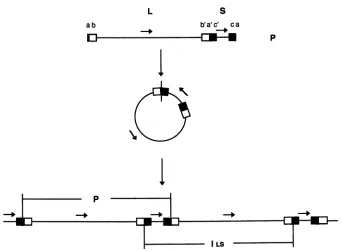
diagrammed in Fig. 1, cleavage of concatemers or circles
* Correspondingauthor.
derived fromone isomeric form ofHSV DNAcanproduce
oneotherisomer inwhichboth segments areinverted. This
hypothetical pathway is therefore potentially capable of
directly generating half of the observed genome segment inversion events. If one further proposes that the two
resultingisomerscanundergo end-to-end ligation in
subse-quentrounds ofinfection, this pathwaymightalso contribute
tothe remainingisomerizationevents. However, the extent
towhich the useofalternative cleavage frames and
end-to-endligation contributetogenomeisomerization hasnotyet
beendirectlyassessed.
The a sequence also drives recombination events that are
potentially capable ofgenerating all four genome isomers.
Thus, HSV recombinantsbearing anadditionalcopyofthea sequenceinserted intothethymidine kinase (tk)genedisplay
all of the additional genome isomers that are predicted to
arise from recombination between the novelainsert andthe residenta sequenceslocatedatthe L andS termini and the
L-Sjunction(2, 19, 27, 28, 35), and at leastsome of these
productshave been showntoarisethroughbona fide
recom-bination events (27). Mocarski et al. (19) initially proposed
that these recombination events are site specific and
uniquely targeted to a sequences. However, it has since
become apparent thatavarietyof other DNAfragments are
alsoabletoinduceanalogousrearrangementswhentheyare
duplicatedin the HSVgenome
(14,
21, 22, 34,37).
Never-theless, the a sequence appears to be considerably more
recombinogenic than other DNA fragments of
equivalent
length, implying that its activity is boosted by
specialized
processes(8, 27, 37, 38).
We recently conducted an extensive analysis of the
cis-acting sequences required for the recombinational
activity
of the HSV type 1
(HSV-1)
a sequence(27).
Our results indicated thatcompletelynonoverlappingsegmentsof thea sequence haddetectable activity, implyingthat recombina-tion does not invariably occurby
cleavage andligation
reactions at a single specific site. An
important
finding
to emerge from thisanalysis
wasthat thetandemly
reiterated sequences present within the a sequence,previously
pro-7505on November 9, 2019 by guest
http://jvi.asm.org/
L
ab
0l-S
b'a'c' ca
-EN-U
pFIG. 1. Structureandreplicationof the HSVgenome.Thefigureshows the structure of the HSVgenomeand illustrates thepotentialfor
genomeisomerization drivenbythe viral DNAcleavage/packaging system.In thecasedepicted here,concatemersorcircles derivedfrom
theprototype(P)isomercanbeprocessedtoproduceeither thePortheinverted L-inverted S(ILS)arrangement.
posedtoserve asthetargetofasite-specificrecombination system(2),could be deletedwithouteliminating recombina-tional activity. Although this analysis did not identify
spe-cific sequenceswithinthea sequencethat areessential for recombination, we found that recombination was strongly
dependent on the integrity of the sequences immediately adjacentto the positions ofpac-dependent DNAcleavage. Taken incombination, thesedata ledustoproposethat the site-specificDNAcleavages induced bythe cleavage/pack-agingsystemstimulate theinitiation ofgeneralized recombi-nationby providing recombinogenic free DNA ends. This modelpredictsthatinter-a recombinationrequiresextended DNA sequence homology between the recombining
part-ners.
TheasequencesofHSV-1 and HSV-2display essentially
no sequence homology, aside from short regions spanning thepacl andpac2 signals (3).Apreviousreport has shown that the HSV-2cleavage/packagingsystemcancleave trans-fected HSV-1a sequences(30), but it isnotclear from the published literature whether the HSV-1 and HSV-2 a
se-quencesarecapableofrecombiningwith each other. Inone
reportthat bearsonthisissue,Davison andWilkie(5)found thatHSV-1 x HSV-2 recombinantsbearing heterotypicba
or ca repeats displayed reduced but detectable levels of
genomeisomerization.However,theinterpretationof these observationswas complex,fortwo reasons. First,the het-erotypicasequenceswereflankedby largeregionsofpartial homologycontributedbytheheterotypic b and/orcrepeats. Second, these recombinantswereunstable andgaveriseto freely invertingderivatives inwhichpartial identitybetween the repeats was restored by recombination or conversion
events. Although some of these recombination events in-volved crossovers between HSV-1 and HSV-2 sequences
within or close to the heterotypic a sequences, crossover
eventsalso occurred within theheterotypicb andcregions.
Therefore, this study did not indicate whether the HSV-1
andHSV-2asequencesareabletorecombine in theabsence
ofextended
flanking-sequence
homology.Weinserteda317-nucleotide
(nt)
asequencederivedfromHSV-1 strain KOSinto the tk geneofHSV-2 strainHG52in
ordertodetermine whether thecleavage/packaging reaction could be uncoupled from recombinational genome
isomer-izationwithin thecontextof the viral genome.PlasmidpA23
bearsthe HSV-1asequence(lackinganyadditionalflanking
HSVsequences) insertedattheBamHI siteinpUC18 (27).
We first modified pA23by insertinga
KpnI
linker into theHincIIsite in thepolylinker;thismanipulationallowed thea sequence and flanking polylinker DNA to be excised as a
KpnI
fragment. TheKpnI
a fragment was then cloned inboth orientations into the unique
KpnI
site in plasmidL3PKlKpnA(Fig. 2). L3PKlKpnA carriesamutantversion
of the HSV-2 tk gene which lacks a 180-nt internal
KpnI
fragment; this deletion inactivates TK activity (17). The
resulting tk-deficient deletion/substitution mutations were
thentransferredinto the genome of HSV-2 HG52 by
DNA-mediated marker rescue. Following selection of tk-deficient progenyby plaque purification in the presence of 100 ,ug of
thymine arabinoside per ml, recombinants bearing the
de-sired insertswereidentified
by
Southern blothybridization of BamHI-cleaved viralDNA(data
not shown).We chose tworecombinants for furtheranalysis. One,Ub5',
bore the HSV-1asequenceoriented with its Ub sequence closest tothe
5' end of the tk gene; the other, Uc5', carried the a sequencein theopposite orientation.Wefirstverifiedthattherecombinant viral genomes bore the
predicted
insert within the tk gene. TheKpnI
fragmentbearing the inserted a sequence contains two internal
BamHIsites contributed by pUC polylinker sequences (Fig. 2).To testfor theacquisitionofthesesites, packaged viral DNA was extracted from cytoplasmic nucleocapsids, cleaved withBamHI, and then examinedbySouthern blot
hybridizationwithradiolabeled L3PKlKpnA plasmid DNA
on November 9, 2019 by guest
http://jvi.asm.org/
[image:2.612.141.483.75.326.2]tk
Sal Kpn Bam Xho
I[
I IKpn Kpn Bam Bglll Sal
I I I WT
tkmRNA
Sal Kpn Bam Xho
ILI
Kpn Kpn Bam Bglll Sal
A I I
I
44 i tkmRNA
L3PK1 KpnA
Sal Kpn Bam Xho
I I
Bam Bam Bam
Bglll
SalKpn Kpn
3'probe
5'probe
EM-aInsert
term1
term 2
-1.0kb O
FIG. 2. Structures ofrecombinant viralgenomes.Theupperportion of thefigure depicts thestructureof the tk region of the HSV-2strain
HG52genome(wildtype[WT]). Recombinant viralgenomes(a insert)wereproduced by insertinga KCnI fragment bearing the HSV-1a
sequenceinto theKpnI siteonplasmid L3PKlKpnA (KpnA).This plasmid bearstksequencesextending from the XhoItotheBglIl site and
lacks a 180-nt I4nI fragment found inwild-type DNA.The lower portion of thefigure depicts the predictedstructures of novel termini
produced by cleavageatthe inserteda sequenceandindicates the oligonucleotide probes used in Fig. 4 (3' probe and 5' probe).
as aprobe (Fig. 3). Theprobedetectedfragments of 3.9and
3.2 kb with wild-type HSV-2 DNA; the 3.2-kb fragment
spansthe site of theainsert inrecombinantsUb5' andUc5'. As predicted, the 3.2-kb fragment was replaced by
frag-ments of 2.8 and 0.4 kb in both recombinants (note that L3PKlKpnAdoesnotbearan asequenceand thereforedoes
notdetect theca.320-nt BamHIafragmentinrecombinants
Ub5' andUc5').Asanother test,welooked forthepredicted 120-ntincreaseinsizeoffragmentsthatspanthe site of the insertion. Thepredictedsize increase in themajor hybridiz-ing band was observed in both Sall and BglII plusXhoI digests of virion DNA (Fig. 3, most clearly visible in the BglII plusXhoI digest; the origins of the additional minor
bands are described below). Similar results were obtained
withPvuII (datanotshown).
We then examined therecombinantsfor the presenceof the predicted submolar tk-related fragments diagnostic of cleavage/packaging and recombinational genome segment inversion. If the inserteda sequence serves as atargetfor theHSV-2cleavage/packagingsystem,packagedviral DNA should displaytwo novel submolar termini that endwithin the tkgene (Fig. 2). Fragmentsof the predictedsizeswere
readilydetected inSalIandBgilII plusXhoIdigestsof viral DNA(Fig. 3,terminus 1 and terminus2[ca. 3.4and 1.5 kb in SalI digests and ca. 2.2 and 1.1 kb inBgilII plusXhoI digests, respectively]; note that terminus 1 and terminus 2
KpnA
}:
-Elff---.M
on November 9, 2019 by guest
http://jvi.asm.org/
[image:3.612.146.473.68.496.2]6.6
-tk _
term1 ,
in in
- D0
9.4
-6.6
4.4
-tk I
tk_
x
termi -M
2.3
2.0
BamHI
FIG. 3. Southern blot analysis of recombinant viral genomes.
Viral DNA extracted fromcytoplasmicnucleocapsidswascleaved
with the indicatedrestriction endonucleases and thensubjectedto
electrophoresis through a0.8%agarosegel.Followingtransfer toa
nylon membrane, the blot was hybridized to 32P-labeled
L3PKlKpnA DNA. tk, uncleaved tk fragment; tk*, tk fragment bearing two tandem a sequences; term 1, terminus 1; term 2,
terminus 2. The sizes (in kilobases) and positions of HindlIl-digested phage markerfragmentsareindicated.wt,wildtype.
differslightlyin size between recombinants Ub5' and Uc5' because the a insert is notprecisely centered in theKjpnI fragmentusedtoproducetheserecombinants). Theidentity of the novel terminal fragments was further confirmed by hybridizing BglII- and XhoI-digested virion DNA to
syn-theticoligonucleotidesderived from the 5'- and3'-flankingtk DNA sequences (Fig. 4). As predicted (Fig. 2), the 3' tk probe hybridized to terminus 1 (and to the uncleaved tk fragments), and the 5' probe hybridized to terminus 2. Unexpectedly, each of these oligonucleotide probes also hybridizedtooneotherfragmentofunknownorigin (ca.2.5 and 9 kb for the 3' and 5'probes, respectively;labeled X and Y in Fig. 4). Inasmuch as the X and Y signals were also observed withwild-typeviralDNA,thesebandspresumably representHSV DNAfragmentsthatcross-hybridizewith the probesunder theconditions used.
Previous work has shown that the cleavage/packaging system duplicates the a sequence (7, 35), leading to the accumulation ofL-Sjunctions bearingtandemareiterations.
Weobservedaminor band(tk*)ofthe sizepredictedforatk
fragment bearingtwo tandema sequences in the SalI and
BglII plus XhoI digests displayed in Fig. 3 and 4 (most clearly seen intheBglII plusXhoI digests). We cloned the tk* Sall fragment from Ub5' virion DNA and showed, by restriction endonuclease cleavagesite mapping, thatitbore thepredicted tandemduplication of theHSV-1a sequence
(datanotshown). Taken incombination,thesedata demon-strate that the HSV-1 a sequence was processed by the
3'probe 5'probe
FIG. 4. Hybridizationof recombinant viral DNAsto
oligonucle-otideprobes.Viral DNA extracted fromcytoplasmicnucleocapsids
wascleaved withamixture of BglII and XhoIand thensubjectedto
electrophoresis through a 0.8% agarosegel. Followingtransfer to
nylon membranes,the blotwashybridized to32P-labeled20-mers derived from tk sequences 3' and 5' to the inserted a sequence
(ATGTGGTACAAGTCCCCGT[ and CTATCGCCTCCCITGCTG TGC, respectively). Fragment nomenclature is described in the legend to Fig. 3 and in the text. X and Y are cross-hybridizing
fragmentsunrelated totksequences. The sizes (in kilobases)and
positionsofHindIII-digestedX fragmentsareindicated.
HSV-2cleavage/packaging system, confirming previous
re-sults of transfection assays(30).
IftheinsertedHSV-1a sequence wasalso ableto
recom-bine with the HSV-2a sequences located at the L and S termini and L-S junction, additional novel junction frag-ments representingfusions of tk sequences to the b andc
repeatswould beformed(for SalI digests,ca.11.3and 6.0 kb
forrecombinant Ub5' andca.9.4and 7.9 kb for recombinant
Uc5'; forBglII plus XhoI digests, ca. 4.3 and 2.2 kb for
recombinant Ub5' and ca. 3.3 and 3.2 kb for recombinant
Uc5'). However, we were unable to detect such novel junction fragments even after prolonged exposures of the Southern blots (Fig. 3 and 4). We estimate that novel junctions would have been detected easily if they were
present at 5% of the abundance of inversion products observedwithananalogous recombinantbearing the HSV-1
asequenceinserted into theHSV-1tkgene(27). Inaddition, we were unable to detect the predicted novel tk-c fusion fragments following hybridization of PvuII-, SalI-, XhoI-, BglII-,orBglIl- plus A7zoI-digested Ub5'orUc5'DNAtoan
oligonucleotide derived from the c region of HSV-2 DNA
(data not shown). Thus, although the inserted HSV-1 a
sequenceservedas atargetforcleavage/packaging, it didnot
detectably recombine with the HSV-2a sequences located
elsewhere in the recombinant viralgenomes. These results contrast with the relatively efficient inter-a recombination
9.4
-tw D tJ P D u 3n=l D 'DDn
3.92& AL
. :w1
3. 2 m"D.
.~
4.4
-2.3
-2.0
-2.8
in in
=D =
tk*
tk
term1
term2
0.56
-term2
0.4
Sail BglilXhol
term2
on November 9, 2019 by guest
http://jvi.asm.org/
[image:4.612.73.350.66.340.2] [image:4.612.147.535.70.337.2]that is observed following insertion of the same HSV-1 a fragment into the tkgene in the HSV-1genome (27).
These data establish that the HSV cleavage/packaging system is capable of generating new genomic termini without provoking the formation of novel junctions. This finding demonstrates that the cleavage/packaging system contrib-utes directly to genome isomerization through the use of alternative cleavage frames on circular or concatemeric precursors (diagrammed in Fig. 1). As noted above, this process can account for half of the genome isomerization events that occur during infection with wild-type HSV-1. Theabsence of noveljunction fragments bearing the inserted a sequence further suggests that intermolecular end-to-end ligation does not measurably contribute to the additional genome segment inversions that occur during infection; more likely, these events occur entirely through bona fide crossovers between pairs of homologous inverted se-quences. Our data suggest that inter-a recombination
re-quires homology between the recombining partners. One
interpretation is that HSV-1 and HSV-2 employ distinct
specialized recombination systems that are targeted
exclu-sivelytotheirrespectiveasequences.However, we believe
that asimpler interpretationof the available evidence is that
recombination between a sequences occurs through a
ho-mology-dependent generalized mechanismthatis stimulated
bythe freeendsproduced bythecleavage/packagingsystem
(27). These two possibilities could be distinguished by
ex-aminingadditional recombinantsbearing two inverted copies
of the HSV-1 a sequence in an HSV-2 background. This researchwassupported by the National Cancer Institute of Canada. J.R.S. isaTerryFoxseniorscientist of theNCI(C).
REFERENCES
1. Bankier,A.T.,W.Dietrich,R.Baer,B.G. Barrell,F. Colbere-Garapin, B. Fleckenstein, and W. Boedmer. 1985. Terminal repetitive sequences in herpesvirus saimiri virion DNA. J. Virol. 55:133-139.
2. Chou, J., and B. Roizman. 1985. Isomerization ofherpes sim-plex virusgenome:identification of thecis-actingand recombi-nation sites within the domain of thea sequence. Cell 41:803-811.
3. Davison, A., and N.Wilkie. 1981. Nucleotidesequenceof the jointbetween the L and S segments ofherpes simplexvirus types1 and 2. J. Gen.Virol. 55:315-331.
4. Davison, A.J. 1984. Structure of thegenome termini of vari-cella-zoster virus. J. Gen.Virol. 65:1969-1977.
5. Davison,A.J., and N. M. Wilkie. 1983. Inversion of the two
segments of the herpes simplex virus genome in intertypic recombinants.J. Gen. Virol.64:1-18.
6. Deiss,L.P., J.Chou,and N. Frenkel.1986.Functional domains within thea sequence involved in the cleavage-packaging of herpes simplex virusDNA. J.Virol. 59:605-618.
7. Deiss, L. P., and N. Frenkel. 1986. Herpes simplex virus amplicon: cleavage of concatemericDNAis linkedtopackaging and involves amplification of the terminally reiterated a
se-quence.J. Virol. 57:933-941.
8. Dutch,RE.,R.C.Bruckner,E.S.Mocarski,and I. R. Lehman. 1992.Herpessimplexvirustype1recombination: role ofDNA replicationandviralasequences.J. Virol. 66:277-285. 9. Hammerschmidt, W.,H.Ludwig,andH.J.Budk. 1988.
Speci-ficityofcleavageinreplicative-formDNAof bovineherpesvirus 1. J.Virol.62:1355-1363.
10. Hayward,G.S.,R.J.Jacob,S. C.Wadsworth,and B.Roizman. 1975.Anatomyofherpessimplexvirus DNA:evidenceforfour populations of moleculesthatdiffer in therelative orientations of theirlongand short segments. Proc. Natl. Acad.Sci. USA 72:4243-4247.
11. Jacob,R.J.,L. S. Morse,and B. Roizman. 1979.Anatomy of herpessimplexvirus DNA. XII. Accumulation ofhead-to-tail
concatemers in nuclei of infected cells and their role in the generationof the fourisomericarrangementsof viral DNA. J. Virol. 29:448-457.
12. Kaerner, H., I. Maichle, A.Ott,and C. Schroeder. 1979.Origin of two different classes of defective HSV-1 Angelotti DNA. Nucleic AcidsRes.6:1467-1478.
13. Locker, H., and N. Frenkel. 1979. Structure and origin of defective genomes contained in serially passaged herpes sim-plex virustype1(Justin). J. Virol. 29:1065-1077.
14. Longnecker, R.,and B. Roizman.1986.Generation ofan invert-ing herpes simplex virus 1 mutant lackingthe L-Sjunctiona
sequences, an origin of DNA synthesis, and several genes, includingthosespecifying glycoproteinEand thea47 gene. J. Virol.58:583-591.
15. Marks, J.R., and D. H.Spector. 1988. Replication of the murine cytomegalovirusgenome:structureand role of the termini in the generationandcleavageofconcatenates.Virology162:98-107. 16. Matsuo, T.,M.Heller,L.Petti,E.O'Shiro,and E.Kieff.1984. Persistence of the entireEpstein-Barrvirusgenomeintegrated into humanlymphocyteDNA.Science226:1322-1325. 17. McDermott,M.R., J.R.Smiley,P. L.J. Brais,H. E.Rudzroga,
andJ.Bienenstock. 1984. Immunityinthe femalegenitaltract
afterintravaginalvaccination of mice withanattenuatedstrain ofherpessimplexvirustype2.J. Virol. 51:747-753.
18. Mocarski, E. S.,A. C.Liu, and R. R. Spaete. 1987. Structure and variability of the a sequence in the genome of human cytomegalovirus (Towne strain). J. Gen.Virol. 68:2223-2230. 19. Mocarski, E. S., L. Post, and B. Roizman. 1980. Molecular
engineeringof theherpes simplexvirusgenome:insertion ofa
second L-Sjunctioninto thegenomecausesadditionalgenome inversions. Cell 22:243-255.
20. Poffenberger, K. L., and B. Roizman. 1985. A noninverting genomeofaviableherpes simplexvirus: presenceof head-to-taillinkagesin packagedgenomes andrequirementsfor circu-larization after infection.J.Virol. 53:587-595.
21. Pogue-Geile,K.L.,G. T. Y.Lee,and P.G.Spear.1985.Novel rearrangements ofherpes simplexvirusDNA sequences result-ing fromduplicationofasequencewithin theunique regionof theL component. J.Virol. 5:456-461.
22. Pogue-Geile, K.L., and P. G. Spear. 1986. Enhanced rateof conversion or recombination of markers within a region of uniquesequencein theherpes simplexvirus genome. J. Virol. 58:704-708.
23. Roizman,B.1979. Theorganizationof theherpes simplexvirus genome. Annu.Rev.Genet. 13:25-57.
24. Roizman,B.1990.Herpesviridae:abriefintroduction,p. 1787-1793. In B. N.Fieldsand D. M.Knipe(ed.), Virology. Raven Press,New York.
25. Sheldrick, P.,and N. Berthelot. 1974.Invertedrepetitionsin the chromosome of herpes simplex virus. Cold Spring Harbor Symp. Quant.Biol. 39:667-678.
26. Skare, J.,and W.C. Summers. 1977.Structure andfunction of herpesvirusgenomes. II. EcoRI, XbaI, andHindIII endonu-clease cleavage sites on herpes simplex virus type 1 DNA. Virology76:581-595.
27. Smiley, J. R., J. Duncan, and M. Howes. 1990. Sequence requirementsfor DNA rearrangements inducedbytheterminal repeat of herpes simplex virus type 1 KOS DNA. J. Virol. 64:5036-5050.
28. Smiley, J. R.,B.Fong,andW.-C.Leung.1981.Construction of
adouble-jointed herpessimplexvirus DNAmolecule: inverted repeats arerequired for segmentinversion and direct repeats promotedeletions.Virology113:345-362.
29. Spaete,R.R.,and N. Frenkel. 1982. Theherpessimplexvirus amplicon: a new eucaryoticdefective-virus cloning-amplifying
vector. Cell30:295-304.
30. Spaete, R.R.,and N. Frenkel. 1985.The herpessimplexvirus amplicon: analysis of cis-acting replication functions. Proc. Natl.Acad. Sci.USA82:694-698.
31. Spaete,R. R.,and E. S.Mocarski. 1985. Theasequenceof the cytomegalovirusgenomefunctionsas a
cleavage/packaging
sig-nal for herpes simplexvirus defective genomes. J. Virol. 54: 817-824.
on November 9, 2019 by guest
http://jvi.asm.org/
32. Stow, N., and E. McMonagle. 1983. Characterization of the TRs/IRsorigin of DNA replication of herpes simplex virustype
1.Virology130:427-438.
33. Stow, N., E.McMonagle, and A. Davison. 1983. Fragments from bothtermini of the herpes simplex virustype1genomecontain signals required for the encapsidation of viral DNA. Nucleic AcidsRes. 11:8205-8220.
34. Tamashiro, J. C., and D. H. Spector. 1986. Terminalstructure
andheterogeneity in humancytomegalovirus strain AD169. J.
Virol.59:591-604.
35. Varmuza, S.L., and J. R. Smiley. 1985.Signals forsite-specific cleavage of HSV DNA: maturation involves two separate
cleavageevents atsites distaltotherecognitionsequences.Cell 41:793-802.
36. Vlazny, D., and N. Frenkel.1981. Replication of herpes simplex virus DNA:localization of replication recognition signals within defectivegenomes.Proc. Natl. Acad. Sci. USA78:742-746. 37. Weber, P. C., M. D. Challberg, N. J. Nelson, M. Levine, and
J. C. Glorioso. 1988. Inversioneventsinthe HSV-1genome are
directly mediated by the viral DNAreplication machinery and lacksequencespecificity. Cell 54:379-381.
38. Weber, P.C., M.Levine,and J.C. Glorioso. 1990.
Recombino-genic properties of herpes simplex virustype1 DNAsequences
resident in simian virus 40 minichromosomes. J. Virol. 64:300-306.
39. Wilkie, N. M. 1976.Physicalmapsfor herpes simplex virustype
1 DNA forrestriction endonucleases HindIII,Hpa-1,and X.
bad.J. Virol.20:222-233.
![FIG. 2.HG52producedsequencelacks Structures of recombinant viral genomes. The upper portion of the figure depicts the structure of the tk region of the HSV-2 strain genome (wild type [WT])](https://thumb-us.123doks.com/thumbv2/123dok_us/1304834.83676/3.612.146.473.68.496/producedsequencelacks-structures-recombinant-genomes-portion-depicts-structure-strain.webp)
