Rochester Institute of Technology
RIT Scholar Works
Theses Thesis/Dissertation Collections
8-2015
A Simulation Based Optimization Approach for
Stochastic Resource Constrained Project
Management with Milestones
Maribel Perez
Follow this and additional works at:http://scholarworks.rit.edu/theses
This Thesis is brought to you for free and open access by the Thesis/Dissertation Collections at RIT Scholar Works. It has been accepted for inclusion in Theses by an authorized administrator of RIT Scholar Works. For more information, please [email protected].
Recommended Citation
Rochester Institute of Technology
A SIMULATION BASED OPTIMIZATION APPROACH FOR STOCHASTIC
RESOURCE CONSTRAINED PROJECT MANAGEMENT WITH MILESTONES
A Thesis
Submitted in partial fulfillment of the requirements for the degree of
Master of Science in Industrial & Systems Engineering
in the
Department of Industrial & Systems Engineering
Kate Gleason College of Engineering
by Maribel Perez
i
DEPARTMENT OF INDUSTRIAL AND SYSTEMS ENGINEERING
KATE GLEASON COLLEGE OF ENGINEERING
ROCHESTER INSTITUTE OF TECHNOLOGY
ROCHESTER, NEW YORK
CERTIFICATE OF APPROVAL
M.S. DEGREE THESIS
The M.S. Degree Thesis of Maribel Perez
has been examined and approved by the
thesis committee as satisfactory for the
thesis requirement for the
Master of Science degree
Approved by:
____________________________________ Dr. Michael E. Kuhl, Thesis Advisor
ii
ABSTRACT
Project managers are challenged to continuously make decisions throughout the
development of a project attempting to minimize the overall project cost and, at the same time,
seeking to accomplish a pre-established deadline. These time-cost tradeoff decisions are made
even more complex when resource constraints, caused by limited available resources, are added
to the equation. The goal of this research is to design a simulation-based optimization approach
to solve the resource constrained project scheduling problem (RCPSP) under uncertainty. Two
methods are proposed: the Total Cost Resource Constrained Method (TCRCM) and the Earned
Value Resource Constrained Method (EVRCM). The TCRCM seeks to minimize the total
project cost, including activity and penalty costs due to lateness at project completion, while
considering the RCPSP with stochastic activity times and costs in terms of resource alternatives
as well as precedence relationships for activities sharing resources. The EVRCM, which is based
on earned value management, not only considers penalty costs at project completion, but at
several project milestones along the execution of the project. Both methods can be implemented
in two phases: Phase I, and Phase II. Phase I is implemented prior the start of the project to
determine the optimal resource configuration for the entire project based on the specified
performance measure (e.g. total project cost). Phase II is implemented as the project progresses
to determine the optimal resource configuration for the remaining activities of the project. The
robustness of both methods is evaluated through a set of experiments. Lastly, the methods are
iii
TABLE OF CONTENTS
ABSTRACT ... ii
1 INTRODUCTION... 1
2 PROBLEM STATEMENT ... 4
3 LITERATURE REVIEW ... 7
3.1 Project Scheduling Techniques ... 7
3.2 Resource Constrained Project Scheduling Problem (RCPSP) ... 11
3.3 Simulation Optimization ... 15
3.4 Earned Value Management Terminology ... 17
3.4.1 Earned Value Main Components ... 18
3.4.2 Earned Value Performance Measures ... 19
3.4.3 Earned Value Forecasting Indicators ... 21
3.5 Discussion ... 23
4 TOTAL COST RESOURCE CONSTRAINED METHOD FOR RCPSP BASED ON EXPECTED TOTAL PROJECT COST ... 25
4.1 Overview of the Simulation-Based Optimization Approach ... 28
4.1.1 Assumptions ... 29
4.1.2 TCRCM: Input Parameters ... 30
4.1.3 TCRCM: Optimization Model ... 31
4.1.4 TCRCM: Simulation Model ... 35
4.1.5 TCRCM: Output Parameters... 39
4.1.6 TCRCM: Project Simulator ... 39
4.2 TCRCM: Implementation ... 40
4.3 TCRCM: Applied Prior the Start of the Project... 44
4.4 TCRCM: Phase I Example... 46
4.5 TCRCM: Applied During Project Execution ... 51
4.6 TCRCM: Phase II Example ... 53
4.7 TCRCM: Experiments ... 62
4.7.1 Experimental Case 1 ... 65
4.7.2 Experimental Case 2 ... 71
4.7.3 Experimental Case 3 ... 76
4.7.4 TCRCM: Experimental Cases Discussion ... 81
4.8 Summary of TCRCM ... 82
5 EARNED VALUE RESOURCE CONSTRAINED METHOD BASED ON MULTIPLE PROJECT MILESTONES ... 83
5.1 EVRCM: Applied Prior the Start of the Project ... 88
5.1.1 EVRCM: Phase I Assumptions ... 90
5.1.2 EVRCM: Phase I Input Parameters ... 90
5.1.3 EVRCM: Phase I Optimization Model ... 91
iv
5.1.5 EVRCM: Phase I Output Parameters ... 94
5.1.6 EVRCM: Phase I Project Simulator ... 96
5.1.7 EVRCM: Phase I Implementation ... 96
5.1.8 EVRCM Applied to the Selection of Resource Alternatives: Phase I Example ... 99
5.1.9 EVRCM Applied to the RCPSP: Phase I Example ... 107
5.2 EVRCM: Applied During Project Execution ... 115
5.2.1 EVRCM: Phase II Assumptions ... 117
5.2.2 EVRCM: Phase II Input Parameters ... 117
5.2.3 EVRCM: Phase II Optimization Model ... 117
5.2.4 EVRCM: Phase II Simulation Model ... 120
5.2.5 EVRCM: Phase II Output Parameters ... 122
5.2.6 EVRCM: Phase II Project Simulator ... 122
5.2.7 EVRCM: Phase II Implementation ... 123
5.2.8 EVRCM Applied to the Selection of Resource Alternatives: Phase II Example ... 126
5.2.9 EVRCM Applied to the RCPSP: Phase II Example ... 137
5.3 EVRCM: Experiments ... 146
5.3.1 EVRCM for Resource Alternatives: Experiments ... 147
5.3.2 EVRCM for RCPSP: Experiments ... 169
5.4 Summary of EVRCM ... 191
6 MS EXCEL USER INTERFACE... 192
6.1 TCRCM User Interface ... 193
6.2 EVRCM User Interface... 202
7 CONCLUSIONS & RECOMMENDATIONS FOR FUTURE RESEARCH ... 215
7.1 TCRCM Conclusions ... 215
7.2 EVRCM Conclusions... 216
7.3 Recommendations for Future Work... 217
REFERENCES ... 218
APPENDICES ... 221
Appendix A. Example of the Implemented TCRCM ... 221
Appendix B. Industrial Strength COMPASS (ISC) Input Parameters ... 229
Appendix C. Input Files ... 231
Appendix D. TCRCM Template User Manual ... 252
1
1
INTRODUCTION
Project management is the application of knowledge, skills, tools, and techniques to
project activities to meet the project requirements (PMI, 2008). Project management is all about
administering and "balancing the competing project constraints, which include, but are not
limited to: scope, quality, schedule, budget, resources and risks" (PMI, 2008), in order to
complete a project on time, budget, and scope.
In the early planning stages of a project, an effort is made to identify the main activities
of the project as well as their precedence relationship, estimated duration, and associated costs.
As the next step, resources are assigned to the project tasks. Assigning different resources to all
activities of the project would certainly make resource allocation simple and provide the shortest
project completion time. However, that approach is not guaranteed to minimize project cost.
Furthermore, in reality, project managers need to face not only resource scarcity, but also the
lack of skilled resources that would qualify to perform a particular activity. Commonly,
resources capabilities are limited by their expertise and knowledge on how to perform the task.
Hence, resource availability is not only dependent on the current number of resources but also
the skills of potential resources.
Throughout this research, the resource constrained project scheduling problem (RCPSP)
under uncertainty is investigated. The RCPSP consists of the allocation of resources to
competing activities in an efficient way (Bhaskar, Pal & Pal, 2011). In the proposed method, the
RCPSP is approached by selecting from among potential resource alternatives with associated
stochastic durations and costs, while simultaneously considering precedence decisions for
2
assignment and resource precedence, with the purpose of minimizing project cost at project
milestones.
To better explain the problem, a sample project network is shown in Figure 1.1. In this
network, the numbered nodes represent the activities of the project (in this case there are a total
of 12 activities) and the nodes labeled “S” and “F” represent the start and finish of the project.
The letters above each node represent the potential resource alternatives that could execute that
task. The solid arcs symbolize the precedence relationships between activities and the dashed
arcs represent the potential precedence constraints if the same resource was chosen to execute
both activities. For example, if resource D was selected to perform both activities 5 and 6, the arc
direction would need to be determined and, afterwards, a resource precedence relationship would
be imposed between the activities. Given multiple potential configurations to select from, finding
the optimal resource configuration for a network, such as the one shown, could get very
complex.
3
This research presents a simulation-based optimization approach that focuses on
identifying the optimal scheduling scheme that minimizes the cost of the project. The method
consists of two phases. The Static Phase, which is executed before the project begins, determines
the best resource configuration based on potential resource alternatives with associated stochastic
times and costs. The Dynamic Phase, which is implemented during project execution,
reevaluates resource configurations for the remaining activities of the project considering that the
uncertainty associated with completed and in progress activities is eliminated.
The rest of this thesis is structured as follows. Chapter 2 presents the problem statement
and the fundamental objectives of this research. Chapter 3 includes a review of the current
literature with regard to project scheduling techniques, resource constrained project scheduling
problem (RCPSP), simulation optimization, and earned value management. Chapter 4 presents
the proposed scope and methodology for the Total Cost Resource Constrained Method
(TCRCM). Chapter 5 presents the proposed scope and methodology for the Earned Value
Resource Constrained Method (EVRCM). Chapter 6 presents the MS Excel user interface
developed for the TCRCM and the EVRCM. Chapter 7 presents the conclusions drawn from this
4
2
PROBLEM STATEMENT
Given the complexity of scheduling resources while attempting to obtain the optimal
project cost at project milestones, the goal of this research is to develop a tool that provides
project managers information regarding the optimal resource scheduling scheme for their
projects. A simulation-based optimization approach that evaluates different resource
configurations for project activities considering their associated stochastic times and costs, as
well as penalty costs due to tardiness, is investigated. Two methods, which are both based on a
simulation-based optimization approach, are developed in this research:
Total Cost Resource Constrained Method (TCRCM): This method seeks to identify the
optimal resource configuration for the RCPSP in terms of resource assignments and
resource precedence relationships by minimizing the total expected project cost at a
single project milestone (project completion).
Earned Value Resource Constrained Method (EVRCM): This method, which is based on
earned value management, seeks to identify the optimal resource configuration that
minimizes the expected cost of the project, which consists of activity costs and lateness
penalty at several project milestones. This method is applied to two problems: 1)
Selection of Resource Alternatives, and 2) the RCPSP.
The main objectives of this research are to:
Develop a simulation-based optimization method for stochastic resource constrained
project management with a single project milestone: In order to solve the resource
constrained problem, there are two main questions that need to be answered. First, for
5
alternative needs to be selected for each project activity. Additionally, for activities
sharing resources, the order of activity execution has to be determined. The method
should be able to provide the optimal resource configuration that minimizes project cost
during the static phase (Phase I), that is, prior the start of the project. In addition, the
method should be capable of reevaluating the project along its progression in order to
provide the optimal resource configuration from that point forward by only considering
uncertainty of activities that have not been started.
Develop a simulation-based optimization method based on Earned Value Management
for stochastic resource constrained project management with several project milestones:
Design a method that uses earned value management to determine the optimal resource
configuration by not only considering penalties associated with lateness at project
completion but also at several project milestones along the execution of the project. The
method is to be applied to the selection of resource alternatives as well as the RCPSP in
terms of resource alternatives with associated stochastic times and costs and resource
precedence relationships. The method should be able to provide the optimal resource
configuration that minimizes planned value during the Static phase (Phase I), that is, prior
the start of the project. In addition, the method should be capable of reevaluating the
project along its progression in order to provide the optimal resource configuration for
6
Conduct an experimental performance evaluation: The capabilities and limitations of the
proposed tool will be evaluated through experimentation. A set of experimental cases will
be used to evaluate the TCRCM. These cases are characterized by a range of
complexities including varying resource alternatives, resource precedence relationships,
levels of variability in activity costs and times, and penalty functions. The EVRCM will
be applied to two problems: 1) Selection of resource alternatives, and 2) The RCPSP.
Cases are utilized to evaluate each problem. When applying the EVRCM to the first
problem, cases with varying resource alternatives, levels of variability, number of project
milestones and weighted penalty functions will be considered. For the EVRCM applied
to the RCPSP, in addition to the complexities mentioned for the TCRCM, multiple
project milestones and weighted penalty functions will be evaluated. For each method,
the experimental evaluation will be conducted for the static and dynamic phase.
Integrate the proposed optimization method with Microsoft Excel: With the purpose of
making the use of the proposed methods as user friendly as possible, the TCRCM and
EVRCM are both integrated to Microsoft Excel. The user will be able to input basic
information associated with the project under evaluation and easily run the
simulation-based optimization methods. The optimal solution will be imported automatically to the
Excel workbook as well as the Earned Value Graphs (for EVRCM) by simply clicking a
button.
By developing the simulation-based optimization methods, a more efficient resource
schedule that minimizes expected project cost under uncertainty will be generated, aiding project
7
3
LITERATURE REVIEW
The current chapter presents a synopsis of the concepts and terms related to this research.
These concepts and terms include project scheduling techniques, the resource constrained project
scheduling problem (RCPSP), simulation optimization, and earned value management
terminology. At the end of the chapter, the contribution provided by this research to the existing
literature will be discussed.
3.1
Project Scheduling Techniques
Scheduling refers to creating a defined plan for a project which clearly indicates the start
and end of project activities. (Vanhoucke, 2012). Scheduling complexities due to constraints
imposed by the characteristics of a project have accelerated the study of methods that simplify
the planning phase efforts. Scheduling techniques in project management began with the
development of the Gantt chart by Henry Gantt; technique that serves as platform for two
scheduling methods developed later on (Vanhoucke, 2012). Critical Path Method (CPM) and
Project Evaluation and Review Technique (PERT) have been widely used since the 1950s as
project scheduling techniques. CPM was developed in 1957 with the purpose of utilizing a
computer in scheduling construction programs, so that such programs could be completed on
time and within cost estimates (Wolf & Hauck, 1985). PERT was implemented in 1958 by the
U.S. Navy for managing the development of the Polaris missile program (Wolf & Hauck, 1985).
Although CPM and PERT were developed independently, they share certain similarities such as
the critical path calculations which serve as a basis for both. These calculations revolve around
identifying the longest path of the project network. That is, the critical activities which cannot be
delayed without extending the project completion time. In addition, the total slack of the project
8
task can be delayed without impacting the project duration is known. To calculate the critical
path, the following parameters need to be calculated (Kerzner, 2013):
1. Earliest start time (ES) and earliest finish time (EF) can be calculated during the forward
pass. Going through the network from left to right, the earliest starting time of a
successor activity is the latest of the earliest finish times of the predecessors. The earliest
finish is the addition of the earliest starting time and the activity duration.
2. Latest start time (LS) and Latest finish time (LF) are calculated during the backward pass
through the network. Since the activity time is known, the latest starting time can be
determined by subtracting the activity time from the latest finishing time. The latest
finishing time for an activity entering the node is the earliest starting time of the activities
exiting the node.
3. Slack time is determined after the forward and backward passes have been completed.
The slack is equal to the latest finish time minus the earliest finish time.
Several characteristics that are essential for analysis by CPM or PERT include (Wiest &
Levy, 1977):
The project consists of a well-defined collection of jobs, or activities, which when
completed mark the end of the project.
The jobs may be started and stopped independently of each other, within a given
sequence.
The jobs are ordered; that is, they must be performed in technological sequence.
Despite their similarities, CPM and PERT differ in numerous ways. CPM is basically
concerned with obtaining the trade-off between cost and completion date for large projects; it
9
in a project and the cost of these resources (Wiest & Levy, 1977). CPM does not manage
uncertainty in activity durations, in fact, the completion time of each activity is known with
certainty. On the other hand, PERT was implemented to cope with the uncertainties identified
during the managing of a development program. PERT has proven to be a useful tool in planning
and scheduling large projects which consist of numerous activities whose completion times are
uncertain (Wiest & Levy, 1977). Hence, PERT is used more in research and development
projects where probabilistic times are used for activity duration, and CPM is used more in
projects such as construction, where there has been some experience in handling similar
endeavors and activity times can be estimated more accurately (Wiest & Levy, 1977). Other
ways in which these two techniques differ are in that CPM is “built up from jobs (or activities)
instead of events” (Battersby, 1970), and that it relates times to costs.
Some of the assumptions underlying CPM and PERT include (Wiest & Levy, 1977):
A project can be subdivided into a set of predictable, independent activities.
The precedence relationships of project activities can be completely represented by a
noncyclical network graph in which each activity connects directly into its immediate
successors.
Activity times may be estimated – either as single-point estimates or as three-point PERT
estimates – and are independent of each other.
Although some of these assumptions are true for realistic scheduling problems, the
assumption of independence of activity durations is not aligned with situations observed in
practice. Resource limitations may cause time dependencies of activities sharing the same
resources (Wiest, & Levy, 1977); for an activity to begin, all technical and resource
10
resource that will execute the activity must be available. Hence, scheduling one activity may
cause another independent activity to be stretched out (or postponed) because of a lack of
sufficient common resources (Wiest & Levy, 1977). For this reason the basic time-only
PERT/CPM forward-backward pass procedure has been called by some seasoned users, a
feasible procedure for producing nonfeasible schedules (Moder, Phillips & Davis, 1983). When
considering resource constraints in PERT/CPM, the following is true (Moder, Phillips & Davis,
1983):
Resource constraints reduce the total amount of schedule slack.
Slack depends both upon activity precedence relationships, and resource limitations.
The early and late start schedules are typically not unique since they depend upon the
scheduling rules used for resolving resource conflicts.
The critical path in a resource-constrained schedule may not be the same continuous
chain(s) of activities as occurring in the unlimited resources schedule.
Given the limited capabilities of PERT/CPM to manage resource constraints, other
scheduling procedures are used for this purpose. Scheduling procedures for dealing with resource
constraints can be roughly divided into 2 major groups, according to the problem addressed
(Moder, Phillips & Davis, 1983):
Resource Leveling: occurs when sufficient total resources are available, and the project
must be completed by a specified due date, but it is desirable or necessary to reduce the
amount of variability in the pattern of resource usage over the project duration.
Fixed Resource Limits Scheduling: This category of problem, which is much more
11
out the project. The scheduling objective in this case is to meet project due dates insofar
as possible, subject to the fixed limits on resource availability.
Heuristic approaches have been used to improve the PERT/CPM procedures when
dealing with resource constraints. Kim & Garza (2003) proposed a step-by-step
resource-constrained path method (RCPM) that not only considered technical precedence constraints for
CPM calculations in the forward and backward pass process, but also accounted for
resource-constrained relationships. Hence, unlike CPM, the critical path identified through the RCPM
would be representative of the resource constrained network. Lu & Lam (2008) investigated “the
current practice of CPM scheduling under resource limit and calendar constraints” by evaluating
the P3 software tool. Lu & Lam (2008) proposed a method for calculating activity total float
during the forward pass analysis of the CPM method while considering resource calendar
restrictions. The results of the method were compared to the results produced by P3 in order to
identify any limitations of the software.
3.2
Resource Constrained Project Scheduling Problem (RCPSP)
The lack of skilled resources to allow the simultaneous execution of activities is a
problem project managers face regularly. Limited resources impose a whole new set of
constraints to the scheduler: job start times are constrained not only by precedence relationships
but also by resource availabilities (Wiest & Levy, 1977). The absence of available resources with
the required set of skills necessary to execute a project task can impact the project schedule
and/or project total cost. Therefore, scheduling resources while considering time-cost tradeoffs
can be a very challenging and complex task. The Resource Constrained Project Scheduling
Problem (RCPSP) is a well-researched problem, which involves allocating scarce resources to
12
some activities over time such that scarce resource capacities are respected and a certain
objective function is optimized (Brucker & Knust, 2011).
Due to the complexities of such a problem, various heuristic-based approaches have been
developed to solve the RCPSP. Kelley (1963), who first introduced the RCPSP, proposed and
applied two heuristic scheduling techniques with the purpose of minimizing total cost: parallel
and serial scheduling methods. In both methods, the set of schedulable activities are identified
and a priority rule is used to define which activities will be scheduled considering limited
resources. In parallel scheduling, all activities starting in a given time period are ranked as a
group in order of priority and resources are allocated according to this priority as long as
available (Moder, Phillips & Davis, 1983). On the other hand, in serial scheduling, “all activities
of the project are ranked in order of priority as a single group, using some heuristic, and then
scheduled one at a time” (Moder, Phillips & Davis, 1983). Gordon (1983) published a
comparison between the serial and the parallel method concluding that the serial procedure gives
better results for some categories of project networks than the parallel procedure. Despite this
and the fact that the parallel method requires more computing time, the parallel method “appears
to be more widely used than the serial method” (Moder, Phillips & Davis, 1983).
Wiest (1966) proposed a simple heuristic program based on three priority rules:
Allocate resources serially in time; that is, schedule all activities that can start in
day 1, then schedule activities eligible to start in day 2, and so on.
When activities compete for the same resource, the job with the least slack is
scheduled.
When no sufficient resources are available to schedule a critical activity, a
13
This simple heuristic was enhanced by Wiest (1967) to develop the so called SPAR-1
resource allocation model. One of the additional features was a probability-based selection rule
that enabled the program to randomly select the scheduling sequence of the activities. Hence,
multiple schedules are generated and the best one is selected from among them. Another feature
is that a minimum, normal or maximum level of resources can be assigned to an activity. That is,
if the activity is critical, the program will attempt to assign more resources in order to complete
the activity in less time (crash the activity). For non-critical activities, the program will first try
to assign the normal amount of resources, then the minimum number of resources or, lastly, the
activity is postponed.
Ant colony optimization (ACO) has been recently used to solve the RCPSP. Merkle,
Middendorf, & Schmeck (2002) proposed a method using new features for ACO such as “a
change of the influence of the heuristic on the decisions of the ants during the run of the
algorithm”. The method was compared to other heuristics such as genetic algorithms, simulated
annealing, tabu search, and sampling methods. For nearly one-third of all benchmark problems,
which were not known to be solved optimally before, the algorithm was able to find new best
solutions (Merkle, Middendorf, & Schmeck, 2002). Zhou, Wang, & Peng (2008) proposed an
ACO where “a new permutation of priorities-based encoding scheme is employed, and the
summation evaluation is applied to direct the moving of ants”. Through the employment of a full
factorial computational experiment, the method was compared to swarm intelligence
optimization algorithms, proving the effectiveness of the proposed algorithm.
Kolisch & Hartmann (2006) present an overview of different heuristic methods such as
X-pass methods (single pass, multi-pass and sampling methods), classical metaheuristic
14
non-standard metaheuristics (local search-oriented and population-based approaches), and other
methods (forward-backward improvement). In addition, Kolisch & Hartmann (2006) evaluate the
performance of such methods through a computational study. The study indicates that the most
successful approaches are: Alcaraz & Ruiz (2004), Debels et al. (2006), Hartmann (2002),
Kochetov & Stolyar (2003), Valls et at. (2003), and Valls et al. (2005).
Debels et al. (2006) proposed a new meta-heuristic to solve the RCPSP by combining
both scatter search and a novel method which was firstly introduced for optimizing
unconstrained continuous functions based on electromagnetism theory. The objective of the
new-metaheuristic is to identify a feasible schedule while minimizing project duration. The method
was “able to provide near-optimal heuristic solutions for relatively large instances”.
Hartmann (2002) proposed a new heuristic known as self-adapting genetic algorithm. The
self-adapting algorithm overcomes a limitation of the classical genetic algorithms: Genetic
algorithm heuristics might often determine suboptimal solutions. The heuristic proposed by
Hartmann (2002) seeks to minimize project duration while scheduling activities according to
precedence and resource constraints. Computational experiments prove that the heuristic is
competitive when compared to other methods in the literature.
Kochetov & Stolyar (2003) describe an “evolutionary algorithm based on path relinking
strategy and tabu search with variable neighborhood”. The algorithm consists of constructing a
path of feasible solutions and evaluating new solutions through tabu search. When the tabu
search identifies a better solution than the ones on the path, the new best solution is added and
the worst solution is removed. The method was evaluated through computational experiments
15
Current project management software, such as Microsoft Project, uses heuristics to
manage the RCPSP by leveling resources along a project schedule to guarantee no resources are
over-allocated. MS Project presents different leveling order alternatives that provide the user
different ways of leveling the resources. The first leveling order alternative is by ID Only. This
allows the leveling to be done first by the task ID that project assigns to each activity as the user
adds the tasks in the WBS of MS Project. Secondly, tasks can be leveled using the Standard
leveling order rule. This rule examines the predecessors, dependencies, slack, dates, priorities,
and constraints to determine the order in which the tasks will be leveled. Lastly, the Priority,
Standard rule first checks the priority specified by the user for each task, and then examines the
same criteria as the second rule mentioned. Although these heuristics provide a simple way to
level resources among all tasks of a project, they do not provide optimal solutions.
Unfortunately, “almost all commercial software for planning and scheduling, utilizes heuristic
rules to provide resource allocation capabilities” (Hegazy, 1999).
3.3
Simulation Optimization
Simulation optimization is used to identify the optimal solution of a system, which is
represented by a simulation model, through the manipulation of the systems’ decision variables
and the evaluation of the simulation model’s output measures. In this research, for instance, the
goal is to identify the optimal resource configuration (composed by resource assignments and/or
resource precedence relationships) that minimizes total project cost and seeks for the on time
completion of the specified project milestones. Usually, simulation models are created to identify
improvement opportunities; hence, generally, the simulation analyst is interested in using
16
Recently, researchers have inclined their interests to Discrete
Optimization-via-simulation (DOvS) (Hong & Nelson, 2006). In DOvS, discrete decision variables are managed;
that is, variables that can only take upon finite values such as integers. Among the methods
available in the literature to solve DOvS problems are: “Globally Convergent Random Search
(GCRS) algorithms, Locally Convergent Random Search (LCRS) algorithms, Ranking and
Selection (R&S), and Ordinal Optimization (OO)” (Xu et al., 2010).
Among one of the algorithms created to cope with OvS problems is Industrial Strength
COMPASS (ISC); name derived from the Convergent Optimization via Most Promising Area
Stochastic Search algorithm of Hong & Nelson (2006). ISC can be described as “a particular
implementation of a general framework for optimizing the expected value of a performance
measure of a stochastic simulation with respect to integer-ordered decision variables in a finite
(but typically large) feasible region defined by linear-integer constraints” (Xu et al., 2010). The
framework is divided into three phases (Xu et al., 2010):
Global: Identifies potential solutions from among the solution space to facilitate the local
search of the next phase.
Local: Evaluates the potential solutions in order to identify a locally optimal solution.
Clean-up: Selects the optimal solution from the locally optimal solutions, and estimates
the value of the optimal solution within the confidence level specified by the user.
Considering that ISC has been recently introduced, the algorithm has some limitations
(Xu et al., 2010):
Only supports a single objective function.
Only considers integer-ordered decision variables.
17
Performance is affected by the number of decision variables.
Despite the limitations, ISC has certain advantages over OptQuest, for instance, which
has been enhanced over the years. ISC “provides convergence guarantees and inference that
OptQuest does not” (Xu et al., 2010). This advantage is due to how ISC deals “with the
stochastic aspect of the problem, which is fundamentally different from any of the commercial
products” (Xu et al., 2010).
Considering the characteristics, limitations, and advantages previously described for ISC,
we can trust that ISC will do a good job on identifying a good solution for the RCPSP.
3.4
Earned Value Management Terminology
Earned Value Management is a technique used to monitor the performance and progress
of a project in order to identify if the project is on track and within budget. In this section, the
terms used in Earned Value Management will be briefly discussed given that they constitute the
framework of the presented EVRCM. The simplified version of EVM provided by Anbari (2003)
will be used as a foundation for this research. In section 3.4.1, a definition of the key components
that serve as the basis for EVM will be provided as well as the most commonly used
abbreviations for these terms. In section 3.4.2, the performance measures used to evaluate the
efficiency of the project are introduced. Lastly, in section 3.4.3, the forecasting indicators that
18
3.4.1 Earned Value Main Components
In order for project managers to monitor the project's progress over time, it is essential
for them to have a defined idea of the project network and the estimated duration and costs of
each activity of the project. Having this in mind, the following concepts need to be clear and
their values need to be identified before the project starts.
1. Planned Start (PS): time at which each activity is planned to start.
2. Planned Duration (PD): amount of time over which each activity is planned to be
completely executed.
3. Planned Completion (PC): time at which each activity is expected to complete.
4. Planned Value (PV): budget that is projected to be spent up to a given period of the
project. It is sometimes referred to as budgeted cost of work scheduled (BCWS).
5. Budget at Completion (BAC): total budget available for the execution of the project or, in
other words, the sum over the planned values of all activities.
6. Schedule at Completion (SAC): total expected project duration that results from the
traditional Critical Path Method (CPM).
With the purpose of identifying if the project is performing as expected by comparing the
baseline plan with actual expenditures, the following values need to be computed and tracked:
1. Actual Start (AS): time at which the activity actually began to be performed.
2. Actual Duration (AD): amount of time over which each activity was actually completed.
3. Actual Finish (AF): time at which each activity was truly completed.
4. Earned Value (EV): represents, in terms of cost, the amount of work accomplished at a
19
(BCWP). It is calculated by multiplying the total project or activity planned value by the
percentage of work that has been accomplished.
5. Actual Cost (AC): actual amount spent up to a given point in time. It is also known as
actual cost of work scheduled.
Figure 3.1 provides a visual representation of the actual expenditures versus the planned
values. In this example, the project was completed late (given that the Earned Value is less than
the Planned Value) and over budget (considering that the Actual Cost is greater than the Planned
Value).
Figure 3.1 Earned Value Main Components
3.4.2 Earned Value Performance Measures
The performance indicators used in the Earned Value methodology provide the PM a
notion of how the project is performing in terms of duration and costs. Performance indicators
give the PMs an early warning signal that lets them know that corrective actions need to be
implemented. Among these indicators we can find:
1. Schedule Performance Index (SPI): it is determined by comparing the Earned Value and
20
Earned Value (EV) / Planned Value (PV). Based on this, an SPI less than 1 indicates that
the project is behind schedule and an SPI greater than 1 indicates the project is ahead of
schedule.
2. Cost Performance Index (CPI): it is determined by comparing the Earned Value and the
Actual Cost at a specific period of a project. The formula employed to obtain the CPI is
Earned Value (EV) / Actual Cost (AC). Hence, a CPI less than 1 indicates that the project
is over budget and a CPI greater than 1 suggests that the project is under budget.
3. Schedule Variance (SV): It is obtained by contrasting the Earned Value and the cost of
work that was scheduled to be performed to date (Planned Value). Therefore, the formula
used to calculate the SV is Earned Value (EV) - Planned Value (PV) which means that
having a negative SV would indicate that the project is behind and having a positive SV
would point out that the project is ahead of schedule.
4. Cost Variance (CV): it is computed by contrasting the amount of money budgeted for the
work that has been performed up to date (Earned Value) and the actual cost of executing
that work (Actual Cost).Consequently, the formula employed for the calculation of CV is
Earned Value (EV) - Actual Cost (AC).
5. Time Variance (TV): it defines the amount of time the project is ahead or behind by
translating the Scheduled Variance (SV) to time units. The formula used to calculate the
TV is SV/Planned Value Rate (PVR), knowing that the PVR is obtained through dividing
the Budget at Completion (BAC) by Schedule at Completion (SAC).
Figure 3.2 visually shows CV, SV and TV. As observed, at time 14, the cost variance is
$300 and the schedule variance is $150, which translates to a time variance of approximately 4
21
Figure 3.2 Earned Value Variances
3.4.3 Earned Value Forecasting Indicators
Although performance measures truly give a heads up of unusual behavior, they do not
provide an indication of the consequences the situation will bring to the future of the project.
Forecasting Indicators predict the project's time and cost at completion based on actual
performance achieved up to a specific time of the project. These indicators are:
1. Estimated at Completion (EAC): which is also referred to as Cost Estimated at
Completion (CEAC) indicates the cost at which the project will be completed based on
the current performance of the project. The formula employed to calculate EAC is Budget
at Completion (BAC) / Cost Performance Index (CPI).
2. Estimated to Complete (ETC): estimates the cost needed to complete the project from the
evaluated instance forward. The formula used to calculate ETC is Estimated at
Completion (EAC) - Actual Cost (AC).
3. Variation at Completion (VAC): indicates the variation between the original budget at
22
specifies if a cost overrun or underrun is present at the completion of the project. VAC is
Budget at Completion (BAC) - Estimated at Completion (EAC).
4. Time Estimate at Completion (TEAC): forecasts the time at which the project will be
completed given the unintentional changes produced to the initial plan. The formula used
to calculate TEAC is Schedule at Completion (SAC) / Scheduled Performance Index
(SPI).
5. Time Variance at Completion (TVAC): indicates the amount of time the project was
completed ahead or behind schedule. The formula used to calculate TVAC is Schedule at
Completion (SAC) - Time Estimate at Completion (TEAC).
Figure 3.3 illustrates the predicted values EAC, VAC, and ETC, based on the
performance of the project at time 14. Table 3.1 provides a summary of the earned value
parameters described throughout section 3.4.
Table 3.1 Earned Value Parameters Summary
Name Abbreviation Formula
Earned Value EV PV * %Work Complete
Schedule Performance Index SPI EV / PV
Cost Performance Index CPI EV / AC
Schedule Variance SV EV - PV
Cost Variance CV EV - AC
Time Variance TV SV / [BAC / SAC]
Estimated at Completion EAC EAC / CPI
Estimated to Complete ETC EAC - AC
23
Figure 3.3 Earned Value Forecasting Indicators
3.5
Discussion
After reviewing the current literature related to the resource constrained project
scheduling problem (RCPSP), several opportunities of improvement have been identified. First
of all, current methods developed to solve the RCPSP are based on heuristics. Although these
heuristics provide good solutions, they do not guarantee optimality. The simulation
based-optimization methods proposed in this research allow a simulation model to generate project
instances of a specified resource configuration while an optimization model determines the
optimal solution. Another identified opportunity is that current methods for solving the RCPSP
primarily focus on minimizing the overall project duration without paying close attention to the
on time completion of project milestones found along the execution of the project. The methods
developed in this research attempt to minimize the cost of the project, including activity cost and
penalty costs due to project tardiness at project milestones. The method proposed in chapter 4
aims to minimize project cost while seeking for the on time completion of the project. On the
24
several project milestones along the execution of the project, which might be useful in
milestone-based projects.
The methods previously discussed in the literature focus on scheduling project activities
with a single resource alternative. The simulation-based optimization methods proposed in this
research evaluate a set of stochastic resource alternatives to determine the set of resources that
result in the least project cost while determining the order of execution for activities with shared
resources.
The Total Cost Resource Constrained Method (TCRCM) is the first method presented in
this research. This method is applied to the RCPSP to determine the optimal resource
configuration (in terms of resource alternatives and resource precedence relationships for
activities sharing resources) that minimizes the total project cost which includes activity costs
and penalty costs due to project lateness.
The Earned Value Resource Constrained Method (EVRCM), which is the second method
proposed, uses earned value parameters to determine the optimal resource configuration while
considering penalties for late completion at several project milestones. The EVRCM is applied to
25
4
TOTAL COST RESOURCE CONSTRAINED METHOD FOR RCPSP
BASED ON EXPECTED TOTAL PROJECT COST
In this chapter, the Total Cost Resource Constrained Method (TCRCM) is proposed. The
TCRCM uses a simulation-based optimization approach to solve the RCPSP in terms of the
resource configuration that minimizes the expected total project cost. The RCPSP consists of
allocating a limited number of resources to the activities of a project. In this research, the RCPSP
will be considered in the context of potential resource alternatives with associated stochastic
activity times and costs as well as potential resource precedence relationships. The costs can
either be independent of time and represented by distributions, or directly correlated with time
and represented by fixed rates per unit of time. Potential resource precedence relationships are
considered with the purpose of determining the order of execution of activities utilizing a
common resource.
To illustrate the problem under consideration, a sample project network is shown in
Figure 4.1 where an activity on node (AON) representation is utilized. The network is defined by
the set of activities {1, 2, …, 12} and the set of resources {A, B, …, O}. Multiple resource
alternatives with stochastic times and fixed rate costs are available for 8 out of the 12 project
activities. In this sample network, the costs of the activities are dependent on the activity’s
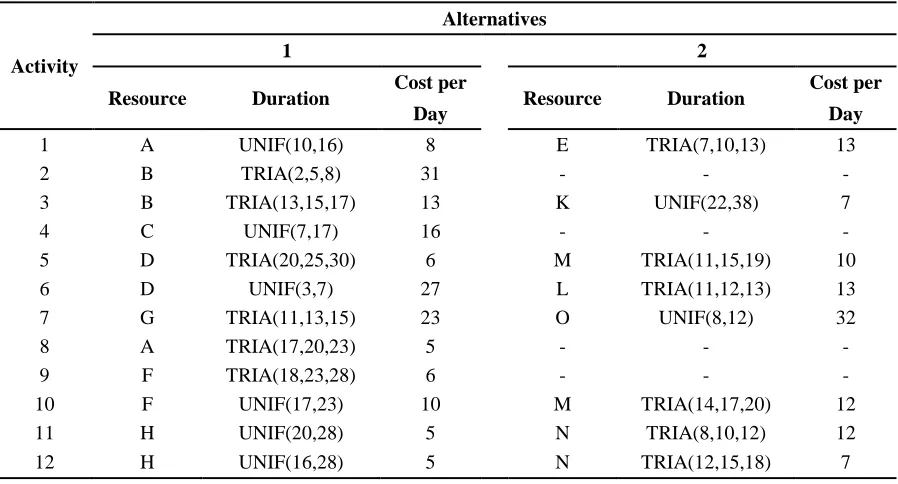
duration, hence, daily costs are provided. Table 4.1 presents the alternatives available for the
project activities. For example, activity one has two potential resource alternatives {A, E}, but
activity two has only one potential resource alternative B. In addition, depending upon the
resource configuration evaluated, precedence decisions may emerge between activities sharing
resources. Table 4.2 shows the activities with potential resource conflict such as {2, 3} which
26
late, a penalty is assessed which is dependent upon the amount of time by which the project is
[image:32.612.73.522.383.625.2]late.
Figure 4.1 TCRCM Project Network Example – Activities with Multiple Resource Alternatives and Potential Resource Precedence Relationships
Table 4.1 TCRCM – Resource Alternative Stochastic Times and Costs
Activity
Alternatives
1 2
Resource Duration Cost per Resource Duration Cost per
Day Day
1 A UNIF(10,16) 8 E TRIA(7,10,13) 13
2 B TRIA(2,5,8) 31 - - -
3 B TRIA(13,15,17) 13 K UNIF(22,38) 7
4 C UNIF(7,17) 16 - - -
5 D TRIA(20,25,30) 6 M TRIA(11,15,19) 10
6 D UNIF(3,7) 27 L TRIA(11,12,13) 13
7 G TRIA(11,13,15) 23 O UNIF(8,12) 32
8 A TRIA(17,20,23) 5 - - -
9 F TRIA(18,23,28) 6 - - -
10 F UNIF(17,23) 10 M TRIA(14,17,20) 12
11 H UNIF(20,28) 5 N TRIA(8,10,12) 12
27
Table 4.2 TCRCM – Potential Resource Precedence Decisions
Activity Pair
Potential Shared Resource
2,3 B
5,6 D
5,10 M
9,10 F
11,12 H or N
In the sample project network, the target completion time for the project is time 72, and
the equation for the penalty costs associated with late project completion is:
𝑃𝐹(𝑇, 𝜏) = {0, 𝑖𝑓 𝜏 ≤ 72 50(𝜏 − 72), 𝑖𝑓 𝜏 > 72
Ultimately, our objective is to obtain the optimal allocation of resources and resource
precedence relationships that minimize the expected total project cost, where the total cost is
defined as activity costs plus penalty due to project lateness.
The Total Cost Resource Constrained Method (TCRCM) is implemented in two phases.
Prior to the start of the project, the method is used to determine the optimal resource
configuration considering the uncertainty that characterizes a project at the beginning stage. This
is identified as Phase I. The dynamic phase (Phase II), which is implemented as the project
unfolds, considers actual costs and durations of completed and in progress activities to reevaluate
the rest of the project. Hence, during Phase II, only the uncertainty associated with the remaining
activities is considered to identify the optimal resource configuration from that point forward.
The next section describes the general simulation-based optimization approach used by
28
4.1
Overview of the Simulation-Based Optimization Approach
The structure of the simulation-based optimization approach, which is the same for both
Phase I and Phase II, is described in this section. The components that make up the structure of
the method include the input parameters, simulation model, optimization model and output
parameters. During Phase I, uncertainty for all project activities is considered to evaluate the
optimal resource configuration while, in Phase II, actual values are used for completed or in
progress activities and the optimization is done considering the uncertainty of the remaining
activities in the project.
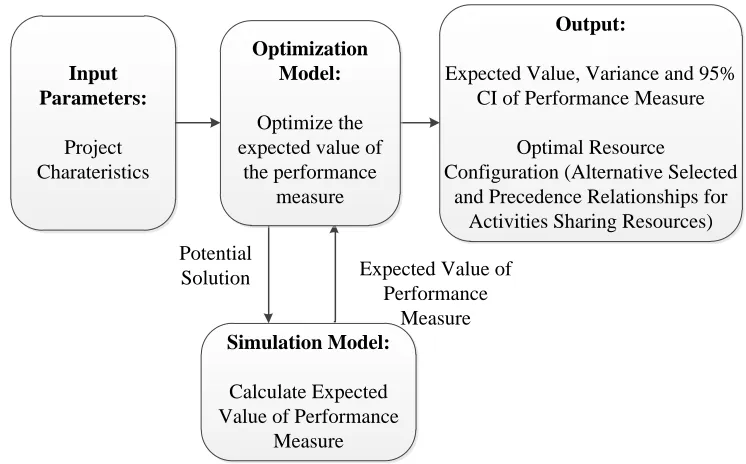
Figure 4.2 illustrates how all the components of the method are linked together. The input
parameters that represent the characteristics of the project network under evaluation are used by
the optimization model to identify potential solutions subject to a set of constraints. The
optimization model determines the values of the decision variables that satisfy the constraints.
Once a feasible solution is identified based on the solution space, the potential solution is sent to
the simulation model in order to simulate instances of the project network and calculate the
expected value of a performance measure (e.g. total project cost). As soon as the simulation
model finishes, the value of the performance measure for the evaluated resource configuration is
returned to the optimization model. This cycle between the optimization model and the
simulation model continues with the purpose of comparing the outcome of different resource
configurations. After the optimal solution has been found, output information regarding the
optimal resource configuration and/or precedence relationships, as well as the value of the
29 Input
Parameters:
Project Charateristics
Output:
Expected Value, Variance and 95% CI of Performance Measure
Optimal Resource
Configuration (Alternative Selected and Precedence Relationships for
Activities Sharing Resources)
Potential
Solution Expected Value of Performance
Measure
Simulation Model:
Calculate Expected Value of Performance
Measure
Optimization Model:
Optimize the expected value of
[image:35.612.117.490.71.303.2]the performance measure
Figure 4.2 Structure of the Simulation-based Optimization Approach
With the optimal solution identified by the optimization model, a project simulator is
used to run multiple replications of the base configuration and the optimal configuration for
comparison purposes. The project simulator components are: the input file, simulation model,
and output file. The input file containing the characteristics of the project and configuration
under evaluation feeds the simulation model. The simulation model runs multiple replications of
the project and provides statistics for project completion time and project cost as an output file.
The following sections describe the general assumptions and modeling details of the
simulation-based optimization approach.
4.1.1 Assumptions
The general assumptions considered in the optimization method include:
Activity time and cost distributions for all alternative resources can be estimated.
Activity times are independent.
Precedence relationships due to technical constraints are defined before the project starts
30
Penalty costs, represented by a linear function, are defined before the project starts.
Activities cannot be split or changed once they have begun. That is, once activities have
been started, they will be worked on continuously until finished.
A single resource/resource set is needed to execute an activity.
The remaining time and cost for in progress activities can be accurately estimated.
4.1.2 TCRCM: Input Parameters
The input parameters provide information regarding the characteristics of the project
network into the optimization model. The parameters that serve as input to the
simulation/optimization model are the following:
n = number of activities in the project.
Co = time and cost correlation. If Co is equal to 1, time and cost are correlated, 0 otherwise.
= target completion time.P = penalty cost per time unit of tardiness.
i
na = number of resource alternatives of activity i1,...,n.
i
NP = number of predecessors of activity i1,...,n.
i
AP= predecessors of activity i1,...,n.
ik
t = stochastic duration of activity i1,...,n by alternative k 1,...,na.
ik
r = resource of activity i1,...,n by alternative k 1,...,na.
ik
c = stochastic cost (if Co = 0) or daily cost (if Co = 1) of activity i1,...,n by alternative
. ..., ,
1 na
31
4.1.3 TCRCM: Optimization Model
The optimization model receives the input parameters and identifies potential feasible
solutions. Different resource configurations, represented by the values of the decision variables,
are identified. The optimization model interacts with the simulation model to evaluate these
configurations in order to determine the optimal expected total project cost (C) which includes
the activity costs and the penalty costs due to tardiness at project completion.
In order to generate the constraints of the optimization model, the following parameters
are calculated:
PCM= predecessor chain matrix that indicates the complete predecessor chain of activity
n
i1,..., . If PCMij is equal to 1, activity j is included in the predecessor chain of
activityi, 0 otherwise, such that,
nn n n PCM PCM PCM PCM PCM PCM PCM ... ... ... ... ... ... ... ... ... ... 1 21 1 12 11 .
AM= resource alternative matrix that indicates if resource l 1,...,nr is a potential alternative for activityi1,...,n. If AMil is equal to 1, resource l can be assigned to activityi, 0 otherwise, such that,
nnr n nr AM AM AM AM AM AM AM ... ... ... ... ... ... ... ... ... ... 1 21 1 12 11 .
CM= cost matrix that indicates the cost, CMil, of assigning resource l1,...,nr to activity
n
32 nnr n nr CM CM CM CM CM CM CM ... ... ... ... ... ... ... ... ... ... 1 21 1 12 11 .
The values of the following decision variables will be determined by the optimization
model and returned to the simulation model to perform the expected total project cost
calculation:
RM= resource matrix that indicates if activity i1,...,n will be executed by resource l. If
il
RM is equal to 1, resource l is assigned to activityi, 0 otherwise, such that,
nnr n nr RM RM RM RM RM RM RM ... ... ... ... ... ... ... ... ... ... 1 21 1 12 11 . ij
a = represents the direction of the resource precedence arc between activities and is equal to
1 if an arc is drawn from activityi1,...,n to activity j 1,...,n, 0 otherwise.
ijl
S= indicator variable that equals 1 if the same resource l 1,...,nris assigned to activity i
and activity j, 0 otherwise.
ijl
S= indicator variable that equals 1 if neither activities i or activity j are assigned resource
nr
33 The optimization model is described as follows:
Minimize:
) , ( ] [ 1 1 T PF RM CM E C E n i il nr l il (4.1) Subject to: 1(1 )(1 ) , ,
nr
ij ji ijl ij ji
l
a a S PCM PCM i j i j
(4.2)1 , , ,
ijl ijl il jl
SS RM RM i j l i j (4.3)
1 , , ,
ijl ijl
SS i j l i j (4.4)
l RM
i
il
1 (4.5)l i AM
RMil il , (4.6)
1 Potential Tours
ij jy yi
a a a narcs (4.7)
The objective function (4.1) minimizes the expected total project cost calculated by the
simulation model. The total project cost includes both, the cost associated with executing the
activities, and the penalty costs due to late project completion. Constraints (4.2), (4.3), and (4.4)
ensure that the resource precedence is only determined between activities that share resources
but do not have a technical precedence. Constraint (4.2) checks if two activities have a technical
precedence, and constraint (4.2) evaluates if the activities share a resource. Constraint (4.4) ties
constraints (4.2) and (4.3) together so that if there are no resources in common, the technical
precedence is not evaluated for those two activities and no arc is drawn between them. In order
to better explain how these constraints work together, let us consider the following: if two
activities have a resource in common, RMil and RMjl both take on a value of one and, hence,
34
of one which allows constraint (4.2) to evaluate if there is a technical precedence between the
activities. If the activities do not have a technical relationship, PCMji and PCMij take on a
value of zero and an arc between the activities needs to be drawn. The constraints tie together the
same way for the cases when there are no common resources but there is a technical precedence.
These constraints reduce the number of arcs to be evaluated by restricting the optimization model
to making the resource precedence decisions between activities with potential conflicts.
Constraint (4.5) guarantees that only one resource or resource set is assigned to each
activity of the project. Constraint (4.6) ensures that the resources assigned to a task are only
those eligible resources from among the set of alternatives available for the activity.
The last constraint (4.7) ensures that there are no looping conflicts (tours) when testing
resource precedence relationships during the optimization of a project. In this formula, narcs
represents the number of arcs involved in the looping conflict. A looping conflict can emerge in
cases where three or more activities have a potential resource in common. To illustrate this,
consider the example in Figure 4.3 where three activities {1,2,3} are assigned the same resource,
X. In the absence of any technical precedence arcs, there are three resource precedence decisions
required. The model formulation would result in two constraints of the form of (4.7), such as:
12 23 31 2
a a a
13 32 21 2 .
a a a
These constraints will prevent a potential tour which would result in an infeasible solution.
35
4.1.4 TCRCM: Simulation Model
Once the optimization model determines a potential solution, this solution is sent to the
simulation model to run multiple project instances of the selected resource configuration. The
decision variables that are manipulated by the optimization model include the resource matrix (
il
RM ) with the resource selected for each activity and the direction of the precedence arc for
those activities that share resources (aij). The values of aijare directly used in the simulation
model while the resource matrix is translated to the vector, SAV , for convenience in coding.
SAV = selected alternative vector where SAVi indicates the alternative k{1,...,na} selected by
the optimization model for each activity i1,...,n.
In order to construct the SAV vector, the resource matrix (RMil) is compared to the
resource alternatives matrixrik. The model loops through RMil to determine which resource l is
assigned to each activity i and, comparing this information withrik, the selected alternative for each project activity is identified.
Once the simulation model translates the decision variables obtained from the
optimization model, the simulation model runs in order to calculate the total project cost of the
selected project configuration. The following parameters are created by the simulation model to
simulate the execution of the project. These are constructed either from the values of the
optimization decision variables or the values of the provided input parameters as follows:
i
rnp = number of resource predecessors of activityi1,..,n where rnpinj1aij i.
ij
PM = predecessor matrix of technical predecessors that indicates if activity i1,...,n is a
predecessor of activity j1,...,n. If PMij is equal to 1, activity i is a predecessor of
36 nn n n PM PM PM PM PM PM PM ... ... ... ... ... ... ... ... ... ... 1 21 1 12 11
The following variables are used as the simulation model runs to identify if an activity is
ready to start. These are compared to rnpi and NPi in order to determine if all resource and
technical predecessors of an activity are completed.
i
rpc = number of resource predecessors of activity ialready completed i1,...,n
i
PC = number of technical predecessors of activity i already completed i1,...,n
As activities start and finish execution, the following variables are updated to capture the
start and finish times of the activities as well as indicate that they have been completed.
i
st = start time of activity i i1,...,n
i
ct = completion time of activity i i1,...,n
i
CA = is 1 if activity i is completed, 0 otherwise i1,...,n
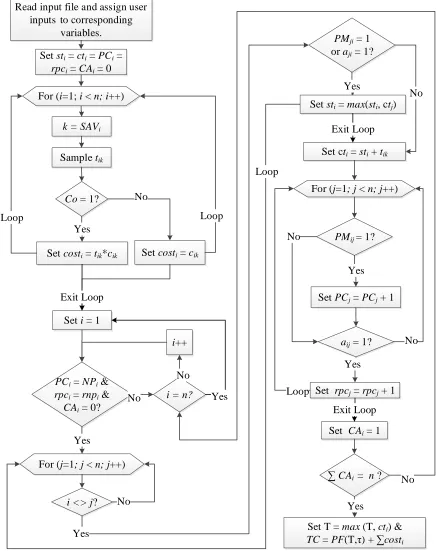
In order to better illustrate how the simulation model works, and how every variable and
calculated parameter binds together, the flow chart shown in Figure 4.4 was provided. First, the
model reads the input file that provides information regarding the characteristics of the project.
Each of the values of the input parameters supplied is assigned to the corresponding variable in
the simulation model. Afterwards, the variables used by the simulation model to check on the
status of activities and the variables used to store start and completion times are set to zero as
their initial state. The