0022-538X/92/052814-07$02.00/0
Copyright C) 1992, American Society for Microbiology
A
Second Origin of DNA Plus-Strand Synthesis
Is
Required
for
Optimal
Human
Immunodeficiency Virus Replication
PIERRE CHARNEAU, MARC ALIZON,t AND
FRANQOIS
CLAVEL* Unit6d'Oncologie Virale, De6partement SIDA etRetrovirus, and CNRS URA 1157,Institut
Pasteur,
25rueduDrRoux,
75724Paris Cede-x
15,
FranceReceived 4September1991/Accepted 21 January 1992
Werecently reportedthat humanimmunodeficiencyvirustype1 (HIV-1) unintegratedlinear DNA displays
adiscontinuityin its plus strand, precisely defined byasecondcopyofthe polypurinetract(PPT)locatednear
themiddle of thegenome(P.Charneauand F.Clavel, J.Virol.65:2415-2421,1991). This central PPTappears todetermine asecond initiation site forretrovirus DNAplus-strand synthesis.We show here thatmutations
replacingpurinesbypyrimidines intheHIV-1 central PPT,which donotmodifythe overlapping amino acid
sequence, areabletosignificantlyslow down viral growthasthey reduceplus-strandoriginatthecenterof the
genome.One of these mutations, introducing four pyrimidines, results in a 2-week delay in viral growth in CEMcells and abolishesplus-strand originatthe centralPPT.Theintroduction inthismutantofawild-type copyofthe PPTatadifferentsitecreatesa newplus-strand originatthat site. Thisneworiginalso determines
the end of the upstream plus-strand segment, probably as a consequence of limited strand
displacement-synthesis.Ourfindingsfurtherdemonstrate the role of PPTsasinitiation sites for thesynthesisof the retroviral
DNAplus strand and demonstrate theimportanceofasecond suchoriginforefficient HIVreplicationinvitro.
Replication ofretroviruses requires reverse transcription
of the viral RNAgenome into double-stranded DNA. Syn-thesis of each strand of retroviral DNA is initiated at a
distinct site of itstemplate by aspecific primer, which will
define each end of the linear, double-stranded retroviral DNA molecule (27). The origin of the minus strand is determined byatRNAmolecule, copackagedwith the viral genomic RNAandhybridized to itnear its 5' end, defining
the3'boundaryof thelongterminalrepeat(LTR).Theorigin of theplusstrand isdeterminedbyapolypurinetract(PPT), which defines the 5' limit oftheLTR (14, 16).It ispresumed that the PPTcancreate anRNAprimeron the DNA minus
strandbyvirtue ofits resistancetothe RNase Hactivityof the reverse transcriptase (18, 20, 23). A specific feature of humanimmunodeficiencyvirus(HIV)and otherlentiviruses is thepresenceofasecondcopyof the PPTlocatednearthe centerof thegenome(24, 29),within thepolgene(Fig. la).
This central PPTappears tobe used as a secondorigin for theplus strand of viral DNA,since it determinesa
discon-tinuity (or gap) in that strand, yielding two discrete plus-strand segments on unintegrated linear DNA (2, 4, 8, 10). Similarfindingswerereportedforspumaviruses(12, 26).We
recently demonstrated thatthe downstream segmentofthe HIV-1 DNAplusstrandstartspreciselyatthe last nucleotide of the central PPT (4). From these observations, we
pro-posedthat theuse of this secondorigin for the synthesisof
HIV-1plus-strandDNA couldallow fasterreverse
transcrip-tion and therefore could mediate faster replication of the virus. Weshow herethatsubstitution ofatleast fourpurines forpyrimidinesinthe HIV-1centralPPTwithoutachangein
the overlapping amino acid sequence eliminates the
plus-strandorigin atthatsiteandimpairs viral growth. Introduc-tion in such a mutant of a wild-type copy ofthe PPT at a
differentsitecreates a newplus-strand origin andappearsto
* Correspondingauthor.
tPresent address: Institut Cochin de Genetique Moleculaire,
75014Paris,France.
improve viral replication. These experiments further dem-onstratethe role of PPTs in initiation of the synthesis of the retroviral DNAplus strand andreveal the importance ofa
secondplus-strand originforefficient HIVreplication.
MATERIALS AND METHODS
Mutagenesis. Site-directedmutagenesiswas performedas
described previously (31) in M13mpl8 carrying an EcoRI
1.1-kb insert (4684 to 5779) from the HIV-1 infectious molecular clone pBRU2 (4). Following mutagenesis, this EcoRI fragmentwascloned intopBRU3,amodifiedpBRU2
missinganEcoRI site in thevectorsequences.Details of the mutationsare shownin Fig. lb.
To generate 225P and 225X mutant viruses, mutant 225 plasmidDNAwasdigestedwithSall, purified,andligatedto
nonphosphorylateddouble-strandedoligonucleotide225Por
225X (see Fig. 4a). The resultingcloneswere screened for
the insertion ofaPvuI(225P)orXbal(225X)restriction site.
Cells and viruses. Peripheral blood lymphocytes (PBLs)
wereobtained fromhealthyblooddonors,stimulated with 1 jig of phytohemagglutinin (Wellcome) per ml, and main-tained in the presence of interleukin-2 (10% Lymphocult; BiotestDiagnostics). MT4 cells are human T-cell leukemia
virus type I-transformed human CD4+ T cells that allow
acute cytopathic HIV-1 infection (7). CEM clone 13 cells
were derived from the human lymphoid cell line CEM
(ATCC CCL119) and express high levels of CD4 antigen (21). Cellswere maintained in RPMI 1640 medium
supple-mented with 10% fetal calf serum. For the production of
mutantviruses,HeLa cellsweretransfectedbythe calcium phosphatemethodwith 10,ugofplasmidDNA from each of themutants. After incubation for 48h,culturesupernatants were harvested and filtered, and the amount of virus
pro-duced was measured by using the DuPont HIV p24 core
profile enzyme-linked immunosorbent assay (ELISA). All cellswere infectedwith anequal amount of cell-freevirus, correspondingto10ngof HIV-1p24.Infectionswerecarried
outinduplicate, using approximately5 x 105cells in afinal
2814
on November 9, 2019 by guest
http://jvi.asm.org/
volume of 1 ml. Virus production in these cultures was monitored with the HIV p24core profile ELISA.
The H12 indicator cells are HIV-infectable HeLa CD4 cells
carrying
the bacterial lacZ gene under control of the HIVLTR. In this system, infected cells can be detected in anin situenzymatic
assaybytheintense blue staining due to the inductionby Tat oflacZ expression as describedprevi-ously (22).
H12 cells are derived from an HeLa LTR-lacZ clone(Z24)
obtained bycotransfection of plasmids pMA175 andpSV2neo,
followedby G418 selection.pMA175contains the HIV-1 BRU LTR ScaI-to-HindIII fragment (-139 to+82) driving
lacZ and simian virus 40 polyadenylationsequences. The Z24 clone was selected for its low basal
,B-galactosidase
activity (undetectablein an in situ assay) and the dramatic induction seen after transfection with tatexpression
vectors or infection with HIV pseudotypescar-rying
theamphotropicmurine leukemia virus envelope. Z24 was further cotransfected with a CD4 expression vector(pMA245)
and aplasmid
conferring hygromycin resistance(pHygroR).
pMA245 contains the CD4 cDNA as an EcoRI-BamHI 1.7-kbfragment
frompT4B (13)under control of the simian virus 40 early promoter and inserted in a murine retroviral vector, the 3' LTRproviding the polyadenylation sequence. Hygromycin-resistant clones were selected for surface CD4expression
and strong3-galactosidase
induc-tion after HIV infecinduc-tion. A clone fulfilling these propertieswas further
purified
by two rounds ofsingle-cell cloning to obtain theH12 subclone.TheH12cellswere usedtodetermine single-round infec-tious titers ofviral
suspensions
corresponding to the differ-ent central PPT mutants. Each mutant was tested at two different dilutions(100
and 10 ng of HIV-1 p24 per ml) in a final volume of 1 ml on monolayers ofH12 cells in6-cm2
wells. The H12 cultureswerethen incubated for 24 h, fixed, and stained with
5-bromo-4-chloro-3-indoyl-,-D-galactopy-ranoside
(X-Gal)
for 1 h. Theinfectious titer of viral suspen-sionsonH12 cellsisexpressedasthenumber of blue foci (a focusbeing
asingle
isolated blue cell or a group of twocontiguous
bluecells)
per nanogram of p24 present in the inoculum. Theseexperiments
were repeatedfour times for each mutant,using
supernatants from separate transfec-tions.Analysis
ofviral DNA. Viral DNA was analyzed in MT4 cells that were infectedby
cocultivation with transfectedHeLacells. Cocultivationwas carried out48 h after trans-fection with thedifferentmutants.Onthenextday,the MT4 cells were transferred to a new
flask,
and fresh MT4 cells were added. These cultures were then monitored daily for appearance of HIVcytopathic
effect, characterized bydis-sociationof the MT4
clumps
androundingof the cells. Whencytopathic
effectwas obvious, low-molecular-weightDNA in thecorresponding
cultures was extracted by the Hirtprocedure (9).
Nuclease
S1
(Amersham)
was used at 1.5 U/,ug ofDNA after addition of 1:10 volume of 10x S1buffer(10xSibufferis 300 mM sodium acetate
[pH
4.6],500 mMNaCl, and 10 mMZnCl2)
and incubatedat37°Cfor30 min.DNA wasthensubjected
toelectrophoresis
on 0.8% agarose gels that didnot contain ethidium bromide and analyzed by Southern
blotting (25).
Two
probes
wereused inhybridization
experiments. The 5'probe
was a1,932-bp
BalI fragment spanning thepolregion
ofpBRU3
frqm
positions
2655to 4587; the 3' probewas a
2,662-bp
KpnI
fragment representingthe env region frompositions
6343 to 9005 of HIV-1 molecular clonepNL4-3
(1).
The nucleotideposition
numbers used herestarta
gag vif
I ri IIpolof1
LTrR lJnt.grae LR
ALLAA^ALGGGG AAALLA=GGGG
central PPT 3' PPT
b
central PPT
ile his asn phe lys arg lys gly gly ile gly
BRU ATC CAC AAT TTT AAA AGA AAAGGG GGG ATT GGG
ile his asn phe lys arg lys gly gly ile gly
223 ATC CAC AAT TTT AAA'L."', AA GG CGG ATT rG
ile his asn phe lys arg lys gly giy ile gly
226 ATC CAC AAT TTT AAAAG" AAA'GGOT ATT GGG
225 ile his asn phe lys erg lys ly ly lie gly
ATC CAC ALT TTT AAALL:(i:ALL '.W.30 ATT GGG
FIG. 1. (a) Positions of the two PPTs on the DNA genome of HIV-1, with respect to the different coding and cis-acting sequences. The shaded domain of the pol gene encodes the integrase, where the mutations affectingthecentral PPT were introduced. (b) Details of the different mutationsaffectingthecentral PPT.
at the 5' end of the U3 region in the 5' LTR. Both probes were labelled by the random hexamer method (5).
RESULTS
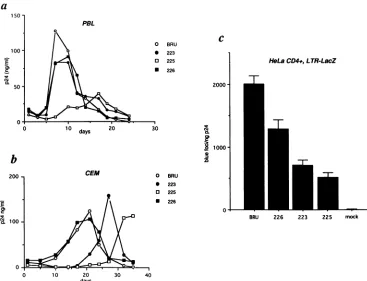
Substitution of pyrimidines for purines in the central PPT affects HIV-1 replication. Using site-directed mutagenesis, we replaced several purines (A or G) with pyrimidines (C or T) in the central PPT. Details of these mutations are shown in Fig. lb. All of the mutations left intact the overlappingpol amino acid sequence, corresponding to the integrase (Fig. la). HIV-1 proviral molecular clones carrying these muta-tions were introduced by transfection into HeLacells. The resulting viruses were analyzed for infectivity in phytohe-magglutinin-stimulated PBLs and in CEM cells, which were infected with equal amounts of cell-free virus, as determined from HIV-1 p24 antigen concentration. Central PPT muta-tions did not affect the amount of virus produced by the transfected cells (data not shown). None of the mutations completely abolished HIV infectivity, but some of the mu-tants markedly differed in infectivity from wild-type virus BRU,as evidenced by important differences in their kinetics of virus production (Fig. 2a and b) in PBLs and CEMcells. Theleastaffected was mutant 226, in which T replaced G at positions 12 and 15 of the central PPT, and was closest to BRUin itsreplicationkineticsin both cellsystems. Mutant 223, replacing A at positions 4 and 6 with C, was comparable to BRU inPBLs, but 223 virus production peaked a week laterthan BRU production in CEM cells. The most affected of the three mutants was 225, which combined themutations in 223 and 226, with a total of four pyrimidines replacing purines in its central PPT. The peak of 225 virusproduction was delayed by 2 weeks in CEM cells and in PBLs. Inthree
on November 9, 2019 by guest
http://jvi.asm.org/
a
PBL
O BRU
* 223
O 225
* 226
10 days
C
2000
-a 1000
30
CEM
0 BRU * 223 O 225 * 226
0-HeLaCD4.,LTR-LacZ
7T
BRU 226 223 225 mock
0 10 20 30 40
[image:3.612.132.499.74.355.2]days
FIG. 2. Phenotypes of the HIV-1 central PPTmutants.(a) Kinetics of replicationinphytohemagglutinin-stimulatedPBLs.(b)Kineticsof
replication in CEM cells. Both PBLs and CEMcellswereinfected withavolume of viralsuspensioncontaining10ngof HIV-1p24,foratotal of5 x 105cells.(c) Titrationof the central PPTmutantsonH12cells(HeLacellsexpressingthe CD4 receptor andcarryingaTat-inducible
lacZgeneunder the control of the HIV-1LTR).Monolayers of H12 cellsin6-cm2wellswereinfectedwith 1 mlof virussuspensioncontaining 100or10ngof HIV-1p24. H12 monolayerswerestained with X-Gal 24 hafter infection. Theresultsarepresentedastheaveragenumber ofblue foci(single isolated blue cellsorgroupsoftwobluecells)pernanogramof HIV-1p24 containedintheinoculum,obtained from four
independent experiments using virus from four different transfections. Error barsrepresentstandarderrorsofthemeans.
independentinfection experiments usingsupernatants from three distinct BRU and 225transfections, adjusted to 10ng
ofHIV-1p24for eachinfection, thepeakof 225production inCEM cellswasdelayed 14, 13,and16days comparedwith
thepeakofBRUproduction.Replicationofthemutantswas
alsoassayedonMT4cells,whichwe usemainlyforanalysis ofviralDNA,sincetheyallowveryrapidviralpropagation
andaccumulation ofhighlevels ofunintegratedviralDNA. Inthis cell system, only minimal differences between wild-typeandmutantvirusescouldbeobserved (datanotshown). Theonsetofviralproduction inlymphocytic cells, which
we monitored as an index ofinfectivity, proceeds through
accumulation of multiple rounds of viral replication. To better understand the natureofthe defectintroducedin the PPTmutants,wewishedtocompare theinfectivity of these
viruses in a system that would allow evaluation of HIV infectivityfollowingasingleinfectious cycle. Consequently, weconstructed acelllinederived from HeLa cells
express-ingtheCD4receptorandharboring the lacZgeneunder the
controlof theHIV-1LTR. Inthese cells, which allowentry
and replication ofHIV-1, the expression of Tat following HIVinfection triggerstheaccumulation of 3-galactosidase, easily detectedasanintense blue staining inanin situX-Gal
assay. Since the infectedH12 cellswere stainedonly 24 h
followinginfection,webelieve that the number of blue cells
in these cultures reflected the number of cells having har-boredonesingle cycle ofHIVreplication, upto integration ofviral DNA andexpression of Tat. The infectious titer of
the different viruseswas expressed as the number ofblue foci per nanogram of p24 measured in the infecting viral suspension. As shown in Fig. 2c, the titer of the mutant viruses in this system was consistently lower than the wild-type BRU titer. As was also observed in PBLs and CEMcells,mutant225displayed themostsignificant reduc-tion, followed by mutants 223 and 226. In four separate experimentsusing viral suspensions obtained from indepen-dent transfections, the average numbers of blue foci per
nanogramofHIVp24were516 81(standarderror ofthe mean)formutant225 and2,002 134 forBRU(Fig. 2c).
Theamountofgappedviral DNA incentral PPTmutantsis
directly proportional to theirreplicative capacity. In an
at-tempt to determine whether the mutations affecting HIV replicationalsoalteredthestructureof thereverse
transcrip-tion product, unintegrated viral DNA from MT4 cells in-fected with the differentmutantswastested for thepresence
of the centralplus-strandgapbynucleaseS1 cleavage (Fig. 3). In untreated preparations, there appeared to be no
significant difference between BRU and the mutants in the totalamountof viralDNA,norwasthereadifference in the
relativeamountsoflinear and circularmolecules. However, the mutations clearly affected the proportion of gapped linearmolecules,asevidenced bytherelease,afternuclease
Si treatment, ofa5-kbfragmentreactive withanHIV-1env
probe. This DNAfragment represents the portion of HIV linear DNA 3' to the gap (4). The amount of this 5-kb fragmenttherefore reflects theamountofgappedviral DNA
b
200
-Q 100
on November 9, 2019 by guest
http://jvi.asm.org/
BRLI 226 223 225 NT SI NT SI NT SI NT SI
0--
--dL -12
C
--Gap- 5
FIG. 3. Southern blot of Hirt supernatants from MT4 cells in-fectedwith the indicated central PPT mutants, before(NT)and after (S1) treatment with nuclease Si, and hybridized with a probe specificof theenvregionof the HIV-1 genome. The three forms of unintegrated viral DNA observed in untreated DNApreparations are linear molecules (L), closed circles (C), and open or relaxed circles (0). Following nuclease S1 treatment, the closed circles disappear, and cleavage of linear molecules at the central gap releases a5-kb fragment (4), reactive with the envprobe (nucleo-tides 6343 to9005)used in thisexperiment.Theintensityof this5-kb band is an indication of theproportionoflinear molecules carrying a central gap. In this experiment, thecleavage of viral DNAs by nuclease Si was notcomplete. Therefore, substantial amounts of uncleaved linear molecules remained after nuclease S1 treatment. Consequently,the double band around 9 kb inS1-treated prepara-tions correspondstouncleaved linear molecules(upper band) and to linearized one-LTR circles (lower band), which were previously shown to lack a central gap(4).
molecules in the acutely infected cells. As we anticipated, the amount of gapped viral DNA in the various mutants directly correlated with the replicative capacity of the cor-responding viruses (Fig. 3). Mutant 226 differed little from BRU, but in mutant 223, the proportion of gapped linear moleculeswasmarkedly reduced.In mutant225,which had the slowestreplication profile inlymphocytesand the lowest titeronCD4+ HeLacells, theamountof 5-kbfragmentwas always extremely low and usually undetectable. The relative amount ofgapped DNA should reflect the capacity of the centralPPT topromotepriming ofHIVplus-strand synthesis at the centerof the genome. Taken together, our observa-tions on infectivity and DNA structure of the central PPT mutants suggest that reduction of plus-strand initiation at that sitedirectly affects replication ofHIV.
Introduction of a newPPTat adifferent location creates a new gap at that site and can affect viral growth. We next
attemptedto create a newplus-strandpriming site inmutant 225, since the utilization of the mutatedPPTin this virus was nearly abolished. Alinkercontaining anexactreplica of the HIV-1 PPT(Fig. 4a)wastherefore introducedintheSall site at position 5821, within the vpr open reading frame (mutant 225P). In this mutant genome, the introduced PPT was located approximately 1,000 bp downstream of the site where the PPT would be found in wild-type HIV-1. The presence and position of a plus-strand gap in the 225P reversetranscription productwereevaluatedby nucleaseSi
cleavage of viral unintegrated linear DNA from infected MT4cells(Fig. 4b andc). Introduction ofaPPT at theSall site indeed created a newpriming site, asevidencedby the presence of a new
Si-sensitive
site in 225P DNA at this position. The 225P DNAfragment released by nucleaseSi
and reactive with theenvprobewas==4kbinsize(insteadof 5 kb inwild-type BRU) and comigrated with the fragment releasedby Sallcleavage onwild-type viralDNA(Fig. 4b, lane3).Interestingly,when we usedapol-specificprobe,we
aI
-Vi1
PCII r
1...::;5 arg ...s.1> dr_ .J;.:
vpr A-C7GAC AA'--. AA.ATA
:AAA:.A...GCAAC 225P
-v--:-:::i .- 225X
b
envprobe e polprobe1 2 3 4 1 2 3 4
to
-1
,*
.~~~~~~~~~~~~~~~~~~~~~~O
S
i
kb
- 12
-9
[image:4.612.87.506.468.552.2]- 5
FIG. 4. Insertion of a new PPT downstream of the original central PPTsite in mutant 225. (a) Oligonucleotide linkersused to insertaPPT in theunique Sall siteatposition5821 of mutant 225 (PPT mutant substituting four pyrimidines forpurines).Linker 225P containsaPPTidenticaltothecentral and 3' PPTs of HIV-1. Linker 225Xis a control with no PPT sequence. (b andc)Southernblots of Hirt supernatants from MT4 cells infected with different viruses aftertreatmentwith nucleaseSi.Lanes:1, BRU Hirt DNAdigested with nuclease S1; 2, 225 DNA digested withnuclease S1; 3, 225P DNAdigestedwith nucleaseS1;4,unintegrated BRU DNA digested with SalI. The same Southern blot wasfirsthybridized with the env probe (nucleotides 6343 to 9005), dehybridized, and rehybridized with apol probe(nucleotides2655 to4587).
found that the 5' fragment releasedby
Si
cleavage was larger(==6kb) than the 5-kbfragment released from wild-type virus (Fig. 4c, lane 3), indicating that the stop inelongation of the upstream plus-strand segment is determined by the PPT itself. Thisobservation seems toimply that the origin of the 3' segment at the PPT cannot be displaced by reverse
transcriptase-drivenDNAsynthesis.AkineticanalysisofSi cleavage(Fig.5) revealed that the relativeamountsof DNA fragment specifically released with time by Si cleavage at their respective gaps were comparable for BRU and 225P (Fig. 5a andc),whereas verylittle,if any, suchfragmentwas released from 225 DNA (Fig. 5b).Thecomparable sensitiv-ities of BRU and 225P DNAs to nuclease
Si
cleavageindicate that thenewplus-stranddiscontinuityon225PDNA hasageneralstructuresimilartothat ofwild-typeDNAand is found inasimilarproportionofDNAmolecules.
Theintroduction of the linkersequence created a frame-shift in the vpr gene of the 225P mutant. Therefore, the
replicationof 225P hadtobecomparedwith that ofacontrol inwhich a linker containinga random sequencewas intro-duced at the same site (mutant 225X), also
creating
aframeshift at the same position in vpr (Fig. 4a).
Clearly,
f71 = env p ..f
ll!Lt
LTR
-=E
t
+
-utatod PPT R&Uon November 9, 2019 by guest
http://jvi.asm.org/
[image:4.612.91.507.605.674.2]BRU 225 225P
NT 5 20 45 NT 5 20 45 NT 5 20 45 kb
0 t ]; -12
C- ~~...
*1
~~~~~~~~~~5
a
bc
FIG. 5. Kinetics of nuclease Sicleavage of unintegrated DNA from HIV-1 central PPT mutants. ASouthern blotofHirt DNAfrom MT4cells infected with thevirus indicated above each panel was subjected tothe action ofnuclease S1 for 5 min(lanes 5), 20 min (lanes 20),and 45 min(lanes45). NT, no treatment.0,opencircles; L,linear molecules; C,closedcircles. The blot washybridizedwith an HIV-1pol probe (nucleotides 2655 to 4587).
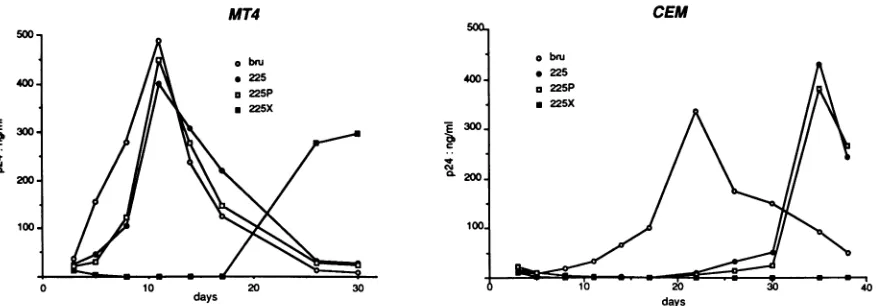
replication of the 225P virus was ahead ofthat of 225X in MT4cells(Fig. 6), but itwas notdifferent from thatof 225. In CEM cells, in which the difference between BRU and mutant 225 was best seen, the growth kinetics of mutant 225Pwasnotdifferent from that of 225, butmutant225Xdid not give rise to a productive infection during the 40-day
observationperiod (Fig. 6). Therefore, itappeared that the introduction of a new PPT, even not exactly where the wild-type PPT is normallyfound, could promote more
effi-cient viral replication in lymphocytic cells. However, the
clearandreproducible reductionininfectivitycharacteristic ofthe 225Xmutant in MT4 and CEM cells(Fig. 6) did not correlate with its one-round infectious titer on H12 cells,
which was repeatedly found to be comparable to those of mutants 225 and 225P (data not shown). This discrepancy could beaconsequence of the interruptionof the vpr gene, whose function ispoorly understood. It may also reflect a
qualitativedifference between the assayonH12cells and the replication kinetics on lymphocytic cells.
MT4
500-
400-
E300-cL
200
-100.
days
DISCUSSION
The results presented here show that the integrity of the HIV-1central PPTis required for optimal replication of this virus in tissue culture.Indeed, replacement of purines within this structure by pyrimidines resulted in delayed growth of the mutant virus in CEM cells and PBLs and in a lower infectious titer on CD4+ HeLa cells (Fig. 2). Strikingly, we found that themorepyrimidines were introduced, the slower and less infectious the virus. In addition, we found a direct relationship between viral growth kinetics or infectious titer and the proportion of unintegrated viral DNA molecules carrying a central single-stranded gap, as measured by the amountofspecific DNA fragments released following nucle-ase
Si
treatment(Fig. 3). Taken together, these observations strengthen the evidence that the central PPTdetermines an additional site for initiation of HIV-1 plus-strand synthesis and establish that this additional origin site allows more efficientreplication of the virus.Onepossible explanationforthisphenomenon is that this second origindetermines faster synthesis of full-length viral DNA and, from there, faster overall replication of HIV-1. Anotherexplanation could be that this additionalplus-strand DNAorigin notonly affects thespeedof viral DNA
synthe-sis but also increases the overall efficiency of the reverse
transcription process. This could be made possible, for
example, by allowingsynthesisofmorestablereverse
tran-scription intermediates. Thishypothesis issupported bythe difference in titer that we observed between the different mutants in cells that harbored asingle round of HIV
repli-cation. We also found thatthis differencewas notaffectedby
a longer incubation period between infection and staining
(datanot shown). Wecannotexclude thepossibilitythat the presenceofagap inlinear viralDNAisrequired forfurther steps of theretroviral life cycle involving processingof the viral DNA genome (i.e., transport to the nucleus,
integra-tion, etc.). This is unlikely, however, since none of the mutantshas its replication completely impaired. In particu-lar, mutant225, in which theproportionof linear molecules with a central gap was dramatically reduced, exhibited a delayedpeakof virusproductionbutwasstillinfectious,and its infectious titeron CD4+ HeLa cells was neverreduced morethansixfoldcomparedwiththewild-typevirus titer.In addition, the replication of this mutant in MT4 cells was
CEM
o bru
* 225
a 225P
* 225X
[image:5.612.67.297.73.217.2]days
FIG. 6. Replication kinetics of 225P and 225X mutants, compared with kinetics of wild-type BRU and PPT mutant 225, in CEM and in MT4 cells infected with a volume of viral suspension from transfected HeLa cells containing 10 ng of HIV-1 p24. For each infection, a total of 5 x 10⁵cells was used in a final volume of 1 ml.
E 6
c
le
cli
a,
on November 9, 2019 by guest
http://jvi.asm.org/
[image:5.612.95.533.542.695.2]close to the wild-type level despite the near absence of a central gap. It should be noted that we did not detect the reappearance of a gap in 225 viral DNA upon serial passage on MT4 cells (data not shown), indicating that the minimal differences found between wild-type and mutants in this cell system were not due to a correction of the PPT mutation. These observations suggest that the presence of the central PPT confers a relative replication advantage but does not constitute an absolute requirement for viral replication.
The three mutations analyzed here clearly differed one from another in their effects on viral growth and use of the central PPT as an origin site, as reflected by the proportion of gapped DNA molecules in acutely infected cells. The least affected, 226, had two pyrimidines replacing purines, and the longest stretch of purines in the mutated 226 PPT was 11, compared with 15 in wild-type virus BRU. Comparatively, mutant 223, whichappeared to be more affected than 226 in the ability of its PPT to generate a plus-strand origin site, also had two replacements, but its longest purine stretch consisted of only nine purines. Finally, mutant 225, in which only a very smallproportion of DNA molecules showed use of the mutated central PPT as a plus-strand origin, had four replacements but also had only five purines in a row at the PPT site. These observations could suggest that the effi-ciency of the PPT is determined by the overall length of the longest stretch of purines. It is also possible that the priming efficiency of a PPT is determined by an overall sequence configuration, which could have been most disrupted by the 225 mutation. In this respect, it has been shown that single base changes in the PPTs of murine retroviruses, including those that are the most conserved among retroviral PPTs, have little effect on primingefficiency in vitro (19).
Interestingly, in all of our mutants, the only discrete
Si-sensitivesite observed in the genome appeared to be still determined by the modified central PPT. We cannot explain why other possible plus-strand origin sites on the HIV genome are notdetected by nuclease SI cleavage. In partic-ular, other stretches of purines present elsewhere in the genome either may not be used as origins for plus-strand synthesis or may be unable to define a discrete and stable strand discontinuity, as the central PPT is. This could be due totheparticular sequence configuration of the PPT or to the participation of yet unidentified neighboring sequences.
We show here that the introduction of a new PPT in mutant225 is able to recreate an origin siteprecisely where the new PPT is inserted, as evidenced by the presence of a new nuclease
Si-sensitive
gap at that site (Fig. 4b and c). This finding furtherdemonstrates the role of the PPT in the generation of an origin for retroviral plus-strand synthesis. In addition, we found that the new gap in mutant 225P remained narrow and discrete, since the 3' end of the upstreamplus-strand segment appeared to coincide with the origin of the new downstream segment, at the site of the inserted PPT. This finding indicates that the stop in progres-sion ofsynthesis of the upstream segment is determined by the PPT itself or, more likely, by the origin of the down-streamsegment at that site. Although we do not provide here data onwhat theprecise 3' end of the upstream segment is, we hypothesize that the termination of its synthesis is a consequence of an inability or limited ability to carry strand displacement-synthesis at the PPT. This mechanism is also thought to generate the strand discontinuities observed in caulimoviruses (17, 28). It has been proposed that in avian retroviruses, stranddisplacement-synthesis by reversetran-scriptase is able to remove short segments of plus strand initiated at nonspecific sites by the elongating main plus
strand initiated at the 3' PPT (3). The resulting lagging strands were also speculated to play a role in retroviral genetic recombination (11). It has also been proposed that strand displacement-synthesis is necessary to generate the ends of the full-length, two-LTR retroviral DNA molecule (6, 18). More detailed in vitro studies on strand displace-ment-synthesis by reverse transcriptase are required to ascertain whether the stop that we observe is a specific feature of PPTs or a general property of reverse transcrip-tion. Whatever its exact mechanism, the inability to displace the plus-strand origin at the central PPT could be a prereq-uisite for the optimal use of this additional priming site, leading to faster or more efficient synthesis of the whole retroviral plus strand.
ACKNOWLEDGMENTS
We thank Luc Montagnier, in whose laboratory this study was conducted, Keith Peden, and John Leonard for helpful discussions. Part of the construction of the H12 cell line was performed in David Klatzmann's laboratory,H6pital Pitie-Salpetriere, Paris, France.
P.C. is a recipient of a fellowship from the Agence Nationale de Recherches sur le SIDA (ANRS). This work was supported by funds from the Institut Pasteur, CNRS, and ANRS.
ADDENDUM
Shortly after this work was performed, a new designation was proposed for the HIV-1 isolate used in this study (15, 30). Therefore, the virus and the corresponding molecular clones designated here HIV-1 BRU should be now referred to as HIV-1 LAI.
REFERENCES
1. Adachi, A., H. E. Gendelmann, S. Koenig, T. Folks, R. Willey, A. Rabson, and M. A. Martin. 1986. Production of acquired immunodeficiency syndrome-associated retrovirus in human and non-human cells transfected with an infectious molecular clone. J. Virol. 59:284-291.
2. Blum, H. E., J. D.Harris,P. Ventura, D. Walker, K. Staskus, E. Retzel, and A. T. Haase. 1985. Synthesis in cell culture of the gapped linear duplex DNA of the slow virus Visna. Virology 142:270-277.
3. Boone, L. R., and A. M. Skalka. 1981. Viral DNA synthesized in vitro by avian retrovirus particles permeabilized with mellitin. II. Evidence for a strand displacement mechanism in plus-strand synthesis. J. Virol. 37:117-126.
4. Charneau, P., and F. Clavel. 1991. A single-stranded gap in humanimmunodeficiencyvirusunintegrated DNA defined by a central copy of the polypurine tract. J. Virol.65:2415-2421. 5. Feinberg, A. P., and B. Vogelstein. 1983. A technique for
radiolabeling DNA restriction endonuclease fragments to high specific activity. Anal. Biochem. 132:6-13.
6. Gilboa, E., S. Mitra, S. Goff, and D. Baltimore. 1979. A detailed model of reversetranscription and tests of crucial aspects. Cell 18:93-100.
7. Harada, S., Y. Koyanagi, and N. Yamamoto. 1985. Infection of HTLV-III/LAV in HTLV-I-carrying cells MT-2 and MT-4 and application in a plaque assay. Science 229:563-566.
8. Harris, J. D., J. V. Scott, B. Traynor, M. Brahic, L. Stowring, P. Ventura, A. T. Haase, and R. Peluso. 1981. Visna virus DNA: discovery of a novel gapped structure. Virology 113:573-583. 9. Hirt, B. 1967. Selective extraction of polyoma DNA from
infected mouse cell cultures. J. Mol. Biol. 26:365-369. 10. Hungnes,O.,E.Tjotta, and B. Grinde. 1991. The plus-strand is
discontinuous in a subpopulation of unintegrated HIV-1 DNA. Arch. Virol. 116:133-141.
11. Junghans, R. P., L. R. Boone, and A. M. Skalka. 1982. Products ofreversetranscription in avian retrovirus analyzed by electron microscopy. J. Virol. 43:544-554.
12. Kupiec, J. J., J. Tobaly-Tapiero, M. Canivet, M.
on November 9, 2019 by guest
http://jvi.asm.org/
Hayat, J. Peries, and R. Emanoil-Ravier. 1988. Evidence for a gapped linear duplex DNA intermediate in thereplicative cycle of human and simian spumaviruses. Nucleic Acids Res. 16: 9557-9565.
13. Maddon, P. J., D. R. Littman, M. Godfrey, D. E. Maddon, L. Chess, and R. Axel. 1985. The isolation and nucleotide sequence of a cDNA encoding the T cell surface protein T4: a new member of the immunoglobulin gene family.Cell 42:93-104. 14. Mitra, S., S. Goff, E.Gilboa, and D. Baltimore.1979. Synthesis
ofa600nucleotide-long plus-strand DNA by virions ofMoloney murine leukemia virus. Proc. Natl. Acad. Sci. USA 76:4355-4359.
15. Myers, G. 1991. In G. Myers, B. Korber, J. A.Berzofsky, R. F. Smith,and G. N.Pavlakis(ed.), HumanretrovirusesandAIDS: a compilation and analysis of nucleic acid and amino acid sequences, p. 1-70. Los Alamos National Laboratory, Los Alamos, N.Mex.
16. Olsen, J., and K. Watson. 1982. Reversetranscription of avian myeloblastosis 35S RNA. Early synthesis ofplus-strand DNA of discrete size in reconstructed reactions. Nucleic Acids Res. 10:1009-1027.
17. Pfeiffer, P., and T. Hohn. 1983. Involvement of reverse tran-scription in the replication of cauliflower mosaic virus: a de-tailed model and testof some aspects. Cell 31:781-789. 18. Rattray, A. J., and J. J. Champoux. 1987.The role of Moloney
murine leukemia virus RNase H activity in the formation of plus-strandprimers. J. Virol. 61:2843-2851.
19. Rattray, A. J., and J. J. Champoux. 1989. Plus-strand priming by Moloney murine leukemia virus: the sequence features importantfor cleavage by RNase H. J. Mol. Biol. 208:445-456. 20. Resnick, R., C. A. Omer, and A. J. Faras.1984. Involvement of retrovirus reverse transcriptase-associated RNase H in the initiationofstrong-stop (+)DNAsynthesis andthegeneration of the longterminal repeat. J. Virol.51:813-821.
21. Rey, M. A., B. Krust, A. G. Laurent, L.Montagnier, and A. G. Hovanessian. 1989. Characterization of human immunodefi-ciency virustype 2envelope glycoproteins: dimerizationof the glycoprotein precursorduringprocessing. J.Virol.63:647-658.
22. Rocancourt, D., C. Bonnerot, H.Jouin, M. Emerman, and J.-F. Nicolas. 1990.Activation of ai-galactosidase recombinant pro-virus:application to titration of HIV and HIV-infected cells. J. Virol. 64:2660-2668.
23. Smith, J. K., A. Cywinski, and J. M. Taylor. 1984. Initiation of plus-strand DNA synthesis during reverse transcription of an avian retrovirus genome. J. Virol. 49:200-204.
24. Sonigo, P., M. Alizon, K. Staskus, D. Klatzmann, S. Cole, 0. Danos, E. Retzel, P. Tiollais, A. Haase, and S. Wain-Hobson. 1985.Nucleotidesequenceof theVisna lentivirus: relationship tothe AIDSvirus. Cell 43:369-382.
25. Southern, E. 1975. Detection ofspecificsequences among DNA fragments separated by gel electrophoresis. J. Mol. Biol. 98: 503-517.
26. Tobaly-Tapiero, J., J. J. Kupiec, M. Santillana-Hayat, M. Canivet, J. Peries, and R. Emanoil-Ravier. 1991. Further char-acterizationof thegappedDNAintermediates of human spuma-viruses: evidence for a dual initiation of plus-strand DNA synthesis. J. Gen. Virol. 72:605-608.
27. Varmus, H., and R. Swanstrom. 1984. Replication of retrovi-ruses, p. 369-512. In R. Weiss, N. Teich, H.Varmus, and J. Coffin (ed.), RNA tumor viruses,vol. 1. Cold Spring Harbor Laboratory,ColdSpring Harbor, N.Y.
28. Volovitch, M., G. Grugeon, and P. Yot. 1978. Studies on the single strand discontinuities in the cauliflower mosaic virus genome.Nucleic Acids Res. 5:2913-2925.
29. Wain-Hobson, S.,P.Sonigo,0. Danos, S.Cole,andM. Alizon. 1985. Nucleotide sequence of the AIDS virus, LAV. Cell 40:9-17.
30. Wain-Hobson, S., J.-P. Vartanian, M.Henry,N.Chenciner,R. Cheynier, S. Delassus, L. Pedroza-Martins, M. Sala, M. T. Nugeyre, D. Guetard, D. Klatzmann, J. C. Gluckman, W. Rozenbaum, F. Barre-Sinoussi, and L. Montagnier. 1991. LAV revisited: origins of the early HIV-1 isolates from Institut Pasteur. Science252:961-965.
31. Zoller, M. J., and M. Smith. 1984. Oligonucleotide-directed mutagenesis: asimplemethodusingtwooligonucleotide
prim-ersandasingle-strandedDNAtemplate.DNA 3:379-388.