Springer Texts in Statistics
Advisors:
F.M. Dekking
C. Kraaikamp
H.P. Lopuhaa¨
L.E. Meester
A Modern Introduction to
Probability and Statistics
Understanding Why and How
Frederik Michel Dekking Cornelis Kraaikamp Hendrik Paul Lopuhaa¨ Ludolf Erwin Meester
Delft Institute of Applied Mathematics Delft University of Technology Mekelweg 4
2628 CD Delft The Netherlands
Whilst we have made considerable efforts to contact all holders of copyright material contained in this book, we may have failed to locate some of them. Should holders wish to contact the Publisher, we will be happy to come to some arrangement with them.
British Library Cataloguing in Publication Data A modern introduction to probability and statistics. —
(Springer texts in statistics)
1. Probabilities 2. Mathematical statistics I. Dekking, F. M.
519.2
ISBN 1852338962
Library of Congress Cataloging-in-Publication Data
A modern introduction to probability and statistics : understanding why and how / F.M. Dekking ... [et al.].
p. cm. — (Springer texts in statistics) Includes bibliographical references and index. ISBN 1-85233-896-2
1. Probabilities—Textbooks. 2. Mathematical statistics—Textbooks. I. Dekking, F.M. II. Series.
QA273.M645 2005
519.2—dc22 2004057700
Apart from any fair dealing for the purposes of research or private study, or criticism or review, as permitted under the Copyright, Designs and Patents Act 1988, this publication may only be reproduced, stored or transmitted, in any form or by any means, with the prior permission in writing of the publish-ers, or in the case of reprographic reproduction in accordance with the terms of licences issued by the Copyright Licensing Agency. Enquiries concerning reproduction outside those terms should be sent to the publishers.
ISBN-10: 1-85233-896-2 ISBN-13: 978-1-85233-896-1
Springer Science+Business Media springeronline.com
©Springer-Verlag London Limited 2005
The use of registered names, trademarks, etc. in this publication does not imply, even in the absence of a specific statement, that such names are exempt from the relevant laws and regulations and therefore free for general use.
The publisher makes no representation, express or implied, with regard to the accuracy of the informa-tion contained in this book and cannot accept any legal responsibility or liability for any errors or omissions that may be made.
Printed in the United States of America
Preface
Probability and statistics are fascinating subjects on the interface between mathematics and applied sciences that help us understand and solve practical problems. We believe that you, by learning how stochastic methods come about and why they work, will be able to understand the meaning of statistical statements as well as judge the quality of their content, when facing such problems on your own. Our philosophy is one ofhow andwhy: instead of just presenting stochastic methods as cookbook recipes, we prefer to explain the principles behind them.
In this book you will find the basics of probability theory and statistics. In addition, there are several topics that go somewhat beyond the basics but that ought to be present in an introductory course: simulation, the Poisson process, the law of large numbers, and the central limit theorem. Computers have brought many changes in statistics. In particular, the bootstrap has earned its place. It provides the possibility to derive confidence intervals and perform tests of hypotheses where traditional (normal approximation or large sample) methods are inappropriate. It is a modern useful tool one should learn about, we believe.
Examples and datasets in this book are mostly from real-life situations, at least that is what we looked for in illustrations of the material. Anybody who has inspected datasets with the purpose of using them as elementary examples knows that this is hard: on the one hand, you do not want to boldly state assumptions that are clearly not satisfied; on the other hand, long explanations concerning side issues distract from the main points. We hope that we found a good middle way.
VI Preface
to be mathematically correct throughout the book. With respect to probabil-ity and statistics the book is self-contained.
The book is aimed at undergraduate engineering students, and students from more business-oriented studies (who may gloss over some of the more mathe-matically oriented parts). At our own university we also use it for students in applied mathematics (where we put a little more emphasis on the math and add topics like combinatorics, conditional expectations, and generating func-tions). It is designed for a one-semester course: on average two hours in class per chapter, the first for a lecture, the second doing exercises. The material is also well-suited for self-study, as we know from experience.
We have divided attention about evenly between probability and statistics. The very first chapter is a sampler with differently flavored introductory ex-amples, ranging from scientific success stories to a controversial puzzle. Topics that follow are elementary probability theory, simulation, joint distributions, the law of large numbers, the central limit theorem, statistical modeling (in-formal: why and how we can draw inference from data), data analysis, the bootstrap, estimation, simple linear regression, confidence intervals, and hy-pothesis testing. Instead of a few chapters with a long list of discrete and continuous distributions, with an enumeration of the important attributes of each, we introduce a few distributions when presenting the concepts and the others where they arise (more) naturally. A list of distributions and their characteristics is found in Appendix A.
With the exception of the first one, chapters in this book consist of three main parts. First, about four sections discussing new material, interspersed with a handful of so-called Quick exercises. Working these—two-or-three-minute— exercises should help to master the material and provide a break from reading to do something more active. On about two dozen occasions you will find indented paragraphs labeledRemark, where we felt the need to discuss more mathematical details or background material. These remarks can be skipped without loss of continuity; in most cases they require a bit more mathematical maturity. Whenever persons are introduced in examples we have determined their sex by looking at the chapter number and applying the rule “He is odd, she is even.” Solutions to the quick exercises are found in the second to last section of each chapter.
Preface VII
Much of the material in this book would benefit from illustration with a computer using statistical software. A complete course should also involve computer exercises. Topics like simulation, the law of large numbers, the central limit theorem, and the bootstrap loudly call for this kind of experi-ence. For this purpose, all the datasets discussed in the book are available at http://www.springeronline.com/1-85233-896-2. The same Web site also pro-vides access, for instructors, to a complete set of solutions to the exercises; go to the Springer online catalog or contact [email protected] to apply for your password.
Delft, The Netherlands F. M. Dekking
January 2005 C. Kraaikamp
Contents
1 Why probability and statistics?. . . . 1
1.1 Biometry: iris recognition . . . 1
1.2 Killer football . . . 3
1.3 Cars and goats: the Monty Hall dilemma . . . 4
1.4 The space shuttleChallenger . . . 5
1.5 Statistics versus intelligence agencies . . . 7
1.6 The speed of light . . . 9
2 Outcomes, events, and probability. . . . 13
2.1 Sample spaces . . . 13
2.2 Events . . . 14
2.3 Probability . . . 16
2.4 Products of sample spaces . . . 18
2.5 An infinite sample space . . . 19
2.6 Solutions to the quick exercises . . . 21
2.7 Exercises . . . 21
3 Conditional probability and independence . . . . 25
3.1 Conditional probability . . . 25
3.2 The multiplication rule . . . 27
3.3 The law of total probability and Bayes’ rule . . . 30
3.4 Independence . . . 32
3.5 Solutions to the quick exercises . . . 35
X Contents
4 Discrete random variables . . . . 41
4.1 Random variables . . . 41
4.2 The probability distribution of a discrete random variable . . . . 43
4.3 The Bernoulli and binomial distributions . . . 45
4.4 The geometric distribution . . . 48
4.5 Solutions to the quick exercises . . . 50
4.6 Exercises . . . 51
5 Continuous random variables. . . . 57
5.1 Probability density functions . . . 57
5.2 The uniform distribution . . . 60
5.3 The exponential distribution . . . 61
5.4 The Pareto distribution . . . 63
5.5 The normal distribution . . . 64
5.6 Quantiles . . . 65
5.7 Solutions to the quick exercises . . . 67
5.8 Exercises . . . 68
6 Simulation. . . . 71
6.1 What is simulation? . . . 71
6.2 Generating realizations of random variables . . . 72
6.3 Comparing two jury rules . . . 75
6.4 The single-server queue . . . 80
6.5 Solutions to the quick exercises . . . 84
6.6 Exercises . . . 85
7 Expectation and variance. . . . 89
7.1 Expected values . . . 89
7.2 Three examples . . . 93
7.3 The change-of-variable formula . . . 94
7.4 Variance . . . 96
7.5 Solutions to the quick exercises . . . 99
7.6 Exercises . . . 99
8 Computations with random variables. . . .103
8.1 Transforming discrete random variables . . . 103
8.2 Transforming continuous random variables . . . 104
Contents XI
8.4 Extremes . . . 108
8.5 Solutions to the quick exercises . . . 110
8.6 Exercises . . . 111
9 Joint distributions and independence. . . .115
9.1 Joint distributions of discrete random variables . . . 115
9.2 Joint distributions of continuous random variables . . . 118
9.3 More than two random variables . . . 122
9.4 Independent random variables . . . 124
9.5 Propagation of independence . . . 125
9.6 Solutions to the quick exercises . . . 126
9.7 Exercises . . . 127
10 Covariance and correlation . . . .135
10.1 Expectation and joint distributions . . . 135
10.2 Covariance . . . 138
10.3 The correlation coefficient . . . 141
10.4 Solutions to the quick exercises . . . 143
10.5 Exercises . . . 144
11 More computations with more random variables. . . .151
11.1 Sums of discrete random variables . . . 151
11.2 Sums of continuous random variables . . . 154
11.3 Product and quotient of two random variables . . . 159
11.4 Solutions to the quick exercises . . . 162
11.5 Exercises . . . 163
12 The Poisson process . . . .167
12.1 Random points . . . 167
12.2 Taking a closer look at random arrivals . . . 168
12.3 The one-dimensional Poisson process . . . 171
12.4 Higher-dimensional Poisson processes . . . 173
12.5 Solutions to the quick exercises . . . 176
12.6 Exercises . . . 176
13 The law of large numbers. . . .181
13.1 Averages vary less . . . 181
XII Contents
13.3 The law of large numbers . . . 185
13.4 Consequences of the law of large numbers . . . 188
13.5 Solutions to the quick exercises . . . 191
13.6 Exercises . . . 191
14 The central limit theorem . . . .195
14.1 Standardizing averages . . . 195
14.2 Applications of the central limit theorem . . . 199
14.3 Solutions to the quick exercises . . . 202
14.4 Exercises . . . 203
15 Exploratory data analysis: graphical summaries. . . .207
15.1 Example: the Old Faithful data . . . 207
15.2 Histograms . . . 209
15.3 Kernel density estimates . . . 212
15.4 The empirical distribution function . . . 219
15.5 Scatterplot . . . 221
15.6 Solutions to the quick exercises . . . 225
15.7 Exercises . . . 226
16 Exploratory data analysis: numerical summaries. . . .231
16.1 The center of a dataset . . . 231
16.2 The amount of variability of a dataset . . . 233
16.3 Empirical quantiles, quartiles, and the IQR . . . 234
16.4 The box-and-whisker plot . . . 236
16.5 Solutions to the quick exercises . . . 238
16.6 Exercises . . . 240
17 Basic statistical models. . . .245
17.1 Random samples and statistical models . . . 245
17.2 Distribution features and sample statistics . . . 248
17.3 Estimating features of the “true” distribution . . . 253
17.4 The linear regression model . . . 256
17.5 Solutions to the quick exercises . . . 259
Contents XIII
18 The bootstrap. . . .269
18.1 The bootstrap principle . . . 269
18.2 The empirical bootstrap . . . 272
18.3 The parametric bootstrap . . . 276
18.4 Solutions to the quick exercises . . . 279
18.5 Exercises . . . 280
19 Unbiased estimators. . . .285
19.1 Estimators . . . 285
19.2 Investigating the behavior of an estimator . . . 287
19.3 The sampling distribution and unbiasedness . . . 288
19.4 Unbiased estimators for expectation and variance . . . 292
19.5 Solutions to the quick exercises . . . 294
19.6 Exercises . . . 294
20 Efficiency and mean squared error. . . .299
20.1 Estimating the number of German tanks . . . 299
20.2 Variance of an estimator . . . 302
20.3 Mean squared error . . . 305
20.4 Solutions to the quick exercises . . . 307
20.5 Exercises . . . 307
21 Maximum likelihood. . . .313
21.1 Why a general principle? . . . 313
21.2 The maximum likelihood principle . . . 314
21.3 Likelihood and loglikelihood . . . 316
21.4 Properties of maximum likelihood estimators . . . 321
21.5 Solutions to the quick exercises . . . 322
21.6 Exercises . . . 323
22 The method of least squares. . . .329
22.1 Least squares estimation and regression . . . 329
22.2 Residuals . . . 332
22.3 Relation with maximum likelihood . . . 335
22.4 Solutions to the quick exercises . . . 336
XIV Contents
23 Confidence intervals for the mean . . . .341
23.1 General principle . . . 341
23.2 Normal data . . . 345
23.3 Bootstrap confidence intervals . . . 350
23.4 Large samples . . . 353
23.5 Solutions to the quick exercises . . . 355
23.6 Exercises . . . 356
24 More on confidence intervals. . . .361
24.1 The probability of success . . . 361
24.2 Is there a general method? . . . 364
24.3 One-sided confidence intervals . . . 366
24.4 Determining the sample size . . . 367
24.5 Solutions to the quick exercises . . . 368
24.6 Exercises . . . 369
25 Testing hypotheses: essentials. . . .373
25.1 Null hypothesis and test statistic . . . 373
25.2 Tail probabilities . . . 376
25.3 Type I and type II errors . . . 377
25.4 Solutions to the quick exercises . . . 379
25.5 Exercises . . . 380
26 Testing hypotheses: elaboration. . . .383
26.1 Significance level . . . 383
26.2 Critical region and critical values . . . 386
26.3 Type II error . . . 390
26.4 Relation with confidence intervals . . . 392
26.5 Solutions to the quick exercises . . . 393
26.6 Exercises . . . 394
27 The t-test. . . .399
27.1 Monitoring the production of ball bearings . . . 399
27.2 The one-samplet-test . . . 401
27.3 Thet-test in a regression setting . . . 405
27.4 Solutions to the quick exercises . . . 409
Contents XV
28 Comparing two samples . . . .415
28.1 Is dry drilling faster than wet drilling? . . . 415
28.2 Two samples with equal variances . . . 416
28.3 Two samples with unequal variances . . . 419
28.4 Large samples . . . 422
28.5 Solutions to the quick exercises . . . 424
28.6 Exercises . . . 424
A Summary of distributions. . . .429
B Tables of the normal andt-distributions . . . .431
C Answers to selected exercises. . . .435
D Full solutions to selected exercises. . . .445
References. . . .475
List of symbols . . . .477
1
Why probability and statistics?
Is everything on this planet determined by randomness? This question is open to philosophical debate. What is certain is that every day thousands and thousands of engineers, scientists, business persons, manufacturers, and others are using tools from probability and statistics.
The theory and practice of probability and statistics were developed during the last century and are still actively being refined and extended. In this book we will introduce the basic notions and ideas, and in this first chapter we present a diverse collection of examples where randomness plays a role.
1.1 Biometry: iris recognition
2 1 Why probability and statistics?
codes and concluded that of the 2048 bits 266 may be considered as uncor-related ([6]). He then argues that we may consider an iris code as the result of 266 coin tosses with a fair coin. This implies that if we compare two such codes from different persons, then there is an astronomically small probability that these two differ in less than 34% of the bits—almost all pairs will differ in about 50% of the bits. This is illustrated in Figure 1.1, which originates from [6], and was kindly provided by John Daugman. The iris code data con-sist of numbers between 0 and 1, each a Hamming distance (the fraction of mismatches) between two iris codes. The data have been summarized in two histograms, that is, two graphs that show the number of counts of Hamming distances falling in a certain interval. We will encounter histograms and other summaries of data in Chapter 15. One sees from the figure that for codes from the same iris (left side) the mismatch fraction is only about 0.09, while for different irides (right side) it is about 0.46.
0
2000
6000
10000
14000
18000
22000
0.0 0.1 0.2 0.3 0.4 0.5 0.6 0.7 0.8 0.9 1.0
0
1
02
03
0
4
05
06
0
7
08
09
0
1
0
0
1
2
0
Hamming Distance
Count
d’ = 11.36
mean = 0.089
stnd dev = 0.042
mean = 0.456
stnd dev = 0.018
222,743 comparisons of different iris pairs 546 comparisons of same iris pairs DECISION ENVIRONMENT
FOR IRIS RECOGNITION
Theoretical curves: binomial family Theoretical cross-over point: HD = 0.342 Theoretical cross-over rate: 1 in 1.2 million
C
Fig. 1.1.Comparison of same and different iris pairs. Source:J.Daugman.Second IMA Conference on Image Processing: Mathe-matical Methods, Algorithms and Applications, 2000. Ellis Horwood Pub-lishing Limited.
1.2 Killer football 3
For this reason, as early as in the 1930s, eye specialists proposed that iris patterns might be used for identification purposes.
1.2 Killer football
A couple of years ago the prestigious British Medical Journal published a paper with the title “Cardiovascular mortality in Dutch men during 1996 European football championship: longitudinal population study” ([41]). The authors claim to have shown that the effect of a single football match is detectable in national mortality data. They consider the mortality from in-farctions (heart attacks) and strokes, and the “explanation” of the increase is a combination of heavy alcohol consumption and stress caused by watching the football match on June 22 between the Netherlands and France (lost by the Dutch team!). The authors mainly support their claim with a figure like Figure 1.2, which shows the number of deaths from the causes mentioned (for men over 45), during the period June 17 to June 27, 1996. The middle horizon-tal line marks the average number of deaths on these days, and the upper and lower horizontal lines mark what the authors call the 95% confidence inter-val. The construction of such an interval is usually performed with standard statistical techniques, which you will learn in Chapter 23. The interpretation of such an interval is rather tricky. That the bar on June 22 sticks out off the confidence interval should support the “killer claim.”
June 18 June 22 June 26
0 10 20 30 40
De
a
ths
Fig. 1.2.Number of deaths from infarction or stroke in (part of) June 1996.
4 1 Why probability and statistics?
Once we have done this, we can compute how often a pattern like the one in the figure might occur—without paying attention to football matches and other high-risk national events. To do this we need the mean number of deaths per day. This number can be obtained from the data by an estimation procedure (the subject of Chapters 19 to 23). We use the sample mean, which is equal to (10·27.2 + 41)/11 = 313/11 = 28.45.(Here we have to make a computation like this because we only use the data in the paper: 27.2 is the average over the 5 days preceding and following the match, and 41 is the number of deaths on the day of the match.) Now let phigh be the probability that there are 41 or more deaths on a day, and letpusual be the probability that there are between 21 and 34 deaths on a day—here 21 and 34 are the lowest and the highest number that fall in the interval in Figure 1.2. From the formula of the Poisson distribution given in Chapter 12 one can compute thatphigh= 0.008
andpusual= 0.820. Since events on different days are independent according
to the Poisson process model, the probabilitypof a pattern as in the figure is
p=p5usual·phigh·p5usual = 0.0011.
From this it can be shown by (a generalization of) the law of large numbers (which we will study in Chapter 13) that such a pattern would appear about once every 1/0.0011 = 899 days. So it is not overwhelmingly exceptional to find such a pattern, and the fact that there was an important football match on the day in the middle of the pattern might just have been a coincidence.
1.3 Cars and goats: the Monty Hall dilemma
On Sunday September 9, 1990, the following question appeared in the “Ask Marilyn” column inParade, a Sunday supplement to many newspapers across the United States:
Suppose you’re on a game show, and you’re given the choice of three doors; behind one door is a car; behind the others, goats. You pick a door, say No. 1, and the host, who knows what’s behind the doors, opens another door, say No. 3, which has a goat. He then says to you, “Do you want to pick door No. 2?” Is it to your advantage to switch your choice?—Craig F. Whitaker, Columbia, Md.
1.4 The space shuttleChallenger 5
The switching question was inspired by Monty Hall’s “Let’s Make a Deal” game show, which ran with small interruptions for 23 years on various U.S. television networks.
Although it is not explicitly stated in the question, the game show host will
always open a door with a goat after you make your initial choice. Many people would argue that in this situation it does not matter whether one would change or not: one door has a car behind it, the other a goat, so the odds to get the car are fifty-fifty. To see why they are wrong, consider the following argument. In the original situation two of the three doors have a goat behind them, so with probability 2/3 your initial choice was wrong, and with probability 1/3 it was right. Now the host opens a door with a goat (note that he can always do this). In case your initial choice waswrong the host has only one option to show a door with a goat, and switching leads you to the door with the car. In case your initial choice wasright the host has two goats to choose from, so switching will lead you to a goat. We see that switching is the best strategy, doubling our chances to win. To stress this argument, consider the following generalization of the problem: suppose there are 10 000 doors, behind one is a car and behind the rest, goats. After you make your choice, the host will open 9998 doors with goats, and offers you the option to switch. To change or not to change, that’s the question! Still not convinced? Use your Internet browser to find one of the zillion sites where one can run a simulation of the Monty Hall problem (more about simulation in Chapter 6).
In fact, there are quite a lot of variations on the problem. For example, the situation that there are four doors: you select a door, the host always opens a door with a goat, and offers you to select another door. After you have made up your mind he opens a door with a goat, and again offers you to switch. After you have decided, he opens the door you selected. What is now the best strategy? In this situation switching only at the last possible moment yields a probability of 3/4 to bring the car home. Using the law of total probability from Section 3.3 you will find that this is indeed the best possible strategy.
1.4 The space shuttle
Challenger
On January 28, 1986, the space shuttleChallenger exploded about one minute after it had taken off from the launch pad at Kennedy Space Center in Florida. The seven astronauts on board were killed and the spacecraft was destroyed. The cause of the disaster was explosion of the main fuel tank, caused by flames of hot gas erupting from one of the so-called solid rocket boosters.
6 1 Why probability and statistics?
build up within. In time these may burn away the putty and subsequently erode the O-rings, eventually causing hot flames to erupt on the outside. In a nutshell, this is what actually happened to theChallenger.
After the explosion, an investigative commission determined the causes of the disaster, and a report was issued with many findings and recommendations ([24]). On the evening of January 27, a decision to launch the next day had been made, notwithstanding the fact that an extremely low temperature of 31◦F had been predicted, well below the operating limit of 40◦F set by Morton Thiokol, the manufacturer of the solid rocket boosters. Apparently, a “man-agement decision” was made to overrule the engineers’ recommendation not to launch. The inquiry faulted both NASA and Morton Thiokol management for giving in to the pressure to launch, ignoring warnings about problems with the seals.
The Challenger launch was the 24th of the space shuttle program, and we shall look at the data on the number of failed O-rings, available from previous launches (see [5] for more details). Each rocket has three O-rings, and two rocket boosters are used per launch, so in total six O-rings are used each time. Because low temperatures are known to adversely affect the O-rings, we also look at the corresponding launch temperature. In Figure 1.3 the dots show the number of failed O-rings per mission (there are 23 dots—one time the boosters could not be recovered from the ocean; temperatures are rounded to the nearest degree Fahrenheit; in case of two or more equal data points these are shifted slightly.). If you ignore the dots representing zero failures, which all occurred at high temperatures, a temperature effect is not apparent.
30 40 50 60 70 80 90
Launch temperature in◦F
0 1 2 3 4 5 6
F
a
ilu
res
·
·· ·
···
··
···
·
···
...... ......
...... ......
...... ......
......
...... ... 6·p(t)
Source: based on data from Volume VI of the Report of the Presidential Commission on the space shuttle Challenger accident, Washington, DC, 1986.
1.5 Statistics versus intelligence agencies 7
In a model to describe these data, the probability p(t) that an individual O-ring fails should depend on the launch temperature t. Per mission, the number of failed O-rings follows a so-called binomial distribution: six O-rings, and each may fail with probabilityp(t); more about this distribution and the circumstances under which it arises can be found in Chapter 4. A logistic
model was used in [5] to describe the dependence ont:
p(t) = ea
+b·t
1 + ea+b·t.
A high value of a+b·t corresponds to a high value of p(t), a low value to lowp(t). Values ofa andb were determined from the data, according to the following principle: chooseaandbso that the probability that we get data as in Figure 1.3 is as high as possible. This is an example of the use of the method of maximum likelihood, which we shall discuss in Chapter 21. This results in a= 5.085 andb=−0.1156, which indeed leads to lower probabilities at higher temperatures, and to p(31) = 0.8178. We can also compute the (estimated) expected number of failures, 6·p(t), as a function of the launch temperaturet; this is the plotted line in the figure.
Combining the estimates with estimated probabilities of other events that should happen for acomplete failure of the field-joint, the estimated proba-bility of such a failure is 0.023. With six field-joints, the probability of at least one complete failure is then 1−(1−0.023)6= 0.13!
1.5 Statistics versus intelligence agencies
During World War II, information about Germany’s war potential was essen-tial to the Allied forces in order to schedule the time of invasions and to carry out the allied strategic bombing program. Methods for estimating German production used during the early phases of the war proved to be inadequate. In order to obtain more reliable estimates of German war production, ex-perts from the Economic Warfare Division of the American Embassy and the British Ministry of Economic Warfare started to analyze markings and serial numbers obtained from captured German equipment.
Each piece of enemy equipment was labeled with markings, which included all or some portion of the following information: (a) the name and location of the marker; (b) the date of manufacture; (c) a serial number; and (d) miscellaneous markings such as trademarks, mold numbers, casting numbers, etc. The purpose of these markings was to maintain an effective check on production standards and to perform spare parts control. However, these same markings offered Allied intelligence a wealth of information about German industry.
8 1 Why probability and statistics?
a serial number, and a two-letter code for the date of manufacture. The first step in analyzing the tire markings involved breaking the two-letter date code. It was conjectured that one letter represented the month and the other the year of manufacture, and that there should be 12 letter variations for the month code and 3 to 6 for the year code. This, indeed, turned out to be true. The following table presents examples of the 12 letter variations used by four different manufacturers.
Jan Feb Mar Apr May Jun Jul Aug Sep Oct Nov Dec
Dunlop T I E B R A P O L N U D
Fulda F U L D A M U N S T E R
Phoenix F O N I X H A M B U R G
Sempirit A B C D E F G H I J K L
Reprinted with permission from “An empirical approach to economic
intelli-gence” by R.Ruggles and H.Brodie, pp.72-91, Vol. 42, No. 237. 1947 by
the American Statistical Association. All rights reserved.
For instance, the Dunlop code was Dunlop Arbeit spelled backwards. Next, the year code was broken and the numbering system was solved so that for each manufacturer individually the serial numbers could be dated. Moreover, for each month, the serial numbers could be recoded to numbers running from 1 to some unknown largest numberN, and the observed (recoded) serial numbers could be seen as a subset of this. The objective was to estimateN for each month and each manufacturer separately by means of the observed (recoded) serial numbers. In Chapter 20 we discuss two different methods of estimation, and we show that the method based on only the maximum observed (recoded) serial number is much better than the method based on the average observed (recoded) serial numbers.
With a sample of about 1400 tires from five producers, individual monthly output figures were obtained for almost all months over a period from 1939 to mid-1943. The following table compares the accuracy of estimates of the average monthly production of all manufacturers of the first quarter of 1943 with the statistics of the Speer Ministry that became available after the war. The accuracy of the estimates can be appreciated even more if we compare them with the figures obtained by Allied intelligence agencies. They estimated, using other methods, the production between 900 000 and 1 200 000 per month!
Type of tire Estimated production Actual production
Truck and passenger car 147 000 159 000
Aircraft 28 500 26 400
——— ———
Total 175 500 186 100
Reprinted with permission from “An empirical approach to economic
intelli-gence” by R.Ruggles and H.Brodie, pp.72-91, Vol. 42, No. 237. 1947 by
1.6 The speed of light 9
1.6 The speed of light
In 1983 the definition of the meter (the SI unit of one meter) was changed to:
The meter is the length of the path traveled by light in vacuum during a time interval of1/299 792 458of a second.This implicitly defines the speed of light as 299 792 458 meters per second. It was done because one thought that the speed of light was so accurately known that it made more sense to define the meter in terms of the speed of light rather than vice versa, a remarkable end to a long story of scientific discovery. For a long time most scientists believed that the speed of light was infinite. Early experiments devised to demonstrate the finiteness of the speed of light failed because the speed is so extraordi-narily high. In the 18th century this debate was settled, and work started on determination of the speed, using astronomical observations, but a century later scientists turned to earth-based experiments. Albert Michelson refined experimental arrangements from two previous experiments and conducted a series of measurements in June and early July of 1879, at the U.S. Naval Academy in Annapolis. In this section we give a very short summary of his work. It is extracted from an article inStatistical Science ([18]).
The principle of speed measurement is easy, of course: measure a distance and the time it takes to travel that distance, the speed equals distance divided by time. For an accurate determination, both the distance and the time need to be measured accurately, and with the speed of light this is a problem: either we should use a very large distance and the accuracy of the distance measurement is a problem, or we have a very short time interval, which is also very difficult to measure accurately.
In Michelson’s time it was known that the speed of light was about 300 000 km/s, and he embarked on his study with the goal of an improved value of the speed of light. His experimental setup is depicted schematically in Figure 1.4. Light emitted from a light source is aimed, through a slit in a fixed plate, at a rotating mirror; we call its distance from the plate the radius. At one particular angle, this rotating mirror reflects the beam in the direction of a distant (fixed) flat mirror. On its way the light first passes through a focusing lens. This second mirror is positioned in such a way that it reflects the beam back in the direction of the rotating mirror. In the time it takes the light to travel back and forth between the two mirrors, the rotating mirror has moved by an angle α, resulting in a reflection on the plate that is displaced with respect to the source beam that passed through the slit. The radius and the displacement determine the angleαbecause
tan 2α=displacement radius
and combined with the number of revolutions per seconds (rps) of the mirror, this determines the elapsed time:
10 1 Why probability and statistics? ... ... ... ... ... ... ... ... ... ... ... ... ... ... ... ... ... ... ... . ... ... ... ... ... ... ... ... ... ... ... ... ... ... ... ... ... ... ... . ... ... ... ... ... ... ... ... ... ... ... ... ... ... ... ... ... ... ... . Fixed mirror ... ... ... Distance .... .... .... .... .... .... .... .... .... .... .... .... .... .... .... .... .... .... .... .... .... .... .... .... .... .... .... .... .... .... .... .... .... .... .... .... .... .... .... .... .... .... .... .... .... .... .... .... .... .... .... .... .... .... .... .... .... .... .... .... .... .... .... .... .... .... .... .... .... ... ... ...... ...... ...... ...... ...... ...... ...... Light source • .... .... .... .... .... .... .... .... .... .... .... .... .... .... .... .... .... .... .... .... .... .... .... .... .... .... .... .... .... .... .... .... .... .... .... .... .... .... .... .... .... .... .... .... .... .... .... .... .... .... .... .... .... ... ... ... ...... ... ...... ...... ...... ...... .... .... ... ... ... ... ... ... ... ... Displacement ... ... ... ... ... ... ... ... ... ... ... ...... ... .. Plate ...... ... .... ... .... .... .... .... .... .... .... .... .... .... .... .... .... .... .... .... .... .... .... ... ... Radius ... ... ... ... ... ... ... ... ... ... ... ... ... ... ... ... ... ... ... ... ... ... ... ... ... ... ... ... ... ... ... ... ... α Rotating mirror ... ... ... ... ... ... ... ... ... ... ... ...... Focusing lens
Fig. 1.4.Michelson’s experiment.
During this time the light traveled twice the distance between the mirrors, so the speed of light in air now follows:
cair=
2·distance time .
All in all, it looks simple: just measure the four quantities—distance, radius, displacement and the revolutions per second—and do the calculations. This is much harder than it looks, and problems in the form of inaccuracies are lurking everywhere. An error in any of these quantities translates directly into some error in the final result.
Michelson did the utmost to reduce errors. For example, the distance between the mirrors was about 2000 feet, and to measure it he used a steel measuring tape. Its nominal length was 100 feet, but he carefully checked this using a copy of the official “standard yard.” He found that the tape was in fact 100.006 feet. This way he eliminated a (small) systematic error.
Now imagine using the tape to measure a distance of 2000 feet: you have to use the tape 20 times, each time marking the next 100 feet. Do it again, and you probably find a slightly different answer, no matter how hard you try to be very precise in every step of the measuring procedure. This kind of variation is inevitable: sometimes we end up with a value that is a bit too high, other times it is too low, but on average we’re doing okay—assuming that we have eliminated sources of systematic error, as in the measuring tape. Michelson measured the distance five times, which resulted in values between 1984.93 and 1985.17 feet (after correcting for the temperature-dependent stretch), and he used the average as the “true distance.”
1.6 The speed of light 11
2
Outcomes, events, and probability
The world around us is full of phenomena we perceive as random or unpre-dictable. We aim to model these phenomena asoutcomesof some experiment, where you should think ofexperiment in a very general sense. The outcomes are elements of asample spaceΩ, and subsets of Ω are calledevents.The events will be assigned aprobability, a number between 0 and 1 that expresses how likely the event is to occur.
2.1 Sample spaces
Sample spaces are simply sets whose elements describe the outcomes of the experiment in which we are interested.
We start with the most basic experiment: the tossing of a coin. Assuming that we will never see the coin land on its rim, there are two possible outcomes: heads and tails. We therefore take as the sample space associated with this experiment the set Ω ={H, T}.
In another experiment we ask the next person we meet on the street in which month her birthday falls. An obvious choice for the sample space is
Ω ={Jan, Feb, Mar, Apr, May, Jun, Jul, Aug, Sep, Oct, Nov, Dec}.
14 2 Outcomes, events, and probability
In a fourth experiment, we find on our doormat three envelopes, sent to us by three different persons, and we look in which order the envelopes lie on top of each other. Coding them 1, 2, and 3, the sample space would be
Ω ={123,132,213,231,312,321}.
Quick exercise 2.1 If we received mail from four different persons, how
many elements would the corresponding sample space have?
In general one might consider the order in whichn different objects can be placed. This is called apermutation of thenobjects. As we have seen, there are 6 possible permutations of 3 objects, and 4·6 = 24 of 4 objects. What happens is that if we add thenth object, then this can be placed in any ofn positions in any of the permutations ofn−1 objects. Therefore there are
n·(n−1)· · · ·3·2·1 =n!
possible permutations ofnobjects. Heren! is the standard notation for this product and is pronounced “nfactorial.” It is convenient to define 0! = 1.
2.2 Events
Subsets of the sample space are calledevents. We say that an eventAoccurs
if the outcome of the experiment is an element of the setA. For example, in the birthday experiment we can ask for the outcomes that correspond to a long month, i.e., a month with 31 days. This is the event
L={Jan, Mar, May, Jul, Aug, Oct, Dec}.
Events may be combined according to the usual set operations.
For example ifR is the event that corresponds to the months that have the letter r in their (full) name (soR={Jan,Feb,Mar,Apr,Sep,Oct,Nov,Dec}), then the long months that contain the letter r are
L∩R={Jan,Mar,Oct,Dec}.
The setL∩Ris called theintersectionofLandRand occurs if bothLandR occur. Similarly, we have theunionA∪B of two setsAandB, which occurs if at least one of the eventsAandBoccurs. Another common operation is taking complements. The eventAc={ω∈Ω :ω /∈A}is called thecomplementofA; it occurs if and only if A does not occur. The complement of Ω is denoted
2.2 Events 15
[image:27.441.55.389.45.143.2] [image:27.441.86.355.462.556.2]IntersectionA∩B
... ... ... ... ... ... ... ... .... .... .... .... .... .... .... .... .... .... .... .... .... .... .... .... .... ... ... ... ... ... ... ... ... ... ...... ... ... ... ... ... ... ... ... ... ... ... .... .... .... .... .... .... .... .... .... .... .... .... .... .... .... .... ... ... ... ... ... ... ... ... ...... ......... ... .. A B Ω
A∩B . . . . . . . . . . . . . . . . . . . . . . . . . . . . . . . . . . . . . . . . . . . . . . . . . . . . . . . . . . . . . . . . . . . . . . . . . . . . . . . . . . . . . . . . . . . . .
UnionA∪B
... ... ... ... ... ... ... ... .... .... .... .... .... .... .... .... .... .... .... .... .... .... .... .... .... ... ... ... ... ... ... ... ... ...... ......... ... ... ... ... ... ... ... ... ... .... .... .... .... .... .... .... .... .... .... .... .... .... .... .... .... .... ... ... ... ... ... ... ... ... ... ...... ... ... ... A B
A∪B
Ω . . . . . . . . . . . . . . . . . . . . . . . . . . . . . . . . . . . . . . . . . . . . . . . . . . . . . . . . . . . . . . . . . . . . . . . . . . . . . . . . . . . . . . . . . . . . . . . . . . . . . . . . . . . . . . . . . . . . . . . . . . . . . . . . . . . . . . . . . . . . . . . . . . . . . . . . . . . . . . . . . . . . . . . . . . . . . . . . . . . . . . . . . . . . . . . . . . . . . . . . . . . . . . . . . . . . . . . . . . . . . . . . . . . . . . . . . . . . . . . . . . . . . . . . . . . . . . . . . . . . . . . . . . . . . . . . . . . . . . . . . . . . . . . . . . . . . . . . . . . . . . . . . . . . . . . . . . . . . . . . . . . . . . . . . . . . . . . . . . . . . . . . . . . . . . . . . . . . . . . . . . . . . . . . . . . . . . . . . . . . . . . . . . . . . . . . . . . . . . . . . .
ComplementAc
... ... ... ... ... ... ... ... ... .... .... .... .... .... .... .... .... .... .... .... .... .... .... .... .... ... ... ... ... ... ... ... ...... ...... ... ... ... A Ac Ω . . . . . . . . . . . . . . . . . . . . . . . . . . . . . . . . . . . . . . . . . . . . . . . . . . . . . . . . . . . . . . . . . . . . . . . . . . . . . . . . . . . . . . . . . . . . . . . . . . . . . . . . . . . . . . . . . . . . . . . . . . . . . . . . . . . . . . . . . . . . . . . . . . . . . . . . . . . . . . . . . . . . . . . . . . . . . . . . . . . . . . . . . . . . . . . . . . . . . . . . . . . . . . . . . . . . . . . . . . . . . . . . . . . . . . . . . . . . . . . . . . . . . . . . . . . . . . . . . . . . . . . . . . . . . . . . . . . . . . . . . . . . . . . . . . . . . . . . . . . . . . . . . . . . . . . . . . . . . . . . . . . . . . . . . . . . . . . . . . . . . . . . . . . . . . . . . . . . . . . . . . . . . . . . . . . . . . . . . . . . . . . . . . . . . . . . . . . . . . . . . . . . . . . . . . . . . . . . . . . . . . . . . . . . . . . . . . . . . . . . . . . . . . . . . . . . . . . . . . . . . . . . . . . . . . . . . . . . . . . . . . . . . . . . . . . . . . . . . . . . . . . . . . . . . . . . . . . . . . . . . . . . . . . . . . . . . . . . . . . . . . . . . . . . . . . . . . . . . . . . . . . . . . . . . . . . . . . . . . . . . . . . . . . . . . . . . . . . . . . . . . . . . . . . . . . . . . . . . . . . . . . . . . . . . . . . . . . . . . . . . . . . . . . . . . . . . . . . . . . . . . . . . . . . . . . . . . . . . . . . . . . . . . . . . .
Fig. 2.1.Diagrams of intersection, union, and complement.
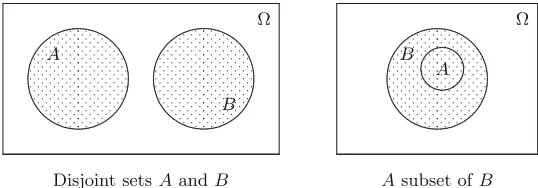
We call events A and B disjoint or mutually exclusive if A and B have no outcomes in common; in set terminology:A∩B=∅. For example, the eventL “the birthday falls in a long month” and the event{Feb} are disjoint.
Finally, we say that event A implies event B if the outcomes of A also lie inB. In set notation:A⊂B; see Figure 2.2.
Some people like to use double negations:
“It is certainly not true that neither John nor Mary is to blame.”
This is equivalent to: “John or Mary is to blame, or both.” The following useful rules formalize this mental operation to a manipulation with events.
DeMorgan’s laws. For any two eventsAandB we have
(A∪B)c =Ac∩Bc and (A∩B)c=Ac∪Bc.
Quick exercise2.2 LetJ be the event “John is to blame” andM the event
“Mary is to blame.” Express the two statements above in terms of the events J, Jc, M, and Mc, and check the equivalence of the statements by means of DeMorgan’s laws.
Disjoint setsAandB
... ... ... ... ... ... ... ... .... .... .... .... .... .... .... .... .... .... .... .... .... .... .... .... .... ... ... ... ... ... ... ... ... ... ...... ... ... ... . . . . . . . . . . . . . . . . . . . . . . . . . . . . . . . . . . . . . . . . . . . . . . . . . . . . . . . . . . . . . . . . . . . . . . . . . . . . . . . . . . . . . . . . . . . . . . . . . . . . . . . . . . . . . . . . . . . . . . . . . . . . . . . . . . . . . . . . . . . . . . . . . . . . . . . . . . . . . . . . . . . . . . . . . . . . . . . . . . . . . . . . . . . . . . . . . . . . . . . . . . . . . . . . . . . . . . . . . . . . . . . . . . . . . . . . . . . . . . . . . . . . . . . . . . . . . . ......... ... ... ... ... ... .... .... .... .... .... .... .... .... .... .... .... .... .... .... .... .... .... ... ... ... ... ... ... ... ... ... ...... ... ... ... . . . . . . . . . . . . . . . . . . . . . . . . . . . . . . . . . . . . . . . . . . . . . . . . . . . . . . . . . . . . . . . . . . . . . . . . . . . . . . . . . . . . . . . . . . . . . . . . . . . . . . . . . . . . . . . . . . . . . . . . . . . . . . . . . . . . . . . . . . . . . . . . . . . . . . . . . . . . . . . . . . . . . . . . . . . . . . . . . . . . . . . . . . . . . . . . . . . . . . . . . . . . . . . . . . . . . . . . . . . . . . . . . . . . . . . . . . . . . . . . . . . . . . . . . . . . . . A B Ω
Asubset ofB
... ... ... ... ... ... ... ... .... .... .... .... .... .... .... .... .... .... .... .... .... .... .... .... .... ... ... ... ... ... ... ... ... ... ...... ... ... ... . . . . . . . . . . . . . . . . . . . . . . . . . . . . . . . . . . . . . . . . . . . . . . . . . . . . . . . . . . . . . . . . . . . . . . . . . . . . . . . . . . . . . . . . . . . . . . . . . . . . . . . . . . . . . . . . . . . . . . . . . . . . . . . . . . . . . . . . . . . . . . . . . . . . . . . . . . . . . . . . . . . . . . . . . . . . . . . . . . . . . . . . . . . . . . . . . . . . . . . . . . . . . . . . . . . . . . . . . . . . . . . . . . . . . . . . . . . . . . . . . . . . . . . . . . . . . . ... ......... ... ... .... .... .... .... .... .... .... ... ... A B Ω
16 2 Outcomes, events, and probability
2.3 Probability
We want to express how likely it is that an event occurs. To do this we will assign a probability to each event. The assignment of probabilities to events is in general not an easy task, and some of the coming chapters will be dedicated directly or indirectly to this problem. Sinceeach event has to be assigned a probability, we speak of a probability function. It has to satisfy two basic properties.
Definition. A probability function P on a finite sample space Ω
assigns to each eventAin Ω a number P(A) in [0,1] such that (i) P(Ω) = 1, and
(ii) P(A∪B) = P(A) + P(B) ifAandB are disjoint. The number P(A) is called the probability thatAoccurs.
Property (i) expresses that the outcome of the experiment is always an element of the sample space, and property (ii) is the additivity property of a probability function. It implies additivity of the probability function over more than two sets; e.g., ifA,B, andC are disjoint events, then the two events A∪B and Care also disjoint, so
P(A∪B∪C) = P(A∪B) + P(C) = P(A) + P(B) + P(C).
We will now look at some examples. When we want to decide whether Peter or Paul has to wash the dishes, we might toss a coin. The fact that we consider this a fair way to decide translates into the opinion that heads and tails are equally likely to occur as the outcome of the coin-tossing experiment. So we put
P({H}) = P({T}) = 1 2.
Formally we have to write{H}for the set consisting of the single elementH, because a probability function is defined on events, not on outcomes. From now on we shall drop these brackets.
Now it might happen, for example due to an asymmetric distribution of the mass over the coin, that the coin is not completely fair. For example, it might be the case that
P(H) = 0.4999 and P(T) = 0.5001.
More generally we can consider experiments with two possible outcomes, say “failure” and “success”, which have probabilities 1−pandpto occur, where pis a number between 0 and 1. For example, when our experiment consists of buying a ticket in a lottery with 10 000 tickets and only one prize, where “success” stands for winning the prize, thenp= 10−4.
2.3 Probability 17
P(Jan) = P(Feb) =· · ·= P(Dec) = 1 12.
Some of you might object to this and propose that we put, for example,
P(Jan) = 31
365 and P(Apr) = 30 365,
because we have long months and short months. But then the very precise among us might remark that this does not yet take care of leap years.
Quick exercise2.3 If you would take care of the leap years, assuming that
one in every four years is a leap year (which again is an approximation to reality!), how would you assign a probability to each month?
In the third experiment (the buckling load of a bridge), where the outcomes are real numbers, it is impossible to assign a positive probability to each outcome (there are just too many outcomes!). We shall come back to this problem in Chapter 5, restricting ourselves in this chapter to finite and countably infinite1 sample spaces.
In the fourth experiment it makes sense to assign equal probabilities to all six outcomes:
P(123) = P(132) = P(213) = P(231) = P(312) = P(321) =1 6.
Until now we have only assigned probabilities to the individual outcomes of the experiments. To assign probabilities to events we use the additivity property. For instance, to find the probability P(T) of the event T that in the three envelopes experiment envelope 2 is on top we note that
P(T) = P(213) + P(231) = 1 6 +
1 6 =
1 3.
In general, additivity of P implies that the probability of an event is obtained by summing the probabilities of the outcomes belonging to the event.
Quick exercise 2.4 Compute P(L) and P(R) in the birthday experiment.
Finally we mention a rule that permits us to compute probabilities of events AandBthat arenot disjoint. Note that we can writeA= (A∩B)∪(A∩Bc), which is a disjoint union; hence
P(A) = P(A∩B) + P(A∩Bc).
If we split A∪B in the same way with B and Bc, we obtain the events (A∪B)∩B, which is simplyBand (A∪B)∩Bc, which is nothing butA∩Bc.
1 This means: although infinite, we can still count them one by one; Ω =
{ω1, ω2, . . .}. The interval [0,1] of real numbers is an example of an uncountable
18 2 Outcomes, events, and probability
Thus
P(A∪B) = P(B) + P(A∩Bc).
Eliminating P(A∩Bc) from these two equations we obtain the following rule.
The probability of a union. For any two eventsA and B we
have
P(A∪B) = P(A) + P(B)−P(A∩B).
From the additivity property we can also find a way to compute probabilities of complements of events: fromA∪Ac= Ω, we deduce that
P(Ac) = 1−P(A).
2.4 Products of sample spaces
Basic to statistics is that one usually does not considerone experiment, but that the same experiment is performed several times. For example, suppose we throw a coin two times. What is the sample space associated with this new experiment? It is clear that it should be the set
Ω ={H, T} × {H, T}={(H, H),(H, T),(T , H),(T , T)}.
If in the original experiment we had a fair coin, i.e., P(H) = P(T), then in this new experiment all 4 outcomes again have equal probabilities:
P((H, H)) = P((H, T)) = P((T , H)) = P((T , T)) = 1 4.
Somewhat more generally, if we consider two experiments with sample spaces Ω1 and Ω2 then the combined experiment has as its sample space the set
Ω = Ω1×Ω2={(ω1, ω2) :ω1∈Ω1, ω2∈Ω2}.
2.5 An infinite sample space 19
Quick exercise2.5 Consider the sample space{a1, a2, a3, a4, a5, a6}of some
experiment, where outcomeai has probabilitypifori= 1, . . . ,6.We perform this experiment twice in such a way that the associated probabilities are
P((ai, ai)) =pi, and P((ai, aj)) = 0 if i=j, fori, j= 1, . . . ,6.
Check that P is a probability function on the sample space Ω ={a1, . . . , a6}×
{a1, . . . , a6} of the combined experiment. What is the relationship between the first experiment and the second experiment that is determined by this probability function?
We started this section with the experiment of throwing a coin twice. If we want to learn more about the randomness associated with a particular exper-iment, then we should repeat it more often, sayntimes. For example, if we perform an experiment with outcomes 1 (success) and 0 (failure) five times, and we consider the event A “exactly one experiment was a success,” then this event is given by the set
A={(0,0,0,0,1),(0,0,0,1,0),(0,0,1,0,0),(0,1,0,0,0),(1,0,0,0,0)}
in Ω = {0,1} × {0,1} × {0,1} × {0,1} × {0,1}. Moreover, if success has probabilitypand failure probability 1−p, then
P(A) = 5·(1−p)4·p,
since there are five outcomes in the eventA, each having probability (1−p)4·p.
Quick exercise 2.6 What is the probability of the event B “exactly two
experiments were successful”?
In general, when we perform an experimentntimes, then the corresponding sample space is
Ω = Ω1×Ω2× · · · ×Ωn,
where Ωi fori= 1, . . . , n is a copy of the sample space of the original exper-iment. Moreover, we assign probabilities to the outcomes (ω1, . . . , ωn) in the standard way described earlier, i.e.,
P((ω1, ω2, . . . , ωn)) =p1·p2· · · ·pn,
if eachωi has probabilitypi.
2.5 An infinite sample space
20 2 Outcomes, events, and probability
of the experiment is the number of tosses it takes to have this first occurrence of a head. Our sample space is the space of all positive natural numbers
Ω ={1,2,3, . . .}.
What is the probability function P for this experiment?
Suppose the coin has probabilitypof falling on heads and probability 1−pto fall on tails, where 0< p <1.We determine the probability P(n) for eachn. Clearly P(1) =p, the probability that we have a head right away. The event
{2}corresponds to the outcome (T , H) in{H, T} × {H, T}, so we should have P(2) = (1−p)p.
Similarly, the event{n}corresponds to the outcome (T , T , . . . , T , T , H) in the space{H, T} × · · · × {H, T}. Hence we should have, in general,
P(n) = (1−p)n−1p, n= 1,2,3, . . . .
Does this define a probability function on Ω ={1,2,3, . . .}? Then we should at least have P(Ω) = 1. It is not directly clear how to calculate P(Ω): since the sample space is no longer finite we have to amend the definition of a probability function.
Definition. Aprobability function on an infinite (or finite) sample
space Ω assigns to each eventA in Ω a number P(A) in [0,1] such that
(i) P(Ω) = 1, and
(ii) P(A1∪A2∪A3∪ · · ·) = P(A1) + P(A2) + P(A3) +· · · ifA1, A2, A3, . . . are disjoint events.
Note that this new additivity property is an extension of the previous one because if we chooseA3=A4=· · ·=∅, then
P(A1∪A2) = P(A1∪A2∪ ∅ ∪ ∅ ∪ · · ·)
= P(A1) + P(A2) + 0 + 0 +· · ·= P(A1) + P(A2).
Now we can compute the probability of Ω:
P(Ω) = P(1) + P(2) +· · ·+ P(n) +· · ·
=p+ (1−p)p+· · ·(1−p)n−1p+· · · =p[1 + (1−p) +· · ·(1−p)n−1+· · ·].
The sum 1 + (1−p) +· · ·+ (1−p)n−1+· · · is an example of a geometric
series. It is well known that when|1−p|<1,
1 + (1−p) +· · ·+ (1−p)n−1+· · ·= 1 1−(1−p) =
1 p.
2.7 Exercises 21
Quick exercise2.7 Suppose an experiment in a laboratory is repeated every
day of the week until it is successful, the probability of success beingp. The first experiment is started on a Monday. What is the probability that the series ends on the next Sunday?
2.6 Solutions to the quick exercises
2.1 The sample space is Ω ={1234,1243,1324,1342, . . . ,4321}. The best way to count its elements is by noting that foreach of the 6 outcomes of the three-envelope experiment we can put a fourth three-envelope in any of 4 positions. Hence Ω has 4·6 = 24 elements.
2.2 The statement “It is certainly not true that neither John nor Mary is to blame” corresponds to the event (Jc∩Mc)c. The statement “John or Mary is to blame, or both” corresponds to the eventJ∪M. Equivalence now follows from DeMorgan’s laws.
2.3 In four years we have 365×3 + 366 = 1461 days. Hence long months each have a probability 4×31/1461 = 124/1461, and short months a probability 120/1461 to occur. Moreover,{Feb}has probability 113/1461.
2.4 Since there are 7 long months and 8 months with an “r” in their name, we have P(L) = 7/12 and P(R) = 8/12.
2.5 Checking that P is a probability function Ω amounts to verifying that 0≤P((ai, aj))≤1 for alliandj and noting that
P(Ω) = 6
i,j=1
P((ai, aj)) = 6
i=1
P((ai, ai)) = 6
i=1 pi= 1.
The two experiments aretotally coupled: one has outcome ai if and only if the other has outcomeai.
2.6 Now there are 10 outcomes in B (for example (0,1,0,1,0)), each having probability (1−p)3p2. Hence P(B) = 10(1−p)3p2.
2.7 This happens if and only if the experiment fails on Monday,. . . , Saturday, and is a success on Sunday. This has probabilityp(1−p)6to happen.
2.7 Exercises
22 2 Outcomes, events, and probability
2.2LetEandF be two events for which one knows that the probability that at least one of them occurs is 3/4. What is the probability that neitherEnor F occurs? Hint:use one of DeMorgan’s laws:Ec∩Fc= (E∪F)c.
2.3LetCandDbe two events for which one knows that P(C) = 0.3,P(D) = 0.4, and P(C∩D) = 0.2. What is P(Cc∩D)?
2.4We consider eventsA, B, andC, which can occur in some experiment. Is it true that the probability thatonly Aoccurs (and notB or C) is equal to P(A∪B∪C)−P(B)−P(C) + P(B∩C)?
2.5The eventA∩Bc thatAoccurs but notBis sometimes denoted asA\B. Here\is the set-theoretic minus sign. Show that P(A\B) = P(A)−P(B) if B impliesA, i.e., ifB⊂A.
2.6When P(A) = 1/3, P(B) = 1/2, and P(A∪B) = 3/4, what is
a. P(A∩B)?
b. P(Ac∪Bc)?
2.7LetAandBbe two events. Suppose that P(A) = 0.4, P(B) = 0.5, and P(A∩B) = 0.1. Find the probability thatAorB occurs, but not both.
2.8 Suppose the events D1 and D2 represent disasters, which are rare: P(D1)≤10−6 and P(D2) ≤10−6. What can you say about the probability that at least one of the disasters occurs? What about the probability that theyboth occur?
2.9We toss a coin three times. For this experiment we choose the sample space
Ω ={HHH, T HH, HT H, HHT , T T H, T HT , HT T , T T T}
whereT stands for tails andH for heads.
a. Write down the set of outcomes corresponding to each of the following events:
A: “we throw tails exactly two times.” B: “we throw tails at least two times.”
C: “tails did not appearbefore a head appeared.” D: “the first throw results in tails.”
b. Write down the set of outcomes corresponding to each of the following events:Ac,A∪(C∩D), andA∩Dc.
2.7 Exercises 23
2.11An experiment has only two outcomes. The first has probabilitypto occur, the second probabilityp2. What isp?
2.12 In the UEFA Euro 2004 playoffs draw 10 national football teams were matched in pairs. A lot of people complained that “the draw was not fair,” because each strong team had been matched with a weak team (this is commercially the most interesting). It was claimed that such a matching is extremely unlikely. We will compute the probability of this “dream draw” in this exercise. In the spirit of the three-envelope example of Section 2.1 we put the names of the 5 strong teams in envelopes labeled 1,2,3,4, and 5 and of the 5 weak teams in envelopes labeled 6,7,8,9, and 10. We shuffle the 10 envelopes and then match the envelope on top with the next envelope, the third envelope with the fourth envelope, and so on. One particular way a “dream draw” occurs is when the five envelopes labeled 1,2,3,4,5 are in the odd numbered positions (in any order!) and the others are in the even numbered positions. This way corresponds to the situation where the first match of each strong team is a home match. Since for each pair there are two possibilities for the home match, the total number of possibilities for the “dream draw” is 25= 32 times as large.
a. An outcome of this experiment is a sequence like 4,9,3,7,5,10,1,8,2,6 of labels of envelopes. What is the probability of an outcome?
b. How many outcomes are there in the event “the five envelopes labeled 1,2,3,4,5 are in the odd positions—in any order, and the envelopes la-beled 6,7,8,9,10 are in the even positions—in any order”?
c. What is the probability of a “dream draw”?
2.13In some experiment first an arbitrary choice is made out of four pos-sibilities, and then an arbitrary choice is made out of the remaining three possibilities. One way to describe this is with a product of two sample spaces
{a, b, c, d}:
Ω ={a, b, c, d} × {a, b, c, d}.
a. Make a 4×4 table in which you write the probabilities of the outcomes.
b. Describe the event “cis one of the chosen possibilities” and determine its probability.
2.14Consider the Monty Hall “experiment” described in Section 1.3. The door behind which the car is parked we labela, the other twobandc. As the sample space we choose a product space
Ω ={a, b, c} × {a, b, c}.

![Fig. 5.1. Area under a probability density function f on the interval [a, b].](https://thumb-us.123doks.com/thumbv2/123dok_us/8213008.263638/69.441.113.327.45.187/fig-area-probability-density-function-f-interval-b.webp)