Explore the Application of Financial Engineering in the
Management of Exchange Rate Risk
Liu Yang
School of Economic SCUEC, Wuhan, 430074, Hubei, China
Abstract. In the background where the domestic enterprises commonly have a weak protection consciousness against the exchange rate risk, this article makes a deep analysis based on the definition of exchange rate risk and its cause. By comparison of the traditional management method of exchange rate risk with another one based on financial engineering tools, it also deeply analyzes the method to use the financial engineering technology in the management of exchange rate risk, and concludes the primary purpose of exchange rate risk management is for hedging. This article proposes an optimal analysis method in two aspects, namely the minimum risk and maximum efficiency, for the forward-based optimal hedging, and proposes an optimal analysis method of dynamic hedging for the optimal hedging of option-based tools. Based on the description of the application of financial tools in foreign exchange futures, forward contract, currency exchange and foreign exchange option, it makes an empirical analysis on the management of foreign exchange risk by taking an assumed T company as the carrier and based on the trading tools of forward foreign exchange and currency option, which describes the operation procedure of financial tools in a more direct way and proves the efficiency of the optimal analysis method of this article.
Keywords. financial tool; exchange rate risk; futures-based tool; option-based tool; hedging
1 Introduction
In April 2013, there’s a strong turbulence in the global exchange rate market due to the release of
“double easing” policy announced by Japan, which was happening in the background where
Chinese currency supply exceeded 10 billion for the first time. This shock had a certain effect on Chinese export just starting to improve[1]. The fluctuation of exchange rate of RMB is affected mainly by the market, so the exchange rate risk our Chinese foreign trade enterprises face will gradually reveal. Therefore, it is very necessary to explore the management of exchange rate risk.
Xie Fei, et al. (2011) said the current exchange rate risk our Chinese financial institutions face is confirmed, and the exchange rate risk has become the main content of modern risk management in the theoretical field[2]. In the early stage, a foreign scholar named Michael Adler (1983) thought the exchange rate risk is a sensitiveness of the actual domestic currency value of assets liability or business income to the unanticipated change of exchange rate[3]; Then a typical foreign scholar
named Michel Crouhy, et al. (2001) thought the exchange rate risk is induced by the
non-DOI: 10.1051/ C
Owned by the authors, published by EDP Sciences, 2015
/2 01
shsconf 51 01007
synchrony between the change of exchange rate and the fluctuation of international interest rate, and the foreign exchange risk consists in an open or incomplete hedging open[4]. These foreign scholars mainly made the research on the relation of exchange rate change and interest rate fluctuation. A domestic scholar named Ling Tian (2004) defined the exchange rate risk as a possibility that the commercial bank suffers a loss due to the change of exchange rate and its expected profit is hard to be achieved[5]. The definition of exchange rate risk given by Ling Tian indicates the commercial bank may suffer a loss due to holding an adverse change of current exchange rate when it holds an open position of a certain type of foreign exchange in the form of spot exchange, forward or both, so this definition about the exchange rate risk given by the scholar is recognized by other domestic scholars.
The value measurement and control of exchange rate risk is based on the analysis on the cause of exchange rate risk. Shelagh Heffeman (1996) pointed that the mismatch of currency and term is a basic feature for banking business. The bank will face exchange rate risk if the change of exchange rate doesn’t comply with the expected trend[6]. And he further noted that in a foreign exchange market, the value of foreign currency will be varied with the interest rate of foreign currency, interest rate of domestic currency and spot interest rate. Huali Huang (2002) said the factors affecting the change of exchange rate mainly include international balance, interest rate change, inflation, exchange rate policy, market expectation and shock[7]. Most of the domestic scholars agree with the opinion of Huali Huang. The common methods for quantitative research on the management of exchange rate risk include analysis method for the open of exchange rate risk
[8]
, VaR[9], CVaR[10] and extreme value theory[11]. There are few research on the open of foreign exchange, but the net open of foreign exchange calculated by this method is closer to the actual open of foreign exchange. As for the calculation of VaR, many scholars have made researches: Yanjun Yang (2005) introduced GARCH model into VaR method to measure the market risk and
measured the copper and aluminum contract in Shanghai futures exchange[12]; Yi Zhang (2007)
made an empirical research on the Delta normal distribution method and historical simulation
method in VaR model[13] ; Bo Zhong and Qingsong Wang (2007) solved the Bayes estimation of
the parameters by a statistical calculation method named MCMC algorithm and got the financial risk value VaR, which might help the investors to adjust the VaR model by the observed data and
the experience information they get to make the decision more efficient[14]. Xiaoxing Liu and
Guihua Qiu (2010) used the Copula, a function with dependency structure, and the extreme value theory (EVT) to construct an La-Copula-EVT risk value model to adjust the liquidity of Chinese stock market, and made an empirical analysis on the high-frequency data of CSI income series, then pointed that the tails of income series in Chinese CSI stock market had a high correlation[15].
As for the economic system of a huge foreign exchange risk, using the financial engineering to manage the foreign exchange risk is to judge the financial situation, confirm the financial goal we expect to achieve, and select a proper financial tool to realize the confirmed financial goal. Based on previous researches, this article describes the advantages of using the financial engineering method to manage the exchange rate risk, discusses the method to apply the financial tools in futures, forward, exchange and option, and analyzes the efficiency of optimal analysis of futures-based and option-futures-based tools in mechanism and theory, expecting to provide a theoretical basis for the management of Chinese exchange rate risk.
2 Definition of financial engineering and its advantages in the
management of exchange rate risk
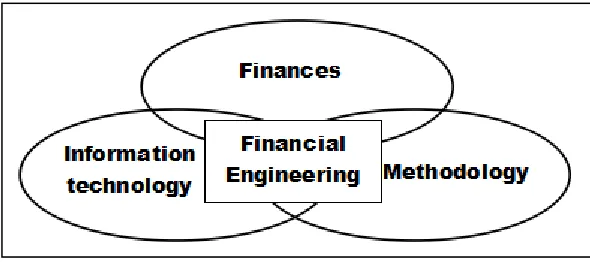
Figure 1. Schematic diagram of financial engineering inter-disciplines
There are two concepts for financial engineering, respectively in broad and narrow sense, and the former means to use advanced mathematical and communication tools to conduct different forms of combination and division based on various existing basic financial products in order to design a new financial product that meets the demand of client and has a certain P/L property; The latter means to use all the engineering-oriented methods to deal with the technical development of financial problems. There are many opinions about the definition of financial engineering. An American financier John finnerty thought the financial engineering is a discipline that includes the design, development, implementation of innovative financial tools and financial methods, as well as solving the financial problems and using various financial tools to solve various financial and business problems in an innovative way[16]. This article firmly agrees with the definition given by John finnerty. The key of financial engineering is to develop and design a new financial product or business, and its main purpose is to improve the efficiency. When the financial engineering faces foreign exchange risk, there are two goals for the management, including replacing the risk with certainty, and replacing the unfavorable risk with favorable risk. To achieve the above goals, the forward foreign exchange trading and currency option trading are the main tools for resolution of the problems.
This article divides the financial tools into two types, namely futures-based tool and option-based tool. The futures-option-based tool includes traditional market tool (complete forward, forward option and exchange), comprehensive contract of forward foreign exchange, foreign exchange futures, etc., and the basic principle of using these tools to manage the exchange rate risk is to confirm the level of a risk by a fixed price in order to realize the goal of risk market, which may avoid the risk due to the adverse change of exchange rate, but meanwhile give up the profits due to the positive change of exchange rate; the option-based tool refers to the foreign exchange option and the product derived from basic option. The basic principle of using non-symmetrical tool to manage the exchange rate risk is to flexibly determine whether to implement the option according
to the detailed conditions of the fluctuation of foreign exchange market. There’s no point in
preventing the exchange rate risk after the event, and if the selection is improper, the non-hedging and forward methods may also produce the worst result. So the option definitely will not bring the worst result though it cannot induce the best result for the customers.
advanced management and risk management, among which the risk management is considered as the most important content in the financial engineering[17].
The financial engineering theory is developed around the risk management, and it has an obvious advantage compared to the traditional method to manage the exchange rate risk, including the accuracy, timeliness, (risk avoidance by derivative tools), costs (lever property of derivative transaction) and flexibility (position of derivative transaction). The main reason for those advantages lies in the problems that can be solved by the theoretical system of financial engineering theory. The arbitrage theory successfully uses the principle “arbitrage balance without risk” to describe the inner mechanism to balance the securities price based on the theory of price estimation, portfolio and assets pricing. And the option pricing theory successfully realizes the pricing for derivative products, which deepens the analysis on the relation between the risk and profits.
3 Optimal analysis on the management of exchange rate risk based
on financial engineering
In the perspective of risk minimization, the transactions between the cash and futures market may be considered as a portfolio, and the best hedging ratio can be confirmed under the condition of risk minimization. Assuming there’s a hedger selling its hedging as it holds a foreign exchange position, the yields
R
h in this hedging period may be calculated with Formula (1).
R
hP
2P
1Q
sF
2F
1Q
f (1)In Formula (1),
P
1,
P
2 refers to respectively the cash price at the beginning and the end of theperiod;
F
1,
F
2 refers to respectively the futures price at the beginning and the end of the period;f s
Q
Q
,
refers to the trading volume of the hedger respectively in spot and futures market. Despite the transaction costs, theP
1,
F
1 andQ
s,
Q
f at the beginning of the period have been confirmed,and
2 2
,
F
P
is a random variable, which makesR
h an another random variable. The expectedyield is represented by mathematical expectation
E
R
h , the risk by the varianceVAR
R
h .From (1), we may get the expression of
VAR
R
h shown in Formula (2).
VAR
R
hQ
s2VAR
P
2Q
2fVAR
F
22
Q
sQ
fcov
P
2,
F
2 (2)To minimize the risk, the first-order derivative of
VAR
R
h toQ
f must be 0, and then, ahedging number in minimum variance will be got, as shown in Formula (3).
s
f
Q
F
VAR
F
P
Q
2 2 2
,
cov
(3)
By Formula (3), we may use the currently held position
Q
s to determine the numberQ
f ofhedging position with the minimum risk.
Considering the maximum efficiency, the utility function may be used to represent the personal preference of investors for the investment result. Provided a productive operator holding the assets of
W
t int
moment hedges with the futures contract, and the hedging rate ish
t, and we may useFormula (4) to represent the assets
W
t1 int
1
moment after the hedging.The
R
s,
R
f in Formula (4) represent the yields produced by using the unit assets to hold thespot and long futures respectively in
t
~t
1
period, and they are both random variables. So, for ahedger holding a utility function with
U
W
, the optimal hedging rate is the maximumexpectation utility after hedging, as shown in Formula (5).
E
U
W
U
W
tR
sh
tR
fdp
tt
h t h u u u1
max
max
1 (5)The Formula (6) may be got due to the definition of covariance and the fact that its first-order derivative is 0 and the hypothesis
R
s,
R
f complies with the normal distribution.
W
tE
U
cov
1
R
sh
tR
f,
R
fE
U
E
R
fR
f0
(6)The hedging ratio
h
u with maximum expectation utility shown in Formula (7) may be gotthrough Formula (6).
U
E
W
R
U
E
R
E
R
R
R
h
t f f f f s uvar
var
,
cov
(7)The best hedging rates analyzed in the perspective of minimum risk and maximum utility are all applicable for the futures-based contract law, while the option-based contract law with nonlinear yield is not applicable. And the method to compensate for the static hedging is to
implement the dynamic hedging. This article uses
delta
to represent the ratio of price change ofoption to the change of its target assets price. And the accurate value of
delta
is generally calculated by Black-Scholes formula shown in Formula (8).
T
d
d
T
T
R
r
x
S
d
d
N
Xe
d
N
e
S
C
f rT qT 1 2 2 0 1 2 1 0 02
ln
ln
(8)In Formula (8), the
C
0 represents the call option costs,S
0 the current stock price,N
d
theprobability of
d
in the standard normal distribution,X
actual purchase price,r
interest rate without risk,T
due time of option, standard deviation of annual yield rate due to continuouscompounding of stock,
R
f interest rate of foreign currency without risk, andq
the dividend rate.Then, the value
delta
of European-style call and put option for dividend payment is as shown in Formula (9).1
delta
delta
1 down 1 upd
N
e
d
N
e
qT qT (9)In the hedging of the option
delta
, people will establish its position of hedging according to thedelta
of the option, and adjust the part of hedging with the change ofdelta
. The absolute value ofdelta
may be used to confirm the hedging ratio in order to determine the basis on which the number of option contract is required for hedging. The principle of determination is that the hedging ratio shall be equal to the multiplicative inverse of absolute valuedelta
of this option so as to realize the complete hedging.according to the actually calculated result so that the hedging purpose will be well realized. The shorter time interval for each time of change for the option position, the better effect of hedging will be. Generally considering the transaction costs, we may have a good effect of hedging simply by keeping the change frequency of
delta
hedging in a certain degree.4 Method to manage the exchange rate risk based on financial
engineering and the empirical analysis
4.1 Method to manage the exchange rate risk based on financial engineering
The financial engineering technology is mainly applies in hedging, speculation, arbitrage and portfolio[18], while the financial engineering tools for the management of exchange rate risk are mainly used in futures, forward, exchange and option. This chapter focuses on the above 4 tools to analyze the method to manage the exchange rate risk based on financial engineering.
The foreign exchange futures is a common tool for hedging, which can be divided into basic strategy of direct hedging and cross hedging. The basic strategy of direct hedging can be divided into long and short hedging, and they are operations reverse to each other. The long hedging is applicable to a case where you purchase a foreign exchange in the future but are afraid of suffering loss due to the rise of foreign exchange rate. However, when people need to use the foreign exchange futures to manage the foreign exchange risk they are faced with, and there’s no proper or available futures contract for hedging in the foreign exchange futures market, the people shall avoid the foreign exchange risk by the more complex cross hedging. In the cross hedging of foreign exchange futures, the hedger will use the domestic and foreign currency which are calculated by a third type of currency and used in the transaction of futures contract. People may purchase the domestic currency futures and sell the foreign currency futures, or purchase the foreign currency futures and sell the domestic currency futures, to realize the cross hedging to avoid the risk of depreciation and appreciation of foreign currency.
As a hedging tool, the forward contract is an efficient complement for the foreign exchange futures. It's not standardized, and the customer may finally “customize” the forward contract to meet their special requirements. In all the forward market, the forward currency is the most developed.
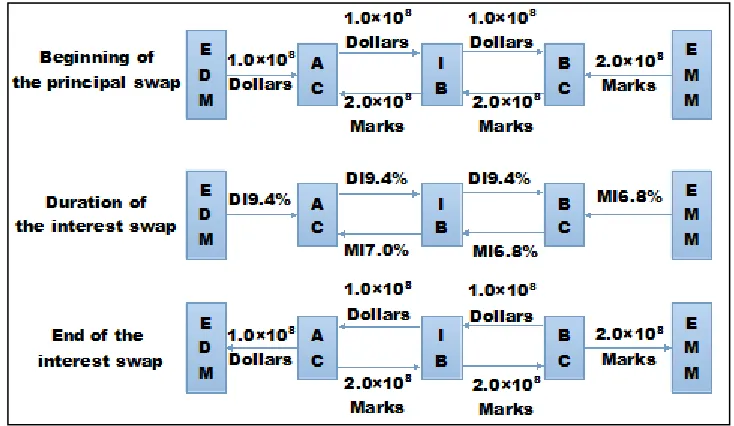
Currency exchange generally refers to the exchange of assets or liabilities with the same interest-bearing method but different currency. It is mainly produced to solve the difficulty in the limitation of market scale, close the position of various currencies, make full use of the relative advantages and avoid the exchange rate risk. The basic procedures of indirect currency exchange include the exchange of early-stage principal, period interest and ending principal. The Figure 2 shows the basic procedures of indirect currency exchange for the currency exchange system composed of European dollar Market (EDM), A Company (AC), Intermediary bank (IB), B Company (BC) and European mark Market (EMM). In this figure, MI refers to Mark Interest, and DI refers to Dollar Interest.
As shown in Figure 2, A and B Company, as well as the intermediary bank, have obtained the exchange benefit. For the intermediary bank, it has obtained 20 basic points of spread income, but for A and B Company, they have got the double benefits that reduce their financing costs and avoid the exchange rate risk.
investor hedges a financial tool and there's no foreign exchange option that takes this currency as the target in the market, or there’s an option contract that cannot be used by the investor as a hedging tool, they will carry out the hedging for this currency through another currency option contract. This is called the cross hedging of currency option.
[image:7.482.57.424.130.343.2]The financial tools able to provide the above management methods include forward foreign exchange transaction and currency option transaction.
Figure 2. Basic procedures of indirect currency exchange
4.2 Empirical analysis
To make a direct analysis on the operation methods for two financial tools, the forward foreign exchange transaction and currency option transaction, this article takes the assumed T company case as a carrier to make an empirical analysis, as shown in Table 1.
Table 1. Schedule of data about the case of foreign exchange risk in T Company
Project number Content Data
1 Date of purchasing the goods 2013.6.6
2 Company's savings of USD in China Bank in 2013.6.6 200,000 USD 3 Company's savings of AUD in China Bank in 2013.6.6 100,000 AUD 4 Company's savings of RMB in China Bank in 2013.6.6 100,000 yuan 5 Closing price of exchange rate of USD to AUD in 2013.6.7 1US $ =1.0550AU$ 6 3-month forward exchange rate of AUD in 2013.6.6 1US$=1.0574AU$ 7 Date of lump-sum payment specified by the contract 9/6/2013
8 Amount of lump-sum payment specified by the contract US $ 100,000 9 Total amount of the company's payables from 2013.6.6 to
2013.9.6 ̞60,000 ; US $ 100,000
10 Total amount of the company's receivables during
2013.6.6~2013.9.6 ̞ 50,000
If using the forward foreign exchange tool to manage the exchange rate risk for this company, the actual operation will be as follows:
[image:7.482.39.444.457.596.2]STEP2. The company shall sign an agreement with local China Bank according to the forward exchange rate in the project number 7, purchase 100,000 USD, and pay 105.740 AUD.
Through the above steps, the company fixes the exchange rate of USD to AUD in a certain level, 1US$ = 1.0574 AU$, by forward foreign exchange transaction. 3 months later, if the exchange rate of USD to AUD exceeds that value, the company will suffer a loss in the payment, but make profits in the forward foreign exchange contract, and avoid the risk to some extent. But if the exchange rate of USD to AUD is less than that value in 2013.9.6, this company will lose the opportunity to make profits.
[image:8.482.45.439.211.286.2]If using the currency option tool to manage the exchange rate risk for this company, and the option data of USD to AUD in 2013.6.7, as well as the cash outflow from purchasing the put option, is as shown in Table 2, the actual option will be as follows:
Table 2. Option data and the cash outflow from purchasing the put option
Delivery price Abstract of option data Cash outflow from purchasing the put option Call option Put option Option fee Cash outflow (AUD)
1.0538 550. 550. 110.880.
1.0553. 370. 370. 109.230.
1.0603. 280. 280. 108.830.
1.0653. 210. 210. 108.630.
1.0703. 160. 160. 108.630.
STEP1. The company selects to purchase the call option of dollars, and it has a right to purchase a certain amount of dollars according to a specific price. The Table 2 shows the option with implementation price 1.0538AUD/USD provides the best protection, and has the highest the option fee.
STEP2. If the company selects the call option with the least cash outflow for transaction, the option with implementation price 1.0603 AUD / USD will be a good choice.
The comparison of relevant data for those two financial tools is as shown in Table 3:
Table 3. Schedule of comparison of relevant data due to the management of two financial tools
Type Cash outflow in 3 months Protection scope Costs Forward tool Forward foreign exchange transaction 105,740 (AUD) / Option tool Purchase the call option 108,830 (AUD)
1.0603From the result of using above two financial tools to manage the exchange rate risk for T Company, it can be found that using the forward foreign exchange transaction costs little without paying deposit, but it has no scope of security. While there’s a certain scope of security when using the method of purchasing call option, but the option fee shall be paid, and the costs are high. The core of those two financial tools that deal with the foreign exchange risk is “hedging”, and it is key for the foreign trade enterprises and some economic entities to efficiently use the financial engineering concept to reasonably select one or more financial tools when facing a special and inevitable risk, which directly determines whether a decision maker is able to avoid the fixed risk for the enterprise.
5 Conclusions
[image:8.482.63.418.408.443.2](1) The financial tools can be divided into futures-based tool and option-based tool. The guideline of applying the futures-based tool is to avoid the risk and improve the utility. The guideline of applying the option-based tool is to flexibly determine whether to implement the option according to the dynamic process.
(2) The optimal analysis on the application of futures-based tool in the management of exchange rate risk shall be made in risk-minimum and utility-maximum perspectives. The key for the former analysis is to determine the number of hedging position with minimum risk, and the latter is to calculate the hedging ratio of maximum expectation utility.
(3) The optimal analysis on the application of futures-based tool in the management of exchange rate risk is fundamentally a dynamic optimization process, and its purpose is to determine the call option and put option in the shortest time and purchase a reasonable call option based on qualitative analysis in order to take the best risk avoidance measures.
(4) The empirical analysis on the management of exchange rate risk for the assumed T Company may provide a clear image of using financial tools to manage the exchange rate risk for the enterprises, and also offer a theoretical guidance for the decision maker in the enterprise to finalize decisions.
References
1. Tian, Y. Description of How the Financial Engineering Manages and Avoid the Risk of
Foreign Exchange —— Analysis on Two Useful Tools for Financial Engineering to Manage
the Foreign Exchange Risk [J]. Journal of Jilin Teachers Institute of Engineering and Technology.
2. Xie, F., Zhang, J., Song, L., Summary of Exchange Rate Risk Management [J]. Journal of
Chongqing University of Technology 2011, 25(9): 46-51.
3. Michael Adler, Bernard Dumas. Exposure to Currency Risk: Definition and Measurement [J].
Financial Management. 1983, 25(3): 121-125.
4. Michel Crouhy, Dan Galai, Robert Mark. Risk Management [M]. [S.1]: McGraw-Hall
Companies. 2001.
5. Tian, L. Research on Risk Management in German Commercial Bank [M]. Beijing: Science
Press. 2004.
6. Shelagh Heffeman. Modern Banking in Theory and Practice [J]. New York: John Wiles &
Sons. 1996: 56-60.
7. Huang, H.L. Management of the Risk of Interest Rate and Exchange Rate in Commercial
Bank [M]. Shanghai: Tongji University Press. 2002.
8. Levonian, Soller J. Small loans, small business [J]. Mimeo. Federal Reserve Bank of San
Francisco. 1994(12): 45-47.
9. Jorion, P. Value at risk [M]. New York: McGraw-Hill. 1997.
10. Rockafellar R, Tyrrell S. Operational Of Conditional Value-at-Risk [J]. Journal of Risk.
2000(3): 21-41.
11. Lingin. The asymptotic distribution of extreme stock market returns [J]. Journal of Business. 1996(69)3: 383-408.
12. Yang, Y.J., Wang. Y.F. Design of Trading Guarantee in Futures Market [J]. Statistics and
Decision. 2005(12): 104-105.
13. Zhang, Y. Research on the Application of VaR in the Assessment of Exchange Rate Risk in
the Commercial Bank [D]. Shanghai: Tongji University, 2007.
14. Zhong, B, Wang, Q.S. Value of Financial Risk Based on Bayes Estimation—— VaR
Calculation [J]. Mathematical Statistics and Management. 2007(5): 881-886.
15. Liu, X.X., Qiu, G.H. Research on VaR and ES in the Adjustment of Chinese Stock Market
16. Xu. Y. Research on the Correlation of Financial Engineering and Financial Efficiency [J]. Contemporary Economy. 2012.21(9): 124-125.
17. Cao, Y., On the Financial Engineering and Management of Exchange Rate Risk [J]. Modern
Industry of Commerce and Trade. 2008.20(5): 166-167.
18. Li, X. Research on the Application of Financial Engineering in the Management of Exchange