International Journal of Innovative Technology and Exploring Engineering (IJITEE) ISSN: 2278-3075, Volume-8 Issue-12, October 2019
Energy-Efficient Clustering With Multiple Sink
(Eecms) In Wireless Body Area Network
Juhi Agrawal, Shelly, Monit Kapoor,
Abstract: Wireless Body Area Networks is consists of compact bio sensors that implanted in various body areas of human being. WBAN is a new revolution in the field of health sciences. It monitors the health related data like blood pressure (BP), heartbeat, glucose level, electro-cardiogram etc. It passes these data to the health monitoring systems. WBAN is playing main role in the field of sports, entertainment, medical, psychological and social welfare. Till now there are different routing protocols have been outlined to increase its performance, energy efficiency, throughput, packet delivery ratio (PDR), delay and network lifetime. This paper proposes a routing protocol named energy-efficient clustering with multiple sink (EECMS) in wireless body area network. Which calculates the fitness function using multiple parameters such as Residual Node Energy, Distance of nodes and Transmission Range for Cluster Head selection. After some interval it keep changing the head to maintain the flow of network.
INDEX TERMS: Clustering, delay, Packet delivery ratio (PDR), WBANs.
I. INTRODUCTION
Wearable equipment has become the intelligent trend with the rapid growth of wireless body area network. It plays a dominant role in human’s life by providing them health care services. The traditional WBANs device had limited resources like computation power, energy and storage. Gradually, WBANs is becoming the important part of daily life activities [1]. Sensors used by WBAN work
independently. After sensing various types of data, the sensor node transfer it to outer nodes through the external server for medical report generation [2]. It monitors the health related data like blood pressure (BP), heartbeat and glucose level in blood etc. and passes these readings to the health monitoring systems. These collected data is transferred over base station for analysis and processing [3]. These data are constantly monitored by sensors and if it reaches to the threshold range then these sensor sends the alert signals [4]. Earlier, the patient must have to stay in hospital which can lead to disturbance in their daily life routine. By using WBAN, the labor and infrastructure cost will get decrease. Rapid growth of electronics had made the sensor more powerful by reshaping the Micro-Electro-Mechanical Systems. These are small sensor device that can sense the data, process and transmit the data.
[image:1.595.138.439.415.684.2]BS or sink node contains the huge storage and transmission power as compared to ordinary sensor nodes. WBAN consists of small size nodes deployed in various parts of body which sense data such as BP, heartbeat and glucose level etc. The recorded data is transmitted to an outside node by providing an interface between local network and cloud storage. Internet is used by medical professional to access the patient’s sensed data. Same has been shown in figure 1.
Figure 1: Wireless Body area network architecture for e-healthcare system.
Revised Manuscript Received on October 05, 2019.
Juhi Agrawal, University of Petroleum and Energy Studies, Dehradun Email Address:[email protected]
With drastic expansion of cases of patients distressing from various problems like diabetes, asthma, cardiovascular etc. is one of purpose that influenced the researchers to take initiative to solve the health-care services. The main downside of sensor node is their limited battery which get empty frequently due to various operations.
The rapid draining of battery power mainly take place because of continuously sending and sensing the data. It can also be the result of sending of redundant sensed data till the successive round reached or re-transmission of sensed packets. Path loss and selection of inefficient route can lead to retransmission of data packets [5] [6]. That is why efficient route selection is very important. When cluster head continuously works for cluster member, its energy also get exhausted and if the energy gets exhausted fully there is no point to use that cluster head. Our proposed approach handles this challenging situation very well.
The research paper presents an energy-efficient clustering with multiple sink in wireless body area network. The proposed technique includes:
1) Dynamic Cluster head selection using fitness function: Fitness function is calculated using multiple parameters such as Residual Node Energy, Distance of nodes and Transmission Range for Cluster Head selection. 2) Path finding in Intra-cluster: After sensing the data, sensor member transfers the data packets to desired destination. When node has to transfer the data within the cluster, it searches the best possible path by considering three important parameters like Residual Node Energy, Direction and signal to noise ratio for path selection.
II. LITERATURE REVIEW
WBAN is currently facing many challenges like packet delivery ratio, delay, path loss, and throughput and may more. Achieve reliable connection is most important necessity that every network wants to have. Health care related data in BAN is critical therefore it requires timely delivery without delay. That’s why many different routing algorithm has been designed to deal with such kind of problems. Omar et. All have proposed routing protocol that deals with the energy and stability of the network [7].Sriyanjana, et al. also have proposed a multiple hop based routing protocol which works for energy consumption and PDR [8]. Javaid et. all have implanted some fixed nodes as a relay node. It works as a forwarder node which forwards the data of another nodes. It also calculates the cost related function with is based on distance of the node, the energy and receiver’s velocity.S. Ahmed et. all has proposed a protocol Co-CEStat for WBAN. This algorithm focuses on transmissions with cooperation so that higher stability and throughput can be achieved in the whole network. This algorithm proposes architecture that sensor are affixed to body of the diseased where as controller is implanted at the center portion of the body. Co-CEStat avoids the duplicate data packets. So it was performing well, mainly energy consumption and throughput as compared with earlier protocols were focused [10].
Javaid et.proposes a BAN architecture named as Energy aware Peering Routing protocol. It uses different methods of discovery with routing table which decrease the network traffic load and makes the wireless body area more reliable. This method avoids the centralized system and makes the WBAN more reliable. It also focuses on the stability of the network.
III. PROPOSED METHOD
In this proposed work, multiple sink node or cluster head approach using Energy-Efficient clustering in Wireless body area network has been proposed as shown in Fig. 3. The work has been designed mainly to increase the life time of network by deploying multiple sink nodes. Additionally, sink nodes also enhances the throughput and packet delivery ratio (PDR) and provides the reliable services to the user. To make connectivity better this approach is using clustering. Every cluster has at least one cluster Head which works like a sink node for another clusters. Main work of CH is to help the cluster members (CMs) to get the data deliver. It works as a gateway. If cluster member wants to transfer the sensed packets to another cluster then CH makes the communication with another CH of the targeted cluster. Even within a cluster, each node transfers the sensed data to the cluster head directly or via other nodes. The residual node energy of the nodes, distance and transmission range taken into consideration to choose the forwarder node or path. The main reason to use the multiple sink nodes is to make data communication more reliable.
There are some problems occur at the cluster head when multiple sensor nodes send the data simultaneously. The load on single sink node increases when data retransmission occurs.so if the sink node gets fail then it will lead to the failure of the entire WBAN as it is a central hub of the whole system and it works as the backbone of the system. So to overcome to this limitation and to increase the performance and the reliability of the system multiple sink nodes (SNs) are required. Small clusters are playing main role here. Every cluster uses cluster Head (CH) which is a sink node.
3.1 Multiple sink approach with Energy-Efficient clustering protocol
This section describes proposed routing approach known energy-efficient clustering with multiple sink (EECMS) in WBAN. This method increase the performance of Wireless BANs by implementing clustering approach along with multiple cluster head and energy efficient path selection within a cluster.
3.2.1 Network topology
International Journal of Innovative Technology and Exploring Engineering (IJITEE) ISSN: 2278-3075, Volume-8 Issue-12, October 2019
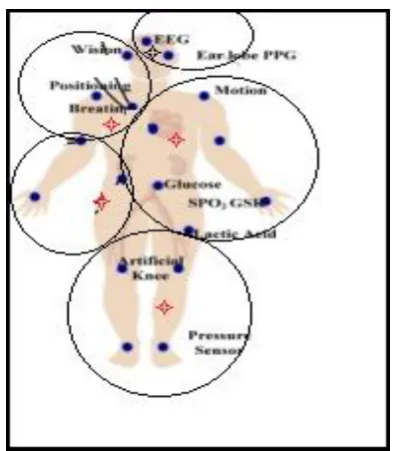
Figure 2: Clustering of sensor members for multiple sink protocol
As shown in the figure 2, multiple clusters are formed in WBAN. Every cluster has cluster head or sink node which has additional power as compared with ordinary sensors. In clusters, every sender node collects the sensed data and sends to the cluster head. CH works as a gateway, it transmits it to other sink node and after that sink node sends to the desired destination. In case cluster head gets out of battery then neighbor cluster head works as sink node for that cluster.
Distance Calculation
Distance calculation for neighbor identification is very important phase for making clusters. Distance calculation phase calculates the distance of each node from selected node to find out the optimal position of cluster head or sink node.
D(nj,ni) =√(nj-ni)2+(mj-mi)2---(1) 3.2.2 Cluster formation
Cluster formation is the second step which comes after pervious step of calculating distance and exchanging “Hello” messages. Cluster formation process starts after calculating the distance of a node from another nodes, so that the optimal position of the sensor nodes can be found and cluster of sensor nodes can be formed. During this process, if any sensor node does not come under any cluster then it finds suitable cluster according to distance by comparing the distance with another clusters. Non-cluster nodes join a closest Cluster head to be a part of cluster. It plays a very major role in data sending and making the communication between nodes. This part is also very crucial for energy consumption of the network.
3.
2.3 Cluster Head SelectionSink nodes (SNs) are also known has Cluster Head for their corresponding clusters. Cluster head plays very important role as they are responsible for transferring collected data from other nodes. CH aggregates and forwards the packets
aim of selecting cluster head, a multiple fitness function is formulated. Residual node energy, distance and transmission power is the main parameter for selecting the fittest candidate of the cluster head. . The details of these parameters are discussed below:
Residual Node Energy (ER): The proposed clustering protocol selects the cluster head with maximum residual energy. Energy plays salient role for any node in network to perform any role. Select the node sensor with highest residual energy would be the better nominee for Cluster head. Additionally, cluster head bears the extra responsibly like cluster management and data sending. The residual energy of a node calculated below:
ER= EI−Ed---(2) Where ER is the residual energy, EI is the starting energy and EC is the consumed energy of the node, the calculation is shown below:
Ed =Ea+ Eb + Ec---(3) Where Ea is amount of energy consumed by the node transceiver and Eb is energy consumed by receiver of data and Ec is the energy taken by the sensor node’s electronic circuitry.
Distance of nodes (NodeDij): It checks that how many sensor nodes are reachable from every node. This part is very important phase to select the Cluster Head as it is very important for cluster members to have a cluster head with high accessibility for every cluster member.
To increase the network’s lifetime, clustering is the greatest approach. It uses multiple sinks and time to time updates the new sinks based on the different network parameters. The best and optimal position CH must be selected to smooth flow of data in WBAN. To achieve the objective, a multiple parameters has been taken to calculate the fitness function. The fitness function is calculated using three parameters: residual node energy, intra-cluster distance and transmission range. The calculation of fitness function using these three parameters are calculated as:
Ffunction = (w1 X ER)+ (w2 X NodeDij ) + (w3 X Tr)---(5)
We have assigned the weight functions to w1, w2 and w3 according to the significance of the parameters. EResidual is the main parameter which contains 0.50 weight value. w2 contains .035 weight value where as w3 contains 0.15 value. Table 3 is showing the weightage of each parameters.
3.2.4 Routing Path selection within a cluster
The huge challenge in WBANs is to attain reliable delivery and increase network lifetime. A well designed network management strategy is required to increase the network lifetime with high data delivery rate. Till now various routing algorithms have been designed to ensure the delivery of data. But due to many constraints like limited
International Journal of Innovative Technology and Exploring Engineering (IJITEE) ISSN: 2278-3075, Volume-8 Issue-12, October 2019
Algorithm1 is showing the cluster formation process. Calculation of distance plays very important role in cluster formation. Cluster members broadcasts the HELLO message and exchanges the routing table to find out the distance of each cluster member to from a cluster. Cluster member which are implanted in nearby places are eligible to be a part of same cluster.
Algorithm 2: Cluster Head (CH) Selection.
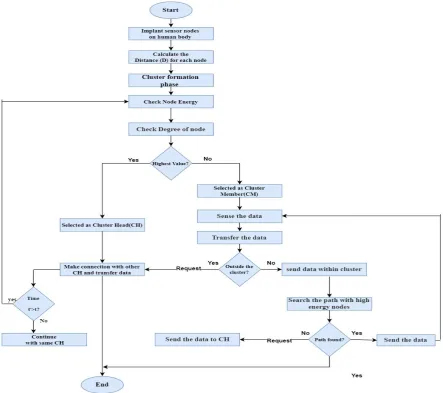
Figure 3: energy-efficient clustering with multiple sink in WBAN. Figure 3 is showing the flow chart of the same. First of all,
sensors are implanted on the human body. After that they broadcasts the HELLO message and find outs the distance between the nodes. Distance calculation is the backbone for the formation of the clusters. The nodes that have less distance or nearby nodes form a cluster. To properly operate the flow and operation of the clusters, cluster head has main responsibility. Cluster head helps the cluster members to transfer the data from one place to another. If a cluster member has to send the data to another cluster then cluster member has to take the help from the cluster head as only cluster has the permission to contact the another cluster head. If cluster member wants to transfer the data packets within the cluster and efficient path also available then intra clustering is possible using cluster members otherwise cluster member takes the help from the cluster head to transfer the data to the destination.
IV. PERFORMANCE EVALUATION
We have used NS2.34 as a tool to judge the performance of the EECMS protocol. We have taken two parameters and compared the achieve results with DARE and SIMPLE protocols.
4.1 Simulation settings
Table 2: Simulation parameters and value.
Parameter Name Value
Simulator NS 2.34
Type Wireless Antenna type – Omni
Antenna
Queue type Drop tail-priority Queue
Simulation time 60 s, 120 s, 180 s, 125 s
Initial energy of
nodes
100Jule
Number of nodes 10
Data rate 200 bits/s
International Journal of Innovative Technology and Exploring Engineering (IJITEE) ISSN: 2278-3075, Volume-8 Issue-12, October 2019
Figure 6: PDR vs time (sec)
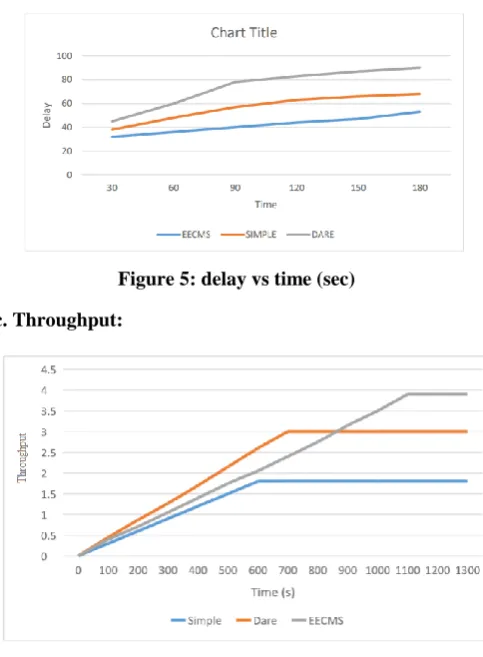
b. End-to-End delay: The efficiency of transmission protocol is calculated by delay caused during a given transmission cycle. ’End-to-End’ delay is a summation of all the delays caused by all the participant nodes in a given communication.
Figure 5: delay vs time (sec) c. Throughput:
Figure 6: Throughput vs time (sec)
V. CONCLUSION & FUTURE SCOPE
In this paper, energy-efficient clustering with multiple sink has been used in wireless body area network. This approach is far better than earlier approaches in terms of stability, energy, high throughput and high PDR as it uses clustering routing protocol. In this work, we have used multiple sink nodes and we keep changing after fix interval if required. Almost eighteen sensor nodes have been implanted on the
deal with overload on a single sink node as increase the efficiency of the network. Energy is the main factor for any node to perform well. This approach gives the better results in terms of delay, throughput and packet delivery ratio as compared to non-clustered WBAN approach. To select next cluster head or forwarder node, we have used fitness function. This function works on nodes residual energy, node’s distance from the other sensor members and transmission power and link’s SNR. The results of simulation shows that EECMS protocol works wonder in terms of network life-time, packet delivery ratio, delay and throughput as compared to the mentioned pervious protocols.
REFERENCES
1. Cavallari R, Martelli F, Rosini R, Buratti C, Verdone R (2014) A
survey on wireless body area networks: technologies and design challenges. IEEE Commun Surv Tutorials 16:1635– 1657.
2. Movassaghi S, Abolhasan M, Lipman J, Smith D, Jamalipour A (2014)
Wireless body area networks: a survey. IEEE Commun Surv Tutorials 16:1658–1686
3. Movassaghi, S.; Abolhasan, M.; Lipman, J.; Smith, D.; Jamalipour, A.
Wireless Body Area Networks: A Survey. IEEE Commun. Surv. Tutor. 2014, 16, 1658–1686. [CrossRef]
4. Dangi KG, Panda SP (2014) Challenges in wireless body area
network-a survey. In Optimiznetwork-ation, Relinetwork-abilty, network-and Informnetwork-ation Technology (ICROIT), 2014 International Conference on, pp 204–207.
5. Karthiga I, Sankar S, Dhivahar P (2015) A study on routing protocols
in wireless body area networks and its suitability for m-Health applications. In Communications and Signal Processing (ICCSP), 2015 International Conference on. pp 1064–1069.
6. Sapio, A., & Tsouri, G. R. 2010. Low-power body sensor network for
wireless ecg based on relaying of creeping waves at 2.4 ghz. In Body Sensor Networks (BSN), 2010 International Conference on (pp. 167-173). IEEE.
7. Smail, O., Kerrar, A., Zetili, Y., & Cousin, B. (2016, September). ESR:
Energy aware and Stable Routing protocol for WBAN networks.
In 2016 International Wireless Communications and Mobile
Computing Conference (IWCMC) (pp. 452-457). IEEE
8. Adhikary S, Choudhury S, Chattopadhyay S (2016) A new routing
protocol for WBAN to enhance energy consumption and network lifetime. In Proceedings of the 17th International Conference on Distributed Computing and Networking, p 40.
9. Javaid N, Imran M, Guizani M, Khan ZA, Qasim U (2015) BEC: a
novel routing protocol for balanced energy consumption in Wireless Body Area Networks. In 2015 International Wireless Communications and Mobile Computing Conference (IWCMC), pp 653–658.
10. S. Ahmed, N. Javaid, and S. Yousaf, “Co-CEStat: Cooperative critical
data transmission in emergency for static wireless body area network,” Journal of Basic and Applied Scientific Research, Vol. 4, No. 1, pp. 200–216, 2014.
11. Z. A. Khan, S. Sivakumar, W. Phillips, N. Aslam, “A new patient
monitoring framework and Energy aware Peering Routing Protocol (EPR) for Body Area Network communication,” Journal of Ambient Intelligence and Humanized Computing, Vol. 5, No. 3, pp. 409-423, June 2014.
12. Javaid, N., Abbas, Z., Fareed, M. S., Khan, Z. A., & Alrajeh, N. 2013.
M-ATTEMPT: A new energy-efficient routing protocol for wireless body area sensor networks. Procedia Computer Science, 19, 224-231. 13. Omeni, O., Wong, A., Burdett, A. J., & Toumazou, C. 2008. Energy
efficient medium access protocol for wireless medical body area sensor networks. Biomedical Circuits and Systems, IEEE Transactions on, 2(4), 251-259.
14. G. Cheng, R.V. Prasad, M. Jacobsson, “Packet forwarding with
minimum energy consumption in body area sensor networks,” in:Proc. IEEE Consumer Communications and Networking Conference (CCNC), pp. 1–6, 2010.
[image:7.595.50.292.283.612.2]16. Caldeira, J. M., Rodrigues, J. P. C., & Lorenz, P. (2012). Toward ubiquitous mobility solutions for body sensor networks on healthcare. Communications Magazine IEEE, 50(5), 108–115.
17. Tsouri, G. R., Sapio, A., & Wilczewski, J. (2011). An investigation into relaying of creeping waves for reliable low-power body sensor networking. Biomedical Circuits and Systems, IEEE Transactions, 5(4), 307–319.
18. Jamil, F.; Iqbal, M.; Amin, R.; Kim, D. Adaptive Thermal-Aware
Routing Protocol for Wireless Body Area Network. Electronics 2019, 8, 47. [CrossRef]
19. Kumaria J and Prachia , “An energy efficient routing algorithm for wireless body area network”, International Journal for Wireless Microwave Technology, 2015.
20. M. M. Monowar, F. Bajaber, On Designing Thermal-Aware Localized
Qos Routing Protocol for In-Vivo Sensor Nodes in Wireless Body Area Networks, Sensors, Vol. 15, No. 6, pp. 14016-14044, June, 2015.
AUTHORS PROFILE
Juhi Agrawal is a PhD candidate in Information Technology in University of Petroleum and Energy Studies, Dehradun, India. She has received the Master Degree in Information Technology from Graphic Era University Dehradun in August 2013 and B.Tech in Information Technology from Lovely Professional University, Punjab in August 2011. She has published 12 research papers in various fields. Her research interest fields are wireless network protocol design and analysis, Semantic web technology, wireless body area network, Mobile ad hoc networks.
Shelly is a PhD candidate in Information Technology in University of Petroleum and Energy Studies, Dehradun, India. She received her B.Tech in Computer Engineering from Jind Institue of Engerring and Technology, Kurukshetra University in 2013. She obtained her M.Tech in Information Technology from YMCA University of Science and Technology, 2016. Her current research interest include artificial intelligence, Machine Learning and Cloud Computing.
Dr. Monit Kapoor is an Assistant Professor in Computer Science at University of Petroleum and Energy Studies, Dehradun, India. He received his Ph.D. degree in Computer Science at University of Petroleum and Energy Studies in 2016. He received his Master Degree in Computer science from Kurukshetra University, Kurukshetra in 2008 and B.Tech in Electrical Engineering from Punjabi University in 1997, Patiala. His research interest includes Mobile Ad-HocNetworks, Mobile Computing, Distributed Computing, Advanced
Computer Architecture, Object Oriented Programming, Discrete