Abstract: In Communication systems Multi Input Multi Output -Orthogonal Frequency Division Multiplexing (MIMO-OFDM) is the most popular and competitive technology for its capability of high rate transmission and its robustness against multipath fading. The performance of a network can result in so many issues and it experiences some degradation in quality due to intercarrier interference.. High data rate information and strong reliability in wireless communication has become the most important factor for the commercial wireless networks. In this paper some different equalizing techniques are implemented and their performances are compared. Here, BER and SNR are the two factors which will be evaluate the performance of the network.
MMSE-SIC and ZF-SIC equalizer techniques are implemented .and the performance values are analyzed . Training Symbol based channel estimation involves algorithms like LSE(Least Square Error) and MMSE(Minimum Mean Square Error).Training symbols usually provide a good performance as seen in previous works in this wireless networking area.
Keywords: MIMO, OFDM, MMSE-SIC, ZF-SIC, MMSE, ZF
I. INTRODUCTION
The channel estimation aims at delivering the best performance out of a channel by using various algorithms. The channel estimation intends at preventing the intercarrier interference so that the performance of the channel is good and there is no loss of data or network reliability issue. To develop an efficient technique that can be used for channel Equalization Technique as MMSE-SIC and ZF-SIC and subcarriers are orthogonal.
In OFDM, it partitions the carrier into narrowband level obscuring subchannels. It is more impenetrable to repeat specific obscuring than single transporter systems are. Using sufficient carrier arrangement and interleaving one can recuperate pictures lost on account of the repeat selectivity of the channel. It is possible to use greatest expectation disentangling with rational complexity provides great insurance against cochannel impedance and incautious parasitic noise Eliminates ISI and IFI through utilization of a cyclic prefix. OFDM makes beneficial usage of the range by allowing spread.
Revised Manuscript Received on May 05, 2019.
R Jeya, Assistant Professor (Sr), Dept. of Computer Science and
Engineering, SRM Institute of Science and Technology, Kattankulathur, Tamil Nadu, India
B.Amutha, Professor, Dept. of Computer Science and Engineering, SRM
Institute of Science and Technology, Kattankulathur, Tamil Nadu, India
Maninder Singh, Student, SRM Institute of Science and Technology,
Kattankulathur, India
Chetan Arora, Student, SRM Institute of Science and Technology,
Kattankulathur, India
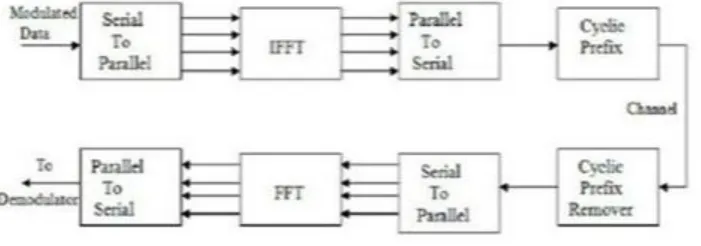
It is algorithmically successful by using methods like FFT to complete the change and demodulation capacities. It is less fragile to test timing offsets as compared to single carrier systems.
By utilizing MIMO, The superior data rate can be expert with the help of various receiving wires and SM (Spatial Multiplexing) system. This assists in achieving superior downlink and uplink throughput. MIMO based structure restrict obscuring effects seen by the information influencing an outing from broadcast to get the verge. This is a direct result of various better than average assortment strategies, for instance, time, repeat and space. The extensive incorporation maintained by MIMO aids in backing immense count of endorsers. There is cut down powerlessness of knocking by informal individuals due to various gathering devices and estimations. So, we plot graphs between the factors being used for our project which are BER and SNR. Later on, from the graph we evaluate which is showing better performance in MIMO channel using OFDM.
II. LITERATURE SURVEY
The idea of improving the performance of a channel is not new because with the advancement of technology new algorithms were devised which helped in the better performance of the channel. Technologies like OFDM and MIMO are currently having the scope of improvement in the 4G networks as well as they will be used in 5G networks. But currently our motive is to improve the performance for LTE networks.
In[1] they implemented two different channel estimation and shown the result as LSE is better than MMSE. So then channel estimation aims at delivering the best performance out of a channel by using various algorithms. The channel estimation aims at preventing the intercarrier interference so that the performance of the channel is good and there is no loss of data or network reliability issue. They have also used PSK and QAM values of which gives us the value of BER. The future scope of that paper was related to LSE which can be used due to delivery of better performance.
In[2] provided in the references uses the Least Square method for first estimation of channel whereas zero compelling calculation is utilized to distinguish and separate the got flag. From this paper, we get to know that larger the value of SNR larger the accuracy of estimation because SNR gets affected by noise. So basically we are using the algorithms which can accept large amount of incoming channels and will try to provide better performance over each other.
Performance Analysis and Comparison of
Different Modulation Schemes with Channel
Estimation Methods for MIMO-OFDM System
MIMO-OFDM System
In Block Type Pilot Channel Estimation, OFDM channel estimation images are transmitted occasionally and all subcarriers are utilized as pilots. The task here is to assess the channel conditions given the pilot flags and got signals with or without utilizing certain learning of the channel statistics. The recipient utilizes the evaluated channel conditions to translate the got information inside the square until the following pilot image arrives. The estimation can be base on Least Square (LS),minimum mean square error (MMSE),modified MMSE. The LS estimator limits the parameter
implies the conjugate transpose operation it is demonstrated that the LS estimator of H is given by
Without utilizing any learning of the measurements of the channels, the LS estimators are determined with exceptionally low complexity, but they experience the ill effects of a high mean square mistake.
While Modified MMSE estimators are considered generally to decrease complexity. Among them a discretionary low position MMSE (OLR-MMSE) estimator is there which consolidates the 3 rearrangements strategies.
The MMSE estimator yields much preferred execution over LS estimators, especially under the low SNR scenarios. A real downside of the MMSE estimator is its high computational complexity especially if framework reversals are required each time the information in X changes. MMSE estimator utilizes the second request measurements of the channel conditions to limit the mean square mistake.
III. METHODOLOGY
MMSE-SIC stands for minimum mean square error successive interference cancellation. It is used to minimize the mean square error, which is a typical proportion of estimator quality. The primary component of MMSE equalizer is that it doesn't typically dispense with ISI totally yet, limits the aggregate intensity of the clamor and ISI parts in the yield. Let us assume x to be unknown and y to be a known variable. So MSE is given by:
MSE = E {(X^ -X2)}
By and large, it is unimaginable to decide a shut structure for the MMSE estimator. In these cases, one probability is to look for the system limiting the MSE inside a specific class, for example, the class of direct estimators. The direct MMSE estimator is the estimator accomplishing least MSE among all estimators of the structure AY + b. On the off chance that the estimation Y is an arbitrary vector, A will be a lattice and b is a vector. The Minimum Mean Square Error (MMSE) approach endeavours to discover a coefficient W which limits the paradigm is given by,
= {[ − ][ − ] }
So finally to solve our matrix as, = [ + −
]
In this algorithm, beneficiary side can get a gauge of the two transmitted symbols,
Y=HX+N
Y=Symbols received at the receiver antennas
H=represents the channel from one antenna to the other. X=represents transmitted symbols.
[image:2.595.129.480.444.567.2]N=represents noise on received antennas.
Fig. 1 Architecture of OFDM
The zero forcing algorithm applies the backwards of the channel recurrence reaction to the got flag, to re establish the flag after the channel. The name Zero Forcing compares to cutting down the inter symbol impedance (ISI) to focus in a commotion free case. This will be helpful when ISI is huge contrasted with clamor. The formula for zero forcing is given by:
For calculating BER with ZF equalizer in MIMO, it can be expressed by:
The last algorithm we are using is ZF-SIC which happens in the following 3 steps:
1. Requesting-to decide the transmitted stream with most reduced blunder difference.
IV. SIMULATION RESULTS
For the simulations, two transmit and two receive antennas MIMO-OFDM system with 64 sub-carriers and four transmit and four receive antennas MIMO-OFDM
[image:3.595.104.494.113.276.2]system with 64 sub-carriers a cyclic extended guard interval of length 16 is considered. Which is shown in Table I
[image:3.595.97.499.300.469.2]Fig. 1 BER in MMSE and MMSE-SIC 2*2 MIMO using BPSK
Fig. 2 BER in ZF and ZF-SIC 2*2 MIMO using BPSK
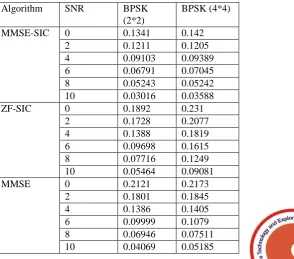
[image:3.595.180.475.538.797.2]Here is the graph of 2*2 MIMO using BPSK. Here MMSE-SIC is performing better compared to other algorithms. It is to be noted that as the value of SNR increases the value of BER decreases.
Table. 1 shows the results s in 2*2 and 4*4 MIMO system using BPSK modulation
Algorithm SNR BPSK (2*2)
BPSK (4*4)
MMSE-SIC 0 0.1341 0.142
2 0.1211 0.1205
4 0.09103 0.09389
6 0.06791 0.07045
8 0.05243 0.05242
10 0.03016 0.03588
ZF-SIC 0 0.1892 0.231
2 0.1728 0.2077
4 0.1388 0.1819
6 0.09698 0.1615
8 0.07716 0.1249
10 0.05464 0.09081
MMSE 0 0.2121 0.2173
2 0.1801 0.1845
4 0.1386 0.1405
6 0.09999 0.1079
8 0.06946 0.07511
MIMO-OFDM System
Fig. 3 BER in MMSE and MMSE-SIC 4*4 MIMO using BPSK
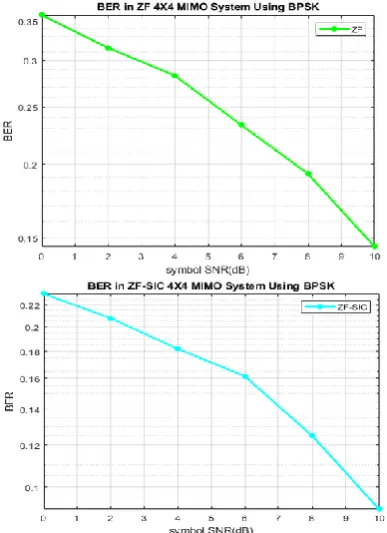
Fig. 4 BER in ZF and ZF-SIC 4*4 MIMO using BPSK
[image:4.595.69.263.333.600.2]Here is the graph of 4*4 MIMO using BPSK.MMSE-SIC performs well again as compared to other algorithms. If it remains the same in QAM as well then MMSE-SIC will be our algorithm which performs better in both modulation techniques. We should not see any fluctuations in the graph as it will show error in the graph because BER is always decreasing with increasing SNR. The second best algorithm is MMSE itself. So we can expect that MMSE-SIC would expect MMSE-SIC will perform better than all of them. So overall if we conclude in terms of BPSK, MMSE-SIC performs better as it provides us low BER.
Fig. 5 BER in MMSE and MMSE-SIC 2*2 MIMO using QAM Modulation
Fig. 6 BER ZF and ZF-SIC 2*2 MIMO using QAM Modulation
ZF 0 0.291 0.3583
2 0.2497 0.3152
4 0.202 0.2829
6 0.1531 0.2331
8 0.1138 0.1927
[image:4.595.327.524.432.705.2]Here is the graph of 2*2 MIMO using QAM(Quadrature Amplitude Modulation).We can see that MMSE-SIC outdid every other algorithm.
[image:5.595.96.493.99.659.2]
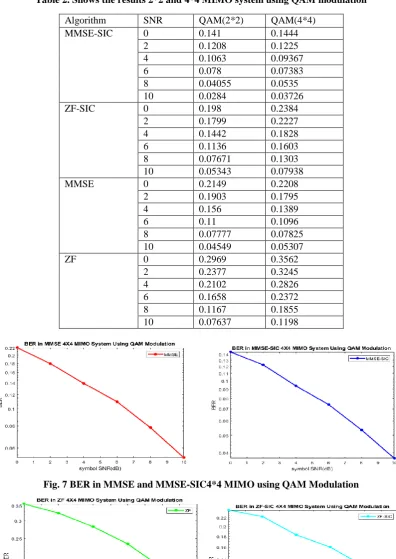
Table 2. Shows the results 2*2 and 4*4 MIMO system using QAM modulation
Fig. 7 BER in MMSE and MMSE-SIC4*4 MIMO using QAM Modulation
Fig. 8 BER in ZF and ZF-SIC 4*4 MIMO using QAM Modulation Algorithm SNR QAM(2*2) QAM(4*4)
MMSE-SIC 0 0.141 0.1444
2 0.1208 0.1225
4 0.1063 0.09367
6 0.078 0.07383
8 0.04055 0.0535
10 0.0284 0.03726
ZF-SIC 0 0.198 0.2384
2 0.1799 0.2227
4 0.1442 0.1828
6 0.1136 0.1603
8 0.07671 0.1303
10 0.05343 0.07938
MMSE 0 0.2149 0.2208
2 0.1903 0.1795
4 0.156 0.1389
6 0.11 0.1096
8 0.07777 0.07825
10 0.04549 0.05307
ZF 0 0.2969 0.3562
2 0.2377 0.3245
4 0.2102 0.2826
6 0.1658 0.2372
8 0.1167 0.1855
MIMO-OFDM System
Here is the graph of 4*4 MIMO using QAM. We can see that we are getting the same results in all the graphs. So we can conclude that MMSE-SIC performs best in all scenarios as well as with different modulation like BPSK and QAM.MMSE-SIC also promises us low BER as compared to other algorithms.
After Comparing all the tables if we see clearly MMSE-SIC is the best algorithm with low BER. In every modulation we are getting the same results.
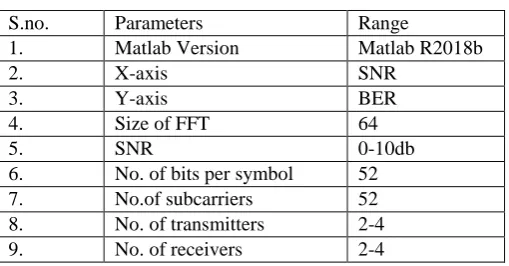
[image:6.595.172.427.133.266.2]The parameters on basis of which we got the results are:
Table. 3 Parameters
V.CONCLUSION
The difference in BER between the methods are shown .If we are able to achieve a reduction in BER it will be having more scope in the coming future technologies like 5G which is the future of wireless communication. MMSE-SIC and ZF-SIC algorithm has more scope of improvement in terms of performance. Training symbol based estimation can used as well in future which have the scope in scenarios where MIMO and OFDM are both present.
There is a hope for MMSE-SIC to be used in the next generation wireless communication like 5G. Maybe MMSE-SIC delivers low BER there as well as it is in the current 4G networks. MIMO and OFDM will be used in the 5G networks because MIMO promises data transfer between multiple sender and receivers at a same time via multiple channels whereas OFDM eliminates ISI with the use of cyclic prefix.
REFERENCES
1. Comparative Study of Bit Error Rate with Channel Estimation in OFDM System for M-ary Different Modulation Techniques(Brijesh Kumar Patel & Jatin Agarwal , International Journal of Computer Applications (0975 – 8887) Volume 95– No.8, June 2014 )
2. A Novel Design of Time Varying Analysis of Channel Estimation Methods in OFDM(K. Murali, M. Sucharitha, T. Jahnavi, N. Poornima, P. Krishna Silpa,IJMIE,Volume 2,Issue 7,July2012. )
3. Least Squares Interpolation Methods for LTE System Channel Estimation over Extended ITU Channels(S. Adegbite, B. G. Stewart, and S. G. McMeekin ,International Journal of Information and Electronics Engineering, Vol. 3, No. 4, July 2013)
4. A Channel Estimation Method for MIMO-OFDM Mobile WiMax Systems(Fabien Delestre and Yichuang Sun,IEEE, 2010 )
5. Channel Estimation in a Proposed IEEE802.11n OFDM MIMO WLAN System(I-Tai Lu and Kun-Ju Tsai,IEEE,2007)
6. Channel Estimation Wireless OFDM Systems (mehmet kemal ozdemir, huseyin arslan, 2nd quarter 2007 volume 9 no 2,ieee )
7. Enhanced Channel Estimation Using Cyclic Prefix in MIMO STBC OFDM Sytems(A.A QUADEER,Muhammad S Sohail,2011 IEEE) 8. Broadband MIMO-OFDM Wireless Communications (Proceedings Of
The IEEE, Vol. 92, No. 2, February 2004,Gordon L. Stüber ,Steve W.Mclaughlin ,Mary Ann Ingram )
9. Channel Estimation for MIMO-OFDM Systems (Shahid Manzoor, Adnan Salem Bamuhaisoon, Ahmed Nor Alifa,IEEE 2015)
10. Robust MIMO-OFDM Design for CMMB Systems Based on LMMSE Channel Estimation(Feng Hu, Yuanye Wang and Libiao Jin,IEEE 2015) 11. H. Yin, L. Cottatellucci, D. Gesbert, R. R. Müller, and G. He, “Robust pilot decontamination based on joint angle and power domain
discrimination,” IEEE Trans. Signal Process., vol. 64, no. 11, pp. 2990–3003, Jun. 2016.
12. L. You, X. Gao, A. L. Swindlehurst, and W. Zhong, “Channel acquisition for massive MIMO-OFDM with adjustable phase shift pilots,” in IEEE Trans. Signal Process., vol. 64, no. 6, pp. 1461–1476, Mar. 2016.
13. C. K. Wen, S. Jin, K. K. Wong, J. C. Chen, and P. Ting, “Channel estimation for massive MIMO using Gaussian-mixture Bayesian learning,”IEEE Trans. Wireless Commun., vol. 14, no. 3, pp. 1356–1368, Mar. 2015.
14. A. Ashikhmin and T. L. Marzetta, “Pilot contamination precoding in multi-cell large scale antenna systems,” in Proc. IEEE Int. Symp. Inf.Theory, Boston, MA, USA, Jul. 2012, pp. 1137–1141
15. Felipe AP De Figueiredo, Fabbryccio ACM Cardoso, Ingrid Moerman, and Gustavo Fraidenraich, “Channel estimation for massive MIMO TDD systems assuming pilot contamination and frequency selective fading”, IEEE Access, Vol. 5, pp. 17733-17741, 2017.
S.no. Parameters Range
1. Matlab Version Matlab R2018b
2. X-axis SNR
3. Y-axis BER
4. Size of FFT 64
5. SNR 0-10db