*
Corresponding author: [email protected]
The interaction problems between large and small business
in modern conditions
Mikhail Belyaev1, Svetlana Sokolova1*, and Svetlana Karpushova2
1
The department of economics and management of projects in the construction industry, Volgograd State Technical University, Volgograd, Russia
2The department of economics and finance, Serebryakovsky branch of Volgograd State Technical University, Mikhaylovka, Russia
Abstract. The development of market relations, changes of the conditions in the business environment encourage the enterprises to look for new management methods and to improve forms of interaction. In this regard, the identification of the interaction of large and small businesses, as well as the evaluation of their relation development seems important and urgent problem in modern conditions. The purpose of the survey – the study of the interaction of large and small businesses, as well as the evaluation of the relations between them. The study was conducted on the basis of a comprehensive and systematic approach in which methods of comparative, retrospective, statistical, mathematical analysis are used. In accordance with the purpose there are identified the prerequisites for the development of large and small businesses, features and their functioning problems, and the links between them.The most common form of interaction of large and small enterprises were identified - outsourcing, franchising, leasing, subcontracting, venture financing, the establishment of regional cooperation forms of large and small businesses. However, the cooperative processes of large and small business in Russia developed are not enough today.The authors identified factors that impede the growth of Russian production, offered recommendations for the development of large and small businesses, justified the state's role in this process. In addition, they described the mechanism of state support of small business, including organizational, financial, information and consulting components.
1 Introduction
The transfer of the Russian economy on an innovative way of development and steady growth of large industrial enterprises cannot be without the cooperation with enterprises which are relatively smaller. Such cooperation is beneficial to large and also small businesses. Also in the conditions of market relations the level of development of small business is one of the key indicators characterizing the maturity and stability of the society. In economically developed countries, the share of small enterprises in the structure of the gross domestic product increases the share of large enterprises and is more than 70%. In our country, this index is only 20%. In this regard, stimulating of the small business development, the definition of the relations between large and small businesses, improving their interaction in a particular area is particularly important in the modern conditions.
At various times, these problems of the industry have been studied by R. Nurks, N. Buchanan, . Lewis, V.V. Ananishnov, .. Busygin, N.I. Dorogov,
N.N. Koltsov, A.M. Lyalin, V.. Rokhchin, Y.V. Trifonov and others. To the study of entrepreneurship development problems P. Druker, R. Cantillon, C. Marks, . Marshall, L. Mises, . Smith, Z.B. Sei, J. Schumpeter and so on addressed. The interaction of small and large businesses was studued in the works of Russian scientists G.L. Azoev, T.. limova, .N. Asaul, G.L. Bagiev, .V. Busygin, .. Buchwald, D.N. Zemlyakov, G.B. Kleiner, S.P. Kusch, .G. Lapusta, .. Omarov, B.P. Sapsay, S.. Sosna, Y.L. Starostin and others. Among foreign scientists V. Anand, J. Brickley, F. Dark, Z. Dilthey, F. Lafontaine, V. Murphy, Y. Murray and others addressed to this problem. However, despite the large number of works dedicated to the problems of the functioning and development of industrial enterprises, including small, the features of large and small businesses interaction are studied insufficiently, a single methodology is absent to assess their link. The research is aimed at studying of the interactions of large and small businesses, as well as evaluating the links between them.
2
The features of the interaction of the
large and small business
The international experience of the industry development confirms the feasibility of the cooperation of large and small businesses. Currently, the most intensive dissemination of this process is in the Eastern countries. Large industrial plants often order the details and components in small enterprises located usually nearby. It promotes sustainability and stability increase of small business, and also allows big business to solve more complex, large-scale and important tasks. As a result, you may experience a synergistic effect. The intensity and nature of the cooperation relations depend, primarily, on the industry sector of the enterprises, on the level of development and structure of the regional economy and the country as a whole.
The need for small businesses to interact with big business is heavily dependent on the sphere of its activities. The companies are more affiliate in providing various services. Today among Russian small businesses repair of motor vehicles, household goods, etc. (39.7%), wholesale trade (24.7%), transactions with real estate, renting and provision of services (20.4%), building (11.0%), retail trade (10.6%), manufacturing (9.5%) are particularly spread.
[image:2.595.51.552.305.510.2]The analysis showed that at the present time, the amount of small businesses in our country is several times smaller than the subjects of big business, this is contrary to international practice. This trend is typical for the whole territory of Russia. The calculated indexes of small and large enterprises ratio, as well as the industrial production indexes in the Southern Federal District (SFD) are shown in Table 1.
Table 1. The dynamics of small and large enterprises ratio indexes, indexes of the inductrial production in the Southern Federal Disrtict of Russia.
Names of the indexes
Large and small enterprises ration indexes in the SFD of Russia
Sparkli nes of the enterpri
ses ratio index
Industrial production index in the SFD of
Russia Sparkline s of the industrial productio
n indexes
2012 2013 2014 2015 2016 2012 2013 2014 2015 2016
Republic of
Adygea 0.51 0.51 0.53 0.53 0.54 109 103 119 124 129
Republic of
Kalmykia 0.12 0.18 0.20 0.25 0.33 90 108 103 110 116
Krasnodar
region 0.40 0.44 0.44 0.46 0.48 108 102 105 104 102
Astrakhan
region 0.51 0.50 0.53 0.55 0.56 119 116 103 95 87
Volgograd
region 0.51 0.51 0.52 0.52 0.52 105 102 102 101 99
Rostov
region 0.64 0.62 0.61 0.59 0.57 108 106 105 104 102
In Russia, the widespread of cooperative links is characterized for science and scientific services, construction and industry, where the share of cooperating companies is about 71%, 50% and 49%, respectively [1]. In general in our country the processes of interaction of large and small industrial enterprises are not sufficiently developed. However, in conditions of instability and crisis, the interaction of large and small businesses is necessary to significantly improve the use efficiency of workforce, financial, material, information, and time resources. It is possible to flow the time or other resources between entities in both directions.
In the current economic conditions in our country, there are often situations when small businesses can provide the workload of production capacity in large industrial enterprises. With intellectual property, innovative technology the small businesses often have not the necessary equipment and other fixed assets for the commercialization of innovations. This reallocation of resources can improve the financial condition of large enterprises that have received the order. But at the same time, such "reverse" interaction can lead to an increase of expenses and increase in the cost of production due to
individual orders and rejection of mass production. If the timely technical upgrade is not implemented in the large industrial enterprises will, it will lose competitive advantages and may even go bankrupt in the long term.
Currently, the main forms of interaction of large and small enterprises in Russia are: outsourcing, franchising, leasing, subcontracting, venture financing, the establishment of regional cooperation forms of large and small businesses. Effective implementation of the above-mentioned forms of interaction of enterprises is possible with the active participation of the state as a regulator that provides the creation of the necessary institutional conditions.
3
The evaluation of large and small
bisiness development relations (for
example SFD in Russia)
and regression analysis was used to establish this relation. The state of the industry has been studied in the Southern Federal District of Russia for ten years (2006-2015), and the analysis was implemented according to the following indexes characterizing the small business:
x the number of small businesses per 1,000 people of working-age population in the region;
x the turnover of small businesses per 1,000 people in the region;
x the proportion of employees in the small business objects of total employment in the region, and others.
The following indexes were used to determine the state of a large industrial business:
x the volume of industrial production per 1000 people in the region;
x the number of existing large industrial enterprises per 1,000 people of working-age population in the region;
x the volume of investment in fixed assets per 1000 people in the region;
x the proportion of employees in the large industrial enterprises of total employment in the region, and others.
[image:3.595.51.293.433.659.2]The correlation link was found between the different indexes as a result of the analysis. It was found that there are more linked indexes such as the volume of industrial production per 1000 people in the region and the number of small business objects per 1,000 people of working-age population in the region. The results of regression analysis of these indexes are presented in Table. 2.
Table 2. The closeness evaluation of small and large indexes link in the South Federal District of Russia.
Names of the indexes The correlation coefficient The regression equation The standard error of the regression The South Federal Dictrict of Russia 0.97 (very high)
y = 0.02x + 98095 2637.52 Republic of Adygea 0.95 (very high)
y = 0.01ɯ + 2846 56.98 Republic of Kalmykia 0.63 (remarkable)
y = -0.03ɯ + 2097
336.38 Krasnodar region 0.43 (low) y = 0.003ɯ
+ 2097
2220.14 Astrakhan region -0.23
(virtually non-existent)
y = -0.002ɯ +
9494 460.53 Volgograd region 0.52 (remarkable)
y = 0.01ɯ + 21872
1373.35 Rostov region 0.82 (high) y = 0.07ɯ -
1364
6278.31
Thus, there is a connection between above shown indexes of large and small businesses preferably from remarkable to very high. We believe that a very high indexes link in the Republic of Adygea is explained, first of all, by a large number of small businesses in the service sector that provide the needs of large businesses. The reason of low link in certain regions (Krasnodar region, Astrakhan region) is the structure of the regional economy, a large proportion of small enterprises, which operate independently and do not need in active
cooperation with big business at the present stage of their development.
Cheddok`s scale was used for qualitative assessment of link closeness. The statistical evaluation of pair correlation coefficient was carried out by comparing it with the absolute value of the critical index when a significance level Į corresponds to 0.05, and the degree of freedom f is equal to 8. If rcalc r crit, then with a given
degree of probability (95%) it can be affirmed that there is a close linear link between these number sets. The importance of pair correlation coefficient was also investigated on the basis of Student's t-criteria for small sample size.
4
The fundamentalsof large and small
bisiness development
The analysis of scientific literature and materials, presented in the media, allowed to identify factors limiting production growth in Russia and the cooperation development between large and small enterprises, including:
x lack of demand for the products of the domestic market;
x insufficient demand for the products of the foreign market;
x competing imports; the high level of taxation;
x deterioration and lack of equipment; the uncertainty of the economic situation;
x a high percentage of commercial loans;
x lack of financial resources; lack of skilled employees;
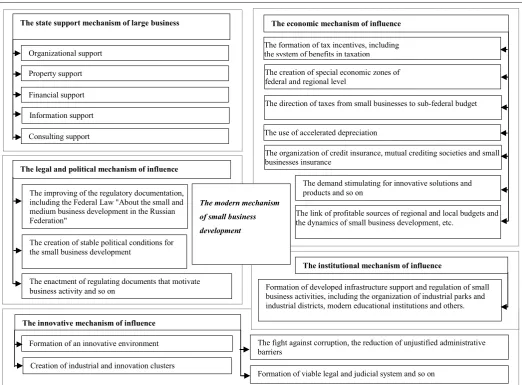
x lack or inadequate of legal and regulatory base. The study showed that the most serious problems in modern conditions are associated with high levels of taxation (54%), lack of demand for the company's products in the domestic market (53%) and the uncertainty of the economic situation (39%). In such conditions, it is important to realize the state support to industrial enterprises, and especially small businesses. When it is inactivity from the government stagnation can create the serious problems of economic development. State support for small enterprises has great importance for the interaction development between large and small businesses. Small business development Program should define the purposes, objects and ways of achieving them, the main indicators, should provide a comprehensive state support of this sector of the economy. The mechanism of state support of small business is schematically shown in Fig. 1.
It should be noted that a large business has become more automated and less labor intensive, that leads to the release of people. These people should be able to become self-employed, income-generating.
Fig. 1. The mechanism of the small business development.
5 Conclusion
The modern interaction of large and small business has its own characteristics and problems. The most common interaction is carried out in the forms of outsourcing, franchising, leasing, subcontracting, venture capital financing, the creation of regional cooperation forms of large and small businesses. There is a stable link of large and small businesses.
In order to intensify the production of Russia, the state should carry out a competent and effective support for large and small businesses. Particular attention should be paid to the state support mechanism of small business development, including the organizational, financial, information and consulting components.
We believe that the development of cooperation between large and small businesses is particularly important in the current economic conditions, as it provides a whole new level of resources using, based on efficiency and thrift.
References
1. A. Shleifer, R.W. Vishny, Journal of Political Economy, 95, 461 (1986)
2. A.D. Evans, Studies in Comparative International Development, 51, 456 (2016)
3. B.S. Min, Journal of Business Ethics, 1 (2016) 4. C. Wickert, Business and Socienty, 55, 792 (2016) 5. D. Palia, Journal of Empirical Legal Studies, 13,
756 (2016)
6. D.H. Kim, M.O. Sambou, M.S. Jung, Empirical evidence from Korea. Sustainability, 8, 1119 (2016) 7. G. Kaplanoglou, V.T. Rapanos, N. Daskalakis,
European Journal of Law and Economics, 1 (2016) 8. G.M. Olevsky, World Economy and International
Relations, 60, 17 (2016)
9. I. Distinguin, C. Rugemintwari, R. Tacneng, World Development, 84, 18 (2016)
10. K. Ding, T. Gokan, X. Zhu, Annals of Regional Science, 1 (2016)
11. K.G. Palepu, Journal of Accounting and Economics,
8, 3 (1986)
12. L. Hou, L. Xue, S.N. Bui, W. Kettinger, Information Technology and Management, 17, 379 (2016) 13. M.C. Jensen, The Journal of Finance, 48, 831 (1993) 14. M.C. Jensen, W.H. Meckling, Journal of Financial
Economics, 3, 305 (1976)
The innovative mechanism of influence
The economic mechanism of influence
The formation of tax incentives, including the system of benefits in taxation
The legal and political mechanism of influence
The creation of stable political conditions for the small business development
Formation of an innovative environment
The creation of special economic zones of federal and regional level
The direction of taxes from small businesses to sub-federal budget
The use of accelerated depreciation
The organization of credit insurance, mutual crediting societies and small businesses insurance
The improving of the regulatory documentation, including the Federal Law "About the small and medium business development in the Russian Federation"
The enactment of regulating documents that motivate business activity and so on
The institutional mechanism of influence
The fight against corruption, the reduction of unjustified administrative barriers
Formation of developed infrastructure support and regulation of small business activities, including the organization of industrial parks and industrial districts, modern educational institutions and others.
Formation of viable legal and judicial system and so on
The link of profitable sources of regional and local budgets and the dynamics of small business development, etc.
Creation of industrial and innovation clusters
The demand stimulating for innovative solutions and products and so on
The modern mechanism
of small business
development The state support mechanism of large business
Organizational support
Property support
Financial support
Information support
15. O.E. Williamson, The Yale Law Journal, 93, 1197
(1984)
16. Q. Guo, C. He, D. Li, Urban Studies, 53, 2584
(2016)
17. R. Morck, A. Shleifer, R.W. Vishny, Journal of Financial Economics, 20, 293 (1988)
18. R. Tresca, International Journal of Social Ecology and Sustainable Development, 7, 35 (2016)
19. R.F. Malaquias, Y. Hwang, Information Development, 32, 1613 (2016)
20. S. Mayadunne, S. Park, International Journal of Production Economics, 182, 519 (2016)