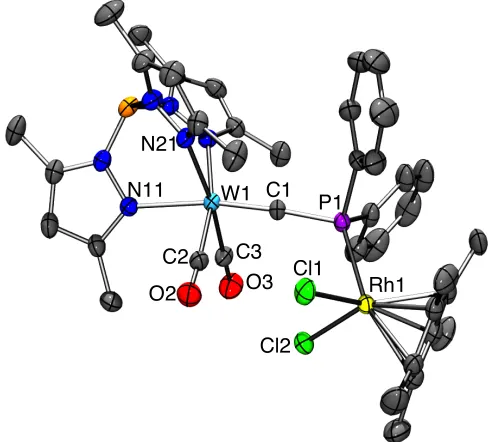
Phosphorus-functionalised
carbyne complexes
Annie Louise Colebatch
A thesis submitted for the degree of Doctor of Philosophy of
The Australian National University
October 2014
08
i
Author's declaration
This thesis is an account of the research undertaken between March 2011 and October 2014 at the Research School of Chemistry, The Australian National University. Except where due reference has been made, the work contained in this thesis is my own.
ii
Contents
Contents ... ii
Acknowledgements ... v
Abstract ... vii
Abbreviations and nomenclature ... x
CHAPTER 1. Introduction ... 1
1.1 Bonding in carbyne complexes ... 5
1.2 Phosphinocarbyne complexes ... 9
1.3 Other phosphorus-functionalised carbyne complexes ... 12
1.4 Other MC1P1Rn systems ... 18
1.4.1 Cyaphide complexes ... 18
1.4.2 Phosphaisocyanide complexes ... 22
1.4.3 Phosphorus-functionalised carbene complexes ... 27
1.5 Comparisons to other group 15 substituted carbyne complexes ... 31
1.6 Summary ... 37
CHAPTER 2. Tertiary phosphinocarbyne complexes ... 38
2.1 The starting material [W(≡CBr)(CO)2(Tp*)] ... 39
2.2 Synthesis of phosphinocarbyne complexes via the lithiocarbyne approach ... 41
2.3 Synthesis of phosphinocarbyne complexes via palladium-catalysed phosphination ... 51
2.4 Attempted synthesis of phosphinocarbyne complexes via a stannylcarbyne complex ... 52
2.5 Reactions with electrophiles ... 54
2.5.1 Synthesis of [W(≡CPMePh2)(CO)2(Tp*)]I ... 54
2.5.2 Synthesis of [W(≡CPPh2·BH3)(CO)2(Tp*)] ... 55
2.6 Protonation of [W(≡CPPh2)(CO)2(Tp*)] ... 58
2.6.1 Protonation of carbyne complexes ... 58
2.6.2 Synthesis of [W(≡CPHPh2)(CO)2(Tp*)]BF4 and [W{η2 -C(H)PPh2}(CO)2(Tp*)]BF4 ... 59
2.6.3 Computational studies ... 67
iii
2.7 Metallation reactions ... 71
2.7.1 Synthesis of [W{≡CPPh2RhCl2(Cp*)}(CO)2(Tp*)] ... 71
2.7.2 Reactions with [AuCl(SMe2)] ... 74
2.8 Reactions with chalcogens ... 79
2.8.1 Reactions with sulfur ... 81
2.8.2 Reaction with selenium ... 89
2.8.3 Synthesis of [W{≡CP(=O)Ph2}(CO)2(Tp*)] ... 90
2.8.4 Synthesis of [W{η2-C(AuCl)P(=S)Ph2}(CO)2(Tp*)] ... 93
2.9 Frontier orbitals of [W(≡CPPh2)(CO)2(Tp*)] ... 96
2.10 Summary ... 98
CHAPTER 3. Chlorophosphinocarbyne complexes ... 100
3.1 Introduction ... 101
3.2 Synthesis of chlorophosphinocarbyne complexes via the lithiocarbyne approach ... 103
3.2.1 Synthesis of [W(≡CPClPh)(CO)2(Tp*)] ... 103
3.2.2 Synthesis of [W(≡CPClCy)(CO)2(Tp*)] ... 106
3.2.3 Synthesis of [W(≡CPCl2)(CO)2(Tp*)] ... 107
3.2.4 Synthesis of [W{≡CPCl(NEt2)}(CO)2(Tp*)] ... 108
3.2.5 Synthesis of [W{≡CPCl(NiPr2)}(CO)2(Tp*)] ... 110
3.3 Reactions of [W(≡CPClPh)(CO)2(Tp*)] ... 113
3.3.1 Reactions with organolithium reagents ... 115
3.3.2 Reactions with alcohols and amines ... 119
3.3.3 Attempted reactions with metal carbonyl anions ... 121
3.4 Reactions of [W{≡CPCl(NiPr2)}(CO)2(Tp*)] ... 125
3.4.1 Reaction with HCl ... 125
3.4.2 Reaction with methyllithium ... 126
3.4.3 Abstraction of chloride ... 128
3.5 Summary ... 132
CHAPTER 4. Secondary phosphinocarbyne complexes ... 133
4.1 Introduction ... 134
4.2 Synthesis of secondary phosphinocarbyne complexes ... 136
4.2.1 Reduction of chlorophosphinocarbyne complexes with borohydride reagents ... 136
iv
4.2.3 Palladium-catalysed phosphination ... 143
4.2.4 Thermal stability of [W(≡CPHPh)(CO)2(Tp*)] ... 148
4.3 Synthesis of an amino-substituted secondary phosphinocarbyne complex ... 148
4.4 Deprotonation of secondary phosphinocarbyne complexes ... 151
4.4.1 Deprotonation with butyllithium ... 152
4.4.2 Deprotonation with potassium hydride ... 153
4.4.3 Reaction with methyl iodide ... 159
4.5 Summary ... 160
CHAPTER 5. Bi- and polymetallic phosphinocarbyne complexes ... 161
5.1 Synthesis of bimetallic phosphinocarbyne complexes ... 162
5.1.1 Synthesis of [W2(µ-C2PPh)(CO)4(Tp*)2] ... 162
5.1.2 Synthesis of [W2(µ-C2PCy)(CO)4(Tp*)2] ... 165
5.1.3 Synthesis of [W2(µ-C2PCl)(CO)4(Tp*)2] ... 167
5.1.4 Attempted synthesis of [W2{µ-C2P(NR2)}(CO)4(Tp*)2] ... 168
5.1.5 Thermal rearrangement of [W2(µ-C2PR)(CO)4(Tp*)2] ... 169
5.2 Reactions with [AuCl(SMe2)] ... 174
5.3 Synthesis of a trimetallic phosphinocarbyne complex [W3(µ-C3P)(CO)6(Tp*)3] .. ... 183
5.4 Summary ... 186
CHAPTER 6. Conclusions ... 188
CHAPTER 7. Experimental ... 192
CHAPTER 8. References ... 228
Appendix ... 244
Computational details ... 245
v
Acknowledgements
The past three and a half years have been an incredible time. Although at times it has been challenging, it has overwhelmingly been so much better than I could have hoped for. I've been so lucky to meet such amazing people and have had so much fun while learning so much. I am so grateful to all the wonderful people who have shown me how enjoyable life can be.
Thank you Tony for giving me this opportunity and being so incredibly supportive throughout my whole time at RSC, you have taught me so much. You have constantly encouraged me and helped me to achieve so much more than I thought I could. You have shown so much confidence in me, and (almost) made me believe it. I couldn't have wished for a kinder, more generous or more brilliant supervisor. And thank you for letting me submit even though I still haven't made [W2{µ-(CPNtBu)2}(CO)4(Tp*)2]!
vi
Thank you to Martin Bennett for being such a pillar of support throughout my Ph.D. For teaching me so much about chemistry, careers and life, for your guidance and encouragement, and your faith in me. It has meant a lot to me.
Thank you to the RSC community for creating such a wonderful place to work in. All of the friends that I have been lucky to make over my time here, especially to the Barrow group, all the incarnations of the morning tea crew, and everyone at Bramleys, especially Adam and Prue, you've all made life at RSC a lot more enjoyable. Thank you to Mark and Geoff for your confidence in me right from the beginning of my undergraduate years and supporting me throughout the past nine years. I really appreciate you giving me the opportunity to teach, and for helping me to become a better teacher. Tony Willis and Jas for you neverending patience despite my complete incompetence with crystallography. To all the analytical staff Chris, Peta, Viki, Sasha, Anitha and Elizabeth for running all of my samples, good and bad, and helping me solve countless problems.
Thank you to all of my family and friends who have loved and supported me throughout this journey. You have helped keep me balanced. Especially to my parents who created such a loving and encouraging environment, and in this way allowed me to even imagine I could make it to this point in my life. For teaching me to strive to achieve my goals, showing me how to be a good person, and for putting up with me while doing it.
vii
Abstract
This thesis describes the study of tungsten complexes bearing phosphorus-functionalised carbyne ligands. The development of two generalised synthetic routes towards phosphinocarbyne complexes is presented. The further functionalisation and derivatisation of these phosphinocarbyne complexes highlights their synthetic versatility.
The bromocarbyne complex [W(≡CBr)(CO)2(Tp*)] was found to undergo a
lithium-halogen exchange reaction with butyllithium to generate the lithiated carbyne [W(≡CLi)(CO)2(Tp*)], which reacts in situ with a range of chlorophosphines to provide
phosphinocarbyne complexes [W(≡CPRR')(CO)2(Tp*)] (R = Cl, R' = Cl, Cy, Ph, NEt2,
NiPr2; R = Ph, R' = Cl, Ph). Alternatively, [W(≡CBr)(CO)2(Tp*)] reacts with secondary
and primary phosphines in the presence of base and a palladium catalyst, yielding phosphinocarbyne complexes [W(≡CPRR')(CO)2(Tp*)] (R = H, R' = Cy, Ph; R = Ph, R'
= H, Ph) bearing aryl, alkyl and hydro substituents. Both of these methods represent scalable, one-pot preparations compatible with a variety of phosphorus substituents.
The tertiary phosphinocarbyne complex [W(≡CPPh2)(CO)2(Tp*)] has been found to
undergo reactions with a wide range of electrophiles. With most electrophiles (E = O, Se, BH3, Me+, [RhCl2(Cp*)]) addition to the phosphine was observed, yielding
[W(≡CPEPh2)(CO)2(Tp*)], and calculations suggest that this preference is steric in
origin. The reaction with sulfur provided both the phosphine sulfide [W{≡CP(=S)Ph2}(CO)2(Tp*)] and the η2-thioacyl complex [W{η2
-SCP(=S)Ph2}(CO)2(Tp*)]. Addition of sulfur to isolated [W{≡CP(=S)Ph2}(CO)2(Tp*)]
does not proceed, demonstrating that oxidation of the phosphorus deactivates the tungsten-carbon triple bond towards electrophilic addition, as also observed for the complexes [W(≡CPEPh2)(CO)2(Tp*)] (E = BH3, Me+, AuCl), which similarly failed to
react with sulfur. However, [AuCl(SMe2)] was found to add to this site, affording
[W{η2-C(AuCl)P(=S)Ph2}(CO)2(Tp*)]. Addition of AuCl to [W(≡CPPh2)(CO)2(Tp*)]
proceeds in a stepwise manner; first at the phosphine, generating [W(≡CPPh2AuCl)(CO)2(Tp*)], and then via coordination to the W≡C bond to provide
viii
phosphine was observed, yielding [W(≡CPHPh2)(CO)2(Tp*)]BF4, followed by a rapid
rearrangement to the η2-phosphinocarbene [W{η2-C(H)PPh2}(CO)2(Tp*)]BF4, the
thermodynamic product of protonation. Calculations suggest that this isomerisation proceeds via an intermolecular, solvent-mediated proton transfer.
Chlorophosphinocarbyne complexes [W(≡CPClR)(CO)2(Tp*)] (R = Cl, Cy, Ph, NEt2,
NiPr2) bearing halo, alkyl, aryl and amino substituents are accessible via the
lithium/halogen exchange protocol. Subsequent nucleophilic substitution of chloride in [W(≡CPClPh)(CO)2(Tp*)] proceeds with a range of organometallic carbon-based and
alkoxy nucleophiles LiMe, LiPh, LiC≡CPh and KOPh, providing access to the further functionalised phosphinocarbyne complexes [W(≡CPPhR)(CO)2(Tp*)] (R = Me, Ph,
C≡CPh, OPh). Reactivity also ensues at the P−Cl bond of the amino-substituted carbyne [W{≡CPCl(NiPr2)}(CO)2(Tp*)], in which the chloride could be substituted by LiMe to
afford [W{≡CPMe(NiPr2)}(CO)2(Tp*)], or abstracted using AlCl3 to afford the
phosphenium carbyne salt [W{≡CP(NiPr2)}(CO)2(Tp*)]AlCl4, or the phosphirenium
derivative [W{≡CP(NiPr2)(CPhCPh)}(CO)2(Tp*)]AlCl4 if performed in the presence of
diphenylacetylene.
Reduction of chlorophosphinocarbyne complexes with borohydride reducing agents afforded the first examples of terminal secondary phosphinocarbyne complexes [W(≡CPHR)(CO)2(Tp*)] (R = Cy, Ph). These complexes can also be prepared using a
palladium-catalysed phosphination reaction of [W(≡CBr)(CO)2(Tp*)] with PH2R.
Attempts to generate a secondary amino-substituted phosphinocarbyne via reduction of [W{≡CPCl(NiPr2)}(CO)2(Tp*)] with Li[BHEt3] resulted in a mixture of the desired
product [W{≡CPH(NiPr2)}(CO)2(Tp*)] and the Et-transfer product
[W{≡CPEt(NiPr2)}(CO)2(Tp*)]. Deprotonation with potassium hydride yielded the
extremely sensitive phosphidocarbyne complexes K[W(CPR)(CO)2(Tp*)], examples of
hereto unknown terminal phosphaisocyanide complexes.
The synthetic strategies developed herein have been extended to the preparation of bi- and trimetallic phosphinocarbyne complexes [W2(µ-C2PR)(CO)4(Tp*)2] (R = Cl, Cy,
Ph) and [W3(µ-C3P)(CO)6(Tp*)3]. These bimetallic phosphinocarbynes undergo a
ix
of [AuCl(SMe2)] to [W2(µ-C2PPh)(CO)4(Tp*)2] produced a mixture of mono-, bi- and
tri-aurated complexes [W2(µ-C2PPhAuCl)(CO)4(Tp*)2], [W2
{µ-(CAuCl)2PPh}(CO)4(Tp*)2] and [W2{µ-(CAuCl)2PPhAuCl}(CO)4(Tp*)2],
demonstrating that, in contrast to the monometallic analogue [W(≡CPPh2)(CO)2(Tp*)],
the W≡C units of [W2(µ-C2PPh)(CO)4(Tp*)2] compete more effectively with the
x
Abbreviations and nomenclature
{1H} proton decoupled NMR experiment
Ac acetyl
Ar aryl
br broad
COD 1,5-cyclooctadiene
COE cyclooctene
Cp η5-cyclopentadienyl
Cp* η5-pentamethylcyclopentadienyl
Cy cyclohexyl
DABCO 1,8-diazabicyclo[2.2.2]octane dba dibenzylideneacetone depe diethylphosphinoethane DFT density functional theory Dipp 2,6-diisopropylphenyl dme 1,2-dimethoxyethane dmpe dimethylphosphinoethane dppe diphenylphosphinoethane EAN effective atomic number ECP electron core potential ESI electrospray ionisation HOMO highest occupied molecular orbital
IR infrared
LUMO lowest unoccupied molecular orbital LW1/2 linewidth at half height
m medium
Mes mesityl (2,4,6-trimethylphenyl)
Mes* supermesityl (2,4,6-tri-tert-butylphenyl)
MS mass spectrometry
m/z mass/charge
NHC N-heterocyclic carbene
nJ
xi
NMR nuclear magnetic resonance
OTf trifluoromethanesulfonate
py pyridine
pz pyrazolyl
R generalised organic group
rac racemic
s strong
sh shoulder
THF tetrahydrofuran THT tetrahydrothiophene
tmeda N,N,N′,N′-tetramethylethylenediamine
Tol p-tolyl
Tp hydrotris(pyrazol-1-yl)borate
Tp* hydrotris(3,5-dimethylpyrazol-1-yl)borate UV/Vis ultraviolet-visible
vs very strong
vw very weak
w weak
X halogen
Chapter 1: Introduction 1
2 Chapter 1: Introduction
CHAPTER 1: Introduction
The chemistry of transition metal carbyne complexes began in 1973 when Fischer reported the first examples of complexes containing a metal-carbon triple bond.1* This seminal work was an extension of his prior discovery of the first transition metal carbene complexes less than ten years earlier.2 Before this time, isolated 'free' carbene and carbyne species were unknown, mentioned only as transient intermediates, but widely employed in organic synthesis.3-7 Although later research has shown that the synthesis and reactivity of transition metal carbynes bear little resemblance to free carbynes, Fischer's work nevertheless demonstrated the pivotal role transition metals can play in stabilising reactive molecules, which has since been extended to many otherwise unisolable species such as cyclobutadiene and carbon monosulfide.
Fischer's carbene synthesis was initially achieved by nucleophilic attack of methyllithium on a carbonyl ligand of [W(CO)6]. The initial acylate salt that forms can
be protonated to generate an unstable hydroxycarbene, which is then esterified by treatment with CH2N2 to provide the carbene complex [W{=C(OMe)Me}(CO)5]
(Scheme 1.1).2 In the interim, this approach has been extended to alkyl, alkenyl and alkynyl nucleophiles in addition to a small range of heteroatom nucleophiles including amino, imino and silyl derivatives. However, thiolate, phosphido and arsenido nucleophiles result in carbonyl substitution. The synthetic versatility of the original alkoxycarbenes lies in the facile nucleophilic substitution of the alkoxide by carbon, nitrogen, phosphido, thiolato, selenolato and arsenido groups, greatly broadening the possible range of accessible carbenes. This protocol, with various refinements, has been extended to vanadium, all the elements of groups 6 and 7, iron, cobalt and nickel, and also proceeds in some cases for heterocarbonyl ligands (CS, CNR).
Chapter 1: Introduction 3 W CO OC OC CO OC CO LiMe
[Me3O]BF4
W C OC OC CO OC CO O Me Me W C OC OC CO OC CO O Me W C OC OC CO OC CO OH Me CH2N2 H+
Scheme 1.1. Fischer's synthesis of the first carbene complex.
In an attempt to generate halocarbene complexes, treatment of these alkoxycarbene species with BX3 instead resulted in abstraction of the alkoxide group to generate the
carbyne complexes [M(≡CR)(X)(CO)4] (X = Cl, Br, I; M = Cr, Mo, W; R = Me, Ph)
(Scheme 1.2).1 This route was later modified by Mayr to provide facile, high-yielding
syntheses of a range of group six complexes of the form [M(≡CR)(X)(CO)2(L)2] (X =
Cl, Br, O2CCF3; M = Cr, Mo, W; R = Me, Ph; L2 = (pyridine)2, tmeda, bipyridine, dppe,
(PMe3)2, (CO)(PPh3)) through the use of thionyl chloride, phosphine dihalides,
phosgene, oxalyl halides or trifluoroacetic anhydride for the direct oxide abstraction from the preliminary acylate intermediate.8,9 The stability of such derivatives relative to the thermolabile intermediate tetracarbonyl species lies in the mutually compatible facial disposition of three strong π-acceptors, each trans to good donor ligands. This approach has since been extended to provide rhenium and iron carbyne complexes.†
M C OC OC CO OC CO O R Me BX 3 M C OC OC CO X CO R – CO
– BX2OMe
Scheme 1.2. Fischer's synthesis of the first transition metal carbyne complexes (M = Cr, Mo, W; R = Me, Ph; X = Cl, Br, I).
As the first example of metal-carbon triple bonding, these complexes created much excitement and opened up the door to a whole new field of chemistry that would
4 Chapter 1: Introduction
flourish in the years to come.10-20 Metal-carbon multiple bonding continues to attract much attention in the scientific community,21-27 as evidenced by the award of the 2005 Nobel Prize to Chauvin, Grubbs and Schrock for the development of the olefin metathesis method in organic synthesis.
The demand for active alkyne metathesis and polymerisation catalysts has driven research towards carbyne complexes bearing organic substituents.17,22,27,28 In this respect, an extensive body of work featuring M−C multiple bonding emerged which initially appeared distinct to the 'Fischer-type' complexes. Whilst the Fischer protocol begins with low valent metal centres ligated by strong π-acceptors (hence coordinatively saturated and EAN-adherent), Schrock and Wilkinson were exploring the synthesis of high-valent metal homoleptic alkyls employing alkyl groups devoid of β
-hydrogen atoms (so-called kinetically stabilised alkyls, CH3, CH2Ph, CH2tBu,
CH2SiMe3). Having averted the usual β-metal-hydride decomposition route, alternative
avenues opened up for alkyls bound to highly coordinatively unsaturated metal centres, i.e. through α-H elimination or abstraction. The isolation of [Ta(=CHtBu)(CH
2tBu)3]
from the attempted synthesis of [Ta(CH2tBu)5]29 (inspired by Wilkinson's isolation of
[W(CH3)6]),30 followed by its deprotonation to provide [Ta(≡CtBu)(CH2tBu)3][Li(dmp)]
(dmp = N,N'-dimethylpiperazine)31 presaged an enormous field of 'Schrock-type' carbene and carbyne complexes. This Fischer-Schrock dichotomy survives, yet as complexes between these two extremes emerged (e.g. [W(≡CH)Cl(PMe3)4] from
Schrock,32 [Re(=CHPh)(CO)2(Cp)] from Fischer,33 oxidation of Fischer's
[W(≡CPh)Br(CO)4] to Schrock's [W(≡CPh)Br3(dme)],34 and Roper's low-valent
nucleophilic carbynes [Os(≡CR)Cl(CO)(PPh3)2]35 and carbenes
[Os(=CH2)Cl(NO)(PPh3)2]),36 more unified and comprehensive bonding schemes were
developed to cover the observed reactivity spectrum (vide infra).
As noted, carbynes bearing σ-organyl substituents have dominated the focus of research groups, in part because of the interest in alkyne metathesis, but also because neither the Fischer nor Schrock protocols are well suited to the installation of heteroatom substituents. In the case of the Fischer approach, nucleophilic attack by heteroatom nucleophiles (e.g. RS−, R2P−, R2As−) at a carbonyl is disfavoured (with the exception of
Chapter 1: Introduction 5
R2Al−).‡ For the Schrock protocol, a high degree of coordinative unsaturation is
required at the metal centre for the α-elimination/abstraction process to proceed, typically via an α-agostic C−H−M interaction. If the alkyl concerned bears a heteroatom capable of interacting with the metal centre (e.g. MCH2SR, MCH2PR2), then this is
likely to compete effectively with the necessary agostic C−H−M interaction.§
These synthetic caveats notwithstanding, carbyne complexes bearing heteroatom substituents represent a significant component of the chemistry of carbynes. Indeed the first example [W(≡CSMe)I(CO)4] was reported not long after Fischer's archetype.38 In
the interim, alkoxy carbynes remain rare, whilst amino- and thiolatocarbynes represent by far the largest groups of heteroatom-functionalised carbynes. The virtual absence of phosphorus from this 'quartet' is therefore curious, but may be traced to synthetic hurdles, rather than any reflection on their viability.
Phosphines are ubiquitous in organometallic chemistry and have played vital roles in the development of the field. The organometallic chemistry of unsaturated organophosphorus species has grown enormously over the last two decades, fuelled in part by the demise of the 'double bond rule' and the conceptual link between isolobal 'P' and 'CH' fragments.39 Nevertheless, simple C1P1 ligands that incorporate combinations
of metal-carbon multiple bonds and phosphino groups are uncommon. This thesis describes research directed towards the synthesis and reactivity of carbyne complexes bearing phosphorus substituents. An introduction to the bonding of carbyne complexes is first presented, followed by an overview of MC1P1Rn-type complexes, and some
comparisons to work on other pnictogen-functionalised carbyne complexes.
1.1Bonding in carbyne complexes
As noted above, different groups consider the bonding of carbyne ligands from different perspectives, though a unified description has emerged to accommodate the apparent continuum. One approach is to consider the carbyne ligand as a [CR]+ fragment (CF+ being isoelectronic with CO and NO+). The metal-carbon bond in carbyne complexes comprises three components: a triple bond consisting of one σ bond and two orthogonal
π bonds. The σ bond can be considered as a dative bond from the lone pair of electrons
‡ Boryl anions have recently been isolated, but the considerable steric bulk required for their generation makes them unlikely candidates for nucleophilic attack at metal carbonyls.37
6 Chapter 1: Introduction
on the carbyne carbon into an empty dσ orbital on the metal centre (Figure 1.1(a)). The π
bonds arise from retrodonation from the filled metal dπ orbitals into the empty p-type
orbitals on the carbon atom (Figure 1.1(b)).
LnM
LnM C R C R
(a) (b)
Figure 1.1. Bonding in carbyne complexes is composed of (a) a dative σ
bond and (b) two orthogonal retrodative π bonds.
Alternative bonding descriptions appear in the literature in which the neutral carbyne fragment CR is considered as a doublet [(sp)2px1] for Fischer carbynes and a quartet
[(sp)1p
x1py1] for Schrock carbynes. The net result of these interactions is always a
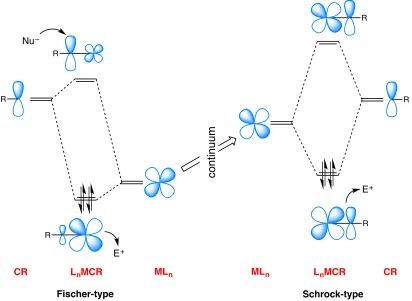
metal-carbon triple bond comprised of one σ and two π bonds, and the extent to which the spin-states of these hypothetical fragments is relevant to the nature of the actual metal-carbon multiple bond is questionable given that, in contrast to NHC chemistry, carbyne ligands are never installed by simple ligand addition. Far more important are the orbital energies of the metal-ligand fragment, how these match with those of the carbyne ligand, and how this determines the character of the resulting M≡C bond. Figure 1.2 below illustrates the π-bonding molecular orbitals for Fischer- and Schrock-type carbynes, focussing on the electron localisation in the resultant complexes, without artificially assigning of electrons to the theoretical MLn and CR fragments.
Historically, distinctions have been made between Fischer-type and Schrock-type carbynes. Fischer-type carbynes typically contain low-valent metal centres, the π -basicity of which is attenuated by competitive π-acidic CO co-ligands such that the carbyne carbon is comparatively electron poor and prone to attack by nucleophiles.** Schrock-type carbynes typically involve higher-valent metal centres, devoid of π-acidic co-ligands such that the carbyne carbon displays nucleophilic character. In reality these are two extreme descriptions that border a spectrum of bonding scenarios. Assignment of complexes into one of these two classes is often not clear-cut and numerous examples of carbyne complexes with ambiphilic character have been described.
Chapter 1: Introduction 7
Independent of the notional origin of the electrons involved or spin-states of the hypothetical fragments, the key discriminating factor in the Fischer-Schrock dichotomy is the energy of the orbitals presented by the metal centre. The reactivity of the M−C bond is primarily concerned with nucleophilic or electrophilic attack at the M−C π -bonds. For a given carbyne group, the closer in energy the metal t2g-type orbitals are to
the px/py orbitals of the carbyne fragment, the greater the overlap and the higher the
degree of covalency. In the case of Fischer-type metal centres, where interaction with π
-acidic co-ligands stabilises the t2g-type orbitals, the energy match (and resulting
overlap) is not so favourable such that the bonding combination is substantially metal based, whilst the anti-bonding combination has considerable carbon character (Figure 1.2). Accordingly, in frontier orbital controlled reactions, the carbyne carbon is the preferred site of nucleophilic attack rather than the coordinatively saturated metal centre.
R R
R R
R R
E+
E+ Nu–
co
n
tin
u
u
m
CR LnMCR MLn MLn LnMCR CR
Fischer-type Schrock-type
[image:21.595.120.532.390.691.2]8 Chapter 1: Introduction
In contrast, for metal centres within the Schrock-type regime, the metal orbitals are typically higher in energy (in some cases elevated by π-donor co-ligands) and better matched for effective overlap with the carbyne px/py orbitals. This leads to greater
covalency and increased contributions from carbon to the bonding combination (Figure 1.2). Although this more equitable contribution of both metal and carbon orbitals also applies to the anti-bonding combination, the metal centre, being typically coordinatively unsaturated, presents alternative orbitals for incoming nucleophiles (i.e. ligands). Thus electrophilic attack is encouraged at the carbyne carbon and nucleophilic attack may occur at the metal centre. For higher valent metal centres, direct electrophilic attack at the metal centre may also be precluded based on formal oxidation state limitations. These descriptions should be seen as extremes separated by a continuum that can be populated by tuning the nature of the metal centre (oxidation state, co-ligands, degree of coordinative unsaturation). Thus, for example, simply varying the nature of co-ligands in a classical Fischer-type carbyne may result in activation of the carbyne carbon towards electrophilic attack. Tuning the energies of the metal-based orbitals is the classic approach. The work detailed in this thesis focuses on the alternative approach of tuning the energies of the ligand-based orbitals by modifying the nature of the carbyne substituent and studying the effect this has on the chemistry of such complexes.
As noted above, for simple hydrocarbon carbyne substituents the M≡CR π-orbitals are either degenerate (R = H, alkyl, alkynyl) or near degenerate (R = aryl, alkenyl), whereas heteroatom substituents bearing lone pairs may alleviate the π-orbital degeneracy. This is most dramatic in the case of aminocarbynes, for which a 2-azavinylidene canonical description is occasionally invoked (Figure 1.3). Crystal structures of aminocarbynes display trigonal planar nitrogen atoms, and contracted carbon-nitrogen bonds accompanied by elongated carbon-metal bonds. This may in turn be manifest in conformational substituent preferences and an increased trans influence and/or trans
effect. Spectroscopically, aminocarbynes display downfield M≡C 13C NMR shifts and lower νCO infrared frequencies due to the increased electron density at the metal centre.
Chemically, these compounds are considerably less reactive than carbyne complexes bearing hydrocarbon substituents. Given the usual decrease in efficiency for pπ-pπ
Chapter 1: Introduction 9
LnM C N LnM C N
aminocarbyne R
R
R R
2-azavinylidene
Figure 1.3. Resonance descriptions of aminocarbyne complexes.
Carbyne complexes with a multitude of substituents are known. This project focuses on those bearing phosphorus substituents, a remarkably small subset considering the important role of phosphorus in coordination, organometallic and organic chemistries. The majority of the known phosphorus-functionalised carbyne complexes are phosphoniocarbynes [M(≡CPR3)(L)n], but examples of a number of other bonding
modes exist. An overview of the literature encompassing carbyne complexes bearing phosphorus substituents is detailed below.
1.2Phosphinocarbyne complexes
To date only three reports exist in the literature describing phosphinocarbyne complexes [M(≡CPR2)(L)n]. Cummins prepared the first examples of phosphinocarbyne complexes
[Mo(≡CPClR)(X)3] (X = NtBu(3,5-C6H3Me2); R = Cl, Ph), arising from the synthetic
sequence shown in Scheme 1.3,40,41 as part of a wider study into novel chemistry supported by the sterically congested molybdenum triamide platform.42-53 Deprotonation of a terminal methylidyne complex using KCH2Ph gave the potassium
dimer [Mo(≡CK)(X)3]2 which undergoes nucleophilic halide substitution reaction with
10 Chapter 1: Introduction
K C
K C
X3Mo MoX3
X3Mo C H
KCH2Ph PCl2R
X3Mo C P
Cl R X3Mo CO
X3Mo C OCOtBu
(i) Na/Hg (ii) tBuCOCl
(i) Na/THF (ii) CH3CN
CO C H Cl + + MoX3
MoX3 TiX3
Scheme 1.3. Cummins' synthesis of phosphinocarbyne complexes (X = NtBu(3,5-C
6H3Me2); R = Cl, Ph).
Investigations into the reactivity of the phosphinocarbyne complex [Mo(≡CPClPh)(X)3]
were undertaken. Reduction with excess sodium amalgam in the presence of a coordinating solvent (Et2O, THF) gave the dimer [Mo(≡CPPhNa)(S')2(X)3]2 (S' = Et2O,
THF) (Scheme 1.4).40 The crystal structure shows a tight ion pair interaction between phosphorus and sodium. The observed bond lengths favour the phosphidocarbyne formalisation [Mo(≡C−PPh)(X)3]−, rather than an anionic complex of a
phosphaisocyanide [Mo(=C=PPh)(X)3]−, although there is some suggestion of
carbon-phosphorus multiple bonding due to the slightly contracted C−P bond length (1.771(5) Å).
X3Mo C P
Cl Ph
X3Mo C P
Ph MoX 3 C P Ph Na S' P S' P Na S' S' Ph C Ph C X3Mo
MoX3 Na/Hg
S'
X3MoCPClPh Na/Hg
S' TiX3
Chapter 1: Introduction 11
Attempts to synthesise a neutral phosphaisocyanide complex [Mo(CPPh)(X)3] led
instead to the phosphinocarbyne dimer [Mo2(µ-CPPh)2(X)6] (Scheme 1.4), either via
chlorine abstraction from [Mo(≡CPClPh)(X)3] or reaction of [Mo(≡CPClPh)(X)3] with
the phosphido complex [Mo(≡CPPhNa)(S')2(X)3]2.40 The dimer [Mo2(µ-CPPh)2(X)6]
could be cleaved by reduction with sodium amalgam to regenerate the phosphido species [Mo(≡CPPhNa)(S')2(X)3]2. DFT studies on the hypothetical model
[Mo(CPPh)(NH2)3]– reveal a degree of C−P multiple bond character and predict a
chemical shift (δP 132) close to the limiting value of δP 126.1 observed in the presence
of ion-pair disrupting 12-crown-4.40 It may therefore be concluded that the ligand does indeed show some phosphaisocyanide character, but that it is the exceptionally electron-rich nature of the 'MoX3–' group that is responsible for the activation of the C−P bond, a
feature that underpins the activation of CO earlier in the synthetic sequence. Thus, whilst entirely unequivocal examples of terminal phosphaisocyanides remain elusive, it may be anticipated that if these emerge based on less π-basic metal centres, more
pronounced phosphaisocyanide character will become evident.
The single other example of a phosphinocarbyne complex, [Mo(≡CPPh2)(CO)2(Tp*)],54
also utilised nucleophilic halide substitution to install the phosphorus-carbon bond, but in a shorter synthetic sequence (Scheme 1.5). The one-pot procedure involved a lithium-halogen exchange reaction of Lalor's bromocarbyne complex [Mo(≡CBr)(CO)2(Tp*)]55
with nBuLi to generate the nucleophilic lithiocarbyne complex [Mo(≡CLi)(CO)2(Tp*)]
for use, in situ, with a range of electrophiles. As in Cummins' work, addition of the corresponding phosphine halide afforded the phosphinocarbyne complex. Interestingly, synthesis of [Mo(≡CPPh2)(CO)2(Tp*)] via nucleophilic substitution rather than
electrophilic substitution was unsuccessful. Treatment of [Mo(≡CBr)(CO)2(Tp*)] with
LiPPh2 did not result in the desired phosphinocarbyne, and the only identifiable product
from the reaction was the benzylidyne complex [Mo(≡CPh)(CO)2(Tp*)]. No subsequent
12 Chapter 1: Introduction
Mo C Tp*
OC OC
Br Mo C
Tp* OC OC P Ph Ph nBuLi Mo C Tp* OC OC Li
PPh2Cl
LiPPh2 Mo C Tp* OC OC Ph
×
Scheme 1.5. Phosphinocarbyne synthesis via lithium-halogen exchange.
1.3Other phosphorus-functionalised carbyne complexes
In contrast to aminocarbynes, which constitute by far the largest class of nitrogen-functionalised carbynes, phosphinocarbynes are rare, while the more prevalent examples of phosphorus-functionalised carbyne complexes are those based on exotic phosphorus variants. The literature hosts reports of a number of other phosphorus-functionalised carbyne systems, the most common being phosphoniocarbynes [M(≡CPR3)(L)n]. There are a couple of one-off examples,56-61 along with more
comprehensive studies by Templeton,62-67 Weber,68-72 and Sundermeyer and Li.73-79 A summary of this chemistry is given below.
The first example of a phosphorus-functionalised carbyne was that of Schrock and co-workers in 1984. In an attempt to oxidise the methylidyne species [W(≡CH)Cl(PMe3)4]
to [W(≡CH)Cl3(PMe3)3] using AlCl3 and C2Cl6, the dimeric phosphoniocarbyne
complex [W(≡CPMe3)Cl2(PMe3)2]2[AlCl4]2 was obtained (Scheme 1.6).58 The
mechanism of formation remains unclear, and no further studies have been undertaken.
W Cl Me3P
Cl C
Cl Me3P
W PMe3 Cl C PMe3 PMe3 PMe3
[AlCl4]2 W
PMe3
Cl Me3P
C
PMe3 Me3P
H
C2Cl6 AlCl3
0.5
Chapter 1: Introduction 13
A novel strategy utilised by Hillhouse and co-workers to access phosphoniocarbynes involved cleavage of carbon suboxide O=C=C=C=O and triphenylphosphoranylidene ketene Ph3P=C=C=O.59-61 Reaction of [WCl2(PMePh2)4] with carbon suboxide cleaves
one of the C=C bonds providing a CO and a CCO ligand (Scheme 1.7). Subsequent PMePh2 migration to the CCO ligand affords the η2-ketenyl complex [W{C,C':η2
-C(O)CPMePh2}Cl(CO)(PMePh2)2]. This complex is thermally unstable and loses CO
over two days at 35°C to give a phosphoniocarbyne complex [W(≡CPMePh2)Cl2(CO)(PMePh2)2]. This reaction appears irreversible, as addition of
carbon monoxide (1 atm) to [W(≡CPMePh2)Cl2(CO)(PMePh2)2] does not regenerate
[W{C,C':η2-C(O)CPMePh
2}Cl(CO)(PMePh2)2], though carbonyl-carbyne coupling to
form ketenyl ligands is common in other systems.80 The related PPh
3 analogue
[W(≡CPPh3)Cl2(CO)(PMePh2)2] was obtained from the direct reaction of
[WCl2(PMePh2)4] with Ph3P=C=C=O at 35°C. Unfortunately, this exciting sequential
cleavage of CO does not appear to be a general strategy to access phosphorus-substituted carbynes, as no further reports of such reactivity have been published, despite extensive studies on the coordination chemistry of R3P=C=C=O.81,82
Cl W
L
L
CO
Cl
C PPh3
L W
L
L
Cl
Cl
L Cl W
L
L
CO
Cl C
C
L
O
35°C
Cl W
L
L
CO
Cl
C L
Ph3P
=
C=
C=
O 35°CO
=
C=
C=
C=
OScheme 1.7. Synthesis of phosphoniocarbynes through cleavage of carbon suboxide and triphenylphosphoranylidene ketene (L = PMePh2).
Templeton and co-workers have utilised nucleophilic substitution to access cationic phosphoniocarbynes [W(≡CPR3)(CO)2(Tp*)]PF6 bearing a range of R groups (R3 =
Me3, Et3, Cy3, Ph3, Me2Ph).62,66 Treatment of the chlorocarbyne [W(≡CCl)(CO)2(Tp*)]
or the thiocarbyne [W(≡CSMe)(CO)2(Tp*)] with the requisite phosphine in the presence
of MPF6 (M = NH4, K) provides the corresponding phosphoniocarbyne as the
14 Chapter 1: Introduction
W C
Tp*
OC OC
X
PR3 MPF6
W C
Tp*
OC OC
R
P
R R
PF6
Scheme 1.8. Templeton's synthesis of phosphoniocarbynes by nucleophilic displacement of chloride or SMe− by phosphine (X = Cl, M = K, R
3 = Cy3,
Ph3, Me2Ph; X = SMe, M = NH4, R = Me, Et).
Templeton has demonstrated the reactivity of these complexes with a broad range of nucleophiles.62-67 These reactions proceed via nucleophilic attack at the carbyne carbon,
or at the carbonyl co-ligand, in some cases followed by rearrangement often involving loss of the phosphine. A particularly interesting example is the reaction of [W(≡CPR3)(CO)2(Tp*)]PF6 with aryloxide nucleophiles KOC6H4R'-4 (R3 = Ph3,
Me2Ph; R' = H, Me, OMe, CN, Cl, NO2).67 When the aryloxide employed is
electron-rich (R' = H, Me, OMe), the phosphonium moiety is substituted to yield aryloxycarbynes [W(≡COC6H4R-4')(CO)2(Tp*)]. When electron-poor aryloxides (R' =
CN, Cl, NO2) were used, a mixture of products resulted due to the weaker
nucleophilicity of the aryloxide. As well as the aryloxycarbyne, phosphoranylideneketene complexes [W{O(4-C6H4R')}{C,C':η2
-C(O)CPR3}(CO)(Tp*)] were produced. This results from attack of the aryloxide
nucleophile at the metal centre accompanied by coupling of the carbyne moiety with one of the carbonyl ligands. In contrast, the reaction of [W(≡CPPh3)(CO)2(Tp*)]PF6
with Li[BHEt3] proceeds initially by nucleophilic attack at a carbonyl co-ligand to
generate a transient formyl complex which rearranges to a labile phosphoniomethylidene followed by extrusion of phosphine to afford the parent methylidyne complex [W(≡CH)(CO)2(Tp*)].64
W C
Tp*
OC OC
R P
R R
PF6 KOAr
W C
Tp*
OC OC
OAr W
Tp*
OC ArO
C
C
PR3
O +
Scheme 1.9. Reactivity of phosphoniocarbyne complexes with aryloxide nucleophiles (PR3 = PPh3, PMe2Ph; Ar = 4-C6H4R'; R' = H, Me, OMe, CN,
Chapter 1: Introduction 15
Weber has comprehensively studied the chemistry of the novel tungsten and molybdenum phosphaalkenylcarbyne complexes [M{≡CP=C(NR2)2}(CO)2(Tp*)] (M =
Mo, W; R = Me, Et) along with their arsenic analogues.68-72 Reaction of the chlorocarbyne [M(≡CCl)(CO)2(Tp*)] with Me3SiP=C(NR2)2 eliminates SiClMe3 to
generate the phosphaalkenylcarbyne (Scheme 1.10). A crystallographic study of the tungsten tetraethyl example confirmed the structure as a phosphaalkenyl-functionalised carbyne. The WCPC spine is bent at phosphorus so as to present a nucleophilic lone pair. A range of electrophiles were shown to add to the phosphorus, although in the case of protonation a rearrangement to the metallaphosphirene complex ensues, the only example of reactivity at the M≡C bond among this work. Addition of 'AuCl' (from [AuCl(CO)]) proceeds not once but twice to afford the trimetallic species [M{≡CP(AuCl)2C(NMe2)2}(CO)2(Tp*)]. These complexes can also be oxidised by air
or pressurised O2 to form the only examples of phosphinate-functionalised carbyne
16 Chapter 1: Introduction M C Tp* OC OC Cl
Me3SiP=C(NR2)2
M C Tp* OC OC P C NR2 NR2 O2 M C Tp* OC OC P O C O NR2
R2N
W Tp* OC OC P C NEt2 NEt2 2 AuCl(CO) M C Tp* OC OC P AuCl C AuCl NMe2
Me2N
M C Tp* OC OC P C NR2 NR2 Me W C Tp* OC OC P C NEt2 NEt2 H X X H C 8 hr X = BF4
MeOTf
X = OTf R = Me
HX
M = W, R = Et
OTf
Scheme 1.10. Weber's synthesis of phosphaalkenylcarbyne complexes and subsequent reactivity (M = Mo, W; R = Me, Et).
A single example of a phosphonatocarbyne complex, [Mo{≡CP(=O)(OEt)2}(CO)2(Tp*)], has been reported to arise via palladium-catalysed
C−P bond formation using a halocarbyne complex54 in place of more conventional aryl halides.83-85 Treatment of the bromocarbyne [Mo(≡CBr)(CO)2(Tp*)] with
HP(=O)(OEt)2 and NEt3 in the presence of 5 mol% [Pd(PPh3)4] generates the
Chapter 1: Introduction 17 Mo C Tp* OC OC Br HP(O)(OEt)2 NEt3 Pd(PPh3)4 (cat.)
Mo C Tp* OC OC P OEt OEt O
Scheme 1.11. Palladium-catalysed synthesis of a phosphonatocarbyne complex.
Following Schmidbaur's demonstration that binuclear phosphoniocarbyne complexes arise from transylidation reactions involving phosphorus ylides and TiCl4,56 Li and
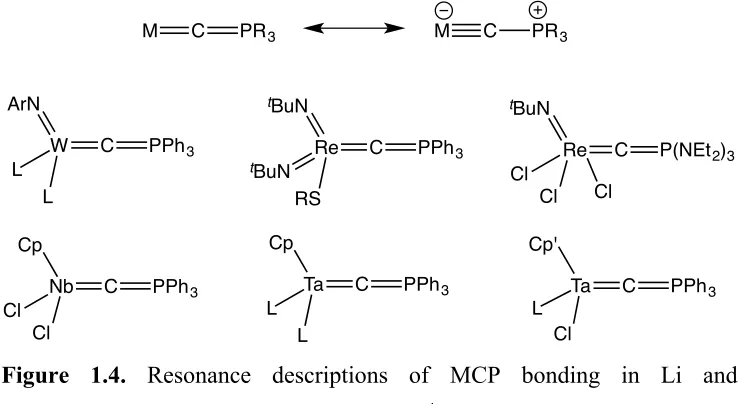
Sundermeyer published a number of reports of d0 phosphoniocarbyne complexes of tungsten, rhenium, niobium and tantalum (Figure 1.4).73-79 These complexes might also be described by a heteroallenic M=C=PR3 canonical form, in addition to the
zwitterionic phosphinocarbyne resonance depiction −M≡C−PR3+ (shown below in
Figure 1.4). As with Schmidbaur's approach, the syntheses of these complexes proceeds via transylidation reactions of R3P=CH2 with a metal halide precursor, eliminating
[R3PCH3]X and forming both CHPR3 and CPR3 ligands.
Nb C
Cp
Cl Cl
PPh3 Ta C
Cp
L L
PPh3 Ta C
Cp' L Cl PPh3 Re C tBuN Cl Cl
P(NEt2)3 Cl Re C tBuN tBuN RS PPh3 W C ArN L L PPh3
M C PR3 M C PR3
Figure 1.4. Resonance descriptions of MCP bonding in Li and Sundermeyer's complexes (Ar = 2,6-C6H3iPr2, 2,4,6-C6H2Me3; R = tBu,
adamantyl; L = CHPPh3; Cp' = Cp, Cp*).
[image:31.595.141.510.424.626.2]18 Chapter 1: Introduction
limitations in our understanding of the reactivity of phosphorus substituted carbyne complexes, calling for further research into this area.
1.4Other MC1P1Rn systems
To understand the chemistry of phosphorus-functionalised carbyne complexes, it is pertinent to consider the chemistry of other MC1P1Rn systems beyond that of transition
metal carbyne complexes. A selection of relevant MC1P1Rn chemistry is given here,
focusing on previous work on cyaphide and phosphaisocyanide species, as well as an overview of phosphorus-functionalised carbene complexes.
1.4.1 Cyaphide complexes
The simplest conceivable carbon-phosphorus ligand is cyaphide, 'CP'. Although cyanide C≡N– is commonly encountered both as a free salt and as a ligand complexed to transition metals, the phosphorus analogue cyaphide C≡P– is extremely rare.86 The first report of a terminal cyaphide ligand was that of Angelici and co-workers from the reaction of trans-[Pt{η1-C(X)=PMes*}(X)(PEt3)2] (X = Cl, Br; Mes* = 2,4,6-C6H2tBu3)
with [Pd(PEt3)4]. This reaction produced trans-[Pd(Mes*)(X)(PEt3)2] and a second
species which was postulated to be trans-[Pt(C≡P)(X)(PEt3)2] (Scheme 1.12).87,88 This
complex was observed by in situ 31P NMR spectroscopy of the reaction mixture which showed a triplet at δP 68.0 (JPP 9.16 Hz), straddled by platinum-195 satellites showing a
relatively small coupling constant (JPtP 303 Hz), suggesting a two-bond cis
-platinum-phosphorus interaction. Attempts to isolate this species led to decomposition but it could be trapped by addition of [Pt(PEt3)4] to afford the first binuclear bridging
cyaphide complex [Pt2(µ:η1-C;η2-C,P-C≡P)X(PEt3)4]. The bonding mode, atypical of
Chapter 1: Introduction 19
P C
R Pt
X X PEt3
Et3P
P C
Me Pt
Pt I PEt3
Et3P
X PEt3 Pd(PEt3)4
C Pt X PEt3
Et3P
P - PdX(R)(PEt3)2
R = Mes*
C Pt X PEt3
Et3P
P Pt
PEt3
PEt3
Pt(PEt3)4 PtCl2(PEt3)2
Na/Ph2CO R = N(SiMe3)2
C Pt X PEt3
Et3P
P Pt
PEt3
PEt3
LnM
MLnL' MeI
Scheme 1.12. Angelici's synthesis of platinum cyaphide complexes (R = Mes*, N(SiMe3)2; X = Cl, Br; MLnL' = [W(CO)5(THF)], [PtCl2(PEt3)2]).
This bridging cyaphide complex [Pt2(µ:η1-C;η2-C,P-C≡P)X(PEt3)4] has also been
prepared by the reduction of trans-[Pt{η1-C(Cl)=PN(SiMe
3)2}Cl(PEt3)2] with
sodium/benzophenone in the presence of [PtCl2(PEt3)2] (Scheme 1.12).90 This reduction
appears to be specific to the PEt3 co-ligand set as no reaction was observed using
[PtCl2(PPh3)2], [PtCl2(PCy3)2], [PtCl2(PiPr3)2] or [PtCl2(depe)]. This complex is able to
coordinate a third metal centre via the phosphorus atom, as shown in the synthesis of [Pt2{µ:η1-C;η1-P;η2-C,P-C≡P(MLn)}Cl(PEt3)4] (MLn = PtCl2(PEt3), W(CO)5).90
Interestingly, X-ray crystallography showed very little deviation in the cyaphide ligand upon complexation of a third metal centre. The nucleophilicity of this phosphorus was also exploited in a reaction with methyl iodide. In this case, rearrangement of the C≡PMe ligand occurs to give a bridging phosphaisocyanide ligand [Pt2(µ:η1
-C=PMe)ClI(PEt3)3].90 The mechanism for this transformation was established using
sequential Me+ and I− addition using MeOTf and NaI. Initial methylation at the phosphorus occurs, followed by iodide addition to platinum, then elimination of PEt3
20 Chapter 1: Introduction
intriguing transformation again appears to be very limited in scope as alkylation attempts using other alkylating and arylating agents were largely unsuccessful.
The first example of an isolated complex containing a terminal cyaphide ligand came as recently as 2006.91 Grützmacher and co-workers devised a synthesis of a ligated C≡P ligand from the triphenylsilylphosphaalkyne Ph3SiC≡P. This phosphaalkyne could not
be isolated but could be obtained in situ via double dehydrohalogenation of Ph3SiCH2PCl2 using DABCO (1,8-diazabicyclo[2.2.2]octane). The presence of AgOTf
is required in the dehydrohalogenation reaction to scavenge chloride from the liberated [HDABCO]Cl as it was suspected that chloride was aiding the decomposition of Ph3SiC≡P to produce Ph3SiCl. Coordination of Ph3SiC≡P to [RuH(dppe)2]OTf yielded
the phosphaalkyne complex [RuH(P≡CSiPh3)(dppe)2]OTf in over 80% yield. At this
stage, abstraction of the silyl group using fluoride sources did not proceed cleanly, impeded by nucleophilic attack of fluoride at the phosphorus atom of the phosphaalkyne ligand. Attempted desilylation with alkoxide and hydroxide reagents was also complicated by nucleophilic attack at phosphorus. Excitingly, when sodium phenoxide was used as the desilylating agent the desired cyaphide complex [RuH(C≡P)(dppe)2]
was obtained in 71% yield (Scheme 1.13).
P Ph2
Ru Ph2 P
P Ph2 Ph2 P H
P
C P
Ph2 Ru Ph2 P
P Ph2 Ph2 P H
C
P
SiPh3 NaOPh
P C Ph3Si Ph3Si
H2 C
Cl Ph3Si
H2 C
PCl2 (i) Mg
(ii) PCl3 DABCOAgOTf
[RuH(dppe)2]OTf
OTf
Scheme 1.13. Grützmacher's synthesis of the first isolated terminal cyaphide complex.
The cyaphide ligand was characterised by a broad peak at δP 165.0 (THF-d8) and a
Chapter 1: Introduction 21
identified in the infrared spectrum at 1228 cm−1 at considerably lower frequency than those of alkyl-substituted phosphaalkynes (νCP > 1500 cm−1). The identity of
[RuH(C≡P)(dppe)2] was confirmed crystallographically. The long carbon-phosphorus
bond (1.573(2) Å) was attributed to retrodonation from ruthenium into the cyaphide π* orbitals.
Recently, the second example of an isolable terminal cyaphide complex was reported by Crossley and co-workers.92 This work extended Grützmacher's strategy, wherein the hydride ligand was replaced by a σ-alkynyl ligand, to produce alkynyl cyaphide complexes in which the cyaphide ligand is incorporated in a conjugated π system. Chloride abstraction from [RuCl(C≡CR)(dppe)2] (R = CO2Me, 4-C6H4OMe) by silver
triflate and addition of P≡CSiMe3 gave the cationic σ-phosphaalkyne complex [Ru(η1
-P≡CSiMe3)(C≡CR)(dppe)2]+. Desilylation using potassium tert-butoxide effected the
rearrangement to the C-coordinated cyaphide species [Ru(C≡P)(C≡CR)(dppe)2]
(Scheme 1.14).
P Ph2
Ru Ph2 P
P Ph2 Ph2 P
P
C P
Ph2 Ru Ph2 P
P Ph2 Ph2 P
Cl
SiMe3
R R
P Ph2
Ru Ph2 P
P Ph2 Ph2 P
C
P R
(i) AgOTf
(ii) PCSiMe3 KOtBu
OTf
Scheme 1.14. Crossley's synthesis of alkynyl cyaphide complexes (R = CO2Me, 4-C6H4OMe).
The presence of the cyaphide and alkynyl ligands was supported by C≡P and C≡C stretching frequencies in the infrared spectra at νCP 1255, νCC 2040 cm–1 (R = CO2Me)
and νCP 1261, νCC 2032 cm–1 (R = 4-C6H4OMe), shifted to higher frequency than that of
the hydride complex (νCP 1228 cm−1).91 A crystallographic study of the para
-methoxyphenyl derivative indicated a shorter C−P bond (1.544(4) Å) and slightly longer Ru−C bond (2.065(4) Å) than [RuH(C≡P)(dppe)2]. This reflects the decreased
22 Chapter 1: Introduction
π-acidic alkynyl ligand. UV/Vis spectroscopy revealed both complexes possessed strong ligand-ligand π (C≡P/C≡C) → π* (dppe) charge transfer absorptions around 250 nm.
Attempts by Russell and co-workers to generate molybdenum cyaphide complexes using analogous nucleophilic desilylation procedures to those employed in ruthenium chemistry have been largely unsuccessful. The formation of [Mo(C≡P)(P≡CSiMe3)(dppe)2]− was proposed based on 31P NMR data (δP 197.8,
multiplet), but further characterisation is required.93
Russo and co-workers have analysed a series of phosphaalkynes, cyaphide and cyaphide complexes computationally through DFT studies.94 These calculations confirmed that
the carbon-phosphorus bond in free CP−, trans-[PtCl(C≡P)(PMe3)2] and
[RuH(C≡P)(dppe)2] is a formal triple bond through natural bond orbital (NBO), electron
localisation function (ELF) and atoms in molecules (AIM) approaches. However, in the case of the bridging cyaphide complex [Pt2(µ-C≡P)Cl(PMe3)4] the phosphorus-carbon
bond order can be described as either a double or triple bond depending on the analysis in question and the basis set used. This is not surprising as π-coordination of Pt(PMe3)2
to the C≡P bond should result in a decrease in the bond order, as observed for conventional phosphaalkynes.
1.4.2 Phosphaisocyanide complexes
Chapter 1: Introduction 23
P C R
C P R
N C R
C N R phosphaalkyne
phosphaisocyanide isocyanide nitrile (cyanide)
P
C C N
cyaphide cyanide
Figure 1.5. Compounds featuring C−P and C−N triple bonds.
A free phosphaisocyanide (also referred to a an isophosphaalkyne or a phosphaisonitriles) has yet to be isolated. Efforts to obtain phosphaisocyanides have mainly involved α-elimination of lithium halides from the corresponding phosphaalkenylidene carbenoids (Scheme 1.15).95 No phosphaisocyanides have been isolated or observed using these routes, although they have been proposed as intermediates in the decomposition process. This decomposition tends to lead to phosphaalkynes, but in some cases C−H activation of the R group is observed.96-102
P C
R
X' X
BuLi
P C
R
Li
X
P C
R
C P
R
+
other decomposition products
Scheme 1.15. Generalised route used in attempted syntheses of phosphaisocyanides (R = Mes*, 2,4,6-C6H2(C5H11)3; X = Cl, Br; X' = H, Cl,
Br).
A true terminally ligated phosphaisocyanide is also unknown, the closest example being the phosphidocarbyne complex [Mo(≡CPPhNa)(S')2(X)3]2 (X = NtBu(3,5-C6H3Me2); S'
= Et2O, THF) prepared by Cummins (Scheme 1.4).40 This species contains the desired
24 Chapter 1: Introduction
complexes synthesised by Weber [M{CPC(NR2)2}(CO)2(Tp*)] (M = Mo, W; R = Me,
Et) were found to be best represented by the phosphaalkenylcarbyne resonance description M≡C−P=C(NR2)2 (c) rather than a zwitterionic phosphaisocyanide
resonance description M=C=P−C(NR2)2 (d).68
Mo C X
X X
P Ph
Mo C X
X X
P Ph
M C Tp*
OC OC
P C
NR2
NR2
M C Tp*
OC OC
P C
NR2
NR2
(c) (d)
(a) (b)
Figure 1.6. Resonance descriptions of [M(CPR)(L)n] complexes (X =
NtBu(3,5-C6H3Me2); M = Mo, W; R = Me, Et).
Although no true terminal phosphaisocyanide complexes are known, bridging phosphaisocyanide ligands have been reported for platinum and iron. The first examples, discussed above, were reported by Angelici through the oxidative addition of [Pt{C(X)=PMes*}X(PEt3)2] to [Pt(PEt3)4] to afford [Pt2(µ-C=PMes*)X2(PEt3)3] (X =
Chapter 1: Introduction 25
P C
Me Pt
Pt I PEt3
Et3P
Cl PEt3 C
Pt Cl PEt3
Et3P
P Pt
PEt3
PEt3
MeI P
C
Mes* Pt
X X PEt3
Et3P C P
Mes* Pt
Pt X PEt3
Et3P
X PEt3 Pt(PEt3)4
Scheme 1.16. Synthesis of bridging phosphaisocyanide complexes (X = Cl, Br).
Iron bridging phosphaisocyanide complexes have been prepared by addition of silylphosphines PH(Ar)(SiMe3) to [Fe2(µ-CSMe)(µ-CO)(CO)2(Cp)2]OTf in the
presence of base (DBU) to give [Fe2(µ-C=PAr)(µ-CO)(CO)2(Cp)2] (Ar = 2,4,6-C6H2R3;
R = Me, iPr, tBu, CF3) (Scheme 1.17).106,107 The crystal structure of the mesityl
derivative showed that the phosphaisocyanide ligand is close to symmetrically positioned between the two metal centres (Fe−C 1.954(16), 1.927(15)Å; Fe−C−P 147.2(10), 129.7(9)°). The phosphorus-carbon distance (1.683(17) Å) is consistent with a double bond and the angle at phosphorus is indicative of the development of a lone pair, as is also often observed for electron rich bridging isocyanide ligands. Unfortunately, this method also appears fairly limited in the scope of substituents, requiring very bulky aryl substituents. Using the smaller phosphine PH(tBu)(SiMe3) in
the reaction led to the bridging phosphinocarbyne complex [Fe2{µ-CPH(tBu)}(µ
26 Chapter 1: Introduction Fe Cp C OC O C Fe CO Cp S OTf Fe Cp C OC O C Fe CO Cp P Me Ar PH(R)(SiMe3)
DBU Fe Cp C OC Me S Fe CO Cp P tBu H R = Ar
R = tBu
Scheme 1.17. Synthesis of a bridging diiron phosphaisocyanide complex (Ar = 2,4,6-C6H2R3; R = Me, iPr, tBu, CF3).
These ligated phosphaisocyanides display nucleophilicity at phosphorus and can coordinate to metal complexes to form µ3-C=PR complexes (Scheme 1.18).107 Oxidation with elemental sulfur or selenium forms the corresponding phosphine sulfide or selenide, while treatment with methyl triflate leads to the phosphonium salt [Fe2(µ
-C=PMeMes)(µ-CO)(CO)2(Cp)2]OTf.108
Fe Cp C OC O C Fe CO Cp P Mes Fe Cp C OC O C Fe CO Cp P
Mes M(CO)n
Fe Cp C OC O C Fe CO Cp P Mes E Fe Cp C OC O C Fe CO Cp P OTf Mes Me
M(CO)nL
E
MeOTf
Scheme 1.18. Electrophilic additions to [Fe2(µ-C=PMes)(µ
Chapter 1: Introduction 27
1.4.3 Phosphorus-functionalised carbene complexes
Although phosphorus-functionalised carbyne complexes are fairly uncommon, carbene complexes bearing phosphorus substituents are better known,109-112 with a large, albeit recent, portion of these based on phosphorus(V) chelates.110-112 Most relevant to the work contained in this thesis is the chemistry of phosphinocarbene complexes,109 and to a lesser extent that of phosphoniocarbenes. Accordingly, selected illustrative highlights are presented here.
Examples of η1-phosphinocarbene complexes are scarce, although η2-phosphinocarbene complexes are more commonly encountered,113-125 – for example, through addition of a PR2 unit to the M≡C bond of carbyne complexes,115,116,126 or the cyclometallation of
alkylphosphines118 – and further complexes of this type will be described in Section 2.6.
Initial attempts to synthesise η1-phosphinocarbene complexes by Fischer led to the isolation of [W{=C(NEt2)PMePh}(CO)4L] (L = CO, PHMePh) in very low yields (3 –
4%). These carbene complexes arose from nucleophilic attack of K[PMePh] on the carbyne carbon atom of [W(≡CNEt2)(CO)5]BF4, with the major product [W2
{µ-(CNEt2)2}(CO)10] being that resulting from reductive coupling of two carbyne moieties
(Scheme 1.19).113
W CNEt2
OC OC CO
OC
CO
W C
OC OC CO
L
CO
PMePh NEt2 K[PMePh]
BF4
(OC)5W C NEt2
W(CO)5 C
Et2N
+
Scheme 1.19. Fischer's preparation of the first phosphinocarbene complexes (L = CO, PHMePh).
Mehrkhodavandi and co-workers found that nucleophilic attack of K[PPh2] upon the α
-carbon of the isocyanide salt [Fe{C≡N(CH2)3PPh2}(CO)(Cp)]BF4, followed by
protonation, gave the cationic η1-phosphinocarbene [Fe{=C(PPh2)NH(CH2)3PPh2}(CO)(Cp)]+ (Scheme 1.20).127 Unfortunately,
spontaneous PHPh2 extrusion occurs to regenerate the isocyanide precursor. Recently,
Schrock and co-workers utilised alkene metathesis to prepare the high oxidation state molybdenum η1-phosphinocarbene complex [Mo(=CHPPh2)(=NDipp){O(C6HPh4
-2,3,5,6)}{N(C(Me)CH)2}] from [Mo(=CH2)(=NDipp){O(C6HPh4
28 Chapter 1: Introduction
Fe C Cp
Ph2P N – PHPh2
OC Fe C
Cp
Ph2P NH
OC
PPh2 K[PPh2]
H+
Scheme 1.20. Synthesis of an iron phosphinocarbene cation.
Unlike phosphinocarbynes, phosphinocarbenes can be prepared in their free state (i.e. R2PCR).109,129 Indeed the first carbene to be isolated in the free state was
(iPr2N)2PCSiMe3, prepared by thermolysis of the corresponding α-diazophosphine
(iPr2N)2PC(=N)SiMe3, predating the enormous growth in NHC chemistry.130 Bertrand
and co-workers have demonstrated that rhodium η1-phosphinocarbene complexes [Rh{=C(C6H3(CF3)2-2,6)P(NiPr2)2}Cl(L2)] (L2 = COD, norbornadiene) can be generated
through complexation of the free ligand (iPr2N)2PC{C6H3(CF3)2-2,6} by an appropriate
metal precursor (Scheme 1.21).131 Although the conceptual simplicity of this methodology makes it very attractive, the availability of stable free phosphinocarbenes is a severe limitation, requiring considerable steric encumbrance or captodative substituent combinations to impart sufficient stability – both factors that may in principle compromise the subsequent coordination chemistry.129
P
C NiPr2 NiPr
2 CF3
CF3
P
C NiPr2 NiPr
2 CF3
CF3
Cl
L L Rh [RhCl(L2)]2
Scheme 1.21. Bertrand's synthesis of phosphinocarbene complexes by ligation of a free phosphinocarbene (L2 = COD, norbornadiene).
Lugan and co-workers have extended their studies of cationic manganese carbynes to deliver phosphinocarbene complexes through the deprotonation of phosphoniocarbenes.132,133 The reaction of [Mn(≡CR)(CO)2(Cp)]BX4 (R = Me, Ph; X =
Chapter 1: Introduction 29
R'' = Ph; R' = H, R'' = Mes), which can be deprotonated to yield phosphinocarbene complexes [Mn{=C(Ph)PRR'}(CO)2(Cp)] (Scheme 1.22). Again, the stability of the
resultant phosphoniocarbenes is limited; the transient phosphinocarbenes [Mn{=C(Ph)PRR'}(CO)2(Cp)] (R = R' = Ph, NiPr2; R = Me, R' = Ph) rapidly isomerise
to the η3-phosphinoketene complexes [Mn{η2-C(O)C(Ph)PRR'}(CO)(Cp)], resulting from CO insertion into the Mn=C bond. Use of a mesityl substituent at phosphorus conferred kinetic stability upon these species, enabling isolation of the η1 -phosphinocarbenes [Mn{=C(R)PHMes}(CO)2(Cp)] (R = Me, Ph), which nevertheless
rearrange within hours (1.5 hours R = Me, 36 hours R = Ph) to give a mixture of η3 -phosphinoketene and η1-phosphaalkene [Mn{η1-P(Mes)=CHR}(CO)2(Cp)] products.
Mn C
Cp
OC CO
R Mn C
Cp
OC CO
PHR'R'' PHR'R''
R
Mn C
Cp
OC CO
PR'R''
R
Mn P
Cp
OC CO
Mes
C
Mn P
Cp
OC
C H
R
C
R'' R'
O R
base
+
Scheme 1.22. Lugan's preparation of phosphinocarbene complexes (R = Me, Ph; R' = R'' = Ph, NiPr2; R' = Me, R'' = Ph; R' = H, R'' = Mes; base =
NEt3, DBU).
As has been seen, the instability and lack of widely applicable synthetic routes has severely hampered progress in the area of η1-phosphinocarbene complexes. In contrast,
η1-phosphoniocarbene complexes are often stable and can be prepared in a relatively straightforward manner by nucleophilic addition of phosphines to carbyne complexes. Phosphoniocarbene complexes of group 6 and 7 metals have been prepared via this route, representative examples of which are outlined in Scheme 1.23.134-136 Addition of phosphines to [W(≡CX)(CO)2(Tp*)] (X = Cl, SMe) generates phosphoniocarbynes
[W(≡CPR3)(CO)2(Tp*)]+ (see Section 1.3), but interestingly, when R = Me the
30 Chapter 1: Introduction
methyl iodide can be used to favour formation of the carbene or carbyne species, respectively.62
M' C L''
OC CO
R' M' C
L''
OC CO
PMe3 PMe3
R'
M C
OC
OC CO
X
CO
R M C
L
OC CO
X
L'
PMe3
R PMe3
Scheme 1.23. Synthesis of phosphoniocarbene complexes via phosphine addition to carbynes (M = Cr, L = L' = CO; M = Mo, L = CO, L' = PMe3; M
= W, L = L' = PMe3; X = Cl, Br, I; R = Me, Ph, CH2Ph, Tol, Mes, SiPh3; M'
= Cr, L'' = C6H6, 1,4-C6H4Me2, 1,3,5-C6H3Me3, R = Ph; M' = W, L'' = Tp*,
R' = PMe3; M' = Mn, Re, L'' = Cp, R' = Ph).
Piers and co-workers found that protonation of the ruthenium carbido complexes [Ru(≡C)Cl2(PR3)(NHC)] (R3 = Cy3, EtCy2, MeCy2, (C5H9)3, iPr3, EtiPr2, MeiPr2; NHC =
C(NR'CH2)2, R' = Mes, Dipp, 2,6-C6H3Et2) triggers phosphine migration to the carbido
ligand, yielding phosphoniocarbene salts [Ru(=CHPR3)Cl2(NHC)]BX4 (X = F, C6F5)
(Scheme 1.24).137-140 If HCl is used, [Ru(=CHPR3)Cl3(NHC)] forms, from which
chloride abstraction with B(C6F5)3 provides the corresponding BCl(C6F5)3− salt.138,140
The 14-electron complexes [Ru(=CHPR3)Cl2(NHC)]+ are very active alkene metathesis


![Figure 2.8. Calculated prototropic trajectory for the intramolecular isomerisation of [5]+ to [6]+ via the intermediate [W(=CHPPh2)(CO)2(Tp*)]](https://thumb-us.123doks.com/thumbv2/123dok_us/8208338.262588/82.595.107.439.74.409/figure-calculated-prototropic-trajectory-intramolecular-isomerisation-intermediate-chpph.webp)