Development of Maths
Capabilities and
Confidence in
Primary School
Terezinha Nunes, Peter Bryant, Kathy Sylva and
Rossana Barros
Department of Education,
University of Oxford
Development of Maths Capabilities and
Confidence in Primary School
Terezinha Nunes, Peter Bryant, Kathy Sylva and Rossana Barros
Department of Education, University of Oxford
In collaboration with ALSPAC, University of Bristol
The views expressed in this report are the authors’ and do not necessarily reflect those of the Department for Children, Schools and Families.
© University of Oxford 2009 ISBN 978 1 84775 457 8 June 2009
Contents
Executive Summary...1
1. Introduction...6
2.
Background
...82.1 Cognitive issues ...8
2.1.1 Learning mathematics: the nature of the task...8
2.1.2 Theories about children’s mathematics learning ...10
2.1.3 The importance of general cognitive processes ...12
2.2 Social and emotional issues ...14
2.2.1. Socioeconomic status and mathematics learning...14
2.2.2 Ethnic background ...16
2.2.3 Gender...16
2.2.4 The effects of streaming on mathematical reasoning ...16
2.2.5. Affective factors: children’s self-confidence in mathematics...17
2.3 Summary ...18
3.
Method
...193.1 The ALSPAC Sample ...19
3.2 The cognitive measures ...19
3.2.1 Mathematical Reasoning - the Year 4 and the Year 6/8 tasks ...19
3.2.2 The Wechsler Intelligence Scale for Children (WISCIII) ...21
3.3 The social and affective measures ...21
3.3.1 Socioeconomic status...21
3.3.2 Streaming ...22
3.3.3 Ethnic group...22
3.3.4 Self-confidence in maths ...22
3.3.5 Others’ perception of the child’s ability and further influences on self-confidence in maths...22
3.4 The sequence of psychological and educational tests in the ALSPAC data ...23
4.
Results
...234.1 Cognitive factors...25
4.1.1 The effects of cognitive measures on mathematics achievement ...25
4.1.2 General cognitive measures ...29
4.1.3 Memory and attention ...33
4.2 Social and emotional factors ...36
4.2.1 The effect of mother’s education and socio-economic status (SES) ...36
4.2.2 The mediation between social background and mathematics attainment by the cultural capital...40
4.2.3 The mediation between social background and mathematics attainment by mathematics reasoning ...40
4.2.4 The social composition of schools and its effect on mathematics reasoning..46
4.2.6 The effect of gender on KS 1-3 attainment, mathematics reasoning and cognitive skills related to mathematics learning ...49
4.2.7 The effect of ethnicity on KS 1-3 attainment, mathematics reasoning and cognitive skills related to mathematics learning ...49
4.2.8 The effect of streaming on mathematics reasoning and on cognitive skills related to mathematics learning ...51
4.2.10 Self-confidence in learning mathematics ...53
4.2.11 School effects on the children’s self-confidence...60
5.
Discussion
...645.1 The importance of mathematical reasoning...64
5.2 Other cognitive variables ...65
5.3 Social factors: social background ...66
5.4 Streaming and self-confidence ...67
5.5 Implications for education and for future research...68
References
...70Appendix A - Details of the ALSPAC tasks analysed in this report ...75
Appendix B
... 78
Appendix C...90
Tables and Figures
Table 1 Correlations between the children’s Mathematical Reasoning in Year 4, their
WISC Arithmetic scores and the mathematics achievement at Key Stages 2 and 3
Table 2 Adjusted means (controlling for mother’s education), number of participants,
and standard error of the means for the different ethnic groups in Mathematics Reasoning measured in Year 4
Table 3 Prediction of Key Stage 2 mathematics assessments by WISC Arithmetic &
Mathematical Reasoning in Year 4
Table 4 Prediction of Key Stage 3 mathematics assessments by WISC Arithmetic &
Mathematical Reasoning in Year 4
Table 5 Prediction of Key Stage 2 mathematics assessments by Mathematical
Reasoning in Year 6
Table 6 Prediction of Key Stage 3 mathematics assessments by Mathematical
Reasoning in Year 6
Table 7 Prediction of Key Stage 3 mathematics assessments by Mathematical
Reasoning in Year 8
Table 8 Prediction of Key Stage Mathematics, English and Science by Mathematical
Reasoning tasks
Table 9 Prediction of Key Stage 2 mathematics assessments WISC Block Design
Table 10 Prediction of Key Stage 3 mathematics assessments by WISC Block Design
Table 11 Prediction of Key Stage 2 mathematics assessments by WISC Object
Assembly
Table 12 Prediction of Key Stage 3 mathematics assessments by WISC Object
Assembly
Table 13 Prediction of Key Stage 2 mathematics assessments by WISC Coding subtest
Table 14 Prediction of Key Stage 3 mathematics assessments by WISC Coding subtest
Table 15 Multilevel analysis of the effects of socio-economic status on the Year 4
Mathematical Reasoning scores at two levels: the level of individual child and the level of the school
Table 16 Multilevel analysis of the effects of socio-economic status on the Year 6
Mathematical Reasoning scores at two levels: the level of individual child and the level of the school
Table 17 Multilevel analysis of the effects of socio-economic status on the Year 8
Table 18 Mean, Standard Deviation, Number of Participants for each Key Stage Mathematical Results by Gender
Table 19 Mean, Standard Deviation, Number of Participants for each Mathematical
Reasoning Test by Gender
Table 20 Mean Scaled Score and Number of Participants for Mathematically Relevant
Cognitive Skills Measured in the WISC by Gender
Table 21 Means (controlling for KS1 results) in the Year 4 Mathematics Reasoning
Test, standard error of the mean, and number of participants by group defined for streaming
Figure 1 Two problems illustrating two types of relations between quantities
Figure 2 An additive reasoning problem in the Year 4 Mathematical Reasoning Task
Figure 3 Timeline for ALSPAC cognitive and affective measures
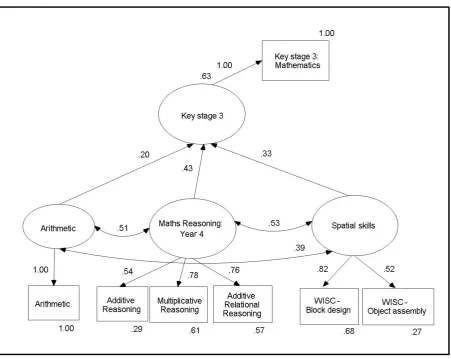
Figure 4 Structural equation model of the relationships between Arithmetic, Maths
Reasoning: Year 4, Spatial Skills, and Key Stage 2: Mathematics achievement
Figure 5 Structural equation model of the relationships between Arithmetic, Maths
Reasoning: Year 4, Spatial Skills and Key Stage 3: Mathematics achievement
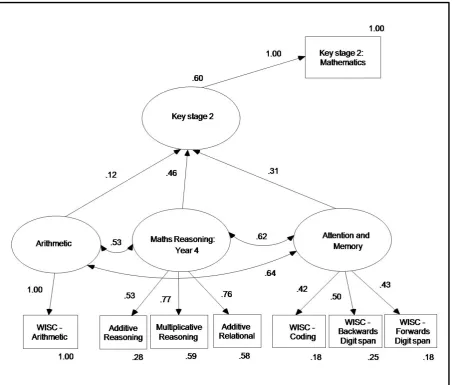
Figure 6 Structural equation model of the relationships between Arithmetic, Maths
Reasoning: Year 4, Attention and Memory Tasks, and Key Stage 2: Mathematics achievement
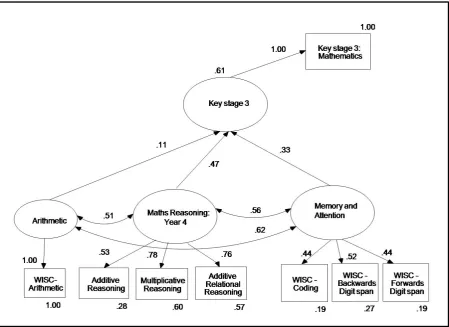
Figure 7 Structural equation model of the relationships between Arithmetic, Maths
Reasoning: Year 4, Attention and Memory Tasks, and Key Stage 3: Mathematics achievement
Figure 8 Mothers’ Educational Levels and the children’s attainment scores in the Key
Stage 1, 2 & 3 mathematical assessments
Figure 9 Mothers’ Educational Levels and the children’s scores in the three
mathematical reasoning tasks
Figure 10 Mothers’ Educational Levels and the children’s scores in the WISC Arithmetic
and Block Design tasks
Figure 11 Distribution of Key Stage results by different levels of mother’s education
Figure 12 Path analysis of mathematics reasoning Y4 as mediator between social
background and KS2 maths attainment
Figure 13 Path analysis of mathematics reasoning Y4 as mediator between social
background and KS3 maths attainment
Figure 14 Path analysis of mathematics reasoning Y6 as mediator between social
Figure 15 Path analysis of mathematics reasoning Y6 as mediator between social background and KS3 maths attainment
Figure 16 Structural equation model showing the influences of maths and reading/oral
ability on teachers’ perceptions of children’s general ability
Figure 17 A structural equation model that shows the relation between the children’s
self-confidence in maths and the different factors that explain independent variance in their self-confidence
Figure 18 Children’s self confidence in maths and liking of other subjects
Figure 19 Graphs showing the relation between the children’s competence and their
self-confidence in maths for each of the streams in mathematics teaching.
Figure 20 Children’s attainment in KS2 maths, self-confidence and competence in maths
Figure 21 Examples of Items in Y4 Mathematic reasoning tests
Figure 22 Examples of items in the Y6/8 Mathematical reasoning tasks
Figure 23 An item that illustrates the Block Design task
Acknowledgements
We are very grateful to the DCSF team of Stephen Witt, Deborah Wilson and Ali Bushell for the careful and sensitive support and also for the excellent advice that they have given us throughout this project, and to the DCSF for the financial support that made the project possible. We are extremely grateful to all the families who took part in this study, the midwives for their help in recruiting them, and the whole ALSPAC team, which includes interviewers, computer and laboratory technicians, clerical workers, research scientists, volunteers, managers, receptionists and nurses. The UK Medical Research Council, the Wellcome Trust and the University of Bristol provide core support for ALSPAC. This publication is the work of the authors who will serve as guarantors for the contents of this
paper. This research was specifically funded by the DCSF. We would also like to thank Kerry
1
Executive Summary
Introduction
The project looked at the development of competence in different aspects of maths and the effect of this on young people’s key stage results. It used data from a large longitudinal survey of young people (ALSPAC - the Avon Longitudinal Survey of Parents and Children) which has unique information on levels and patterns of understanding in mathematics at different stages of young people's progress through primary and early secondary school.
Key Findings
• Mathematical reasoning, even more so than children’s knowledge of arithmetic, is
important for children’s later achievement in mathematics
o Mathematical reasoning and knowledge of arithmetic (as assessed in year 4)
make independent contributions to children’s achievement in mathematics in KS2 and 3. While both are important, mathematical reasoning is more important than knowledge of arithmetic for achievement in KS2 and 3.
• Spatial skills are important for later attainment in mathematics, but not as important
as mathematical reasoning or arithmetic
o The influence of spatial skills (being able to rotate and manipulate shapes and
imagine the results of these actions) play a role in achievement that is independent both of mathematical reasoning and arithmetic. This role increases from KS2 to KS3 as the teaching of geometry gains in importance and spatial competence is being tested.
• Children’s attention and memory also plays a small but consistent part in their
mathematical achievement
o The ability to focus and maintain attention and to remember relevant
information are important factors in mathematics achievement, even after controlling for individual differences in arithmetic and mathematical reasoning.
• Children from high socio-economic status backgrounds are generally better at
mathematical reasoning than their peers
• Streaming, or ability grouping, in Primary school improves the mathematical
reasoning of children in the top ability group, but the effect is small. It hinders the progress of children in the other groups.
• Children’s self confidence in maths is predicted most strongly by their own
competence, but also by gender (girls are less confident than boys) and by the ability group in which the child is placed. Children’s attainment, although largely determined by cognitive and social factors, is also influenced by their self-confidence.
2
Background
Quite striking differences in mathematical achievement exist among children in the UK and in other countries. We need to be particularly concerned about pupils who do not succeed in mathematics at school and about the general level of mathematical skills in the population and the UK’s ability to compete in the world market with other technologically advanced societies.
The more we can find out about differences in mathematical achievement and their causes, the more likely it is that we will also find ways of helping those who have difficulties in learning about mathematics.
There are several possible reasons for differences among children in mathematics achievement. Some are cognitive: it is quite possible that differences in some underlying cognitive skill, such as the ability to reason about mathematical relations, or to calculate, or to pay sustained attention in the classroom and remember information, might determine how well and how badly children do in mathematics at school. Other possible reasons are social, such as the child’s own social background or the social composition of the school that the child goes to, or the influence of their experience at home or school.
Still other reasons for differences in mathematics learning could be categorised as affective: among these are the children’s self-confidence in mathematics and in their ability to learn in the future. Each of these ideas is plausible enough, and yet up to now very little progress has been made in determining why children differ so widely in mathematics.
Methodology
There were four main research questions:
1. Are there differences in the development of specific types of mathematical
understanding and if so, how do these influence pupils’ progression across the Key Stage 1-3 period?
2. Is the development of some mathematical skills more important for progression than others?
3. Are there differences in the development of skills by gender, ethnicity, or socio-economic factors, such as parents’ education or SES?
4. How is development of understanding affected by children’s self perception of their own ability in maths?
To answer these questions we used the large and impressive data bank collected in the ALSPAC study. This contains more than 14000 children born in Avon in the West of England in 1991- 92 and it has followed them over the whole of their childhood. The data include plentiful information on possible underlying cognitive differences, on the wide range of the children’s social backgrounds and on relevant affective variables, such as their self confidence in their own abilities.
3
Very nearly all our analyses were about how well a particular predictor was related to an outcome measure that was given some time later. Our main outcome measures were the mathematics assessments at Key Stage 2, when the children were 11, and at Key Stage 3, when they were just 14. The predictor variables were cognitive, social and emotional measures, many of which were administered three years before the Key Stage 2 and six years before the Key Stage 3 measures.
The most successful of the cognitive predictors were two mathematical reasoning tasks, one of which was given when the children were 8 and the other when they were 10 and again at 12. All the other cognitive predictors were sub-tests of the WISC (Wechsler Intelligence Scale for Children). Our social measures were of the children’s self-perception and their parents’ SES: we used measures of the mother’s and the father’s social economic status, as defined by their occupations, and of the mother’s educational level.
Our self-perception and self-confidence scores were based on a measure of how much the children liked maths in Year 3 and their self-perception as learners of maths in Year 4. These two measures were highly correlated (r=.83) even though they were given to the children in different school years. We integrated the information from these two measures into a single factor and treated this as a measure of a single concept, children’s self-confidence in mathematics.
We analysed the relations between the predictor and the outcome variables in three main ways:
1. Through multiple regressions in which we usually looked at the effect of different variables on the outcome measure. These regressions provide a measure of the contribution that each predictor variable makes to the outcome measure independent of all the other predictor variables.
2. Through Structural Equation Models (SEMs) in which we measured the strength of the pathways between the predictors and the outcome measure and considered whether these pathways went directly from the predictor to the outcome measure or indirectly through another predictor variable.
3. Through multi-level modelling in which we looked at the level at which social variables operated. One was at the level of the individual, and the other at the level of the school. Thus, our aim was to see how much of the difference in children’s
mathematical abilities was due to differences in the children’s own SES status and how much to the SES composition of the pupils in the schools that they go to.
Findings and Implications
Mathematical reasoning, even more so than children’s knowledge of arithmetic, is important for children’s later achievement in mathematics
Arithmetic here is defined as ‘learning how to do sums and using this knowledge to solve
problems’, mathematical reasoning is ‘learning to reason about the underlying relations in
mathematical problems they have to solve’ and can include both additive and multiplicative reasoning.
Finding: Children’s ability to reason about mathematical relations was easily the most
powerful predictor of children’s mathematical achievement, out of all the relevant cognitive measures in the ALSPAC data bank. It strongly predicted their mathematics achievement in Key Stage 2 and 3 assessments even after controls for the effects of differences in
4
Implication: It is important to promote reasoning about mathematical relations in primary
school. Children at risk for difficulties in mathematics can be identified early through mathematics reasoning assessments and receive early intervention, which would translate into better mathematics achievement later on.
Finding: The contribution of calculation skills to mathematics achievement was modest but it
was independent of reasoning.
Implication: In the context of time pressures, more time should be allocated to developing
children’s reasoning than to practising calculation skills.
Finding: Mathematical reasoning scores were strongly related to the Key Stage mathematics
assessments, less strongly but quite well related to the science assessments, and only weakly related to the English assessments. The relation between mathematical reasoning and the science assessments was stronger with the Key Stage 3 than with the Key Stage 2 assessments.
Implication: The teaching of both science and mathematics could benefit from an analysis of
the forms of mathematical reasoning used in science and from the close coordination of the teaching mathematics and science at school. This coordination should be particularly beneficial in the education of older primary school children.
Spatial skills are important for later attainment in mathematics, but not as important as mathematical reasoning or arithmetic
Finding: Children’s spatial skills also predicted their Key Stage mathematics results, but to a
lesser extent. Spatial skills were more important for Key Stage 3 than Key Stage 2
achievement. Children’s achievement in the mathematics reasoning questions about space was very modest.
Implication: Greater attention to children’s spatial reasoning in mathematics lessons should
improve children’s achievements in geometry.
Children’s attention and memory also plays a small but consistent part in their mathematical achievement
Finding: Memory and attention also made a modest, but independent, contribution to
children’s mathematical achievement in Key Stage 2 and 3. Some children may be at risk for difficulties in learning mathematics due to low performance in these cognitive factors.
Implication: Recent developments in research that show that it is possible to improve
children’s attention and memory through training. This should be considered as part of a personalised programme for children at risk.
Children from high SES backgrounds are generally better at mathematical reasoning than their peers
Finding: Individual children whose SES status is high are on the whole better at
5
SES also operates at the level of the school. Children, who go to Primary schools in which the SES composition is high, reason about mathematics more successfully than children at schools with a lower SES composition, whatever their own social background.
Implication: The identification of a mechanism that mediates the connection between SES
and mathematics achievements should help us to explain the effects of social background on mathematics achievement. In addition, improving children’s mathematical reasoning through instruction in school can make an important contribution to reducing SES inequalities in mathematics achievement.
Streaming, or ability grouping, in primary school improves the mathematical reasoning of children in the top ability group, but the effect is small. It hinders the progress of children in the other groups.
When young people were in Year 3, teachers were asked in which stream or ability group the target children were placed for maths, but this did not distinguish between putting children into different classes according to ability (streaming), or grouping pupils by ability within classes (ability grouping).
Finding: Streaming only improves mathematical achievement of children in the top ability
group, but this effect is small. It actually hinders the progress of children in the other groups. It also influences children’s self-confidence in maths: children of the same level of ability placed in a lower ability group are less confident in their ability than those placed in a higher group.
Implication: Schools need to consider alternatives to grouping children by ability levels if
they want to promote higher achievement for children with all levels of ability.
Children’s self confidence in maths is predicted most strongly by their own
competence, but also by gender and by the ability group in which the child is placed.
Finding: Children’s self-confidence in mathematics is predicted most strongly by their own
mathematical competence but also, independently by their gender (girls are less confident than boys) and by ability group. Children’s attainment in Key Stage 2 and 3 mathematics, although largely determined by cognitive and social factors, is also influenced by their self-confidence.
Implication: It is important to pay attention to the affective aspects of children’s mathematics
6
1.
Introduction
The least controversial proposition that one could make about children’s success in learning mathematics is that it varies a great deal from child to child. Some children learn
mathematics quickly and well; others make only slow progress and abandon the subject as soon as they are allowed to do so. These differences operate at different levels. They occur at the individual level, since even children at the same schools and from much the same social backgrounds vary a great deal from each other in their mathematical development (Dowker, 2005), but there are also striking and consistent differences between children in
different countries (TIMS: PISA : Stevenson et al., 1985, 1986; Stigler et al., 1987), from
different social backgrounds (Reyes & Stanic, 1988; Sacker, Schoon & Bartley, 2002) and, as we shall show later in this report, in different schools. Children’s success in mathematics, therefore, depends not just on their own abilities and motivations but also on their family, their school and their nationality.
There are two good reasons to study why these differences occur. The more obvious of the two is that they are a serious cause for concern. Adults with low mathematics skills are more likely than those with low literacy skills to be unemployed; among those employed, low numeracy skills are a stronger predictor than low literacy skills of low levels of employment (Bynner & Parson, 2000). So, those who do poorly in the subject and have learned very little about it by the time that they leave school are likely to suffer at work as a result, especially in a technological society in which mathematical skills are increasingly needed (Noss & Hoyles, 1992, 1996). For the same reason, society at large may suffer if there is a shortage of
mathematical skills in the community. The generally declining number of pupils who pursue mathematics after the age of 16 in the UK suggests that this is a particular danger for this country. We urgently need to find ways of removing the difficulties that so many children encounter in mathematics lessons and thus to decrease the spread and improve the general level of mathematical abilities among schoolchildren.
The second reason, a related one, for paying close attention to differences in mathematical success is as important as the first. It is that research on this issue could give us information that we badly need about the basis for children’s success or lack of it in mathematics. By studying the factors that are related to how well children do in mathematics, we should be able to identify the kind of experiences that children should have, and the kind of teaching that they should be given, to help them most effectively. We can consider, for example, what underlying skills determine how well children do in mathematics: how important is it for children to be able to take in and remember mathematical information well, to calculate efficiently and to reason about mathematical relations logically? We can study, too, the social and emotional bases of children’s mathematical success, such as their liking of mathematics and their self-confidence in their own mathematical ability and also the effect on their
mathematical learning of their family background in socio-economic terms and of the school that they happen to be in. Convincing answers to any of these questions should make it easier to devise a better system for teaching mathematics than we have already.
7
own social background from the effects of the social composition of the school that he or she is attending.
The Avon Longitudinal Study of Parents and Children (ALSPAC) offers an almost unique opportunity to surmount these research obstacles. This impressive project has accumulated a wealth of data on a representative group of slightly more than 14,000 children. The large body of data in the project includes information about the children’s educational progress, including their progress in mathematics, and their performance in several relevant
psychological tests such as a well-known intelligence test and a test of mathematical reasoning that was given to a sub-sample of the children when they were 8-, 10- and 12-years old. The size of the ALSPAC sample and the longitudinal nature of the data about them remove the difficulties that have hindered the progress of so much previous research on differences in children’s mathematical learning.
8
2.
Background
2.1 Cognitive
issues
Two kinds of cognitive issue will be analysed in this investigation: issues that are specific to mathematics learning, and issues that are related to children’s cognitive processes and skills in general and are not specifically mathematical.
2.1.1 Learning mathematics: the nature of the task
Learning mathematics in primary school involves learning about numbers, quantities and relations, and about the connections and distinctions between these three concepts.
Numbers and quantities are not the same. A quantity can be represented by a number but we do not always need to measure a quantity and represent it by a number: we can compare one person’s height to another’s, for example, without any measurements or numbers.
Thompson (1993) provided a framework which we shall use throughout this report when he distinguished between numbers, quantities and relations. According to him “Quantitative reasoning is the analysis of a situation into a quantitative structure - a network of quantities and quantitative relationships. A prominent characteristic of reasoning quantitatively is that numbers and numeric relationships are of secondary importance, and do not enter into the primary analysis of a situation. What is important is relationships among quantities”
(Thompson, 1993, p. 165). Elsewhere, Thompson (1994) emphasised that “a quantitative
operation is nonnumerical; it has to do with the comprehension (italics in the original) of a
situation” (p. 187-188).
9
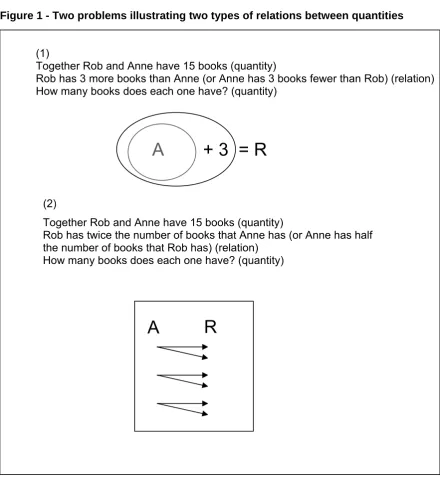
Figure 1 - Two problems illustrating two types of relations between quantities
(1)
Together Rob and Anne have 15 books (quantity)
Rob has 3 more books than Anne (or Anne has 3 books fewer than Rob) (relation) How many books does each one have? (quantity)
One characteristic of relations, which distinguishes them from quantities, is that they have a converse: if A is greater than B, then B is smaller than A. So understanding relations involves understanding the connections between these two ways of thinking about the same relation.
In order to learn mathematics, children must be able to coordinate their understanding of quantities with their understanding of relations, and must also distinguish between them. We can think about relations between quantities and represent the relation by a number even if we do not know what the quantities are. For example, if Paul plays a game of marbles and wins 7, then plays a second game and loses 1, and then plays a third game and loses 2, we know that at the end of the three games he has 4 more marbles than before. However, we do know not know how many marbles he has nor how many he started with.
Numbers are signs, spoken or written. Each number sign is part of a network of signs (i.e. all other numbers), the meanings of which are interconnected. Children can be said to truly understand the meaning of numbers only when they understand, for example, that all sets with the same number of objects are equivalent and that if two sets are equivalent they necessarily have the same number of objects (Piaget, 1952). They should also understand,
A
+ 3 = R
A
R
(2)
Together Rob and Anne have 15 books (quantity)
Rob has twice the number of books that Anne has (or Anne has half the number of books that Rob has) (relation)
10
for example, that 4 is one less than 5 and one more than 3, and that you only change the number in a set if you add or subtract elements. These meanings are part of the network of meanings in a number system.
Numbers can be used to represent both quantities and relations. Quantities and relations are meanings for numerical signs and children must learn how to interpret numbers by
connecting them to quantities and relations and must also learn how to represent quantities and relations by numbers.
2.1.2 Theories about children’s mathematics learning
Current hypotheses about the cognitive processes involved in children’s mathematical learning fall into two broad camps. One stresses the importance of numbers and procedures related to determining the number in a set, such as counting, remembering number facts and calculating. The other emphasises the significance of children being able to understand quantities and relations and being able to reason logically and imaginatively about them.
The first type of theory, which focuses on numbers without considering quantities and relations, is best exemplified at pre-school age by the ideas of Gelman and Gallistel (1978). They argued that children are born in possession of innate, psychological mechanisms that eventually make it possible for them to learn, and to understand, the counting system with very little difficulty. With the help of these innate mechanisms children, who are learning to count, immediately apply a set of essential principles, such as the principle of cardinality, which Gelman and Gallistel define as the knowledge that the number of items in a set that they have counted corresponds to the last number that they produced in the count.
Other researchers (Dehaene, 1997; Butterworth, 2003; Durand, Hulme, Larkin, & Snowling, 20005) agree on the central importance of pre-school children’s knowledge of the counting system but, when considering school-age children, have turned to children’s success in comparing the magnitude of different numbers as a crucial index of mathematical ability, independent of or in coordination with knowledge of counting (Gelman & Butterworth, 2005). Still others (Geary & Brown, 1991) have argued that the ability to carry out simple
calculations and to remember number facts lies at the heart of children’s mathematical successes and failures. Children first learn how to use numbers and carry out calculations and later, through their use, come to understand why the procedures work (i.e. the concepts on which they are based).
All these theories agree in stressing the importance of the numerical procedures that children have to conquer at the start of their mathematical career at school without any reference to their understanding of quantities or relations. However, there is evidence that children can use these procedures without understanding their connection with quantities, and this shows that learning about numbers by themselves is not sufficient for learning mathematics in school. Fuson (1988), for example, showed that 3-years old children who satisfied Gelman’s criterion for using the cardinality principle continue to use the last number word in the
counting sequence to say how many items are in a set even if the counting started from two, rather than from one. Freeman, Antonuccia and Lewis (2000) also assessed 3- and 5-year-olds’ rejection of the last word after counting if there had been a mistake in counting. The children watched a puppet count an array with either 3 or 5 items, but the puppet
miscounted, either by counting an item twice or by skipping an item. The children were asked whether the puppet had counted right, and if they said that the puppet had not, they were asked to evaluate the puppet’s knowledge of the cardinal for the set. Although all children had shown that they could count 5 items accurately, only about one third of the children were
able to say that the answer was not right after they had detected the error. These results
11
between counting and the quantity represented. After observing a puppet counting wrongly, about two thirds still believed that the cardinal for the set is the last word used in the counting string.
There is also evidence that later, at school age, children continue to learn how to carry out operations with numbers - i.e. they learn number facts and computation - but may not know when to use them. In Thompson’s terms, they may not understand the relations between quantities in problem situations well enough to know how to use numerical operations to solve a problem. Teachers are well aware of this discrepancy between knowing how and when to do sums, and there is research that supports their practical knowledge: two problems that require the same computation may have radically different levels of difficulty because they differ in the demands that they make of children’s understanding of relations between quantities (e.g. Brown, 1981; Bryant, 1985; Carpenter & Moser, 1982; Thompson, 1993).
The fact that children often know about numerical symbols and procedures and yet fail to use them to solve problems about quantities and relations can be interpreted in different ways. One possibility is that children’s counting and calculation skills develop independently of their understanding of quantities and relations between quantities. According to this hypothesis, this number knowledge should be a predictor of children’s mathematics achievement independently of their ability to reason about quantities and relations. The latter should play no role in predicting mathematics achievement. An alternative hypothesis has been proposed by some researchers (e.g. Baroody & Gannon, 1984; Siegler & Crowley, 1991) who
acknowledge that children often learn numerical procedures without understanding their conceptual basis. They suggest that, by learning procedures and practising them, children eventually understand the principles behind them.
These distinct possibilities are worth testing in a longitudinal study because there is so far no evidence for the idea that children’s knowledge of number facts and calculations forms the basis for the development of their mathematical reasoning. A prediction from it about school children is that their knowledge of number signs and computation at an early age predicts their later understanding of quantities and relations and also their mathematics achievement. The present study will provide a test of this hypothesis.
The second type of theory focuses instead on the importance of children’s reasoning about quantities and relations for mathematical learning, and assigns numerical procedures only a secondary and sometimes a very minor role. Piaget’s theory, of course, is the best known example (Piaget, 1952; Piaget & Inhelder, 1974; 1975) but many other researchers have since stressed the significance of understanding quantities and relations for children’s mathematics learning (e.g. Brown, 1981; Carpenter & Moser, 1983; Clements, Copple & Hyson, 2005 ; Ginsburg, Klein, & Starkey, 1998; Thompson, 1994; Vergnaud, 1979, to name only a few). This theoretical approach is at odds with the view that what matters is children’s knowledge of numerical procedures on every important point.
12
A report by Stern (2005) on some of the results of the impressive Munich longitudinal study of development did provide some interesting support for the importance of reasoning about relations and quantities for later mathematics learning. She showed that a measure of children’s understanding of the inverse relation between addition and subtraction when they were eight years old was a good predictor of their performance in an algebra test many years later in university, even after allowing for differences in the participants’ intelligence. In fact, the measure of the children’s understanding of the inverse relation between addition and subtraction correlated as highly with their performance in algebra as the measure of the children’s general intelligence that had been obtained at the same time.
Another longitudinal study, this time in the U.K., shows that differences between children in their understanding of quantities and relations in a measure obtained when they start school
predict their mathematics achievement later (Nunes et al., 2007). The interval between the
predictor (a measure of children’s understanding of relations) and the outcome (KS1 Maths) was certainly more modest than that in the Munich study because the children’s mathematics achievement was measured through their Key Stage 1 results, about a year and a half after the measure of mathematical reasoning had been administered. Nevertheless this is quite an important result because the study was longitudinal and appropriate controls were used in the analysis: the contribution of children’s reasoning to the prediction of mathematics achievement was still considerable even after controlling for the children’s specific
knowledge of number and for general cognitive skills. The study was carried out with a small sample (59 children); evidence from a larger sample is urgently needed before one could draw implications for practice with great confidence. The present study will test this
hypothesis longitudinally with a very large sample and over much longer intervals between the assessment of the children’s reasoning and the measures of their mathematics
achievement.
In summary, the evidence for both sets of theories regarding the prediction of mathematics achievement is sketchy. Longitudinal studies, which are so vital in this context, are so far very limited. The opportunities, therefore, that are provided by the ALSPAC study, are welcome and timely.
2.1.3 The importance of general cognitive processes
In the previous sections, we considered what children need to learn to be successful
mathematics learners and the theories about the development of mathematics knowledge. In this section we consider general cognitive processes. No one would doubt that children’s intelligence plays a role in their mathematics learning. The question is which aspects of children’s intelligence have a specific connection with their mathematics learning.
Measures of children’s intelligence assess a verbal and a non-verbal component. The connection between the verbal component and children’s mathematics achievement is usually high: children’s understanding of the teacher’s verbal explanations in any context affects what they learn from instruction. Their reading ability also affects their performance in problem solving when the problems are presented in written form. However, this connection is not specific and does not help us understand children’s mathematics achievement. In order to understand the connection between children’s intelligence and their mathematics achievement, we need to take the concept of intelligence apart and to identify specific
components that influence mathematics achievement. After accomplishing this, we could ask whether it is possible for education to help children at risk for difficulties in mathematics due to low performance in these specific measures.
13
• pay attention to information in whatever form it is given to us (for example, in a story
about a situation);
• pick out and remember the relevant parts of this information;
• remember number facts and procedures that help us answer the question we want to
answer.
Researchers have proposed some hypotheses regarding the importance of these general cognitive processes for children’s mathematics learning. One of these hypotheses is about memory and attention. When children use a computation procedure in order to solve a subtraction or a division sum with four digits, for example, or when they solve an applied problem, they need to keep in mind the information in the problem and the steps to implement the solution, while monitoring what they have done and what still needs to be done. Working memory is the ability to keep information in mind and at the same time operate on it. It is therefore expected that working memory should affect how well they can keep numerical information in mind and thus their success with mathematical procedures and problem solving. The hypothesis that working memory determines children’s
mathematics achievement has been proposed by many researchers both in the U.K. and in other countries (e.g. Hitch & McAuley, 1991; Towse & Hitch, 1995; Adams & Hitch, 1997; McLean & Hitch, 1999; Siegel & Linder, 1984; Siegel & Ryan, 1989) but so far there is little evidence for it from large scale longitudinal studies.
Attention is most certainly involved in working memory but it can be measured relatively independently of memory. Most teachers would agree that some children make mistakes in solving problems that they should solve correctly because they do not pay sufficient attention to what they are doing. No specific theory links attention to mathematics learning but
teachers’ practical knowledge can be analysed in the context of this study. Contemporary measures of children’s intelligence, such as the Wechsler Intelligence Scale for Children (WISC), show that measures of attention and memory are strongly related and seem to assess a single component, called “freedom from distractibility”.
It has also been suggested that we must be able to use our visual and spatial skills in the process of attending to and interpreting information (see, for instance, a collection of papers edited by Zimmermann & Cunningham, 1991, which discusses the role of visualisation in algebra, calculus and computer programming). For example, if we are asked a question like, “The head teacher has 36 books to distribute to classes Pink and Yellow. There are more children in class Pink so she decides to give 6 more books to class Pink than to the Yellow class. How many books will each class receive?”, it should help to imagine from the start a pile of books for class Pink that is taller than the one for the Yellow class, and has 6 books more. The problem then becomes trivial: all we need to do is separate out the 6 extra books for class Pink and share the remaining 30 books equally between the two classes.
Imagination in this case helps us solve the problem and we do not need to know anything about the order in which the operations of subtraction and division should be carried when solving problems. Thus, although spatial and visualisation skills are general cognitive skills, they might play a specific role in predicting children’s mathematics achievement.
14
2.2
Social and emotional issues
Cognitive factors are arguably central to children’s mathematics learning but cognition is not the only factor that influences children’s learning, which is not free from social and affective influences. In this section we discuss social influences connected to children’s own
characteristics (social background, ethnicity and gender), connected to school practices (streaming) and affective factors in mathematics learning (children’s self-confidence in mathematics).
2.2.1. Socioeconomic status and mathematics learning
There is a strong relationship between school children’s social background and what they achieve in mathematics at school, both at early stages (Ginsburg & Russell, 1981) and later on (Lee & Bryk, 1989; Reyes & Stanic, 1988; Sacker, Schoon, & Bartley, 2002; Tate, 1997). As in other school subjects, so in mathematics, children from more prosperous families do better than children with less prosperous backgrounds in the classroom and in exams. This is a consistent and also a familiar correlation, but it raises some unanswered questions.
One is about mediators: there must be a channel of some sort between children’s social background and their mathematical success, some factor or factors associated with social background that lead to children from high SES families having relatively more success in mathematics than others from lower SES backgrounds.
Several related possibilities have been discussed in the literature. One is that children from different backgrounds come to school with different sorts of mathematical knowledge.
Children from lower SES know some things about mathematics, those from higher SES know other things, and these different forms of knowledge affect what they learn in school and how they perform in school tasks. Ginsburg and Russell (1981) have indeed observed these different levels of performance between children from different social backgrounds on various mathematical tasks at pre-school level. However, their study did not allow for conclusions on the influence of these different skills in relation to the children’s mathematics learning in school because it was not a longitudinal study.
A second possibility is that the link between SES and mathematical achievement happens as a result of associated differences in what is often called “cultural capital”. There might be differences in the material that supports mathematical learning at home, such as access to a computer, or the presence of a clock, books, comics and games (e.g. Snakes and Ladders) at home, and the activities that are associated with these objects. For example, learning to use a computer involves learning to follow rules in a rigorous order, a sort of knowledge that could prepare children for learning computation algorithms in school. Children who have a watch or a clock in their bedrooms might learn more about time than those who do not, and thus have an advantage in school. Previous research (Siegler & Ramani, 2009) has shown that children’s performance in some number tasks was improved by an intervention in which an experimenter played a board game like Snakes and Ladders with the children: having board games at home, therefore, might give children a head start in number tasks. These differences in the cultural capital might be the underlying reason why children from more prosperous families do relatively well in mathematics.
15
benefit can operate in two ways. First, achievement tests may draw more on the sorts of knowledge developed by higher SES students, and thus they would perform better. This is the argument formulated when one asks whose knowledge gets into tests. Second, the un-stated, implicit curriculum may include more of the sort of knowledge developed outside school by students from higher SES backgrounds, leaving students from lower SES backgrounds to fend for themselves in achieving this sort of knowledge, exactly because it remains implicit.
Finally, social background might have a direct effect on some underlying ability which in turn influences how well children do in mathematics at school. This kind of mediation seems quite plausible if one accepts that relatively well educated parents may be readier than others to discuss mathematical ideas and to promote mathematical thinking with their children at home. This kind of informal interaction, if it has any effect at all, is likely to encourage children to think about quantities and mathematical relations and therefore to reason mathematically. Thus, children’s mathematical reasoning might be the mediator between social background and children’s mathematics.
These are not alternative hypotheses and it is quite likely that they operate together. For example, if children from higher SES backgrounds have more opportunities to engage in
informal interactions that promote mathematical reasoning in school and if schools leave
much of the learning about mathematical reasoning implicit in the curriculum, then children from lower SES background would start school at a disadvantage and also have fewer opportunities to develop the reasoning skills which they need to develop in order to learn better the mathematics that they are taught explicitly.
One must also consider that SES levels influence children’s mathematics achievement at the level of the school as well as at the individual level. The average social class of the school has an effect on students’ achievement above and beyond the effect of the individual’s social class (Alexander, McDill, Fenessy, & D'Amico, 1979; Melhuish, Romaniuk, Sammons, Sylva, Siraj-Blatchford, & Taggart, 2006; Opdenakker & Van Damme, 2007). So it is quite possible that the social composition of the pupils in a school might influence the underlying abilities that form the basis for learning mathematics in school. In other words, whatever their own social background, children might be more likely to develop mathematical reasoning well in a school in which the average SES level is high than in one with a lower average SES
composition. As far as we know, there is evidence for the effect of schools’ different social compositions on mathematics achievement in standardised assessments (e.g. Lee & Bryk, 1989; Reyes & Stanic, 1988; Sacker, Schoon, & Bartley, 2002; Tate, 1997) but not in assessments of mathematical reasoning that would explain differences in the achievement measures.
16
2.2.2 Ethnic background
Different studies have documented that there is a gap between students from minority ethnic groups and those from the dominant group in the society in school achievement in general and also specifically in mathematics (e.g. Secada, 1992; Tate, 1997). Although SES and ethnic background are confounded in many studies, ethnic differences in mathematics attainment persist even when SES is controlled for (Green, Dugoni, Ingels, & Cambum, 1995).
There is only a reduced percentage of children in the ALSPAC sample with minority ethnic backgrounds. This study will investigate effects of ethnicity on mathematics learning as far as possible within the sample and using controls for SES background.
2.2.3 Gender
The study of gender differences in mathematics achievement captured much interest from researchers for about two decades but is has attracted less attention in this last decade because it has become progressively clear that, of the groups that define inequalities in mathematics learning - gender, ethnic origin and social background - gender has the least impact. Lubienski and Bowen (2000) carried out a survey of the studies that analyse group differences in mathematics attainment and report that gender differences were the focus of the largest number of publications about inequalities in education during the 80s and 90s; they located 323 articles about gender effects on mathematics attainment, 112 about effects of ethnicity and 52 about SES effects. After some speculation on the importance of gender differences in brain structure and how the age of adolescent maturation could influence mathematics learning (see Leder, 1992), a sort of speculation that made gender into a biological variable, gender has become firmly placed in the realm of social influences on mathematics learning.
In his review of research on gender, Tate (1997) concluded that, although males tend to perform better than females on standardised tests, effects tend to be small and generally non-significant. Lockheed, Thorpe, Brooks-Gunn, Casserly, and McAloon (1985) observed
that the interaction between gender and ethnicity was more important than gender effects per
se, and criticised previous research in which this interaction had not been analysed.
In this study, we will analyse both gender effects and the interaction between gender and ethnicity. The variation in ethnic background is restricted in the ASLPAC sample, but there is still a sufficiently large sample for an analysis to be carried out.
2.2.4 The effects of streaming on mathematical reasoning
Slavin (1990, p. 472) defines streaming as between-class ability groups, an arrangement in which students are placed in different abilities across all subjects. This form of ability
grouping is found more commonly in secondary schools; primary schools tend to use within-class ability grouping, which allows for the assignment of the same student to different ability groups in different subjects. In spite of his recognition of this difference, in his review of the effects of streaming, he included both between-class and within-class ability grouping in his analysis (p. 475). Slavin (1990) and Boaler (1997) carried out excellent reviews of the impact of ability grouping on mathematics learning. Both reviews led to the same conclusion: that streaming only benefits students placed in the top ability group and, even so, just
17
In the studies reviewed, the evidence is based on achievement tests, without the benefit of a measure obtained independently which could be used to assess whether students with the same level of measured ability but placed on different streams for mathematics teaching perform differently.
In this study, it will be possible to carry out an analysis of the effects of streaming on students’ achievement controlling for an independent measure of their mathematical
reasoning. When the participants were in Year 3, the teachers were asked in which stream or ability group the target children were placed for maths and for English. Their response with respect to maths could either indicate that the school did not use streaming or the stream or ability group in which the child was placed. This information will be used in subsequent analyses. The expressions “stream” and “ability group” will be used interchangeably, as they were used in the questionnaire, but streaming will be used more often for brevity.
2.2.5. Affective factors: children’s self-confidence in mathematics
The DCSF publication “Making Good Progress in Key Stage 3 Mathematics” reports that pupils who struggle to progress from Level 3 to 5 in mathematics have a low self-concept as mathematics learners: they feel that they were never able to do maths and have become used to not understanding mathematics. This makes it important for research to describe what influences children’s self-perception as mathematics learners and also how it relates to mathematical ability. It is possible that low self-concept as a mathematics learner is a result from low achievement. It is just as plausible that the reverse is true: low self-confidence results in low achievement. These are not necessarily alternative hypotheses: both may be true, with achievement and self-confidence reinforcing each other over time.
Past research has shown that at least four factors influence individual differences in children’s self-confidence in maths:
• their mathematics competence (Marsh, 1986; Pretzlik, Olsson, Nabuco, & Cruz, 2003);
• others’ (i.e. their teachers’ perception and their peers’) perception of their ability
(Crocker & Cheeseman, 1991; Dermitzaki & Efklides, 2000; Pretzlik, Olsson, Nabuco, & Cruz, 2003);
• gender (girls are reported to have less confidence in their mathematical ability than
boys and to attribute their success more to luck than to ability, whereas boys do the opposite; Fennema, 1977; Fennema & Peterson, 1985);
• their verbal ability (past research shows a small negative correlation between verbal
ability and self-perception as a learner of maths; Marsh, 1986; Marsh & Yeung, 1997; Skaalvik & Rankin, 1995).
There are conflicting results concerning the importance of these affective factors in the prediction of later achievement. Mortimore, Sammons, Stoll, Lewis and Ecob (1988) found that attitudes and achievement were almost independent of each other whereas Pajares and Miller (1994) found that pupils’ attitudes were related to achievement. It is quite possible that
these discrepancies result from the use of different measures: in the study by Mortimore et
al., the measures were of attitudes towards the subject and in the study by Pajares they
18
In this study, we investigate the relative importance of the four factors listed earlier on for predicting children’s confidence in maths. We also investigate whether children’s self-confidence makes a contribution to explaining later achievement after controlling for cognitive measures that predict achievement. The ALSPAC data base offers a unique opportunity to study these factors longitudinally: at approximately the same time, the children were given measures of mathematical reasoning, self-perception as learners of mathematics, and their liking of mathematics. These measures preceded the Key Stage 2 and 3 assessments, thus providing the opportunity of an analysis of their power in a longitudinal prediction.
2.3 Summary
Children vary considerably in what they achieve in mathematics at school. The
consequences of this wide variation are significant both for the children themselves and for society, given both the importance of mathematical ability for progress in education and employment and also the competitiveness of contemporary societies in the global economy.
19
3. Method
3.1
The ALSPAC Sample
The Avon Longitudinal Study of Parents and Children (ALSPAC) project has accumulated a wealth of data on slightly more than 14,000 children, born between April 1991 and December 1992 in the geographical region in the West of England that was covered at the time by the Avon Health Authority. The sample is not only a large but also a representative one, since it includes over 80% of the children born in the area during the 21-month recruitment period. The large body of data in the project includes a great deal of information about the children’s educational progress, including of course their performance in mathematics and in several relevant psychological tests, such as a well-known intelligence test, the Wechsler Intelligence Scale for Children (WISC; Wechsler, 1992), a test of mathematical reasoning that was given to a sub-sample of the children when they were 8-, 10- and 12-years old, and a measure of children’s self-perception as learners of mathematics. The data bank also provides
information about the children’s social background and about their schools
3.2
The cognitive measures
3.2.1 Mathematical Reasoning - the Year 4 and the Year 6/8 tasks
The aim of the Mathematical Reasoning tasks was to assess children’s understanding and use of the quantitative relations, which we discussed in the introduction, in order to solve mathematical problems. The tasks were originally devised by Nunes and Bryant for the ALSPAC study. Our view, when we designed the items in these tasks was that it was highly likely though not certain that the importance of reasoning about mathematical relations in mathematical learning is seriously underestimated in mathematical education. However, we recognised that there was no decisive evidence to support that view, and that the ALSPAC study could establish, one way or the other, the part that mathematical reasoning plays in children’s learning.
We designed two Mathematical Reasoning tasks. One, containing 17 items, was given to school-children in Year 4 (N= 5275, mean age 8 years 9m). The other, containing 35 items, was given to children in Year 6 (N= 7981, mean age 11 years 2m) and in Year 8 (N= 2755, mean age 12 years 8m).
The aim of both tasks was to assess children’s reasoning about quantities and the relations between quantities in mathematical problems independently of their computation skills. None of the items in these tests contained difficult calculations; the children had to reflect on the relations between quantities in each item in order to decide how to solve the problem. All the items were presented with the support of drawings; the children could actually use counting to solve many of the problems if they did not know the number facts that might be used in the solution. All the problems were presented orally by the teachers in order to avoid an undue influence of reading difficulties on the children’s performance.
20
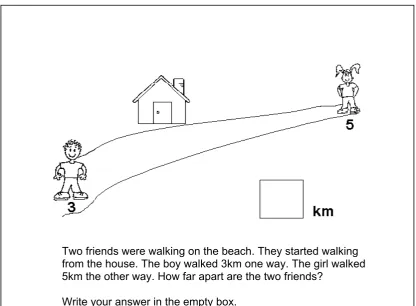
Figure 2 - An additive reasoning problem in the Year 4 Mathematical Reasoning Task
A similar item was included, in which the two friends started walking from the house and in the same direction. In this second item, in spite of the similarity in the language of the problem, the relation between the quantities (how far the friends are from each other) is different and the problem is solved by a subtraction.
Three types of item were included in the Year 4 Mathematics Reasoning Task: additive reasoning items about quantities, additive reasoning items about relations, and multiplicative reasoning items about quantities. The assessments used in Years 6 and 8 included six types of item: additive reasoning items about quantities; additive reasoning items about relations; multiplicative reasoning items about quantities; multiplicative reasoning items involving relations (i.e. proportions); items about spatial reasoning and items about fractional quantities. Our hypothesis is that, although these different items can be distinguished in terms of their content, they measure the same concept, Mathematics Reasoning. Examples of items in these tasks are presented in Appendix A.
Analyses of their internal consistency using the Cronbach’s α showed that on all three
occasions the mathematics reasoning tasks had good levels of inter-item reliability: .74 at
Year 4 (N=5275), .89 at Year 6 (N=7881) and .91 at Year 8 (N=2755).1 This high internal
consistency justifies the addition of all the items into a single score in some of the analyses.
Exploratory factor analyses, followed by confirmatory analyses in structural equation models, were carried out by entering scores for each of the sets of items described previously in this section. In these analyses, a single factor was identified, again justifying the use of a total
1 The Year 8 Mathematics Reasoning Task was only given to the cohort of children born between 1st September 1991 and 31st August 1992, so the number of participants in this assessment is considerably smaller although it is still a large sample.
Two friends were walking on the beach. They started walking from the house. The boy walked 3km one way. The girl walked 5km the other way. How far apart are the two friends?
21
score. The details of these analyses will be presented later, when the structural equation models are described.
3.2.2 The Wechsler Intelligence Scale for Children (WISCIII)
The WISC is very well-known, and is probably the most widely used general intelligence test for children. It was administered to 7354 children in the ALSPAC sample, whose mean age at the time was 8 years 7m. (SD 3.92). It consists of 12 subtests, one of which is a measure of children’s knowledge of arithmetic.
This arithmetic subtest contains a series of very simple word problems, which pose no conceptual difficulties to children aged about 8 years. For example, “John had 4 pence and his mother gave him 2 more. How many pence did he have altogether?”; “A shop had 25 cartons of milk and sold 14 of them. How many cartons were left?”; “At £8 each, how much will 3 T-shirts cost?” Problems about these types of situation demand little conceptual analysis; when small numbers are used, pre-school children show high rates of success in these problems (for studies showing pre-school children’s success in addition and
subtraction problems, see Carpenter & Moser, 1982 ; for pre-school children’s success in simple multiplication problems, see Becker, 1993; Carpenter, Ansell, Franke, Fennema, & Weisbeck, 1993). Thus this sub-test of the WISC is a simple measure of children’s
knowledge of arithmetic, as indicated in the task’s label. This measure will be used in analyses carried out in this study on its own, as an index of the children’s knowledge of number facts and computation skill.
The WISC was originally conceived as a measure of two aspects of intelligence, verbal (measured by six subtests) and non-verbal (measured by the remaining six subtests). Over time, the conception of general intelligence has developed and so did the analyses of the different tasks included in the WISC. Recent analyses of the WISC tasks led to the
identification of three, rather then two, aspects of intelligence: in the new analyses the Verbal Comprehension Index is much the same as the original Verbal Scale, but the non-verbal tasks are regrouped in two indices, a Perceptual Organisation Index (which contains items about spatial reasoning and ordering pictures to form an appropriate time sequence) and a Freedom from Distractibility Index (which contains tasks that measure attention and memory; the arithmetic subtest also relates to this factor). We ran a factor analysis on the raw scores of these tasks and confirmed that these three indices could be identified for the ALSPAC sample.
In some of our analyses, we will use an estimate of the children’s full IQ score as a control in order to see whether differences in the children’s mathematics reasoning allow us to predict their mathematics attainment after controlling for differences in their intelligence. In other analyses we separated out and looked at particular sub-test scores in detail. In particular we were interested in the WISC Arithmetic task, two spatial sub-tasks from the Perceptual Organisation Index, which were the Block Design and the Object Assembly tasks, and two tasks from the Freedom from Distractibility Index, the Digit Span task which gave us a
measure of Working Memory and the Coding task which provided us with a measure of each child’s attentional powers. Details of these sub-tests are given in Appendix A.
3.3
The social and affective measures
3.3.1 Socioeconomic status
22
attained by the mother. One of the SES categories (army) cannot be placed in the ordinal scale formed by other occupations. There are only a few cases in the data set of mothers (n=4) and fathers (n=28) whose SES is described by this category: because this is such a small number, it was decided to exclude this category from the analyses in order to avoid noise in the data. The three measures are highly correlated with each other and so we integrated them into a single factor through a principal components analysis. In most analyses this combined index will be used to measure the children’s socio-economic background.
3.3.2 Streaming
Teachers of the children participating in the ASLPAC study were asked whether the school used streaming by ability level for mathematics teaching. Their responses will be treated in two ways in the analyses of effects of streaming. First, a variable will be created to test whether streaming per se affects children’s outcomes. Second, the mathematics
achievement of children in each ability group (top, middle, and bottom) will be compared with that of children in schools that do not stream children by ability levels for mathematics
instruction.
3.3.3 Ethnic group
Information about the children’s ethnic group is included in the ASLPAC data set. The groups represented in the data file were classified as White, Black Caribbean, Black African, Other Black, Indian, Pakistani, Bangladeshi, Chinese and Other. Of these groups, two (Black African and Pakistani) had numbers smaller than 5, and so these were excluded from our analyses. When there was a loss of participants due to missing values, groups that numbered less than 5 were systematically excluded for the specific analysis.
The sample of children with scores in mathematics reasoning and results in KS mathematics is mostly (98%) white. Thus the possibilities for investigating effects of ethnicity on
mathematics achievement are limited but the data will be analysed as far as possible.
3.3.4 Self-confidence in maths
The children were given a measure of how much they liked maths in Year 3 and a measure of self-perception as learners of maths in Year 4. These two measures were highly correlated (r=.83) even though they were given to the children in different school years. They can be
treated as a measure of a single concept, children’s self-confidence in maths. We integrated
the information from these two measures into a single factor, through a principal components analysis. This factor will be used in different statistical analysis.
3.3.5 Others’ perception of the child’s ability and further influences on self-confidence in maths
The teachers’ perception of the children was assessed in Year 3 with questions that do not refer specifically to the children’s mathematical ability but to their general ability and
knowledge. We analysed the relation between teachers’ perceptions and their pupils’ reading and mathematical competence in order to test whether this factor, as measured in the
ALSPAC data, might be relevant to the children’s self-confidence in maths.
Boaler (1997) observed that students are well aware of which stream they themselves and their peers are placed in for mathematics. Although there is no measure of how peers perceive the children’s mathematics ability, when we analyse the effects of streaming on the children’s self-confidence in maths we should remain aware that this effect might be
23
3.4
The sequence of psychological and educational tests in the ALSPAC
data
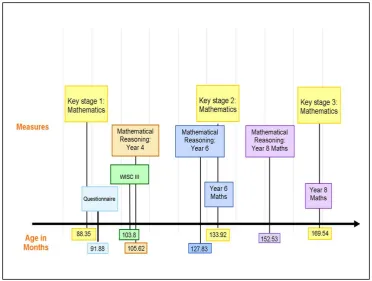
[image:32.595.141.514.185.466.2]In order to make the relative timing of the different measures clear, we end this sect