
Using the DYD stakeholder consultation process to connect with practitioners to define a set of graduate capabilities for a program
10
0
0
Full text
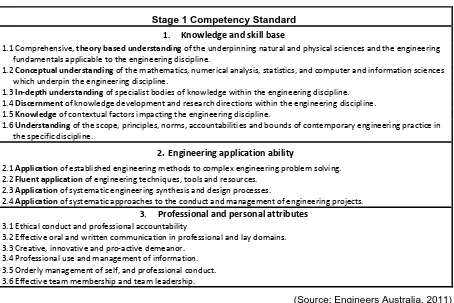
(2) Innovation, Practice and Research in Engineering Education. EE2012. term graduate attributes is popular in the university sector, while employability skills is used in the Australian vocational education and training (VET) sector, and in the UK. A review of the relevant literature shows that many other terms are also used to describe the nondiscipline employability skills that employers expect graduates to have acquired. For example: core skills, essential skills, generic skills, generic professional skills, graduate attributes, generic graduate attributes, non-technical skills, soft skills, and transferable skills (Gilbert et al., 2004; Johnston & McGregor, 2004, Oliver, 2010). York defined employability skills as being those ‘skills, understandings and personal attributes that make an individual more likely to secure employment and be successful in their chosen occupation to the benefit of themselves, the workforce, the community and the economy’ (York, 2006, p. 8). To avoid the limitations of the words attribute or competency some practitioners have adopted the term capability (Stephenson & Yorke, 1998; Dowling, 2004; and Oliver, 2012) which Stephenson and Yorke define as ‘an integration of knowledge, skills, personal qualities and understanding used appropriately and effectively – not just in familiar and highly focused specialist contexts but in response to new and changing circumstances’ (Stephenson & Yorke,1998, p2). The establishment of clear, detailed and agreed national standards in the form of discipline-specific Graduate Capabilities for a program would provide a sure footing for discipline leaders tasked with reorienting their undergraduate programs to meet current and emerging trends in their discipline.. International perspective The International Engineering Alliance (IEA) defines Graduates Attributes and Professional Competencies for Engineers, Engineering Technologists and Technicians (IEA, 2009). The document states that ‘The fundamental purpose of engineering education is to build a knowledge base and attributes to enable the graduate to continue learning and to proceed to formative development that will develop the competencies required for independent practice’ (IEA, 2009, p1). The Graduate Attributes defined in the document ‘form a set of individually assessable outcomes that are the components indicative of the graduate's potential to acquire competence to practise at the appropriate level. The graduate attributes are exemplars of the attributes expected of a graduate from an accredited programme. The Graduate Attributes are clear, succinct statements of the expected capability, qualified if necessary by a range indication appropriate to the type of programme (IEA, 2009, p2). The IEA Graduate Attributes are generic and therefore apply to all engineering disciplines. IEA expects that they will be interpreted within a disciplinary context and, where appropriate, individual statements may be amplified and given particular emphasis. However, the substance of each statement should not be altered and all elements must be addressed when seeking accreditation through a signatory organisation.. Australian perspective Most Australian universities have defined and published a set of graduate attributes that they expect all undergraduate students to acquire in their program. Barrie (2004) suggests that ‘… generic graduate attributes in Australia have come to be accepted as being the skills, knowledge and abilities of university graduates, beyond disciplinary content knowledge, which are applicable to a range of contexts.’ However, these attributes tend to be bland and generic as they must be suitable for graduates from the many different programs offered by a university. They do, however, normally include an attribute that recognises the need for graduates to acquire specific knowledge and skills in their chosen discipline, for example, Psychology. Many industry organisations in Australia have defined a set of graduate attributes for their discipline. For example, Engineers Australia has defined Stage 1 Competency Standards for Professional Engineer, Engineering Technologist, and Engineering Associate (Technician) (Engineers Australia, 2011). As Engineers Australia is a signatory of IEA, these Competency Standards are aligned with the IEA Graduate Attributes. As shown in Table 1, there are three Stage 1 Competencies (Knowledge and skill base; Engineering application ability; and Professional and personal attributes) and 16 Elements of Competency in the Standard for Professional Engineer. In the Standard, statements of ‘Evidence of Attainment’ are listed for each Element to guide the user. For example, the statements for Element 3.1, Ethical conduct and professional accountability are:. 2.
(3) Innovation, Practice and Research in Engineering Education. EE2012. a) Demonstrates commitment to uphold the Engineers Australia - Code of Ethics, and established norms of professional conduct pertinent to the engineering discipline. b) Understands the need for ‘due-diligence’ in certification, compliance and risk management processes. c) Understands the accountabilities of the professional engineer and the broader engineering team for the safety of other people and for protection of the environment. d) Is aware of the fundamental principles of intellectual property rights and protection. However, as with university graduate attributes, these sets of attributes are high level and generic in nature as they apply to all fields of engineering. They therefore lack the detail required for them to be useful as the driver of curriculum renewal, particularly within a discipline context. They also lack the detail required to properly assess student achievement of the competencies. Table 1: The Stage 1 Competency Standard for Professional Engineer Stage 1 Competency Standard 1. Knowledge and skill base 1.1 Comprehensive, theory based understanding of the underpinning natural and physical sciences and the engineering fundamentals applicable to the engineering discipline. 1.2 Conceptual understanding of the mathematics, numerical analysis, statistics, and computer and information sciences which underpin the engineering discipline. 1.3 In-depth understanding of specialist bodies of knowledge within the engineering discipline. 1.4 Discernment of knowledge development and research directions within the engineering discipline. 1.5 Knowledge of contextual factors impacting the engineering discipline. 1.6 Understanding of the scope, principles, norms, accountabilities and bounds of contemporary engineering practice in the specific discipline.. 2. Engineering application ability 2.1 Application of established engineering methods to complex engineering problem solving. 2.2 Fluent application of engineering techniques, tools and resources. 2.3 Application of systematic engineering synthesis and design processes. 2.4 Application of systematic approaches to the conduct and management of engineering projects. 3. Professional and personal attributes 3.1 Ethical conduct and professional accountability 3.2 Effective oral and written communication in professional and lay domains. 3.3 Creative, innovative and pro-active demeanor. 3.4 Professional use and management of information. 3.5 Orderly management of self, and professional conduct. 3.6 Effective team membership and team leadership.. (Source: Engineers Australia, 2011). Overview of the DYD Project The purpose of the DYD Project was to develop a stakeholder consultation process to enable the members of a discipline to develop a detailed set of Graduate Capabilities for a program in their discipline. This was based on the assumption that it is more efficient for a discipline to undertake this work at a national level than at the single institution level. The resulting set of Graduate Capabilities can then be used to inform curriculum renewal and accreditation processes. A national approach also helps to mitigate the risk that a School may face if its locally defined Graduate Capabilities were not aligned with the views of an Accreditation Panel. The two aims of the ALTC DYD Project are: 1. To identify and develop an efficient, effective, and inclusive consultation process that can be used by discipline stakeholders to define Graduate Capabilities for their discipline. 2. To use the consultative process to deliver nationally agreed Graduate Capabilities for at least one engineering discipline. The DYD Stakeholder Consultation Process was developed by the DYD Project Team at the beginning of 2010. Since then the DYD Process has been used to develop Graduate Capability statements for educational programs in three disciplines, all at different levels on the Australian Qualifications Framework (AQF).. 3.
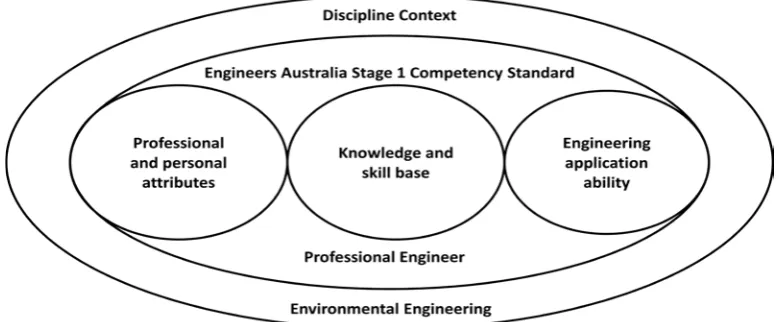
(4) Innovation, Practice and Research in Engineering Education. EE2012. During 2010 and 2011 the Team trialled the DYD process with members of Engineers Australia's Environmental Engineering College to produce a set of Graduate Capabilities for Environmental Engineering degree programs for Professional Engineers. A draft of the resulting Guide was tabled at a College Board meeting in March 2012 and will be published in late 2012 (Dowling & Hadgraft, 2012). As shown in Figure 1, the defined Graduate Capabilities situate the Stage 1 Competency Standard for Professional Engineer in the context of the Environmental Engineering discipline.. Figure 1: Engineers Australia’s Stage 1 Competency Standard in a discipline context. The educational context The educational context of the Graduate Capabilities defined by the DYD Process is shown in Figure 2, which shows the four phases of a policy driven cyclical process for the review, design, delivery and evaluation of the curriculum for a program. The cycle may be aligned with a program accreditation cycle, for example Engineers Australia’s five year cycle. The four phases of the cycle are: 1. Review an existing set of graduate attributes, or develop a new set of graduate attributes; 2. Review existing curriculum and embed the graduate attributes, or use the graduate attributes to inform the development of the curriculum for a new program; 3. Teach the curriculum; and 4. Assess student learning and evaluate program outcomes. A broader definition of the term graduate attributes is used here as it includes both generic and discipline specific attributes. In this sense, they define the graduate outcomes for a program.. Figure 2: A graduate attribute driven curriculum design & delivery process (Dowling, 2004). 4.
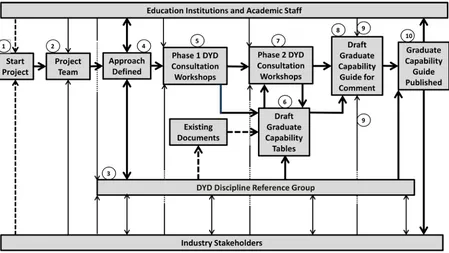
(5) Innovation, Practice and Research in Engineering Education. EE2012. The DYD Stakeholder Consultation process can be used to inform Phase 1 of the cycle.. The DYD Stakeholder Consultation Process Numerous tools have been used to develop and authenticate Graduate Capabilities, particularly for the development of competency-based curriculum in the vocational education sector. For example: occupational analysis tools can be used to observe and document the tasks undertaken by workers; a curriculum can be developed using the DACUM job analysis process (CETE, 2011); or the Delphi technique can be used to iteratively gather and synthesise data from stakeholders until consensus is reached. The DYD Stakeholder Consultation process is based on the Modified Delphi Technique (Custer, Scarcella, & Stewart, 1999), and uses aspects of the DACUM job analysis method. The design of the process was based on an issue (the definition of a set of Graduate Capabilities) rather than a method (Gregory, Fischoff, Thorne, & Butte, 2003), and was informed by the results of a stakeholder analysis (Reed et al., 2009). The analysis determined who had a legitimate stake, based on their knowledge and interest. The self-appointment method was adopted to recruit workshop participants and a selection method was used to form the group of experts who are overseeing the process (Catt & Murphy, 2010). The DYD Process ensures that the input from each stakeholder is equally valued so that the opinions or biases of individuals or groups do not impact on the final outcome. For example, the individual nature of the data gathering process ensures that dominant personalities, the professional standing of individuals, or group thinking do not influence the raw data. The Process also ensures that the contributions from each participant are captured. The phases of the DYD Stakeholder Consultation Process are represented in the schematic reproduced in Figure 3, and the 10 steps in the process are briefly described in the following paragraphs.. Figure 3: A schematic showing the steps in the DYD Stakeholder Consultation Process Step 1 Project initiation: The Project Client decides to use the DYD Stakeholder Consultation Process to develop a set of Graduate Capabilities for a program. The Client may be an industry organisation, a discipline group from one or more educational institutions, or a combination of these. Step 2 Appointment of the Project Team: The Client appoints a Project Team to lead the project and facilitate the development of the Graduate Capabilities for the discipline. Reporting guidelines and funding arrangements are agreed at this stage.. 5.
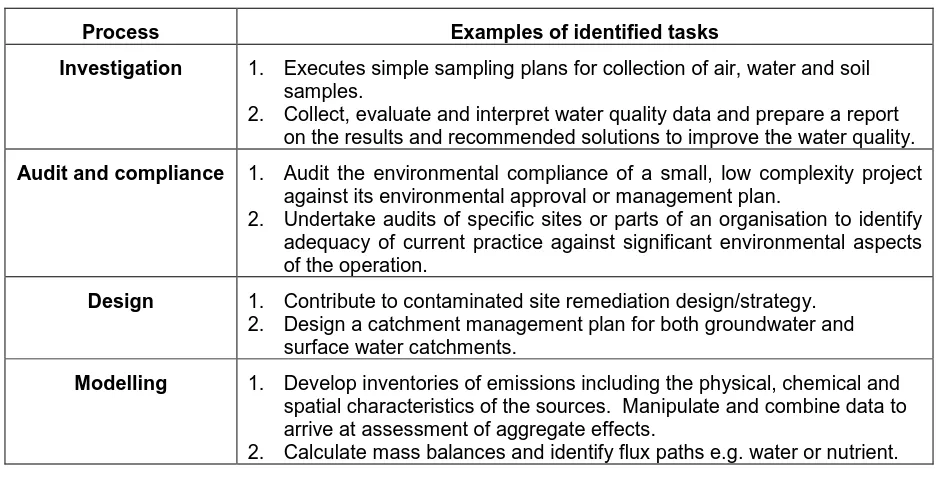
(6) Innovation, Practice and Research in Engineering Education. EE2012. Step 3 Formation of the DYD Discipline Reference Group: The Client appoints a Reference Group to advise the Project Team and oversee their work. Step 4 Approach selected: The Project Team consults with the key stakeholders and then decides on the approach to be used to develop the Graduate capabilities. This includes the decision to either start with a clean slate or to base the graduate capabilities on existing documents, such as program outcomes, job descriptions, etc. Step 5 Phase 1 Stakeholder Consultation Workshops: The Project Team organises a series of Stakeholder Consultation Workshops to gather information about the tasks that graduates undertake in their first few years of employment in the industry. The Project Team works with the Client and the Reference Group to identify and recruit participants for the workshops, which should include practitioners, recent graduates and teaching staff. Each DYD Stage 1 workshop begins with an introduction given by the Client. This is followed by a brief description of the project and an overview of the workshop activities, both given by one of the Team members. The consultation process then commences with a divergent phase, where each workshop participant is asked to write down the tasks that they believe a graduate should be able to do in their first three to five years after graduation, including supervised tasks. The participants are asked to do this while keeping a future-proofing mindset that focuses on the skills graduates may need in 10 to 20 years rather than just current requirements. After an initial period (usually about 30-40 minutes) the participants at each table collaborate to generate additional tasks. Participants then begin the second phase of the consultation process, the convergent phase, by performing a cluster analysis. This involves laying out all the tasks on a large flat surface and looking for commonalities. The tasks are then clustered and ordered as shown in Table 2, which shows some of the tasks that Environmental Engineering participants wrote, and four of the clusters they identified at one of the workshops. The participants then review the lists and write new task statements to cover any perceived gaps. The workshop concludes when the participants agree on the clusters, the names of the clusters, and the order of each task in a cluster. Table 2 - Tasks performed by recent environmental enginering graduates Process. Examples of identified tasks. Investigation. 1. Executes simple sampling plans for collection of air, water and soil samples. 2. Collect, evaluate and interpret water quality data and prepare a report on the results and recommended solutions to improve the water quality.. Audit and compliance. 1. Audit the environmental compliance of a small, low complexity project against its environmental approval or management plan. 2. Undertake audits of specific sites or parts of an organisation to identify adequacy of current practice against significant environmental aspects of the operation.. Design. Modelling. 1. Contribute to contaminated site remediation design/strategy. 2. Design a catchment management plan for both groundwater and surface water catchments. 1. Develop inventories of emissions including the physical, chemical and spatial characteristics of the sources. Manipulate and combine data to arrive at assessment of aggregate effects. 2. Calculate mass balances and identify flux paths e.g. water or nutrient.. Step 6 Preparation of a draft of the Graduate Capability Tables: A draft set of Graduate Capability tables is developed from the information gathered from the workshops and/or existing documents. Because each task is identified and numbered, the Project Team can track each task through the clustering and synthesising process and, at the end of the project, assess the influence on the defined set of Graduate Outcomes of each task, each person, and each stakeholder group. During this step the Reference Group may be consulted for advice on technical matters, the structure of the Graduate Capabilities, and the names of the clusters.. 6.
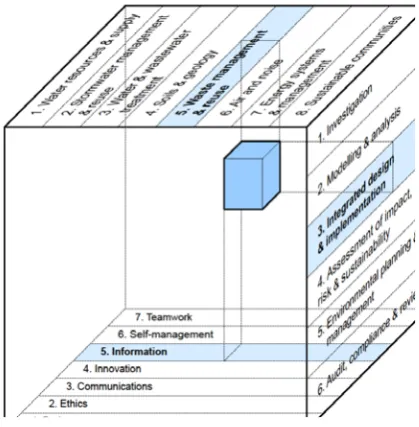
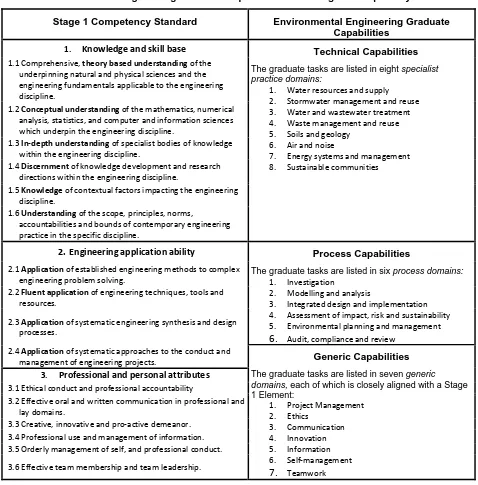
(7) Innovation, Practice and Research in Engineering Education. EE2012. Step 7 Phase 2 Stakeholder Consultation Workshops: The Project Team organises a second series of Stakeholder Consultation Workshops to receive feedback on the draft set of Graduate Capability tables. The Project Team works with the Client and the Reference Group to identify and recruit participants for the workshops, including: people who attended the Phase 1 Workshops; teaching staff from relevant educational institutions; and additional people from the stakeholder groups. Step 8 Preparation of draft Graduate Capability Guide: The Project Team liaises with the Reference Group to review the Phase 2 Workshop responses and finalise the Graduate Capability tables. These are then integrated into the draft Graduate Capability Guide for the program. Step 9 Stakeholder review of the draft Graduate Capability Guide: The draft Guide is circulated to all stakeholders for comment. Step 10 Publication and dissemination of the Graduate Capability Guide: The Project Team liaises with the Client and the Reference Group to review the responses from the stakeholder consultation and then finalises the Graduate Capability tables. The Graduate Capability Guide is then published and disseminated to all stakeholders.. Case study: Environmental Engineering The DYD Process was initially used to define Graduate Capabilities for the Environmental Engineering discipline and workshops were held in most Australian capital cities and at some universities. The Process produced some interesting outcomes. For example, the cluster analysis yielded quite unexpected results, as the Team’s hypothesis was that clusters would form around application areas in environmental engineering such as: soil, water, energy, noise, and air pollution. Thus, it was expected that these statements would, together, form a more detailed layer in the graduate outcomes hierarchy, one step below, and an expansion of, Engineers Australia’s Stage 1 Competency Standard. Instead, clusters consistently formed around six major work types or processes: investigation, impact assessment, design, modelling, audit and compliance, and environmental management. While half of these are quite generic skills – investigation, design and modelling - the remaining three have a distinctly environmental feel – impact assessment, audit and compliance, and environmental management (Dowling & Hadgraft, 2011; Dowling et al., 2011). The Graduate Capabilities were grouped into three sets of capabilities and these are accompanied by a set of contexts: Technical Capabilities; Process Capabilities; and Generic Capabilities. Table 3 shows the relationship between the three sets of Graduate Capabilities defined in the Draft Guide and the three competencies in the Stage 1 Competency Standard.. Figure 4: The Environmental Engineering Capability Cube (Dowling & Hadgraft, 2012) A three dimensional model can be used to represent the scope of the Environmental Engineering discipline. The Environmental Engineering Capability Cube reproduced in Figure 4 shows the. 7.
(8) Innovation, Practice and Research in Engineering Education. EE2012. interrelationships between the three sets of Capabilities defined in the draft Guide, which make up the axes of the Cube. This is designed to help users to understand the complex relationships between the clusters: it shows that when undertaking a project, a graduate uses Generic Capabilities when applying a Process in one or more Technical Domains. For example, a graduate may be gathering information (Generic) to prepare a design (Process) for a soil (Technical domain) remediation project at a mine site (Context). Table 3: Environmental Engineering Graduate Capabilities & the Stage 1 Competency Standard Stage 1 Competency Standard 1.. Knowledge and skill base. 1.1 Comprehensive, theory based understanding of the underpinning natural and physical sciences and the engineering fundamentals applicable to the engineering discipline. 1.2 Conceptual understanding of the mathematics, numerical analysis, statistics, and computer and information sciences which underpin the engineering discipline. 1.3 In-depth understanding of specialist bodies of knowledge within the engineering discipline. 1.4 Discernment of knowledge development and research directions within the engineering discipline. 1.5 Knowledge of contextual factors impacting the engineering discipline. 1.6 Understanding of the scope, principles, norms, accountabilities and bounds of contemporary engineering practice in the specific discipline.. 2. Engineering application ability 2.1 Application of established engineering methods to complex engineering problem solving. 2.2 Fluent application of engineering techniques, tools and resources. 2.3 Application of systematic engineering synthesis and design processes.. Environmental Engineering Graduate Capabilities Technical Capabilities The graduate tasks are listed in eight specialist practice domains: 1. Water resources and supply 2. Stormwater management and reuse 3. Water and wastewater treatment 4. Waste management and reuse 5. Soils and geology 6. Air and noise 7. Energy systems and management 8. Sustainable communities. Process Capabilities The graduate tasks are listed in six process domains: 1. Investigation 2. Modelling and analysis 3. Integrated design and implementation 4. Assessment of impact, risk and sustainability 5. Environmental planning and management 6. Audit, compliance and review. 2.4 Application of systematic approaches to the conduct and Generic Capabilities management of engineering projects. The graduate tasks are listed in seven generic 3. Professional and personal attributes domains, each of which is closely aligned with a Stage 3.1 Ethical conduct and professional accountability 1 Element: 3.2 Effective oral and written communication in professional and 1. Project Management lay domains. 2. Ethics 3.3 Creative, innovative and pro-active demeanor. 3. Communication 3.4 Professional use and management of information. 4. Innovation 3.5 Orderly management of self, and professional conduct. 5. Information 6. Self-management 3.6 Effective team membership and team leadership. 7. Teamwork. The draft Guide was tabled at a meeting of the Environmental College Board in late March 2012. The Board was extremely impressed with the hard work the Project Team had done, and is considering its response to some questions relating to the cluster names and content, as well as deciding on how the guide will be used for accreditation purposes.. Conclusion The DYD Stakeholder Consultation Process was designed to enable education institutions and/or industry organisations to connect teachers with practitioners and other stakeholders to develop a set of practitioner authenticated Graduate Capabilities for a program in their discipline. The resulting. 8.
(9) Innovation, Practice and Research in Engineering Education. EE2012. Graduate Capabilities can then be used to guide the development of curriculum for a program, to inform a review of existing curriculum, or to guide reviews by external accrediting organisations. The DYD Process proved to be an efficient, effective, flexible and inclusive consultation process that produced a detailed set of Graduate Capabilities for Environmental Engineering. Because the process started with a blank sheet, it produced some unexpected, but extremely valuable results. To verify these results the Process is currently being trialled in other disciplines and AQF qualification levels.. References Barrie, S. (2004) A Research-based approach to generic graduate attributes policy. Higher Education Research and Development, 23 (3). Catt, H., and Murphy, M. (2010) What voice for the people? categorising methods for public consultation. Australian Journal of Political Science, 38 (3), 407-421. CETE (2011). DACUM and SCID Training Information. Available from http://www.dacumohiostate.com/index.htm [accesssed 17 June 2011]. Custer, R. L., Scarcella, J. A., and Stewart, B. R. (1999). The Modified Delphi Technique - A Rotational Modification. Journal of Vocational and Technical Education, 15 (2). Dowling, D. (2004), Beyond the Generic: A Conceptual Model for the Development, Implementation and Evaluation of the Attributes of a USQ Graduate. Academic Board, University of Southern Queensland. Dowling, D., and Hadgraft, R. (2012). Graduate Capabilities for Environmental Engineering Degree Programs: A Guide for Australian Universities. Office for Learning and Teaching, Australian Government, (Submitted). Dowling, D., Hadgraft, R., and Lamborn, J. (2011). Developing an inclusive stakeholder consultation process: A case study. AAEE Conference, Perth, December. Dowling, D., and Hadgraft, R. (2011). The development of a systematic consultation process to define graduate outcomes for engineering disciplines. REES 2011 Conference, Research in Engineering Education Network. Madrid, October. Engineers Australia (2011) Stage 1 Competency Standard for Professional Engineer. Available from http://www.engineersaustralia.org.au/ [accesssed 17 June 2011]. Gilbert R, Balatti J, Turner P, and Whitehouse H. (2004) The generic skills debate in research higher degrees. Higher Education Research and Development, 23 (3). Gregory, R., Fischoff, B., Thorne, S., and Butte, G. (2003) A multi-channel stakeholder consultation process for transmission deregulation. Energy Policy, 31, 1291-1299. Grindel, T .(ed.) (2006). In search of global engineering excellence: Educating the next generation for the global workplace. Hanover: Continental AG. IEA (2009) Graduate Attributes and Professional Competencies: Version 2. International Engineering Alliance. Available from http://www.washingtonaccord.org/ [accessed 10 may 2012]. Johnston, S., and McGregor, H. (2004) Recognising and Supporting a scholarship of practice: Soft skills are hard! 15th Conference of the Australasian Association for Engineering Education and the 10th Women in Engineering Forum, 27-29 September 2004, Toowoomba Australia. OECD (2005) The Definition and Selection of key Competencies: Executive Summary OECD. Available from http://www.oecd.org/dataoecd/47/61/35070367.pdf [accessed 10 May 2012]. Oliver, B. (2012) Teaching Fellowship: Benchmarking partnerships for graduate employability. Final Report, Australian Learning and Teaching Council. Available from http://www.olt.gov.au/resources?text=Oliver [accessed 10 May 2012]. Oliver, B. (2010) Teaching Fellowship: Benchmarking Partnerships for Graduate Employability. Available from http://www.altc.edu.au/resources?text=Oliver [accessed 7 March 2012]. Reed, M., Graves, A., Dandy, N., Posthumus, H., Hubacek, K., and Morris, J. (2009) Who's in and why? A typology of stakeholder analysis methods for natural resource management. Journal of Environmental Management, 90, 1933-1949.. 9.
(10) Innovation, Practice and Research in Engineering Education. EE2012. Stephenson, J. and Yorke, M. (1998) Capability and Quality in Higher Education. London: Kogan Page. York, M. (2006). Employability in higher education: what it is - what it is not. London: Higher Education Academy.. Acknowledgements The work reported in this paper was funded by the Australian Learning and Teaching Council (ALTC). The author acknowledges the contribution of Roger Hadgraft, Julia Lamborn and the members of the Environmental Engineering Reference Group.. Copyright statement Copyright © September 2012, authors as listed at the start of this paper. This work is licensed under a Creative Commons Attribution-NonCommercial-NoDerivs 3.0 Unported License (CC BY-NC-ND 3.0).. 10.
(11)
Figure
+3
Related documents