Peer assisted learning in an online postgraduate course on
engineered fibre composites
First Author Name (First, Last); Second Author Namea, and etc b.
First Author Affiliation, Second Author Affiliation (if different)a , Subsequent Author Affiliationb Corresponding Author Email:
BACKGROUND
While the attractiveness of courses delivered via distance learning increases to the working and remote students because of the flexibility they provide, it is more difficult for an examiner to keep these students engage in active learning than those in a classroom. Discussion forums were identified as one way of replicating the energy of face-to-face engagement in an online environment (Meyer, 2003). In the same way, peer assisted learning encourages active learning where students can explore answers through discussion (Cheng and Walters, 2009). Recently, the Australia’s first online course on engineered fibre composites has focused on using both the online technical discussions and peer assisted learning as a tool to exchange knowledge and experience among practicing engineers and senior undergraduate engineering students to enhance their knowledge on fibre composite materials. This online discussion is introduced and included in the assessment criteria.
PURPOSE
How technical discussions facilitated students’ learning and engagement in an online postgraduate course on engineered fibre composites?
DESIGN/METHOD
Discussion topics are designed and posted in the online forum such that it provide opportunities and a platform where students discuss and exchange ideas on technical issues in the context of their own experiences combined with their critical thinking on the different study modules of the course. The teaching team then facilitated the discussion to ensure a more active engagement amongst students and to keep the discussion focussed. The overall performance of the students are then analysed with respect to the quality of participation, questions and comments on the online discussion forum. The views and learning experiences of the students are also sought to determine the effectiveness of this learning and teaching method.
RESULTS
Results showed that the online discussions resulted in students to have a collective knowledge on different technical aspects of the course through the combine sharing of limited experience and knowledge by each student. There is also a good evidence of exchange of ideas among students rather than a flow of information from the teaching team. Moreover, the online technical discussion forums keep the high level of interest on the different study modules and active participation of students to learning. Most of the students indicated that the online technical discussions have been a very useful way to gain extra knowledge from other students. It was observed that the level of
engagement among students and the exchange of ideas are highest on the discussion topic where the teaching team participated most. The results also showed that the students who are more active in the discussion forum achieve a better grade than those who rarely participated in the forum.
CONCLUSIONS
Based on the results, peer assisted learning in online technical discussions is an effective tool to enhance a more effective student’s learning and engagement. This provided an avenue to students to have a broader knowledge on engineered fibre composites through the combination of the shared experience and knowledge by each student. Moreover, it encourages active learning where students can explore answers through discussion. The results show that the students who actively engaged in the discussion forum achieved better grades.
KEYWORDS
Introduction
The first web-based postgraduate course in Australia on engineered fibre composites was offered by the University of Xxxxxxxx Xxxxxxxxxx (UXX) in 2008. This course, ABC1234 – Aaaa Bbbb is designed as a postgraduate program or for continuing professional
development for civil and structural engineers who have had minimal or no exposure to fibre composites in their training curriculum. This also offered to senior undergraduate engineering students as an elective course. The course is delivered online which makes it very attractive to many working students. As a result, the course has gained considerable interest to both postgraduate and undergraduate students. From only 7 students who took the course in 2008, this number has increased to 24 students in 2012.
While the attractiveness of courses delivered via distance learning increases to the working and remote students because of the flexibility they provide, Orabi (2004) found that it takes much more time from the examiner to teach and administer online courses. Online course developers agree that teaching and maintaining an online course takes a considerable amount of time (Green, 1997). Allen and Seaman (2006) also mentioned that students need more discipline to succeed in online courses. It is more difficult for an examiner to keep the students engage in active learning than those in a classroom or face-to-face delivery where spontaneous discussion can take place and are encouraged to engage students with the process of learning (Harris and Sandor, 2007). Thus, new approaches to learning in the online environment should be implemented to keep the students actively engage in their learning journey.
Discussion forums are identified as one way of replicating the energy of face-to-face
engagement in an online classroom (Meyer, 2003). In the same way, peer assisted learning encourages active learning where students can explore answers through discussion among other students (Cheng and Walters, 2009). Moreover, Beckman and Kilby (2008) suggested that the online discussion provides a forum where students learn with and from each other without the intermediate intervention of a teacher. Graham (2002) further indicated that online discussion can facilitate student interactions and create effective opportunities for peer learning. Harris and Sandor (2007) also mentioned that online discussion forum has the potential to reduce the instructor’s forum related workload. While many academics have used the online discussion as a forum and tool for teaching, only a few have effectively utilised the online discussion in facilitating learning in highly technical courses.
Recently, ABC1234 has focused on using both the online technical discussions and peer assisted learning as a tool to exchange knowledge and experience among practicing engineers and senior undergraduate engineering students to enhance their knowledge on fibre composite materials. The online discussion is introduced and included in the
assessment criteria. In this paper, an analysis of the overall performance of the students enrolled to the course from 2008-2012 with respect to the quality of participation, questions and comments on the online discussion forum are presented. The views and learning experiences through student’s feedback on the effectiveness of this learning and teaching method are also discussed. Moreover, the overall mark of the students was correlated with their participation in the discussion forum. Finally, opportunities for improvement on the structure of the online technical discussion as an effective teaching and engagement tool for ABC1234 are identified.
Course description
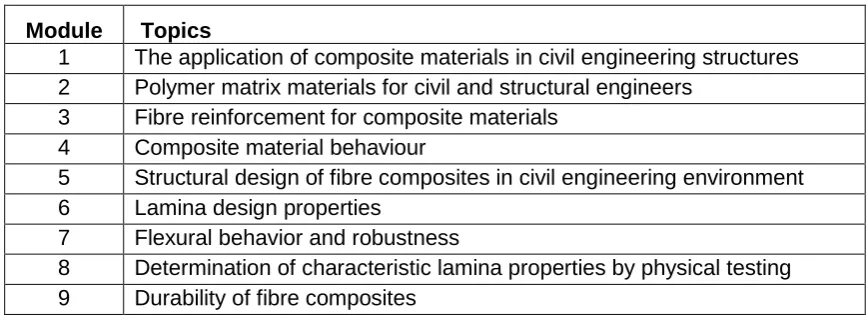
research and development work at the AAAA. The study modules for ABC1234 are listed in Table 1. It is entirely web-based using the Moodle system with the study materials regularly uploaded through the course homepage.
Table 1: Course content of ABC1234
Module Topics
1 The application of composite materials in civil engineering structures 2 Polymer matrix materials for civil and structural engineers
3 Fibre reinforcement for composite materials 4 Composite material behaviour
5 Structural design of fibre composites in civil engineering environment 6 Lamina design properties
7 Flexural behavior and robustness
8 Determination of characteristic lamina properties by physical testing 9 Durability of fibre composites
Online discussion as a tool for peer learning
Kimbal (2001) mentioned that the teaching strategies are more important than technology in terms of the quality of learning in distance education. However, how can we make the students in an online environment more engage in their learning activities? In ABC1234, several innovative teaching techniques are implemented and a number of developed
resources are made available in the learning management system of the course to enhance student’s learning. These innovative teaching methods and new learning resources are developed to increase course attractiveness and produce better educational outcomes. The key resources that are used include online discussion and quizzes, online lectures, video of testing and manufacturing processes, electronic submission and marking.
In recent course offering and delivery of ABC1234, the course has focused on utilising the online discussion as a tool for peer assisted learning through exchange of knowledge and experience among practicing engineers and senior undergraduate engineering students on fibre composite materials. Discussion topics are designed and posted in the online forum such that it provide opportunities and a platform where students discuss and exchange ideas on technical issues in the context of their own experiences combined with their critical
thinking on the different study modules of the course. The discussion questions are posted by the course examiner in the Moodle from time to time, generally on a weekly basis
throughout the course of semester in the form of “Standard forum for general use”. This is an open forum where students can provide their answer and views to the posted questions. In the same way, the students can also debate and dialogue on the answers of other students on the present topic to facilitate engagement and peer learning. The teaching team then facilitated the discussion to ensure a more active engagement amongst students and to keep the discussion focussed. The mark of the students in the online technical discussion is assessed based on the quality and active participation of their contribution to the discussion topic as well as their questions and comments on the relevant topic and on the
contribution of other students. The views and learning experiences of the students are also sought to determine the effectiveness of this learning and teaching method in ABC1234.
Results and evaluation
The level of participation of the students in the online discussion for 5 years (2008-2012) of course delivery was evaluated. This is conducted by examining the number of access/views made by the students on the different activities in each study module throughout the
also correlated. Finally, the responses of students regarding their learning experience through the online technical discussion were presented.
[image:4.595.148.445.285.444.2]Student participation
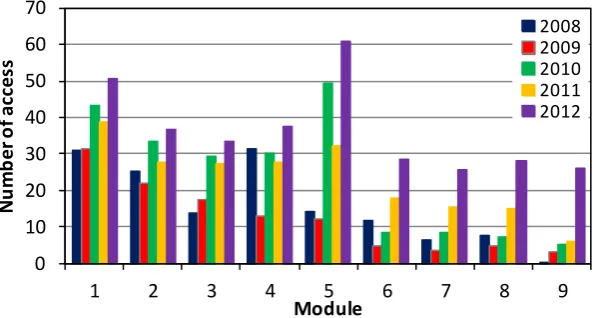
Figure 1 shows a summary of the activity report in each study module. In the figure, the number of access represents the normalized value of the level of participation of students (the number of times the students have accessed each study module divided by the total number of students). The activity report includes accessing the study materials and other online learning resources, answering quizzes and participating in the discussion forum. It is clearly indicated in the figure that the level of student’s participation increases every year since the course was introduced with the highest level of student’s activity recorded in 2012. The increase in the level of activity can be due to the several innovative teaching techniques implemented and the developed learning resources which made available to the students in each year of the course delivery. Starting in 2010, the increase in the student’s activity in the course is driven by their participation in the online technical discussion.
0 10 20 30 40 50 60 70
1 2 3 4 5 6 7 8 9
N
u
m
b
er
o
f
ac
ces
s
Module
2008 2009 2010 2011 2012
Figure 1: Level of participation in study modules
It can be seen in Figure 2 that the level of participation in the online discussion forum increased significantly in years 2010 until 2012 as seen by the increased in the number of views. However, in 2010, most of the students are actively engaged in the discussion only up to Module 5 and the level of participation is very low thereafter. It is important to note that in this year, the discussion topics are provided only up to Module 5. This is not the case however for years 2011 and 2012 where a discussion topic was provided to all study
modules. Consequently, students became more engaged in their learning the different study modules in the course.
The increase in the level of student’s activity in the ABC1234 course in years 2010 to 2012 is due to the active participation of the students in the online technical discussion. Comparing Figures 1 and 2, it can be seen that the participation in the discussion forum constitutes 60-70% of the activity of the students in each study module. It is also very evident that the level of engagement of the students increases significantly in 2012. This increase in the level of participation in 2012 is probably due to the increased percentage allocation of the discussion forum in the final marks. In this year, the participation in the discussion forum constitutes 15% of the total marks compared to years 2009 to 2011 where it only caries 10%.
It can be observed in Figure 1 that the most accessed modules are Modules 1 and 5. Figure 2 also indicates that the level of engagement amongst students is highest on these topics. As listed in Table 1, Module 1 covers topic related to the recent developments and application of fibre composites in civil infrastructure and Module 5 is related to the design of structures from these advanced materials. This is compatible with the result of the initial survey on the
the course for them to have better understanding of the various applications for fibre
composites and gain knowledge and confidence in designing fibre composite materials and structures. It can also be noticed that in 2012, the level of participation is almost the same in the other study modules indicating that the students realized the equal importance of each study module. More importantly, there has been an increased level of activity among students on the module related to durability which was the least perceived topic by the students in the years from 2008-2011.
0 10 20 30 40 50
1 2 3 4 5 6 7 8 9
[image:5.595.147.454.178.336.2]N u m b er o f vi ew s Module 2008 2009 2010 2011 2012
Figure 2: Level of participation in the discussion forum
[image:5.595.90.514.475.670.2]Level of engagement
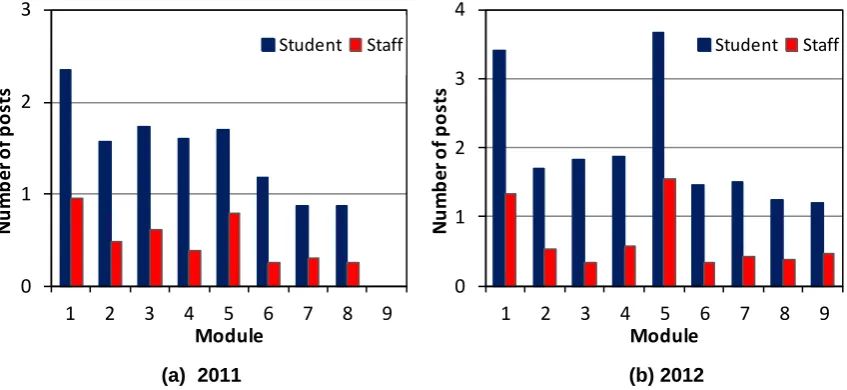
Figure 3 shows the normalised number of postings by the students and the teaching
team/staff in each discussion topic in 2011 and 2012. Only these two years are considered to analyse the level of engagement between the student and the teaching staff as these are the years where a technical discussion topic is provided in most all study modules. In these 2 years, ABC1234 has a student cohort of 47 students (16 postgraduates and 31
undergraduate students consists mainly of working engineers).
0 1 2 3
1 2 3 4 5 6 7 8 9
N u m b er o f p o st s Module Student Staff 0 1 2 3 4
1 2 3 4 5 6 7 8 9
N u m b er o f p o st s Module Student Staff
(a) 2011 (b) 2012
Figure 3: Number of post by students and teacher in each discussion topic
students post at least once in each discussion topic. Furthermore, it is clearly evident that the average number of post per discussion topic increases significantly from 2011 to 2012.
It can be seen from the figures that the level of participation of the students in the online technical discussion has a correlation on the level of participation of the teaching team. The evaluation shows that the students are more engaged in the discussion when the teaching team is more active in steering the discussion process. This parallels the relative importance placed on the influence of lecturer facilitation on the learning of students in an online
environment (Beckman and Kilby, 2008). There is also a good evidence of exchange of ideas among students rather than a flow of information from the teaching team and more
engagement among the students to address the technical issues related to a specific study module. On an average, the teaching team responded once to every 3 posts by the students suggesting that there has been less involvement provided by the teaching team to keep the discussion going. More importantly, the results showed that the online discussion
encouraged the students to take a more active role in their learning process.
Discussion
The student evaluation and comments are useful in determining the value of the online technical discussion in ABC1234. In general, most students were satisfied with the way the online discussions had been incorporated in the teaching of the course and the impact on learning, although there was an interesting diversity of views. Furthermore, the students indicated that the most beneficial aspect of the online discussion was the knowledge and experience they gained from other students which help them to develop a “better
understanding” of the fibre composite materials.
Facilitating learning
Most of the students have valued the knowledge and experience shared by other students which help them in better understanding the different study modules in the course. Many of them have benefited from the first hand experience contributed by other students.
Consequently, this has provided rich learning experiences to all students as evidenced by the comments below.
“The online discussions in ABC1234 have been a very useful way to gain extra
knowledge from other students that is not in the learning materials.”
“The online discussion forums in ABC1234 ensured I stayed up to date with my
reading. A very good tool for bouncing ideas between students. Speedy responses to questions allowed efficient consolidation of the study materials. Overall, the forums guided me in to what I needed to focus studying for this course.”
“The online technical discussion provided me with an insight as to what others had to
say about each of the learning module. The online discussions and questions covered in each module reinforced what was covered in the text and allowed me to conduct my own independent learning to answer the questions asked. I also believe that the lecturer did structure the questions in a way that aided me in better
understanding the module objectives in ABC1234. In constantly reading comments added on the discussion board, this re-emphasised the areas that were deemed critical to remember as a practicing engineer.”
Promoting student’s engagement
The students feel more a part of the course and enjoy the opportunity to learn from the knowledge and experiences shared by other students. Undergraduate students learned from the actual experiences of practicing engineers. This sharing of ideas is believed the main reason which keeps the students engaged in their learning throughout the semester.
“Online technical discussions were very useful for on-campus students. Most of the
on-campus students do not have the real life experience so we were able to understand about it from many external students.”
“The online discussions in ABC1234 are very helpful and practical especially for
external students. All technical topics were very useful as everyone from different background have been sharing their experiences which enhanced the general knowledge of each student on composite materials.”
“Having little experience with fibre composites myself, I was surprised to find how
many others have firsthand knowledge with either the fabrication or design of composites. The online discussion allowed the sharing of these experiences.”
“The different online technical discussion topics were very helpful because it give
each student a chance to see a different approach or facet of a particular topic from the view point of our fellow classmates. In some instances, queries posted on the forums are answered by fellow classmates. While the study book is already sufficient for the most part, the literature available for each specific discussion topic posted by other students has also proven invaluable in the further understanding of fibre composites.”
The online discussion not only enabled the sharing of experiences and information about the topics being discussed but also facilitated sharing of experiences and information. More importantly, the involvement of peer students in the process promoted collaborative and active learning through sharing of knowledge and experiences.
Structuring and enhancing
The experiences of the students showed that the online discussion provided an avenue to promote engagement and enhance learning. However, students also mentioned that it increases their workload. One student commented that “The online discussion forums in
ABC1234 added much value to my learning but consumed a lot of time”. This confirms the
observation by Meyer (2003) that the online discussion increases the amount of time
students spend on course objectives. Some students mentioned that the learning through the technical discussion could also be gained through assignment questions. Furthermore, they have suggested that the current structure should be improved to maximise the effectiveness of the online discussion.
“I have mixed feelings about the online discussion as a part of assessment. I found it
useful in some modules to read differing opinions and when I was looking for
guidance. Having it as part of the assessment was a sure way to get people involved however a lot of the time students were just re-posting the same information given in the study materials and repeating the answers provided by other students.”
“I think the discussion topics did help improve my understanding in ABC1234 course;
however this deeper understanding could have been gained through assignment questions. I think the online discussion has the potential to facilitate discussion and the exchange of knowledge; however the current structure isn’t appropriate and could possibly be improved with little effort to maximise the results.”
“Having the discussions as part of the course assessment in ABC1234 made
my learning. A downside is that it was structured as a general discussion making students response a little repetitive and a bit more like a submission board for everyone's answers to the questions. If there is a way to possibly discourage this in the future, it would improve the effectiveness of the discussions.”
“The online discussion forum is a great learning tool. In the future, perhaps an
industry professional could be involved in different forum topics allowing students to gain more knowledge from real world experiences in fibre composites.”
This kind of responses showed the tendency of some students to structure their learning activities to optimise their assessment performance without providing significant time as also indicated by Beckmann and Kilby (2008). However, these feedbacks give the teaching team an idea on how to structure the online technical discussions to effectively enhance the course delivery and to ensure a more effective student’s learning and engagement.
Keeping the level of engagement among students in the discussion forum is a major challenge. The increase in the percentage marks to the overall marks has seen some encouraging effect as it has resulted in a stronger engagement among students in the year 2012 than in 2011. In the next year's offer, the online technical discussion will be set as “Q
and A forum” where students can only see other students post and discuss further when they
provide they own contribution. This structure of the forum requires students to post their perspectives before viewing other students' postings. After the initial posting, students can view and respond/comment to others' postings as well as post further questions and clarifications. This will allow equal initial posting opportunity among all students, thus
encouraging original and independent thinking. It is also anticipated that this structure would encourage much stronger participation and boost overall performance of the students.
Measuring success
Cheng and Walters (2009) indicated that most education researchers correlated the success of peer-assisted learning with the final grade of students. The same correlation was
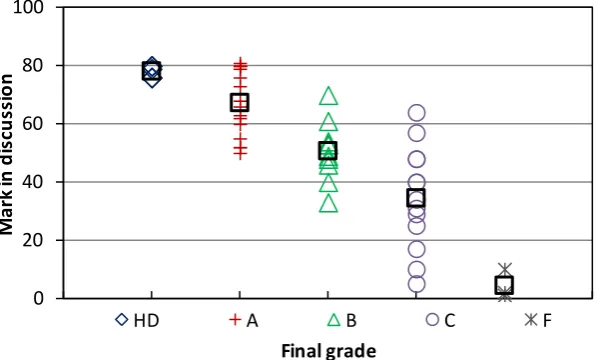
conducted to evaluate the relation of the level of participation in the online discussion forum to the overall the performance of the students in ABC1234 course in years 2011 and 2012. Figure 4 shows the relationship of the marks of the student in their participation in the technical discussion and their overall grade in the course. The average percentage marks are also provided in the figure. In the figure, HD, A, B, C, F represents the final mark for students who got an overall grade of more than 85, 75 to 85, 65 to 75, 50 to 65, and less than 50%, respectively from the course.
0 20 40 60 80 100
0 1 2 3 4 5 6
M
ark
in
d
is
cu
ss
io
n
Final grade
[image:8.595.147.450.541.721.2]HD A B C F
As can be seen in Figure 4, there is a direct correlation with the overall student’s mark and their participation in the discussion forum. The students who actively engaged in the discussion forum achieved high grades. The possible reason for this is that the active participation and engagement helps the student to better understand the different study modules and gain additional knowledge from other students. On the other end, students who rarely participated in the discussion forum received a low or even a failing grade. The
average percentage marks for the student’s contribution and participation to the discussion forum are 78.2, 67.3, 50.7, 34.4, and 4.3 for students who got HD, A, B, C, and F,
respectively. While further analysis needs to be conducted to determine the correlation between the overall marks and participation in the discussion forum, the results indicated that the students who are more engaged in the online discussion has higher likelihood of getting a better mark than those who are not.
Conclusion
The learning experiences of the students in an online postgraduate course through the technical discussion forum are evaluated in this paper. Based on the results, peer assisted learning in online technical discussions is an effective tool to enhance a more effective student’s learning and engagement. This provided an avenue to students to have a broader knowledge on engineered fibre composites through the combination of the shared
experiences and knowledge by each student. More importantly, the online discussion
encouraged the students to take a more active role in their learning process and provided an avenue where students can explore answers through discussion. Results showed that the students who actively engaged in the discussion forum are more likely to achieve a better grade. A more structured format of the online technical discussion will encourage more engagement among the students and more time effective for the teaching team.
References
Allen, I.E. & Seaman, J. (2006). Making the Grade: Online education in the United States, The Sloan Consortium, Needham, MA.
Beckmann, E.A. & Kilby, P. (2008). Online, off-campus but in the flow: Learning from peers in development studies. Journal of Peer Learning, 1(1), 61-69.
Cheng, D. & Walters, M. (2009). Peer-assisted learning in mathematics: An observational study of student success. Journal of Peer Learning, 2(1), 23-39.
Graham, C.R. (2002). Factors for effective learning groups in face-to-face and virtual environments.
Quarterly Review of Distance Education, 3, 307-319.
Green, K. (1997). Drawn to the light, burned by the flame? Money, technology and distance education.
ED Journal, 11(5), 9.
Harris, N. & Sandor, M. (2007). Developing online discussion forum as student centred peer e-learning
environments. Proceedings ASCILITE Conference, Singapore, 383-387.
Meyer, K. A. (2003). Face-to-face versus threaded discussions: the role of time and higher-order thinking. Journal of Asynchronous Learning Networks, 7(3), 55-65.
Orabi, I.I. (2004). Comparison of student performance in an online with traditional based entry level
engineering course, Proceedings of ASEE Annual Conference, Salt Lake, Utah.