STATISTICAL ARTICLE
ERTHYGL YSTADEGOL
Development of Learner Outcome Measures for
Adult Community Learning
1Background
The Delivering Community Learning for Wales policy statement published by the Welsh Government (WG) in November 2010 stated that the Department for Education and Skills (DfES - formerly DCELLS) must “develop consistent performance measures and benchmarking data to help Adult Community Learning (ACL) providers to evaluate learner outcomes”.
To achieve this aim, WG statisticians have been working in collaboration with DfES officials and NIACE Dysgu Cymru in order to develop learner outcome measures for the ACL sector in Wales. This statistical article provides an update on this work and presents a set of preliminary benchmarks for the 2009/10 academic year. We welcome any feedback on the content and scope of this article.
Definition of ACL provision
ACL is defined in Delivering Community Learning for Wales as:
“Flexible learning opportunities for adults, delivered in community venues to meet local needs”
For the purposes of this development work, we have focussed on four distinct types of ACL provision:
1) learning directly delivered by local authorities (LAs);
2) learning delivered by LAs via a franchise arrangement with a further education (FE) institution; 3) all provision delivered in Wales by the YMCA Wales Community College and Workers
Educational Association (South Wales), and;
4) learning delivered in the community by FE institutions.
Data on learners accessing these types of ACL provision across Wales is submitted electronically to DfES by learning providers via the Lifelong Learning Wales Record (LLWR) (further information on the LLWR can be found towards the end of this article).
Date of Publication: 14 July 2011
Next update: Not a regular output
Author: Scott Clifford, Post-16 Education Statistics, Statistical Directorate
E-mail: [email protected]
Telephone: 029 2092 6025
Twitter: www.twitter.com/statisticswales | www.twitter.com/ystadegaucymru
Whilst provision types 1, 2 and 3 can be derived relatively easily from LLWR, provision type 4 has proved harder to capture. From 2010/11 onwards, a new value to specifically identify ACL provision has been introduced to LLWR field LP17 (Type of learning programme). However, for 2009/10 we have considered provision delivered away from main FE college sites as an approximation.
Note that provision types 2, 3 and 4 have historically been categorised as ‘FE provision’ and included in the FE learner outcomes data published annually within the National Comparators for Further
Education and Work-Based Learning Statistical First Release.
Measures of performance
Given the existing overlap with the FE section of the National Comparators SFR, the three main FE measures of learner outcomes were adopted as a starting point for the development of ACL benchmarks. These measures are:
• Learning activity completion: the proportion of learning activities commenced which are completed;
• Learning activity attainment: the proportion of completed learning activities which lead to the attainment of a qualification; and
• Learning activity success: the proportion of learning activities commenced which lead to the attainment of a qualification. This combines the measures of completion and attainment.
Consultation and data reconciliation
Representatives from the ACL sector in Wales were informally consulted by NIACE Dysgu Cymru to determine how these measures should be aggregated and presented. These discussions were informed by the results of preliminary analysis produced from the LLWR. The report summarising these
discussions and providing further advice to DfES on the implementation of ACL performance measures will shortly be published on the Quality & Effectiveness pages of the WG website.
Whilst these discussions progressed, a process of data-reconciliation was also undertaken. Monthly reconciliation reports detailing provisional learner outcomes figures were produced and issued to local authorities. Data quality issues were then followed up by DfES officials and resolved accordingly.
Preliminary ACL benchmarks for 2009/10
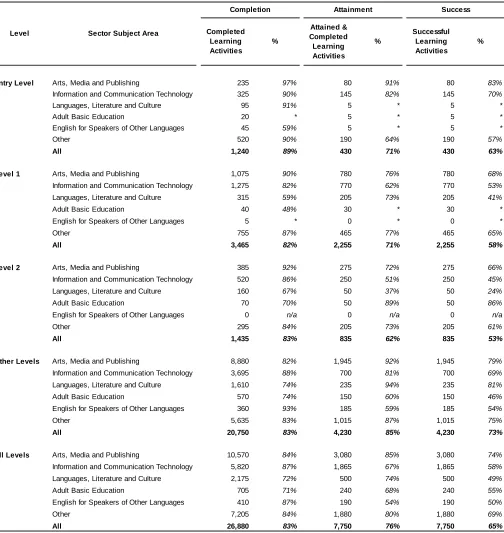
Tables 1 – 3 present completion, attainment and success rates for the ACL sector in 2009/10 split by level and sector subject area.
Table 1 details ACL provision directly delivered by local authorities.
Table 2 details ACL provision delivered by local authorities via a franchise arrangement with a further education institution.
Issues requiring further investigation
Non assessable learning activities
Learning activities that are deemed to be non-assessable (i.e. do not lead to an associated award) are excluded from the denominators of attainment and success rate calculations. Directly delivered local authority provision has a notably high proportion of such activities (69 per cent of terminated learning activities in 2009/10) compared with local authority provision delivered via a franchise arrangement with an FE institution (11 per cent of terminated learning activities). Further liaison with providers will be undertaken to clarify that provision is being correctly recorded as non-assessable.
Level of learning activities
A significant number of local authority learning activities were recorded with a level of ‘Not Known’ or ‘Not Applicable’ on LLWR. In 2009/10, these learning activities have been categorised as ‘Other Levels’ (see table 1). Further work will be carried out with providers to ensure the consistent use of these codes.
Early drop out
As part of the derivation of FE performance measures, learning activities with an expected duration that ended before 1 November of the academic year in which they commenced without completing are classified as early drop-outs and excluded from calculations.
However, as ACL provision is predominantly comprised of short courses that are not necessarily delivered on an academic year basis, this method was deemed inappropriate for the ACL sector and a decision on the treatment of early drop-outs has been deferred pending further analysis of the
underlying LLWR data.
Non-franchised ACL delivered by FE institutions
For the purposes of this article, this provision has been approximated by considering learning delivered away from main college campuses. However, additional analysis to refine this approximation will need to be undertaken. Further to this, preliminary analysis of LLWR field LP17 will need to be produced to ensure that robust data on this type of provision is available for 2010/11.
Next steps
Dissemination of detailed benchmarking data and individual
Learner Outcome Reports (LORs) to local authorities July – August 2011
Review of methodological/data issues impacting upon performance measures
July – August 2011
Dissemination of draft 2010/11 reports to local authorities September 2011 - February 2012
Production of 2010/11 benchmarks March 2012
Publication of Statistical First Release detailing ACL learner outcomes for 2010/11
Table 1: Indicative completion, Attainment and Success Rates for ACL provision delivered by local authorities, 2009/10
Completed Learning Activities
%
Attained & Completed Learning Activities
%
Successful Learning Activities
%
Entry Level Arts, Media and Publishing 235 97% 80 91% 80 83%
Information and Communication Technology 325 90% 145 82% 145 70%
Languages, Literature and Culture 95 91% 5 * 5 *
Adult Basic Education 20 * 5 * 5 *
English for Speakers of Other Languages 45 59% 5 * 5 *
Other 520 90% 190 64% 190 57%
All 1,240 89% 430 71% 430 63%
Level 1 Arts, Media and Publishing 1,075 90% 780 76% 780 68%
Information and Communication Technology 1,275 82% 770 62% 770 53%
Languages, Literature and Culture 315 59% 205 73% 205 41%
Adult Basic Education 40 48% 30 * 30 *
English for Speakers of Other Languages 5 * 0 * 0 *
Other 755 87% 465 77% 465 65%
All 3,465 82% 2,255 71% 2,255 58%
Level 2 Arts, Media and Publishing 385 92% 275 72% 275 66%
Information and Communication Technology 520 86% 250 51% 250 45%
Languages, Literature and Culture 160 67% 50 37% 50 24%
Adult Basic Education 70 70% 50 89% 50 86%
English for Speakers of Other Languages 0 n/a 0 n/a 0 n/a
Other 295 84% 205 73% 205 61%
All 1,435 83% 835 62% 835 53%
Other Levels Arts, Media and Publishing 8,880 82% 1,945 92% 1,945 79%
Information and Communication Technology 3,695 88% 700 81% 700 69%
Languages, Literature and Culture 1,610 74% 235 94% 235 81%
Adult Basic Education 570 74% 150 60% 150 46%
English for Speakers of Other Languages 360 93% 185 59% 185 54%
Other 5,635 83% 1,015 87% 1,015 75%
All 20,750 83% 4,230 85% 4,230 73%
All Levels Arts, Media and Publishing 10,570 84% 3,080 85% 3,080 74%
Information and Communication Technology 5,820 87% 1,865 67% 1,865 58%
Languages, Literature and Culture 2,175 72% 500 74% 500 49%
Adult Basic Education 705 71% 240 68% 240 55%
English for Speakers of Other Languages 410 87% 190 54% 190 50%
Other 7,205 84% 1,880 80% 1,880 69%
All 26,880 83% 7,750 76% 7,750 65%
Source: Lifelong Learning Wales Record (LLWR)
Success
Level Sector Subject Area
Table 2: Completion, Attainment and Success Rates for ACL provision delivered by local authorities via a franchise arrangement with an FE institution, 2009/10
Completed Learning Activities
%
Attained & Completed Learning Activities
%
Successful Learning Activities
%
Entry Level Arts, Media and Publishing 680 91% 355 93% 360 84%
Information and Communication Technology 780 87% 610 89% 615 78%
Languages, Literature and Culture 40 * * * * *
Adult Basic Education 2,595 86% 1,645 73% 1,650 62%
English for Speakers of Other Languages 2,185 75% 1,450 85% 1,465 60%
Other 1,515 88% 880 92% 890 81%
All 7,795 83% 4,945 83% 4,975 67%
Level 1 Arts, Media and Publishing 1,160 78% 1,060 91% 1,080 74%
Information and Communication Technology 3,000 88% 2,395 85% 2,415 76%
Languages, Literature and Culture 970 83% 880 93% 890 78%
Adult Basic Education 1,450 81% 875 68% 875 56%
English for Speakers of Other Languages 150 83% 135 89% 140 78%
Other 2,500 89% 2,080 84% 2,090 76%
All 9,230 85% 7,420 84% 7,490 73%
Level 2 Arts, Media and Publishing 855 87% 755 88% 760 80%
Information and Communication Technology 830 89% 605 78% 605 69%
Languages, Literature and Culture 565 81% 495 89% 500 73%
Adult Basic Education 365 80% 255 79% 260 62%
English for Speakers of Other Languages 40 * 35 * 35 *
Other 1,705 86% 1,455 87% 1,465 75%
All 4,360 85% 3,600 85% 3,625 74%
Other Levels Arts, Media and Publishing 185 70% 110 58% 110 46%
Information and Communication Technology 340 93% 135 75% 140 67%
Languages, Literature and Culture 175 95% 165 94% 165 89%
Adult Basic Education 65 94% 45 82% 45 77%
English for Speakers of Other Languages 0 n/a 0 n/a 0 n/a
Other 455 83% 385 87% 385 72%
All 1,220 85% 840 81% 840 69%
All Levels Arts, Media and Publishing 2,880 83% 2,275 88% 2,310 75%
Information and Communication Technology 4,955 88% 3,745 84% 3,775 75%
Languages, Literature and Culture 1,750 83% 1,545 92% 1,555 77%
Adult Basic Education 4,470 84% 2,820 72% 2,830 60%
English for Speakers of Other Languages 2,370 75% 1,620 86% 1,640 62%
Other 6,175 88% 4,800 87% 4,825 76%
All 22,605 85% 16,810 84% 16,930 71%
Source: Lifelong Learning Wales Record (LLWR)
Success
Level Sector Subject Area
Table 3: Completion, Attainment and Success Rates for non-franchised ACL provision delivered in the community by FE institutions, 2009/10
Completed Learning Activities
%
Attained & Completed Learning Activities
%
Successful Learning Activities
%
Entry Level Arts, Media and Publishing 530 91% 450 92% 465 87%
Information and Communication Technology 1,335 78% 740 91% 765 82% Languages, Literature and Culture 415 90% 285 78% 285 74%
Adult Basic Education 1,985 76% 1,485 85% 1,525 76%
English for Speakers of Other Languages 2,285 88% 1,975 87% 2,045 82%
Other 1,990 93% 1,235 95% 1,250 90%
All 8,535 85% 6,165 88% 6,335 82%
Level 1 Arts, Media and Publishing 3,140 91% 2,955 95% 2,995 88%
Information and Communication Technology 6,920 90% 5,715 95% 5,790 88% Languages, Literature and Culture 925 70% 785 88% 870 78%
Adult Basic Education 1,765 84% 1,455 87% 1,465 81%
English for Speakers of Other Languages 480 93% 445 93% 450 90%
Other 14,335 94% 12,755 95% 12,830 91%
All 27,570 91% 24,105 94% 24,405 89%
Level 2 Arts, Media and Publishing 1,985 88% 1,775 90% 1,835 84%
Information and Communication Technology 3,465 92% 2,450 92% 2,475 87% Languages, Literature and Culture 440 68% 365 89% 400 79%
Adult Basic Education 580 82% 395 86% 395 83%
English for Speakers of Other Languages 150 96% 145 99% 145 97%
Other 13,770 94% 12,430 93% 12,490 88%
All 20,390 92% 17,555 92% 17,740 87%
Other Levels Arts, Media and Publishing 2,005 90% 1,040 94% 1,070 84%
Information and Communication Technology 5,115 89% 840 86% 840 75% Languages, Literature and Culture 685 93% 330 92% 330 85%
Adult Basic Education 1,215 95% 90 82% 90 77%
English for Speakers of Other Languages 245 95% 5 * 5 *
Other 11,805 91% 5,965 89% 6,000 83%
All 21,075 90% 8,265 90% 8,330 83%
All Levels Arts, Media and Publishing 7,660 90% 6,215 93% 6,365 86%
Information and Communication Technology 16,835 89% 9,740 93% 9,875 86% Languages, Literature and Culture 2,465 78% 1,760 87% 1,885 79%
Adult Basic Education 5,545 83% 3,425 86% 3,480 79%
English for Speakers of Other Languages 3,165 90% 2,565 89% 2,645 84%
Other 41,900 93% 32,380 93% 32,565 88%
All 77,570 90% 56,090 92% 56,810 86%
Source: Lifelong Learning Wales Record (LLWR) Success
Level Sector Subject Area
Further Information
1 Data
sources
Data on learners accessing ACL provision across Wales is submitted electronically to DfES by learning providers via the Lifelong Learning Wales Record (LLWR).
The LLWR comprises datasets based on learners, their learning programmes, their constituent learning activities and their ensuing awards. A learning activity, typically, is a specific qualification or course pursued by a learner. A learning programme is a group of related activities (and awards where applicable) such as a work-based learning apprenticeship.
Further information on LLWR including user support manuals can be found at: Welsh Assembly Government - Lifelong Learning Wales Record
Our statement of administrative sources, which also refers to this data source, can be found at: Statement of Administrative Sources
2 Definitions
2.1 Cohorts
The base cohorts underpinning tables 1, 2 and 3 comprise all learning activities that were either expected to complete during the respective academic year or actually ended during the academic year but were expected to complete prior to it.
2.2 Completion, Attainment and Success
The completion rates shown in tables 1 - 3 are calculated as the number of learning activities completed divided by the number of learning activities terminated (completed or withdrawn).
The attainment rates shown in tables 1 - 3 are calculated as the number of learning activities attained divided by the number of learning activities completed.
The success rates shown in tables 1 - 3 are calculated as the number of learning activities attained divided by the number of learning activities terminated.
Learning activities that are deemed to be non-assessable (i.e. do not lead to an associated award) are excluded from the denominators of the attainment and success rate calculations.
Learning activities recorded as either transferred or continuing are excluded from all calculations.
2.3 Level of learning aim
2.4 Sector subject area
The sector/subject areas are based on the 15 first-tier areas of learning in the Qualifications and Curriculum Development Agency’s (QCDA) sector/subject framework and are grouped to reflect the most popular ACL subject areas.
3 Rounding
and
Suppression
All figures in this Statistical Article are rounded to the nearest 5 and therefore there may be apparent slight differences between the sum of the constituent rows/columns and the totals. A ‘*’ represents numbers greater than 0 but less than 5.
In addition, percentage calculations where the denominator is less than 50 have been suppressed and the percentage replaced with a ‘*‘.
4 Franchise
arrangements
The following table summarises the franchise arrangements for the delivery of ACL provision that are currently in place between FE institutions and local authorities:
Franchising FE institution Local authority delivering learning
Barry College Cardiff Council
Vale of Glamorgan Council
Bridgend College Bridgend County Borough Council
Coleg Sir Gar Carmarthenshire County Council
Coleg Ceredigion Ceredigion County Council
Coleg Glan Hafren Cardiff Council
Coleg Gwent Blaenau Gwent County Borough Council Caerphilly County Borough Council Monmouthshire County Council Newport City Council
Torfaen County Borough Council
Coleg Morgannwg Rhondda Cynon Taff County Borough Council
Neath Port Talbot College Neath Port Talbot County Borough Council
Pembrokeshire College Pembrokeshire County Council
Coleg Powys Powys County Council
Notes on the use of statistical articles
Statistical articles generally relate to one-off analyses for which there are no updates planned, at least in the short-term, and serve to make such analyses available to a wider audience than might otherwise be the case. They are mainly used to publish analyses that are exploratory in some way, for example:
• Introducing a new experimental series of data;
• A partial analysis of an issue which provides a useful starting point for further research but that nevertheless is a useful analysis in its own right;
• Drawing attention to research undertaken by other organisations, either commissioned by the Welsh Government or otherwise, where it is useful to highlight the conclusions, or to build further upon the research;
• An analysis where the results may not be of as high quality as those in our routine statistical releases and bulletins, but where meaningful conclusions can still be drawn from the results.
Where quality is an issue, this may arise in one or more of the following ways:
• being unable to accurately specify the timeframe used (as can be the case when using an administrative source);
• the quality of the data source or data used; or • other specified reasons.
However, the level of quality will be such that it does not significantly impact upon the conclusions. For example, the exact timeframe may not be central to the conclusions that can be drawn, or it is the order of magnitude of the results, rather than the exact results, that are of interest to the audience.
The analysis presented does not constitute a National Statistic, but may be based on National Statistics outputs and will nevertheless have been subject to careful consideration and detailed checking before publication. An assessment of the strengths and weaknesses in the analysis will be included in the article, for example comparisons with other sources, along with guidance on how the analysis might be used, and a description of the methodology applied.
Articles are subject to the release practices as defined by the release practices protocol, and so, for example, are published on a pre-announced date in the same way as other statistical outputs. Missing value symbols used in the article follow the standards used in other statistical outputs, as outlined below.
.. The data item is not available
. The data item is not applicable
- The data item is not exactly zero, but estimated as zero or less than half the final digit shown