Evaluation of the Creative Learning
through the Arts Programme
Report 1: Theory of Change
Mae’r ddogfen yma hefyd ar gael yn Gymraeg.
This document is also available in Welsh.
© Crown Copyright Digital ISBN 978-1-78859-163-8
SOCIAL RESEARCH NUMBER:
40/2017
PUBLICATION DATE:
Evaluation of the Creative Learning through the Arts Programme
Report 1 Theory of Change
Author(s) / Company
Endaf Griffiths, Wavehill
Mair Bell, Wavehill
David Parker
Andy Parkinson
Views expressed in this report are those of the researcher and not necessarily those of the Welsh Government
For further information please contact:
Richard Thurston, Deputy Chief Social Research Officer Knowledge and Analytical Services
Welsh Government Cathays Park Cardiff
CF10 3NQ
Tel: 0300 025 5324
Table of contents
List of tables ... 2
List of figures... 2
Glossary ... 3
1. Summary ... 4
2. Introduction ... 10
3. Theory of Change... 13
4. Rationale for the Programme ... 33
5. Programme Design and Delivery... 44
6. Key Evaluation Questions ... 64
7. Conclusion and Next Steps ... 67
Appendix 1: Objectives of the Evaluation ... 70
Appendix 2: Literature Review References and Further Reading ... 71
List of tables
Table 3.1: Indicators of change in LEARNERS ... 26
Table 3.2: Indicators of change in TEACHERS... 28
Table 3.3: Indicators of change in SCHOOLS ... 30
Table 3.4: Indicators of change in ARTISTS AND ARTS ORGANISATIONS ... 32
Table 5.1: Total Plan Cost (May 2014 - June 2020)... 45
Table 5.2: Projected Numbers of Schools Engaged in the Lead Creative Schools scheme 46 Table 5.3: Lead Creative Schools Scheme Cost (May 2014 - June 2020) ... 49
Table 5.4: Representativeness of Round 1 Lead Creative Schools by Region and Type .... 51
Table 5.5: Representativeness of Round 1 Lead Creative Schools by Language of Instruction ... 51
Table 5.6: All-Wales Arts and Education Offer Cost (May 2014 - June 2020) ... 55
Table 5.7: All-Wales Arts and Education Offer delivery indicators ... 62
List of figures
Figure 3.1: Theory of Change for the Lead Creative Schools Scheme ... 20Figure 3.2: Theory of Change for the All-Wales Arts and Education Offer ... 22
Figure 3.3: Outline Theory of Change for LEARNERS ... 24
Figure 3.4: Outline Theory of Change for TEACHERS ... 27
Figure 3.5: Outline Theory of Change for SCHOOLS ... 29
Figure 3.6: Outline Theory of Change for ARTISTS AND ARTS ORGANISATIONS ... 31
Glossary
Acronym/
Key word Definition
ATLAC Arts as a Tool for Learning Across the Curriculum (Scotland) CAPE Chicago Arts Programme in Education
CCE
Creativity, Culture and Education (an international foundation
dedicated to unlocking the creativity of children and young people in and out of formal education).
CCiSS Cultural Coordinators in Scottish Schools (Scotland) CP Creative Partnerships (England)
CPD Continuous Professional Development
CSC Central and South Wales Education Consortium EAS South East Wales Education Consortium
eFSM Eligible for free school meals
ERW South West and Mid Wales Education Consortium GwE North Wales Education Consortium
ITT Initial Teacher Training
LAs Local Authorities
LCS Lead Creative Schools
NFER National Foundation for Educational Research
OECD Organisation for Economic Cooperation and Development
REC Regional Education Consortium
RSA
Royal Society for the encouragement of Arts, Manufactures and Commerce
SDP School Development Plan
1.
Summary
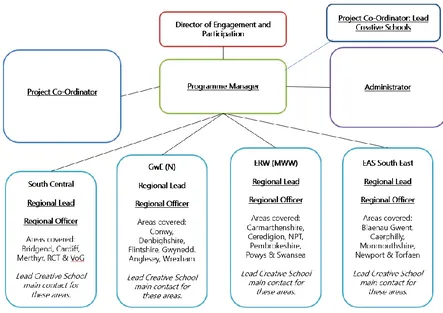
1.1 Launched in March 2015, the Creative Learning Through the Arts programme is a partnership between Arts Council of Wales and the Welsh Government. The programme is managed by a team within the Arts Council of Wales, under the direction of the Director for Engagement and Participation. It is supported by equal investments of Arts Lottery and Welsh Government Department for Education and Skills funding, totalling £20m over five years.
1.2 The initiative consists of two strands of activity:
strand 1, the Lead Creative Schools scheme, is focused on improving attainment through creativity. It is an intensive intervention that involves teachers, ‘Creative Agents’ and ‘Creative Practitioners’ working together to deliver a creative approach to learning. It is anticipated that the scheme will support around a third of schools in Wales over the 5-year lifetime of the programme
strand 2, the All-Wales Arts and Education Offer, includes a range of different activities designed to increase and improve opportunities for teachers,
learners, artists and arts/cultural/heritage organisations to work together. This includes an online Arts and Creative Learning Portal, Regional Arts and Education Networks, Local Arts Champions and an ‘Experiencing the Arts’ fund.
1.3 This is a first report on an independent evaluation of the Creative Learning Through the Arts programme. Broadly, its purpose is to examine the process, impact and value for money of the programme. This report, produced in the early stages of the programme, explores the changes (or outcomes) that it is anticipated Creative Learning Through the Arts will generate and how we can measure those changes. It does this by considering the Theory of Change1 which underpins the programme (Chapter 2), the rationale for the intervention (Chapter 3) and by setting out the programme design and delivery structure (Chapter 4). Essentially, this report provides the foundation upon which subsequent phases of the
evaluation will build.
1 A Theory of Change can be described as a roadmap that outlines the things (intermediary outcomes) that
Key findings: Theory of Change
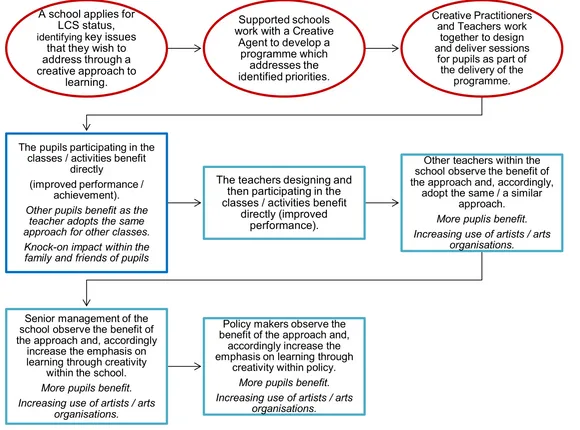
1.4 The key stages in the Theory of Change for Strand 1, the Lead Creative Schools scheme, are:
the pupils (learners) participating in the classes / activities benefit directly from that experience
the teachers working with the Creative Agents and Practitioners to design and then deliver sessions benefit from that experience and observe the benefit to the learners
other teachers within the school observe the benefit to pupils and, as a result, adopt the same or a similar approach
senior management of the school observe the benefit of the approach and, as a result, increase the emphasis on learning through creativity within the school policy makers observe the benefit of the approach and, as a result, increase
the emphasis, within policy, on learning through creativity.
1.5 Essentially, the above is a ‘proof of concept’ approach; the intervention is used to demonstrate that pupils benefit from the approach, and the other outcomes follow on from there. The hypothesis is that the lack of ‘proof’ that the creative
approaches do indeed work is limiting (or even blocking) the potential implementation of such approaches in schools in Wales.
1.7 Five groups of potential beneficiaries have been identified, and this report
considers how each of these groups will (in theory) change as a result of Creative Learning Through the Arts. We have not included here ‘policy makers’; they will not be a primary focus of this evaluation for the time being.
1.8 The result of this evaluation will be a series of indicators of change related to each one of the ‘beneficiary groups’. Importantly, these include indicators for a number of intermediary outcomes which can be used to assess the progress that Creative Learning Through the Arts is making towards achieving the final goals of the programme.
Key findings: Programme Rationale
1.9 The rationale for the programme is explored through a review of policy along with literature associated with programmes which are similar to Creative Learning Through the Arts. The conclusion reached was that there are a number of ‘condition setting’ phases to pass through before the real value of creative teaching and learning can be unlocked, highlighting that risks and contingencies should be considered through a formative evaluation process. For example we know that:
without the correct application and selection processes there can be
mismatched expectations between schools and artists which put at risk project planning
without adequate planning processes and support it is possible for creative teaching to be misconstrued and for learning outcomes to become loosened or detached from creative inputs, losing the sense of intent and causation which is crucial to success
without sufficient external expertise to support delivery phases some of the educational challenges arising from creative learning can seem overwhelming, leading to teacher disengagement and artist dominance
without adequate reflection and mechanisms for shared learning between artists and teachers, much of the understanding that can lead to sustainable changes to practice can be lost
without an understanding of the culture shift involved in using creative
approaches to teaching and learning, inadequate time is given during the early phases of a programme for schools, teachers and pupils to build new norms, thereby jeopardising longer term aims associated with attainment
without senior leadership buy-in, without a culture of teacher development, without high quality input from creative professionals and without creative strategies to improve pupils’ disposition to learning there is unlikely to be enough momentum generated to achieve the programme’s high level goals. 1.10 This is not an exhaustive list, but it does point to the lessons to be drawn from the
research and of course, the pitfalls to be avoided in the design and delivery of Creative Learning Through the Arts.
1.11 A key finding is that we need to understand what we should expect to see six months in, as opposed to six years down the line. We should not, for example, be rushing to look for signs of impacts on nationwide pupil attainment too soon - when other sorts of indicator are more significant early on and could be important
precursors to later impacts at pupil level.
Key findings: Programme Design and Delivery
1.12 The overview of the design and delivery of the programme outlines the progress that has been made to date and also underlines the assumptions that have been made which the evaluation will need to review as the programme progresses. These assumptions include:
Strand 1: Lead Creative Schools
Schools want to participate and will apply to be a Lead Creative School. Schools have the correct motivation for applying (to pilot creative approaches
to learning rather than to attract ‘replacement’ funding).
Creative Agents and Practitioners, with the correct skills set, can be identified, recruited and (if necessary) developed.
Creative Practitioners and teachers can effectively work together.
Teachers want, and have the ability and an opportunity, to participate in the scheme – does the appetite to participate filter down beyond senior
management / those who applied for the scheme?
Senior management support in participating schools will be forthcoming or can be developed.
Strand 2: All-Wales Arts and Education Offer
A Regional Arts and Education Network is an effective method for engaging with teachers, learners, arts and cultural organisations and practitioners. Schools will be interested in, and will be able to apply for, the funding which is
available from the Experiencing the Arts Fund.
Adequate appropriate opportunities will be available to schools, particularly in deprived areas.
Schools and other stakeholders will effectively engage with the Local Arts Champions.
An online learning portal is an effective method for engaging with teachers, learners, arts and cultural organisations and practitioners, including those not (yet) engaged with the Lead Creative Schools scheme.
That the scheme may work differently in different language settings and linguistic skills of learners, teachers and practitioners.
Evaluation Questions
1.13 Evaluation Questions make it easier to decide what data to collect, how to analyse it, and how to report it. These are not questions that are asked in an interview or via a questionnaire but high-level research questions that will be answered by combining data from several sources.
Further stages of the evaluation
1.15 The next stage of our work is to develop the evaluation framework which will provide the structure for the evaluation and which will detail the following: a) questions to be answered (evaluation questions)
b) evidence to be collected (indicators) c) how it will be collected (method) d) when it will be collected (method) e) how it will be analysed (method).
The review of the programme monitoring data is on-going as elements of the programme become established and data becomes available.
1.16 Lead Creative Schools will use the summer term to evaluate their activity. This should provide further information on what is working well and not so well. Also it will provide examples of any unanticipated benefits of, or challenges to, the
scheme, both in terms of process and impact. The completed evaluation forms will demonstrate how schools, Creative Agents and Practitioners are monitoring and evaluating their activities, and highlight gaps, good practice and areas on which the evaluation should focus further.
1.17 It is likely that the programme will inform Wales’ participation in an OECD research study. Its participation will be for the purposes of assessing progression in
creativity and critical thinking in schools. The study is concerned with developing approaches to creative teaching and learning practices in classrooms, and is trialling tests in creativity (convergent and divergent thinking). While full participation in the study may be too resource intensive, there might be
2.
Introduction
Background
2.1 The Creative Learning Through the Arts programme is a partnership between Arts Council Wales and the Welsh Government. The programme is managed by a team within the Arts Council of Wales, under the direction of the Director for
Engagement and Participation. It is supported by equal investments of Arts Lottery and Department for Education and Skills funding, totalling around £20m over five years. It was launched in March 2015.
2.2 The Creative Learning Through the Arts initiative consists of two innovative strands of educational activities. Strand 1, the Lead Creative Schools scheme, is focused on improving attainment through creativity. It is an intensive intervention that involves teachers, ‘Creative Agents’ and ‘Creative Practitioners’ working together to deliver a creative approach to learning. It is anticipated that this Scheme will support around a third of the schools in Wales over the five-year lifetime of the Creative Learning Through the Arts programme.
2.3 Strand 2, the All-Wales Arts and Education Offer, includes a range of different activities designed to increase and improve opportunities for teachers, learners, artists and arts/cultural/heritage organisations to work together. The Offer includes: a) the Arts and Creative Learning Portal – designed to be a source of information
and a collaboration hub for teachers, learners, arts and cultural organisations and practitioners.
b) the establishment of four Regional Arts and Education Networks with a remit to, amongst other things, provide opportunities for teachers and artists to develop and share their knowledge and skills.
c) local Arts Champions whose role it will be to promote best practice and support others to adopt similar approaches.
Purpose of the evaluation and method
2.4 This is a first report on the evaluation of the Creative Learning Through the Arts programme which is being undertaken alongside the delivery of the programme. The evaluation is being undertaken by the social and economic research
company, Wavehill, in association with the RSA and Consilium Research and Consultancy. Broadly, its purpose is to examine the process, impact and value for money of the Creative Learning Through the Arts programme. The evaluation will assess the effectiveness of Creative Learning Through the Arts in its own terms, but it will also relate the findings to extant literature describing the effects of arts and creativity in schools. By these means, it will contribute to learning and
development in relation to creative education in ways that will potentially influence debates and practices nationally and internationally.
2.5 The specific objectives of this evaluation are set out in Appendix 1. They include the development of the programme logic model and the theory of change for the Creative Learning Through the Arts programme. These have been the focus of the first phase of the evaluation, and of this report.
2.6 The research undertaken during the first phase included:
a review of the strategic and policy context, within which Creative Learning Through the Arts is placed, complemented by a literature review examining the evidence in support of the approach being introduced by Creative Learning Through the Arts. This background review aimed at improving the
understanding of the context within which the Programme has been
developed, as well as the extent to which the Creative Learning Through the Arts model reflects existing evidence and, therefore, a plausible theory of change
theory of Change workshop sessions with (a) evaluation steering group members and other key stakeholders, and (b) Arts Council Wales’ Creative Learning Through the Arts team
a review of project literature along with scoping consultations with key
members of the Creative Learning Through the Arts team and the evaluation steering group. This fed into the development of the theory of change
Structure of this report
2.7 The structure of the remainder of this report is as follows:
Chapter 2 introduces the Theory of Change associated with the Programme Chapter 3 explores the rationale for the Programme
Chapter 4 provides an overview of the design and delivery of the Programme, and the assumptions that have been made and which the evaluation will need to review
Chapter 5 presents the high-level questions which the evaluation will seek to answer, and
3.
Theory of Change
Key points
Five groups of beneficiaries (of Creative Learning Through the Arts) have been identified within the Theory of Change: Learners, Teachers, Schools, Artists & Arts Organisations and Education Policy makers.
Separate Theories of Change have been developed for the two strands of Creative Learning Through the Arts as well as for each of the beneficiary groups.
The outcome indicators identified using a behavioural change model will form the basis of the Evaluation Framework to be developed during the next phase of the evaluation.
Introduction
3.1 The Theory of Change can be described as a roadmap that outlines the things (intermediary outcomes) that need to happen in order to achieve the final outcome. A Logic Model is a closely related method (also sometimes referred to as an
‘intervention logic’ or ‘programme theory’) which depicts, graphically, the logic of an intervention and is useful for succinctly describing an intervention’s key
components and interacting relationships. The key components typically comprise the intervention’s inputs, activities, outputs, outcomes and impacts2. The
discussion in this chapter draws upon both of these concepts (Theory of Change and Intervention Logic).
3.2 An effective Theory of Change and logic model are very useful tools for programmes as they can reveal:
whether the activities being undertaken make sense, given the goals of the programme
whether there are things being done that do not help to achieve the goals of the programme (i.e. they do not lead to a relevant outcome)
whether there are gaps in the support provided (i.e. some of the range of necessary interim outcomes are not being achieved)
how to measure impact and/or progress towards achieving the final outcome of the programme
the existence of any additional or unforeseen outcomes which may not have been anticipated previously.
3.3 The final point is very significant since interventions often occur in a situation wherein those charged with assessing the programme are unlikely to see (or be able to measure) the final outcome during their lifetime. This can make it difficult to assess whether the programme can be considered a success. If, however we can demonstrate that interim outcomes (which will ultimately lead to the final outcome) have been achieved, making a judgement on the success or otherwise of the programme is possible.
3.4 The process is useful also because it identifies the assumptions that are being, or have been, made when a programme is being devised. For example, it is assumed that certain actions will lead to certain outcomes or that certain interim outcomes will lead to the desired final outcome. Testing the accuracy of those assumptions is an important part of any evaluation.
Vision and Aims
3.6 The following is the ‘vision’ that has been set out for Creative Learning Through the Arts:
The arts, and creative approaches to teaching and learning, should have a major role in all our schools, where collaboration with arts and cultural organisations and with creative practitioners is a common feature, and where good practice is shared and accessible to all.3
3.7 The ‘overarching aim’ (in line with the Welsh Government’s priorities) is described as being to improve literacy, numeracy and to reduce the impact of disadvantage and/or deprivation (the exact definition of which has yet to be agreed).
Issue
3.8 Whilst ‘reduce the impact of disadvantage’ is part of the overarching aim it is not explicitly noted within the three more specific aims. This may lead to the risk that this particular element of the overarching aim is not operationalized. It is important that any assumption that disadvantaged learners will be prioritised through the implementation of the programme, whether implicitly, explicitly or indirectly, is recognised and progress monitored in this area.
3.9 The overarching aim has subsequently been broken down into three more specific ‘sub-aims’ which are to:
1) improve attainment through creativity
2) increase and improve arts experiences and opportunities in schools 3) support teachers and arts practitioners in developing their skills.
3.10 Five groups of beneficiaries of Creative Learning Through the Arts have been identified:
These are the main beneficiary groups for both strands of the scheme. The Theory of Change for both cases is different, however, and so these are presented
separately below.
3 Creative learning through the arts – an action plan for Wales 2015-2020
Lead Creative Schools Scheme (Strand 1)
3.11 The Lead Creative Schools scheme strand is focused on improving attainment through creativity (i.e. sub-aim 1). For the purposes of the scheme, the ‘five creative habits of mind’ are used as indicators of creativity4:
1. inquisitive - wondering and questioning, exploring and investigating, challenging assumptions
2. persistent - tolerating uncertainty, sticking with difficulty, daring to be different 3. imaginative - playing with possibilities, making connections, using intuition 4. disciplined - crafting and improving, developing techniques, reflecting critically 5. collaborative - cooperating appropriately, giving and receiving feedback,
sharing the creative ‘product’.
3.12 The graphic on the following page illustrates the Theory of Change for the Lead Creative Schools scheme. The red ovals in the graphic show the primary activities being undertaken to deliver the scheme, whilst the blue rectangles show the outcomes of these activities.
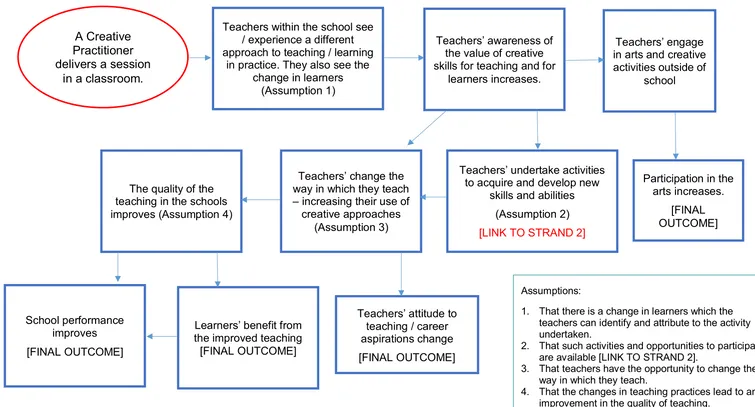
3.13 The Theory of Change shows the benefits of participating in the sessions with the Creative Practitioner, to the pupils, as the first outcome. The benefits to the
teacher participating follow, generated by her or him observing the benefits to the pupils. There is then a snowball effect which leads to the benefits to the other teachers, the school’s senior management and to policy makers. Essentially, this represents a ‘proof of concept’ approach, demonstrating that pupils benefit from the approach and that the other outcomes (and ultimately the final outcome – improved attainment) will follow.
3.14 The basic logic of the Theory of Change as set out above and in the graphic is clear, and this is the theory as presented by those who designed the scheme. It could, however, be argued (as it was by some participants in the workshops undertaken as part of this phase of the evaluation) that at least some
understanding of creativity as a learning tool at a policy and school (senior management) level is a pre-requisite. This is because the school (via its senior management) needs to successfully apply to participate in the Lead Creative Schools scheme.
4 Creativity, Culture and Education (CCE) identified the five ‘habits of mind’ as indicators of creativity based on
3.15 To do that, it needs at least some basic understanding of the value of the approach within the school. Teachers within the school also need to choose to participate5.
3.16 In relation to these concerns, developing a basic understanding of the concept at the senior management level and amongst some teachers within the school should, one could argue, be the first stages in the Theory of Change. A similar argument can be made for identifying policy makers as participants in the first step of the Theory of Change; if there is no understanding of the concept at a policy level, no funding will be allocated to the scheme, and so on. This highlights a wider point regarding the need for creativity to be acknowledged within policy and in teacher training in order for the approach to be ‘mainstreamed’.
3.17 The experience during the first phase of the scheme has been that it has not been necessary to encourage schools to apply to participate. This may, however, not remain the case for subsequent phases since those schools with an active interest in the subject may have already passed through the scheme.
5A teacher has decided not to participate in the scheme in at least one of the schools designated as a Lead
A school applies for LCS status,
identifying key issues that they wish to address through a creative approach to
learning.
Supported schools work with a Creative
Agent to develop a programme which
addresses the identified priorities.
Creative Practitioners and Teachers work
together to design and deliver sessions
for pupils as part of the delivery of the
programme.
The pupils participating in the classes / activities benefit
directly
(improved performance / achievement).
Other pupils benefit as the teacher adopts the same approach for other classes. Knock-on impact within the family and friends of pupils
The teachers designing and then participating in the classes / activities benefit
directly (improved performance).
Other teachers within the school observe the benefit of the approach and, accordingly,
adopt the same / a similar approach.
More puplis benefit. Increasing use of artists / arts
organisations.
Senior management of the school observe the benefit of the approach and, accordingly
increase the emphasis on learning through creativity
within the school.
More pupils benefit. Increasing use of artists / arts
organisations.
Policy makers observe the benefit of the approach and,
accordingly increase the emphasis on learning through
creativity within policy.
More pupils benefit. Increasing use of artists / arts
[image:20.842.126.706.91.521.2]organisations.
The All-Wales Arts and Education Offer (Strand 2)
3.18 Strand 2 has been set up to deliver the following (which relate to programme level sub-aims 2 and 3):
a) increase and improve opportunities for teachers, learners, artists and arts/cultural/heritage organisations to work together
b) increase opportunities for young people to experience the work of Wales’ artists and arts/cultural organisations
c) create more opportunities for communication and partnerships between schools, artists, arts/cultural/heritage organisations and local communities. 3.19 All of these objectives are activities rather than outcomes. As such, this is a far broader and less targeted intervention than the Lead Creative Schools scheme which is designed to work intensively with individual schools. The focus, here, is on creating ‘opportunities’ whereas the Lead Creative Schools scheme is tasked with a very specific final outcome – improving attainment through creativity. There must, however, obviously be a reason for these opportunities to be created.
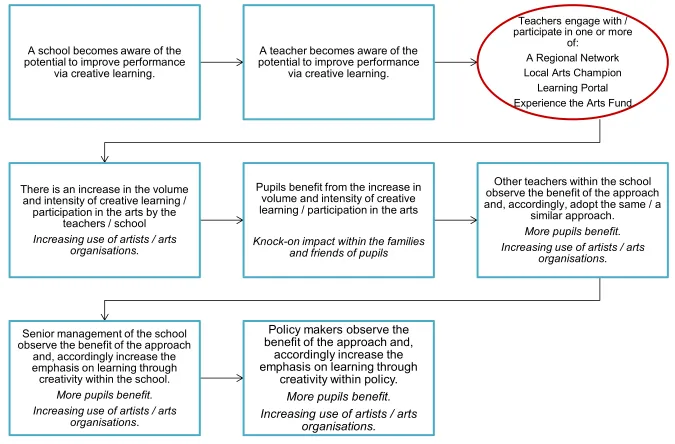
3.20 The graphic on the following page illustrates the Theory of Change for the Strand 2 activities. Again, the red ovals in the graphic show the primary activities being undertaken to deliver the scheme, whilst the blue rectangles show the outcomes of the activities.
A school becomes aware of the potential to improve performance
via creative learning.
A teacher becomes aware of the potential to improve performance
via creative learning.
Teachers engage with / participate in one or more
of:
A Regional Network Local Arts Champion
Learning Portal Experience the Arts Fund
There is an increase in the volume and intensity of creative learning /
participation in the arts by the teachers / school
Increasing use of artists / arts organisations.
Pupils benefit from the increase in volume and intensity of creative learning / participation in the arts
Knock-on impact within the families and friends of pupils
Other teachers within the school observe the benefit of the approach and, accordingly, adopt the same / a
similar approach.
More pupils benefit. Increasing use of artists / arts
organisations.
Senior management of the school observe the benefit of the approach
and, accordingly increase the emphasis on learning through creativity within the school.
More pupils benefit. Increasing use of artists / arts
organisations.
Policy makers observe the benefit of the approach and,
accordingly increase the emphasis on learning through
creativity within policy. More pupils benefit. Increasing use of artists / arts
[image:22.842.79.754.83.527.2]Observing and Measuring Change
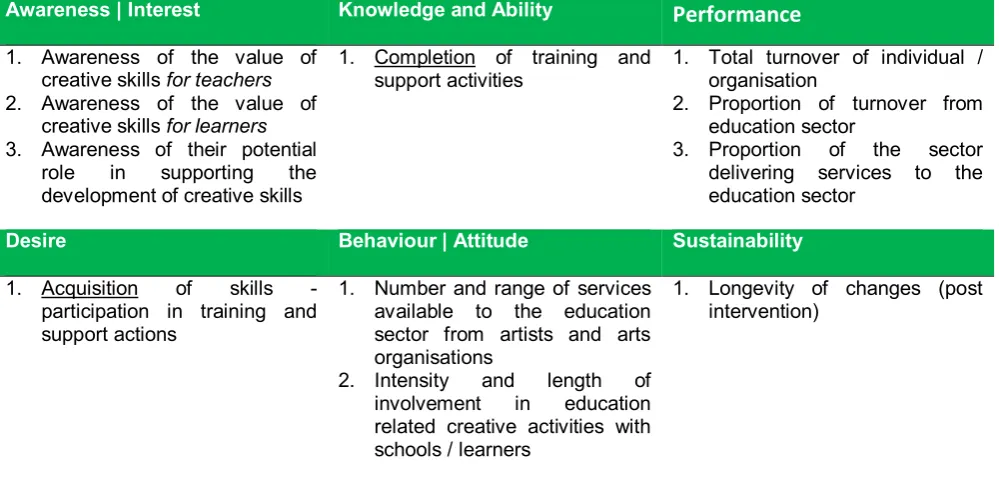
3.22 It is important to consider what the change will be for each of the five beneficiary groups, so that any such change can be observed and measured.
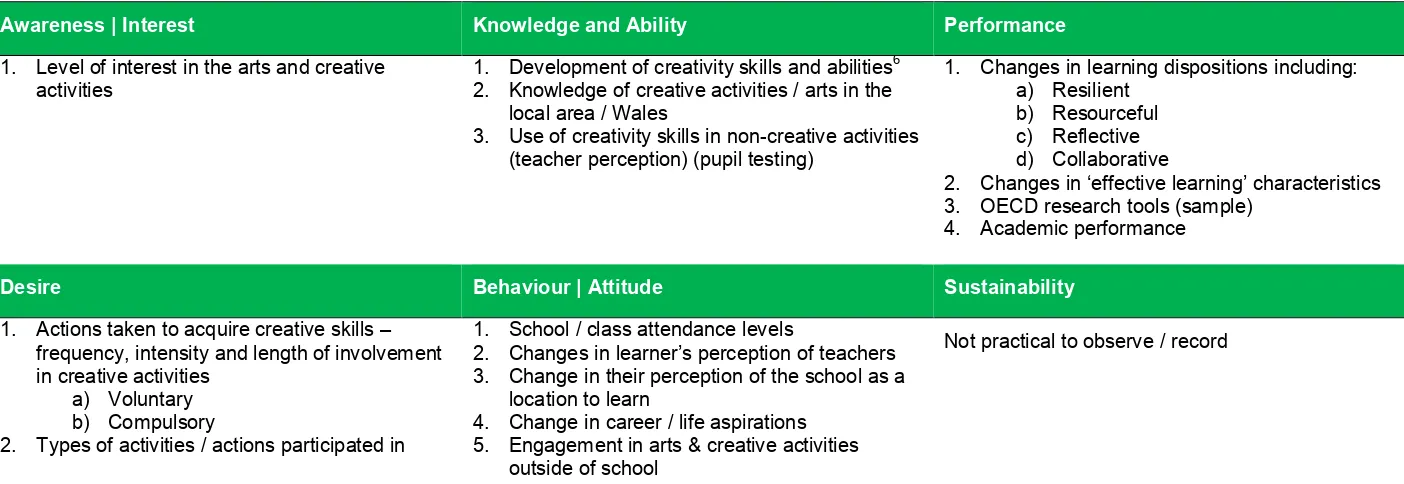
For each group, the change will follow a basic behavioural change model as illustrated below.
3.23 For example, pupils and teachers will first need to be aware of the creative approach to learning, they then need to be interested in the approach, and also they must have a desire to participate or use the approach and subsequently develop the knowledge and ability to do so. This should (in accordance with the Theory of Change) lead to a change in their behaviour and, hence, performance. In the case of pupils, performance will ultimately be measured in terms of their attainment (although it is anticipated that there will be earlier outcomes as discussed below). For teachers, it would be their performance as teachers. We can also add ‘sustainability’ to the model: to what extent are the changes that have been observed sustainable in the longer term? Will they be sustained once the intervention has been withdrawn?
3.24 We can use this model as a basis for observing and measuring change in each of the beneficiary groups identified in the Theory of Change as noted in the graphics and tables that follow. The exception is changes in policy makers, which will not be a primary focus for this evaluation for the time being.
Awareness /
Interest
Desire
Knowledge
and Ability
Behaviour /
3.25 On occasion, the difference between the categories in which an indicator has been placed can be ‘fuzzy’. For example, an indicator may fit in both the ‘knowledge & ability’ and the ‘behaviour / attitude’ categories because it is the change in
behaviour that indicates the change in knowledge & ability. This should not, however, be of great concern since the main purpose is to identify indicators of a change within the stakeholder group. The indicators have been developed based on the discussions held as part of the Theory of Change workshops and the findings of the literature review discussed later in this report.
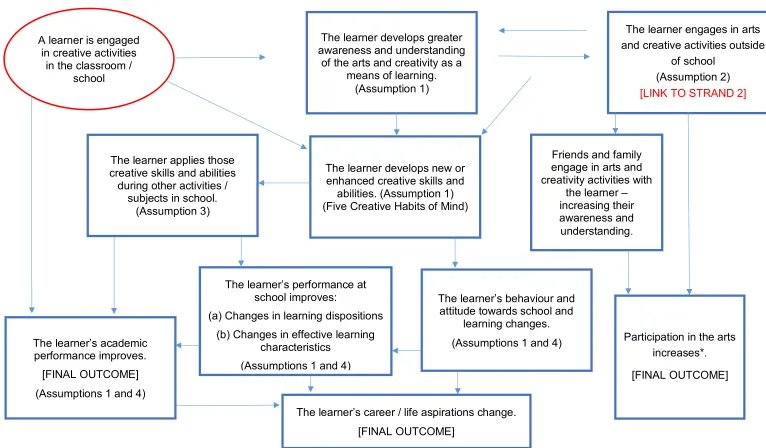
Figure 3.3: Outline Theory of Change for LEARNERS
The learner engages in arts and creative activities outside
of school (Assumption 2)
[LINK TO STRAND 2]
Friends and family engage in arts and creativity activities with
the learner – increasing their awareness and understanding.
A learner is engaged in creative activities
in the classroom / school
The learner develops greater awareness and understanding
of the arts and creativity as a means of learning.
(Assumption 1)
The learner applies those creative skills and abilities during other activities /
subjects in school. (Assumption 3)
The learner develops new or enhanced creative skills and
abilities. (Assumption 1) (Five Creative Habits of Mind)
The learner’s performance at school improves:
(a) Changes in learning dispositions (b) Changes in effective learning
characteristics (Assumptions 1 and 4)
The learner’s behaviour and attitude towards school and
learning changes. (Assumptions 1 and 4) The learner’s academic
performance improves. [FINAL OUTCOME] (Assumptions 1 and 4)
The learner’s career / life aspirations change. [FINAL OUTCOME]
Participation in the arts increases*.
Assumption
1. That the quality and ‘depth’ of the intervention is sufficient to generate this outcome.
2. That these opportunities exist and are accessible to the learner, etc. 3. That the learner has the opportunity to do this.
4. That improved creative skills and abilities lead to these outcomes (alongside other factors).
*Note: this increase in participation in the arts could lead to further outcomes for the individual concerned. This is however the ‘final outcome’ in respects of this
Table 3.1: Indicators of change in LEARNERS
Awareness | Interest Knowledge and Ability Performance
1. Level of interest in the arts and creative
activities 1. Development of creativity skills and abilities
6
2. Knowledge of creative activities / arts in the local area / Wales
3. Use of creativity skills in non-creative activities (teacher perception) (pupil testing)
1. Changes in learning dispositions including: a) Resilient
b) Resourceful c) Reflective d) Collaborative
2. Changes in ‘effective learning’ characteristics 3. OECD research tools (sample)
4. Academic performance
Desire Behaviour | Attitude Sustainability
1. Actions taken to acquire creative skills – frequency, intensity and length of involvement in creative activities
a) Voluntary b) Compulsory
2. Types of activities / actions participated in
1. School / class attendance levels
2. Changes in learner’s perception of teachers 3. Change in their perception of the school as a
location to learn
4. Change in career / life aspirations 5. Engagement in arts & creative activities
outside of school
Not practical to observe / record
Note: Baseline and / or comparator group needed
Figure 3.4: Outline Theory of Change for TEACHERS
A Creative Practitioner delivers a session
in a classroom.
Teachers within the school see / experience a different approach to teaching / learning
in practice. They also see the change in learners
(Assumption 1)
Teachers’ awareness of the value of creative skills for teaching and for
learners increases.
Teachers’ undertake activities to acquire and develop new
skills and abilities (Assumption 2)
[LINK TO STRAND 2]
Teachers’ engage in arts and creative activities outside of
school
Participation in the arts increases.
[FINAL OUTCOME] Teachers’ change the
way in which they teach – increasing their use of
creative approaches (Assumption 3) The quality of the
teaching in the schools improves (Assumption 4)
Learners’ benefit from the improved teaching [FINAL OUTCOME] School performance
improves [FINAL OUTCOME]
Teachers’ attitude to teaching / career aspirations change [FINAL OUTCOME]
Assumptions:
1. That there is a change in learners which the teachers can identify and attribute to the activity undertaken.
2. That such activities and opportunities to participate are available [LINK TO STRAND 2].
3. That teachers have the opportunity to change the way in which they teach.
Table 3.2: Indicators of change in TEACHERS
Awareness | Interest Knowledge and Ability Performance
1. Awareness of value of creative skills for teachers
2. Awareness of value of creative skills for learners
3. Awareness of the support and tools available
1. Completion of training and support activities 1. Performance of the teacher a) Self-assessment
b) Independent assessment 2. Career progression of the teacher
Desire Behaviour | Attitude Sustainability
1. Acquisition of skills - participation in all training and support actions:
a) Creative related b) In general
1. Intensity and length of involvement in creative activities in school
2. Use of creative learning methods in non-creative setting (without external support) 3. Change in perception of teaching as a
vocation
4. Change in perception of the school as a location to learn and work
5. Teaching career aspirations
1. Longevity of changes in teacher behaviour (post intervention)
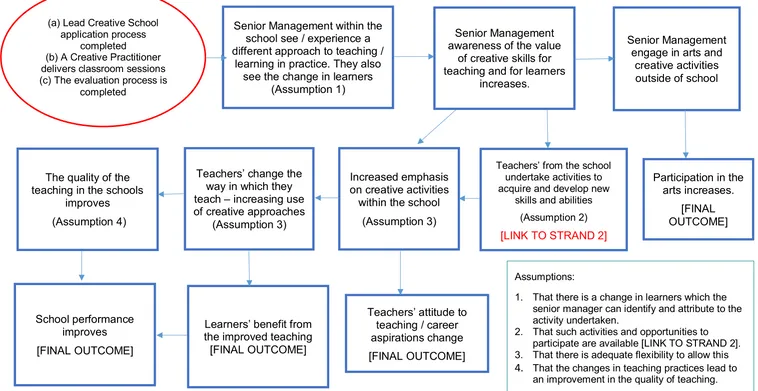
Figure 3.5: Outline Theory of Change for SCHOOLS
(a) Lead Creative School application process
completed
(b) A Creative Practitioner delivers classroom sessions (c) The evaluation process is
completed
Senior Management within the school see / experience a different approach to teaching /
learning in practice. They also see the change in learners
(Assumption 1)
Senior Management awareness of the value
of creative skills for teaching and for learners
increases.
Teachers’ from the school undertake activities to acquire and develop new
skills and abilities (Assumption 2)
[LINK TO STRAND 2]
Senior Management engage in arts and
creative activities outside of school
Participation in the arts increases.
[FINAL OUTCOME] Teachers’ change the
way in which they teach – increasing use of creative approaches
(Assumption 3) The quality of the
teaching in the schools improves (Assumption 4)
Learners’ benefit from the improved teaching [FINAL OUTCOME] School performance
improves [FINAL OUTCOME]
Teachers’ attitude to teaching / career aspirations change [FINAL OUTCOME]
Assumptions:
1. That there is a change in learners which the senior manager can identify and attribute to the activity undertaken.
2. That such activities and opportunities to
participate are available [LINK TO STRAND 2]. 3. That there is adequate flexibility to allow this
4. That the changes in teaching practices lead to an improvement in the quality of teaching.
Increased emphasis on creative activities within the school
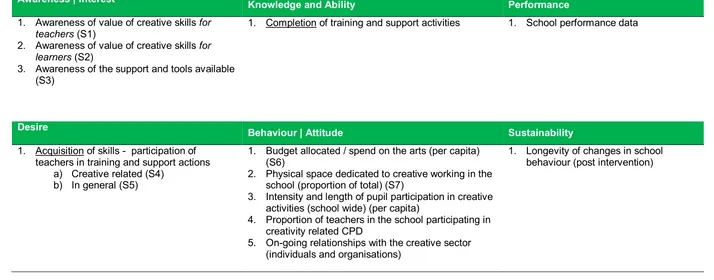
Table 3.3: Indicators of change in SCHOOLS
Awareness | Interest Knowledge and Ability Performance
1. Awareness of value of creative skills for teachers (S1)
2. Awareness of value of creative skills for learners (S2)
3. Awareness of the support and tools available (S3)
1. Completion of training and support activities 1. School performance data
Desire Behaviour | Attitude Sustainability
1. Acquisition of skills - participation of teachers in training and support actions
a) Creative related (S4) b) In general (S5)
1. Budget allocated / spend on the arts (per capita) (S6)
2. Physical space dedicated to creative working in the school (proportion of total) (S7)
3. Intensity and length of pupil participation in creative activities (school wide) (per capita)
4. Proportion of teachers in the school participating in creativity related CPD
5. On-going relationships with the creative sector (individuals and organisations)
1. Longevity of changes in school behaviour (post intervention)
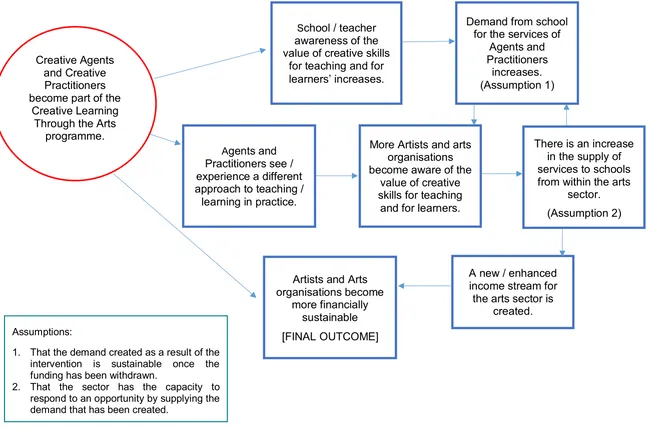
Figure 3.6: Outline Theory of Change for ARTISTS AND ARTS ORGANISATIONS
Creative Agents and Creative Practitioners become part of the
Creative Learning Through the Arts
programme.
Agents and Practitioners see / experience a different approach to teaching / learning in practice.
School / teacher awareness of the value of creative skills
for teaching and for learners’ increases.
Demand from school for the services of
Agents and Practitioners
increases. (Assumption 1)
More Artists and arts organisations become aware of the
value of creative skills for teaching
and for learners.
There is an increase in the supply of services to schools from within the arts
sector. (Assumption 2)
A new / enhanced income stream for the arts sector is
created. Artists and Arts
organisations become more financially
sustainable [FINAL OUTCOME]
Assumptions:
1. That the demand created as a result of the intervention is sustainable once the funding has been withdrawn.
Table 3.4: Indicators of change in ARTISTS AND ARTS ORGANISATIONS
Awareness | Interest Knowledge and Ability Performance
1. Awareness of the value of creative skills for teachers
2. Awareness of the value of creative skills for learners
3. Awareness of their potential role in supporting the development of creative skills
1. Completion of training and support activities
1. Total turnover of individual / organisation
2. Proportion of turnover from education sector
3. Proportion of the sector delivering services to the education sector
Desire Behaviour | Attitude Sustainability
1. Acquisition of skills - participation in training and support actions
1. Number and range of services available to the education sector from artists and arts organisations
2. Intensity and length of involvement in education related creative activities with schools / learners
1. Longevity of changes (post intervention)
4.
Rationale for the Programme
Key points
The Creative Learning Through the Arts programme is being implemented as a result of a number of policy developments in Arts and Education in Wales. The principal rationale for Creative Learning Through the Arts as an intervention
is that, based on international literature and recent experiences of the Creative Partnerships Programme in England (discussed in the following chapter), there is evidence to suggest that interventions with a focus on creativity and the arts can boost the attainment of learners across all age groups.
There is also evidence to suggest that an arts-rich education can help to build a sense of personal confidence, well-being and aspiration in learners.
Introduction
4.1 What is the rationale for this intervention? Why does the Programme exist? Why is it being funded? These are important questions for any evaluation to answer, and they are briefly explored in this chapter.
4.2 The following considers the broader policy landscape associated with the Programme, the key theoretical assumptions underpinning its design and the extent to which they conform to the evidence identified in the literature review. Policy context
4.4 It is also important to take into account broader developments in respect of the curriculum in Wales. In March 2014, the Welsh Government asked Professor Graham Donaldson to conduct a fundamental review of curriculum and
assessment arrangements, from Foundation Phase to Key Stage 4. Professor Donaldson’s report - Successful Futures – contained 68 recommendations, all of which were accepted in full by the Minister for Education and Skills in June 2015. A new curriculum is now being developed with education professionals across Wales with the aim of it being available to settings and schools by September 2018. The Welsh Government’s ambition is that by 2021 the new curriculum will be being used to underpin teaching and learning for children and young people aged 3-16.
4.5 The ‘4 purposes’ are described as being at the heart of the new curriculum. They will be the starting point for all decisions on the content and experiences
developed as part of the curriculum to support children and young people in Wales to be:
1) ambitious, capable learners ready to learn throughout their lives
2) enterprising, creative contributors, ready to play a full part in life and work 3) ethical, informed citizens of Wales and the world
4) healthy, confident individuals, ready to lead fulfilling lives as valued members of society.
Assumptions:
that the evidence collected from other interventions is accurate and that a similar approach in Wales will generate the same outcomes
that there is a correlation between creativity and attainment that there is a correlation between creativity and the ‘4 purposes’
that performance during the early years of the programme will not deteriorate significantly.
Conclusion:
on the face of it, there would seem to be a clear rationale for funding the Creative Learning Through the Arts programme
Literature / evidence review
Overview
4.6 Based on international literature, and in particular on research from the Chicago Arts Programme in Education (CAPE), the recent experiences of the Creative Partnerships Programme in England (2001-2011) and the Arts Across the
Curriculum development programme in Scotland (Seagraves et al 2009), there is evidence to suggest that carefully designed and managed interventions with a strong element of quality assurance which are driven by a focus on creativity and the arts can boost the attainment of learners across all age phases. There is also evidence to suggest that an arts-rich education can help build a sense of personal confidence, well-being and aspiration. The Creative Learning Through the Arts programme builds on this evidence by offering an All-Wales programme that plausibly addresses the overarching aims as set out above.
4.7 Below, we briefly explore some of the recent research literature that relates to the overarching aim and sub aims of Creative Learning Through the Arts. Ultimately this should help to identify some indicators of early, mid-term and final success, enabling us to be reassured by progress made and the overall direction of travel - even in the early months of school engagement.
Overarching aim and sub aim 1: improving attainment
4.8 Improving attainment through creativity is an area which has been most extensively researched through the Creative Partnerships (CP) programme in England. The literature suggests some modest gains in learning within formal school curriculum areas, as measured by tests and exams, and particularly in maths and English (Cooper et al, 2011, Durbin et al, 2010). Demonstrating impacts in this area was certainly a challenge for the CP programme.
4.9 However, annual research by NFER (the National Foundation for Educational Research) which used multi-level modelling techniques in order to isolate variables shows modest, but statistically significant, improvements at all key stages across all schools (Parker, 2013, pp. 82-83). However, some individual schools claimed more significant changes in learning – the National Schools of Creativity in particular, often demonstrated more dramatic leaps in attainment (Faultley,
evidence of the contribution of creativity to pupil attainment, albeit this is not captured consistently across all participating schools (Scottish Arts Council 2010). 4.10 There is strong evidence for creative learning encouraging enjoyment and
engagement in schools. We see this demonstrated through improvements in attendance and increased motivation (Eames et al, 2008a, Eames et al 2008b, Kendall et al 2008, McLellan et al, 2011).
4.11 Research evidence drawn from the Arts Across the Curriculum development
programme in Scotland, the aims of which included increasing pupils’ achievement and motivation and improving school ethos, concluded that the integrated
approaches developed by the artists and the teachers were effective in focusing on the curriculum while engaging pupils’ with the art form and wider aspects of learning (Seagraves et al 2008).
4.12 Case studies of schools almost always remarked on improved attendance. Looking across the activities at national level, this was borne out over time and across the whole programme. Qualitative accounts clearly showed that teachers believed students to be generally more enthusiastic and engaged in learning, directly because of creative learning principles and philosophies. Research conducted as part of the Arts as a Tool for Learning Across the Curriculum (ATLAC) programme in Scotland found that the opportunity to combine various subjects, such as language, mathematics, science and so on, with art forms contributed to shaping enjoyable and ‘active’ learning experiences, and this was identified as a preferable teaching method for achieving targeted learning
intentions (Das & Gray 2008).
4.13 The biggest improvements were found in primary schools involved in the programme over a sustained period (Durbin et al, 2010): The CP document Changing Young Lives (Creativity Culture and Education, 2012) provides comparative data which illustrates school attendance improvements over a five-year period.
4.15 Taken together, these research summaries strongly suggested that initial impacts on teacher’s ethos and culture, followed by deeper shifts in their practice and values and pupil’s dispositions to learning led, finally, to impacts on attainment. Essentially this summarises the Theory of Change for Creative Learning Through the Arts as discussed in the previous chapter.
4.16 Reinforcing the fact that gains in attainment might only be expected to occur after consistent, long-term participation in interventions, the evaluation of the Chicago Arts Programme in Education (CAPE) (Catterall & Waldorf 1999) revealed that after four years CAPE schools began to show significant differences in maths and reading compared to non-CAPE schools and that this impact was more likely to be evident at elementary levels.
4.17 Creating the conditions under which the learning gains for teachers could be
realised was a crucial stepping stone on the path to improved pupil learning - there was no by-passing this.
4.18 This implies, at least at programme level since trends may differ from school to school, in terms of precise detail, a linear relationship between the
elements which gives credence to the Creative Learning Through the Arts programme design.
4.19 The emphasis Creative Learning Through the Arts places on CPD and engaging pupils with fresh enthusiasm for learning suggests that a set of intermediary outcomes may be worth defining for the purposes of the evaluation. If we imagine a process that begins with a culture shift in the early stages – signalling, at a high level, improved engagement for teachers and pupils - what follows may be
improvements to attendance and learning behaviours in classrooms with consequent impacts on creativity skills and attainment emerging later. Constructing metrics for each phase is potentially possible.
4.20 The review of creativity across learning undertaken by Education Scotland (2013) highlights the important role that creativity skills play in contributing to an
help children and young people, not just to understand their world, but also to be sufficiently equipped to influence its shape and to exercise control over their interactions with it. This suggests that the Creative Learning Through the Arts programme may wish to measure the acquisition of creativity skills and attainment as distinct but related outcomes (see Appendix 2 for overview of creativity skills). 4.21 Creative Partnerships’ research also suggests that, overall, the programme did
produce considerable benefits for young people: in the areas of wellbeing, citizenship and work-related skills and habits.
Sub aim 2: increase and improve arts experiences in schools
4.22 Creative Learning Through the Arts, like Creative Partnerships before it, has to address a number of different agendas. It will attempt to tread a line that maintains a productive tension between cultural and creative learning in its own right and as a means of improving attainment in other subjects.
4.23 Research suggests that increased quality of arts provision in-school is bolstered significantly by the training and support offered to teachers as part of the
intervention design. This creates improvements in teacher awareness and confidence with regard to high-quality arts provision. It is also achieved via the aggregated effects of the programme – sets of smaller impacts combining to make schools seem qualitatively better places in which to work and learn.
4.24 The CP research literature suggests eight processes through which arts learning outcomes were achieved; these are set out in Thomson et al (2014):
1. CP brought new resources into the school; it offered new opportunities and experiences to teachers and students through new technologies and different art forms and media
2. the Creative Agent acted as a catalyst and champion for change and introduced ‘signature pedagogies’. The Creative Learning Through the Arts networks, including Regional Education Consortia Challenge Advisors, should provide this catalysing effect
3. CP supported improvements to school capacities by making changes to physical spaces and focusing on learning and strengthening human
capabilities
5. CP advocated curriculum reform, or a shift in pedagogic direction to a more creative approach which involved cross-school and/or cross-curricular work, often based on real-life issues and concerns
6. CP encouraged schools to engage parents and the community through capitalising on the students’ positive experiences and their consequent enthusiasm in regard to bringing parents into school, and also by making tempting offers for parents to engage in their own learning opportunities 7. in urging a change in school ethos, CP ‘gave permission’ to schools to
embrace creativity and creative approaches to teaching and learning
8. championing youth voice and student involvement, CP gave students more say in their learning, creating a more personalised learning experience.
4.25 Across the research, what seemed to be most significant about CP’s arts and cultural offer were the intensity and length of involvement that was possible and its shared and compelling vision for schooling, its support for teachers’ professional work and judgment, the advocacy of student involvement and ownership, and its arts-based pedagogies.
4.26 Comparable findings are evident in research drawn from the ATLAC and CCiSS programmes in Scotland. Both were credited with creating wider scope for creativity in lesson delivery, which in turn contributed to potentially deeper curriculum knowledge for the learners through interconnected learning. Sub aim 3: support for teachers and arts practitioners
4.27 We know from Lamont, Jeffes and Lord (2010) that CP produced a range of impacts for teachers – in their study these are termed personal, interpersonal and leadership, teaching and learning and career impacts. These were significant impacts, not only signalling increased confidence in mobilising the arts and culture and creative practices but also, in a deeper sense, reenergising their teaching practice generally. For many, building awareness of creative learning was a way of reconnecting to fundamental drivers associated with teaching – educating the whole child, being attainment focused but not test or exam obsessed and so forth. Similar findings were identified in the evaluation of the CCiSS programme in Scotland (Scottish Arts Council, 2010).
individual capacity building (i.e. developing skills and aptitudes) as well institutional changes to school ethos, pedagogy and curriculum. Creative Learning Through the Arts has clear aims regarding this particular issue.
4.29 Increasing teacher creativity was also related to broader impacts, including job satisfaction, self-confidence and motivation. Teacher development within CP was more than just professional development in and of itself – it involved profound changes in the institution and the individual teachers within it.
4.30 There were seven key processes through which CP contributed to teacher development, summarised by Thomson et al (2014):
1. CP gave teachers the resources to acquire new skills, ideas, techniques and contacts. Creative Learning Through the Arts will aim to do this by setting up new face-to-face and virtual networks
2. CP motivated teachers to adopt creative approaches by giving them, and not just their students, real experience of creative approaches in action. Creative Learning Through the Arts will aim to do this by building closer links between teachers, creative professionals and artists via the Lead Creative Schools activities, including bespoke professional development
3. CP provided new teaching and learning opportunities, created new practices and encouraged teachers to explore new ideas. Creative Learning Through the Arts will aim to achieve this through mechanisms to support peer learning; such as paid release time for lead teachers
4. CP provided time and space for teachers to explore creativity and to plan its integration into their pedagogical approach. Creative Learning Through the Arts will do this through connections with Creative Agents who will act as ‘grit in the oyster’ to facilitate reflection and planning
5. in providing and/or supporting CPD, CP was able to build teachers’ creative pedagogical repertoires. The long-term sustainability aims of Creative Learning Through the Arts signal its ambition to build teacher-owned knowledge of a similar kind
7. CP encouraged and enabled whole school activities, allowing staff to collaborate and share. The emphasis within Creative Learning Through the Arts on senior leadership support and links to School Improvement Plans will aim to achieve a similar whole school effect.
4.31 There is some research focused specifically on teacher learning (e.g. Galton, 2010). It seems that there were three ‘types’ of teacher learning:
1) when teachers took the skills on offer from the artists and were then able to use them, themselves, in much the same way
2) when teachers took the skills on offer and were able to transfer them to other similar topics
3) when teachers were able to understand the pedagogic principles on offer and use these as the basis for developing new practice.
This latter possibility (3) was much less common than the other two types of teacher learning.
4.32 One programme which has been considered to have ‘transformed’ teachers was the Royal Shakespeare Company Learning Performance Network via which key teachers were engaged in a long-term programme which supported both practice and academic development (Neelands, 2009; Thomson, Hall, Jones, & Franks, 2010).
4.33 Across the research, more generally, what seemed to be significant were the long term trusting and mutually rewarding relationships which Creative Agents and artists established with teachers and school leaders. Teachers ‘bought into’ the programme because CP was ‘on their side’ and was not there to judge and evaluate. Many teachers re-found their sense of professionalism and valued the opportunity to participate in professional learning communities within and beyond their schools (one example of such a community being the Creative Learning Networks in Scotland which are managed by Education Scotland and aim to encourage collaborative working across the Education, Culture and Communities sectors).
4.35 Teacher learning was however also very dependent on the overall processes of school change and leadership practice (Thomson et al, 2009). Across the
programme, there was a great deal of variation in teacher learning opportunities. This difference was of concern to CP and thus the programme was reorganised in the mid-2000s into three tiers of school involvement - with National Schools of Creativity being ‘lighthouse’ examples of change and teacher/student learning. Conclusion
4.36 Taken collectively, recent research shows us, unsurprisingly, that to achieve success in terms of improved attainment through creativity a range of processes are implicated and that these unfold over time and overlap - each providing momentum for the next. It would seem that Creative Learning Through the Arts has built in an awareness of this by providing a CPD offer to teachers and
ensuring mechanisms are in place for artists to understand the needs of schools better.
4.37 Throughout the written summaries of the programme’s aims and approaches it is stated or very clearly implied that there are a number of ‘condition
setting’ phases to pass through before the real value of creative teaching and learning can be unlocked.
4.38 This is certainly borne out in research findings. For example we know that: without the correct application and selection processes there can be
mismatched expectations between schools and artists; these put at risk project planning
without adequate planning processes and support it is possible for creative teaching to be misconstrued, and for learning outcomes to become loosened or detached from creative inputs, losing the sense of intent and causation which is crucial to success
without sufficient external expertise to support delivery phases some of the educational challenges arising from creative learning can seem overwhelming, leading to teacher disengagement and artist dominance
without adequate reflection and mechanisms for sharing learning much of the understanding that can lead to sustainable changes to practice can be lost without an understanding of the culture shift involved in using creative
phases of the programme for schools, teachers and pupils to build new norms, thereby jeopardising the longer term aims associated with attainment
without senior leadership buy-in, without a culture of teacher development, without high-quality input from creative professionals, without creative strategies to improve pupils’ disposition to learning there is unlikely to be enough momentum generated to achieve the programme’s high-level goals. This is not an exhaustive list, but it points to the lessons to be drawn from the research and of course, the pitfalls to be avoided.
4.39 What would seem clear from the Creative Learning Through the Arts action plan is that these issues have been attended to through the programme design. Less clear at this stage is how each of the programme aims will inter-relate over time and what the outward signs of a healthy programme might be for those managing and evaluating it as it unfolds.
5.
Programme Design and Delivery
Key points
The total programme budget is just over £20 million, 46% of which is allocated to the Lead Creative Schools strand.
It is anticipated that the Lead Creative Schools (LCS) scheme will support around a third of schools in Wales (provision for both Welsh and English medium) over 5 years.
The first of three rounds of the scheme began in September 2015 with support being provided to 128 schools, representing 24.5% of the target total 522 schools for the Lead Creative Schools scheme.
Applications from schools for Round 2 of the Lead Creative Schools scheme were submitted in January and February for a September 2016 start.
The four Regional Arts and Education Networks have been established and are developing their programmes of activity.
The Experiencing the Arts fund was launched in mid-March 2016, tying in with the launch of the Creative Learning Zone.
The Local Arts Champions will be identified and coordinated through the Regional Arts and Education Networks, once they have operationalized their delivery plans.
Introduction
5.1 This chapter briefly reviews the design and delivery of the Creative Learning Through the Arts programme, outlining progress so far. Key assumptions are also identified which the evaluation will review, as it progresses, along with delivery performance indicators.
Allocation of Resources
5.2 The programme budget is allocated across the strands as follows. Table 5.1: Total Plan Cost (May 2014 - June 2020)
Budget allocation Percentage of total
Lead Creative Schools Scheme £9,264,455 46% All-Wales Arts and Education Offer £5,793,533 29% Cross-programme, central management, online portal
and contingency £5,133,030 25%
Total £20,191,018 100%
[image:46.595.95.538.346.659.2]The Lead Creative Schools Scheme (Strand 1)
5.4 It is anticipated that the Lead Creative Schools (LCS) scheme will support around a third of schools in Wales (provision for both Welsh and English medium) over the 5-year lifetime of the Creative Learning Through the Arts programme. Schools are supported for two years; therefore, the structure of the programme is such that from September 2016, Round 1 Year 2 Lead Creative Schools will be running in parallel with Round 2 Year 1 Lead Creative Schools. This will continue such that, from September 2017, Round 2 Year 2 Lead Creative Schools will be running in parallel with Round 3 Year 1 Lead Creative Schools. It is anticipated that there will be three rounds but this was under review at the time of writing.
[image:47.595.58.544.406.567.2]5.5 There are currently 1,564 eligible schools in Wales7; thus, the aim is to engage 522 as Lead Creative Schools; however, schools can apply for the scheme as groups or as individual schools. The budget has been calculated according to the following projections:
Table 5.2: Projected Numbers of Schools Engaged in the Lead Creative Schools scheme
1st Cohort
2nd Cohort
3rd
Cohort Total
% of total Schools
Individual Primary Schools 53 120 86 259
Primary Schools in Primary School Groups (3 per
Group) 9 60 45 114
Primary Schools in Secondary/Primary Feeder School
Groups (2 per Group) 20 40 30 90
Total Primary Schools 82 220 161 463 32.6% Individual Secondary Schools 33 30 25 88
Secondary Schools in Secondary/Primary Feeder
School Groups (1 per Group) 10 20 15 45
Total Secondary Schools 43 50 40 133 62.4% Total Unique Schools 125 270 201 596