David Buttsworth, Ray Malpress Faculty of Engineering and Surveying,
University of Southern Queensland Toowoomba, Australia [email protected]
Abstract: Hardware-based problem solving activities for teams of on-campus and external students have been introduced in a third level problem solving course over the past 3 years. The problems typically involve the teams in the acquisition and analysis of genuine data, the development and implementation of models for the hardware
performance, and the testing of their solutions on the hardware. However, such activities are resource-intensive and it was not clear if the students shared our enthusiasm for hardware-centric problem solving. We have sought such evidence from the students through feedback and survey tools. It appears that the students’ perspectives on hardware-based problem solving are closely aligned with ours and that their interest in the course is enhanced by the hardware-based approach.
Introduction
Experimentation with real physical hardware is widely recognised as being of value in science and engineering programs. The laboratory experience is one of the cornerstones of science learning (Nersessian, 1991; Clough 2002), and laboratory courses can positively affect the learning outcomes of engineering students (Magin et al., 1986). Therefore, we contend that skills in engineering analysis and problem solving should be developed in the context of real physical hardware and
experimentation.
Remote access laboratories offer a useful approach for external and on-campus students when resources limit physical access, and remote access laboratories appear to have comparable
effectiveness to physical laboratories (e.g., Corter et al., 2004, Ma and Nickerson, 2006). Although remote access laboratories offer some resource relief, hardware-based teaching activities remain resource intensive relative to classroom teaching at least during the hardware development phase (e.g., see the number of colleagues listed in our acknowledgements).
Over the past 3 years we have been introducing hardware-based activities into a third level engineering problem solving course which caters for teams of on-campus and external students. During this time we have been asserting that hardware-based problem solving activities for external and on-campus student teams should be promoted within engineering programs because: (1) the synthesis of experimental observations and theoretical analyses is an important skill for professional engineers; (2) courses with a laboratory component can positively affect the learning outcomes of engineering students; and (3) there has been a trend towards reducing or partitioning of laboratory components in some engineering programs.
Context
Team-Based Problem Solving Courses
Engineering Problem Solving 3 is the third in a series of four team-based problem solving courses offered by the University of Southern Queensland. In addition to fostering teamwork skills within the students, Engineering Problem Solving 3 has the objective of developing skills in engineering analysis using a modern technical computing environment. Matlab was used for these purposes, although other packages could be used in future. All of the Engineering Problem Solving courses offered by USQ cater for both on-campus and external students. In the case of Engineering Problem Solving 3, there were 72 students in the on-campus cohort and 92 students in the external cohort.
Teams’ Composition
Cross-disciplinary teams with 5 students in each team were identified based on the students’ grade point average prior to taking the Engineering Problem Solving 3 course: students with similar GPAs but from the different engineering disciplines worked together on the major problem solving exercises. Students were allocated to teams based on their GPAs because we believe that (1) an equitable
distribution of workload within the team is more likely under these conditions; (2) learning
opportunities for students with moderate GPAs are enhanced; (3) less tension arises within teams due to conflicting expectations; and hence (4) facilitation of team learning and mediation by staff requires less effort. There were separate on-campus and external teams: on-campus students were in teams composed only of on-campus students, and likewise for the external students.
Assessment
In the 2008 offer of Engineering Problem Solving 3, there were 4 primary assessment items: (1) an individual assignment: “Minor 1” worth 5%; (2) the first team-based problem, “Major 1” worth 20%; (3) the second team-based problem, “Major 2” worth 30%; and (4) an exam worth 45%. Students were assigned to teams by the teaching staff following submission of the individual assignment “Minor 1” – a check point for identifying students who were likely to continue in the course past the last date for dropping without academic penalty.
Hardware-Based Problems
Over the period from 2006 to 2008, we have introduced three hardware-based problems for the teams to solve. We have done this in an effort to stimulate student interest in engineering analysis through technical computing and to link student learning to the world of engineering hardware in an obvious manner. An Unmanned Aerial Vehicle problem was tackled in 2006, an air cannon problem was introduced in 2007 and was used again in 2008, and a water rocket problem was introduced in 2008. Further details of these problems and the hardware-based approach are presented in Buttsworth et al. (2008).
Methods
Feedback during Course
Feedback was solicited from the students at the time of submission of Major 1 and Major 2. Major 1
Answers to a seven specific questions were requested from teams at the time of the submission of Major 1. The questions related to their perceptions of hardware in engineering problem solving, their team learning environment and overall experience during this problem, and their experiences with the remote access environment used in this problem.
Major 2
Individual team members were requested to provide general feedback at the time of submission of Major 2. The request for feedback was stated in the following way, “Feedback should include an appraisal of Major 2 and how well you believe it matches what you consider a team based problem solving course should cover.”
Post-Course Survey
To augment feedback provided by the students during the course (July – November 2008), students participating in Engineering Problem Solving 3 during 2008 were also asked to complete a survey in July-August 2009. Responses to 17 statements were requested on the 5 point Likert scale, 1: strongly disagree to 5: strongly agree. The statements presented to the students related to their perceptions and experiences in Engineering Problem Solving 3 and related courses. The survey included a number of statements relating to their experience of hardware-based problem solving.
Results and Discussion
[image:3.595.195.387.404.553.2]Teams’ Composition
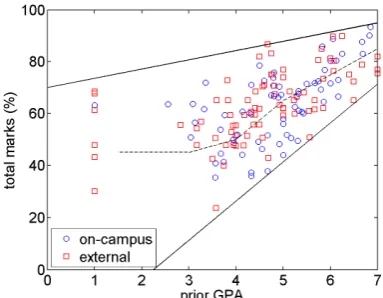
Figure 1 presents the total marks obtained by students in Engineering Problem Solving 3 in 2008 relative to their prior GPA. The broken line on this figure indicates the ‘break even’ line: students falling above this line achieved at a level higher than the prior GPA, and those below this line achieved at a level lower than their prior GPA. While there is clearly a correlation, the upper and lower bounds are broad: students were not constrained to perform only at their prior level; a high prior GPA was no guarantee of high marks and a low prior GPA was no guarantee of low marks. Figure 1 indicates that some students achieved in Engineering Problem Solving 3 at levels above or below their prior GPA by more than 2 grade points.
Figure 1: Total marks in Engineering Problem Solving 3 vs GPA prior to taking the course.
Student Views on Hardware in Problem Solving
At the time of Major 1 submission, feedback on the following question was solicited. “In the context of your engineering studies, do you see any value in solving problems that involve actual physical hardware? Explain your answer.” Responses to this question were overwhelmingly positive. Of the 31 responses received, 29 were classified by us as either positively or very positively valuing physical hardware in problem solving; 1 response was conservatively classified as neutral (the theme of this response was “we should only use hardware if software modelling does not work”); and 1 respondent did not understand the question (and instead chose to answer a question along the lines “do you see any value in mathematical modelling exercises?”).
1. Hardware performance conflicts with theory. The “real world” involves hardware problems and the actual performance of hardware conflicts with theory. 55 %
2. Hardware applications complement theory. Solving problems with hardware is complementary to solving problems with theory: it provides a useful link with theory and an application of theory. 42 %
3. Hardware is relevant to an engineering career. Use of hardware during training is important because employment as an engineer will involve interaction with hardware. 32 %
4. First-hand experience is important. First-hand experience with hardware provides an enhanced understanding of the problem. 32 %
5. Analysis of experiments is important. Analysis of experimental data from hardware is an important skill. 19 %
Remote Access and Overall Problem Solving Experience with Hardware
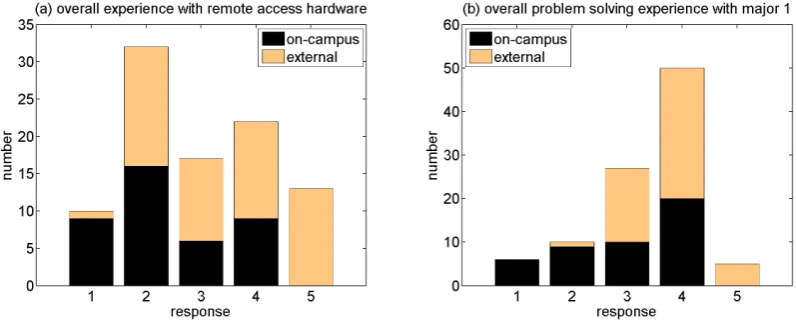
Although we received feedback very strongly supporting the notion that it was important to use actual physical hardware in problem solving, various teething problems were experienced, particularly the case of the Major 1 in the 2008 offer of Engineering Problem Solving 3. This was the first time at USQ that a remote access environment was used in an assessment item for on-campus and external teams. Figure 2 presents results from the feedback received with the submission of Major 1. Figure 2a demonstrates that overall, students had a somewhat negative experience with the remote access environment, but that on-campus students viewed it more negatively than the external students. In the case of the external cohort, responses were quite evenly distributed across the range from 2 (negative) to 5 (very positive). Feedback from the on-campus and external students offers some insight into this difference. On-campus students found it frustrating having to obtain data from a physical device by remote access when they knew it was located nearby. On-campus frustrations were compounded by technical difficulties associated with the remote access to the hardware. Some
external students were likewise frustrated by technical difficulties associated with the new remote access environment, but external students were more appreciative of the opportunity to experiment, be it via remote access, with such hardware.
[image:4.595.94.493.525.687.2]Although difficulties were experience in the implementation of the remote access hardware, the overall experience of students in Major 1 was positive, Fig. 2b. External students rated the overall experience as a positive one more frequently than neutral or negative responses, and some external students rated the overall experience as very positive. On-campus students were more reserved in their assessment, though the most frequent response by the on-campus students was still “positive”.
Figure 2: Feedback responses in Major 1 to the questions (a) “How would you rate your overall experience with the remote access experiment?”; and (b) “How would you rate your overall problem solving experience with Major 1?” Scale: 1 – very negative experience; 5 – very positive
Use of Hardware to Increase Interest
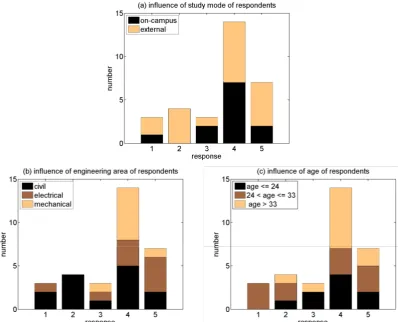
In the post-course survey, the following proposition was put to the students. “The knowledge that an actual physical device was being employed in the major assignments increased my interest in the subject.” The respondents to the survey were most commonly in agreement, or in strong agreement, with this statement as demonstrated in Fig. 3.
Figure 3a illustrates the breakdown of responses to this proposition in terms of the study mode: either on-campus or external. It appears that external students are more strongly in agreement with the statement because the number of responses from the external students is more evenly split between “agree” and “strongly agree” than is the case with the on-campus cohort where the division favours the “agree” category.
Through Fig. 3b we probe the influence of engineering study area on the capacity for hardware to increase the level of interest. Responses from students in the mechanical area (which also includes mechatronic engineering) are strongly clustered within the “agree” category, and students from electrical area (electrical, electronic, power, instrumentation engineering) favour the “strongly agree” and “agree” categories. Responses from students in the civil areas (agricultural, civil and
environmental engineering) are more evenly distributed across the range from “strongly disagree” to “strongly agree”.
[image:5.595.94.493.398.720.2]In Fig 3c, the influence of the age of respondents is assessed. The age groupings were specified such that there were approximately the same numbers of respondents within each of the 3 groups. Within the youngest group (ages less than 24) there is some clustering towards the “agree” response, but with the intermediate age group (ages between 24 and 33) there is no obvious clustering towards a single category of response. For respondents aged greater than 33, “agree” is the dominant response.
Conclusions
Students in Engineering Problem Solving 3 consistently saw substantial value in solving problems that involve actual physical hardware and they volunteered a range of reasons for incorporating hardware into problem solving courses. The benefits in hardware-based problem solving which the students identified in their feedback are consistent with the motivation for introducing hardware-focussed activities into the course. Technical difficulties associated with implementing hardware problem solving activities for both on-campus and external student teams was a source of some dissatisfaction, particularly in the case of the remote access environment which was trialled for the first time in this course. However, the students still reported an overall satisfaction with the hardware-based problem solving activity. Students also indicated that there was a significant increase in their level of interest in the subject because physical devices were being employed as part of the major problem solving activities. Evidence from the feedback and survey tools has reinforced the notion that, resource permitting, hardware-based activities can, and should be incorporated into at least some team-based problem solving activities of both on-campus and external teams.
References
Buttsworth, David R. and Malpress, Ray and Phythian, Mark W. (2008) Hardware-based engineering problem solving for on-campus and external teams. In: AaeE 2008: 19th Annual Conference of the Australasian Association for Engineering Education, 7-10 Dec 2008, Yeppoon, Queensland, Australia.
Clough, M. P. (2002). Using the laboratory to enhance student learning. In R. W. Bybee (Ed.), Learning Science and the Science of Learning. (pp. 85-97). Washington, DC, National Science Teachers Association.
Corter, J. E, Nickerson, J. V., Esche, S. K., & Chassapis, C. (2004), Remote Versus Hands-On Labs: A
Comparative Study, In 34th ASEE/IEEE Frontiers in Education Conference, 20-23 Oct 2004, Savannah, GA, USA, Session F1G (pp. F1G17-21).
Ma, J. & Nickerson, J. V. (2006). Hands-on, simulated, and remote laboratories: A Comparative literature review. ACM Computing Surveys, 38(3), Article 7.
Magin, D. J., Churches, A., E., & Reizes, J. A. (1986). Design and experimentation in undergraduate mechanical engineering. In Proceedings of a Conference on Teaching Engineering Designers. (pp. 96-100). Sydney, Australia, Institution of Engineers.
Nersessian, N. J. (1991). Conceptual change in science and in science education. In M .R. Matthews (Ed.), History, Philosophy and Science Teaching: Selected Readings. (pp. 133-148). NY Columbia Teachers College Press.
Acknowledgements
We would like to acknowledge the contributions of Mark Phythian, Tony Ahfock, Andrew Maxwell, Cheryl McCarthy, Adrian Blokland, and Terry Byrne to the establishment and operation of the remote access experiment, and the contributions of Terry Byrne and Brett Richards to the establishment and operation of the UAV experiment.