DO RUMOURS CONTRIBUTE TO KNOWLEDGE MANAGEMENT
– AND WILL WE EVER KNOW?
Brown, Martyn, University of Southern Queensland, Toowoomba, Australia,
[email protected]
Cater-Steel, Aileen, University of Southern Queensland, Toowoomba, Australia,
[email protected]
Abstract
Organisational rumour mongering and informal knowledge transfer share common characteristics. They both rely on informal social groups for communication. Uncertainty caused from changing environments leads to increased activity in both. The process of rumour mongering involves discussing content. Implicit in the informal knowledge transfer process is the same. Although they share characteristics, rumour and informal knowledge transfer are treated differently. The former is seen as negative and destructive while the latter is a positive influence. This paper reports on an empirical pilot study carried out at a university to see if organisational rumour contributes toward informal knowledge transfer. The discussion focuses on the challenges encountered and limitations of researching a sensitive area such as rumour.
Keywords: Knowledge Management, Organisational Rumour, Survey.
1
INTRODUCTION
Organisational rumour is treated in academic literature and by practitioners as a destructive phenomenon. Depicted as inaccurate and detrimental to an organisation’s performance, it is something to be minimised by management. However, it shares many of the characteristics of informal knowledge transfer, a practice largely applauded in the knowledge management paradigm by academics and practitioners alike. The motivation for this research project is to see if the apparent similarities between the two phenomenon lead to a new perspective on the two. Specifically, to what extent are they interrelated? Depending on what is found, management may find it has to adjust its attitude and thereby response to rumour. The aim of this paper is to report on a research project in progress which investigates the research question: to what extent does organisational rumour contribute toward informal knowledge transfer within an organisation?
This research project involves several disciplines (Social Psychology, Knowledge Management, Information and Communications and Technology, and Education). Two of these - Information Systems (IS) and Knowledge Management (KM) are themselves considered multidisciplinary. This paper provides a brief review of relevant literature and derives a research model and hypotheses. The constructs are defined and the methodology detailed. The preliminary results of a pilot online survey are presented. The discussion focuses on the challenges encountered and limitations of researching a sensitive area such as rumour.
2
LITERATURE REVIEW
independent variables: (i) importance (i.e. to an individual) and (a) ambiguity (1947, p.43). Shibutani wrote in the early 1960s and argued for a radical departure to viewing rumour as a problem solving process used by groups of people in need of information (Miller, 2005). Literature on rumour, whether it be concerned with the organisation or society as a whole, written by social scientists or academics from the broad category of what we might call ‘management’, relies on theoretical frameworks and empirical studies developed in the social sciences. However, the social scientists in later work borrow from management studies on organisational rumour. For example, social psychologists Rosnow and Foster (2005) writing an overview of the conceptual study of gossip (and, in part, rumour) cite works by DiFonzo, Bordia and Rosnow (1994) and Kimmel (2004). However, they do not state that these works have emanated from the management arena and only that they are aimed at combating rumour.
Most empirical studies to date in the area of management have examined the rumour phenomenon as a destructive force to be minimized. That is, they only seek out rumours that are ‘destructive’. There have been some studies indicating other possibilities. For example, a content analysis study of organisational rumours in a hospital undergoing major structural change found a marked difference between what they found and the widely used Knapp typology (Bordia, Jones, Gallois, Callan, & DiFonzo, 2006). Pointedly, the authors believe their study to be the first detailed analysis of rumour content during organizational change (p.613). Their rumour types include changes to job and working conditions, nature of organizational change, poor change management, consequences of the change for organizational performance, and gossip-rumours. Within these rumour types were 12 categories. The greatest number (48%) of rumours were concerned with changes to jobs (the majority of which were concerned with the loss of jobs). The second most prevalent rumour category (19%) concerned ‘Changes to the structure and nature of the organization’. Although these were ‘neutral statements’ they were concerned with topics such as unit structural changes within the hospital and privatization. This study also included a considerable number (5%) of rumours pertaining to ‘consequences of change for organizational performance’. Most of these rumours focussed negative consequences (pp. 608-611). The findings of this study show a difference between the rumour type (often the fantastic, false and destructive) that has informed management literature. That typology was part of the larger theory framework developed during World War II by Allport and Postman (1947). At this time, there was a differing argument which eventually prevailed. This was from the work of Caplow (1947) who examined rumour in military units. He found rumour in military units operating at the front to be accurate and disseminated very quickly (pp.299-301).
As a previously published conference paper by Brown and Napier (2004) has shown, an examination of the literature of organisational rumour and informal knowledge transfer share some common characteristics.
Both rely upon informal relationships within an organisation to communicate. In rumour literature this is often the ‘grapevine’ while KM has informal social groups. Rumour content transmitted through the grapevine undergoes change. In studies of rumour this is predominantly a distortion (often focusing on the fantastic) and categorised into negative emotional responses (e.g. fear and hate). Both rumour and informal knowledge transfer have a content type which is not formally recorded, seemingly reacting to a changing environment. In this study the focus will be on the process undertaken. This is a result of this study being a first step in an area which has not received any attention in the literature. It can be seen as a process to learn and hence increase knowledge. Both rumour and informal knowledge transfer are considered to be most active during rapid change and uncertainty. For example, with rumour this is mostly during industrial relations issues while KM looks at rapid responses, which may involve organisational change to altering external business drivers. As indicated above, although there are common characteristics, the two are considered very differently. For management rumour is something to be minimised, informal knowledge transfer maximised.
2.1 Research Model and Definitions of Constructs
Organisation rumour is defined as ‘an unverified bit of information about something of importance to a group. It is like news in every way except that it is not verified. It may or may not be true. It may be spread by word-of-mouth, fax, electronic mail, or any other communication channel’ (Di Fonzo & Bordia, 2002, p. 7) .
Informal knowledge transfer is considered by some as a process but one whose outcome has to be measured as a formal outcome. Furthermore the actual process is transitory, expended like energy. However, the ability to engage in that process is one of learning. For knowledge transfer to have been effective learning must have transpired in the recipients (Sussman & Siegal, 2003, p. 48). Learning has a long term strategic quality that is not the sum of the ‘individual’ transactions of investing in seeking and transferring knowledge. Furthermore, this ‘will allow not only for information transmission among collectives but also open up possibilities of generating and sharing new meanings, thus providing increased capability to innovate as well as to share and generate knowledge’ (Garcia-Lorenzo, 2006, p. 174). Hence the process of informal knowledge transfer feeds itself and allows more. This research project therefore sees the informal knowledge transfer as a learning process and uses that explicit construct.
The model used in this study results from adapting three theoretical works. One is from the domain of pedagogy, use of ICT and finally management. The authors are respectively Bloom (1956), Massey and Montoya-Weiss (2006), and Gullberg and Pelser (2006).
Bloom’s Taxonomy of Learning (1956) is used to measure the dimensions of the learning process. These are the sub-processes of:
Remembering (i.e. recalling)
Understanding (i.e. give meaning)
Analysing (i.e. break down into component parts)
Evaluating (i.e. determine usefulness or value against criteria)
Creating (i.e. developing an informed hypothesis – a new idea, solution or explanation).
As stated earlier the learning process itself leads to increased ability to carry out those same sub processes. That is, by remembering, understanding, etc. a situation or situations, one’s ability to do the same will be affected. Thus one finds the same sub-processes used in the Post-Informal Knowledge construct. Specifically, they are used to measure the cognitive learning dimension. The other dimension is the behavioural learning. This is the application of learning in the work place and can be seen as the main benefit of the research for practitioners. Behavioural learning is measured with the constructs previously used by Gullberg and Pelser (2006) to examine knowledge transfer in a high technology company: decision making skills, technical/functional skills, negotiation skills, and supervisory skills. This process may involve the use of communication media. In this study this is restricted to Information and Communication Technology (ICT) - a key enabler in the KM paradigm and is measured using two dimensions - Communication ICT and Knowledge Repository Based ICT. This differentiates between a person actively engaging in communicating with another human being (i.e. communication technology) and gaining information from a captured and codified source (i.e. a knowledge repository).
The construct ICT (or type of exchange) is operationalised to reflect more specific ICT tool categories. The following definitions are based in part upon the work of Massey and Montoya-Weiss (2006, p. 101):
Communication ICT is defined as enabling communication between individuals and or groups, for example email, online chat sessions, online forums and bulletin boards. It also includes voice to voice type of technologies (in this ‘telephone’ includes landline telephone, mobile phones, IP telephone) is represented as a separate construct as it is still essentially voice (i.e. mouth to mouth) and not text based (email, chat or forums);
Knowledge Repository Systems are defined as facilitating access to knowledge artefacts. Online databases, intranet web pages, websites, and files on a shared drive are all examples of knowledge repository systems.
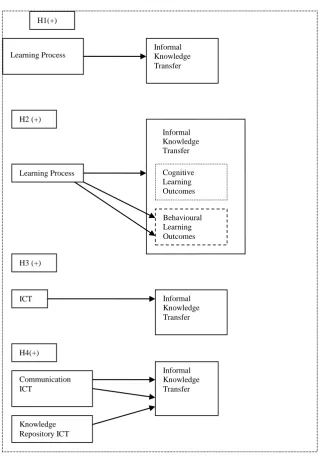
1. Does the extent of the learning process affect the extent rumour contributes toward informal knowledge transfer?
H1. The greater the extent, the higher the probability that rumour will contribute toward informal knowledge transfer.
2. To what extent does cognitive and
behavioural type learning result if rumour has contributed toward informal knowledge transfer?
H2. The process will have a more positive effect on cognitive than behavioural knowledge when rumour contributes to informal knowledge transfer.
3. Does the extent of use of ICT media type and mode increase the likelihood of rumour contributing toward informal knowledge transfer?
H3.The more ICT is used the greater the extent of rumour contributing toward knowledge transfer.
[image:4.595.68.533.72.209.2]H4.The greater the reliance is on communication ICT than knowledge repository based ICT the greater the extent of rumour contributing toward informal knowledge transfer.
Table 1. Research sub-questions and hypotheses
Figure 1 – Model Applied showing hypotheses, independent and dependent variables.
Cognitive Learning Outcomes Learning Process
H1(+)
Informal Knowledge Transfer
Learning Process H2 (+)
Behavioural Learning Outcomes
Informal Knowledge Transfer H3 (+)
ICT
Informal Knowledge Transfer Communication
ICT
Knowledge Repository ICT H4(+)
[image:4.595.70.390.232.689.2]3
METHODOLOGY
3.1 Survey Design
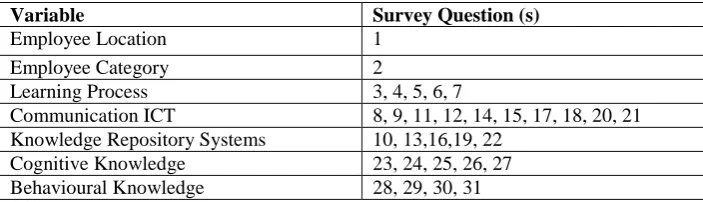
An anonymous and voluntary online survey was conducted at an Australian university. The organisational unit was the Faculty of Business (FoB). There were 31 questions. The structure of the survey is shown in Table 2 and a copy of the wording of the 31 questions of the online survey is included in the Appendix.
Variable Survey Question (s)
Employee Location 1 Employee Category 2
Learning Process 3, 4, 5, 6, 7
Communication ICT 8, 9, 11, 12, 14, 15, 17, 18, 20, 21 Knowledge Repository Systems 10, 13,16,19, 22
[image:5.595.67.419.209.310.2]Cognitive Knowledge 23, 24, 25, 26, 27 Behavioural Knowledge 28, 29, 30, 31
Table 2. Structure of Questionnaire: variables related to survey questions
All the questions were mandatory. The first two questions related to demographics (employee category and place of work) while the remaining 29 tested the four hypotheses. Each demographic question offered the choice of several categories. Respondents could select ‘Decline to answer’ for these two questions. A six point Likert-type scale was used for the remaining 29 questions. The scale offered the choice of Strongly Disagree, Disagree, Neutral, Agree, Strongly Agree or N/A. It was intended to use Factor Analysis followed by Multiple Variable Regression techniques test the hypotheses. Although the plan was to make the survey available to respondents for a period of one week, this was extended to two weeks due to the low response rate.
Rather than undertake a rigorous sampling procedure, it was decided to use a convenience sample by conducting the survey in the University where the researcher is a student. However, circumstances led to the organisation undergoing a major change process that began some months before the survey was carried out. It was a difficult time for the staff but a fortuitous one for the researcher!
3.2 Organisational Context
Rumour theory stresses the influence of uncertain or ambiguous conditions. Following the dominant view of rumour, it leads to speculation and destructive and inaccurate communication. Informal knowledge transfer, on the other hand, is considered to assist in making sense of quickly changing environments and consequently, reactions that would assist the organisation moving through that time of change.
The University surveyed had been going through a period of restructuring of staffing positions as well as reviewing of educational programs delivered. The Faculty of Business was the organisational unit surveyed. This was largely a matter of convenience. Gaining permission was faster than anticipated.
3.3 Preparing the Online Survey
LEARNING PROCESS COMMUNICATION TYPE POST INFORMAL KNOWLEDGE Dimensions of: Communication ICT Cognitive Remembering Knowledge repository ICT e.g. online
databases, intranet web pages, websites, files on a shared drive
Behavioural Understanding
Analysing Evaluating Creating
Table 3. Constructs and their variables
Adhering closely to the constructs developed from the literature review avoids the common disagreement concerning the selection of factors (Good & Hardin, 2006, p. 178). The survey software used was Survey Monkey, an Internet web based tool. This tool was chosen because of its design capabilities, relative low cost, familiarization to both the researcher (used in his place of employment) and his academic supervisor (used successfully by previous students).
A hard copy version of the questionnaire had been pilot tested prior to implementing it in an online environment. The questionnaire had been reviewed in terms of clarity, logical progression and completed by a small group of staff from the researcher’s own place of employment. Feedback had been incorporated in the reworked survey. Migrating the questionnaire to the online Survey Monkey environment involved a second review by some of the original group (not all were available) and the academic supervisor of the researcher. Including as many people as possible from the first group provided benefits of continuity and familiarity with the subject.
This second review looked at the layout and colour scheme of the online survey, response times and verification of data being recorded. Two of the original pilot group and the academic supervisor of the researcher as well as the researcher entered dummy data, examined layouts and colour schemes. Several minor errors in spelling and layout were corrected. The researcher verified that the dummy data had been collected. The survey was accessed from both sides of the Tasman (i.e. New Zealand and Australia) so as to verify acceptable response times.
3.4 Conducting the Online Survey
It was decided to open the survey on a Friday. This was chosen due to the low teaching load on that day which would possibly lead to a higher response rate. Coupled with this is the time in the semester when the survey would be released. Time constraints meant the survey had to be ready, approved by relevant ethics and management bodies and made available before the semester exam period began. This was achieved with an email invitation sent out six working days before exams began. The email message was drafted by the researcher and sent internally by the academic supervisor. An email reminder was sent six days later (i.e. one day before the advertised day the survey would close). In total the survey was open for 13 days.
During the survey, three respondents sent emails to the researcher and/or the academic supervisor. Two emails were related to the actual survey instrument. One respondent reported an error in the Likert type scale of Question 16. It had the incorrect label of ‘Agree’ instead of ‘Disagree’ i.e. Strongly Disagree, Agree, Neutral, Agree, Strongly Agree, N/A. As it was not possible to correct this without possibly losing data already collected it was decided to let the survey proceed without alerting the possible respondents to the error. As the survey was nearly entirely composed of Likert scale questions (29 out of 31 questions using the same labels), it was thought that the respondents would not notice this error. However, as the survey software downloaded label strings, a process to manage this was applied in the preparation of the data for analysis (detailed later).
that could be carried out to be completed regarding this communication. The same respondent who identified the incorrect label also sent another email- ‘I have completed the survey but found I didn't relate to most of the categories of sharing … it appears I'm old-fashioned and do it in person.’ This required no action. It is assumed that the respondent was speaking of use of technology in relation to communication. The third email was one of encouragement stating that the survey was needed in the workplace and suggesting an academic journal which might be interested in the results.
4
ANALYSIS OF RESPONSES
4.1 Preparation of data for analysis
The survey data was downloaded from Survey Monkey into an Excel spreadsheet. Although 30 staff commenced the online survey, only 18 completed responses were received. The incomplete survey responses were omitted from analysis. Firstly, a visual check was made of the data downloaded to ensure it matched that on the survey website. No errors in data migration were detected. Survey Monkey outputs data for download using the labels of the answer options (e.g. ‘Strongly Agree’, ‘Toowoomba’, ‘Decline to answer’). The search and replace functionality in Excel was used to replace these with numeric values. For the Likert-type scale these were 1 for ‘Strongly Agree’, 2 for ‘Disagree’, 3 for ‘Neutral’, 4 for ‘Agree’, 5 for ‘Strongly Agree’ and 6 for ‘N/A’. The Excel data was imported into SPSS. It was subjected to another visual check to ensure data had been transferred accurately.
As indicated earlier, Question 16 had an erroneous label – ‘Agree’ instead of ‘Disagree’. That meant there were two choices of ‘Agree’. This error might have been accommodated if there were no instances of ‘Agree’ in the data set. The logic justifying this is that either respondents accepted the spurious label as a typing error and neither disagreed or agreed with the statement. As there were 9 instances of ‘Agree’, the entire question was excluded from most of the data analysis (although data from the question was included in the data set downloaded into SPSS).
Once in SPSS, the default generic labels used by the software were replaced by mnemonic ones. This was intended to make data analysis more efficient.
5
PRELIMINARY FINDINGS
This section includes both a descriptive analysis of the survey results as well as some preliminary observations. As the survey was recently conducted, the analysis is still underway. Frequencies of responses for each question are provided in the Appendix. The overall response rate was 11.8 percent. This low figure meant that the intended factor analysis could not be undertaken (this is expanded upon in the Discussion Section).
Number of FoB Staff
Percentage Started Survey
Questionnaires Commenced
Percentage Completed Survey
Questionnaires Completed
153 19.6% 30 11.8% 18
Table 4. Response rate
Table 4 shows the response rate as well as actual numbers. The relatively low rate will have an impact on the testing of hypotheses. Also of note is the attrition rate with nearly half (40%) of those who commenced the survey exiting without completing it.
Construct # of Questions SD/D N A/SA N/A Learning Process 5 1
(1%)
15 (17%)
73 (81%)
1 (1%) Communication ICT 10 104
(53%)
22 (11%)
72 (36%)
Knowledge Repository ICT 4 54 (75%)
6 (8%)
12 (17%)
0 (0%)
ICT 14 158
(59%)
28 (10%)
84 (31%)
0 (0%) Cognitive Learning Outcomes 5 18
(20%)
27 (30%)
45 (50%)
0 (0%) Behavioural Learning Outcomes 4 21
(29%)
25 (35%)
24 (33%)
2 (3%)
Post-Informal Knowledge 9 39 (24%)
52 (32%)
69 (43%)
[image:8.595.67.511.71.211.2]2 (1%) SD/D = STRONGLY DISAGREE & DISAGREE, N = NEUTRAL, A/SA= AGREE & STRONGLY AGREE, N/A = NOT APPLICABLE
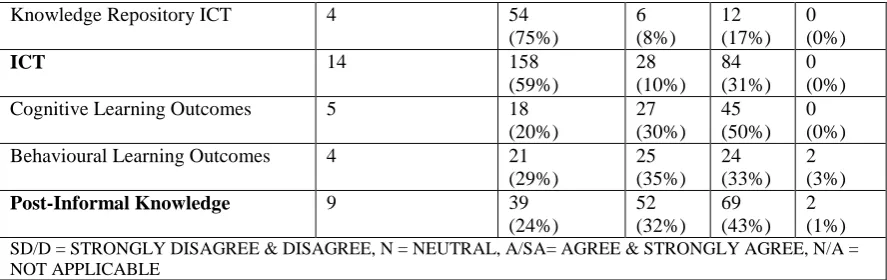
Table 5. Initial results for each construct
Table 5 provides a summary of results for each of the constructs examined by summing the responses of questions related to each construct (as listed in Table 3). Actual responses numbers are included as well as percentages for questions relevant to each construct. Results for LearningProcess show 81 percent of responses were Agree/Strongly Agree. Thus there is strong support for the application of a learning process (remembering, understanding, analysing, evaluating and hypothesising) in discussing rumours. Initial observations from the preliminary analysis for each hypothesis are now provided.
H1. The greater the extent, the higher the probability that rumour will contribute toward Post- Informal Knowledge.
The initial findings indicate that the extent of the learning process does not have a direct correlation to Post-Informal Knowledge. While 73 percent of respondents Agree/Strongly Agree that they applied the Learning Process, only 43 percent (almost half) felt the same after the process had been completed. H2. The process will have a more positive effect on cognitive than behavioural knowledge when rumour contributes to Post-Informal Knowledge.
There is support for this hypothesis. While 50 percent chose Agree/Strongly Agree for improvement for Cognitive Learning Outcomes nearly half (i.e. 33%) indicated the same for Behavioural Learning Outcomes.
H3. The more ICT is used the greater the extent of rumour contributing toward knowledge transfer.
This hypothesis is not supported. Only 31 percent of responses indicated Agree/Strongly Agree with 59 percent stating Strongly Disagree/Disagree.
H4. The greater the reliance on communication ICT rather than knowledge repository based ICT, the greater the extent of rumour contributing toward Post-Informal Knowledge.
There is support for this hypothesis. 36 percent of responses Agreed/Strongly Agreed that Communication ICT was used while 17 percent said the same for Knowledge Repository ICT. It should be re-emphasised that the above statements relating to the hypotheses are initial findings without any rigorous statistical testing at this point in time.
6
DISCUSSION
In this section, both the extent to which the chosen initial methodology was effective as well as results of the survey are discussed. The former is included because of the aim to learn from this pilot exercise, adapt the procedure where possible and then reapply it in industry. The actual results while lacking statistical power may provide some tentative insights into an area, informal knowledge transfer and organisational rumour, which has not been explored before.
acceptable, but sample sizes of 200+ are preferable’ (2005, p. 154). This survey on rumour and informal knowledge transfer has, as its target population, the staff of one Faculty. At the time of the survey there were 153 staff members. Taking Coake’s approach of calling each question a ‘variable’, 145 responses (5 subjects each to satisfy 29 questions relevant to the hypothesis testing) would be required. To achieve 145 responses from the Faculty would require a response rate of 94.7 percent. If the other criterion of 100 cases is taken then a 65.3 percent response rate would be required. Taking into account the sensitivity of rumour as a topic of research, it is highly unlikely that such response rates are attainable.
The results from this survey have opened the possibility that using a KM framework, there might some constructive elements in organisational rumour. As such this paper may be seen as a call for further research.
6.1 Management Support
It is of note that the ethics clearance for this study and also the permission from the Dean of the FoB to run the survey were obtained through a first submission. While the former is related to academic freedom it is not necessarily the case that management supports rumour research. One previous study in industry was abandoned due to gradual non-cooperation from the management team once they saw the critical nature of the responses from employees.
7
LESSONS FOR THE FUTURE
7.1 Wording of Survey
The survey used two variables to measure use of technology. It is possible that not stressing to respondents that they might use technology in interacting with other members of their informal group may have caused some lack of clarity (e.g. interaction using technology is an exception to the normal communication pattern). Hence a new wording (words in italics) might be thus ‘Those employees with whom you mix with informally face to face – e.g. have coffee or lunch with – or electronically (email or online chat).’ However, this may be taken as largely conjecture as there is not a high percentage of respondents leaving the survey at the technology questions (41.6% between questions Q 8 – Q22).
7.2 Configuring Software
The error in the scale already mentioned may have been detected with another trial test. However, a more conclusive solution to the problem would have been to investigate in situ editing of the survey instrument without risk of adversely affecting data already recovered. This could have been achieved through better design of the survey within the software used (i.e. can labels be differentiated from associate values?).
7.3 Timing of the Survey
While the overall context of the organisational situation (major organisational change) was conducive to this study, the specific time spans within it may have affected the response rate. The survey was opened shortly before exams began. This was dictated by the time constraint in the researcher’s own assessment deadline. While this may have avoided the priorities of marking and other end of semester activity, the survey was conducted at a time when preparatory tasks were carried out for the end of semester deadline. Possibly a better response rate could have been obtained in less hectic periods of the semester.
8
CONCLUSION
participate. It can be suggested that the social stigma attached to rumour is so great that staff members do not wish to participate even though their identity remains unknown and they work in a place of higher learning which, by its nature, encourages exploration of ideas and subjects which may not always be raised in industry.
Periods of uncertainty are associated with rumour activity and, it has been suggested, can be managed by informal knowledge transfer. This survey was undertaken in such as situation. It might be a possibility that a study aimed at examining possible positive effects of rumour will not attract the attention of staff facing the possibility of likely negative repercussions on their livelihood. A contextual situation that still holds that level of uncertainty but is not threatening as much to the individual might be explored to see if it generates more interest.
In terms of implementing quantitative research, the fact that an incorrect label was missed in a number of quality checks by several different parties (including an editor) indicates the need for a software package that is robust enough to provide data integrity following any in situ changes to elements such as labels and also separation between labels and associated values (i.e. label is ‘Strongly Disagree’ while value recorded if chosen is ‘1’). However, there is no indication from the data that the respondents decided not to continue the survey at the question containing the error.
The learning experience of carrying out this survey will assist its future application. The initial findings show some indications of organisational rumour being a richer phenomenon than that depicted in mainstream management literature.
REFERENCES
Allport, G. W., & Postman, L. (1947). Psychology of Rumour. New York: Holt.
Bordia, P., Jones, E., Gallois, C., Callan, V., & DiFonzo, N. (2006). Management are aliens! Rumors and stress during organizational change. Group & Organization Management, 31, 601-621.
Brown, M., & Napier, A. (2004). Knowledge Transfer and Rumour - Have we missed Something? Paper presented at the Fifth European Conference on Organizational Knowledge Learning and
Capabilities.
Caplow, T. (1947). Rumors in war. Social Forces, 25(3), 298-302.
Coakes, S. (2005). SPSS- Analysis without anguish, version 12.0 for Windows. Brisbane: Wiley. Di Fonzo, N., & Bordia, P. (2002). Corporate rumor activity, belief and accuracy. Public Relations
Review, 28, 1-19.
DiFonzo, N., Bordia, P., & Rosnow, R. L. (1994). Reining in rumors. Organizational Dynamics, 23, 47-62.
Garcia-Lorenzo. (2006). Networking in Organisations: Developing a Social Perspective Practice for Innovation and Knowledge Sharing in Emerging Work Contexts. World Futures, 62, 171-192.
Good, P., & Hardin, J. (2006). Common errors in Statistics and how to Avoid Them. Brisbane: Wiley. Hair, J., Black, W., Babin, B., Anderson, R., & Tahtham, R. (2006). Multivariate Data Analysis. New
Jersey: Prentice Hall.
Kimmel, A. (2004). Rumors and rumor control: a manager’s guide to understanding and combatting rumors. London: Lawrence Erlbaum Associates.
Massey, A. P., & Montoya-Weiss, M. M. (2006). Unraveling the temporal fabric of knowledge conversion: a model of media selection. MIS Quarterly, 30(1), 99-114.
Miller, D. E. (2005). Rumor: an examination of some stereotypes. Symbolic Interaction, 28(4), 505-519. Rosnow, R., & Foster, E. K. (2005). Rumor and gossip research. Psychological Science Agenda, 19(4). Sussman, S. W., & Siegal, W. S. (2003). Informational influence in organizations: an integrated approach
to knowledge adoption. Information Systems Research, 14(1), 47-65.
Q1. 1. At which location (Toowoomba campus or other) do you work most of your time? Toowoomba 14: Other campus 4; Declined to answer 0
Q2 In what role are you employed?
Academic 8; Senior Academic or professor 2; Manager 2; Administrator 3; Decline to comment 2.
PART TWO The following questions concern the process that you and the informal group carried out when you discussed organizational rumours that have been communicated to you during the last 6 months.
To what extent do you agree with the following statements? Make your selection by clicking on the radio button to the left of the description.
Question SD D N A SA NA
3. Events, people, statements, earlier rumours etc relevant to the rumours were recalled (i.e. remembered) by you and the group?
0 0 4 12 2 0
4. You and the group initially understood (i.e. gave meaning) the rumours?
0 0 2 13 3 0
5 You and the group analysed (i.e. broke down into component parts) the rumours?
0 0 3 9 5 1
6 You and the group evaluated (i.e. determine usefulness or value against criteria) the rumours?
0 0 3 12 3 0
7. You and the group developed an ‘informed ‘hypothesis (i.e. a new idea, solution or explanation) from the rumours?
0 1 3 11 3 0
When things (i.e. events, people, statements, earlier rumours etc) relevant to the rumours were recalled (i.e. remembered) by you and the group
-8. Non-voice communication technology (e.g. email, online chat sessions, online forums and bulletin boards) was used.
4 5 1 7 1 0
9 Voice communication technology (e.g. telephone and Internet based voice) was used.
3 7 2 4 2 0
10. Electronic information (online databases, intranet web pages, websites, files on a shared drive) was used
6 7 1 4 0 0
When you and the group tried to understand (i.e. give meaning to) the rumours - 11. Non-voice communication technology (email, online chat
sessions, online forums and bulletin boards) was used.
2 8 2 5 1 0
12 Voice communication technology (e.g. telephone and Internet based voice) was used.
2 6 2 7 1 0
13. Electronic information (e.g. online databases, intranet web pages, websites, files on a shared drive) was used
7 6 2 3 0 0
When you and the group analysed (i.e. broke down into component parts) the rumours -14. Non-voice communication technology (email, online chat
sessions, online forums and bulletin boards) was used.
4 6 1 7 0 0
15 Voice communication technology (e.g. telephone and Internet based voice)
3 6 3 5 1 0
16. Electronic information such as online databases, intranet web pages, websites, files on a shared drive
N/A N/A N/A N/A N/A N/A
When you and the group evaluated the rumours (i.e. determine usefulness or value against criteria)-17. Non-voice communication technology (email, online chat
sessions, online forums and bulletin boards) was used.
3 7 2 6 0 0
18 Voice communication technology (e.g. telephone and Internet based voice) was used.
2 8 2 5 1 0
19. Electronic information such as online databases, intranet web pages, websites, files on a shared drive was used.
7 7 1 3 0 0
20. Non-voice communication technology (email, online chat sessions, online forums and bulletin boards) was used
3 7 3 5 0 0
21 Voice communication (e.g. telephone and Internet based voice) was used
3 7 2 5 1 0
22. Electronic information such as online databases, intranet web pages, websites, files on a shared drive ) was used
7 7 2 2 0 0
As a result of applying the processes described above (recalling, understanding, analysis, evaluating and making new hypotheses) to the rumours you and the group discussed, you believe that in the workplace your -
23 Recalling (i.e. remembering) what has happened (i.e. events, people, statements, earlier rumours etc) has improved.
0 3 7 8 0 0
24 Understanding (i.e. give meaning to) what is happening has improved.
0 3 4 11 0 0
25 Analysing (i.e. breaking down into component parts) has improved.
0 4 5 9 0 0
26 Evaluating (i.e. determining usefulness or value against criteria) has improved.
0 4 7 6 1 0
27 Proposing new hypotheses (i.e. a new idea, solution or explanation) has improved
0 4 4 8 2 0
28 Work related decision making skills have improved 1 3 6 8 0 0 29 Your work related technical and functional skills have
improved
1 5 8 4 0 0