The revised GNVQ
Managing
Published by FEDA
Feedback should be sent to FEDA publications, Citadel Place, Tinwor th Street, London SE11 5EH
Tel: 0207 840 5302/4 Fax: 0207 840 5401 e-mail: [email protected]
Registered with the Charity Commissioners
Editor: Jenny Rhys Proofreader: Jeremy Pinel Designer: Kevin Ashill
ISBN 1 85338 527 1
© 2000 FEDA
You are welcome to copy this document for internal use within your organisation. Other wise, no par t of this publication may be reproduced, stored in a retrieval system, or transmitted in any form or by any means; electronic, electrical, chemical, optical, photocopying, recording or other wise, without prior written permission of the copyright owner.
Contents
Foreword 1
Introduction 2
Section 1 – Strategic management issues 4
Why run GNVQs? 4
Which GNVQs? 4
Resources 7
Recruitment and marketing 8
Centre-wide policies and procedures 9
Developing key skills 9
Staff development 10
Internal moderation 11
Monitoring and improving the programme 11
Section 2 – Managing a GNVQ course 12
Selecting units 12
Timetabling teaching staff 12
The role of the vocational tutor 15
Planning teaching and assessment 15
Inducting students 17
Foreword
The revised GNVQ is being introduced into schools and colleges from September 2000. It will introduce changes that were recommended by the Capey review of GNVQ assessment and also by Sir Ron Dearing’s review of all post-16 qualifications. The changes are designed to achieve two major objectives. First, to ensure that all GNVQs are more manageable in schools and colleges. Second, to ensure that the assessment of GNVQs is rigorous and consistent.
This pack is par t of the suppor t provided through FEDA’s GNVQ Suppor t Programme. It is one of five packs designed to help tutors and managers implement revised GNVQ courses:
● Managing the revised GNVQ
● Recruitment, induction and progression
● Teaching, learning and assignment writing
● Assessing the revised GNVQ
● Key skills within the revised GNVQ.
Introduction
The structure of the pack
This pack is divided into two sections.
Section 1explores GNVQ management
from a strategic perspective, including all those matters that need to be managed at centre level: for example, which GNVQs to offer and at which levels, assigning staff to programmes, resources for each GNVQ and quality assurance systems.
Section 2addresses the issues that relate
to each individual course: for example, choosing which units to offer, timetabling class contact and assigning responsibilities to staff for unit deliver y and assessment.
Whatever your role, all sections of the pack are useful. Read the whole pack at least once to gain an over view of the management implications of the revised GNVQ and then reread those sections that are most relevant to you.
If you are a senior manager the first section is par ticularly relevant. If you are the GNVQ centre coordinator you need to be familiar with both sections. To a GNVQ course coordinator, Section 2 is the most impor tant. If you have a general management role that includes some GNVQ responsibilities then pick out the relevant topics.
GNVQ management roles
Each GNVQ centre has its own organisational culture and structure and these will determine the detailed management system. Most centres have the following key management roles:
● GNVQ senior manager
● GNVQ centre coordinator
● GNVQ course coordinators
The internal verifiers also have a key monitoring role. Other managers involved with GNVQs might include faculty or section heads, the other members of the senior management team and cross-centre managers covering such functions as marketing, guidance, key skills etc.
The GNVQ senior manager
The wider strategic management of GNVQs within a centre is the responsibility of the senior management team. Centre experience has shown that a specific member of the team must be designated to have a clear overall
responsibility for GNVQs. The GNVQ senior manager will typically be responsible for:
● identifying the rationale and
objectives for running GNVQs (see page 4)
● choosing which GNVQ vocational
areas to run and at which levels (see page 4)
● allocating resources to the GNVQ programme (see page 7)
● appointing the centre and course co-ordinators to manage and deliver the programmes (See below)
● developing policies and strategies
for marketing and recruitment (see page 8)
● overall quality assurance. (see page 11)
In practice the senior manager often delegates some of the responsibility for these issues to other managers or to the GNVQ and course coordinators. For example, a section head may choose the course coordinators for their section, and marketing may be the responsibility of a specialist marketing team.
The GNVQ centre coordinator
Many aspects of any GNVQ programme are common to all vocational areas. It takes time and effor t to develop effective systems for implementing, monitoring and recording GNVQ course activity and it does not make sense for each separate team or even depar tment to develop its own
approach. The degree of central coordination you need depends on the scale of your GNVQ provision. Where several GNVQs are offered, and especially where there is more than one GNVQ team, this is best carried out by a centre coordinator (usually called the GNVQ coordinator).
The GNVQ centre coordinator should
collaborate with the senior management team, the course coordinators and internal verifiers to:
● develop and implement common policies, procedures and documentation (see page 9)
● promote the effectiveness of GNVQ staff through staff development (see page 10)
● monitor the centre’s GNVQ provision, repor t on progress to the programme teams and senior management, and recommend
adjustments where appropriate (see page 11).
The GNVQ course coordinator
GNVQs require a team approach and this is generally best achieved when each distinct GNVQ course has a coordinator. Where there are several small groups, one person may coordinate several GNVQ courses. A course coordinator should collaborate with the course team to design and set up the course, promote the effectiveness of the team and monitor the course and make adjustments. The course coordinator’s responsibilities usually include:
● selecting units (see page 12)
● timetabling teaching staff (see page 12)
● assigning staff responsibilities to specific units (see page 13)
● coordinating the planning of teaching and learning oppor tunities (see page 15)
● coordinating the development of key skills
● recruiting students (see page 8)
● organising student induction into the specific GNVQ programme (see page 17)
● promoting team work (see page 17)
Why run GNVQs?
If you have not yet decided whether to run GNVQs it is wor th considering the potential benefits they may offer to your centre. These include:
● a vocationally oriented curriculum offer which can be successfully delivered in full-time education
● an alternative approach to learning activities and assessment which is interesting and attractive to many students and can improve retention and success rates
● a flexible, unit-based structure with clear equivalencies to other awards
● Foundation and Intermediate GNVQs as an alternative to a GCSE resit programme
● Advanced-level GNVQs as an alternative to A- and AS-levels for able students who prefer a more vocational approach
● all levels as an alternative to NVQs for students who do not wish to study academic subjects but who are not yet sure of their career choice
● increased staying-on rates for school sixth forms
● increased par ticipation rates for all post-16 education providers
● a nationally recognised award with a rigorous quality assurance system.
Set clear objectives for your GNVQ courses based on these potential benefits.
Which GNVQs?
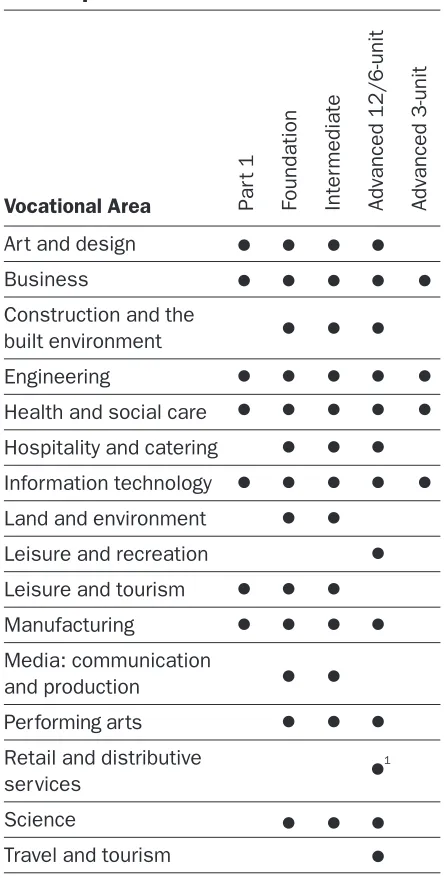
You need to choose which vocational areas to offer, at which levels and – at Advanced level – whether you will offer 12-unit, six-unit and three-unit GNVQs.
[image:6.668.369.591.399.838.2]The vocational areas available from September 2000 are shown in Table 1.
Table 1 – GNVQ vocational areas available from September 2000
Vocational Area
Ar t and design ● ● ● ●
Business ● ● ● ● ●
Construction and the
● ● ●
built environment
Engineering ● ● ● ● ●
Health and social care ● ● ● ● ●
Hospitality and catering ● ● ●
Information technology ● ● ● ● ●
Land and environment ● ●
Leisure and recreation ●
Leisure and tourism ● ● ●
Manufacturing ● ● ● ●
Media: communication
and production ● ●
Performing arts ● ● ●
Retail and distributive
●1
ser vices
Science ● ● ●
Travel and tourism ●
1. Only available as 6-unit award
Advanced 3-unit
Advanced 12/6-unit
Inter
mediate
Foundation
Par
t 1
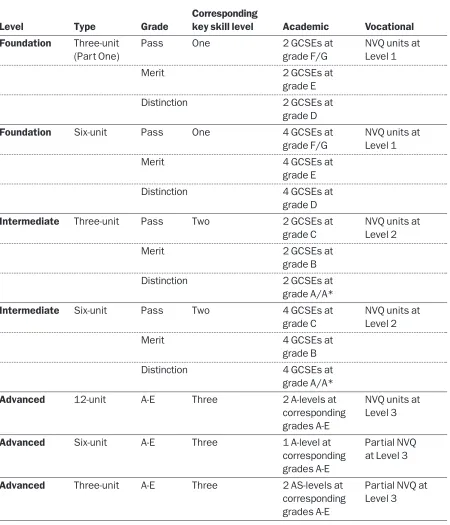
The equivalence of GNVQs at each level to academic and vocational awards is shown in Table 2.
Note: each Advanced GNVQ unit is equivalent to one A-level module so there is precise correspondence between A-levels and GNVQs. Both are graded A-E.
Table 2 – GNVQ equivalences
Corresponding
Level Type Grade key skill level Academic Vocational
Foundation Three-unit Pass One 2 GCSEs at NVQ units at
(Par t One) grade F/G Level 1
Merit 2 GCSEs at
grade E
Distinction 2 GCSEs at
grade D
Foundation Six-unit Pass One 4 GCSEs at NVQ units at
grade F/G Level 1
Merit 4 GCSEs at
grade E
Distinction 4 GCSEs at
grade D
Intermediate Three-unit Pass Two 2 GCSEs at NVQ units at
grade C Level 2
Merit 2 GCSEs at
grade B
Distinction 2 GCSEs at
grade A/A*
Intermediate Six-unit Pass Two 4 GCSEs at NVQ units at
grade C Level 2
Merit 4 GCSEs at
grade B
Distinction 4 GCSEs at
grade A/A*
Advanced 12-unit A-E Three 2 A-levels at NVQ units at
corresponding Level 3 grades A-E
Advanced Six-unit A-E Three 1 A-level at Par tial NVQ
corresponding at Level 3 grades A-E
Advanced Three-unit A-E Three 2 AS-levels at Par tial NVQ at
When choosing which GNVQ(s) to offer, you need to consider:
● your existing GNVQ provision, if any
● other provision in your centre
● the resources available and the resources required (see page 7)
● staff exper tise (see page 13)
● the target student groups
● other centres’ provision
● the local labour market
● progression issues (also see – Recruitment, induction and progression).
Your existing provision, if any
If you already offer GNVQs, you may simply continue to offer the same vocational areas. However the revised GNVQ does offer an oppor tunity for review and change, and it may not always be appropriate to continue with the existing arrangements. Advanced GNVQ Leisure and tourism has been split into Travel and tourism and Leisure and recreation, so you will have to choose whether to offer one or both of the two qualifications.
Also note that students starting GNVQs before September 2000 will not be able to change mid-course onto the revised specifications.
Other provision in your centre
Consider whether any of the proposed GNVQs clash with or complement your current provision. Possible clashes include subject overlaps, for example between six-unit Business GNVQ and A-level Business studies or between six-unit Information and Communication Technology GNVQ and A-level Information and
Communication Technology. It is per fectly acceptable to offer these competing options, since they have a different focus and approach, but it may cause recruitment problems if you have only a small cohor t of students.
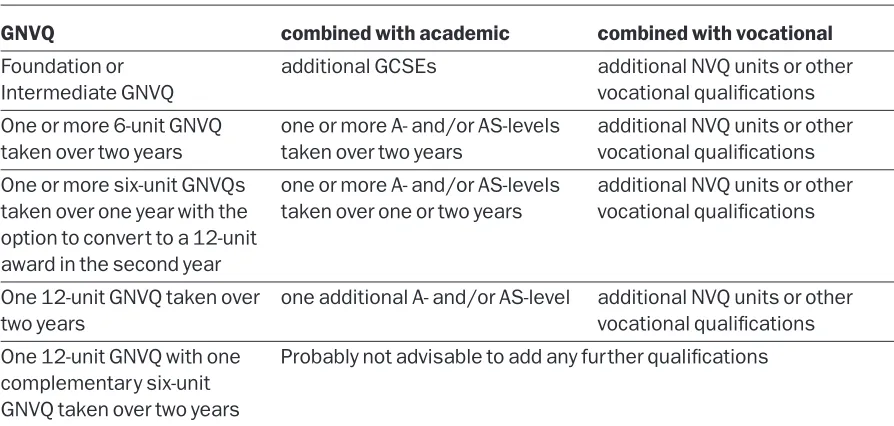
[image:8.668.141.588.616.829.2]More commonly, you will find that GNVQs add variety and choice to your provision. For example, they can be jointly timetabled or offered as options within modular timetables. The difference in approach and assessment between GNVQs and academic awards makes it difficult to combine students from each type of award into a single teaching group. However, six-unit GNVQs in par ticular lend themselves to being offered as modules within an A-level modular timetable.
Table 3 – GNVQ combinations
GNVQ combined with academic combined with vocational
Foundation or additional GCSEs additional NVQ units or other
Intermediate GNVQ vocational qualifications
One or more 6-unit GNVQ one or more A- and/or AS-levels additional NVQ units or other taken over two years taken over two years vocational qualifications
One or more six-unit GNVQs one or more A- and/or AS-levels additional NVQ units or other taken over one year with the taken over one or two years vocational qualifications option to conver t to a 12-unit
award in the second year
One 12-unit GNVQ taken over one additional A- and/or AS-level additional NVQ units or other
two years vocational qualifications
One 12-unit GNVQ with one Probably not advisable to add any fur ther qualifications complementar y six-unit
There is a wide range of potential combinations. The main choices are shown in Table 3 but others are possible. All combinations should include key skills.
The range of options your centre can offer will depend on which levels you offer, your specific timetabling arrangements and how access to key skills will be enabled.
Target student groups
Be careful to aim your GNVQ provision at all types of students. This will raise the status of GNVQs in your centre. The GNVQ system is intended for students of all levels of ability and can challenge even the most able.
●
●Also see – Recruitment, induction and progression
Other centres’ provision
You need to consider what other local schools and colleges are providing. The information may simply help you to assess the viability of a par ticular option but there may also be useful scope for collaborative agreements. This is a complex and delicate area but collaboration can offer benefits in terms of shared development costs as well agreements on what to offer. For example, each member of a group of local centres might agree to specialise in par ticular GNVQs to minimise the risk of courses closing through lack of recruitment. Consider using existing local networks to facilitate this process or setting up a local GNVQ provider network.
Resources
Rooms and equipment
Most GNVQs do not have a prescribed level of resources, but clearly some vocational areas require more room space and/or equipment than others. For example, GNVQ Information Technology requires more in-house computers and software than most other areas while GNVQ Hospitality and catering requires access to catering facilities. This may influence your choice of GNVQs, since some will be more expensive to set up and run than others.
Many GNVQs do not require specialist classrooms, but all GNVQ students need effective access to study areas and to equipment and facilities for preparing assignments and repor ts, e.g. computers and printers.
External contacts
The vocational emphasis of GNVQs demands contact with external organisations. You will need to establish and promote contacts through making visits, arranging work shadowing, involving local organisations in assignment design and assessment, inviting organisations to join a course development group, bringing in outside speakers etc. This process should be incorporated into centre policy and encouraged, suppor ted and monitored.
Learning materials
course-related handouts and activities. You also need to consider students’ access to external resources such as local libraries, and the vocationally specific materials that may be available through relevant local organisations. Negotiated access to local external resources will help to supplement your own
resource provision.
Notional learning hours
There is no prescribed amount of notional learning hours, but 60 hours per vocational unit is typical and is in line with previous recommendations. You may also consider allowing teams to allocate different amounts of time to some units within a fixed overall amount of time.
Likewise, there is no prescribed amount of class contact for key skills but they will require some contact time, par ticularly as students need to be prepared for external assessments. Another factor is the amount of additional suppor t individual students need.
●
●Also see – Key skills
Structured study and work time
in addition to class contact
As well as formal class contact, consider providing additional scheduled study time in a learning resource centre. Since so many of the internally assessed vocational units require the students to research their own information, this policy gives an appropriate emphasis to self-directed learning. Also consider the amount of access to learning facilities that students will have outside the scheduled times. For example, when will they have access to computing and printing facilities?
Recruitment and
marketing
Strategies for marketing GNVQ courses are not essentially different from those for any other course. Effective marketing depends on clearly identifying the benefits GNVQs offer to potential students. These include:
● relevance to their future careers and working life
● development of a wide range of knowledge and skills which will be valuable at work or in fur ther and higher education
● an active, interesting and varied learning programme
● development of learning skills – learning how to learn
● a wide range of vocational areas to suit their specific needs
● progression oppor tunities
● a wide range of combinations with academic and vocational awards
● a nationally recognised award.
●
Centre-wide
policies and
procedures
Consider developing common systems to cover:
● recording achievement (see below)
● deliver y and assessment of key skills (see below)
● internal verification (see page 11)
● dealing with awarding bodies and par ticularly the external moderation process (see page 11).
These should allow a limited degree of variation to reflect the different needs of each vocational area and level.
Recording progress on revised GNVQs is a relatively straightfor ward process in which each team has to record the unit achievement of each student. Awarding bodies usually provide documentation for record-keeping. Use it or adapt it to your centre’s needs.
Make sure that all generic centre policies – such as those for equal oppor tunities and access – are in place within each GNVQ programme. Some centres also establish common policies on such matters as late submission of work and attendance.
Common systems and procedures are preferred because they:
● ensure consistency and fairness
● avoid duplication of effor t
● can be a vehicle for effective staff development
● help ensure and assure quality.
Developing
key skills
Key skills are separately cer tificated in the revised model but are still expected to be delivered and assessed within the GNVQ context. Key skills may be delivered by:
● specialist key skills tutors
● vocational specialists with sufficient key skills competence
● a combination of both.
A key skills specialist may be preferred to deliver the external assessment component but the internal component could probably be mainly delivered and assessed by the vocational team.
Typically each key skill is delivered and assessed by several different members of staff. This has the advantage that the students are more likely to perceive the key skills as integral to the vocational programme, but the drawback is that it requires much more careful
coordination. In par ticular there is a danger that students will duplicate work for some aspects of the key skill but leave out other par ts completely.
You cannot assume that all your students will possess the necessar y skills at the level required to transfer them into the vocational context. There are likely to be wide variations in the skill levels of your students and it is impor tant therefore to provide as far as possible an individualised development programme for each student. This avoids the more competent students becoming demotivated because they are covering ground they already understand and ensures that students with specific key skills weaknesses receive the suppor t they need.
a specialist. You need to make available a range of resources to suppor t students. These will be par tly delivered through timetabled class contact and par tly through learning resources accessed in study times. You need to consider both aspects in planning key skills suppor t.
Ideally, each student should be assessed for key skills level on entr y to the course and given a customised development programme to enable him/her to attain their best achievement.
●
●Also see – Key skills
Staff development
Staff development includes the need to keep staff up to date with current developments in the GNVQ system, and to provide staff development that will improve their competence and vocational experience to deliver the programmes.
Even staff who are experienced in delivering current-model GNVQs will need to become fully aware of the revised characteristics and the implications for their own practice. High-quality staff training is essential, which may be complemented by the use of in-house development projects. (See the FEDA pack
Improving quality through small projectsfor a well-tried approach to running such projects.)
A cross-section of staff should take advantage of the relevant awarding body’s standardisation training activities and cascade their learning to their GNVQ colleagues.
For staff new to the system, GNVQs are a significant depar ture from the kind of teaching with which they are familiar; they will therefore need a high level of suppor t to make the
transition. Staff who are familiar with the current system may have less difficulty adapting but still need to be aware that some current practices need to be changed.
Internal
verification
In the revised GNVQ, responsibility for making final assessment decisions for all internally assessed units rests clearly with the assessor and the course team. Details of the standards moderation process are not yet finalised but there are serious potential consequences for failing to assess accurately and consistently. Cer tification may be withheld until the awarding body is satisfied that the centre’s assessment judgements are accurate. In extreme cases this could mean reassessing whole por tfolios of all the students before they can be cer tificated.
It is therefore vital that, in addition to your standard quality assurance and monitoring systems, you have a robust internal verification system and procedures and systems for effective coordination with external moderation processes.
Key characteristics of an effective internal moderation system include:
● appointment of internal verifiers with an appropriate level of subject exper tise to cover each assessor
● regular and systematic sampling of the assessment judgements of each assessor across all units by the internal moderators
● effective feedback and suppor t for assessors provided by the internal verifiers
● regular standardisation meetings for groups of assessors to give them an oppor tunity to assess a standard piece of work and compare their judgements
● a clear appeals procedure for students if they are not satisfied with an assessment
judgement.
●
●Also see – Assessing
Monitoring and
improving the
programme
Course review and evaluation
Centre-wide data can be collected for
comparative purposes on entr y qualifications, overall recruitment, achievement and completion rates and progression, as well as the results of student satisfaction sur veys. The GNVQ coordinator is ideally placed to collect and analyse these data, and to repor t progress to the senior management and course teams.
As well as monitoring key per formance data, the GNVQ coordinator has the wider role of advising and suppor ting course teams on all aspects of their programmes. Each course coordinator monitors his/her course, makes adjustments as appropriate and passes information on to the GNVQ coordinator. This then becomes par t of the centre’s quality audit process.
Choosing an awarding body
Three unitar y awarding bodies offer the
revised GNVQ. In alphabetical order, these are:
● AQA
● Edexcel
● OCR.
Selecting units
Factors to take into account when choosing units include:
● the Qualifications and Curriculum Authority (QCA) rules for selection
● staff exper tise
● progression oppor tunities
● the optional units offered by your chosen awarding body
● your expected student intake
● the preferences of your students, where known.
You must offer all the QCA-produced vocational units and select the required number from the awarding body units using the rules for selection for that vocational area, i.e. that at least one-third of the chosen units must be externally assessed. This applies to both optional and compulsor y units.
For Foundation and Intermediate levelsyou
must adhere to the 3 + 3 or 4 + 2 model for that vocational area.
For asix-unit awardyou must adhere to the model for that vocational area.
For an Advanced 12-unit awardyou must offer the six QCA-produced units and at least six units from the awarding body, two of which must be externally assessed.
You may decide to offer more than the minimum number of options to give your students a choice.
Timetabling
teaching staff
Timetabling models
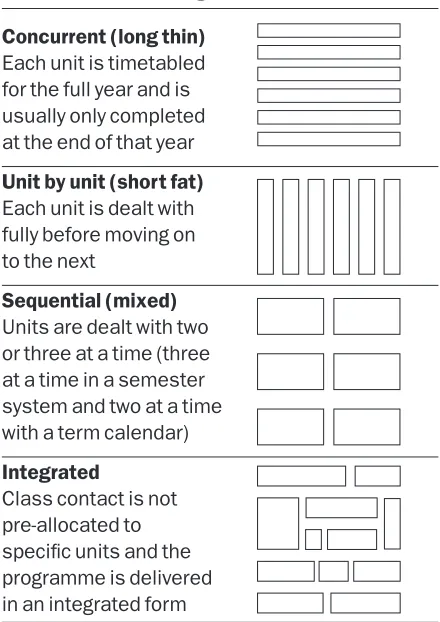
[image:14.668.370.590.413.724.2]See ‘Notional learning hours’ (page 8) on resources for a discussion of the number of hours that should be timetabled to each unit. Various timetabling models are shown in the Table 4.
Table 4 – Timetabling models for GNVQ units
Concurrent (long thin) Each unit is timetabled for the full year and is usually only completed at the end of that year
Unit by unit (short fat) Each unit is dealt with fully before moving on to the next
Sequential (mixed) Units are dealt with two or three at a time (three at a time in a semester system and two at a time with a term calendar)
Integrated
Class contact is not pre-allocated to specific units and the programme is delivered in an integrated form
There is no one correct model but most centres have tended to opt for a mixed model: two or three vocational units run concurrently for a term or semester, with perhaps the key skills running throughout the year.
The concurrent (long thin) model has the drawback that it does not permit the students to achieve units cumulatively. By contrast, the unit-by-unit model (shor t fat) tends to demotivate students who may become bored by the intense focus on a single unit. It also ignores the fact that some units link to each other and should be taught at the same time. The integrated model is ver y effective when properly managed but is complex and difficult to get right.
If you choose a sequential model you have to determine the sequence of the units. A key consideration in this decision is the timing of external assessments. You could timetable the external units first to maximise the students’ oppor tunities to sit the external assessment. Other factors to consider are the logical sequencing of information in the units and whether any units seem more difficult (and therefore could be postponed) or less difficult (and should therefore be scheduled early in the programme). Unit one is usually an introductory unit so will tend to be chosen first.
Staffing the vocational units
This involves deciding which members of staff will contribute to the programme and assigning unit teaching, assessment and moderation responsibilities to them. Clearly some tutors may teach on more than one type of unit.
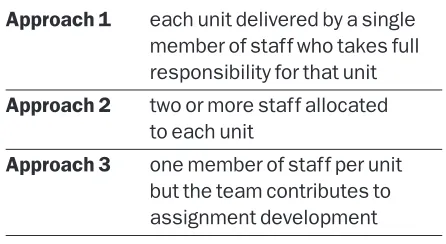
[image:15.668.306.529.250.372.2]There are several alternative approaches to allocating staff to the units as shown in Table 5.
Table 5 – Approaches to staffing the units
Approach 1 each unit delivered by a single
member of staff who takes full responsibility for that unit
Approach 2 two or more staff allocated
to each unit
Approach 3 one member of staff per unit
but the team contributes to assignment development
Involving more than one member of staff in each unit increases the breadth of experience brought to the unit, but does need a collaborative
approach if it is to work effectively. In par ticular, a joint scheme of work and assignment
programme should be developed and time must be made available for the unit tutors to meet and discuss progress, assessment etc.
Qualities needed by
GNVQ teachers
●
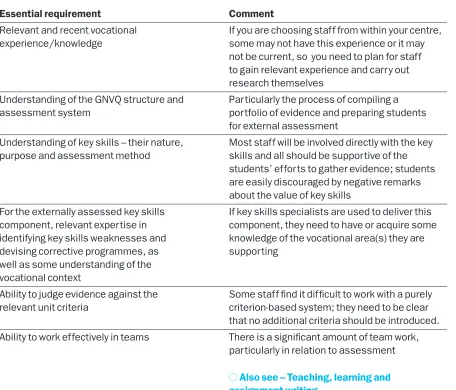
[image:16.668.142.598.246.636.2]●Also see – Teaching, learning and assignment writing
Table 6 – GNVQ teacher qualities
Essential requirement Comment
Relevant and recent vocational If you are choosing staff from within your centre, experience/knowledge some may not have this experience or it may
not be current, so you need to plan for staff to gain relevant experience and carr y out research themselves
Understanding of the GNVQ structure and Par ticularly the process of compiling a assessment system por tfolio of evidence and preparing students
for external assessment
Understanding of key skills – their nature, Most staff will be involved directly with the key purpose and assessment method skills and all should be suppor tive of the
students’ effor ts to gather evidence; students are easily discouraged by negative remarks about the value of key skills
For the externally assessed key skills If key skills specialists are used to deliver this component, relevant exper tise in component, they need to have or acquire some identifying key skills weaknesses and knowledge of the vocational area(s) they are devising corrective programmes, as suppor ting
well as some understanding of the vocational context
Ability to judge evidence against the Some staff find it difficult to work with a purely relevant unit criteria criterion-based system; they need to be clear
that no additional criteria should be introduced.
The role of the
vocational tutor
In theor y it is possible to separate the role of tutor from that of the assessor. In practice the roles are almost always combined for internally assessed units. Table 7 describes the key tasks of a vocational tutor/assessor.
In addition, vocational tutors usually have some input into the deliver y and assessment of the internally assessed components of the key skills.
●
●Also see – Key skills
Planning teaching
and assessment
Advanced planning is par ticularly impor tant for GNVQ programmes because of the need to coordinate the effor ts of the whole team. As well as the usual schemes of work for each unit, the team should produce an overall assessment plan indicating:
● when each assignment is to be issued and submitted
● which assignments will contribute to which key skills
● scheduled dates for external assessments of relevant units; how this is done will depend on the rules for the par ticular units.
The teaching and assessment programme should be designed to incorporate the key principles of active learning, vocational relevance and integrated key skills. The team should be able to show how, where and when they have planned to apply these principles.
●
Table 7 – Key tasks of a vocational tutor
Key task
Develop a scheme of work for the unit, scheduling the main teaching/ ● ● learning opportunities, external contacts/visits and the use of internal
resources and indicating the date(s) for submission of assessment evidence
Provide teaching/learning suppor t for the assigned unit, ● ● ensuring coverage by students of the ‘What you need to learn’
section and reflecting the guidance on teaching strategies supplied in ‘Essential information for teachers’
Suppor t students to help them provide the evidence for the ● unit as specified in the ‘Assessment evidence’ section. This
suppor t should take full account of the guidance on assessment evidence supplied in‘Essential information for teachers’
Suppor t students to help them prepare for the external assessment ● of the unit as specified in the ‘Assessment evidence’ section. This
suppor t should take full account of the guidance on assessment evidence supplied in ‘Essential information for teachers’
Liaise with external organisations to help the students gain access ● ● to vocationally relevant information. This liaison may take the form of
trips, work shadowing, case-study material and e-mail, letter and telephone contact. The aim is to pave the way for the students and to avoid logistical problems arising from many students contacting a single organisation
Assess the completed evidence supplied by the students against the ● criteria specified in the ‘Assessment evidence’ section, also using
‘Essential information for teachers’
Provide feedback on assessment outcomes and give advice to those ● ● who need to resubmit referred work or re-sit the external assessment
Review assessment outcomes with the students and give advice ● to those who need to resit the assessment
Keep records of student achievement and pass these on ● ● to the course coordinator
Supply assessed work to the internal and external standards ● moderators as and when required.
Respond appropriately to feedback from internal and external ● ● standards moderators/examiners
If sharing the unit with another tutor, meet to plan the scheme of ● ● work, assessment programme and student progress, and collaborate
on marking assignments.
Take par t in team meetings and activities ● ●
Externally assessed
unit Internally
Inducting students
GNVQ induction should be designed to
familiarise students with the distinctive learning culture and assessment regime. This process may take much longer than the few days or a week normally allocated to induction, and staff need to take account of the difficulty students may experience.
A formal induction is an essential component of any GNVQ course and should include the following topics:
● distinctive characteristics of the GNVQ system
● the layout and format of the specifications
● a list of the units provided and any options
● the weekly timetable and course calendar
● initial development of learning skills
● an introduction to assignment work and por tfolio building
● key skills – nature and purpose
● the assessment system and timetable.
Induction activities should include:
● diagnostic assessment of any key skills strengths or weaknesses
● an individual programme action-planning inter view for each student
● an induction assignment to help the students experience the assignment process, and ideally to generate evidence towards a par ticular GNVQ unit.
●
●Also see – Recruitment, induction and progression
Promoting
team work
It is impor tant to hold regular team meetings, focused on the curriculum as well as
administrative matters. Make sure there is a clear and relevant agenda with proper minutes and action points. Useful agenda items for team meetings include:
● the content and deliver y of the induction programme
● internal moderation/standardisation activities
● identifying and enhancing key skills oppor tunities within the assignment programme
● student progress repor ts
● principles of effective assignment design
● preparation for external assessments
● preparation for external moderation.
Team meetings are also a useful forum for keeping staff up to date with the latest GNVQ developments; for providing staff development as appropriate; and for deciding who should go to external staff development events.