Semi-direct speech: Manambu and beyond
Alexandra Y. Aikhenvald
*Research Centre for Linguistic Typology, La Trobe University, Melbourne, Vic 3084, Australia
Received 10 April 2007; received in revised form 29 June 2007; accepted 12 July 2007
Abstract
Every language has some way of reporting what someone else has said. To express what Jakobson [Jakobson, R., 1990. Shifters, categories, and the Russian verb. Selected writings. Word and Lan-guage. Mouton, The Hague, Paris, pp. 130–153] called ‘speech within speech’, the speaker can use their own words, recasting the original text as their own, within an ‘indirect’ speech construction. Or the other person may be quoted ‘directly’, just as they said it, or more or less so. One major dif-ference between direct and indirect speech lies in the way person specification within the speech report is cast. In direct speech, person reference is expressed exactly as it was in the original speech report. In indirect speech, the person reference is shifted to the perspective of the speaker. There is a third option – a ‘middle ground’ situation known as ‘semi-direct’ speech – with incomplete person shift. Semi-direct speech often involves coreferentiality between the current speaker – rather than the author of the speech report – and a participant within the speech report. In Manambu, a Ndu language spoken in the New Guinea area, semi-direct speech differs from both direct and indirect speech in a few interesting ways. Further examples of semi-direct speech and its various guises come
0388-0001/$ - see front matter 2007 Elsevier Ltd. All rights reserved. doi:10.1016/j.langsci.2007.07.009
Abbreviations: A, subject of transitive verb; ACC, accusative; ACT.FOC, action focus; ADVS, adverbializer; AUX, auxiliary; BAS.NP, basic nonpast cross-referencing; CAUS, causative; COM, comitative; COMPL, co-mpletive aspect; COMPL:SS, completed action same subject; CONF, confirmation marker; COP, copula; CS, Current Speaker; DAT, dative; DAT.SG, dative singular; DECL, declarative; DEM.DIST, distal demonstrative; DES, desiderative; DIR.SP.REP, direct speech report; du, dual; excl, exclusive; fem, feminine; FUT, future; IMPV, imperative; INCL, inclusive; IND.SP.REP, indirect speech report; IPTV, imperfective; LK, linker; LOC, locative; LOG, logophoric; masc, masculine; NEG, negative; NOM.PL, nominative plural; NP, nonpast; NR, nominalizer; O, object of a transitive verb; OBJ, object marker; OBL, oblique; OS, Original Speaker; P, past; pers, person; PERF, perfective; PERM, permissive; pl, PL, plural; POSS, possessive; PRO, pronoun; PROG, progr-essive; PURP.DS, purposive different subject; PURP.SS, purposive same subject; QUOT, quotative; RED, re-duplication; RP, reported speech marker; S, subject of intransitive verb; SEQ, sequential; sg, singular; SS, same subject; SUB, subordinative; SUBJ, subject cross-referencing set; VOC, vocative.
* Tel.: +61 3 94796402; fax: +61 3 94673053. E-mail address:[email protected]
Language Sciences 30 (2008) 383–422
from a number of African languages, other languages from New Guinea area, and Colloquial Eng-lish. The existence of a semi-direct speech construction brings an additional dimension to the typol-ogy of speech reports: the necessity of including the perspective of current speaker in the overall picture.
2007 Elsevier Ltd. All rights reserved.
Keywords:Direct and indirect speech; Semi-direct speech; Papuan languages
1. The problem: speech reports with incomplete person shift
1.1. Direct and indirect speech reports
Every language has some way of reporting what someone has said. To express what Jakobson (1990, p. 130)called ‘speech within speech’, the speaker can use their own words, recasting the original text as their own, within an ‘indirect’ speech construction. Or the other person can be quoted ‘directly’, just as they said it, or more or less so. In some lan-guages, such ‘direct’ speech is the only type of speech report. Others have an array of structures on a continuum between ‘direct’ quotation and ‘indirect’ speech. One major dif-ference between direct and indirect speech lies in the person of participants within the speech report.
In a direct speech construction, the speech report content corresponds exactly (or more or less so), to what the ‘Original Speaker’, that is, the author of the speech report content, had said. Consider the English sentences (1a) and (1b):
(1a) Johnisaid: ‘Iisaw Fred yesterday’
(1b) Johnisaid: ‘Hejsaw Fred yesterday’
In both examples, the direct speech report – marked with quotes in the written language – is postposed to the reporting verb ‘say’. There is no overt link between the two. In (1a), the personal pronoun ‘I’ is coreferential with the Original Speaker, ‘John’, and is used within the speech report. In (1b), the personal pronoun ‘he’ is not coreferential with the Original Speaker. The subject of the speech report is someone other than John.
Alternatively, the report may be made without using his or her exact words, cast as ‘indirect speech’. Then the person reference within a speech report is adapted to the per-spective of the Current Speaker. In (2a), the original ‘I’ (used by John in (1a)) is changed to ‘he’:
(2a) Johnisaid (that) heihad seen Fred the previous day
And in (2b) ‘he’ used by John in (1b) is preserved
(2b) Johnisaid (that) hejhad seen Fred the previous day
sawin both (2a) and (2b) is ‘back-shifted’ to the ‘past perfect’, or past with respect to the past, had seen. The time adverb yesterday is changed to the previous day. The optional complementizer that is a marker of syntactic link between the reporting clause and the speech report content.Appendix Acontains a survey of features which serve to differen-tiate speech reports across languages. A list of points to be addressed in an analysis of speech reports in any language is given inAppendix B.
In this paper we focus on SHIFT IN PERSONAL DEIXIS, which is a major property
distin-guishing direct and indirect speech reports. Suffice it to say that in many languages it is indeed the only way of telling direct and indirect speech apart – examples include Hatam (Papuan area:Reesink, 1999, p. 105), Abun (Berry and Berry, 1999, p. 177), Nigerian Pid-gin (Faraclas, 1996, p. 6) and Babungo (Schaub, 1985, p. 1).1But is such person shift always straightforward? This takes us to the next section.
1.2. Person shift, and coreferentiality in speech reports
A speech report may involve:
• the Current Speaker (CS) – that is, the person who produces the speech report;
• the Original Speaker (OS), e.g. John in (1a,b) and (2a,b);
• and the participants within the speech report itself – the subject ‘I’ in (1a), ‘he’ in (1b)– (2a,b), and the object ‘Fred’ in (1a,b) and (2a,b). There can be further participants – such as the addressee, and a variety of obliques.
When a direct speech report is recast as indirect speech, and if the Original Speaker is coreferential with a Speech Act Participant within the report (that is, first person ‘I’ or sec-ond person ‘you’), a non-third person shifts to third person – compare (1a) and (2a). If there is no coreferentiality, there is no person shift – compare (1b) and (2b).
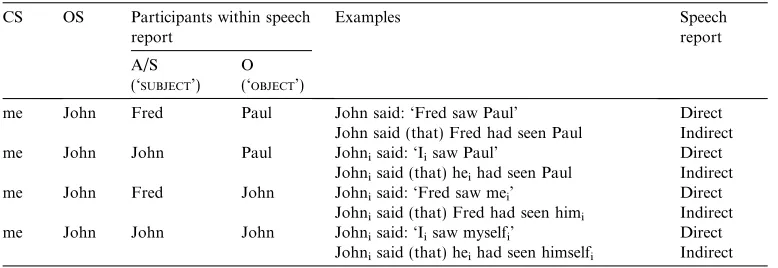
A selection of options for coreferentiality between the Original Speaker (OS) and the participants within the speech report is given inTable 1. For the sake of simplicity, at this stage, I have not included either the option for a second person for the Original Speaker, or any ungrammatical options with the lack of shift in indirect speech reports (e.g.*John
i said that Paul had seen mei).
This table contains a set of grammatical options. Further options would be ungram-matical in standard English. These involve person shift within a direct speech report. So, a sentence*John
isaid:‘Heisaw Paul’ where ‘he’ refers to John would be nonsensical.
A sentence*John
isaid:‘Fred saw himi’ where ‘him’ refers to John would also be
impossi-ble, ifHe saw PaulandFred saw himare direct speech reports. These examples could be grammatical only if seen as a variation on an indirect speech report with thatomitted, Johni said hei saw Paulwith no tense back-shift. We will see below, however, that such
‘strange’ speech reports – ‘semi-direct speech’ – are a legitimate option in some languages.
1 Cross-linguistic statements within this paper are based on a comprehensive typological account of speech
The Current Speaker (CS) may be coreferential with the Original Speaker, and/or with a participant within a speech report situation. A selection of relevant options is given in Table 2.
Here again, a number of further options would be ungrammatical in standard English. These involve person shift within direct speech reports which cast the Current Speaker (here ‘me’) as if the Current Speaker were also the Original Speaker when she is not, as in*John
isaid:‘ICurrentSpeakersaw Fred’. This may be acceptable as an indirect speech report
withthatomitted and no tense back-shift, but not as a direct speech report.
If I am simultaneously the Current Speaker and the subject of a statement within the speech report, the option*John
isaid‘SheCurrentSpeakersaw himi’ would also be
ungrammat-ical, as would be*John
isaid‘ICurrentSpeakersaw mei’ (the grammatical option in both cases
would beJohn said‘She saw me’). Another ungrammatical option would involve preserv-ing the first person reference for the Current Speaker as object within a direct speech report, as in*John
[image:4.468.39.428.86.220.2]isaid ‘Iisaw meCurrentSpeaker.
Table 1
Coreferentiality of the Original Speaker and the participants within speech reports
CS OS Participants within speech report
Examples Speech
report
A/S (‘SUBJECT’)
O (‘OBJECT’)
me John Fred Paul John said: ‘Fred saw Paul’ John said (that) Fred had seen Paul
Direct Indirect me John John Paul Johnisaid: ‘Iisaw Paul’ Direct
Johnisaid (that) heihad seen Paul Indirect
me John Fred John Johnisaid: ‘Fred saw mei’ Direct
Johnisaid (that) Fred had seen himi Indirect
me John John John Johnisaid: ‘Iisaw myselfi’ Direct
[image:4.468.42.424.453.625.2]Johnisaid (that) heihad seen himselfi Indirect
Table 2
Coreferentiality of the Current Speaker, the Original Speaker and the participants in speech reports (the Current Speaker is feminine)
CS OS Participants within speech report Examples Speech report
A/S (‘SUBJECT’) O (‘OBJECT’)
me me John Fred ICSsaid: ‘John saw Fred’ Direct
I said (that) John had seen Fred Indirect
me John me Fred John said ‘SheCSsaw Fred’ Direct
John said (that) I had seen Fred Indirect me John me John Johnisaid ‘SheCSsaw mei’ Direct
Johnisaid (that) I had seen himi Indirect
me John John me Johnisaid ‘Iisaw herCS’ Direct
Johnisaid (that) heihad seen meCS Indirect
me me me Fred ICSsaid ‘ICSsaw Fred’ Direct
ICSsaid (that) ICShad seen Fred Indirect
me me Fred me ICSsaid ‘Fred saw meCS’ Direct
ICSsaid (that) Fred had seen meCS Indirect
me me me me ICSsaid: ‘ICSsaw myselfCS’ Direct
A further ungrammatical option involves casting the Current Speaker as if she were not the Original Speaker when in fact she was, as in *I
CurrentSpeaker=OriginalSpeaker said
‘SheCurrentSpeaker=OriginalSpeakersaw Fred’. It is equally impossible to say*ICurrentSpeakersaid
‘Fred saw herCurrentSpeaker’.2
These ungrammatical starred examples can be viewed as weird instances of direct speech with unexpected person shift. The starred examples discussed afterTable 1contain what looks like ‘illegitimate’ shift of person of the Original Speaker. Those discussed after Table 2contain peculiar shifts of person of the Current Speaker. The value of other per-sons remains the same as it was produced by the Original Speaker.
Speech report constructions with such ‘incomplete’ person shift, also known as ‘semi-direct’ speech, are in fact a legitimate option in a number of languages, many of them spo-ken in the Highlands of New Guinea. In some, semi-direct speech is obligatory.3
In summary, such semi-direct speech reports can be:
Type I. Original-Speaker-Oriented which correspond to the options discussed after
Table 1
Type II. Current-Speaker-Oriented which correspond to the options discussed after
Table 2
We start with a brief outline of speech reports in Manambu, a Ndu language from the Papuan area, which has both options for semi-direct speech (Section2). In Section3 we consider further examples of semi-direct speech documented in the literature, and the con-ditions under which it is used. There, we also discuss the possibility of semi-direct speech constructions in English. The last section (Section4) contains brief conclusions.
2. Speech report constructions in Manambu
2.1. Background
Manambu belongs to the Ndu family, and is spoken by about 2000 people in five vil-lages in the Ambunti region of the East Sepik Province of Papua New Guinea. It is a highly synthetic, predominantly suffixing and agglutinating language, with a strong ten-dency towards verb-final constituent order. Its morphological structure is quite complex (Aikhenvald, 2008). Manambu has contrastive word stress, and no tones.
Nouns distinguish two genders, three numbers and nine case forms. Verbs have an array of grammatical categories, including several modalities, aspects and tenses fused with person, number and gender marking; a complex system of negation; and clause-chaining. Only declarative verbs are fully inflected: they can cross-reference two partici-pants (the subject and another topical argument or oblique) and take a full array of aspect
2 Other ungrammatical examples which involve lack of shift in indirect speech reports, such as*John isaid that heihad seen herCSare not included, for the sake of simplicity.
3
Whether any language has indirect speech reports similar to*John
isaid that heihad seen herCSis an open
markers. Desideratives and same subject purposives do not take any person inflection. The different subject purposive cross-references just the subject.
The imperative has its own paradigm of subject marking. Importantly, there is one verb form for second person singular, dual and plural imperative. The exact reference is distin-guished by using free personal pronouns:a-wuk(IMPV.2pers-listen) may mean ‘you
(singu-lar) listen!’ or ‘you (dual) listen!’, or ‘you (plural) listen’. To disambiguate these, one can saym\n a-wuk (you.mascIMPV.2pers-listen) ‘you (masculine) listen!’,n˜\n a-wuk (you.fem IMPV.2pers-listen) ‘you (feminine) listen!’,b\r a-wuk(you.duIMPV.2pers-listen) ‘you two
lis-ten!’,gur a-wuk(you.pl IMPV.2pers-listen) ‘you many listen!’
Direct speech reports in Manambu are highly frequent, and semantically versatile. Any speech act – statement, question or command – can be cast as a direct speech report. In contrast, indirect speech reports are restricted to reported commands, and are less seman-tically versatile. In Section 2.2, we address the differences between direct and indirect speech reports. ‘Semi-direct’ speech with incomplete person shift along the lines of Section 1.2is considered in Section2.3.
2.2. Distinguishing direct and indirect speech reports
Speech reports in Manambu are multiclausal. They are by far the most frequent clause type in Manambu discourse of all genres. An overwhelming majority of speech reports are direct speech. These aim at reproducing what has been said without any shift in personal, temporal or spatial deixis. Direct speech reports are often quotations. And, more often than not, they convey not just the words, but the intonation, the look, the gestures, the particular tone of voice and so on – depending on the ‘theatrical effect’ the speaker wants to produce. A direct speech report can be separated from the reporting clause by a short pause.
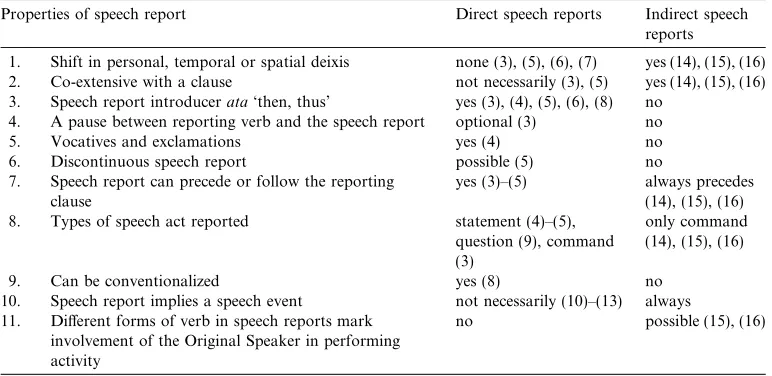
[image:6.468.40.426.437.625.2]Direct speech reports in Manambu cover statements, reported commands and reported questions. Indirect speech reports exclusively cover reported commands. The distinguish-ing properties of direct and indirect speech reports are listed in Table 3. Most of these
Table 3
Direct and indirect speech reports in Manambu: a comparison
Properties of speech report Direct speech reports Indirect speech reports
1. Shift in personal, temporal or spatial deixis none (3), (5), (6), (7) yes (14), (15), (16) 2. Co-extensive with a clause not necessarily (3), (5) yes (14), (15), (16) 3. Speech report introducerata‘then, thus’ yes (3), (4), (5), (6), (8) no
4. A pause between reporting verb and the speech report optional (3) no
5. Vocatives and exclamations yes (4) no
6. Discontinuous speech report possible (5) no
7. Speech report can precede or follow the reporting clause
yes (3)–(5) always precedes (14), (15), (16) 8. Types of speech act reported statement (4)–(5),
question (9), command (3)
only command (14), (15), (16)
9. Can be conventionalized yes (8) no
10. Speech report implies a speech event not necessarily (10)–(13) always 11. Different forms of verb in speech reports mark
involvement of the Original Speaker in performing activity
properties are mentioned in Appendix Aas potentially criterial for distinguishing direct and indirect speech reports cross-linguistically.
The numbers of examples from Manambu which illustrate the points in theTable 3are given in brackets.
2.2.1. Direct speech reports, and their properties in Manambu
As expected, a direct speech report does not display any shift in personal, temporal or spatial deixis to fit in with the perspective of the reporter. This is illustrated in (3). Here, the locativek\l\m‘here’ reflects the location of the female addressee’s ‘staying’. (We can recall, from Section 2.1, that the second person imperative does not distinguish gender and number of the addressee: this is why the second person imperative form adakw is used.) A direct speech report is typically introduced with the demonstrative adverb ata ‘then, thus’ within the reporting clause with the verbwa- ‘say, speak’. There is an optional pause between the speech report and the reporting verb. (Here and throughout the paper, clauses are in square brackets. Speech reports are in italics.)
(3) [n˜\n k\ta k\l\m adakw] [PAUSE] [ata wa-bEr lE-kE-k]
you.fem.sg now here stay:IMPV.2pers PAUSE then say-3duSUBJ.P she-LK-DAT
‘ ‘‘You stay here now,’’ thus they said to her’
A direct speech report can be co-extensive with a clause, or a sentence. It may con-tain part of a clause, for instance, just a vocative, as in (4). Or it may consist of several sentences and be discontinuous, as in (5). Such discontinuity only occurs on clause boundaries.
(4) [gra-n] [ata wa-na] [wun-a-d\ mam-eee]
cry-SEQ then say-ACT.FOC+3fem.sgSUBJ.NP I-LK-masc.sg older.sibling-VOC
‘She said crying: ‘‘Oh my older brother!’’ ’
(5) [d\-k\-k v\ ma:] [wun warya-u] he-OBL-DAT see:NEG NEG I fight-1sgPERM
[ata wa-dE-di]
then say-3masc.sgSUBJ.P-3plOBJ.P
[d\-k\-wa k\ta warya-k yi-na-d\wun-\k]
he-OBL-COM now fight-PURP.SS go-ACT.FOC-1masc.sgSUBJ.P-CONF
‘ ‘‘She is not to see him, let me fight,’’ thus he said to them, ‘‘I am going to fight with him now’’ ’
Speech reports can precede or follow the framing clause containing the speech verb, with a slight preference for the former. (In the corpus about 70% of direct speech reports precede the framing clause.)
If a command is part of a larger speech report which contains a justification for the command, a direct speech report is a preferred strategy. The reported command in (6) was accompanied by an explanation in (7): the older brother felt he ought to be killed by the enemy before they killed his younger sibling:
(6) [k\ t\pa:m wun-a:k a-vi] [ata wa:d]
this village+LK+LOC I-LK+DAT IMPV-hit/kill then say+3masc.sgSUBJ.P
‘ ‘‘Kill me in this village,’’ thus he said’
(7) [wun kiya-u ta:y] [wun ma:m] I die-1sg.PERM first I older.sibling
‘Let me die first, I am the older brother’
A conventional greeting which has the form of a command is always cast as a direct speech report:
(8) [yara ma:y] [ata wa:l]
well go then say+3fem.sgSUBJ.P
‘ ‘‘Good-bye (lit. you go well),’’ she said’
A question within a direct speech report is illustrated in (9).
(9) [[n˜\ kas] wa-ku] [bassa:d]
sun how.much say-COMPL:SS ask+3masc.sgSUBJ.P
‘He asked what time it is (lit. He asked saying ‘‘What time is it?’’)’
This example illustrates an additional point: the verbwa- ‘say, speak’ is the only speech verb which consistently introduces speech reports.4 Other verbs referring to speech acts (e.g. ‘ask’ in (9), and ‘cry’ in (4)) can only occur with a speech report if they are preceded by a dependent medial clause containing the verb wa- which, in its turn, introduces the speech report, as in (9). In such cases the direct speech report introducerata‘then, thus’ can be omitted: it is indeed omitted in (9), but not in (4).
Direct speech reports in Manambu are extremely versatile: besides reporting an actual speech event, they are employed to express internal speech and thought, desire and inten-tion of third person, warning, reason and purpose. In these cases,atais often omitted.
Example (10) is cast as a direct speech report. It did not involve any actual speech act. As I was coming downstairs with a loaded camera (without saying anything, but with a
4 Manambu has three verbs of speech –bla- (allomorph bEl-) ‘say/tell (something)’, yi- ‘say X, speak (a
clear intention to take pictures, as requested prior to that), my adopted sister said to make sure the girls were ready for me to take their picture.
(10) [kayik kur\k] [wa-na]
picture/image do/get+PURP.SS say-ACT.FOC+3fem.sgSUBJ.NP
‘She wants or intends to take pictures (lit. She says ‘‘(I) am intending to take pictures’’)’
One day a duckling was brought inside the house. The cat did not dare touch him, but its desires were clear from the way it looked at the bird. (11) – a comment on this – could not have referred to an actual speech act: cats do not talk.
(11) [pusi væn tE-na-d]
cat see+SEQ keep-ACT.FOC-3masc.sgSUBJ.NP
[pap\r k\-k\-tua] [wa-na-d]
later eat-FUT-1sgSUBJ.NP+3fem.sgOBJ.NP say-ACT.FOC-3masc.sgSUBJ.NP
‘The cat keeps looking (at the duckling), he wants to eat her later (lit. He says ‘‘I will eat her later’’)’
Direct speech reports are the only way of expressing someone’s intention – Manambu has no other way of expressing the notion of ‘intending’, or ‘wanting’. They can also express reason, as in (12):
(12) [[asayik] wa-ku] gra-na
father+DAT say-COMPL:SS cry-ACT.FOC+3fem.sgSUBJ.NP
‘She is crying because of her father’ (lit. ‘Having said ‘‘because of father’’ she is crying’)
This was said about a baby who was crying because her father had gone off to a meeting, leaving her. The baby could not talk, so there was no actual speech act involved. Similarly, in (13), a speech report is a way of expressing the end result of counting: this was a ques-tion to a mother about the age of her toddler:
(13) [nabi kas] wa-na-d
year how.many say-ACT.FOC-3masc.sgSUBJ.NP
‘How old is he? (lit. ‘How many years does he say?’)’
Internal speech and thought are also cast as direct speech reports, using the same verb wa- ‘say’ whose meaning can be viewed as far more general than simply reporting a speech act.
and motives are represented as quoted speech in languages of the Marind and Awyu fam-ilies (Drabbe, 1955, 1957, 1959).5
2.2.2. Indirect speech reports, and their features in Manambu
In contrast to direct speech reports which are not limited to any speech act, indirect speech reports cover just reported commands. An alternative to (6) is (14). Then, the exact words of the actual command are not preserved. The predicate in reported commands appears in the different subject purposive, if the Original Speaker is not involved in per-forming the activity. The person shift in the verb ‘hit/kill’ and in the spatial deictic are indicative of an indirect speech report.
(14) [a t\pa:m d\-k\-k vya-m\n-k\k]
that village+LK+LOC he-OBL-DAT hit/kill-2masc.sg-PURP.DS
[wa:d]
say+3masc.sgSUBJ.P
‘He told (you) to kill him in that village’
Indirect speech reports cannot contain the speech report introducerata‘then, thus’. A speech report is always preposed to the reporting verbwa- and there is no pause. Unlike direct speech reports, an indirect speech report cannot be discontinuous, consist of more than one clause, or be shorter than a clause. If the subject of the speech report is different from the Original Speaker, different subject purposive is used, as in (15). The Original Speaker is not going to join the subject of the speech report in ‘eating sago’.
(15) [na:gw k\-l\-k\k\k] [wa-tua-l]
sago consume-3fem.sg-PURP.DS say-1sgSUBJ.P-3fem.sgOBJ.P
‘I told her to eat sago’
But if the original speaker is involved in performing the required activity, the same subject purposive is used within the indirect speech report, as in (16):
(16) [na:gw k\ka:k] [wa:d]
sago eat+RED+PURP.SS say+3masc.sgSUBJ.P
‘He told (them) to eat sago’ (he was eating with them)
This is somewhat similar to the phenomenon of logophoricity (see Section3.5).
5 These do not exhaust potential polysemies of reporting verbs. In Australian languages, one verb often means
In contrast to direct speech reports which have a number of semantic extensions, indi-rect speech reports in Manambu always imply an actual speech event. There are no con-ventionalized uses of indirect speech reports (see (8) above, for a concon-ventionalized direct speech report).
In terms of their syntactic status, neither the direct speech nor the indirect speech report is an object of the verbwa- ‘say, speak’ since they cannot be cross-referenced on the verb as a direct object or an oblique (such as, for instance, location or manner) would. The verb wa- can be used either transitively or intransitively; when used transitively, the addressee can be cross-referenced – this is illustrated in (5) (‘he-said-to-them’). Speech reports are best considered a special type of obligatory grammatical relation different from any other (seeMittwoch, 1985; Partee, 1973; Munro, 1978, 1982, on the special syntactic status of speech reports).
2.3. Semi-direct speech reports in Manambu
Direct and indirect speech reports are very common in Manambu. Semi-direct speech constructions are less frequent, but nevertheless are a recurrent and acceptable pattern. Of the total of direct speech reports in the corpus, semi-direct speech reports account for about 10%. All involve free personal pronouns.
2.3.1. Formal properties of semi-direct speech
While in indirect speech reports the person reference ‘shifts’ to the perspective of the Current Speaker, there is no such shift in direct speech reports. In semi-direct speech, the reference for some participants is shifted, while for others it is not.
Example (18) illustrates such an ‘intermediate’ speech report in Manambu. Before the two brothers had left the house, they said (17) to their sister. This is cast as a direct speech report within the narrative. The imperative, ‘you-stay’, is underlined.
(17) [n˜\n ata wiya:m adakw an ma: kami:k yi-t\k]
you.fem.sg then house+LOC stay:IMPV.2pers 1du again fish+DAT go-1duIMPV
[wa-ku] [ata yi-bEr] say-COMPL:SS then go-3duSUBJ.P
‘ ‘‘You stay at home, let us two go fishing again,’’ having said (this) the two went off’
We can recall, from Section2.1above that second person imperative in Manambu does not distinguish number or gender of the addressee. The second person free pronounn˜\n ‘you feminine’ appears here: it is now fully clear that the girl is the addressee.
Later in this story, a stranger approaches the girl and makes an attempt to kidnap her. She tells him that she will stay at home after what her brothers have told her to do. This is how she reports her brothers’ speech:
(18) [wun wiya:m adakw] [wa-bEr-kEkEb]
I:IND.SP.REP house+LOC stay:IMPV.2pers:DIR.SP.REP say-3du-AS.SOON.AS
[wiya:m kwa-k\-na-wun-\k wun]
house+LOC stay-FUT-ACT.FOC-1fem.sgSUBJ.NP-CONF I
Example (18) contains reported speech within reported speech. This example, like fur-ther instances below, comes from a story told by a narrator. However, the narrator’s iden-tity as a ‘Current Speaker’ is of no relevance to person shift. The Original Speaker (i.e. the girl) in (18) is the ‘second level’ reporter, which can be considered a ‘surrogate’ Current Speaker.
The speech report in (18) is an example of Type I semi-direct speech. The speech report contains a token of direct speech report: the second person imperative form of the verb. This is exactly what the brothers had said to the girl, in (17) in the direct speech report (hence the noteDIR.SP.REPin the gloss). On the other hand, the speech report in (18)
con-tains one feature of indirect speech: the free pronoun has been shifted to first person ‘I’, to fit in with the perspective of the ‘surrogate’ Current Speaker, that is, the girl (hence the noteIND.SP.REPin the gloss). The token of indirect speech is coreferential with the Original
Speakers – the two brothers.
The differences and similarities between a direct speech report in (17) and a semi-direct report in (18) are summarised in Scheme 1.
Scheme 1. Differences between direct and semi-direct speech reports in Manambu (17–18)
DIFFERENT FROM DIRECT SPEECH REPORT: change of pronounn˜\n‘you’ to wun‘I’
SAME AS DIRECT SPEECH REPORT: imperative verb formadakw
Semi-direct speech reports found in the corpus do not always contain commands. They can be declarative statements. A mother (who has recently died but keeps an eye on her orphaned children) tells her son that the things belonging to him and his sister are here:
(19) [b\r-a-di ja:p k\diya taka-tua-di] [ata wa:l]
you.du-LK-pl thing this.pl.here put-1sgSUBJ.P-3plSUBJ.P then say+3fem.sgOBJ.P
‘She said thus: ‘‘The things belonging to you two I put here’’ ’
The son then reports to his sister what the mother had said:
(20) [an-a-di ja:p k\diya taka-tua-di]
we.two-LK-pl:IND.SP.REP thing this.pl.here put-1sgSUBJ.P-3plOBJ.P:DIR.SP.REP
[ata wa:l]
then say+3fem.sgSUBJ.P
‘Sheisaid thus: ‘‘The things belonging tous twoIiput here’’ ’
Just as in (18), the person shift within the speech report is incomplete. The first person singular cross-referencing on the verb is exactly the same as in the original speech, in (19), and thus can be considered a token of direct speech (DIR.SP.REPin the gloss). The possessive
pronoun (‘belonging to us two’) is ‘adjusted’ to the Original Speaker’s (that is, the son’s) perspective, and can thus be considered a token of an indirect speech report (IND.SP.REPin
A speech report with incomplete person shift may contain an uninflected verb – a desid-erative form with no person cross-referencing, in (21). A man says to two sisters, in an attempt to frighten them:
(21) [wun k\-k\-tua-digur-\k] [wun k\ta bra:m k\-k\r] I eat-FUT-1sgSUBJ.NP-2plOBJ.NP-CONF I now you.two+LK+OBJ eat-DES
‘I will eat you up, I want to eat you two’
The younger sister is scared, and says (22) to her older sister, recasting the man’s speech as follows:
(22) [lE-kE mamEk ata wa-lE-l]
she-LK+fem.sg elder.sibling+LK+DAT then say-3fem.sgSUBJ.P-3fem.sgOBJ.P
[a-d\ du [pause]] [wun k\ta
DEM.DIST-masc.sg man [pause] I:DIR.SP.REP now
an-a:m k\-k\r] [ata wa-na-d]]
1du-LK+OBJ:IND.SP.REP eat-DES thus say-ACT.FOC-3masc.sgSUBJ.NP
‘She said to her elder sister thus: ‘‘That mani: ‘Iiwant to eatus now’ (hei) said’
The girl did not quote the man’s speech exactly – she partly recast it, transforming it into a semi-direct speech report. The subject reference (‘I’) is not adjusted to her, that is, the ‘Original Speaker’s’ perspective. This is a token of direct speech report, and is exactly the same as in the man’s original speech in (21). So is the temporal deictic,k\ta ‘now’. In contrast, the object referent (‘us two’) is adjusted to the perspective of the girl as the Original Speaker, and is a token of indirect speech. This is another example of semi-direct speech report of Type I.
Examples (17)–(22) come from traditional stories, told by a story-teller. As mentioned above, for each of (18), (20) and (22), one can postulate two sets of ‘Original Speakers’, if the story-teller is to be considered a Current Speaker. For instance, in (18) brothers are the ‘primary’ Original Speakers whose speech appears in (17), and the girl who is reporting their speech can be treated as a ‘secondary’ Original Speaker. The secondary Original Speaker can be considered, for all effects, a ‘surrogate’ Current Speaker, since the perspective of the story-teller appears to be irrelevant for person shifts. The reference within the speech report is shifted to that of this Current Speaker – the girl in (18), ‘us two’ in (20), and in (22). Similar constructions are used in spontaneous conversations where there is no speech report within a speech report. A mother told her child to listen to the care-taker:
(23) [sa! m\n l\-k\-k a-wuk]
hey! you.masc she-OBL-DAT IMPV.2pers-listen
‘Hey! You listen to her!’
Later on, the care-taker grumbled at the child, reminding the child of what the mother had said, and using the same imperative intonation and the same interjectionsa‘Hey!’ as the one in (23):
(24) [sa! m\n wun-a:k a-wuk]
hey! you.masc I-LK+DAT:IND.SP.REP IMPV.2pers-listen:DIR.SP.REP
[ata wa-na] [mEn ma: wa:k]
then say-ACT.FOC+3fem.sgSUBJ.NP you.masc NEG listen+NEG
As in the examples (18), (20) and (22) above, the semi-direct speech report in (24) has features of both direct and indirect speech: second person imperative is a token of direct speech report, and the form of the addressee, ‘me’, is a token of indirect speech (the mother had said ‘her’, in (23)). The interjectionsa!‘Hey!’ is another token of direct speech in (24). However, (24) differs from the other examples of semi-direct speech discussed so far in that the token of indirect speech reflects the perspective of the real Current Speaker (the care-taker), and not that of the Original Speaker (the mother). (24) is an example of a semi-direct speech report of Type II: the person shift is done here in agreement with the person of the Current Speaker: the Current Speaker – coreferential with the addressee in (24) – is expressed as ‘me’.
The Current Speaker (that is, the narrator of the story) was of no relevance for person marking in (18), (20) and (22). So, the person of a participant within a speech report was shifted, to mark coreferentiality with the secondary Original Speaker, a ‘surrogate’ Cur-rent Speaker.
The imperative intonation of (17) and of (23) was preserved in the semi-direct speech reports in (18) and (24). This ‘mimicking’ effect is a feature of direct, and not of indirect, speech reports both in Manambu (seeTable 3), and cross-linguistically (seeWierzbicka, 1974; Clark and Gerrig, 1990).
Within a semi-direct speech report, free pronouns shift to fit in with the perspective of the Original Speaker (tokens of semi-direct speech of Type I, exemplified in (18), (20), and (22)) or with that of the Current Speaker (tokens of semi-direct speech of Type II, exem-plified in (24)). Tokens of direct speech can be free pronouns, or bound forms of pronom-inal cross-referencing.
All the instances of semi-direct speech always imply an actual speech event. This is in contrast to direct speech reports which have a plethora of other meanings, to do with intention, reason and counting – see (10–13) above. The speech report introducerata is optional (see (22)) These features bring semi-direct speech reports closer to indirect than to direct speech. Semi-direct speech reports of Type I and Type II do not show any differ-ences between themselves with respect to any of these features.
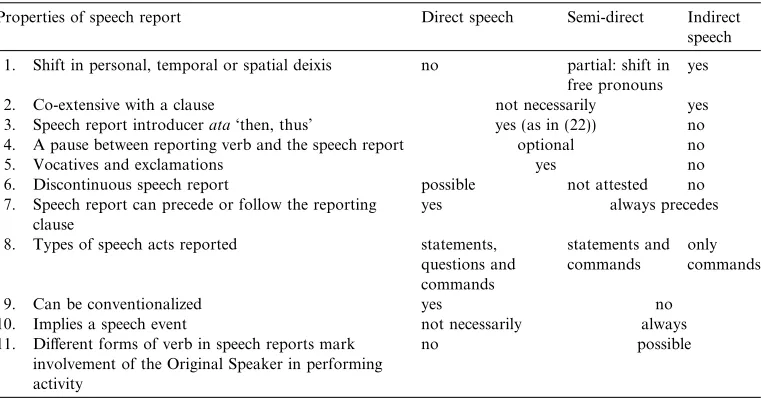
Table 4features a comparison between semi-direct, direct, and indirect speech reports, in terms of the defining properties outlined inTable 3above.
The person shift in semi-direct speech is partly shared with direct speech, and partly with indirect speech. Of the further 10 properties differentiating direct and indirect speech reports, semi-direct speech reports share four with direct speech, and four with indirect speech. Semi-direct speech reports occur only in statements and commands (but not in questions), while indirect speech is limited to commands, and direct speech may contain commands, questions, or statements (property 8). Discontinuous semi-direct speech reports have not been attested (property 6). That is, semi-direct speech reports indeed occupy a ‘middle ground’ between direct and indirect speech.
Semi-direct speech is recognizable through the shifts in personal deixis, rather than in spatial or temporal deixis. The conditions under which semi-direct speech occurs in Man-ambu provide a partial explanation.
2.3.2. How to use a semi-direct speech report in Manambu: a summary
Type I. The secondary Original Speaker – or the surrogate Current Speaker – is involved in the speech report, as the subject of an intransitive verb (18), as the possessor (20), or as the object (22). The ‘real’ Current Speaker (that is, the narrator of the story) is of no relevance in the person shift.
Type II.The Current Speaker is involved in the speech report, as the object (24).
In all the examples, the tokens of indirect speech are free pronouns, while the tokens of direct speech can be free or bound.
The use of semi-direct speech as an alternative to either direct or indirect report is not obligatory. Rather, it has a pragmatic effect: it occurs in situations when the speaker is under stress and particularly focussed on their own well-being. In (18), the girl is about to be kid-napped by a stranger. In (20), the two orphaned children are being robbed of their things by their nasty cousins, which makes them concerned about their things and where they are. In (22), the girl is afraid of being devoured by a man. And in (24), the care-taker is desperate because the naughty child would not listen. Examples (18)–(22) come from the climactic parts of narratives each of which is crucial for the rest of the story. Semi-direct speech is a stylistic device; it does not have the function of disambiguating who did what to whom.
[image:15.468.48.429.86.285.2]That is, semi-direct speech can thus be considered a strategy for marking the involvement of the Original Speaker or of the Current Speaker in a situation which affects them (note that either one or the other is marked as a first person). The function of semi-direct speech reports is to allow the Current Speaker or the narrator to simultaneously ‘index’ two speech events: the current one and the former one. This tends to happen when the former speech event is relevant to the current situation, or is the climactic part of the story, or when it is appropriate to highlight the relevance of the participants in the speech event. This may be why semi-direct speech is focussed on person shift, rather than on shifts in time and space.6
Table 4
Semi-direct, direct and indirect speech reports in Manambu: a comparison
Properties of speech report Direct speech Semi-direct Indirect speech
1. Shift in personal, temporal or spatial deixis no partial: shift in free pronouns
yes
2. Co-extensive with a clause not necessarily yes
3. Speech report introducerata‘then, thus’ yes (as in (22)) no 4. A pause between reporting verb and the speech report optional no
5. Vocatives and exclamations yes no
6. Discontinuous speech report possible not attested no 7. Speech report can precede or follow the reporting
clause
yes always precedes
8. Types of speech acts reported statements, questions and commands
statements and commands
only commands
9. Can be conventionalized yes no
10. Implies a speech event not necessarily always
11. Different forms of verb in speech reports mark involvement of the Original Speaker in performing activity
no possible
6
3. Beyond Manambu: semi-direct speech world-wide
Semi-direct speech can be a stylistic, or a discourse-organizing option, as in Manambu and in a number of languages from Africa and from the New Guinea area (Section3.1). Or it can be obligatory, under certain conditions (Section3.2).
3.1. Optional semi-direct speech
The phenomenon of semi-direct speech as an alternative to direct and indirect speech was first described for African languages. While in indirect speech reports the person ref-erence must ‘shift’ to the perspective of the narrator, there is no such shift in direct speech reports and in quotations. And in semi-direct speech, the reference for some participants is shifted, while for others it is not (see Hedinger, 1984; Jackson, 1987; Noss, 1988; and Wiesemann, 1990).
We first discuss direct speech of Type I, whereby person marking within a semi-direct speech report can be shifted to the perspective of the Original Speaker. We then con-sider semi-direct speech of Type II, whereby the person reference is shifted to the perspec-tive of the Current Speaker.
3.1.1. Semi-direct speech of Type I: Person shift to the perspective of the Original Speaker An oft-quoted example of semi-direct speech comes from AkOOse (a Bantu language from Cameroon:Hedinger, 1984, pp. 91–92). (25) illustrates direct speech, and (26) con-tains a straightforward indirect speech report. Note that in AkOOse any speech report is preceded by a reporting particle (ba´n in (25) and (26)) which distinguishes person and number of the Original Speaker. The direct speech report contains a vocative phrase: this is a typical feature of direct speech, but not of indirect speech reports:
AkOOse
(25) [Be´-la´Nge´ bE nen ba´n] ½a-mwe0e ba´n s^e-d nyı´ a`-wo´ó] they-told them this RP:pl VOC-friends RP:pl we-like you to-marry
‘They said to them, ‘‘Friends, we would like to marry you’’ ’
(26) [e c˜^e Ng¿nde´de` e-kwentene ba´n] [be-0won b
those girls they-agreed RP:pl they-will.marry them
‘Those girls agreed to marry them’ (Lit. Those girls agreed (saying that) they will marry them)
of an indirect speech report (‘she’). The second person plural agreement on the verb is a token of direct speech, and so is the vocative form of ‘husband’.
‘The wife said to her husband, ‘‘Husband, since we have stayed like this . . . the day when I die, go and put me in a grave’’ ’ (lit. ‘Husband, since you and she you-plural-have stayed like this, the day when she dies, you go and you put her in a grave’)
Vocative phrases can occur in semi-direct speech reports in AkOOse, just as they do in direct speech. This is hardly surprising, since vocatives ‘refer’ to the addressee, whose marking is the same in direct and in semi-direct reports.7 Whether semi-direct speech shares any further features – such as temporal, spatial and deictic reference – with direct and/or with indirect speech reports remains an open question (as noted byHedinger, 1984, p. 94).
Using a semi-direct speech report in lieu of indirect or direct speech in AkOOse, Gbaya (Noss, 1988, pp. 105, 111) and other African languages (Wiesemann, 1990, pp. 77–78) is the speaker’s choice. As Noss (1988, pp. 110–111) observed for Gbaya narratives, the interplay of direct, indirect and semi-direct (‘combined’) discourse is a literary device used by the performer ‘to develop his plot’. InWiesemann’s (1990, p. 78)words, this reflects ‘a manner of speaking current in conversation’ – as a stylistic option.
The use of tokens of direct and of indirect speech in AkOOse is similar to Manambu in that free pronouns appear as tokens of indirect speech, while bound pronouns are tokens of direct speech. The complex free pronoun (‘you and she’ in (27)) combines both.
A significant difference between choice of tokens of direct and indirect speech reports in AkOOse and Manambu lies in the treatment of the Original Speaker in Type I of (27) [mwa`a´d a-l^ange n`jo´m aˇ] [a`-n`jo´m
wife she-tells husband RP:3sg VOC-husband(DIR.SP.REP)
nga´ne` ny^ıdye nen. . .
you(DIR.SP.REP)+she(IND.SP.REP) 2pl:DIR.SP.REP-stay ‘‘like.this’’. . .
aˇ mbw e0e mE-0wee aˇ
RP:3sg day.when she’ll-die:IND.SP.REP RP:3sg
e-ke e-lEged me a´ son teˆ]
you-go:DIR.SP.REP you-leave:DIR.SP.REP her:IND.SP.REP locative grave in
7 Additional complications to do with logophoricity in Ak
semi-direct speech. In Manambu, the Original Speaker is cast as first person, while in AkOOse this is cast as third person.8
3.1.2. Semi-direct speech of Type II: Person shift to the perspective of the Current Speaker Semi-direct speech as an optional choice has been documented for a number of languages from the Papuan area (many of them from the Highland regions of New Guinea). Unlike Manambu and the African languages, all these Papuan languages typically have just direct speech reports, and no indirect speech report as an alternative option.
In all semi-direct speech report constructions the Current Speaker is involved in the speech report. The reference to the Current Speaker is shifted to their perspective (and not to that of the Original Speaker).
Consider (28), from Usan (Numugenan family, Madang-Adalbert range: Reesink, 1993, p. 220). The Current Speaker (‘I’) is the addressee within the speech report; it is expressed with a token of indirect speech report (‘to me’) fused with the imperative
8
This goes hand-in-hand with the statement by Donald Webster, about Abidji (Kwa, Ivory Coast): ‘Any reference to the speaker of a quotation inside the quotation is made by indirect reference, and any reference to the person spoken to is made by direct reference’ (Grimes, 1975, p. 321). Similar examples have been reported by
Hyman (1978), for Aghem, byPerrin (1974), for Mambila, byHill (1995)for Adioukrou, and byJackson (1987)
for Tikar.
Instances of optional semi-direct speech occur in other languages. An example is found in Old Russian (Fennell and Obolensky, 1969, p. 33), in theTale about Boris and Gleb(c. early 1200):
(i) Se slyshavshi, Novgorodcy re:s˜a Yaroslav-u, this+neuter.ACC having.heard Novgorodians.NOM.PL said Yaroslav-DAT.SG
[jako zautra perevezemsja na nj]
that next.day go.across+1pl.FUT:DIR.SP.REP onto him:IND.SP.REP
‘Having heard this, Novgorodians said to Yaroslav, (that) the next day we would go across onto you’ (lit. ‘thatwewill go across ontohim’)
To what extent such semi-direct speech structures were common in Old Russian is an open question. They are not mentioned in the existing grammars where speech reports are discussed only very briefly (seeVlasto, 1986, pp. 203–205, Borkovskij and Kuznetsov, 1965, p. 525; and Matthews, 1960, pp. 222–223). I am grateful to Jonathan Clarke for drawing my attention to this example, and to Noel Brackney and Ian Press for commenting on it.
Galo(Tibeto-Burman: Post, 2007)displays a similar structure: the object pronoun, ‘3-ACC’, is a token of indi-rect speech, while the ‘self-diindi-rected’ imperative form (which can be roughly translated as ‘cut-me-off’) is a token of direct speech:
(ii)
3-ACC:IND.SP.REP stone=ACC pa´-pa`k-la´a-ku-ka]
chop-OFF-IPTV.SELF/SPEAKER.DIRECTED:DIR.SP.REP-COMPL-ADVS
Em-duu-ku na = na tell-IPFV-COMPL DECL=DECL
‘Sheitold them [to cut herifree from the rock, see]’
form. The free pronoun within the speech report is a token of direct speech – it reflects what ‘he’ (the Original Speaker, different from the Current Speaker, ‘me’) had actually said:
Usan
(28) [Woi eng ba di] [yej yeis-ibi]
he this take come:up I:DIR.SP.REP give:me:IND.SP.REP-sg:FUT:SS
qambi] [ba di-arei]
say:SS take come:up-3sgFAR.PAST
‘Heibrought this up in order to give to mej’ (lit. ‘he brought this up saying:
I = Original Speakeriwill give it to me = Current Speakerj’)
In (29), also from Usan (Reesink, 1987, pp. 258–259), the first person ‘refers to a group of children of which the Current Speaker is a part, and the third person plural refers to the children’s parents’:
(29) wuri [wau qei ini-nob ir-i
they child some us-with:IND.SP.REP ascend-CAUS in-waˆgaˆr]
us:IND.SP.REP-leave.pl.IMPV:DIR.SP.REP
[qaˆmb] [maribig-umir eng Boui ne Memind]
say.SS appoint-3persFAR.PAST the Boui and Memind
‘They (parents) appointed Boui and Memind saying ‘‘May the children (that is, Boui and Memind) leave us (=a group which includes the Current Speaker)’’
The token of indirect speech, ‘us’, is coreferential with the group which includes the Current Speaker (not the Original Speaker) and is expressed as an argument of a postpo-sition, and also a bound pronoun on the verb. The token of direct speech is expressed in the imperative form of the verb itself.
Similar examples come from Lower Grand Valley Dani (Dani family, Papuan area: Bromley, 1981, p. 244). The Current Speaker, ‘I’, is the object of the speech report.
Lower Grand Valley Dani (30) [n-asuwok]-olvk-at
me:IND.SP.REP-let’s.kill.later:DIR.SP.REP-having.said-PREDICATE
ykhy-lakoukwha]
saying-they:were:FAR.PAST
‘They used to make plans to kill me’ (lit. Theyi(= Original Speaker) were saying
having said ‘Let’s kill mej(= Current Speaker) later’
The token of indirect speech is coreferential with the Current Speaker, ‘I’, and is expressed as a bound pronoun on the verb. The token of direct speech is expressed in the imperative form of the verb ‘kill’ within the speech report.
speech (‘I’) and of indirect speech reports (‘me’) are expressed as bound pronouns on the verb (Bromley, 1981, p. 245):
(31) [wo0nesik-ylvk] [eken/]
move-let.me.transfer.it.to.me:DIR.SP.IND.SP having.said.did.you(sg).say ‘Did youisay that youiwere planning to give it to mej?’ (Lit. did youi(= Original
speaker) say ‘Iiam planning to give (i.e. move.let.transfer) it to mej(= Current
Speaker)?’)
In the descriptions of Usan and Lower Grand Valley Dani, semi-direct speech reports are presented as occasional alternatives to the usual direct speech reports.9There is no information as to how semi-direct speech compares to direct speech, in terms of the use of vocatives, ‘mimicking effect’, pauses, or any other potentially criterial features (as was described for Manambu, in Table 4 above). The exact conditions under which semi-direct reports are preferred are equally unknown, and require further investigation for these languages. The feature they share is overt marking of the Current Speaker’s role in a speech report quoted by them.
We can recall, from the discussion followingTable 2, that speech report constructions with incomplete person shift such as*John said‘I
CurrentSpeakersaw Fred’ or*ICurrentSpeaker
said‘SheCurrentSpeakersaw Fred’ are unacceptable in English. (They would be fine if
under-stood as indirect speech reports with the linkerthat omitted.) However, these construc-tions – analogous to the semi-direct speech attested in Papuan languages – do occur in imperative constructions.
Consider the following example, from colloquial British English. The Current Speaker is talking about an administrator who has told the Current Speaker to come and see him.
(32) ICSrang up Pauli, and Paulisaid ‘ComeCSand see himi’
What Paul had said wasCome and see me(see (33a)). In the speech report construction in (32) the second person imperative formcomeis kept just as Paul might have uttered it. The Current Speaker (‘I’) is the addressee. This lack of shift of person is a token of direct speech. But the free pronominal form of the addressee,me, has been changed tohimto fit in with the perspective of the Current Speaker. This is a token of indirect speech.
Straightforward direct and indirect speech report constructions corresponding to (32) are given in (33a) and (33b-c) respectively, for comparison. These are considered grammat-ical English, while the construction in (32) – albeit used – is rejected by many as an ‘ungrammatical slip of the tongue’.10
9 In Bromley’s words, ‘the person reference of any personal object-marking prefixes is interpreted from the
standpoint of the speaker in all cases, so that in this construction, and only here, there occur verb forms which have first person object markers, referring to the speaker or the speaker with others, and also first person subject markers, where these refer to the addressee or any other non-speaker, since the marked subject person category is not interpreted from the standpoint of the speaker but of the subject of the superordinate verb’ (1981, p. 244).
10
The speech report in (32) shares another feature with direct speech reports – its ‘thea-trical effect’. AsClark and Gerrig (1990, p. 772)put it, quotations are ‘demonstrations’, and they often convey not just the words, but the intonation, the look, the gestures and so on; ‘the internal structure of quotation is really the structure of what is being depicted, and that can range from the raging of a person to the racket of a machine’. In (33a) the Original Speaker mimicked the administrator’s high-pitched voice and his broad Austra-lian accent. This mimicking is perfectly possible with direct speech reports – as in (33a) – but not with indirect speech – as in (33b) and (33c). Along similar lines, the administrator’s high-pitched voice was mimicked in (32). This is a major reason why (32) cannot be con-sidered an instance of indirect speech report withto omitted.
A similar example of a command directed at the Current Speaker and cast as a semi-direct speech report is (34). The speaker had broken her contact lenses, the doctor was alarmed and told her to make an appointment as soon as possible. What the doctor actu-ally had said wasMake an appointment with me. The speaker reports this as:
(34) And sheisaid, [makeCS=ADDRESSEE an appointment with herias soon as possible]
The speech report in (34) is similar to that in (32) in that the imperative form of the verb,make, is identical to what had actually been said and can be seen as a token of direct speech report. The free pronoun,her, has been changed to fit in with the perspective of the Current Speaker, and is a token of indirect speech.
A somewhat different example was recorded in the speech of a toddler. Sam was at the time 2 years 9 months old, and quite fluent for his age. His mother was trying to show us what he could say, and kept asking him: ‘And what does Daddy say to you?’ ‘G’day, mate’. ‘And what does Granny say to you?’ ‘Hello, dear’. ‘And what does Mummy say to you? Sam, wash your hands?’ To this last question Sam replied:
(35) Mummy says: ‘SamCS,washCS=ADDRESSEEmyCShands’
Just like in (32) and (34), the imperative, wash, appears within the speech report in exactly the same form as Mummy had used it. It is a token of direct speech. But the pos-sessive myis changed according to the perspective of Sam, the Current Speaker (rather than the Original Speaker’s, Mummy), and is a token of indirect speech.11
All the instances in English which contain shift to the Current Speaker’s perspective involve commands. Just like direct speech reports, these semi-direct speech constructions can contain vocatives, and mimic what has been said. The functions of these constructions and the pragmatic implications require further investigation. Examples (32), (34) and (35) illustrate that the inclusion of Current Speaker in speech report – resulting in the emergence of marginal semi-direct speech constructions – is a reality in everyday varieties of English.
We now turn to the few instances whereby semi-direct speech is obligatory. (33a) I rang up Paul, and Paul said: ‘Come and see me’
(33b) I rang Paul, and Paul said that I should come and see him (33c) I rang Paul, and Paul told me to come and see him (33d) I rang Paul, and Paul said to come and see him
11
3.2. Obligatory semi-direct speech
Two languages, both from the New Guinea Highlands area, have been described as having semi-direct speech as an obligatory construction: Gahuku, from the Gorokan fam-ily (Deibler, 1971, 1976), and Dom, from the Chimbu famfam-ily (Tida, 2006).12Semi-direct speech is obligatory if the Current Speaker is first person and is also the addressee or the object within the speech report. In all other cases, direct speech is the only option.
Gahuku (Deibler, 1971, p. 115; 1976, pp. 110–118) is said to have just straightforward direct speech reports, in all but one context. If the speech report is made by first person subject who is also the addressee in the reported speech, the second or third person is shifted to first, to fit in with the perspective of ‘I’, the Current Speaker.
If (36) were a bona fide direct speech construction, we would have expected ‘you’ in lieu of ‘me’. In (36), the Original Speaker had said ‘We will seize your hands’. This appears in the speech report in (36) (Deibler, 1976, p. 115) as ‘We will seize my hands’. The person reference of ‘we’ is determined by the perspective of the Original Speaker of ‘we will seize your hands’. The person reference of ‘my’ is determined by the perspective of the Current Speaker.
The first person plural marker on the verb ‘seize’ within the speech report is a token of direct speech: this is exactly what the Original Speaker, ‘you’, had said. The first person singular in ‘my hands’ is coreferential with the Current Speaker and can be considered a token of indirect speech, since the person has ‘shifted’:
Gahuku
(36) [NIgizatoq al-it-UNE]
my.hands.at:IND.SP.RP take-FUT-1pl:DIR.SP.REP
[L-iki niahe]
say-SUCCESSIVE.ACTION are_you?
‘Are you saying: ‘‘We will seize your hands?’’ ’ (lit. Are youisaying: ‘Weiwill
seize myCShands?’)
In (37) (Deibler, 1971, p. 109), the third argument of the verb ‘give’ is coreferential with the Current Speaker, and its person reference is ‘shifted’ to the Current Speaker’s perspec-tive. What was said in the original speech report was ‘I’ll give it to you now’. The speech report within (37) is cast as ‘I’ll give it to us (= Current Speaker) now’. ‘I’ remains as in the original speech report, and thus can be considered a token of a direct speech report. ‘Us’ includes the Current Speaker (‘he’) and retains his perspective. The Current Speaker is the addressee.
(37) [Lelliq nemoqza], [mota limitove] [lokake]
ours is.but now I’ll.give.to.us:DIR.SP.REP.IND.SP.REP after.he.said ‘It is ours, but after he said ‘‘I’ll give it to you(plural) now’. . .(lit. ‘after heisaid ‘Ii’ll
give it to usCS now. . .’’)
12
In (38), the addressee of ‘open’ (Deibler, 1971, p. 110) is coreferential with the Current Speaker. A few further, similar examples are inDeibler (1976, p. 115).
(38) [gapo hamagokoq gahe segelatove] [loko]
road only.one door I’ll.open.for.us
DIR.SP.REP.IND.SP.REP
saying
[amuza nomolako] strength as.you.are.putting
‘. . .As you are striving to open the door of a single way for us. . .’ (Lit. ‘as youiare
putting strength saying ‘‘Iiwill open the door of a single way for usCS’’)
Along similar lines, in Dom (Tida, 2006, p. 219) semi-direct speech is obligatorily used when the Current Speaker is the object or the addressee of the speech report. In (39), the free pronoun is a token of direct speech report, and the bound pronoun (‘me’) is a token of indirect speech, from the perspective of the Current Speaker. The ‘reporter’ is expressed as a token of indirect speech – this is similar to Manambu.
(39) [ ta na kar-Val] d —u-na-ga
a I(excl):DIR.SP.REP see-FUT.1sg:IND.SP.REP QUOT come-FUT-2sgSUB
‘(One) of youiwho would come (here) saying ‘‘Iiwill see himCS(= Current Speaker)’’
(lit. ‘Ii(=Original Speaker:IND.SP.REP) will see meCS(= Current Speaker:
DIR.SP.REP))’13
In all other circumstances, straightforward direct speech reports are used. Note that, un-like other New Guinea languages mentioned here, Dom employs a special quotative mar-ker to introduce any speech report.
3.3. Parameters of variation in semi-direct speech reports
Semi-direct speech reports can be an option; or they can be obligatory. They appear to coexist with direct and with indirect speech reports in just two languages where a semi-direct speech report is an optional choice: Manambu and AkOOse. ‘Original-Speaker-oriented’ semi-direct speech of Type I has been attested in Manambu and AkOOse. ‘Current-Speaker-oriented’ semi-direct speech of Type II has been attested in Usan, Lower Grand Val-ley Dani, Manambu, Gahuku,14and Dom. Manambu differs from other languages discussed here in that it combines the two types of semi-direct speech. English has semi-direct speech constructions of Type II, limited to commands. Tokens of direct and indirect speech can be encoded by free pronouns, bound pronouns, or both. In Colloquial English, the impera-tive verb is a token of direct speech, and the free pronoun is a token of indirect speech.
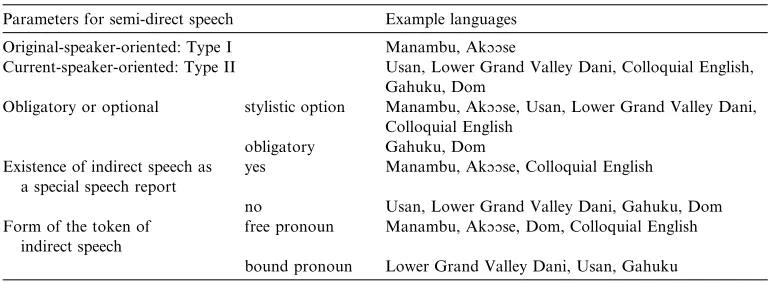
The parameters of variation in semi-direct speech constructions of two types are sum-marized inTable 5.
13
, V,—are tone marks (Tida, 2006).
14
The existence of Current-Speaker-oriented semi-direct speech constructions confirms the importance of the Current Speaker for a comprehensive typology of speech reports – despite the fact that for some languages, such as English (exemplified in Section1.2), marking coreferentiality with the Current Speaker appears superfluous.
We will now compare the two types of semi-direct speech reports with instances which look superficially similar: ‘mixed’ speech reports, and the phenomenon of ‘logophoricity’.
3.4. Semi-direct speech and ‘mixed’ speech reports
Semi-direct speech reports containing tokens of direct and indirect speech are reminis-cent of ‘mixed’ direct and indirect speech (seeMittwoch, 1985, pp. 140–142; called ‘mixed direct and indirect quotations’ byPartee, 1973). Consider the following examples, all from written sources. Dixon describes how the Jamamadı´ people of Southern Amazonia came to be converted to Christianity by the Campbells, a missionary team (Dixon, forthcom-ing). The mixed direct and indirect speech is in bold.
(40) An intruding Branco had been shot by the Jamamadı´ at the end of the airstrip. But he was such an evil fellow that they really did fear his spirit.The Campbells said [that
Jesus is all powerful]INDIRECT SPEECH REPORTand [only he can protect you – better
convert double quick!]DIRECT SPEECH REPORT’
The direct speech report here is unlikely to be a verbatim quotation, but it has all the trappings of direct speech: lack of person shift and imperative form. Some authors put direct speech report inserts within quotes, as in (41) (Mittwoch, 1985, p. 140) and (42) (Weekend Australian Magazine, March 17–18, 2007, p. 14):
(41) Heiassures the reader that during the journey heiwrote down ‘in the evening what
during the day Iihad seen. . .’
(42) Noxon started doing his research ‘in order to understand myself’.
[image:24.468.39.423.85.226.2]Such ‘mixed’ constructions are used to achieve a stylistic effect – making the narrative more vivid. These occur predominantly in written style. Unlike semi-direct speech of Type Table 5
Parameters of variation in semi-direct speech constructions
Parameters for semi-direct speech Example languages
Original-speaker-oriented: Type I Manambu, AkOOse
Current-speaker-oriented: Type II Usan, Lower Grand Valley Dani, Colloquial English, Gahuku, Dom
Obligatory or optional stylistic option Manambu, AkOOse, Usan, Lower Grand Valley Dani, Colloquial English
obligatory Gahuku, Dom Existence of indirect speech as
a special speech report
yes Manambu, AkOOse, Colloquial English
no Usan, Lower Grand Valley Dani, Gahuku, Dom Form of the token of
indirect speech
free pronoun Manambu, AkOOse, Dom, Colloquial English
I described above, the identity between the Original Speaker and a participant within the speech report is optional. Unlike semi-direct speech reports of Type II, the Current Speak-er’s perspective is irrelevant.
3.5. Semi-direct speech and logophoricity
The phenomenon of logophoricity (identified in numerous African languages, and first introduced by Hage`ge, 1974) involves a special set of forms reserved for indirect speech clauses. They indicate that one of the referents of the embedded speech clause (often, but not always, the subject) is coreferential with one of the participants in the reporting (‘matrix’) clause. That is, examples such as (2a) and (2b) from English would be explicitly differentiated by different forms of ‘he’ – one coreferential with the Original Speaker, as in (2a), and one not, as in (2b).
Consider logophoric pronouns in Donno SO, a Dogon language from Burkina Faso (Culy, 1994a) (underlined). In (43), the referent of ‘he’ is neither Anta nor Oumar. In (44) ‘he’ is Oumar.15
Donno SO
(43) Oumar [Anta wo-n˜ waa be] gi
Oumar Anta 3sg-OBJ seen AUX said
‘Oumarisaid that Antajhad seen himk’
(44) Oumar [Anta inyeme-n˜ waa be] gi Oumar Anta LOG-OBJ seen AUX said
‘Oumarisaid that Antajhad seen himi’
As pointed out by Wiesemann (1990, pp. 78–79), logophoric reference is primarily employed in a situation where ‘third person identification refers to any participant other than the speaker of the original speech act’. The instances of semi-direct speech of Type I and Type II discussed above do not – and cannot – serve the function of differentiating referents. They mark coreferentiality of a participant within the speech report with the Original Speaker, or with the Current Speaker. Note that current-speaker-oriented semi-direct speech differs from ‘classical’ logophoricity – which concerns a third-person speaker and a participant within the speech report – in that it includes marking of the Cur-rent Speaker.
An additional difference between semi-direct speech of Type II and logophoricity lies in the syntactic functions of the speech report participant coreferential (or not) with the Ori-ginal Speaker. Logophoric pronouns are typically tied to the function of subject, or object. In contrast, reference to ‘Current Speaker’ in optional semi-direct speech of Type II spans a variety of participants (O in (24) from Manambu, in (30) from Lower Grand Valley Dani and in (39) from Dom; addressee in (28) from Usan, (31) from Lower Grand Valley Dani and (32) from English; possessor in (35) from English).
15Alternatively, logophoricity can be expressed with verbal cross-referencing, or with a clitic (seeHyman and Comrie, 1981, p. 24; and an overview byCurnow, 2002a,b). This phenomenon is not confined to Africa (see
Obligatory semi-direct speech of Type II is closer to logophoricity in that the Current Speaker has to be in the addressee or direct object function within the speech report (see (36)–(38) from Gahuku; and (39) from Dom). That is, semi-direct speech can be seen as a marker of coreferentiality between the Current Speaker and a particular participant within the speech report.
3.6. Semi-direct speech and ‘first-person logophoricity’
An analogy can be drawn between semi-direct speech of Type II and so-called ‘first per-son logophoricity’. In some African languages with logophoric pronouns, if the Original Speaker is the subject of the speech report, first person marking may appear in the speech report. This is illustrated with (45), also from Donno SO(Culy, 1994b, p. 123). The person of the possessor is cast as if it were an indirect speech report (with a logophoric pronoun indicating the identity of Oumar and ‘he’, the possessor). First person marking on the verb is coreferential with the Original Speaker, Oumar, and reflects what one would expect in a direct speech report.
(45) Oumar [{minne inyeme} m~¿ gendezem] gi
Oumar field LOG:IND.SP.REP POSS regard:PROG:1sg:DIR.SP.REP said ‘Oumar said that heiwill look at hisifield’ (lit. Oumar said ‘I-will-look at his field)’
This ‘first person logophoricity’ (Curnow, 2002b, pp. 3–5) serves the same function as a logophoric pronoun – it indicates that an argument (often subject, but sometimes also an object) within a speech report is coreferential with the Original Speaker. It is indeed rem-iniscent of Type I of semi-direct speech.16
A similar instance of first person-only logophoricity has been documented for Central and East Hokkaido dialects of Ainu (Bugaeva, forthcoming, Section 2.3). If the Original Speaker is identical to the subject of the direct speech report, the inclusive pronoun ‘I and you’ is used, rather than the singular pronoun. The verb appears in the plural form:
(46) ne eper ene Ø=itak i, [anokay. . .kamuy mosir ine
this bear like.this 3S=sayNR INCL god land to
paye=an] sekor Ø=Ø-ne
go.PL=INCL.S QUOT 3S=3O-COP
‘The bear said: ‘‘I shall go to the land of gods (=die)’’ ’ (lit. The bear said: ‘‘We (I+you+s/he/they) shall go to the land of gods’’)
This is comparable to whatWiesemann (1990, p. 78)refers to as ‘direct reporting of the use of third person to refer to first or second person as a manner of speaking, such as [. . .] Somebody is hungry around heremeaning ‘I am hungry’Somebody has not finished his work meaning ‘you didn’t finish’’. The difference lies in the fact that in examples like (46) from Ainu the inclusive pronoun is an obligatory choice and not a stylistic option.
There is thus a superficial similarity between first-person logophoricity in (45)–(46) and the semi-direct speech of Type I. But there are also two major differences.
16