The Early Intervention Solution: Enabling or Constraining Literacy Learning
Annette Woods (Griffith University) and
Robyn Henderson (The University of Southern Queensland)
Contact: Dr Annette Woods
School of Education and Professional Studies Gold Coast Campus
Griffith University
PMB 50 Gold Coast Mail Centre Qld, Australia 9726
Ph +61 (0)7 555 29043 Fax +61 (0)7 555 28599
Email [email protected]
The Early Intervention Solution: Enabling or Constraining Literacy Learning? Abstract
Introduction
In educational contexts within Western nations, the rise of neo-liberalism with its expectations for „market-based efficiencies‟ (Hill, 2005, p. 270) has been
accompanied by policy, media and curriculum initiatives offering simplistic understandings of literacy and literacy pedagogy. In the US No Child Left Behind Act (United States of America, 2001), the UK National Literacy Strategy (United Kingdom, 2003)and Australia‟s conservative moves to review the teaching of reading (Department of Education Science and Training, 2005), literacy has been represented as a commodity. This implies that literacy is a set of neutral skills, able to be
generalised across contexts and unrelated to the purposes and practices of engaging with text. With a strong focus on the early years of schooling and „top-up‟
intervention programs, large-scale approaches to literacy policy have implied that „quick fixes‟ to difficulties in learning literacy are both desirable and attainable. As Comber and Nichols (Comber & Nichols, 2004) point out, getting literacy „into place‟ in early childhood contexts has been assumed to be effective as a way to promote future educational success as well as to guarantee „a smart workforce for the contemporary global economy‟ (p.43).
Within this context, governments have moved to manage, regulate, supervise and monitor „flows of discourse, human and material resources to schools and classrooms, teachers and students in particular normative directions‟ (Luke & Greieshaber, 2004, p. 7). Teachers working in the area of the early years of schooling have been „pressed to deliver‟ improved literacy outcomes (Comber & Nichols, 2004, p. 44) and to demonstrate that literacy problems can be eliminated by effective instruction in early childhood contexts. Nevertheless, there is considerable evidence that „inoculation‟ approaches to literacy learning do not have lasting effects and that a whole range of issues – including gender, behaviour, ethnicity, language and accent, poverty and location along with other social, cultural and environmental factors – impact on students‟ literacy learning in complex ways (Woods, 2004). This is a foundational concept within an understanding of literacy as social practice (Barton & Hamilton, 2000; Comber, 1997; Gee, 1999; Luke, 1994; Street, 1998, 1999, 2003)
difference – highlight the problems of unrealistic expectations for a literacy „quick-fix‟ (Allington & Walmsley, 1995). They also raise important questions about what literacy is, how it is defined within educational contexts, and how literacy instruction and interventions work to produce literate subjects (Armstrong, 2006).
In 2002 we published a critique of Reading Recovery as a program (Woods & Henderson, 2002), as a way to begin problematising early intervention as a solution for literacy failure. Having both been accidental tourists in Reading Recovery in past lives, we called upon our insiders‟ knowledge of the program to consider the
disciplinary practices of the institution of early intervention. We commented on the uncomfortable sense of vulnerability that was produced by our attempts to present a version of critique open to so few. By interweaving our own narratives of training as Reading Recovery tutors with our analysis of the training of teachers and children within the program, we explicated the regulation of bodies, time and knowledge of all involved in the program.
However, we also set ourselves as visible and in fact „in relief‟ within the research. Such an unnerving experience is not one that we intend to duplicate in this paper. Nevertheless, we are aware that our past experiences remain implicated in the reading we make of Reading Recovery specifically and of early intervention more generally. We remain cognisant that the reading presented here is but one of many possible readings.
The solutions to the issues raised in the following sections of this paper cannot be simple replacements of one method with another, one teacher with a „better‟ one, or one school with parental choice. We work within this paper to (dis)solve (Woods, 2004) – to lay bare the common-held assumptions of early intervention as a solution to „failure‟ to learn literacy by problematising the ambiguities of its practice.
Consequently we do not set out to replicate the work of the many researchers who have investigated early intervention as successful or otherwise (Australian Council for Educational Research, 1993; Center, Freeman, & Robertson, 1996; Chapman,
Tunmer, & Prochnow, 1999; Chapman, Tunmer, & Prochnow, 2001; Clay, 1990; Clay & Watson, 1982; Crevola & Hill, 1998; Dahl, Scharer, Lawson, & Grogan, 1999; Deschamp, 1995; Elbaum, Vaughn, Hughes, & Moody, 2000; Hiebert, 1994; Hurry, 2000; Moore & Wade, 1998; Morris, Tyner, & Perney, 2000; National Diffusion Network, 1991; Pikulski, 1994; Pinnell, 1997; Pinnell, Lyons, Deford, Bryk, & Seltzer, 1994; Rasinski, 1995; Reading Recovery Council of North America, 1999; Smith, 1994; Swanson, 1999; Trethowan, Harvey, & Fraser, 1996) to offer up alternative programs as replacements for those like Reading Recovery, choosing instead to suggest that the basic assumptions of early intervention as a solution necessitate troubling.
Contextualising this analysis
In an analysis of a Reading Recovery lesson involving a year two student (Sam) and his Reading Recovery teacher (Woods & Henderson, 2002), we found that there was evidence of disciplinary techniques, of setting up binaries of what is and isn‟t „reading and writing‟, and of the regulation of bodies, time and knowledge. The program that was making claims about encouraging the development of independent readers was in fact based on pedagogical relations that controlled and constrained what was said, done and thought by „apprentice‟ independent readers. Our claim was that such an environment would seem unlikely to produce independence in students‟ reading behaviours. Students, we suggested, might be learning ways of „doing‟ literacy within the constraining and disciplining context of Reading Recovery and that might not serve them well in other literacy learning contexts such as their classrooms (Groves, 1994; Woods, 2004).
even within Reading Recovery lessons, and not just between Reading Recovery lessons and other literacy learning contexts as we detailed in our first paper (Woods & Henderson, 2002). The Reading Recovery program (Clay, 1993b) is conducted by teachers trained by Reading Recovery tutors and supervised by trainers. Based in a cognitive theory of reading acquisition, as theorized by Clay (1991), Reading Recovery involves daily, individualized instruction of students. To receive this
instruction, the child is removed from the classroom and instructed in a quiet, isolated space. Children are trained to develop and use strategies which Clay (1993b, p.39) describes as fast in-the-head reactions of the brain which seem to be automatic rather than conscious. While Reading Recovery continues to receive support in some contexts, it is a program which throughout its history has been dogged by relentless dichotomy(For a review of these debates see Woods & Henderson, 2002; Woods, Wyatt-Smith, & Elkins, 2005).
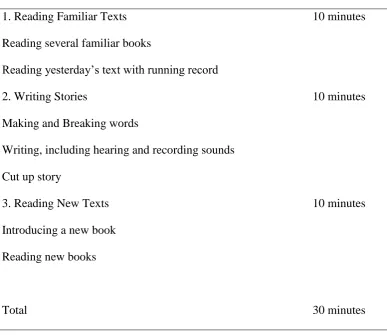
According to Clay (1993b, p. 14) a typical Reading Recovery lesson includes set activities conducted in a predetermined sequence. The thirty minute lesson is divided into three slots of 10 minutes each. The daily lesson format and timing follows guidelines as presented in table 1 below.
Place Table 1 about here.
Although Clay (1993b) states that „individual variations in lesson plans are always possible, providing there is a sound rationale based on a particular child‟s response to lessons‟ (p. 14), Reading Recovery lessons closely follow this structure, timing and sequence in the many contexts in which they are delivered.
A prime ambiguity of this program is that Clay (1993b) claims to understand the heterogeneity of the group to which she addresses her support, but offers a scripted, set of procedures that detail even the words to be said by teachers as they work with students. The model claims that skilled teachers should „select the activities needed by a particular child‟ (Clay, 1993b, p. 19), but this selection only occurs from the
The intention here is to investigate the structuring of lessons, as detailed by Clay (1993b) and described in the section above, to uncover if it signifies more than different skills and activities related to reading and writing. The analysis calls on a lesson involving Eloise and her Reading Recovery teacher as an instance of Reading Recovery lessons more generally. At the time of data collection Eloise was a seven year old student in her second year of school. She had been identified as requiring extra assistance in learning school-based literacy because her scores on Clay‟s Observation Survey (Clay, 1993a) had marked her as one of the lowest literacy achievers in her cohort. Eloise attended a small school in a satellite city of a large capital city in Australia. Many of the children who attended this school, including Eloise, had backgrounds marked by poverty. The school took various approaches to providing literacy pedagogy, Reading Recovery being just one of the intervention programs made available.
In the analysis we call on Foucault‟s notions of the subject (Foucault, 1982) along with the tools of talk in interaction, to make the shifting interaction in the lesson visible and to investigate how this represents the different roles taken on by the teacher and the reciprocal positionings offered up to Eloise as Reading Recovery student. The analysis is focussed on only the first ten minutes of the lesson, as a way to make evident the speed with which these shifts occur. The transcript of the
interaction and analysis is presented in two parts. The first section presented in Extract 1 takes place as Eloise reads a section of a familiar text The Little Red Hen
(Randell, 1997) which she has read many times before in Reading Recovery lessons. The second section, presented in Extract 2, follows directly on from this and is where Eloise reads yesterday‟s new text, The Busy Beavers (Randell, 1997), while the Reading Recovery teacher records her oral reading using the technique of running record.
Shifting ways to be a reader and writer
being read for the first time (Clay, 1993b). Both sections of interaction analysed here are instances of pedagogy aimed at promoting the first of these aims.
Eloise as a watched collaborator
Extract 1 (10.04 am)
9. T: have you got one from here you‟d like to read (5) 10. Eloise: little red hen?
11. T: yeap
12. Eloise: I love little red hen
13. T: you love little red hen don‟t forget when you read little red hen it‟s got to be like?
14. Eloise: talking 15. T: good good
16. Eloise: the little red hen opens book
17. T: writing on sheets with head down lovely start
18. Eloise: one? upon a time there was a little red hen she lived on a farm (2) oops I forgot to stop there
19. T: facing Eloise good girl that‟s good though reaches in to move the book toward her it doesn‟t matter you noticed that it didn‟t sound right did it 20. Eloise: no looking at the teacher
21. T: cause you said there lived a little red hen she lived on a farm and you went kept going? but then points to the book you stopped because it didn‟t ss quite ss did it
22. Eloise: no
23. T: did it sound no it didn‟t (2) ok that‟s great keep going (2)
24. Eloise: she lived on a farm with a duck and a (2) a dog looks to teacher
26. Eloise: and a pig (2) one day she fo found some sh one day she found some (1) wheat
27. T: good you stopped at that full stop (3)
28. Eloise: I will plant this wheat who will help me (2) ops aah I[I read that line 29. T: [you missed a
line that‟s ok just take a deep breath and settle [down/ 30. Eloise: [I went 31. T: /that‟s a girl
32. Eloise: I [will
33. T: [let‟s start the page again that‟s it (1)
34. Eloise: I will plant this wheat (4) said the little read hen who will help me not I quacked the duck and she went away to swim in the pond not I barked the dog (2) the dog and he went away to run in the field (2)to run in the field/
35. T: /that‟s right keep going looks at watch
36. Eloise: not I (2) grunted the pig and he went away to roll in the mud 37. T: do you know what that sounded really good that‟s the best reading I‟ve
heard from you since before you lost your tonsils points to Eloise’s
tonsils
38. Eloise: haha
39. T: haha cause you said not I barked the dog and he went away to run in the field that‟s how that‟s how touches Eloise’s arm it sounded did that sound exciting
40. Eloise: (nods head) Teacher and Eloise look at each other
42. Eloise: [then I will do it myself said the little red hen (2) and she did(1) soon the wheat began to grow I must (2) I must water the wheat said the little red hen who will help me
43. T: yeap moves the book turns head to Eloise oh that‟s sounding so I‟m so proud of you Eloise that‟s sounding so much better yesterday this was you then . I . will . do . it . my . self . that was you yesterday
44. Eloise: hhhh
45. T: this is you today not I barked the dog and he went away faces Eloise to run in the field
46. Eloise: haha throws head back
47. T: that is wonderful I‟m so proud of you (2) passes book into instructional space see if you can do it with the beavers (10.07 am)
Many of the techniques of surveillance and discipline uncovered in our original analysis of Reading Recovery are also evident in this lesson. Note, for example, in turns 37 to 41 how the teacher relays to Eloise what her behaviour has been. Eloise is watched openly as the teacher often faces her, turned sideways in her chair and engaged in Eloise‟s reading. This surveillance is regularly placed into the public sphere within the lesson interaction, as the teacher tells Eloise what she has done and said. The teacher also controls the resources and materials of the lesson, bringing them in and out of the instructional space as required. The section of the lesson is marked by relatively equal length of turns by the teacher and Eloise. It proceeds with an IRE (Initiation, Response, Evaluation) (Mehan, 1979)patterning that consists of relatively short responses by Eloise and initiations and evaluations provided regularly by the teacher. Note how in turn 17, for example, as Eloise turns the cover to open the book, the space is filled by the teacher with an evaluation „lovely start‟. These regular evaluations are part of the collaborative fashioning of the reading of text in this section of the lesson.
the teacher and student have rights to select the next speaker. So while the teacher does determine the pace of the lesson and present Eloise with the next turn through the use of continuas such as “keep going” (turns 23 and 35 for example), Eloise also controls when her turn will end, when she stops reading to comment on her own reading (see for example turn 28). In this way, she seems to equally determine that the teacher will take a turn and is often rewarded, as in turns 18 and 28. Note also how she has mastered the skill of disciplining bodies and behaviour without speaking. In turn 24 she successfully seeks and receives (in turn 25) evaluation or perhaps confirmation of her reading behaviour by looking to the teacher and waiting for her response.
This practice of providing a commentary on her own reading demonstrates that Eloise has internalized the gaze (Foucault, 1978)of the institution. For while Eloise uses it as a practice to create a space to become involved in determining when her turn will end, it can also be seen to be part of the disciplining practice of the Reading Recovery lesson. In turn 18 Eloise reads a small section of the text, and then stops reading to comment on her reading thus far. This commentary has become a confession (Foucault, 1978). Eloise displays her understanding of what reading is in Reading Recovery. She must read so that it „sounds like talking‟ (see turns 13 to 14) (Clay, 1993b, p. 52), and the fact that she has missed reading a full stop somehow means that this has not been achieved. The teacher approves of Eloise‟s confession and mimics it in her own behaviour when she provides a more developed commentary in turn 19. This practice, which continues throughout this section of the lesson, places what is done well, and what is not, into the public sphere. It thus acts as part of the
mistake as long as that mistake is followed by a public or private „in-the-head‟ confession of what was done.
As Eloise completes reading the short section of text in turn 44, the book is moved by the teacher, who then proceeds to display the surveillance that has occurred by
commenting on the quality of Eloise‟s recent reading. Eloise receives an instant replay of her performance, and is even told what she did and said during the previous day‟s lesson. This section of the lesson is brought to an end when the teacher removes one book from the instructional space and places a second, The Busy Beavers
(Randell, 1997), into this same space. This action by the teacher marks a shift in the lesson‟s processes. With no other sign to mark the shift, the texture of the lesson transforms from a collaborative fashioning of what the reading will be to an independent display of singular behaviour. Eloise is no longer watched openly and supported as she was in Extract 1. Instead, as demonstrated in Extract 2 below, she is now offered a space to act as a solitary performer.
Eloise as a solitary performer1
Extract 2 (10.07 am)
47. T: that is wonderful I‟m so proud of you (2) passes book into instructional space see if you can do it with the beavers
48. Eloise: points to book on other side of Teacher’s space oh [I know that one
49. T: [the busy beavers
do you [hooo takes on surprised expression faces Eloise
50. Eloise: [I
51. T: well we‟re going to do that one next
1 Transcript notation
voice: talk voice: reading from text
behaviour: movement, action and behaviour V O I C E: letter names pronounced voice: emphasis placed or spoken loudly / latched turn
? raised intonation . lowered intonation
(2) timed pause [ overlapped talk
52. Eloise: they um they go over the bridge and they say who‟s g the man says [who‟s going
53. T: [ ho well let‟s see later you keep it slaps hand several times on the Busy Beavers book keep it to yourself
54. Eloise: the
55. T: the busy [beavers remember
56. Eloise: [beafers beavers turns pages of the book looks at teacher can I start the one where I was starting before
57. T: turns pages back to front of the text well let‟s wo
58. Eloise: the busy beavers
59. T: faces table and gives attention to her sheet I just wanta see how well you can read this
60. Eloise: a father beaver and a mother beaver hh (2) teacher looks at her own sheet and the f fower beavers the (6) the I know that says the
61. T: where 62. Eloise: there
63. T: well keep going
64. Eloise: the (3) the looks to teacher T H E R E I R (5)looks to teacher the 65. T: their doesn’t look up
66. Eloise: their F their F ow fowl little beavers their f ow fow 67. T: how many were there
68. Eloise: four little beavers (1) lived (3) in a home (2) in a (1) lake there‟s two ins in that one
69. T: that‟s very good keep going
70. Eloise: they? looks across to the teacher’s sheet (3) their their home was a little (3) looks to teacher’s sheet a island island
72. Eloise: little island (3) with a (2) (whispers sounding) srecret secret tunnel (2) that? Went down into the water they were fast? (4) looks to teacher’s sheet fast (3) f s:a safe (1) on the island the beavers and the fox (1) foxes (2) and the great (8) looks to teacher’s sheet w (3) w:I ld wild cats called (6) cowd (2) called not (2) get (2) not get them (5) teacher turns sheet over Eloise looks the beavers (2) had m:ade a island from ah is that a island points to book and looks to teacher
73. T: yeah
74. Eloise: island from sticks (1) and (1) stones and mud they had made a long (2) dam to (1) the (3) dam (k:ept) kept the (lake) lake (filled) filled with water plap plap (1) plap (1) went the (2) went the water all (2) down day along day (1) day all all day all day long (3) as the
beavers slept (4) one spring then sits back the 75. T: moves into instructional space
10.11 am
In this section of the lesson, the teacher is a „second version‟ of the Reading Recovery teacher. No longer providing regular evaluations of Eloise‟s reading, in fact seeming to avoid providing evaluation at all, she now sits facing the table and mostly directs her attention to a sheet of paper (the running record sheet) in front of her, only glancing occasionally at the instructional space. The teacher‟s body is now closed to Eloise and this is in contrast to her bodily positioning in the earlier section of this lesson, as presented in Extract 1. Eloise still looks to the teacher, but this technique has ceased to work as a way to engage the teacher in a collaborative endeavour of reading. The text read by Eloise in turns 60 to 72 is:
that went down into the water. They were safe on the island. The bears and the foxes and the great wild cats could not get them.
(Retold by Jenny Giles, 1997, pp. 2-3) Eloise actually reads as follows:
a father beaver and a mother beaver hh and the f fower beavers the the the the T H E R E I R the their F their F ow fowl little beavers their f ow fow little beavers lived in a home in a lake they? their their home was a little a island island little island with a srecret secret tunnel that? went down into the water they were fast? fast f s:a safe on the island the beavers and the fox foxes and the great w w:I ld wild cats called cowd called not get not get them the beavers had m:ade a island (adapted from Extract 2)
about words in the text. In both instances she is rewarded with a short turn by the teacher who supplies the continua „keep going‟ to move the lesson along and to resist engagement. This style of commentary is different from the confessional sequences used by Eloise in Extract 1, and its effect affords only a marginal space for resistance. This begins to suggest that the teacher‟s level of regulation of the lesson has increased as the level of collaborative practice has decreased.
Supporting this assumption is the fact that the teacher has, in this section, refused Eloise any control over what is read, where-as in the previous section Eloise was engaged in the choice of reading material. Although Eloise does on two occasions attempt to direct this choice, she seems to quickly come to the understanding that it is no longer part of what she needs to do to be competent in this setting. It would also seem that she reads the teacher‟s body as a way to come to this understanding. Notice how in turn 56, when Eloise requests to read another section of the same book, it is the action of the teacher turning back pages and positioning the priority text that leads to Eloise proceeding with the reading as requested. This reading is already underway in turn 58 before the teacher has supplied an explanation in turn 59.
This second section of the lesson positions Eloise as a solitary performer, left to read text at word level – or more narrowly at the level of sounds. This reading has at several stages of the reading episode lost meaning and coherence. Yet the teacher rarely steps in to provide support and only in small measure. Evaluation is also held back from the apprentice reader. The continua „keep going‟ is used when the lesson looks like slowing down, or when Eloise attempts to engage the teacher in some collaborative practice. The teacher rarely looks up from her sheet as she records Eloise‟s reading on a running record sheet.
Negotiating versions of literate competence
In less than 10 minutes, Eloise negotiated several versions of literate competence – or at least she was expected to negotiate the same. She left her classroom, where she had been working as a group member with other students to complete a worksheet
By swapping this book for another, the teacher demonstrated a shift in the texture of the pedagogy. Then, for the next 4 minutes, Eloise was left to perform as a solitary apprentice reader, whose mistakes were no longer pardoned quickly and efficiently by the teacher, but instead were placed in the public sphere of pedagogic interaction. They were collected and recorded for use in the next section of the lesson. In 10 minutes, this „lowest achieving literacylearner‟ was presented with a shifting terrain of positionings and moved within them with a remarkable level of competence. What though is the consequence of her competence with dealing with this shifting terrain? As she looked to the teacher for support in Extract 2, as she decided that looking would be an unsuccessful technique for this section of the lesson, and as she trialed and evaluated a new technique of asking directly – could she instead have been learning more about the coherence of text, the syntactic structuring or perhaps the semantic signposts, and how to use them to produce a coherent oral reading? Returning to (dis)solve the solution
The competence with which Eloise appropriated and fell into line with the shifting ground presented to her certainly demonstrated a social and pedagogical competence on the part of a young child, who had been constructed within the intervention discourse of her school as one of the „lowest achievers‟ in her cohort (Clay, 1993b, p.8). This student and others like her who were marked as least able to achieve, were being expected to negotiate shifting contexts in ways that those who were marked as achievers were not. Furthermore, the time spent by Eloise in learning these different subjectivities and how this might have been taking her away from learning any thing to do with reading and writing text, should become a focus for research in literacy pedagogy and intervention.
In this way, the critique of an intervention program, as presented here has moved beyond the qualitative work reported by others. In our first critique (Woods &
students within Reading Recovery lessons in fact run counter to learning even this narrow band of literacy skills and processes. The critical pedagogy argument – that while ever corporeal processes are fore grounded but not explicitly named, then pedagogy will be about learning the corporeal elements required to display competence rather than learning the competence itself – holds true in this context (Ellsworth, 1989; Gore, 1995; Grosz, 1995).
Systemic intervention programs are complicit in the marking and dividing of student populations. The social practices of identification and remediation, once
institutionalized as a „program‟ or „method‟, work to set out grids of specification of what it is to „do‟ or not to do literacy. These grids homogenize the characteristics of a divided student population and pathologize literacy learning as a „problem‟ for particular students. The grids set out simplistic notions as representation of what it is for these students to engage with school-based literacy pedagogy, thus ignoring the complexity of disadvantage related in sophisticated ways to location, poverty, gender, race, ethnicity, and language and accent.
In this paper, we have extended our investigation of some of the ambiguities related to intervention in an attempt to (dis)solve it as a solution to literacy „failure‟ in schools. Our sequence of research in this field continues as we problematize the current „back to basics‟ drive as a narrowing of access for selected groups of children. The
argument that we continue to make is that, as Luke (Luke, 2003)suggests, effective literacy pedagogy does not „centrally reside in the need for packaged, standardized commodities for the teaching of basic skills‟ (p. 101). Instead, such narrow
conceptions of literacy constrain rather than enable literacy learning (Woods, 2001), preparing the students – particularly those who are disadvantaged socially, culturally, racially or economically – for neither classroom pedagogical contexts nor broader societal contexts.
A major concern is that the failure of national initiatives to enhance literacy learning – through mandated teaching processes and testing regimes that rely on narrow
1. Reading Familiar Texts Reading several familiar books
Reading yesterday‟s text with running record
10 minutes
2. Writing Stories
Making and Breaking words
Writing, including hearing and recording sounds Cut up story
10 minutes
3. Reading New Texts Introducing a new book Reading new books
10 minutes
[image:20.595.88.476.90.425.2]Total 30 minutes
References
Allington, R. L., & Walmsley, S. A. (1995). Afterword: No quick fix: Where do we go from here? In R. L. Allington & S. A. Walmsley (Eds.), No quick fix: Rethinking literacy programs in Americas's elementary schools. New York: Teachers College Press.
Armstrong, D. (2006). Future directions in literacy. In R. Ewing (Ed.), Beyond the reading wars: A balanced approach to helping children learn to read (pp. 7-12). Newtown, NSW: Primary English Teaching Association.
Australian Council for Educational Research. (1993). The impact of First Steps on the reading and writing ability of Western Australian Year 5 students. Hawthorne, Victoria, Australia: Australian Council for Educational Research.
Barton, D., & Hamilton, M. (2000). Literacy practices. In D. Barton, M. Hamilton & R. Ivanic (Eds.), Situated literacies. Reading and writing in context (pp. 7-15). London, UK and New York, USA: Routledge.
Center, Y., Freeman, L., & Robertson, G. (1996). Examining the effects of two alternative early literacy programs: Reading Recovery and schoolwide early
language and literacy. Sydney, NSW, Australia: Macquarie University. Chapman, J., Tunmer, W., & Prochnow, J. (1999). Reading Recovery and
phonological processing: does success in the Reading Recovery program depend on developing proficiency in phonological processing skills? Scientific Studies of Reading.
Chapman, J., Tunmer, W., & Prochnow, J. (2001). Does success in the Reading Recovery program depend on developing proficiency in phonological processing skills? A longitudinal study in a whole language instructional context. Scientific Studies in Reading, 5, 141-176.
Clay, M. (1990). The Reading Recovery Programme, 1984-88: coverage, outcomes and Education Board district figures. New Zealand Journal of Educational Studies, 25(1), 61-69.
Clay, M. (1991). Becoming literate: The construction of inner control. Auckland: Heinemann.
Clay, M. (1993b). Reading Recovery: A guidebook for teachers in training. New Zealand: Heinemann.
Clay, M., & Watson, B. (1982). The success of Maori children in the Reading Recovery Programme (Project No. 1 : Child Study Research Group). Wellington: University of Auckland.
Comber, B. (1997). Literacy, poverty and schooling: Working against deficit equations. English in Australia, 119-120, 22-34.
Comber, B., & Nichols, S. (2004). Getting the big picture: Regulating knowledge in the early childhood literacy curriculum. Journal of Early Childhood Literacy, 4(1), 43-63.
Crevola, C., & Hill, P. (1998). Initial evaluation of a whole-school approach to prevention and intervention in early literacy. Journal of Education for Students Placed at Risk, 3(2).
Dahl, K., Scharer, P., Lawson, L., & Grogan, P. (1999). Phonics instruction and student achievement in whole language first grade classrooms. Reading Research Quarterly, 34(3), check this out.
Department of Education Science and Training. (2005). National Inquiry into the Teaching of Literacy. Retrieved 5 December, 2007, from
http://www.dest.gov.au/nitl/report.htm
Deschamp, P. (1995). The effects of First Steps teaching on student achievement. Perth, Western Australia: Department of Education.
Doecke, B., Howie, M., & Sawyer, W. (2006). The present moment. In B. Doecke, M. Howie & W. Sawyer (Eds.), Only connect...: English teaching, schooling and community (pp. 1-3). Kent Town, SA: Wakefield Press and AATE.
Elbaum, B., Vaughn, S., Hughes, M., & Moody, S. (2000). How effective are one-to-one tutoring programs in reading for elementary students at-risk for reading failure? A meta-analysis of the intervention research. Journal of Educational Psychology, 92, 605-019.
Ellsworth, E. (1989). Why doesn't this feel empowering? Working through the repressive myths of critical pedagogy. Harvard Educational Review, 59(3), 297-324.
Foucault, M. (1982). The subject and power. In H. L. Dreyfus & P. Rabinow (Eds.),
Michel Foucault: Beyond structuralism and hermeneutics (pp. 208-226). Chicago, USA: The University of Chicago Press.
Gee, J. (1999). Reading and the New Literacy Studies: Reframing the National Academy of Sciences report on reading. Journal of Literacy Research, 31(3), 355-374.
Gore, J. (1995). Foucault's poststructuralism and observational educational research: A study of power relations. In R. Smith & P. Wexler (Eds.), After post-modernism: Education, politics and identity (pp. 98-111). London: Falmer Press.
Grosz, E. (1995). Space, time and perversion. New York, USA: Routledge. Groves, C. (1994). A comparison of interactions between reading recovery and
classroom reading programs. Unpublished Masters of Philosophy, Griffith University, Brisbane.
Hiebert, E. (1994). Reading Recovery in the United States: What difference does it make to an age cohort? Educational Researcher, 25(6), 15-25.
Hill, D. (2005). Globalisation and its educational discontents: Neolibralism and its impacts on education workers' rights, pay and conditions. International Studies in Sociology of Education, 15(3), 257-288.
Hurry, J. (2000). Intervention strategies to support pupils with difficulties in literacy during key stage 1. London, University of London.: National Literacy
Strategy.
Luke, A. (1994). The social construction of literacy in the primary school. Melbourne, Australia: Macmillan Education Australia.
Luke, A. (2003). Making literacy policy and practice with a difference. Australian Journal of Language and Literacy, 26(3), 58-82.
Luke, A., & Greieshaber, S. (2004). New adventures in the politics of literacy: An introduction. Journal of Early Childhood Literacy, 4(1), 5-9.
Mehan, H. (1979). Learning lessons. Cambridge, USA: Harvard Press.
Moore, M., & Wade, B. (1998). Reading comprehension: A longitudinal study of ex-Reading Recovery students. Educational Studies, 24(2), 195-2003.
National Diffusion Network. (1991). The Reading Recovery program. Executive summary 1984-1991. Ohio, USA: Author.
Pikulski, J. (1994). Preventing reading failure: A review of five effective programs.
The Reading Teacher, 48(1), 30-39.
Pinnell, G. S. (1997). Reading Recovery: A summary of research. In J. Flood, S. Brice Heath & D. Lapp (Eds.), Handbook of research on teaching literacy through the communicative and visual arts (pp. 638-654). New York, USA: Simon and Schuster Macmillan.
Pinnell, G. S., Lyons, C., Deford, D., Bryk, A., & Seltzer, M. (1994). Comparing instructional models of literacy education of high-risk first graders. Reading Research Quarterly, 29(1), 9-38.
Randell, B. (1997). The busy beavers. Petone, NZ: Nelson Price Milburn Ltd. Rasinski, T. (1995). On the effects of Reading Recovery: A response to Pinnell,
Lyons, DeFord, Bryk and Seltzer. Reading Research Quarterly, 30, 264-270. Reading Recovery Council of North America. (1999). Does Reading Recovery work?
Excerpts from the executive summary. Retrieved 9th February 2000, 1999 Retold by Jenny Giles. (1997). The little red hen. Petone, NZ: Nelson Price Milburn
Ltd.
Smith, P. (1994). Reading Recovery and children with English as a second language.
New Zealand Study of Education Studies, 29(2), 141-155.
Street, B. (1998). New literacies in theory and practice: What are the implications for language in education? Linguistics and Education, 10(1), 1-24.
Street, B. (1999). The meanings of literacy. In D. Wagner, R. Venezky & B. Street (Eds.), Literacy: An international handbook (pp. 34-40). Colorado, USA: Westview Press.
Street, B. (2003). What's "new" in New Literacy Studies? Critical approaches to literacy in theory and practice. Current Issues in Comparative Education, 5(2), online journal at http://www.tc.columbia.edu/cice/.
Swanson, H. L. (1999). Reading research for students with LD: A meta-analysis of intervention outcomes. Journal of Learning Disabilities, 32(6), 504-432. Trethowan, V., Harvey, D., & Fraser, C. (1996). Reading Recovery: Comparison
United Kingdom. (2003). The National Literacy Strategy. Retrieved January 5, 2007, from http://www.literacytrust.org.uk/update/strat.html
No child left behind act of 2001, 6301 (2001).
Woods, A. (2001). Literacy competence: Issues of enablement and constraint in a Reading Recovery lesson. In R. Capeness, A. Kolatsis & A. Woods (Eds.),
Creating new dialogues: Policy, pedagogy and reform. Flaxton, Qld, Australia: Post Pressed.
Woods, A. (2004). The contexts and purposes of school literacy pedagogy: Failing in the early years. Unpublished Doctorate of Philosophy, University of
Queensland, Brisbane, Australia.
Woods, A., & Henderson, R. (2002). Early intervention: Narratives of learning, discipline and enculturation. Journal of Early Childhood Literacy, 2(3), 243-268.