© Crown copyright 2016
You may re-use this information (not including logos) free of charge in any format or medium, under the terms of the Open Government Licence v3. To view this licence, visit http://www.nationalarchives.gov.uk/doc/open-government-licence/version/2/ or write to the Information Policy Team, The National Archives, Kew, London TW9 4DU, or e-mail: [email protected].
Where we have identified any third party copyright
information you will need to obtain permission from the copyright holders concerned.
Any queries regarding this publication should be sent to us at: [email protected].
Contents
Page
Chapter 1 Introduction 3
Chapter 2 Policy costings 5
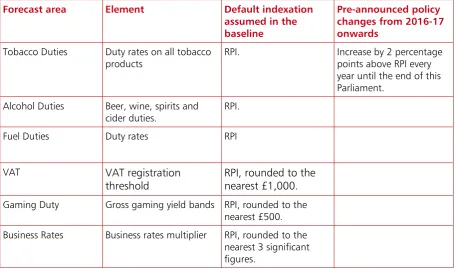
Annex A Indexation in the public finance forecast baseline 73
Annex B Office for Budget Responsibility: certification of policy costings
1
Introduction
1.1This document sets out the assumptions and methodologies underlying costings for tax and Annually Managed Expenditure (AME) policy decisions announced since the Spending Review and Autumn Statement 2015, where those policies have a fiscally significant impact on the public finances. These costings are all submitted to the independent Office for Budget
Responsibility (OBR) for their certification. This continues the practice established at June Budget 2010 and the principles outlined in ‘Tax policy making: a new approach’, published alongside June Budget 2010.1This publication is part of the government’s wider commitment to increased transparency.
1.2Chapter 2 presents detailed information on the key data and assumptions underpinning the costing of policies in Budget 2016. Each note sets out a description of the measure, the base, the methodology for the costing (including relevant adjustments for behavioural responses) and highlights any areas of additional uncertainty, beyond those inherent in the OBR’s forecast. All costings are presented on a National Accounts basis.
1.3Annex A sets out the indexation assumptions included in the public finances forecast
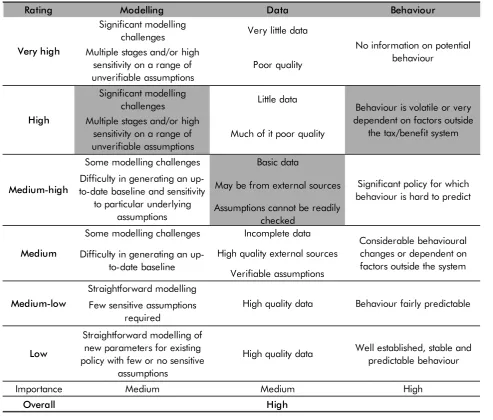
baseline, including all pre-announcements. Annex B, by the OBR, sets out the approach the OBR has taken to scrutiny and certification of the costings, and highlights areas of particular
uncertainty.
2
Policy costings
The following policy costings are included in this chapter: Personal Allowance and Higher Rate Threshold increase
Lifetime ISA and raise ISA limit to £20,000
Savings: remove withholding tax obligations
Financial Advice Markets Review: increase tax relief on employer provided pension advice
Soft Drinks Industry Levy
Business Rates: permanently double the Small Business Rate Relief and extend thresholds
Business Rates: increase threshold for higher multiplier to £51,000
Business Rates: switch from RPI in April 2020
Corporation Tax: reduce to 17% in April 2020
Corporation Tax: restrict relief for interest
Corporation Tax: withholding tax on royalties
Corporation Tax: extend scope of hybrid mismatch rules
Corporation Tax: reform loss relief
Corporation Tax: further restrict use of banks’ pre-2015 losses
Corporation Tax: implement agreed patent box nexus approach
Corporation Tax: extend first year allowance and lower emission thresholds for business cars
Corporation Tax: defer bringing forward payment for large groups for two years
Stamp Duty Land Tax for non-residential property: reform freehold and leasehold premium regime to slice and increase leasehold rate over £5m
Capital Gains Tax: reduce basic rate to 10% and main rate to 20% excluding residential property and carried interest
Entrepreneurs Relief: extend to long-term investors in unlisted shares
Capital Gains Tax: lifetime limit under Employee Shareholder Status
Capital Gains Tax: extend reliefs
Self Employed: abolish Class 2 NICs
Sharing Economy: £1,000 allowance for both trading and property income
Business Energy: abolish Carbon Reduction Commitment and offsetting increase to Climate Change Levy
Carbon Price Support Rate: cap at £18/tCO2 in April 2019 and uprate in April 2020
Corporation Tax: update technologies with access to enhanced capital allowances
Disguised remuneration: tackling historic and new schemes
Off-payroll working: transfer liability to public sector employers
Loans to participators: align rates with dividend higher rate
Removing employer tax advantage of different forms of remuneration: pay-offs over £30,000
Offshore Property Developers: tackle avoidance and evasion
Stamp Duty Land Tax on additional properties: exemptions
Corporation Tax: removing the renewals allowance
Value Added Tax: tackling overseas trader evasion
Value Added Tax: extend reverse charge to electronic communications services
Gambling Duties: reform treatment of freeplays
Asset Managers: reform treatment of performance awards
Border Force: illicit tobacco strategy
Landfill Tax: tackling waste crime
Tax Free Childcare and Employer Supported Childcare: updated roll-out and grandfathering
DWP operational measures – use of RTI
DWP operational measures - ESA and PIP Presenting Officers
Fuel Duty: freeze in April 2016
Alcohol Duty: freeze for beer, spirits and cider
Heavy Goods Vehicles: freeze VED and Road User Levy
Hand-rolling Tobacco: increase by RPI+5%
Aggregates Levy: freeze rates
Package Recycling Target: reform
Insurance Premium Tax: increase by 0.5%
Enterprise Zones: extend enhanced capital allowances
Local Government Assets: receipts flexibility
Help to Save
Right to Buy: pilots
Personal Independence Payments: aids and appliances
Pay to Stay: make voluntary for housing associations
Pay to Stay: introduce taper
Social Rent downrating: one year deferral for supported housing
Benefit Cap: exemption for recipients of carers and guardians allowance
Local Housing Allowance: implement for new tenancies from April 2017
Public Service Pensions: update to discount rate
Doctoral loans
Personal Allowance and Higher Rate Threshold increase
Measure description
This measure increases the personal allowance to £11,500 and the higher rate threshold to £45,000 from April 2017.
The tax base
The tax base is estimated using data on taxable incomes taken from the Survey of Personal Incomes (SPI), comprising a sample of around 730,000 tax records, weighted to be
representative of all taxpayers. The latest available data is for the tax year 2013-14.
The tax base, including taxpayer numbers and incomes, grows over the forecast period in line with OBR Budget 2016 forecast determinants.
Costing
The Exchequer impact is estimated using a micro-simulation model of the UK tax system. The pre- and post-measure tax regimes is then applied to the tax base described above to estimate the impact of the measure in terms of the difference in income tax and National Insurance contributions liabilities and any behavioural and secondary impacts of the change.
Exchequer impact (£m)
2016-17 2017-18 2018-19 2019-20 2020-21
Exchequer impact 0 -2,030 -2,540 -2,510 -2,585
Areas of uncertainty
The main uncertainties in this costing relate to the projection of SPI survey data from 2013-14, which in particular affects the number of baseline taxpayers who will benefit from the measure.
Lifetime ISA and raise ISA limit to £20,000
Measure description
People who are under the age of 40 will be able to open a Lifetime ISA from April 2017 and save up to £4,000 per year. The government will then top this amount up by 25%. This means that for people who save the maximum each year, the government will top up the account with £1,000, paid at the end of the tax year.
Lifetime ISA funds can be put toward a deposit for a home that is worth a maximum of
£450,000 in all areas of the UK, or taken at age 60 to be used as retirement income. Savers can have a Lifetime ISA each year, as well as a cash ISA, a stocks and shares ISA, and an Innovative Finance ISA.
This measure also increases the annual ISA savings limit for all adults to £20,000 from April 2017.
The tax base
The tax base for the Lifetime ISA consists of income and/or wealth which could be saved into this product and receives the bonus.
The tax base for the increase of the ISA savings limit consists of the returns on savings paid to all savers using ISAs who are expected to be constrained by the current ISA subscription limit from April 2017 who will be able to increase their ISA savings under this new higher limit.
The tax base, including taxpayer numbers and incomes, grows over the forecast period in line with OBR Budget 2016 forecast determinants.
Costing
The costing of the Lifetime ISA accounts for a behavioural response whereby individuals may choose to take up this voluntary savings option. This behavioural response has been estimated by comparing the relative incentives to save into the Lifetime ISA compared to alternative pension and savings products. Administrative data on personal pension contributions and ISA savings of the eligible population has been used to estimate the value of Lifetime ISA
contributions. This leads to an Exchequer cost through 25% matching of eligible contributions.
The costing of the ISA savings limit increase is calculated by estimating the value of tax on savings that individuals will move from taxable savings into ISAs as a result of this change. Exchequer impact (£m)
2016-17 2017-18 2018-19 2019-20 2020-21
Exchequer impact neg -170 -330 -590 -850
Areas of uncertainty
Savings: removing withholding tax obligations
Measure description
This measure ends withholding obligations for interest paid by collective investment vehicles (CIVs) and on peer to peer (P2P) loans for the 2017-18 tax year onwards. For CIV, a withholding tax is presently in place. For P2P, this means that the government will not proceed with a previously announced measure to introduce new rules for withholding tax from April 2017.
The tax base
The tax base is interest paid to investors by collective investment vehicles (CIV) and on peer to peer (P2P) loans.
Costing
The costing is the difference in timing between collection mechanisms. This measure does not affect the amount of tax due. The Exchequer impact is a result of the changes in the timing of the tax collected as withholding tax is collected earlier than the non-withholding mechanisms. While this leads to a small Exchequer cost in the forecast period due to an increasing tax base, the cost broadly nets off to zero in the long run.
Exchequer impact (£m)
2016-17 2017-18 2018-19 2019-20 2020-21
Exchequer impact 0 -260 -45 -100 -120
Areas of uncertainty
The main uncertainties in this costing relate to the size of the tax base.
Financial Advice Markets Review: increase tax relief on employer
provided pension advice
Measure description
This measure will increase the tax and NICs relief available for employer-arranged pensions advice from £150 to £500 to help make advice more accessible and affordable. Under the new exemption, the first £500 of any advice received is eligible for the relief.
This measure will be effective from April 2017.
The tax base
The tax base is the amount of employer-provided pensions advice which is currently taxed because the value exceeds £150.
Costing
The costing is the tax and NICs lost when some of the existing tax base is exempted by the higher limit.
The post-behavioural costing allows for further tax and NICs lost from additional take-up. Post-behavioural Exchequer impact (£m)
2016-17 2017-18 2018-19 2019-20 2020-21
Exchequer impact 0 -10 -10 -5 neg
Areas of uncertainty
Soft Drinks Industry Levy
Measure description
This measure introduces a unit-levy on producers and importers of water-based added sugar soft drinks. The levy is based on the total sugar content of the drinks.
There will be two bands – one for sugar content above 5g/100ml and a second higher band for sugar content above 8g/100ml.
This measure will be effective from April 2018.
The tax base
The tax base is based on Mintel and Zenith International data on the volume of taxable drinks produced. This is then divided into the different bands based on their sugar content. An adjustment is also made to remove small producers.
Costing
The costing is estimated by applying the pre- and post-measure tax regimes to the tax base described above.
The costing accounts for a behavioural response whereby producers reformulate their product mix by lowering sugar content, promoting lower sugar alternatives, and reducing portion sizes. It also accounts for the behavioural responses resulting from any change to the associated prices.
Exchequer impact (£m)
2016-17 2017-18 2018-19 2019-20 2020-21
Exchequer impact 0 0 +520 +500 +455
Areas of uncertainty
The main uncertainties in this costing relate to the size of the tax base and behavioural response.
Business Rates: permanently double the Small Business Rate Relief
and extend thresholds
Measure description
This measure permanently doubles the Small Business Rate Relief (SBRR) and raises its thresholds from 1 April 2017 at full Exchequer cost. The changes provide eligible properties with rateable values up to £12,000 with 100% relief, with the relief tapering to 0% for eligible properties with rateable values up to £15,000.
The cost base
The primary data sources are the 2010 Valuation Office Agency (VOA) rating list and National Non-domestic Rates 1 (NNDR1) returns provided by local authorities and published by the Department for Communities and Local Government.
Costing
The starting point for the static cost is the NNDR1 return forecast for the cost of SBRR for 2015-16. This number is then adjusted to reflect inflation (using the RPI data by which business rates are uprated annually).
Next, the total number of properties on the VOA rating list is adjusted to account for empty properties and other SBRR eligibility criteria. The new threshold limits are then applied. The proportion of single properties benefitting from the current doubled SBRR reported through the NNDR1 return is then applied to the new thresholds and the new aggregate business rates bill is calculated.
Two further adjustments are made to the static costs:
Business tax adjustments: business rates are deductible for corporation tax for companies and income tax for the self-employed.
Barnett consequentials: business rates are devolved to Scotland, Wales and Northern Ireland.
Exchequer impact (£m)
2016-17 2017-18 2018-19 2019-20 2020-21
Exchequer impact 0 -1,575 -1,410 -1,420 -1,460
Areas of uncertainty
Business Rates: increase threshold for higher multiplier to £51,000
Measure description
This measure will increase the standard multiplier threshold from £18,000 (or £25,500 in Greater London) to £51,000 from 1 April 2017 onwards.
The cost base
The primary data source is the Valuation Office Agency (VOA) 2010 rating list.
Costing
[image:18.595.73.534.379.424.2]The total rateable value of properties in Greater London with rateable values between £25,500 and £51,000 and the rest of England between £18,000 and £51,000 is calculated using the VOA rating list. This total is then multiplied by the current standard multiplier supplement. This figure is then adjusted to reflect inflation for future years.
Two further adjustments are made to the static costs:
Business tax adjustments: business rates are deductible for corporation tax for companies and income tax for the self-employed.
Barnett consequentials: business rates are devolved to Scotland, Wales and Northern Ireland.
Exchequer impact (£m)
2016-17 2017-18 2018-19 2019-20 2020-21
Exchequer impact 0 -125 -110 -110 -115
Areas of uncertainty
The main uncertainties in this costing relate to the size of the cost base, and the impact of the 2017 revaluation.
Business Rates: switch from RPI in April 2020
Measure description
The business rates multiplier (the tax rate) is increased each April in line with inflation. The figure used is the Retail Price Index (RPI) from the preceding September. This measure changes that measure of inflation to the government’s main measure of inflation, currently the Consumer Prices Index (CPI) from April 2020.
The cost base
The primary data sources are the OBR Budget 2016 forecast for future business rates receipts and the OBR Budget 2016 forecast for RPI and CPI. The tax base for this measure consists of the 1.8m properties that are liable for business rates.
Costing
The RPI forecast on which business rates forecasts are based in 2020-21 is replaced with the CPI forecast. Adjustments are then added to account for the changes in Small Business Rate Relief and the standard multiplier threshold. The costs will grow after the first year of implementation as the multiplier each year is dependent on the previous year’s multiplier.
Two further adjustments are made to the static costs:
Business tax adjustments: business rates are deductible for corporation tax for companies and income tax for the self-employed.
Barnett consequentials: business rates are devolved to Scotland, Wales and Northern Ireland.
Exchequer impact (£m)
2016-17 2017-18 2018-19 2019-20 2020-21
Exchequer impact 0 0 0 0 -370
Areas of uncertainty
Corporation Tax: reduce to 17% in April 2020
Measure description
This measure reduces the corporation tax (CT) main rate to 17% from the 1 April 2020. This rate does not apply to ring fenced profits of oil and gas companies which have their own CT rates.
The tax base
Estimates of the tax base for the CT main rate are calculated from the OBR Budget 2016 CT receipts forecast. The baseline for the forecast is calculated using the latest tax receipts data and is then projected in line with relevant determinants from the OBR Budget 2016 economic forecast.
The estimate of chargeable profits taxed at the main rate of CT calculated from this forecast is around £200bn in 2015-16.
Static Costing
The static Exchequer impact is calculated by applying the pre- and post-measure CT main rates to the tax base data described above.
Static Exchequer impact (£m)
2016-17 2017-18 2018-19 2019-20 2020-21
Exchequer impact 0 0 0 -150 -1,105
Post-behavioural costing
The costing includes a behavioural response to account for changes in the incentives for multinational companies to invest and to shift profits in and out of the UK. A reduction in the CT main rate makes the UK more attractive, relative to other locations, as a destination to invest and locate profits.
An adjustment has also been made to account for the increased incentive to incorporate as a result of this measure.
Post-behavioural Exchequer impact (£m)
2016-17 2017-18 2018-19 2019-20 2020-21
Exchequer impact 0 0 0 -120 -945
Areas of uncertainty
The main uncertainties in this costing are the tax base and behavioural response.
Corporation Tax: restrict relief for interest
Measure description
This measure introduces a restriction on the tax deductibility of corporate interest expense consistent with the G20-OECD recommendations for addressing base erosion and profit shifting (BEPS).
It introduces a fixed ratio rule limiting corporation tax (CT) deductions for net interest expense to 30% of a group’s UK earnings before interest, tax, depreciation and amortisation (EBITDA). Alongside this, a group ratio rule based on the net interest to EBITDA ratio for the worldwide group will be introduced.
The rules also include a de minimis threshold of £2m net UK interest expense per group, an exclusion for public benefit projects, carry-forward/back rules to deal with volatility in interest expense and EBITDA, and changes to simplify and integrate the worldwide debt cap into the new interest restriction rules.
This measure will be effective from 1April 2017.
The tax base
The tax base is the net interest expense that is restricted as a result of applying the new interest restriction rules. This has been estimated using information from company tax returns and consolidated financial statements for large groups operating in the UK. The tax base grows over the forecast period in line with OBR Budget 2016 determinants.
Costing
The costing is estimated by applying the CT rules to the tax base described above. The costing allows for a number of behavioural responses by the groups affected as they seek to mitigate the impact of the new rules.
Exchequer impact (£m)
2016-17 2017-18 2018-19 2019-20 2020-21
Exchequer impact 0 +920 +1,165 +995 +885
Areas of uncertainty
Corporation Tax: withholding tax on royalties
Measure description
This measure strengthens rules around withholding tax on royalties. This measure has three parts. The part counteracting payments of royalties made under tax avoidance arrangements exploiting double taxation agreements is effective from 17 March 2016. The parts widening the categories of royalties to which withholding tax must be applied and expanding the
circumstances in which royalties will be considered to be from a source in the UK will have effect from Royal Assent of the Finance Bill 2016.
The tax base
The tax base is estimated using HMRC operational intelligence and consists of:
non-resident multinational corporations with a permanent establishment (PE) in the UK, who make royalty payments that are not currently within those to which withholding tax must be applied.
resident persons making payments of royalties under tax avoidance arrangements; and
resident persons making payments of royalties that are not currently within those to which withholding tax must be applied.
The tax base is projected over the forecast period using the OBR Budget 2016 profits forecast.
Costing
The costing is estimated by applying withholding tax at 20% to the tax base described above. The costing allows for a number of behavioural responses, whereby those affected seek to mitigate the impact of the changes.
Exchequer impact (£m)
2016-17 2017-18 2018-19 2019-20 2020-21
Exchequer impact +210 +165 +115 +120 +125
Areas of uncertainty
The main uncertainties in this costing relate to the size of the tax base and the behavioural response.
Corporation Tax: extend scope of hybrid mismatch rules
Measure description
This measure addresses tax avoidance arrangements involving permanent establishments that generate a tax mismatch. Mismatches can involve either double deductions for the same expense, or deductions for an expense without any corresponding receipt being taxable.
The measure extends the scope of the hybrid mismatch measure already announced at Autumn Statement 2014. The original measure targets hybrid mismatches from hybrid financial
instruments and hybrid entities, hybrid transfers, dual resident companies.
This measure is effective from 1 January 2017.
The tax base
The tax base is the forecast level of cross-border payments by companies which generate these types of hybrid mismatches. The tax base is estimated using HMRC administrative data, the ONS Pink Book, US Bureau of Economic Analysis data and Bank of England data. The tax base grows in line with OBR Budget 2016 forecasts.
Costing
The costing applies the relevant corporation tax rates to the tax base. A behavioural adjustment is made to account for the affected population finding ways to mitigate the tax impact.
Exchequer impact (£m)
2016-17 2017-18 2018-19 2019-20 2020-21
Exchequer impact +15 +265 +255 +215 +200
Areas of uncertainty
Corporation Tax: reform loss relief
Measure description
This measure is a loss reform that will relax the use of carried-forward losses, enabling them to be used against profits of any type and by any company within a group. It will also restrict the use of carried forward losses above a threshold of £5m so that they cannot reduce a company’s profits by more than 50%.
This measure will be effective from 1 April 2017.
The tax base
The tax base consists of two parts. Firstly, losses carried forward and used by UK companies that are greater than 50% of relevant profits after in-year losses are accounted for. Secondly, new losses carried forward from the previous year that can be set against profits of any kind within any group company up to the 50% limit.
The tax base grows over the forecast period in line with OBR Budget 2016 forecasts.
Costing
The costing is estimated by applying effective corporation tax rates to the tax base affected by this measure, described above. The majority of those affected are large groups.
A behavioural adjustment is made to reflect groups finding ways to mitigate the impact of this measure.
Exchequer impact (£m)
2016-17 2017-18 2018-19 2019-20 2020-21
Exchequer impact 0 +395 +415 +295 +255
Areas of uncertainty
The main uncertainties in this costing relate to the size of the tax base and behavioural response.
Corporation Tax: further restrict use of banks
’
pre-2015 losses
Measure description
This measure alters the existing bank-specific loss relief restriction for pre-2015 losses so that the proportion of profits in a year against which losses brought forward by banking companies can be set is reduced from 50% to 25%.
This measure will be effective from April 2016.
The tax base
The tax base consists of carried-forward losses that accrued up to 1 April 2015 which are used by regulated banking companies to reduce taxable profit. The decline in the tax base as the stock of pre 1 April 2015 losses is modelled over the forecast period using the OBR Budget 2016 corporation tax forecast.
Costing
The costing makes assumptions about the future taxable profit of banking companies, and how much of this would be offset by carried-forward losses before and after the imposition of a 25% restriction as opposed to a 50% restriction.
The costing also accounts for a behavioural response of banking groups to the restriction whereby those affected may find alternative routes of tax planning and avoidance, taking into account the targeted anti-avoidance rule within the legislation.
Exchequer impact (£m)
2016-17 2017-18 2018-19 2019-20 2020-21
Exchequer impact +330 +520 +465 +375 +315
Areas of uncertainty
Corporation Tax: implement agreed patent box nexus approach
Measure description
This measure changes the design of the UK Patent Box to comply with a new international framework for preferential tax regimes for intellectual property (IP) set out by the Organisation for Economic Co-operation and Development (OECD).
This means that the amount of profit from an IP asset which can qualify for the reduced 10% rate of corporation tax (CT) available through the Patent Box will depend on the proportion of the asset’s development expenditure incurred by the company (the “nexus fraction”).
This measure is effective for new entrants to the Patent Box from 1 July 2016. IP arising before that date to a company within the existing Patent Box rules will continue to receive the benefit of the existing Patent Box for a period of five years, until 30 June 2021.
The tax base
The tax base is the amount of IP profit excluded by the application of the fraction mentioned above. This has been estimated using data from company tax returns and HMRC operational evidence. The tax base is projected over the forecast period using the OBR Budget 2016 profits forecast.
Costing
The costing is estimated by applying the difference between the main and reduced rates of CT to the tax base described above. The costing allows for a behavioural response to account for firms seeking to mitigate the impact of the changes.
Exchequer impact (£m)
2016-17 2017-18 2018-19 2019-20 2020-21
Exchequer impact 0 +15 +25 +35 +45
Areas of uncertainty
The main uncertainties in this costing relate to the size of the tax base and the behavioural response.
Corporation Tax: extend first year allowance and lower emission
thresholds for business cars
Measure description
This measure reduces the main rate threshold for capital allowances for cars from 130g/km to 110g/km CO2, and extends first year allowances (FYAs) for ultra-low emission vehicles (ULEV)
from 2018 until 2021 at the reduced emission threshold of 50g/km.
This measure will be effective from April 2018.
The tax base
The tax base is the expenditure qualifying for capital allowances at different rates based on emission bands expressed in g/km CO2 - FYA (100% in first year), main rate (18%), or special rate
(8%).
Static costing
The static costing is estimated by applying the pre- and post-measure emission thresholds to the tax base described above. Further assumptions are applied to account for sales price discounts, disposal patterns and the proportion of capital allowances that will be tax effective.
Static Exchequer impact (£m)
2016-17 2017-18 2018-19 2019-20 2020-21
Exchequer impact 0 0 +5 +50 +100
Post-behavioural costing
The costing includes a behavioural effect to account for businesses choosing to purchase lower emission band cars to qualify for the FYA or the main rate.
Post-behavioural Exchequer impact (£m)
2016-17 2017-18 2018-19 2019-20 2020-21
Exchequer impact 0 0 +5 +35 +80
Areas of uncertainty
Corporation Tax: defer bringing forward payment for large groups
for two years
Measure description
At Summer Budget 2015 it was announced that corporation tax (CT) payment dates for companies with profits in excess of £20m paying by quarterly instalments would be brought forward by four months, effective for accounting periods beginning on or after 1 April 2017. This measure puts back the change in due dates to accounting periods beginning on or after 1 April 2019. This will give businesses more time to prepare for the transition to the new payment schedule.
The tax base
The tax base for this measure is all companies paying CT by quarterly instalments and with annualised profits exceeding £20m, or a proportion of this amount for companies which are members of corporate groups.
Costing
The costing is estimated by taking the accruals tax base, as described above, and calculating when payments of this tax liability become due under both the previously announced timetable and the later start date. The difference between these two calculations gives the impact of this measure.
The differences in the effects on Exchequer revenues are a result of the timings of the accounting period dates.
Exchequer impact (£m)
2016-17 2017-18 2018-19 2019-20 2020-21
Exchequer impact 0 -6,000 -3,850 +5,965 +3,600
Areas of uncertainty
The main uncertainty in this costing relates to the size of the tax base.
Stamp Duty Land Tax for non-residential property: reform freehold
and leasehold premium regime to slice and increase leasehold rate
over £5m
Measure description
This measure reforms non-residential and mixed use Stamp Duty Land Tax (SDLT) on freehold and lease premium transactions (which involve an upfront payment) from a ‘slab’ rate system, where the tax is paid at a single rate on the entire transaction value, to a marginal ‘slice’ rate system where each new SDLT rate will only be payable on the portion of the property value which falls within each band. The new SDLT rates are as follows:
£0-£150,000 – 0%
£150,000-£250,000 – 2%
Over £250,000 – 5%
It also introduces a new 2% marginal SDLT band for leasehold rent for non-residential and mixed use transactions where the net present value (NPV) of the rent is greater than £5m. The new SDLT rates on the NPV on leasehold rent are as follows:
£0-£150,000 – 0%
£150,000 - £5,000,000 – 1%
Over £5,000,000 – 2%
This measure will be effective on and after 17March 2016.
The tax base
Freehold and lease premiums: the tax base for this measure is comprised of all non-residential and mixed use freehold and lease premiums transactions in England, Wales and Northern Ireland.
Leasehold rent: the tax base for this measure is comprised of all non-residential and mixed use leasehold rent transactions in England, Wales and Northern Ireland.
The tax base is estimated using HMRC administrative data and grows over the forecast period in line with OBR Budget 2016 determinants for commercial property prices, commercial property transaction volumes and GDP growth.
Costing
The costing is estimated by calculating the difference in tax revenue between the pre- and post-measures tax regimes to the tax base described above.
The costing includes the following behavioural effects:
This measure is expected to impact on the frequency of transactions. For
The costing also incorporates temporary behavioural effects around implementing the new system.
Exchequer impact (£m)
2016-17 2017-18 2018-19 2019-20 2020-21
Exchequer impact +385 +515 +535 +560 +590
Areas of uncertainty
The main uncertainty is the size of the behavioural response to the reformed SDLT regime.
Capital Gains Tax: reduce basic rate to 10% and main rate to 20%
excluding residential property and carried interest
Measure description
This measure reduces the higher rate of Capital Gains Tax (CGT) from 28% to 20% and the basic rate from 18% to 10%. There will be an 8 percentage point surcharge on the new rates for carried interest and for gains on residential property. These changes will take effect for disposals made on or after 6 April 2016.
The tax base
The tax base consists of gains subject to the higher and basic rates of CGT, excluding residential property and gains relating to carried interest.
Costing
The costing is estimated by applying the difference between the pre- and post-measure tax rates to the tax base described above.
The costing accounts for behavioural responses, including greater realisation of gains, and increased incentive to take capital gains relative to income.
Exchequer impact (£m)
2016-17 2017-18 2018-19 2019-20 2020-21
Exchequer impact -105 -630 -605 -670 -735
Areas of uncertainty
Entrepreneurs Relief: extend to long-term investors in unlisted
shares
Measure description
This measure extends entrepreneurs’ relief (ER) to external investors in unlisted companies. The new rules will apply to newly issued shares purchased on or after 17 March 2016, providing they are held for a minimum of 3 years from 6 April 2016, and subject to a lifetime limit of £10 million of gains.
The tax base
The tax base consists of gains on newly issued, unlisted shares qualifying for ER under the new rules. The tax base grows over the forecast period in line with OBR Budget 16 forecasts.
Costing
The costing is estimated by applying the difference between the effective pre- and post-measure tax rates to the tax base described above.
The costing accounts for behavioural responses, including greater realisation of gains, and increased incentive to take capital gains relative to income.
Exchequer impact (£m)
2016-17 2017-18 2018-19 2019-20 2020-21
Exchequer impact neg +5 -25 -40 -60
Areas of uncertainty
The main uncertainty in this costing relates to the size of the tax base and behavioural responses.
Capital Gains Tax: lifetime limit under Employee Shareholder Status
Measure description
This measure introduces an individual lifetime limit of £100,000 on gains eligible for Capital Gains Tax exemption through the Employee Shareholder Status. This limit will apply for arrangements entered into on or after 17 March 2016.
The tax base
The tax base consists of estimated gains realised from shares acquired by an employee under ESS arrangements. The tax base grows over the forecast period in line with OBR Budget 2016 equity price forecasts.
Costing
The costing is estimated by applying the pre- and post-measure tax regimes to the tax base described above. The costing accounts for a behavioural response by the population affected.
Exchequer impact (£m)
2016-17 2017-18 2018-19 2019-20 2020-21
Exchequer impact 0 0 0 +10 +35
Areas of uncertainty
Capital Gains Tax: extend reliefs
Measure description
This measure allows entrepreneurs’ relief (ER) to be claimed in certain cases where relief ceased to be due as a result of changes in the Finance Act 2015. In particular, relief will be due, subject to conditions, on gains on the goodwill of a business when that business is transferred to a company controlled by five or fewer persons or by its directors. These changes will take effect for disposals made on or after 3 December 2014.This measure also provides for non-doms who become deemed-domiciled in April 2017 having been resident for 15 of the past 20 years to be able to treat the cost base of their non-UK based assets as being the market value of that asset on 6 April 2017.
The tax base
The tax base consists of gains that are now eligible for relief.
Costing
The costing is estimated by applying the pre- and post-measure tax regimes to the tax base described above. Behavioural effects are expected to be small.
Exchequer impact (£m)
2016-17 2017-18 2018-19 2019-20 2020-21
Exchequer impact -45 -20 -40 -40 -40
Areas of uncertainty
The main uncertainties in this costing relate to the size of the tax base.
Self Employed: abolish Class 2 NICs
Measure description
This measure will abolish Class 2 National Insurance contributions (NICs) and will introduce a contributory benefit test into Class 4 NICs. This will enable the self-employed to gain entitlement to contributory benefits through payment of Class 4 NICs.
This measure will be effective from April 2018.
The tax base
The tax base consists of self-employed individuals and is estimated via HMRC’s personal tax model using Survey of Personal Incomes (SPI) base data for 2013-14, projected using the OBR Budget 2016 forecast.
Costing
The costing is estimated by applying the pre- and post-measure tax regimes to the tax base described above.
Exchequer impact (£m)
2016-17 2017-18 2018-19 2019-20 2020-21
Exchequer impact 0 0 -355 -360 -360
Areas of uncertainty
Sharing Economy: £1,000 allowance for both trading and property
income
Measure description
This measure provides two £1,000 tax-free allowances for individuals: one for property income and one for trading income. Both of these allowances are optional and can be used at the same time if applicable. Individuals with property income or trading income below £1000 will no longer need to declare or pay tax on that income.
If an individual chooses to use the allowance, they will pay tax on the gross income less the value of the allowance, but they will no longer be able to deduct expenses for that income. If they do not use the allowance, the individual can continue to deduct their expenses for that income to calculate their taxable profits, as per the existing rules.
This measure will be effective from April 2017.
The tax base
The tax base for this costing is made up of those who declare self-employment trading or property income via Self-Assessment (SA) returns and those who declare small amounts of this type of income via PAYE. They have been identified using 2013-14 SA data and data from the Survey of Personal Income (SPI) and projected forward using OBR Budget 2016 determinants.
Costing
The costing is made up of the difference between the tax paid before and after applying the allowances for all who are eligible for it. An adjustment is made for take-up and compliance. Exchequer impact (£m)
2016-17 2017-18 2018-19 2019-20 2020-21
Exchequer impact 0 -15 -235 -195 -200
Areas of uncertainty
The main uncertainty in this costing relates to the size of the tax base and the behavioural responses.
Oil and Gas: abolish Petroleum Revenue Tax and reduce
Supplementary Charge to 10%
Measure description
This measure supports investment in the upstream oil and gas sector through:
reducing permanently the rate of the Petroleum Revenue Tax (PRT) from 35% to 0%,
reducing the rate of the Supplementary Charge (SC) from 20% to 10%, and
enabling changes to be made to the Investment and Cluster Area Allowances to allow tariff income to activate the allowance.
The measure to reduce the rate of PRT and SC will be effective from 1 January 2016.
The measure to enable changes to Investment and Cluster Area Allowances will be effective from Royal Assent, to be delivered through secondary legislation later in 2016.
The tax base
The tax base comprises of taxable profits from oil and gas exploration and production
companies operating in the UK or on the UK Continental Shelf. This is estimated using HMRC’s North Sea oil and gas forecasting model which uses survey information provided by operating companies. The tax base grows over the forecast period in line with OBR Budget 2016 forecasts for production, expenditure and oil and gas prices. There are approximately 200 companies carrying out exploration and production from around 400 active oil and gas fields.
Costing
The costing is estimated by applying the pre- and post-measure tax regimes to the tax base described above. The current tax regime is used to provide a pre-measures forecast of offshore corporation tax and PRT receipts. This is then compared with the forecast following the policy change.
A behavioural adjustment is made to account for the expected increase in investment and production levels in the North Sea, which will generate additional Exchequer yield.
Exchequer impact (£m)
2016-17 2017-18 2018-19 2019-20 2020-21
Exchequer impact -165 -265 -225 -155 -200
Areas of uncertainty
Business Energy: abolish Carbon Reduction Commitment and
offsetting increase to Climate Change Levy
Measure description
This measure ends the Carbon Reduction Commitment (CRC) energy efficiency scheme following the 2018-19 compliance year, such that no purchase of allowances is required to cover
emissions for energy used from April 2019.
This measure also increases the rates of the Climate Change Levy (CCL) from 2019-20 while updating the electricity/gas ratio to 2.5:1, to reflect recent data on the fuel mix used in electricity generation. The rates for liquefied petroleum gas and other taxable commodities will maintain their current ratios to gas.
Climate Change Agreement (CCA) discounts will be adjusted accordingly to ensure that rates for CCA participants will be unaffected by this policy.
The tax base
The tax base consists of all taxable commodities covered by the CCL. This grows over the forecast period using the OBR Budget 2016 CCL forecast. The costing accounts for the impacts of a new reporting system to be introduced in 2019 that will reduce the tax base for CCL.
Costing
The costing is calculated by multiplying the tax base by the difference between the pre-and post-measure CCL tax rates. Revenue lost from CRC closure is calculated by multiplying the quantity of emissions forecast by projected allowance prices. The revenues associated with each CRC compliance year accrue when allowances are surrendered, which takes place in the following financial year.
The costing includes a behavioural effect to account for a potential reduction in demand in response to the impact on energy prices.
Exchequer impact (£m)
2016-17 2017-18 2018-19 2019-20 2020-21
Exchequer impact 0 0 0 +425 +35
Areas of uncertainty
The main uncertainty in this costing relates to the size of the tax base.
Carbon Price Support Rate: cap at £18/tCO
2in April 2019 and uprate
in April 2020
Measure description
This measure continues to cap the Carbon Price Support (CPS) rates at £18/tCO2 to 2019-20. For
2020-21, the cap will be maintained in real terms and set at £18/tCO2 then uprated by RPI.
This measure will be effective from 1 April 2020.
The tax base
The tax base for this measure is fossil fuels burned by major power producers to generate electricity and combined heat and power installations producing electricity that is not used on site. The tax base is estimated using modelling from the Department of Energy & Climate Change, and grows in line with OBR Budget 2016 determinants for GDP, inflation, exchange rates, and oil and gas prices.
Costing
The costing is calculated by multiplying the above tax base by the difference between the pre-and post-measure CPS tax rates. The individual commodity tax rates are calculated using emissions factors published by the Department for Environment, Food & Rural Affairs.
The costing includes a behavioural effect to account for a change in the generation mix used in generating electricity as high carbon intensive fuels become more expensive compared to low carbon intensive fuels.
Exchequer impact (£m)
2016-17 2017-18 2018-19 2019-20 2020-21
Exchequer impact 0 0 0 0 +25
Areas of uncertainty
Corporation Tax: update technologies with access to enhanced
capital allowances
Measure description
This measure updates the list of technologies and products covered by the first-year allowance scheme for energy-saving and environmentally-beneficial technologies.
The tax base
The tax base is the total change in qualifying expenditure for all affected technologies and products, and is estimated using data from the Department of Energy and Climate Change and the Department for Environment, Food and Rural Affairs.
Costing
The costing is estimated by applying the first-year allowance at 100% to the tax base, compared with the main rate at 18% or special rate at 8% capital allowances it would otherwise be eligible for. Adjustments are made to take into account take-up rates based on previous research and tax returns. A further adjustment is also made for the proportion of capital allowances that will be tax effective based on information from tax returns.
Exchequer impact (£m)
2016-17 2017-18 2018-19 2019-20 2020-21
Exchequer impact neg +5 +5 +5 +5
Areas of uncertainty
The main uncertainties in this costing are around take-up rates and the estimates of the tax base.
Disguised remuneration: tackling historic and new schemes
Measure description
This measure tackles the current and historic use of disguised remuneration schemes, which are used to avoid income tax and National Insurance contributions. These schemes often involve individuals being paid in loans through structures such as Employee Benefit Trusts.
This measure will create a new tax charge on historic loans from disguised remuneration avoidance schemes that remain unpaid on 5 April 2019. It will also address current usage by strengthening the current legislation. A transitional relief on investment growth will also be withdrawn.
The change to current legislation and the withdrawal of the transitional relief will be effective from 2016-17, with the remainder coming into force in later years.
The tax base
The tax base consists of historic tax due from use of these avoidance schemes and use anticipated in the future in the absence of a policy change. The yield excludes revenue that is expected to be collected from Accelerated Payment Notices.
Costing
The costing is estimated by determining the value of the tax base described above. The costing accounts for people being unable to pay, as well as those who move to other forms of tax planning. It also accounts for a small proportion of previously unidentified cases coming forward.
Exchequer impact (£m)
2016-17 2017-18 2018-19 2019-20 2020-21
Exchequer impact +100 +335 +645 +1,235 +215
Areas of uncertainty
Off-payroll working: transfer liability to public sector employers
Measure description
This measure will move the liability to determine whether or not the intermediaries rules apply, and the liability to employment taxes, to the engager of an intermediary rather than on the intermediary itself. This change will only apply to engagements with public sector end-clients, both direct and through agencies or other third parties. The government proposes to apply the change to public sector bodies as defined in the Freedom of Information Act 2000.
This measure will be effective from April 2017.
The tax base
The tax base consists of the taxable income of all intermediaries from contracts with public sector clients that are in scope of the existing intermediaries legislation. The tax base grows over the forecast period using forecast growth in the stock of relevant micro-sized companies.
Costing
The costing is estimated by applying the pre- and post-measure tax regimes to the tax base described above. It assumes that for contracts covered by the legislation the deemed
employment payment calculation is applied including using the flat rate 5% expenses allowance in all cases.
The costing accounts for a behavioural response whereby some of those affected may cease to operate as the owner/director of a limited company.
Exchequer impact (£m)
2016-17 2017-18 2018-19 2019-20 2020-21
Exchequer impact 0 +265 +65 +105 +120
Areas of uncertainty
The main uncertainties in this costing relate to the size of the tax base and behavioural response.
Loans to participators: align rates with dividend higher rate
Measure description
This measure increases the rate of tax payable by close companies under the loans to
participators rules from 25% to 32.5% in line with dividend tax rates. The loans to participators rules aim to prevent owners of close companies avoiding personal tax by remunerating
themselves through loans or advances that are not repaid, or other arrangements, rather than taking dividends or salary.
The loans to participators tax rate will be increased in April 2016, with effect for loans, advances and arrangements made on or after 6 April 2016.
The tax base
The tax base consists of tax payable by close companies on loans to, and benefits conferred on their participators. The tax base grows over the forecast period in line with OBR Budget 2016 forecast for UK GDP.
Costing
The costing has been derived by applying the increased rate to the tax base described above. The costing also allows for behavioural responses by the groups affected as they seek to mitigate the impact of the new rate.
Exchequer impact (£m)
2016-17 2017-18 2018-19 2019-20 2020-21
Exchequer impact +15 +80 +80 +70 +65
Areas of uncertainty
Removing employer tax advantage of different forms of
remuneration: pay-offs over £30,000
Measure description
This measure tightens the scope of the income tax exemption for termination payments, and applies employer National Insurance contributions to all termination payments over £30,000 where income tax is currently due.
This measure will be effective from April 2018.
The tax base
The tax base consists of termination payments being received by individuals.
The tax base grows over the forecast period in line with OBR Budget 2016 determinants for average wages and salaries.
Costing
The costing is estimated by modelling the impact on the tax base of reforming the taxation rules for termination payments and introducing a charge for employer National Insurance on relevant termination payments over £30,000.
The costing accounts for a behavioural response from the impacted population. Exchequer impact (£m)
2016-17 2017-18 2018-19 2019-20 2020-21
Exchequer impact 0 +45 +420 +470 +485
Areas of uncertainty
The main uncertainties in this costing relate to the size of the tax base.
Offshore Property Developers: tackle avoidance and evasion
Measure description
This measure ensures that trading profits from developing UK land are always subject to UK tax by introducing specific rules to tax the full amount of such profits whether or not the person to whom they arise is UK resident.
This measure will be effective from the Report Stage of Finance Bill 2016.
The tax base
The tax base consists of the trading profits of non-resident developers of UK land. This has been estimated using HMRC operational data including information on large property developments. The tax base grows over the forecast period in line with OBR Budget 2016 determinants.
Costing
The costing is estimated by applying the corporation tax rates to the tax base described above. The costing allows for a number of behavioural responses by the businesses affected as they seek to mitigate the impact of the new rules.
Exchequer impact (£m)
2016-17 2017-18 2018-19 2019-20 2020-21
Exchequer impact +130 +435 +550 +640 +520
Areas of uncertainty
Stamp Duty Land Tax on additional properties: exemptions
Measure description
This measure clarifies several aspects of the policy design of the Spending Review and Autumn Statement 2015 measure that introduced 3% higher Stamp Duty Land Tax (SDLT) rates on the purchase of additional residential properties. The main impacts are from:
providing a transitional relief for transactions which exchanged contracts before the 26 November 2015 and completed after 1 April 2016;
removing an exemption from the higher rates for purchases made by significant investors, including corporates and funds owning more than 15 residential properties, and,
extending the period where purchasers can claim a refund from the higher rates, or before the higher rates will apply (in the event that there is a period of overlap or gap in ownership of a main residence) from 18 months to 36 months.
The measure will be effective from 1 April 2016.
The tax base
The original Spending Review and Autumn Statement 2015 tax base was estimated by combining data from the Council of Mortgage Lenders, Council Tax and Census 2011. This measure changes the size of this original tax base and is estimated using HMRC administrative data from SDLT returns.
The tax base is grown over the forecast horizon using the OBR Budget 2016 forecasts for residential SDLT revenue, residential transactions and average house prices.
Costing
The costing is estimated by applying the pre- and post-measure tax regimes to the changes in the tax base.
Exchequer impact (£m)
2016-17 2017-18 2018-19 2019-20 2020-21
Exchequer impact +45 +55 +60 +65 +70
Areas of uncertainty
The main uncertainties in this costing are broadly the same as in the original measure and relate to the size of the tax base and behavioural response.
Corporation Tax: removing the renewals allowance
Measure description
The measure will repeal the Renewals Allowance. The Renewals Allowance is currently available as a revenue deduction for small capital items such as tools.
This measure will have immediate effect from Budget 2016.
The tax base
The tax base is the expenditure currently made on renewed items that will now be eligible for capital allowances.
Costing
The costing is calculated by applying the tax rate and capital allowances rates to the tax base described above.
Exchequer impact (£m)
2016-17 2017-18 2018-19 2019-20 2020-21
Exchequer impact +5 +5 +5 +5 +5
Areas of uncertainty
Value Added Tax: tackling overseas trader evasion
Measure description
This measure aims to tackle VAT evasion by non-EU traders who sell through online
marketplaces and store goods in UK fulfilment houses prior to sale to UK customers via the internet by:
giving HMRC powers to direct overseas businesses to appoint a UK VAT
representative with joint and several liability. It also provides for powers to make online marketplaces jointly and severally liable for VAT unpaid by non-EU online sellers who do not comply with HMRC direction. These new powers will be effective following Royal Assent of the Finance Bill 2016.
setting up a Fulfilment House Due Diligence Scheme. This measure will be effective from 2018-19 and will set out ‘fit and proper’ standards that fulfilment houses will need to meet in order to operate. They will also have to evidence the due diligence they have undertaken to ensure overseas clients are following VAT rules.
The tax base
The tax base consists of the estimated total value of under-declared imported goods from outside of the EU. The tax base grows over the forecast period using the OBR Budget 2016 VAT receipts forecast.
Estimates have been derived from UK import data, supplemented with operational data and other intelligence to identify high risk imports, the proportion of goods undervalued, and the extent of the undervaluation.
Costing
The costing for this policy is estimated by applying the pre- and post-measure tax regimes to the tax base described above. The costing accounts for a behavioural response whereby some non-EU online sellers or fulfilment houses may find ways to mitigate the impact of this measure. Exchequer impact (£m)
2016-17 2017-18 2018-19 2019-20 2020-21
Exchequer impact 0 +65 +130 +315 +365
Areas of uncertainty
The main uncertainties in this costing relate to the size of the tax base and the behavioural response.
Value Added Tax: extend reverse charge to electronic
communications services
Measure description
This measure introduced a domestic reverse charge to tackle Missing Trader Intra Community (MTIC) fraud. MTIC fraud is where fraudsters charge and receive VAT on their supplies and then go missing instead of paying the VAT over to the Exchequer.
This measure makes the business customer liable to account for the VAT due rather than the supplier. The reverse charge will only apply to the wholesale services of routing telephone calls and associated data such as texts and images over landlines, mobile networks or the internet. It does not affect consumption supplies.
This measure was announced on 11 January 2016 and introduced by Treasury Order on 1 February 2016.
The tax base
The tax base consists of unpaid VAT on wholesale supplies of electronic communications services (ECS). VAT Information Exchange System data is used to calculate ECS MTIC fraud.
Costing
The costing is the value of the tax base as the reverse charge will eliminate the opportunity to undertake this specific type of fraud. The costing also takes into account the behavioural response of fraudsters finding ways to displace this fraud into other goods or services. Exchequer impact (£m)
2016-17 2017-18 2018-19 2019-20 2020-21
Exchequer impact +115 +105 +90 +75 +60
Areas of uncertainty
Gambling Duties: reform treatment of freeplays
Measure description
This measure broadens the tax base of the Remote Gaming Duty (RGD) by making the full value of discounted or free stakes (‘freeplays’) offered by operators taxable. The measure also ensures that any freeplays given as a prize have no value when calculating gross profits for tax purposes.
This measure will be effective from 1 August 2017.
The tax base
The tax base is the gross profits of the operators in the RGD regime. The measure broadens the tax base to include the full value of free or discounted plays. The tax base grows over the forecast period in line with OBR Budget 2016 gambling forecasts.
Costing
The costing is estimated by applying the existing tax rates to the broadened tax base under the option and then calculating the difference.
The costing includes a behavioural effect to account for a change in the marketing strategy of affected operators as well as the potential for firms finding ways to mitigate the impacts of the measure.
Exchequer impact (£m)
2016-17 2017-18 2018-19 2019-20 2020-21
Exchequer impact -20 +45 +90 +100 +110
Areas of uncertainty
The main uncertainty in this costing relates to the size of the tax base and behavioural response.
Asset Managers: reform treatment of performance awards
Measure description
This measure aims to ensure that individuals who manage collective investment schemes, where the underlying activities are more aligned with trading (short-term) than investing activities (long-term), start to pay full income tax on any performance fee/carried interest they receive. This will be applied by reference to an investment fund’s average holding period across its investments. Depending on this, a proportion of the carried interest will be deemed income and charged income tax and National Insurance contributions, with the remaining proportion being eligible for Capital Gains Tax (CGT) treatment.
This measure will be effective from April 2016.
The tax base
The tax base comprises carried interest returns on which investment fund managers pay CGT. The tax base grows over the forecast period in line with OBR Budget 2016 forecasts for equity and property prices.
Costing
The costing is estimated by applying the pre- and post-measure tax regimes to the tax base described above. This is the difference between the CGT tax rate (pre-measures regime) and a higher effective rate on capital gains based on the average holding period (post-measures regime). The costing uses estimates of the average holding period for investment managers and applies the relevant effective tax rate to estimate the change in yield.
The costing accounts for a behavioural response by the affected population. Exchequer impact (£m)
2016-17 2017-18 2018-19 2019-20 2020-21
Exchequer impact +15 +210 +115 +90 +65
Areas of uncertainty
Border Force: illicit tobacco strategy
Measure description
This measure provides Border Force with additional officers who will be dedicated to searching for illicit tobacco products. This will involve recruiting additional staff to expand business as usual activity as well as undertaking a range of new initiatives.
This measure will be fully operational by December 2016.
The tax base
The tax base is the estimated size of the market for illicit tobacco and the tax revenue foregone. This is estimated using Home Office performance data, HMRC administrative data, and tax gap estimates.
Costing
This costing is calculated by determining the proportion of the illicit tobacco market that will be targeted by the new teams within Border Force.
The costing includes a behavioural adjustment to account for a reduction in demand by those who previously used to consume illicit tobacco.
Exchequer impact (£m)
2016-17 2017-18 2018-19 2019-20 2020-21
Exchequer impact -5 +20 +25 +30 +45
Areas of uncertainty
The main uncertainty of this costing relates to the size of the behavioural response.
Landfill Tax: tackling waste crime
Measure description
This measure will deploy additional HMRC resource to increase compliance activity across the waste supply chain and support delivery of HMRC’s Landfill Tax compliance strategy.
This measure will be effective from October 2016.
The tax base
The tax base is based on historic performance of compliance staff working on similar excise compliance work and grows in line with OBR Budget 2016 determinants.
Costing
The costing is based on compliance yield per full-time equivalent. Exchequer impact (£m)
2016-17 2017-18 2018-19 2019-20 2020-21
Exchequer impact 0 +5 +10 +20 +30
Areas of uncertainty
Tax Free Childcare and Employer Supported Childcare: updated
roll-out and grandfathering
Measure description
Tax-Free Childcare (TFC) will commence in early 2017.
This measure updates the detail of a phased rollout so that from early 2017, TFC will be
progressively rolled out to parents, allowing those parents with the youngest children to become eligible first. All other families becoming eligible by the end of 2017.
In addition, Employer-Supported Childcare (ESC) will remain open to families who wish to join schemes providing childcare vouchers and directly-contracted childcare until April 2018. It was previously due to close to new entrants when TFC is launched.
The tax base
The TFC tax base consists of all families eligible for TFC. The tax base grows over the forecast period using the TFC forecasting model, which is consistent with the OBR Budget 2016 forecast. The ESC tax base consists of all employees eligible for ESC. The tax base grows over the forecast period using the ESC model, which is consistent with the OBR Budget 2016 forecast.
Costing
The costing is calculated by identifying monthly TFC costs for families based on the age of the youngest child and reallocating them based on the new rollout. The costing also takes into account employees who will choose to join ESC schemes as income tax and National Insurance contributions relief is available for longer.
Exchequer impact (£m)
2016-17 2017-18 2018-19 2019-20 2020-21
Exchequer impact +20 -35 -155 -120 -85
Areas of uncertainty
The main uncertainty in this costing relates to the size of the tax base, which is estimated using survey data from the Family Resource Survey.
DWP operational measures
–
use of RTI
Measure description
This measure extends the use of Real Time Information (RTI) data to claims for Income Support (IS), Jobseeker’s Allowance (JSA) and Employment and Support Allowance (ESA). This policy will aim to prevent errors relating to incorrect earnings and occupational pension payments
occurring by allowing Department for Work and Pensions (DWP) operational staff to access RTI when someone makes a claim and as soon as a change of circumstance is detected. This measure is effective from September 2016 for ESA and from April 2017 for IS and JSA.
The cost base
The cost base is the stock of DWP fraud and error which is expected to be captured by the RTI system. This is estimated using data from:
National Statistics for fraud and error 2013-14 which includes a breakdown of the amount of benefit overpaid by cause of overpayment, and
DWP debt management data which includes case