Rochester Institute of Technology
RIT Scholar Works
Theses Thesis/Dissertation Collections
8-2016
Deadly Pleasure
Chunhui Bao
Follow this and additional works at:http://scholarworks.rit.edu/theses
This Thesis is brought to you for free and open access by the Thesis/Dissertation Collections at RIT Scholar Works. It has been accepted for inclusion in Theses by an authorized administrator of RIT Scholar Works. For more information, please [email protected].
Recommended Citation
Deadly Pleasure
ByChunhui Bao
A THESIS SUBMITTED IN PARTIAL FULFILLMENT OF THE REQUIREMENTS FOR THE DEGREE OF
MASTER OF FINE ARTS
IMAGING ARTS / COMPUTER ANIMATION SCHOOL OF FILM & ANIMATION COLLEGE OF IMAGING ARTS & SCIENCES ROCHESTER INSTITUTE OF TECHNOLOGY
ROCHESTER, NEW YORK August 2016
Stephanie Maxwell Date Thesis Advisor/Professor
School of Film & Animation
Atia Quadri Date Committee Member / Assistant Professor
School of Film & Animation
ABSTRACT
In this work, a girl’s father is one of the victims in the mass political
persecution by Emperor Yongzheng, 18 A.D., and he is killed in front of his
family. The Emperor is present during his murder and he notices the girl and
her gorgeous, long hair. Because of this the girl survives the massacre of her
entire family and is sent away and trained to become a concubine. It becomes
the goal of the girl to work hard to become a chosen concubine by the
Emperor so she can avenge the murder of her family with her gorgeous,
magical hair.
Deadly Pleasure is my Master’s of Fine Arts thesis film with a total runtime of
five minutes and thirteen seconds. It is a 2D animation that was produced
primarily in TVpaint, Photoshop, and After Effects.
This paper outlines the entire creation process of making this 2D animated
film. It details the very beginning of the story ideas to the final screening
version. It describes all my intentions, obstacles, challenges and successes, as
ACKNOWLEDGMENTS
First I would like to thank my adviser, Professor Stephanie Maxwell in the
School of Film and Aniamtion. I cannot tell how many meetings we had in the
past year, but I do remember every meeting and every change in my work, my
thesis like a little baby growing up. In the beginning it was just an idea, over
and over again my story was building in my mind and it grows up in
Stephanie’s calendar book, too. It is so easy when a student gets stuck in the
middle of her thesis, comes with some impossibly hard problems, or the story
gets off the point. I am very appreciative of all the valuable suggestions
Professor Maxwell offered.
I would also like to thank my two committee members, Professor Brian Larson
and Professor Atia Quadri for their suggestions and feedback that kept my
thesis on track.
A special thank you to my composer, Eddy Liu. He is talented, imaginative
and also a quick worker. I believe we had a kind of tacit and intuitive
understanding. His second version of the music did not need any changes,
because he created the music I dreamed of.
Lastly, I would like to express my gratitude to my family, friends, and my
husband, Bo Ding. With their support and care I was able to complete this
TABLE OF CONTENTS
Abstract...II Acknowledgements...III
Introduction...1
Pre-visualization...1
Story Development...1
Art Stylization...4
Stylization Research...4
Concept Design...7
Character Design...8
Background Design...14
Storyboard...16 Animatic...17 Production...18 Animation...18 Coloring...20 Rendering...20 Composition...21 Post-production...22
Music Composing and Sound FX...22
Final Adjustments...22
Reflections...24
Screening...24
Learning...24
Challenges and Triumphs...25
Time Management...25
Subcontracting Work...26
References...27
Appendix...28
Proposal...28
INTRODUCTION
The making of my graduate thesis film Deadly Pleasure began in March 2013
and lasted until December 2014 as a final project within the MFA animation
program in the School of Film & Animation at Rochester Institute of
Technology. My work was done under the supervision of my thesis committee
advisor, Stephanie Maxwell and committee members Brian Larson and Atia
Quadri. The whole process consisted of pre-visualization (story development,
concept design, storyboards and animatic), production (environment drawing,
animation, coloring, lighting and rendering), and postproduction (music
composing, sound FX and final editing).
PRE-VISUALIZATION
Story Development
In the very beginning, the inspiration behind the idea of Deadly Pleasure was
a scene from the well-known Beijing Opera, Sanchakou. There are two people
coming into a low, shabby thatched cottage during the night without any light
or candles. Although everything is in darkness and they have never been to the
cottage before, both of them feel there must be someone else or something
strange going on inside. The audience of the opera watch all the characters
play hide-and-seek under the bright stage lights, which is very hilarious. From
this scene, I came up with an idea for my thesis: What if I could tell a story
about an assassin who comes to kill someone, but another assassin has
already been there and done the assassination earlier. Not only this, but the
real killer does the assassination in front of the other one in the dark without
The first version of my thesis script was the story of an assassin whose mission
is to kill the Emperor. He masquerades as a servant hiding in the palace. One
day, he gets his chance to murder the Emperor and hides in the Emperor’s
closet. After a while he comes out of the closet but finds the Emperor already
murdered and sees the real murderer -- a Concubine running away from the
scene.
At this time of thinking of a thesis idea, I was trying to find a way to tell a story
from a different point of view. I wanted the audience to feel as if they were
part of the story, mainly by experiencing this story as one of the characters.
The script idea was written as follows:
In the garden outside a small country house in China, a man Liu (Qiu’s father, 40) is planting seeds into the ground. Suddenly, horses carrying soldiers and the Emperor Yongzheng arrive at the house. The soldiers grab the man and tie him up. He is set before the emperor. Not far away, his daughter Qiu(6) is hiding in a bamboo basket. Liu’s wife, Tao, the mother of Qiu, covers the basket with her body. Qiu sees the emperor order his soldiers, “Off with his head!” At this moment Qiu is found by a soldier who kicks over the basket. Qiu rolls out from the basket. Her clothes are torn, on a bare shoulder there is a plum flower-shaped birthmark. When Qiu rises off the ground and sees the emperor, the emperor takes his bloody sword and puts the point to Qiu and cuts off Qiu’s hair bun. Qiu is terrified and the emperor laughs at her and then he gets on his horse and leaves. The soldier fans Qin and Tao.
Ten years after, in the bedroom of the emperor at the palace, a eunuch holds a tray on which there are many small wood pieces with different names on them. The emperor chooses a wood piece and then walks away.
The wood piece is hanging on the wall near a beautiful concubine who is in the bathtub. She has very long hair and she steps out of the bath making her hair into a special bun.
In the lobby of the palace, there are two eunuchs carrying the
Suddenly, one of the eunuchs withdraws a dagger from his sleeve and kills the other eunuch and the guards nearby. The eunuch removes his costume. He enters the bedroom quietly and walks close to the bed of the emperor with a dagger in hand.
He raises the dagger above the emperor with the intention of killing him. Suddenly, the emperor screams in ecstasy as he and the concubine are making love. The assassin jumps back and knocks over a table. The sound surprises the emperor and he calls loudly for the imperial bodyguard. The assassin rushes into a closet.
The bodyguard rushes to the bedroom door and sees the dead eunuch and guards all around. The assassin throws the dragger and kills the bodyguard. The assassin rushes to the bed and finds the emperor dead! A very long length of a woman’s black hair has strangled the emperor. The concubine is gone.
A few years later, Qiu feeds pigs in a country yard that looks like the one she used to live in when she was a child. There is a baby on her arm playing with her pigtail, and there is a little boy, around five years old playing with a ball nearby. A man, Qiu’s husband, comes back from work. The boy sees the man and runs towards him. The family is together in the yard and the sunset shines on their faces.
End.
After I sent the script to Professor Atia Quadri, we had a deep discussion. She
suggested that I keep this story in a single storyline so I could focus more on
the storytelling and the cause and effect of karma.
The final script came out after that meeting. I cleaned up the story and only
kept one storyline: The concubine’s revenge. For a 5-minute film, to create a
character, the eunuch assassin, whose only function is to provide a new
viewpoint is distracting. After making changes to the script idea I began
research and chose the Qing dynasty as the story background.
The Qing dynasty was a period that had a great society with a fusion of
But like many multi-ethnic, feudal system empires, solving the problem of
nationality, or races, is required of the new emperor.
Emperor Yongzheng ascended to the throne in 1723. Minority nationality
“Man” became the highest class in the hierarchy system. The new emperor
was worried about the different ethnic groups within the empire, like the Han
group, which was the largest population. So, he began a mass political
persecution campaign of the Han group officials. Most of the time all males in
the family would be killed and all females would become slaves of the
emperor.
After I set up the main idea of the story and story background, everything
became clear. I wasted a lot of time struggling with details, background stories,
and even camera positions before I thought about the structure of the story.
Thinking about details too much limited my view of the whole picture. I
decided to forget all the details I had thought of before. After two weeks, I
came up with the final story and my advisor, Professor Maxwell said it was
much better than the proposal script.
Art Stylization
Stylization Research
In a live action movie, the movements of hands and feet are usually used to
describe the character's inner state as well as emotions. However, in
animation, hands and feet at the ends of limbs are often ignored by animators.
In my graduate film, I decided to use ‘realistic’, non-cartoony animation
depiction of characters. And, a character’s head would be a very small
When thinking about the art style of this movie, I connected with the
interpretation of the female role in the Peking Opera, called “Dan”. Because of
the physical limitations of the opera stage, the complicated drama costumes
and thick facial makeup, as well as the scrupulously prescribed lyrics, the body
language of Peking Opera actors is superior to voice and expression, especially
Dan. There were no female actors in the traditional opera, so the male actors
had to act as women of all ages. They kept working on how to cross the gender
in the performance and show the greatest artistic value when expression
methods were limited.
The famous Dan actor, Mr. Lanfang Mei had once created a great reform and
made many contributions in the gesture of opera. For performances in the
past, predecessors rarely exposed hands in order to preserve the grave and
dignified bearing of the actors. But later, Mr. Yaoqing Wang made a
breakthrough in this area. And Mr. Mei inherited his achievements and
further innovated boldly, deeply researching the performing arts of gesture
according to all kinds of drama. [1] He had developed and created many
beautiful gestures during his lifetime, which were all designed on purpose
Figure 1: Mei Langfang in Beijing Opera
Picture from: Peking Opera and Mei Lanfan, China Books & Periodicals; First Edition edition
(May 1981),Wu Zuguang and Mei Shaowu
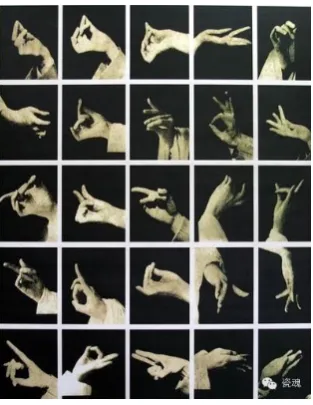
Gestures in the performance of Dan in Peking Opera are mainly reflected in
the finger styles. Since most of the finger styles seem like orchids, they are
collectively referred to as the "orchid finger poses". The characters in the
opera have complex expressions, such as happy or angry or sad or joyous in
order to reflect the external image of the character, which is an important
aspect of the art of Beijing opera.[3] At the same time, the actors can also
express complex inner feelings and thoughts by changing gestures. This kind
of gesture can be flexibly applied to concrete details, serving as a kind of
artistic body “language”. Gestures, as a kind of “language”, are extremely rich,
Figure 2: Mei Lanfang hand gestures
Picture from: Album of Mei Lanfang acting art, Memorial Hall of Mei Langfang, 2002
Mr. Mei understood gestures very well, so he paid special attention to the
aspect of expression. The gestures created by him changed a lot with profound
meanings. They had not only won high praises from domestic art circles but
were highly valued and appreciated by international art circles. When it comes
to the gesture performance of Mr. Mei, the former Soviet Union dramatist
Stanislavsky sang his praises without ceasing, “Mr. Mei's extraordinary hand
has not only attracted me very much, but had a strong appeal to many famous
artists in the Soviet Union as well." [4]
Figure 3: Mei Lanfang and Chen Bohua exchange their experience about finger gestures
[image:13.595.183.414.556.695.2]After researching multiple related media, I decided to learn from master Mei
Lanfang and apply Peking Opera gestures to the action design of the main
actors in my film.
In my thesis, I was trying to systematize the gestures in Beijing Opera, not just
with how it looks, but with how it plays out in spirit and as a means of artistic
expression.
After I finished this research, I concluded that Mr. Mei’s interpretation of
characters through gestures would be a great experience for me to follow.
Historically, traditional oriental women are implicit and introverted about
expressions of feelings.
Since my story takes place in the Qing Dynasty, and in an era of culture fusion,
Confucianism was interpreted in a distorted form by other nationalities. The
feudal palace was very hierarchical and with a lot of rules, which created
increased difficulties for me for character design and acting. As a result, I
decided to challenge myself to express thoughts and emotions mainly by a
character’s gestures, rather than facial expressions. In addition, I used some
famous orchid finger poses as reference and created some key frames for
characters in the animation based on these poses.
Concept Design
Concept design is a form of visual development used to convey an idea in the
animation before it is put into the next stage. It is a visual representation of
the characters, backgrounds, sets and props that will define the final image
style for the animation. I started creating the concept design in September
2013. At the same time that I was doing the character design and I also began
In the very beginning, I did not have any particular style in my mind. I
watched some Beijing Operas trying to find some inspiration, but the
traditional Beijing Opera scenery only contains simple chairs and tables. I did
not think that this stage setting style could be used for reference, and
[image:15.595.146.451.218.391.2]considering the whole story I preferred a more realistic style.
Figure 4: Beijing Opera stage setting
Picture from http://xiqu.91ddcc.com/c_3689.html
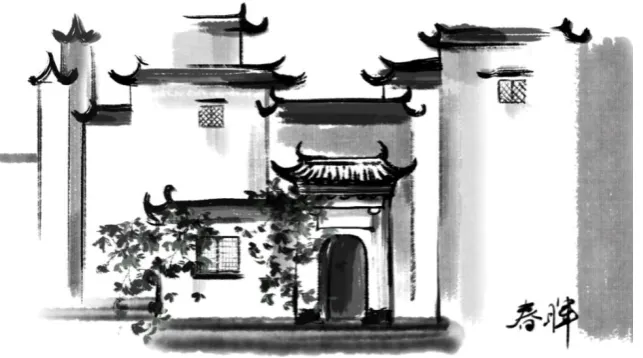
From the concept art aspect, I hesitated about using either ink painting or
traditional animation as my major art style. I tried almost all the styles I could
think of. I lost some of my initial draft artwork, but I still have some paintings
left, like the one below:
[image:15.595.139.461.560.739.2]I started to get a picture in my mind based on these very first drawings. I
decided on the style I wanted to do, with consideration for the complexity for
the whole art process. I decided to go for a ‘new’ ink painting style that has
simple organic shapes and a simple hand drawing line and uncomplicated
textures. After making some graphics samples, I settled on using TVpaint
software for the animation.
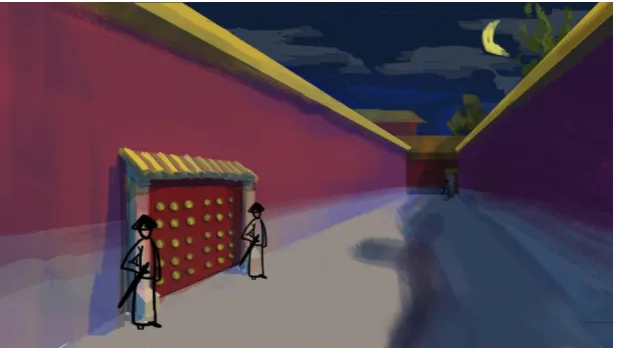
At the same time, I created 3D backgrounds in the film as a timesaving
technique since I could make one scene in 3D and then render from as many
camera angles as I wanted. However, before I finished the final 3D modeling, I
had to make a 3D block for testing so I could find out whether I liked the
‘clean’ and ‘neat’ look of the 3D style. I found that this look differed too greatly
from the simple opera stage style, so I only used the 3D backgrounds as
[image:16.595.144.454.429.605.2]references for actual background drawing.
Figure 6: Background design test sample
Character Design
I did extensive research when I was doing my character design. I had to
balance the visual impact that I desired for a character with the feasibility of
achieving my goals during production. I consulted the Beijing Opera mask for
special makeups for female characters. In the early era of Beijing Opera, there
were only actors but no actresses. Females were not allowed in shows or on
stages. Only during the late Qing dynasty, around 1900, could females finally
come to the stage. There were even female Beijing opera troupes that formed.
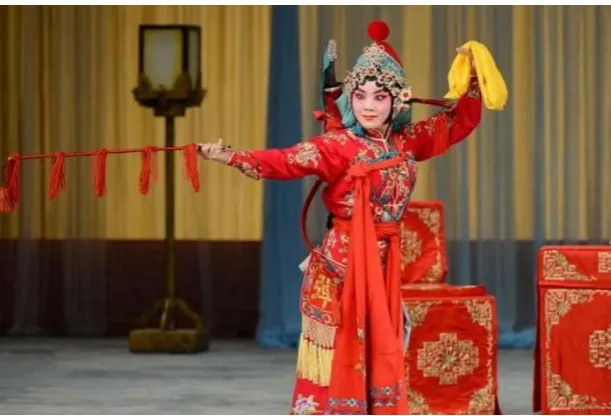
Currently, even though there are many famous actresses in Qingyi, Huadan,
Laodan (these are different age or types of female roles in Beijing Opera), the
[image:17.595.145.451.240.448.2]Beijing Opera is essentially an art for males.
Figure 7: Dan actor in Beijing Opera
Picture from web
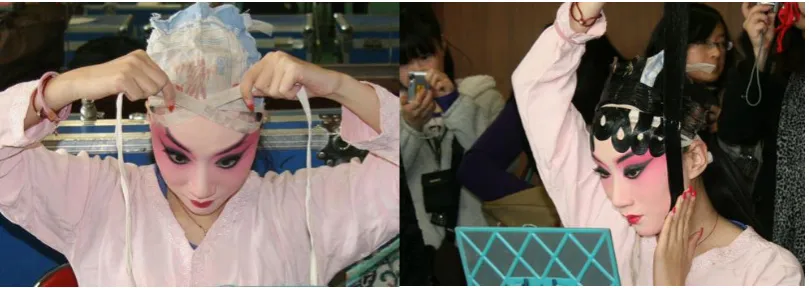
Before a show, actors or actresses spend hours and hours in makeup.
Audiences are able to distinguish the age, gender, and personalities for the
actors or actresses by the types of facial makeup in operas. There are some
specific rules in Dan makeup. Most of them attempt to cover any masculinity
with a pink blush, thick eyeliner, thin eyebrows, and tiny but mellow and full
lips. Audiences are generally unable to identify any original features of the
face after makeup. This allows for multiple actors and actresses to perform as
the same character seamlessly. In Dan makeup steps, there is one where a
actor’s head. Another step is affixing a strand of fake hair on sideburns in
[image:18.595.93.498.148.292.2]order to shape the actor’s face into the public aesthetic of the times.
Figure 8: Dan actress makeup
Picture from web
In my characters’ designs, especially the main characters, I took some
elements from makeup techniques in Beijing Opera. I imagined the makeups
and masks like a 2D texture map applied on a 3D model face. With dramatic
and romantic makeup, the actors’ expressions and their acting, like in opera,
could come with their own unique enchantment.
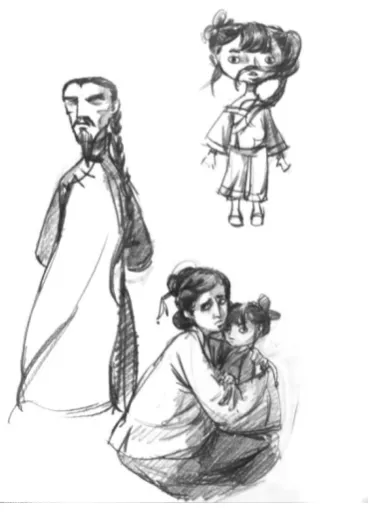
After making sure that the art style and achievements in the character design
were ready, I made lots of sketches. They looked good, however, not any of
Figure 9: Early character design samples
Figure 10: Character design
I then tried to come up with the background style first and this made me able
to truly feel my characters when I was designing them, since I felt I could
[image:19.595.154.441.397.585.2]There are two main characters and two kinds of supporting characters in my
film. The Emperor and the Concubine are the only two characters with faces
and expressions. The other female servants and eunuchs look almost like
puppets. There are many of them, but it does not matter who they are or what
they do. They are with human bodies but without human feelings in this film.
Concubine
The Concubine is around 16 years old, with extremely long hair, cherry lips,
and monolid, dark brown eyes. Seven years before, her family members were
killed in front of her and that was the first time she saw the Emperor. The
Emperor noticed her at this terrible moment, because of her beauty and
gorgeous hair, and so she survived the killings. As a concubine, she does not
talk much. Everyone around her behaves like puppets. They are only following
orders.
Concubine Keywords: Silence, introversion, with magic powers (like the
mutants in the X-Men film)
Emperor
The Emperor is around 50 years old. He wears golden-yellow imperial robes,
and there is always a deep frown on his face as if he is constantly thinking
about something. In the Feudal era, the emperor was called the “Son of God”
and was deified. The common people treated emperors as a half human, half
celestial being, even though they became emperor only because their
forefathers won some wars.
Emperor Keywords:Brashness bordering on arrogance, ruthless, no respect,
always giving orders
Background Design
My story mainly takes place in the Emperor’s palace. I used the famous
there were many new buildings and renovations to buildings that were made
during the later Qing dynasty. I created a couple of different designs for the
palace hallway, the interior of the palace, and the outside of the palace based
off pictures and images from films depicting the Forbidden City. All the
interior rooms in my thesis film were delicately re-invented and tastefully
[image:21.595.172.423.211.536.2]furnished based on the real pictures and film documentaries.
Figure 11: The indoor furnishings of the Forbidden City
Picture from http://young.dpm.org.cn/
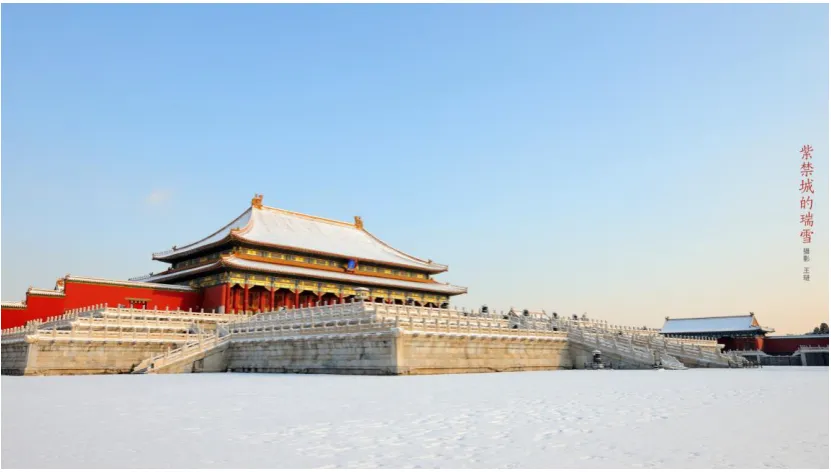
I visited the Forbidden City a few years back. The things that impressed me
the most were the walls in the hallway and the ground tiles that are made of
stone. The Cultural Relic Protection Department in China repaints most of the
walls every ten years. There are some layers of past paintings along the edges
of the walls that show through, kind of like tree rings that expose the age of a
tree. The painted walls are battered by the wind and the rain, and exposed to
Figure 12: Forbidden City in winter
Picture from http://young.dpm.org.cn/
I decided to apply some paper textures, watermarks, or smudges on the
backgrounds to show the traces of time. All the buildings in the palace attest
well to the alternating of dynasties, changes of thrones and many mysteries.
Many stories have been forgotten by people, as the faded-out paintings on the
walls block out the history. But, there are still some marks and traces telling of
the old days.
Storyboarding
Once I finalized the script, I began to think about storyboards. A storyboard is
a way of planning the story of the animation in drawn pictures prior to making
the animation itself. The storyboard helped me to finalize the camera angles
and frame compositions, calculate the number of scenes and shots, establish
different shots and make them consistent to convey the story.
I started storyboarding in December 2013, and I redid it in May 2014. I had an
Then, after the first time I changed my script, I had to redo all the
storyboards.
Actually, the new script made it easier for the storyboard. With a clear
storyline and an adequately linked characters relationship diagram, I came up
with the new storyboard and got approved by all committee members in a
month.
I created 3D environment blocking for the environment setup and these were
not used in the final storyboard. Because I cut some shots inside the palace,
there are not many shots left showing the environment inside. Creating the 3D
environment blocking was still a great way for me as a reference when
drawing the backgrounds.
As a result, there are eight scenes and 45 shots in Deadly Pleasure. This is
quite a lot for a thesis film. In the storyboard design, there were over 60 shots
in the first version of the storyboard. It was really hard for me to make
decisions on cuts. I had to make sure that the shots that would be cut would
not impair the storytelling. Some shots to cut came into my mind at the very
beginning, even before the final script came out.
Doing the shot subtractions was the first step in my storyboard polishing. The
next step was adjusting all the shots left and trying to make every shot work in
well-composed groups. Some inspiration for compositions for my thesis came
from traditional Chinese paintings.
Animatic
I have separated the animatic part from the storyboard in this project because
the composer, who was not in Rochester, and not even in New York. I had not
met him before, and since he was in California we had to work with a
three-hour time difference. This caused some problems that I write about in
detail in the Music Composing and Sound FX section of this paper.
I had to come up with a time-settled animatic for the composer to work with.
After my storyboard was finished, I still did not know how many frames it
would take for each shot, so I recorded every shot of the characters’ animation
using the reference timings of my live action acting. Then I imported the
footage into After Effects to remap the timing and made it ‘look like’
animation. This way of making an animatic was very useful, but also
humorous. But, using the footage this way allowed me to produce a final
animatic in a week. After meeting with my advisor, I sent the animatic to the
composer and then began to animate each shot.
PRODUCTION
Animation
Many techniques have been applied to Deadly Pleasure, including cel
animation, After Effects transition, and After Effects 3D. Different types of
graphic motions require different processes to deal with, and each of them had
specific conditions for use.
Different from traditional animation that re-draws everything frame by frame,
cel animation innovatively divides an animation scene into separate layers and
allows some parts of each frame to repeat from frame to frame in order to save
labor and time. On the other hand, hand drawing gives more flexibility and
As an example, the first walking cycle has 10 key frames, and each of them
repeats for 2- 3 frames. The whole walking cycle repeats 10 times for a total of
220 frames.
Background
I calculated the number of backgrounds and scenes right after I finalized the
storyboard. I created the character animations and the backgrounds
separately in my thesis. I worked more than ten hours a day for three months
on my thesis, and my schedule was pretty tight. In order to achieve the best
efficiency, I switched between drawing backgrounds and character animations
to keep myself from feeling bored of doing a single thing.
When dealing with perspective issues, collaborating with 3D would solve the
problem. 3D software is able to test and preview the perspective immediately.
However, on the other hand, 3D rendered images were too mechanical looking
to match the rest of the hand-drawn animations. Therefore, to have both the
accurate perspective and consistent visual style, 3D blocked backgrounds were
modeled and rendered first. Then they were imported as references to create
animation backgrounds in Photoshop. I separated backgrounds by object
groups to many layers, and exported them to PNG files with a transparent
channel. Then I listed them in After Effects with 3D layers, which could create
the “fake 3D” stage. The animated sequences were set between the
background layers.
Coloring
Color palette was the first thing I defined after finishing the background
concept design. My thesis story happened during the night time. I was trying
to simulate a cool palette with different shades. I started with Kuler - Adobe's
own palette. The app was great and user-friendly but it did not work for me. It
seemed I dived too deep in color itself and forgot about the whole film. Then I
decided to upload a picture which looked close to the color palette in my mind.
After doing some adjustment in colors, I got the color palette for the first
scene. I used the same way in other scenes too. It was much easier for me to
improve a color palette rather than to create a brand new one.
Figure 13: The color palette for the first scene
I colored the film in TVPaint directly. There were a few adjustments in After
Effects, but mainly I did all the coloring in TVPaint. I allocated most of my
color work to my undergraduate colleagues Qina Chen, Molly Sotak, Ginda
Sun, and Miranda Sider. I really appreciate their help. I should also say thanks
to Mary Barnard, the office secretary in SOFA, who forwarded my recruiting
email to all undergraduate students, who responded quickly within a week. I
organized their names by the kind of work. Molly Sotak, Ginda Sun, and
Miranda Sider were junior students majoring in animation, and only one of
them knew how to use TVPaint. So, I scheduled a meeting for training after I
decided who the assistants were. I came up with a list of specifications, and
wrote down any requirements and set up tips, like brush settings, for instance.
The students’ work was very helpful, but there were some shots that needed to
be re-worked. Fortunately, I still had enough time to fix these shots.
Rendering
In my thesis, there were three renders in my working process. After I finished
files due to its lossless nature. I did some color correction and adjustments in
After Effects then put these sequences into the compostions with the
backgrounds. I rendered the full film with credits as a PNG sequence, in order
to add music in Adobe Premiere.
The final rendering settings were based on the requirements for thesis
screening. All the information is listed below.
Title: Deadly Pleasure
Format: A 2D animation film
Length: 5:00
Display Resolution: 1280 x 720 pixels
Aspect Ratio: 16: 9
Frame Rate: 24 fps
Audio Channels: Stereo
Sample Rate: 48 kHz
Used Softwares: Adobe Photoshop, After Effects, Premiere, TVPaint
Composition
I used Adobe After Effects in my thesis for the animatic, layout movements,
compositing animations and backgrounds together, color adjustments, and
highlight effects and credits.
I finished animation layers and background individually, so the first thing I
did in After Effects was combining the character animations with the
background layers. Some color adjustments were also did in After Effects. I
decreased the contrast of some backgrounds to make audience focus on the
under Effect-Color correction-Brightness & Contrast, and Effect-Color
correction-Curves.
My thesis story takes place in the nighttime. There was no daylight in any
scene. The lighting fixtures in this film were moonlight and candlelight. I tried
to make this film in an enigmatic and quiet mood, so there was a lot backlight
and side surface shots from the beginning to the end. Under these situations, I
came up with a good solution for the characters’ lighting part. The character
animations were exported as PNG file sequences with alpha channel. After the
import, I replicated each animation layer three times. I translated the first
layer horizontally for a few pixels. The overlap of the top two layers was
dimmed to be the part of this layer’s shadow.
POST-PRODUCTION
Music Composing and Sound FX
Adding music was almost the last step in my film. Music plays a significant
role in Deadly Pleasure, especially because there is no narration or text in the
film. Before I set up the stage art stylization, I totally had no idea about the
music. The function of the music was to evoke an emotional reaction and
create a certain ambiance to promote the film. The theme music was
composed and recorded by Haiyi Liu, a newly graduated music student from
UCLA. He is a very talented composer, even though he became one of my
biggest challenges near the end of my thesis.
I had not met Liu before we started working together, although he had been a
Facebook friend for around two years. I asked him if he was interested in
composing for my film in the first semester of the thesis project. When we
both agreed to collaborate we began to explore appropriate music styles and
some Chinese music clips as references. After several meetings on Skype, we
made an agreement about the style of the music. It would be similar in idea to
the Beijing Opera and its simple stage sets, with strong rhythm but only a few
musical instruments. He began to work on the music after I sent him the final
animatic. We both worked on the same timeline and we worked individually.
He sent me the final music two weeks before the screening deadline so I could
have time to fix any problems with the visuals and do some adjustment before
the screening.
Everything went smoothly until a few weeks before the screening due date.
When I asked the composer if he could send me any music drafts or get some
feedbacks, he did not reply my email. After disappearing for about 4 weeks, he
sent me some music edits. It seems the final one. At that moment, it was
almost one week before the due date. To be honest, I was a little pissed off.
In the final moments of my thesis film, I spent a whole weekend working in
the graduate animation lab and finished the film the day before screenings,
complete with the music! Unfortunately, because of finishing so close to the
deadline I was unable to get any changes on the background music from my
colleagues and faculty committee. But fortunately, the music worked great
with my film. I did the final timing alignment in After Effects for my
animation with time remapping. I cannot adjustment the music clip, so I have
to do some adjustments in order to make my animation perfectly fit the music.
Normally, music always fits for the imagery. In my case, it could work when
the music cannot be changed.
Final Adjustments
Final adjustment is the last and very important step in a film production.
There are always some issues that remain just before the release of a film and
composition, camera shots adjustments, color and light tunings, sound
volume adjustments for exaggerations, and inserting shots. I also remapped a
few timings and corrected some frames that were not transitioning smoothly
in the final film.
REFLECTIONS
The development of my thesis project was a great learning experience.
Although it was not my first animation project, I had not spent so much time
working on one film before. Based on the audience response to the film at its
premiere in the SOFA screenings, Deadly Pleasure still has potential for
improvement in the release version of the project. For instance, adding a few
more scenes to deliver the main idea for more clarity, polishing character
animation for more smoothness, and adding more background details, were a
few suggestions from the audience.
Screening
I got some responses from the audiences and professors in my SOFA
screening. Some of the ideas were from the perspectives I had never thought
about. I really appreciate these suggestions and they offered other points of
view for my film which were extremely helpful to improve my film after
screening.
The questions about the film were focusing on 2 things. One was why the girl
wants to revenge. The audience coming up with this question showed that I
should do something more to deliver the revenge idea in my film. Maybe
adding another piece of memory image could fix it. The other question was
why the eunuchs and guards did not have faces or expressions. They did look
mentioned in the character design part. After I explained the reason the
audience got it quickly, so I do not think that part should be changed.
Learning
I gained a deeper understanding of 2D animation during the development of
the character animations. This is not the first time I went through a whole
process of 2D animation from the character design to the final compositing,
but this thesis project impressed me the most amongst all the past projects I
have worked on. I improved my communication skills, gained more
experience in working with a team, and my technical skills were enhanced. I
learned that to create a mature film that offers enjoyable visual entertainment
and helpful cultural information, plenty of patience and hard work are
required throughout the whole process.
Future Considerations
Deadly Pleasure will be published online and submitted to different film
festivals and design competitions. In the meantime, I continue to refine the
design and animation to improve its visual effectiveness and overall success.
Challenges and Triumphs
Time Management
Time management has always been a problem for the artist, especially for
animators. I could always tell the deadline for each class by the population in
the animation lab. During my thesis there was time management problems
too.
The first thing that broke my timeline was having to redo the script. Before the
first committee meeting after my initial proposal, I found out my thesis script
was out of control. I did not know how I could finish the storyboard, since
my friends told me there was too much information in the story that might
distract me from the main storyline.
It took me a few weeks to think about whether I should give up the “finished”
script and storyboard. After I made the decision to make a big change in the
story the original timeline needed to be revised and my schedule became very
tight.
I don’t wish to imply that other students should not change their story or
script, but what I am trying to say is that if there is any issue or sticking place
in their story they would better off finding it out and fixing it as soon as
possible. Starting over happens in film production. But, it is better to find out
any problems early and not let it get so far into production that it risks not
finishing the film at all or making a bad film. For a realistic timeline, I would
recommend leaving more time for the idea and script.
Subcontracting Work
In my thesis, I did most of the work, except for the music scoring and some
coloring. I recruited volunteers for coloring in TVPaint. The first
recommendation I have is that if you plan to recruit volunteers, you should do
it at the beginning of the semester. My volunteers sent me emails to delay the
coloring schedule because they were busy, and this altered my thesis plan a
little bit. I pretty much understand that they were probably very busy on their
own projects, but it delayed my whole process. My composer also disappeared
for half a month, and I did not know how I could find him. It is better to leave
more time or have a backup plan for all subcontracting work. Anything can
happen, but these are not what I can control. Compared with these pressures,
working more than ten hours a day was not that bad. At least I knew
REFERENCES
[1] Memoir of Qi Rushan, Liaoning Education press, Qi Rushan, 2005 [2] The Biography of Mei Lanfang, Hebei Education Press, Yanjun Liu, 1996 [3] Joshua Goldstein, "Mei Lanfang and the Nationalization of Peking Opera, 1912-1930,"
APPENDIX
Proposal
Film stills
Deadly Pleasure Image 1
Deadly Pleasure Image 3
Deadly Pleasure Image 5
Deadly Pleasure Image 7
Deadly Pleasure Image 9
Deadly Pleasure Image 11
Deadly Pleasure Image 13
Deadly Pleasure Image 15
Deadly Pleasure Image 17
Deadly Pleasure Image 19
Deadly Pleasure Image 21