Image Mining: Trends and Developments
Ji Zhang
Wynne Hsu Mong Li Lee
School of Computing National University of Singapore
Singapore 117543
{zhangji, whsu, leeml}@comp.nus.edu.sg
Abstract
Advances in image acquisition and storage technology have led to tremendous growth in very large
and detailed image databases. These images, if analyzed, can reveal useful information to the human
users. Image mining deals with the extraction of implicit knowledge, image data relationship, or other
patterns not explicitly stored in the images. Image mining is more than just an extension of data
mining to image domain. It is an interdisciplinary endeavor that draws upon expertise in computer
vision, image processing, image retrieval, data mining, machine learning, database, and artificial
intelligence. Despite the development of many applications and algorithms in the individual research
fields cited above, research in image mining is still in its infancy. In this paper, we will examine the
research issues in image mining, current developments in image mining, particularly, image mining
frameworks, state-of-the-art techniques and systems. We will also identify some future research
directions for image mining.
Keywords: Image mining, image indexing and retrieval, object recognition, image classification,
image clustering, association rule mining.
1. Introduction
Advances in image acquisition and storage technology have led to tremendous growth in very large
and detailed image databases [43]. A vast amount of image data such as satellite images, medical
images, and digital photographs are generated every day. The World Wide Web is regarded as the
largest global image repository. An increasing proportion of the contents in digital libraries are images.
These images, if analyzed, can reveal useful information to the human users. Unfortunately, it is
difficult or even impossible for human to discover the underlying knowledge and patterns in the
Image mining is rapidly gaining attention among researchers in the field of data mining, information
retrieval, and multimedia databases because of its potential in discovering useful image patterns that
may push the various research fields to new frontiers. Image mining systems that can automatically
extract semantically meaningful information (knowledge) from image data are increasingly in demand.
The fundamental challenge in image mining is to determine how low-level, pixel representation
contained in a raw image or image sequence can be efficiently and effectively processed to identify
high-level spatial objects and relationships. In other words, image mining deals with the extraction of
implicit knowledge, image data relationship, or other patterns not explicitly stored in the image
databases.
Research in image mining can be broadly classified into two main directions. The first direction
involves domain-specific applications where the focus is in the process of extracting the most relevant
image features into a form suitable for data mining [10, 18, 22]. The second direction involves general
applications where the focus is on the process of generating image patterns that maybe helpful in the
understanding of the interaction between high-level human perceptions of images and low level image
features [30, 43]. The latter may lead to improvements in the accuracy of images retrieved from image
databases.
In this paper, we first examine how image mining is different from some of its related fields such as
image processing, pattern recognition, and traditional data mining. Next, we analyze the essential
components that are needed in an image mining framework and how these components interact with
one another to discover interesting image patterns. Two types of image mining frameworks will be
described, namely, a functional-driven image mining framework and an information-driven image
mining framework. Major research efforts in the area of image mining will be highlighted. Finally, we
will use a real-world application to demonstrate the importance of image mining.
The rest of this paper is organized as follows. Section 2 discusses the objectives of image mining and
the research issues that are unique to image mining. Section 3 presents two possible frameworks for
image mining: the functionality framework versus the information-driven framework. Section 4 gives
an overview of the major image mining approaches and techniques used in image mining including
object recognition, image indexing and retrieval, image classification and clustering, association rules
mining, and neural networks. In section 5, we demonstrate the applicability of image mining in a
2. Image Mining Issues
Image mining denotes the synergy of data mining and image processing technology to aid in the
analysis and understanding in an image-rich domain. In fact, it is an interdisciplinary endeavor that
draws upon expertise in computer vision, image processing, image retrieval, data mining, machine
learning, database, and artificial intelligence [3]. While some of the individual fields in themselves
may be quite matured, image mining, to date, is just a growing research focus and is still at an
experimental stage.
Broadly speaking, image mining deals with the extraction of implicit knowledge, image data
relationship, or other patterns not explicitly stored in the images and between image and other
alphanumeric data. For example, in the field of archaeology, many photographs of various
archeological sites have been captured and stored as digital images. These images, once mined, may
reveal interesting patterns that could shed some lights on the behavior of the people living at that
period of time.
Clearly, image mining is different from low-level computer vision and image processing techniques.
This is because the focus of image mining is in the extraction of patterns from a large collection of
images, whereas the focus of computer vision and image processing techniques is in understanding
and/or extracting specific features from a single image. While there seems to be some overlap
between image mining and content-based retrieval (since both are dealing with large collection of
images), image mining goes beyond the problem of retrieving relevant images. In image mining, the
goal is the discovery of image patterns that are significant in a given collection of images and the
related alphanumeric data.
Perhaps the most common misconception of image mining is that image mining is yet another term
for pattern recognition. While the two fields do share a large number of common functions (for
example feature extraction), they differ in their fundamental assumptions. In pattern recognition, the
objective is to recognize some specific patterns; whereas in image mining, the focus is on generating
all significant patterns without prior knowledge of what patterns may exist in the image databases.
Another key difference is in the types of patterns examined by the two research fields. In pattern
recognition, the patterns are mainly classification patterns. In image mining, the patterns types are
more diverse. It could be classification patterns, description patterns, correlation patterns, temporal
pattern analysis. In image mining, this is only one (albeit an important) aspect of image mining. Image
mining deals with all aspects of large image databases which implies that the indexing scheme, the
storage of images, and the retrieval of images are all of concerns in an image mining system.
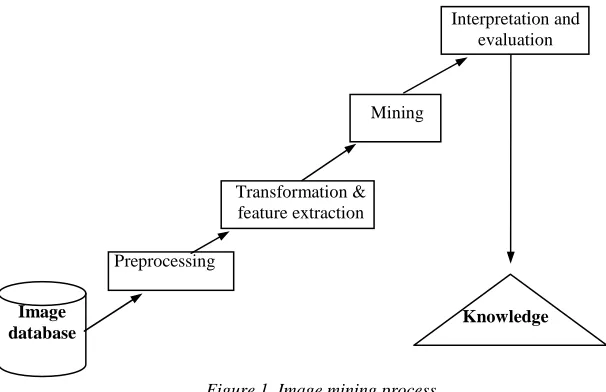
Figure 1 shows the image mining process. The images from an image database are first preprocessed
to improve their quality. These images then undergo various transformations and feature extraction to
generate the important features from the images. With the generated features, mining can be carried
out using data mining techniques to discover significant patterns. The resulting patterns are evaluated
[image:4.595.136.439.298.494.2]and interpreted to obtain the final knowledge, which can be applied to applications.
Figure 1. Image mining process.
It should be noted that image mining is not simply an application of existing data mining techniques
to the image domain. This is because there are important differences between relational databases
versus image databases:
(a) Absolute versus relative values
In relational databases, the data values are semantically meaningful. For example, age is 35 is
well understood. However, in image databases, the data values themselves may not be significant
unless the context supports them. For example, a grey scale value of 46 could appear darker than a
grey scale value of 87 if the surrounding context pixels values are all very bright.
(b) Spatial information (Independent versus dependent position)
Another important difference between relational databases and image databases is that the implicit
spatial information is critical for interpretation of image contents but there is no such requirement
in relational databases. As a result, image miners try to overcome this problem by extracting Image
database
Interpretation and evaluation
Transformation & feature extraction
Preprocessing
Mining
position-independent features from images first before attempting to mine useful patterns from the
images.
(c) Unique versus multiple interpretation
A third important difference deals with image characteristics of having multiple interpretations for
the same visual patterns. The traditional data mining algorithm of associating a pattern to a class
(interpretation) will not work well here. A new class of discovery algorithms is needed to cater to
the special needs in mining useful patterns from images.
In addition to the need for new discovery algorithms for mining patterns from image data, a number
of other related research issues also need to be resolved. For instance, for the discovered image pattern
to be meaningful, they must be presented visually to the users. This translates to following issues:
(a) Image pattern representation
How can we represent the image pattern such that the contextual information, spatial information,
and important image characteristics are retained in the representation scheme?
(b) Image features selection
Which are the important image features to be used in the mining process so that the discovered
patterns are meaningful visually?
(c) Image pattern visualization
How to present the mined patterns to the user in a visually rich environment?
3. Image Mining Frameworks
Early work in image mining has focused on developing a suitable framework to perform the task of
image mining. The image database containing raw image data cannot be directly used for mining
purposes. Raw image data need to be processed to generate the information that is usable for
high-level mining modules. An image mining system is often complicated because it employs various
approaches and techniques ranging from image retrieval and indexing schemes to data mining and
pattern recognition. A good image mining system is expected to provide users with an effective access
into the image repository and generation of knowledge and patterns underneath the images. Such a
system typically encompasses the following functions: image storage, image processing, feature
extraction, image indexing and retrieval, patterns and knowledge discovery.
At present, we can distinguish two kinds of frameworks used to characterize image mining systems:
functionalities of different component modules to organize image mining systems while the latter is
designed as a hierarchical structure with special emphasis on the information needs at various levels
in the hierarchy.
3.1 Function-Driven Frameworks
Several image mining systems have been developed for different applications. The majority of
existing image mining system architectures [3, 9, 43] fall under the function-driven image mining
framework. These descriptions are exclusively application-oriented and the framework was organized
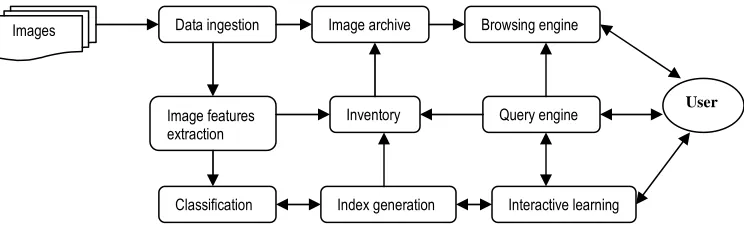
according to the module functionality. For example, Mihai Datcu and Klaus Seidel [9] propose an
intelligent satellite mining system that comprises two modules:
(a) A data acquisition, preprocessing and archiving system which is responsible for the extraction of
image information, storage of raw images, and retrieval of image.
(b) An image mining system, which enables the users to explore image meaning and detect relevant
[image:6.595.108.480.418.533.2]events.
Figure 2 shows this satellite mining system architecture.
Similarly, the MultiMediaMiner [43] which mines high-level multimedia information and knowledge
from large multimedia database, comprises four major components:
(a) Image excavator for the extraction of images and videos from multimedia repository.
(b) A preprocessor for the extraction of image features and storing precomputed data in a database.
(c) A search kernel for matching queries with image and video features in the database.
(d) The discovery modules (characterizer, classifier and associator) exclusively perform image
information mining routines to intelligently explore underlying knowledge and patterns within
images.
Data ingestion
Image features extraction
Classification Index generation Interactive learning Inventory
Image archive
Query engine Browsing engine Images
User
The Diamond Eye [3] is an image mining system that enables scientists to locate and catalog objects
of interest in large image collections. This system employs data mining and machine learning
techniques to enable both scientists and remote systems to find, analyze, and catalog spatial objects,
such as volcanos and craters, and dynamic events such as eruptions and satellite motion, in large
scientific datasets and real-time image streams under varying degrees of a priori knowledge. The
architecture of the Diamond Eye system is also based on module functionality.
3.2 Information-Driven Frameworks
While the function-driven framework serves the purpose of organizing and clarifying the different
roles and tasks to be performed in image mining, it fails to emphasize the different levels of
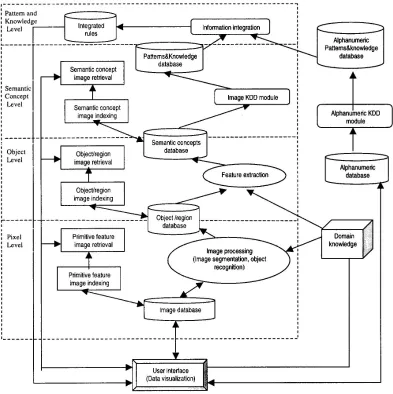
information representation necessary for image data before meaningful mining can take place. Zhang
et. al. [45] proposes an information-driven framework that aims to highlight the role of information at
various levels of representation (see Figure 3). The framework distinguishes four levels of
information as follows.
(a) The lowest level is the Pixel Level. This level consists of the raw image information such as image pixels and the primitive image features such as color, texture, and shape.
(b) The Object Level deals with object or region information based on the primitive features in the Pixel Level. Clustering algorithms, together with domain knowledge can help to segment the
images into some meaningful regions/objects.
(c) The Semantic Concept Level places the objects/regions identified in the Object Level in the context of the scenes depicted. High-level reasoning and knowledge discovery techniques are
used to generate high-level semantic concepts and discover interesting patterns.
(d) The Pattern and Knowledge Level integrates domain related alphanumeric data and the semantic relationships discovered from the image data. Further mining are carried out to discover useful
correlations between the alphanumeric data and the image patterns. Such correlations discovered
are very useful in many real-world domains.
The four information levels can be further generalized to two layers: the Pixel Level and the Object
Level form the lower layer, while the Semantic Concept Level and the Pattern and Knowledge Level
form the higher layer. The lower layer contains raw and extracted image information and mainly deals
with images analysis, processing, and recognition. The higher layer deals with high-level image
information in the higher layer is normally more semantically meaningful in contrast to that in the
lower layer.
It is clear that by proposing a framework based on the information flow, we are able to focus on the
critical areas to ensure all the levels can work together seamlessly. In addition, with this framework, it
highlights to us that we are still very far from being able to fully discovering useful domain
[image:8.595.80.473.275.669.2]information from images.
4. Image Mining Techniques
Besides investigating suitable frameworks for image mining, early image miners have attempted to
use existing techniques to mine for image information. These techniques include object recognition,
image indexing and retrieval, image classification and clustering, association rules mining, and neural
network. We will briefly discuss these techniques and how they have been applied to image mining
in the following subsections.
4.1 Object Recognition
Object recognition has been an active research focus in field of image processing. Using object
models that are known a priori, an object recognition system finds objects in the real world from an
image. This is one of the major tasks in image mining. Automatic machine learning and meaningful
information extraction can only be realized when some objects have been identified and recognized by
the machine. The object recognition problem can be referred to as a supervised labeling problem
based on models of known objects. That is, given a target image containing one or more interesting
objects and a set of labels corresponding to a set of models known to the system, what object
recognition does is to assign correct labels to regions, or a set of regions, in the image. Models of
known objects are usually provided by human input a priori.
An object recognition system typically consists of four components, namely, model database, feature
detector, hypothesizer and hypothesis verifier. The model database contains all the models known to
the system. These models contain important features that describe the objects. The detected image
primitive features in the Pixel Level are used to help the hypothesizer to assign likelihood to the
objects in the image. The verifier uses the models to verify the hypothesis and refine the object
likelihood. The system finally selects the object with the highest likelihood as the correct object.
In order to locate a particular known object in an image or set of images, Jeremy S. De Bonet [5]
design a system that processes an image into a set of “characteristic maps”. Michael C. Burl et al. [3]
employ learning techniques to generate recognizers automatically. Domain knowledge is captured
implicitly through a set of labeled examples. Stephen Gibson et al. [15] develop an optimal FFT-based
mosaicing algorithm to find common patterns in images and show that it works well on various kinds
of images.
Image mining requires that images be retrieved according to some requirement specifications. The
requirement specifications can be classified into three levels of increasing complexity [3]:
(a) Level 1 comprises image retrieval by primitive features such as color, texture, shape or the spatial
location of image elements. Examples of such queries are “Retrieve the images with long thin red
objects in the top right-hand corner” and “Retrieve the images containing blue stars arranged in a
ring”.
(b) Level 2 comprises image retrieval by derived or logical features like objects of a given type or
individual objects or persons. These queries include “Retrieve images of round table” and
“Retrieve images of Jimmy”.
(c) Level 3 comprises image retrieval by abstract attributes, involving a significant amount of
high-level reasoning about the meaning or purpose of the objects or scenes depicted. For example, we
can have queries such as “Retrieve the images of football match” and “Retrieve the images
depicting happiness”.
Rick Kazman and John Kominek [21] propose three query schemas for image retrieval: Query by
Associate Attributes, Query by Description, and Query by Image Content. In Query by Associate
Attributes, only a slight adaptation of the conventional table structure is needed to tailor it to fit the
image needs. The table organization is still used, with images appended as extra field. The image or
the graphic files within the table remains as just large bitmaps, and image retrieval is performed based
on other associated attributes within the same table. This is essentially very similar to the regular
text-based query operation, except that it has been extended to handle image data. The query results can be
the image whose associate attribute(s) satisfies the query requirements plus possibly other associated
attribute(s) sometimes.
The basic idea in Query by Description is that by storing description along with each image through
which the user can locate the images interested. The image description is often called label or
keyword. This description is typically generated manually and assigned to each image in the image
preprocessing stage. Ideally, the description should be discriminative, concrete and unambiguous. In
practice, this approach suffers from the drawbacks of the “vocabulary problem” and non-scalability.
With the emergence of large-scale image repositories, the problems of vocabulary and non-scalability
faced by the manual annotation approach have became more pronounced. Content-based image
retrieval is thus proposed to overcome these difficulties. There are three fundamental bases in
application [33]. Many techniques have been developed in this direction, and many image retrieval
systems, both research and commercial, have been built.
Commercially, IBM’s QBIC system [12] is probably the best known of all image content retrieval
systems. It offers retrieval by any combination of color, texture or shape, as well as text keyword. It
uses R*-tree indexes to improve search efficiency. More efficient indexing techniques, an improved
user interface, and the ability to search grey-level images have been incorporated in the latest version.
Virage [2] is another well-known commercial system. This is available as a series of independent
modules, which system developers can build into their own programs. Excalibur [11], by virtue of its
company’s pattern recognition technology, offers a variety of image indexing and matching
techniques. There are also a large number of University prototypes and experimental systems
available, the representatives ones being Photobook [31], Chabot[28], VisualSEEk[36], MARS[26],
Surfimage[27] and Synapse [24].
4.3 Image Indexing
While focusing on the information needs at various levels, it is also important to provide support for
the retrieval of image data with a fast and efficient indexing scheme. Typically, the image database to
be searched is large and the feature vectors of images are of high dimension (typically in the order of
102), search complexity is high. Two main approaches are: reducing dimensionality or indexing
high-dimensional data. Reducing the dimensions can be accomplished using two well-known methods: the
Singular Value Decomposition (SVD) update algorithm and clustering [34]. The latter realizes
dimension reduction by grouping similar feature dimensions together. High-dimensional indexing
schemes includes SR-tree[20], TV-tree[23] X-tree[4] and iMinMax[29].
Current image systems retrieve images based on similarity. However, Euclidean measures may not
effectively simulate human perception for certain visual content. Other similarity measures such as
histogram intersection, cosine, correlation, etc., need to be utilized. One promising approach is to first
perform dimension reduction and then use appropriate multi-dimensional indexing techniques that
support Non-Euclidean similarity measures [33]. [13] develop an image retrieval system on Oracle
platform using multi-level filters indexing. The filters operate on an approximation of the
high-dimension data that represents the images, and reduces the search space so that the computationally
expensive comparison is necessary for only a small subset of the data. [17] present a new compressed
Other proposed indexing schemes focus on specific image features. [23] give an efficient color
indexing scheme for similarity-based retrieval which has a search time that increases logarithmically
with the database size. [38] propose a multi-level R-tree index, called the nested R-trees for retrieving
shapes efficiently and effectively. With the proliferation of image retrieval mechanisms, a
performance evaluation of color-spatial retrieval techniques was given in [39] that serves as
guidelines to select a suitable technique and design a new technique.
4.4 Image Classification and Image Clustering
Image classification and clustering are the supervised and unsupervised classification of images into
groups. In supervised classification, we are given a collection of labeled (pre-classified) images, and
the problem is to label a newly encountered, yet unlabeled images. Typically, the given labeled
(training) images are used to do the machine learning of the class description which in turn are use to
label a new image.
In unsupervised classification (or image clustering), the problem is to group a given collection of
unlabeled images into meaningful clusters according to the image content without a priori knowledge
[19]. The fundamental objective for carrying out image classification or clustering in image mining is
to acquire content information the users are interested in from the image group label associated with
the image.
Intelligently classifying image by content is an important way to mine valuable information from
large image collection. The classification module in the mining system is usually called classifier. [40]
recognize the challenge that lies in grouping images into semantically meaningful categories based on
low-level visual features. Currently, there are two major types of classifiers, the parametric classifier
and non-parametric classifier. [6] develop a variety of classifiers to label the pixels in a Landset
multispectral scanner image. MM-Classifier, a classification module embedded in the MultiMedia
Miner developed by Osmar R.Zaiane et al. [43], classify multimedia data, including images, based on
some provided class labels. James Ze Wang et al. [42] propose IBCOW (Image-based Classification
of Objectionable Websites) to classify whether a website is objectionable or benign based on image
content. [40] use a binary Bayesian classifier to perform hierarchical classification of vacation images
into indoor and outdoor categories. An unsupervised retraining technique for a maximum likelihood
(ML) classifier is presented to allow the existing statistical parameter to be updated whenever a new
Image clustering is usually performed in the early stages of the mining process. Feature attributes that
have received the most attention for clustering are color, texture and shape. Generally, any of the three,
individually or in combination, could be used. There is a wealth of clustering techniques available:
hierarchical clustering algorithms, partition-based algorithms, mixture-resolving and mode-seeking
algorithms, nearest neighbor clustering, fuzzy clustering and evolutionary clustering approaches.
Once the images have been clustered, a domain expert is needed to examine the images of each cluster
to label the abstract concepts denoted by the cluster. Edward Chang et al. [4] use clustering technique
in an attempt to detect unauthorized image copying on the World Wide Web. Lundervold et al. [17]
use clustering in a preprocessing stage to identify pattern classes for subsequent supervised
classification. [17] describe a partition-based clustering algorithm and manual labeling technique to
identify material classes of a human head obtained at five different image channels (a
five-dimensional feature vector).
More recently, Dantong Yu et al [35] present an unsupervised clustering and query approach (also
known as ACQ for Automatic Clustering and Query) for large-scale image databases. ACQ does not
require the number of clusters to be known a priori and is insensitive to noise. By intelligently
applying wavelet transforms on the feature space, this clustering can effectively and efficiently detect
clustering of arbitrary shape of high dimensional feature vectors. [22] apply clustering methods such
as k-means and the self-organizing map (SOP) for visualizing the distribution of typhoon cloud
patterns on a two-dimensional space.
The benefits of image classification and clustering include better image storage and management, and
optimized image-indexing scheme for fast and efficient image retrieval, all of which are also
important to the image mining systems. In view of the differences and similarities between image
classification and clustering, we present the following generic steps required in the image
classification and clustering [19]:
(a) Pattern representation. This may involve image processing such as image segmentation, feature
extraction and selection.
(b) Definition of image proximity measure appropriate to the domain.
(c) Classification or clustering.
(d) Group abstraction or adaptation.
An association rule is an implication of the form X→ Y, where X, Y⊂ I and XΛY=φ. I is the set of
objects, also referred as items. D is a set of data cases. X is called the antecedent and Y is called the
consequent of the rule. A set of items, the antecedent plus the consequent, is call an itemset. The rule
X→ Y has support s in D if s% of the data case in D contains both X and Y, and the rule holds in D
with confidence c if c% of the data base in D that support X also Support Y. Association rule mining
generate rules that have support and confidence greater than some user specified minimum support
and minimum confidence thresholds. A typical association rule mining algorithm works in two steps.
The first step finds all large itemsets that meet the minimum support constraint. The second step
generates rules from all the large itemsets that satisfy the minimum confidence constraint.
Association rule mining is frequently used in data mining to uncover interesting trends, patterns and
rules in large datasets. Recently, association rule mining has been applied to large image databases
[25, 30, 43]. Although the current image association rule mining approach is far from mature and
perfection compared its application in data mining field, there opens up a very promising research
direction and vast room for image association rule mining. There are two main approaches. The first
approach is to mine from large collections of images alone, and the second approach is to mine from a
combined collection of images and associated alphanumeric data [30]. A typical example of the first
kind of association mining of image is to find if there is some pattern existing for an individual city or
between different cities by studying a collection of satellite imagery of various cities of the United
States. An example of the second case may involve medical imagery and patient records. Image data
and patient records can be viewed together to find interesting associations.
Association mining from transaction database is a typical case of mining association rules from large
database. In this case, an association rule can be generated by examining all the transaction data. The
data is explicit and there is a specific and definite data item for each the component item and an
individual customer transaction would include a subset of these items and in general a subset of all the
items sold by the store. In image databases, manually labeling all the images is practically impossible,
and we can only rely on automatic or semi-automatic analysis of the image content, before carrying
out mining on the generated descriptions. The generated descriptions could be color, texture, shape,
size etc.
C. Ordonez et al. [30] present an image mining algorithm using blob needed to perform the mining of
associations within the context of images. A prototype has been developed in Simon Fraser University
3-dimensional visualization to explicitly display the associations. In another application, Vasileios M. et
al. [25] use association rule mining to discover associations between structures and functions of
human brain. An image system called BRAin-Image Database has also been developed. Though the
current image association rule mining approaches are far from mature and perfection compared its
application in data mining field, this opens up a very promising research direction and vast room for
improvement in image association rule mining. Antonie et al. use the Apriori algorithm to discover
association rules among the features extracted from mammography database and category to which
each mammography belongs [1]. The rules discovered describe frequent sets of features per category
normal and abnormal (benign and malign) based on the Apriori association rule discovery algorithm.
4.6 Neural Networks
Artificial neural network models have been studied for many years in the hope of achieving
human-like performance in several fields such as speech and image understanding [1]. A neural network, by
definition, is a massively parallel distributed processor made up of simple processing units, each of
which has a natural propensity for storing experiential knowledge and making the knowledge
available for use [17]. Neural networks are fault tolerant and are good at pattern recognition and trend
prediction. In the case of limited knowledge, artificial neutral network algorithms are frequently used
to construct a model of the data. Note that there are some key differences in the way conventional
programs and neural networks work. The former require programming whereas neural networks are
train by using of train data. The conventional programming uses serial processing, while neural
networks use parallel processing.
Even though there has been a lot of research work with regard to neural network and its applications,
it is relatively new in the image mining domain. A noteworthy research work that applied neural
network to image mining is the Artificial Neural Network (ANN) developed by G.G. Gardner et al
[14] which provides a wholly automated approach to fundus image analysis by computer that could
improve the efficiency of the assessment work of the image by offering an immediate classification of
the fundus of the patient at the time of acquisition of the image. A Site Mining Tools, based upon the
Fuzzy ARTMAP neural network [7], provides an intuitive means by which an image analyst can
efficiently and successfully mine large amounts of multi-sensor imagery for Feature Foundation Data
(e.g. roads, rivers, orchards, forests) [37]. In [44], Zhang and Zhong proposed to use
Self-Organization Map (SOM) Neural Nets as the tool for constructing the tree indexing structure; the
advantages of using SOM were its unsupervised learning ability and dynamic clustering nature.
back-propagation which proved to be less sensitive the database imbalance at a cost of high training
time [1]. A three-step method (Data Collection, Hypothesis Formulation, and Hypothesis Verification)
is proposed for discovering the relationship between visual image features and feature of related data
in [40]. User is able to make use of the computer-aided visual exportation system named MIRACLES
to facilitate the tasks of feature selection and hypothesis formulation.
5. Image Mining Real-World Application
In this section, we describe a real-world application of image mining involving satellite images.
Satellite images are an important source of information. One useful application of satellite images is
to examine the paths and trends of forest fires over the years, thereby enabling firefighters to have a
better understanding of the behavior of such forest fires in order to combat these fires effectively. This
is our aim in the satellite image mining application. To achieve this, we need:
1. An efficient and effective spatial clustering technique for large-scale multi-resolution incremental
clustering that are adaptable in dynamic environment;
2. An image indexing scheme based on cluster-related semantic concepts to achieve high-level
image retrieval in the satellite image database;
3. Fire cluster information to discover any spatial and temporal trends and patterns of fire
development in terms of scale, area, time duration and location.
The mining of fire patterns from satellite images involves the following 6 steps which corresponds to
the information-driven framework level:
(1) Image processing
In the lowest pixel level, image processing technique (simple thresholding technique) is used to
extract the spatial location information of fire spots. The spatial location of a fire spot is represented
by its altitude and longitude in the map. Such spatial information is stored in the HotSpot database.
(2) Database integration
The commercial satellite typically generates 2 to 3 images of a specified location every day and the
extracted fire locations of each image, that is, the latitude and longitude, is stored in individual table
of the HotSpot database. Thus, it is necessary for us to carry out database integration before trying to
mine the image information over a longer time interval, say a week, a month or a year.
Once the integration is completed, we then perform spatial clustering using a state-of–the-art
clustering method, called FASTCiD [46]. FASTCiD is well suitable for this application because of it
is highly efficient and effective in performing clustering of large dynamic spatial databases. The
cluster label of each fire spot is obtained after this clustering process.
(4) Semantic cluster concept generation
Using FASTCiD, it is very easy to automatically obtain the information regarding the spatial layout,
the area and the density of a specific cluster. Based on these information, we are able to define a few
semantic cluster concepts, such as center cluster, left cluster, dense cluster, sparse cluster, big cluster,
small cluster and so on.
(5) Semantic concept image indexing and retrieval
After the generation of cluster semantic concepts, semantic concept indexing of HotSpot images is
built to support high-level image retrieval based on these semantic concepts. Examples of such image
retrieval are: “retrieval all the HotSpot images which have dense cluster in the center of the image”,
and “retrieval all the HotSpot images in which the clusters located in the left and lower corners are all small ones”.
(6) Trends and patterns mining
Finally, it is desirable to produce some spatial and temporal trends and patterns of the forest fire. To
this end, we explore the fire cluster information to discover any spatial and temporal trends and
patterns of fire development in terms of scale, area, time duration and location. These trends and
patterns are potentially useful for better understanding of the forest fires behavior.
Figure 4 shows the overview of the HotSpot image mining and Figure 5 gives the screen-shot of a
5.1 Results of Mining HotSpot Database
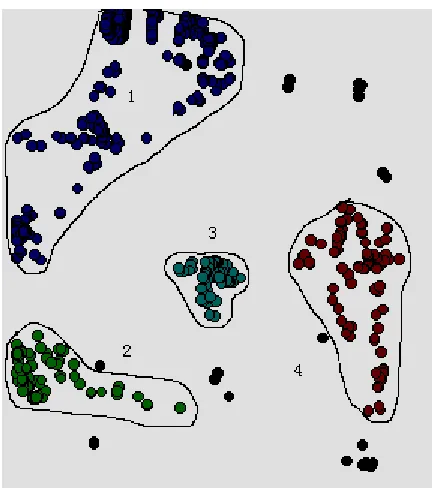
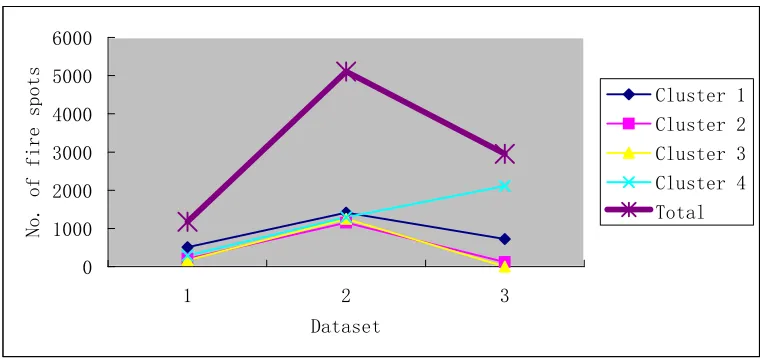
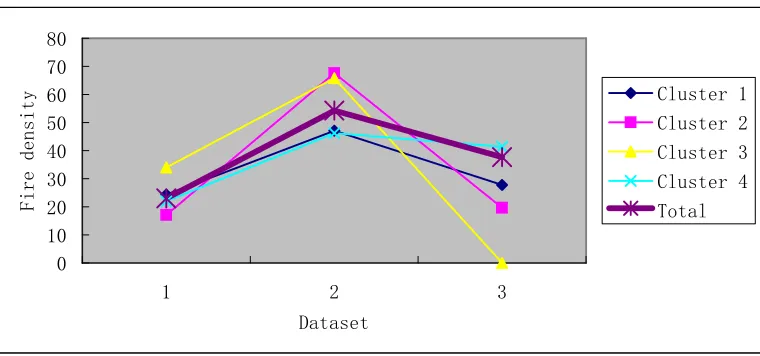
Applying FASTCiD, we cluster the potion of HotSpot Database in September 2000. We integrate the
databases to form three datasets (September 1-10, September 11-20, and September 21-30) according
to the time stamp. Figures 6 to 8 show the clustering results of these three datasets.
After clustering the three HotSpot datasets, we are able to automatically obtain the detailed
information (such as area and density) of the each clusters found. In our application, the area of a
cluster can be approximated by summing up the area of all the grid cells the objects of this cluster occupy [46]; the density of a cluster is defined as the number of fire spots falling into each gird cell on
average within this cluster, which is computed by dividing the total number of fire spots in this cluster
by its area. Tables 1 to 3 show the detailed cluster information of the three datasets, while Figures 9 to
[image:19.595.189.406.357.601.2]11 provide better visualizations of such information.
No. of fire spots Fire area Fire density
Cluster1 512 28 24.4
Cluster2 205 12 17.1
Cluster3 170 5 34
Cluster4 286 13 22
Total 1173 51 23
No. of fire spots Fire area Fire density
Cluster1 1412 30 47.1
Cluster2 1150 17 67.6
Cluster3 1250 19 65,8
Cluster4 1294 28 46.2
Total 5106 94 54.3
No. of fire spots Fire area Fire density
Cluster1 723 26 27.8
Cluster2 118 6 19.7
Cluster3 0 0 0
Cluster4 2109 51 41.4
Total 2950 77 37.7
0 1000 2000 3000 4000 5000 6000
1 2 3
[image:21.595.187.408.114.213.2] [image:21.595.187.408.245.346.2]Dataset N o . o f f i r e s p o t s Cluster 1 Cluster 2 Cluster 3 Cluster 4 Total Table 1. Cluster information of Dataset 1
Table 2. Cluster information of Dataset 2
Table 3. Cluster information of Dataset 3
[image:21.595.187.410.381.479.2] [image:21.595.107.499.516.696.2]0 20 40 60 80 100
1 2 3
Dataset F i r e a r e a ( c e l l u n i t s ) Cluster 1 Cluster 2 Cluster 3 Cluster 4 Total 0 10 20 30 40 50 60 70 80
1 2 3
Dataset F i r e d e n s i t
y Cluster 1
Cluster 2 Cluster 3 Cluster 4 Total
From Figures 9 to 11, it is clear that the fires are more intense during the period of Sept 11-20, 2000
compared to the other two periods, Sept 1-10,2000 and Sept 21-30, 2000. This pattern is supported by
the fact that the fire area and fire density of the whole territory especially fire clusters (Cluster 1, 2,
and 3) were much higher compared to that of Sept 1-10,2000 and Sept 21-30, 2000 periods. In
addition, cluster 4 is a rapidly developing fire region with a dramatic increase in fire spots and fire
area (fire spots and fire area were increased by 63% and 82%, respectively). Hence, more attentions
[image:22.595.107.495.117.287.2]should be paid to this fire cluster.
Figure 10. Fire area of the three datasets
[image:22.595.108.488.316.494.2]6. Conclusion and Future Research Directions
In this paper, we have highlighted the need for image mining in view of the rapidly growing amounts
of image data. We have pointed out the unique characteristics of image databases that brings with it a
whole new set of challenging and interesting research issues to be resolved. In addition, we have also
examined two frameworks for image mining: function-driven and information-driven image mining
frameworks. We have also discussed techniques that are frequently used in the early works in image
mining, namely, object recognition, image retrieval, image indexing, image classification and
clustering, association rule mining and neural network. Finally, we briefly introduce the research
work in image mining that we are currently working on.
In summary, image mining is a promising field for research. Image mining research is still in its
infancy and many issues remain solved. Specifically, we believe that for image mining
research to progress to a new height, the following issues need to be investigated:
(a) Propose new representation schemes for visual patterns that are able to encode sufficient
contextual information to allow for meaningful extraction of useful visual characteristics;
(b) Devise efficient content-based image indexing and retrieval techniques to facilitate fast and
effective access in large image repository;
(c) Design semantically powerful query languages for image databases;
(d) Explore new discovery techniques that take into account the unique characteristics of image data;
(e) Incorporate new visualization techniques for the visualization of image patterns.
References
[1] M. Antonie, O.R. Zaiane, A. Coman. Application of Data Mining Techniques for Medical Image
Classification. In Proceedings of the Second International Workshop on Multimedia Data
Mining (MDM/KDD'2001), San Francisco, CA, USA, August, 2001.
[2] J. R. Bach, C. Fuller, A. Gupta, A. Hampapur, B. Horowitz, R. Humphrey, R. Jain, C-F. Shu.
Virage Image Search Engine: An Open Framework for Image Management, in Storage and
Retrieval for Image and Video Databases (SPIE), pp 76-87, 1996.
[3] M. C. Burl et al. Mining for Image Content. In Systemics, Cybernetics, and Informatics /
Information Systems: Analysis and Synthesis, (Orlando, FL), July 1999.
[4] S. Berchtold, D. A. Keim and H. P. Kriegel. The X-tree: An Index Structure for
[5] J. S. D. Bonet. Image Preprocessing for Rapid Selection in “Pay attention mode”. MIT, 2000.
[6] L. Bruzzone and D. F. Prieto. Unsupervised Retraining of a Maximum Likelihood Classifier for
the Analysis of Multitemporal Remote Sensing Images, IEEE Transactions on Geoscience and
Remote Sensing, Volume: 39 Issue: 2, pp 456 –460, Feb. 2001.
[7] G. A. Carpenter, S. Grossberg and J. H. Mrkuzon. Fuzzy ARTMAP: A Neural Architecture for
Incremental Supervised Learning of Analog Multidimensional Maps, IEEE Transactions on
Neural Networks, 3(5), 698-713, 1688-1692,1998.
[8] R. F. Cromp and W. J. Campbell. Data Mining of Multi-dimensional Remotely Sensed Images.
International Conference on Information and Knowledge Management (CIKM), 1993.
[9] M. Datcu and K. Seidel. Image Information Mining: Exploration of Image Content in Large
Archives. IEEE Conference on Aerospace, Vol.3, 2000.
[10] U. M. Fayyad, S. G. Djorgovski, and N. Weir: Automating the Analysis and Cataloging of Sky
Surveys. Advances in Knowledge Discovery and Data Mining, 471-493, 1996.
[11] J. Feder. Towards Image Content-based Retrieval for the World-Wide Web”, Advanced Imaging
11(1), 26-29, 1996.
[12] M. Flickner, H.S. Sawhney, J. Ashley, Q. Huang, B. Dom, M. Gorkani, J. Hafner, D. Lee, D.
Petkovic, D. Steele, P. Yanker. Query by Image and Video Content: The QBIC system, in IEEE
Computer Volume 28 No. 9, pp 23-32, 1995.
[13] A. Guttman. R-tree: A Dynamic Index Structure for Spatial Searching. ACM SIGMOD, 1984.
[14] G. G. Gardner and D. Keating. Automatic Detection of Diabetic Retinopathy Using An
Artificial Neural Network: A Screening Tool. British Journal of Ophthalmology, 1996.
[15] S. Gibson et al. Intelligent Mining in Image Databases, with Applications to Satellite Imaging
and Web Search, Data Mining and Computational Intelligence, Springer-Verlag, Berlin, 2001.
[16] R. M. Haralick, and K. Shanmugam. Texture Features for Image Classification. IEEE
Transactions on Systems, Man, and Cybernetics, Vol 3 (6), 1973.
[17] S. Haykin. Neural Networks: A Comprehensive Foundation. Prentice Hall, 1999.
[18] W. Hsu, M. L. Lee and K. G. Goh. Image Mining in IRIS: Integrated Retinal Information
System (Demo), in Proceedings of ACM SIGMOD International Conference on the
Management of Data, Dallas, Texas, May 2000.
[19] A. K. Jain, M. N. Murty and P. J. Flynn. Data Clustering: A Review. ACM computing survey,
Vol.31, No.3, September 1999.
[20] N. Katayama and S. Satoh. The SR-tree: An Index Structure for High-dimensional Nearest
Neighbor Queries. In proceedings of the 1997 ACM SIGMOD Conference, pages 369-380,
[21] R. Kazman and J. Kominek. Information Organization in Multimedia Resources. In proceedings
of the 11th annual international conference on Systems documentation, Pages 149 – 162,1993. [22] A. Kitamoto. Data Mining for Typhoon Image Collection. In Proceedings of the Second
International Workshop on Multimedia Data Mining (MDM/KDD'2001), San Francisco, CA, USA, August, 2001.
[23] K. Lin, H. V. Jagadish and C. Faloutsos. The TV-tree: An Index Structure for
High-Dimensional Data. The VLDB Journal, 3 (4): 517-542,1994.
[24] R. Manmatha and S. Ravela. A Syntactic Characterization of Appearance and its Application to
Image Retrieval. In Proceedings of the SPIE conference on Human Vision and Electronic
Imaging II, Vol, 3016, San Jose, CA, Feb. '97, 1997.
[25] V. Megalooikonomou, C. Davataikos and E. H. Herskovits. Mining Lesion-deficit Associations
in A Brain Image Database. KDD, San Diego, CA USA, 1999.
[26] S. Mehrotra, K. Chakrabarti, M. Ortega, Y, Rui, and T.S. Huang. Towards Extending
Information Retrieval Techniques fro Multimedia Retrieval. In 3rd International Workshop on Multimedia Information Systems, Como, Italy, 1997.
[27] C. Nastar, M. Mitschke, C. Meilhac, and N. Boujemaa. Surfimage: a Flexible Content-based
Image Retrieval System. In ACM-Multimedia, Bristol, England, September 12-16 1998.
[28] V. E. Ogle, and M. Stonebraker. Chabot: Retrieval from a Relational Database of Images, in
IEEE Computer Volume 28 No. 9, pp 40-48, 1995.
[29] B. C. Ooi, K. L. Tan, C. Yu and S. Bressan. Indexing the Edges - A Simple and Yet Efficient
Approach to High-Dimensional Indexing, 19th ACM SIGMOD-SIGACT-SIGART Symposium
on Principles of Database Systems, pp. 166-174, Dallas, Texas, May 2000.
[30] C. Ordonez and E. Omiecinski. Discovering Association Rules Based on Image Content.
Proceedings of the IEEE Advances in Digital Libraries Conference (ADL'99), 1999.
[31] A. Pentland, R. Picard, and S. Sclaroff. Photobook :Tools for Content-Based Manipulation of
Image Databases. SPIE Storage and Retrieval of Image & Video Databases II, Feb 1994
[32] Y. Rui, K. Chakrabarti, S. Mehrotra, Y. X. Zhao, and T. S. Huang. Dynamic Clustering for
Optimal Retrieval in High Dimensional Multimedia Databases. In TR-MARS-10-97, 1997.
[33] Y. Rui, T. S. Huang et al. Image Retrieval: Past, Present and Future. Invited paper in Int
Symposium on Multimedia Information Processing, Taipei, Taiwan, Dec 11-13, 1997.
[34] J. Salton, and M. J. McGill. Introduction to Modern Information Retrieval. McGraw-Hill Book
[35] T. Sellis, N. Roussopoulos and C. Faloutsos. The R+ Tree: A Dynamic Index for
Multi-dimensional Objects. In Proc 12th VLDB, 1987.
[36] J. R. Smith and S. F. Chang. VisualSEEk: A Fully Automated Content-based Image Query
System, in Proceedings of the 4th ACM International Multimedia Conference and Exhibition, Boston, MA, USA, November 1996.
[37] W. Strelilein and A. Waxman. Fused Multi-sensor Image Mining for Feature Foundation Data.
Proceedings of the Third International Conference on Information Fusion (FUSION 2000), Volume: 1, 2000.
[38] K. L. Tan, B.C. Ooi and L. F. Thiang. Retrieving Similar Shapes Effectively and Efficiently,
Multimedia Tools and Applications, Kluwer Academic Publishers, The Netherlands, 2001. [39] K. L Tan, B. C. Ooi and C. Y. Yee. An Evaluation of Color-Spatial Retrieval Techniques for
Large Image Databases, Multimedia Tools and Applications, Vol. 14, No. 1, pp. 55-78, Kluwer
Academic Publishers, The Netherlands, 2001.
[40] Y. Uehara, S. Endo, S. Shiitani, D. Masumoto, and S. Nagata. A computer-aided Visual
Exploration System for Knowledge Discovery from Images. In Proceedings of the Second
International Workshop on Multimedia Data Mining (MDM/KDD'2001), San Francisco, CA, USA, August, 2001.
[41] A.Vailaya, A. T. Figueiredo, A. K. Jain, and H. J. Zhang. Image classification for content-based
indexing. IEEE Transactions on Image Processing, Vol. 10 No.1, pp 117 –130, Jan. 2001.
[42] J. Z. Wang, J. Li et al. System for Screening Objectionable Images Using Daubechies' Wavelets
and Color Histograms. Interactive Distributed Multimedia Systems and Telecommunication
Services, Proceedings of the Fourth European Workshop (IDMS'97), 1997.
[43] O. R. Zaiane, J. W. Han et al. Mining MultiMedia Data. CASCON'98: Meeting of Minds, pp
83-96, Toronto, Canada, November 1998.
[44] H. Zhang and D. Zhong. A Scheme for Visual Features Based Image Retrieval. In Proc. SPIE
storage and Retrieval for Image and Video Databases, 1995.
[45] J. Zhang, W. Hsu and M. L. Lee. An Information-driven Framework for Image Mining, in
Proceedings of 12th International Conference on Database and Expert Systems Applications (DEXA), Munich, Germany, September 2001.
[46] J. Zhang, W. Hsu, M. L. Lee. FASTCiD: FAST Clustering In Dynamic spatial databases.