Involving consumers in research and
development agenda setting for the
NHS: developing an evidence-based
approach
S Oliver, L Clarke-Jones, R Rees, R Milne,
P Buchanan, J Gabbay, G Gyte, A Oakley
and K Stein
HTA
Health Technology Assessment
How to obtain copies of this and other HTA Programme reports.
An electronic version of this publication, in Adobe Acrobat format, is available for downloading free of charge for personal use from the HTA website (http://www.hta.ac.uk). A fully searchable CD-ROM is also available (see below).
Printed copies of HTA monographs cost £20 each (post and packing free in the UK) to both public and
private sector purchasers from our Despatch Agents.
Non-UK purchasers will have to pay a small fee for post and packing. For European countries the cost is £2 per monograph and for the rest of the world £3 per monograph.
You can order HTA monographs from our Despatch Agents: – fax (with credit card or official purchase order)
– post (with credit card or official purchase order or cheque) – phone during office hours (credit cardonly).
Additionally the HTA website allows you either to pay securely by credit card or to print out your order and then post or fax it.
Contact details are as follows:
HTA Despatch Email: [email protected]
c/o Direct Mail Works Ltd Tel: 02392 492 000
4 Oakwood Business Centre Fax: 02392 478 555
Downley, HAVANT PO9 2NP, UK Fax from outside the UK: +44 2392 478 555 NHS libraries can subscribe free of charge. Public libraries can subscribe at a very reduced cost of £100 for each volume (normally comprising 30–40 titles). The commercial subscription rate is £300 per volume. Please see our website for details. Subscriptions can only be purchased for the current or forthcoming volume.
Payment methods
Paying by cheque
If you pay by cheque, the cheque must be in pounds sterling, made payable to Direct Mail Works Ltd and drawn on a bank with a UK address.
Paying by credit card
The following cards are accepted by phone, fax, post or via the website ordering pages: Delta, Eurocard, Mastercard, Solo, Switch and Visa. We advise against sending credit card details in a plain email.
Paying by official purchase order
You can post or fax these, but they must be from public bodies (i.e. NHS or universities) within the UK. We cannot at present accept purchase orders from commercial companies or from outside the UK.
How do I get a copy of HTA on CD?
Please use the form on the HTA website (www.hta.ac.uk/htacd.htm). Or contact Direct Mail Works (see contact details above) by email, post, fax or phone. HTA on CDis currently free of charge worldwide.
The website also provides information about the HTA Programme and lists the membership of the various committees.
approach
S Oliver,
1*
L Clarke-Jones,
1
R Rees,
1
R Milne,
2
P Buchanan,
3
J Gabbay,
2
G Gyte,
4
A Oakley
1
and K Stein
5
1
Social Science Research Unit, Institute of Education, London, UK
2Wessex Institute for Health Research and Development,
University of Southampton, UK
3
The Breastfeeding Network, Paisley, UK
4The National Childbirth Trust, London, UK
5
Peninsula Technology Assessment Group, Peninsula Medical School,
Universities of Exeter and Plymouth, Exeter, UK
* Corresponding author
Declared competing interests of authors: John Gabbay is Director of the NCCHTA but is not directly involved in setting research agenda. He is also a member of the editorial board for Health Technology Assessment, although was not involved in the editorial process for this report. JG is a member of the consumer involvement steering group at the NCCHTA and also is a member of INVOLVE, which promotes public involvement in the NHS, public health and social care research. Ruairidh Milne works for the NCCHTA, supporting the NHS HTA Diagnostics and Screening Panel in setting its HTA R&D agenda. He is also a member of the editorial board for Health Technology Assessment, although he was not involved in the editorial process for this report. Sandy Oliver is an external advisor for consumer involvement at the NCCHTA. Ken Stein is also a member of the editorial board for Health Technology Assessment, although he was not involved in the editorial process for this report.
Published April 2004
This report should be referenced as follows:
Oliver S, Clarke-Jones L, Rees R, Milne R, Buchanan P, Gabbay J, et al. Involving consumers in research and development agenda setting for the NHS: developing an evidence-based approach. Health Technol Assess2004;8(15).
NHS R&D HTA Programme
T
he research findings from the NHS R&D Health Technology Assessment (HTA) Programme directly influence key decision-making bodies such as the National Institute for Clinical Excellence (NICE) and the National Screening Committee (NSC) who rely on HTA outputs to help raise standards of care. HTA findings also help to improve the quality of the service in the NHS indirectly in that they form a key component of the ‘National Knowledge Service’ that is being developed to improve the evidence of clinical practice throughout the NHS.The HTA Programme was set up in 1993. Its role is to ensure that high-quality research information on the costs, effectiveness and broader impact of health technologies is produced in the most efficient way for those who use, manage and provide care in the NHS. ‘Health technologies’ are broadly defined to include all interventions used to promote health, prevent and treat disease, and improve rehabilitation and long-term care, rather than settings of care.
The HTA programme commissions research only on topics where it has identified key gaps in the evidence needed by the NHS. Suggestions for topics are actively sought from people working in the NHS, the public, consumer groups and professional bodies such as Royal Colleges and NHS Trusts. Research suggestions are carefully considered by panels of independent experts (including consumers) whose advice results in a ranked list of recommended research priorities. The HTA Programme then commissions the research team best suited to undertake the work, in the manner most appropriate to find the relevant answers. Some projects may take only months, others need several years to answer the research questions adequately. They may involve synthesising existing evidence or designing a trial to produce new evidence where none currently exists.
Additionally, through its Technology Assessment Report (TAR) call-off contract, the HTA Programme is able to commission bespoke reports, principally for NICE, but also for other policy customers, such as a National Clinical Director. TARs bring together evidence on key aspects of the use of specific
technologies and usually have to be completed within a limited time period.
The research reported in this monograph was commissioned by the HTA Programme as project number 97/19/02.As funder, by devising a commissioning brief, the HTA Programme specified the research question and study design. The authors have been wholly responsible for all data collection, analysis and interpretation and for writing up their work. The HTA editors and publisher have tried to ensure the accuracy of the authors’ report and would like to thank the referees for their constructive comments on the draft document. However, they do not accept liability for damages or losses arising from material published in this report.
The views expressed in this publication are those of the authors and not necessarily those of the HTA Programme or the Department of Health.
HTA Programme Director: Professor Tom Walley
Series Editors: Professor John Gabbay, Dr Chris Hyde, Dr Ruairidh Milne, Dr Rob Riemsma and Dr Ken Stein
Managing Editors: Sally Bailey and Caroline Ciupek
ISSN 1366-5278
© Queen’s Printer and Controller of HMSO 2004
This monograph may be freely reproduced for the purposes of private research and study and may be included in professional journals provided that suitable acknowledgement is made and the reproduction is not associated with any form of advertising.
Applications for commercial reproduction should be addressed to NCCHTA, Mailpoint 728, Boldrewood, University of Southampton, Southampton, SO16 7PX, UK.
Published by Gray Publishing, Tunbridge Wells, Kent, on behalf of NCCHTA.
Printed on acid-free paper in the UK by St Edmundsbury Press Ltd, Bury St Edmunds, Suffolk.
Criteria for inclusion in the HTA monograph series
Reports are published in the HTA monograph series if (1) they have resulted from work commissioned for the HTA Programme, and (2) they are of a sufficiently high scientific quality as assessed by the referees and editors.
Reviews in Health Technology Assessment are termed ‘systematic’ when the account of the search,
appraisal and synthesis methods (to minimise biases and random errors) would, in theory, permit the replication of the review by others.
Objectives: To look at the processes and outcomes of identification and prioritisation in both national and regional R&D programmes in health and elsewhere, drawing on experiences of success and failure. Also to identify the barriers to, and facilitators of, meaningful participation by consumers in research identification and prioritisation.
Data sources: Electronic databases and interviews with UK consumers and research programme managers.
Review methods: A framework was devised for examining the diverse ways of involving consumers in research. It identified key distinguishing features as: the types of consumers involved; whether consumers or researchers initiated the involvement; the degree of consumer involvement (consultation, collaboration or consumer control); forums for communication (e.g. committees, surveys, focus groups); methods for decision-making; and the practicalities for
implementation. Context (institutional, geographical and historical setting) and underpinning theories were considered as important variables for analysing examples of consumer involvement. This innovative framework was then applied to the review data from reports selected for inclusion and interviews.
Results: The study found 286 documents explicitly mentioning consumer involvement in identifying or prioritising research topics. Of these, 91 were general discussions, some of which included a theoretical analysis or a critique of research agendas from a consumer perspective, 160 reported specific efforts to include consumers in identifying or prioritising research
topics and a further 51 reported consumers identifying or prioritising research topics in the course of other work. Detailed reports of 87 specific examples were identified. Most of this literature was descriptive reports by researchers who were key actors in involving consumers. A few reports were written by consumer participants. Fewer still were by independent researchers. Our conclusions are therefore not based on rigorous research, but implications for policy are drawn from individual reports and comparative analyses.
Conclusions: Productive methods for involving consumers require appropriate skills, resources and time to develop and follow appropriate working practices. The more that consumers are involved in determining how this is to be done, the more research programmes will learn from consumers and about how to work with them. Further success might be expected if research programmes embarking on collaborations approach well-networked consumers and provide them with information, resources and support to empower them in key roles for consulting their peers and prioritising topics. To be worthwhile, consultations should engage consumer groups directly and repeatedly in facilitated debate; when discussing health services research, more resources and time are required if consumers are drawn from groups whose main focus of interest is not health. These barriers can largely be overcome with good leadership, purposeful outreach to consumers, investing time and effort in good communication, training and support and
thereby building good working relationships and iii
Abstract
Involving consumers in research and development agenda
setting for the NHS: developing an evidence-based approach
S Oliver,
1*L Clarke-Jones,
1R Rees,
1R Milne,
2P Buchanan,
3J Gabbay,
2G Gyte,
4A Oakley
1and K Stein
51Social Science Research Unit, Institute of Education, London, UK
2Wessex Institute for Health Research and Development, University of Southampton, UK 3The Breastfeeding Network, Paisley, UK
4The National Childbirth Trust, London, UK
5Peninsula Technology Assessment Group, Peninsula Medical School, Universities of Exeter and Plymouth, Exeter, UK
building on experience. Organised consumer groups capable of identifying research priorities also need to find ways of introducing their ideas into research programmes. Further research is suggested to develop and evaluate different training methods, information and education and other support for consumers and those wishing to involve them; to address the barriers
to consumers’ ideas influencing research agendas; and to carry out prospective comparative studies of different methods for involving consumers. Research about collective decision-making would also be further advanced by addressing the processes and outcomes of consensus development that involves consumers.
Abstract
Glossary, list of abbreviations, and key ... vii
Executive summary... ix
1 Introduction ... 1
Background ... 1
Research questions ... 2
2 A framework for examining consumer involvement in research ... 3
Definitions ... 3
Characteristics of consumer involvement in research agenda setting ... 3
Theories underpinning consumer involvement ... 5
Evaluating consumer involvement ... 6
A framework for analysis ... 7
3 Methods ... 11
Part 1: systematic review of the literature .. 11
Part 2: illustrating methods used in the UK ... 13
4 Results of systematic review ... 15
Consumer involvement in research agenda setting ... 15
Type A: inviting consumer group involvement through collaboration ... 17
Type B: inviting involvement of consumer groups through consultation ... 27
Type C: inviting involvement of individual consumers through collaboration ... 37
Type D: inviting involvement of individual consumers through consultation ... 42
Type E: responding to consumer action with collaboration ... 51
Type F: responding to consumers with consultation ... 61
Type G: responding to consumer action with research ... 64
Type H: independent consumer action ... 69
5 UK experience of consumer involvement in agenda setting... 73
Types of interactions in the UK ... 73
Consumer and researcher experiences: some individual reflections ... 82
Advantages and disadvantages seen in the UK ... 85
6 Synthesis of findings... 89
Who was involved? ... 89
Who initiated the engagement? ... 90
Consultation or collaboration? ... 90
Forum for exchange ... 91
Eliciting and prioritising ideas ... 91
Implementation ... 91
Nature of the evidence ... 92
Context of consumer involvement in agenda setting ... 93
Which methods have contributed most knowledge? ... 95
7 Discussion... 99
Related literature ... 99
Potential impact of consumer involvement ... 101
8 Conclusions and recommendations... 103
Implications for research programmes ... 103
Implications for consumers ... 104
Recommendations for research ... 104
Acknowledgements... 105
References... 107
Appendix 1 Search strategy for agenda setting report ... 113
Appendix 2 Tabular synthesis of findings ... 119
Health Technology Assessment reports published to date ... 137
Health Technology Assessment Programme ... 145
Glossary
Bioethics The study of ethical, social, legal, philosophical and other related issues arising in healthcare and in the biological sciences.
Collaboration Active, on-going partnership. For example, partnership with consumers has included committee membership or less formal collaboration to complete a task, as in
teamworking.
Community development The process of
involving a community in the identification and reinforcement of the aspects of everyday life, culture and political activity that are conducive to health. This might include support for political action to modify the total environment and strengthen resources for healthy living, and also reinforcing social networks and social support within a community and developing the material resources available to the community.
Consultation As a method of involving consumers, asking consumers for their views and using these views to inform decision-making.
Consumers Users and potential users of services, products and resources (including natural resources). In health this includes patients and potential patients; long-term users of services; carers and parents; organisations that represent consumers’ interests; members of the public who are the targets of health promotion programmes; and groups asking for research because they believe they have been exposed to potentially harmful circumstances, products or services. Depending on the context, consumers may also be described with any of the following terms: ‘lay’, ‘non-expert’,
‘service user’, ‘survivor’ or ‘member of the general public’.
Descriptive reports (or descriptions) Formal descriptions or reflections of, in this case, consumer involvement or of research management (including agenda setting).
Empowerment in research Changes
conventional research relations from inequality between active, dominant researchers and passive, subordinate research subjects to more equal relations between the two, and increased inclusion and involvement; the degree to which consumers are empowered to influence
research may be evident in the source of the original research topics, the potential benefits and subsequent spread and use of research findings, the background and accountability of the researcher and the control of the research design, conduct and funding.
Evaluations More than descriptions and reflections, in that they present clearly and systematically their methods of investigation and the results of the evaluation.
Involvement Any form of participation in the making of decisions, at whatever stage or level, from consultation at the end of the decision-making process to joint working throughout the entire decision-making process.
Learning organisation One in which people continually expand their capacity to achieve their objectives, where new and expansive patterns of thinking are nurtured and where people are continually learning how to learn together.
vii
Glossary, list of abbreviations, and key
Technical terms and abbreviations are used throughout this report. The meaning is usually clear from the context, but a glossary is provided for the non-specialist reader. In some cases, usage
differs in the literature, but the term has a constant meaning throughout this review.
Glossary, list of abbreviations, and key
viii
Glossary
continued
Organisational change Purposeful and reflective management of change within an organisation.
Participative research, participatory research, action research and participatory action research Include collaboration, education and action. Such research stresses the relationship between researcher and community, with the direct benefit to the community as an outcome of the research and the community’s
involvement as itself beneficial.
Research and development agenda setting
Identifying and prioritising topics suitable for research and development.
Research management All stages from
identification and prioritisation of research topics to conducting research and reporting and implementing the findings (e.g. based guideline development and evidence-based audit).
Consumer-controlled research Consumers
designing, undertaking and disseminating the results of a research project.
List of abbreviations
HEA Health Education Authority (now Health Development Agency)
IDDT Insulin Dependent Diabetes Trust
NBCC National Breast Cancer Coalition (USA)
NCCHTA National Coordinating Centre for Health Technology Assessment
NCT National Childbirth Trust
NEAT New and Emerging Applications for Technology
NIH National Institutes of Health (USA)
NIOSH National Institute for Occupational Safety and Health (USA)
NPEU National Perinatal Epidemiology Unit
PCD physical and complex disabilities
PORT Patient Outcomes Research Team (USA)
R&D research and development
RADAR Society for Research in Rehabilitation
RAGE Radiotherapy Action Group Exposure
SDO service, delivery and organisation
All abbreviations that have been used in this report are listed here unless the abbreviation is well known (e.g. NHS), or it has been used only once, or it is a non-standard abbreviation used only in figures/tables/appendices in which case the abbreviation is defined in the figure legend or at the end of the table.
Key
Report written by non-participant observer
Report written by consumers
Report written by researchers
UK Episode of involvement based in the UK
ix
Background
This is the first systematic study of consumer involvement in identifying and prioritising possible topics for research and development.
Objectives
The objectives of the study were to:
1. look at the processes and outcomes of identification and prioritisation in both national and regional R&D programmes in health and elsewhere, drawing on experiences of success and failure
2. identify the barriers to, and facilitators of, meaningful participation by consumers in the research identification and prioritisation.
Framework for examining
consumer involvement
We devised a framework for examining the diverse ways of involving consumers in research. It
identified key distinguishing features as: the types of consumers involved; whether consumers or researchers initiated the involvement; the degree of consumer involvement (consultation,
collaboration or consumer control); forums for communication (e.g. committees, surveys, focus groups); methods for decision-making; and the practicalities for implementation. We considered context (institutional, geographical and historical setting) and underpinning theories as important variables for analysing examples of consumer involvement.
We translated the principles for minimising bias and maximising transparency to reviewing a body of literature that is largely descriptive or reflective rather than based on systematic research methods. We assumed, conventionally, that well-conducted research studies would be less biased and more reliable. In order to draw on other reports where necessary, we assumed that reports where
consumers shared authorship with researchers would be less biased, that reports originating in
the UK would be more relevant and that findings supported by more reports or by reports
originating from both the UK and elsewhere would be more generalisable.
Methods
We systematically sought literature through databases, handsearching and citation tracking, and also through people in the UK who were (a) known to have worked to identify or prioritise health research topics or (b) recognised consumer specialists or advocates.
We included reports if they explicitly mentioned consumer involvement in identifying or
prioritising research topics. We also interviewed consumers and research programme managers from some UK examples. We applied the innovative framework to review data from interviews and reports.
Results
We found 286 documents explicitly mentioning consumer involvement in identifying or
prioritising research topics. Of these, 91 were general discussions, some of which included a theoretical analysis or a critique of research agendas from a consumer perspective,
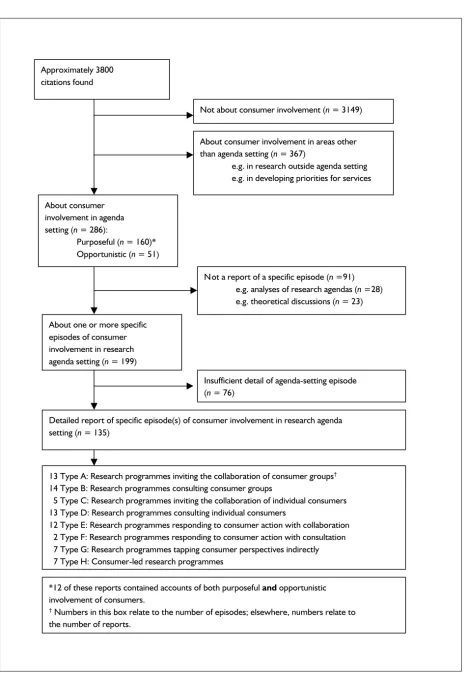
160 reported specific efforts to include consumers in identifying or prioritising research topics and a further 51 reported consumers identifying or prioritising research topics in the course of other work. We found detailed reports of 87 specific examples. These included:
● inviting consumer groups to collaborate in setting research agendas (13)
● consulting consumer groups (12)
● inviting individual consumers to collaborate in identifying and/or prioritising research topics (17)
● consulting individual consumers (13) ● responding to consumer action with a
collaboration (13)
● responding to consumer action by consulting with consumers (3)
x
● responding to consumer action by conducting research without consumer input (6)
● consumers independently identifying or prioritising research topics (10).
Most of this literature was descriptive reports by researchers who were key actors in involving consumers. A few reports were written by consumer participants. Fewer still were by independent researchers. Our conclusions are therefore not based on rigorous research, but implications for policy are drawn from individual reports and comparative analyses.
Conclusions
Research programmes have sufficient collective experience of involving consumers to plan their agendas working directly or indirectly with consumers. Appropriate methods depend upon the tasks to be undertaken, the consumers to be involved and the support required. Productive methods for involving consumers require appropriate skills, resources and time to develop and follow appropriate working practices. The more that consumers are involved in determining how this is to be done, the more research
programmes will learn from consumers and about how to work with them.
More success might be expected if research programmes embarking on collaborations approach well-networked consumers and provide them with information, resources and support to empower them in key roles for consulting their peers and prioritising topics. To be worthwhile, consultations should engage consumer groups directly and repeatedly in facilitated debate; when discussing health services research, more resources and time are required if consumers are drawn from groups whose main focus of interest is not health.
Barriers to consumer involvement include: poor representation of consumers; consumers’ unfamiliarity with research and research programmes’ unfamiliarity with consumers; negative attitudes and poor working relationships; difficulties in communication; and time
constraints. These barriers can largely be overcome with good leadership, purposeful
outreach to consumers, investing time and effort in good communication, training and support and thereby building good working relationships and building on experience.
Organised consumer groups capable of identifying research priorities need to find ways of
introducing their ideas into research programmes. They should be aware that consumers making efforts to (re)design structures and procedures have had greater influence over research agendas. Consumers are particularly well placed to reflect on their experience of research agenda setting in order to build the evidence about their priorities and methods for involving them.
Recommendations for research
The following areas are recommended for further research.
● Research to develop and evaluate different training methods, information and education and other support for consumers and those wishing to involve them.
● Research to address the barriers to consumers’ ideas influencing research agendas.
● It is suggested that research programmes embarking on working with consumers do so with a view to learning more about these processes using an ethos of reflexive research. At a minimum they should involve consumers in reflecting on and reporting the process and outcome. Whenever possible, they should involve consumers in considering the methods and implications of working together both in advance and with hindsight. There is also a place for independent researchers to work with research programmes and consumers to investigate and record working practices. Consumers should be involved in conducting and reporting this work.
● We suggest carrying out prospective
comparative studies of different methods for involving consumers.
● It is suggested that research about collective decision-making be further advanced by addressing the processes and outcomes of consensus development that involves consumers.
Background
Setting research agendas is a specific aspect of priority setting. Hence, this study focuses on the intersection of priority setting and consumer involvement in research and development. Since 1990, priority setting for services in the NHS has generally become more explicit and has more commonly involved consumers. Since 1991 this has also involved the newly established NHS research and development (R&D) strategy.
Priority setting in NHS research
Traditionally, setting priorities for healthcare has been implicit in the decisions made by clinicians for their patients. In the UK, more formal and explicit methods were called for with theintroduction of the internal market in 1991. This required purchasers of healthcare to act on behalf of the populations they served: taxpayers and patients. Justifying their decisions required developing explicit methods for priority setting.
Similarly, priorities for research were set in an uncoordinated fashion by academics and industry. The launch of the NHS R&D programme, also in 1991, provided a needs-led programme of commissioned research that counterbalanced the responsive programmes which relied primarily on researchers suggesting potential research projects to funders.1This was the beginning of a
“systematic approach to identifying and setting R&D priorities in which NHS staff and the usersof the Service are being asked to identify important issues which confront them and, in partnership with the research community, to characterise and prioritise these problems as the basis for seeking solutions”2[emphasis added]. This approach has evolved through a series of agenda-setting exercises by multidisciplinary advisory groups, some of which have involved consumers.
Consumer involvement in health
services research
The NHS R&D strategy is committed to involving consumers in the work it undertakes – not as ‘subjects’ of research, but as active participants. The Central Research and Development Committee (which advises the Director of R&D) set up a unique group to advise them on how best
to involve consumers in the R&D process. This group, which met for the first time in 1996, at the time of the study was called Consumers in NHS Research (it is now known as INVOLVE). It aims to ensure that consumer involvement in R&D in the NHS, public health and social care improves the way in which research is prioritised,
commissioned, undertaken and disseminated.
Consumers may be involved in research because the NHS is politically mandated to involve those most intimately affected (the users of health services) and those who provide the funds, either directly or through taxes or insurance. They may also be involved because their experience and insights can complement those of health
professionals and researchers, so that collectively these people can produce ‘better’ research. ‘Better’ research may be research that: has a higher methodological or ethical quality; produces findings which are more relevant to practical decisions made by consumers and those caring for them; is presented in more accessible and widely disseminated reports; or more appropriately influences policy and practice.
Consumer involvement in identifying and
prioritising research topics should be considered in the context of the increasing involvement of consumers in making decisions about their own personal healthcare and about the development and delivery of services. Pressure for this increasing involvement comes from individual patients and service users, their families and carers, and from organised groups of such people.3Between them, these individuals and groups challenge the professionally dominated social structure of healthcare. They challenge indirectly, by using and developing alternative services within the voluntary or commercial sectors, and directly, by calling for change in established/statutory services, during clinical encounters, through complaints procedures and by campaigning.
With policy support for consumer involvement in research, and guidelines prepared on the basis of the pooled experience of consumers, academics and NHS staff by the Consumers in NHS Research group,4there is increasing interest and activity in
this area. This was reflected in a special issue of 1
Chapter 1
the BMJin September 1999. The articles in this issue illustrated the extent of consumer
involvement in health. They included opinion articles about consumer involvement in health services, research articles about patient
involvement in shared decision-making in clinical settings and an interpretative review about participative research. However, there were no details about methods for involving consumers in identifying or prioritising research topics.
Research questions
This study aimed to review such literature as there is on consumer involvement in setting research agendas, to cover the health research field but also going beyond it. The review was required to record what methods have been attempted, for what purpose, how they have been evaluated and what can be learnt from their documentation and/or their evaluation.
Options for drawing on related literature beyond the immediate focus of the review included literature about: consumer involvement in evidence-based health decisions generally; consumer involvement in research apart from agenda setting; priority setting in health services; and research agenda setting in other sectors. The relevance and usefulness of each of these
literatures was considered before defining the scope of the review, as described below.
The literature is most advanced for consumer involvement in evidence-based decision-making for personal healthcare, where there are well-established methods for consumer involvement and its evaluation5and a growing collection of systematic reviews of impact.6Other appraised and synthesised literature addresses eliciting public preferences, but not involvement in service decisions;7consensus development for clinical guidelines, but not involvement of consumers;8 and priority setting for health services.9Despite their convenience, these publications were dismissed for being insufficiently relevant to consumer involvement in agenda setting which requires engagement with:
● organisational decision-making ● research methods
● gaps in knowledge, which is conceptually more challenging than engaging with gaps in services.
The literature about consumer involvement in research more broadly (i.e. not restricted to
research agenda setting) is extensive. It includes numerous reports of individual initiatives and traditional reviews, but no conveniently appraised and systematically synthesised summary or a widely agreed characterisation of the diverse methods for consumer involvement or their evaluation. This literature was therefore dismissed for being potentially overwhelming and in need of a systematic review independent of this project.
Ultimately, it was decided that the nature of research agenda setting set it apart from these other activities and their literature, that the act of prioritising gaps in knowledge, along with the technical nature of that knowledge, distinguished it from involvement in service provision decision-making and in other aspects of research.
There were therefore no restrictions applied in terms of the health sector, or other sectors, and the review’s scope was therefore broadened to encompass research agenda setting in other sectors in order to answer the research question:
● What are the advantages and disadvantages of
different methods of involving consumers in identifying and prioritising possible topics for R&D?
The objectives of the study were to: 1. look at the processes and outcomes of
research identification and prioritisation in both national and regional R&D
programmes in health and elsewhere, drawing on experiences of success and failure
2. identify the barriers to, and facilitators of, meaningful participation by consumers in research identification and prioritisation.
In order to address these research questions, we brought together a research team of nine people including two consumers. In addition to formal roles in consumer organisations, academia and public health, as authors of this report we brought direct experience as consumers and researchers involved in research agenda setting. We subscribe to the belief that research agendas should reflect the needs and values of the people who use and pay for health services, and that this is unlikely to be achieved without directly involving some of these people. Our experience of consumer involvement in research has introduced us to many challenges and a few successes, but it has not led us to conclude that particular methods are reliably beneficial whatever the context.
Introduction
T
his chapter proposes a framework forexamining consumer involvement in research. It provides definitions for key concepts to help further define the scope of this review. It identifies key distinguishing features of different methods of consumer involvement and structures these into a framework for describing and analysing reports of specific episodes of consumer involvement. It finishes by discussing the applicability of principles for minimising bias and maximising transparency to reviewing a body of literature that is largely descriptive or reflective rather than based on systematic research methods.
Definitions
Consumers
The Consumers in NHS Research group recommended the following definition of consumers of healthcare. Consumers include patients and potential patients; long-term users of services; carers and parents; organisations that represent consumers’ interests; members of the public who are the targets of health promotion programmes; and groups asking for research because they believe they have been exposed to potentially harmful circumstances, products or services.4In order to draw on other sectors (e.g. commercial and agricultural), we have extended this definition to include users and potential users of resources, including natural resources.
Research agenda setting
Research agenda setting includes both identifying and prioritising research topics. Although there are formal methods for both activities, reports of other activities such as collaborative service planning or environmental campaigning reveal examples of consumers identifying research topics in the course of those debates. For instance, gaps in evidence may be identified opportunistically when planning services, although they may not necessarily be captured in a useful way to inform a research agenda. We labelled this as opportunistic agenda setting, as opposed to purposeful agenda setting.
There is a similar distinction in prioritising research topics. Prioritising research topics may be purposeful in a formal agenda setting exercise, particularly for commissioned research
programmes. Alternatively, prioritisation may be an amalgamation of researchers’ priorities and the responses of peer referees and funding panels, as is more common where funders respond to unsolicited proposals from researchers (responsive programmes). Lastly, consumers may identify principles for prioritising topics, without necessarily being involved directly in
prioritisation. We have included all these activities in the scope of our review as they are all aspects of research agenda setting.
Consumer involvement
Consumers involved in research have traditionally been given the role of research ‘subject’. An alternative role requires more active involvement in guiding the research rather than merely providing data. In this review, our interest is in consumers providing their views in order to influence research. We have included reports of purposeful agenda setting where consumers have been actively involved, where they have consulted or where they have been involved indirectly through other activities (such as asking questions in Parliament or to helplines). We have also included reports of consumers being involved opportunistically in identifying research topics, such as women raising research issues in the course of campaigning for better maternity services.10We have not included most of the research literature where consumers are subjects and researchers conclude their analyses with recommendations for further work.
Characteristics of consumer
involvement in research agenda
setting
Describing reports of consumer involvement in research agenda setting coherently and
consistently was a challenge that we struggled to overcome throughout the duration of the study.
Consumers have been involved in many types of 3
Chapter 2
research through a diversity of methods. The names of particular activities appear to label them without providing a consistent system for
distinguishing them. For instance, the Cochrane Consumer Network emphasises (with the name of Cochrane) its central importance of contributing to systematic reviews, whereas the National Breast Cancer Coalition of member organisations is named according to the health condition in which they share an interest. In contrast, participative research initiatives11and community participation and development often employed in health promotion12,13are identified by their underlying philosophy rather than their specific interests. In seeking to identify the advantages and
disadvantages of different methods, we needed to set aside labels of specific examples commonly and conveniently used in discussions, and describe methods in terms that would distinguish examples in meaningful ways.
We sought distinguishing characteristics of different methods for involving consumers in research agenda setting from our own experience, current policy documents, abstracts of relevant literature, key methodological literature and related systematic reviews.
We chose as key features for our framework those characteristics which we assumed would influence the process and outcome of consumer
involvement: the consumers involved, who initiated the involvement, the degree of
involvement, the forum for exchanging ideas and the methods for decision-making. Each of these is considered below.
Consumers involved
The definition of consumers provided above is broad. Although there are clearly important differences between patients, carers and the broader public, for the purpose of reviewing methods for involving consumers, we recognise the most pertinent distinction being between people involved as individuals and people involved as members of organised consumer groups. Members of organised groups are not typical of the general public. In being a member of a group they have expressed an active interest and, potentially, they have access to a broader range of views than those formed by their own experience alone. Another overlapping distinction is between consumers who have volunteered their involvement (for instance, through their
membership of a group or by responding to an advertisement) and consumers who have been targeted for involvement (for instance, through
representative opinion polls). These distinctions are analogous to distinctions between health professionals who volunteer to represent their peers in consultations or formal reviews about professional practice and experience and those who have been targeted for their involvement. Similarly, there is a distinction between health professionals who express an active interest in research and those who do not despite current policy supporting research-based practice.
Proactive and reactive involvement
Consumer involvement can be an expression of consumer empowerment. This empowerment can be initiated in specific encounters between consumers and professional services by either party and this affects not only how involvement has developed, but also how this involvement is viewed by health professionals and by different sectors of society.14Where researchers or research programmes have taken the initiative, they may be embarking on an exercise in organisational change where theories about learning organisations highlight the importance of inclusion, reflection and managing diversity.15,16An alternative theoretical approach is participatory research, which probably requires the greatest changes in organisational structures and procedures and is claimed to maximise community and lay involvement.17The three primary features of participatory research include collaboration, mutual education and acting on the results developed from research questions that are relevant to the community. It therefore embraces more of the research to service pathway than merely research agenda setting.
Consumers taking the initiative was part of a broader collective social action, where campaigns and self-help groups emerged in response to health problems to engage in research under their own initiative. In these circumstances, self-help groups or other social service or political advocacy groups act as social movement organisations.3
Degree of involvement
The extent to which consumers can influence decisions rather than just be aware of them depends on their degree of involvement. Arnstein proposed a ‘ladder of participation’ with rungs on the ladder representing increasing degrees of participation, from non-participation or
manipulation and therapy, through the tokenism of informing, consulting and placating to citizen power through partnership, delegated power and citizen control.18She described contrasting A framework for examining consumer involvement in research
examples in America of frequent ‘attitude surveys’ in ghetto neighbourhoods where residents see their time being taken up for no benefit, and residents elsewhere being delegated and funded the power to prepare an entire ‘model cities’ plan. This ladder of participation has been contracted to three steps by Consumer in NHS Research: consultation, collaboration and consumer control.4 We anticipated finding examples of consultation, collaboration and consumer control in research agenda setting and adopted this terminology for our framework.
● Consultationwas defined as asking consumers for their views and using these views to inform decision-making. For example, funders of research have held one-off meetings with consumers to ask them about their priorities for research, or write to consumers in accessible terms to invite their views. Consumers’ views were not necessarily adopted, although they may inform decisions.
● Collaborationwas described as active, on-going partnership with consumers. For example, consumers have been committee members or collaborated less formally to complete a task. ● Consumer-controlled researchwas described as
consumers designing, undertaking and disseminating the results of a research project. ‘Professionals’ were only involved at the invitation of the consumers.
Consultation, collaboration or consumer control, defined as above throughout this report, have been used at different stages of the same projects.
Forum for exchanging ideas
However a working relationship has beeninitiated, and whatever the degree of involvement, there are also many options for the type of forum for exchanging ideas. The choice of forum will be determined by the type and range of tasks on which consumers and others are embarked. A recent review of public involvement in healthcare priority setting described how methods for engaging consumers in collaborations or consultations have been chosen for different purposes.9The authors distinguished qualitative methods such as one-to-one interviews, focus groups, Delphi technique and citizens’ juries, which elicit ideas, from quantitative methods such as ranking or rating, which set priorities.19
Methods for decision-making
These methods for engaging in a working relationship can vary further in the way in which decisions are made. Methods that supportcollective decision-making include those for eliciting values (such as voting, ranking, scoring, visual scales and Delphi surveys) and those for aggregating values. A systematic review of consensus development for clinical guidelines drew a number of conclusions which might be applicable to research agenda setting.8These conclusions related to selecting the participants, choosing and preparing background information, structuring the interaction and synthesising individual judgements. However, few of the studies specifically related to consumers.
Implementation
The final details of any methods are the practicalities of implementation. These can include planning, resources, coordination and training. We anticipated, for example, that dedicated resources or training materials would lead to greater consumer influence. How methods are implemented may facilitate or hinder
consumer involvement. For instance, attention to the facilitation of multidisciplinary groups, as advised by Consumers in NHS Research, is likely to affect the extent to which consumers are able to express their views and be heard.4
Context of consumer involvement in
research
As we became more familiar with the range of examples of consumer involvement in setting research agendas, we encountered more contextual issues, which we considered were likely influences of how methods developed and how appropriate or successful they appeared to be. We recognised contextual issues that were associated with the consumers and the researchers involved, particularly the organisational setting of the players (see Box 1). These included institutional settings (e.g. academic or commercial research or self-help or charitable voluntary sector
organisations), geographical settings (e.g. regional, national, international), and historical settings in relation to rights movements (e.g. with or without a legacy of consumer activism).
Theories underpinning consumer
involvement
Similarly, our understanding of the role of theory in investigating consumer involvement advanced as we became more familiar with the diversity of methods and circumstances of consumer
involvement. We recognised (see above) that different initiators of consumer involvement are
methods of working. For instance, forward-looking research programmes have employed an
organisational change approach to management whereas forward-looking consumers have employed collective social action. A diversity of theories relate to how consumers are involved (see
Box 2). For instance, a framework of
evidence-informed patient choice invokes attention to patients’ questions in order to identify research questions.5Alternatively, community development invokes recognising research topics in the course of working with communities in order to identify their own health needs and support them in taking action to address them.12,13On a broader scale still, bioethics brings ethical, social, legal and philosophical perspectives to public debates about health services and related research.20
Evaluating consumer involvement
Advantages and disadvantages
The main reasons for involving consumers are pragmatism, in the face of consumer demand or non-cooperation, political principle and the pursuit of ‘better’ research. The principles and practicalities of consumer involvement may be satisfied by the presence of consumers during the planning process, and the quality of their
involvement in those processes may be a measure of success. These can be considered as
intermediate benefits or, when success is not assured, intermediate harms and costs. The objective of better research has a range of more ambitious interpretations. ‘Better’ research could mean methodologically or ethically superior research, or research that is more likely to influence practice and improve health. Some of A framework for examining consumer involvement in research
6
The research programme:
● the research focus (e.g. topic focus and type of research)
● organisational setting of the research programme (e.g.
geographical scope and nature of funding body)
● experience and resources for consumer involvement.
The consumers:
● focus of interest (e.g. services, population, patients or
carers)
● function of group (e.g. campaigning, mutual support) ● organisational setting of the consumers
(e.g. geographical scope of group)
● experience and resources for involvement in research.
The interaction
● initiated by research programme or by consumers ● methods employed to involve consumers in identifying
or prioritising research topics
● tasks undertaken by consumers
● relationship between consumers involved and wider
consumer population.
BOX 1 Characteristics of players and methods for interaction – framework for selecting UK cases
● Bioethics (the study of the ethical, social, legal, philosophical and other related issues arising in healthcare and in the
biological sciences.20
● Collective social action (where people join forces with the aim of improving lives through campaigning and peer support).3 ● Community development is the process of involving a community in the identification and reinforcement of the aspects of
everyday life, culture and political activity that are conducive to health. This might include support for political action to modify the total environment and strengthen resources for healthy living, as well as reinforcing social networks and social support within a community and developing the material resources available to the community.12
● Consumerism (where the motivation for involving consumers is financial and consumers are seen as direct users of a
commercial product).75
● Empowerment in research changes conventional research relations from inequality between active, dominant researchers and passive, subordinate research subjects to more equal relations between the two, and increased inclusion and involvement; where service users play a greater part in identifying the topic for research and the benefits of research, designing and conducting the research, disseminating and acting on the research findings, and having more control over the funding and the research process.21
● Evidence-informed patient choice (where the interests of patients are framed in terms of evidence required to support
personal health decisions).5
● A learning organisation is one where people continually expand their capacity to achieve their objectives, where new and
expansive patterns of thinking are nurtured, and where people are continually learning how to learn together.16
● Managing diversity (where methods were adapted specifically to encourage input from populations who might otherwise
find existing structures and procedures too great a barrier).15,16
● Organisational change (where there was an intention within an organisation to develop new formal methods through
piloting and reflection).15,16
● Participatory research (where collaboration, education and action combined to enhance the relationship between
researcher and community, with direct benefit to the community as an outcome of the research and the community’s involvement being itself beneficial).17
this better research may be better because it better fits the needs of an important and arguably under-represented stakeholder group. These objectives can be considered as final benefits or, if not met, final harms and costs (such as lack of research, poorer research, opportunity costs and bad publicity).
The degree to which consumers influence research may be evident in the source of the original research topics, the potential benefits and subsequent spread and use of research findings, the background and accountability of the
researcher and the control of the research design, conduct and funding.21For instance, plans for a conventional survey by a researcher of disabled people using cash payments provided by the Independent Living Support Service was
challenged by the service users obtaining funding and directing a piece of research themselves, with the help of a professional researcher as a
consultant, thereby controlling the presentation of the findings and their use in future decisions about funding.22
Based on their collective experience of consumers, practitioners and researchers, Consumers in NHS Research attributed advantages and disadvantages to different degrees of involvement.4The
advantages of consultation were seen as obtaining consumer views quickly without being committed to act on them and being a ‘safe’ way to start working with consumers. Disadvantages were also recognised. Some consumers have found it frustrating to be asked their views without any commitment to act on them. Some consumer organisations have declined to become involved, arguing that it is a waste of their time if they are not seen as partners in the research process, particularly if their views had been ignored in the past. The advantages of collaboration were seen as increasing the likelihood that the outcome
measures, assessment criteria and evaluation would be relevant to consumer participants in research, access to consumers as research participants would be improved and consumers could help with recruitment and informed
consent, and with interpreting and understanding data. Following collaboration, consumers were likely to feel more ownership of research results and be more likely to actively disseminate them. The perceived disadvantages included the
additional time, costs and possible alienation. This approach involved an active commitment to collaborate, which meant that some control over the research was lost by the researchers. The perceived advantages of consumer-controlled
research included increased involvement of consumers who have often been marginalised, research likely to address questions that may not have been considered important to researchers and the development of research skills among consumers and the professionals with whom they worked. Commitment from consumer
organisations to disseminate the results of research and to influence change in practice was
considered more likely. This type of involvement requires researchers to hand over the ownership of a project to consumers. Some researchers have found this difficult or unacceptable.
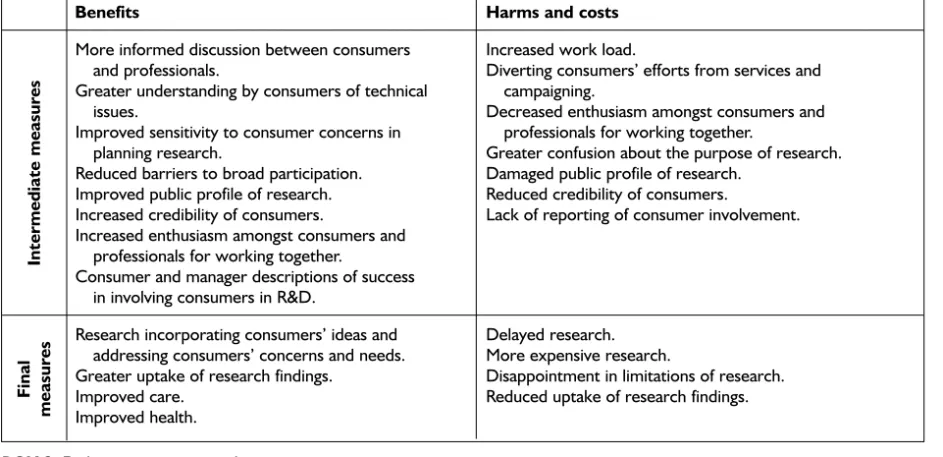
Box 3lists outcomes and processes that may be assessed in attempts to evaluate consumer involvement in setting research agendas. These include recording participants’ views on the process, demonstrating changes in the process and consumers’ consequent influence on the research, and subsequently on healthcare and health. The remit of this study is limited to investigating the processes of research agenda setting and consumer influence on the research agenda. The importance of a benefit or harm may be perceived differently by researchers and by consumers. For instance, greater uptake of research findings may be welcomed by a profession embracing evidence-informed practice, but not by consumers who are critical of the original research.
Advantages and disadvantages of methods may also be conceived not as measures of achievement, but as features that facilitate or hinder consumer involvement. For instance, good communication or skilled facilitators may benefit consumer involvement, whereas short timetables or technical language may hinder it.
Hence an advantage or disadvantage may be perceived as a facilitator of, or a barrier to, agenda setting or consumer involvement, a benefit, or cost resulting from agenda setting or consumer involvement, at an intermediate stage or as a final outcome, as seen by consumers or researchers.
A framework for analysis
Facing such a diversity of methods for consumer involvement, we needed an analytical framework for grouping similar episodes of consumer involvement, comparing similarities and
differences between them and identifying common conclusions. From the concepts described above,
● whether consumers were involved as individuals or as members of organised groups
● whether the involvement was at the invitation of the research programme or in response to consumer action (approach to engagement) ● the degree to which consumers were involved
(consultation, collaboration and user control).
This combined a simplified version of Arnstein’s ladder of involvement18as operationalised by Consumers in NHS Research4and Mullen and
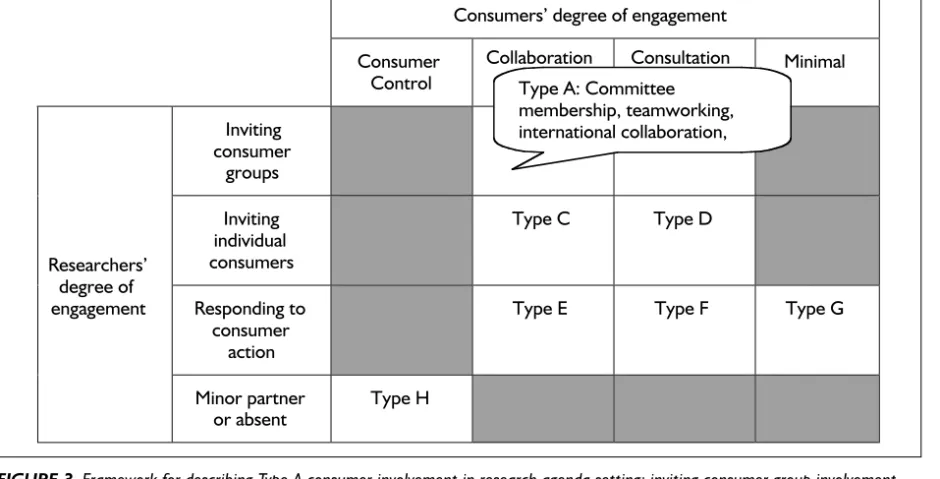
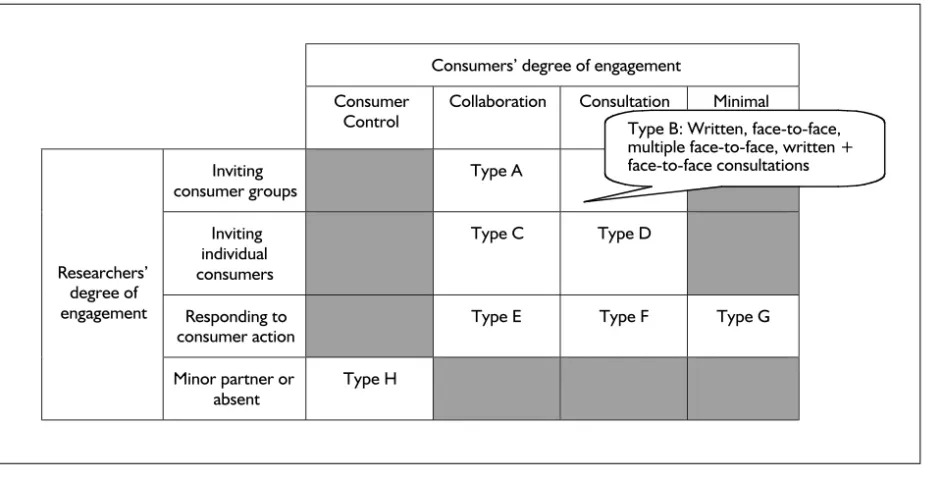
colleagues’ distinction between reactive and proactive consumer involvement14(see Figure 1).
The columns represent decreasing consumer involvement and the rows represent decreasing researcher commitment to consumer involvement. Examining the different possible combinations would allow us to describe the methods that were employed to support such an engagement in terms of who was involved, how and with what consequences (as discussed above). When this A framework for examining consumer involvement in research
8
Benefits Harms and costs
More informed discussion between consumers Increased work load.
and professionals. Diverting consumers’ efforts from services and Greater understanding by consumers of technical campaigning.
issues. Decreased enthusiasm amongst consumers and Improved sensitivity to consumer concerns in professionals for working together.
planning research. Greater confusion about the purpose of research. Reduced barriers to broad participation. Damaged public profile of research.
Improved public profile of research. Reduced credibility of consumers.
Increased credibility of consumers. Lack of reporting of consumer involvement. Increased enthusiasm amongst consumers and
professionals for working together.
Consumer and manager descriptions of success in involving consumers in R&D.
Research incorporating consumers’ ideas and Delayed research. addressing consumers’ concerns and needs. More expensive research.
Greater uptake of research findings. Disappointment in limitations of research. Improved care. Reduced uptake of research findings. Improved health.
BOX 3 Evaluating consumer involvement
Intermediate measures
Final
measures
Consumers’ degree of engagement Consumer
Control
Collaboration Consultation Minimal
Inviting consumer
groups
Type A Type B
Inviting individual consumers
Type C Type D
Responding to consumer
action
Type E Type F Type G Researchers'
degree of engagement
Minor partner or absent
[image:20.607.75.547.246.474.2]Type H
framework is illustrated as a table, some cells remain empty because they represent scenarios that are illogical or imply minimal engagement between the two groups. For instance, consumer-controlled action was unlikely to be initiated by research programmes (column 1, row 1), and research programmes cannot consult or collaborate with consumers if they are minor partners or absent (row 4, columns 2 and 3).
The details of methods applied within each type of approach to engagement were conceptualised as the operational methods of an episode of consumer involvement. Thus each type of engagement might have embraced one or more forums for discussion (e.g. committee
membership, written consultation, focus groups or public meetings) that may have employed formal or informal methods for building consensus or other decision-making. We therefore needed to consider included specific interactions between consumers and research programmes in terms of both the approach to engagement and the operational methods of involvement.
In addition to the above five dimensions describing each model of interaction:
● consumers involved ● direction of approach
● degree of consumer involvement ● forum for exchange
● methods for decision-making
we hypothesised that the context (in terms of the research focus and the historical, geographical or institutional setting) would also be significant, as would the selection or self-selection of participant consumers. Together these provide a set of key variables for describing the diverse episodes of consumer involvement in research agenda setting.
Methodology
Typical of a newly developing area, research about consumer involvement is scant. Enthusiasts initially report their reflective descriptions, and research programmes report consumer
involvement with little or no detail. Formal research, exploring or evaluating consumer involvement, is rare. In order to identify those methods that appear most advantageous, we applied the principles from systematic review methodology of maximising relevance, reliability and generalisability and minimising bias. We assumed, conventionally, that well-conducted research studies would be less biased and more reliable. In order to draw on other reports where necessary, we assumed that reports where
consumers shared authorship with researchers would be less biased, that reports originating in the UK would be more relevant and that findings supported by more reports or by reports
originating from both the UK and elsewhere would be more generalisable.
T
his study had two main parts:1. a systematic review of the empirical research literature about methods for consumer involvement in research agenda setting 2. a description of cases illustrating the range of
methods used for consumer involvement in research agenda setting in the UK.
Part 1: systematic review of the
literature
Searching
The full searching strategy is reported in
Appendix 1. A brief description follows here. We interrogated commercially available and
specialised bibliographic databases for references to literature at the intersections of ‘consumer’ involvement in decision-making, research and development and agenda setting. Database search strategies were developed by (i) using controlled and free-text terms and (ii) combining terms for consumer involvement with those describing research and development and agenda setting. Searches were made of commercially available bibliographic databases (MEDLINE, EMBASE, CINAHL, Social Science Citation Index and Applied Social Sciences Index and Abstracts) and specialised databases and registers [ERA, the EPPI Centre’s in-house database of consumer
involvement in research (http://eppi.ioe.ac.uk), and CAREDATA, from the National Institute of Social Work].
We handsearched conference reports and scanned web pages of R&D programmes. References of several reviews of consumer involvement were also searched for studies of possible relevance. Because details of consumer involvement in research agenda setting are often not reported, either in research papers or programme reports, we wrote to over 250 researchers and consumers. We identified them from NHS R&D programme reports and web pages, presentations about consumer involvement at conferences, records held by consumers and researchers working with them and references in reports and papers. We asked for information about potentially relevant episodes of consumer involvement and for other
contacts and related documents. Of these 250, 15 consumers and 57 researchers replied. All but one of these was from the UK.
Selecting reports for inclusion in the
review
A set of inclusion criteria (Box 4) was used to
identify studies to review in depth. A team of three researchers screened potentially relevant reports. In order to facilitate discussion of the inclusion criteria and their application, two researchers independently screened abstracts and titles found by searching bibliographic databases. Full copies of all relevant reports were retrieved. Where there was any doubt, researchers were over-inclusive and retrieved full reports. Once obtained, the full reports were screened by two researchers
independently. Any discrepancies were resolved by discussion.
Reports meeting the inclusion criteria for the review could be original descriptions or formal studies of episodes of consumer involvement. Literature reviews of consumer involvement were not selected for in-depth review. Instead, they were used to identify primary reports, and the findings of reviews were included in the discussion of the current review.
Review of reports’ content and quality
assessment
Each report was then examined to identify and describe specific episodes of consumer involvement in research agenda setting. Where episodes were described in more than one report, information on each episode was pooled from all the relevant reports. Each episode was then described using the following structured summary format:
● A description of the episode in terms of each of the aspects required for inclusion criterion number 4 listed in Box 4; characteristics of the
research programme concerned; the sort of consumers involved; the methods employed to involve consumers; the tasks consumers
undertook; the roles consumers undertook; and an indication of the time frame for involving consumers.
● The theories underpinning this interaction
where the characteristics of the aims, methods 11