Low Complexity Approximate Log-MAP Detection
for MIMO Systems.
Jos Akhtman and Lajos Hanzo
School of ECS., Univ. of Southampton, SO17 1BJ, UK.
Tel: +44-23-80-593 125, Fax: +44-23-80-593 045
Email: [email protected], http://www-mobile.ecs.soton.ac.uk
Abstract— In this paper we propose a novel low-complexity Log-MAP space-time detection method, which can be regarded as an advanced exten-sion of the Complex Sphere Decoder (CSD). We demonstrate that as op-posed to the previously published variants of the soft-output CSD, the pro-posed technique may be employed in the so-called “over-loaded” scenario, where the number of transmit antennas exceeds that of the receive anten-nas. The proposed method closely approaches the optimum performance of the Log-MAP detector even in heavily over-loaded scenarios, while the associated computational complexity is only moderately increased.
I. INTRODUCTION
Multi-Carrier (MC) modulation techniques [1, 2] have found their way into several wireless broadband communications stan-dards as well as into local area networks. Owing to their advan-tageous properties they also constitute strong contenders for the next-generation cellular mobile communications standards.
The relevant information-theoretical analysis predicts [3] that substantial capacity gains are achievable in wireless commu-nication systems employing a Multiple Input Multiple Output (MIMO) architecture using multiple antennas. Specifically, provided that the fading processes corresponding to different transmit-receive antenna pairs may be assumed to be indepen-dently Rayleigh distributed, the associated attainable capacity was shown to linearly increase with the smaller of the numbers of the transmit and receive antennas. Additionally, the employ-ment of a MIMO architecture allows for the efficient exploita-tion of the spatial diversity available in a wireless MIMO en-vironment, thus an improvement of the system’s transmission integrity, as well as a further increase in the system’s capacity becomes possible.
In [4] we have introduced a novel Optimized Hierarchy Re-duced Search Algorithm (OHRSA)-aided space-time processing method, which may be regarded as an advanced extension of the Complex Sphere Decoder (CSD) method, portrayed in [6]. The algorithm proposed in [4] extends the potential application range of the CSD methods of [5] and [6], as well as reduces the associated computational complexity. Moreover, the OHRSA-aided SDM detector proposed combines the near-optimum per-formance of the ML SDM detector with the low-complexity of the linear MMSE SDM detector, which renders it an attractive design alternative for practical systems.
It is widely recognized [1] that the BER associated with the
Acknowledgements: The work reported in this paper has formed part of the Wireless Enabling Techniques work area of the Core 3 Research Programme of the Virtual Centre of Excellence in Mobile and Personal Communications, Mobile VCE, www.mobilevce.com, whose funding support, including that of EPSRC, is gratefully acknowledged. Fully detailed technical reports on this research are available to Industrial Members of Mobile VCE.
process of communicating over a noisy fading MIMO channel can be dramatically reduced by means of employing channel coding. A particularly effective channel coding scheme is con-stituted bysoft-input soft-outputturbo codes [8]. Turbo coding, however, requiressoftinformation concerning the bit decisions at the output of the SDM detector, in other words thea posteri-orisoft information regarding the confidence of the bit-decision is required.
Consequently, in Section II we deduce the OHRSA-aided Log-MAP SDM detector, which allows for an efficient evalu-ation of the soft-bit informevalu-ation and therefore results in highly efficient turbo decoding. Unfortunately however, in compari-son to the OHRSA-aided ML SDM detector derived in [4] the OHRSA-aided Log-MAP SDM detector of Section II exhibits a substantially higher complexity. Consequently, in Section III we derive an approximate Log-MAP method, namely the SO-PHIE SDM detector. The SOSO-PHIE SDM detector combines the low complexity of the OHRSA-aided ML detector described in [4] with the near-optimum performance of the OHRSA-aided Log-MAP SDM detector of Sections II. Specifically, it exhibits a similar performance to that of the optimal Log-MAP detector, while imposing a modest complexity, which in the scenario of employing QPSK is only slightly higher than that required by the low-complexity MMSE SDM detector [1]. The computa-tional complexity as well as the achievable performance of the SOPHIE SDM detector of Section III are analysed and quanti-fied in Section IV. Finally, our conclusions are summarized in Section V.
II. OHRSA-AIDEDLOG-MAP SDM DETECTION
The subcarrier-related MIMO-OFDM system model consid-ered is given by [1]
y=Hs+w, (1)
wherey,wandsdenote thenr-dimensional received signal and AWGN sample vectors as well as the mt-dimensional trans-mitted signal vector, respectively. Furthermore,Hrepresents a (nr×mt)-dimensional matrix of subcarrier-related CTF coeffi-cients. Note that for the sake of brevity we omit the OFDM sub-carrier and symbol indiceskandn. where we omit the OFDM subcarrier and symbol indiceskandn, respectively.
legit-imate solutions. More explicitly, we have
ˆ
s= arg max ˇ
s∈MtP{ˇs|y,H}, (2)
whereMtis the set ofall possiblemt-dimensional candidate
symbol vectors of themt-antenna-based transmitted signal vec-tors. More specifically, we have
Mt =ˇs= (ˇ∫
∞,· · · ,ˇ∫t)T; ˇ∫∈ M
. (3)
Furthermore, it was shown in [1]that we have
P{ˇs|y,H}=Aexp
− 1
σw2
y−Hˇs2, (4)
whereAis a constant, which is independent of any of the values
{ˇsi}i=1,···,mt. Thus, it may be shown [1] that the probability
maximization problem of Equation (2) is equivalent to the cor-responding Euclidean distance minimization problem. Specifi-cally, we have
ˆ
s= arg min ˇ
s∈Mty−Hˇs
2. (5)
In our previous work [4] we have demonstrated that the ML so-lution of Equation (5) of a noisy linear problem described by Equation (1) is given by
ˆs= arg min
ˇs∈MtU(ˇs−ˆx)
2, (6)
where the transmitted symbolsssatisfy the condition of|s|2= 1 andUis an upper-triangular matrix having positive real-valued elements on the main diagonal and satisfying
UHU= (HHH+σ2
wI), (7)
while
ˆ
x= (HHH+σ2
wI)−1HHy (8)
is the unconstrained MMSE estimate of the transmitted signal vectors.
Consequently, we define a new objective functionJ(ˇs)as fol-lows [4]
J(ˇs) =U(ˇs−ˆx)2
=
mt
i=1
mt
j=i
uij(ˇsj−xˆj)
2 =
mt
i=1
φi(ˇsi), (9)
whereφi(ˇsi)are a positive real-valued sub-cost function.
Furthermore, let Ji(ˇsi) be a Cumulative Sub-Cost (CSC)
function recursively defined as
Jmt(ˇsmt) =φmt(ˇsmt) =|umtmt(ˇsmt−xˆmt)|2 (10a)
Ji(ˇsi) =Ji+1(ˇsi+1) +φi(ˇsi), i=mt−1,· · · ,1, (10b)
where we define the candidate subvector asˇsi= [ˇsi,· · ·,ˇsmt].
To elaborate a little further, the derivation of an expression for the evaluation of the soft-bit information associated with the bit
estimates of the SDM detector’s output characterized by Equa-tion (2) is given in [1]. Here, we present a brief summary of the results deduced in [1].
The soft-bit value associated with themth bit of the QAM symbol transmitted from theith transmit antenna element is de-termined by the log-likelihood function defined in [10] as
Lim= log
ˇ
s∈M∞;t
P{y|ˇs,H}
ˇ
s∈M;t
P{y|ˇs,H}
, (11)
where we define
M;t
=
ˇ
s= (ˇ∫∞,· · ·,ˇ∫t)T; ˇ∫|∈ Mfor j= i, ˇsi∈ M
(12)
and M denotes the specific subset of the entire set M of modulation constellation points, which comprises the bit value b={0,1}at themth bit position.
However, the direct calculation of the accumulatea posteriori conditional probabilities in the nominator and denominator of Equation (11) may have an excessive complexity in practice. Fortunately, as advocated in [1], the expression in Equation (11) can be closely approximated as follows
Lim≈log
Py|ˇs1im,H
P{y|ˇs0im,H}, (13)
where we define ˇ sb
im= arg max
ˇ
s∈M;t
P{y|ˇs,H}, b= 0,1. (14)
As suggested by the nature of Equation (13), the detection pro-cess employing the objective function determined by Equations (13) and (14) is usually referred to as the Logarithmic Maximum A Posteriori(Log-MAP) probability detector.
A practical version of the Log-MAP detector may be derived as follows. Substituting Equation (4) into (11) yields
Lim= log
ˇ
s∈M∞;t
exp
− 1
σ2wy−Hˇs
2
ˇs∈M;t
exp
− 1
σw2y−Hˇs
2. (15)
Note that Equation (15) involves two summations over2bmt−1
exponential functions. This operation may potentially impose an excessive computational complexity for large values ofmt and/or b. However, as demonstrated in [1], the expression in (15) may be closely approximated by a substantially simpler ex-pression, namely by
Lim≈
1 σw2
y−Hˇs0
im2− y−Hˇs1im2
, (16)
where we have ˇsb
im= arg min
ˇ
s∈M;t
y−Hˇs2, b=0,1, (17)
and again, M;t
denotes the specific subset of the entire set
Mtof signal vector candidates associated with the modulation
A. Bitwise approach
As it was demonstrated in [7], the complex-valued system model of Equation (1) may be substituted by the correspond-ing real-valued bitwise system model, which may be expressed as follows
˜
y= ˜Ht+w.˜ (18)
Additionally, in [4] we have shown that solving the detection problem of Equation (2) is equivalent to solving the following bitwise minimization problem
ˆ
t= arg max ˇ
t∈{−1,1}rP
ˇ t|y,˜ H˜
= arg min ˇ
t∈{−1,1}r
˜
y−H˜ˇt2, (19)
whererdenotes the number of columns of the real-valued bit-wise channel matrix H, which is equal to the product of the˜ number of receive antennasmtand the number of bits per QAM symbolb.
Consequently, the Log-MAP detector defined by Equations (16) and (17) may be applied for obtaining the soft-bit informa-tion associated with the bitwise OHRSA ML SDM detector of Equation (19). Substituting the bitwise system model of Equa-tion (18) into (16) and (17) yields
Li≈
1 σ2w
y−Hˇt˜ 0
i;min2− y−Hˇt˜ 1i;min2
, (20)
where we have ˇtm
i;min = arg min
ˇt∈D;∇y−
˜
Hˇt2, b=0,1 (21)
and D;∇ denotes the subset of the entire set D∇ of (r =
mtlog2M)-dimensional bitwise vectors, which comprise the binary valueˇti=dm={−1,1}at theith bit position.
Furthermore, substituting the bitwise objective function of Equation (16) into (20) yields
Li≈
1 σw2
J(ˇt0i;min) +φ−J(ˇt1i;min)−φ
= 1 σw2
J(ˇt0i;min)−J(ˇt1i;min)
, (22)
where ˇtm
i;min and the corresponding cost function value J(ˇtm
i;min)may be obtained by applying the constrained OHRSA-aided ML detection method derived in [4].
Consequently, the evaluation of the bitwise Log-MAP esti-mates of the transmitted bitwise signal vectortinvolves repeti-tive evaluation of2rconstrained ML estimatesˇtm
i;minalong with the associated2rvalues of the objective functionJ(ˇtm
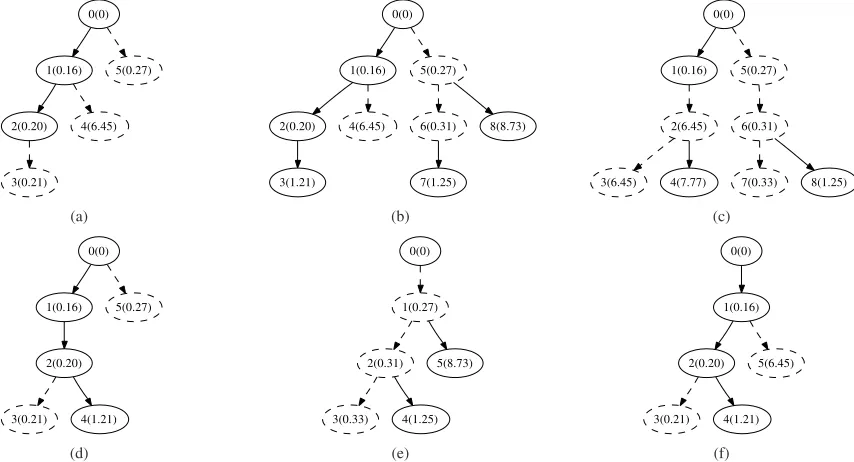
i;min). The operation of the OHRSA-aided Log-MAP detector in the scenario of using BPSK and employingmt = nr = 3 trans-mit and receive antennas is illustrated in Figure 1. Specifically, the repetitive search process generates 2·3 = 6 search trees associated with obtaining the ML estimates of the bitwise sig-nal vectortconstrained by bit-component valueˇti =dm, i =
1,2,3, dm=−1,1. The resultantsixsearch trees obtained by
applying the OHRSA-Log-MAP detection method are depicted in Figures 1 (a–f).
Clearly, the repetitive nature of the OHRSA-Log-MAP search process exemplified by Figure 1 imposes a substantial increase in the associated computational complexity. Hence, in the next section we derive an OHRSA-aided approximate Log-MAP method, which is capable of approaching the optimum Log-MAP performance, while avoiding the repetitive evaluation and therefore imposes considerably reduced complexity require-ments.
III. SOFT-OUTPUTOPTIMIZEDHIERARCHY-AIDED
APPROXIMATELOG-MAP SDM DETECTION
As we may conclude from a closer analysis of the search-tree diagrams depicted in Figures 1 (a–f), a substantial amount of information concerning the reliability of possible values of the transmitted bit-representationstiof themt-antenna-based
sym-bols becomes available in the process of determining the ML estimateˆt of Equation (19). Consequently, it is beneficial to exploit this information and hence to avoid the extra complex-ity imposed by the repetitive search involved in the Log-MAP method derived in Section II. In order to derive an appropriate soft-output RSA we make the following proposition.
Proposition 1: Lety,H˜ andtbe the quantities involved in the system model of Equation (19), namely the received signal vector, the bitwise channel matrix and the transmitted bit-based signal vector, respectively. Furthermore, let Ji(ˇti)be a CSC
function defined by Equation (10). Then thea posteriori proba-bility associated with the candidate valueˇti={−1,1}of theith
component of the bit-based signal vectorˇtmay be approximated as
P
ˇ
ti|y,H˜ ≈Ai
ˇti+1∈D∇−
exp− 1
σ2w
Ji([ˇti,ˇtTi+1]T), (23)
where Ai is a scalar independent of any of the values of
{tˇi}i=1,···,r.
Note 1. A particularly interesting implication of the proposi-tion outlined above is that thea posterioriprobability associated with the given value of the bitti may be approximately
deter-mined, regardless of the values of the bits situated in the hier-archy of the tree-diagrams depicted in Figures 1 (a–f) at levels lower than leveli. In other words, the approximate a posteriori probability valueP
ˇ
ti|H,˜ y may be evaluated independently
of any of the values{tˇj}j=1,···,i−1.
Note 2. Another important implication of Proposition 1, which may be directly inferred from Note 1, is that given the appropri-ate sorting of the bitwise channel matrixH, the process of SDM˜ detection may be reduced to detecting the transmitted symbol componentsti,· · ·, tmt associated with thegoodchannel
0(0)
1(0.16) 5(0.27)
2(0.20) 4(6.45)
3(0.21)
(a)
0(0)
1(0.16) 5(0.27)
2(0.20) 4(6.45)
3(1.21)
6(0.31) 8(8.73)
7(1.25)
(b)
0(0)
1(0.16) 5(0.27)
2(6.45)
3(6.45) 4(7.77)
6(0.31)
7(0.33) 8(1.25)
(c)
0(0)
1(0.16) 5(0.27)
2(0.20)
3(0.21) 4(1.21)
(d)
0(0)
1(0.27)
2(0.31) 5(8.73)
3(0.33) 4(1.25)
(e)
0(0)
1(0.16)
2(0.20) 5(6.45)
3(0.21) 4(1.21)
[image:4.595.100.527.43.274.2](f)
Fig. 1. Example of search trees formed by the OHRSA-Log-MAP SDM detector in the scenario of a system employing BPSK modulation,mt=nr= 3transmit and receive antennas and encountering average SNRs of 10dB. The labels indicate the order of visitation, as well as the corresponding valueJi(ˇti)of the CSC function, as seen in the brackets.
thelow-powerusers without attempting to actually detect their signals.
The major justification of the validity of Proposition 1 accrues from the high efficiency of the detection method derived.
Let us now define the(r×2)-dimensional Bitwise Cumulate Cost (BWCC) function matrixJˆhaving elements as follows
ˆ
Jim=−JacLog({−Ji(dm,ˇtTi+1)}ˇti+1∈Dt−) (24)
fori= 1,· · · , r, m= 0,1, whereJacLog(·)denotes the
Jaco-bian logarithm function defined as
JacLog(a, b,· · ·, c) = log(ea+eb+· · ·+ec). (25)
When using the BWCC function of Equation (24), the a pos-terioriprobability function of Equation (23) may be expressed as
P
ˇ
ti=dm|y,H˜ =Aiexp
− 1
σw2
ˆ
Jim([dm,ˇtTi+1]T)
(26)
fori= 1,· · ·, r, m= 0,1.
A simple expression deduced for the evaluation of the soft-bit information vector derived in Section II is generated by substi-tuting the conditional probability function of Equation (26) into (13), which yields
Li= log
P
ˇ
ti=d0|y,H˜
P
ˇ
ti=d1|y,H˜
(27)
= 1 σ2w
ˆ Ji0−Jˆi1
, i= 1,· · ·, r. (28)
Observe that the constant scalar Ai of Equation (23) appears
both in the nominator and denominator of Equation (27) and
therefore may be discarded. Equation (28) may be also ex-pressed in a vectorial form as
L= 1 σw2
(ˆJ)0−(ˆJ)1, (29)
where, as before,(ˆJ)mdenotes themth column of the matrixJˆ having elements defined by Equation (24).
Finally, by supplementing Equations (24) and (29) into the OHRSA-Log-MAP method of Section II, we arrive at an ap-proximateOHRSA-Log-MAP SDM detector, which avoids the repetitive search required by the OHRSA-Log-MAP SDM de-tector.
The search tree diagram generated by applying the approxi-mateOHRSA-Log-MAP SDM detector described above in the scenario of using BPSK and employingmt = nr = 3 trans-mit and receive antennas is depicted in Figure 2(a). A close analysis of the search tree-diagram of Figure 2(a) reveals that the information collected by the search process of the modified OHRSA-ML method may be insufficient for the reliable eval-uation of the soft-bit information associated with some of the bits of the transmitted bitwise signal vectort. Consequently, a certain performance degradation may be expected. In order to mitigate this undesirable effect, we introduce the additional pa-rameterρ, which we refer to as thesearch radius factor. More specifically, the parameterρallows us to control the rate of con-vergence for the OHRSA-ML search process derived in [4] and affects the cut-off value of a CSC function, which limits the passage of the recursive search process throughlow likelihood search branches having the CSC function valueJi(ˇti)in excess
0(0)
1(0.16) 6(0.27)
2(0.20) 5(6.45)
3(0.21) 4(1.21)
(a)
0(0)
1(0.16) 6(0.27)
2(0.20) 5(6.45)
3(0.21) 4(1.21)
7(0.31) 8(8.73)
(b)
0(0)
1(0.16) 6(0.27)
2(0.20) 5(6.45)
3(0.21) 4(1.21)
7(0.31) 10(8.73)
8(0.33) 9(1.25)
(c)
Fig. 2. Example of the search trees formed by the modified OHRSA-ML SDM detector of Algorithm 22using different values of the parameterρ, namely, (a)
ρ= 1.0, (b)1.3and (c)2.0. We consider a system employing BPSK modulation,mt =nr = 3transmit and receive antennas and encountering an average SNR of 10dB. The labels indicate the order of evaluation, as well as the corresponding valueJi(ˇsi)of the CSC function, as seen in the brackets.
Observe that the higher the value ofρ, the slower the conver-gence of the search process is. The suitable value of the global search radius factor ρmay be found empirically and its exact value within a sensible range has in fact little effect on the attain-able performance and the associated complexity of the proposed algorithm. More specifically, we have found that the range of values spanning the interval1.2 < ρ < 1.7 is appropriate and a meritorious value for the majority of system configurations is ρ= 1.3.
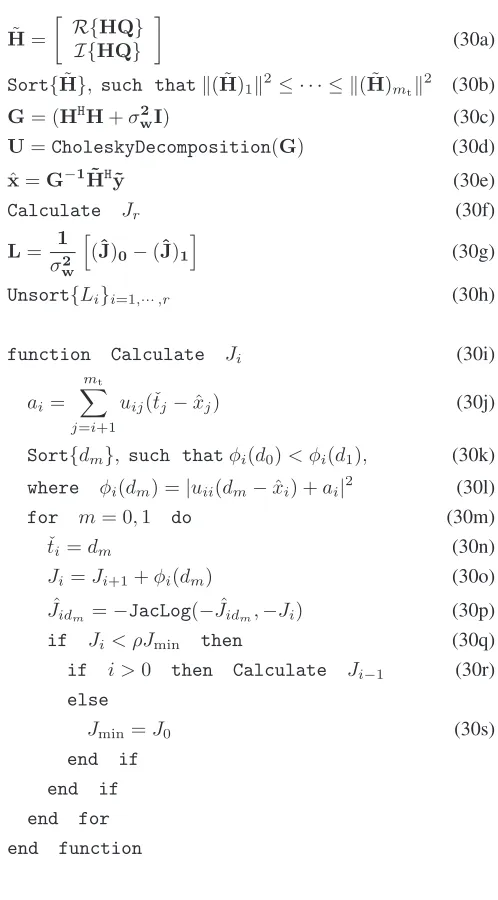
The resultant OHRSA-aided approximate Log-MAP SDM detector, which we refer to as the Soft-output OPtimized HI-Erarchy (SOPHIE) SDM detector is summarized in Algorithm 1.
IV. PERFORMANCEANALYSIS
TABLE I SYSTEM PARAMETERS.
Parameter OFDM MC-CDMA
Channel bandwidth 800 kHz Number of carriersK 128 Symbol durationT 160µs Max. delay spreadτmax 40µs
Channel interleaver WCDMA [9] – 248 bit
Modulation QPSK
Spreading scheme – WH
FEC Turbo code [8] , rate 1/2 component codes RSC, K=3(7,5) code interleaver WCDMA (124 bit)
Our simulations were performed in the base-band frequency domain. The OFDM system considered utilises 128 QAM-modulated orthogonal subcarriers. For forward error correction (FEC) we use1
2-rate turbo coding [8] employing two constraint-lengthK = 3Recursive Systematic Convolutional (RSC) com-ponent codes and the standard124-bit WCDMA UMTS turbo code interleaver of [9]. The octally represented RCS genera-tor polynomials of (7,5) were used. We assume a 9-tap CIR Rayleigh-fading multipath channel and stipulate the assump-tion of perfect channel knowledge, where the knowledge of the frequency-domain subcarrier-related coefficientsH[n, k]is
Algorithm 1SOPHIE Approximate Log-MAP SDM Detector
˜ H=
R{HQ} I{HQ}
(30a)
Sort{H˜}, such that( ˜H)12≤ · · · ≤ ( ˜H)mt2 (30b)
G= (HHH+σ2
wI) (30c)
U=CholeskyDecomposition(G) (30d)
ˆ
x=G−1H˜H˜y (30e)
Calculate Jr (30f)
L= 1 σw2
(ˆJ)0−(ˆJ)1 (30g)
Unsort{Li}i=1,···,r (30h)
function Calculate Ji (30i)
ai= mt
j=i+1
uij(ˇtj−xˆj) (30j)
Sort{dm}, such thatφi(d0)< φi(d1), (30k)
where φi(dm) =|uii(dm−xˆi) +ai|2 (30l)
for m= 0,1 do (30m)
ˇ
ti=dm (30n)
Ji=Ji+1+φi(dm) (30o)
ˆ
Jidm =−JacLog(−Jˆidm,−Ji) (30p)
if Ji< ρJmin then (30q)
if i >0 then Calculate Ji−1 (30r)
else
Jmin=J0 (30s)
end if
end if
end for
end function
[image:5.595.66.532.42.157.2]deemed to be available in the receiver.
[image:5.595.312.561.232.682.2]10-6 10-5 10-4 10-3 10-2 10-1 100
-5 0 5 10 15
BER
Eb/N0 [dB]
sdm-cmp-sophie-mmse-cmplx ber : 23-Jan-2006
OHRSA SIC MMSE mt=6
16QAM nr=4
QPSK nr=4
[image:6.595.43.279.42.244.2]QPSK nr=6
Fig. 3. Bit Error Rateexhibited by the rate-12turbo-codedSDM-OFDM sys-tem employing theSOPHIESDM detector of Algorithm 1. The abscissa represents the averageEb/N0. The OFDM system parameters are summa-rized in Table I.
102 103 104 105 106 107 108 109 1010
-5 0 5 10 15
Complexity per QAM symbol
Eb/N0 [dB]
sdm-cmp-sophie-mmse-cmplx cmplx : 23-Jan-2006
OHRSA ML MMSE mt=6
16QAM nr=4
QPSK nr=4 QPSK nr=6
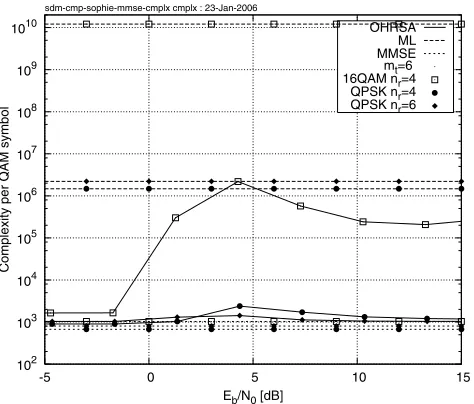
Fig. 4. Computational complexity, quantified in terms of the total number of additions and multiplications, exhibited by the rate-1
2turbo-coded SDM-OFDMsystem employing theSOPHIESDM detector of Algorithm 1. The abscissa represents the averageEb/N0. The OFDM system parameters are summarized in Table I.
the MIMO-OFDM system employing the SOPHIE detector pro-posed, as well as that of a number of other popular detection methods, such as the MMSE and SIC detectors. We can see that as opposed to the MMSE and SIC detectors, the proposed SOPHIE detector performs equally well both in fully-loaded as well as in overloaded scenarios, where the number of transmit antennas exceeds that of the receive antennas and thus we have mt> nr. Furthermore, the SOPHIE method exhibits an equally good performance, when employed in the overloaded 16-QAM-modulated MIMO-OFDM system.
On the other hand, Figure 4 illustrates the corresponding com-putational complexity quantified in terms of the total number of real addition and multiplication operations per detected QAM
symbol. Observe that the complexity exhibited by the SOPHIE method in the QPSK scenario is only slightly higher than that exhibited by the MMSE detector. Moreover, the complexity exhibited by the SOPHIE detector in the overloaded 16-QAM scenario is almost five orders of magnitude lower than that ex-hibited by the exhaustive ML detector, while their BER perfor-mance is expected to be similar. We note however that the BER performance of the ML detector is not shown since it would im-pose a more than104-times higher complexity.
V. CONCLUSION
In this paper we proposed a so-called SOPHIE SDM detection method, which may be regarded as an advanced extension of the CSD method. We have shown that the SOPHIE SDM detector proposed closely approaches the optimum performance of the Log-MAP detector while imposing a dramatically lower compu-tational complexity. In particular in the scenario of employing QPSK the complexity associated with both SOPHIE and soft-output linear MMSE detectors may be shown to be nearly sim-ilar. Moreover, the method is readily applicable to OFDM sys-tems employing high-throughput modulation schemes, such as M-QAM. Particularly, in the (M≥16)-QAM single-antenna sce-nario the SOPHIE detector imposessubstantially lower com-plexity than its soft-output MMSE counterpart, which renders it an attractive solution even in the conventional SISO communi-cation systems.
Additionally, the SOPHIE detector may be employed in the over-loaded scenario, where the number of transmit antenna el-ements exceeds that of the receive antenna elel-ements, while the associated computational complexity increases only moderately even in heavily overloaded scenarios and is almost independent of the number of receive antennas. The method proposed main-tains the near-optimal performance of the Log-MAP SDM de-tector even in the heavily over-loaded scenarios.
REFERENCES
[1] L. Hanzo, M. M¨unster, B. J. Choi, and T. Keller. OFDM and MC-CDMA for Broadband Multi-User Communications, WLANs and Broadcasting. John Wiley and IEEE Press, 2003. 992 pages.
[2] L. Hanzo, L-L. Yang, E-L. Kuan, and K. Yen. Single- and Multi-Carrier DS-CDMA. John Wiley and IEEE Press, 2003. 1080 pages.
[3] A. Goldsmith, S. A. Jafar, N. Jindal, and S. Vishwanath. Capacity limits of MIMO channels.IEEE Journal on Selected Areas in Communications, 21(5):684–702, June 2003.
[4] J. Akhtman and L. Hanzo. Reduced-complexity maximum-likelihood de-tection in multiple-antenna-aided multicarrier systems. InProceedings of the 5th Int’l Workshop on Multi-Carrier Spread Spectrum, Oberpfaffen-hofen, Germany, 14-16 September 2005. to appear
[5] B. M. Hochwald and S. ten Brink. Achieving near-capacity on a multiple-antenna channel.IEEE Transactions on Communications, 51(3):389–399, March 2003.
[6] D. Pham, K. R. Pattipati, P. K. Willet, and J. Luo. An improved complex sphere decoder for V-BLAST Systems. IEEE Signal Processing Letters, 11(9):748–751, September 2004.
[7] T. Cui and C. Tellambura. An efficient generalized sphere decoder for rank-deficient mimo systems. IEEE Communications Letters, 9(5):423– 425, 2005.
[8] L. Hanzo, T. H. Liew, and B. L. Yeap.Turbo Coding, Turbo Equalisation and Space-Time Coding. John Wiley and IEEE Press, Chichester, UK; Piscataway, NJ, USA, 2002. 766 pages. (For detailed contents, please refer to http://www-mobile.ecs.soton.ac.uk.).
[9] H. Holma and A. Toskala, editors.WCDMA for UMTS : Radio Access for Third Generation Mobile Communications. John Wiley and Sons, Ltd., 2000.
[image:6.595.42.279.303.505.2]